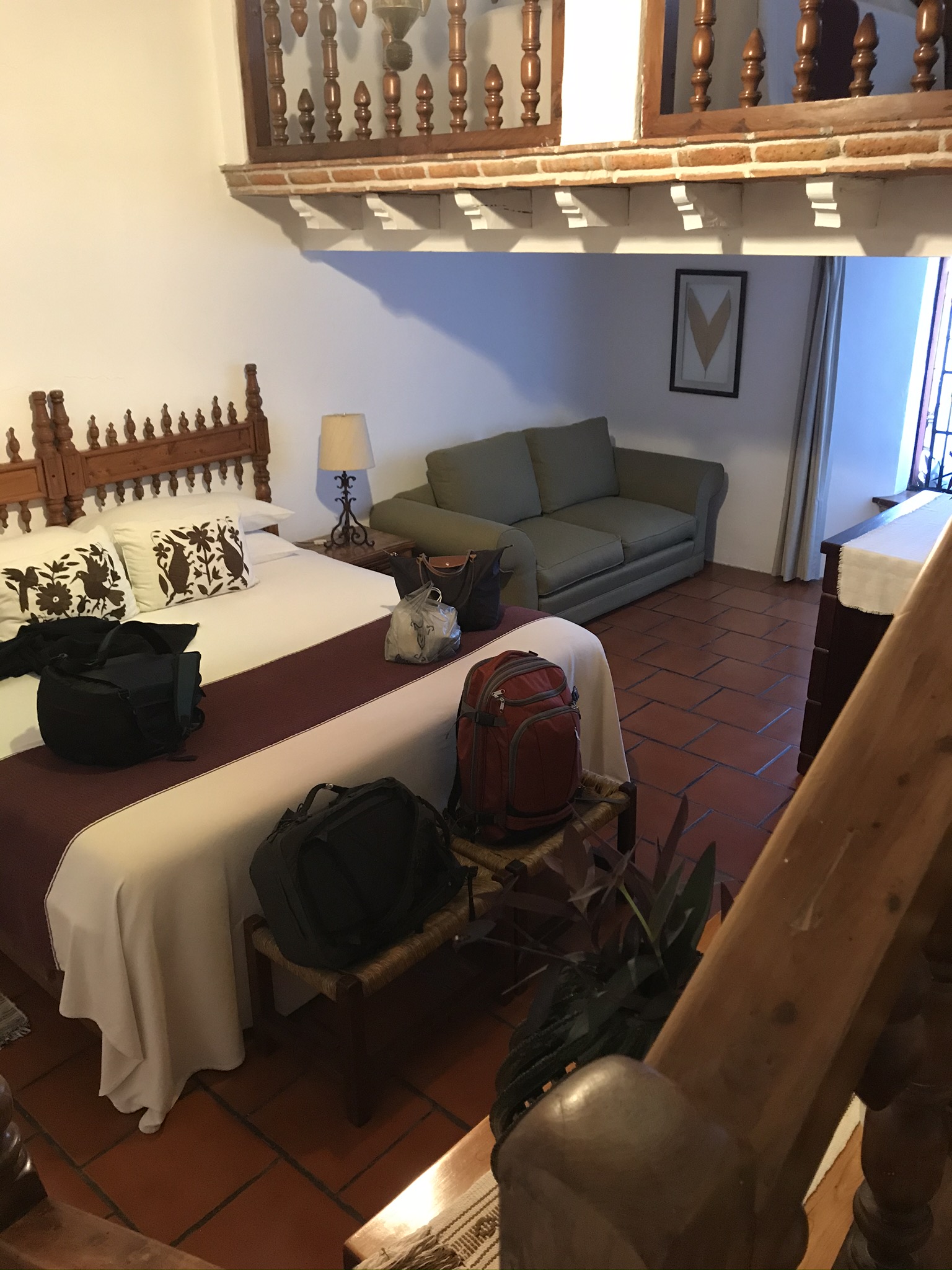
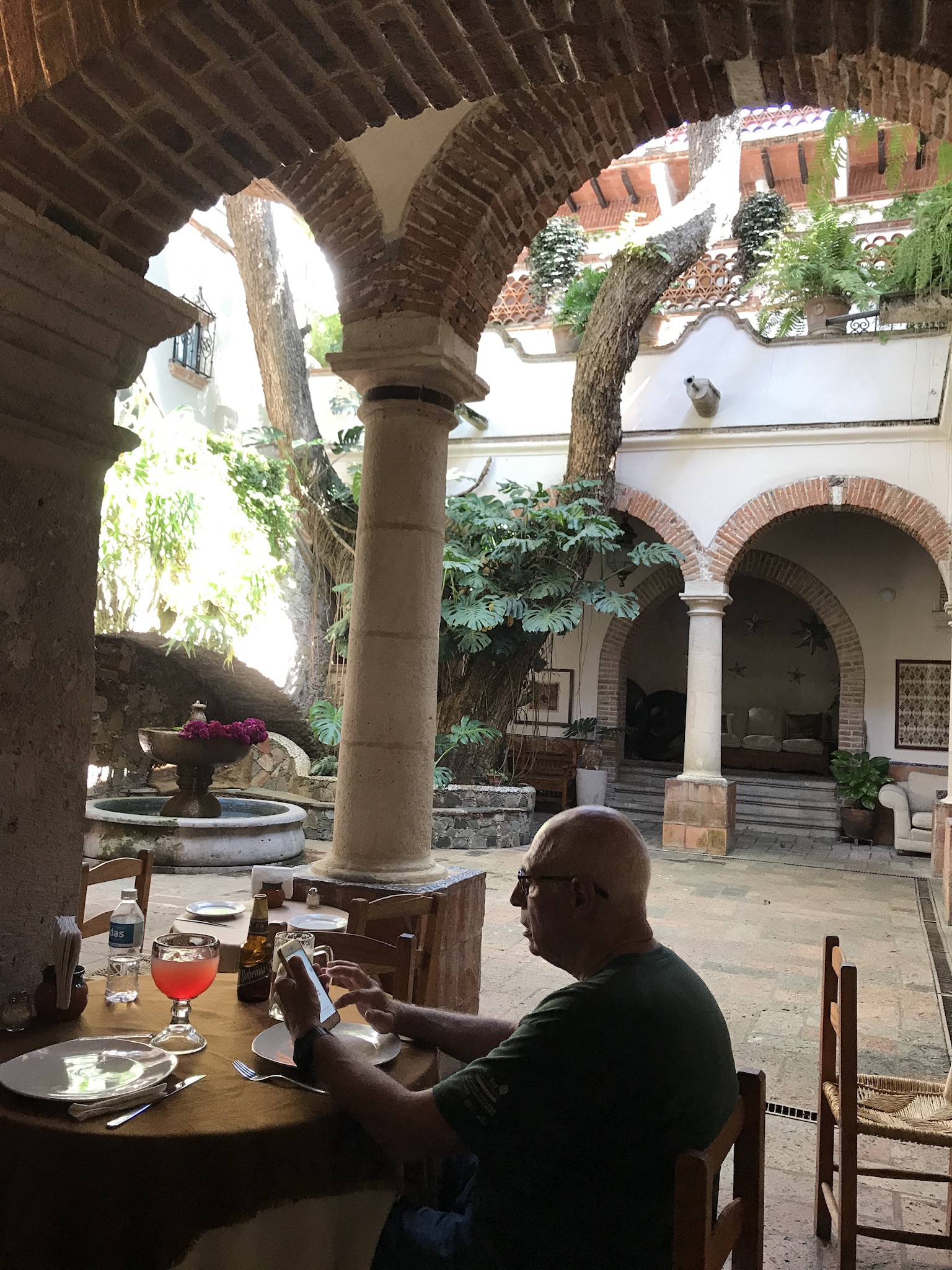
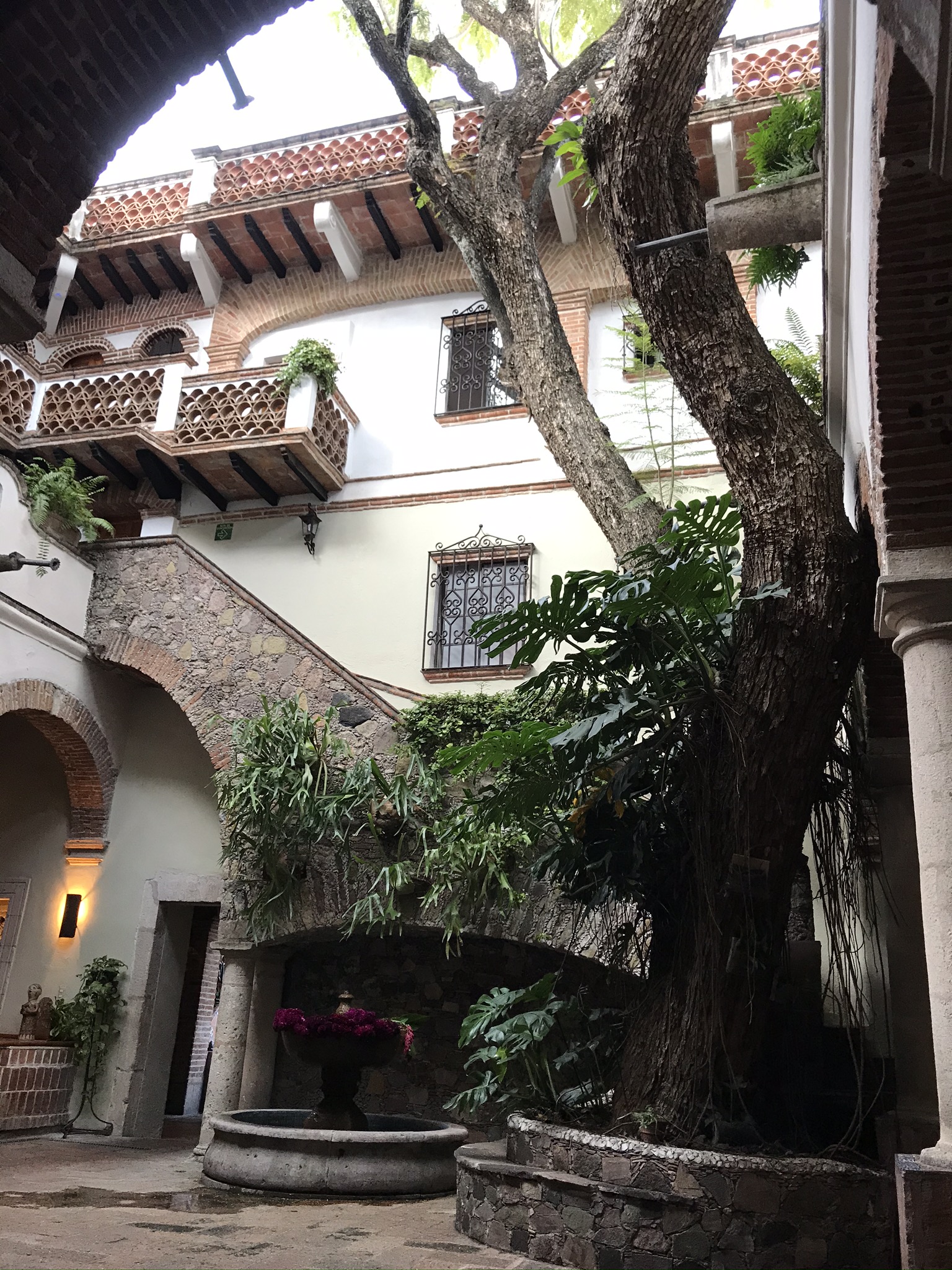
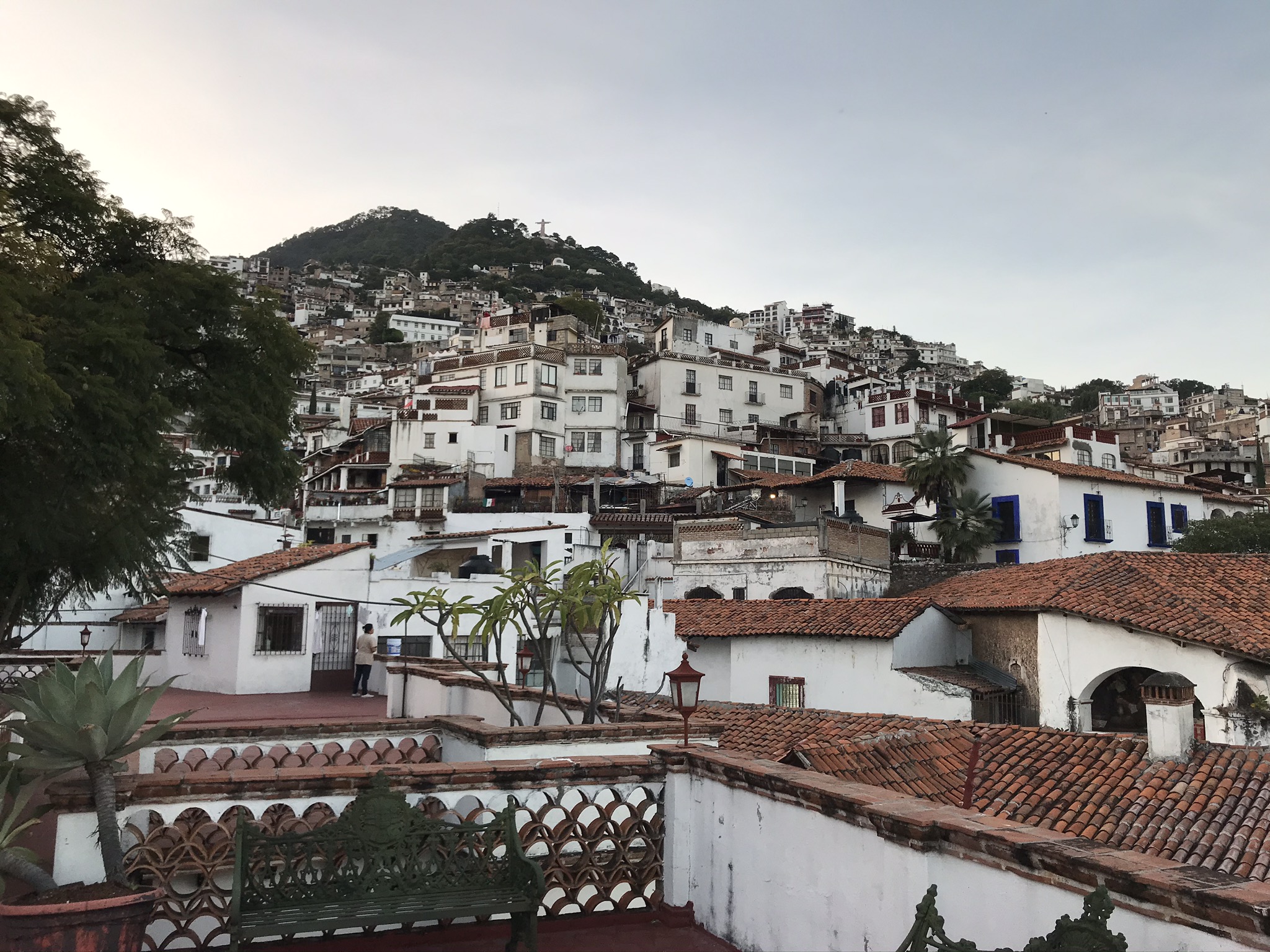
I’m not sure how I selected this place but it turned out to be perfect. While there is no quiet spot in Taxco on a weekend, the location, just around the corner and down the hill a bit from the zocalo, was ideal. The room was large and comfortable and the central patio peaceful and picturesque. On the roof is a large terrace with gorgeous views of the town, which stretches way up the mountain and down into a valley. Walking this town requires stamina (it’s at around 6,000’), good shoes, and strong thighs and knees. We loved it.
Bufy (pronounced boo-fee) is a former street dog who is now under the protection of the hotel. Dogs are allowed everywhere; this hotel, which seems to be operated by a group of women as we never saw a man working there, has a sign at the front desk listing restaurants which are dog friendly. We saw a fair number of street dogs, maybe 5-10 all told, which were calm and well treated. In fact we saw Bufy around the zocalo and out and about, often on his own but sometimes with someone from the hotel on an errand. Dog food and water bowls are all over the place.
Food highlights
Well, the food in general in Taxco is as delicious and inexpensive as elsewhere in Mexico but a few meals and restaurants stand out.
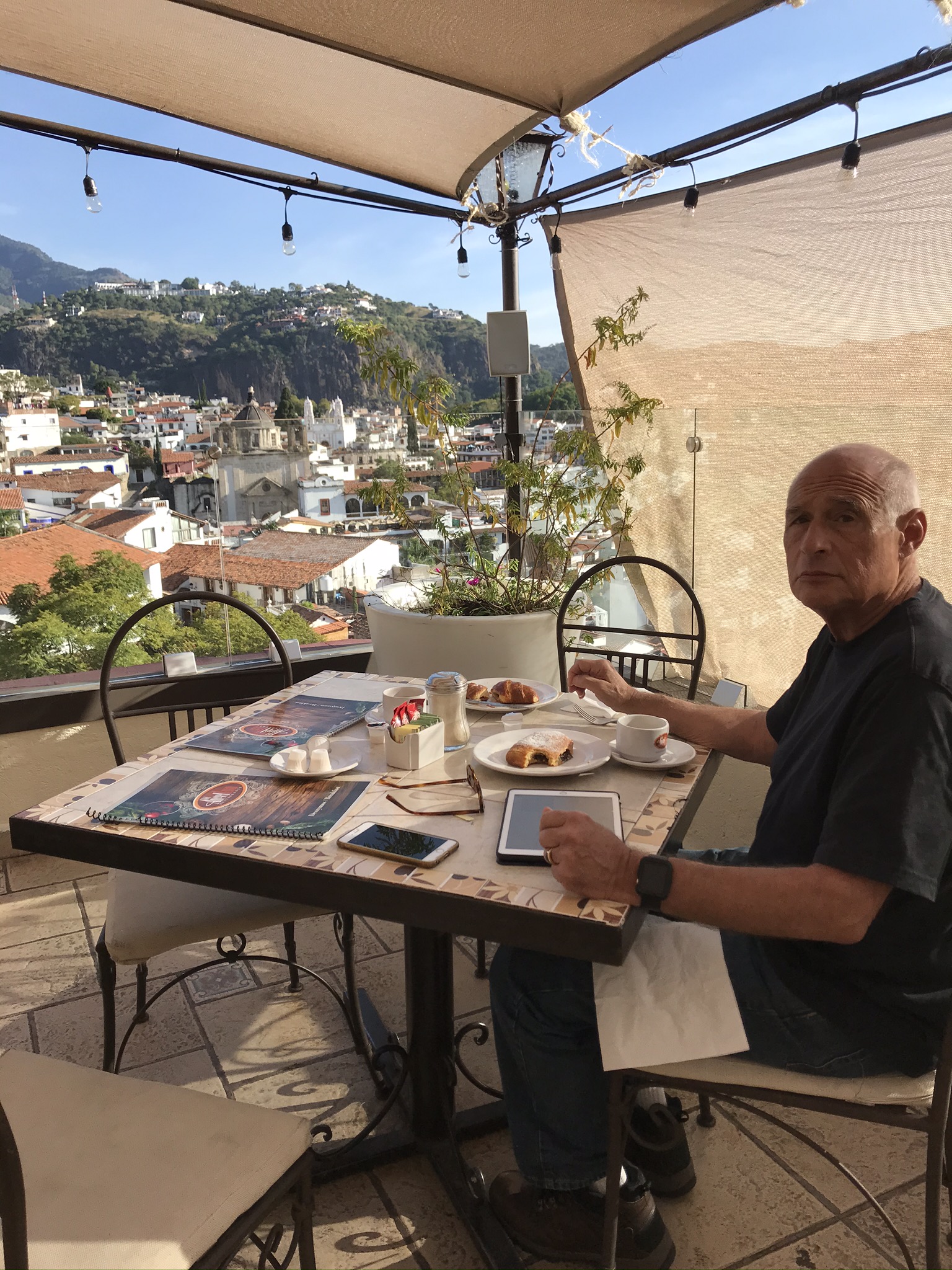
We had two fantastic, and typically enormous, breakfasts of chilequiles with eggs. The restaurant that serves in the hotel patio is terrific and highly recommended for convenience, service, delicious food. One of the “jams” they serve is a sweet chipotle that was memorable…not spicy, just a smoky, just sweet enough condiment. For the view—though the servings were overwhelmingly large so eating was almost discouraging, we went to Del Angel, a hotel behind Templo de Santa Prisca, the huge central church on the zocalo. The restaurant has several outdoor terraces, all with sweeping vistas of the town. Don’t get me wrong, the food was great—but entirely too much for a normal human being to consume in the morning.
Seriously, after fresh juice and pastries, all part of the shockingly inexpensive paquete (like the Japanese breakfast sets), could you eat that entire serving of chilequiles?
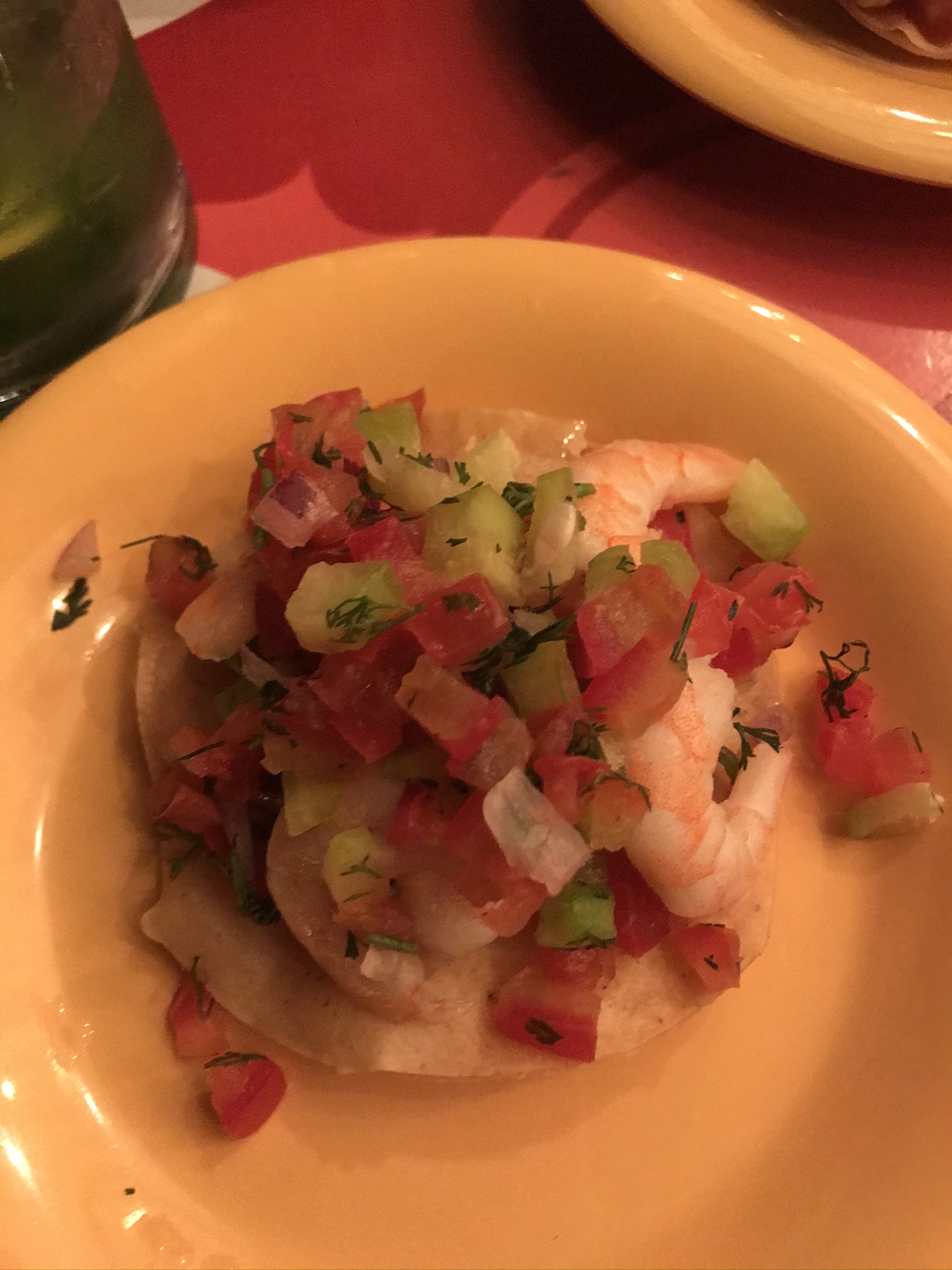
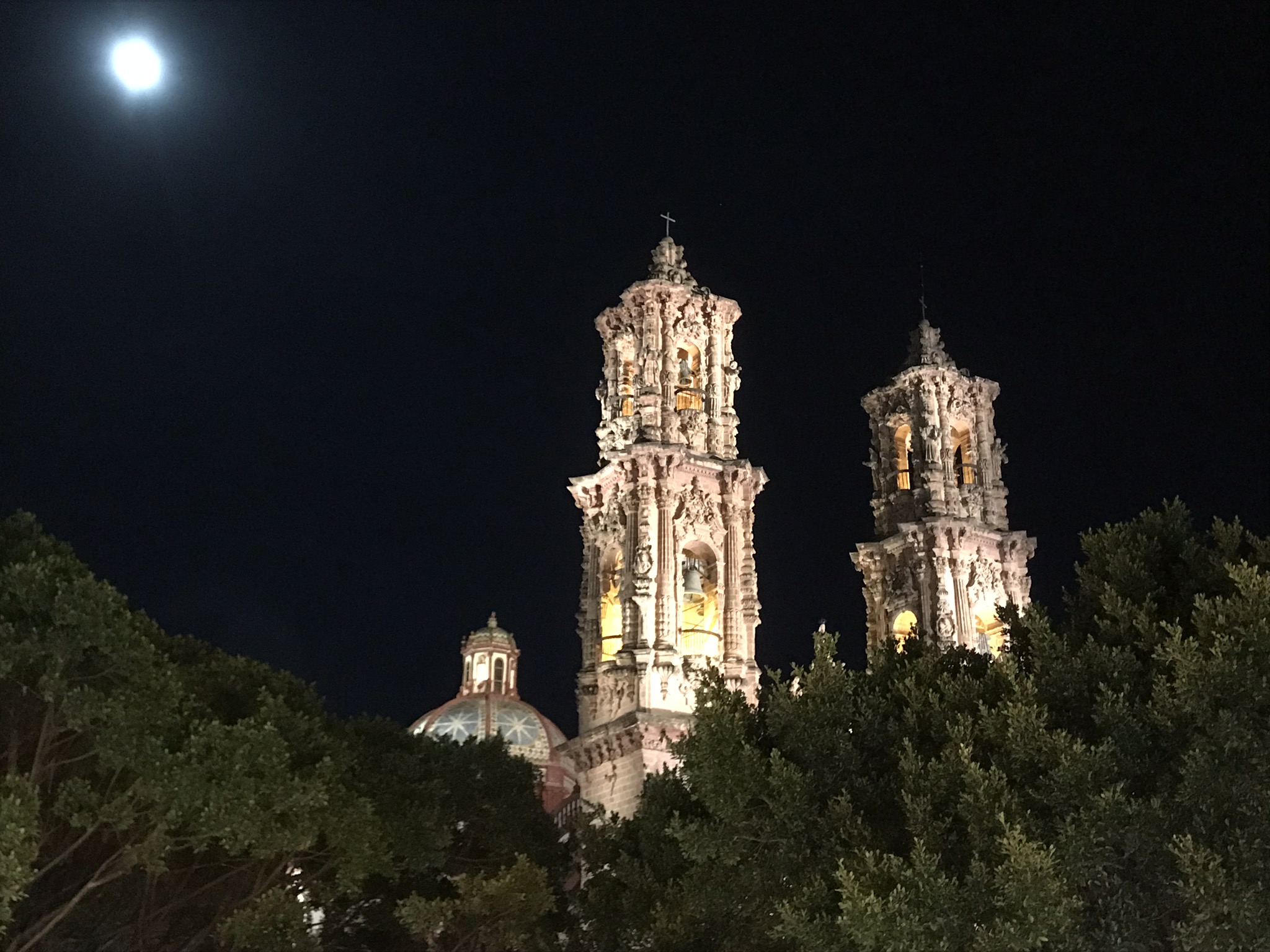
Two of our three nights in town we went to La Bendita, a small cantina-like place for drinks and small plates such as tacos, tostadas, quesadillas. The ceviche tostadas were what called us back for a second time, and I highly recommend the chicharron pescado (fried fish) tacos as well. My mojito(s) were delicious, and both nights David had the liter of beer. Sitting at a tiny table on a tiny balcony overlooking the zocalo madness was entertaining. The second evening the moon rose over the bell towers to give us a magical picture.
Finally, on the Taxco food front, we went to the famous Tia Calla, a basement level pozoleria. David isn’t a big fan of pozole but I am—and he had the chalupas, four little tortillas with chicken and chipotle. By the end of his snack he said his mouth was tingling but they were not the killer heat we know from chipotles in the US. The pozole was the best I’ve had.
The pozole had a half an avocado in it!
Plata
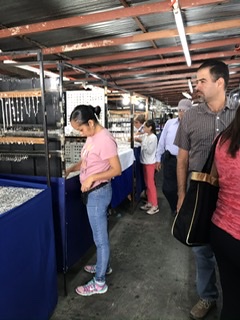
I really wanted to be in town for the Saturday market, a truly insane explosion of silver puestos (little stands) that seemingly filled every bit of space in the town—buildings that were closed on Friday opened to be consumed by hundreds of vendors each with approximately a card table’s worth of display. While many vendors sell the same things, as you walk each aisle you see that from one to the next they have a particular type of jewelry or a distinct style. My plan was to leave with enough pairs of earrings to last me for years, and I did. We also bought a few little gifts which will not be shown here as we want to surprise the recipients. The prices are absurdly low and the experience always “muy linda.” I had tried to describe Saturdays to David—there are always hundreds of vendors in stores and on the streets in Taxco—but he was shocked at the sheer level of commercial enterprise.
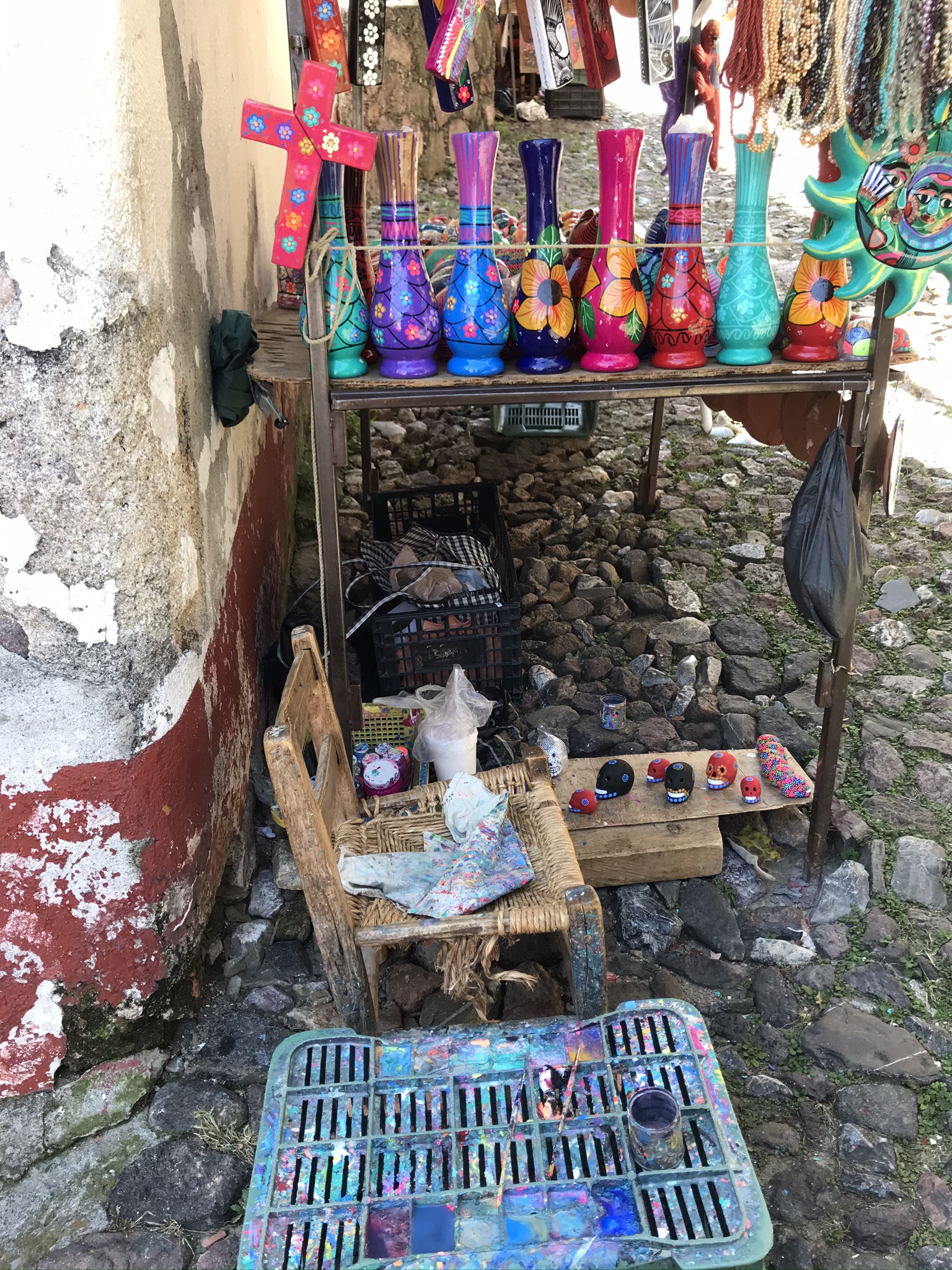
The picture on the left does not do justice—this is one of maybe thirty spaces that are filled with vendors on Saturday. I bought several pair of earrings from this most friendly woman at this puesto, which was down a series of stairways winding around impossibly complicated aisles lined with taco stands, jewelry vendors…just a mass of activity.
Simply too picturesque
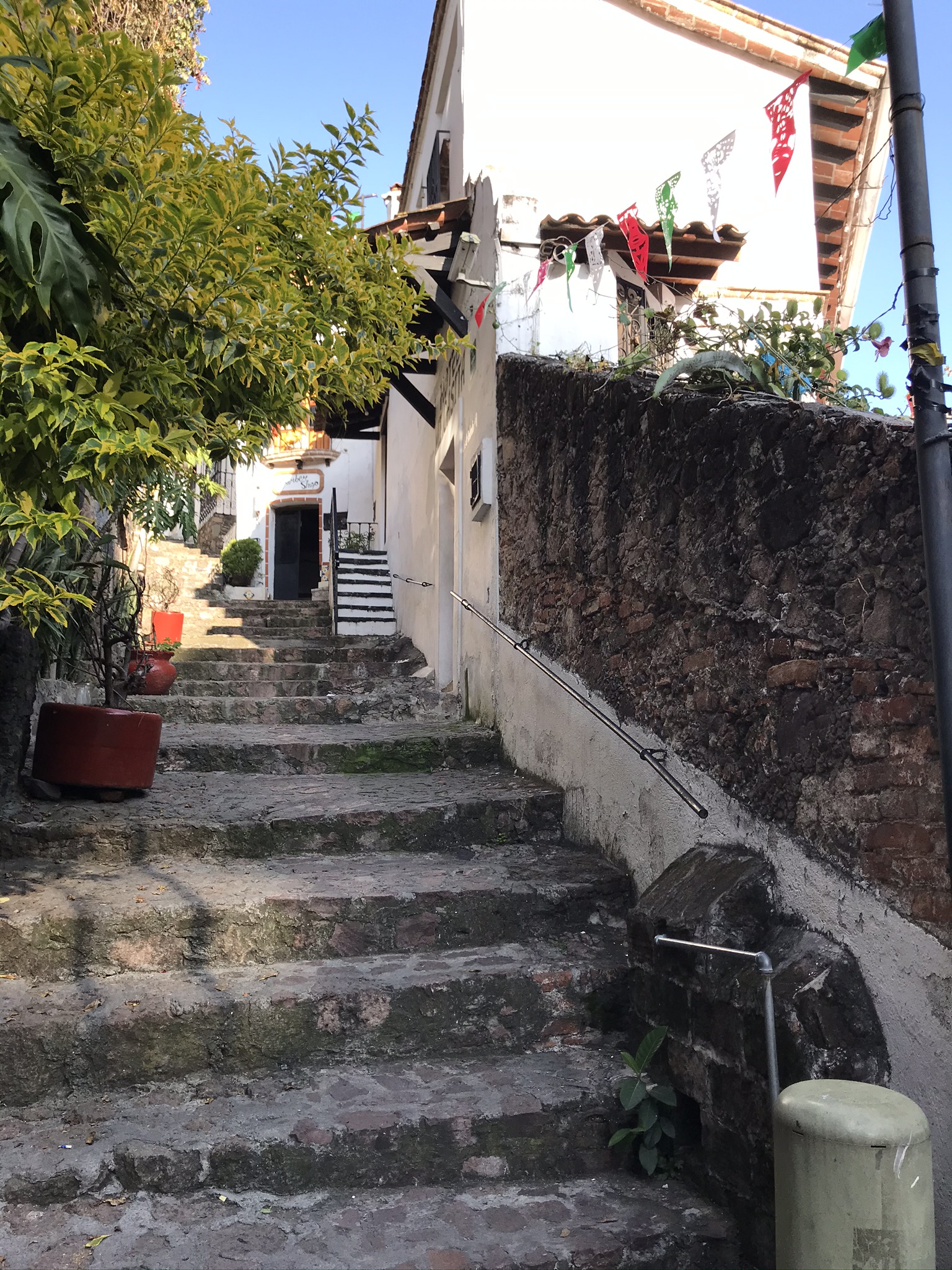
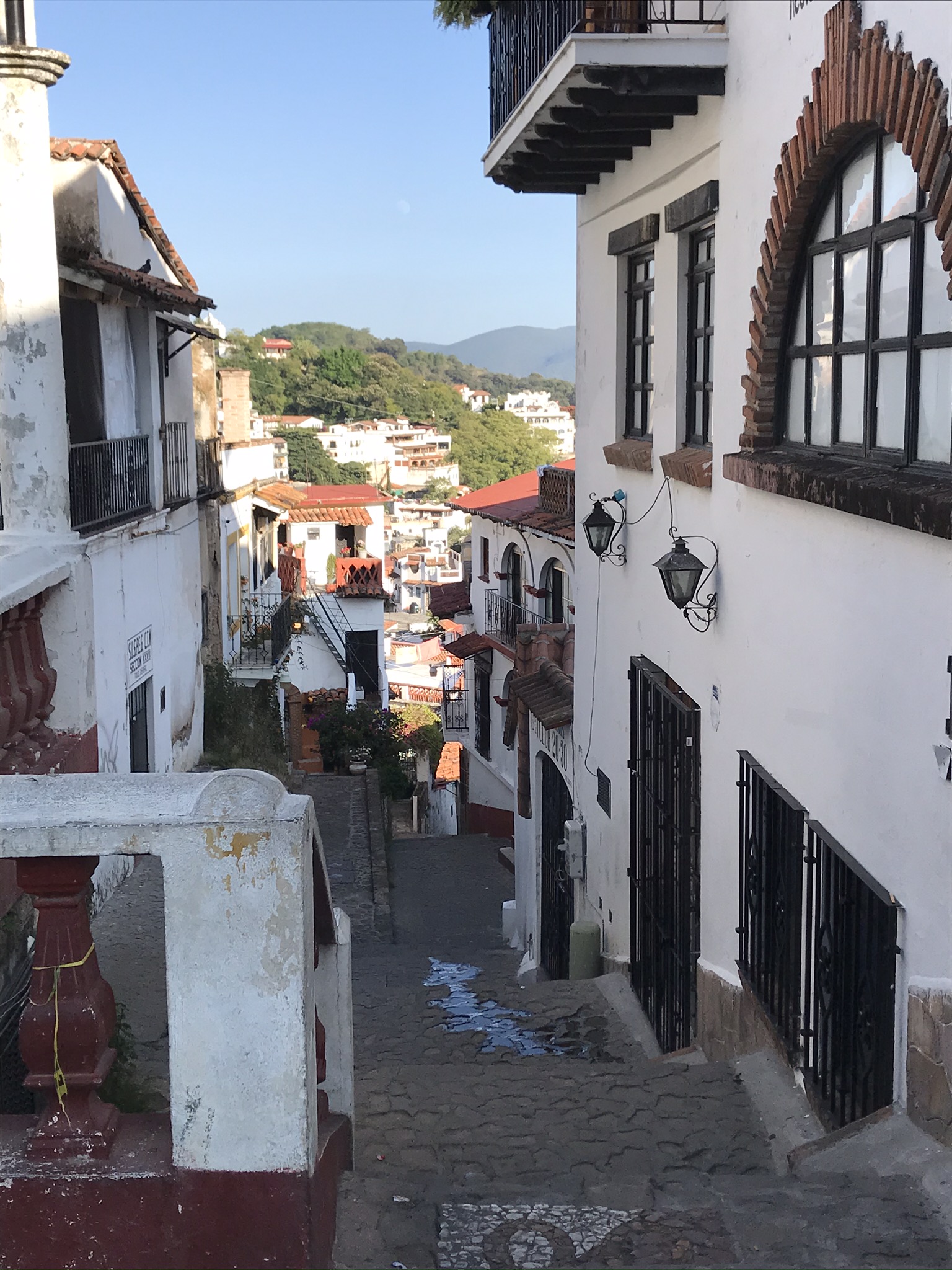
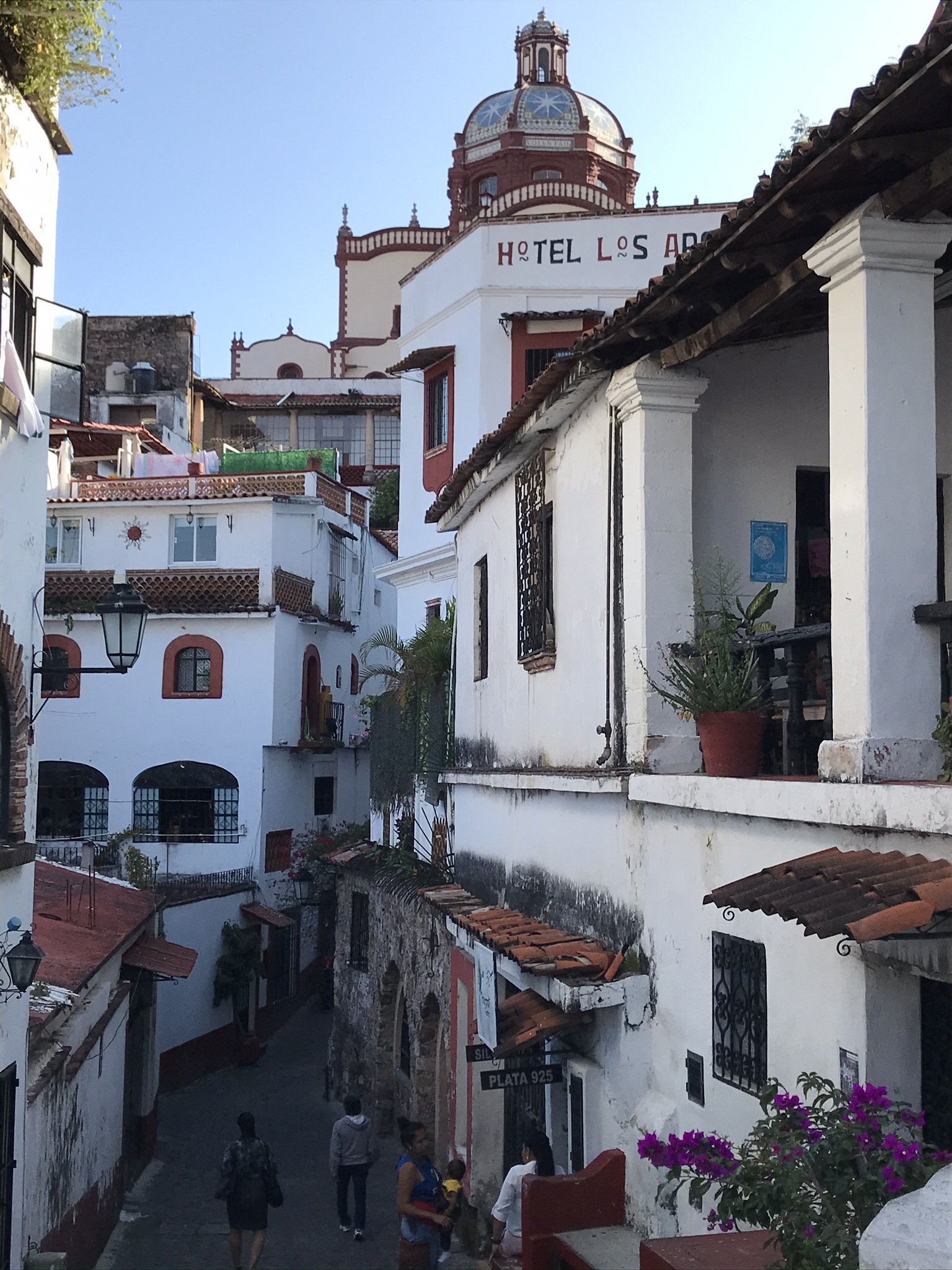
We wandered the town every day, and at every turn enjoyed the beauty of this amazing town, one of Mexico’s Pueblos Magicos.
Cemitas are the Puebla version of an oversized, overstuffed sandwich. They are everywhere…from tiny puestos, holes in the wall with rickety card tables and often waves of heat coming from gas fired flat grills of beaten steel, with shallow depressions that are filled with cooking oil for frying potatoes and nopales, stand alone puestos on the street where buy your food and eat out of hand on the sidewalk, to full restaurants that serve cemitas from a menu.
Our last afternoon in Puebla we knew cemitas were on our menu for lunch, and as we left the Casa Alfenique we asked the group of students at the entry where we should go for cemitas—they recommended the neighborhood El Carmen, which was very close to where we had stopped for chanclas the day before. It was about a 20 minute walk, and we were en route when we passed one of the tiny holes in the wall, the grill in the doorway, 3 women cooking like mad, and a sample cemita displayed on the edge of the grill as an advertisement. The sample cemita was enormous—and the smells of the frying potatoes and nopales was enticing. Also, only one of the 4 card tables was empty. David said “let’s just go here” and as it was 2 blocks from the hotel and we were hungry from all the work of visiting museums, in we went.
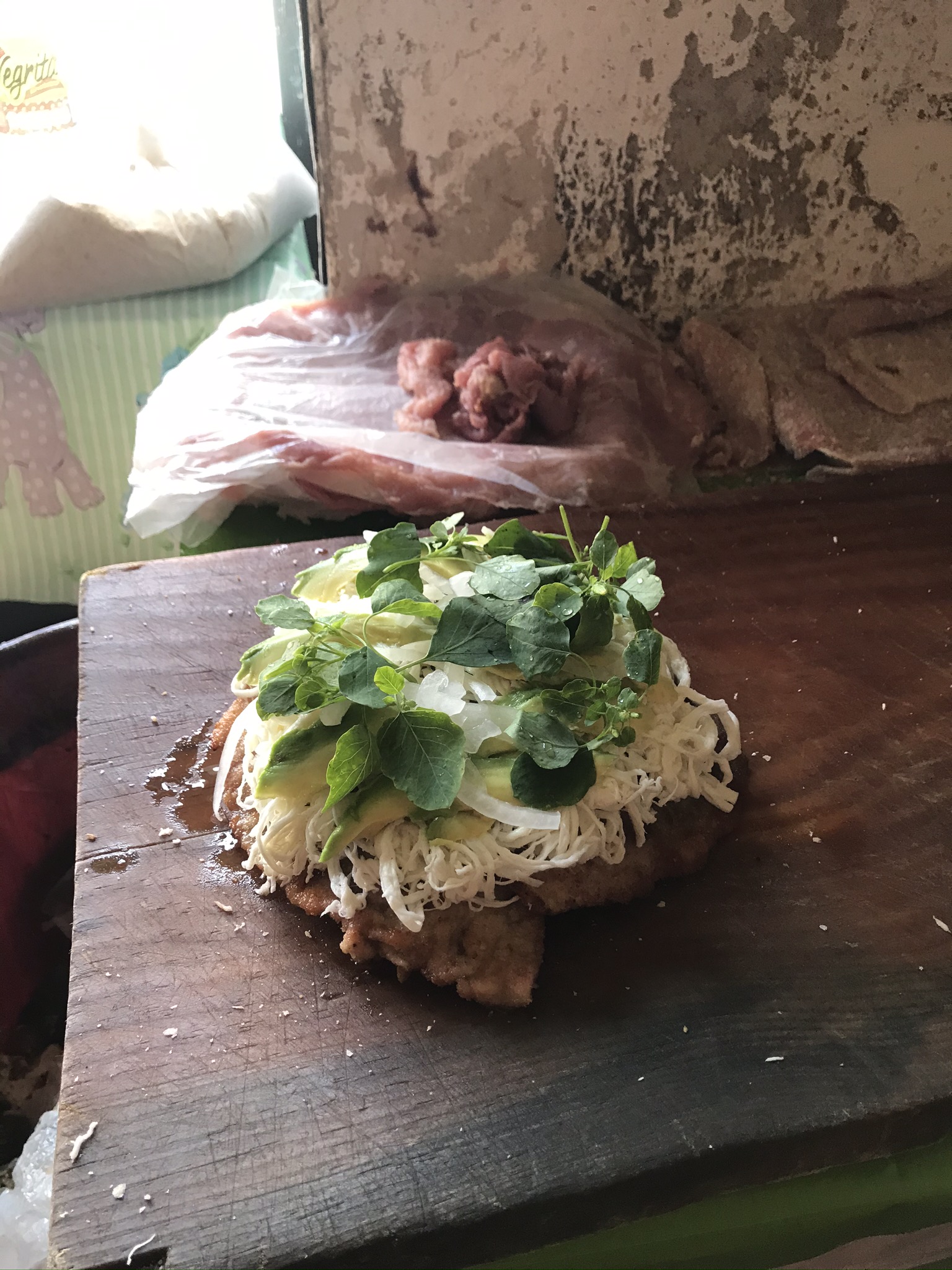
As we sat down at the empty table we were able of course to watch all the cooking—it was literally right in front of us. One woman was making tortillas from a pile of masa harina that must have been a foot tall and a foot wide. As she removed the tortilla from the press she passed it back and forth from hand to hand—exactly the same technique I had watched recently in a video about making naan. Each tortilla puffed up as she moved them around the grill. A second woman was chopping onions with an enormous knife. The third was cooking cemitas—she took 3 paper thin pieces of meat, probably pork, and slapped them on the grill. While the meat grilled she prepared the rest of the filling. The bottom of the roll was covered with avocado, strings of Oaxacan cheese (the only cheese we saw in Puebla), slices of onion, an herb papalo which is kind of similar to cilantro though unrelated, a good flavor and quite strong, and a handful of French fries. As you can see from the picture, it is enormous. I was unable to finish my half and I was so very hungry when I started! Anyway, this little place turned out amazing food and was always full—there was a “nicer” cemitas place next door which was empty as we walked by. What a treat. And our 100% good luck eating street food held—no after effects at all.
A wonderful no-name place turning out world class cemitas!
Chanclas
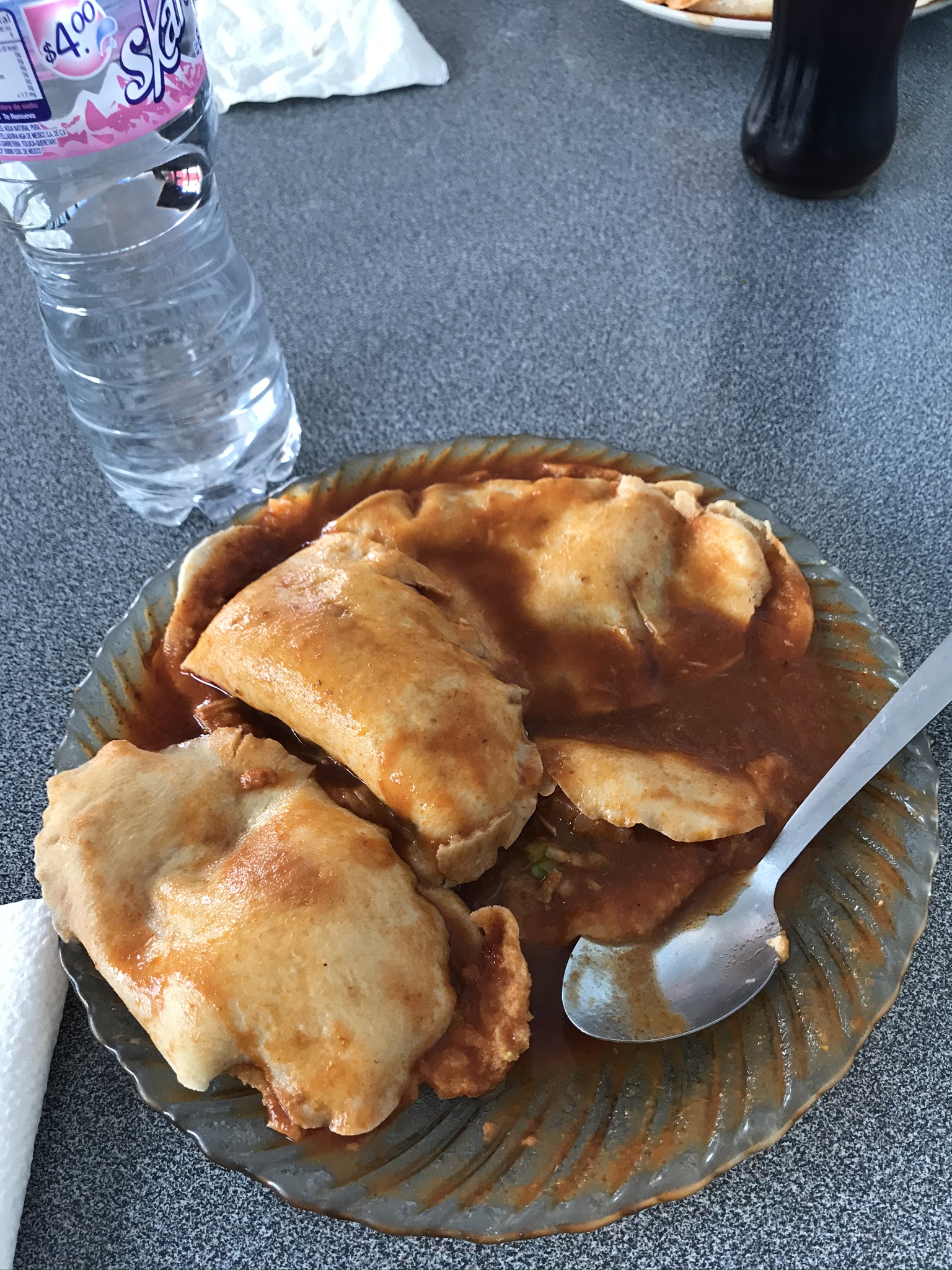
These were described to us as a kind of sandwich, but though there is bread involved these are nothing like a sandwich.
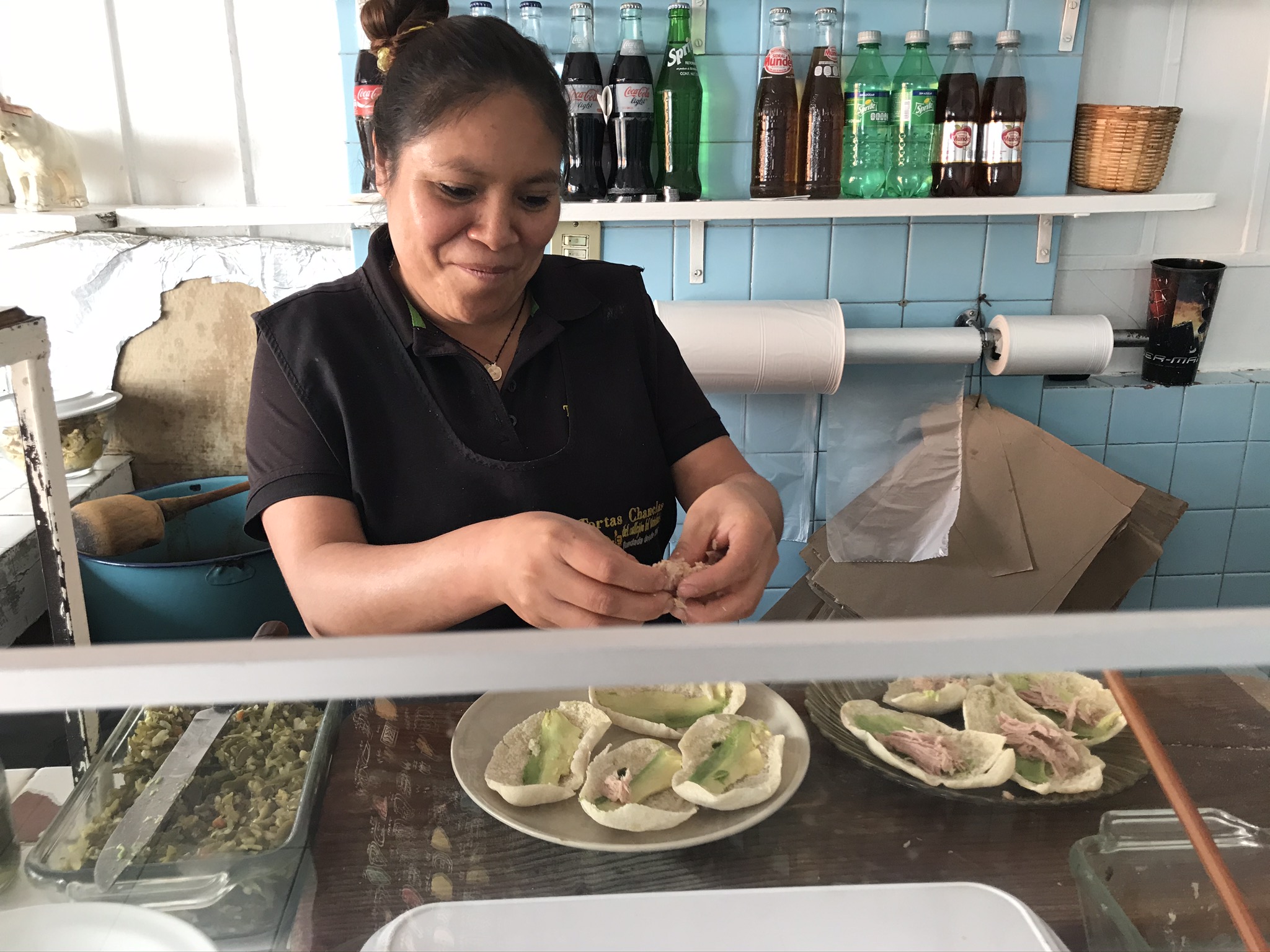
Small white rolls, which are somehow hollow, are cut in half. The place we went—recommended by our Uber driver, letting us off there instead of taking us back to the hotel as he told the owner “I have some tourists here who want chanclas”— was of course tiny so I could watch the assembly which included shredded chicken, slices of avocado, the top of the roll and then the entire plate is filled with a thin red sauce similar to the red sauce we know from red enchiladas in the states. One order is four chanclas—I ALMOST finished mine, though David had no trouble with his four.
And as always the very nicest young woman prepared our food.
Moles (that’s mo-lays, not the rodent)
Every region seems to have its own specialities when it comes to moles and we had several different such in Puebla.
The dark mole, almost always served over chicken or a chicken wrapped in a corn tortilla, is sprinkled with sesame seeds and is intensely flavored with a very definite chocolate undertone. A little too sweet for me, but David loved it. We also had a mole “house specialty” at the sister hotel Meson Sacristia de la Compania which was not at all sweet, even a bit sour/tangy. I loved that one. The other common mole in Puebla is pipian, ground squash seeds which I liked as well, lots of cumin and a hint of tahini-like flavor. We had this trio at Fonda de la Santa Clara over beef—we were a little tired of chicken on our last night.
Tacos al pastor and tacos arabe, and the grilled mix alambre
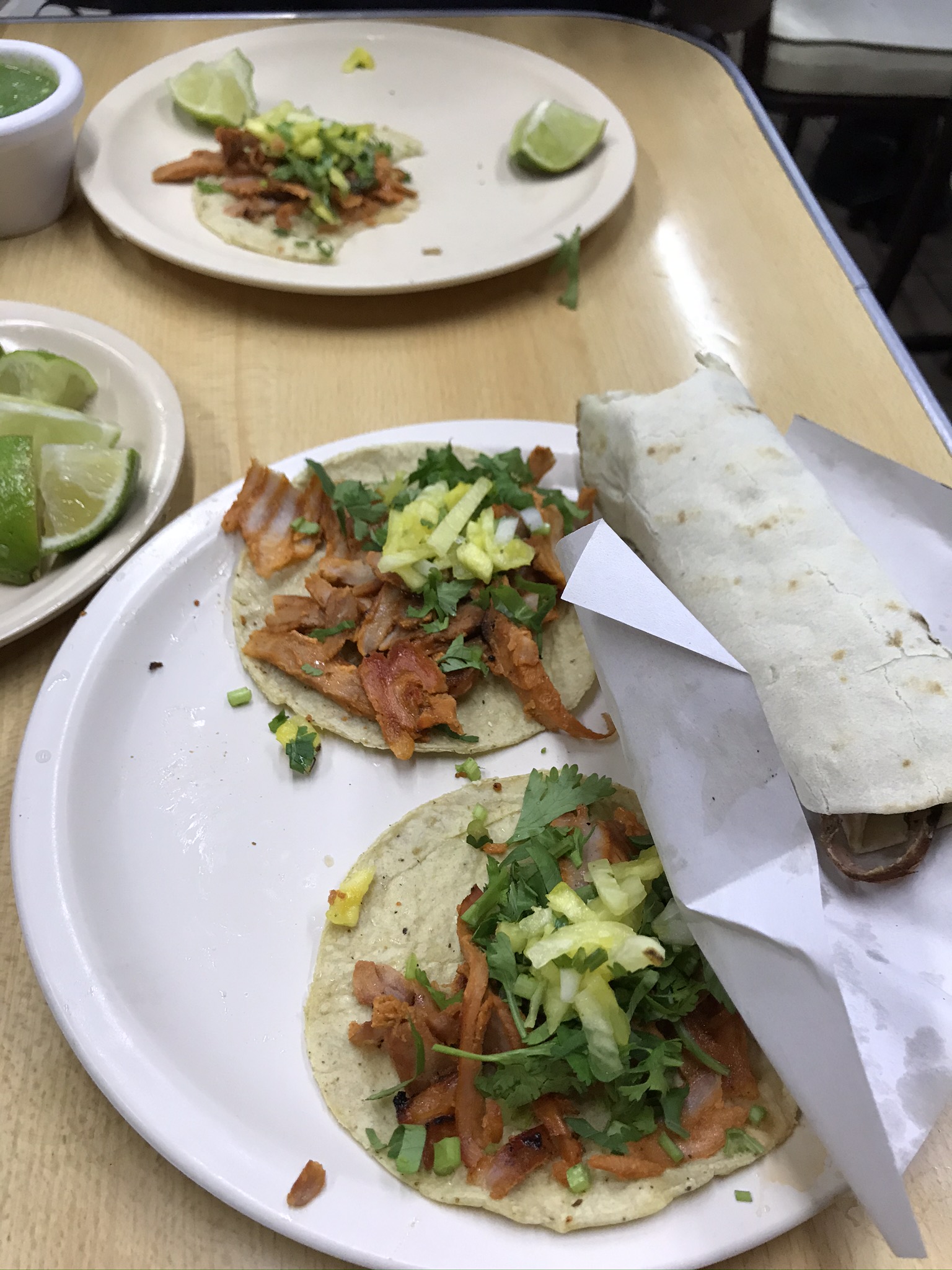
Tacos al pastor and tacos arabe are both specialties of Puebla and so good. Arabe means the meat comes wrapped in a flour tortilla, well, halfway between pita bread and a tortilla. The default meat in a taco arabe they call “carne blanco” which means it’s not reddish brown with spices as al pastor is. Simple and delicious, especially with the bright green tomatillo salsa usually on the table.
Al pastor is what we see in the US if you are lucky enough to live near good taquerias: stacked meat, heavily spiced, turning in front of a roaring vertical grill, sliced off in thin pieces and served on corn tortillas with pineapple, onion, and cilantro. OMG so good, almost refreshing with the fresh pineapple on top. I could have eaten those every day if there hadn’t been so many other things to try!
(At the central bus station, which is like an airport with all the companies in one place and a large waiting area surrounded by food stands, the “Rincon Poblano” (Puebla Corner) had tacos arabe and cemitas—but we were on an morning bus and passed, reluctantly.)
Our first night we went to Las Ranas where we ordered the .5kilo of meat with a stack of tortillas. It turned out to be a mix of meats—not sure what all—with peppers and onions and a cover of melted cheese. So delicious and we could not finish, as hungry as we were after a long day of travel.
On the left, cutting al pastor; in the middle, tacos al pastor and unwrapped taco arabe; on the right, alambre.
In conclusion—
Every single place we went was so friendly, so helpful, and so welcoming it was easy to jump into foreign foods with happy confidence. For a food festival, go to Puebla!
With only four days left and pretty darned tired we arrived in Madrid…Spain’s New York City. We had been given somewhat complicated instructions to the apartment which did not correspond to the Metro maps we had, and spent maybe 30 minutes in the airport-sized train terminal looking for a tourist information desk. It was late afternoon on Saturday and no luck until we decided to just go to the Metro and figure it out. Voila, an information booth where the young woman marked exactly where our apartment was, just four or five blocks down Calle Mayor–“look for Casa De La Villa,” so simple after all.
Our destination stop was Sol, smack in the middle of madhouse Plaza Del Sol. One of those heaven-sent ticket machine aides helped us buy the card and explained we could put two riders’ worth of trips on one (like the lovely T-10 card we used in Barcelona. Unlike our mistaken albeit inexpensive purchase of 2 rides to the airport on one card in Porto and had to buy a second card…which, when we got to the Porto airport we found there was no turnstyle exit anyway. Whatever.) For all the complicated instructions we’d had from our Airbnb host re looking for particular routes, it turned out there is just a single metro train running through the Madrid train terminal, and in about 8 minutes we were coming up the escalator into crazy Plaza Del Sol.
Yikes. A large and crazy plaza where several streets crisscross at acute angles, both pedestrian and not, a gazillion people, but all we had to do was make sure we remained on Calle Mayor and in 10 minutes we were at our address. Alas, we were early by about 45 minutes–Roberto would meet us outside and take us up but not until 7:30. We were so tired and hungry and thirsty…looked up the street a short block and there was a bar where people were sitting in a little enclosed patio smoking and drinking.
Yeah! We sat at a small table with luggage heaped around us but there was ample room and in a quick minute David had a large beer and I a glass of cold white wine. Relief. I got up to see if I could get a menu as we really needed a snack. The waitress was very apologetic but the kitchen was closed. All I could order was one of the salads. Poor us. We had the most delicious burratta salad with cherry tomatoes and arugula, so refreshing and ample with a ball of burratta that more than generous. With a basket of bread we couldn’t have been happier and then it was 7:30 and Roberto was there.
The apartment was just as expected; we settled in and then went looking for dinner. The rather crazy tapas bar scene was just a few blocks away, but everything looked crowded and hipster. Hungry and now hungrier, we knew enough by this time about food in Spain to drop into a narrow little bar/restaurant that was anything but hip, the front section all folks drinking and watching soccer, squeezed through to a table in the back and perused the now relatively familiar array.
I had one question-what was tripe Madrid style? It means cooked with chorizo and blood sausage. David ate the sausage and I tried my best to finish the delicious, meltingly tender tripe but it was altogether too much…half portion of course. David, with a bit of help from me, finished a half portion which was most generous of anchovies in vinagre, what we call in the US white anchovies. So good. And a small order of patatas bravas to round out the flavors. Staggered home to bed as we had a busy Sunday planned.
I think on this trip we have eaten about 200 anchovies. Not complaining about that.
It was an accurate introduction to Madrid. We spent the next three days walking, eating, and being dazzled by the Royal Palace (10 minute walk): the Prado (20 minute walk) and the Thyssen (across the boulevard from the Prado). All in all, though we had some complaints about the apartment itself the location was fantastic.
David had sussed out all the information about tickets, free times, and locations of our 3 sightseeing goals. On Sunday nights the Prado is gratis from 5 to 7. We decided a visit to check off a few boxes was worth it, and it was, because we knew Tuesday was reserved entirely to see everything there. Mondays the Thyssen is gratis 12-4 but closed on Tuesdays and Wednesdays. Our plan was set and we filled our last 3 days thusly:
Sunday
Sunday morning, El Rastro, a rambling outdoor market where basically everything is available from antiques to socks to batteries to pots and pans. As we started down one of the side streets of the market area, lined with a hodgepodge of junk shops and antiques we passed a corner joint advertising bocadillos de calamares. Okay, will be back for that!
We were still on the hunt for coffee and a teeny bar, Bar de Ca’ Kiko, called to us. If this had been our first day in Iberia we would have passed, but we knew it would be a safe and interesting experience and it was. This place was filled with a shifting crowd of men from (probably working) the market, and there was plenty of high spirited morning commotion. Every time someone left he’d (I was the only woman in the place) slap the small counter and with a “Chicos!” and was out the door. Behind the counter were two gruff looking men making coffee and handing food over the high counter–their specialty is tostas as shown in a long handwritten menu on the wall. Piled on a back ledge and under plastic covers on the counter were mysterious (to us) toppings on thick slices of bread, presumably toasted. As we drank our cafes con leche (delicious as usual, and served in small glasses as usual) I tried to puzzle out what the I was looking at paired with the list on the wall. I knew every person I asked about food, in both Portugal and Spain, would be happy to explain in Spanish I could largely follow, and the men behind the bar were as friendly as they could be proudly explaining what was what adding “Muy rico” after each. Every few minutes an arm with a plate of more tostas was thrust through a rough hole the size of a small window in the door to the kitchen, and one of the men took it and added it to the inventory. I kept asking, what’s this? What’s that? They even had something listed as barbacoa, a food word that has many many definitions depending on where you are in the Latin world. (In one city I visited in Mexico has a string of “barbacoa” stands outside of town–where barbacoa means grilled goat.) Anyway. a strange melange on bread turned out to be that, and when I asked them what kind of meat they looked at each other and said “Ternera?” (beef) so perhaps it’s beef. It all looked so good…but we weren’t at all hungry and knew those bocadillos de calamares were waiting for us when we finished at the market.
We wandered, I bought some earrings and David bought a leather billfold, and then we started looking around for that corner joint we’d seen on the way in. It was only 11am but hey, we’re on vacation–and with some backtracking and hey-didn’t-we-come-down-this-street’s we found it. Joint is the word, with soccer games on one tv and a weird kind of Latin candid camera show on another, and “decor” that hasn’t changed since 1960, and people standing or perched at the counters eating bocadillos, and drinking beer. We joined in, David having beer and I a glass of fresh squeezed orange juice that you can get anywhere, anytime, and our bocadillos de calamares, a Madrid specialty sandwich comprising a long crusty roll filled with tender fried calamari rings, on which you can squirt either mayo or aoli. A perfect brunch!
After I ordered a fellow called out to me “You speak English!” He and his wife were from Toronto (that’s in Canada, he explained) and had just finished a group hike on Majorca. They didn’t speak or understand a single word of Spanish, and seemed very surprised that I did. We had a small dish of patatas bravas, gratis with our drinks, and the woman asked what it was. How can you have been in Spain for more than 1/2 a day and not know that? Anyway, I gave her a piece on a toothpick which she reluctantly ate. Poor people.
We headed to the Royal Palace and took the audio tour. We liked the tour very much, but it was funny/tiresome that almost every explanation came around to how this or that painting or decoration “demonstrated the legitimacy of the Spanish monarchy”. But surprisingly interesting–it includes such amazing decor as several rooms where the walls and ceiling are entirely porcelain! As we left we heard the music of pipes and castanets outside–it was the tail end of a demonstration/parade we had seen on the walk back from El Rastro, a Basque protest, with music, costumes, enormous oxen pulling huge wooden carts and even a Green Peace sign, all demanding an end to agribusiness destroying great food and village life. The marchers, in costume and periodically breaking out into castenet routines, all looked somewhat grim but the crowd seemed on their side with smatterings of applause.
Free night at the Prado, 5-7pm! We headed over and joined a two block and growing queue and at 5 the line moved and we were part of the crowds inside where we got our bearings, sort of, and readied for a quick dose of art. Wow. We couldn’t wait to get back. It would have been immensely frustrating if we didn’t know Tuesday was Prado day.
We stopped at La Plateria for a yummy dinner of judios verdes con jamon, paella (both half portions meaning of course they were huge) and still hungry (!) we each had a plato, David the hake and green salad, me grilled beef with salad. Enjoyed a bottle of wine with dinner and strolled home through the still busy streets, I guess normal for 9pm on a Sunday in Madrid.
Monday
On the chilly and refreshing Monday morning we started with a long walk past the palace and up to Gran Via, the sort of main commercial street, very big city with huge buildings, Times Square style signs, and lots of people. We were on a quest to find a pair of shoes for Hannah which were summer style and only could find them on sale racks…hence store after store had maybe one or two, but not in her very common size 39. It was fun to have a mission and an excuse to speak Spanish about shoes…and then pretty sure we wouldn’t be successful…we found them!
We had had a late breakfast so went to the Thyssen museum for the free opening at noon. This is a very lovely, somewhat quirky assortment as museums based on a private collection tend to be. Unlike the Prado, the collection ranges into some 20th century art which was great to see but surprising to SFMOMA members as there was basically no modern artists that in the US we consider iconic–no Jasper Johns, no Thiebaud, no David Smith, no Diebenkorn, one Lichtenstein. We also saw so, so many artists we had never heard of–several times I thought like “Oh, that’s Braque” but it was someone totally unfamiliar. Even the Impressionist collection was surprising, with only two small Renoir (never saw them before). Two Edward Hopper, neither of which I’d seen before anywhere. So Fun!
We took a midday break for a quick lunch in the museum restaurant, a beautiful, no stunning, ultra modern setting outside with okay food, then finished up till almost closing time (4pm). We were so tired, and a bit nervous about our stamina for the following day’s plan to see everything at the Prado. But we perked up with a tapas supper at Txirimiri where we not only had great food but fun conversation with the guy behind the bar and a buddy of his, both enthusiastic about explaining some food terms and menu items to me. I had so much fun talking food in Spanish! And a few glasses of cava made me feel almost fluent. They had a wonderful array of pintxos including one that David ordered twice, thick slice of bread with a slab of smoked salmon.
Tuesday
Tuesday, our last day, and we were happy to have a plan to carry us through. We decided to wander our way to the Prado as it doesn’t open until 10, and stopped in a panaderia for superior croissants. Gosh they were good, and as fresh a can be–this is an on-the-premises bakery and I watched as a fellow was baking them in the back. A suitable ultimo desayuno.
We hit the museum at about 10:20, skipping the line as usual due to David’s going online for tickets. With audio guides in place off we went.
I cannot begin to describe the breadth and depth of the collection. It is a marvel, a joy, a revelation room after room after room…3 floors plus a small circular room at the top holding the treasures of the dauphinois. While I could probably live without seeing any more bloody crucifixes, everything was worth seeing. They have, for example, rooms of enormous paintings of historical and mythological events. Huge rooms that hold just six canvases, other rooms with exquisite landscapes, family portraits, royal portraits. Go to Madrid and give it two full days. It did, combined with all we had seen to that point, inspire us to read or audiobook the history of Iberia.
Two artists I’d never heard of and fell in love with, Marin Rico (1833-1908) and Mariano Fortuny (1871-1949). The scene of the Alhambra below is Rico, the charming painting of his two children in the “Japanese room” by Fortuny.
We ate at the Prado restaurant, really very good, and at around 5 we stepped outside in a daze.
For supper we decided to try El Sur, which was maybe a 25 minute walk away into a neighborhood we’d not visited before. We finished off a lovely bottle of wine–“3 Tempranillos” which is a blend of, what do you know, three tempranillo grapes all from the Duero valley but from 3 different elevations. It was delicious. A nice, homey place, nothing at all fancy, and we ate our fill, went home, and packed.
Up at 3:15am, driver arrived to take us to the airport at 4…flight to Amsterdam at 6. All without a hitch!
Time to leave lovely Sevilla. We had an early bus to Granada, 8:30, and had some anxiety about the long walk with all our stuff and the changing weather. Córdoba had been lovely, really a perfect day, but Thursday promised rain.
Luckily we had had a kind of revelation coming back from the train station when we returned from Córdoba. When we had arrived in Sevilla we were so totally disoriented as to the layout of the city that we had not completely understood that our Airbnb was just like two short blocks into the old city. In other words we were two short blocks from the modern city, the one with cabs and wide streets. When we came home from the train last evening it all made sense, and handy to know because as we crept out of the Airbnb it was raining quite hard and happily we knew a cab would be easy to find and it was.
The bus was full and luggage space inadequate, it rained the whole way, and the bus took about 45 minutes longer than scheduled. We both were a bit queasy when we got off, and the city was still wet with rain spitting on and off. We got into a cab right away, and right away we felt so much better as our driver was a delightful conversationalist and though he spoke very rapidly I was able to keep up as we discussed Spain, the US, intergroup stresses in both countries, the environment, tourism, gosh, I cannot remember what all we explored. I was ecstatic that my ability to communicate had improved so much! Turns out he was from Córdoba so we talked about what we had seen there, how it was different from Granada, etc. I think the ride was about 15 minutes weaving through the complicated streets of Granada. It was raining harder when we got out. Our hotel was in a pedestrian zone so we had to walk into the square and even with his directions we were confused as we stood against a building juggling phones to get a map up. Well, Hotel Los Tilos was literally 15′ from where we stood and we hustled in.
It was actually nice to be in a hotel, our only one of the trip, because we had a bathtub! We both took two baths over the two nights we were there! While the hotel was fairly bare bones it felt like a luxurious return to the 21st century after Sevilla, and our view out on the square delightful, with The Alhambra in the distance and the cathedral right across the way.
We needed food and a walk. Food was at Los Diamanté’s, a 5 minute walk and so good we had lunch there again the next day. A modern, slightly manic place with long shared tables on one side, bar seating on the other, and an open kitchen in back, waiters running to and fro shouting out orders to the kitchen.
The place was kind of empty when we arrived, as it was only noon, but within 15 minutes it was full and fiesta-like. We were so hungry for vegetables and they had something translated as “buds with garlic” and another of marinated tomatoes. We ordered both. Buds turned out to be little, maybe 4″, romaine heads, sliced top to bottom and doused with a marvelously tasty vinaigrette loaded with smaller-than-minced dark brown garlic. I think the garlic was sautéed, drained, and added to the vinaigrette as the taste was very fresh and not at all bitter. The tomatoes were icy cold and crisp, also small, with oil and vinegar. Absolutely delicious. And a perfect balance for the mixed fried seafood and intensely flavored,yummy razor clams. This all followed the Spanish rice that came with our glass of beer and glass wine of wine order.
We returned for lunch the next day…and had probably the plumpest freshest mussels possible. And the rice again…
Well fortified we headed out into the rain for a walk through the Arab quarter, up winding cobbled streets, almost entirely pedestrian only, staying clear of the rainwater rushing down the middle. The cobbled paving was well designed to drain quickly leaving the sides pretty passable. We had to take care but it wasn’t especially slippery thank goodness. Up and up we went, to a puerta at the top opening into a small square, so pretty.
We were pretty wet when we got back down but took a quick tour through the cathedral. The audio tour was oppressively Catholic, with rather tedious and extremely religious explanations of how each nave celebrated a particular incarnation of La Virgen. The place is enormous, shown vividly by means of a scale model. The bell tower is, however, rather stubby with no actual bell, explained in the audio tour the result that the “planned third section” was abandoned due to “stability problems.”
Thoroughly chilled after the cathedral we headed to our room for hot baths. Heaven.
Granada is known for its unique custom of free tapas with each drink order, rotating through the tapas of the day. We took full advantage that evening with a visit to La Vinoteca, eating the food that appeared as we each enjoyed several glasses and finishing with a salad off the menu of mixed greens, mango, avocado, and very sweet and flavorful shrimp, with teeny tiny squares of crispy bacon adding a surprising smoky-salty note. I want to try this at home, but it is very hard to find shrimp of that quality so this may remain a happy culinary memory only.
The Alhambra
No one goes to Granada without visiting The Alhambra. I was amazed to find it so close to the center of the city and also amazed at how very steep the walk is, through a true forest (not a manicured park) filled with birds none of which I could see in the tall trees. Up, up,and then you are there, an ancient walled castle/palace/fort with extensive gardens and multiple buildings of various eras.
Like La Mezquita it combines Moorish and Christian-western influences and spaces. Unlike La Mezquita the Christian rulers built their palace rooms right into and indivisible from the Moorish rooms. It is enormous. We walked several miles as we of course went to every building and then through the Alhambra museum, fantastic even to our over-stimulated eyes and minds. The only thing we skipped is the reportedly uninteresting Bellas Artes museum.
Exit to Madrid
We had train tickets to Madrid leaving around noon and we knew there was a bus bridge to the high speed train. The train station is right in the city, only a 25 minute walk from our hotel, so even though we would have all our stuff we headed out on foot. A boring walk but pretty easy. The station was a bit shocking after the various other terminals and stations we had been in. It is a smallish building with inadequate seating and nothing else. The room gradually filled up, suddenly there was a long queue, our tickets were gruffly inspected and we were divvied up among several buses each bound to a different station. Ours was an hour or so trip into what seemed the middle of nowhere, no town in sight, just a new station with several high speed tracks. We had seen the tracks for much of the bus ride, elevated through the endless olive groves. An hour later we were headed into the Córdoba station, so familiar from our earlier day trip from Sevilla.
I went into the small tienda that sold products of Espana to chat with the woman at the counter whom I had enjoyed talking to when last there when buying a few little gifts. We had shared a laugh when a large, unsmiling man had come to the register to pay for a bottle of beer (yes, you can buy a beer just about anywhere). He looked and sounded so grumpy I said to her when he left that he really needed a beer!
She remembered me and I told her we were leaving for Madrid and then home. We talked about our dogs (she has three), the tragedy of abandoned dogs, how much we loved them. She asserted “dogs are better than people” and we shared how sad we were when our dogs died. She insisted Spanish people are not dog lovers as there are so many abandoned dogs, and we commiserated about our respective societies’ failures. Then David and I had to rush down to the platform as we had been startled when last there at the approximately 30 seconds’ pause of the train for new passengers.
I am going to highlight just four meals, two of which were in the same restaurant, and one which sated our salad-and-vegetable starved appetites.
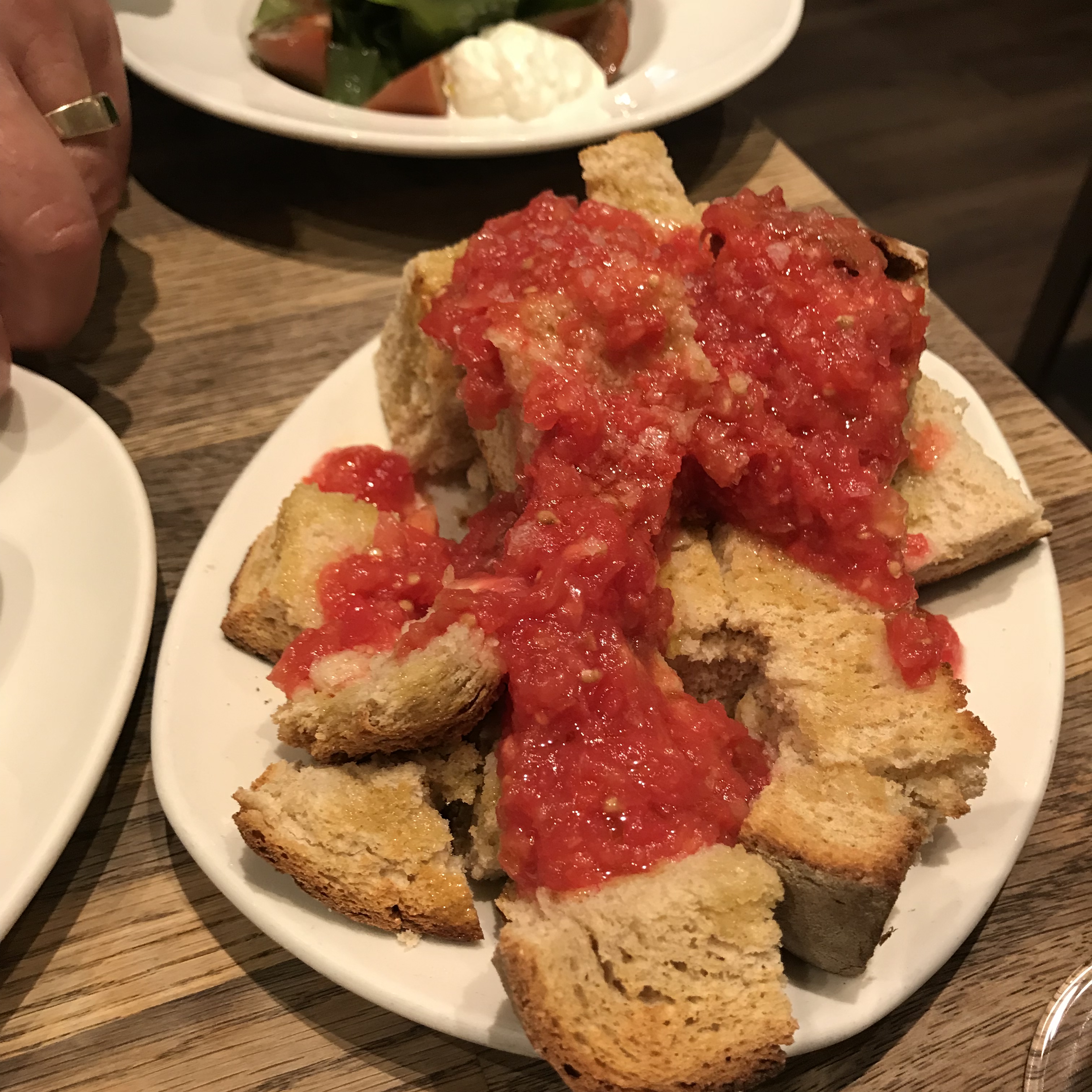
Yelp plus recommendations in Rick Steve’s guide have continued to serve us well. Our first night I scoured Yelp to find something a little different from tapas, tapas…poor us…and we headed to La Azotea. Right in the heart of la zona touristica a block from the cathedral, this narrow and modern place serves higher end (50-60€, including a bottle of wine) food with imaginative combinations as well as the typical, but here especially high quality, plates of Iberian ham, pork cheeks, pan con tomate. I wanted to go right away in case it was as good as the reviews promised.
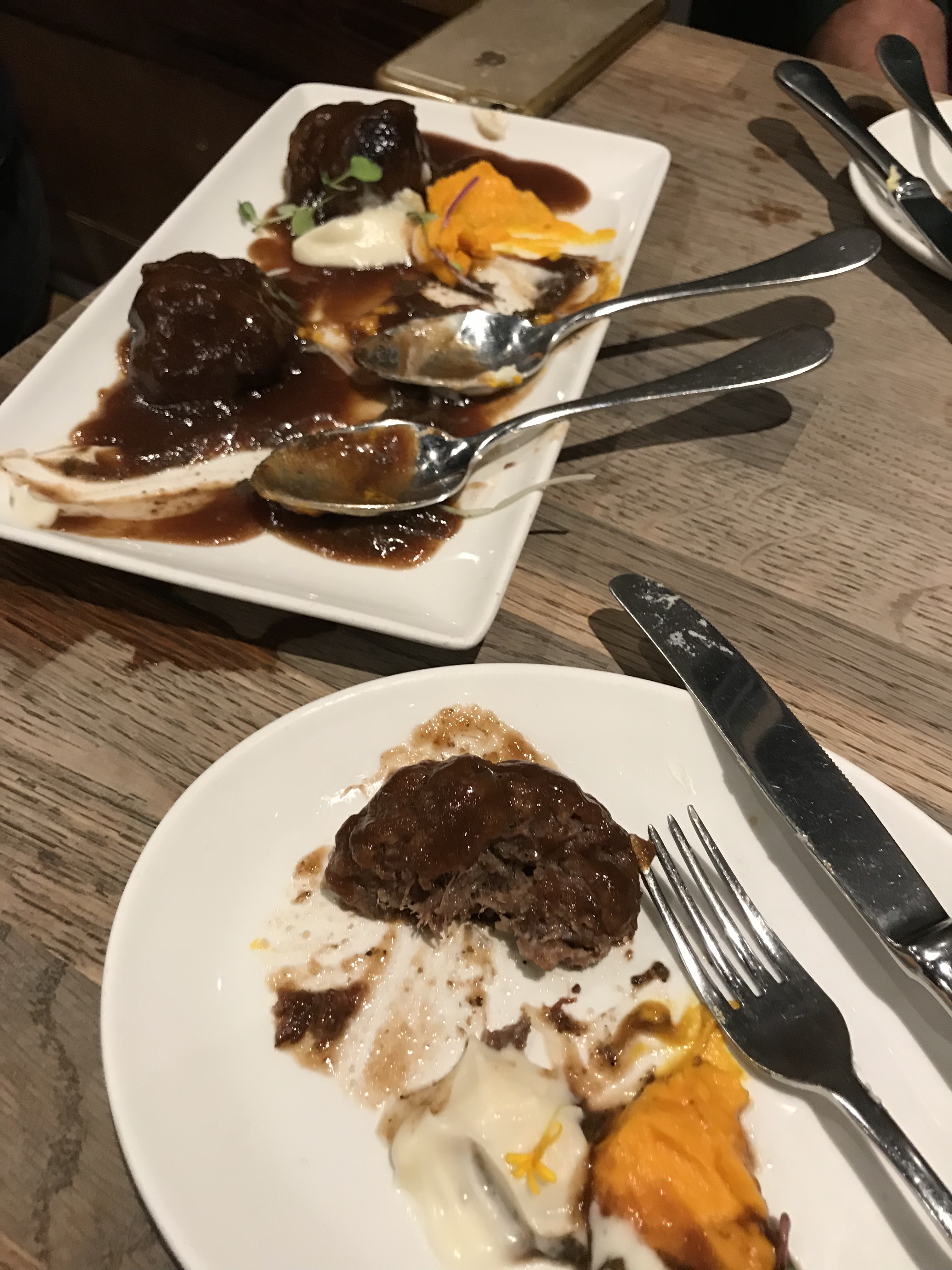
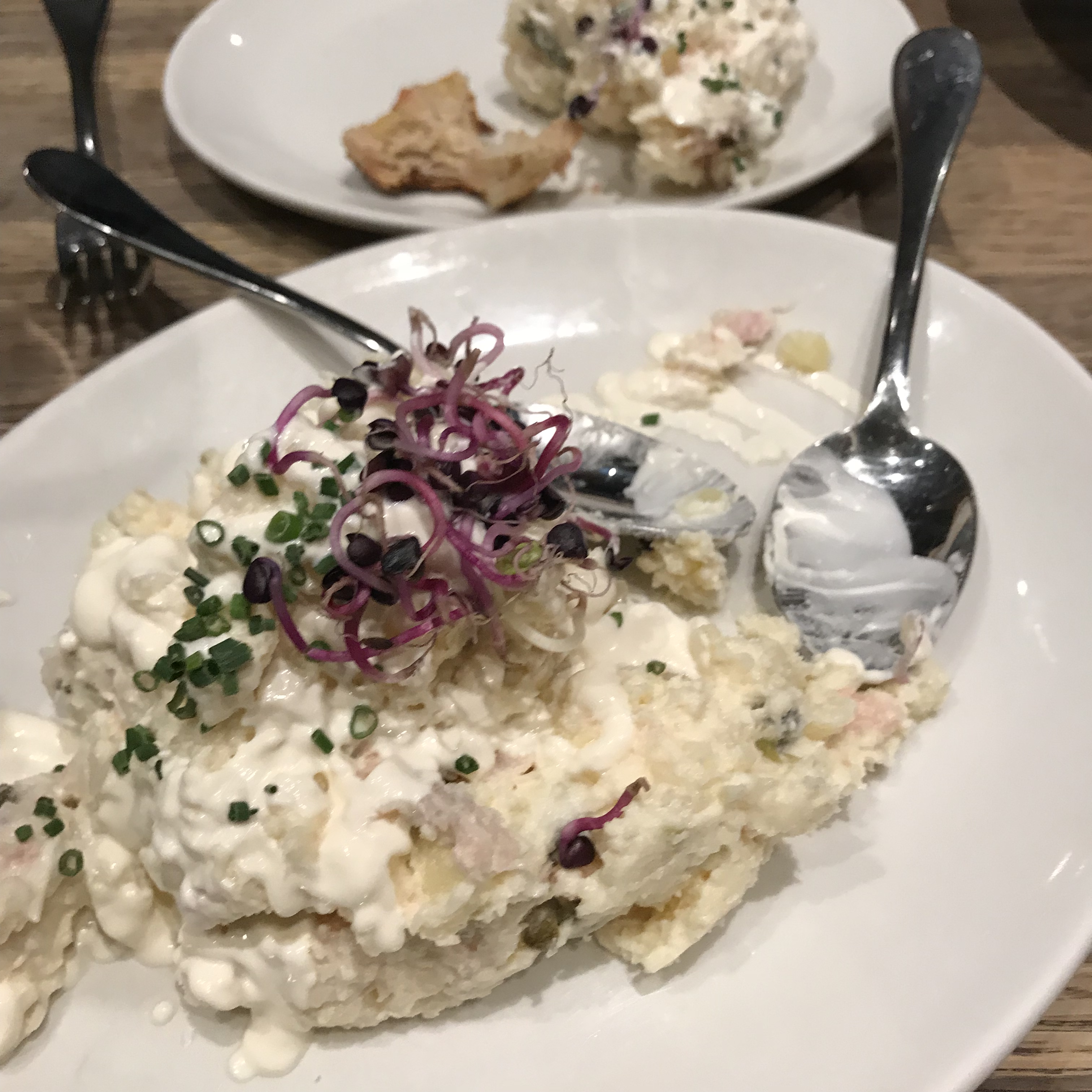
It is. The first night, with a bottle of rosado, we ordered “media” (small, ha ha) portions of salmon tartare, a potato salad with capers and smoked salmon, and oxtail meatballs. These three “media” portions were a huge amount of delicious food…we were even struggling a bit to finish the oxtail meatballs which were served in a very rich sauce. We were glad we waved away olives and bread.
Two nights later we rewarded ourselves after a grueling day of sightseeing and ten miles of walking with a return to La Azotea to order “media” portions of the potato salad, again, pan con tomate, and the burrata salad, a plate composed of two mounds of burrata and a scoop of lemon sorbet on a small head of red butter lettuce with little gelatin squares tasting of fresh basil. To top it off we had the steak tartare, little cubes of meat mixed with a tangy light mustard sauce. Ate every last bit with a bottle of Rioja (yummy and 15€).
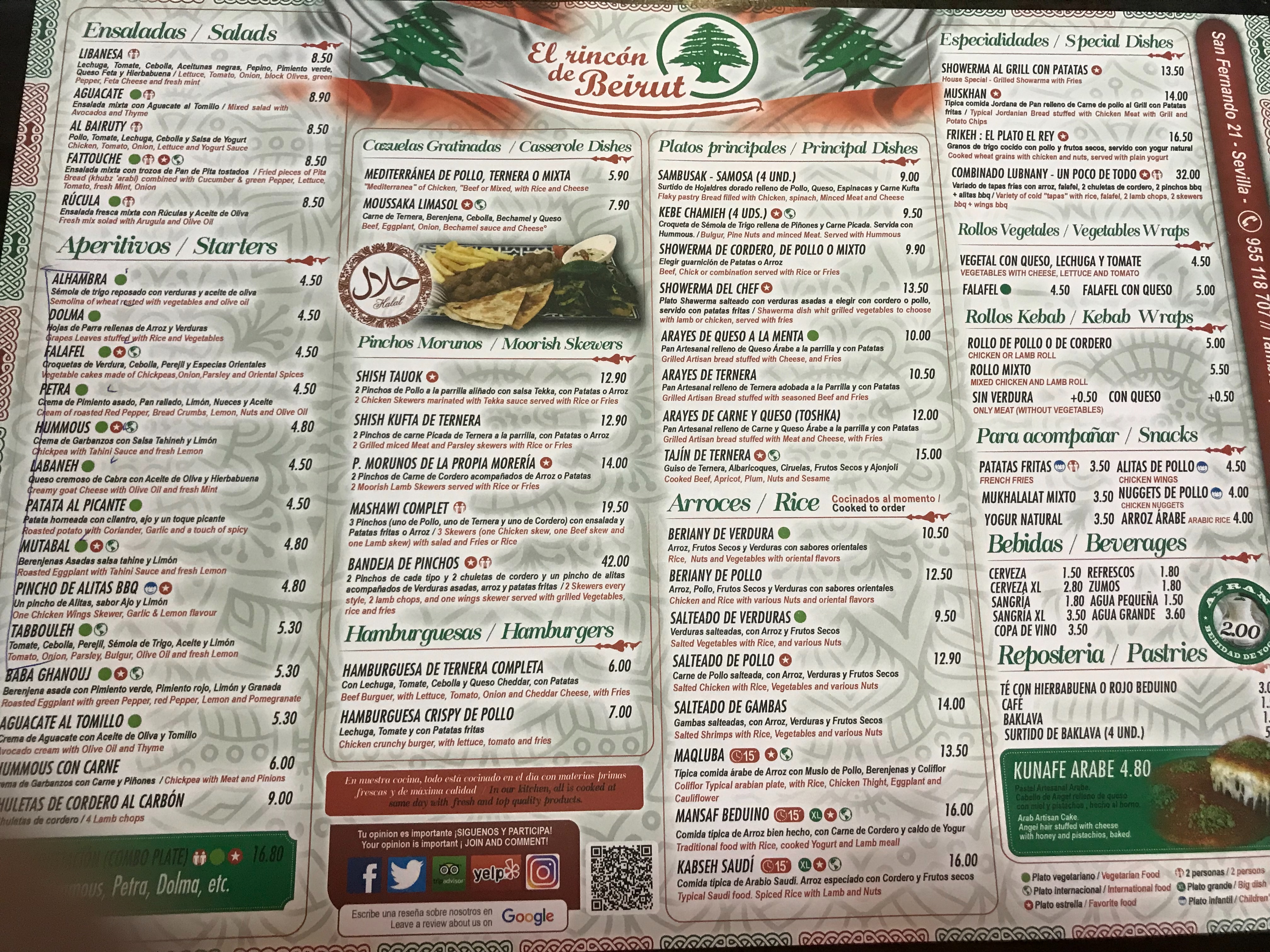
The night before we needed vegetables so headed to El Rincon de Beirut. The enormous menu daunted us until we saw a “combo” that the waiter explained was basically all the appetizers. It came, we ate, our bodies said thank you.
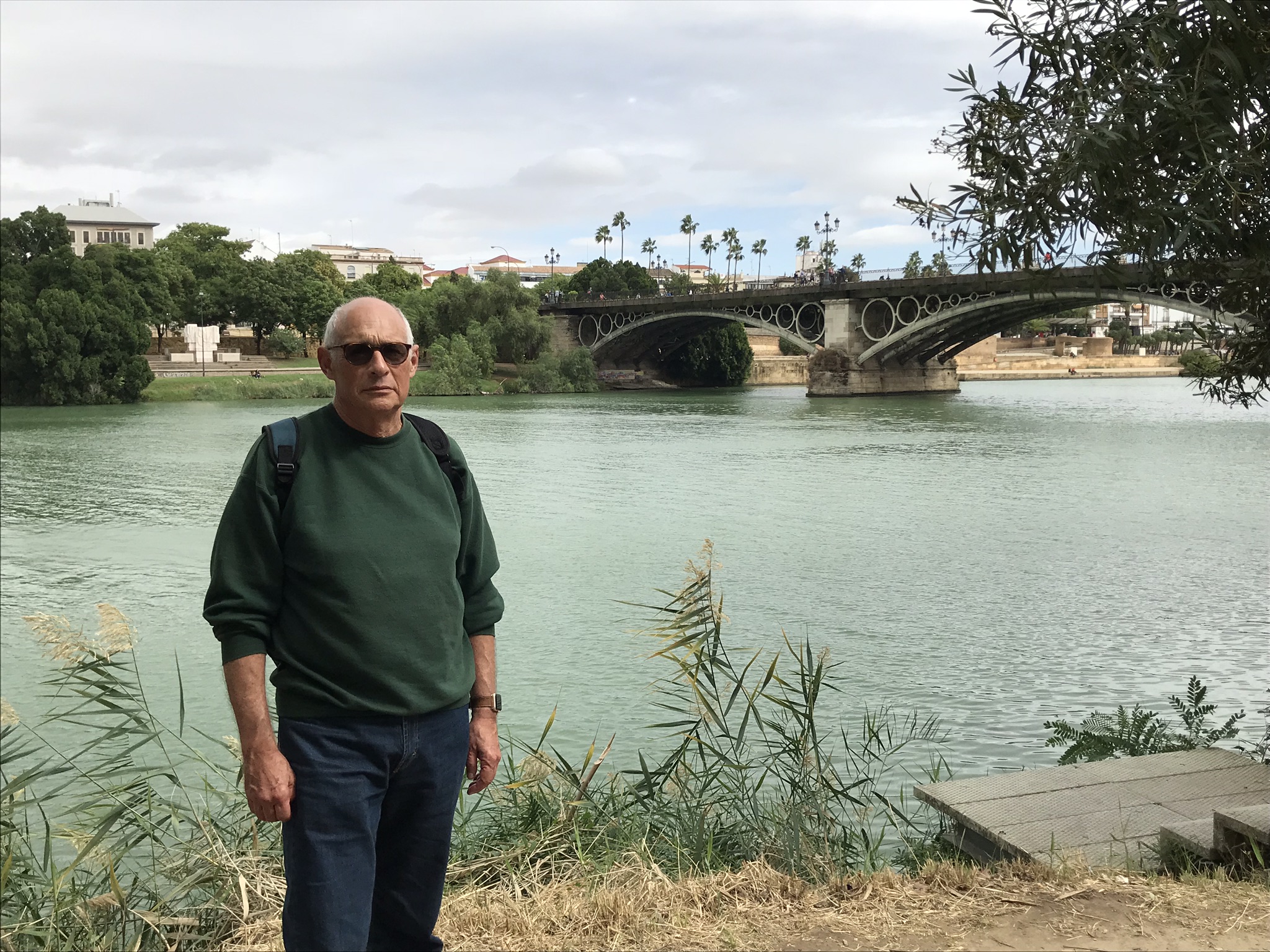
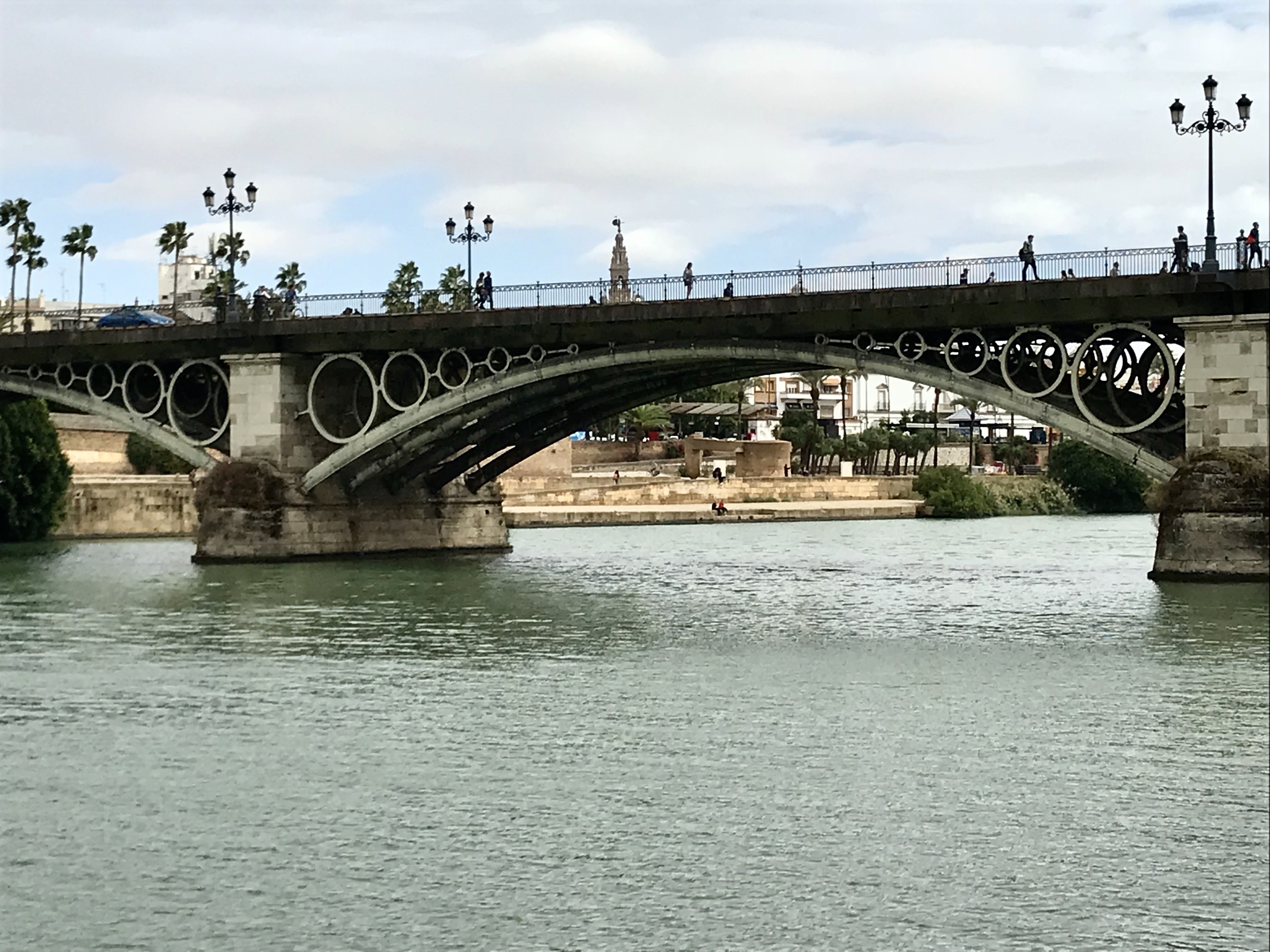
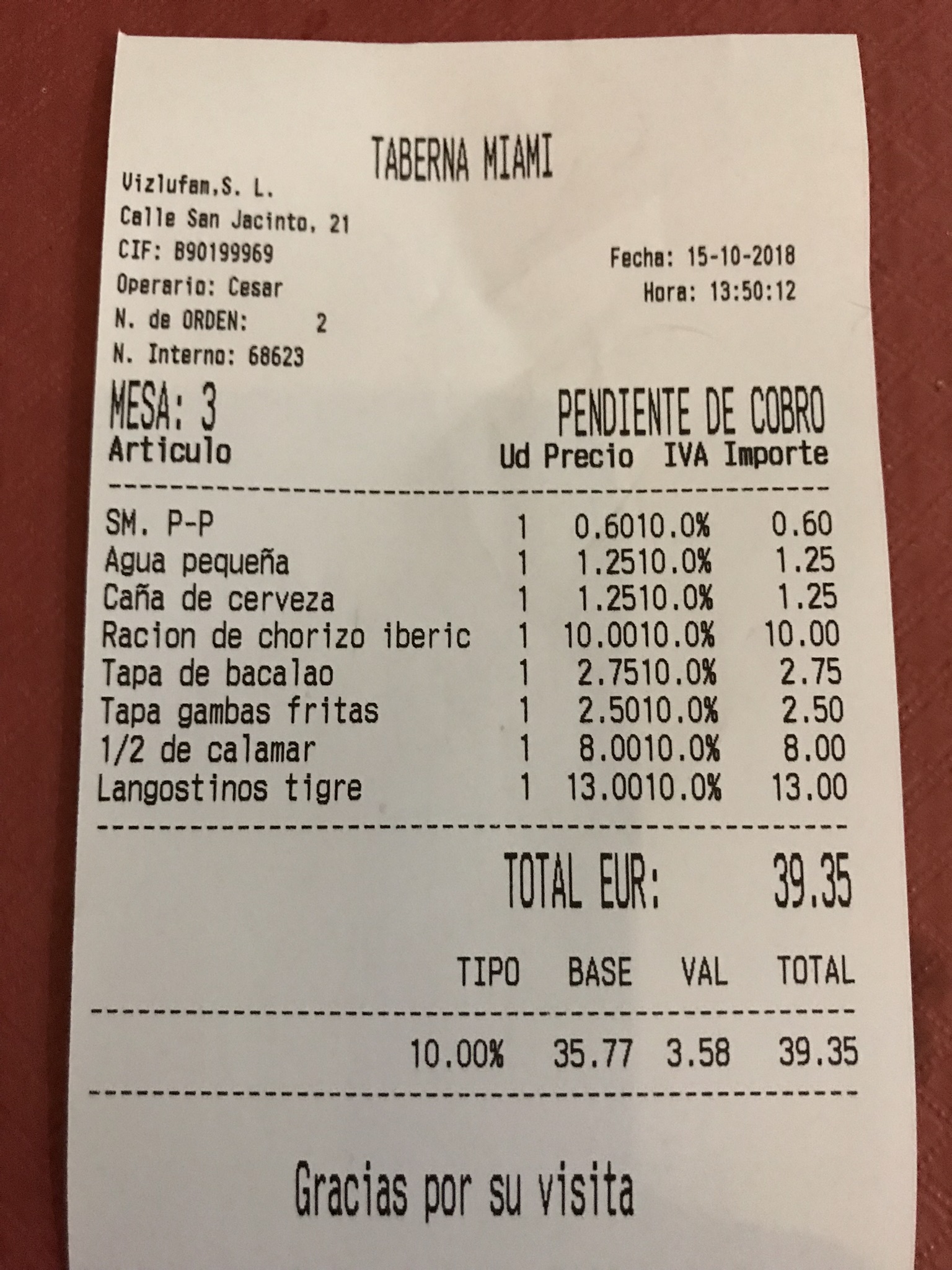
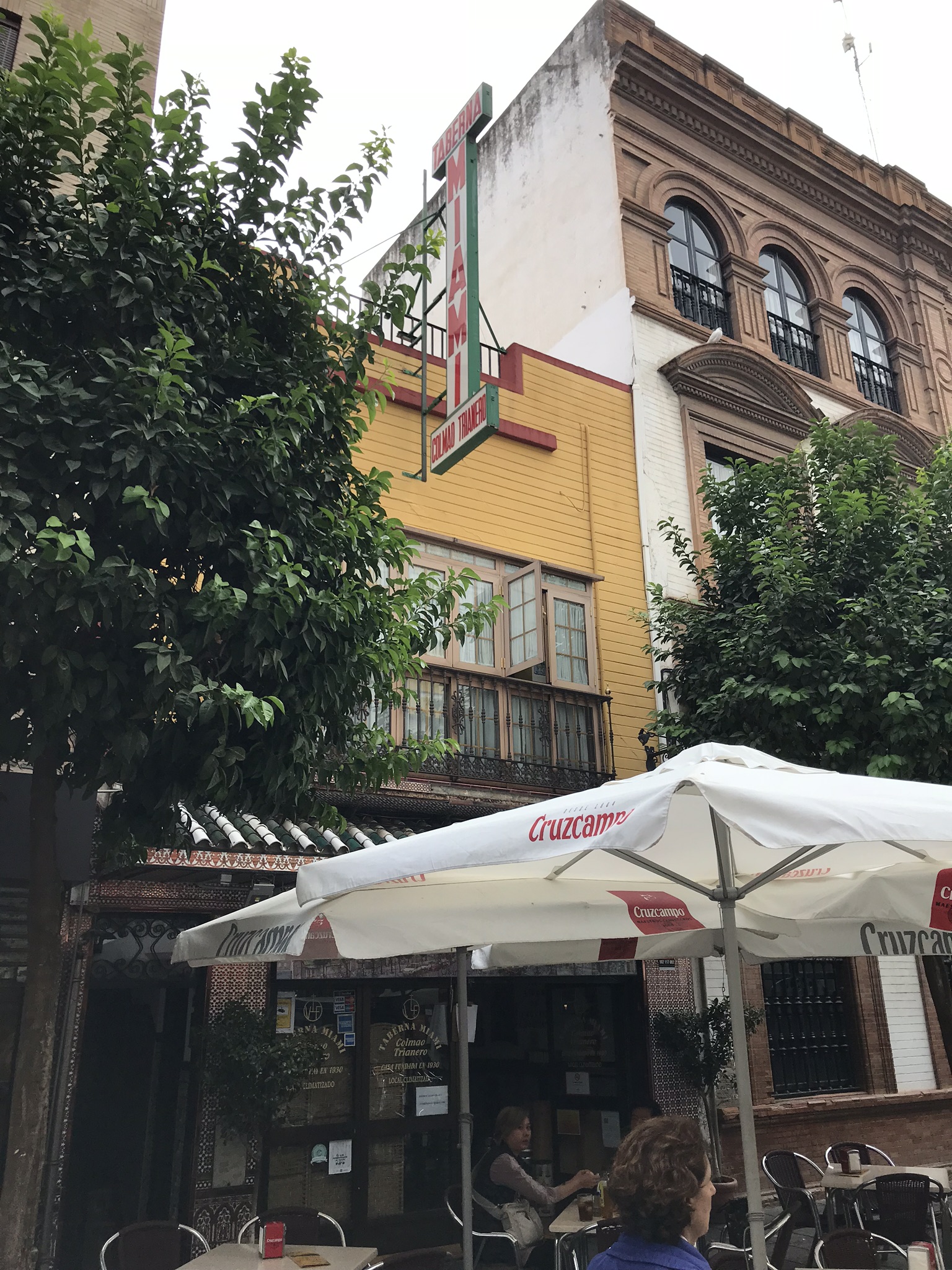
Our final gustatory highlight came in Triana, the city across the river. We strolled across at lunchtime and settled on a Rick Steve’s suggestion of Taberna Miami, an old bullfighting themed place that promised to be “reliable for seafood” and sits in the middle of the pedestrian zoned street in the middle of centro historico. We were so hungry and just started ordering, again attempting to not overdo it by getting the tapas size of everything.
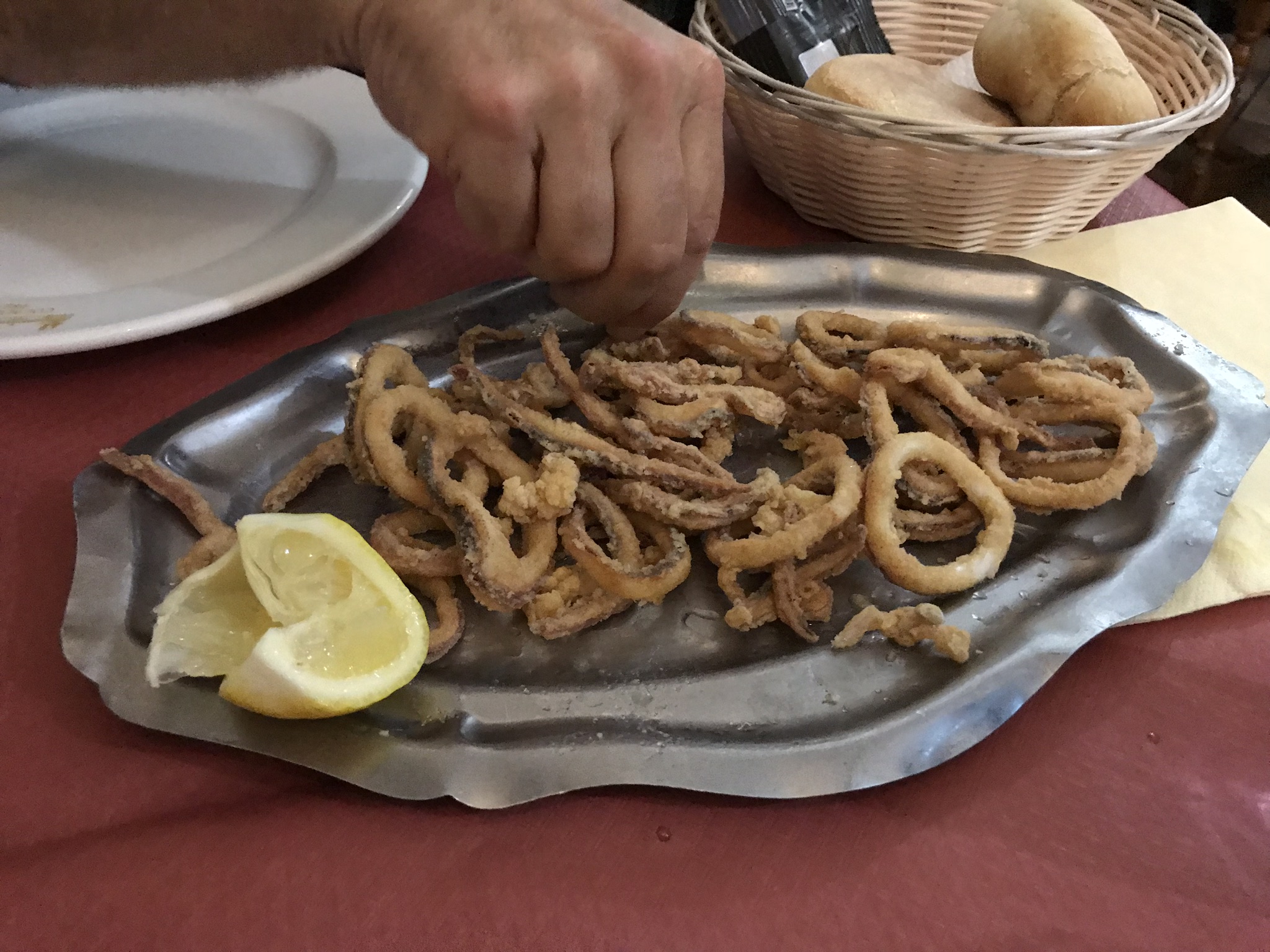
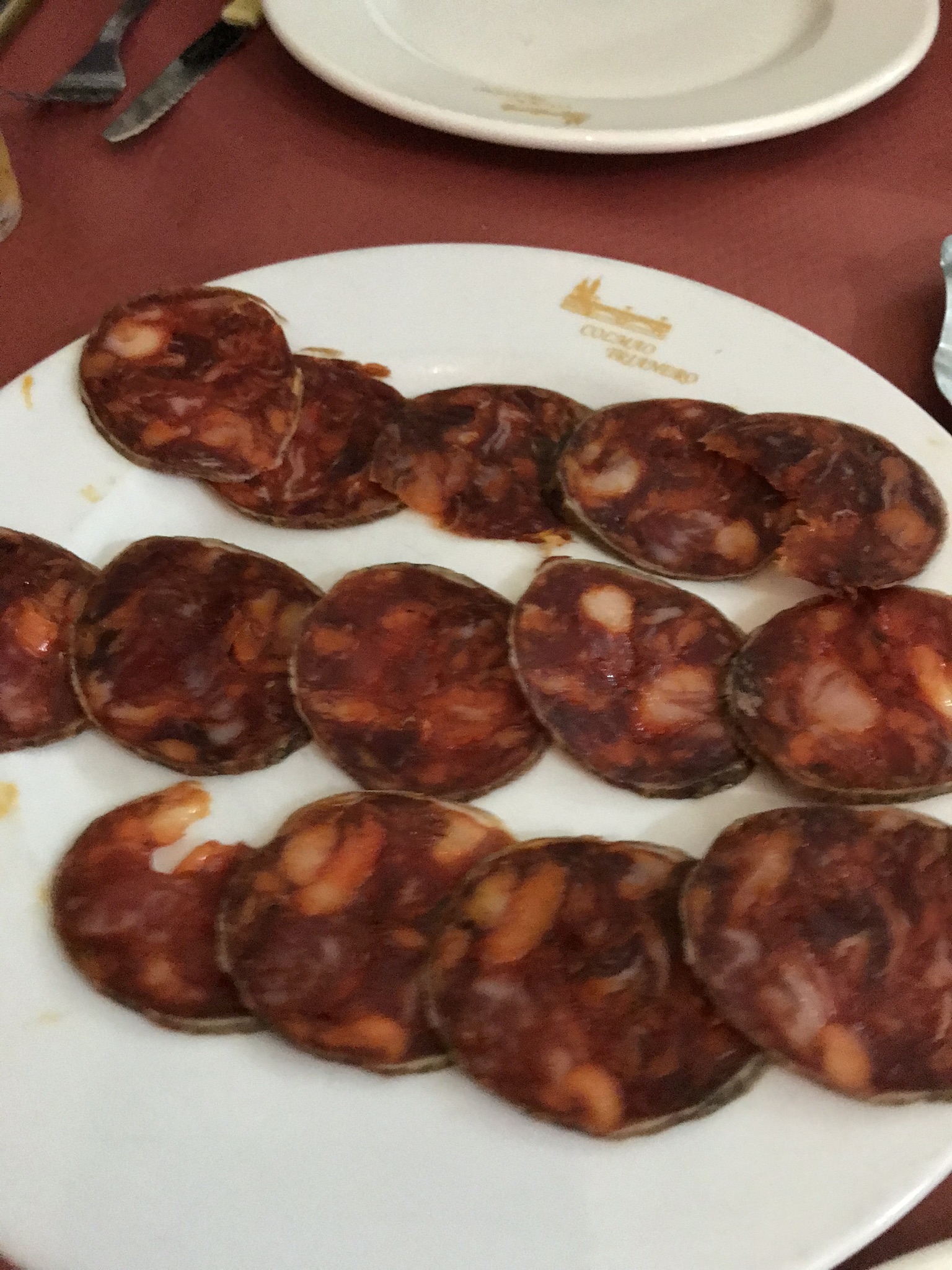
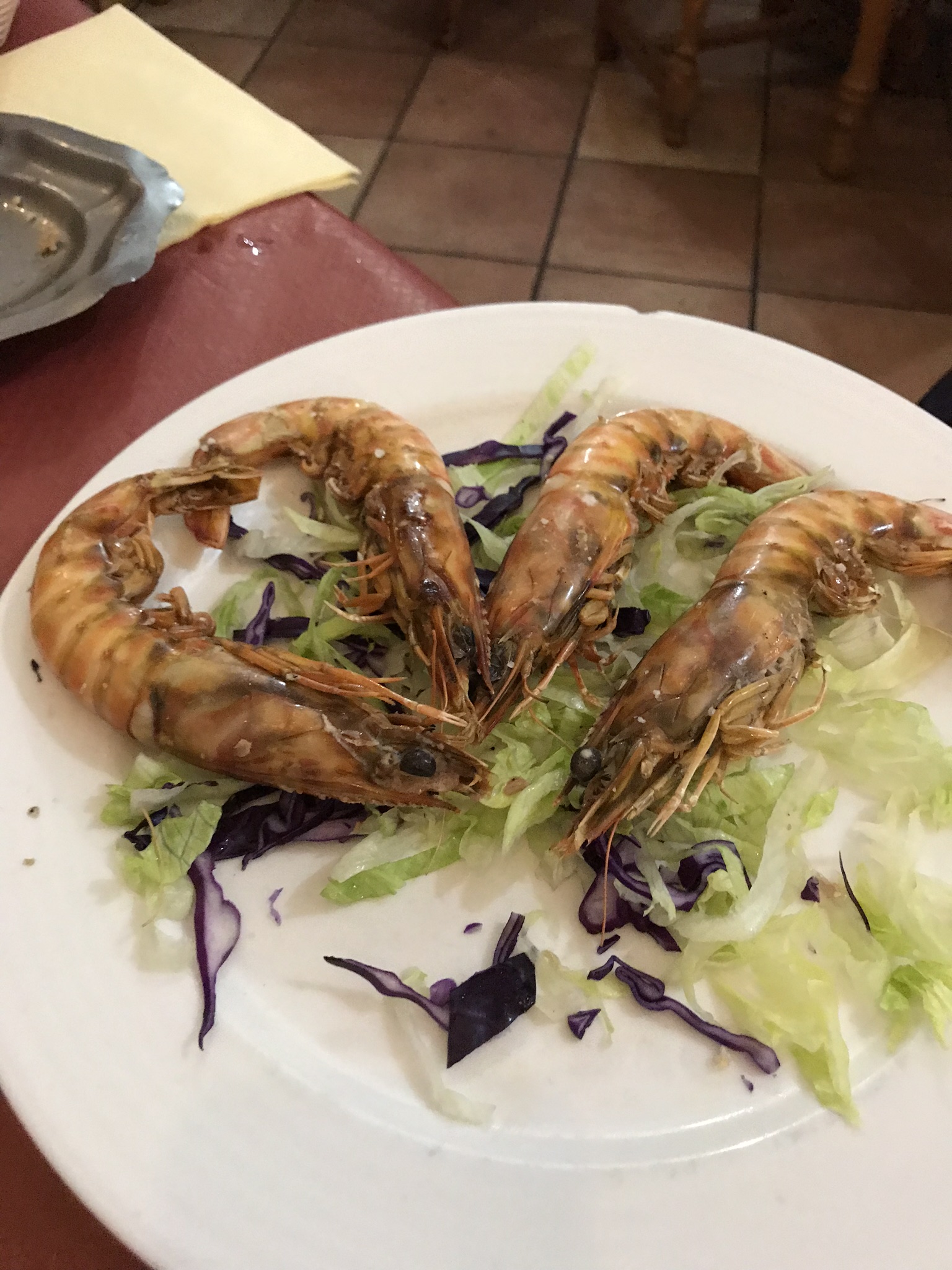
Little whole fried shrimp, crunchy shells and all; a huge platter of fried squid rings that we had eaten half of in a few minutes; grilled tiger langustinos that tasted like lobster and were challenging to peel; a platter of sliced chorizo; and fried bacalau so tender and flavorful we judged it the best we have had, and we have had a lot. With David’s bear, total 40€.
p.s. Returning from our day trip to Córdoba we stopped at a random place in the new city because they had a sign out front advertising paella. Sounded soooo good, so we had the mixta. YUM! With beer, two glasses of wine, and a salad, 20€.
Our first evening we were so tired…and so hungry. We started out for a restaurant our host recommended but en route came upon Mercado da Baixa…as mentioned above. I said it was fun and good and I meant it! to illustrate:
Tuesday night we did make it to the host-recommended restaurant, Cerqueira. We were a bit early and the only customers: sitting at the next table was the owner’s young boy, mesmerized by the soccer game on the TV, cheering his team’s two goals. We had grilled fish, David the bacalhao, I the dourada. Oh, yum for 24€ with wine. Note I started to dig into my fish before remembering to take a photo.
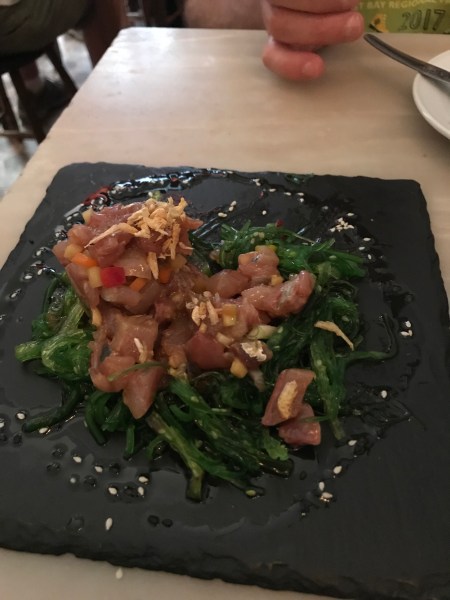
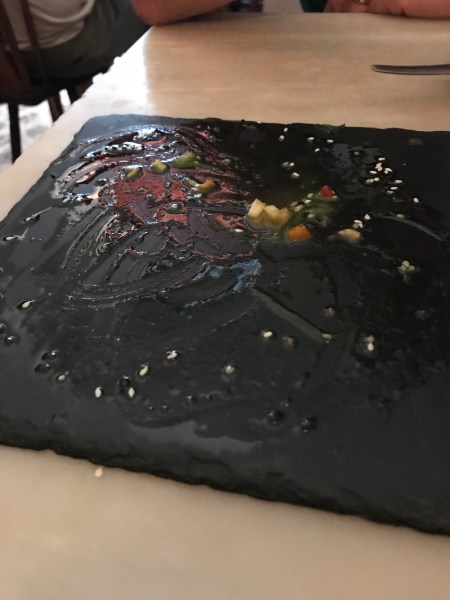
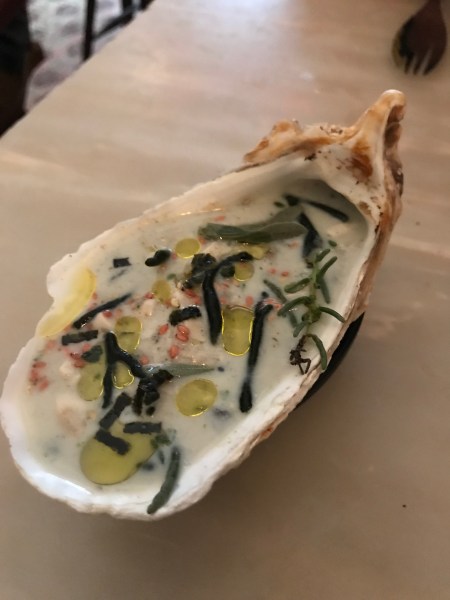
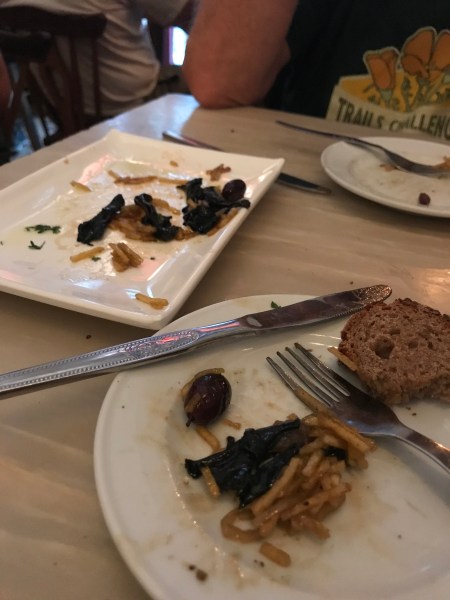
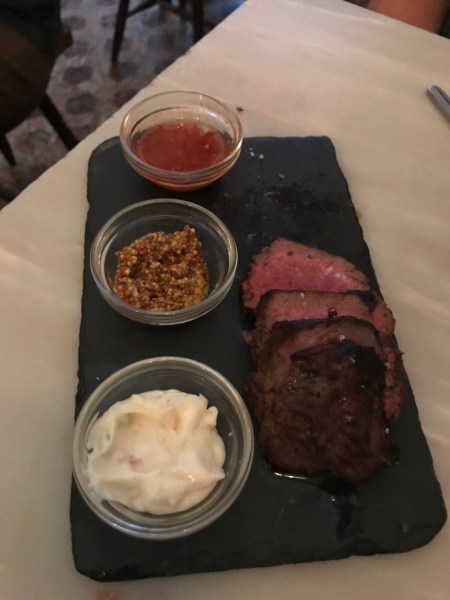
Wednesday we were at a loss. I looked at my “maybe try these?” restaurant notes and found one that was intriguing. A no reservation tiny place with small plates, which was a 15 or so minute walk from the apartment. We threw ourselves out the door, as it was almost 6 and after looking at Yelp (“I had to wait 2 hours for a table and am still giving it 5 stars…”) we didn’t think our chances were good. Got the last free table…and feasted. Honestly if we could have eaten another dish we would have, after the mackerel tartare, a spectacular raw chopped oyster thing in a mysterious broth, a mushroom thing, and cool slices of intensely beefy beef with 3 scrumptious sauces…and the lime mousse with white chocolate shards. (No picture of the mousse…we ate it so quickly!). With wine (they only serve Lisboa wine and locally supplied ingredients) the bill was 54€? Is that possible? Oh, yeah, and bread and olives to start (in Portugal these are never gratis.)
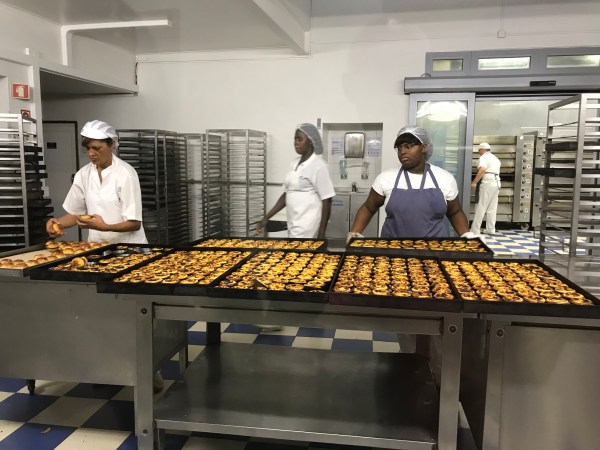
Thursday, we went to the famous Belém home of the ubiquitous pastry pastel de nata, Casa Pasteis de Belem. While they are scrumptious everywhere, here you eat them still warm from the oven. Oh, my. David also had a chocolate eclair which he loved and asked me to learn how to make choux pastry.
To round out our Belém experience we shared an enormous hot dog from a stand on the water because we were fascinated with the combination a customer ordered–crispy potato sticks, then ketchup, hot dog, mayo, mustard, and more potato sticks. Quite satisfying, and we knew we had a treat waiting for dinner…
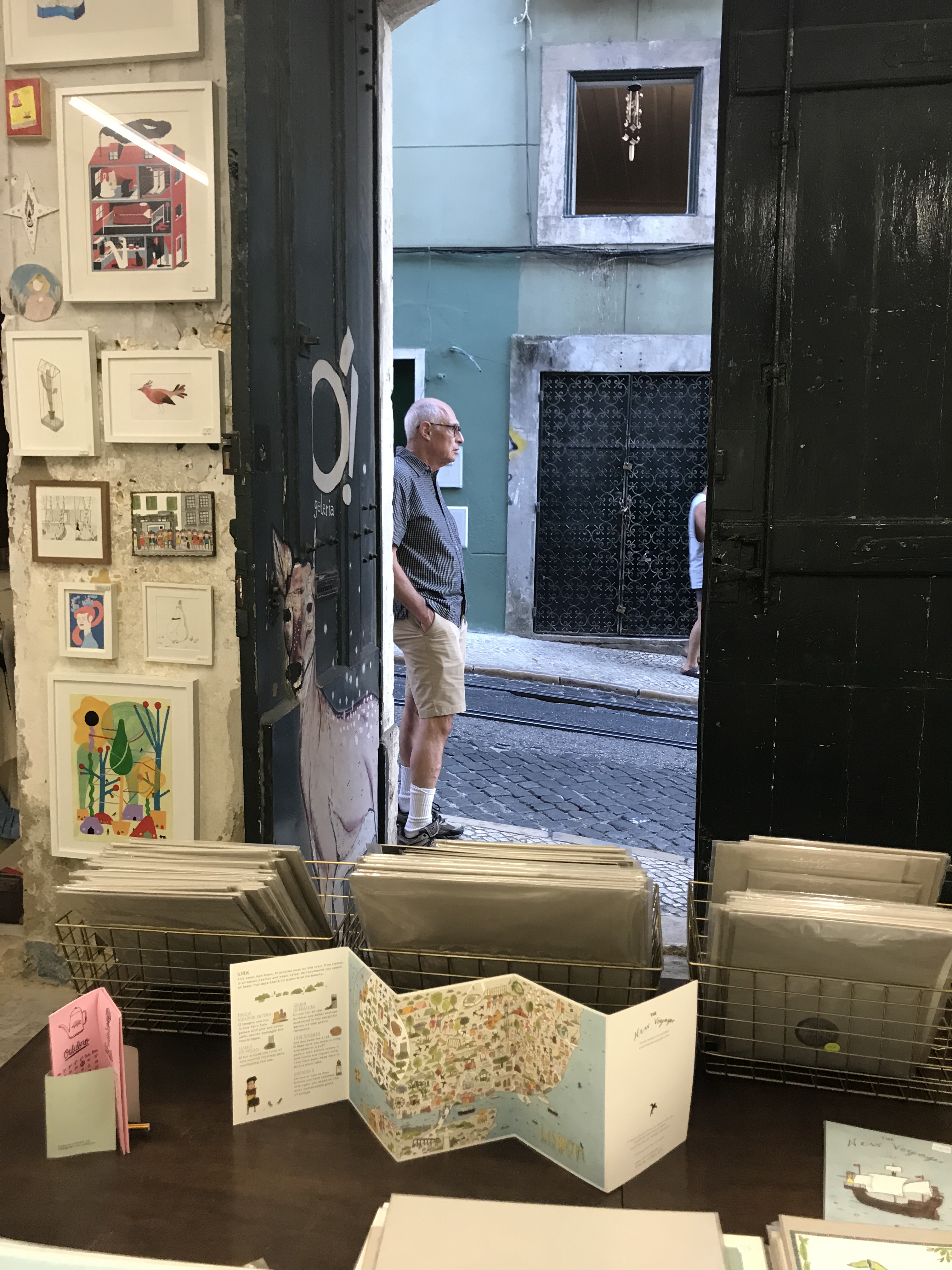
Our final dinner in Lisbon was our only reservation which David made online before we left the States. Friend Laura (thank you Hannah for having Laura in our lives–not only for travel advice!) suggested Leopold, a 20 seat gem run by a husband and wife team who offer a set course and one seating a night. An uphill walk from our apartment turned out to be especially fascinatingly diverse, charming, and artsy in turns. We missed our street but had given ourselves plenty of time to wander and it was a lucky miss because it took us to a hilltop view complete with a Mozambiquian band, outdoor bar, women in headscarves and hip folk with kids…we paused a bit and enjoyed the scene before we realized we were headed in the wrong direction.
A few pictures from our walk up:
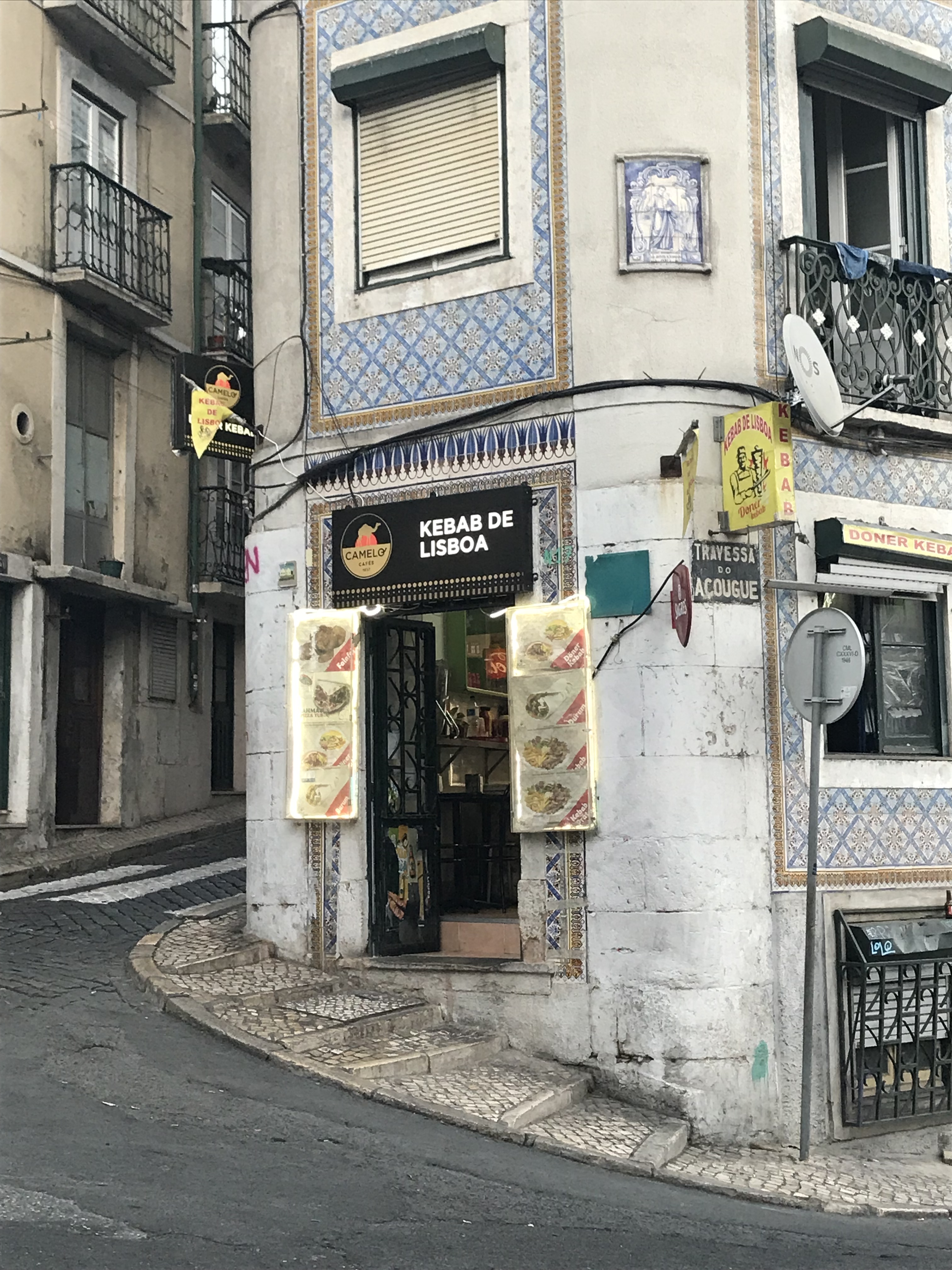
Is there a city on earth that doesn’t have a kabob restaurant?
We easily corrected our route (again, hurrah for Google offline maps) and arrived 30 minutes before our reservation. As we stood looking at Leopold wondering if we were even too early to enter a woman stepped out, said “Catherine?” In we went. Started at 7:45, left around 11. ”Twas a great meal and great wine. Toddled down the hill and fell into bed.
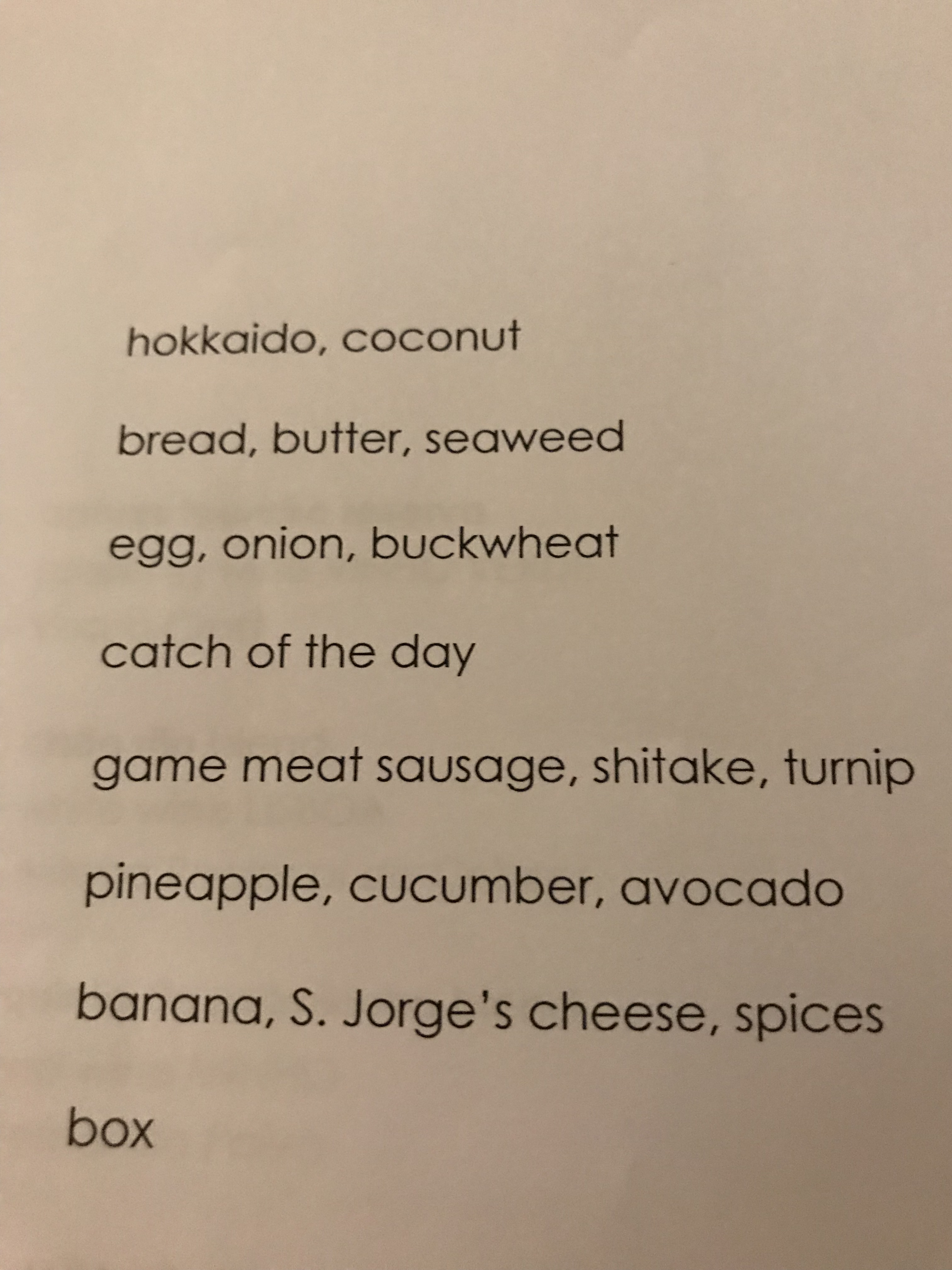
I include the menu because the food was not at all recognizable (a few photos below). Wine pairing was really fun. The first was a truly flavorful sparkling wine (all were Portuguese), the vinho verde marvelous, the first red blend we loved (second one less so) and the fortified wine very much like a Madeira. All were surprising and creative!
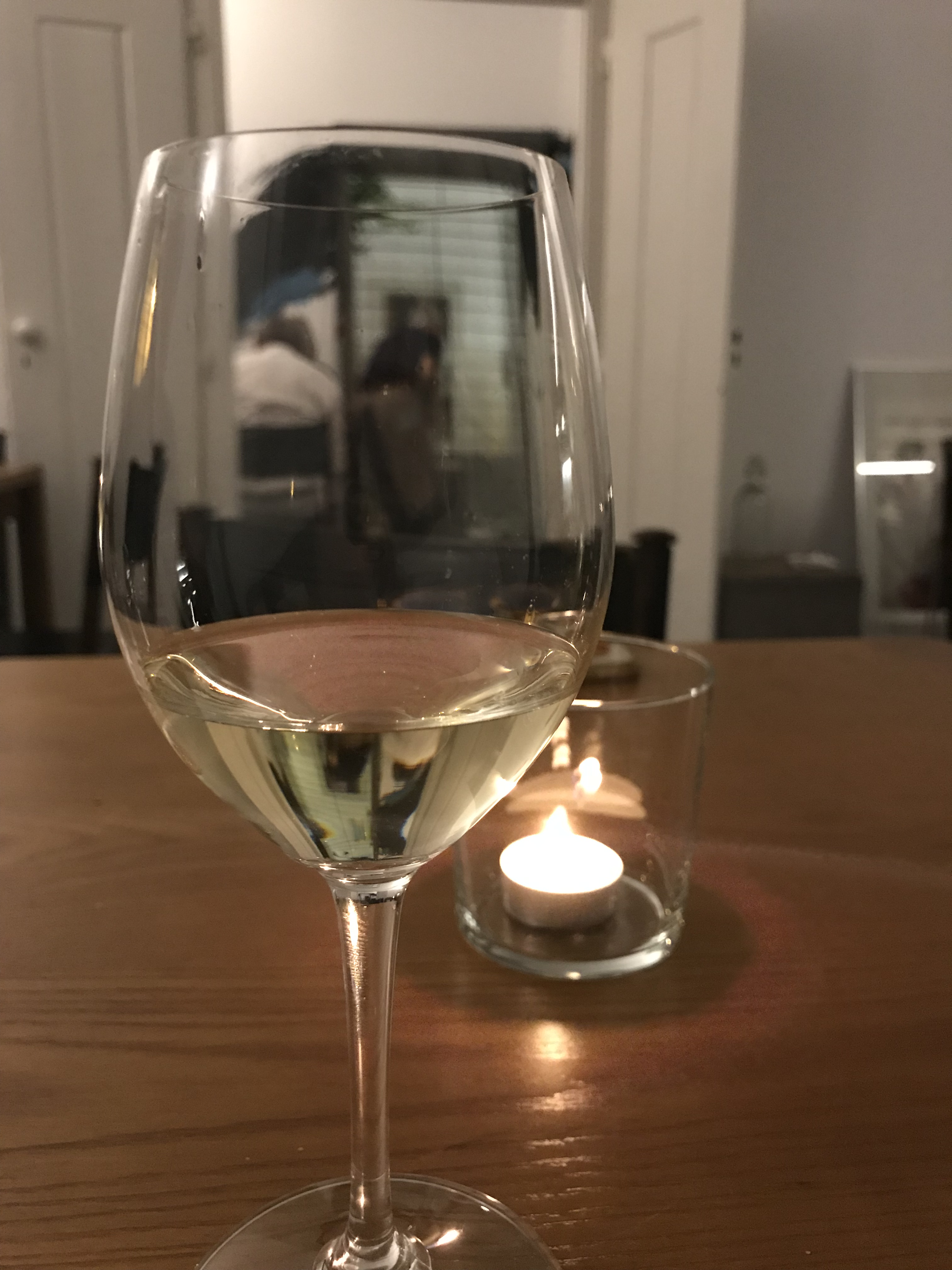
I did take a photo of the vinho verde because it was virtually colorless!
I repeatedly forgot to take photos, but here is what I did manage to capture. First, the place. Yeah, it filled up but we had it to ourselves for a little while.
Okay, I missed taking a picture of the first course…it was a slice of a small pumpkin, charred, with a blob of coconut something or other with toasted coconut on top, and you dipped or spooned the blob onto the pumpkin. It was delicious!
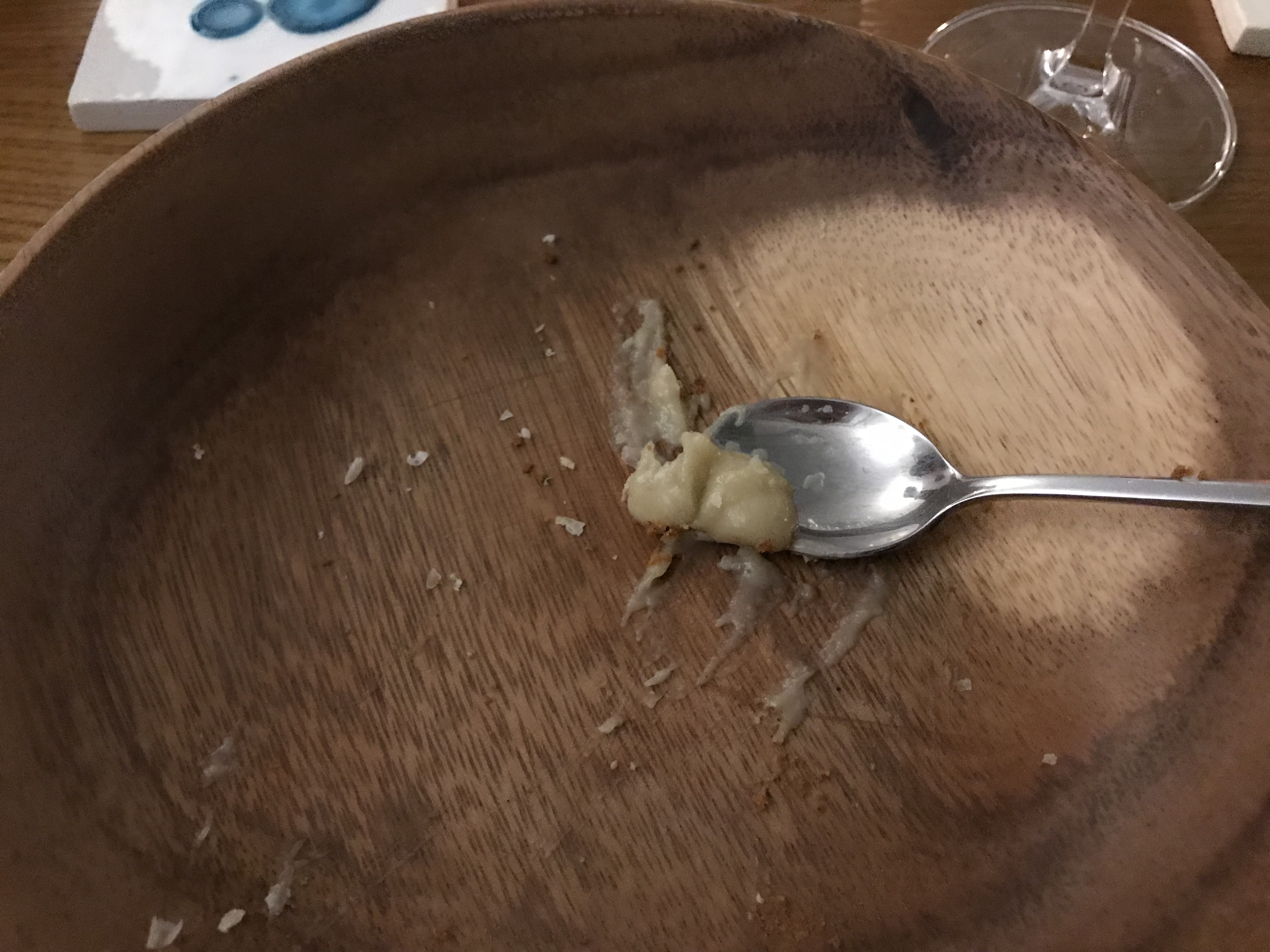
“Bread, butter, seaweed” turned out to be a small half loaf of sourdough bread made with dark beer (?), a butter so good it was how you think butter should always be…and we finished it plain when the bread was gone, and a chopped seaweed, capers, mustard combo to put on top. Yummy.
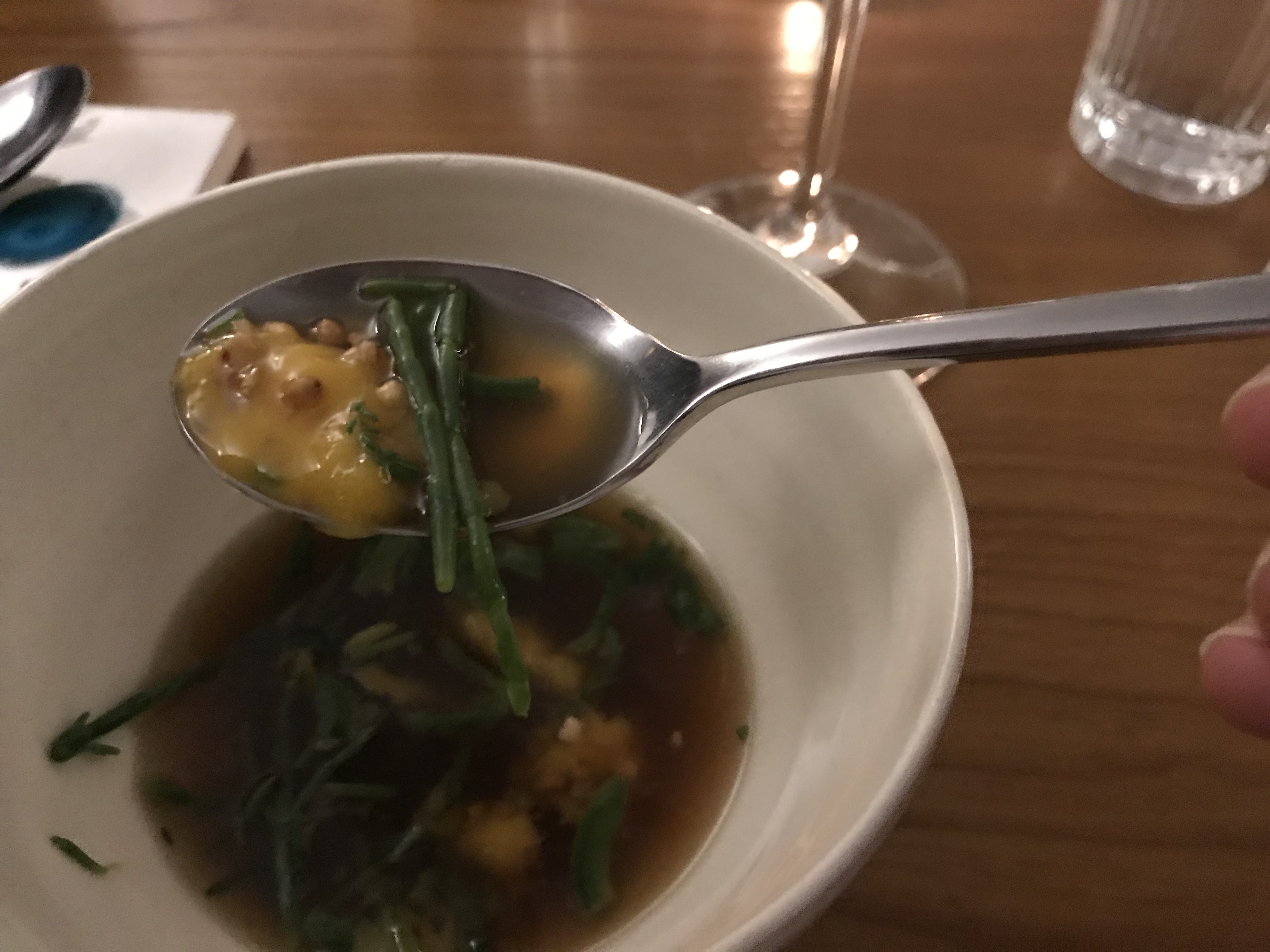
Egg, onion, and buckwheat was a soup with a slightly cooked egg yolk, crunchy toasted buckwheat seeds, and a clear broth sweet from carmelized onions. Doesn’t make for much of a picture but we ate every bit. Oh, the green things were crunchy and salty…reminded us of the sea grapes we had in a salad in Kyoto.
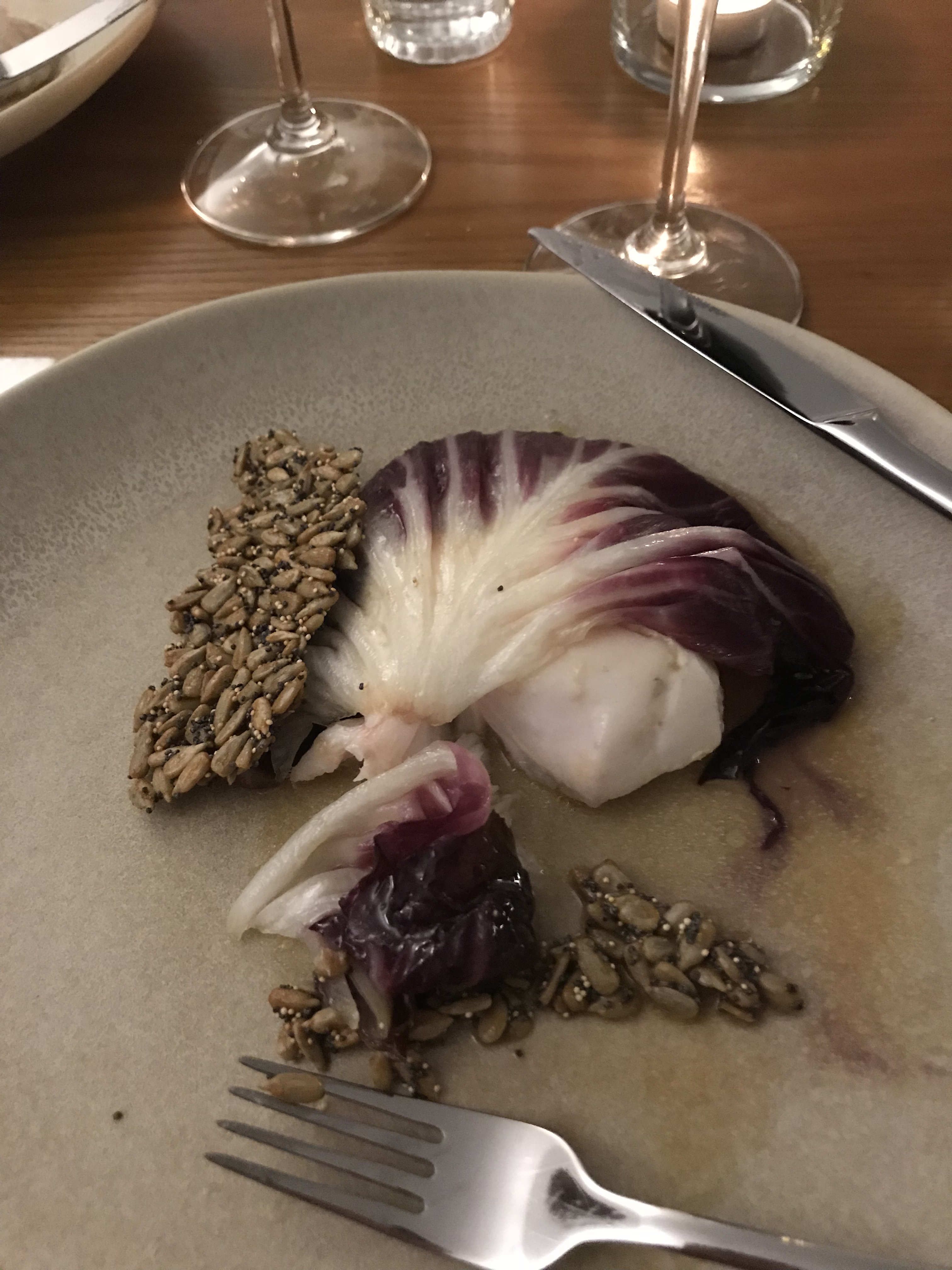
Catch of the day was grouper (local, natch) sooooo good and perfect with the red wine.
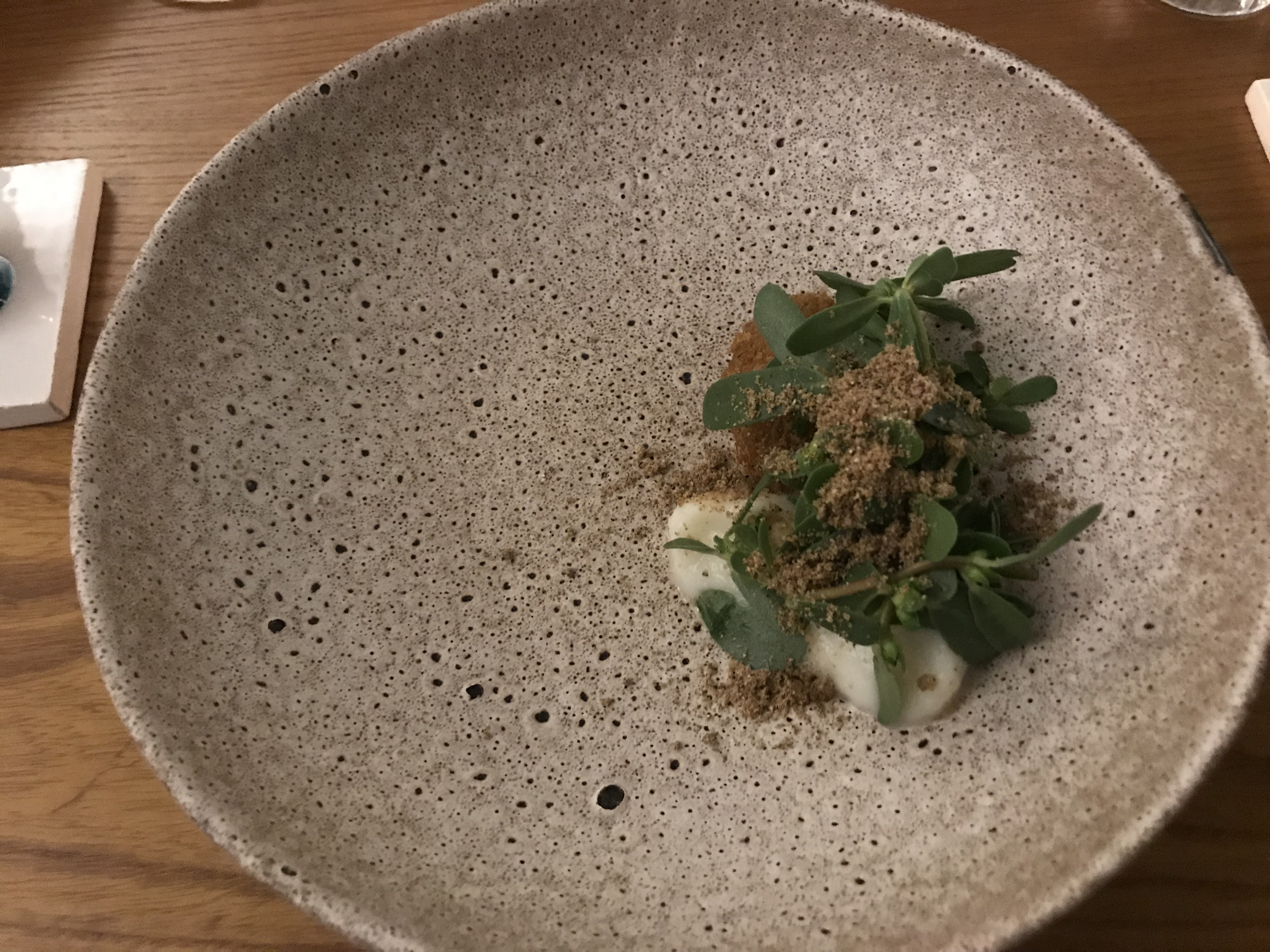
The meat course was a very soft sausage, intensely flavorful and topped with purslane and shiitake powder. Oh, and a turnip purée (the white stuff). We were getting full…
I forgot to take a picture of the banana, avocado, and something or other sweet…I blame the fortified wine. And “box” was an intensely sweet thing, the ingredients of which we cannot remember. Paid the bill of 170€. Floated down the hill. Went to bed.
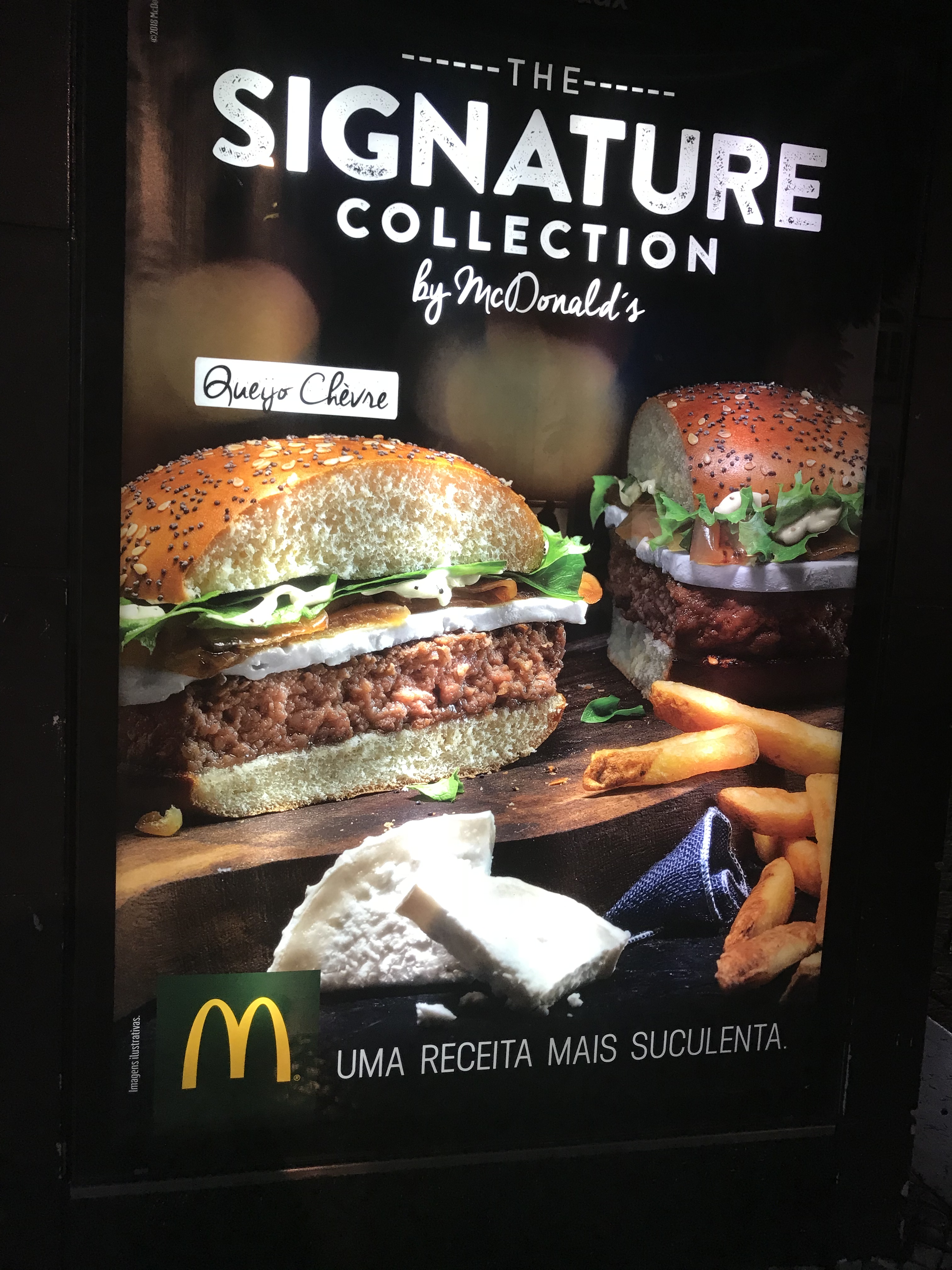
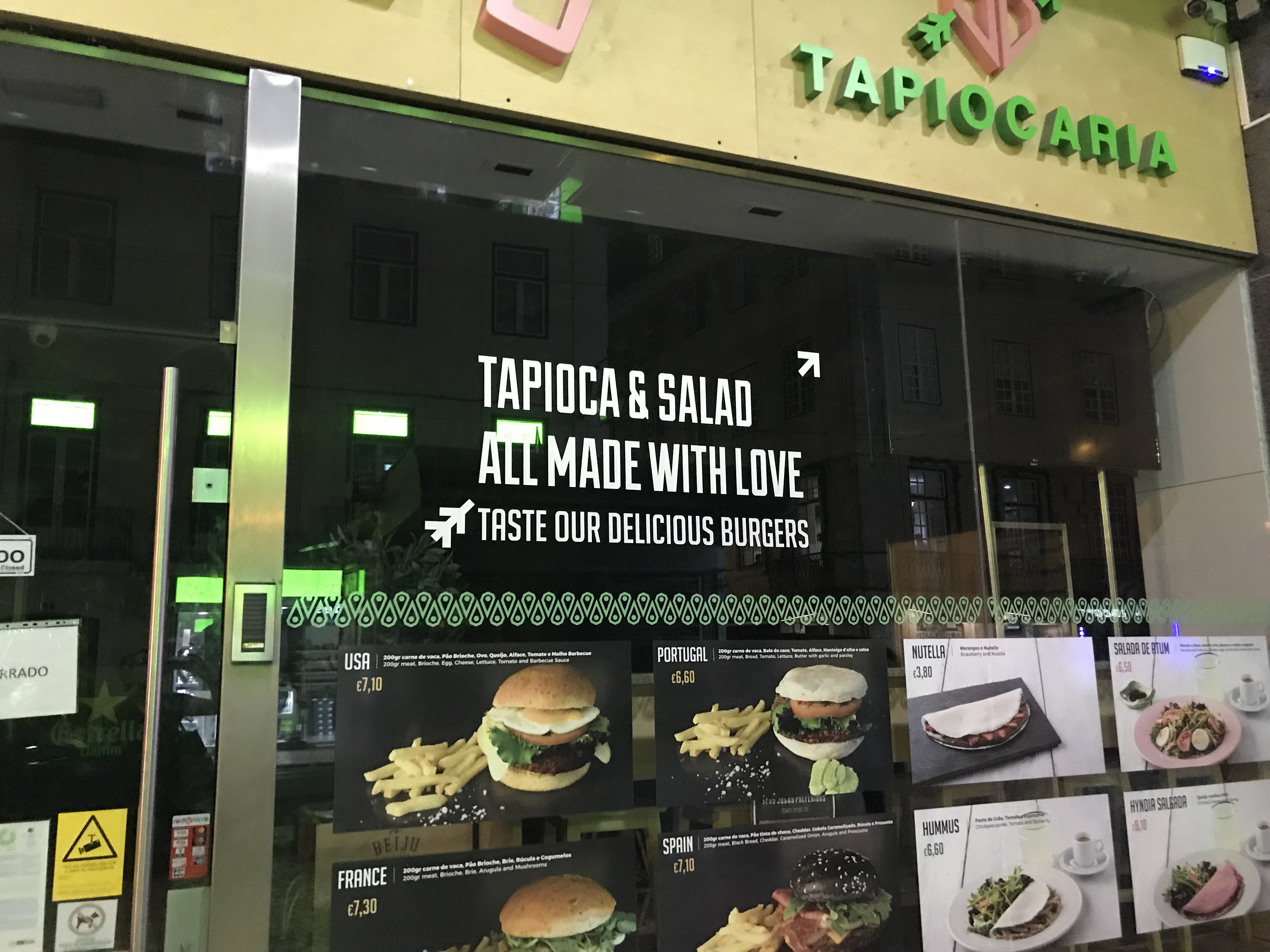
I didn’t know I was missing McDonald’s with goat cheese or burgers with tapioca…
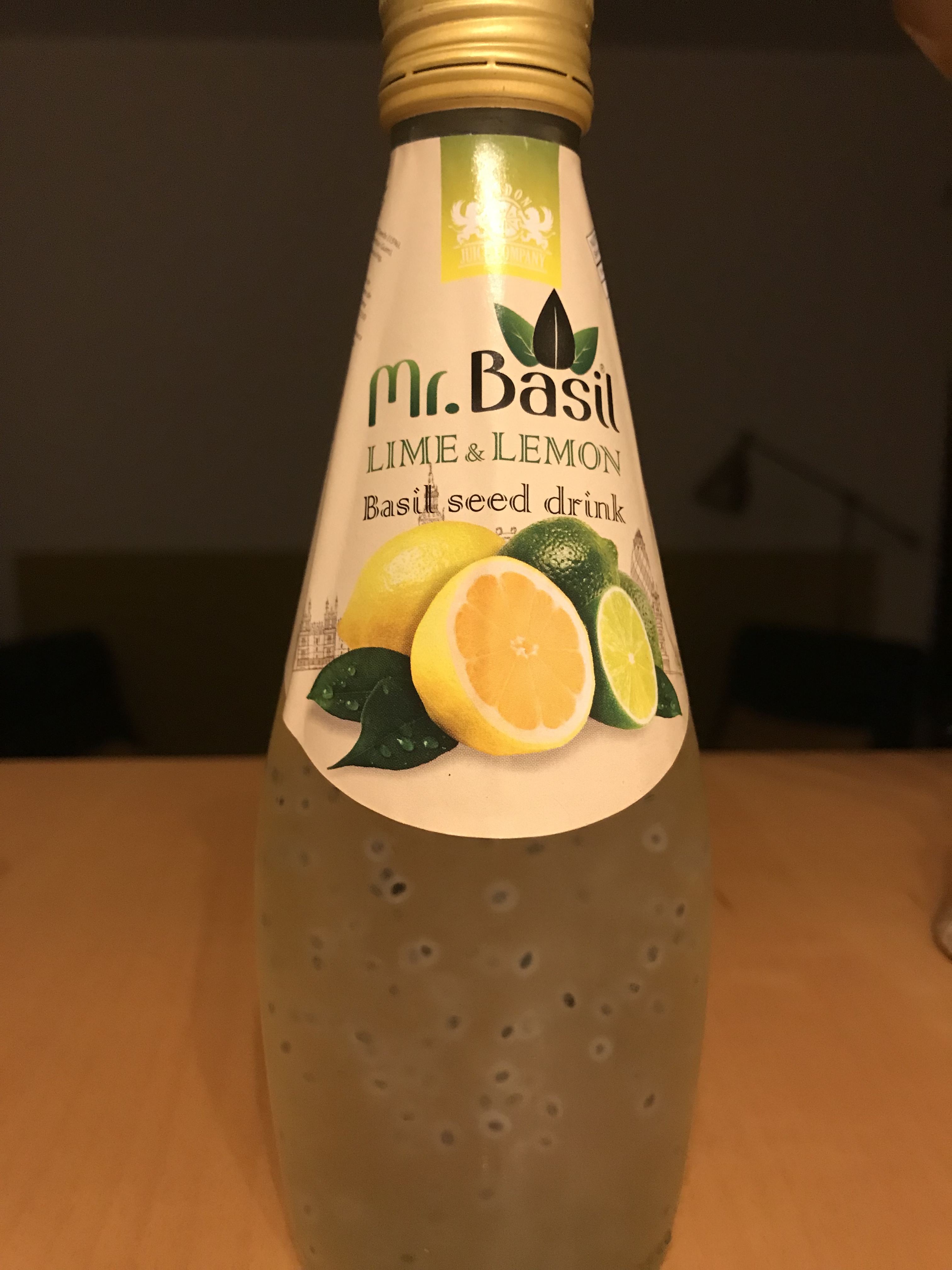
Yes, they have a full array of basil seed drinks…the seeds are sort of sour and gelatinous. Not quite as great as the jelly drinks we had in Korea but still fun.
We arrived on a very hot day, exhausted and headache-y, staggered into the metro which of course goes directly from the airport (oh, USA, when oh when will you get with the transit program in every city?), and were quickly at our stop. Free WiFi on the train platform alerted us to connect and get our map up. We had 2 hours to kill before our airbnb was ready, and with our luggage we could just squeeze into the restaurant across the way…taking 2 of the 12 seats in this tiny neighborhood hole-in-the-wall. Three small tables and three seats at the counter, and a steady stream of regulars in and out.
We had been advised to rely on Google translate for menu help. You open the app, select “camera” and aim at the page for instant translation. Wow. A few glitches…the second carne (meat) item was translated as “cub scouts.” We went with the fish.
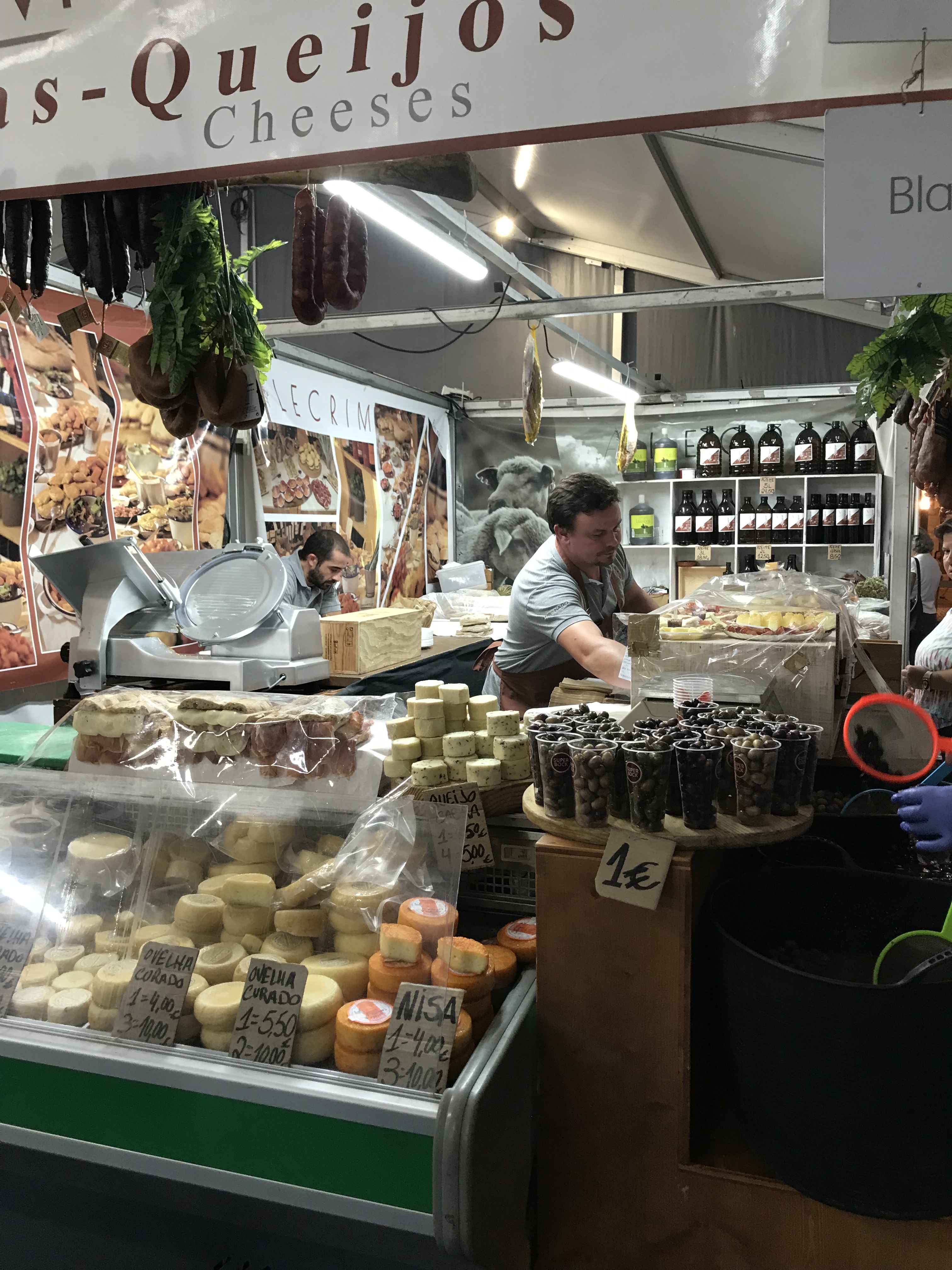
Our apartment is modern and sparkling clean…and after we met the host and she was finishing up cleaning (we came in as the previous guests were leaving) we fell onto the bed and were fast asleep in minutes–didn’t even hear her leave. Refreshed and ready to get our bearings we headed to a recommended restaurant but on the way encountered Mercado da Baixa, a cluster of vendors of food, wine, sangria, crafts, and jumping with locals and tourists. It looked like such fun and we were so hungry we dove in. Little plates of cheeses, meats, bread, some with tiny cups of fruit jam to spread on the cheese, sandwiches of ham and spread with strong white cheeses, cups of olives, all sorts of nuts and dried fruits, recorded fado serenading the noisy eaters, boys on skateboards, German tourists drinking teeny cups of orange liqueur chased with huge glasses of beer…on a still hot evening it was a welcoming and welcome party.
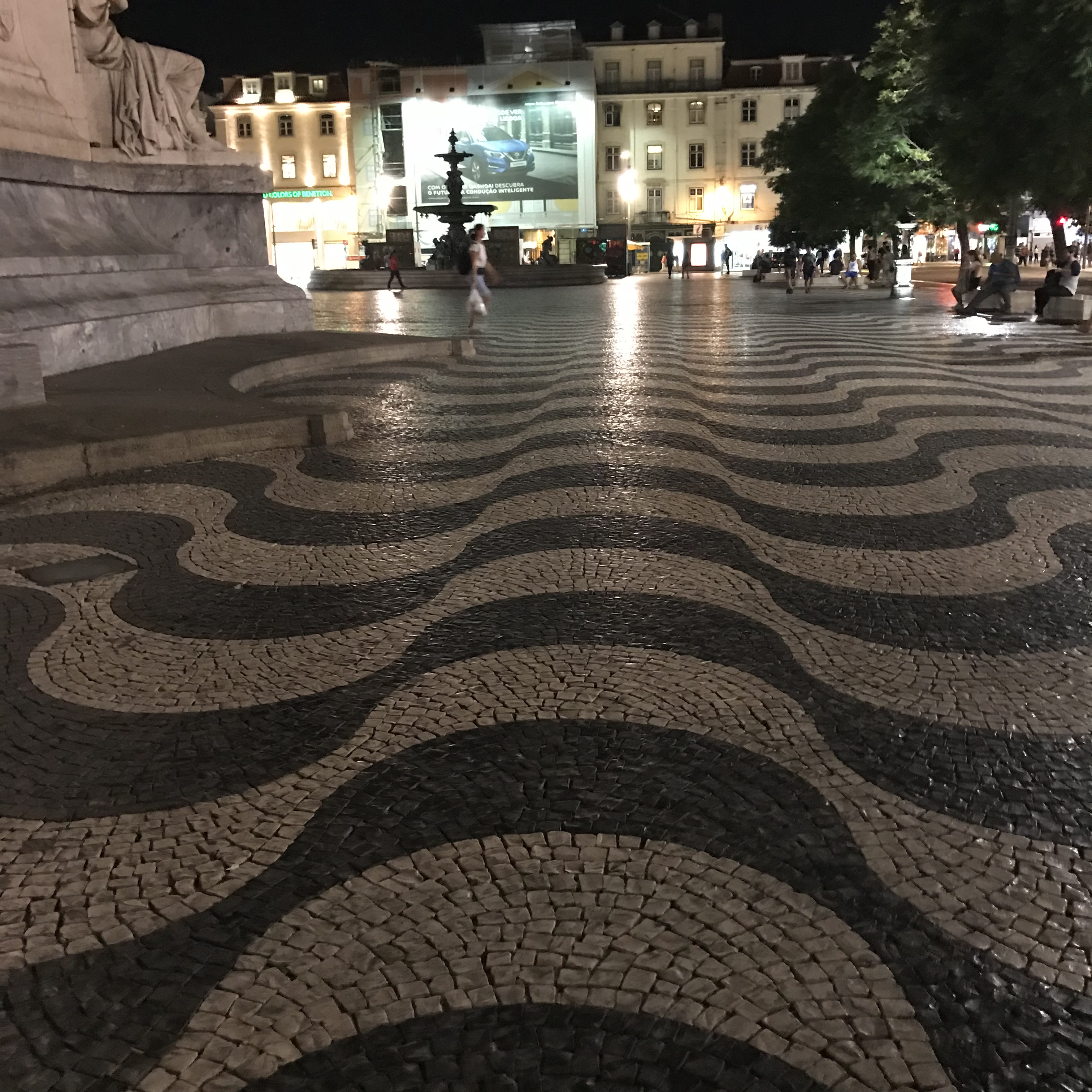
After food and alcohol we strolled a bit. Yup, the cobbled streets and mosaics are amazing to look at and a bit treacherous to walk on. The patterns change by streets, sometimes by the block, and they are in mixed repair and often rather slippery. Another reason to be glad we have backpacks and not roller bags…most older tourist couples struggle to maneuver and we do feel especially smart. Thanks to Hannah and Mark!
The beautiful Rossio train station. We will be back when we go to Sinatra.
After a bit of sangria these waves were disorienting!
The National Theater.
A typical street downtown.
We headed home and took a pedestrian walkway which looked perfect on the map but was a seemingly endless climb, finally depositing us on the street where the recommended restaurant was…it looked casual, friendly, and delicious so we will eat there our second night.
Welcome to Lisbon. Now, to fall into a long night’s sleep.
The last time we were in Japan we ended a long hot day of a fantastic river trip in this little town which we saw a bit of and then hopped the train back to Kyoto. All we had seen that time was a pretty place of tourist shops—and we were quite tired!
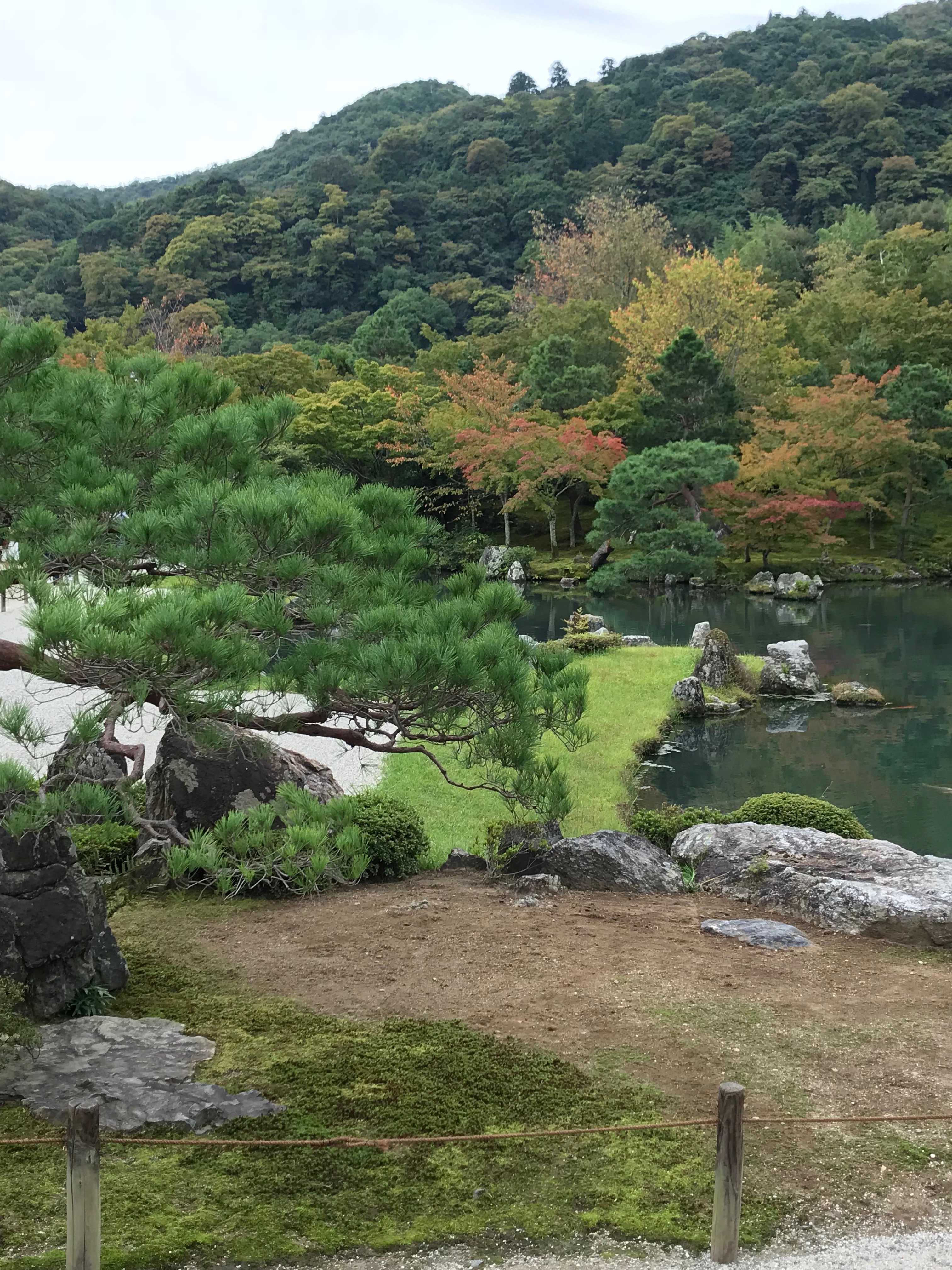
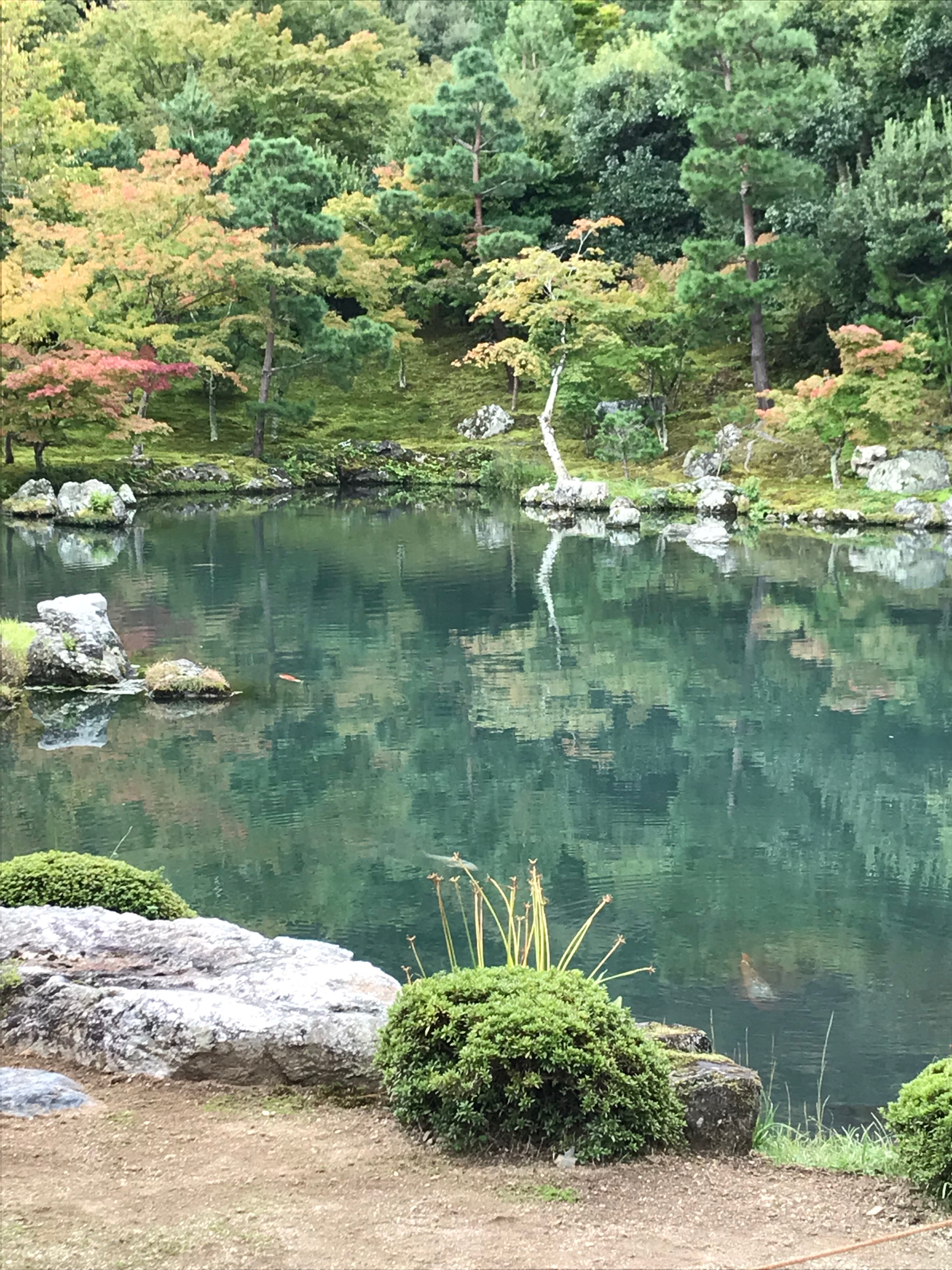
Searching for a final day’s excursion we decided to give Arashiyama another try. I swore I had seen enough temples for a lifetime, that they were all beginning to run together, but we didn’t have a better idea so hopped on the train and 15 minutes later were there. After reinterpreting the tourist map near the station, which of course had North pointing down, we started in on a recommended walking tour. The first stop was Tenryo-ji and paid the $8 to see both the temple and the garden, an extremely famous and popular spot that was, for an off season Saturday, full of tourists. Let’s see why it is so popular:
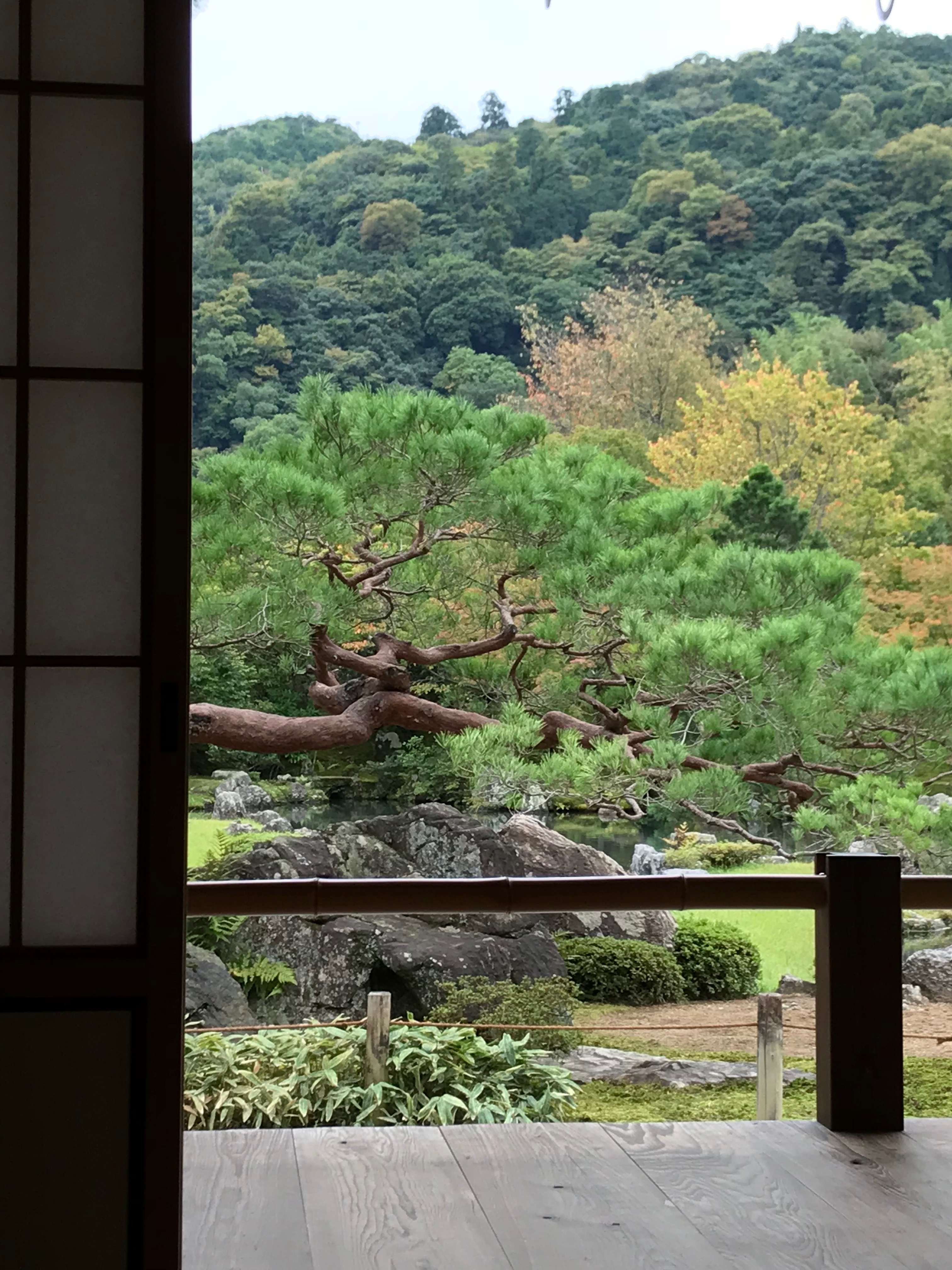
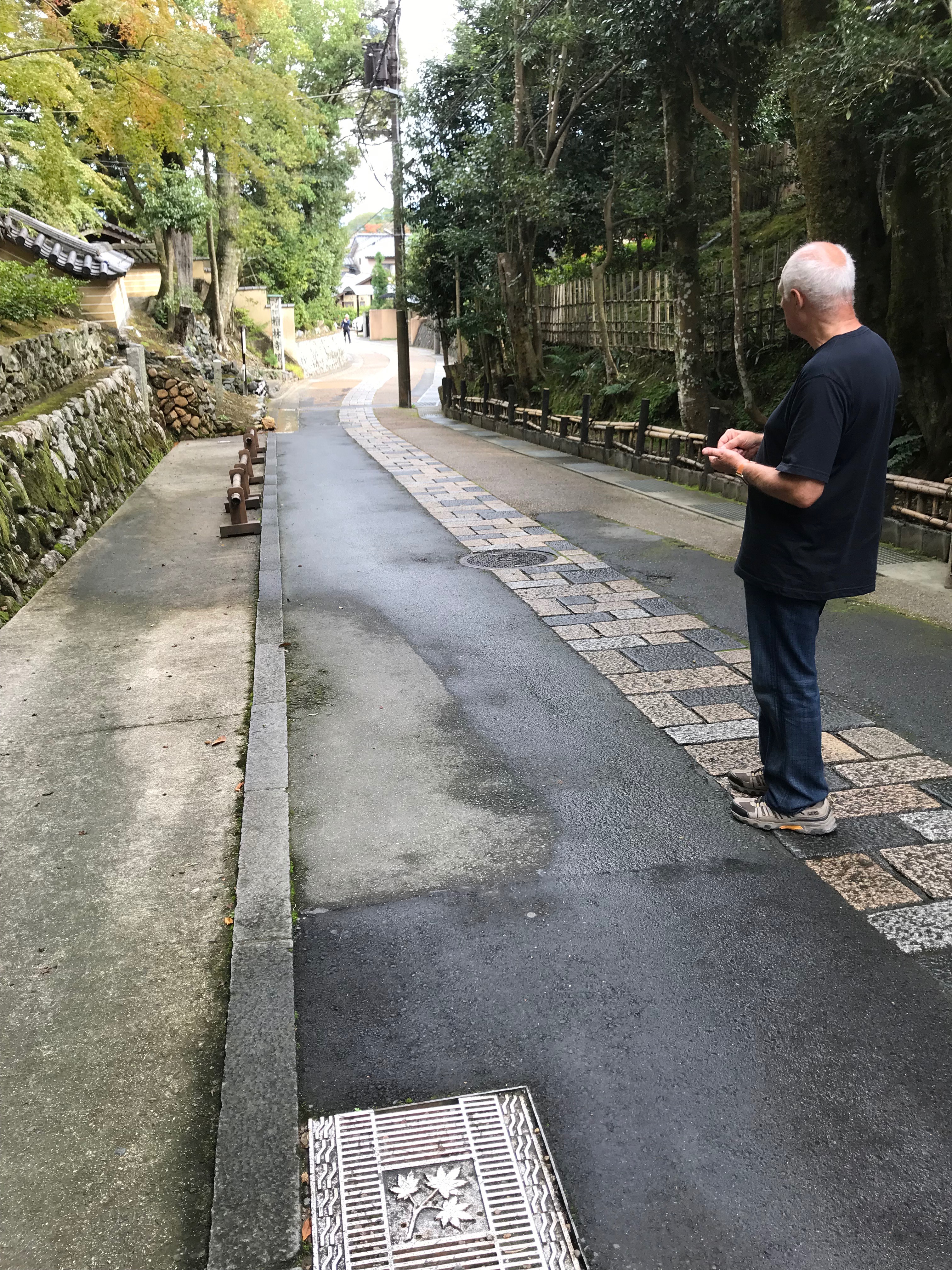
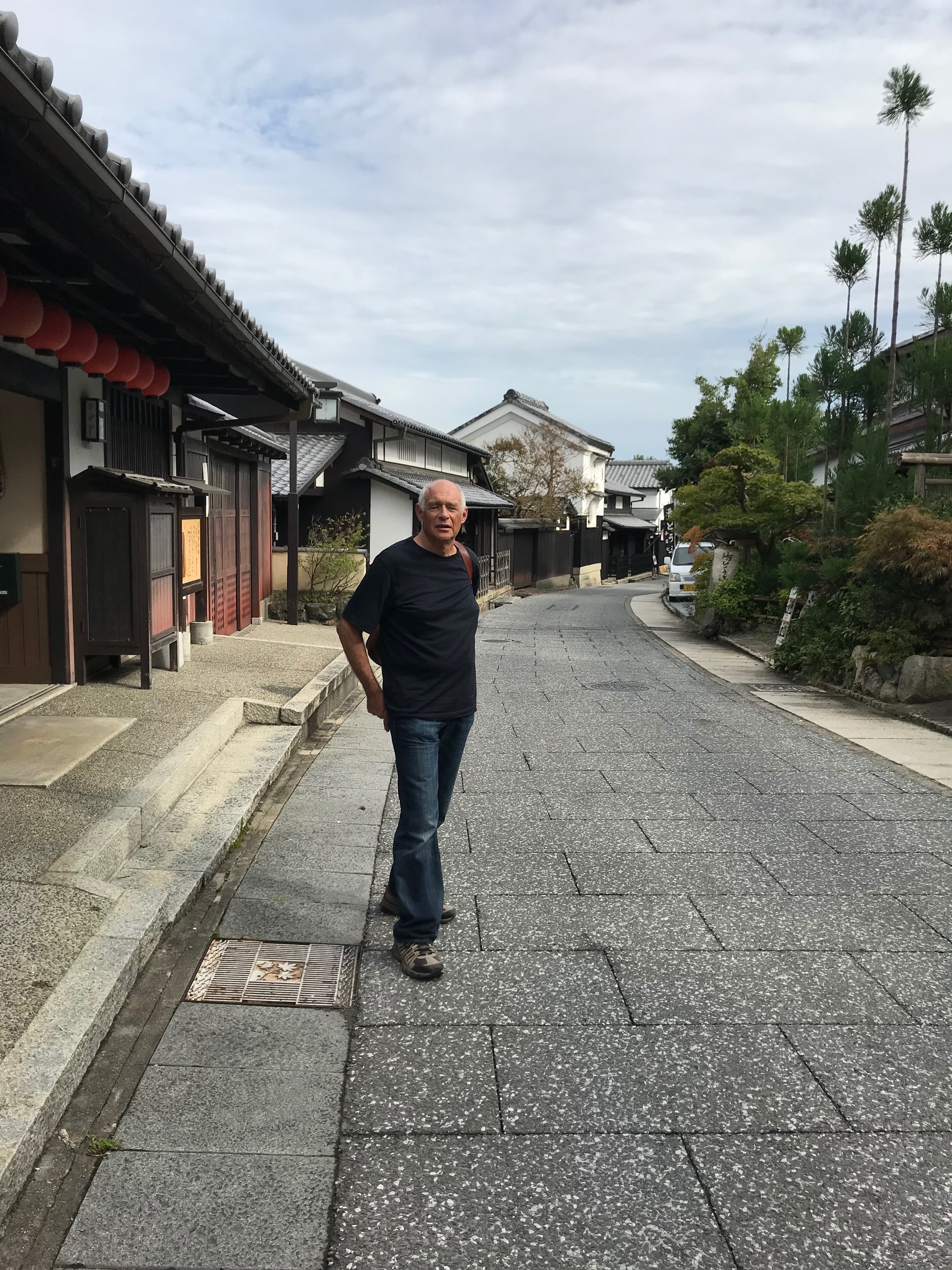
I could call this “suggested wallpaper/screen savers” and I suspect David and I will be rotating several of these for just that. While we were there we saw gardeners working, sitting or kneeling pulling up the tiniest weeds and raking up, with mini-bamboo rakes, the smallest leaves. Their care certainly shows. The north exit of the temple takes you right into the famous Bamboo Grove, which is pretty cool but was also filled with visitors taking pictures. We walked through but kept going, and as the route goes gently uphill, and the day was cool and a little drizzly, we were rewarded for our energy by ever dwindling fellow visitors.
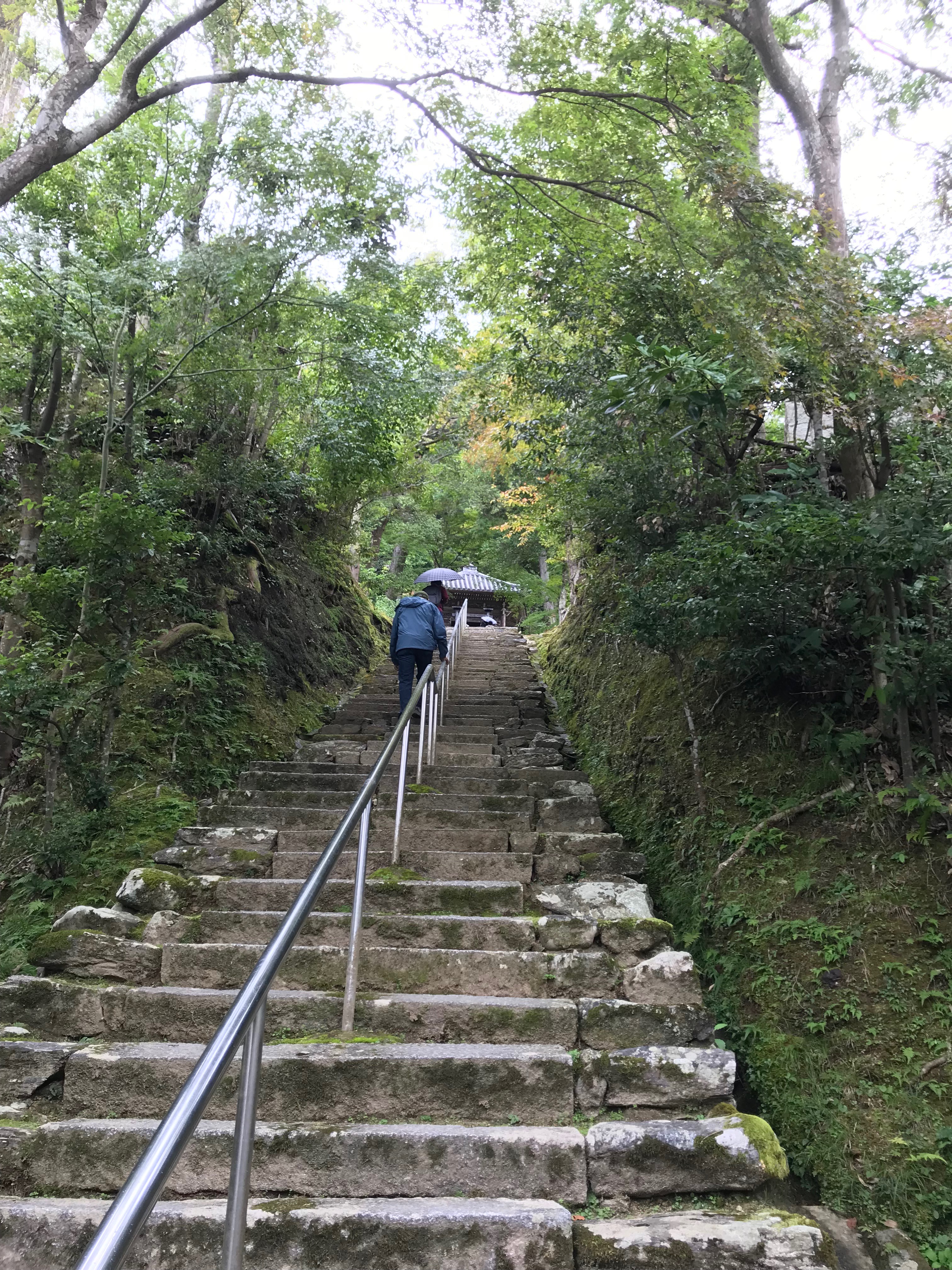
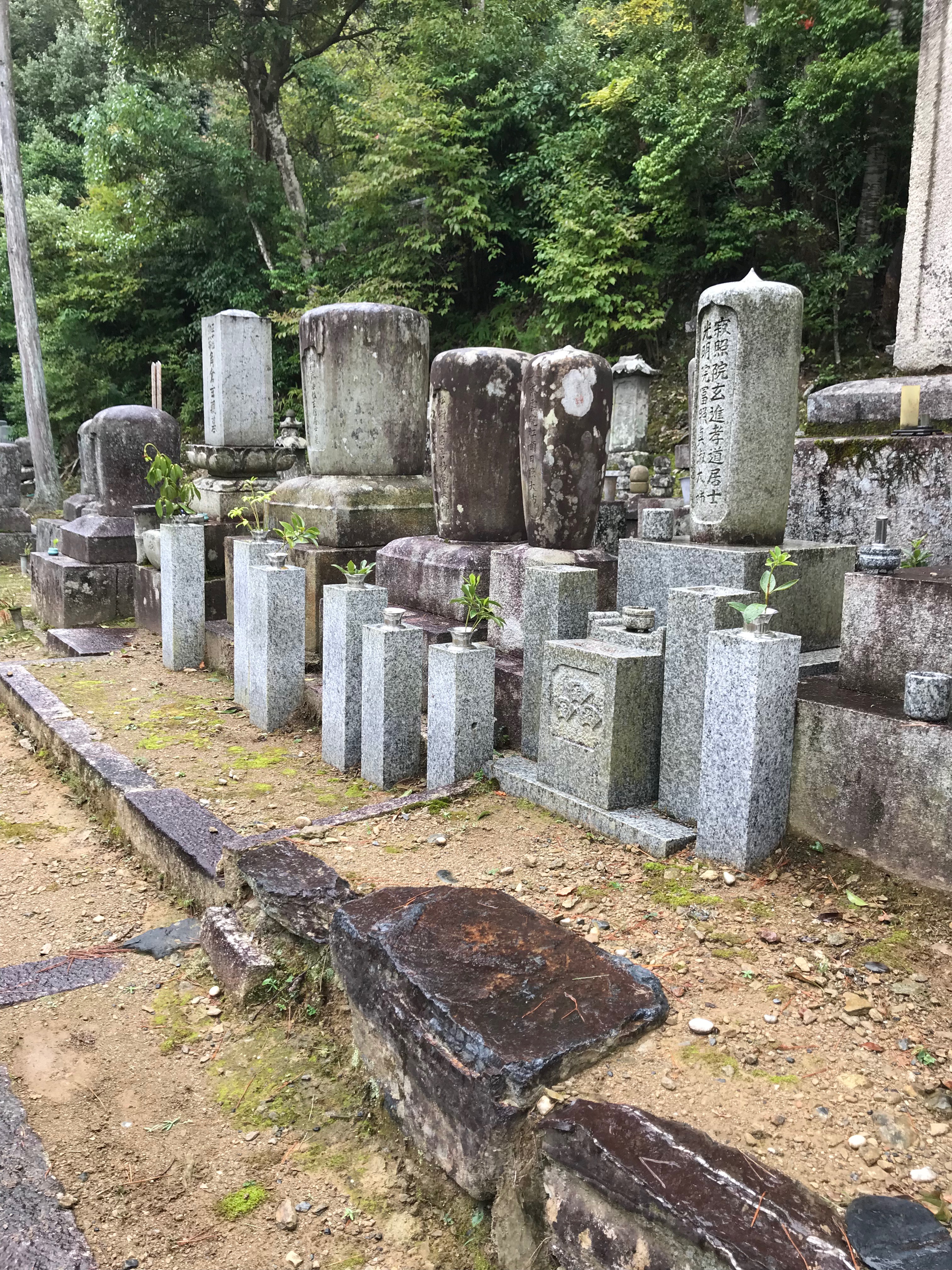
We walked slowly up and up, peering into a few temples but moving on until we arrived at Jojakko-ji. This one made my top 5 or 6 of the trip. So quiet, with beautiful views back toward the city of Kyoto, a truly gorgeous main temple with stunning gold Buddhas, a mysterious-feeling cemetery and a bonus as we left (see video below the photos).
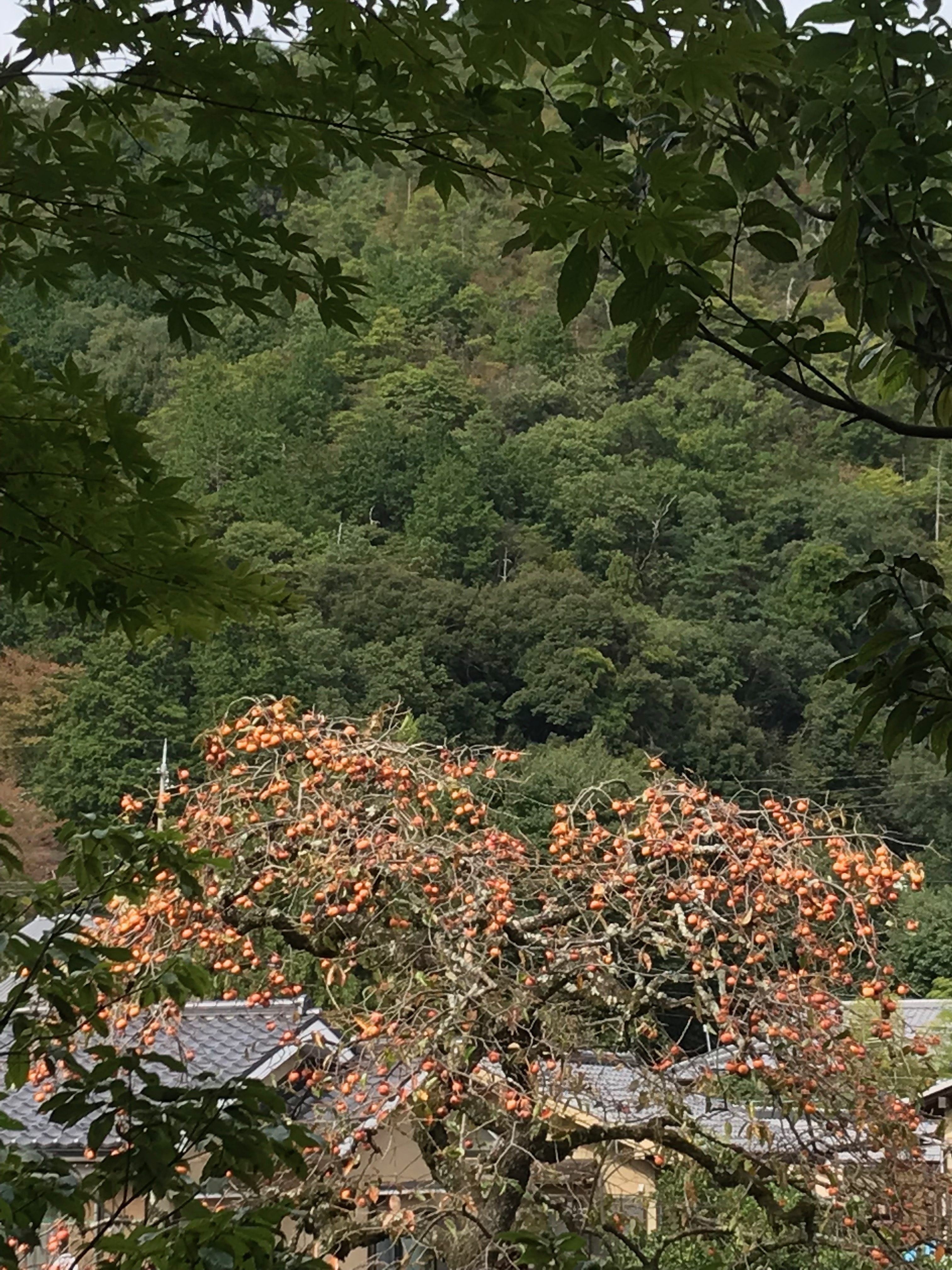
In the long view picture above, Kyoto Tower (a block from our hotel) is peeking up, but the misty day makes it impossible to see here–it is in that loop of branches right in the middle of the photo. I just loved this place–it was a little hard to leave and move on.
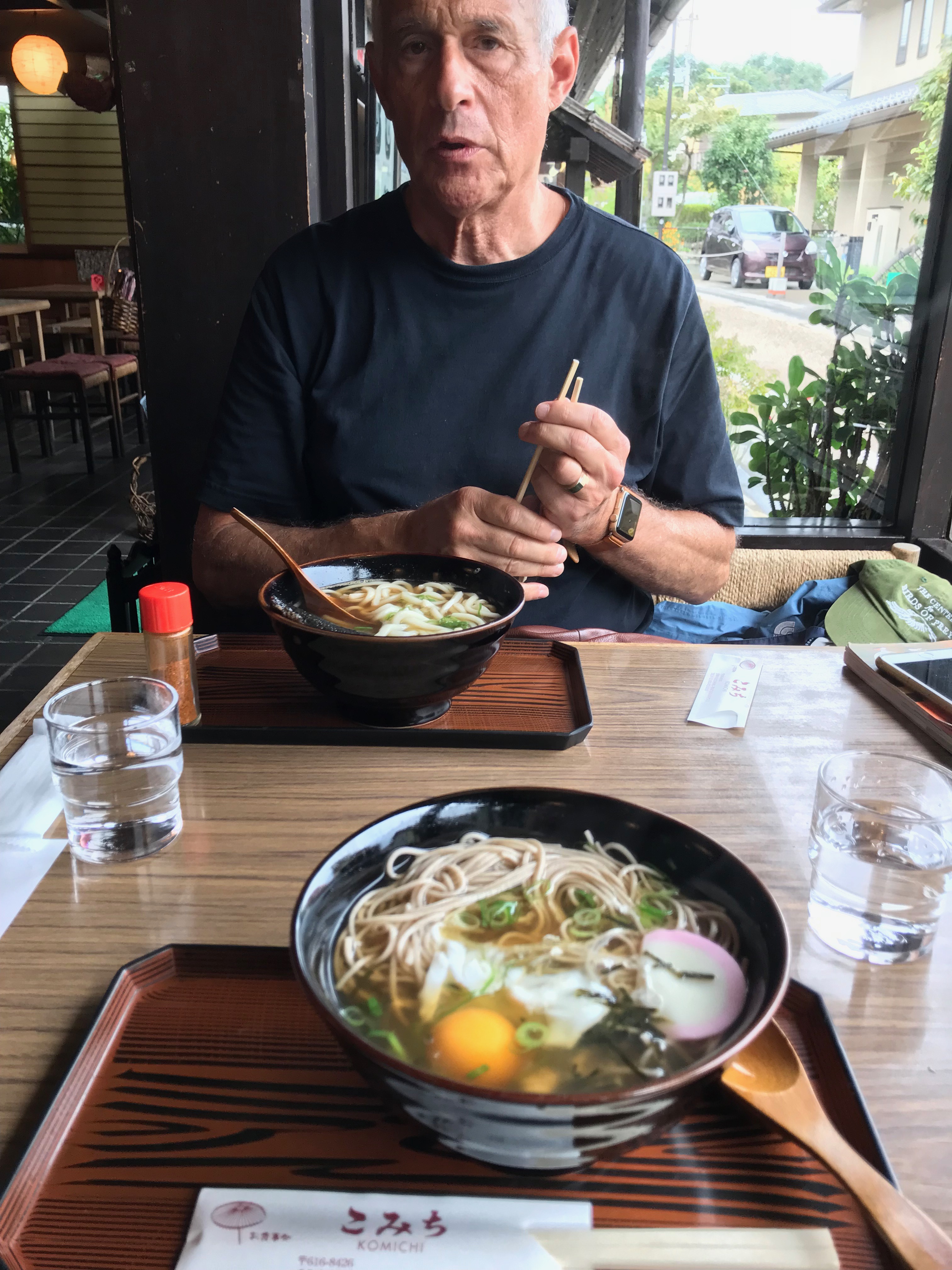
We were getting hungry and voila, an inexpensive noodle shop popped up a little way further up the hill and we ducked in for a bowl. Yummy, quick, and we were off.
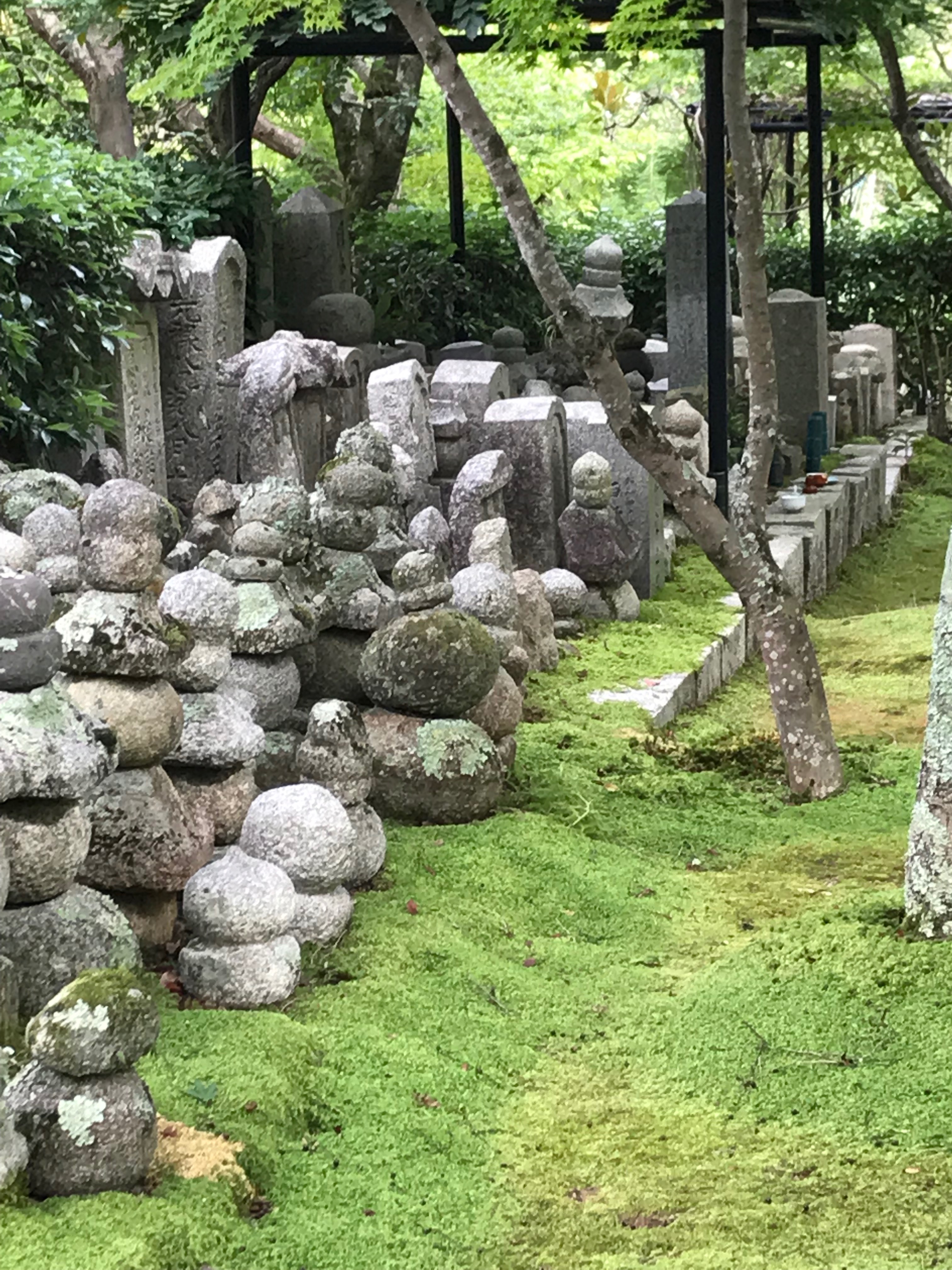
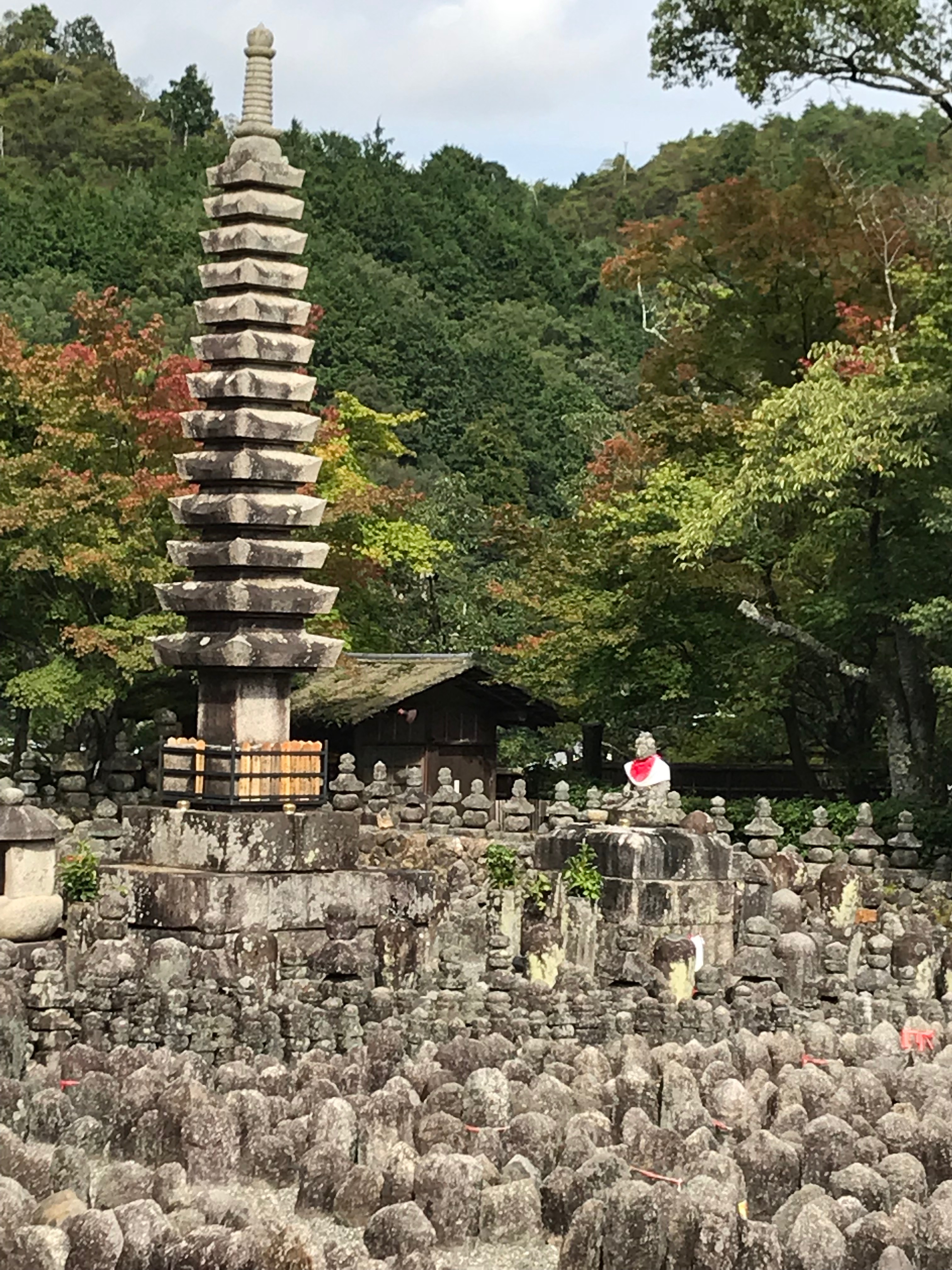
The weather slowly improved as we decided to trek on to Adashino Nenbutsu-ji, almost to the top of the hill. The guidebook called this “rather unusual” and where the abandoned bones of paupers and 8000 stone images (which had been uncovered about 100 years ago, having been discarded or buried, unclear) were dedicated to their spirits. Lonely Planet said “not a must see” but “interesting.” We beg to differ on the category. This was one of the most moving, beautiful, holy places we have visited anywhere, with powerful and intense spirits.
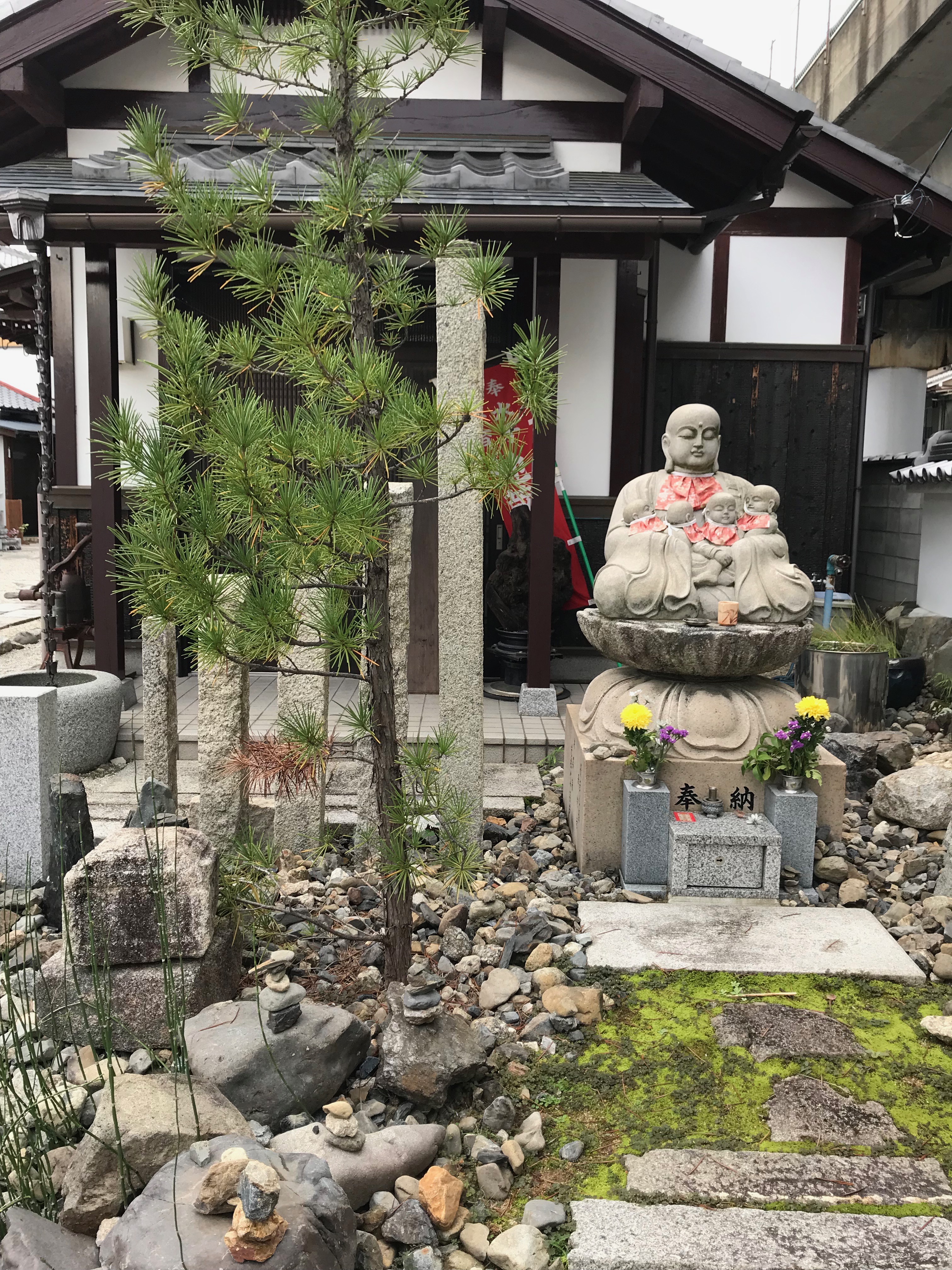
We stayed for a while, then wandered down to the train station where we passed the unnamed, unremarkable shrine in the photos below, about a block before we found the station entrance.
So, who had the fantastic idea of going to Arashiyama? It was a magical, peaceful day and suitable end to our stay in Kyoto (end except for our third sushi engorgement…).
As we get ready to leave Japan I realize I’ve accumulated a few items that don’t deserve a full blog entry, so I’ll run through them here. Then a post or two about our last excursions.
Elevators in Korea and Japan Unlike the US, every elevator bank we used required you to push the button per elevator. Not realizing this, we had a few undue delays thinking that a single up or down request would apply across all the elevators in a bank. So remember—push every “up” or “down” to speed the arrival of what you want.
Japanese Tourist Maps We had forgotten this little quirk from our last visit–one of the oddest things about using the little billboard maps that are posted in many neighborhoods, train stations, and in other tourist-heavy areas. You know, these are the ones that have the red You Are Here circles to show you how to get to the next place or out of where you are. There are many of these around Kyoto and the often appear just when you need them.
However, first check is which way the North arrow is pointing. For some, to us, unfathomable reason, N is not always up as it is in the US. It can be to the left, to the right, or pointing to the bottom of the map, requiring you to completely reorient yourself. It is surprisingly difficult to figure out what’s what when N is pointing to the right, so there you are twisting your guidebook and your head around to make sure you are not heading in the exact wrong direction. As many times as we looked at these maps, and knew about the N issue, we repeatedly started to read the map incorrectly.
Disability Access and Using Escalators Accommodations for disabled or simply tired (or old!) folks are spotty, and there are places where there is escalator service but no elevator when an elevator seems called for. Getting to the JR train platform at Kyoto Station, where many folks are going long distance or to the airport, there is an escalator and no elevator. Other places have signs forbidding using the escalator if you have a suitcase (similar to the US), and in one department store signs stated no walking on escalators. We also found elevators quite slow and/or tucked into corners. Plan accordingly.
Since we were last in Japan about five years ago we did see many, many more disabled people out and about. It was great to see that people who obviously were always there were now in public without incident, even several severely disabled in fully motorized chairs. On the subway we saw a man in a motorized chair, and the moment the train stopped a train employee (there are many around who give directions or, more often instructions) put a small ramp in the doorway so this fellow could drive off easily across the gap. Twice I saw a train employee accompanying a blind person across the station, chatting away. (I say train employee, but I am not sure who they work for—perhaps these are public employees. They wear uniforms and they are in transit stations.)
We saw no wheelchairs or other disabled people in Korea which could have been chance or an indication they are still kept out of the public spaces. There isn’t much sign of accommodations there.
Rules and Worries and a Few Inconveniences It is cliché that the Japanese have traded conformity and safety for some kinds of American-style freedom as we like to think of it. It is true that people are expected to follow rules and instructions, and our first taste was when we landed in Osaka and proceeded to the train platform. Two uniformed men were checking each ticket and then telling us exactly how to line up for the train. This line, not that one. Put your baggage here, not there. Line up in an orderly queue. Do not step on the yellow barrier. It was quite lovely for us tired travelers because we knew for certain we were in precisely the right place and would end up in the correct car (the queuing lines were by car number for trains, bus number for buses) and subsequently in Kyoto Station. Even when the “instructors” seemed a little bit severe and unsmiling, we were continually grateful that we weren’t allowed to make an unfortunate mistake.
There are also a lot of signs in Japan, both official and handwritten, which even when a little alarming (“Bears have been sighted in this region.”) were helpful. My favorites were warnings were combined with seemingly unnecessary instructions. A cute example was at a neighborhood Shinto shrine, a rather raggedy and charming set of very small shrines and statues and figurines of animals, with a few flowers and teacups set out in honor of woodsy fauna. At the small entry there was blue tape and sign: “This barrier is to keep wild boars out. Please step over the barrier to enter.”
Both countries are seemingly free of petty crime. Bicycles are everywhere, and lots of bicycle parking lots in Japan. While there were bike locks, we saw many bikes leaned up or on kickstands outside of stores and houses as in the picture below taken from our hotel room of the alley behind the building.
We never for a second worried about making sure a bag was zipped up, or walking around with a phone in hand, or putting down a package for a minute to get organized. It was common to see bags left along the paths in shrines and temples while the owners took photos or walked around.
Both Japan and Korea seem bereft of trash cans. In Korea we finally asked—where do you throw anything away? A few times we traded a small purchase for an excuse to ask a shopkeeper to let us throw away a bag or beverage container. It seems the custom is to use the public restrooms (they are everywhere) to find a trash container, but even many of those had none, as they have either air dryers or nothing. Carry something to dry off with if you prefer not to shake off the drops or (as we did) use your jeans. In both countries every sit-down food place starts with a plastic-wrapped damp hand towel; we accumulated them when we didn’t need them right then, so we had them ready when we were sweaty or just a little greasy. In Korea, street food is usually served in a paper sleeve of some kind, sometimes even a sliced paper cup. While this is convenient for immediate eating it is messy and those extra hand towels were great.
In Korea, all the public restrooms I used were western style. In Japan, women beware that there are still many toilets which require very strong knees and sense of balance—they are porcelain troughs (in private stalls) which I could neither get down to or, I am sure, get up from. Some public restrooms had both, but a few only the troughs. One of the last I used had western toilets (this was in Arashiyama) complete with instructions. See photo below and note Japanese, Chinese, Korean, and English. In general, in both countries there are many more public restrooms than you see in the US or Europe (where in some places I have learned to march into large hotels like I know where I am going, because there is always a restroom near the lobby).
Re public smoking, it’s pretty much gone though the isakaya we went to did have a couple smoking in a corner. We may have seen one or two incidences of smoking in public in Korea, but this scourge of international travel is clearly on the wane, thank goodness.
Traditional Clothing Both countries have many, many traditional clothing rental places, mostly around hanok neighborhoods (Korea) or clusters of shrines and temples (Japan). In Japan we also saw many younger men and women in kimonos in shopping areas. As we had noticed last time, it seems to be rather hip to dress traditionally. In Japan we occasionally saw older women in what seemed to be their normal go-to-work kimonos compared with the very colorful styles worn by younger women. Two or three times we saw westerners dressed in hanbok or kiminos. They looked very odd and were clearly enjoying themselves.
Vending Machines
Both countries have gazillions of drink vending machines, and in both countries cold coffee in various versions and brands are ubiquitous. When you order coffee at a stand or in a bakery or cafe (cafe=coffee) you must state whether hot or cold, unlike in the US where coffee is hot, and iced coffee is iced coffee. In both places you find drink vending machines in out of the way corners, at public parks or shrines and temples, and in Japan we started noticing that prices varied quite a bit with the same drink, same size, sometimes as cheap as a dollar and sometimes as expensive as two dollars or more. Occasionally there was also a place to put an empty drink container near the machine. At the top of Inari there is a vending machine and next to it in the little wooden shop (where you can buy shrine-related tokens and offerings) there is a sliding glass door and a wooden table inside on which to put your empty. This is where I discovered Pokari Sweat, a sports drink that was perfect for a sweaty American on a hot and humid day, and was especially grateful a woman showed me where to stow the empty can.
In Japan we started noticing that in the row of machines there is often one with beer and perhaps other liquor. We didn’t see any note regarding age restrictions, not that they could be enforced anyway. Nor did we ever see public drinking or rowdiness.
Convenience Stores Go to Youtube if you want an education about convenience/7-11 type stores in both countries. These stores have everything and then some, especially food of all kinds including hot soup, croquettes, and in Japan fish cakes in various forms in tubs of broth or hot water (not sure—didn’t want to try). They are fun and inexpensive—and we found that if you go away from the main street a few blocks prices drop. They also all have ATMs, not just 7-11’s as in the past. We use a bank that reverses the service charges so we used them regardless. Just check for the Visa/MC/Cirrus stickers—not all ATMs have them but those that did worked for us 90% of the time and at about that same rate we were able to find the “English” button.
Public Transit We like BART. Multiply BART by 100, or even the NY subway/bus system by 2 or 3 in convenience and reach, and you have something approaching the public transit options in Korea and Japan. Korea wins by a mile for English guidance—almost all subway cars and buses have full English stop information—but even in Japan it’s not at all hard to figure out where to go, how to get a ticket, and so forth.
In both cities, Seoul and Kyoto, the subway seems at first much easier, but because the subway maps are schematics that do not conform to actual geography you never get much of a sense where you are going or how one place relates to another compared with taking the bus. Also, most of the subway trains are almost entirely underground, so no scenery. With just a little practice the buses are more convenient and better educationally for finding your way around.
In Kyoto a few bus routes (e.g., #100) are oriented to tourists, and announce all imminent and upcoming stops displayed on the big monitor up front as well as by announcement, in Japanese, English, Korean and Chinese, with advisories as to what sights or major destinations are nearby. It was comforting to know the stop we wanted was the third one after this, and great to see and hear confirmation in English.
The one-day and other passes are a fantastic deal if you plan just a little bit. In Kyoto a one way bus fare was $2.40 or so, but the one-day bus pass was $5.00 so you are ahead with just 3 trips. There are several information counters at Kyoto Station and we got 100% accurate advice even if the English was incomplete. Also, the buses depart from numbered queues which also have (as in Korea) full “next bus” information at the stops. At Kyoto Station there are uniformed men who tell you where to go, or when a bus coming into an adjoining queue will get us there faster. And, of course, they tell you exactly how to line up, with individual bus numbers on marked queue lines in case you are a complete idiot. Do not fear—Japanese people were asking as many questions about which line/which bus as we were!
In Seoul public transit, including taxis (which we never used), is extremely cheap, too. We hopped on and off without a care to the cost.
If you thought American youth are obsessed with taking selfies The selfie craze, with sticks 95% of the time, is overwhelming and funny and annoying. Just be prepared to get out of the way!
Coffee and Food in Kyoto Yes, Japan is expensive but with a little care you can eat for less. First, breakfast and coffee—if you go to a good coffee place (there are many, but our fave by far is Ogawa Coffee in Kyoto Station) you can pay $5 for a latte. Look for a place with a “breakfast set” which is coffee and what was for us plenty of food to start the day. At Ogawa the breakfast set was $5.80, which includes coffee, a fantastic croissant, and a small dish of unflavored yogurt (yeah!!) with a drizzle of honey and a few frozen berries, usually a mix of currants and a black- or raspberry. It was quick, delicious, and perfect fuel to start the day.
Eat sushi! We found the conveyer belt sushi, Musashi, in Kyoto Station was incredibly inexpensive and very high quality. Inexpensive—most plates with 2 pieces of nigiri, most as in almost all, were $1.46. The fancy stuff was 1 piece for that price, or $3.46 for 1 or 2, depending. We ate there 3 times in one week, and with beers the total bill was about $44…and we ate, each time, 22 plates’ worth.
Eat noodles! And shop for price/quality. We had several quick lunches of udon or somen for about $7. The ramen at Karako, which is on a busy street a few blocks from the museum neighborhood, was about $7 and the best I’ve ever had. Get the kotteri. The ramen at Ippudo, which is right next to Nishiki Market was very good, not quite as exciting but a fancy as opposed to old (OLD) lunch counter style ambiance, and was about twice that. In Arashiyama, right on the tourist trail (an exquisite walk that I write about on this blog) were two noodle places with very similar appearing menus where in one the price was $12 and the other $7. Directly across from each other—point being, do not assume the prices are generally the same regardless of where you are.
Isakaya! For very reasonable prices (about what we spent for sushi) we got nice and high on sake and ate more than we should have. Plus it was comfy and fun and super casual.
Takeout! See the lower floors of any big department store—if you are smart and are staying near Kyoto Station, go to Isetan. There is an unbelievable array of takeout food, putting Harrod’s to shame in variety and price. Wander around for 10 minutes before you make a choice, and if you are hungry for good bread go up one floor to the sweets department and visit the Danish bakery. Grab a basket and tongs and get everything from unidentified bread-like concoctions to good old fashioned baguettes and hard rolls.


























































 Inescapably Rational