We left Paris by train, high speed to Bordeaux and then a bit of a crawl to Toulouse. Almost five hours all told, but the five of us were physically and mentally tired and thus it was nice to just sit, each in our own heads. Granddaughter watched her ipad with headphones, Mark read, I wrote about Paris and then veg’d out…the trip went quickly. Toulouse was thankfully the end of the line so we had plenty of time to gather up luggage. We had been worried about the walk to the hotel, fearing Toulouse late afternoon would be hot, but walking on the shady side for 20 minutes was pleasant and eased us into this wonderful, lovely, friendly city. The hotel was on a short street off one of the main streets of the historic center, and we were greeted by the always friendly and helpful staff.
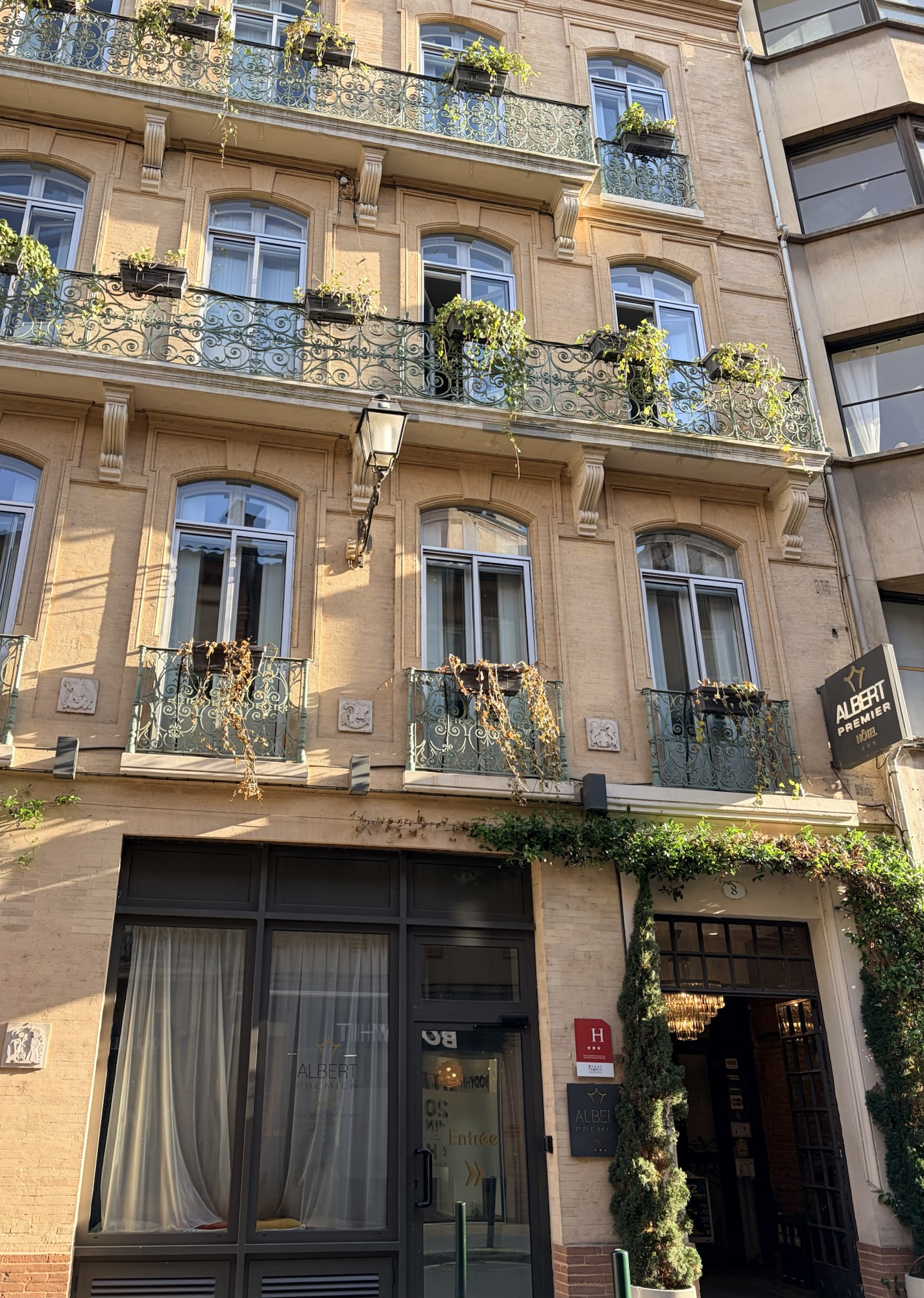
We ate so much each night. Boullion Capitole our first night was so much fun with bustling charming servers and great food that we knew we were going to like this city. Stayed four nights, hated to leave. And to top it off, probably my favorite hotel ever. Comfy rooms, good air conditioning, fabulous breakfast. Hotel Albert 1er, we love you.
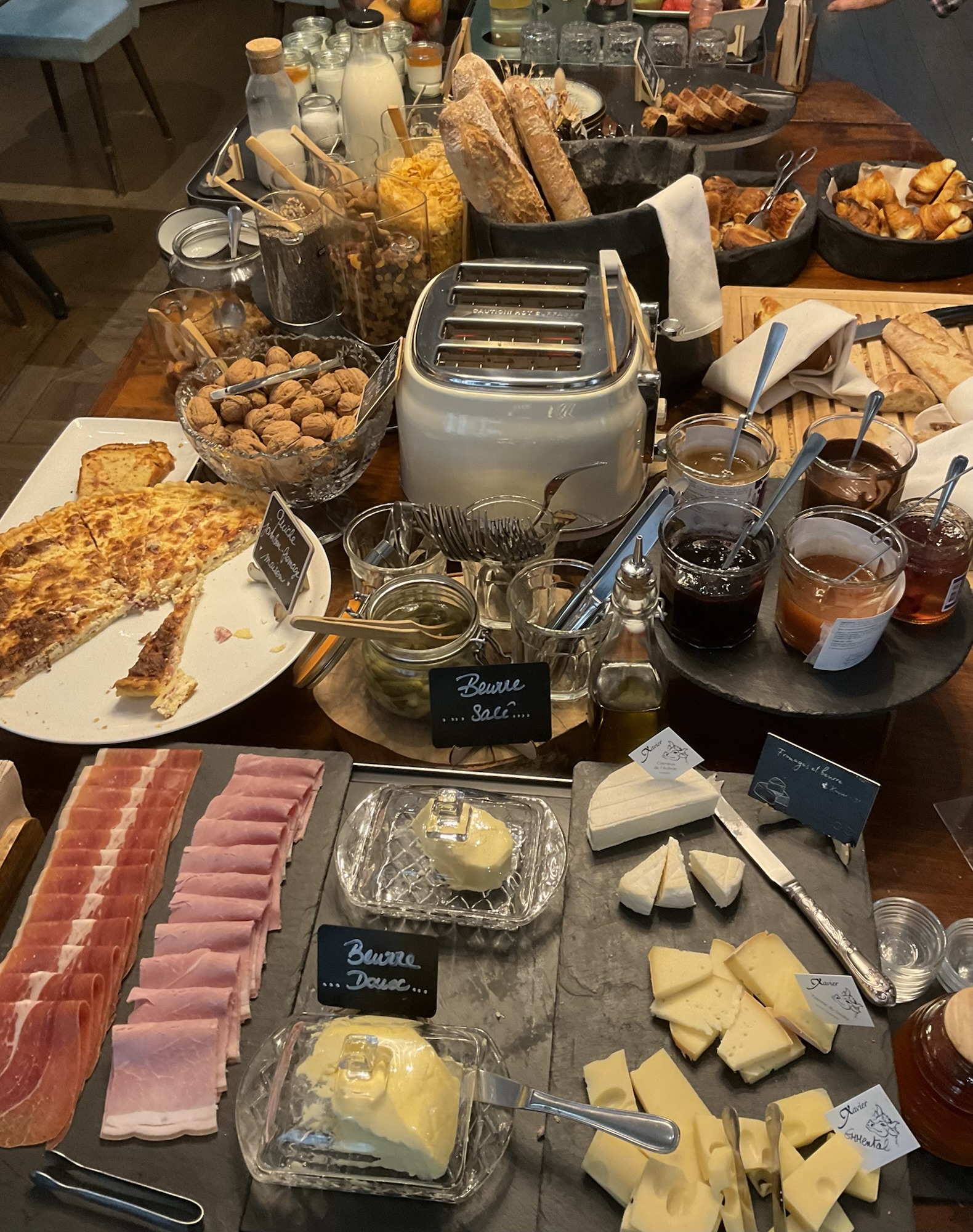
Wonderful hotel. That is a part of the breakfast buffet…included fresh squeezed OJ at a do-it-yourself machine and very good coffee.
What’s “All True?” That Toulouse is the easier, less expensive alternative to Paris, as often advertised. The prices were about 20-30% cheaper than Paris. The city is sooo pretty: red brick buildings dominate, streets are clean, walking everywhere was a pleasure, every clerk, wait person…to the woman security guard at the city hall…was smiling, friendly, helpful. Lots of playgrounds made granddaughter extremely happy. One in a plaza otherwise filled with outdoor seating for the surrounding restaurants, one next to the tourist office, one in a large park where the Japanese garden is, one we didn’t have time to find next to the Toulouse Musee. This childtren’s natural history museum enchanted granddaughter—her mother said she had never been so engrossed by minerals, butterflies, taxidermied animals, even the animation of the earth’s landmasses forming and reforming which she watched twice, then as we were getting ready to leave she asked to go back and watch it again, this time wiping a tear and hugging her mom—“the music makes me sad.” Gosh I love them so much.
We were to leave on Saturday. For our last full day we got out of the city by renting a car and driving an hour or so south into the foothills of the Pyrenees to a small town that had a Friday market. David and I had so enjoyed these last time we were in France so I really wanted my daughter to experience one. The only bad part was getting the rental car out of the horrid parking lot in Toulouse!
This town, Foix, is magical and the market was a blast. We arrived around 10, and stayed several hours after the market ended just hanging out enjoying our lunch purchases (the bread! The cheese! The olives!!) and letting granddaughter enjoy the playground smack in the center of town. The scenery is all greenery, flowers, the river, Pyrenees in the distance. A great day.
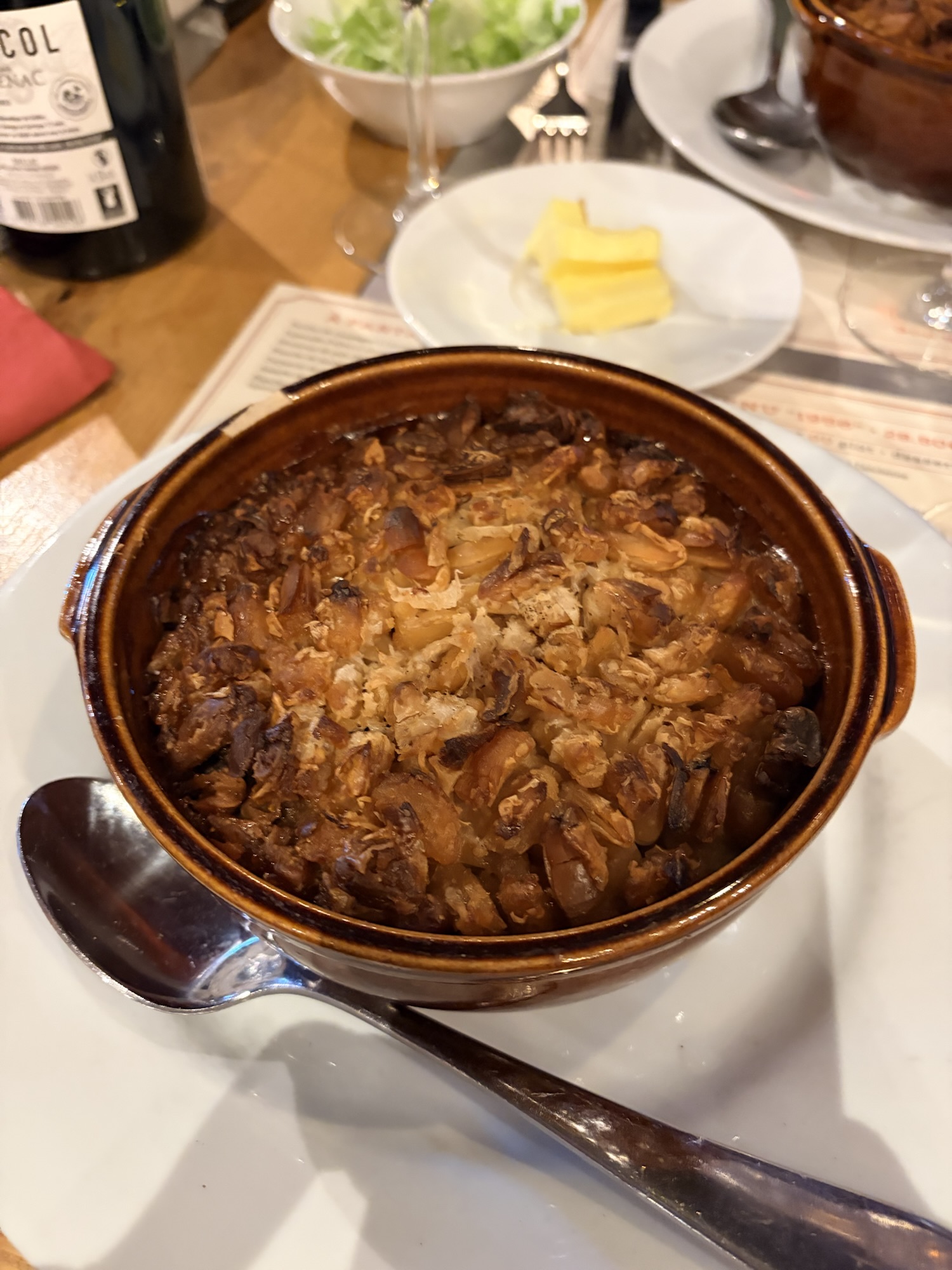
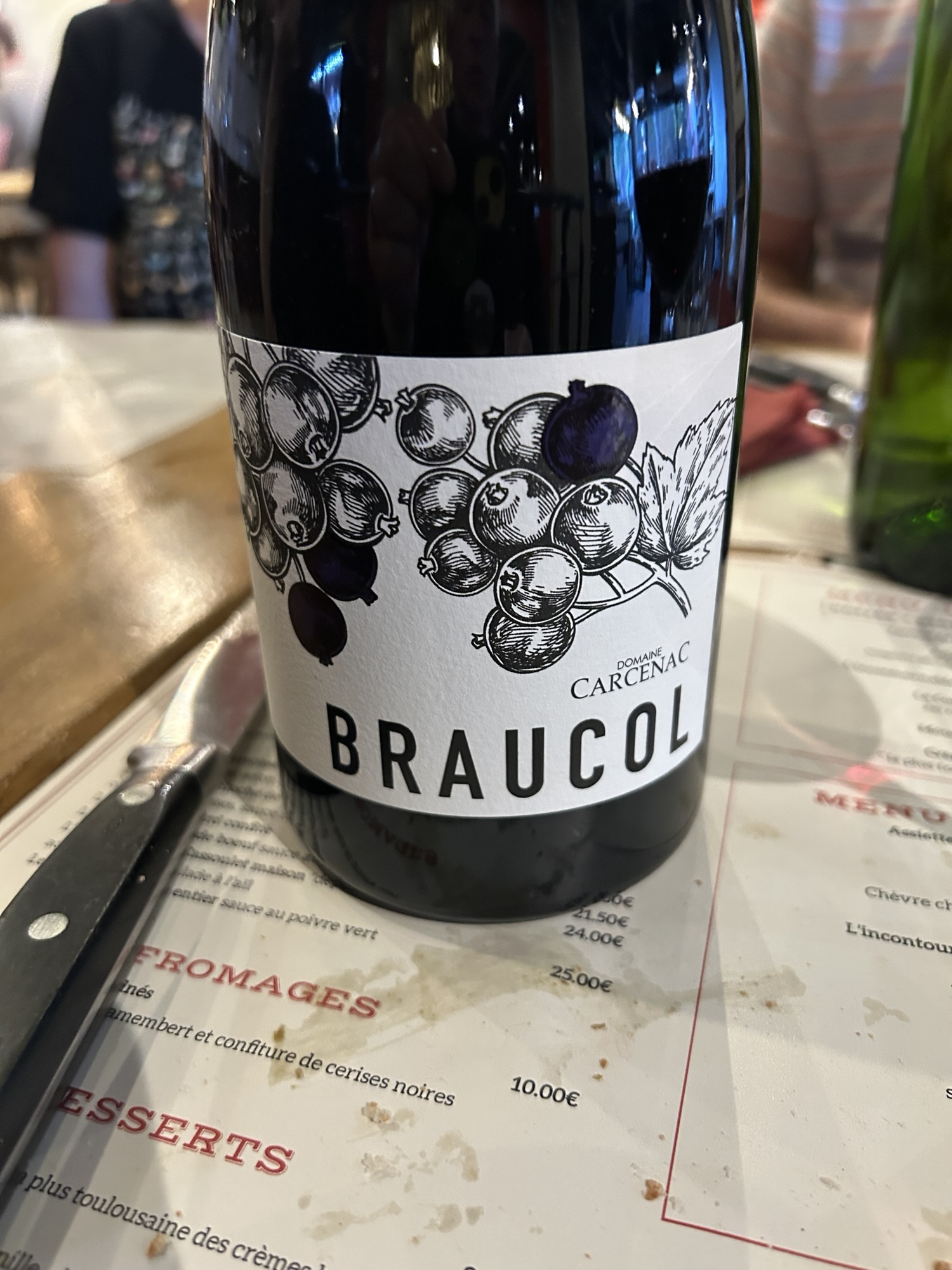
We returned to Toulouse and ate a magnificent dinner at the Maison du Cassoulet. Yup, we all had cassoulet and a wine suggested by the server which will live in my memory forever.
Only down moment was saying goodbye to daughter, son-in-law and granddaughter. Next morning they left for Spain and we drove to Albi.
After four hours at the archeological museum we felt a bit over-prepared for our visit to Pompeii. Assuming we’d be well acclimated to Italy, over any jet lag, and sleeping well we had booked a 9am start for a 3 hour tour with a professional archeologist as our guide. This meant getting up quite early, hopping the Metro to Garibaldi Piazza and station, finding the local Circumvesuviana train to Pompeii, and amazingly everything went perfectly. We even made a friend on the train, an American now living in Portugal, in Naples for a conference and winding up her stay with a trip to Pompeii. She now helps people relocate to Europe. I have her card in case, well, you know.
The first two hours of the tour were in a group of about 12; the last hour, to the Villa dei Misteri, a relatively recent excavation outside the walls of Pompeii, was just us and a very nice couple, young men from Mexico who were so totally engaged I asked if they were archeology students. No, just fanatics like us.
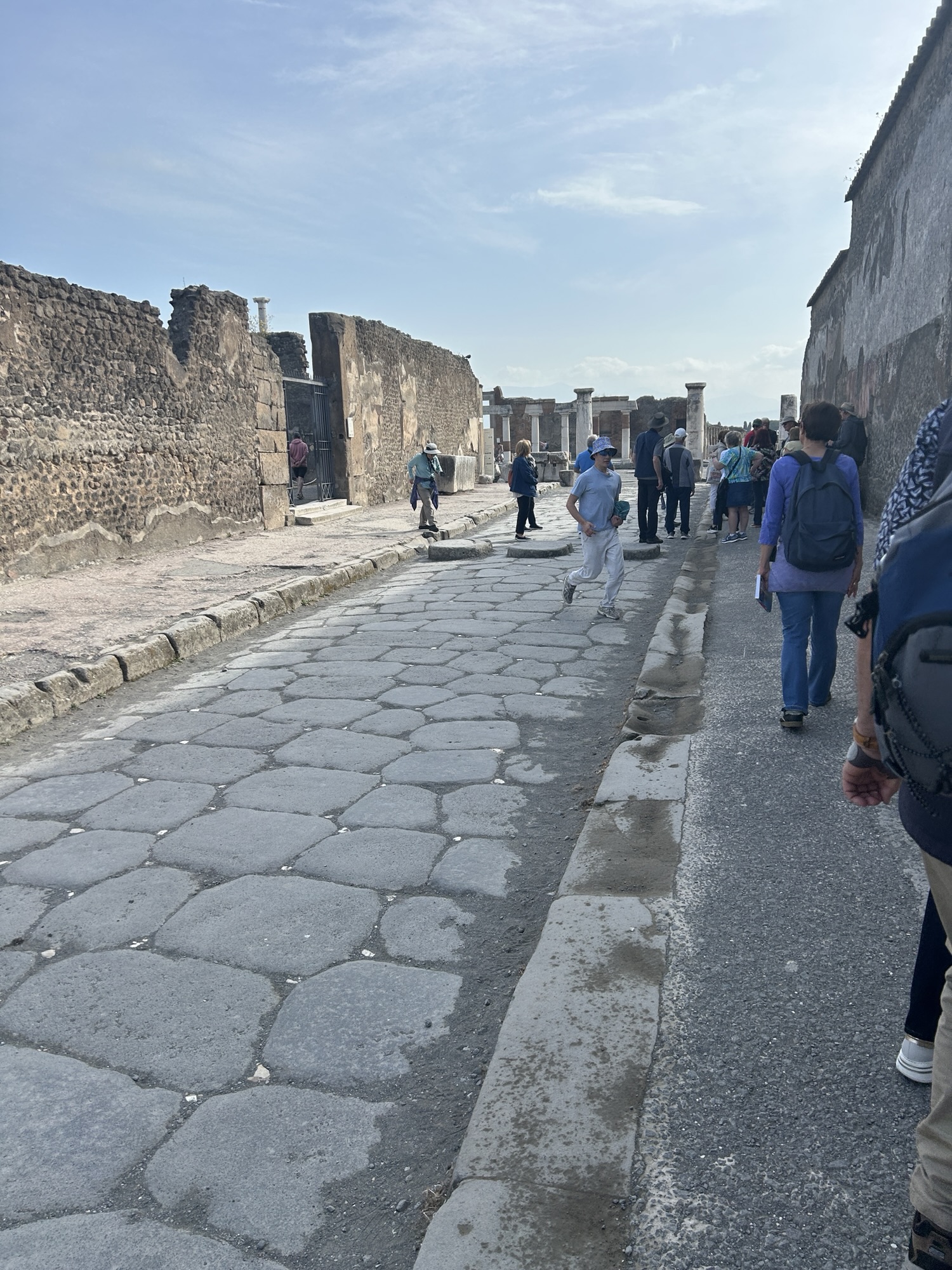
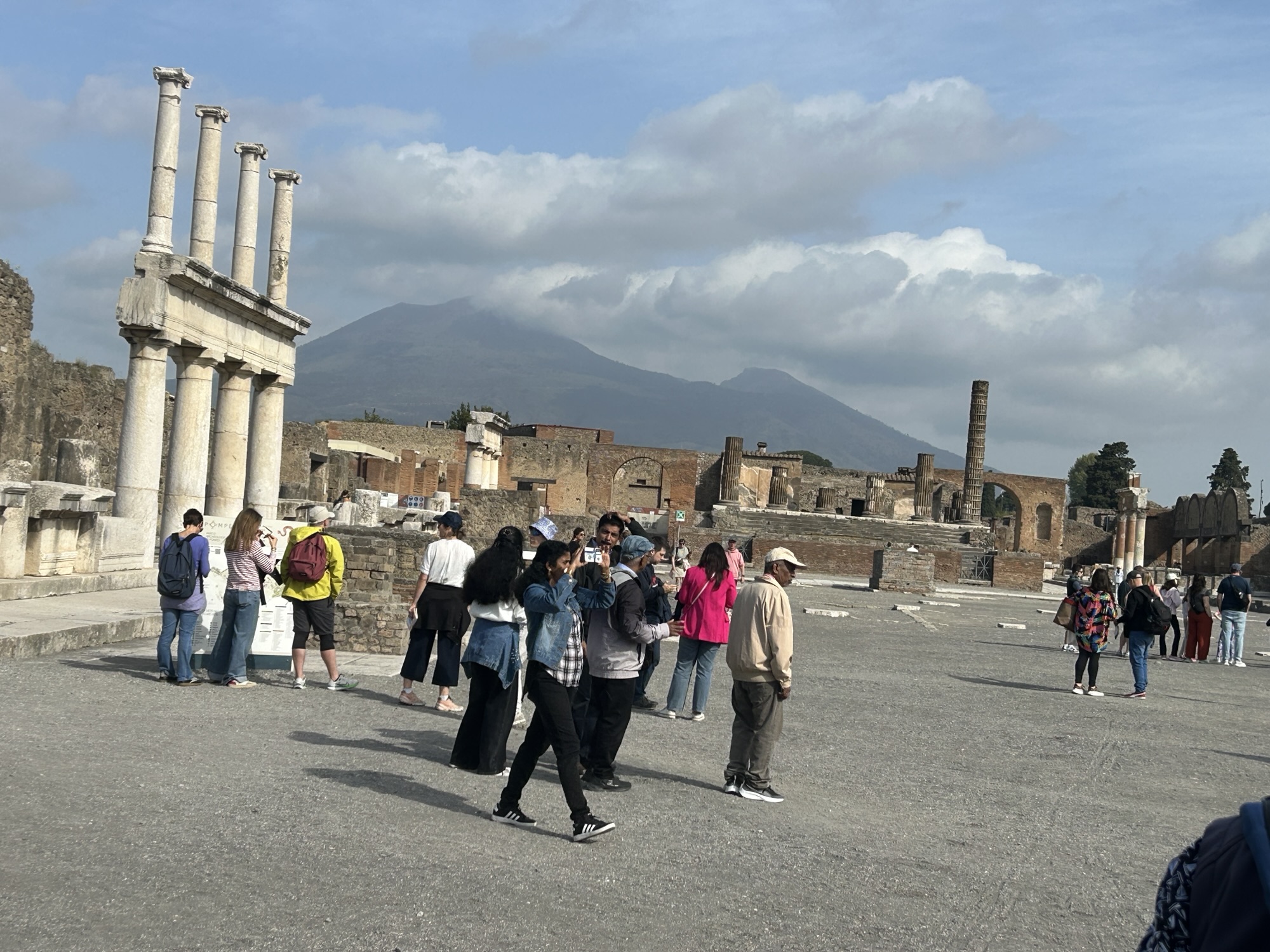
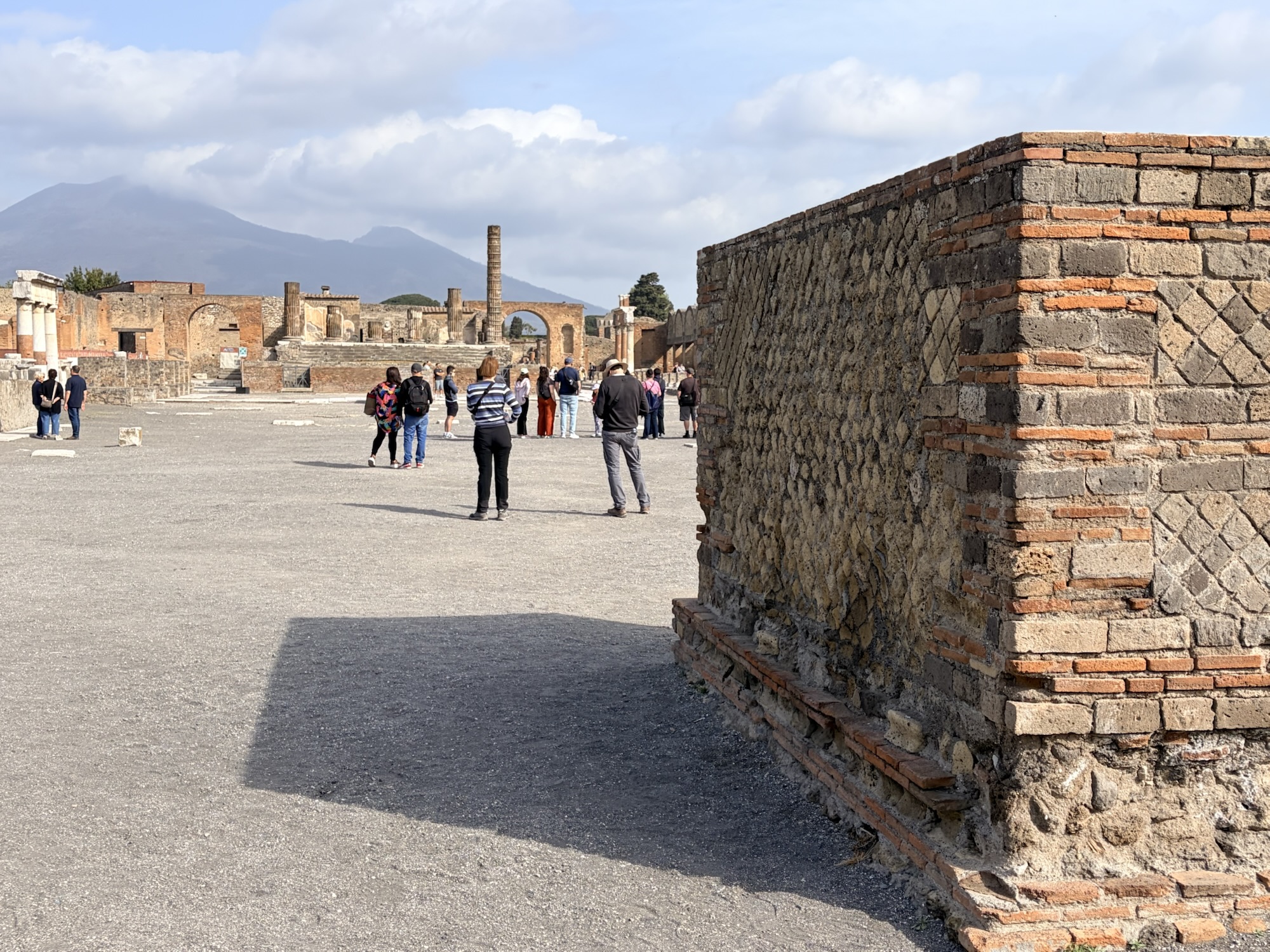
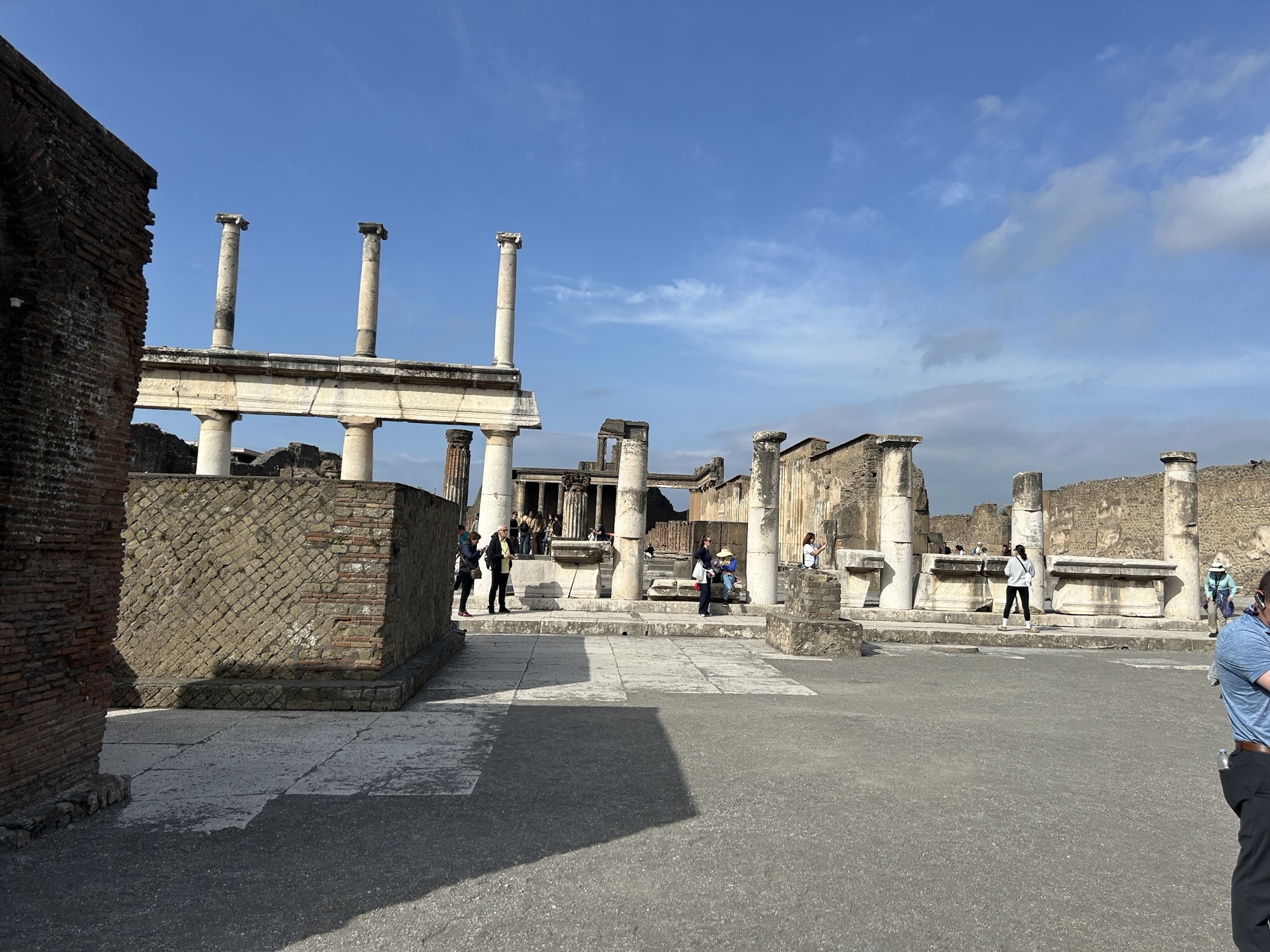
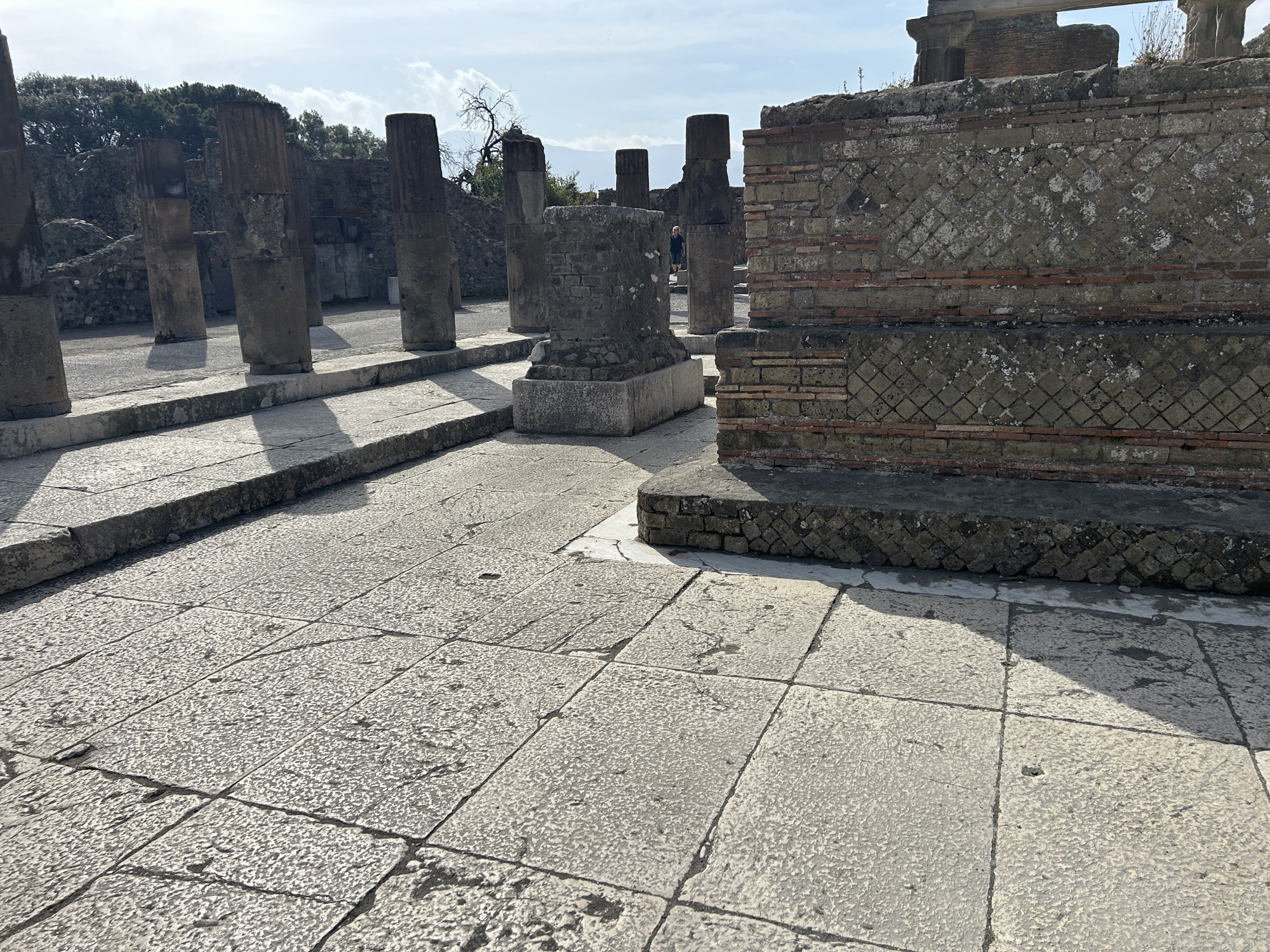
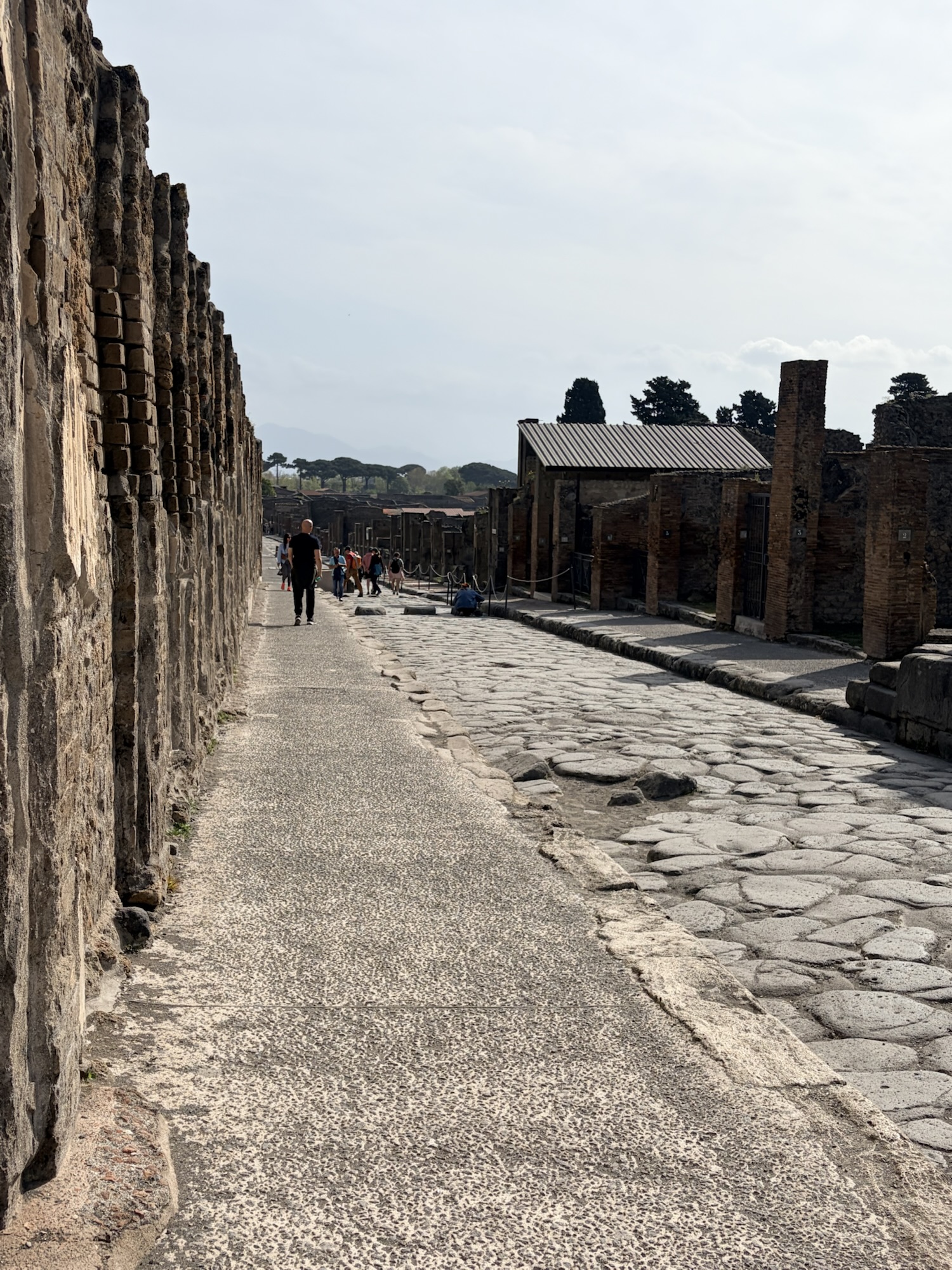
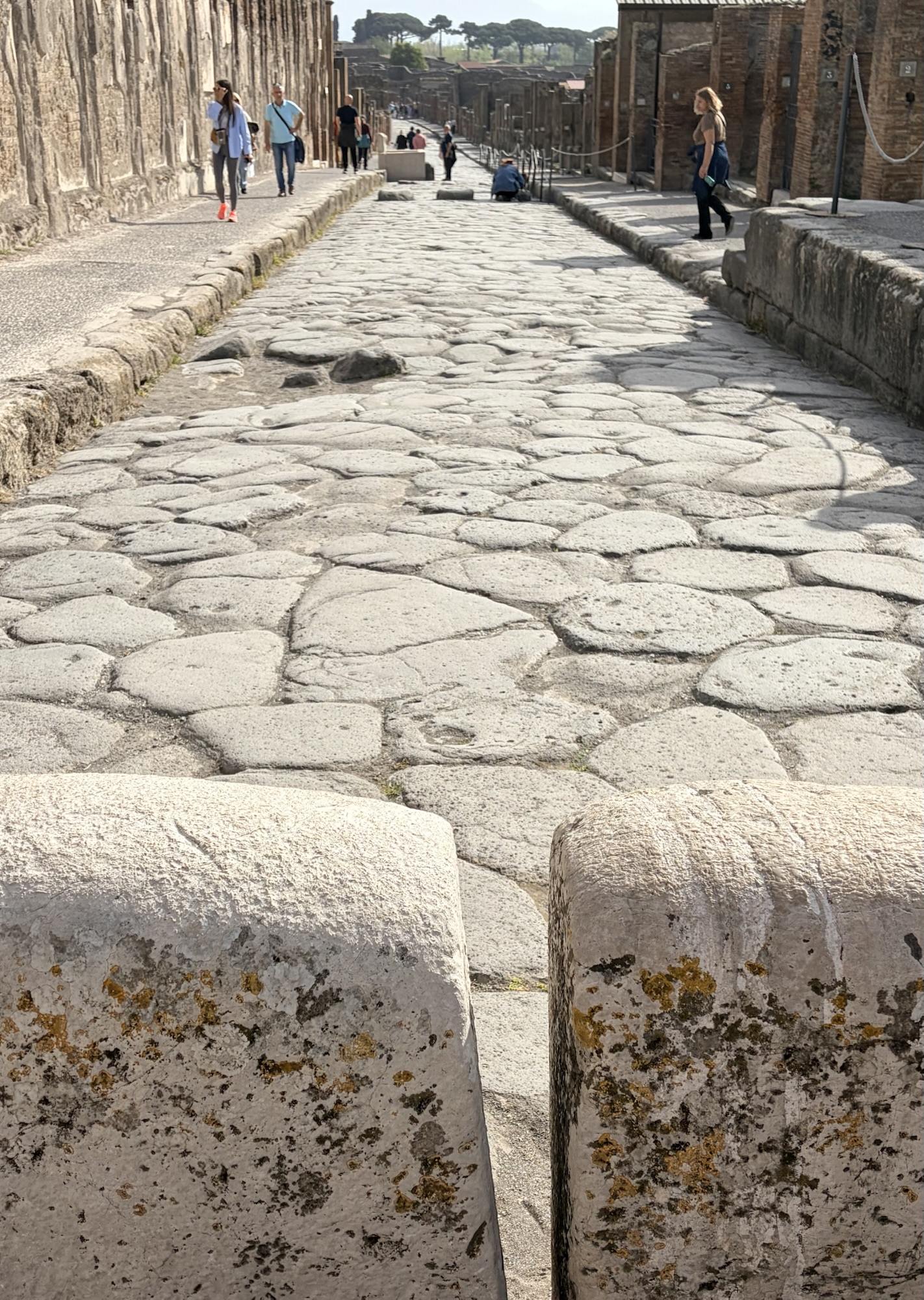
Note the little white stones between the paving rocks, which are dark gray. They are pieces of marble which reflected moonlight to help visitors find their wayThe large forum near the main gate; Vesuvius in the background (“Don’t worry, she is sleeping.”)Near the forum, another public space
We have seen a few documentaries about Pompeii and Roman history in general, so I wondered how much we would still have to learn and enjoy. Answer: A LOT! As I looked over the photos when we returned to Napoli I was again overwhelmed and incredibly happy we went there. It is transformative to walk on the same volcanic rock streets that the Romans walked, gaze at the same frescoes, examine the same mosaics, wander through houses that we now know so much about thanks to the archeologists…Just a wow experience in every way.
The excavation of Pompeii began in the 1740’s on the order of the regional king but excavation by an archeologist wasn’t begun until 1910; our guide rued what had been haphazard and destructive up to then. Our guide showed us where she had most recently been working—the cemetery outside the city walls. The specific spot she showed us was unremarkable, just grass and wildflowers, a reminder that every bit of this part of Italy especially still hides multiple eras underground. Unimaginable.
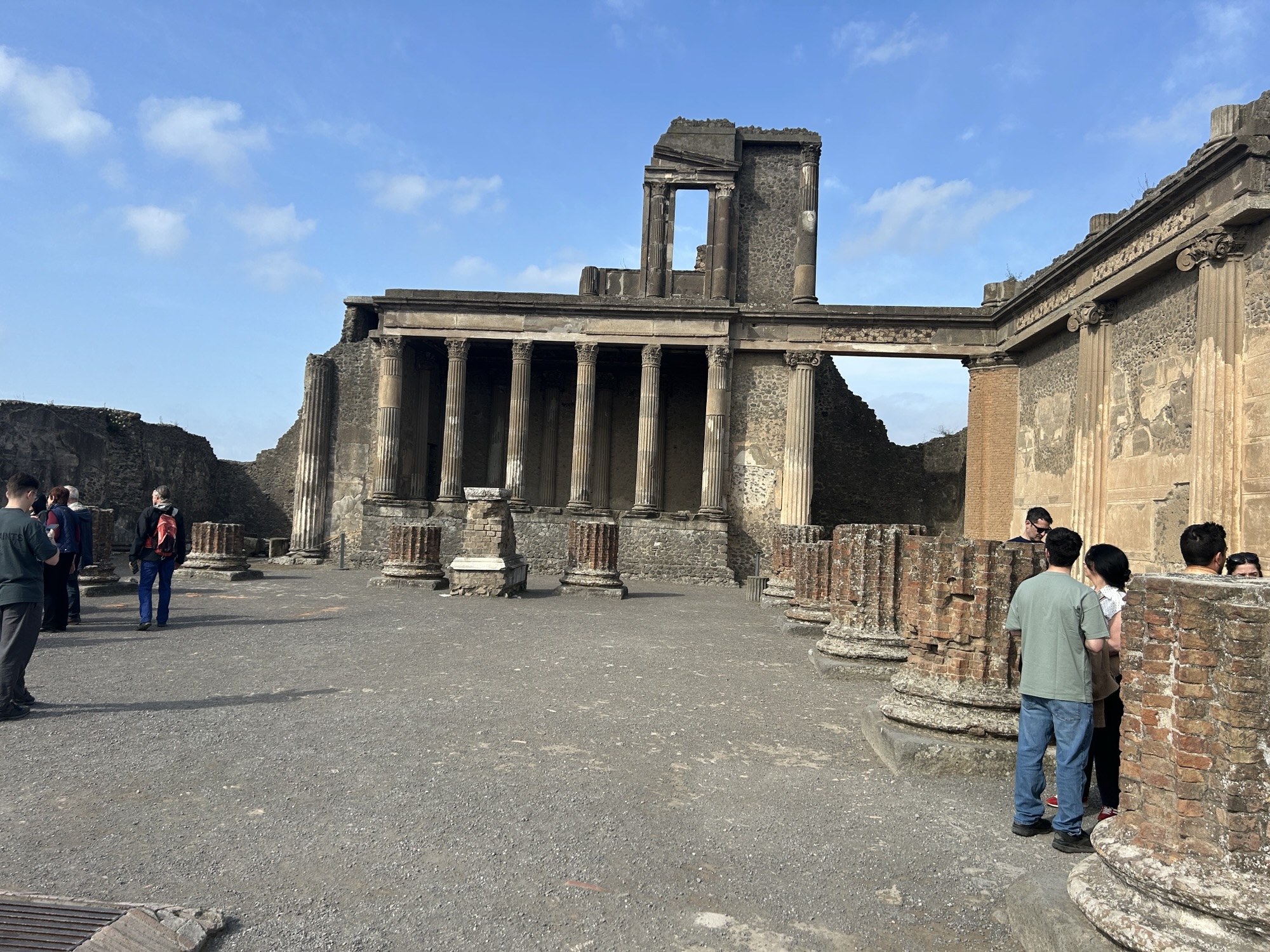
Many layers of construction—stones covered by bricksA temple with two stories of columns still standingThe criss-cross on the wall means it was built by Romans, not prior occupants
What was most remarkable to me is how much archeologists know about the life in Pompeii. An example is the identification of political life and even which houses politicians/officials lived in. If there’s a bench outside next to the entrance, it was there for clients of the official to sit waiting for an appointment. The purchase of votes was legal, so officials and aspiring officials provided favors or services in return for the client’s support. A particular house we were able to walk through (usually closed to the public but open occasionally to protect the interior frescoes) has what looks like a bench in front (a large rectangular stone) but archeologists know it was part of a street repair that had been moved out of the way. Speaking of which, the eruption was in 79AD, following a severe earthquake in 62AD. Repairs from the significant earthquake damage were still underway when Vesuvius erupted. Think of the wrangling over repairs and expenses, then boom.
We even saw a replanted garden in the center atrium of a house that our guide said was exactly the original garden…they analyzed the remains of the roots and were able to identify the shrubs.
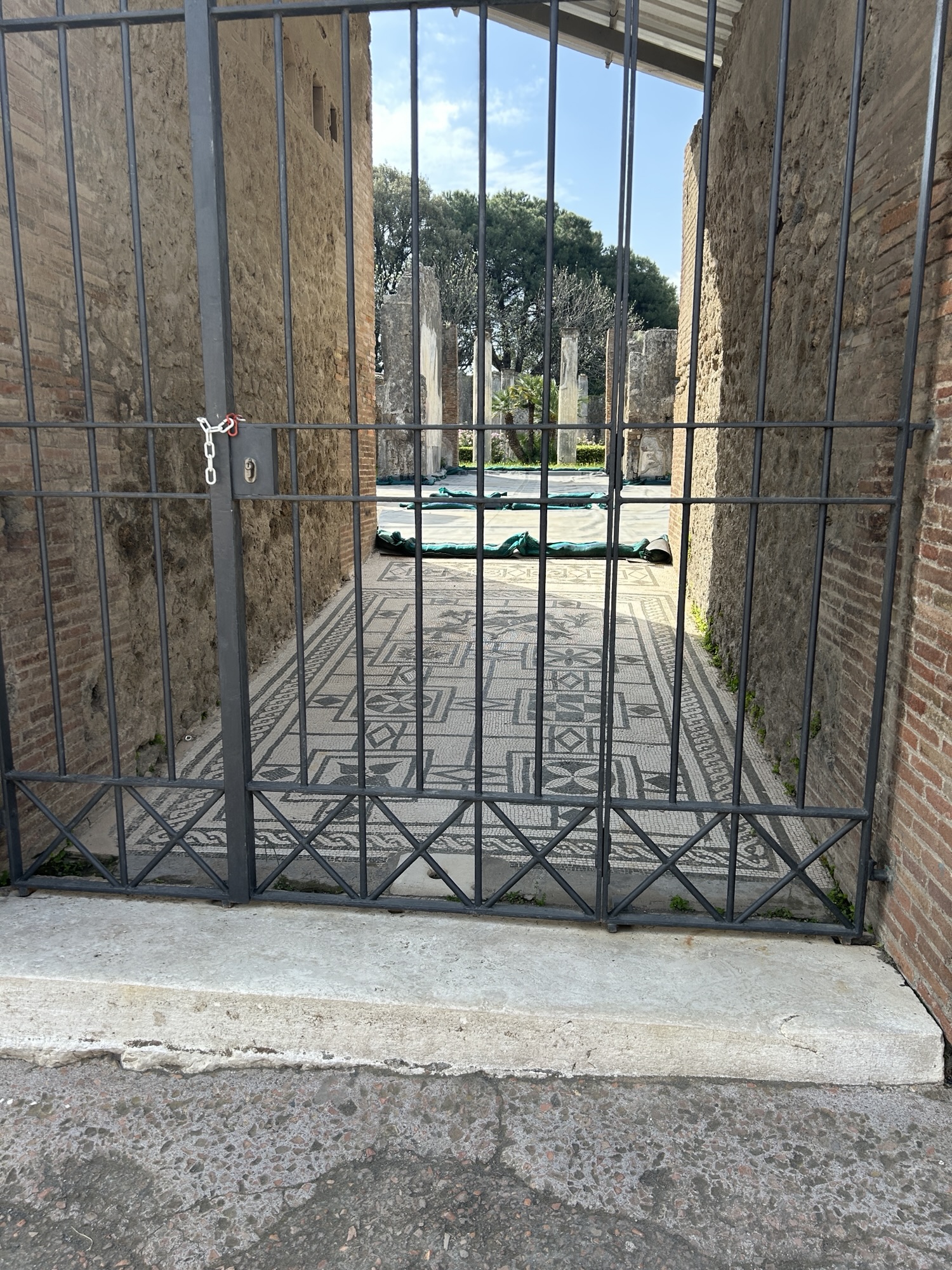
Tried to take it all in! It was so lovely and strange and somewhat sadThe barriers at the end of the street (like we use now) to keep carts and animals out of the forum which was a marketplace so animals not welcomeEntry to a large house. Every house had the same plan, smaller or bigger depending on the wealth of the family
It is believed the city had 20,000 people, but remains of only 9,000 are evident because the wealthy had a little time to get out. The terrifying last day/hours are difficult to imagine; death was by suffocation which took about 15 minutes. Some of the wealthy likely fled to Herculaneum, which was also destroyed but a day or two later. Also, the “bodies” you’ve probably seen are plaster casts; when a cavity was found that was suspected to have been left by human remains, plaster was poured in to reveal the outlines of the remains.
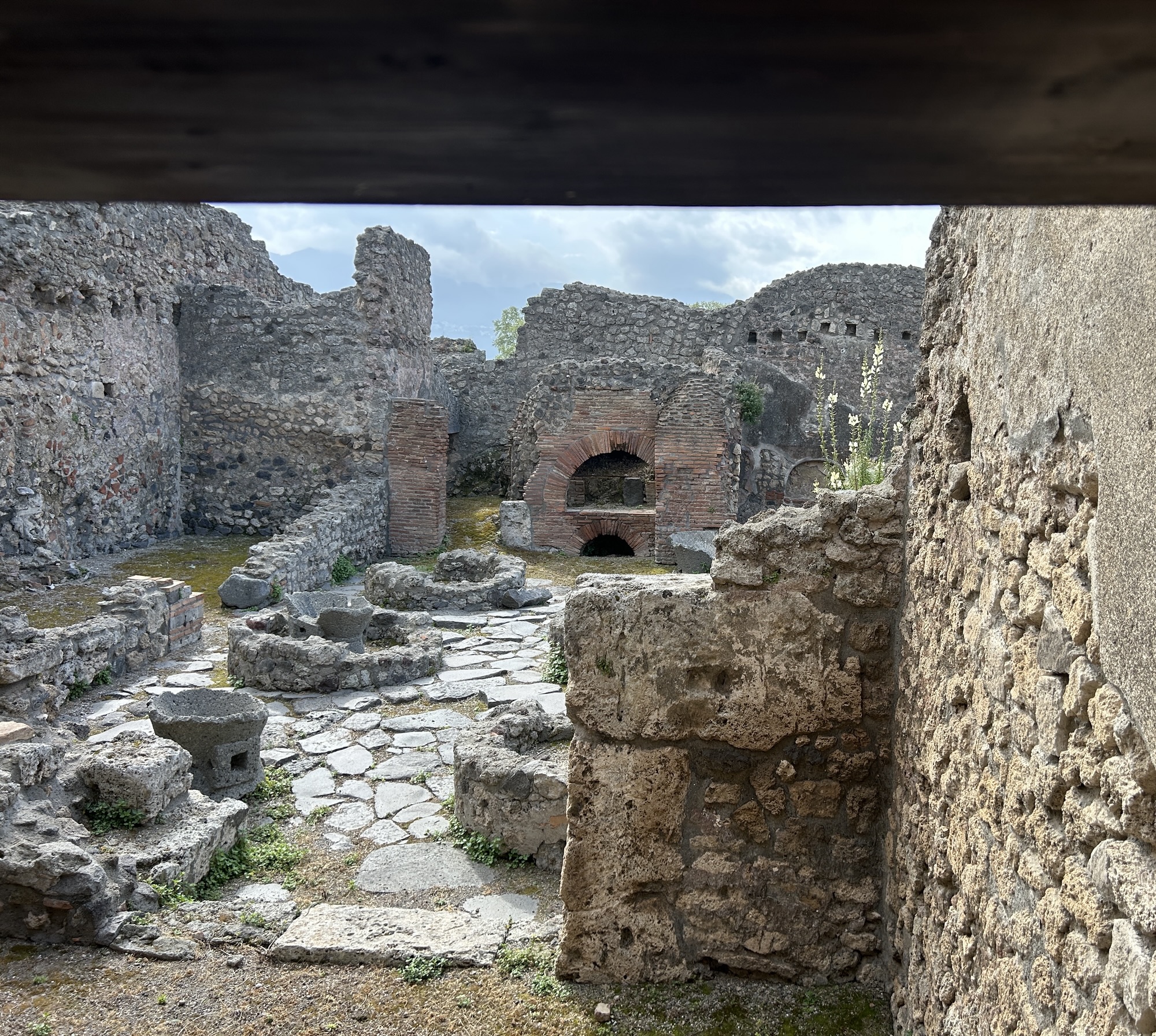
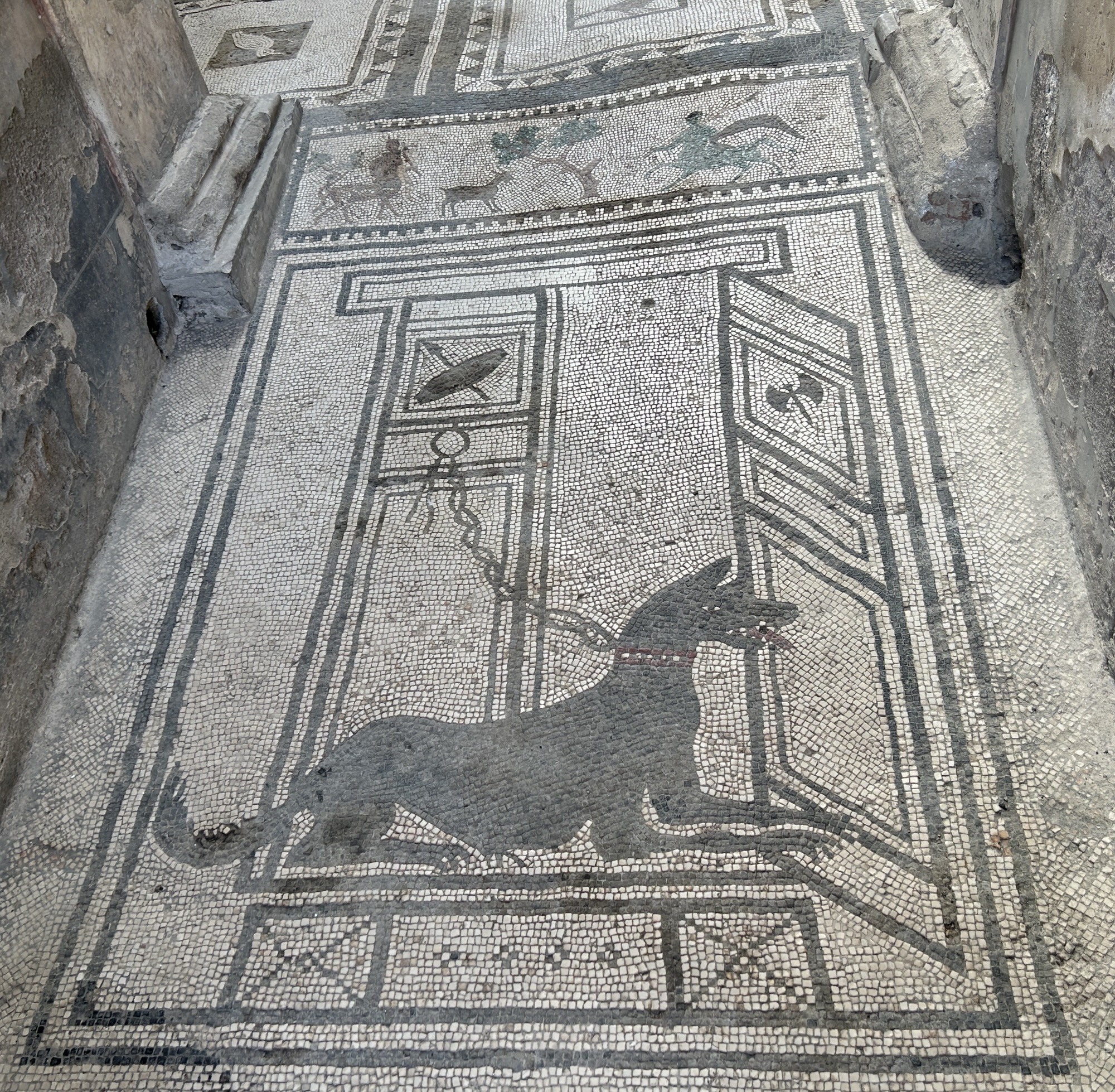
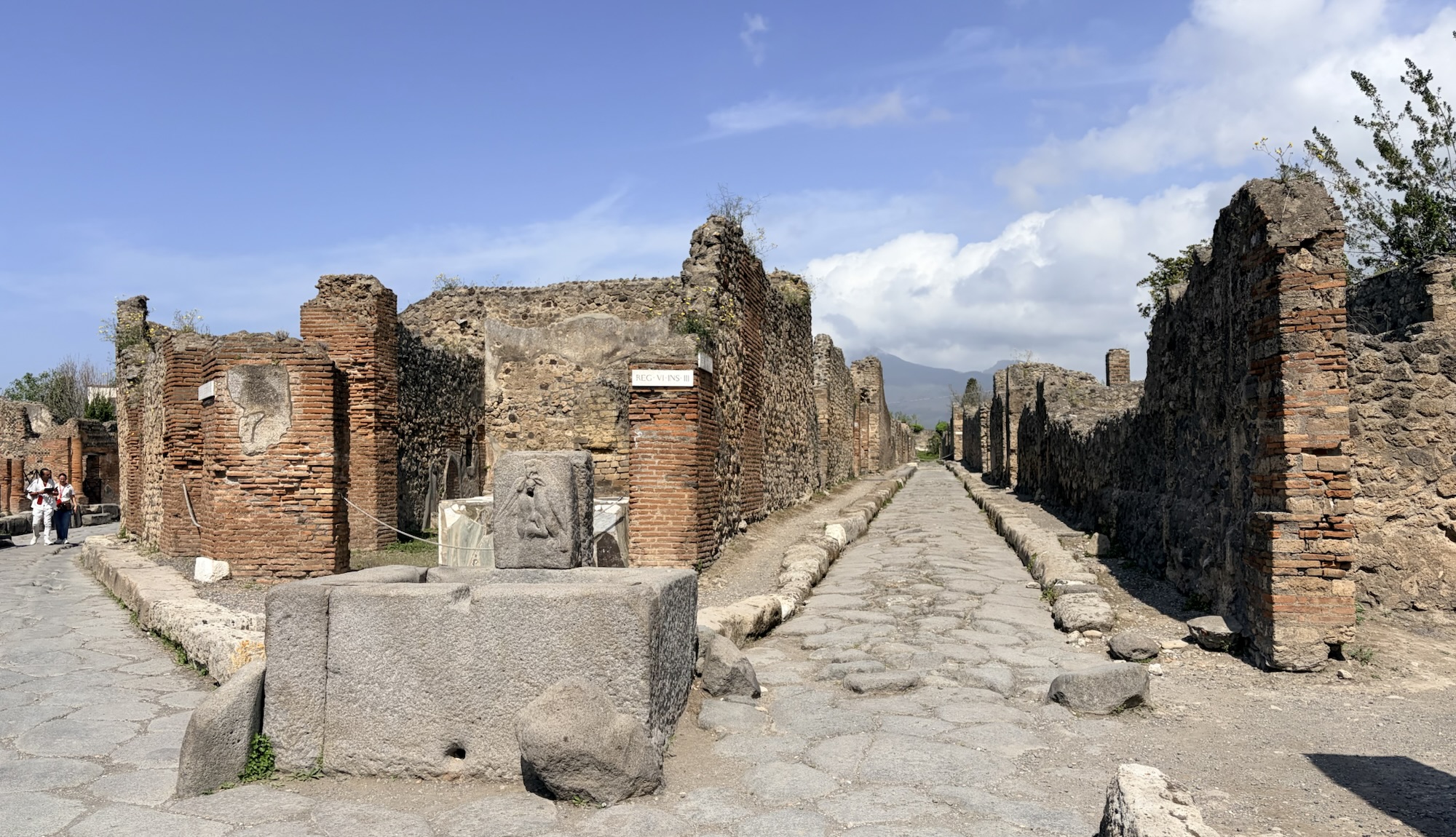
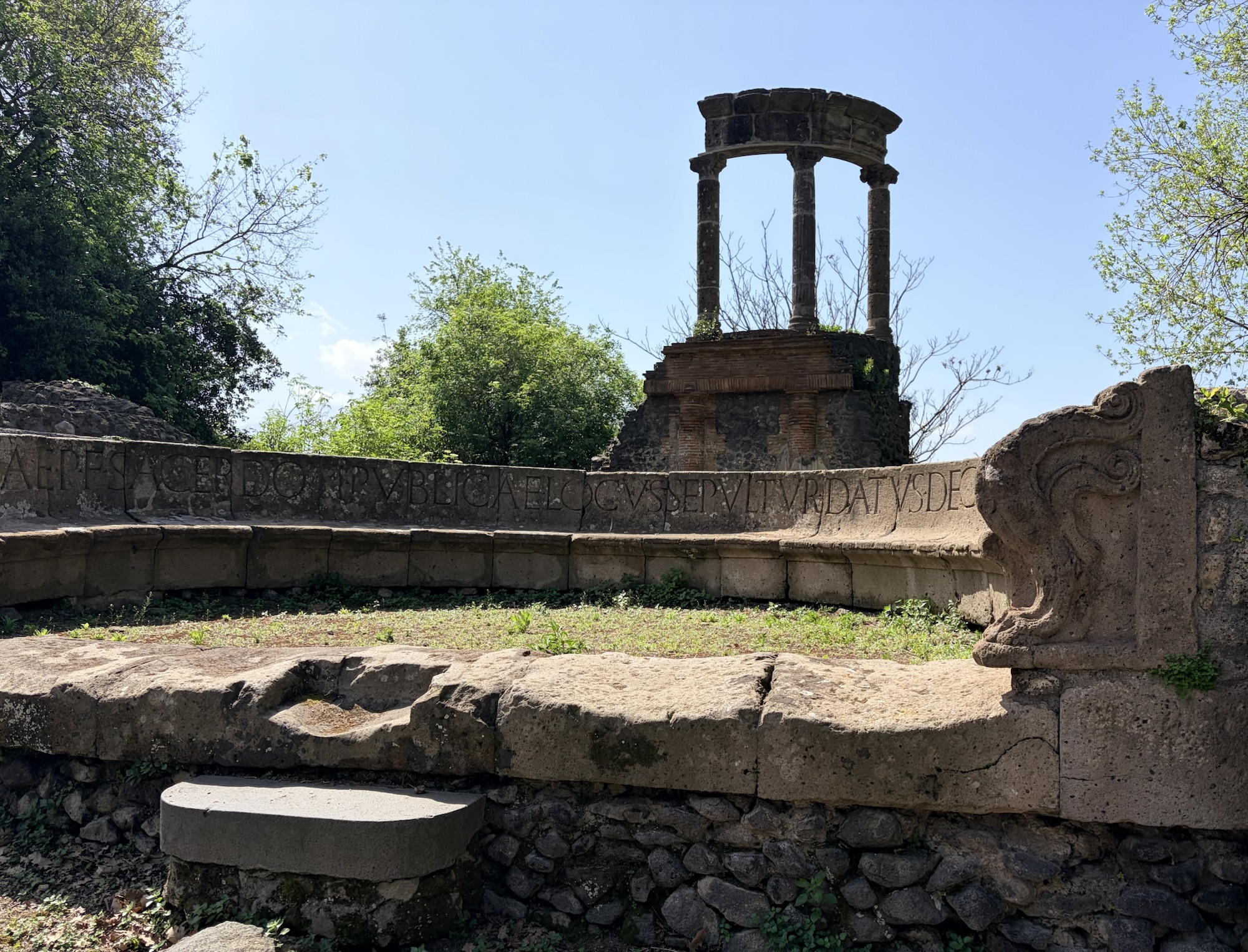
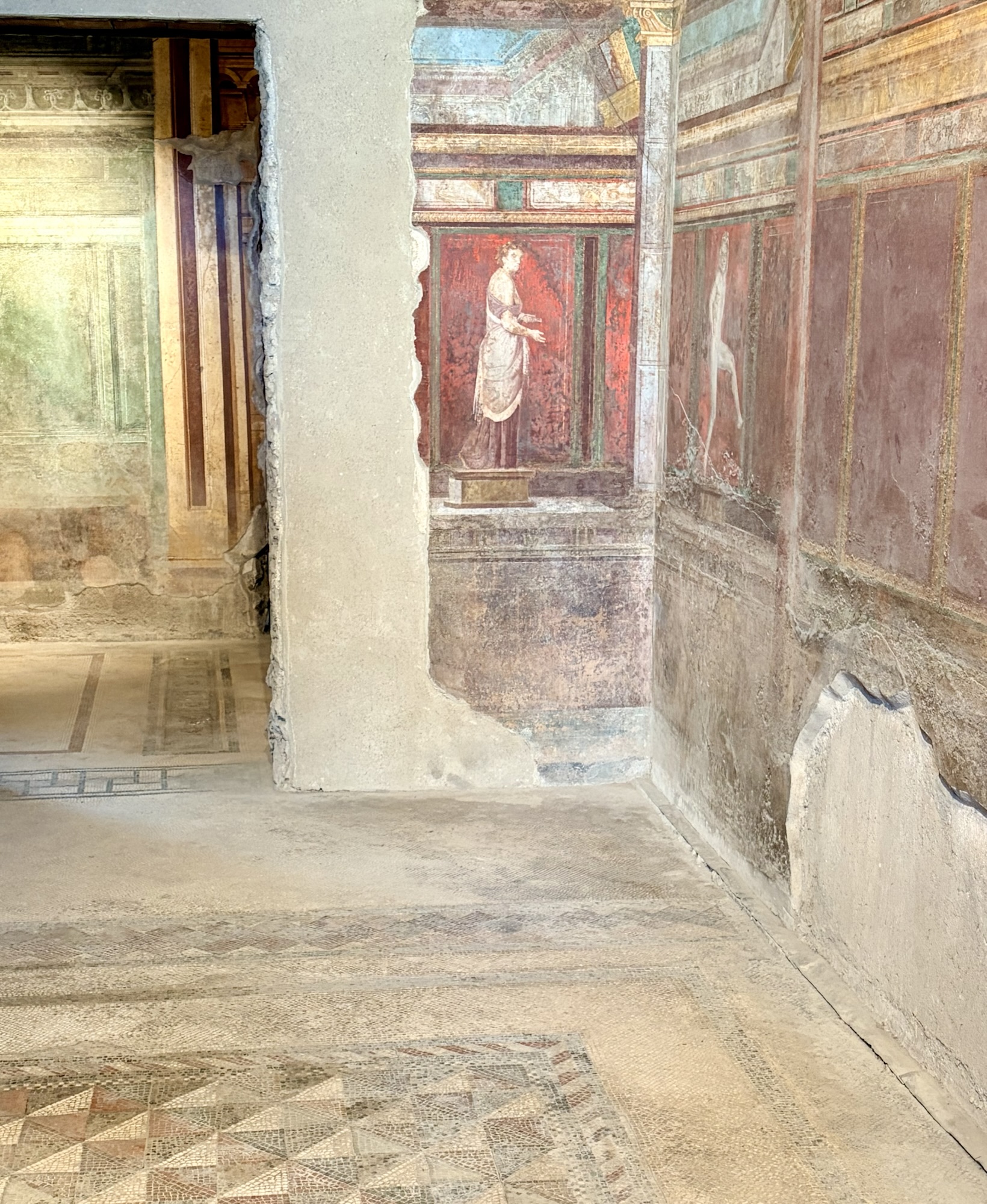
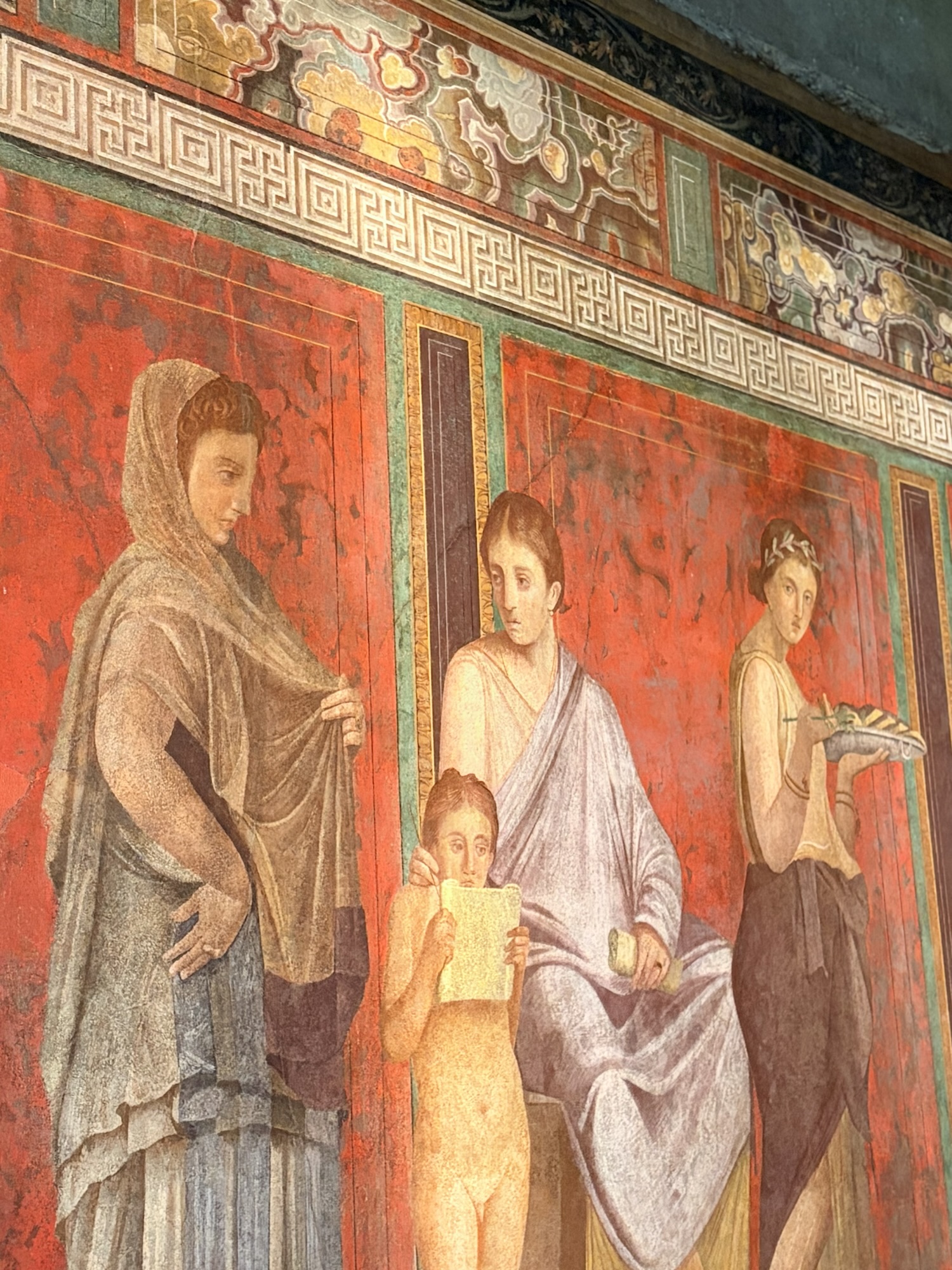
A bakery—oven in the rear, flour grinding stones along the leftBeware of dog mosaic at the entrance to a large homeJust a beautiful street.A huge cemetery plot for a celebrated woman paid for by the city.Frescoes still extant in the Villa dei MisteriA small section of a fresco that surrounds the room illustrating the woman of the house as a bride; vivid and gorgeous
Everything we saw was the result of excavation and some shoring up of dangerous walls except the large amphitheater. It has been rebuilt because events are held there, such as Madonna’s recent birthday concert. Excavation continues, probably forever as our guide said, “we archeologists are very slow.” Thankful for that.
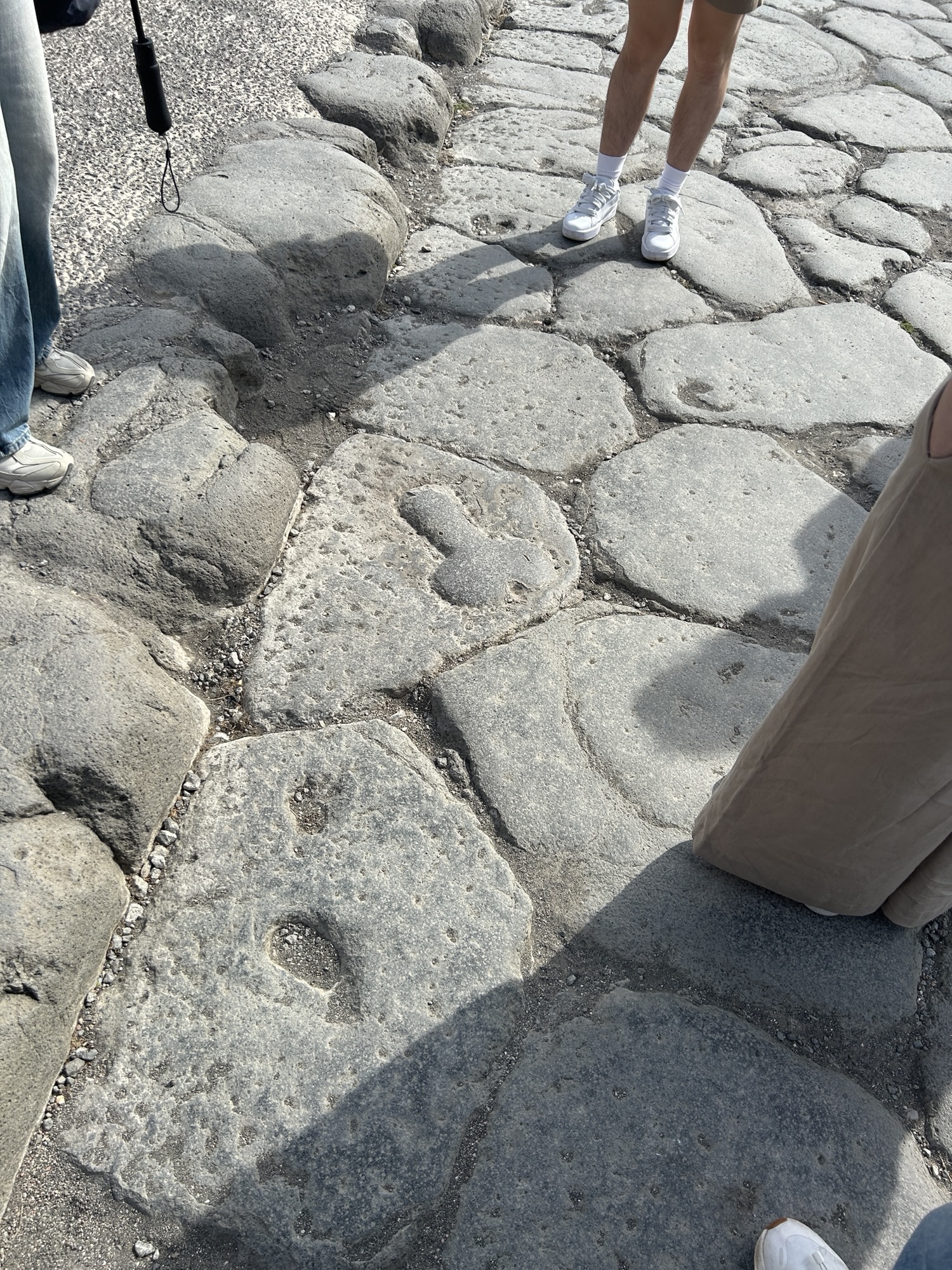
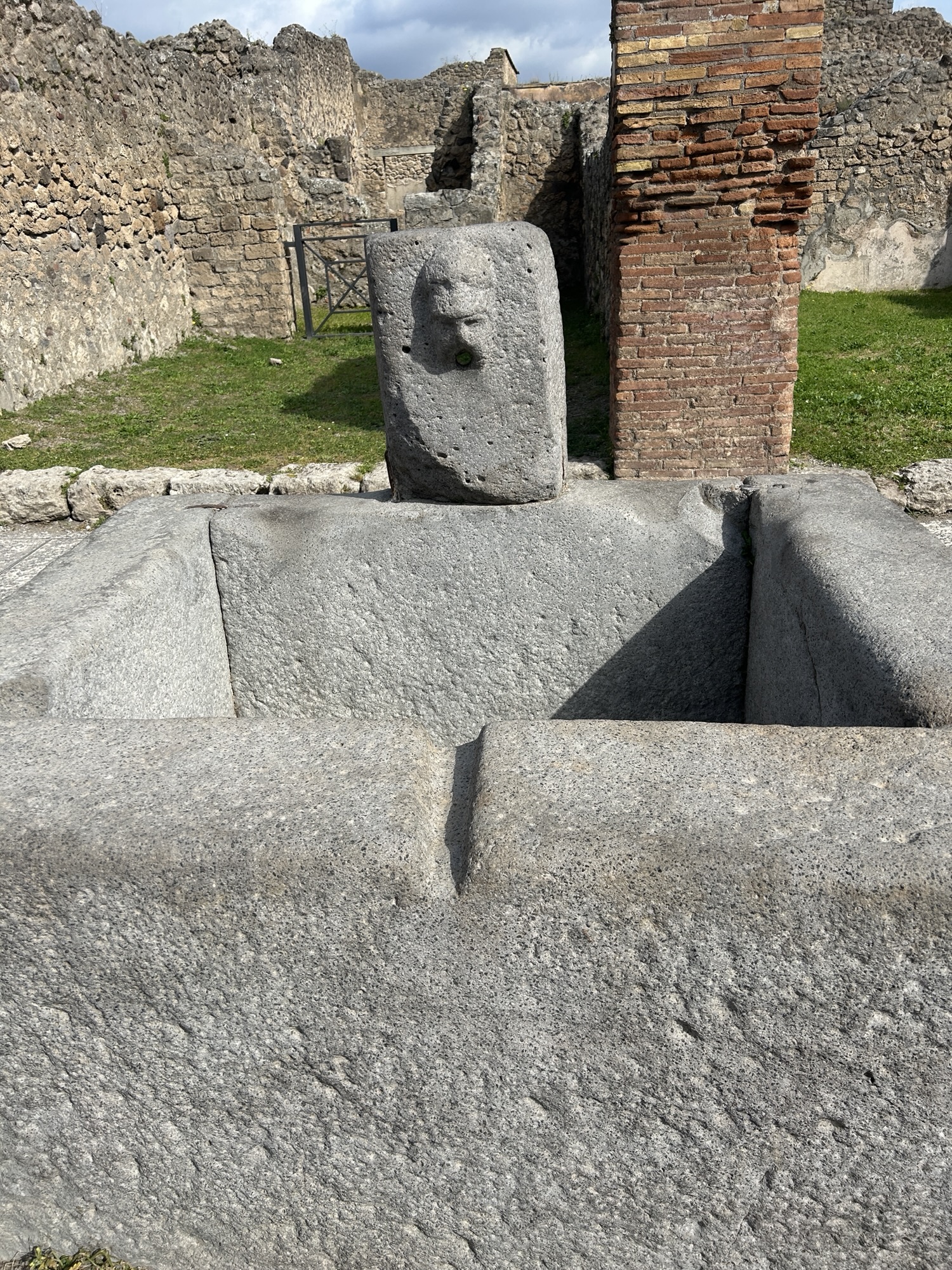
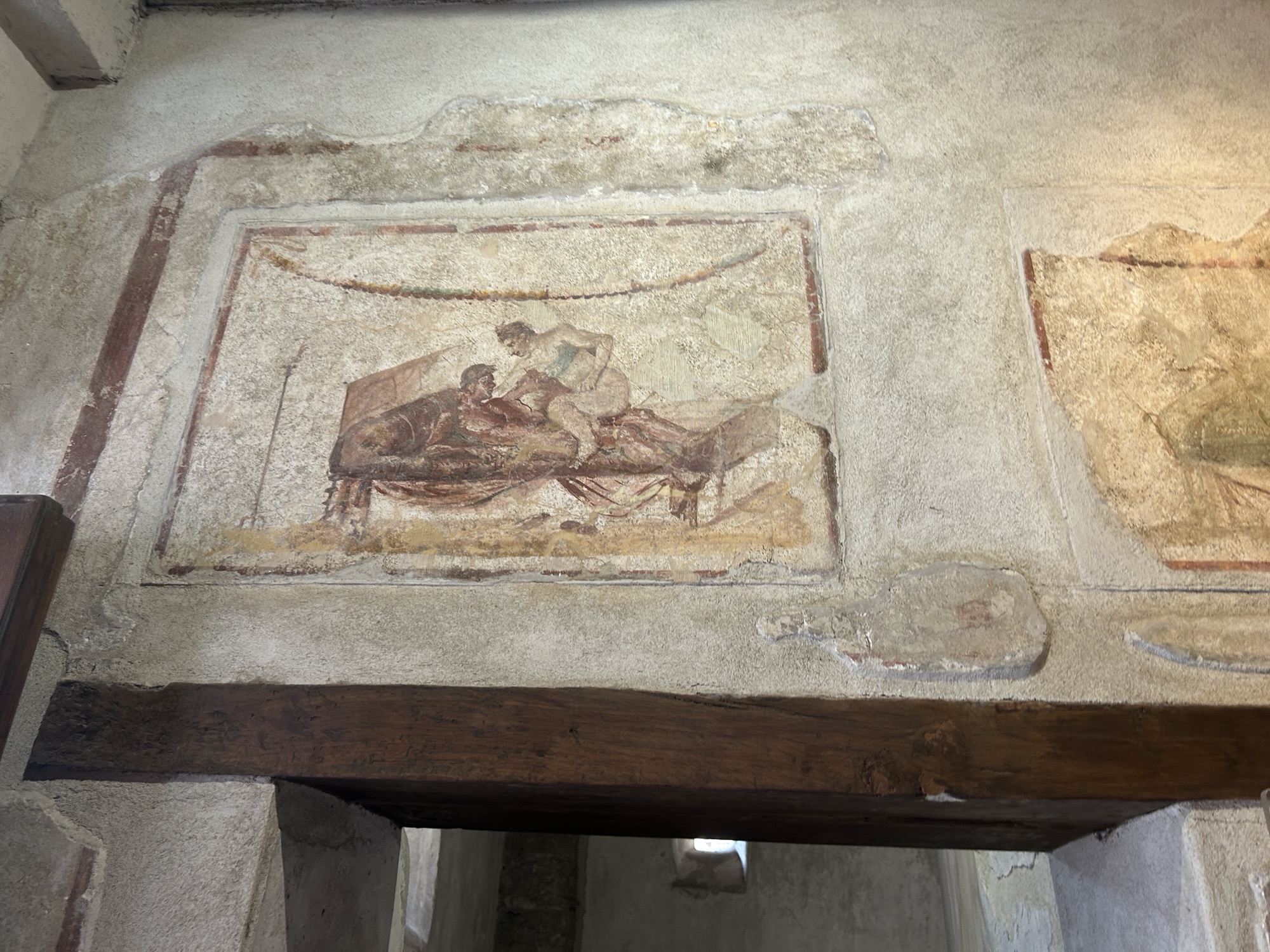
The symbol on the stone in the center points to a brothel. Many visitors (sailors and traders) didn’t speak LatinFountains place around the city—some sponsored by wealthy (noted on the fountain!)Fresco over the doorway of a prostitute’s room advertising what she offers.
After the long and frankly tiring tour, physically and mentally, we walked back into the town of Pompei for a perfect lunch (antipasto della casa) and a walk back to the train station.
The train back to Garibaldi was late and packed, but the windows were open and the air was breezy. Everyone around was friendly, lots of impromptu conversations. Then the train began to slow, many stops skipped, then we stopped. This is a very old train more like an ancient metro than a train—no announcements, no displays of stops upcoming (you had to read the station sign…if possible… to see where you were). We were now stopped 4 stations from Garibaldi. Finally the doors opened. No information was forthcoming. A few people stepped off in search of updates—the train was broken, would take a few hours to fix. No buses, no alternate routes on google; everyone had a phone out looking for solutions. We got off the train and walked up to street level.
In spite of David’s chronic aversion to paying “extra” for a taxi I opened the Freenow app (Lyft in Europe) and watched the repeated “Looking for a driver; high demand” flash by over and over. We began to despair. A woman with whom I had strategized on the train came over to ask what app I was using—she had Bolt and it was not working. Chantelle is from Malta, on vacation before starting a new job; we shared the ride that finally came and Chantelle and I talked and exchanged information all the way back to Garibaldi. She even had a restaurant suggestion for Toulouse!
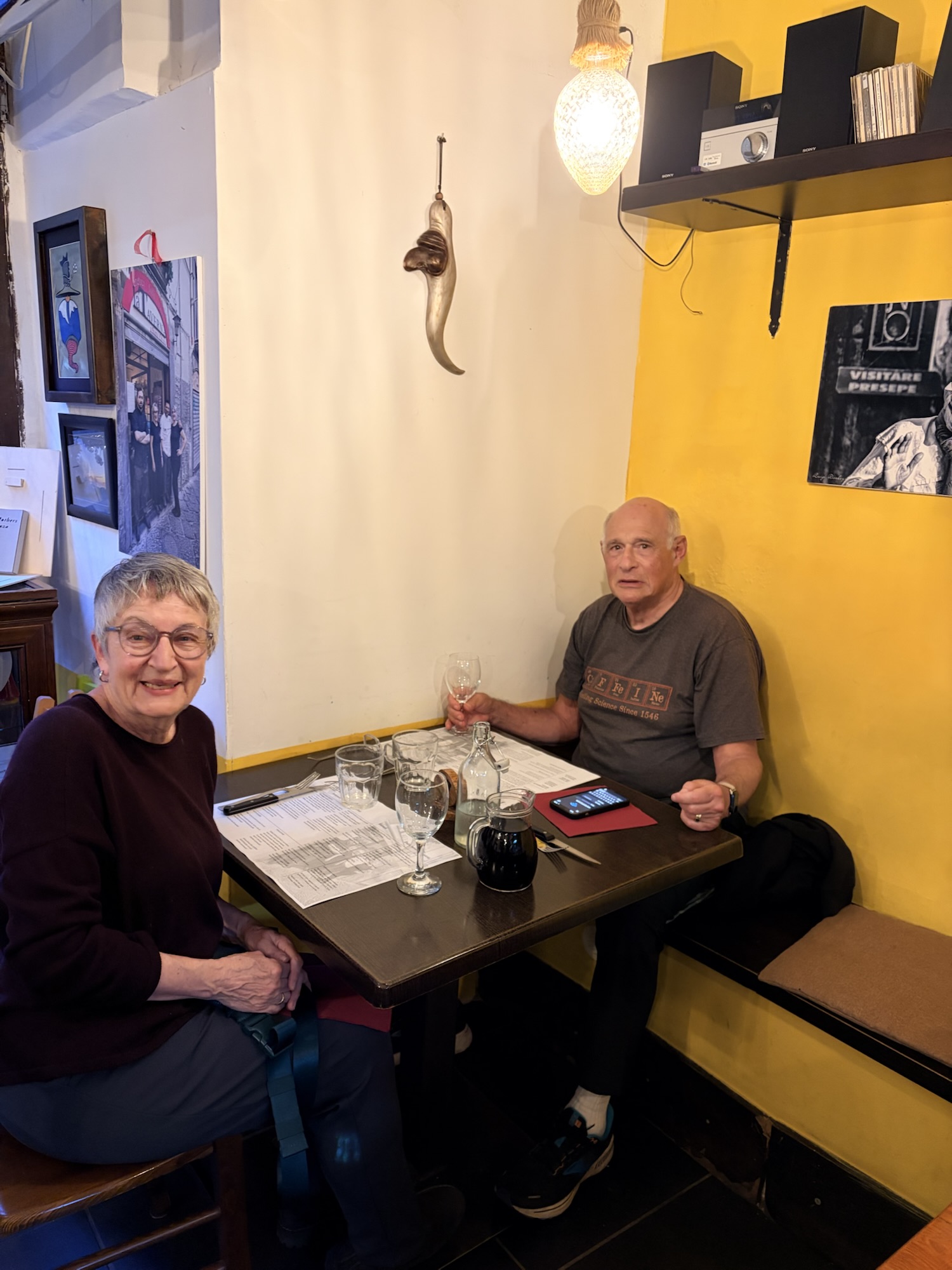
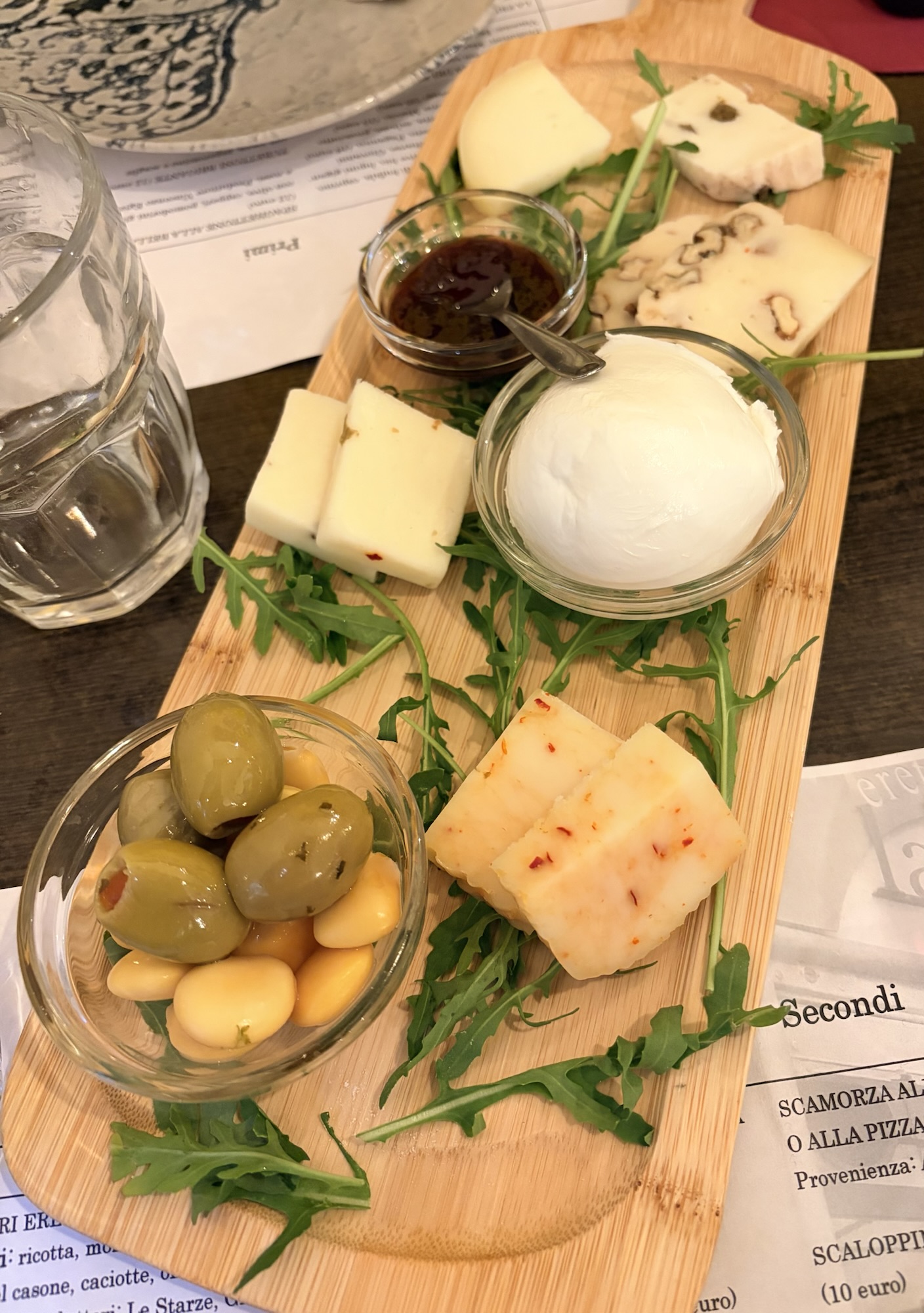
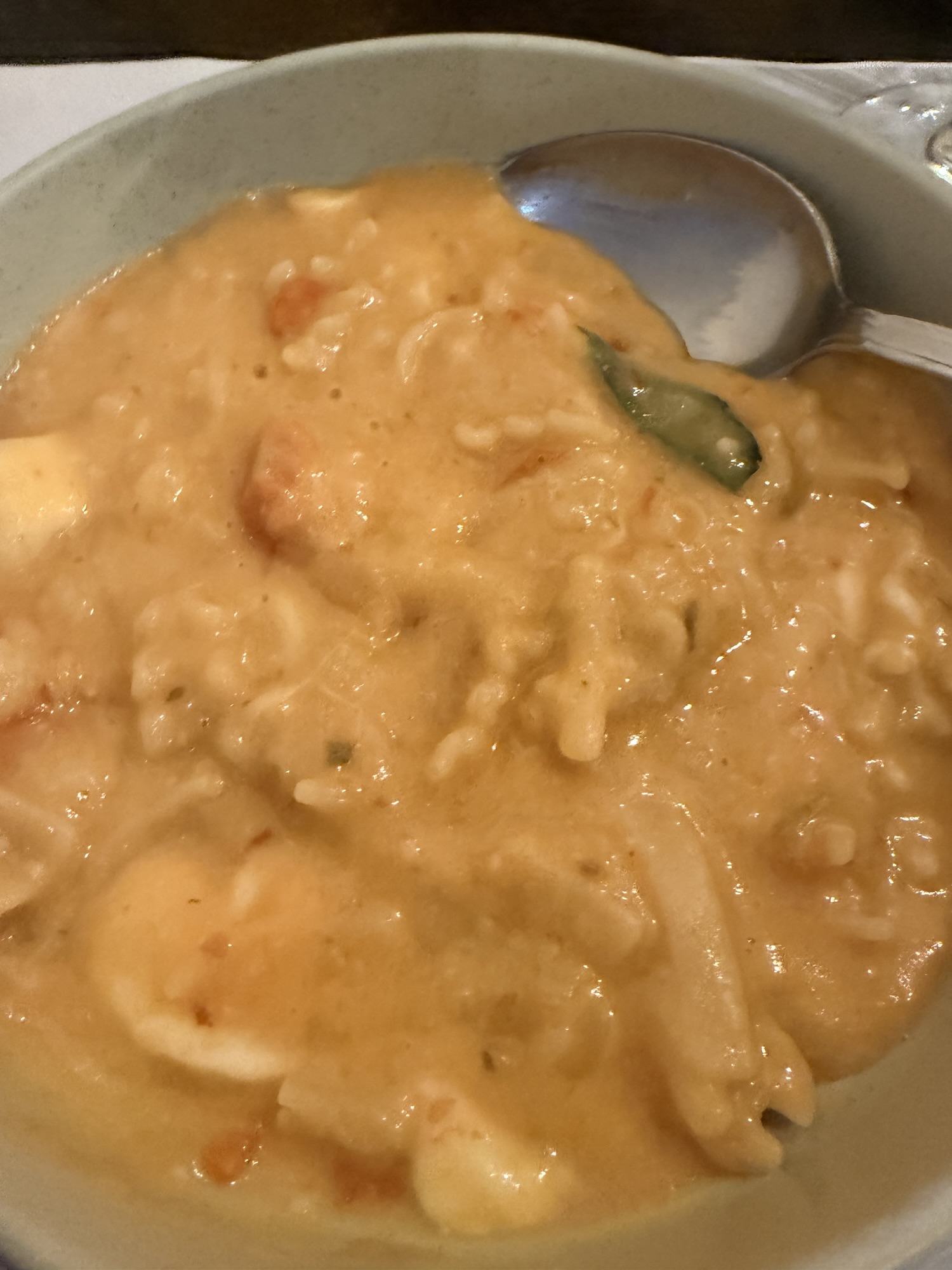
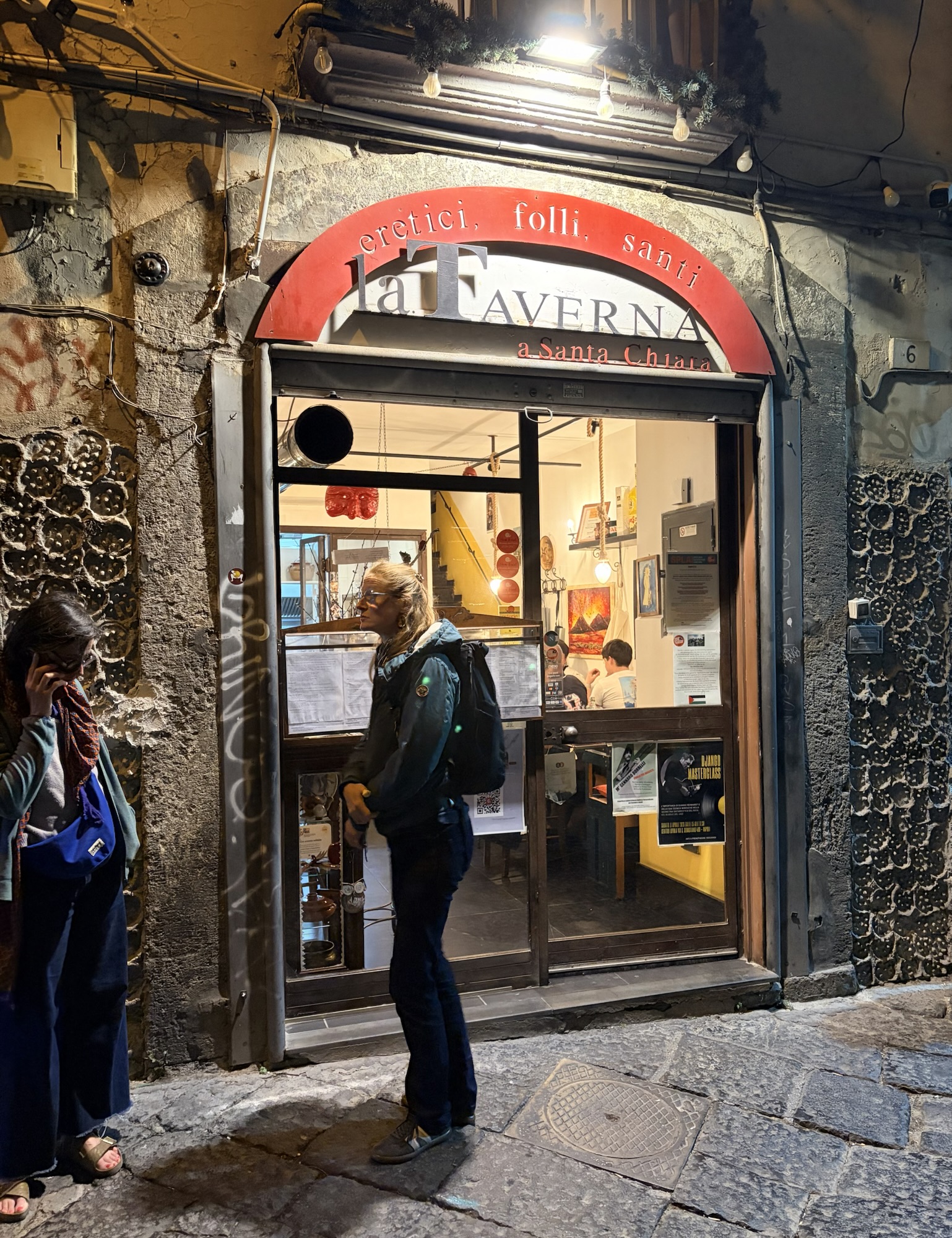
We still had time to lie down for a bit before our dinner reservation at la Taverna a Santa Chiara, which was so good. A tiny place where we watched the owners turn away walk-ins with “Maybe after 9?” We ate cheese and bread and shared an order of the local pasta and potatoes (see picture) which I must make at home it was so yummy. We walked back to Gioia Toledo and collapsed. What a day.
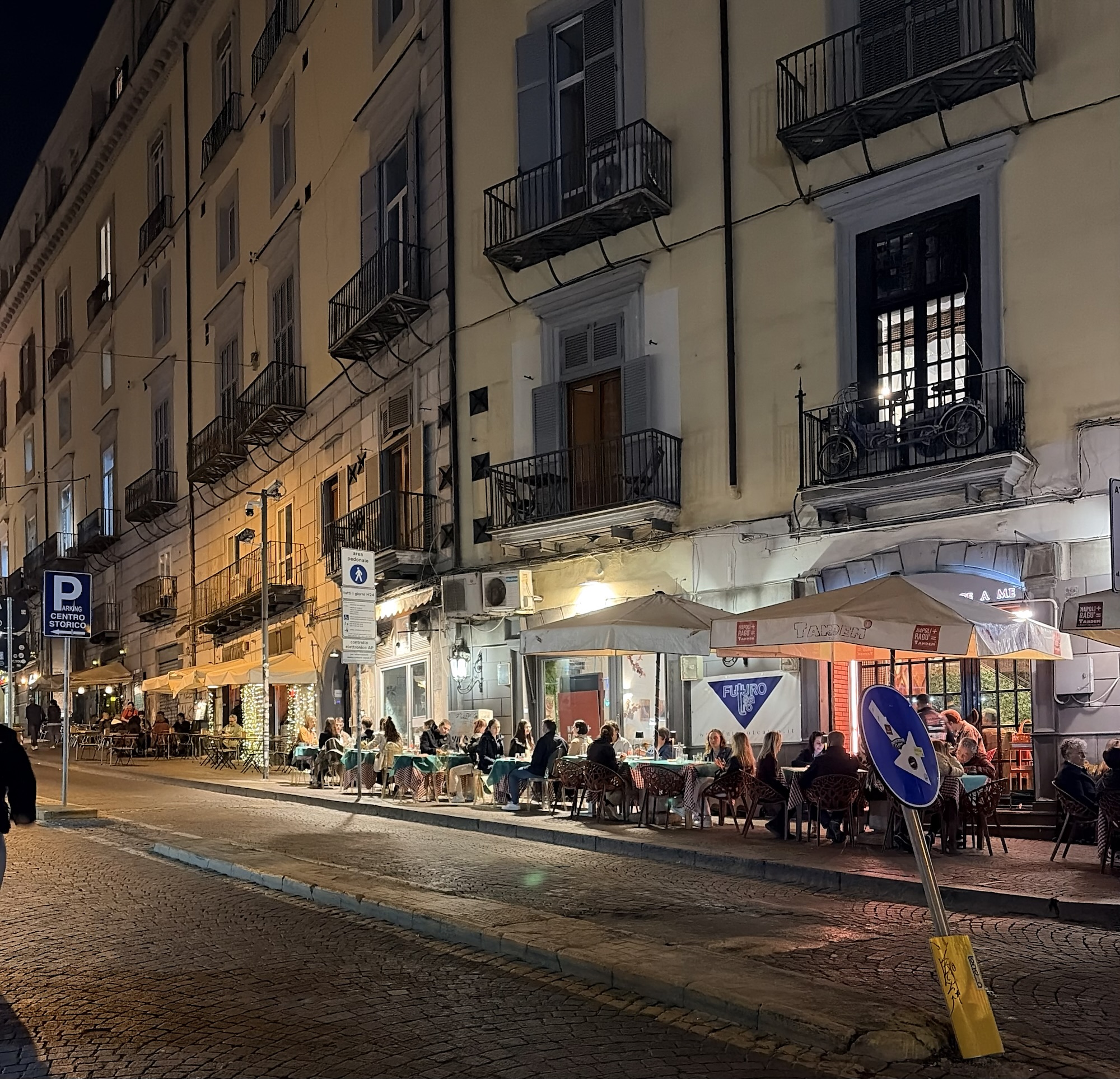
Wish we had had a map of the cheeses; they were all deliciousOh, this pasta was incredibly deliciousEn route back to our roomLots of people out as usual in Italy (and France and Spain…)
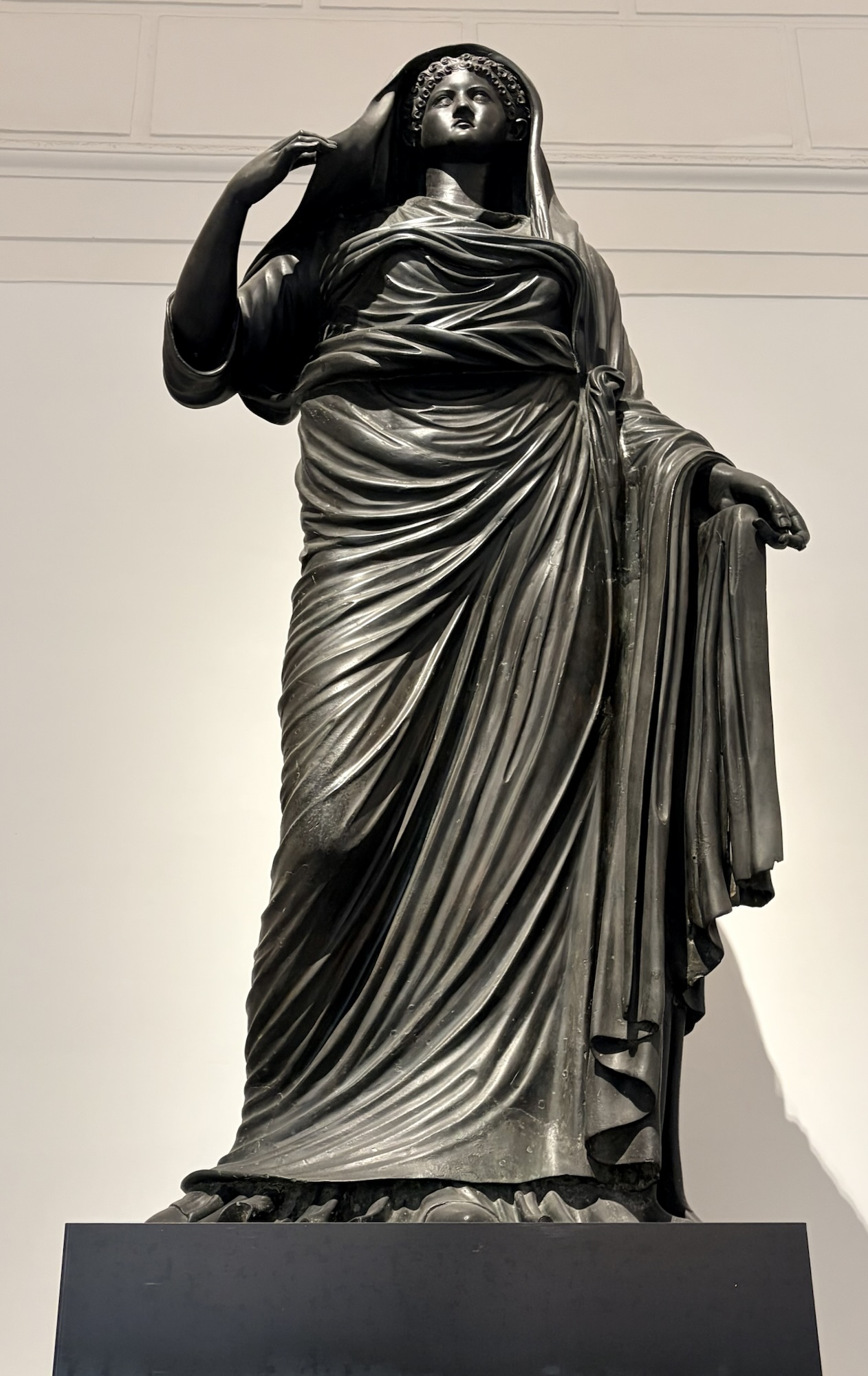
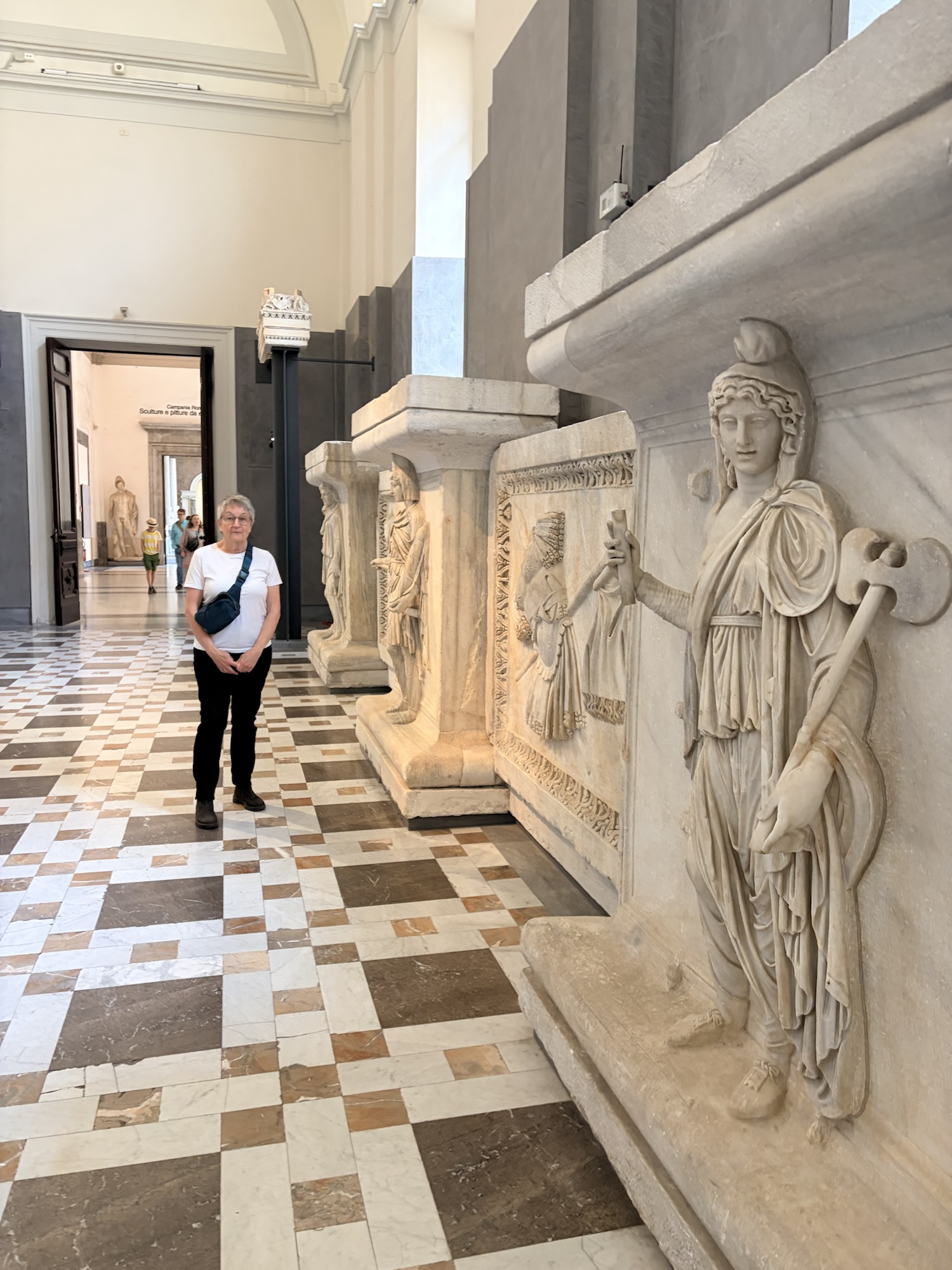
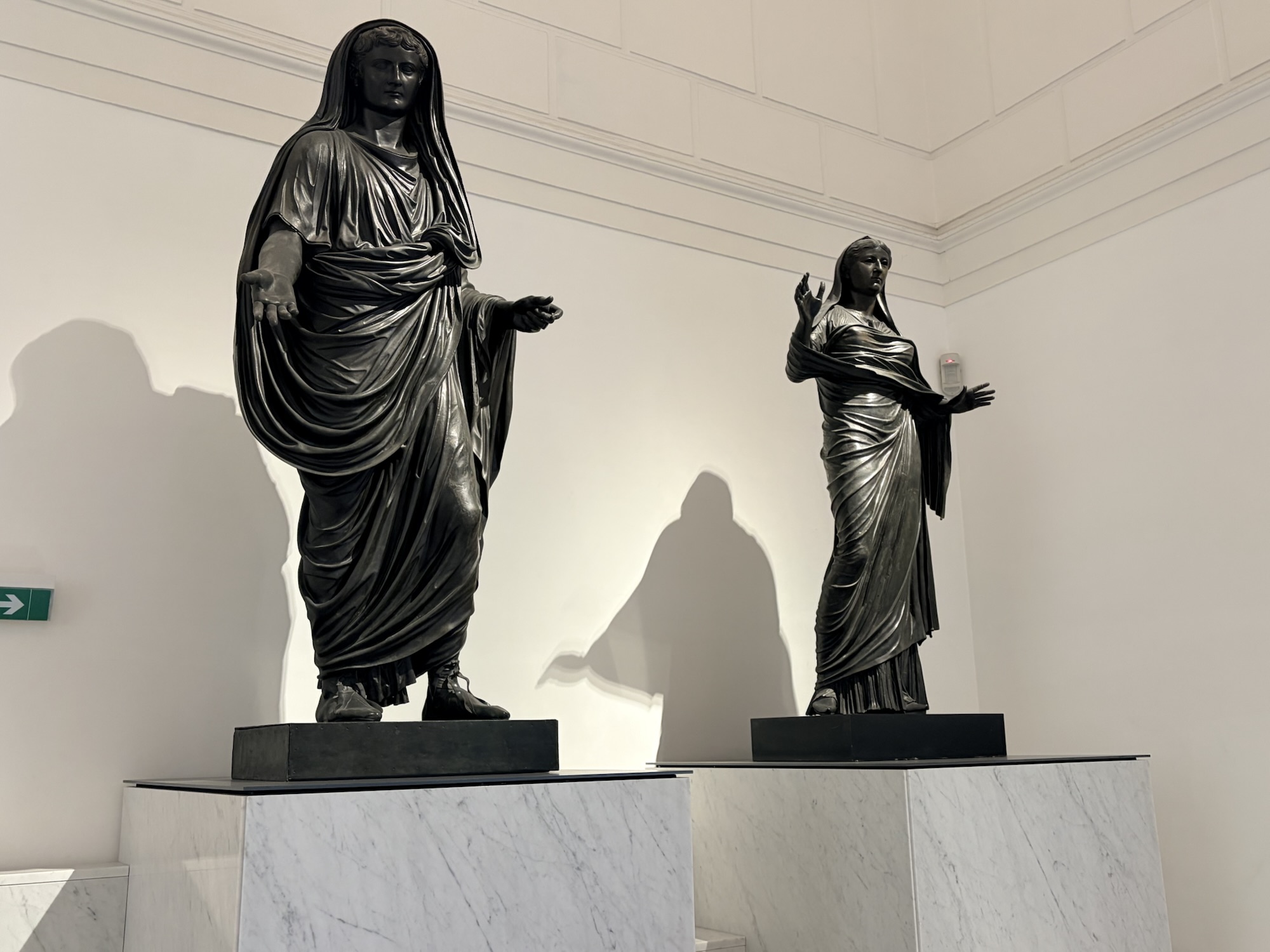
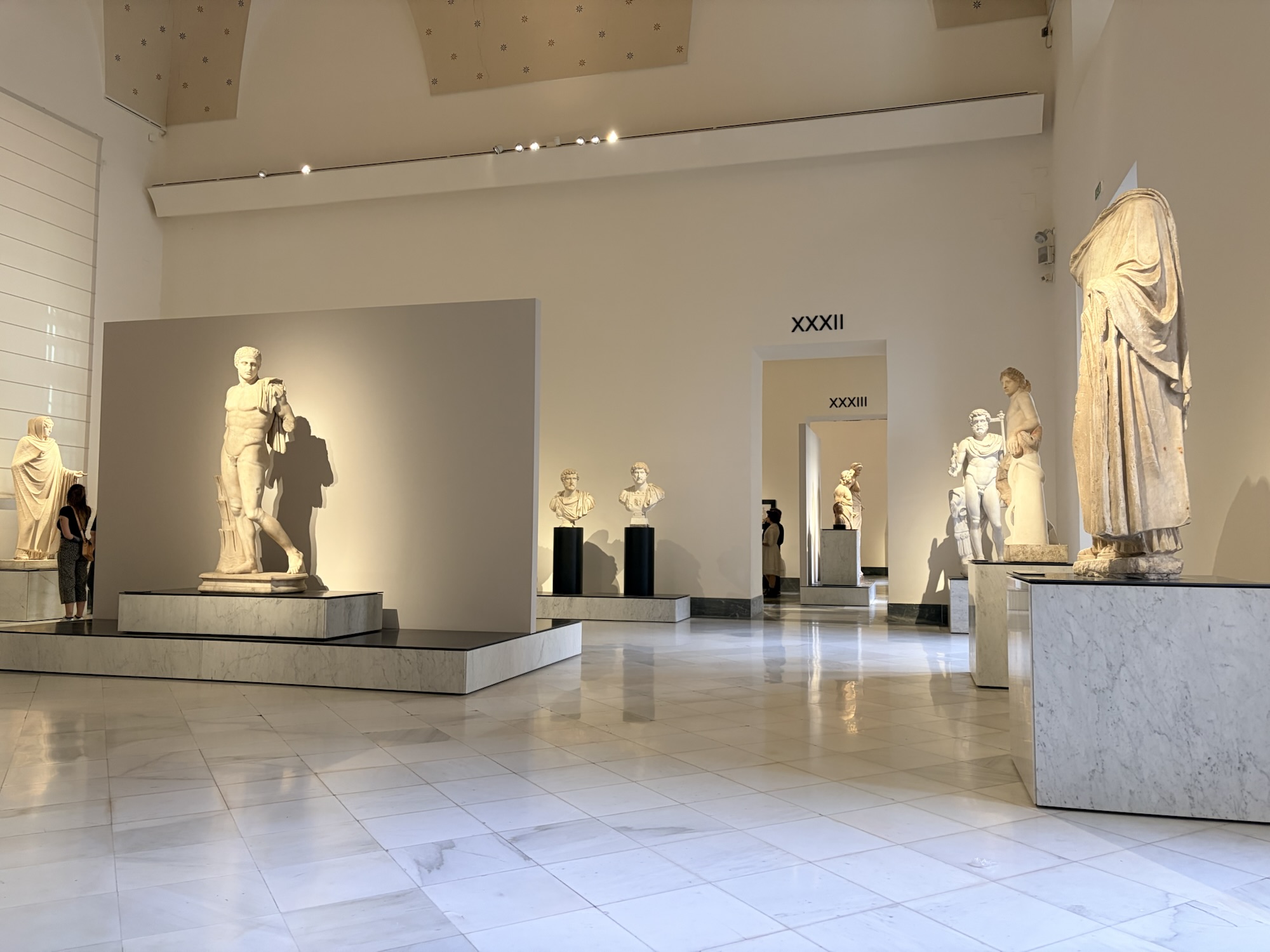
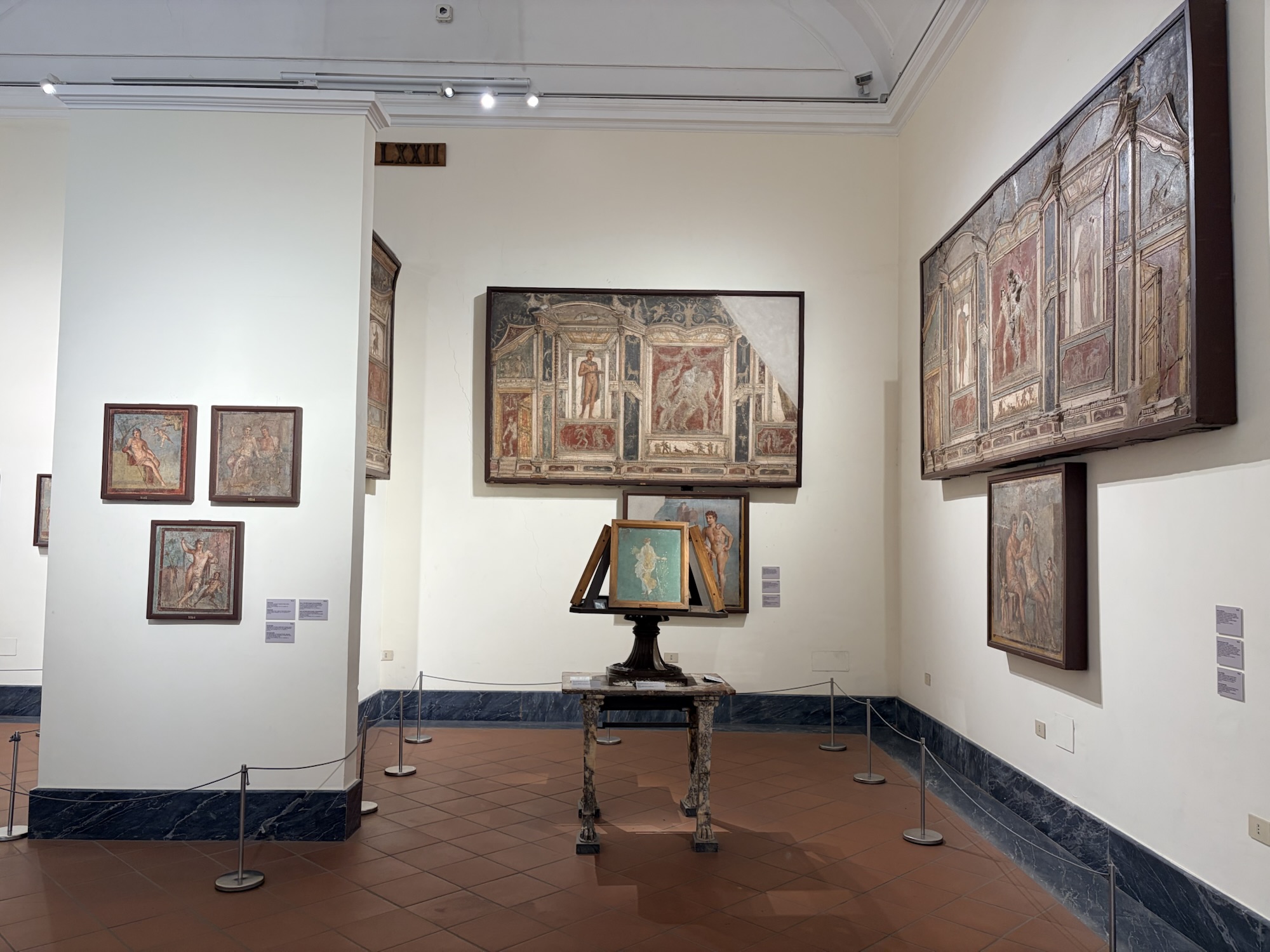
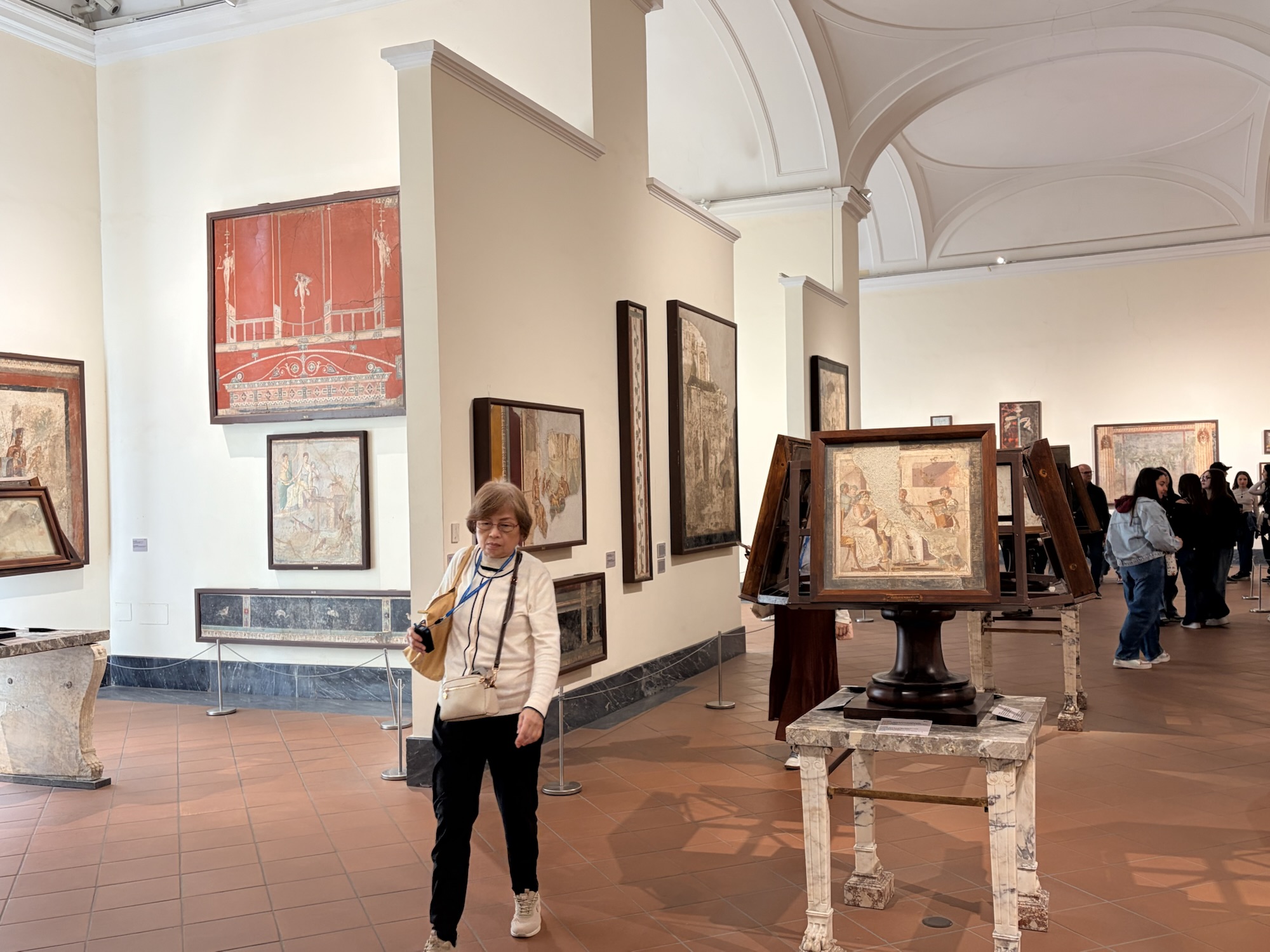
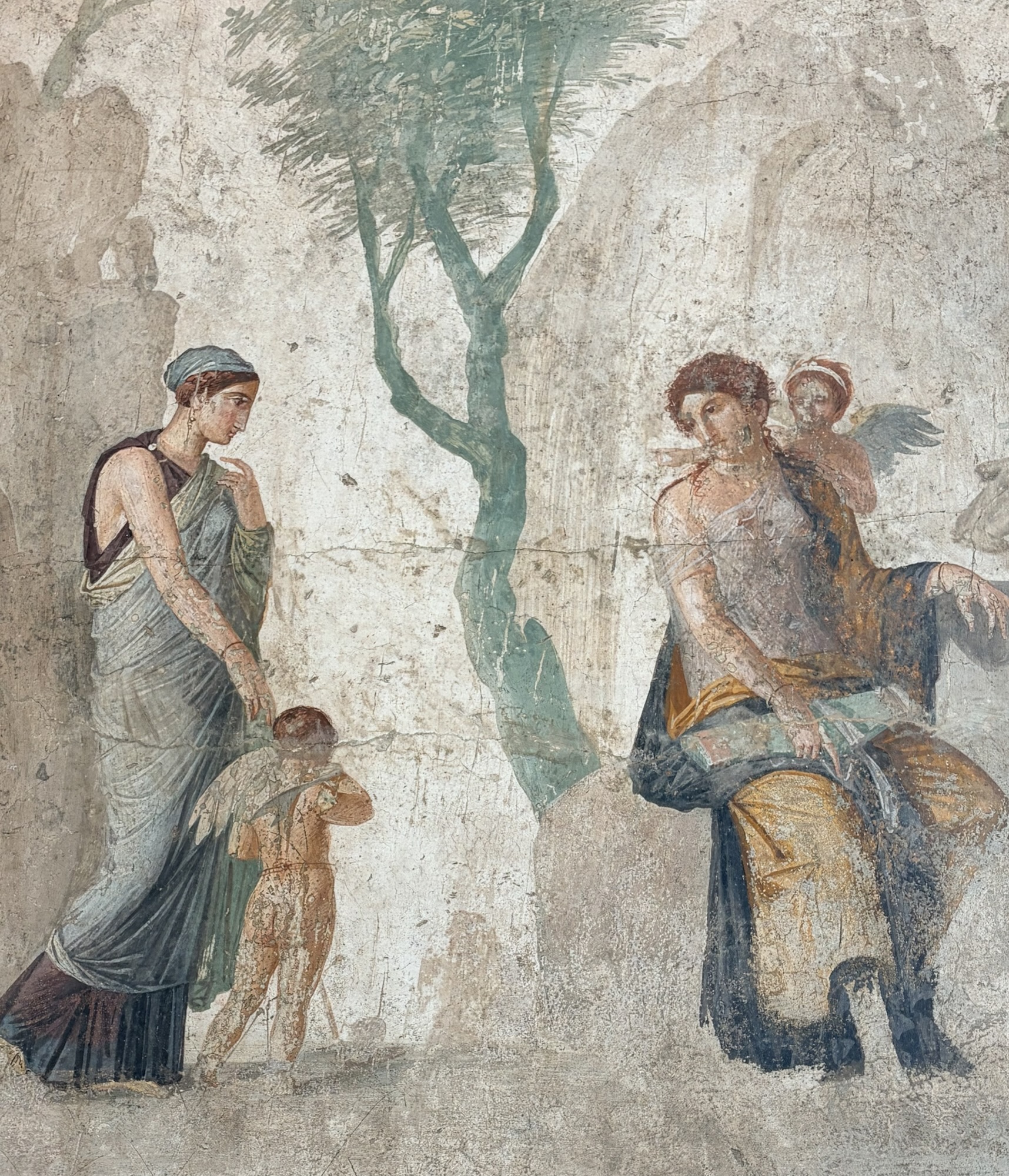
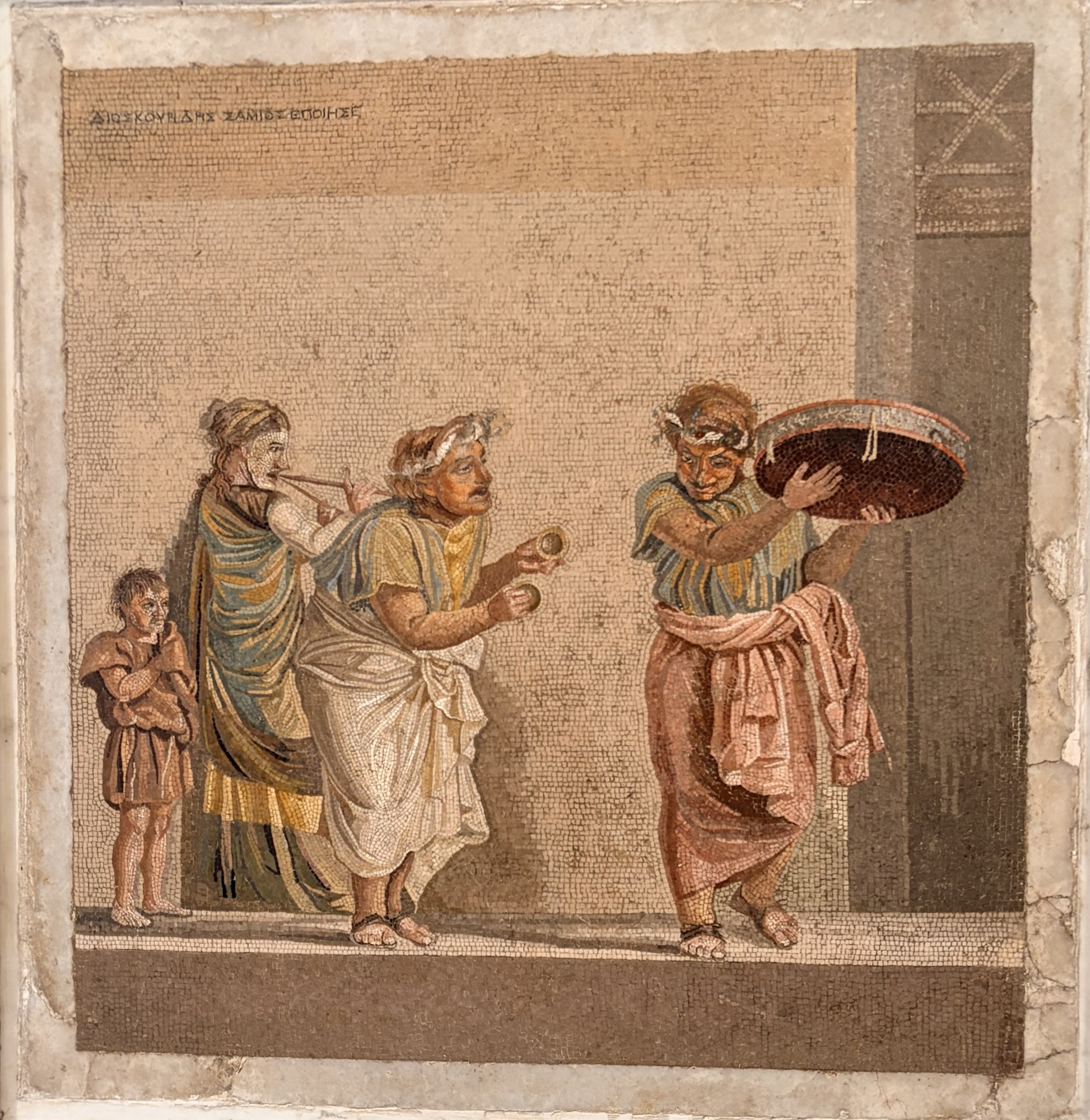
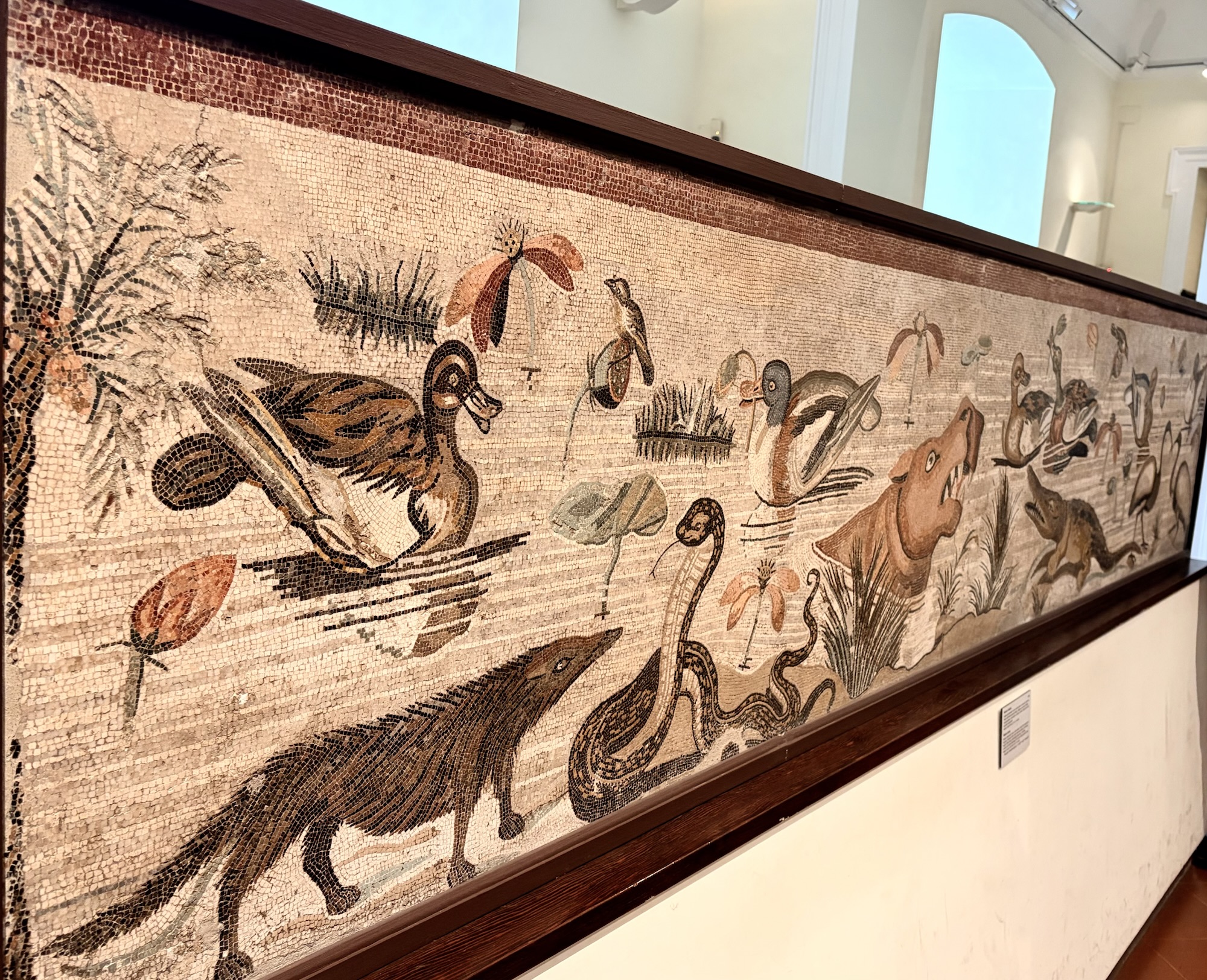
We had online tickets for 10 when it opens…and we staggered out 4 hours later having seen most everything except the Egyptian section. Wow, what a place. Rooms and rooms of massive marble and bronze statues, rooms and rooms of frescos and household items from Pompeii, and a small but fabulous mosaic collection. I have come to love mosaics most of all. We almost missed that particular section because it is on a half-level we only saw as we walked up the multi-level marble stairs.
Words will fail me, so I defer to a few of our photos.
Artifacts from Pompeii were stunning.
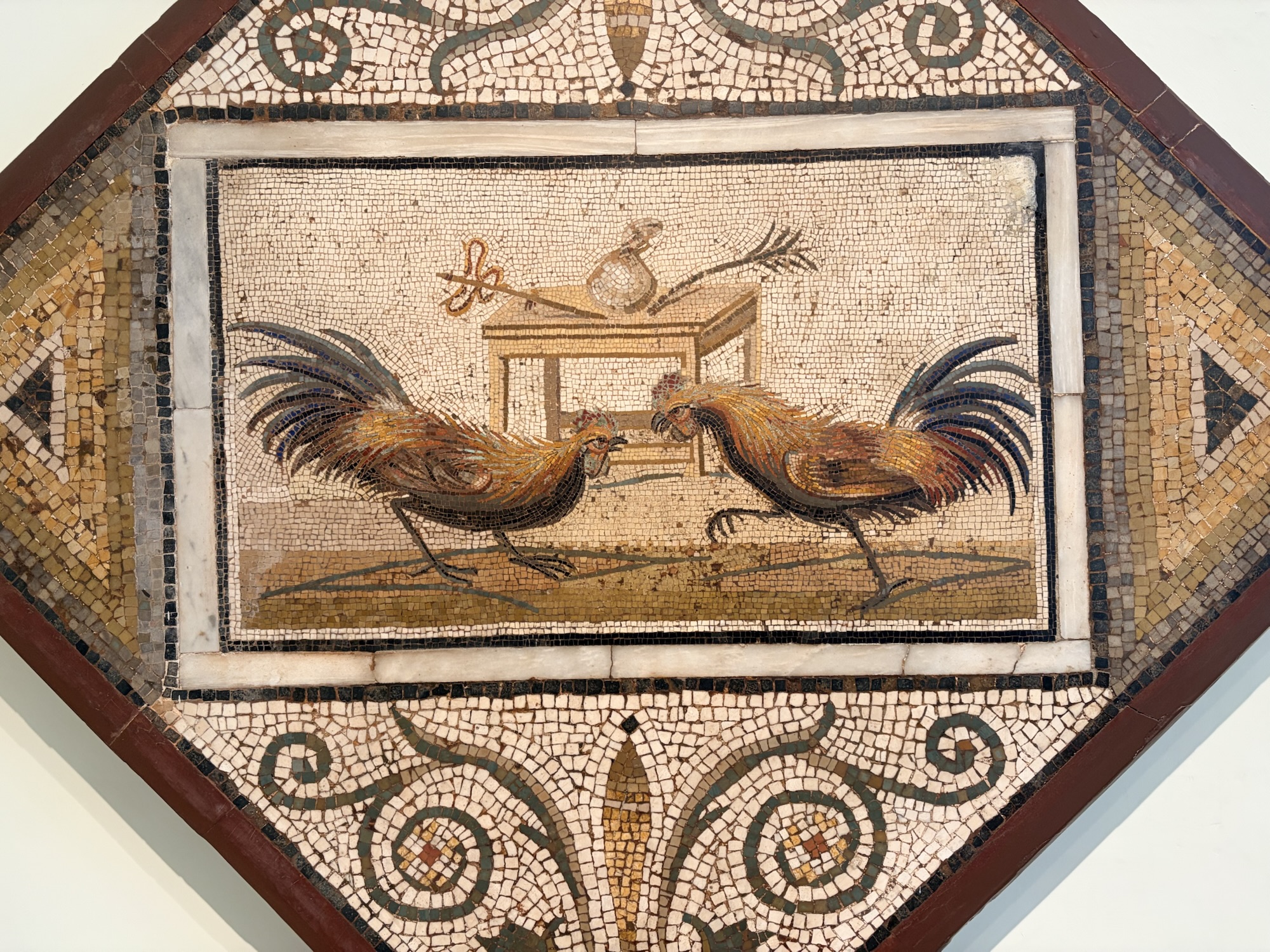
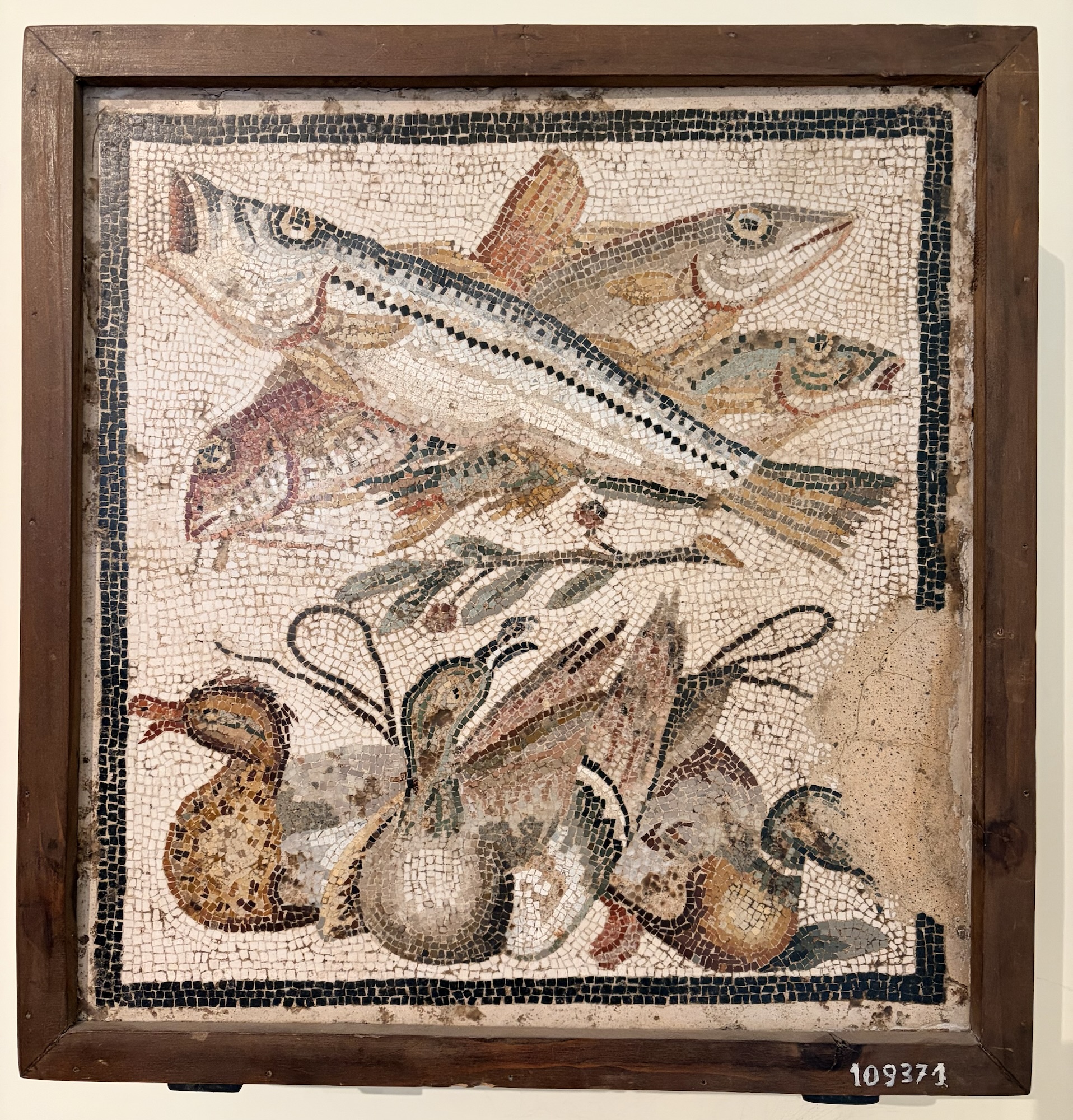
The mosaics, ah.
I love the use of tiny stones for the cocks and larger for the border May I have this as a jigsaw puzzle, please?The fresco of this same scene was hung just above this amazing piece, and was not nearly so vivid and aliveThis was fifteen feet (?) long…impossible for an iPhone camera to convey. Struck us as very modern in design.
Several years ago I read a piece about why Americans who live in less populated areas are so afraid of foreigners and so convinced Democratic mayors are inept—these Americans have never spent time in a big city. If you have not experienced the messiness of New York, London, Paris, San Francisco, even little old Oakland, it is scary and crazy from a distance. All big cities are messy, noisy, heterogeneous, confusing.
Wow, Rome covers all of those bases. It is big; it is messy; it is noisy; it is complicated. Also fascinating, exuding history—ancient history—at almost every turn. Yup, we’re having a good time even in our first jet-lagged days.
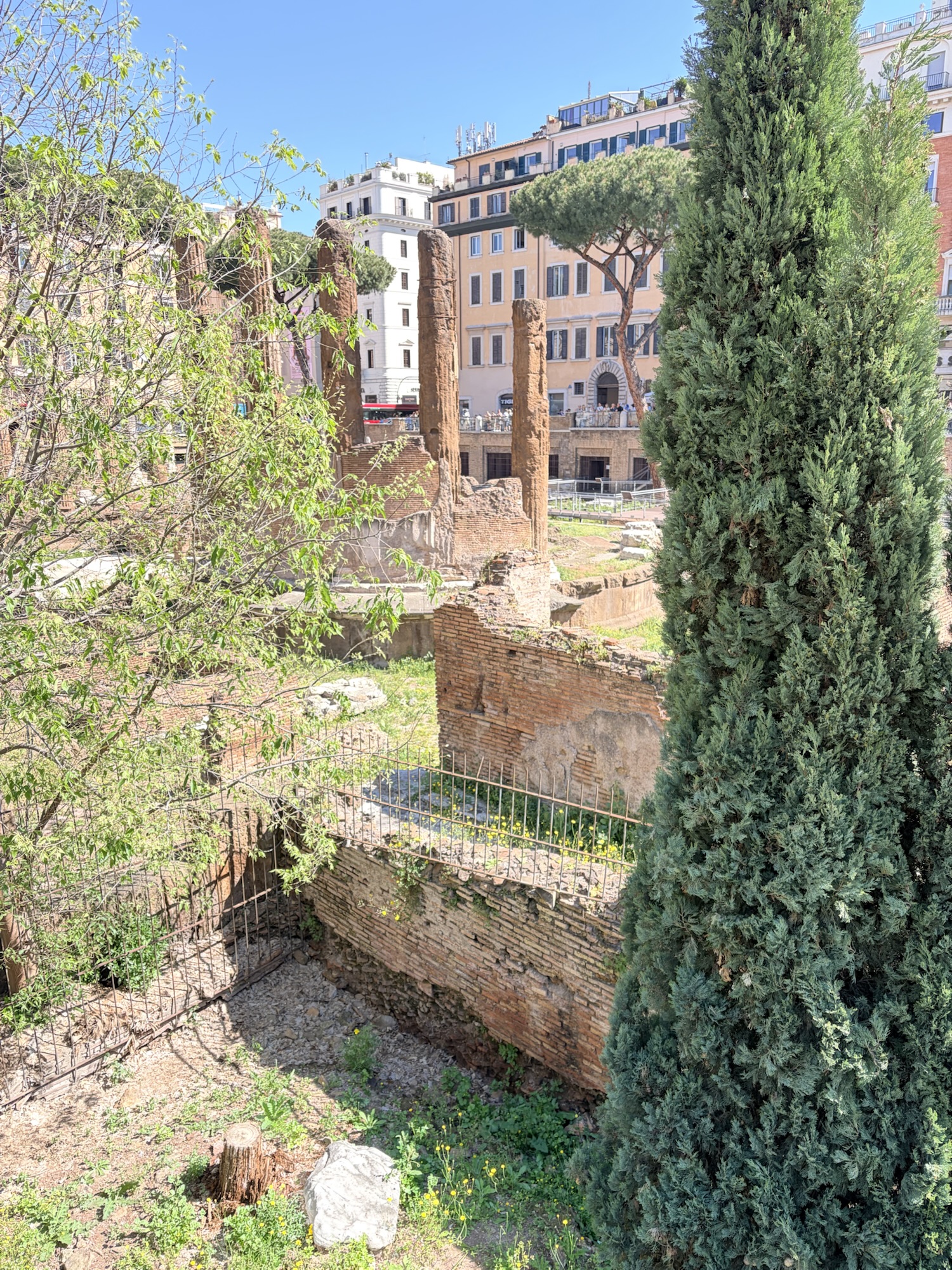
Random ruins we passed on a walk to the Pantheon.
We chose to stay in Trastevere, a neighborhood known for excellent restaurants and a bit removed from Roma Centro, the historical district. It was a good choice. We are staying at Dulcis in Fundo, a B&B right on the tram line. Our host met us at the tram stop from the train station from the airport (easy to navigate even as tired as we were after 24 hours of travel) and walked us into the building, up the steps, up the ancient (our host called it vintage) elevator, and into our room. Room is large, host Alberto is as friendly and helpful as you could ask for, and the plumbing works.
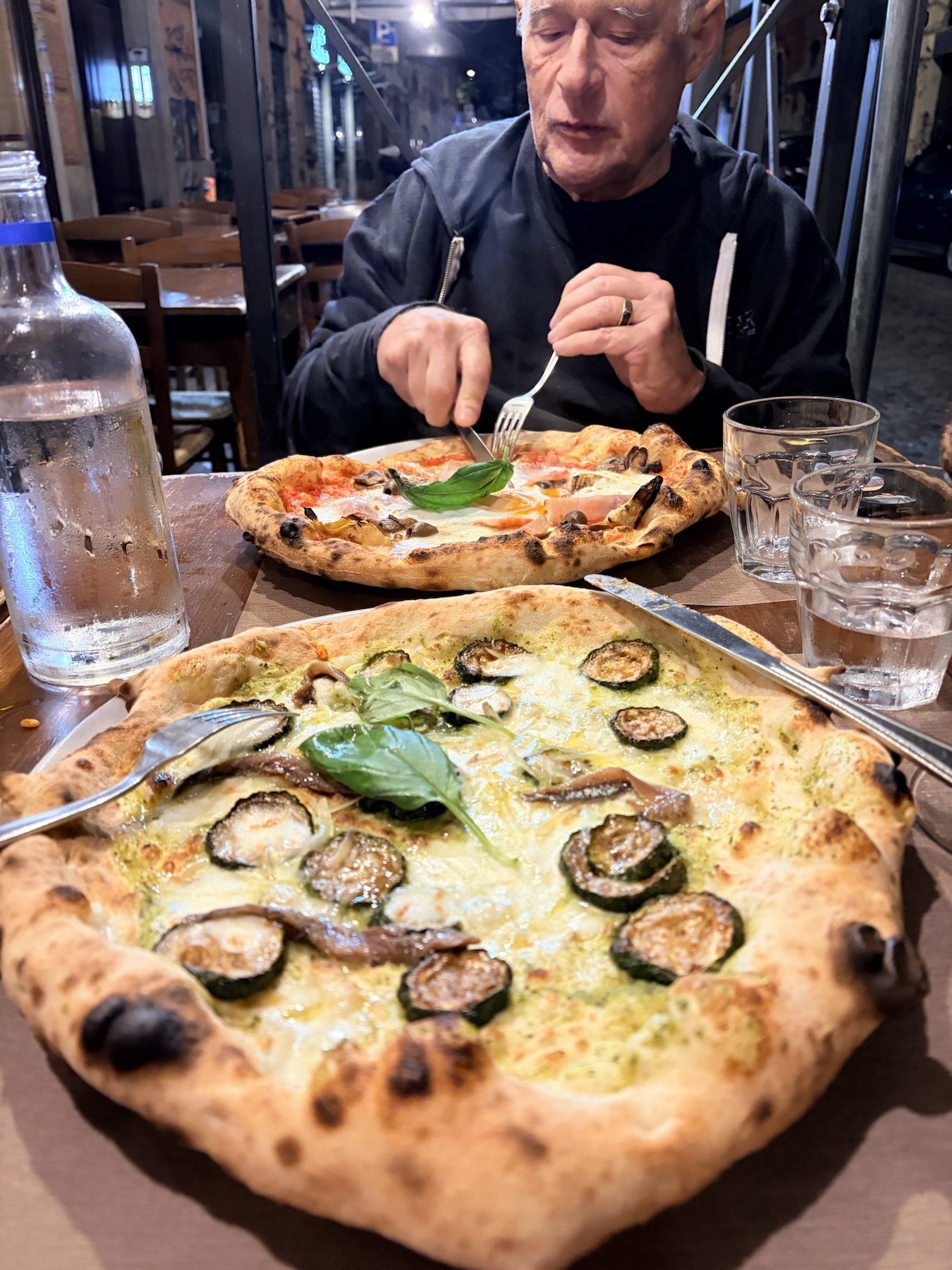
I had asked Alberto for his walkable restaurant suggestions and we were only a few blocks from all of them. Pizza first night, pasta second night, all delicious.
Peppo al Cosimato in Via Natale Del Grande. As good as they look.
Our second night we went to the famous Tonnarello for pasta. Not only were we seated immediately (they often have a 30 minute wait but we were on the early side) but we were surrounded by happy families, gracious and friendly service and delicious pasta. There are comments on the web re Tonnarello—is it still good? Worth the wait? If you are in Trastevere do not hesitate to go.
Villa Borghese
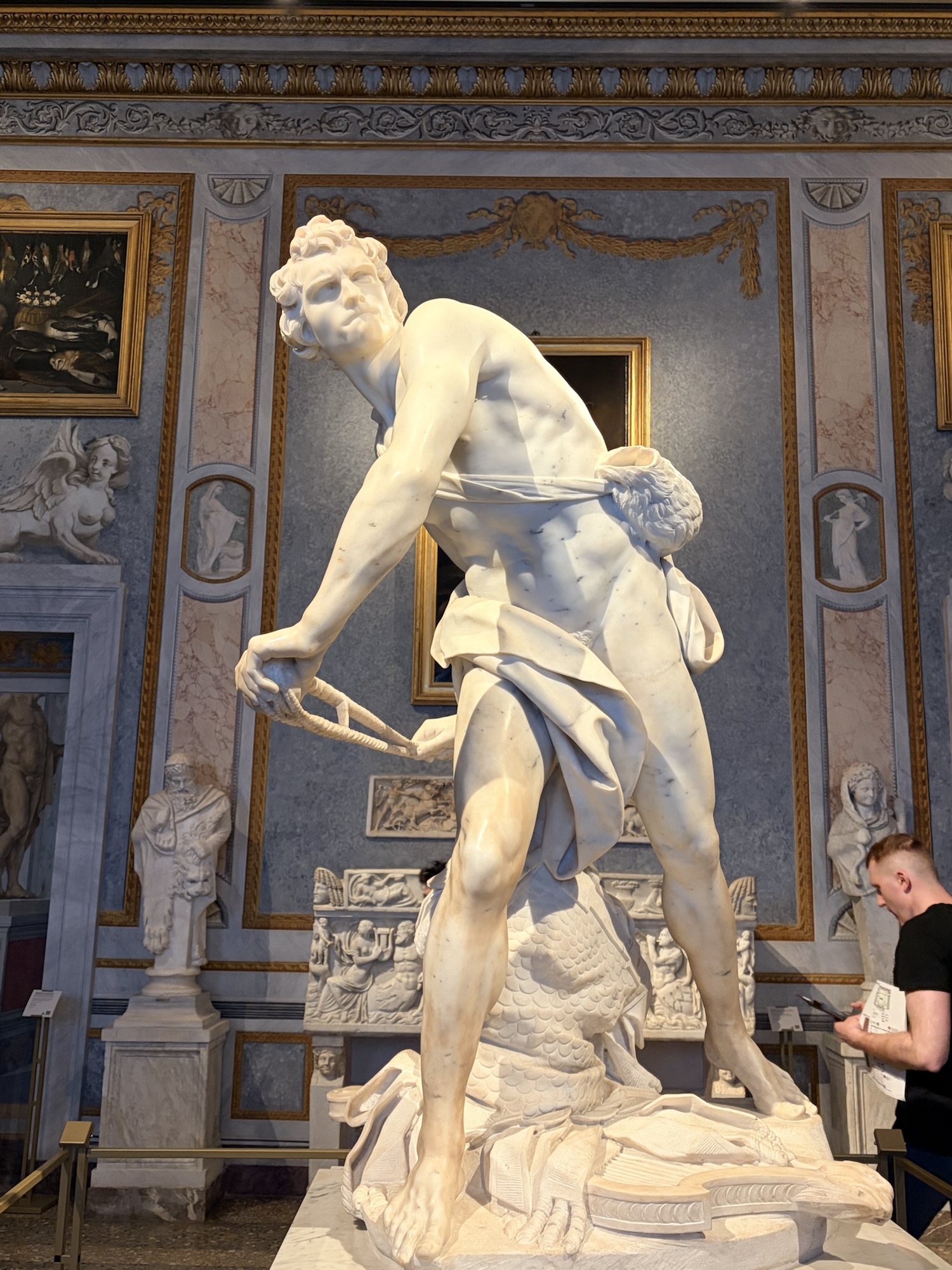
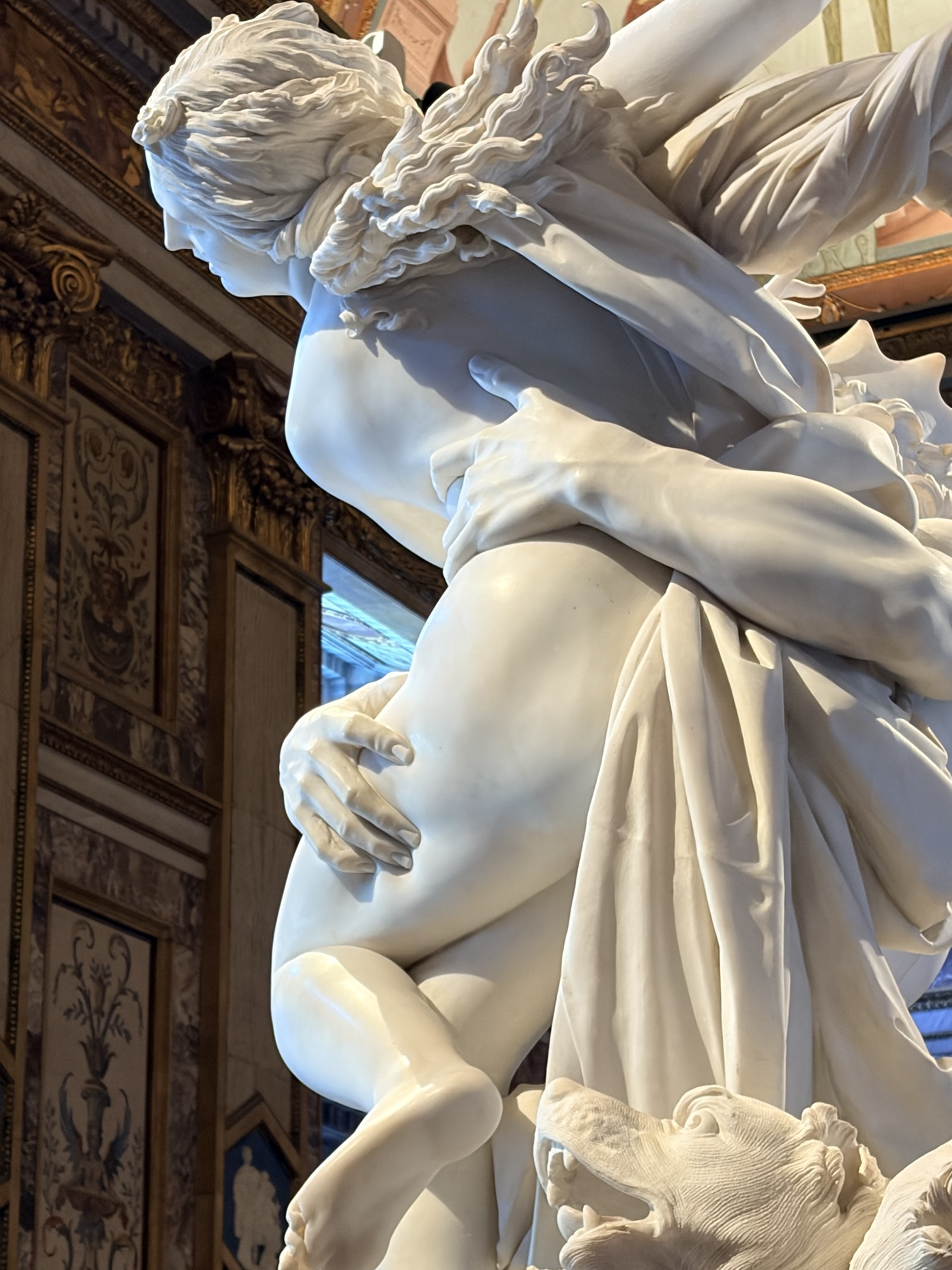
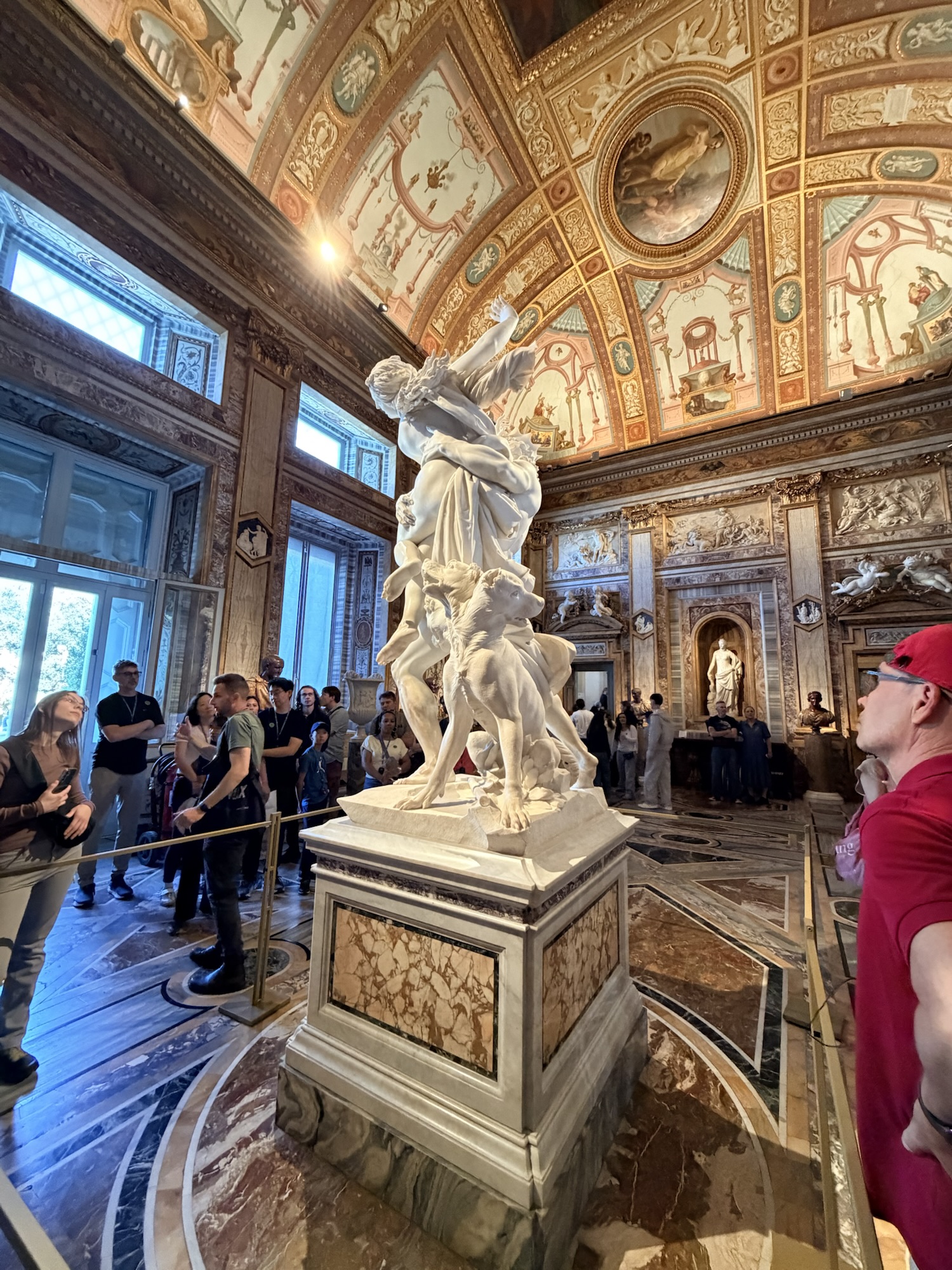
Our first booked tour was of this private family art museum from the 1600’s. If you have read any of my trip reports you know we love museums and this was spectacular. Much smaller than Musee d’Orsay or the Louvre or the Uffizi, it is overwhelming nonetheless with rooms decorated with frescoes, paintings, finely detailed mosaics (I thought they were paintings until I looked closely) and stunning marble sculpture. We were not so familiar with Bernini and we were wowed over and over. The Rape of Persephone, terrifying…but not as terrifying as Apollo and Daphne, showing her transformation into a laurel tree at the moment Apollo touches her. Those Greek myths are not kind when it comes to forcing young women to submit to the gods who want them. Bernini’s skill at depicting movement turns cold white marble into hot violence.
Our guide was an expert, so articulate in English and so charming to our ears with the beautiful rolling “allora” with which she began each explanation. Every language should have “allora!”
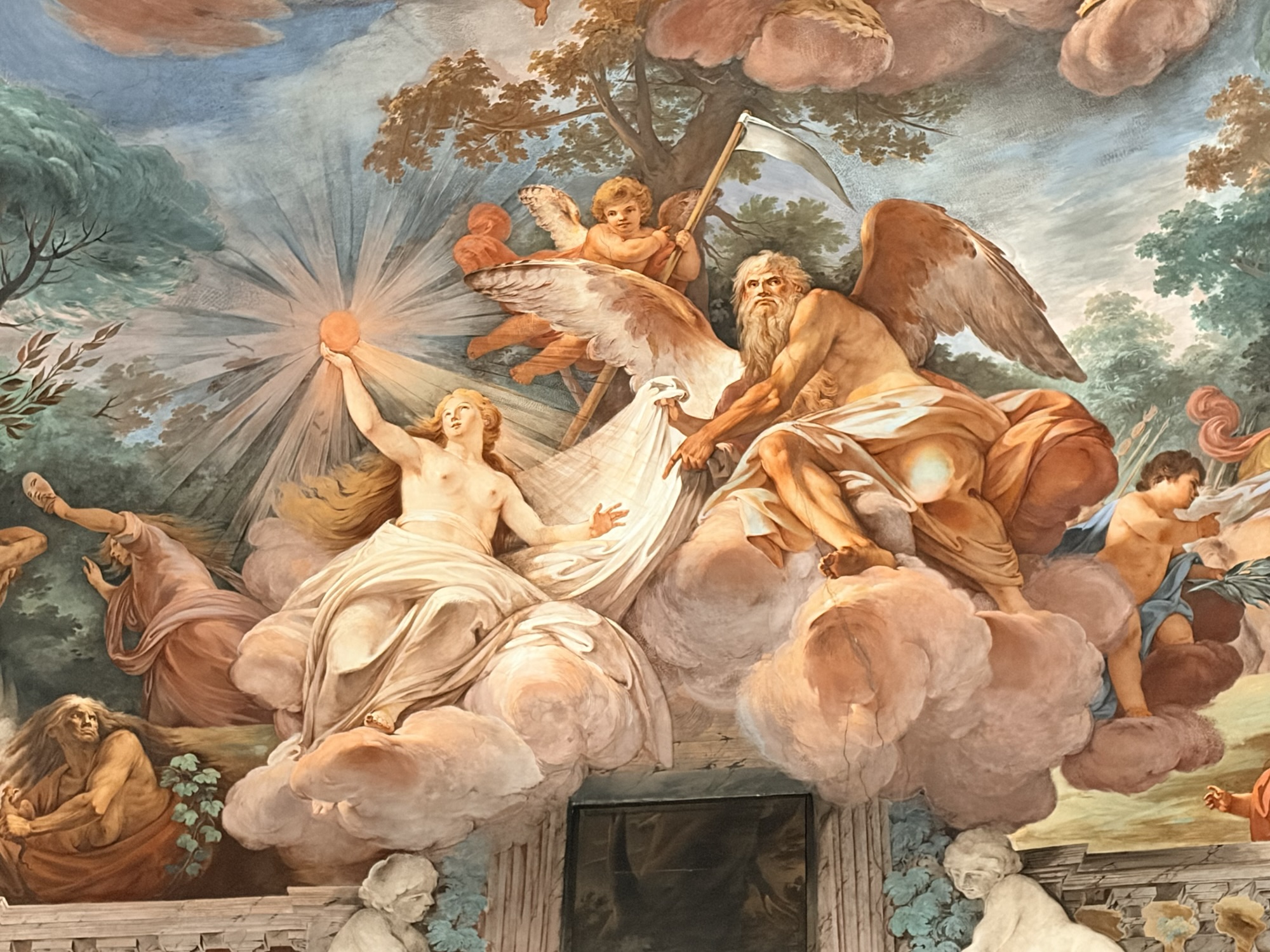
David’s intensity as he prepares to sling the rock to kill Goliath. The face is the sculpter’s.The pressure of the hand on Persephone’s thigh…wow.Persephone has no chance of escape.Truth, the blond woman, is revealed by Time, the bearded man on the right. The eagle head that Time forms in the white sheet is a symbol of the Borghese family.
While we were here the shocking theft occurred and, though we had left the Louvre in the “maybe” column, this cinched things—the museum closed, and the morning of the theft our bus was rerouted to avoid the vicinity. Fortunately we had already selected several other museums to enjoy, and enjoy we did.
Musee d’Orsay
Musee d’Orsay…a train station transformed into a gorgeous, albeit confusing, temple to art—painting, sculpture, art nouveau furniture, and more. The building itself is massive, with some galleries by theme (French Impressionism) and some by donating collector. So you think you have absorbed all you can of French Impressionist painting…until you wander into another part of the building where a private collector’s donation includes even more. A great experience, utterly exhausting.
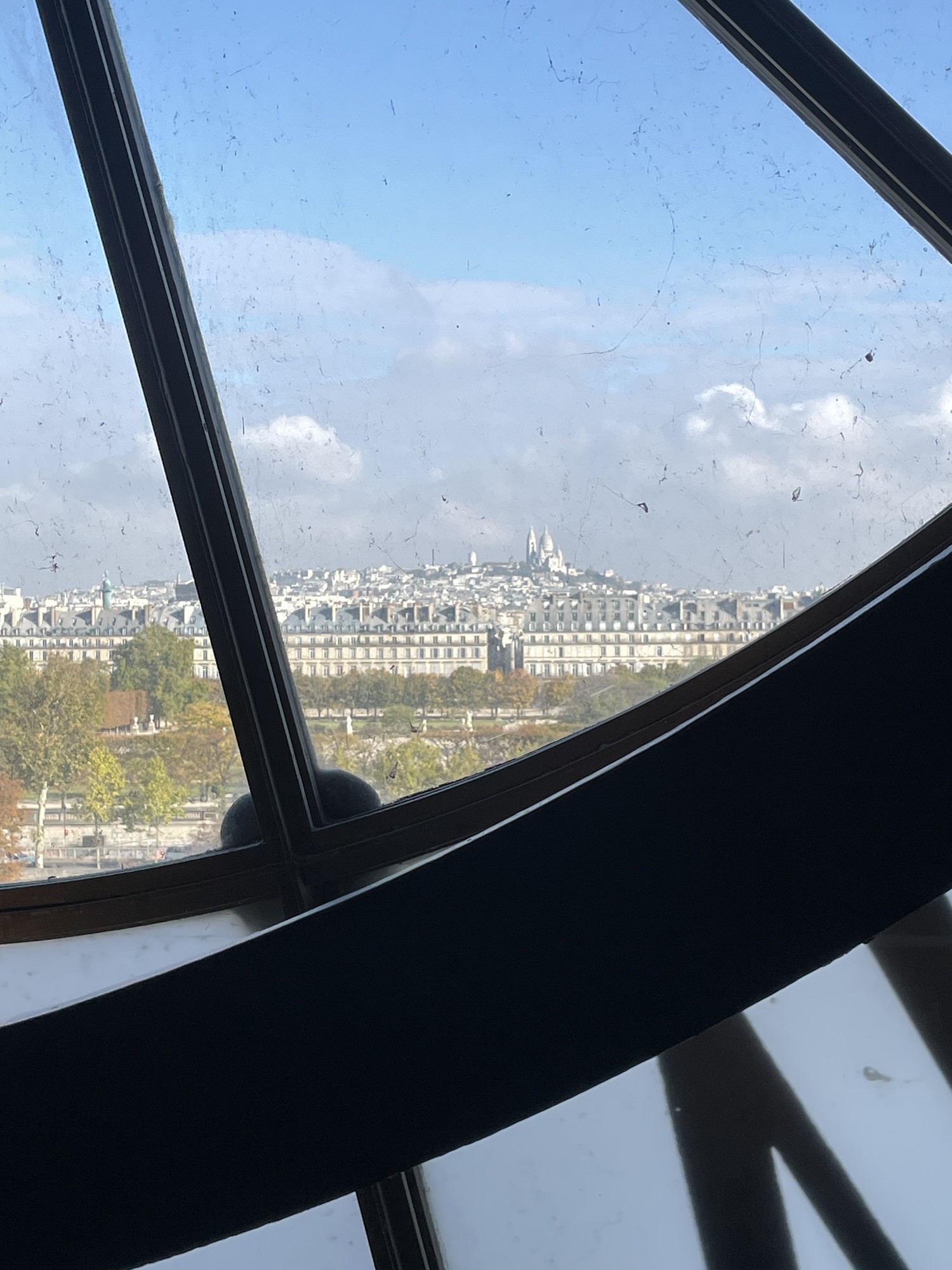
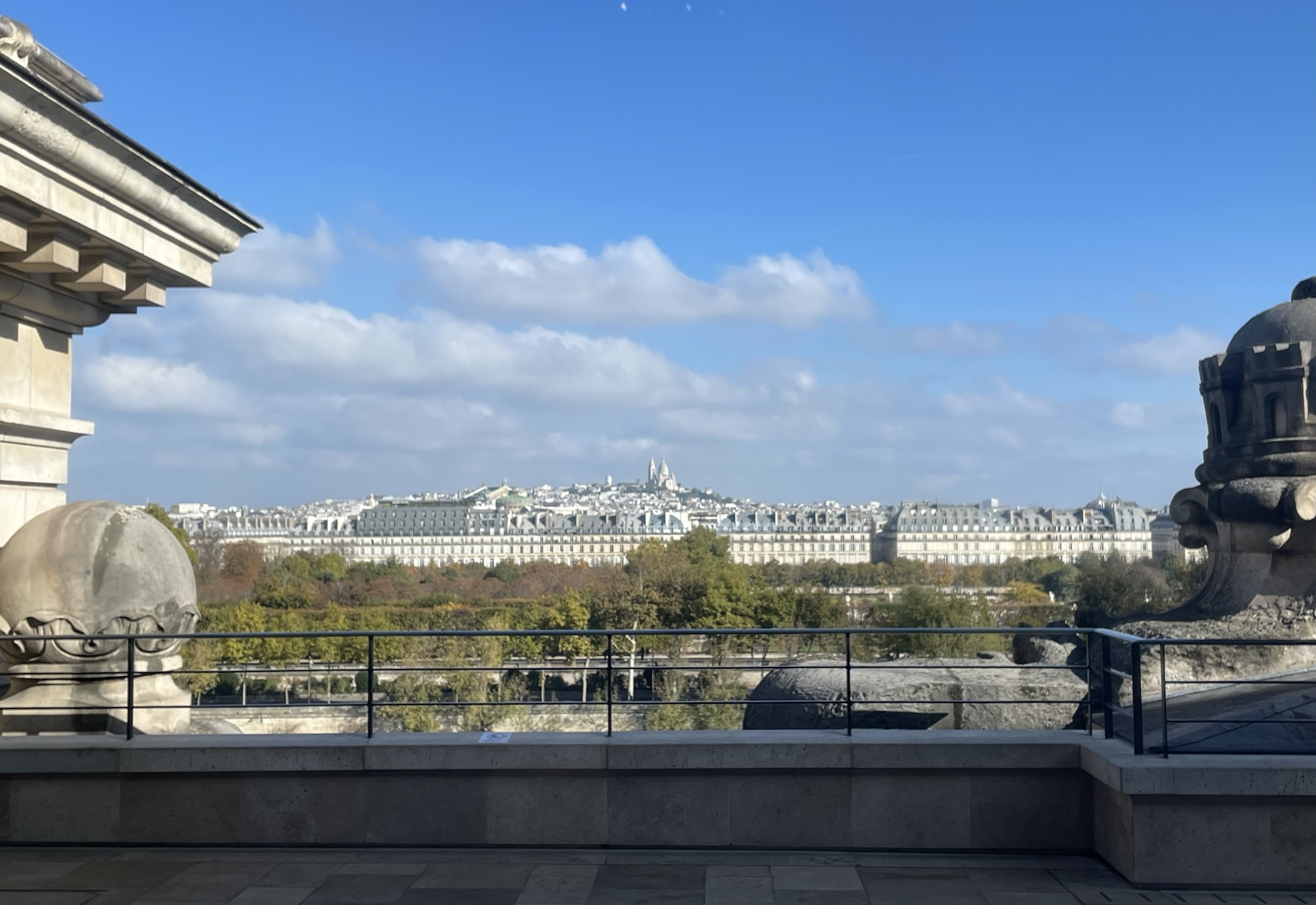
On the top floor are several lovely views of Montmartre and Sacre Coeur.
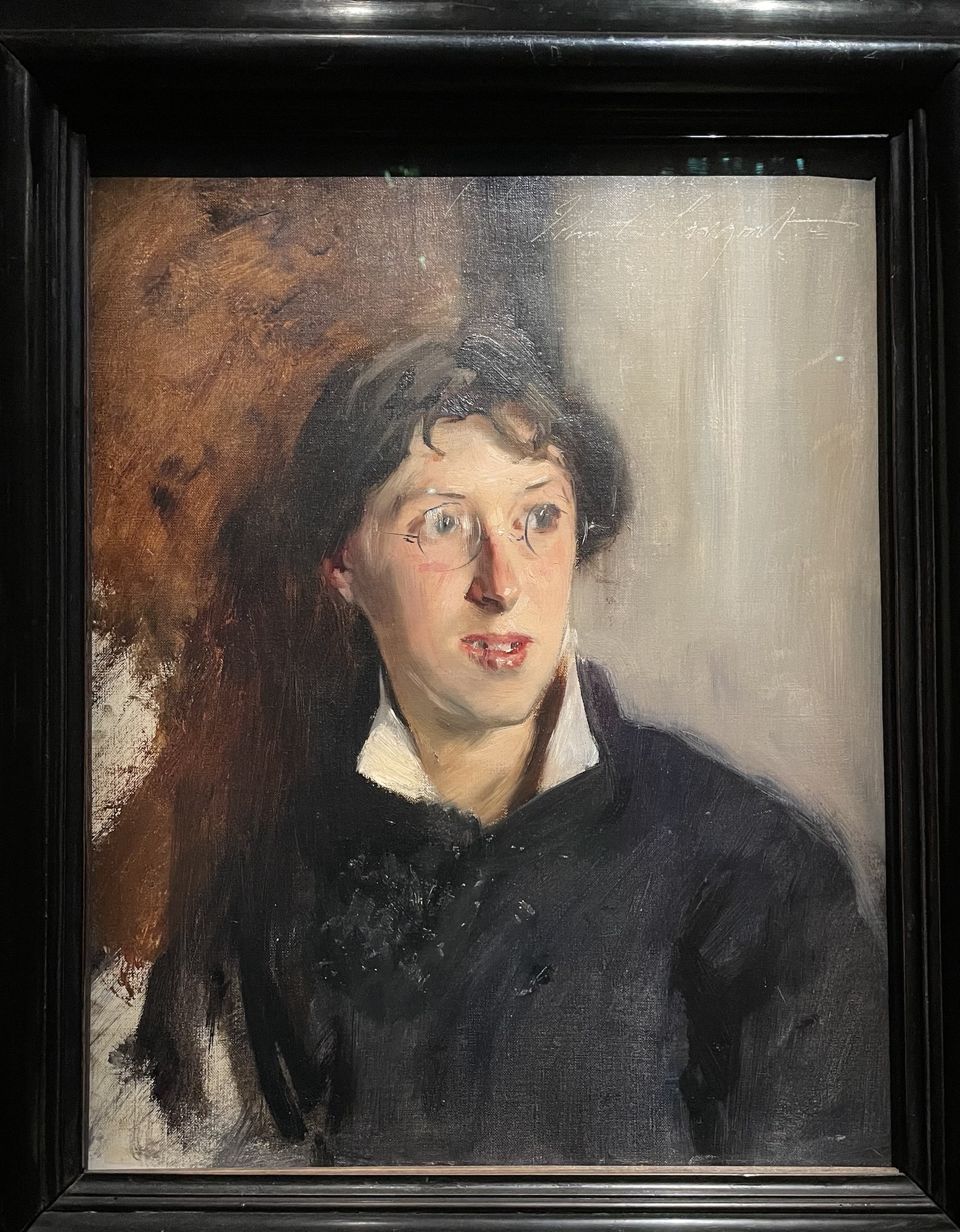
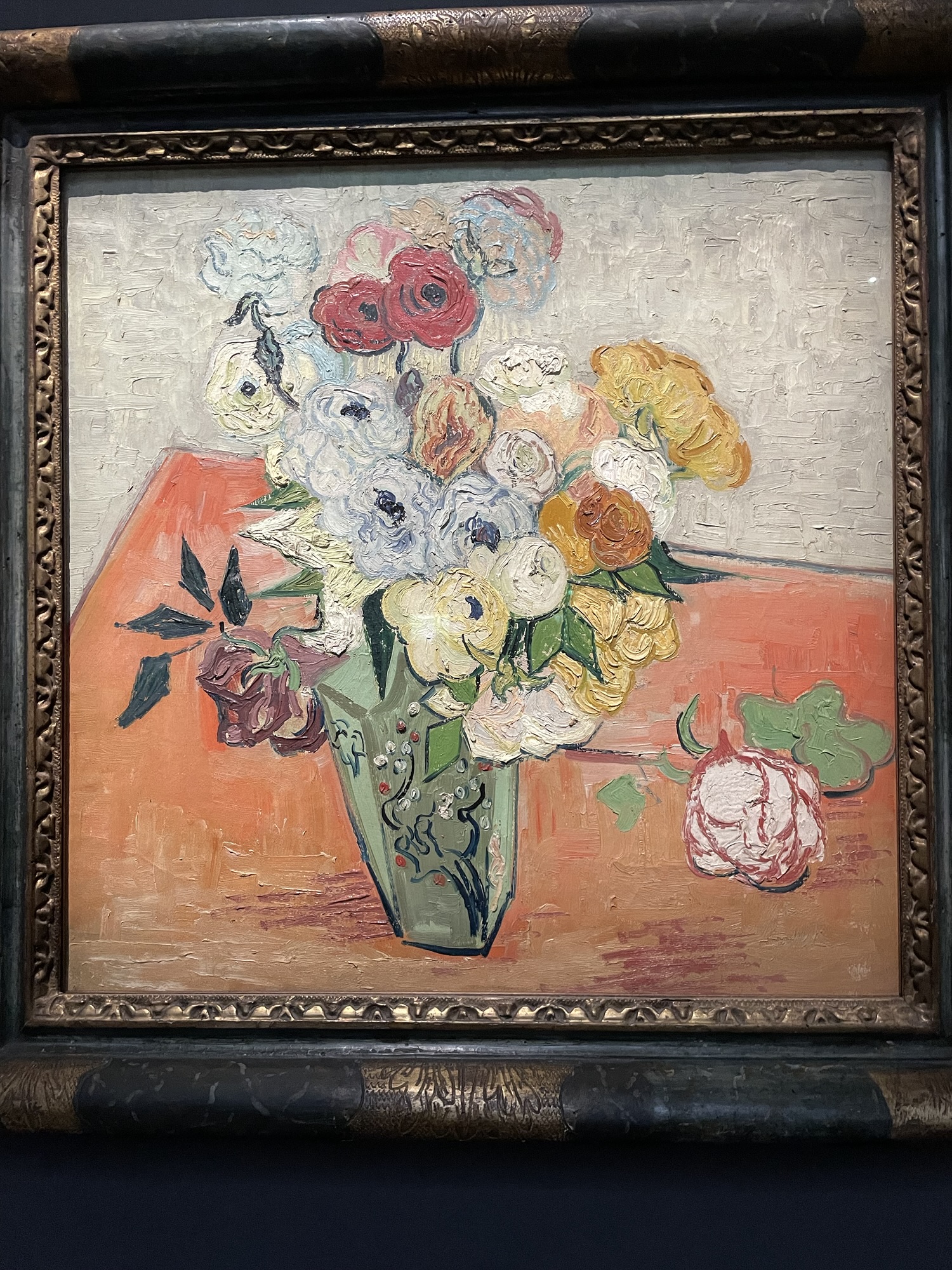
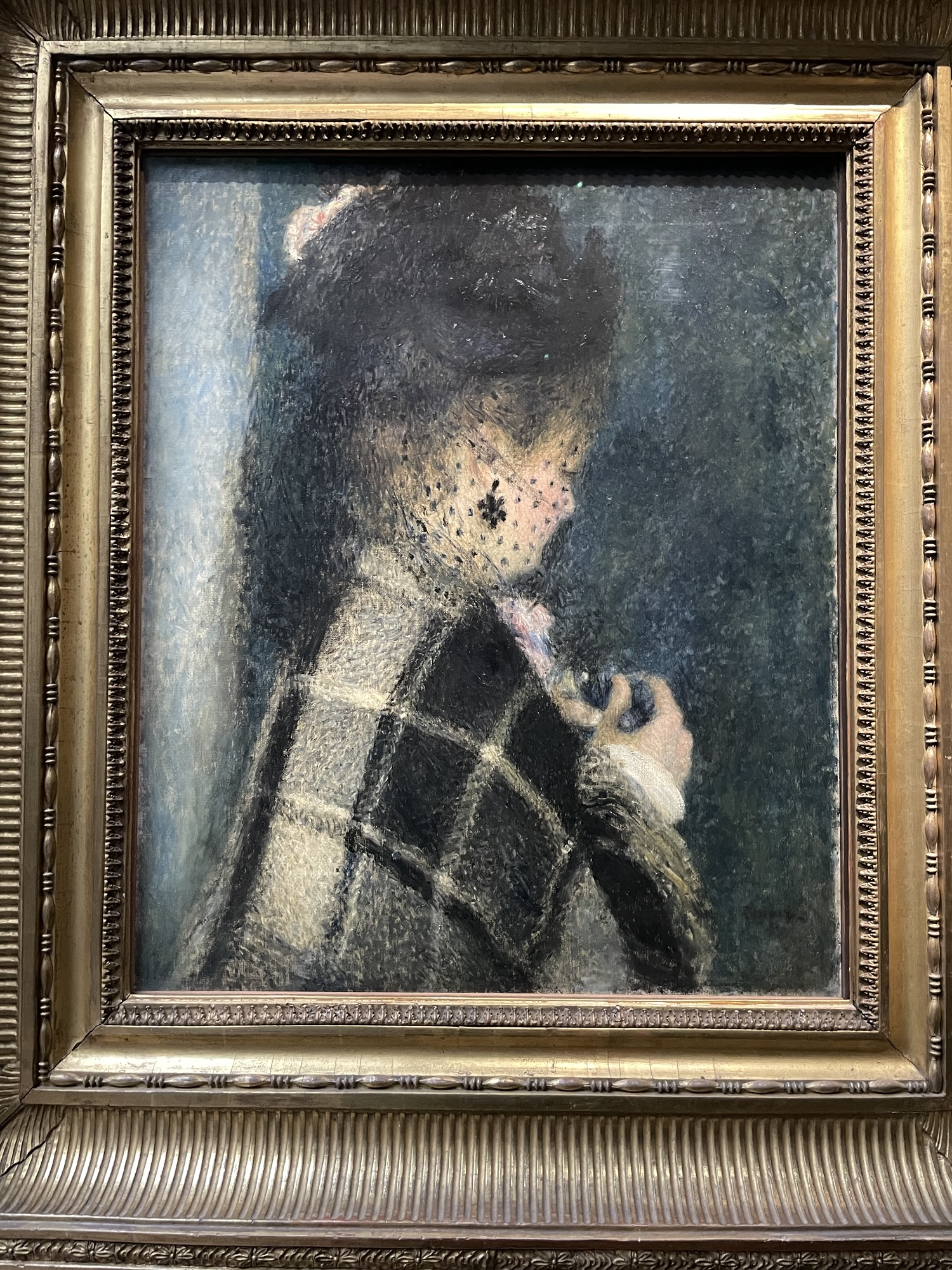
I snapped the smallest selection of stunning paintings, including this beautiful portrait by Singer Sargeant (the special exhibit and it was a stunner), two very different Renoirs, and one Van Gogh from his final few months of production. Re the Van Gogh, you can almost feel the manic energy he must have been feeling as he painted faster and faster.
Portrait by Sargeant of Violet Paget, who went by pseudonym Vernon Lee.Van Gogh, obviously, painted in his last year in his frenzy of production.This was new to me, and so sweet. Renoir’s Jeune Femme a la Violet. Epitome of zoftig. Renoir, of course.
Musee Jacquemart-Andre
This stop was a recommendation of a friend and it was different and kind of amazing. A wealthy man, in some decline in health, married a young friend of the family arranged by them so he would be cared for, and they built and filled an enormous, enormous mansion with art. Paintings, sculpture, frescoes—they traveled Europe buying things and when they died willed it to the city. The house and its hodgepodge collection is entertaining, but the real gem was the special exhibit—absolutely magical paintings by Georges de La Tour, whose work was completely forgotten after his death in 1692. He was not rediscovered until 1919, by an art historian who went on to curate Hitler’s (stolen) artwork. They had maybe 30 of his works, some quite large, and they cast a spell in the way he used candlelight to illuminate a scene. He also painted scenes of common people when this wasn’t popular, in addition to his (mostly) religious scenes. It was great, albeit the exhibit was very crowded.
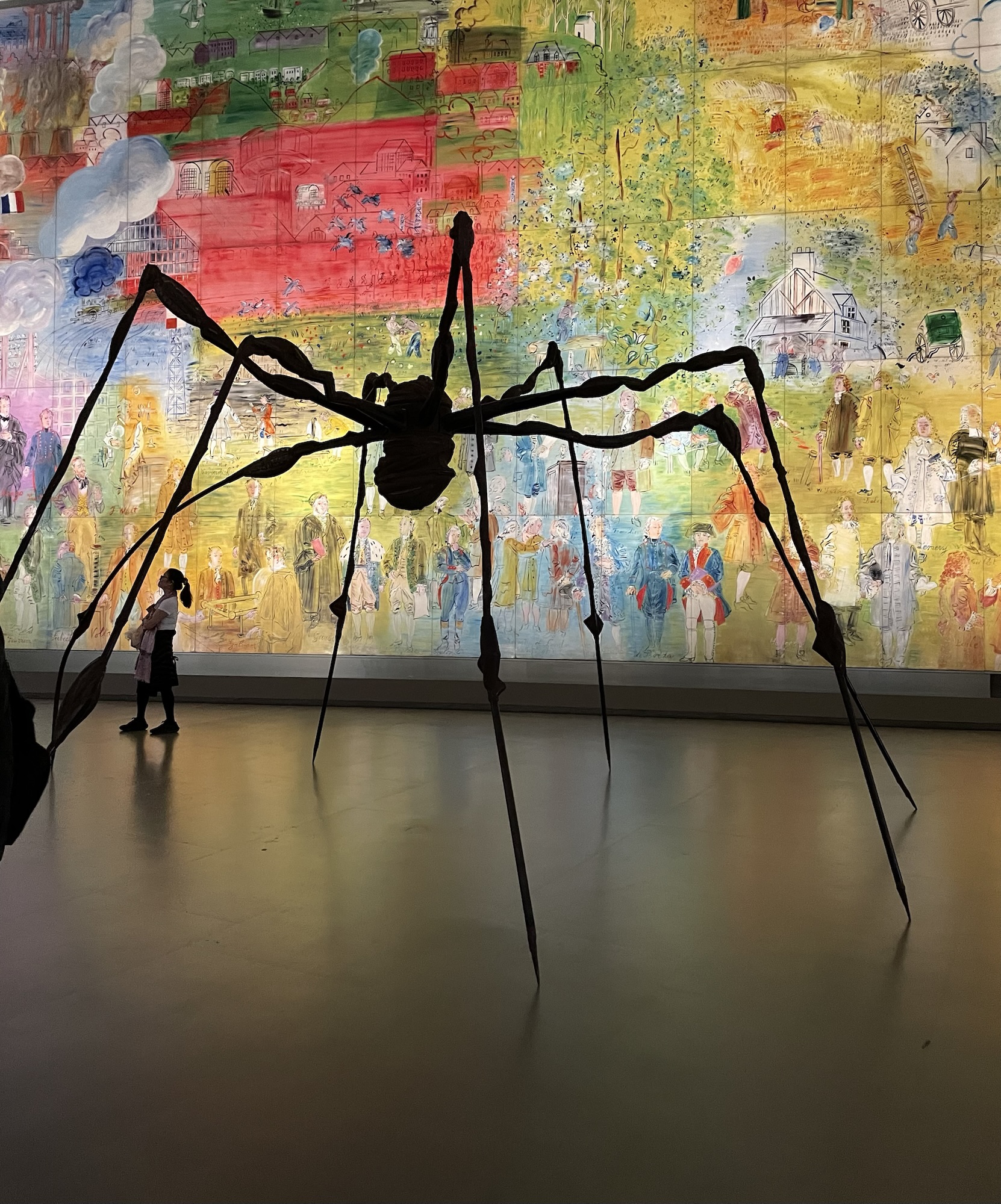
Great, great, great! We saw lots of things we liked by artists we had never heard of. Like the d’Orsay, there are exhibits by era and also by private collector/donor. The first big room—a huge room-wrapping mural about the scientists who contributed to the development of electricity—is a stunner.
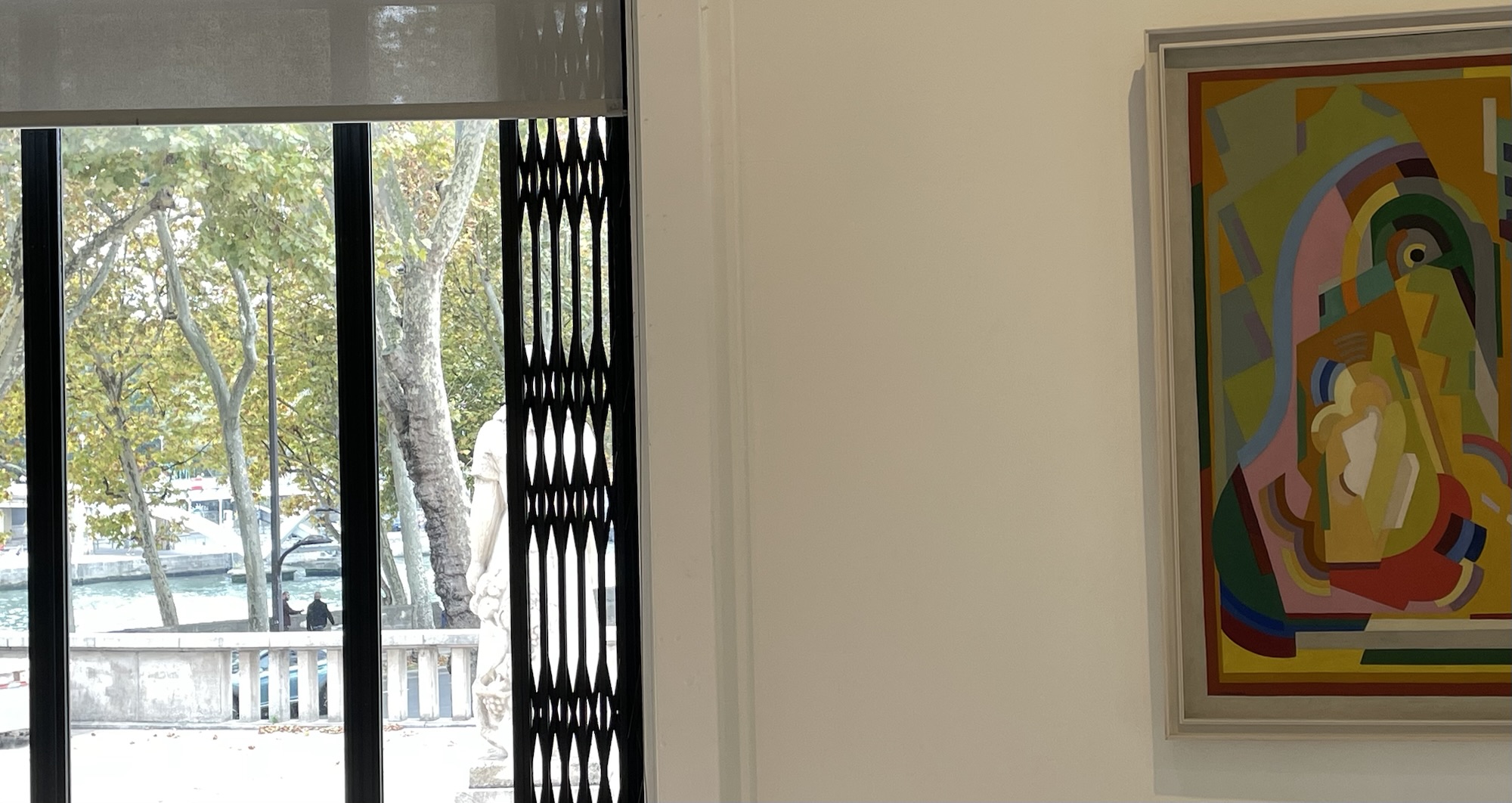
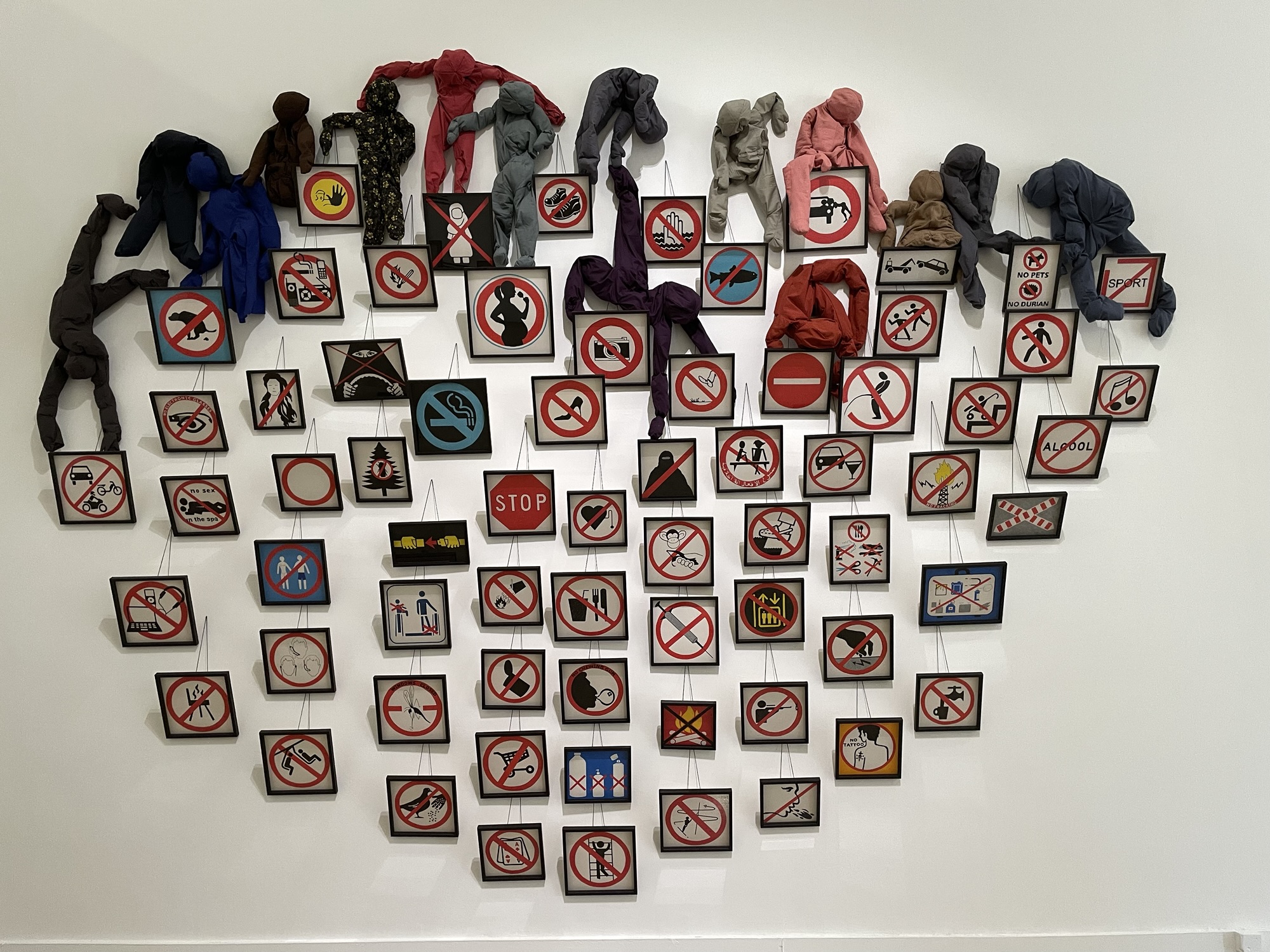
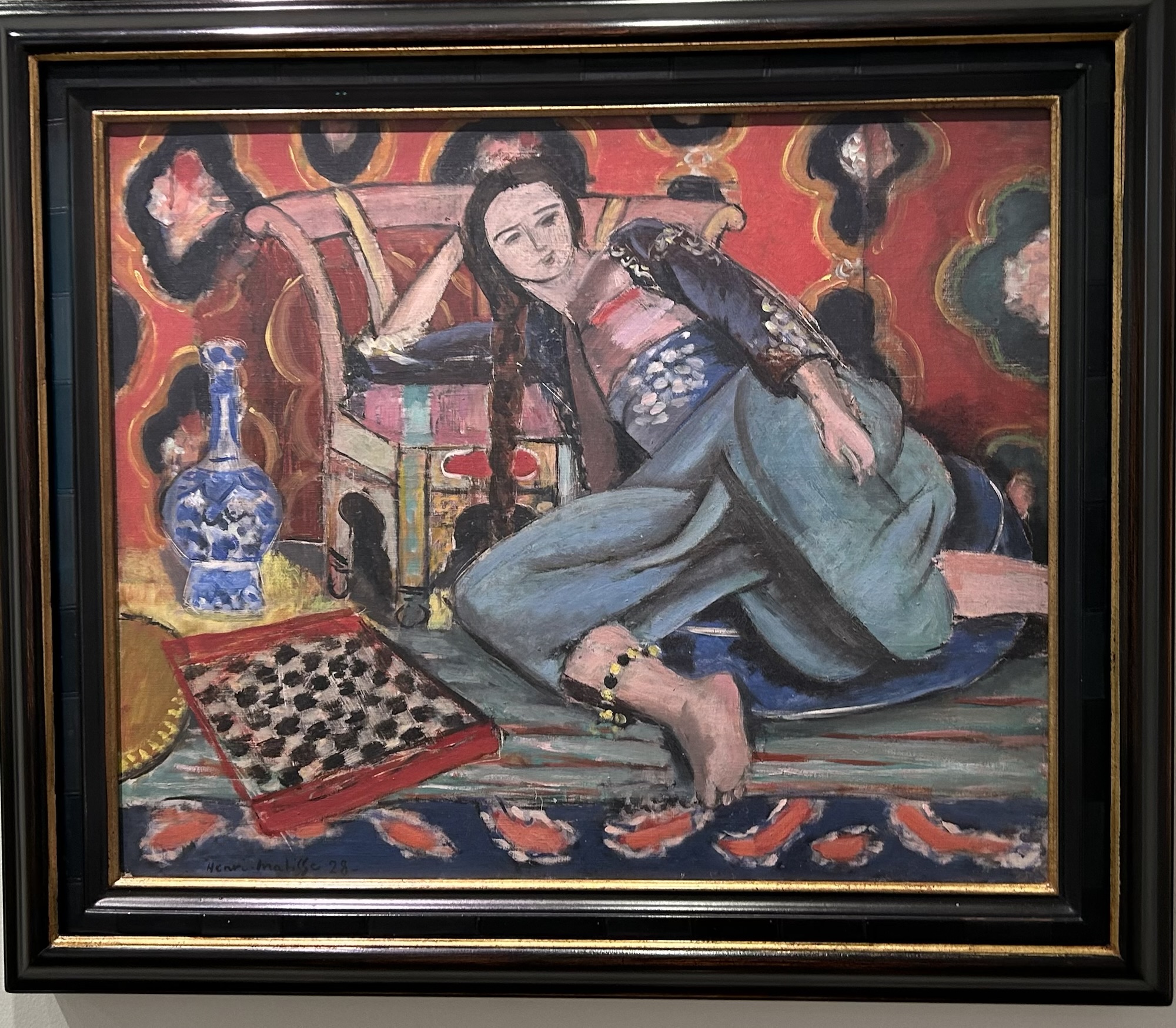
The Duffy mural and spider are stunningNu Couche by Tsuguharu Foujita, (inspired by the famous Manet) Studio paintings are always fun. 1904, Jean HelionOutside, the Seine. Inside, art. If I recall correctly this is Interdit est Interdit…forbidding things is forbidden. Who loves Matisse? Catherine loves Matisse!
From the metro stop to the museum was a walk in a large park. Almost there!
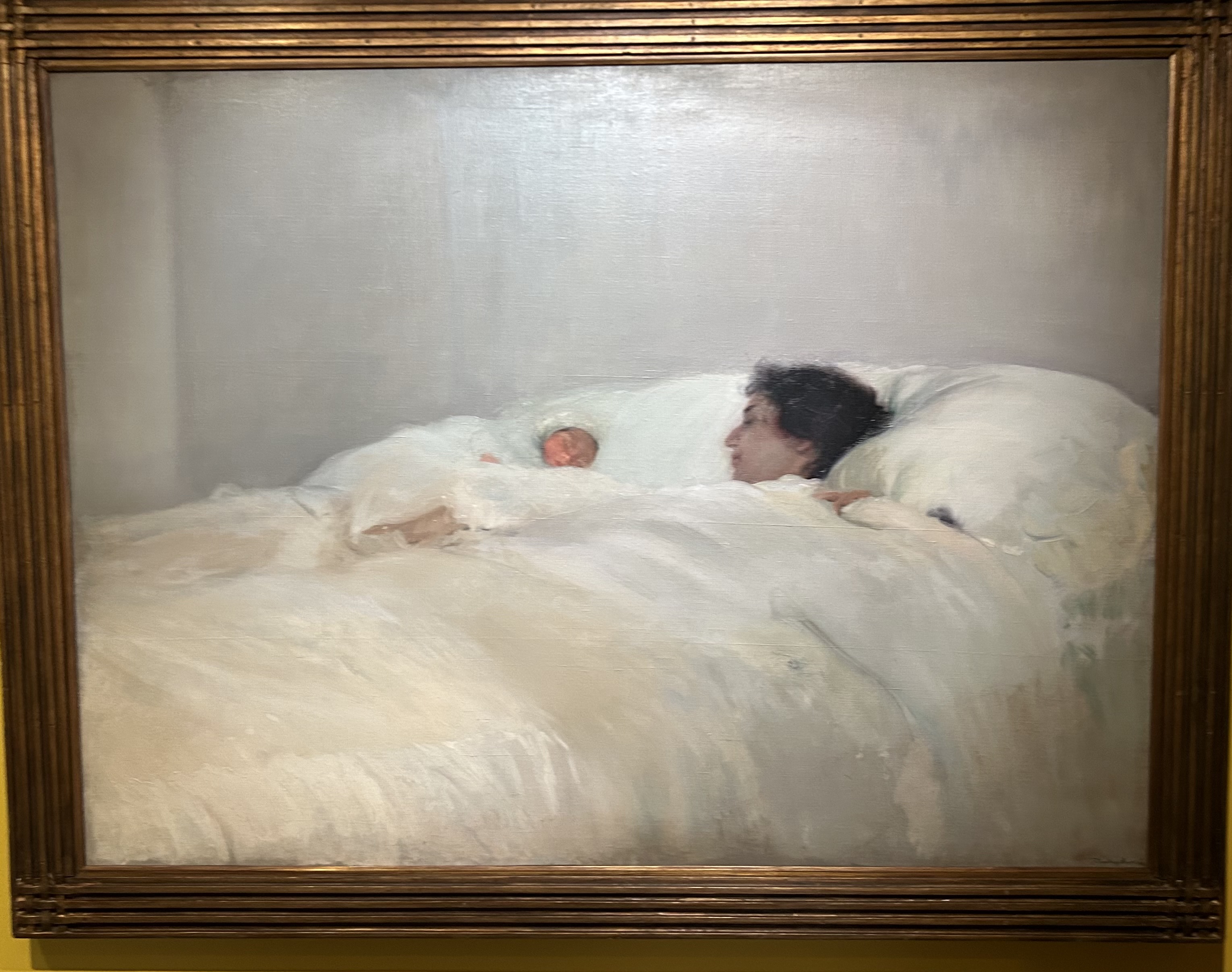
Oooh, this was a delightful surprise. I have in truth seen enough garden and water lily Monets in my lifetime and was unenthusiastic thinking it was all Monet. Yes, there is a large Monet collection but the special exhibit was L’Empire de Sommeil…an entertaining collection of paintings from many eras of people sleeping. We loved it! The accompanying book was too heavy to bring back so I am ordering it when I return, I hope. This is one of the museums a bit off the path and you do not need a time of entry ticket–just show up. So glad we did.
So poignant.pre-Rafaelite romanceThe painter’s wife and newbornA miniature—the collector’s bedroom
Le Bois, our lunch find
Hungry after such a wonderful dose of art, and the lovely walk through the park, we happened on Le Bois. Best hamburger of my life…David was more restrained and had a Caesar salad with smoked salmon. Lunch was in full swing, and the noise level climbed as more conversations launched around us. The service was great. Very warm and welcoming. Sated, we decided this was the day to explore Montmartre so we hopped on the metro and headed to the LaMarck station.
Montmartre–lovely and insane
While our hotel, which we were very satisfied with (Joyce Hotel, an “Astotel”), is at the bottom of Montmartre we had yet to explore the hill itself. Famed for its artistic history, it’s vineyard, some cool clubs, and the enormous Sacre Coeur at the tippy top, it is also a climb, with stairs, winding streets, more stairs, and even a funicular. I can imagine in the summer this place is almost unnavigable, but in the fall it was manageable and had a few nice surprises.
David’s research was great, again, as he knew there was a metro stop way up, perhaps even at the top of the hill, LaMarck-Caulaincourt. Well, it’s not quite that high, but high enough that instead of a few stairs or short escalator there is a continuously running elevator which goes from the metro platform up two stories to a street level exit. We emerged and were immediately confused about where we were and which way to go. Google maps are great…but sometimes getting your bearings takes some concentration. We wanted to wander enough to see the pretty spots, then check out Sacre Coeur, and perhaps wander all the way down to our hotel.
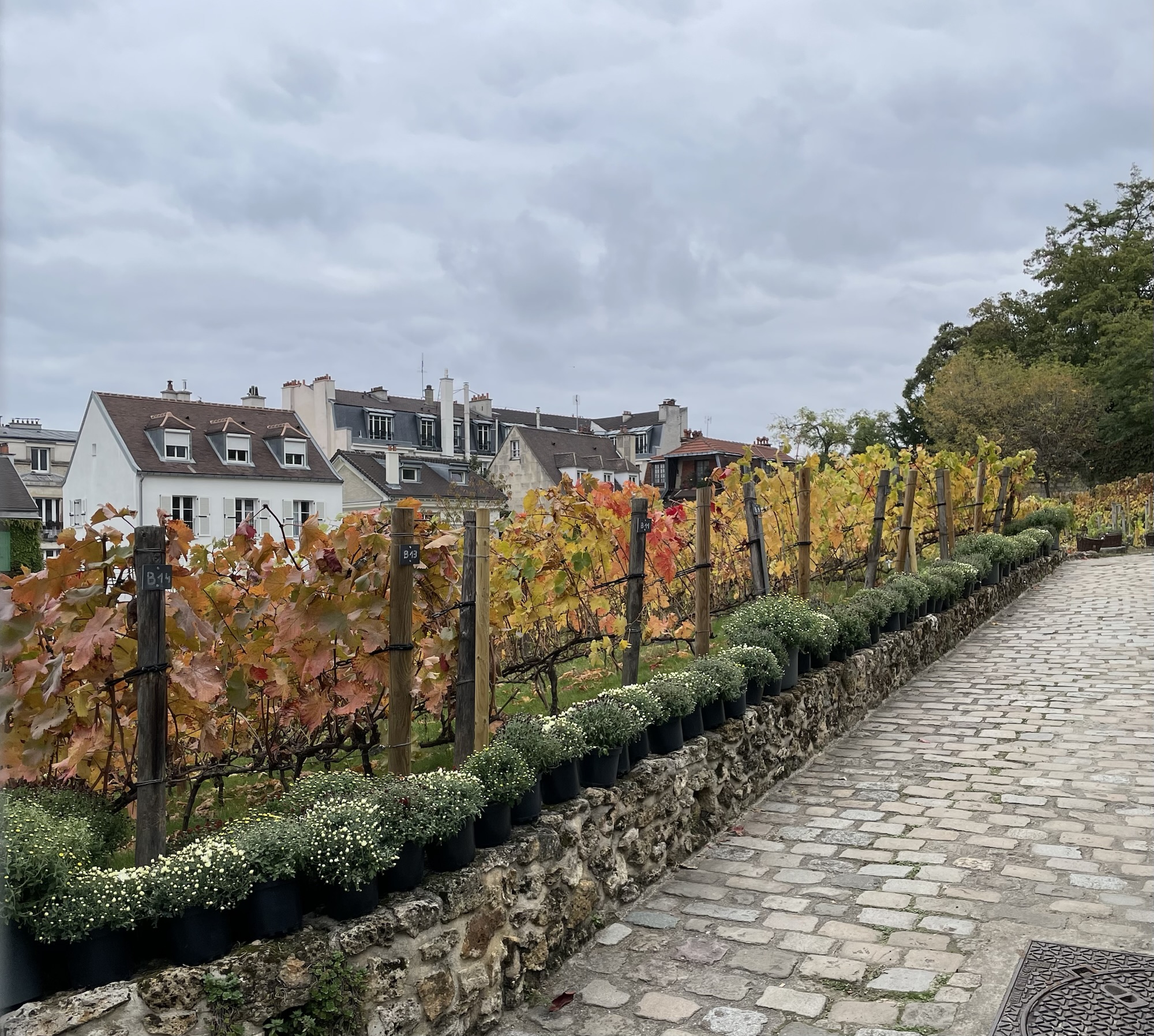
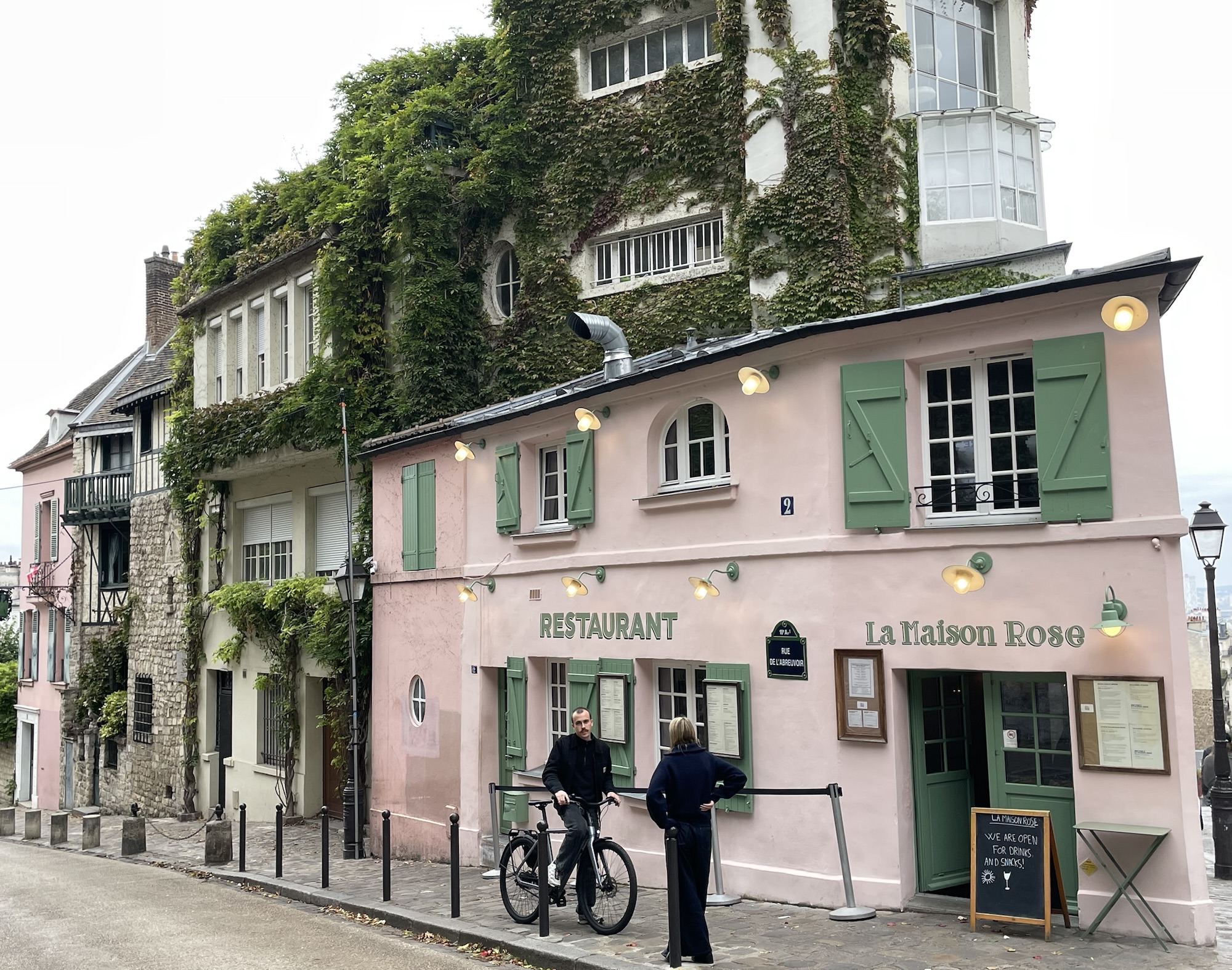
We walked by the famous Agile Lapin, a small club–it was named at one time A Gill Lapin (Gill was the owner) but it devolved into its current name. La Maison Rose, the vineyard, and zig zagged up and up, finally reaching the touristic insanity of Place du Tertre (jammed with artists doing caricatures and more serious portraits) and around to Sacre Coeur. It was wild how block by block this small area changes completely.
Agile LapinWhat a great shop!Working vineyardSacre CoeurLa Maison Rose
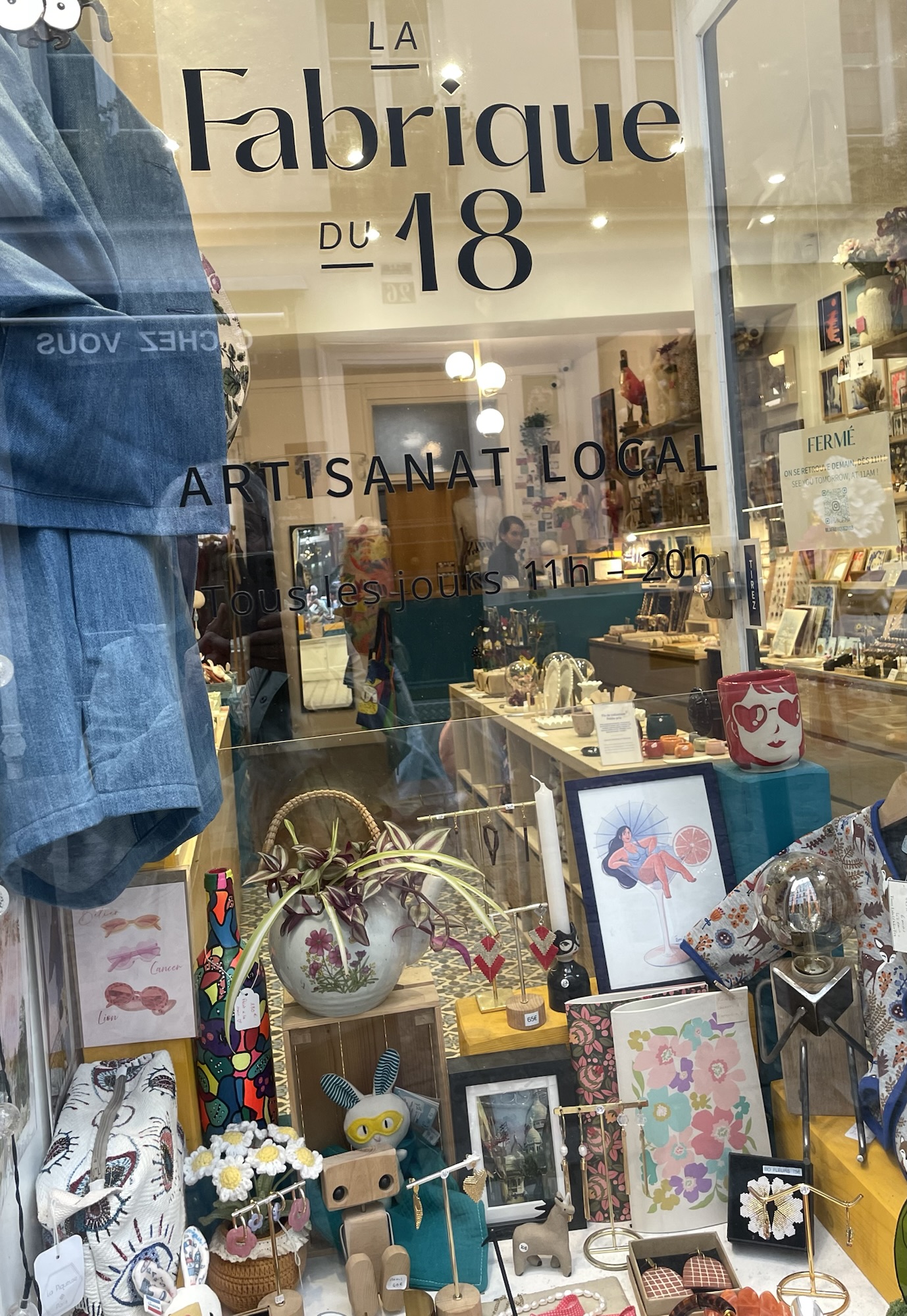
After emerging from Sacre Coeur we wandered down, down, and within a few blocks it was tranquil again. I had been looking for a local artisan store to buy earrings for our beloved dog sitter, and suddenly we were in a village-like section where I found La Fabrique du 18, the perfect place to find-and I did-the perfect earrings for Roni. As I was completing the purchase I asked the proprietor if she knew of any place that sold authentic, all wool, made in France berets for children. We had been looking everywhere but all we found were made in China. Her response? “Around the corner.” Literally around the corner was a small shop, Laulhere, that sells ONLY made in France berets and knit caps, and the woman ushered us to the children’s section where we found one for our granddaughter in a bright dark pink. Adorable.
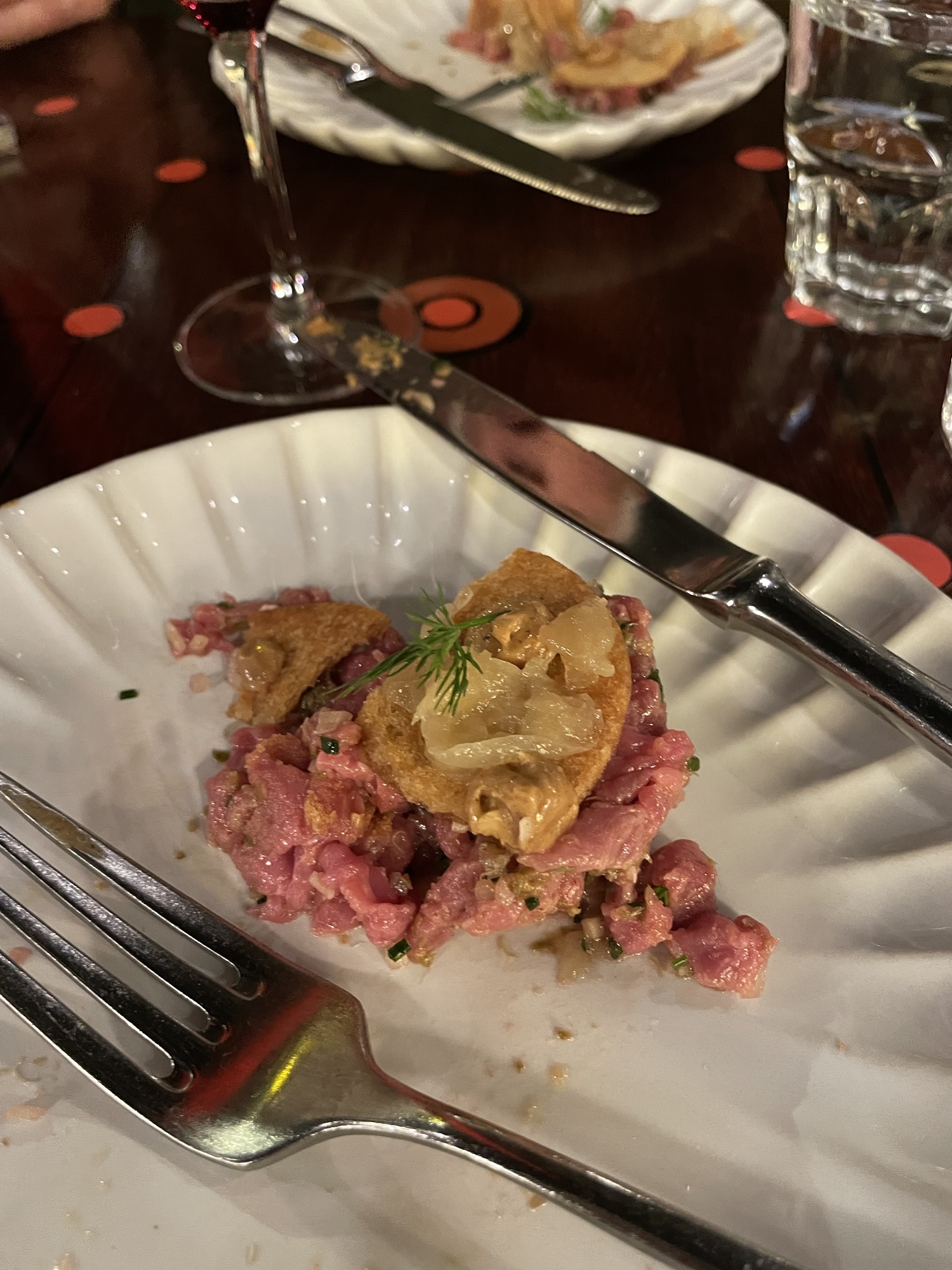
We continued to wander down, through the former red light district, now full of musical instrument stores and lots of young people, Pigalle. We passed countless tiny food options–like kiosks built into the buildings, some just takeaway, some with two or five seats–and found ourselves a half block from our hotel. A lovely afternoon. We celebrated by going to a restaurant at the end of our block, Le Comptoir Boutary, which was spectacular. I looked it up afterward to find it is consistently rated five stars and Michelin listed. A lucky find. We drank an entire bottle of wine with dinner and were glad it was only half a block to our hotel.
Boutary version of boeuf tartare was magicalYes, drank this entire bottle.
Our flight was fine, but of course sleep was on/off and we arrived quite tired. I have always assumed everything works better in Europe, but we landed in a humid airport and a long walk to a 50-minute line at passport control. Lots of people and a high-pitched alarm somewhere that was extremely annoying. All for the literal 15 seconds of passport examination; leaving we approached the source of the alarm which was deafening as we ran through the exit doors. Outside the humidity climbed and poor David was sweating as we got into a waiting, and crowded, bus. Several nice people reshuffled so we could both sit down. I guess we looked pitiful.
It was a long ride into the city where we were bleary, hot, tired, and grumpy looking for our street. It turned out to be a very short walk and we got there without mistakes thank goodness. Nice hotel—The Catalonia Vondel. There are so many small hotels in this part of the city we had trouble deciding where to book but this was a reasonably good choice. Nice staff, an elevator, and lovely room which alas we had to change because the tub-shower walls were SO high it was literally treacherous to climb into and I kept picturing the trip ending with a rush to the ER. We moved the next day to a room with a teeny bathroom but a walk-in shower. Our last 24 hours have a few issues [no maid service, very difficult to adjust the water temperature in the shower] so I cannot recommend it unequivocally. We found the location, on the edge of the museum district, just about perfect.
The Stedelijk Museum of Contemporary Art
Stedeljik Museum was our first stop because we didn’t have to book an entry time. We have gradually come to really enjoy contemporary art and this place is pretty great all around, with one masterpiece that we returned to our last day to see again. It is a short [45 minute] film by Wael Shawky titled Drama 1882, telling the story of the rebellion against the British in Egypt, ultimately crushed by the British. It is an opera, with a hauntingly beautiful score, subtitled in English thank goodness. We both loved it…so much we went back Saturday, our last day and the last chit on our museum pass, to watch it again. It is so poignant, so sad, as the citizens are betrayed by European powers and their own people [“Traitor 1, Traitor 2, Traitor 3”]. The entire film is a masterpiece. I have scoured the net looking for where else it can be seen but after a month long installation in LA I found nothing. It premiered at the Venice Bienniale last year.
The Seafood Bar
Oooh, so yummy. I suppose I should have taken pictures but we were immersed in eating and drinking. Started with 6 oysters, easily equal to the best we have ever had. Then shared the Plateau, a small lettuce salad and huge serving of smoked and cold fish and shrimp. Delectable. Then we shared an order of mixed grill, a tower of fish and shellfish grilled perfectly. We ate every bite. It was a ten minute walk from the hotel and we practically staggered back and fell into bed.
Day 2: RijksMuseum and Indonesian Dinner
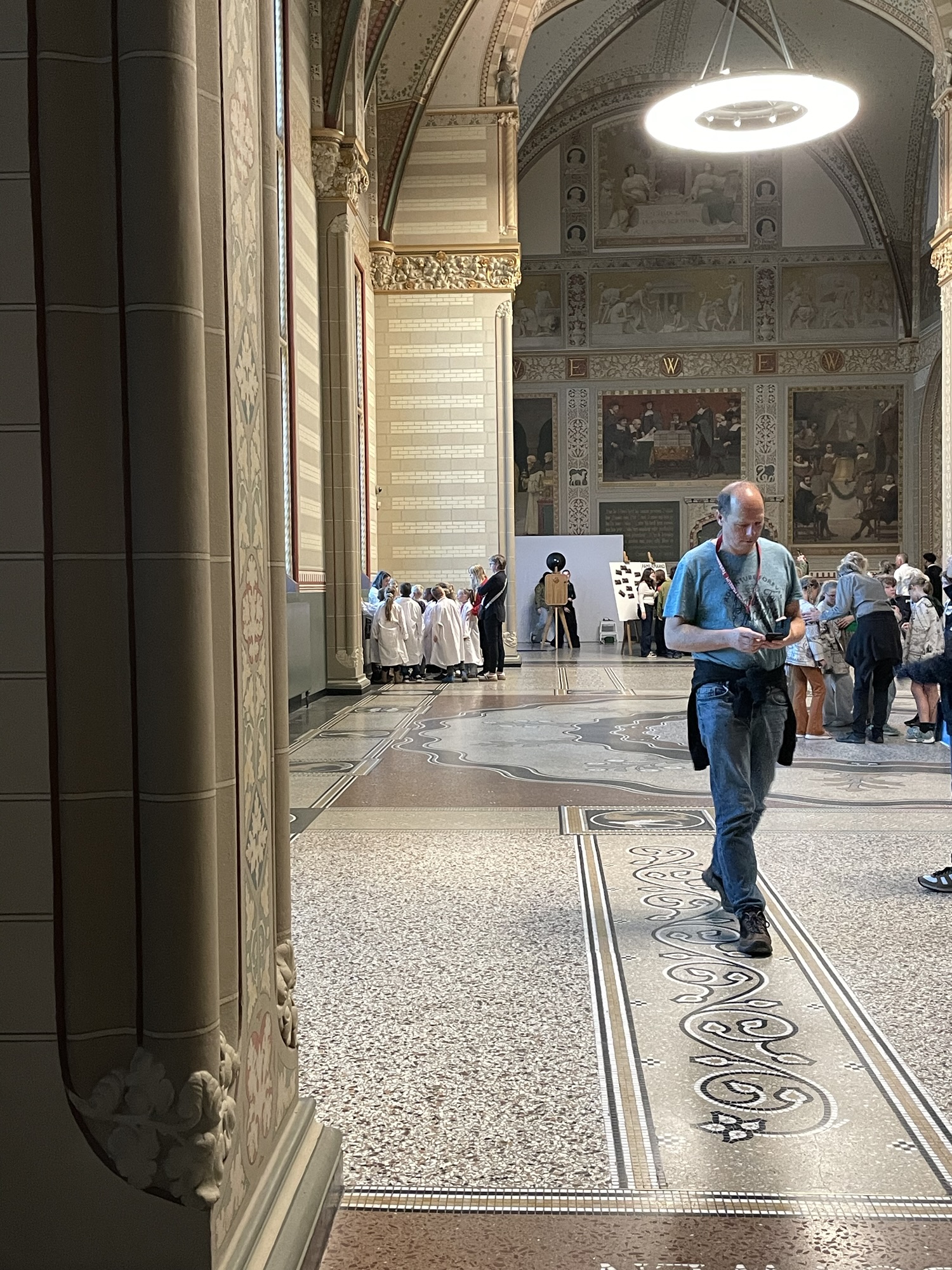
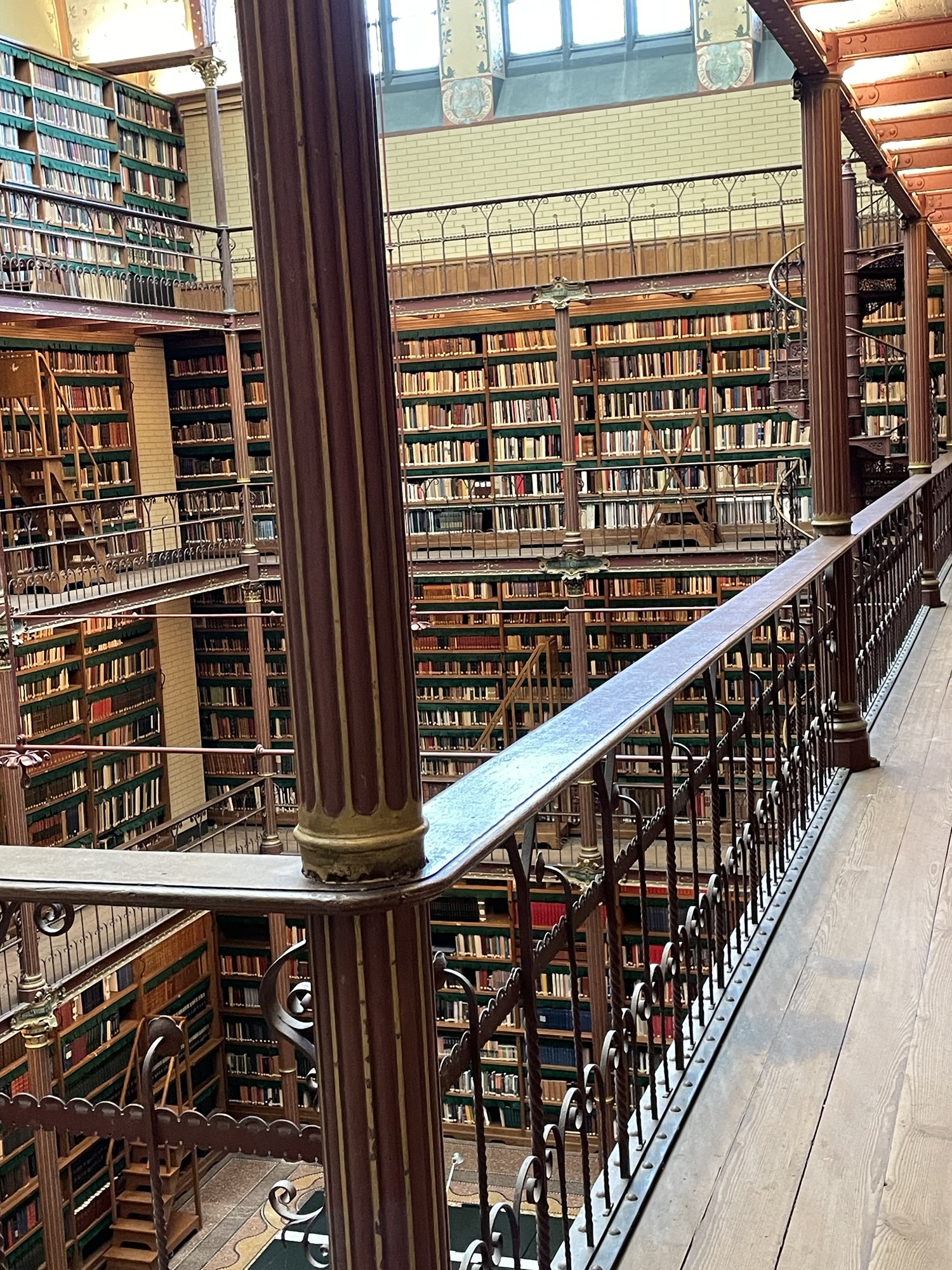
Well, this place is justifiably highly recommended in every guidebook…it is enormous, the building is fantastic, the layout fairly easy [though we had to ask at the information desk where the exit was!] and the audio tour essential. The first stop on the tour is the Great Hall, a beautifully adorned, immense space with massive murals that were part of the original construction. I mention this because not long after the museum opened styles changed and all the walls were painted over in white. The audio tour device allows you to “paint” the walls white to see this travesty of modernity over beauty. As the narration explains, years later it was decided the white walls were a mistake and fortunately all the original decorations and murals were intact under the paint which was meticulously scraped away. Phew.
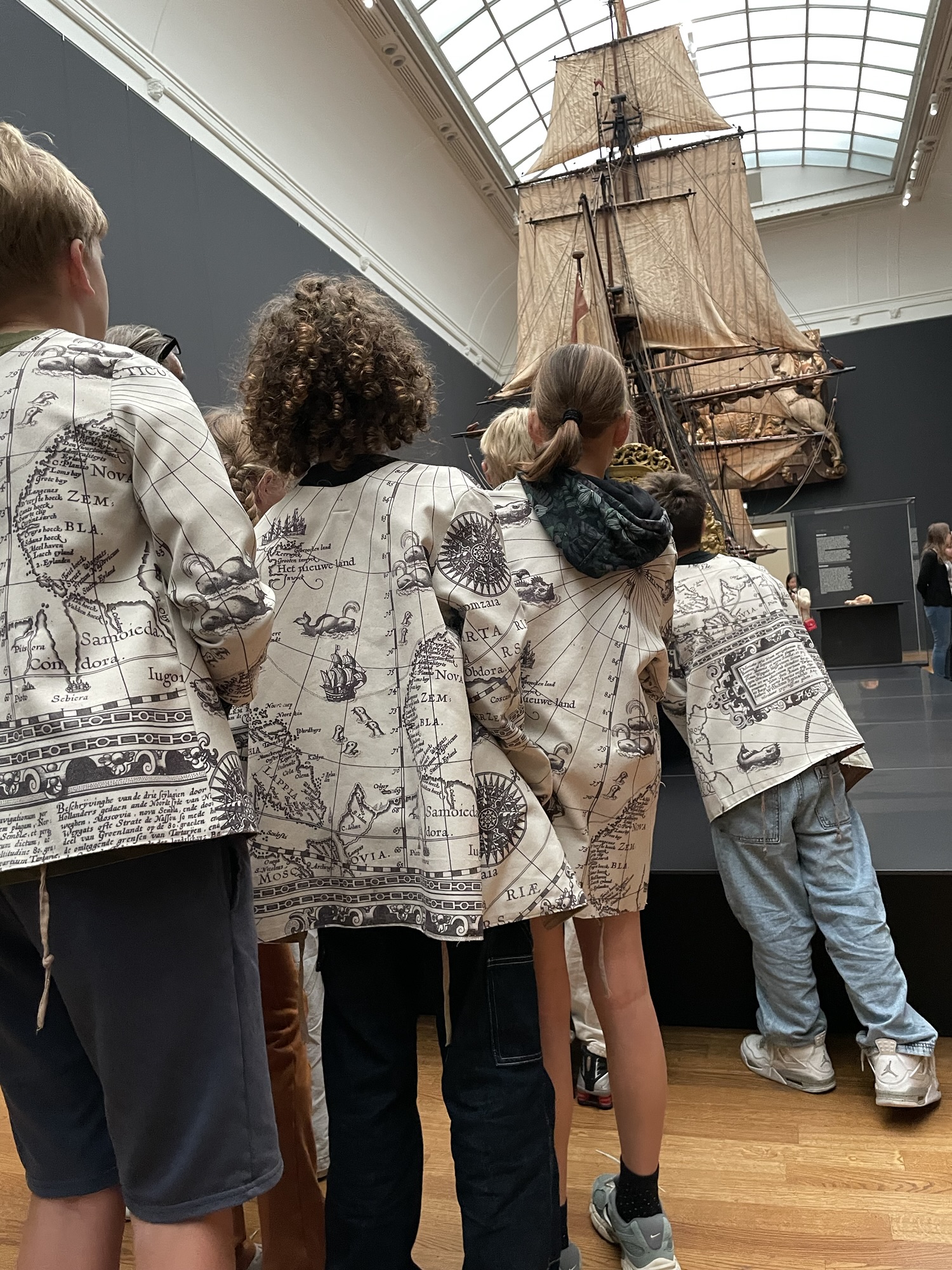
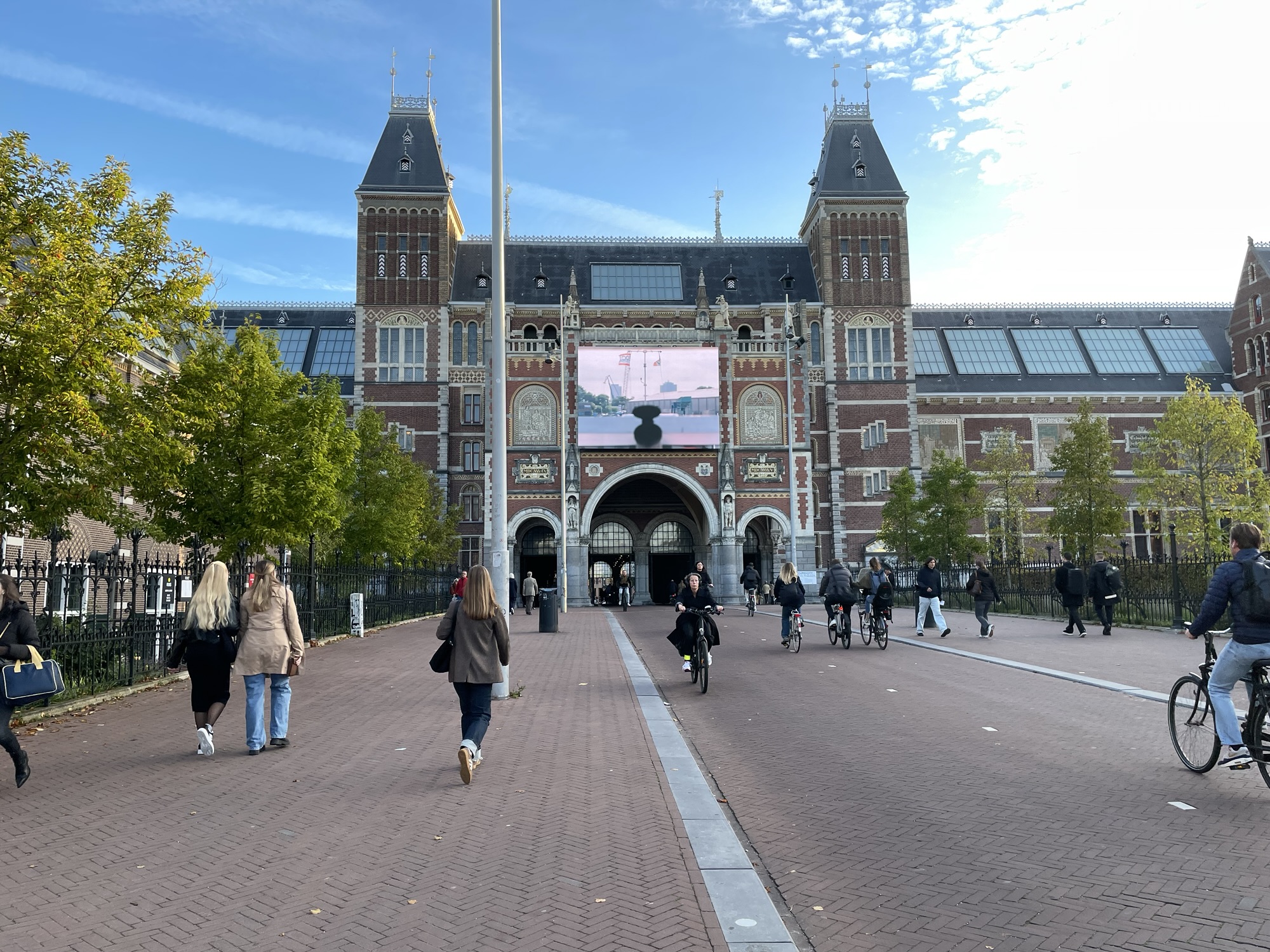
The title is Puck—the dogA corner of the great hall with smocked school group on the leftThis is the library. No talking. Another school group examining a ship modelThe Night Watch undergoing restorationThe galleries are so beautifulThe massive Rijksmuseum
Of course the Dutch masters are well represented and their works remain as appealing as ever. The Night Watch is being restored and behind a glass wall—but visible behind the wall and a reproduction is in the next room over so one can see the details. The tour had ample explanations of why these masterpieces of the 17th Century are as wondrous today as ever. Still lifes that entice you to reach in and take a piece of cheese; interiors (e.g. The Milkmaid) that are inviting and colorful; group portraits, such as The Nightwatch, that transport you to the scene. We loved it.
Afterward we wandered across the canal to a sweet little restaurant, Cafe Mankind, and at 12:30 we were the first people to sit down for lunch. I had learned from the massive sandwich I had had the day before that a half would suffice so we shared a smoked salmon on brown, thin, warm toast. Yummy. We returned to our room for a nap, then had a very good Indonesian dinner in honor of the colonial past and staggered back to bed.
Day 3: Haarlem Food Tour and Frans Hals Museum
We had booked a food tour in the city of Haarlem, a very short train ride, and ever worried about making our way to unknown locations on time we were an hour plus early for the tour so stopped in a nice coffee place with wifi. Thirty minutes in an American sounding guy sat next to us, a talker but an entertaining one. He was born in Indiana but had emigrated to Canada years ago and was now a Canadian citizen. Show off. We had a fun time mostly listening to him, getting in words as we could, as we explored traveling, being Canadian, his time on vacation in Haarlem (which I recommend highly…stay there and take day trips into Amsterdam) , and so forth. It passed the time and then we walked a few more blocks to the food tour.
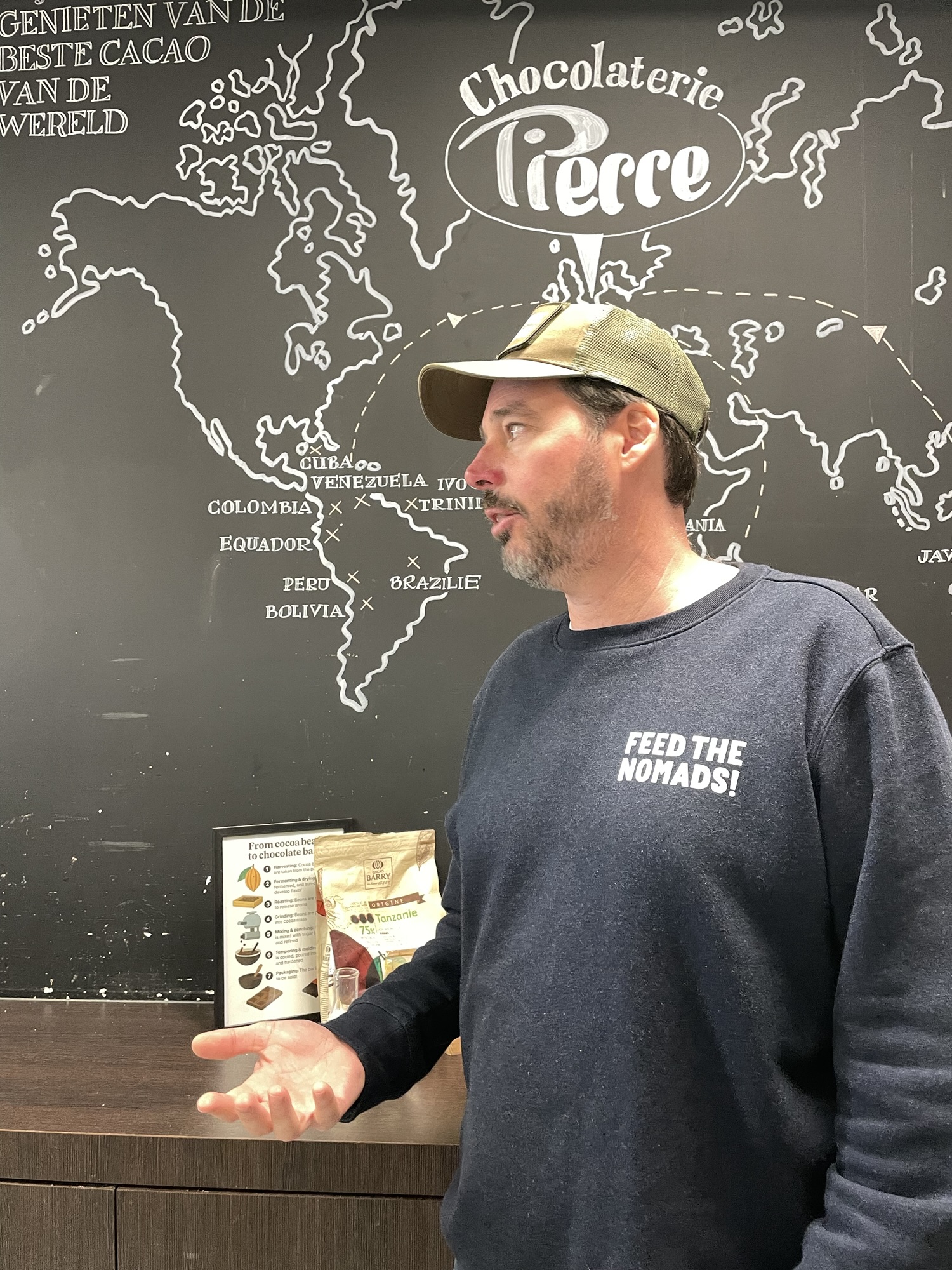
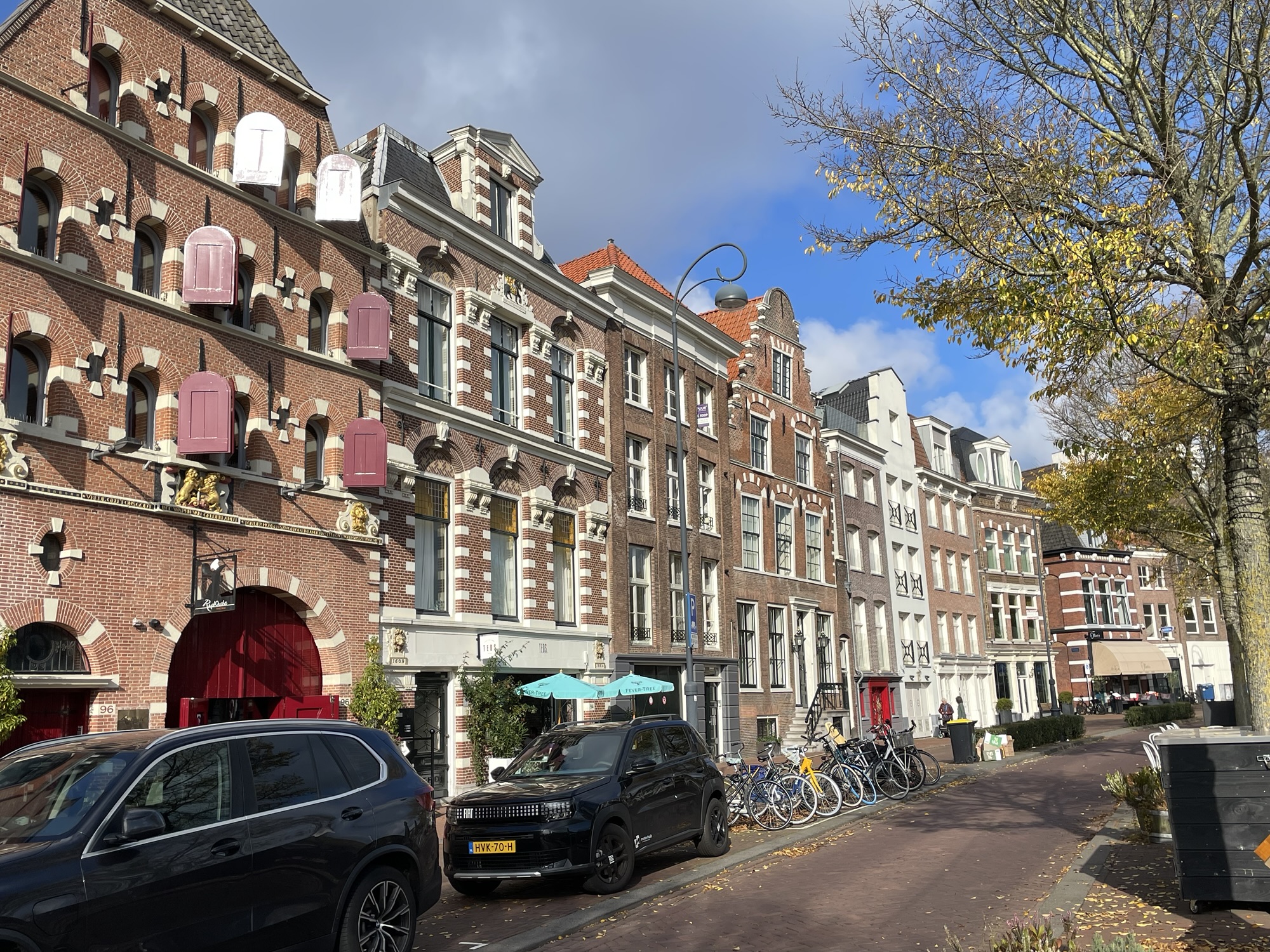
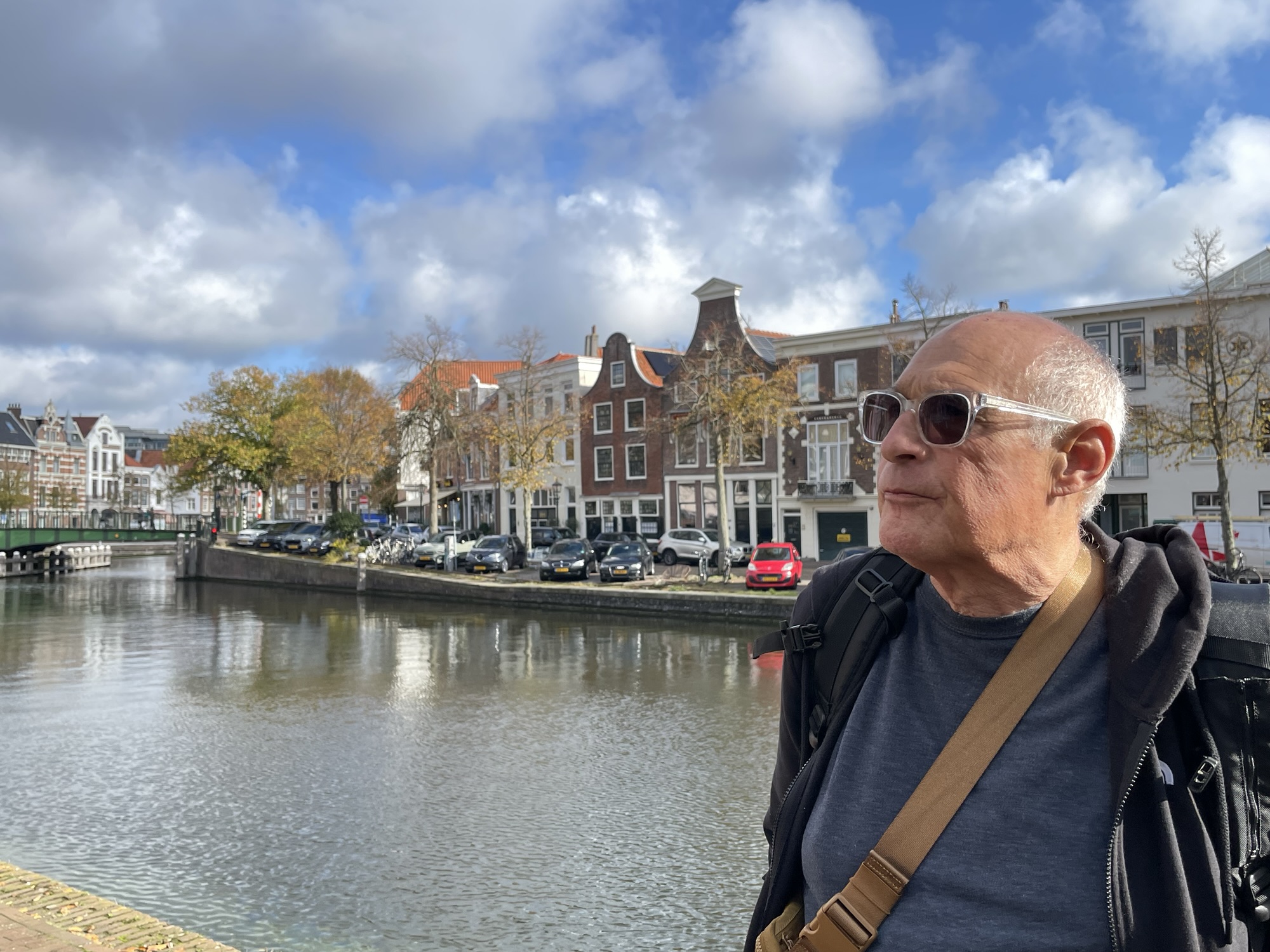
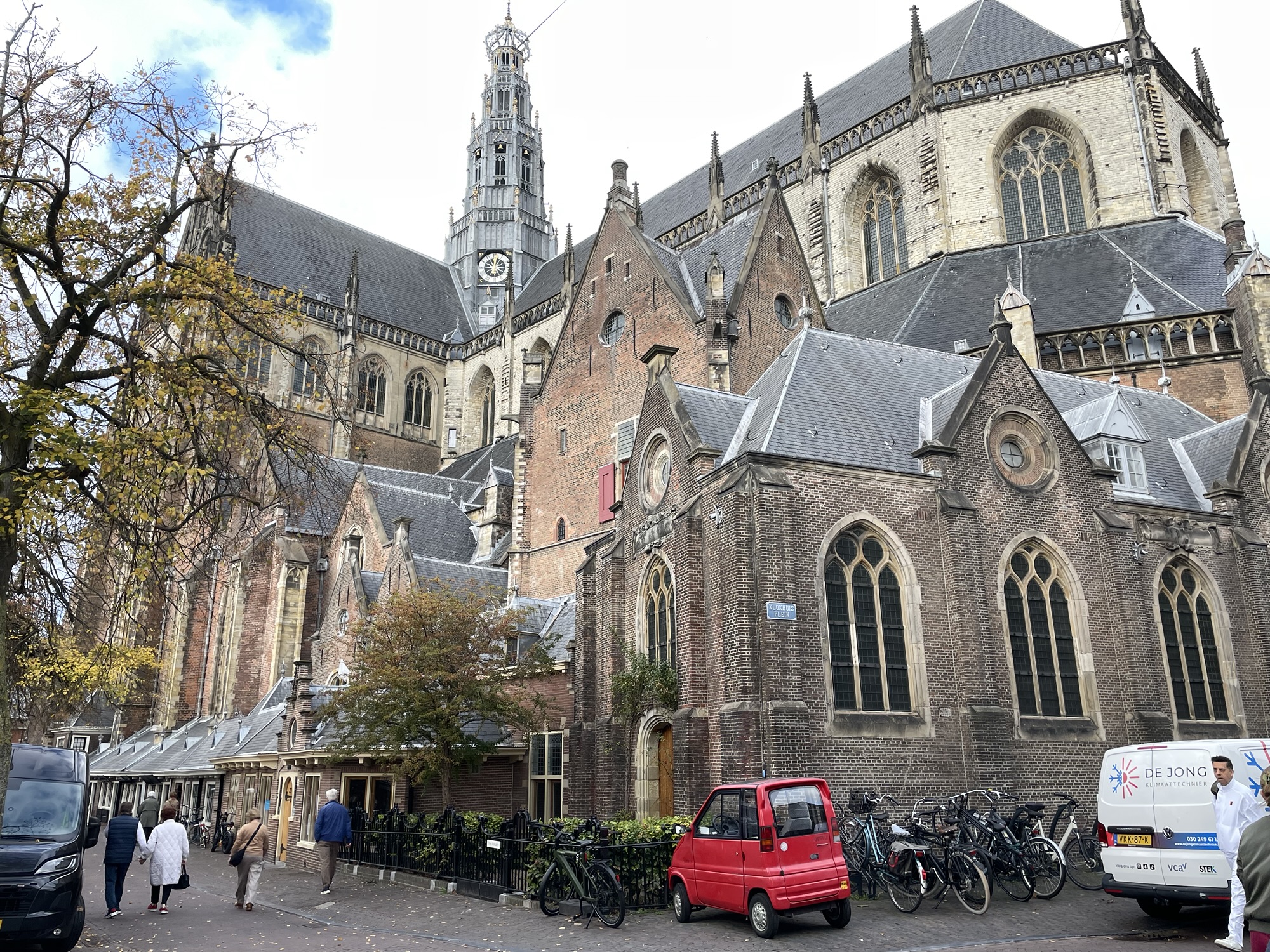
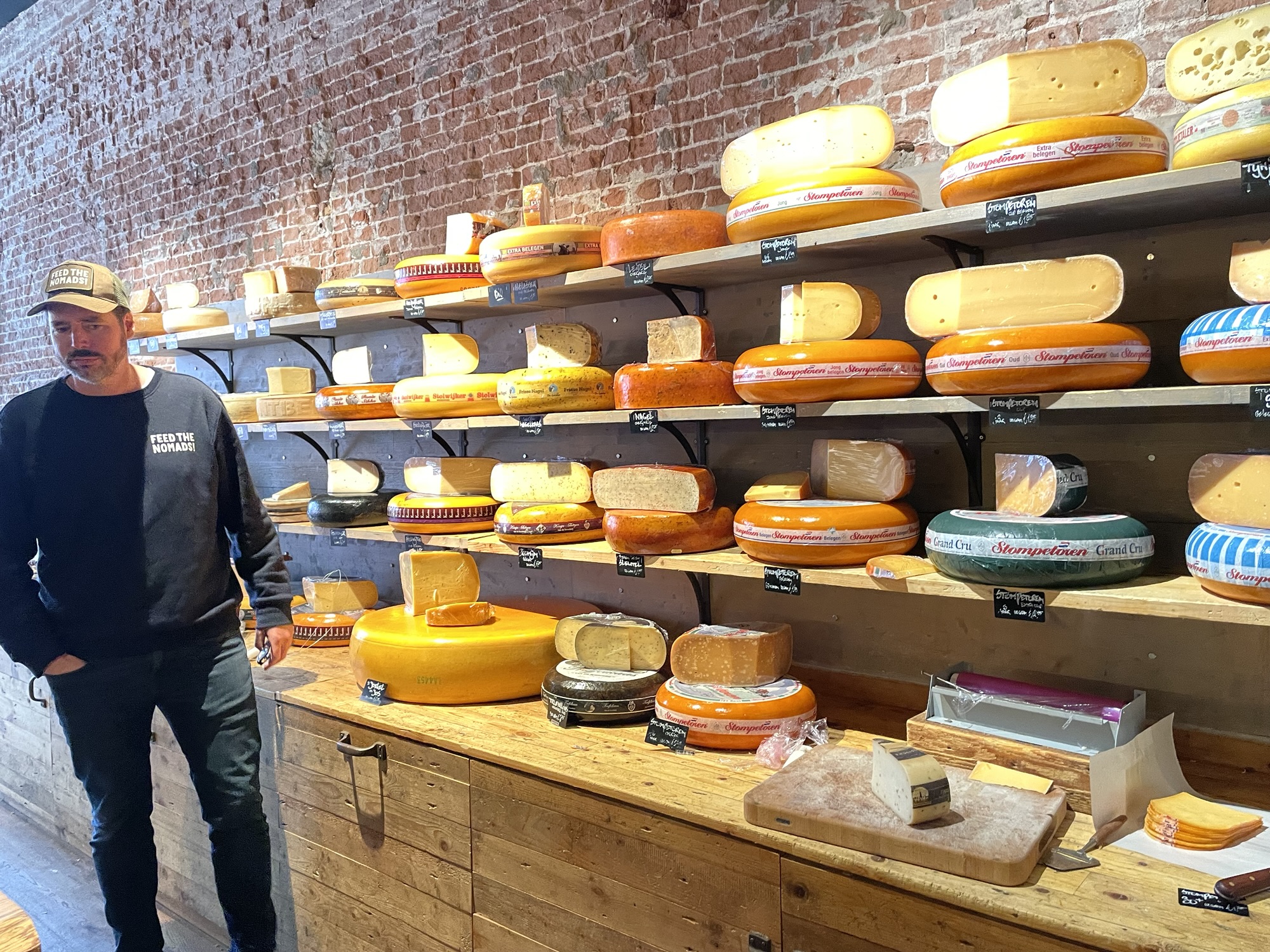
Haarlem, a manageable amsterdamOur wonderful guide explaining chocolate Narrow residential streets where the city promotes greeneryThese enormous houses were built primarily by beerPlenty of canals…this is an actual riverThe former cathedral, now Protestant, is a jumble of buildings smashed togetherDutch cheese is similar to parmesan in that it is non-perishable meant for long sea journeys as they became a colonial power.
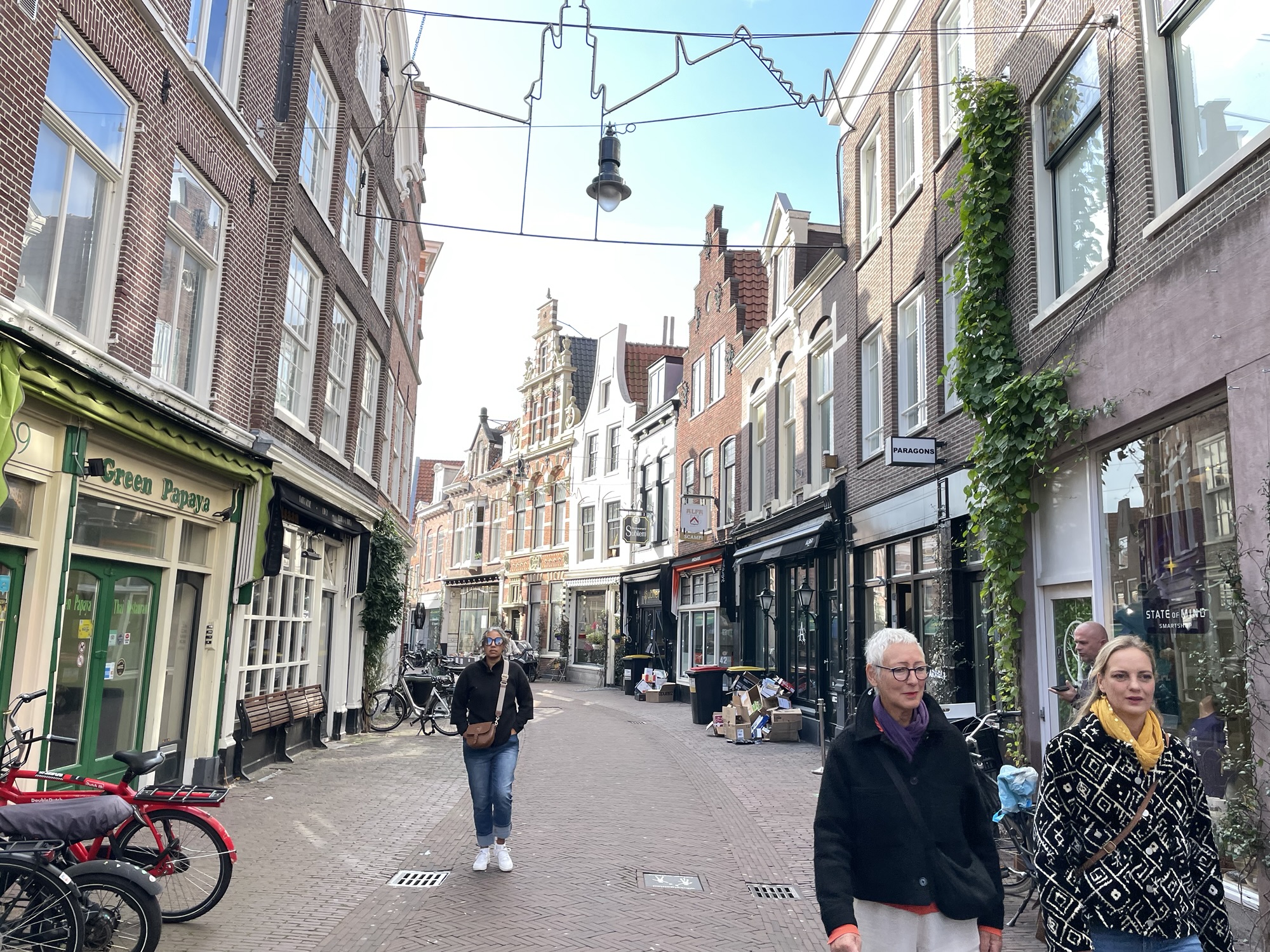
This food tour was more a walking tour through old Haarlem and its history—our guide introduced the tour by going through all the Dutch-American connections, place names, etc.—a walking tour with great snacks! It turned out the group was the guide, the two of us, and 3 of his buddies. We had a blast. Old Haarlem is gorgeous, with lovely restored buildings, NO CHAIN STORES as a result of city government policy, plazas, canals, narrow alleys of original buildings, built for warehouses and businesses but now residential, filled with greenery (also government policy to keep things cooler—oh, huh, is global warming a thing?), hidden gardens, little green squares surrounded by small row houses built specifically for elderly women or the disabled…everything on a small scale with no more than 3 or 3 1/2 stories per building. I yearned to go shopping in these lovely local businesses but luckily no time. Snacks started with coffee and little savory bites, then a cheese store, an outside market where we ate smoked eel (delicious) and salted herring with onions and pickles, warm donuts filled with raisins, chocolate at a local chocolatier, local craft beer and bitterballen, everything delicious and just right. The tour, we suppose because it was a group of (delightful) friends and the two of us, was four hours! We left the group at another restaurant/bar built on the top of a parking structure with a great view of the city—we had timed tickets to the Frans Hals Museum. We shook hands and left for our next immersion in Dutch painting.
Frans Hals Museum
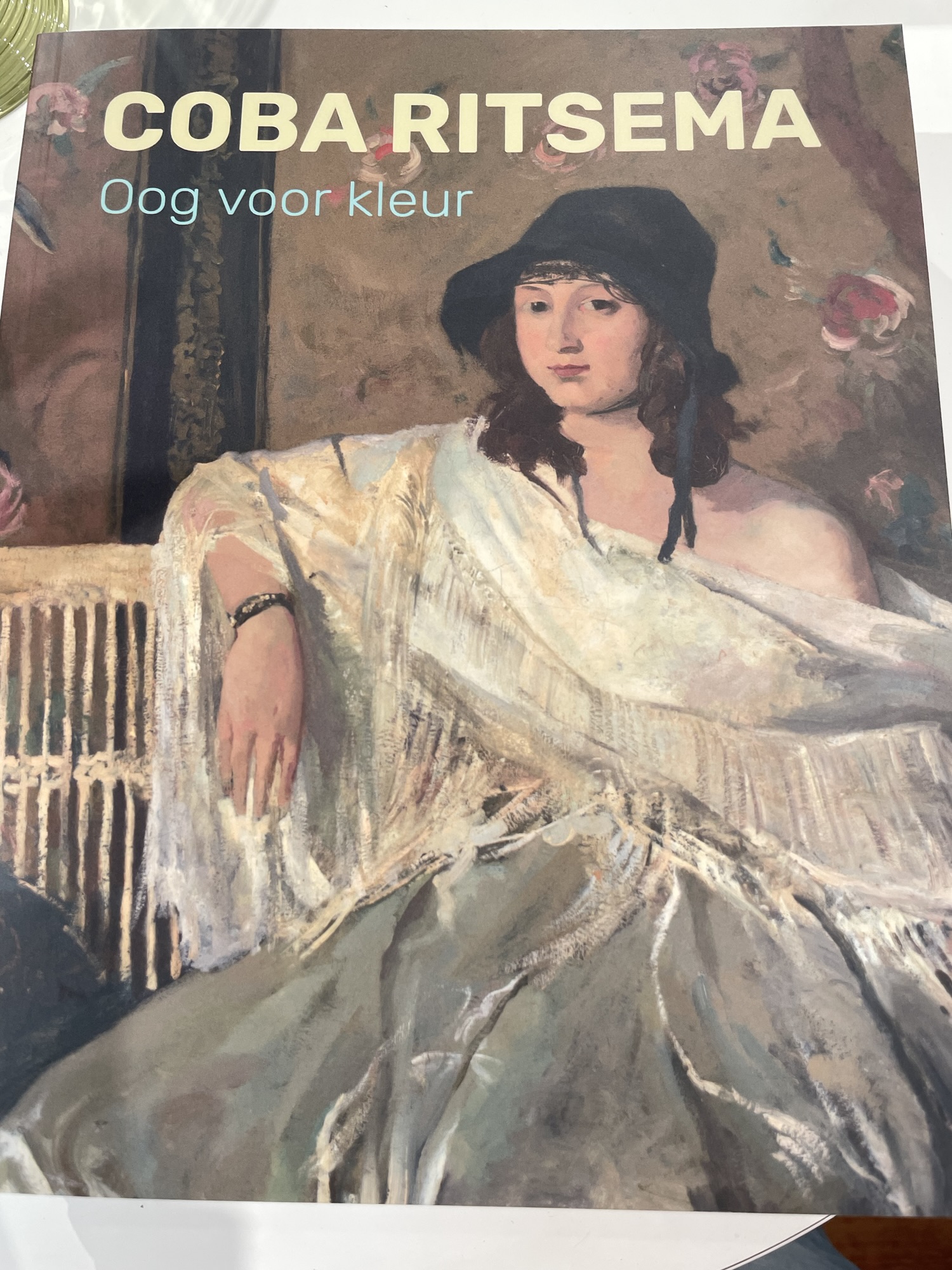
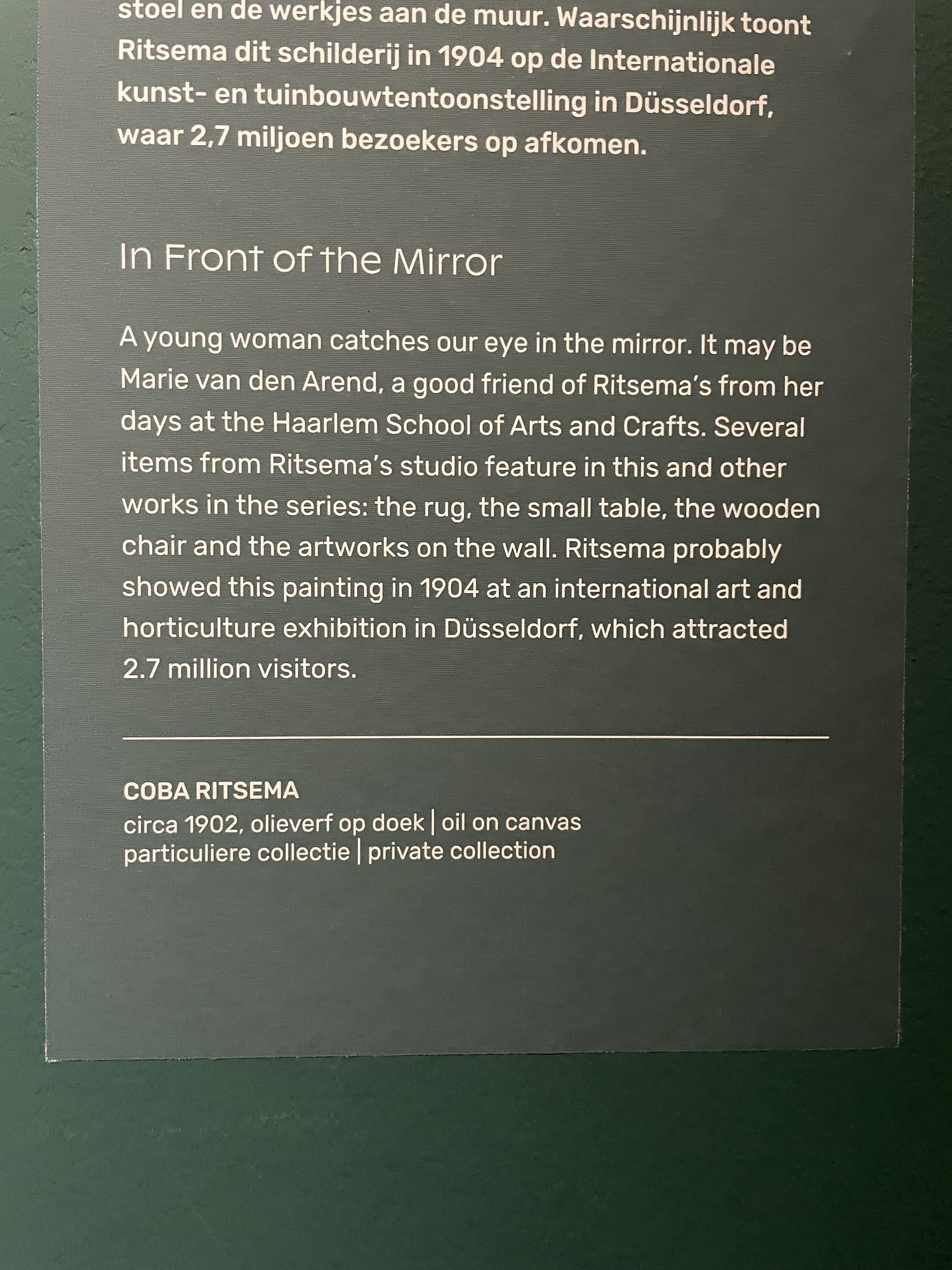
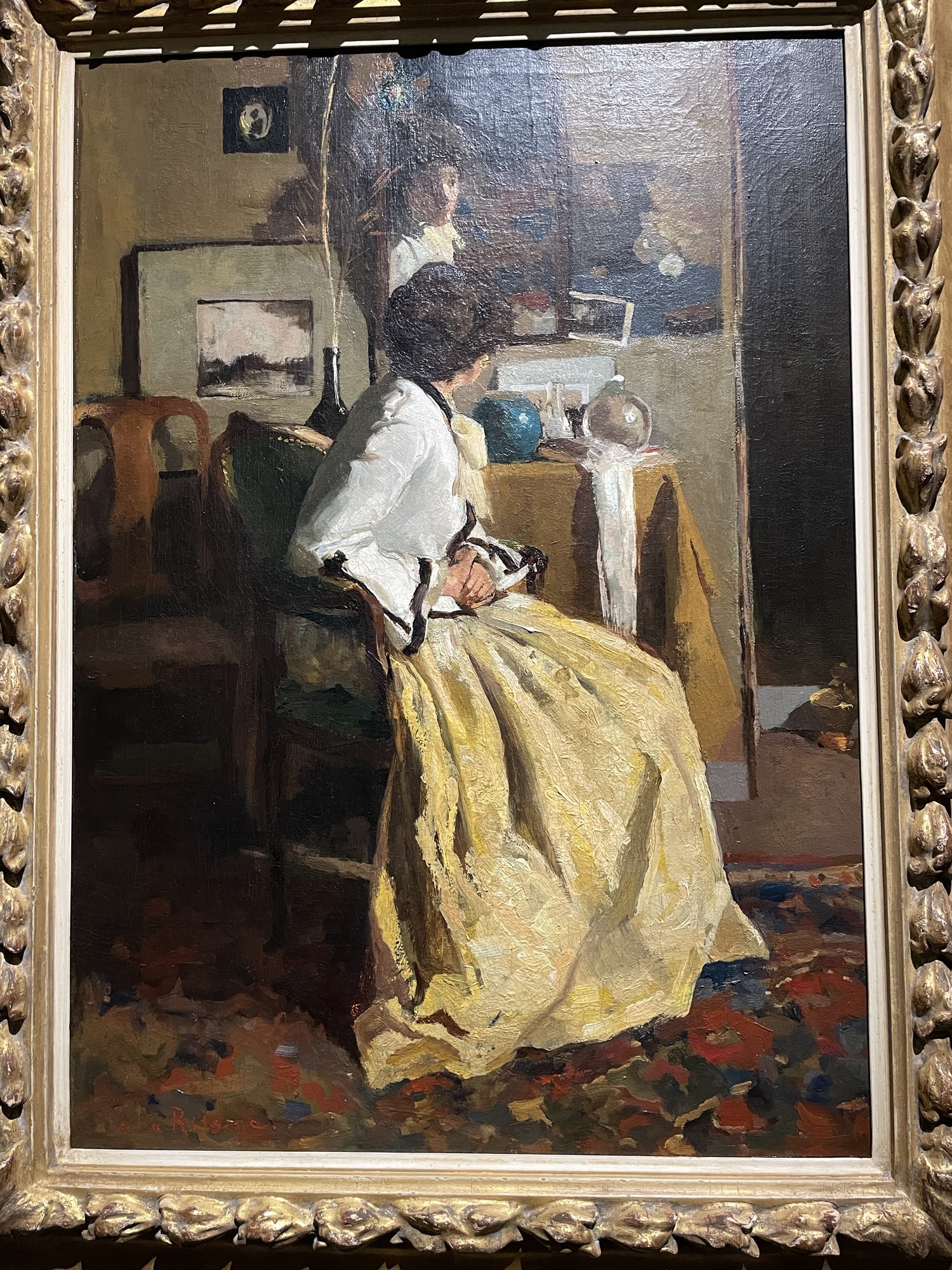
We liked it. All on one story, surprisingly large, but by the end I felt I had seen as many Hals and Hals-adjacent portraits I would ever want to see. There was a nice surprise at the end—several rooms of the life and work of Coba Ritsema, an amazing 20th century woman painter we had never before encountered. I was sad that the only book of her work on sale was entirely in Dutch. She is worth tracking down.
We really loved Ritsema’s workThe one-story museum on a typical Haarlem street. Charming.
We headed back to Amsterdam thinking we were on a bus to the Haarlem train station but it turned out to be a bus to Amsterdam South Station. A hop onto a tram and we were back in our neighborhood. We redeemed our champagne coupons (a very generous pour) and wandered across a few canals to have a fast burger and fries supper. Easy and fun—we were worn out and looked forward to bedtime.
Last Day: Van Gogh Museum! And a return to Stedelijk for Drama 1882 redux
Oh boy. We had 9:30am tickets to the Van Gogh Museum so after a stop at our favorite bakery for rolls and coffee we hurried over. It was just opening and the line was long, but these major museums have maximum tickets/day and timed entries so while there were a lot of people it was manageable.
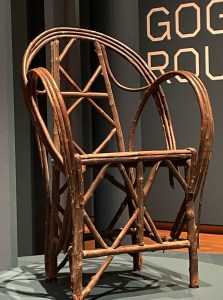
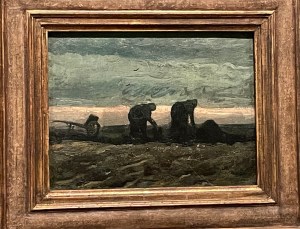
So many of his paintings are iconic and well known. I did my best to not take pictures of his work unless it was new to me—his chairs and a small country scene that kind of stunned me.
We like Van Gogh but here I realized how little I knew of him. (In April we had spent a few hours in Arles, his second-to-last home, so we knew a little bit about the events of his life.) This museum is fantastic, not to be missed. It is huge. We got the audio tour which was well done, and the first special exhibit was all about his time in Arles where he painted this particular family over and over and became very close with them. Van Gogh had decided to be a portrait painter and it was here, with these models, that he learned his approach. You have seen his pictures of the Roulin family if you have ever seen anything of his. He painted a version, e.g. of Postman Joseph Roulin, and then painted multiple versions; the same for his wife, a beautiful rendering of this beloved friend, over and over with subtle changes. He did the same with his self-portraits, changing the colors of the background and clothing. They are wonderful. That he was already struggling mentally adds a dimension to understanding his work in this era. He also wrote hundreds of letters to his brother Theo, fortunately and lovingly preserved and transcribed by Theo’s widow. He wrote with intensity and awe about art and what it meant to him and, he hoped, to his viewers. Many of these letters were quoted in the audio tour and wow.
I had not known that painters of this era in France, where he went to learn to paint, were excited to experiment with new science of color. Van Gogh and others used dabs of many colors to let the beholder’s eye blend into another color. In the museum they have extreme (via microscope) close ups of one of his paintings to show in detail how the shapes and colors of these dabs create depth and interest. Also little grains of sand in a painting he did at the seashore. So cool.
Dutch Lunch
We had lunch reservations at The Pantry, a tiny, famous, old restaurant a 10 minute walk from the museum. Fun and yummy.
Drama 1882 Redux
David and I were so enchanted by the movie the first time we visited Stedelijk we wanted to see it again. I wish it were widely available, e.g. on YouTube or venues in the US, but I have scoured the web without finding anything. It played at the LA Museum of Contemporary Art for a month this spring.
We had one more museum left on our pass and we chose to use it to return to Stedelijk. Friends, I cried. It is so moving, so beautiful, so very unusual. We were so happy we could see it a second time. A masterpiece. Wael Shawky. Remember that name.
Fancy Dinner with our beloved niece
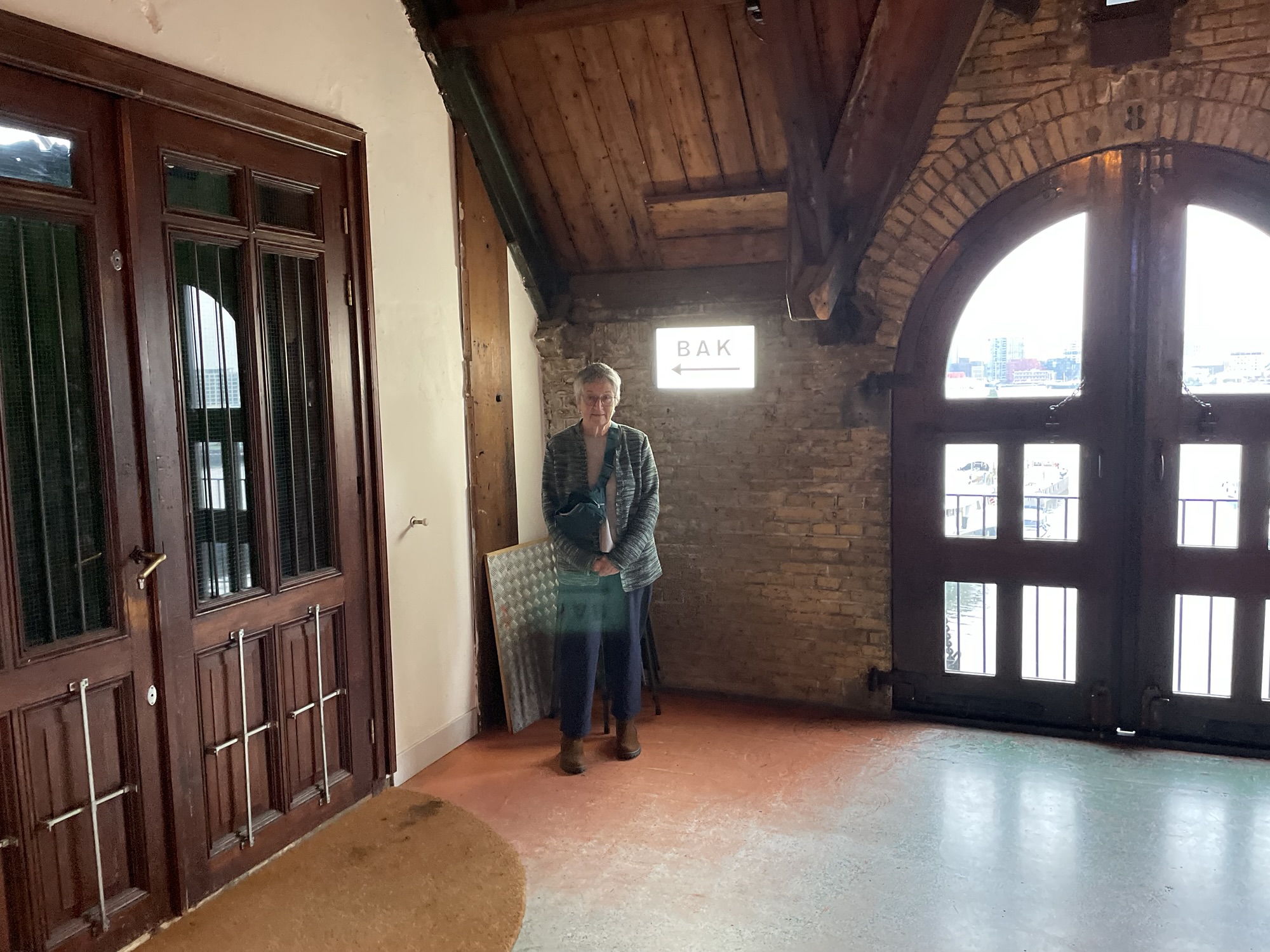
We had reservations at Bak, a place that occupies a corner of the top floor of a warehouse on the river (not a canal!) renowned for its tasting menu. We had to deposit 40 euros per person to hold the reservation, and we hoped it was worth it.
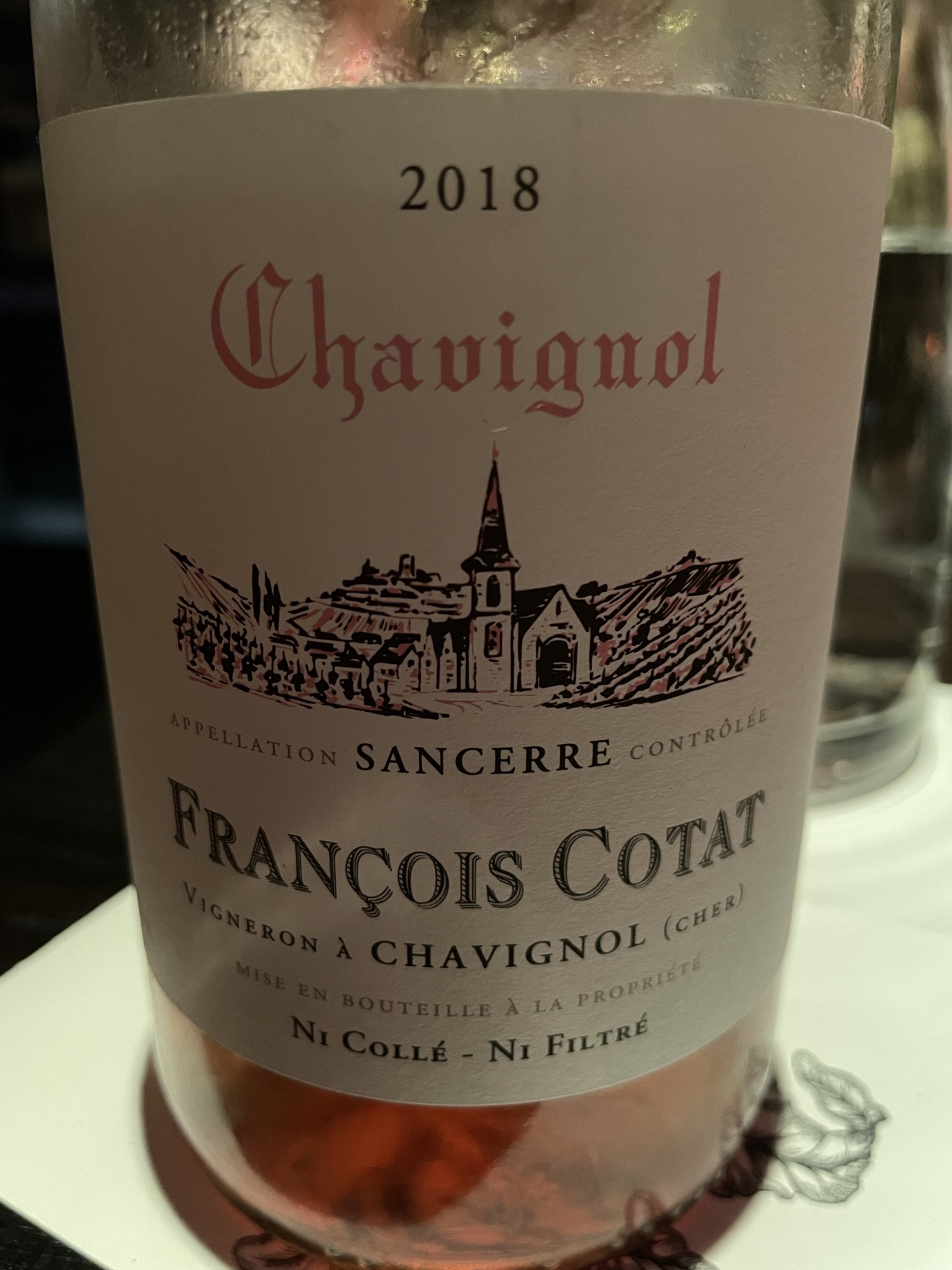
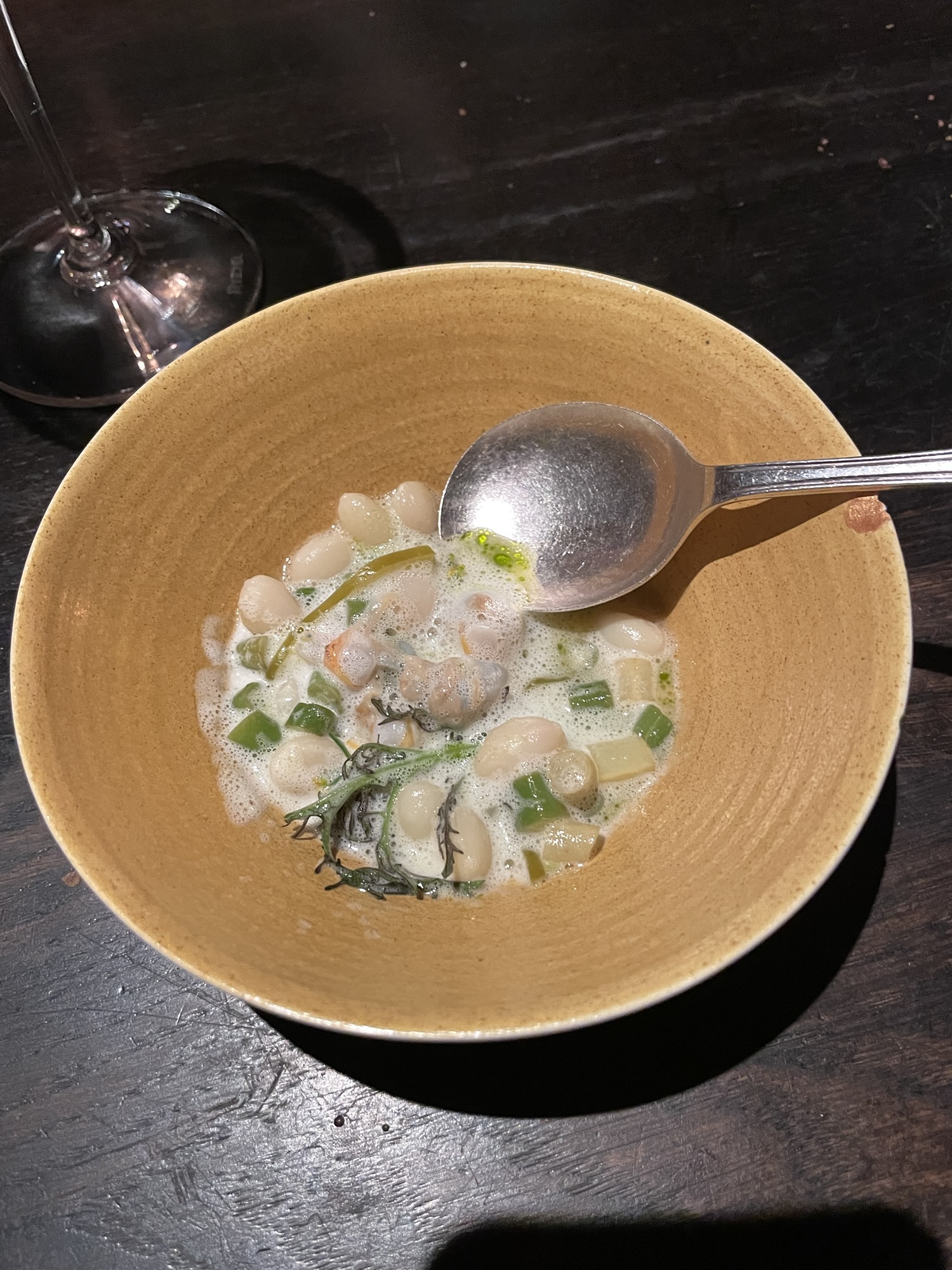
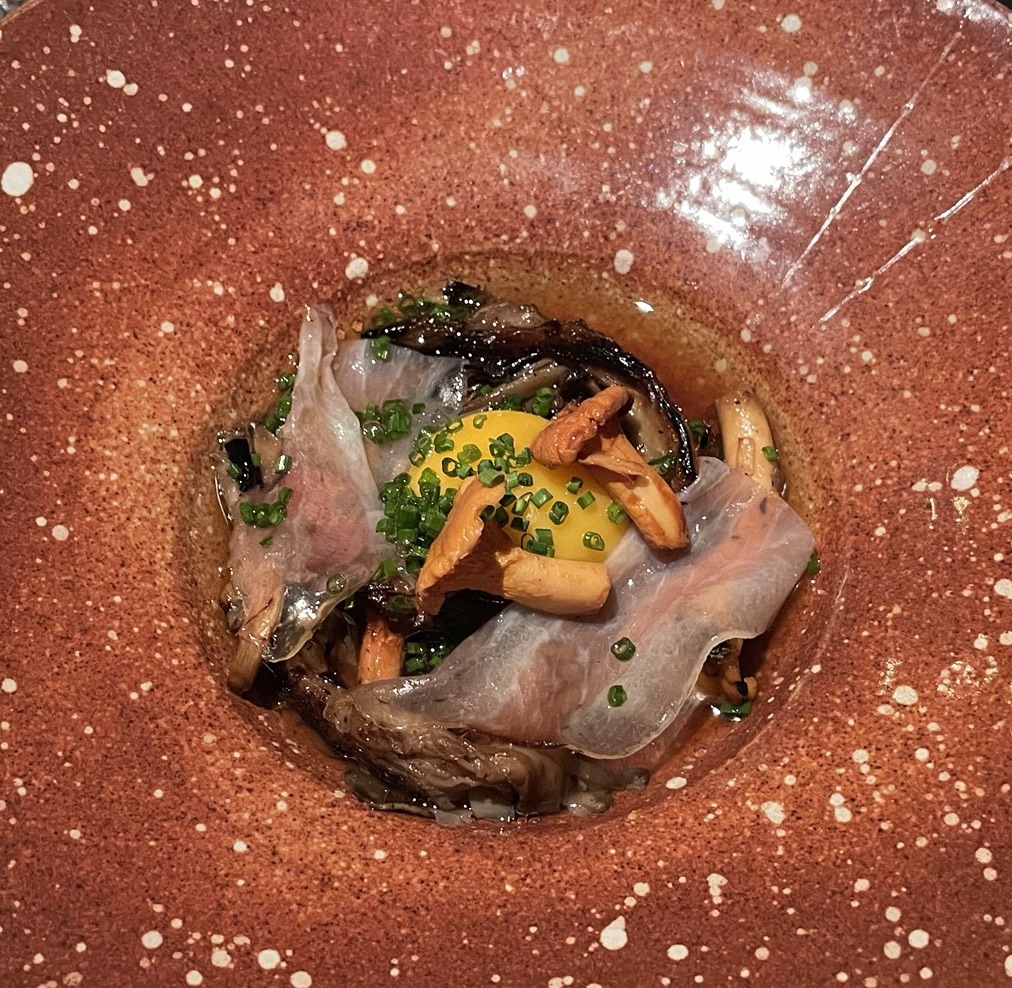
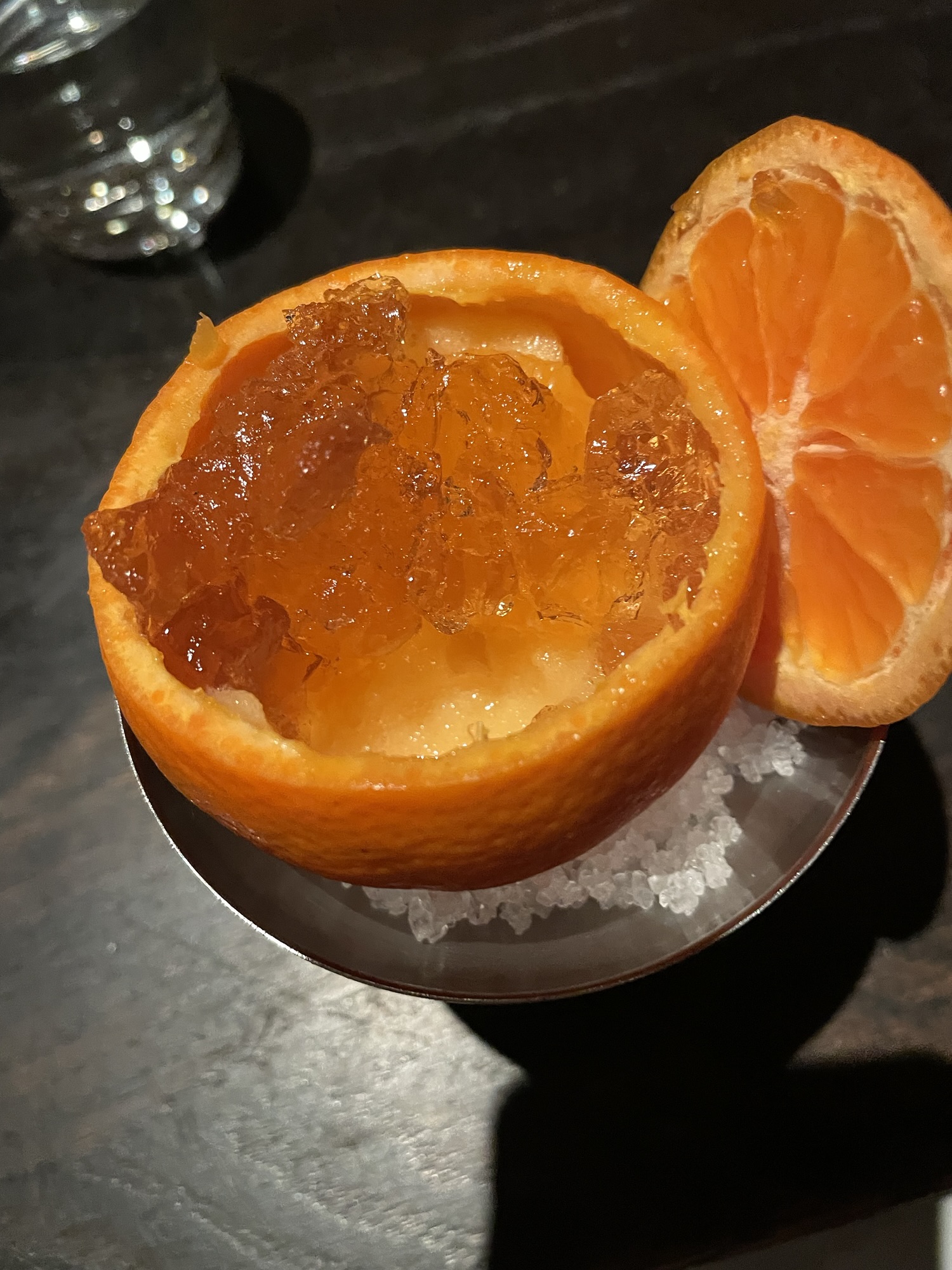
In the top floor of a warehouseAn almost thrilling roseDon’t recall what this was other than deliciousDitto. And…ditto.One of 3 desserts, an orange sorbet, I think, with sherry jelly on top.
It was. These kinds of meals are such fun, and perfect for a long evening of conversation. Lauren joined us and we talked and ate for hours. Service is attentive and unfussy, food delicious, and when they didn’t have the (least expensive) rose they substituted a spectacular French rose for the same price. After gin and tonics, all that food, all that wine, we were sated to say the least. To complete the luxury of the evening we shared Uber with Lauren (we of the always take the local transit habit) and returned to our room feeling as if we had enjoyed our narrow version of Amsterdam sufficiently.
As I write this we are on the fast train to Paris for another ten days of sightseeing, museums, and food.
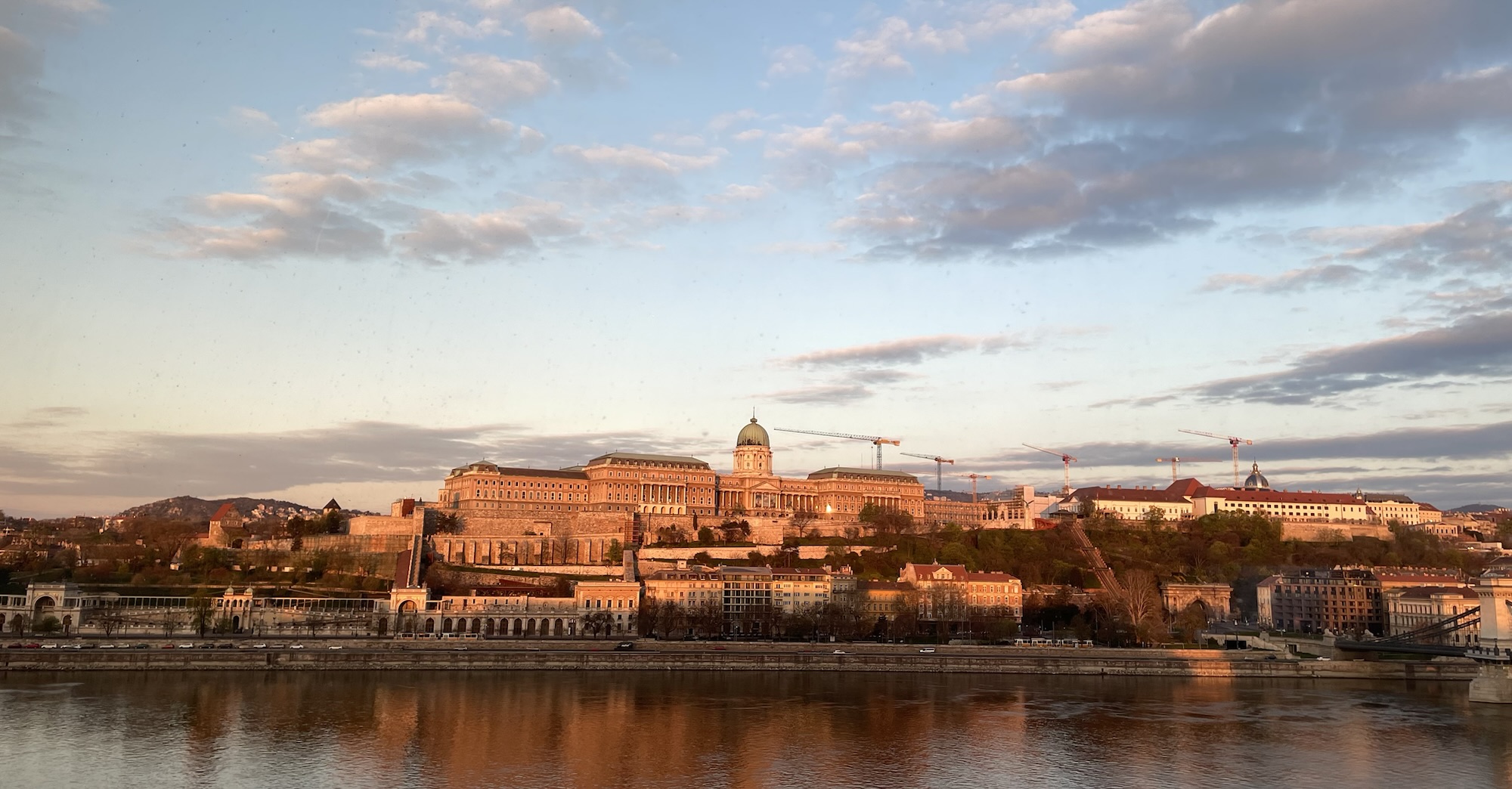
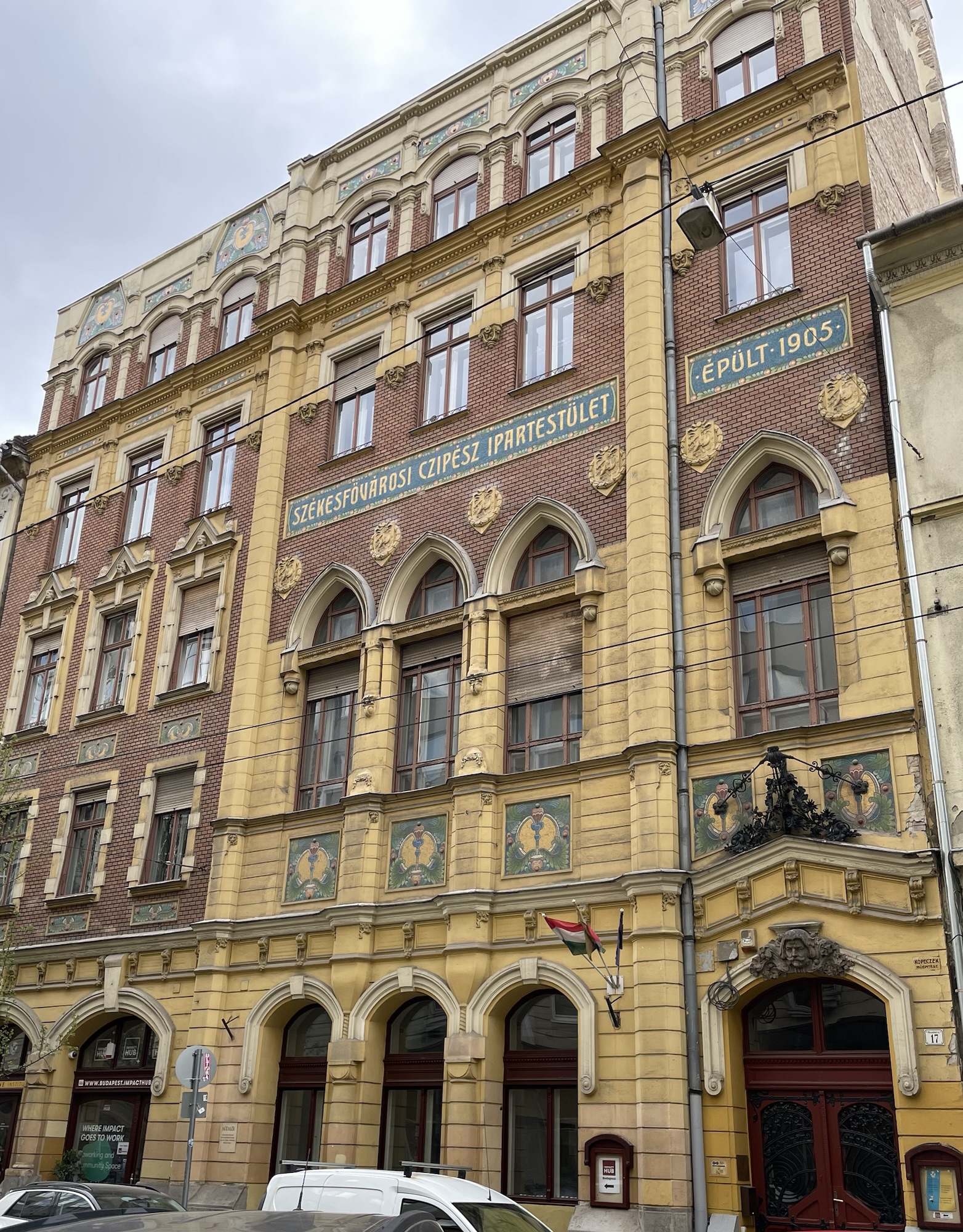
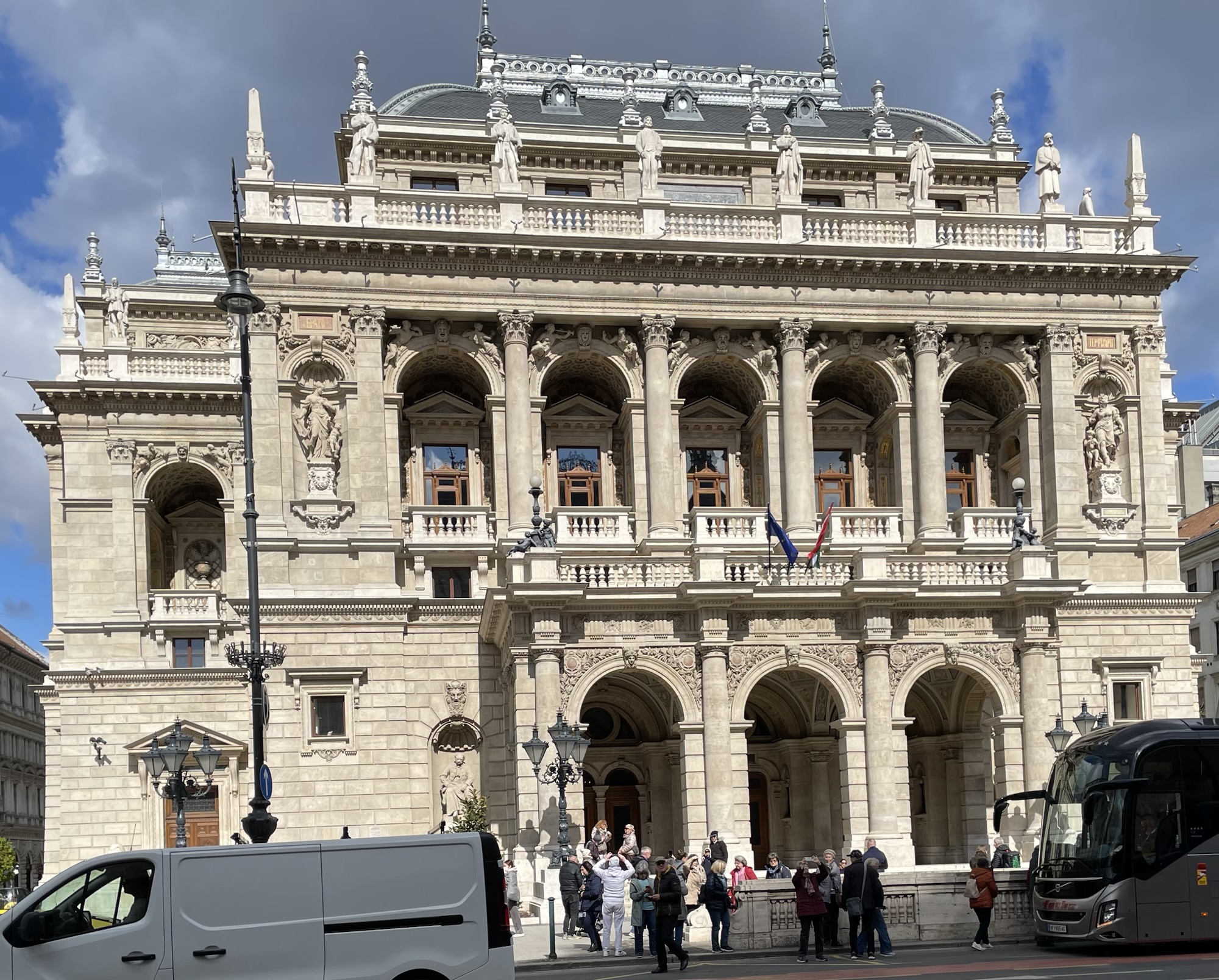
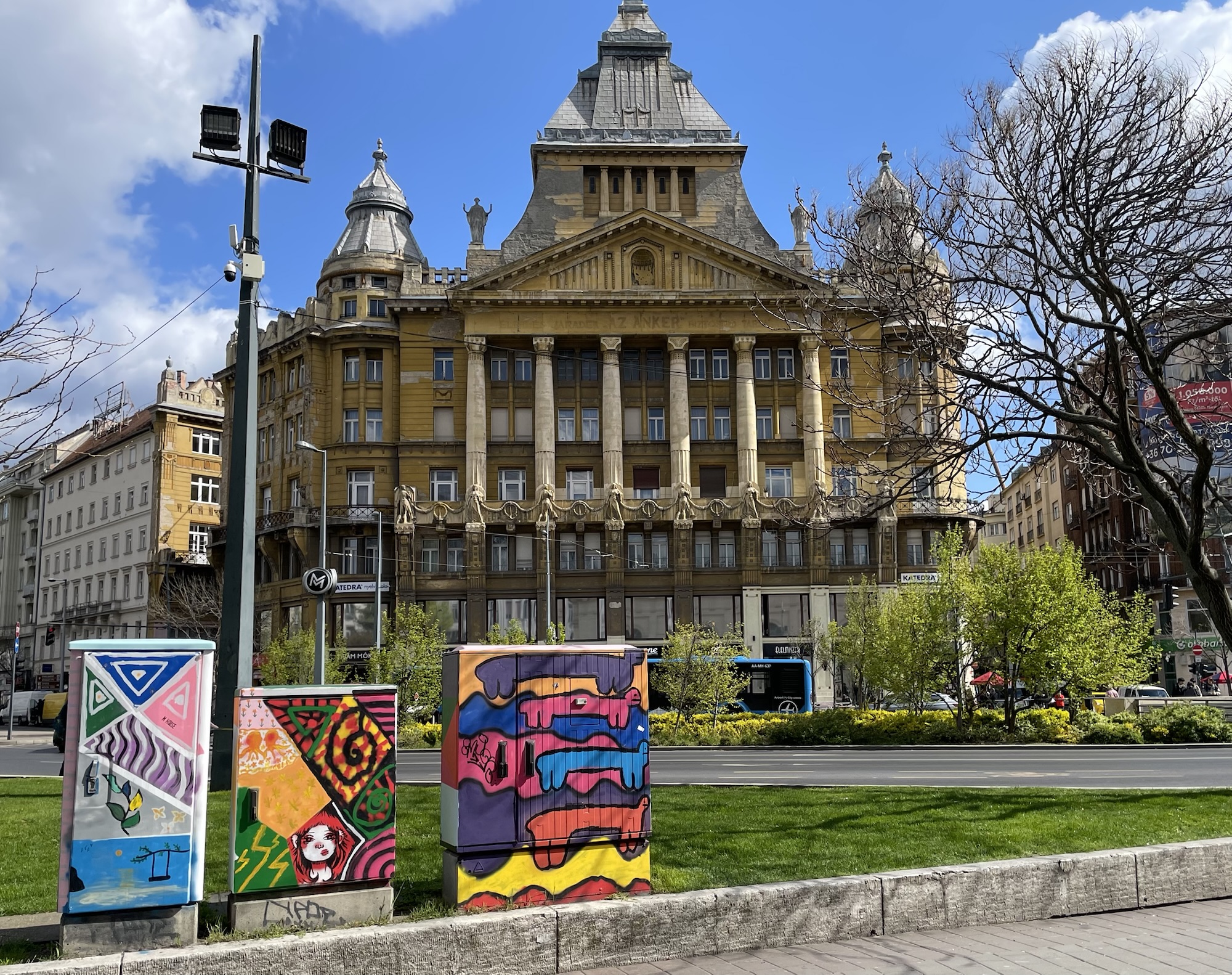
Budapest is a beautiful city. Like Prague, around virtually every corner is another deco or nouveau building, a small green park, or a monument with an unrecognizable, to Americans, statue on top.
It is also infected with plenty of American shops, pizza restaurants, kebab shops. I suppose we should no longer be bummed by Starbucks and McDonalds and Burger King, right? And yet…
We arrived several days before our Danube cruise started, fresh out of France and perhaps a bit hard to please on the food front as a result. Our visit was also handicapped by incredibly cold and windy weather that arrived our first morning. Nonetheless we layered up and headed out and about.
Public transportation
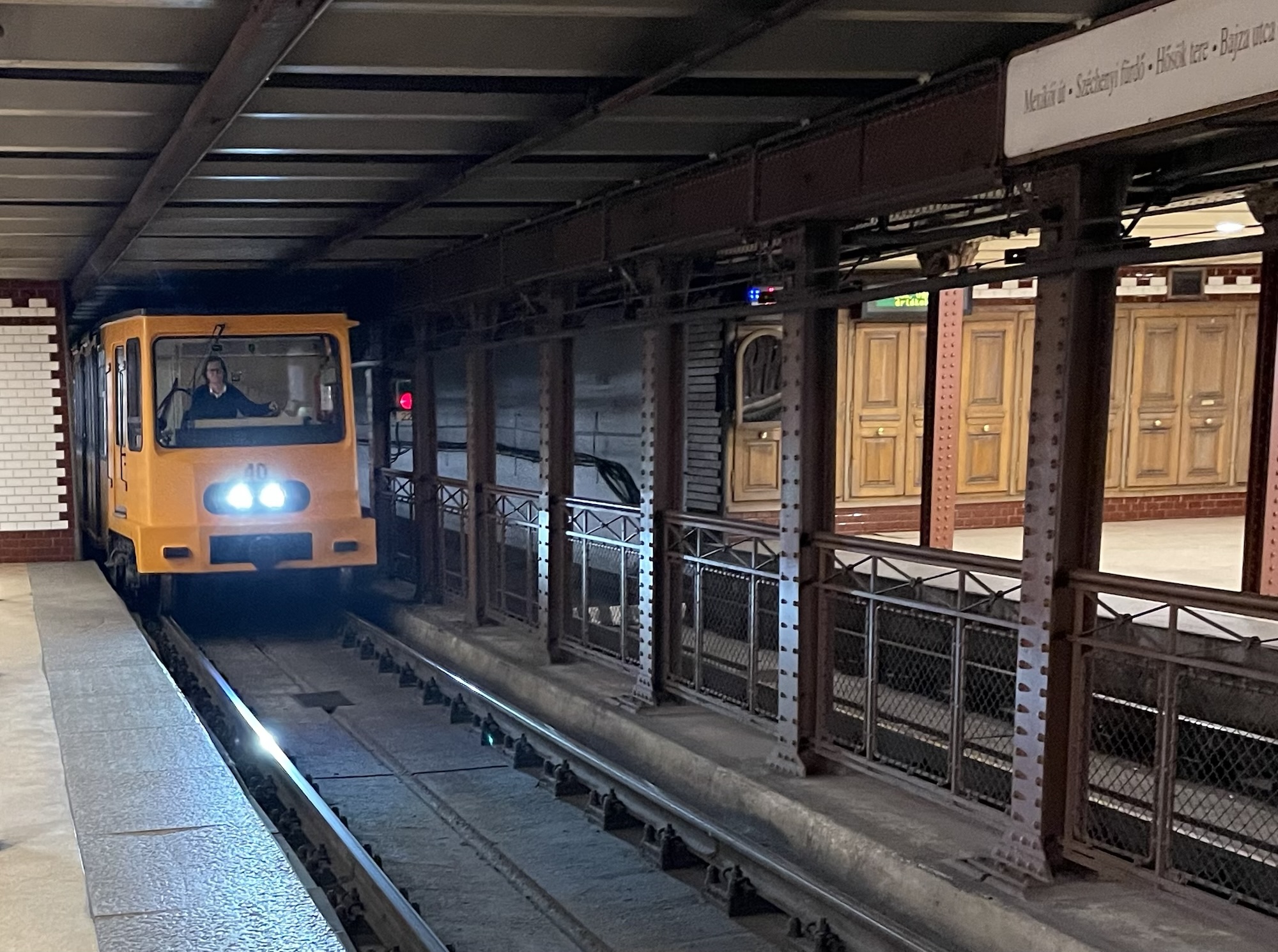
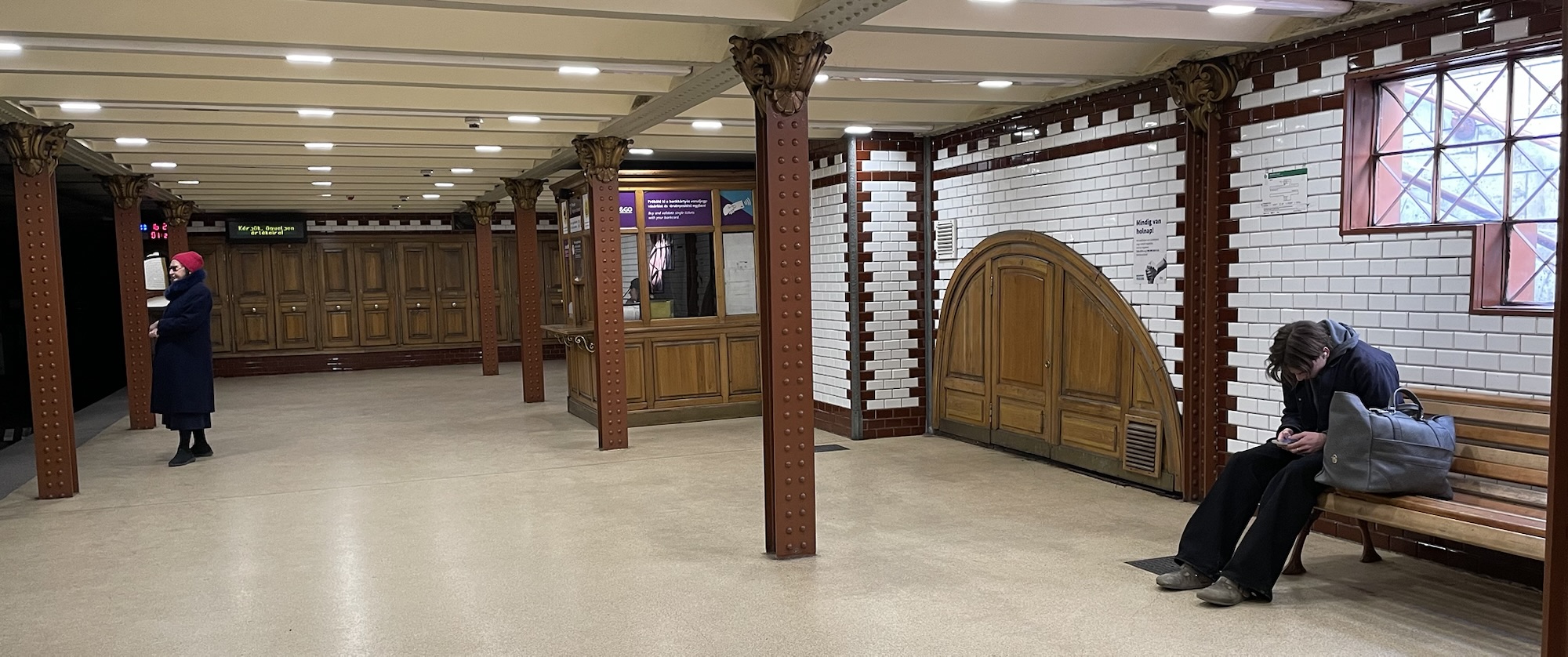
Line 1, the yellow line, oldest in Budapest
The metro is great, with the added attraction of the oldest line (yellow) with white and brown original tiled stations, quite small, and low ceilings. According to our guide it was the 3rd major underground system in the world after London and Istanbul. It is not many steps below ground and supposedly because it is not in a tunnel it is technically not a subway. The cars have leather straps (!), low ceilings, and the most terrifying door closings I have experienced. I tried to capture them on video but it does not do them justice. Ding, ding, ding and the doors close, slamming violently the last few inches. I bet they would take a limb off, easy.
Between the metro, the bus system, and electric streetcars you can get anywhere and quickly.
Advice: From the airport skip the cab line and head right for the express bus 100E, which barrels into Pest and drops you right in the center.
As we lined up for that bus, pretty tired from walking at least ten miles across the Munich airport (very slight exaggeration), we were taken aback by a twenty-something man who was almost aggressively asking us a question in incomprehensible English, over and over. We stepped back, alarmed, as another young man at the door to the bus asked if we were over 65. Uh, yes? No charge for public transportation! The insistent young man who had been pressing us a moment before looked down, saw he didn’t have his ID badge around his neck and immediately fumbled to get it out of his jacket pocket. He had been asking us “How old are you?” Poor guy.
Google maps were reliable for walking and taking public transportation, with few of the dead spots in many other old cities. So in spite of the windy cold we got around easily.
Disappointing
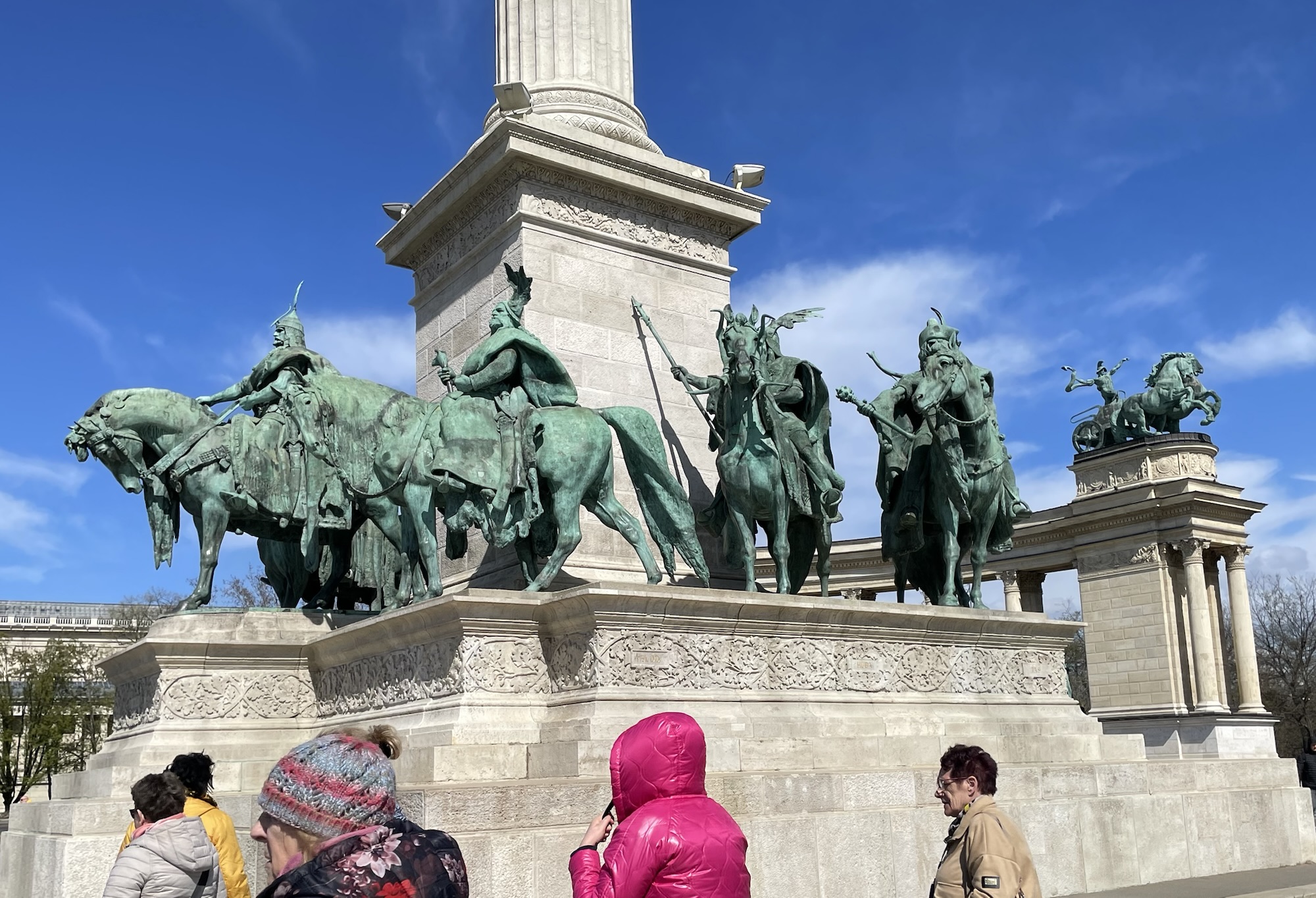
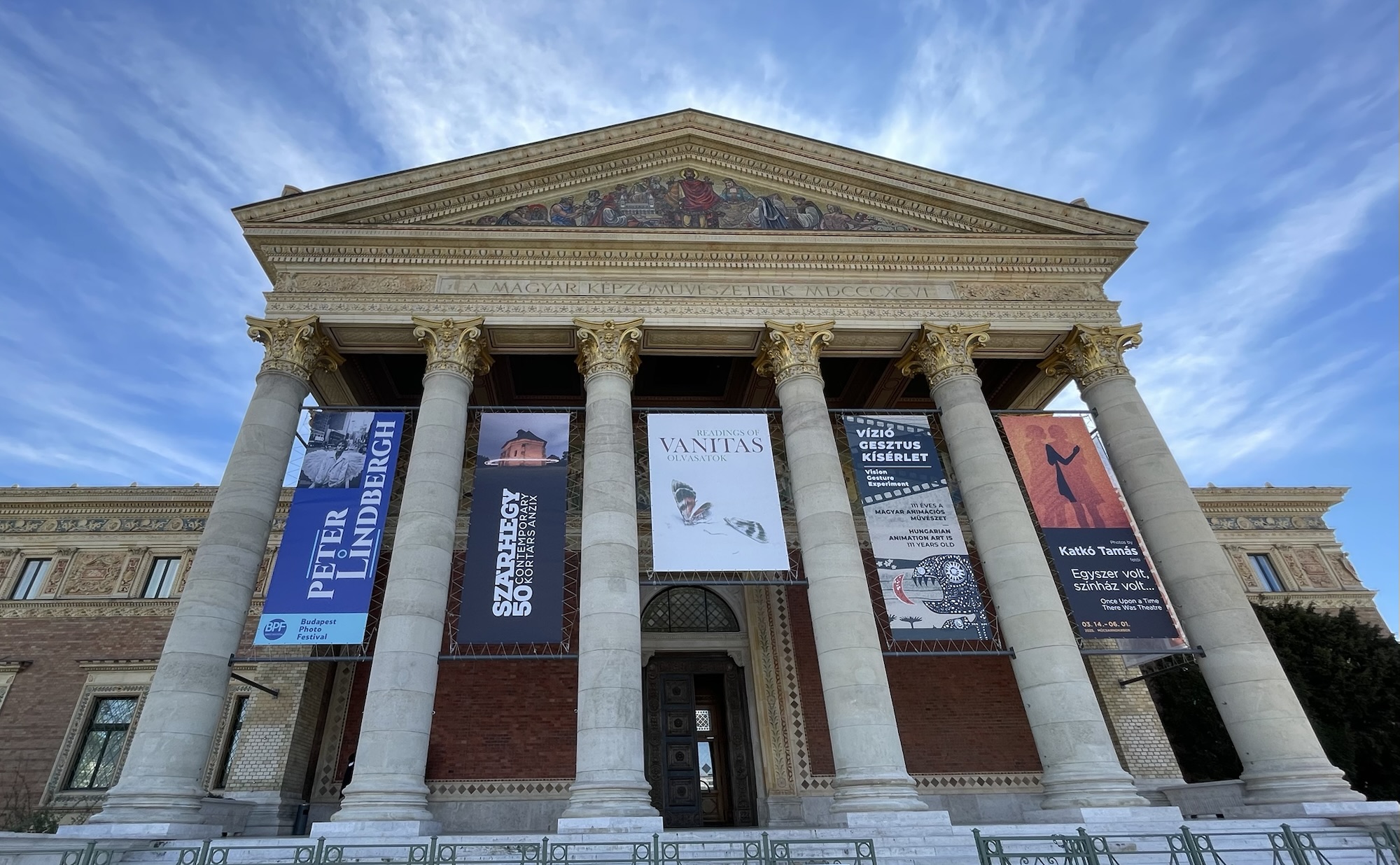
We love museums, primarily art and history. We found Budapest museums underwhelming. The fine arts museum, which is on Heroes Square (which is magnificent) is only mediocre and the building itself terribly confusing. It seemed in each era the examples on display were not the most impressive. Admittedly we have been to a lot of art museums but I do not think we’re jaded, we just had no wow moments, no revelations. But it is very well regarded and maybe we weren’t in the mood.
Heroes SquareHistorical Hungarian leadersFine Arts MuseumOne half of the Ethnography Museum
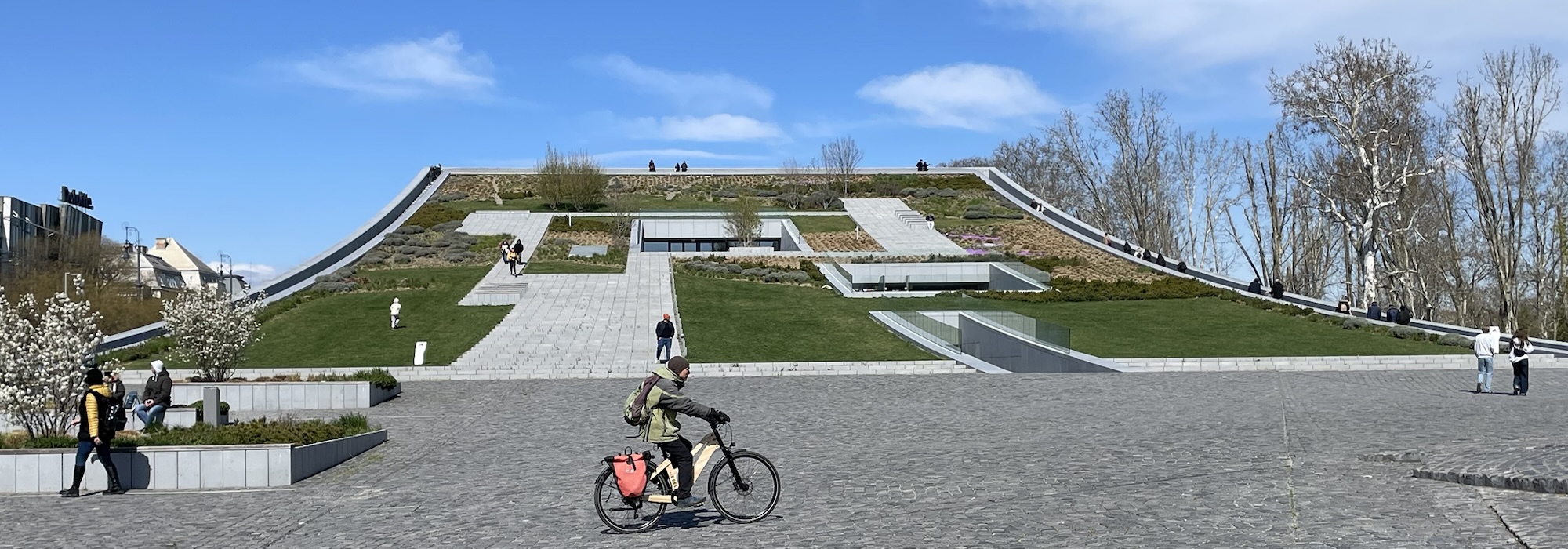
In retrospect we wish we had gone to the ethnography museum instead. First of all the building is amazing from the outside (see photos below) and lots of people were walking up to the top. For us it was way too cold and windy to try. A missed opportunity. And second, given the bits of Hungarian history we picked up a few days later at the national museum, an ethnographic history would have been fascinating. Quick, which language is Hungarian most closely related to? Yup, both the Finns and the Magyars came out of Siberia.
Our last museum experience worth mentioning was the National Museum, all about Hungarian history. Best part by far is on the second floor, 1703-1990. Lizt’s piano, which had been Beethoven’s! And the fascinating era from World War I through the velvet revolution. Well laid out, sufficient English signage, moving and just interesting.
Beethoven’s, subsequently Lizt’s piano!!
When we got there, tired as all get out, we decided to take the elevator up and walk down. We asked where it was at the entrance and were told to see a particular woman who motioned for us to sit down. We did. After perhaps ten minutes we didn’t begrudge given how tired we were, she motioned for us to follow as she led us through locked doors, a warren of hallways, finally getting into a freight elevator to the third floor where we were escorted back out to a public area. We said thank you and went on our way.
Our Hotel
Beautiful in the daytime too.These bronze figures are all over the city. This is right outside the hotel.So Zsa Zsa, darlingNight view from our room
We stayed at the Intercontinental Hotel, right on the river, and we thrilled to the view both day and night. Our room was big and dead quiet, bed comfy, and we almost caught up on our sleep.
Food
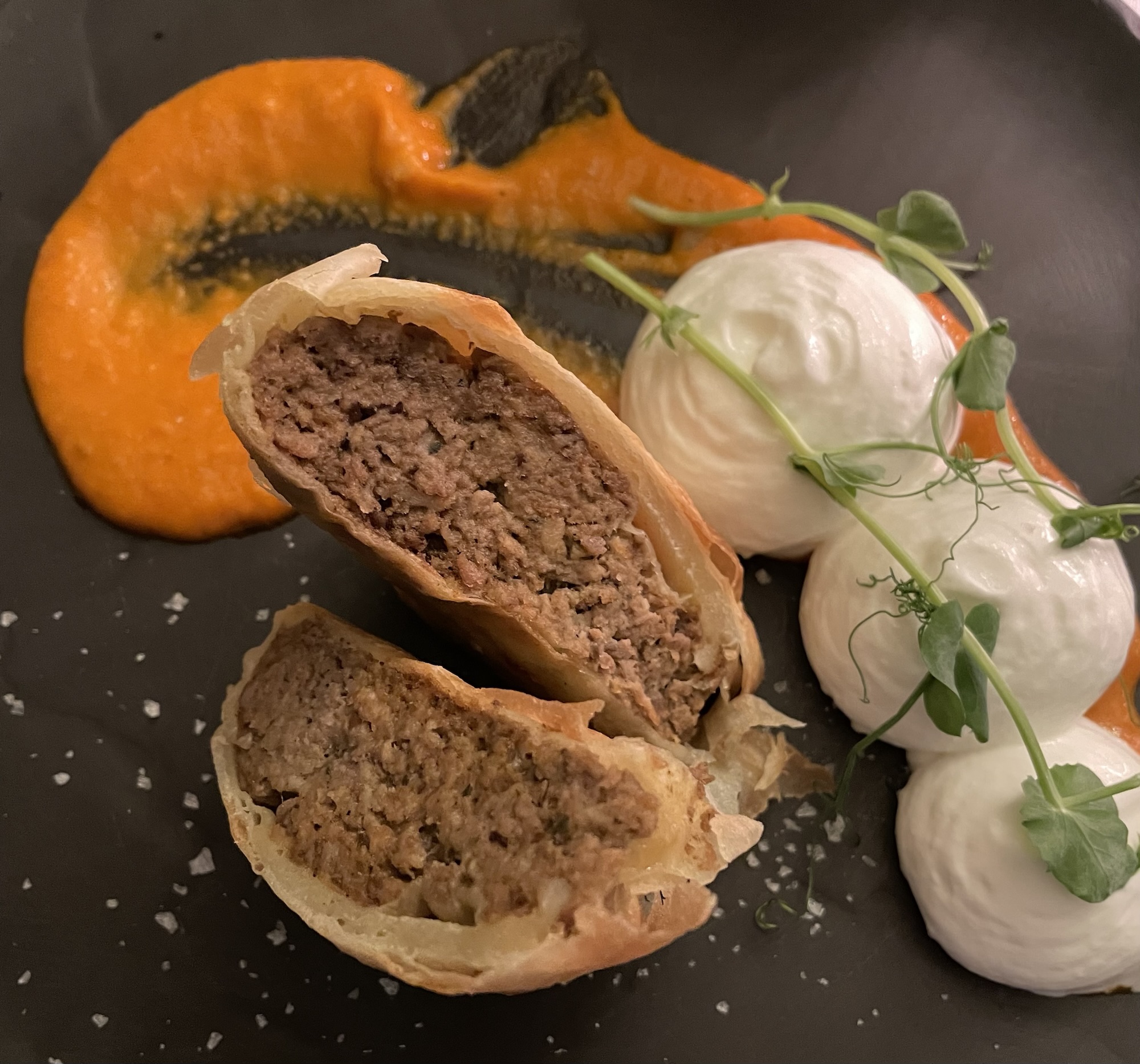
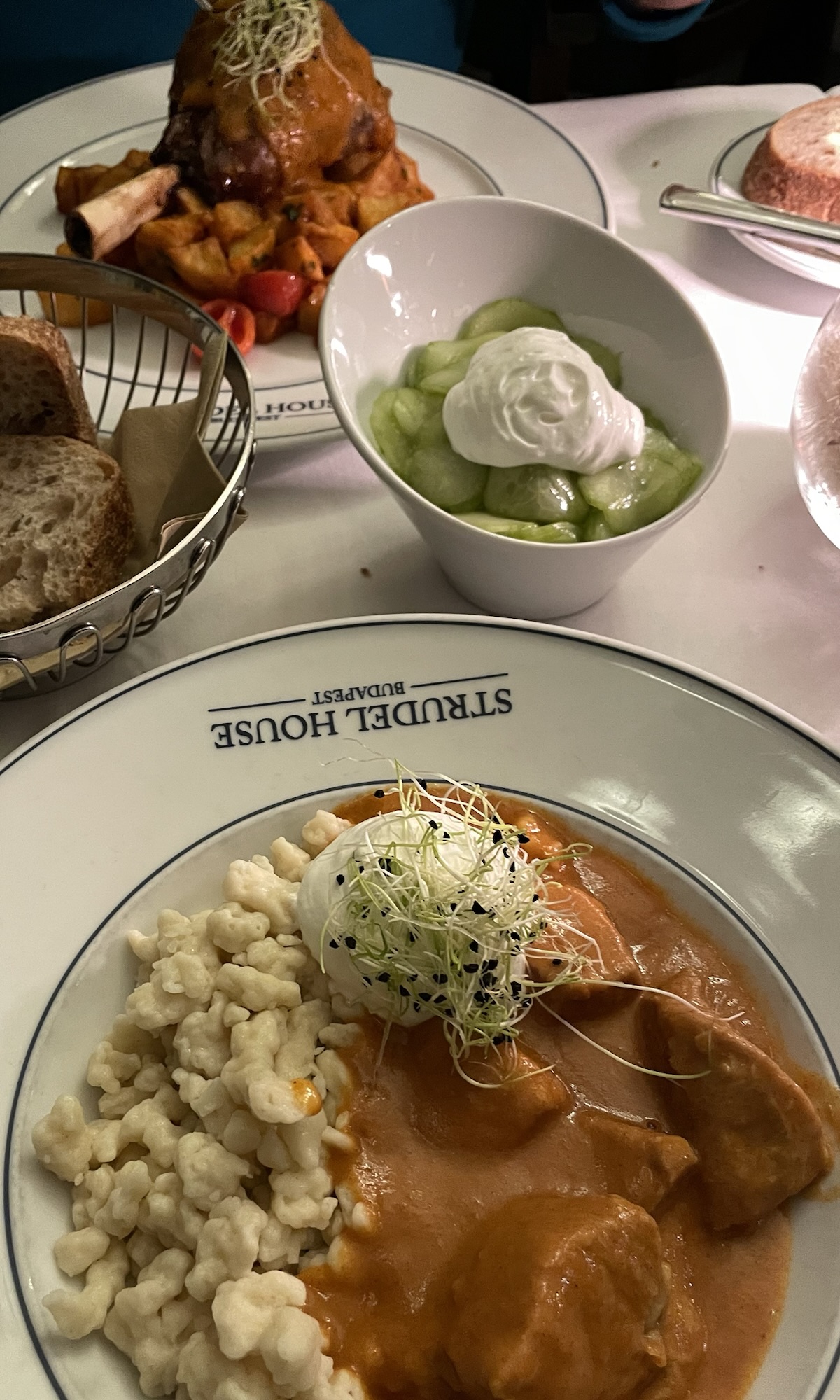
We had paprikash and goulash several times. Delicious. I think perhaps the cucumber salad that came with veal paprikash our last night was a highlight, as was the “onion” soup David ordered. It was the bright dark green of very fresh spinach, maybe, thinner textured than a cream soup, and wow what a flavor. The English translation in the menu was “Ramson’s onion soup.” Oh! Ramps, a beloved spring wild onion found in eastern US. it was a revelatory dish. This great meal was at Elso Pesti Reteshaz, also known as Strudel House. And yes, great strudel both savory and sweet.
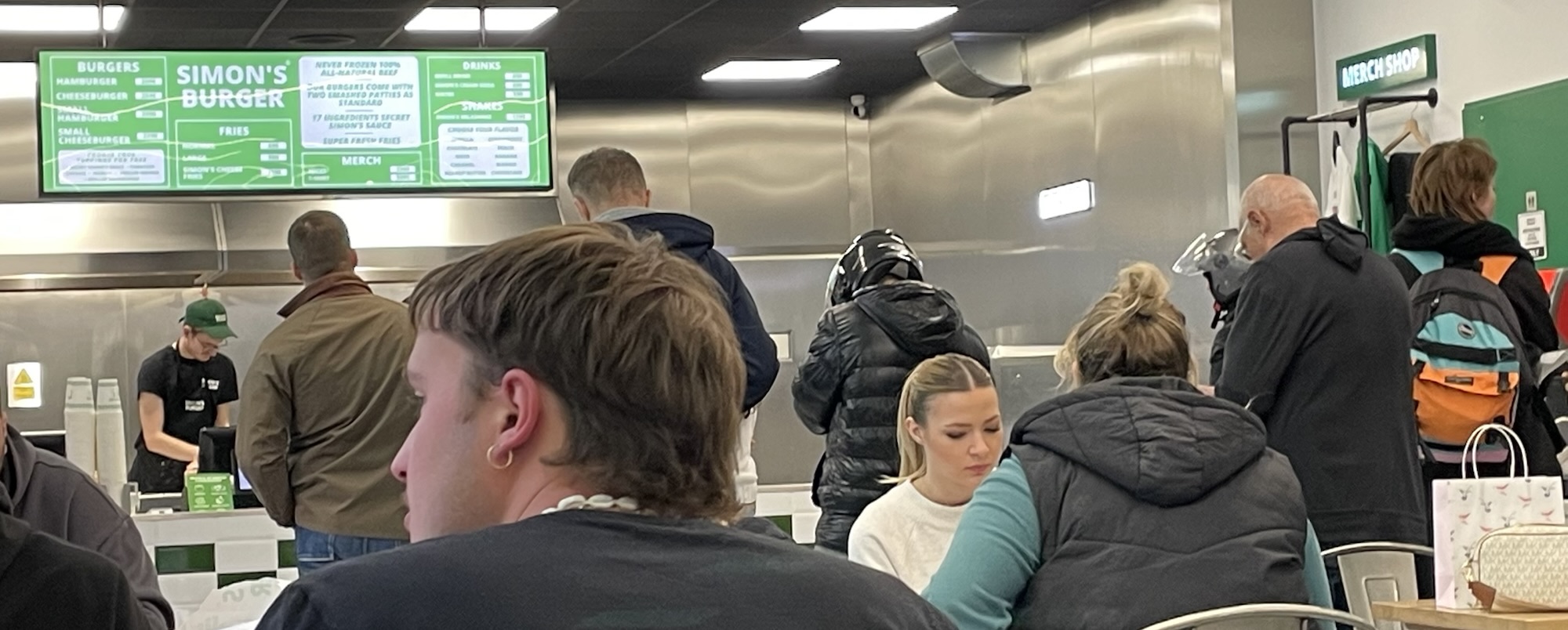
David and I raise the average age in Simon’s
A funny and yummy meal experience at the other end of the spectrum is Simon’s Burger. It is a love letter to American smash burgers and that cuts both ways, right? But we were tired of finding places to eat, we were hungry, and it was close by. Everything is in English, though the clientele is young and Hungarian. We raised the average age by a decade and the place was packed. We had medium hopes that were way too low. The burgers and fries were terrific, perfectly cooked and hot, and the ambiance so entertaining, we were very happy we went.
The concierge sent us to A La Maison, a ten minute walk, for breakfast because it was open at 8 unlike many of the coffee houses. Huge menu, delicious variations of eggs benedict, a few oddities to Americans like Hungarian French toast (savory, served with grated cheese on the side), pretty darned good coffee and fresh orange juice. Heaven for me.
Jewery
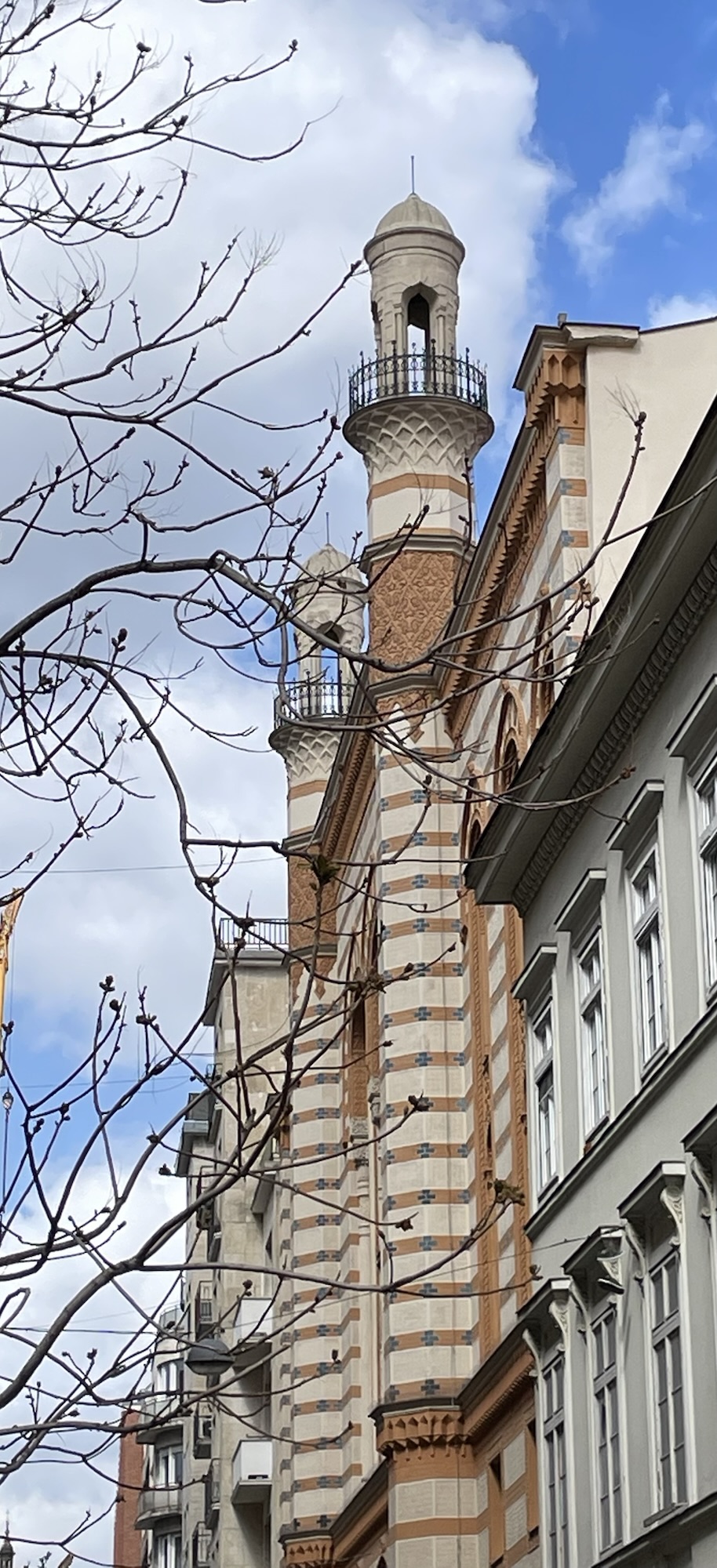
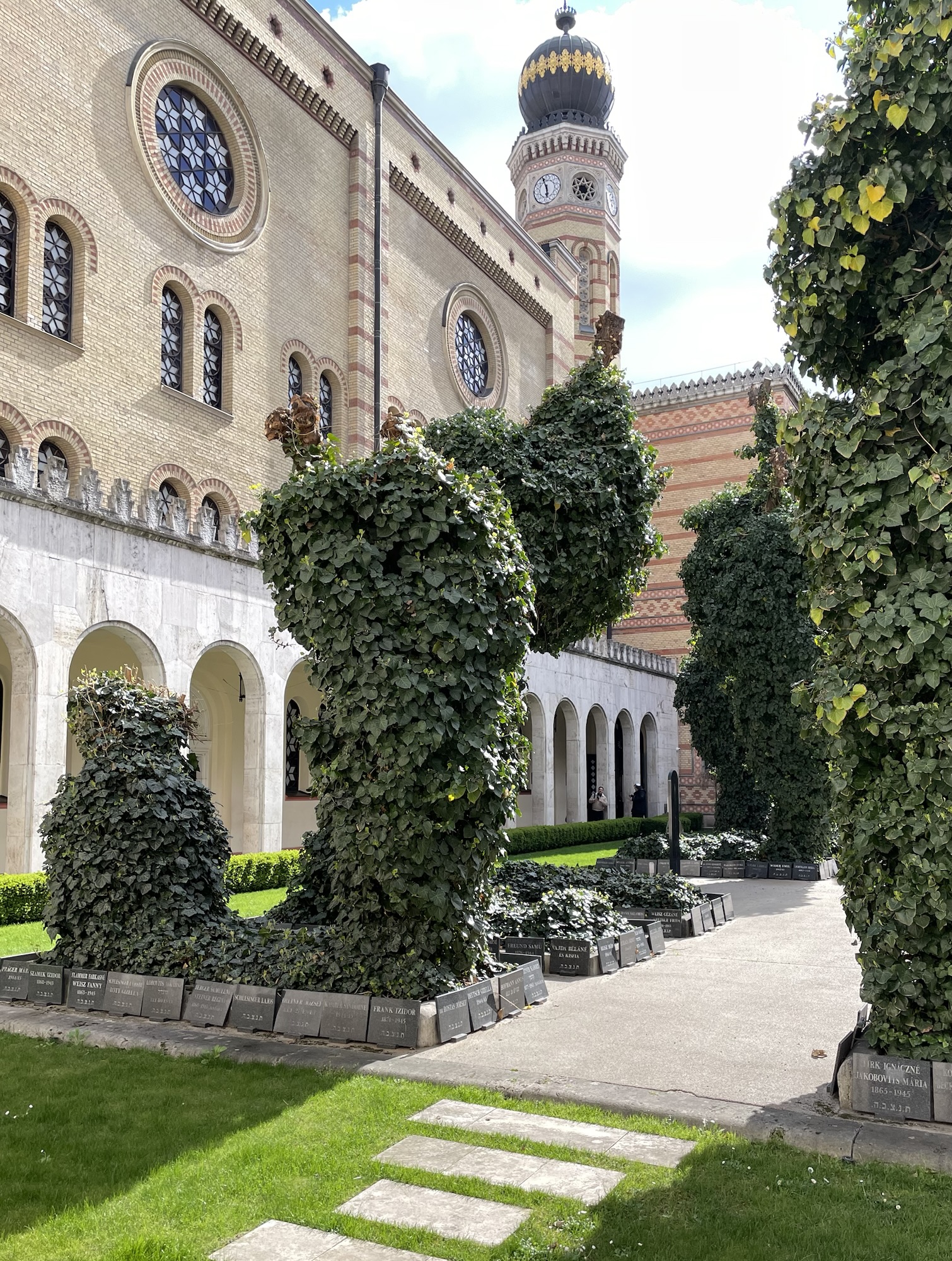
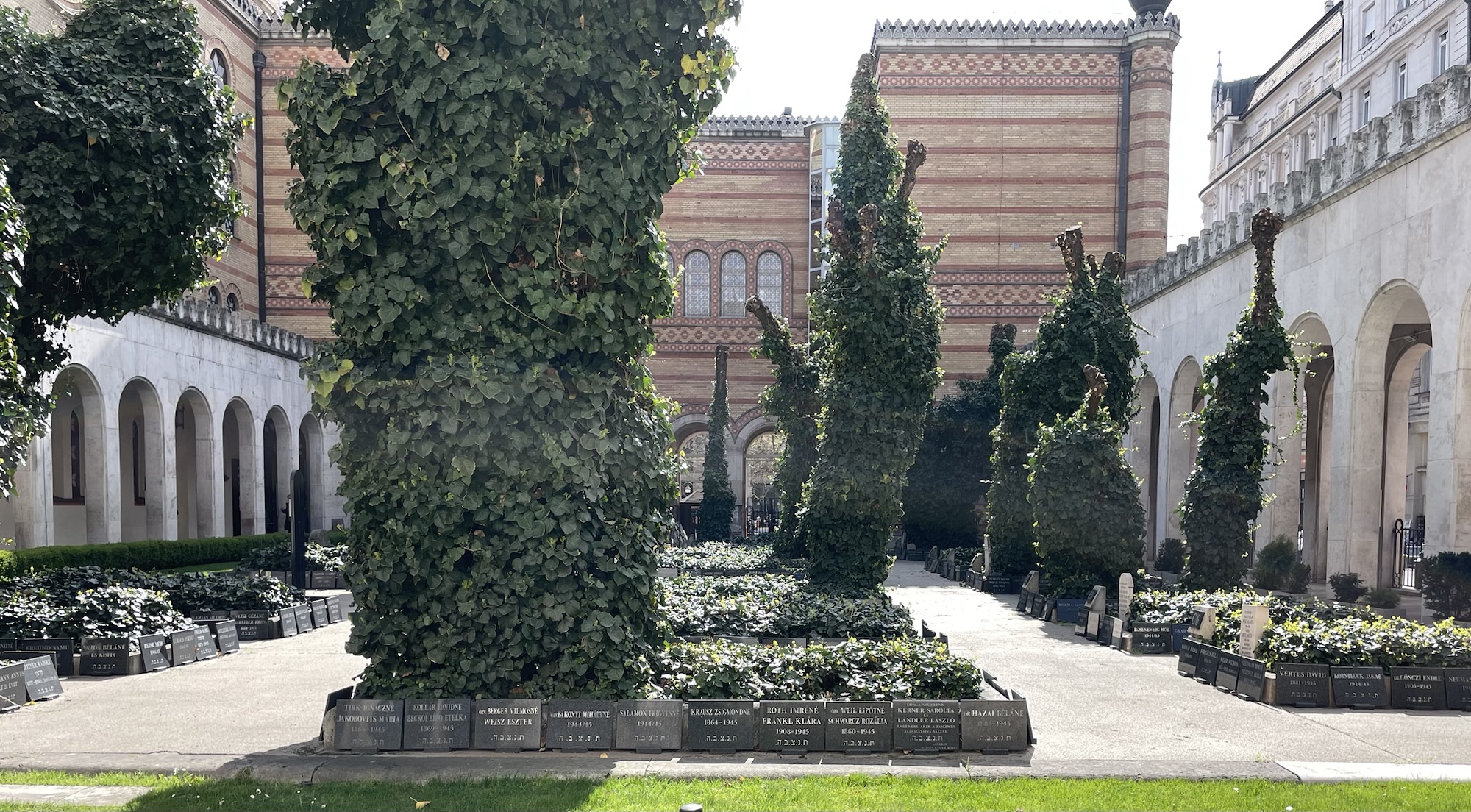
The Jewish quarter is known as the party district due to lots of “ruin bars” and a funky feel. It also has a lot of Jews and several large synagogues. One of these also has the Jewish Heritage Museum (somewhat boring) and a devastating photo exhibit about the demise of Budapests’s formerly large Jewish population at the very end of 1944, and the cemetery of mostly unidentified victims buried in perhaps a dozen mass graves ringed with the gravestones of the small number who were identified. Also a courtyard dedicated to Raoul Wallenberg and other gentile heroes who saved Jews from the Nazis. Worth seeing and facing but personally I couldn’t manage all of it and ended up leaving to cry in the synagogue.
Known and unknown buried together
Surprisingly interesting for me is the Robert Capa museum of his photography and his life. What a life. He was a very famous war photographer starting in the Spanish civil war through both world wars. He took a break of a few years, managing to squeeze in an affair with Ingmar Bergman and friendships with Steinbeck and other men of letters, then returned to the French Indochina war where he died in 1954 when he stepped on a land mine. It’s a grueling experience to see his work and read about his life and worth every minute. The Capa museum is on the edge of the Jewish Quarter, so if you are visiting I advise you to pace yourself.
Miscellany
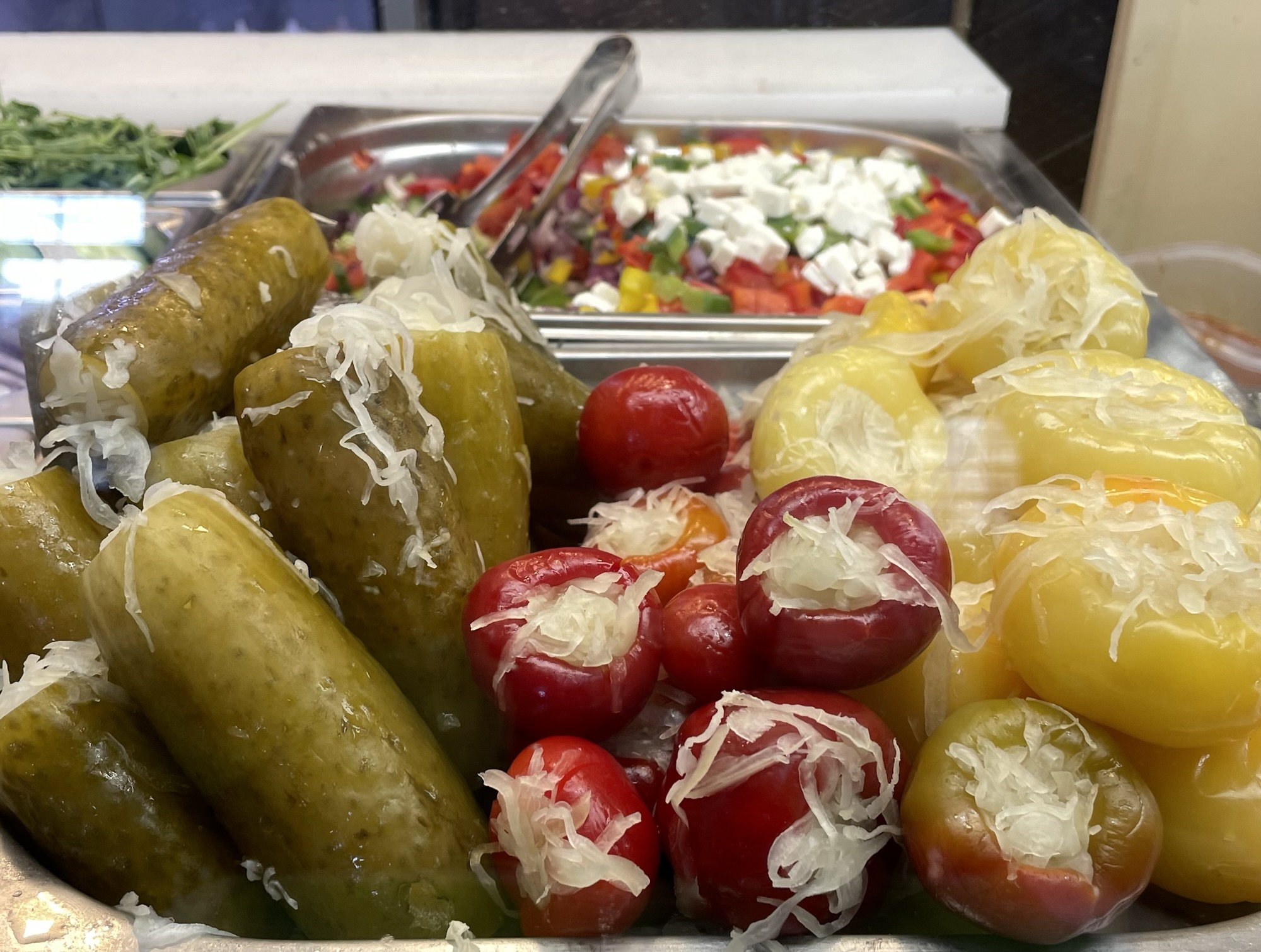
The enormous, somewhat touristy Central Market is worth a trip if only to buy eleventy-seven kinds of paprika. I also discovered the butchers are happy to sell you 4 little slices of salami to scarf down on the spot.
Hungarian specialty chocolatiers are amazing!
As you bus from center city outward the beautiful buildings gradually step down from maybe 7 stories to 5 to 4 to 2. All of the nouveau/deco eras, all gorgeous.
If you manage to learn even 3 words of Hungarian, especially thank you, you will always get a smile.
Most people who mention the government are scornful of Orban and sadly baffled by you-know-who. Oddly coincidental Netanyahu was landing for a visit as we landed Saturday.
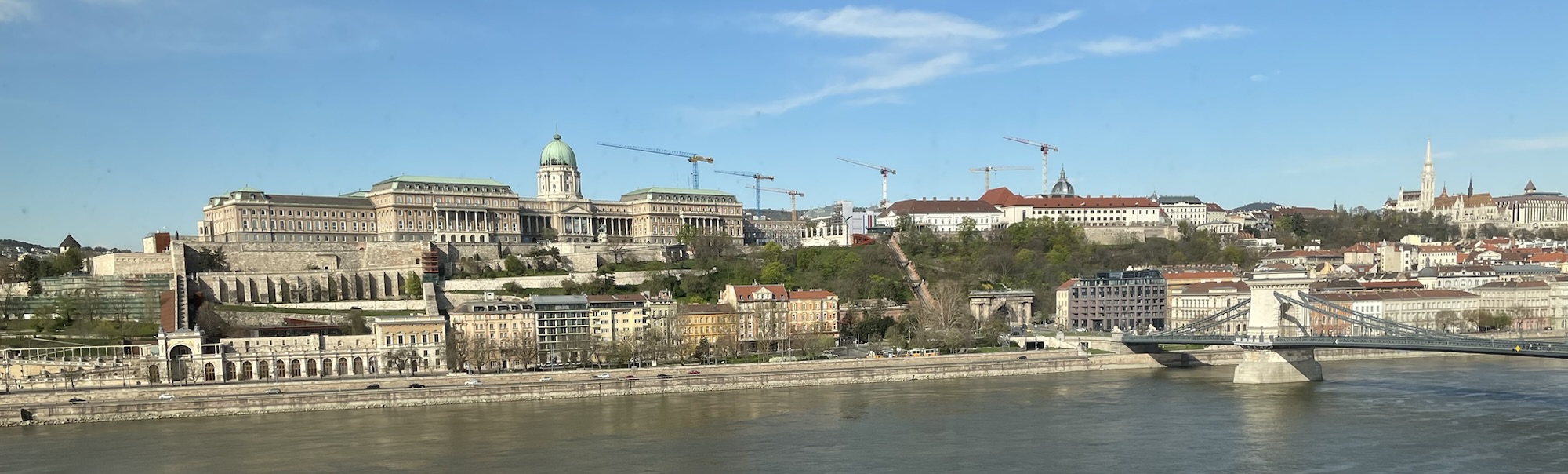
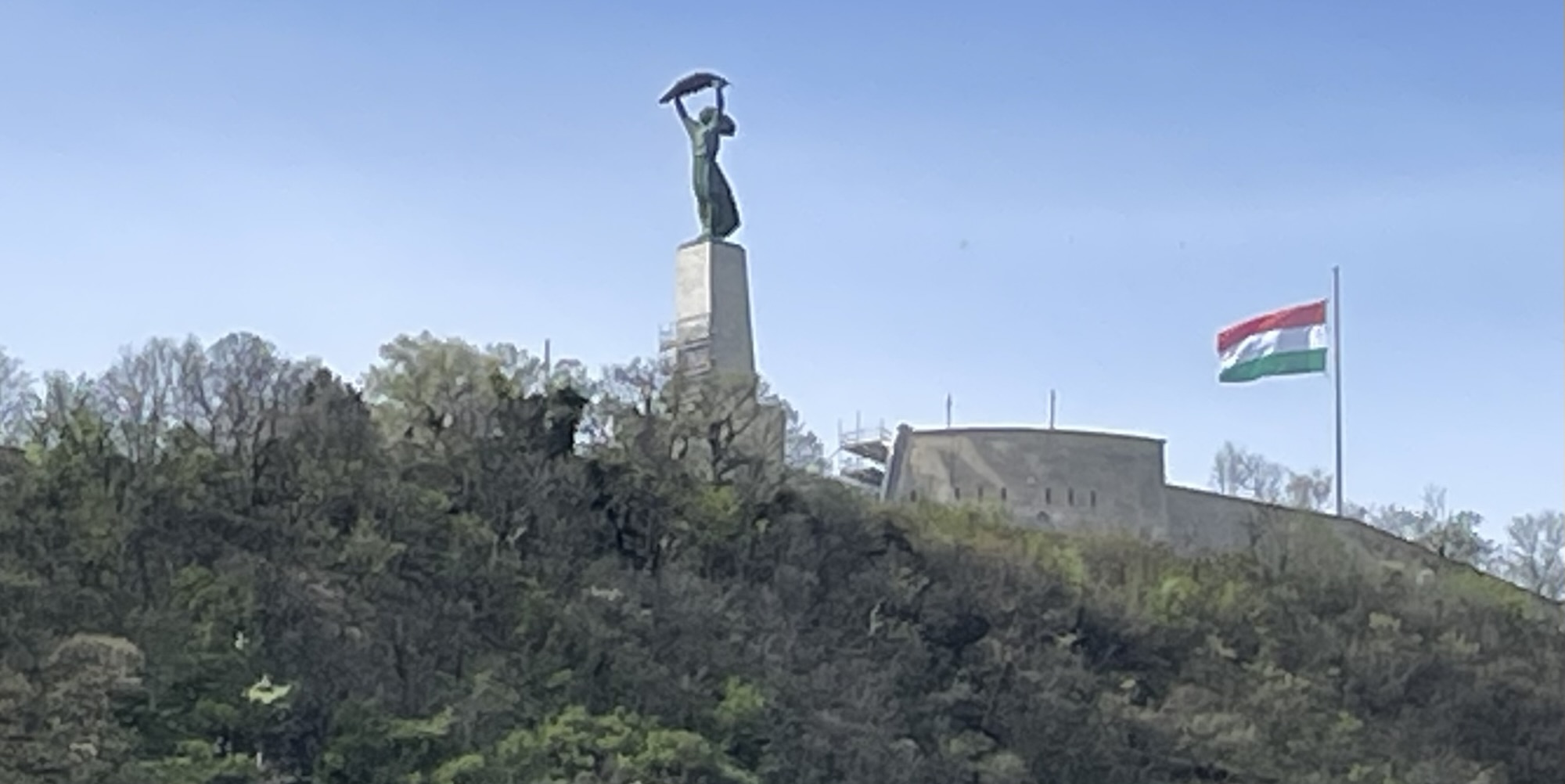
The photo below is a soviet era statue, very very large on the hill in Buda. After the velvet revolution it was draped in a white sheet for three days…our guide said it looked ghostly. Then the sheet was removed and it was renamed Lady of Liberty. Cool, huh?
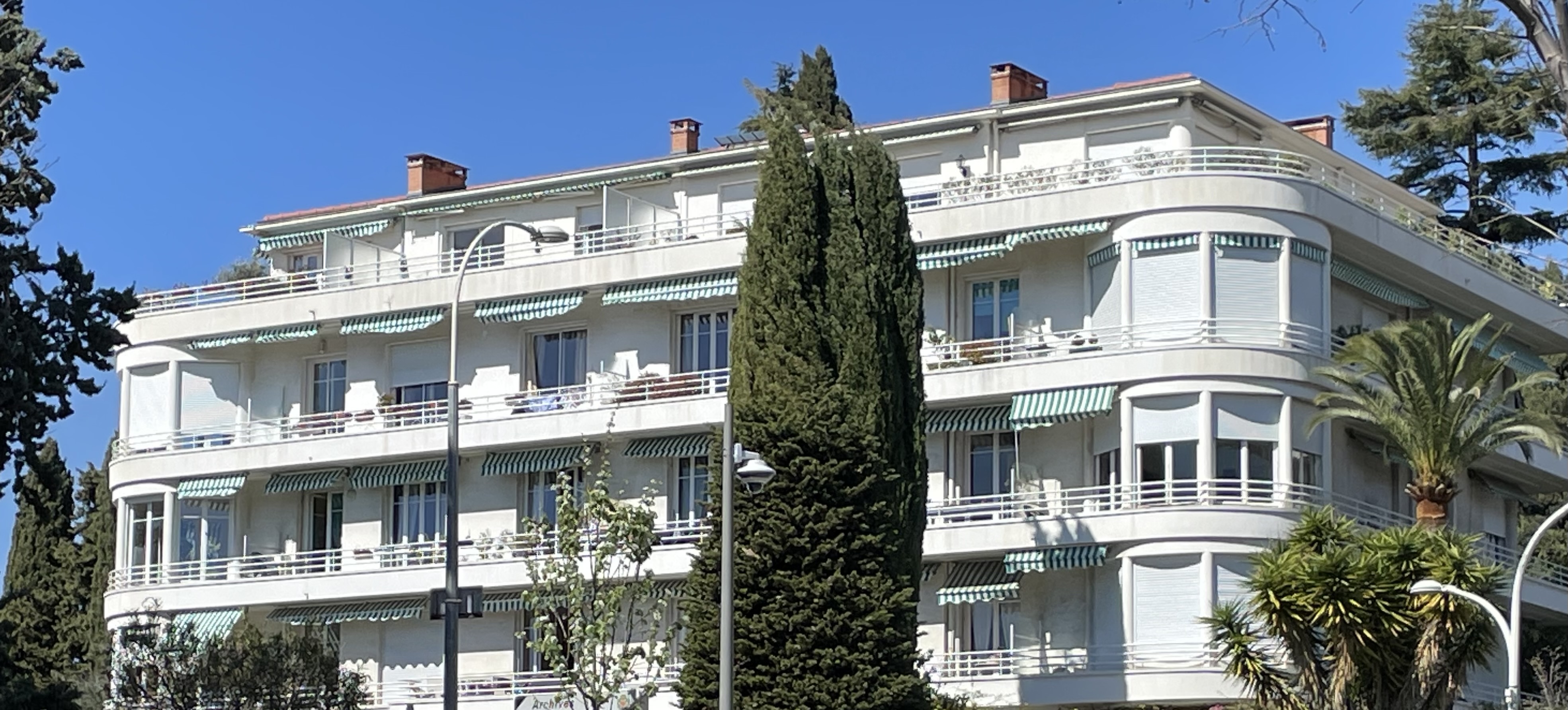
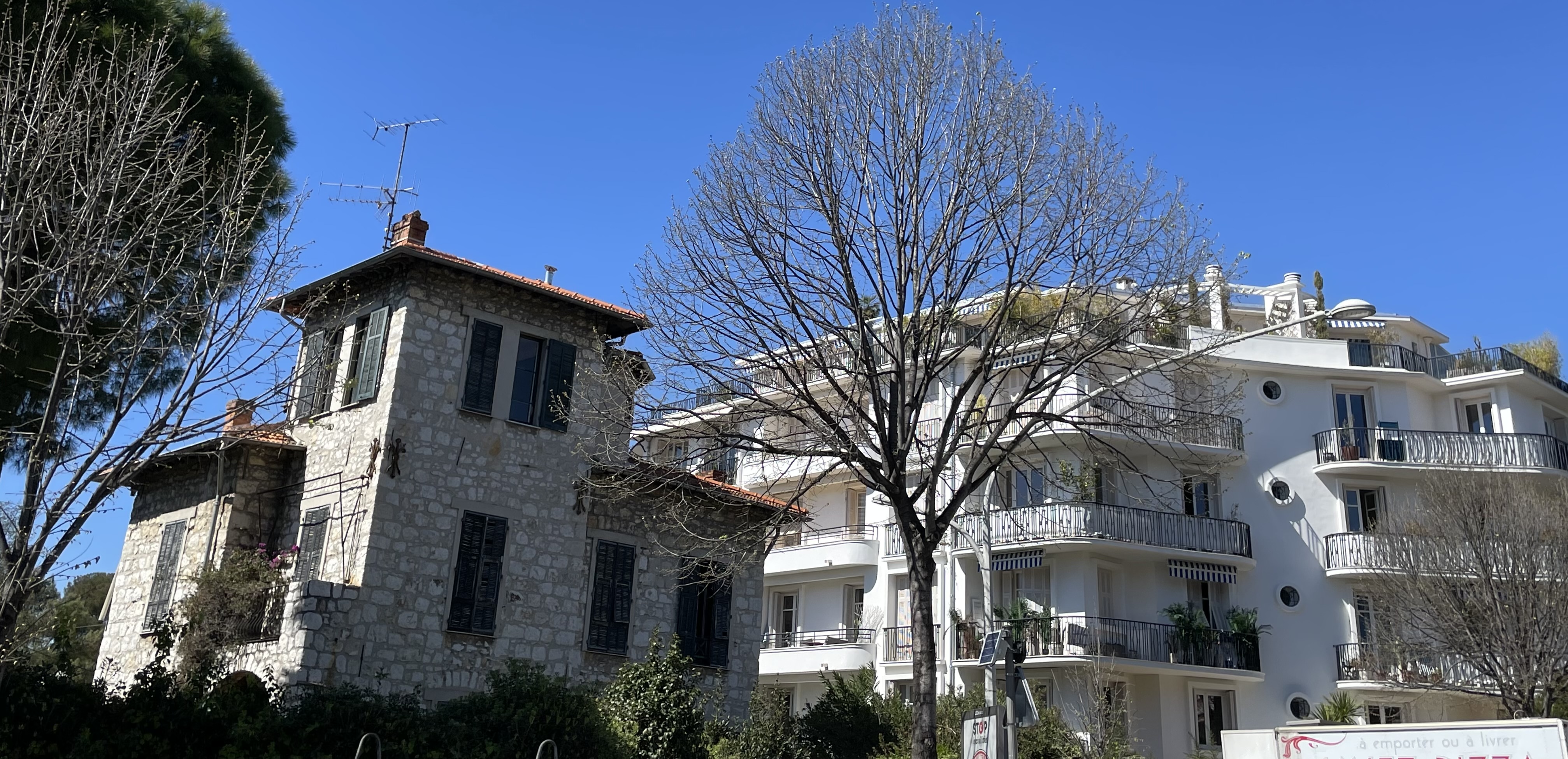
We arrived in Nice by car and I missed the exit so we ended up driving a bit more through the city up in the fancy hills. So very pretty—everything looks like it came right out of a movie in the 1960s. Large buildings with wrought iron balconies that would be complete with a young beautiful blond woman in a flowing scarf leaning over and calling “Jacques, I’ll be right down” as she scoops up her miniature poodle and ducks inside.
The view from my aunt’s apartment
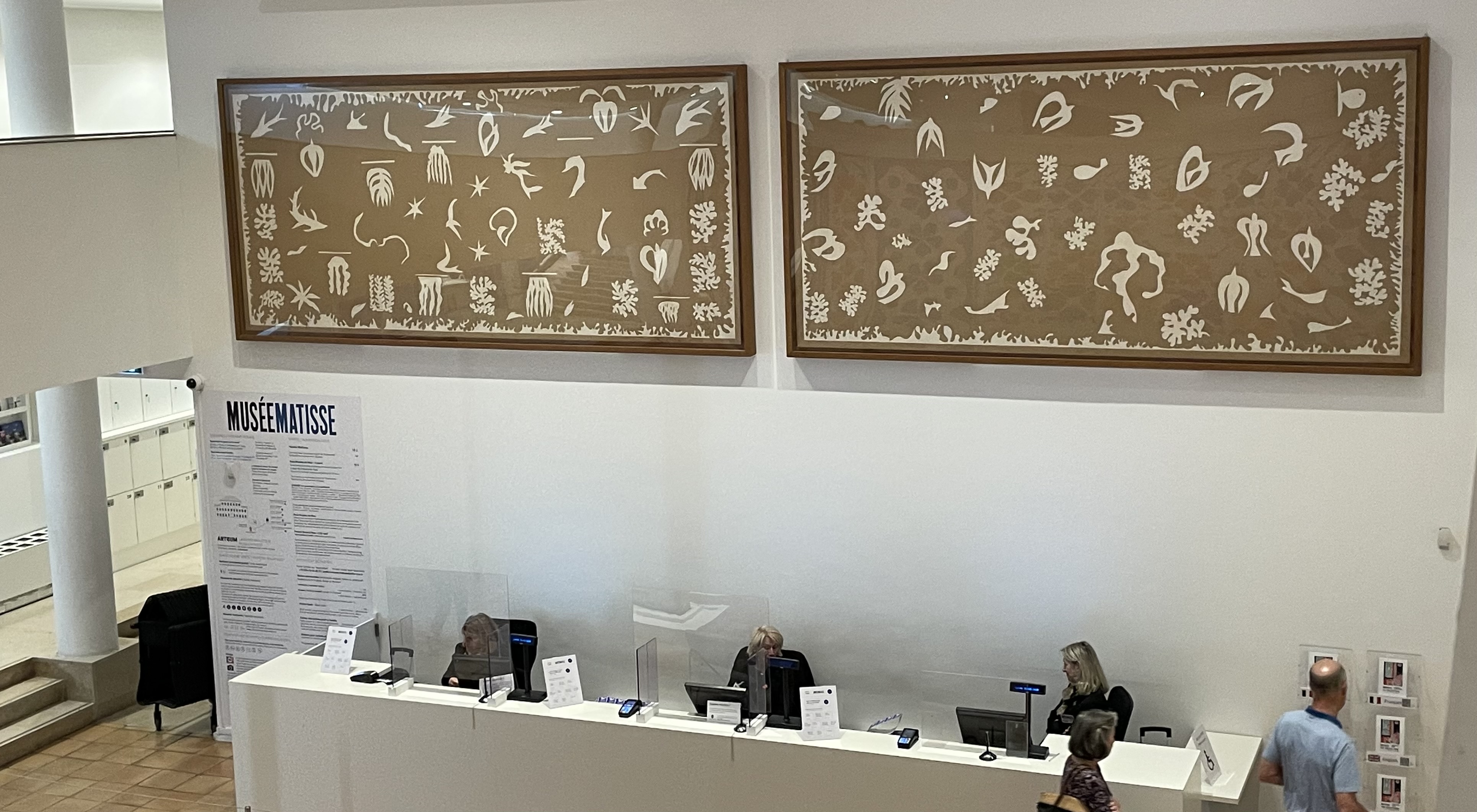
We didn’t see any blonds with poodles but we have enjoyed the lovely scenery, fantastic food, and the mix of old and new. It is by far the largest city of our trip so far and though I’m still going to hold out for a little apartment in Villeneuve, this place ain’t at all bad. Best of all, it has a museum devoted to Henri Matisse, my favorite painter, which I sopped up. Fortunately for David he is also a fan so he also enjoyed it and tolerates my over-the-top delight.
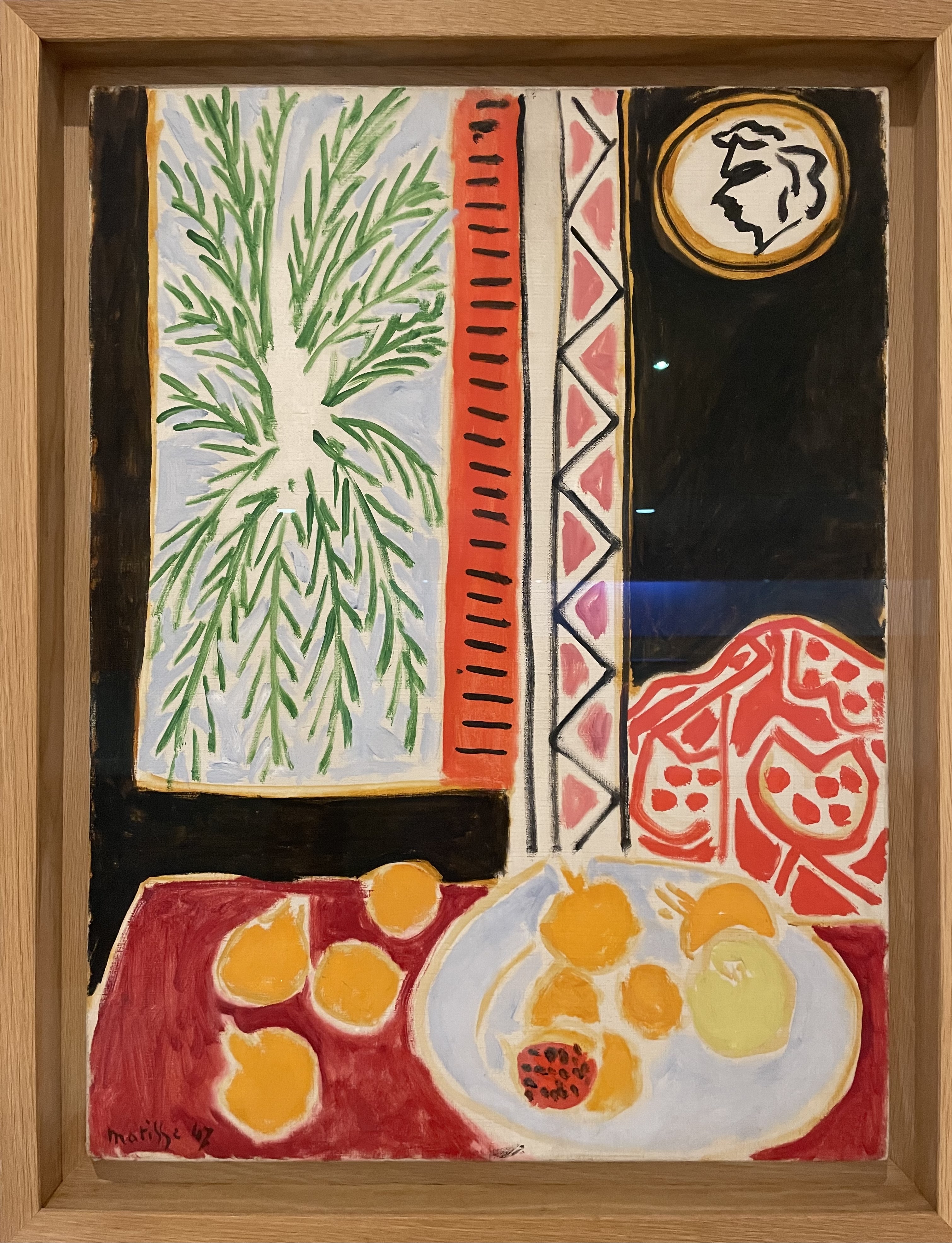
If he’d stuck with Impressionism he would have been grand!
The museum is here because Matisse and his family donated many many drawings (so many of those that they are rotated into public view), paintings, sculpture, photographs, lithographs, paper cutouts. To watch his progression as an artist from his very early self portrait drawings to his impressionist paintings to his exploration of techniques to transform the flat canvas to a multi-dimensional experience to his abstract cutouts…wow. I wonder if I could convince David to go back before we leave Saturday morning.
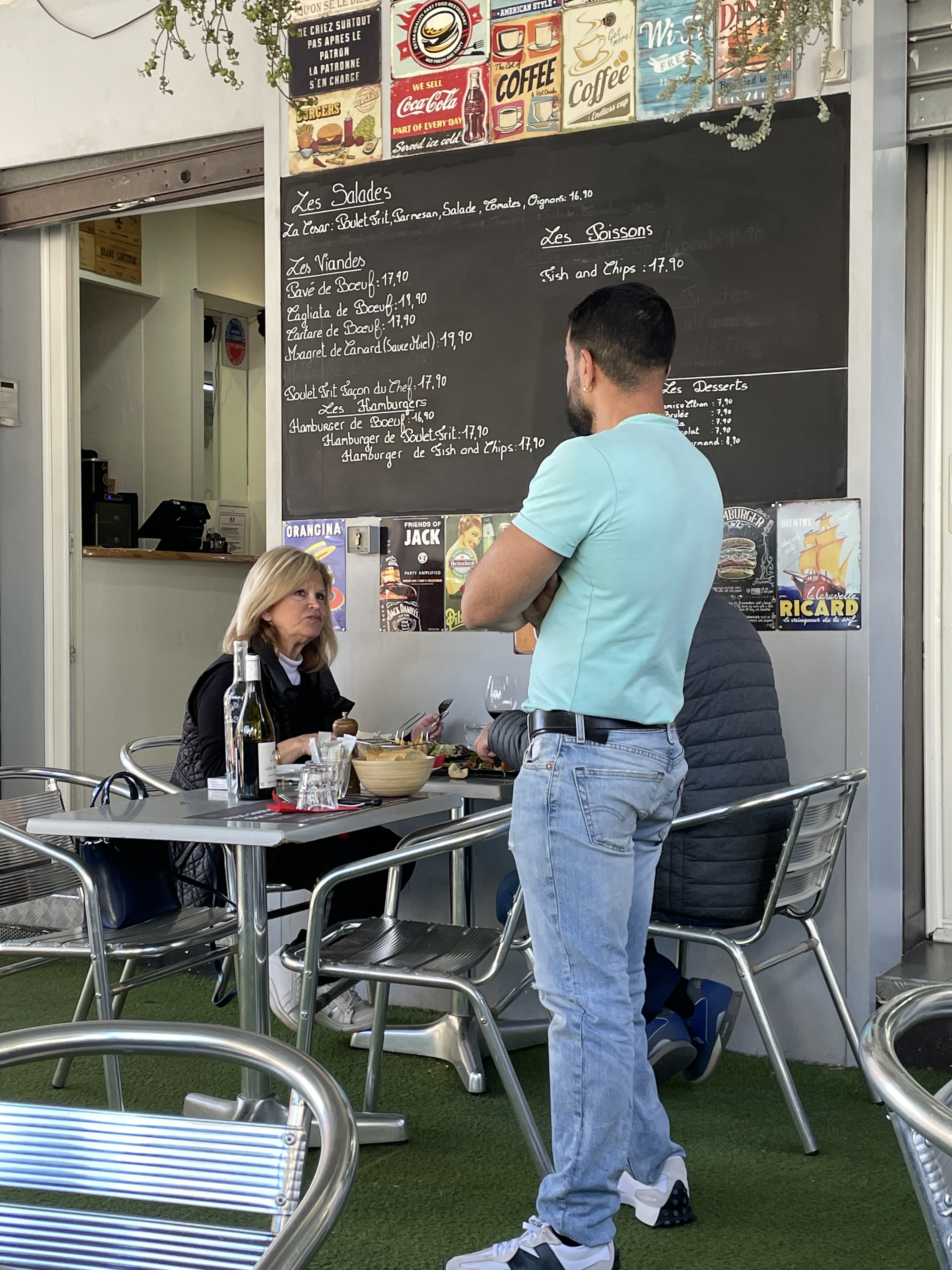
We left fully satisfied and walked down the hill to the Chagall Musee. En route I of course got hungry for lunch and we ducked into the only restaurant we passed and had an overwhelming fun lunch. I asked for the “Hamburger au poulet frite”, otherwise known as a fried chicken sandwich, which came with the predictably yummy fries. David had the “Cesar salade avec poulet frite” which looked delicious and which he finished down to the last little piece of lettuce.
Of course we were a bit tired by the time we got to the Chagall museum. We’ve seen plenty of Chagall, and David said he was not that into him because “too many goats.” So we had a contest—first one to see a goat wins. I won—third painting. We wandered the collection which is displayed in airy, spacious rooms and enjoyed it enough but our eyes couldn’t absorb any more and we walked home.
Home is my aunt’s enormous and comfortable four bedroom apartment in the thick of the commercial area, super convenient to the tram, to a large and fantastic Monoprix department store—though all we can vouch for is the overwhelming grocery, boulangerie, prepared food section. Every morning I take croissant orders and am there a bit after 8am, selecting the same assortment (butter croissants for me and the two other friends of my aunt spending the week here; a GIANT pain chocolat for David, and the ‘round thing with raisins’ for my aunt). After three days of buying more or less the same things from the same somewhat dour woman, this morning I said “A demain!” (See you in the morning!) and got a big smile and “Oui! A demain!” I think she might be tired, not dour.
After the museum overload we took the tram, right outside the apartment, to Vieux Ville, the old city. It is not separated from the rest of the city—no wall or gate that we saw—but it reminded us of the old cities and towns we’ve visited thus far. A few touristy shops and restaurants, a crowded plaza outside the old Cathedrale, but the same delightful narrow back streets and assortment of enticing places to eat lunch. We ended up at Bistro Antoine and oh oh oh. When I commented to the woman at the next table (she’s from Cyprus) how delicious our lunch was she said well of course, it’s been recognized under some designation or other by Michelin. We left so happy and full, but managed to eat the three beignets we had picked up at the open market. I mean, you cannot let fresh baked goods go uneaten.
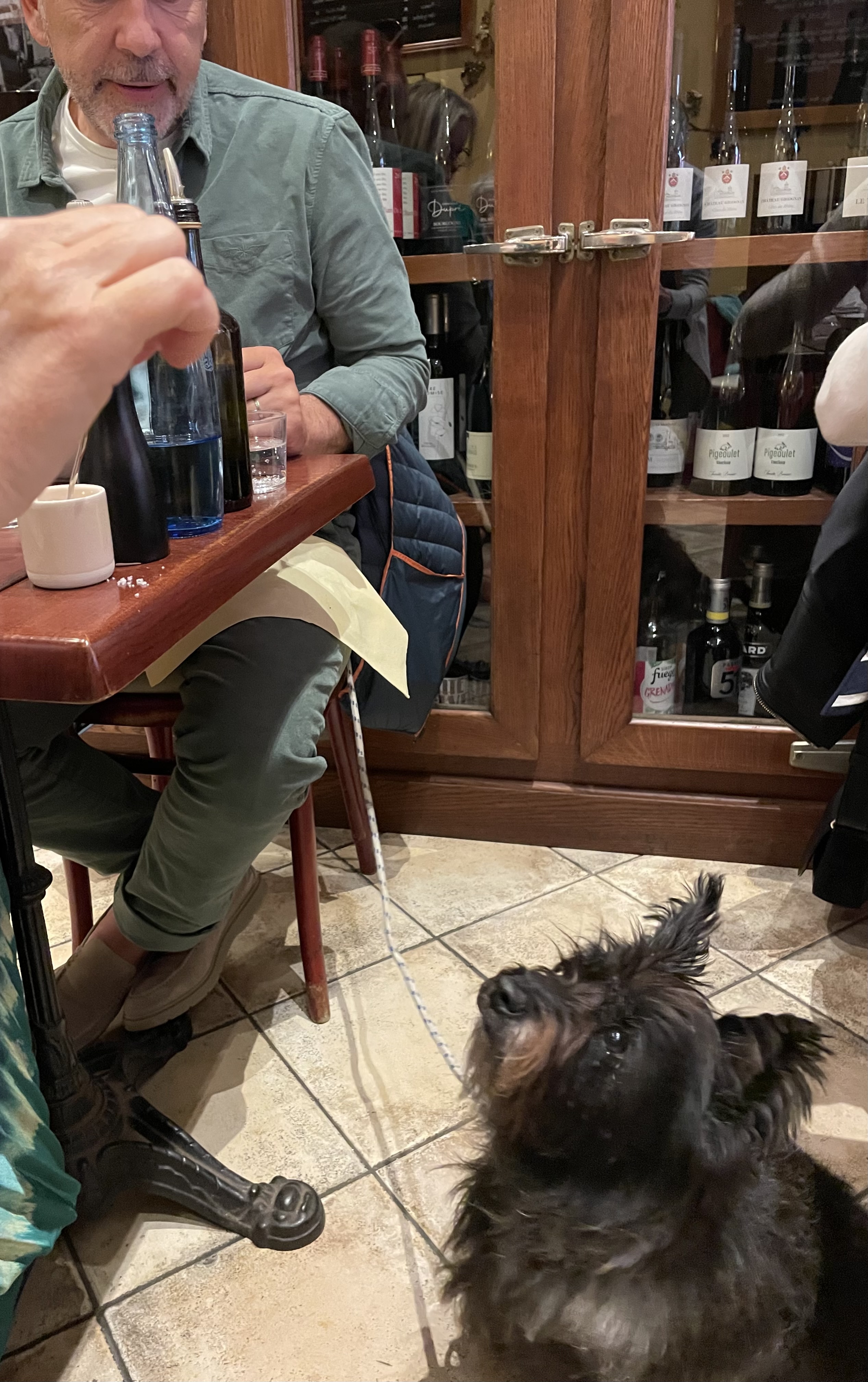
Dogs in restaurants…why not?In Nice, so of course nicoise olives.Indescribable lemon (the white stuff) that the waiter said was not a gelatin but it was smooth as silk.I had to have tartare one more time!
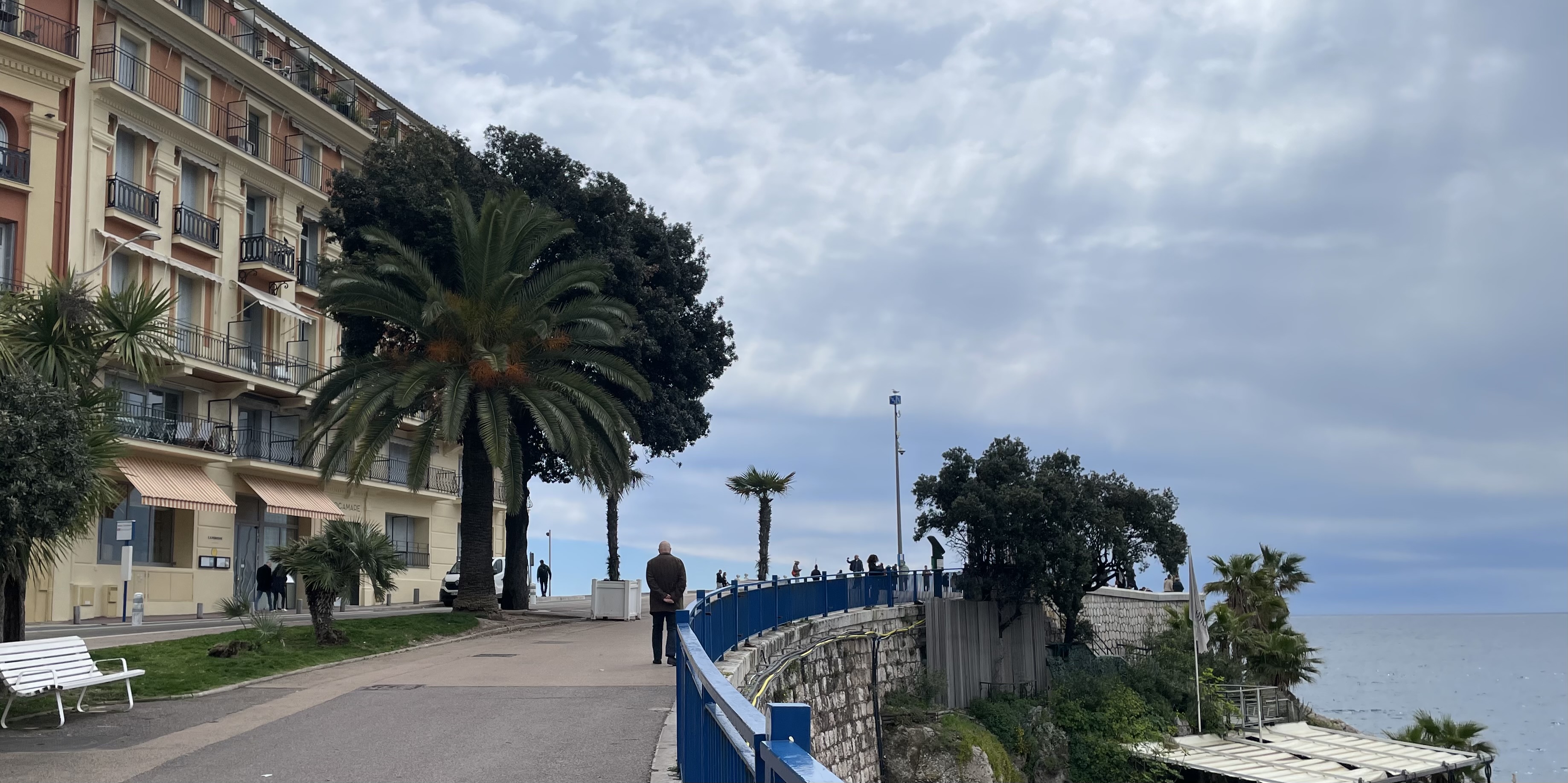
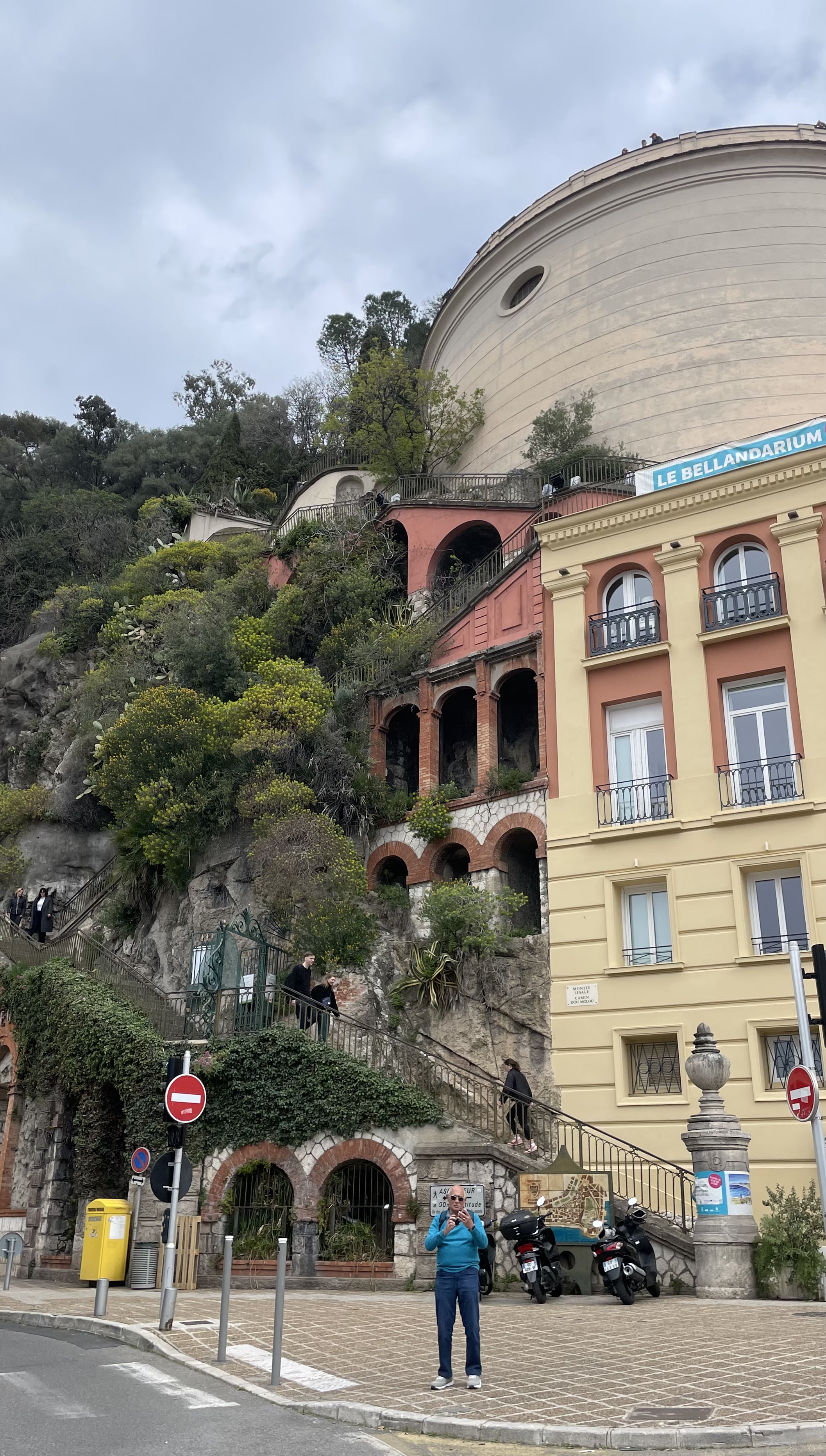
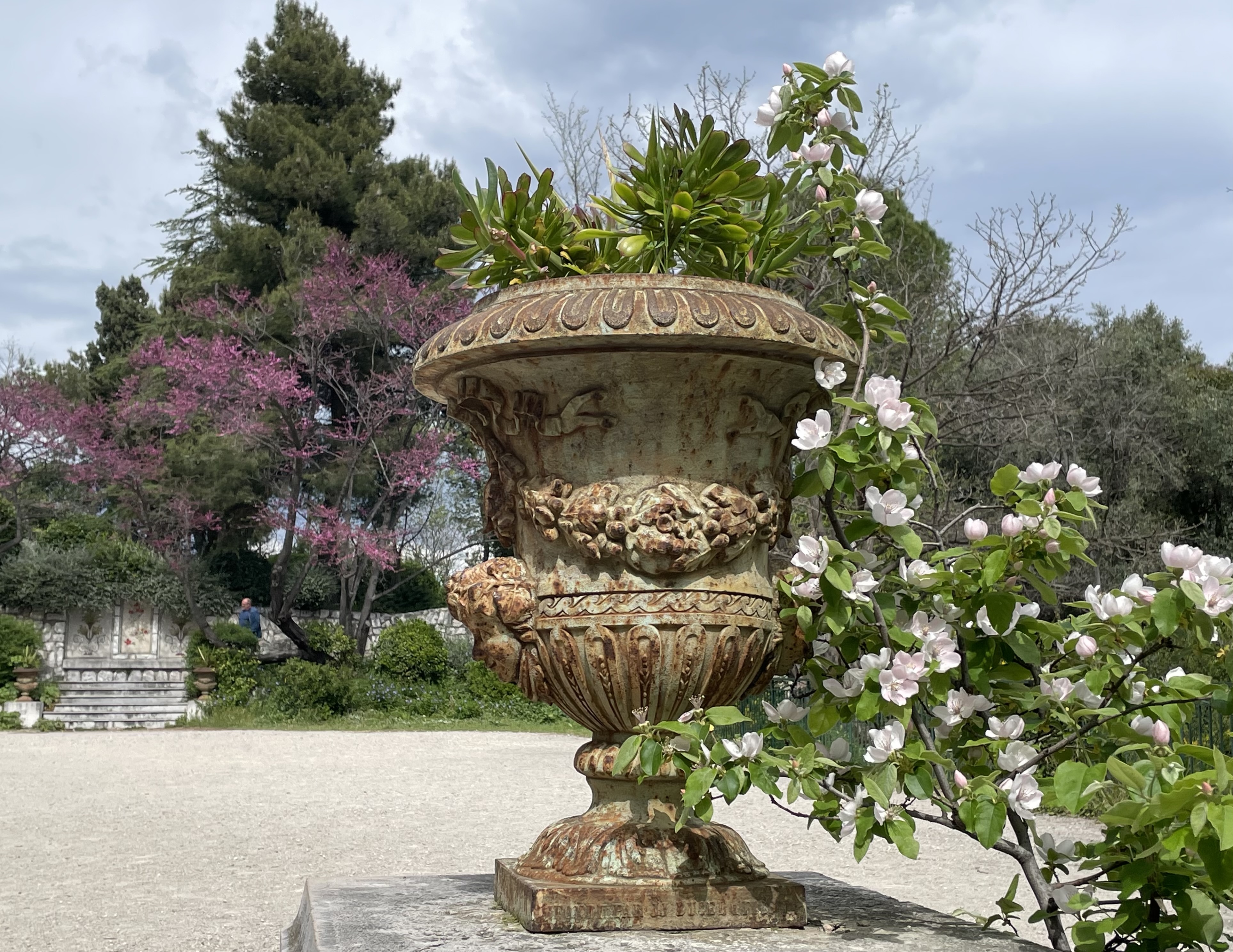
We walked along the waterfront a block or two and took the ascensuer (elevator) up to the top of the Colline de Chateau, walked around the chateau ruins, wandered the gardens (we wander a lot!), explored the Jewish cemetery, then walked back down super tired to the tram and hopped on. In a few minutes we were home.
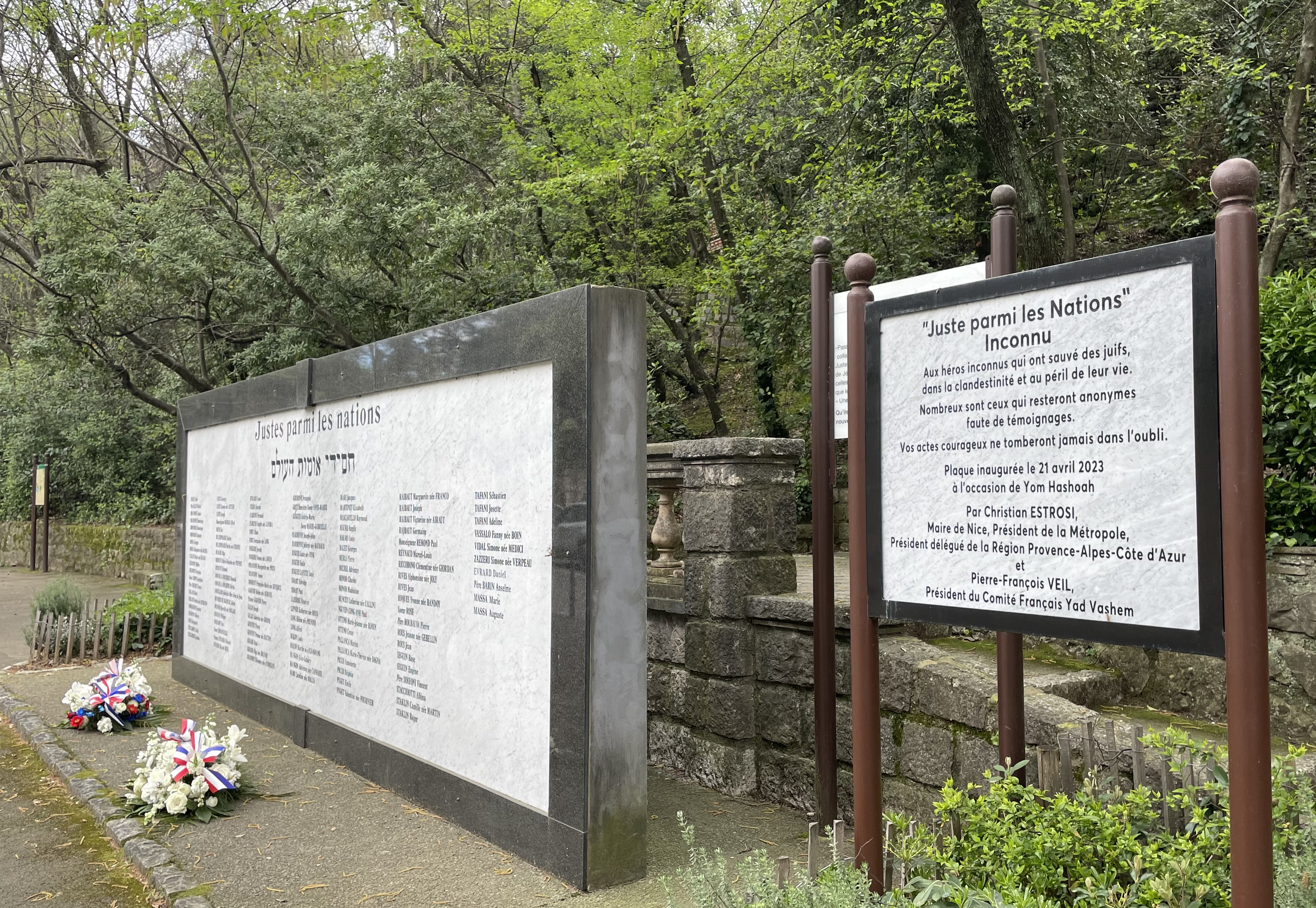
In this lovely hilltop garden is a memorial to those who saved Jews during WWII…”that their courageous acts will never be forgotten.”
We love museums. History and art are our favorites, and everywhere we go we spend hours in museums. Really. They are restful, mind-expanding, educational, and for us just plain fun.
I will now tell you about the museums of Avignon and tomorrow will add a bit about Villeneuve-Lez-Avignon. There are some great ones.
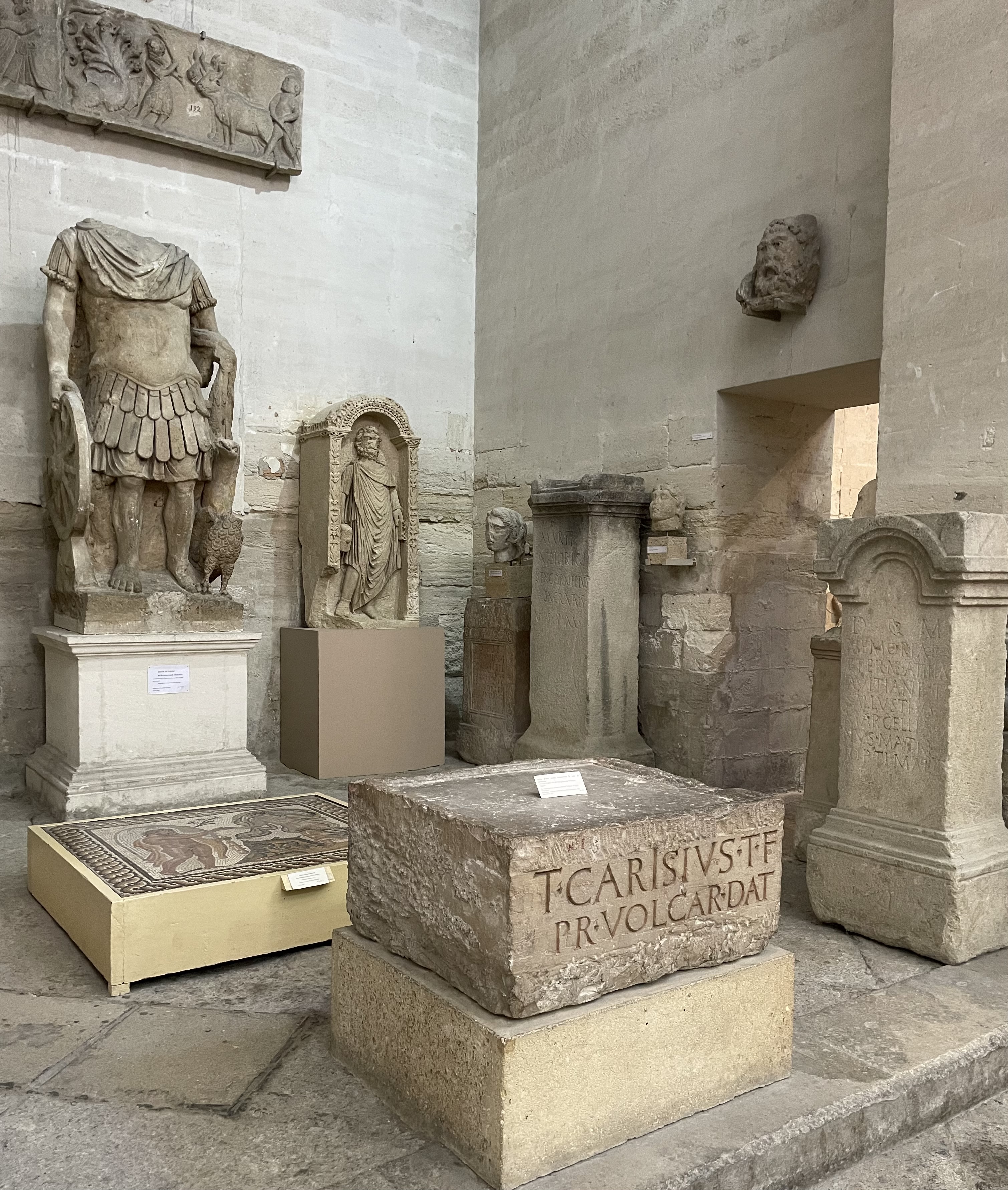
Our first day in Avignon we stopped at the Office de Tourisme and discovered there are four free museums—we visited three of them that first day. David and I are into Roman history and we had several day trips we had planned to see Roman ruins. And here we find out that there is a museum of Roman artifacts, Lapidaire Musee, a few doors from the Office de Tourisme. And free! We headed right over there and wow, what a lovely experience if you like Roman stuff.
A single soaring room filled, without feeling crowded, with all these amazing items that were excavated in Avignon, most in the mid 1800s. Best of all as you can see nothing is behind a barrier (except glassware and little ceramics) so you can walk right up and see things close. There was another couple in there with us and I said offhand to the woman “Incroyable, oui?” She nods yes and asks me if I am Spanish—doubtless due to my lousy accent. I say I do speak Spanish thinking that is what she speaks. She asks me where in Spain I am from. I say California, and ask her if SHE is from Spain. No, they are from France. Then we have a mish mash conversation, a melange of French and Spanish. We smile and laugh, then I hear her explaining to her husband what THAT was all about. Needless to say through this first week my French has come more easily and my accent has improved tremendously.
Anyway, get a load of this Roman mosaic. So beautiful.
Next we headed uphill to the Palais de Papes and across the plaza to the Musee Petit Palais. This is a relatively small museum, free, with an extensive collection of medieval paintings, virtually all religious as that’s what artists were expected to paint. The docents were wonderful (yes, I had questions) and were able to follow my French to my delight. But the best part for me was the ground floor exhibit that detailed what the profession of painter entailed in the Middle Ages. The artist who led an atelier with many apprentices was not just an artist and painter. He had to be a project manager, a teacher, a bit of a chemist—mixing colors was an art in itself in addition to a science—and a salesman. Of course! But I had never thought about it and led me to think differently about what art was all about in those days.
Finally, although we were warned it was boring we went inside the Palais de Papes. It is enormous..and we loved it. When you check in you get a tablet that, when aimed at a stand in each room, shows the room as historians believe it looked like in the day. Very cool, and surprising how walls, beams and ceilings were painted as well as the array of furniture. The tablet had loads of information about each room, how it was used, in some cases what it meant. When you get to the chambre de pape (the pope’s bedroom) the uncovered and restored tiles that cover the floor are breathtaking—and they let you walk on them! So neat. We failed to take any pictures inside so you’ll have to visit yourself. It is definitely NOT boring.















































 Inescapably Rational