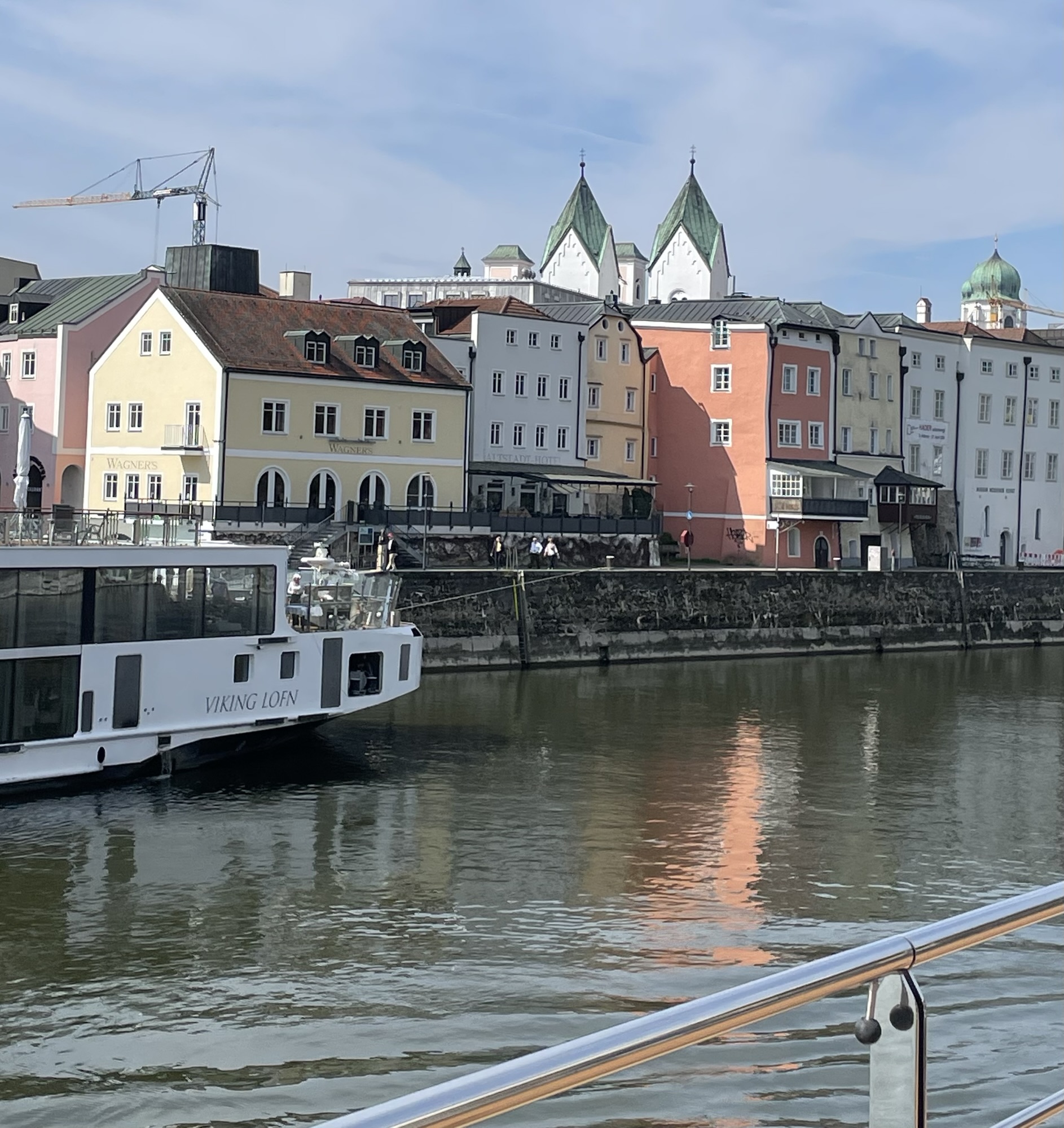
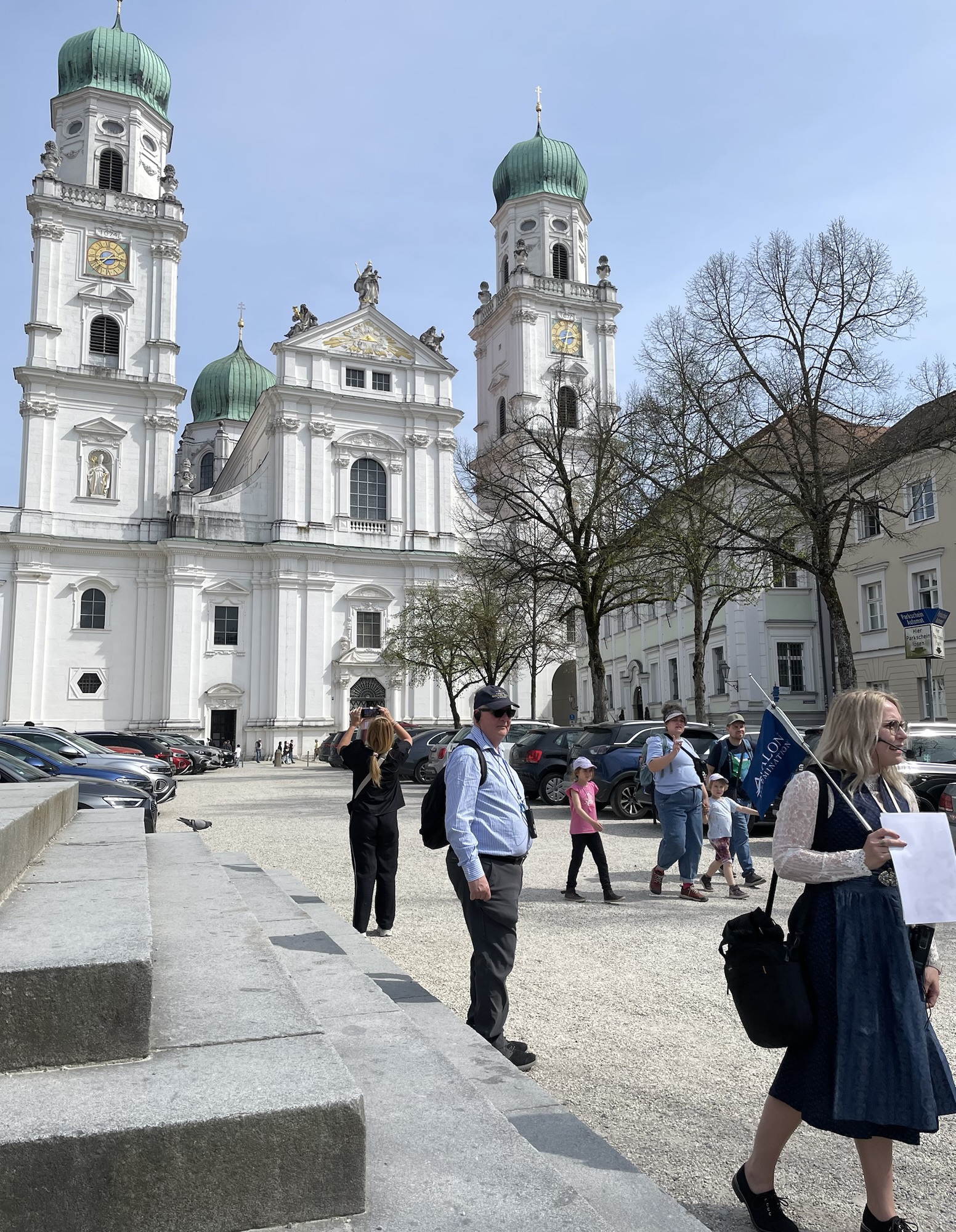
Our time on the boat was suddenly winding down and we were looking forward to being on our own again. This last stop in Passau was just half a day, and given the size of the old town along the river that seemed enough.
We had an hour and a half, maybe, of a delightful tour. I am struck by how very local our guides have been…I grew up here, went to university here, now have a job where I talk about a place I know so well and love. Our guide, a young woman dressed in dirndl (and sneakers), explained the meaning of the placement of the bow on the overskirt. Married (or unavailable), widowed (or a waitress!), open to a relationship, and one other I cannot recall. Handy, I suppose.
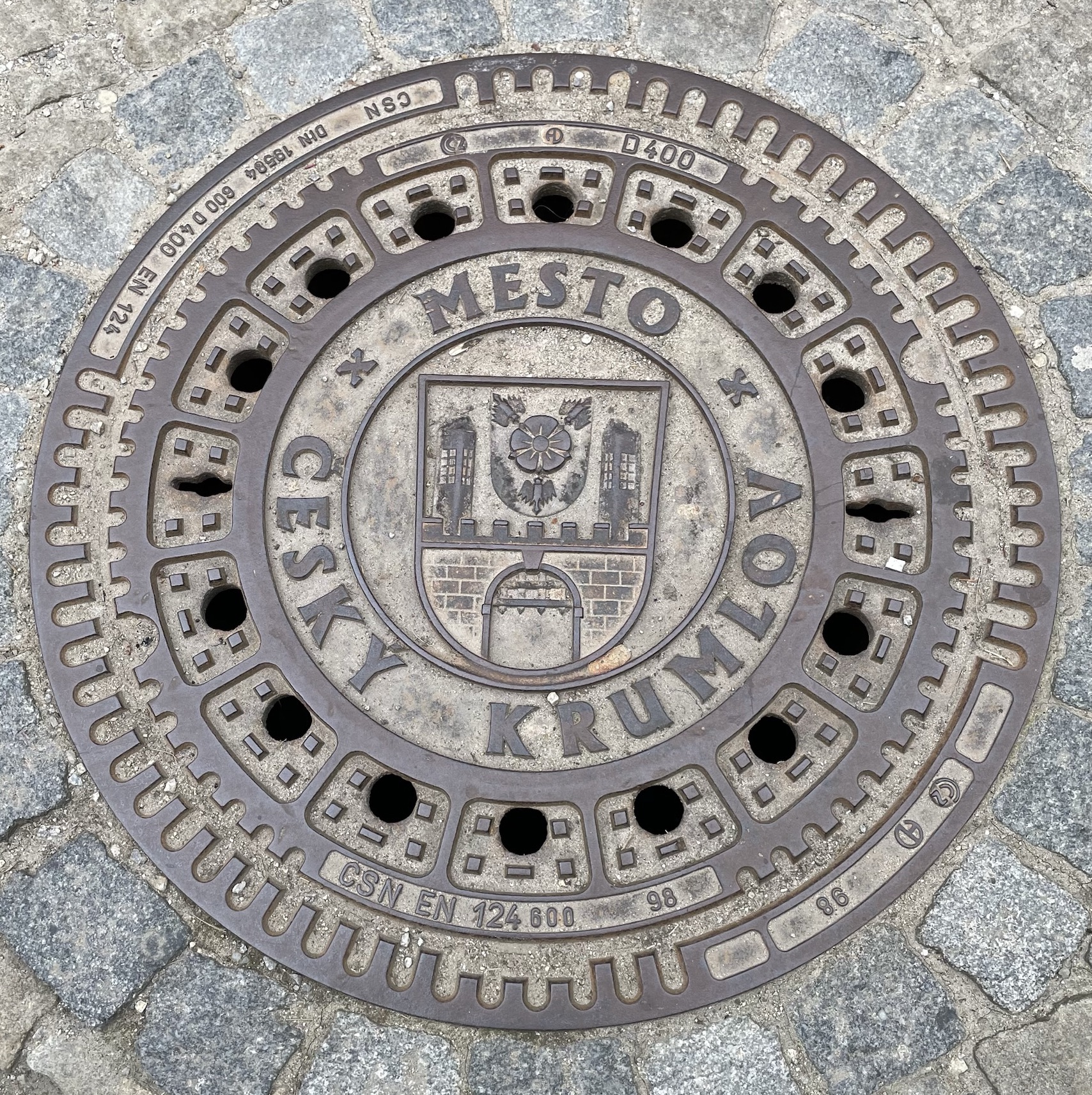
The tiny peninsula of the old town is as picturesque as most every other small town we have visited. Because of the surrounding three rivers, though, serious floods have been a problem for centuries. Currently the part of the city that is especially vulnerable is where artists and other artistic folks live, and of course they are loathe to move. As in Cesky Krumlov the high water marks are unimaginable. In 2013 the water rose 42 feet.
After our tour David wanted to walk down to the tip of the peninsula while I hung out on the boat. It was getting hot. Several hours later the boat moved on to Vilshofen where we disembarked the next morning and hopped on the train to Munich.
When the boat arrived in Linz we saw nothing of the town as we were hustled aboard comfy touring buses. One group headed to Salzburg, Austria while we were off to Cesky Krumlov, a medieval town across the border in the Czech Republic. We had little memory of how we had made the decision and even less about our destination. It turned out just fine due to excellent guides (one on the bus, one in the town), a yummy lunch, and a pleasant afternoon walking around a very small old town.
The drive through Austrian farmland…rolling green hills, immaculate farms and small villages…took two hours that seemed much shorter. Our guide was a great storyteller and taught us a lot about the days of soviets right across the border and the evolving relationship between Austria and the Czech Republic.
About 45 minutes into the drive we passed Hallstatt, a tiny farming village, very pretty. We were through it in a blink. Our guide explained that a Chinese official, some years ago, had been touring the area and fell in love with the town. He returned to China and oversaw the building of a replica village that, unlike other European town replicas in China which are basically housing developments, is more or less a museum (and apparently a wedding destination). Well, it has generated a steady stream of Chinese tourists who come to see the real thing. Unfortunately like idiotic tourists everywhere they fail to distinguish between a real live place with real live people living real lives, and a museum. There are many tales of Chinese walking into houses assuming they are museums as in the Chinese replica. She told a personal version—a friend of hers whose husband was startled in the bathroom—and the bus driver who lives in Hallstatt was nodding along. It seemed far fetched, right? And yet we saw tens of Chinese tourists in nearby Cesky Krumlov, so it was believable.
Our guide also explained why there were so many Vietnamese restaurants across the border. During the Viet Nam war when North Viet Nam was a more rigid communist country it was much easier for North Vietnamese citizens to travel abroad to other communist countries and places like communist Czechoslovakia welcomed the tourists…and many stayed.
A happy result of the Austrian-Soviet Czech border is the wildlife-rich two kilometer wide swath that the soviets had enforced to keep people from crossing over to Austria. It is now a protected green belt.
We had been instructed multiple times that we must have our passports for this particular outing, and we did of course, but at no time were they of any use. I guess it´s a just-in-case deal but we were a bit disappointed that we crossed the border and back with nary a border guard interaction.
It is truly lovely country. Our guide pointed out the tiny “dachas” that had been built in soviet times and were used for free by Czech citizens. Now they have been built out, added onto, and are year round homes for the most part. They are cute and Russian-looking.
Although it looks like an aqueduct it is a bridge between two parts of the castle.
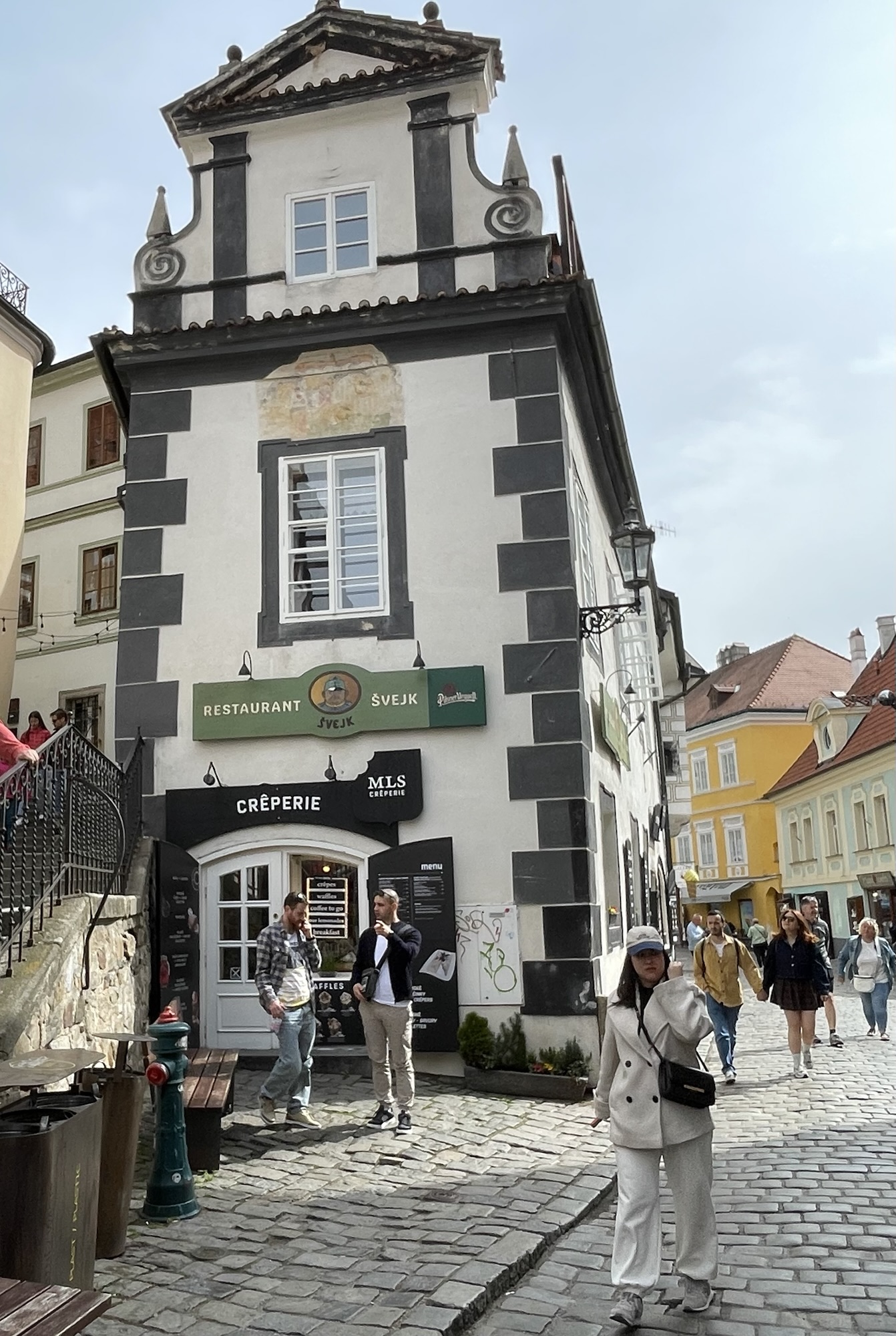
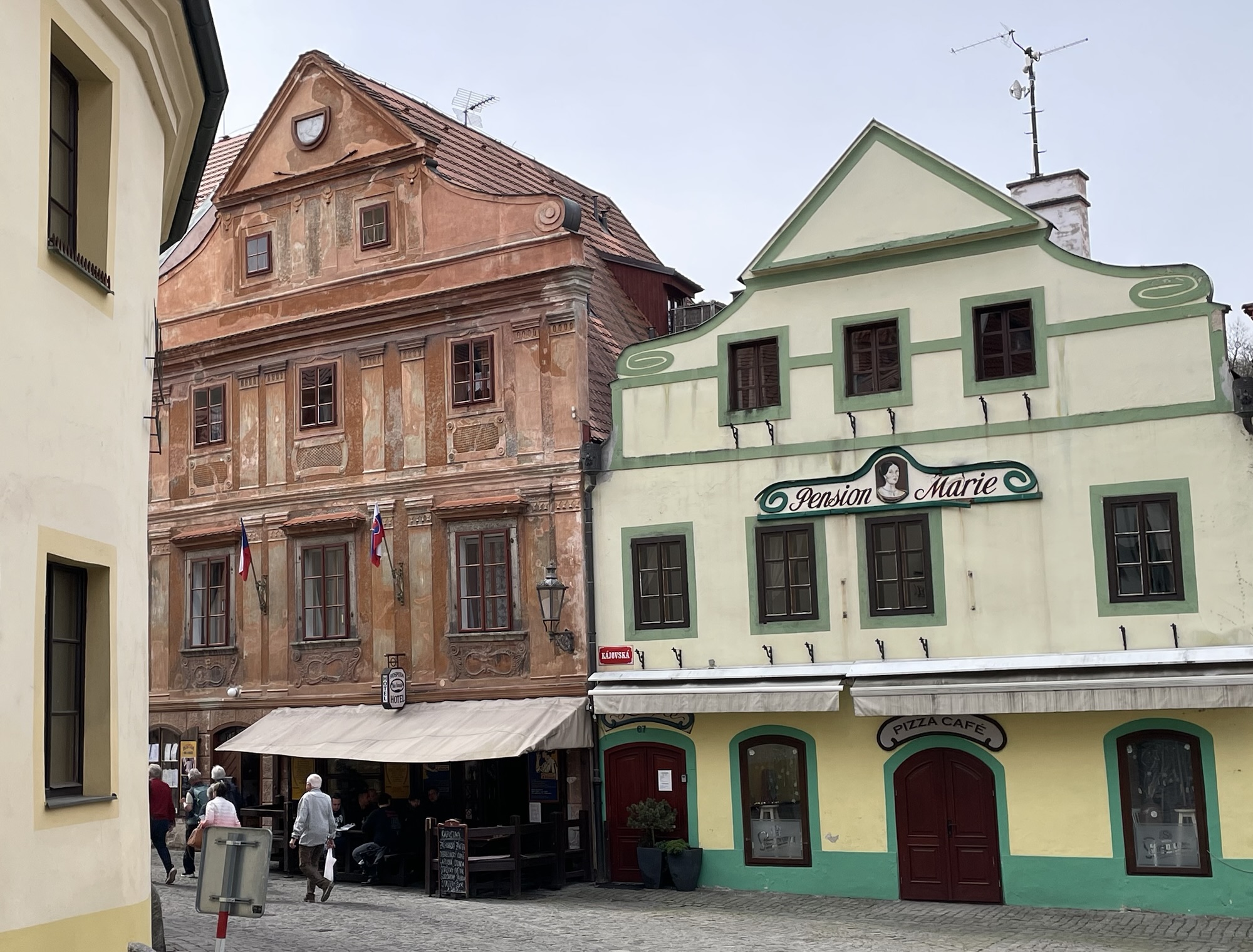
Suddenly we arrived and we were out of the bus walking into the town. It is fairy-tale like, with twisty streets, unbelievably uneven cobblestones, a small river running through, and a bit of an artsy feeling.
Our town guide was an extremely droll man who made the driest jokes among a densely informative spiel. It was a lot of fun. He also told us where to eat, where to walk…and we had several hours to explore. One of their local products is pencils of all things, because of nearby graphite mines. Makes sense. After the tour and a delicious lunch David and I walked literally the entire town. Then back on the bus for a gorgeous drive into Linz and our comfortable boat.
Such a pretty restaurant with fantastic food. The slices on my plate are mosaic bread dumplings. I was sure it was too much food but ate it all.
One of the unique architectural features on many buildings is a 3-D effect of the stucco (?) by scratching the surface to make it seem faceted. Hard to explain! Here is an example.
A now deceased sculpter left his mark all over the town. He made a lot of things that look like over sized fat fingers and hands.
A bench next to the river. Door to an art supply store.
It is a fun, funny, friendly and pretty little town. Glad we went!
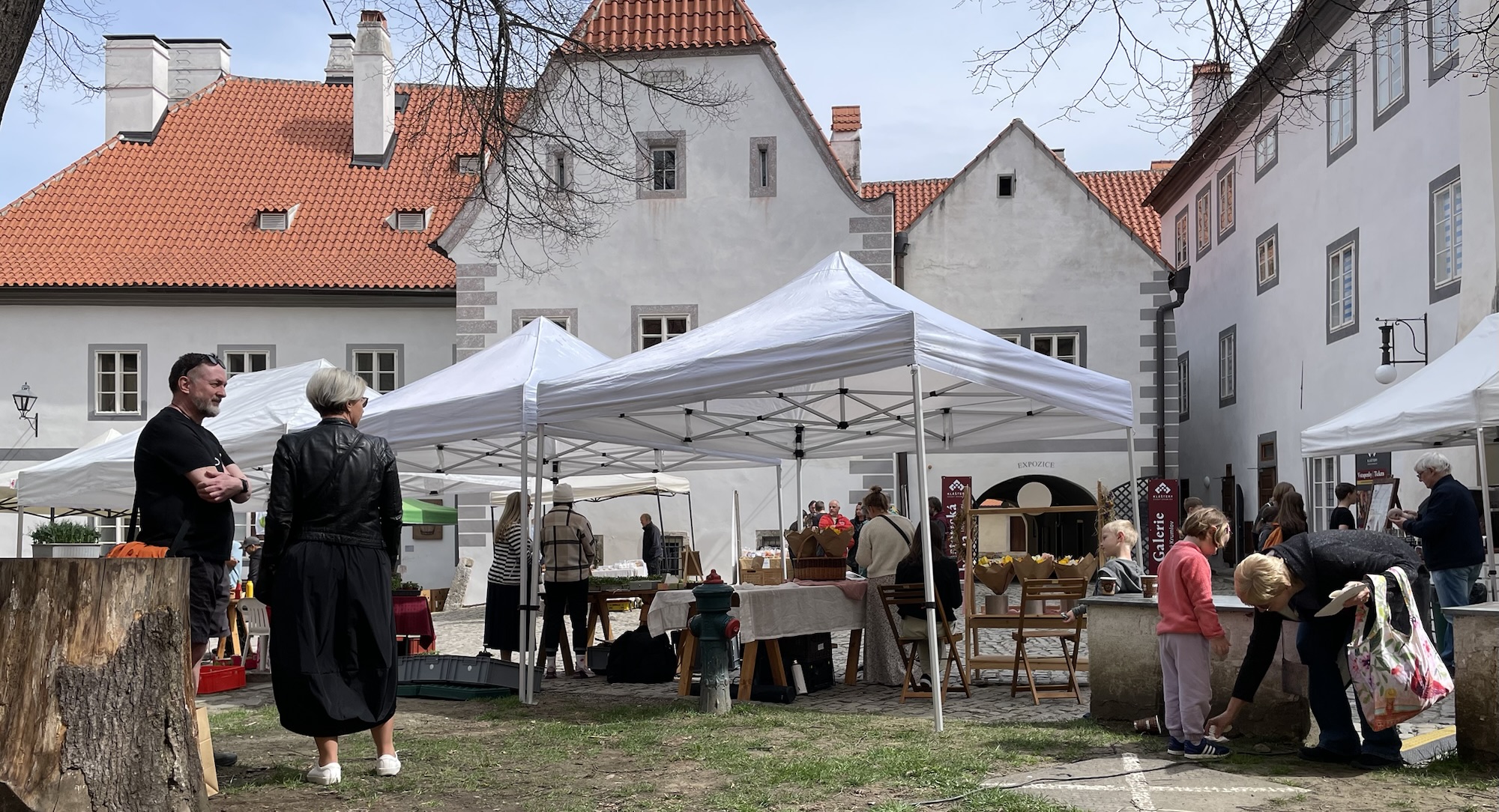
A small fair, all locals. Except us!The line on the building is the high water mark of a flood a few years ago. Ridiculously uneven street surfaces made walking a bit annoying.
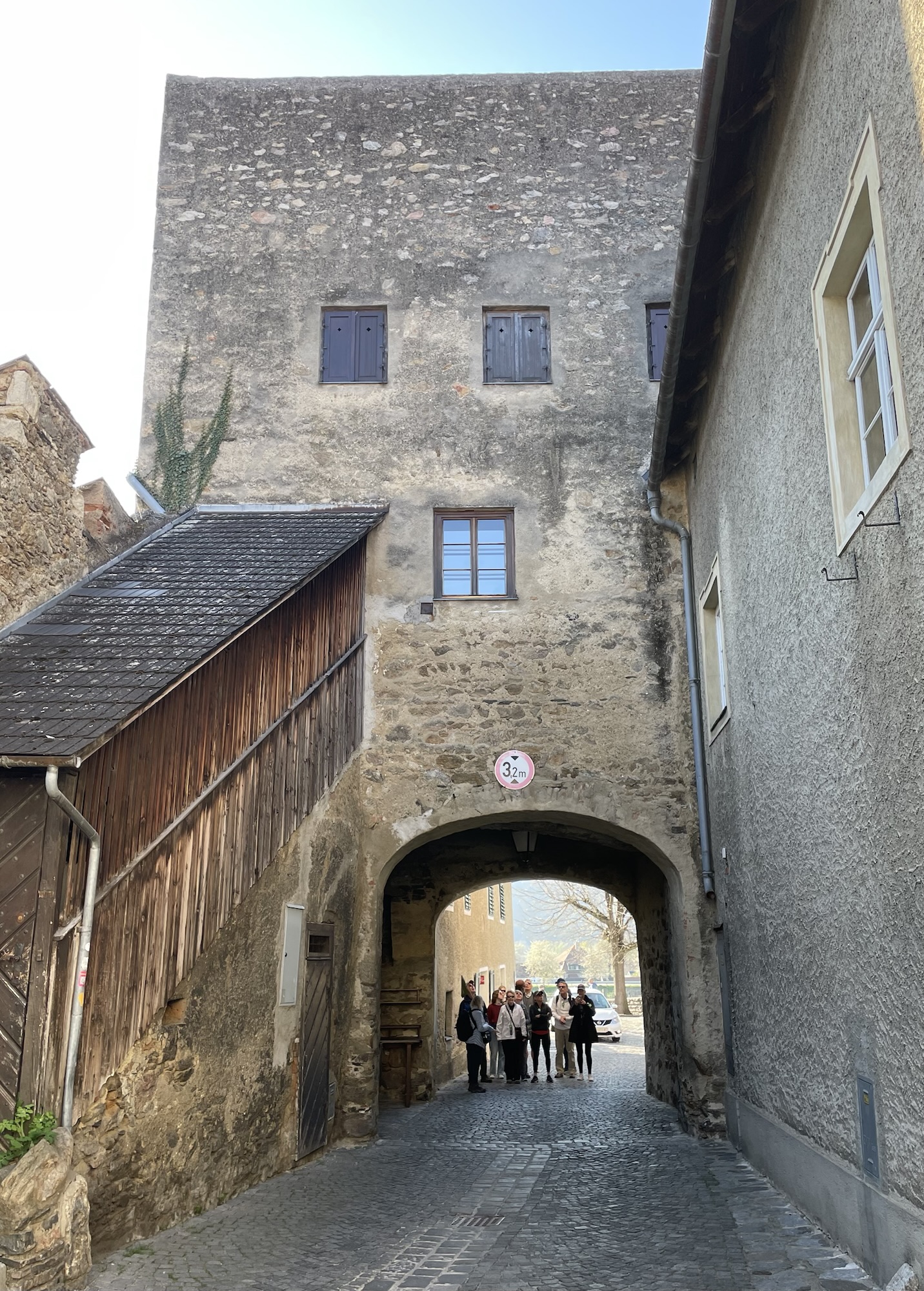
Our destination in the upper leftThrough the townThe town gate
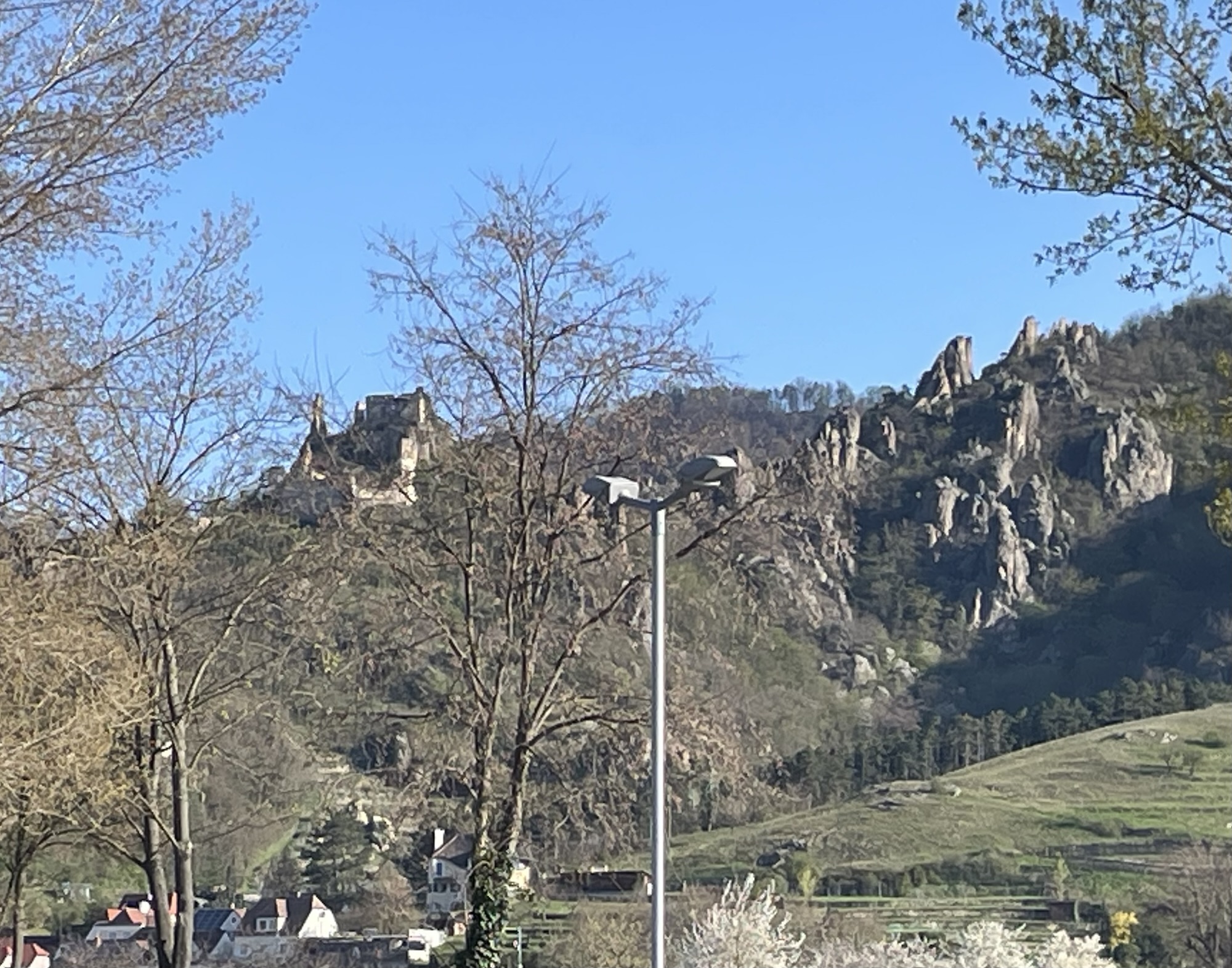
We woke up Saturday, April 12, in Durnstein, a ridiculously picturesque Austrian town. We had signed up for the hike to the castle ruins, which seemed, when we chose it months ago, so doable. That was before we entered the lazy period that started when we got on this boat. As we looked up at the destination we gulped, but, committed, we laced up our shoes and joined our little group.
It was 8:30. The guide promised we would be back in an hour and a half and off she went, the group hurrying to catch up. It was a cool, sunny morning and the weather inspired us all as we walked up a steep cobblestone street the width of a small alley, crossed the main street (wide enough for a car, cobblestone of course) and up and up we went.
This town has 150 permanent residents and only they are allowed to drive into the old part of town. The new town is maybe .2 of a mile to the right. I hope I got those facts right.
Anyway, soon the hike got serious with steep stone steps that required close attention. The guide promised 3 stops to take photos and it was some work to catch up in time to rest a bit before we were off again. It was hard work. But the cool air, the many many wild flowers, the views, and our common determination to get to the top propelled us all.
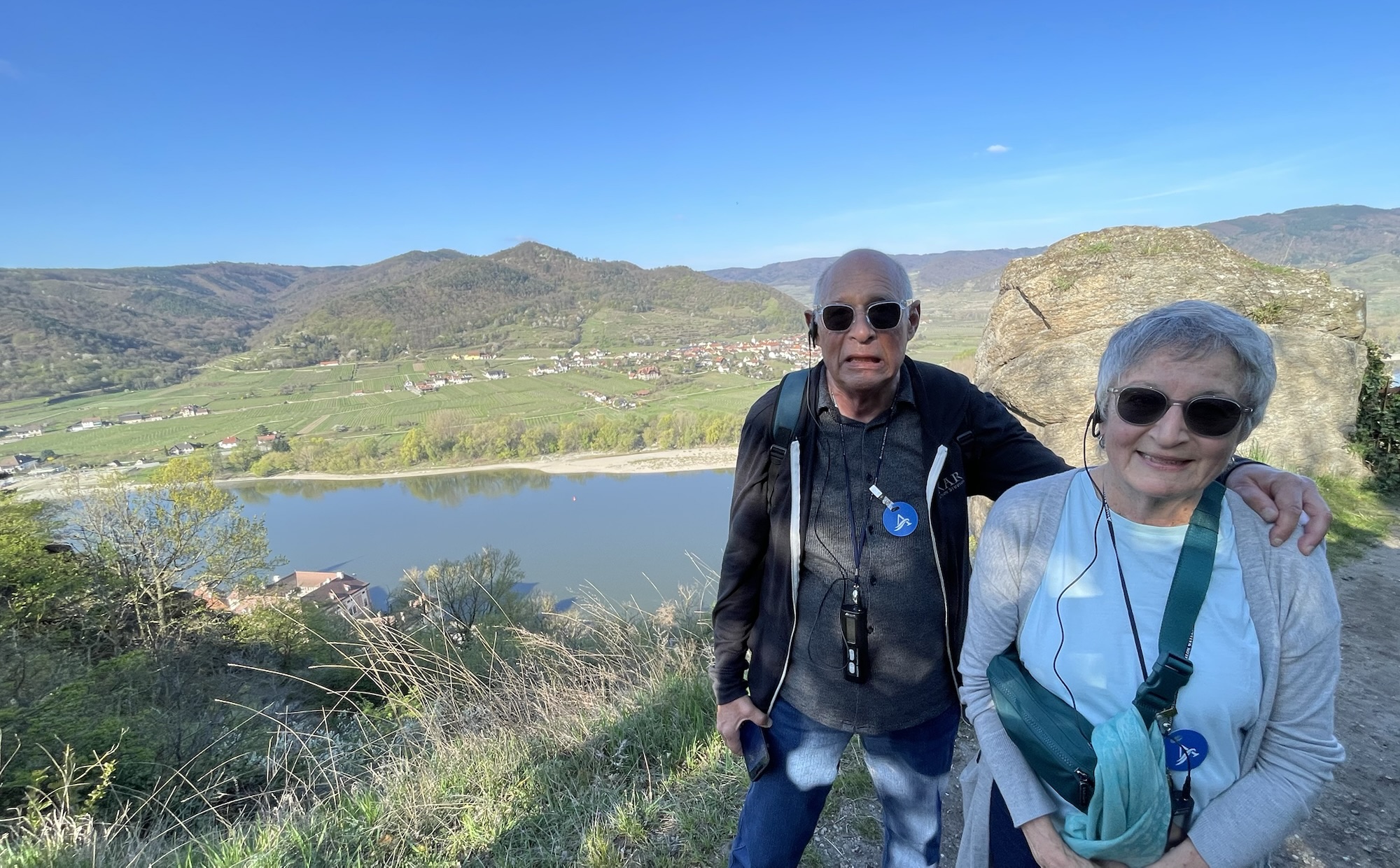
It was worth every huff and every puff.
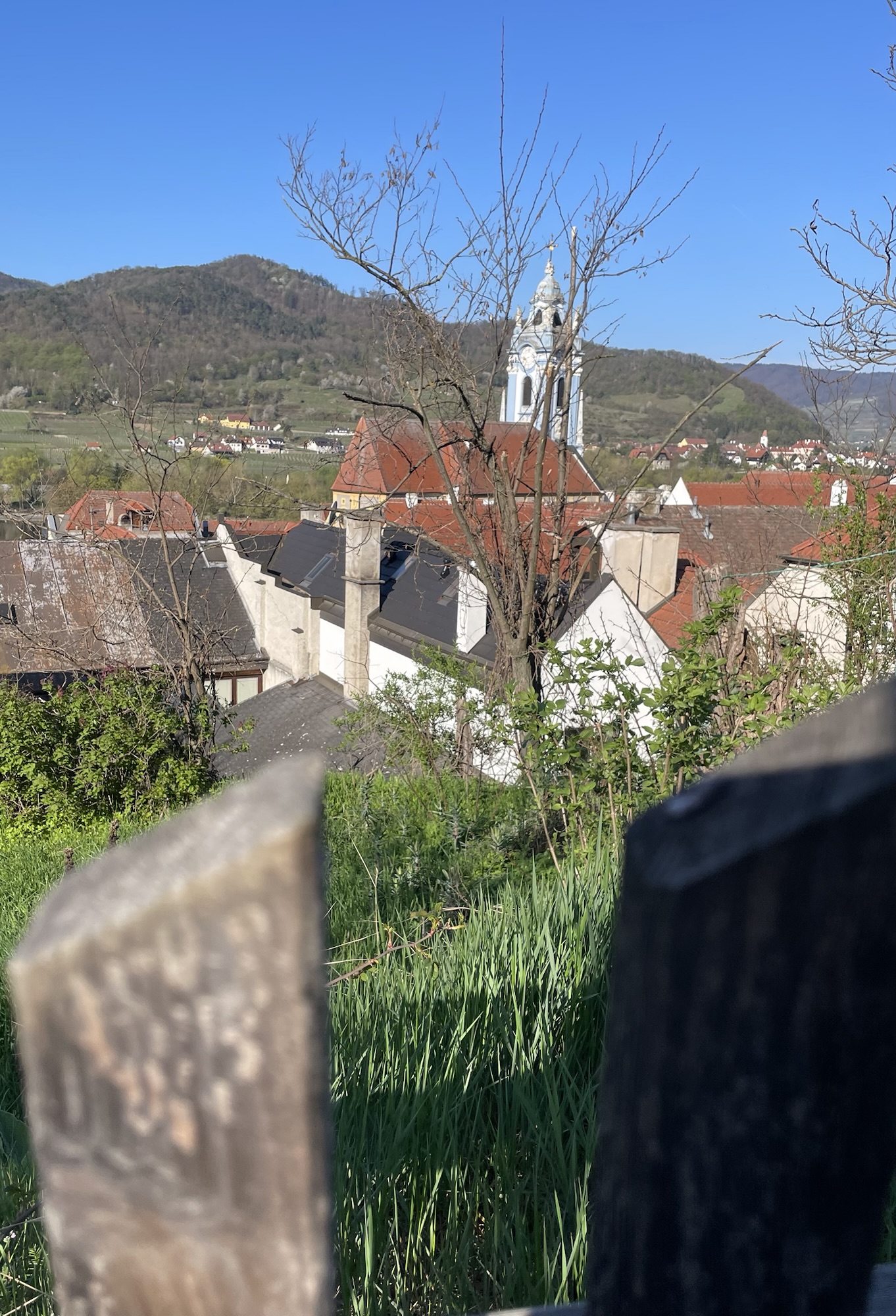
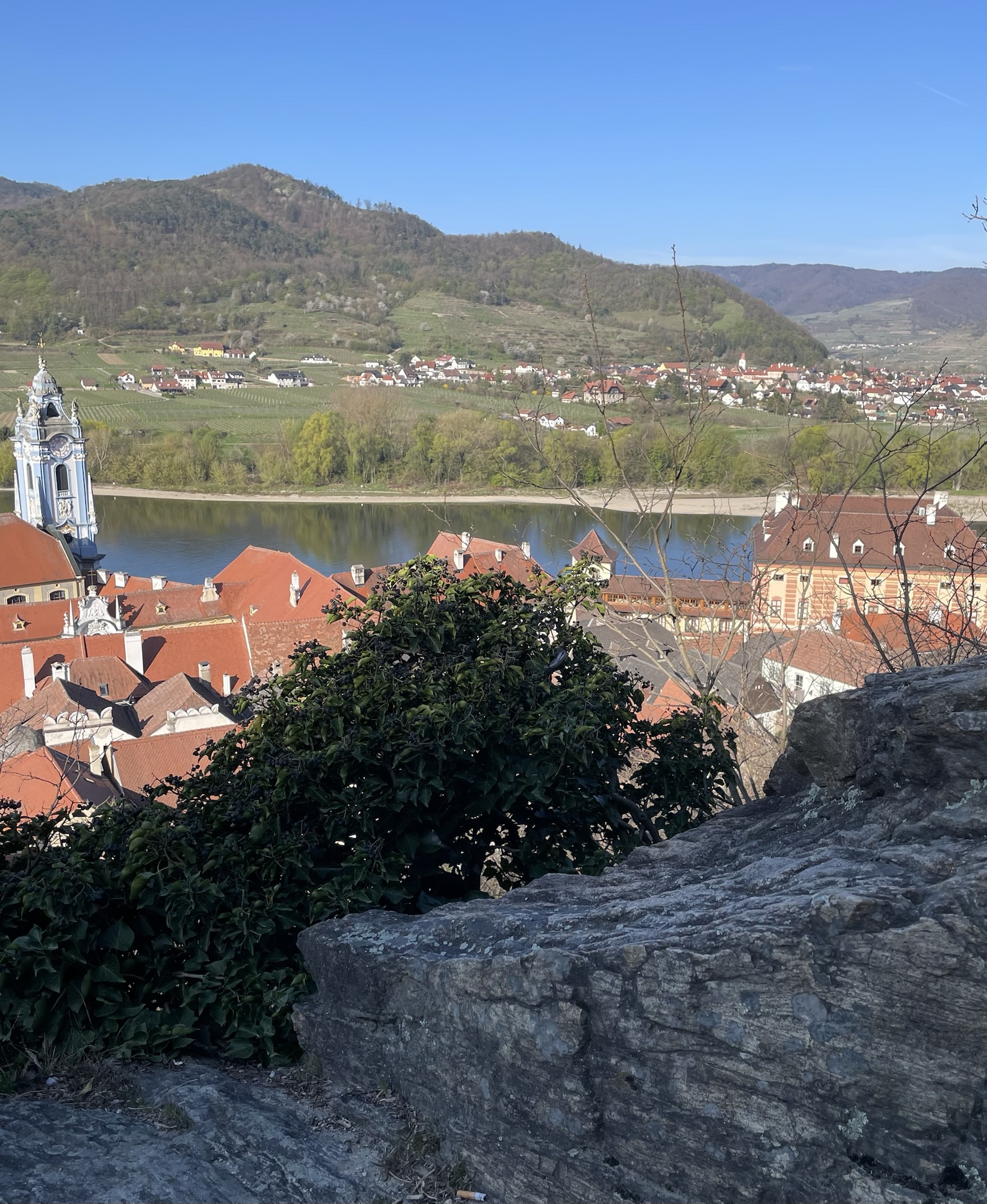
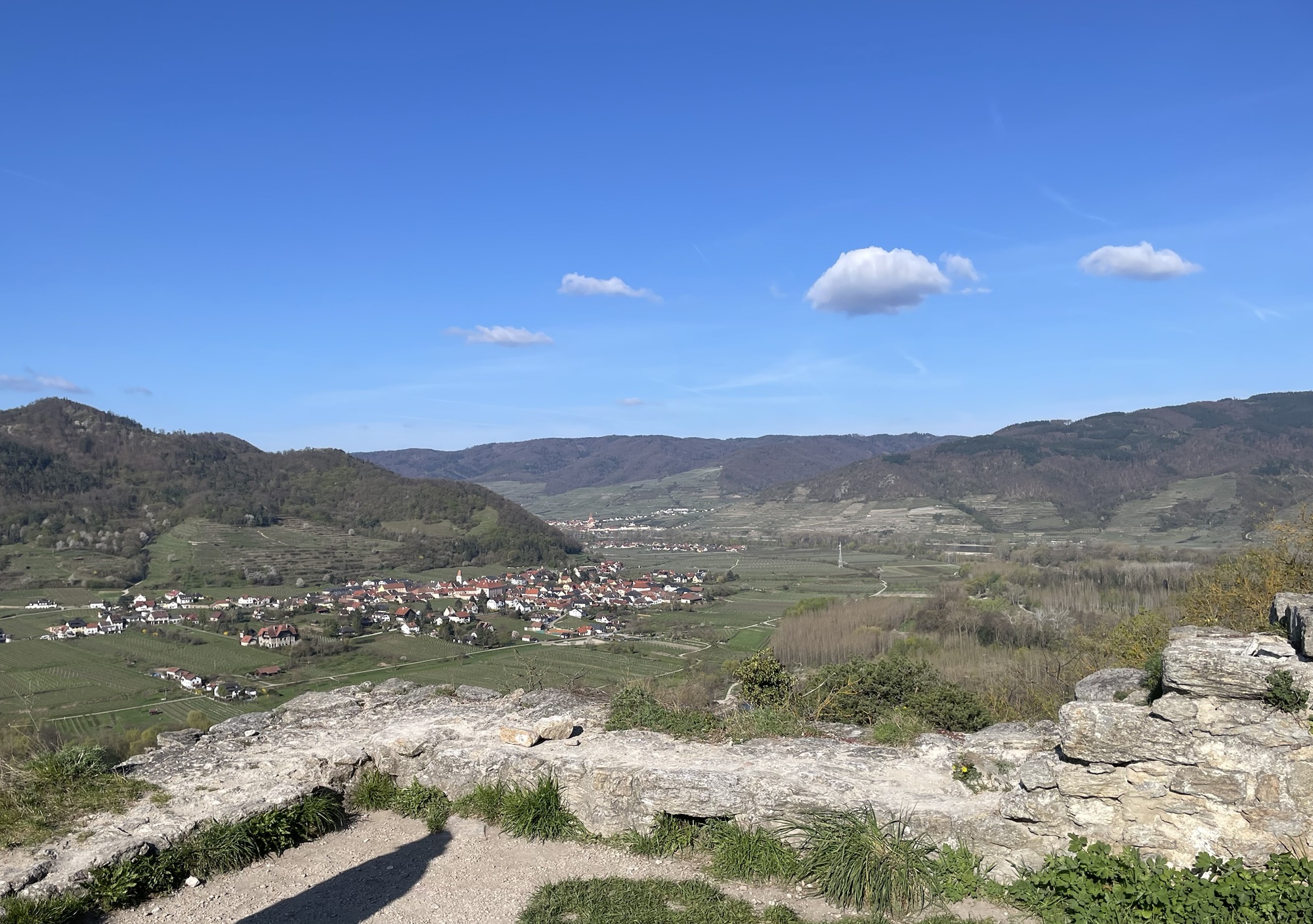
UpAnd upFlowers everywhereAnd up…the Danube waaay down thereJust below the ruins
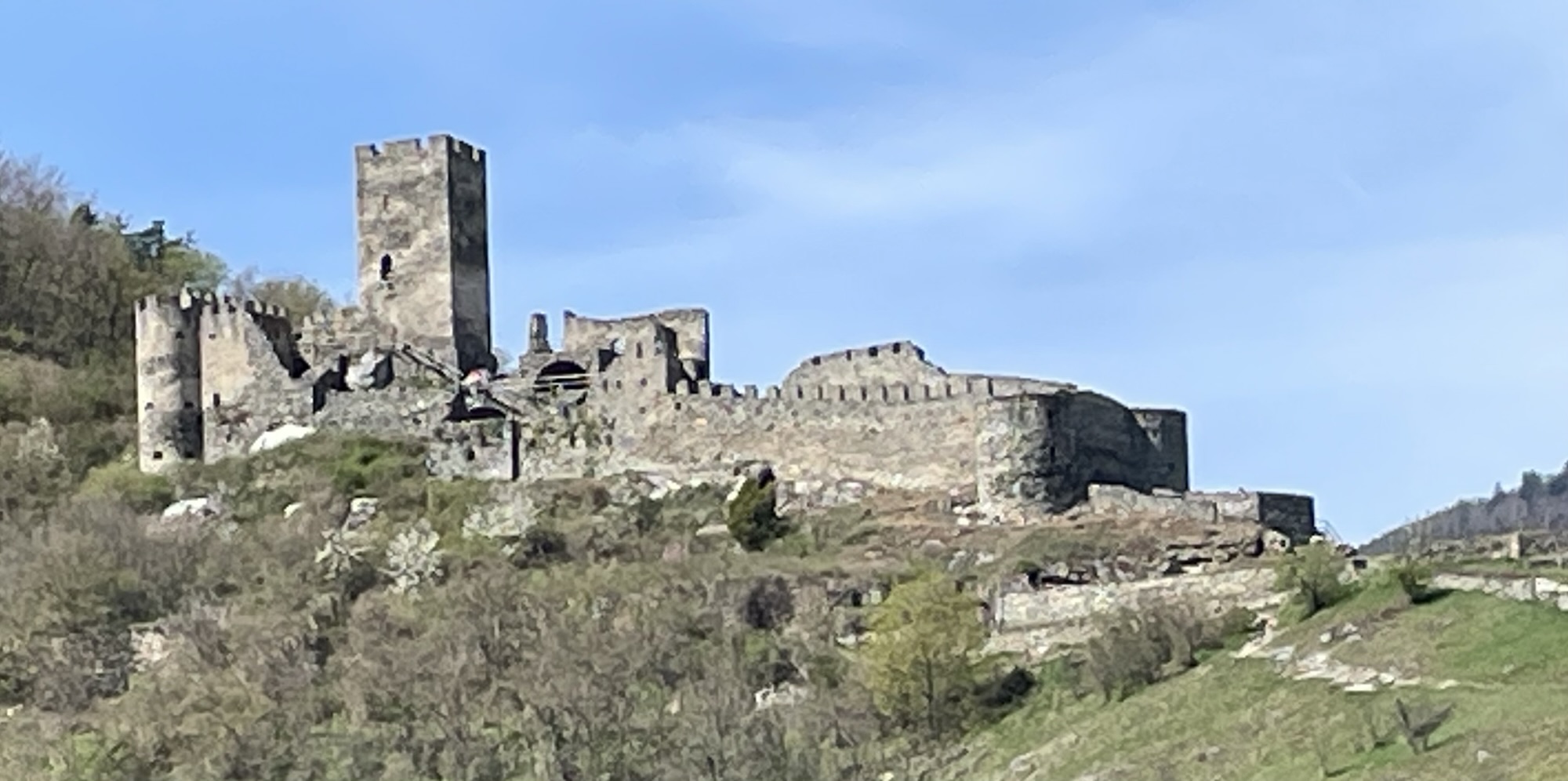
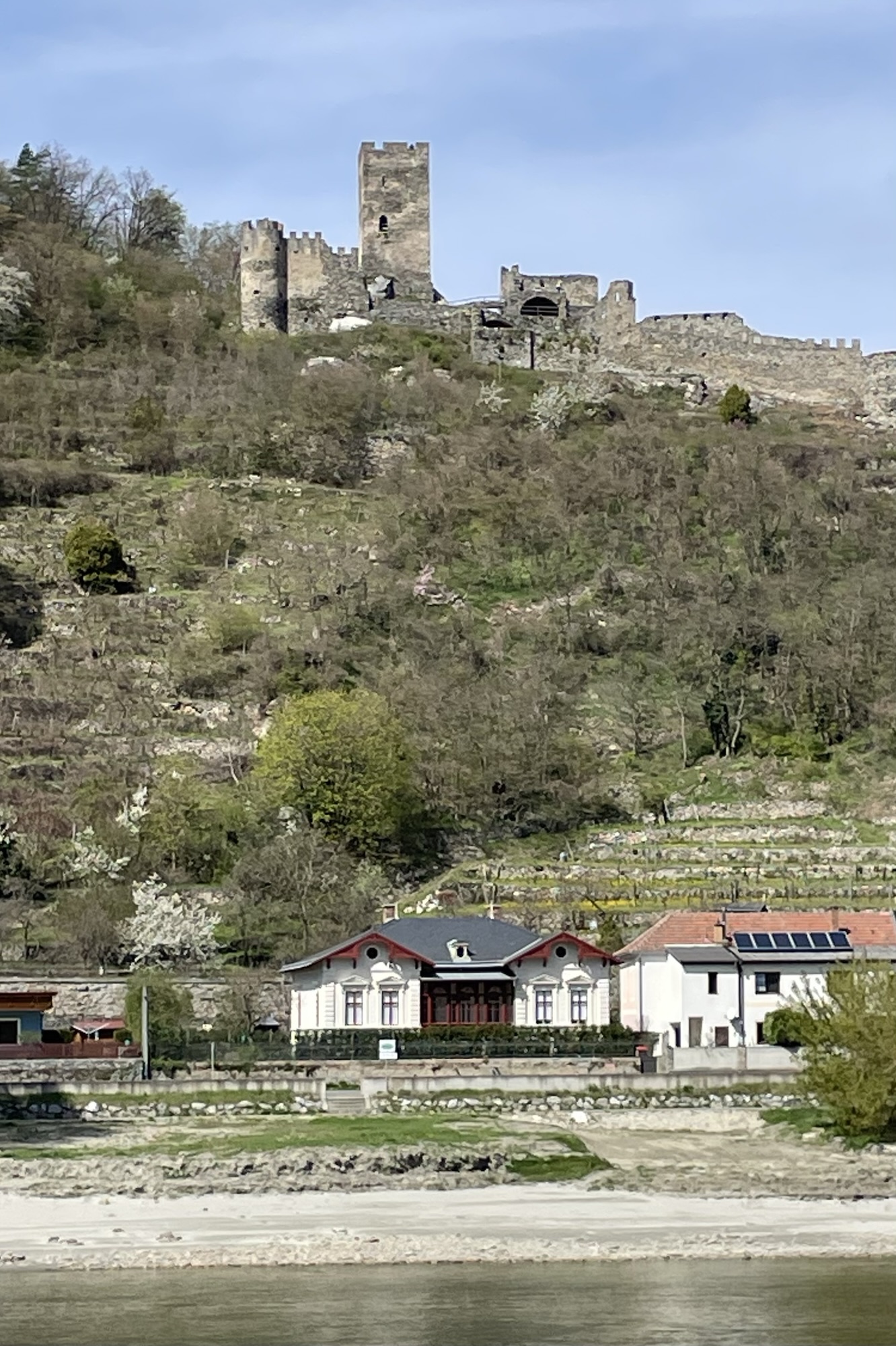
At the top we learned that Richard the Lionhearted had been kept prisoner there, waiting for a ransom to be paid. He wa alowed to hint, go into the town, and live a nice enough life as one could when one is not allowed to leave and return home. Having seen this place I now want to learn more about the details of this fellow’s life.
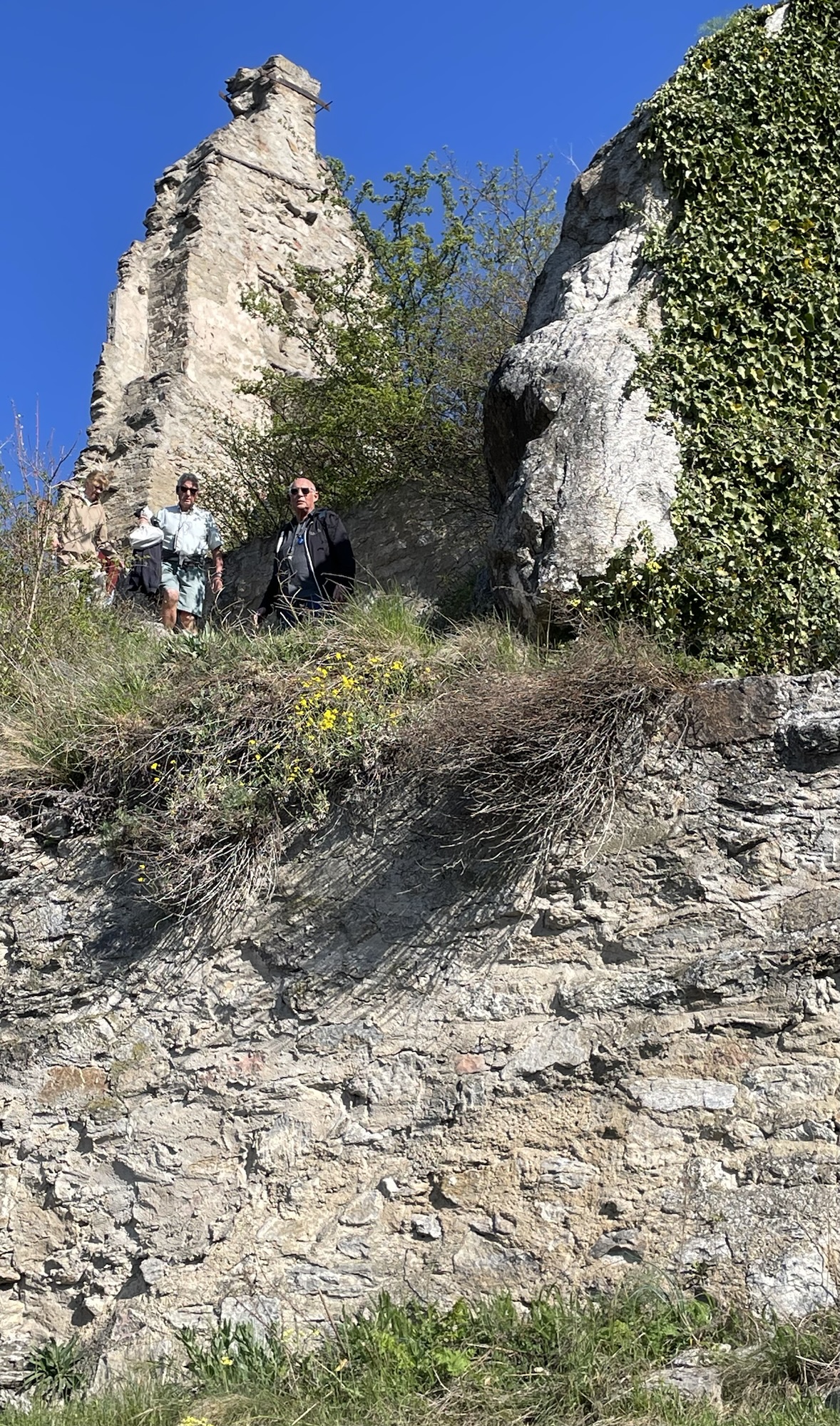
David coming down from the tippy topHad to get a few more flowers inWhen we came down it was hard to believe we had climbed up!
Because we all wanted at least a half hour to see the town itself we hurried down a different route that was fairly steep but without steps. Thank goodness. Suddenly the guide stopped, excitedly pointing to the side of the trail. It was an emerald lizard, a good luck symbol. The lizard rather deliberately walked away into the vegetation. She was indeed bright green. Neat!
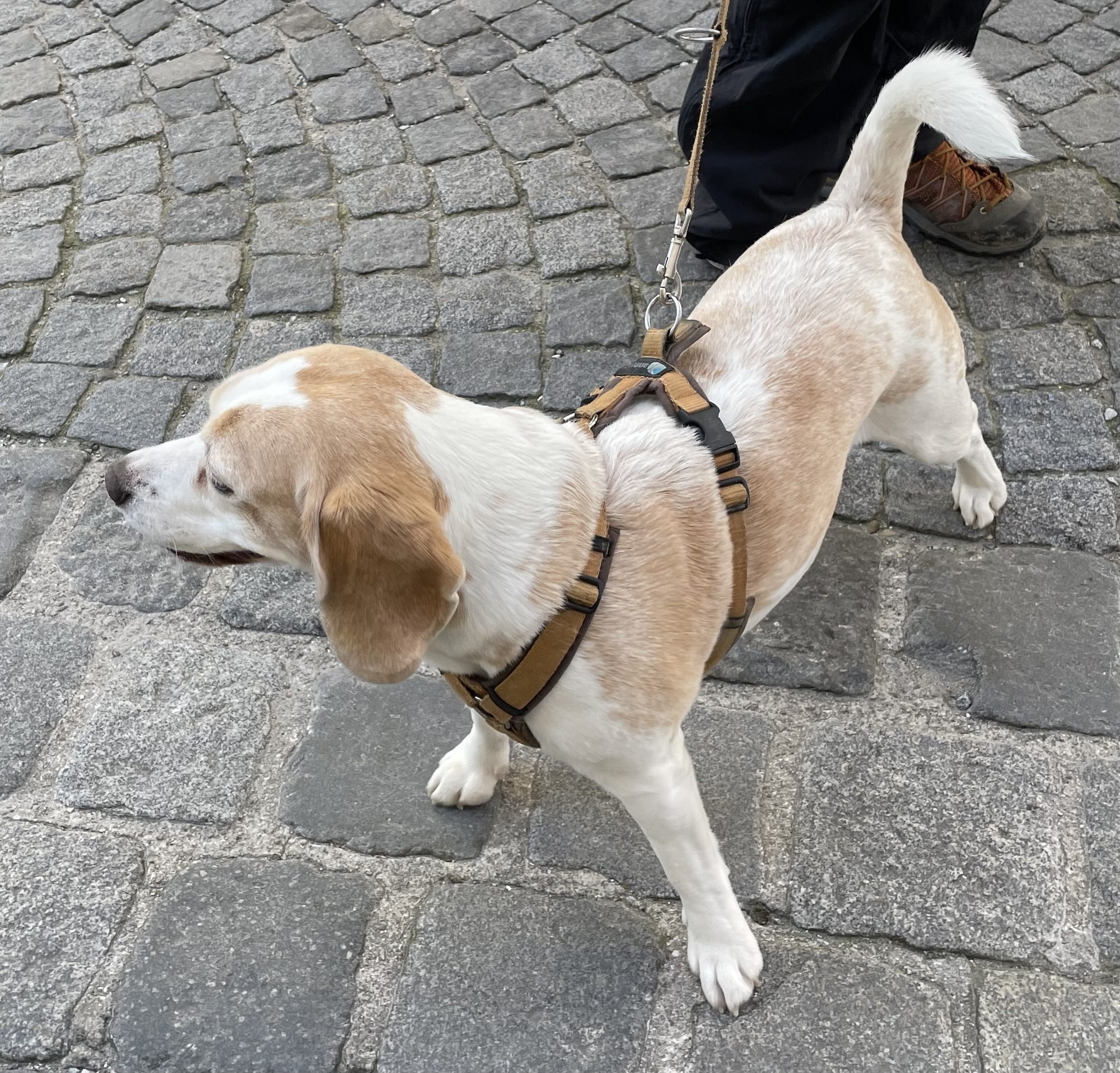
The nicest chocolate maker. She was from Ukraine, talked a mile a minute in German saying her German was poor. We switched to French. Adorable doggieJust a gate and flowersWe got back in time!
In the town I rushed to get to the chocolatier’s store, only because I had a tradition to keep, buying chocolate in as many places as I could—only chocolate made locally. I had a great time tasting and choosing a poppyseed chocolate and another with apricots and almonds. This area grows apricots that are prized throughout the region…you cannot buy them in supermarkets and they are controlled by the government the way champagne is by France. So of course I also bought a very small jar of preserves. One must support the local economy.
Many of us went up top to watch the valley glide by.
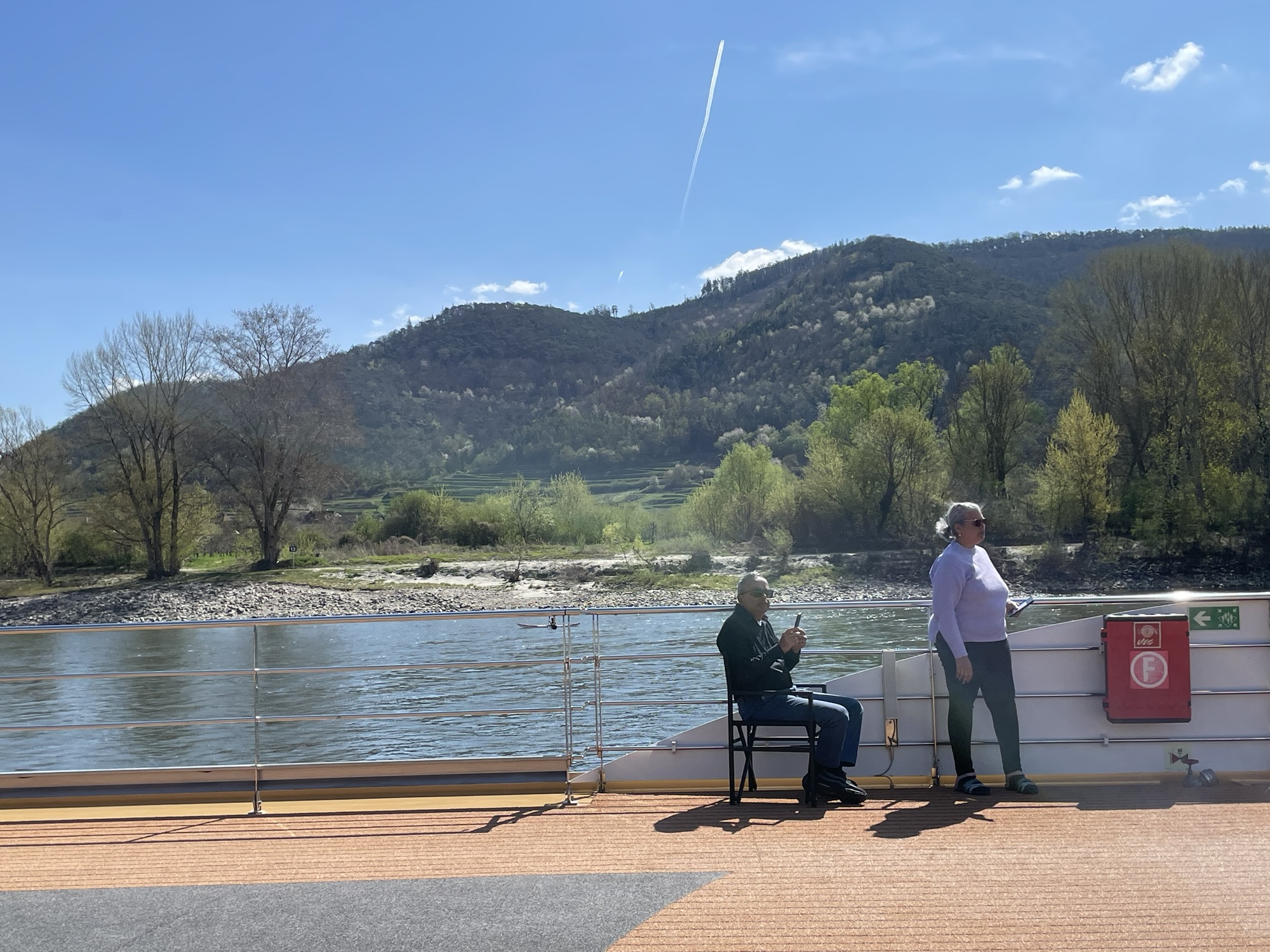
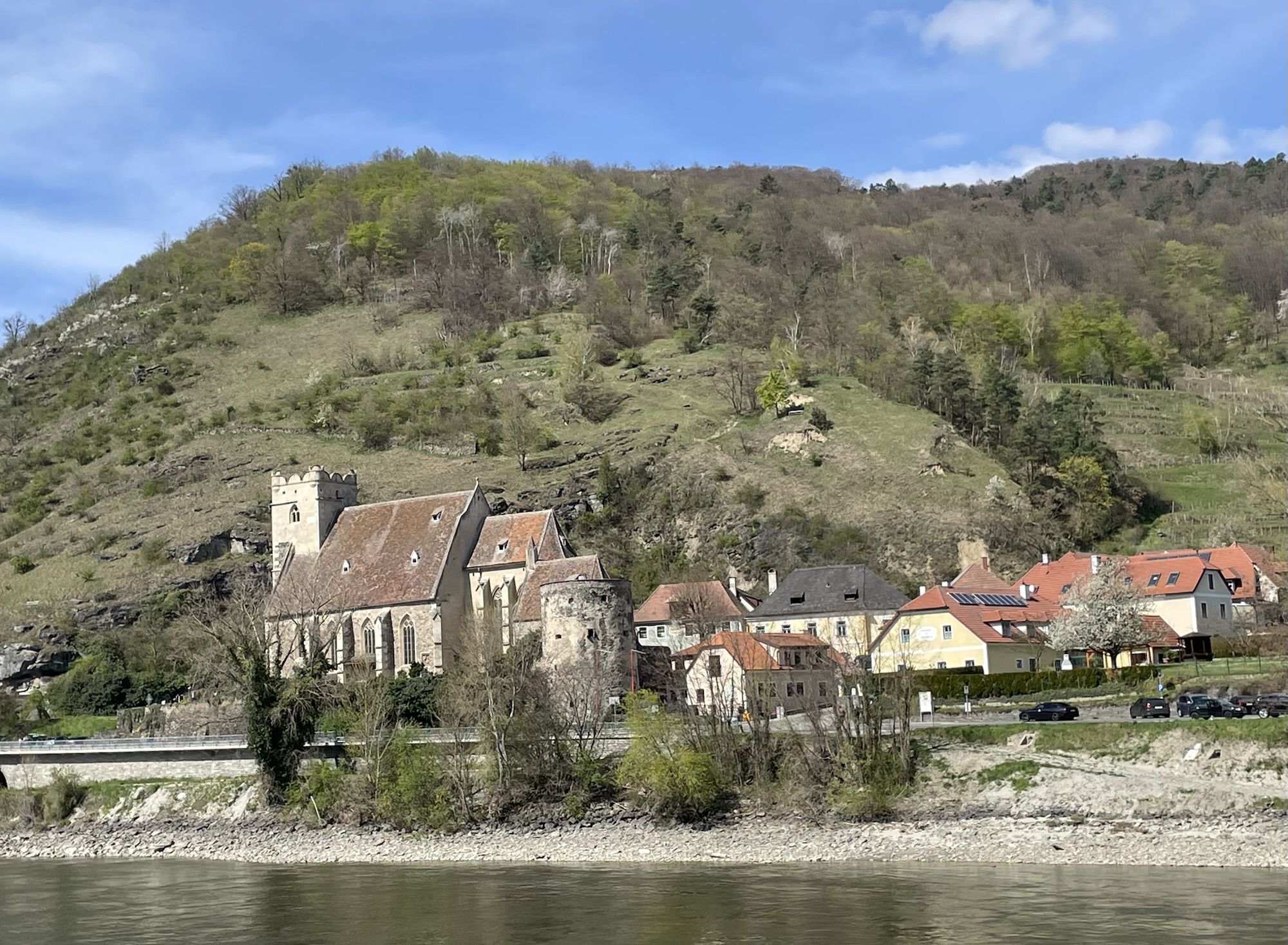
The boat left at 10:45 and many of us went up top to see the Wachau Valley. The Danube runs between steep hills, almost mountains, gorgeous and peaceful.
After lunch we left for a boring, too long tour of the Melk Abbey. No indoor photos are allowed as there are still 21 monks living there. The guide was wonderful but we had to stay an additional hour with little to do while the boat moved on to Ybbs where we were driven to meet it by the tour bus. Not our favorite afternoon…but the morning was amazing.
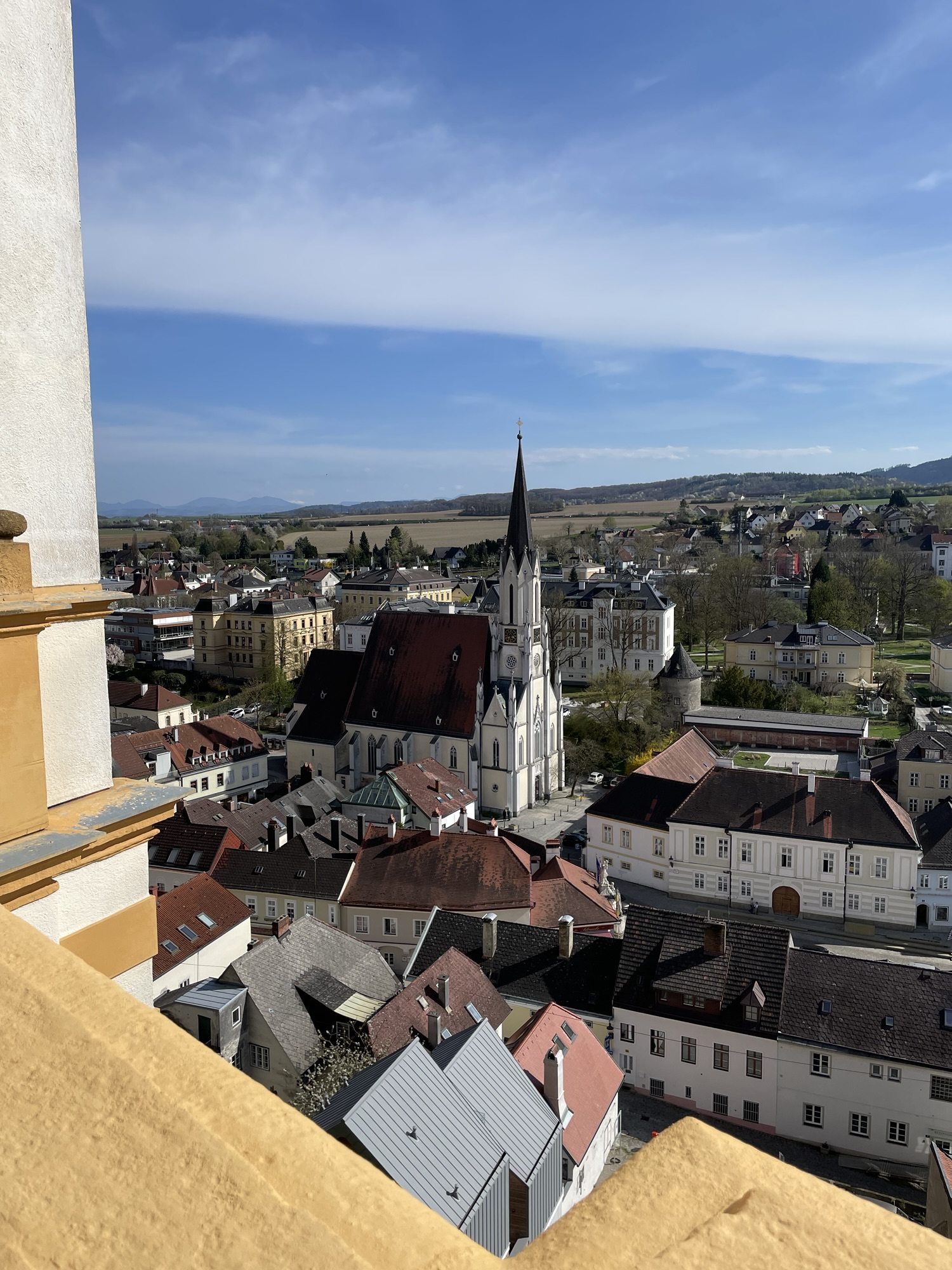
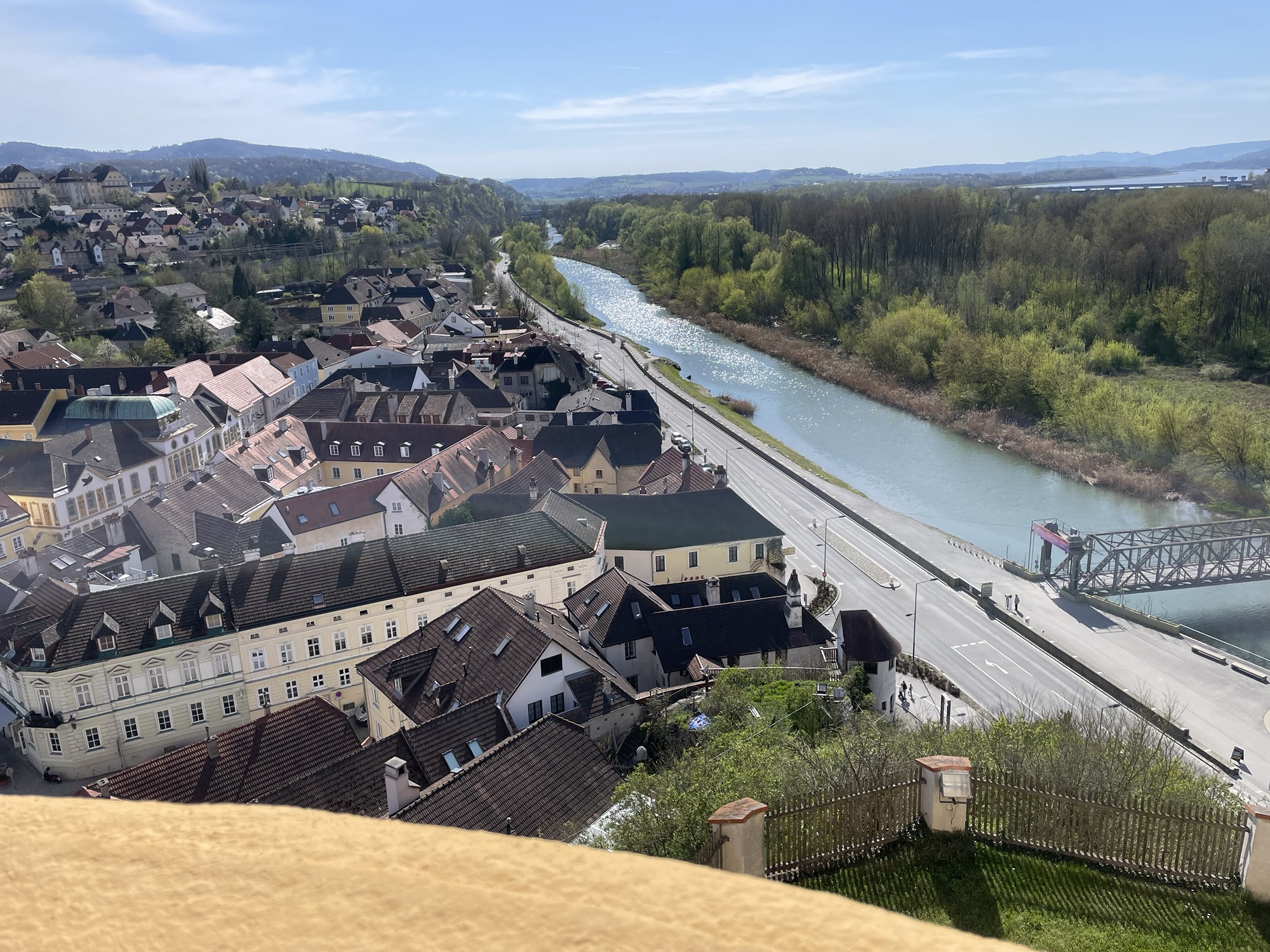
Melk Abbey courtyardMelk AbbeyView of the town of Melk Not the Danube
I read later that the restoration of the Abbey, completed in 1996, was financed largely by the sale of the Abbey’s Gutenberg bible to Harvard. Seems interesting enough to have been mentioned on the tour. Oh, well.
We arrived in this small (450,000) capital city on a cloudy morning with the same considerable windchill which ebbed and flowed throughout the day.
The walking tour was one of the best ever because our guide had all the requisite traits: she knew the city and its history, she was by turns serious and respectful and funny, and she gave me a recommendation for a restaurant that served a superb version of a Slovakian specialty, halusky. More on that later.
Because our guide, Jana, had lived half her life under Soviet rule she could share many insights and family stories about those dark times and about how life had changed since the velvet revolution. Jana plus the exceedingly picturesque old city (barely a city!) made for a great morning.
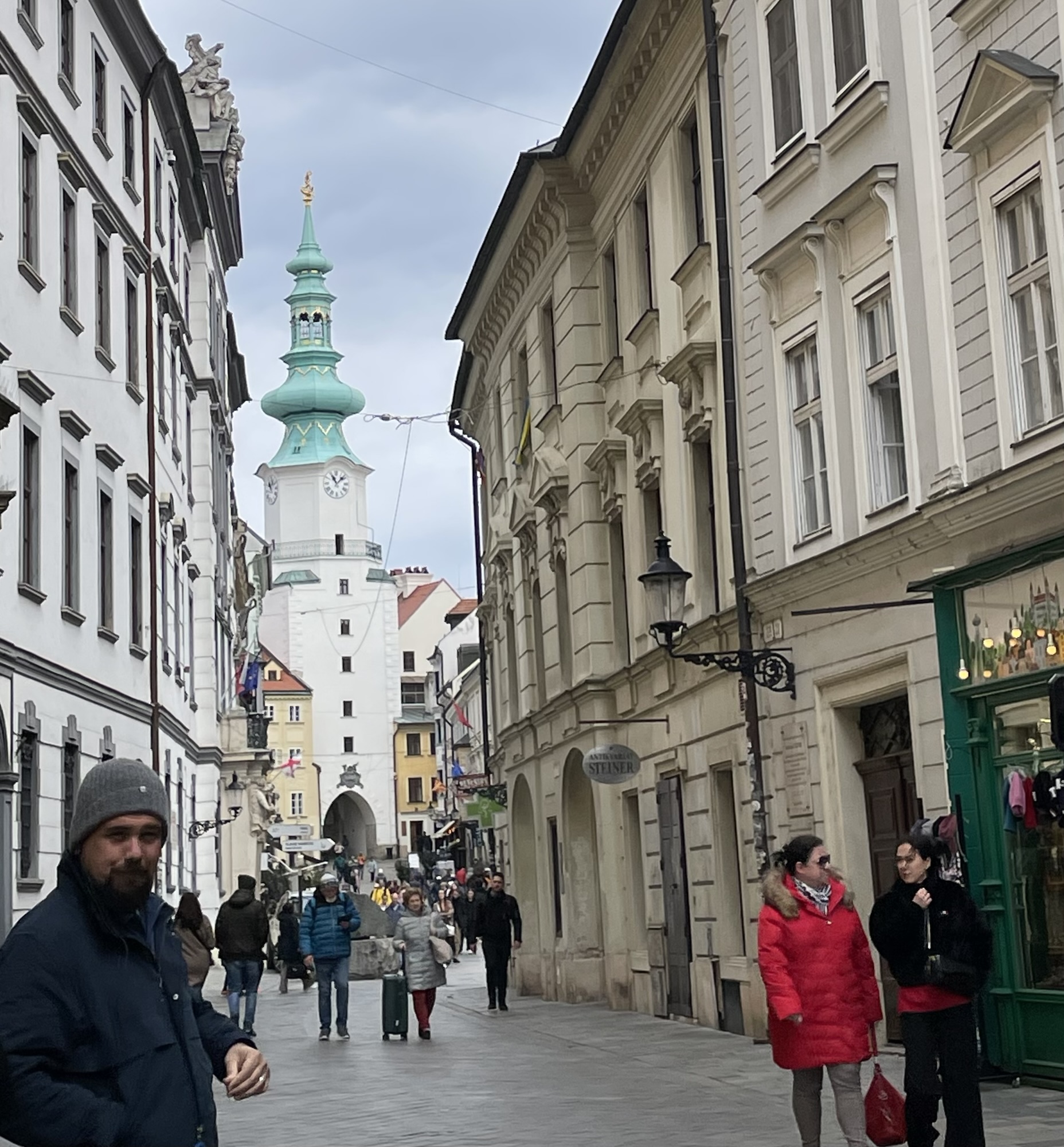
Jana introduced us to Bratislava by stating the two unequivocal advantages to living in her town. One, no traffic. It was rush hour and we were at a major intersection with barely a lane full of cars. Two, it is located at the intersection of three countries—Hungary, Austria, and Slovakia.
Soviet times
Standing just a few yards from the boat Jana pointed across the Danube at a woods with a large hill behind on which we could see a transmitter tower. The tower was in Austria, and the woods at the edge of the river were not at all dense. Jana explained that the soviet government had mowed down the trees and shrubbery and placed several rows of barbed wire and high voltage lines to prevent escapes. (According to wikipedia 400 Bratislavan citizens were killed trying to escape during the years Soviet Russia ruled Slovakia.). But the Austrian tower transmitted television, though often jammed, and Jana asked us what we thought her grandmother’s favorite tv series was. Dallas! Her grandmother was really pissed when jamming made her miss an episode.
Upper left, the Neolog memorial; lower right, the drop of blood in that little hole in the gold decoration
The Neolog Synagogue that survived both world wars was torn down by the Soviets in 1969 to make way for a road, which now runs so close to the beautiful St. Martin’s Cathedral that it is now suffering damage from traffic vibration. There are reminders of the lost synagogue around the central historic district including a memorial on the site and information placards posted nearby.
St. Martin’s Cathedral alongside the Neolog Synagogue before the Soviets destroyed the synagogue.
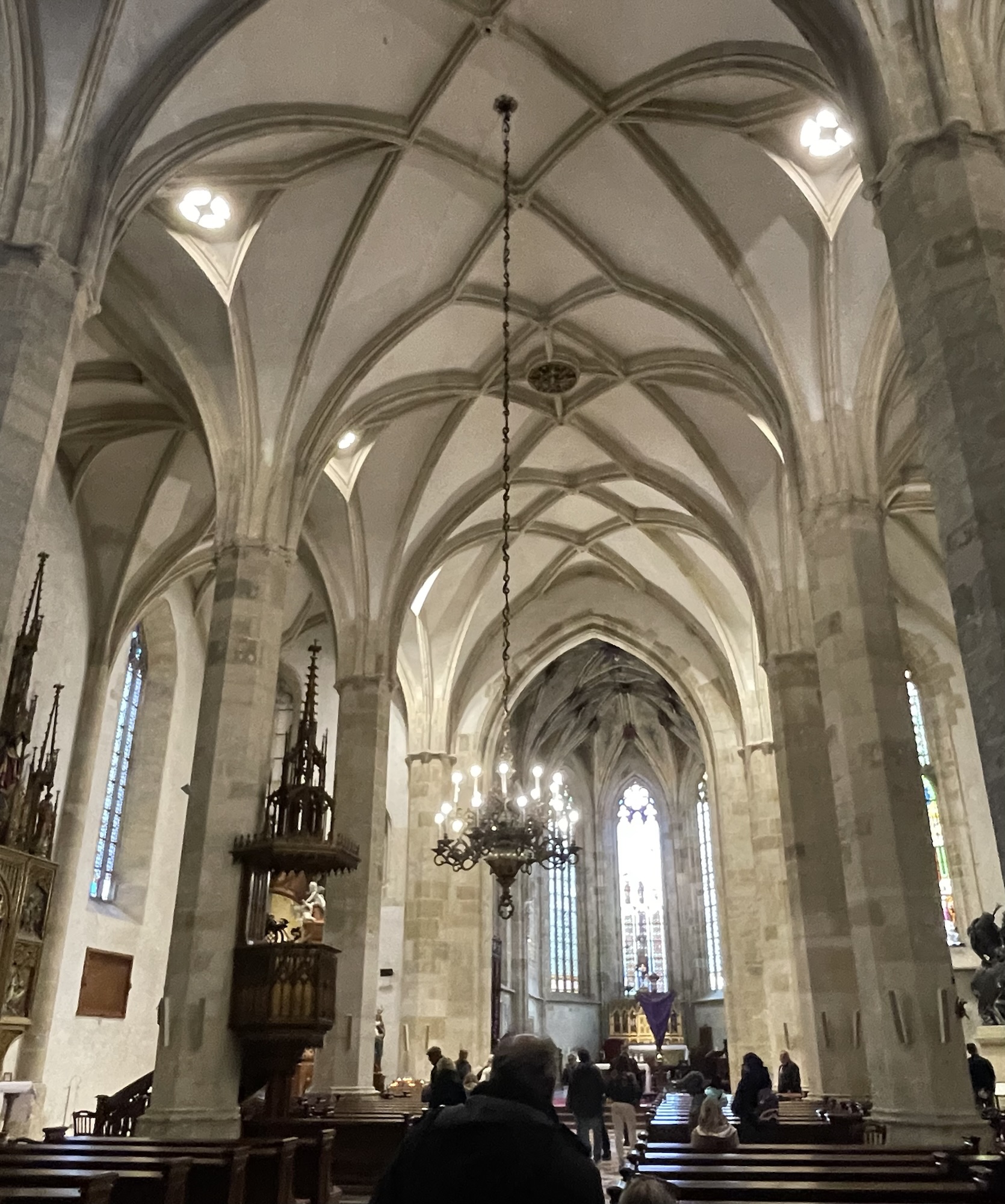
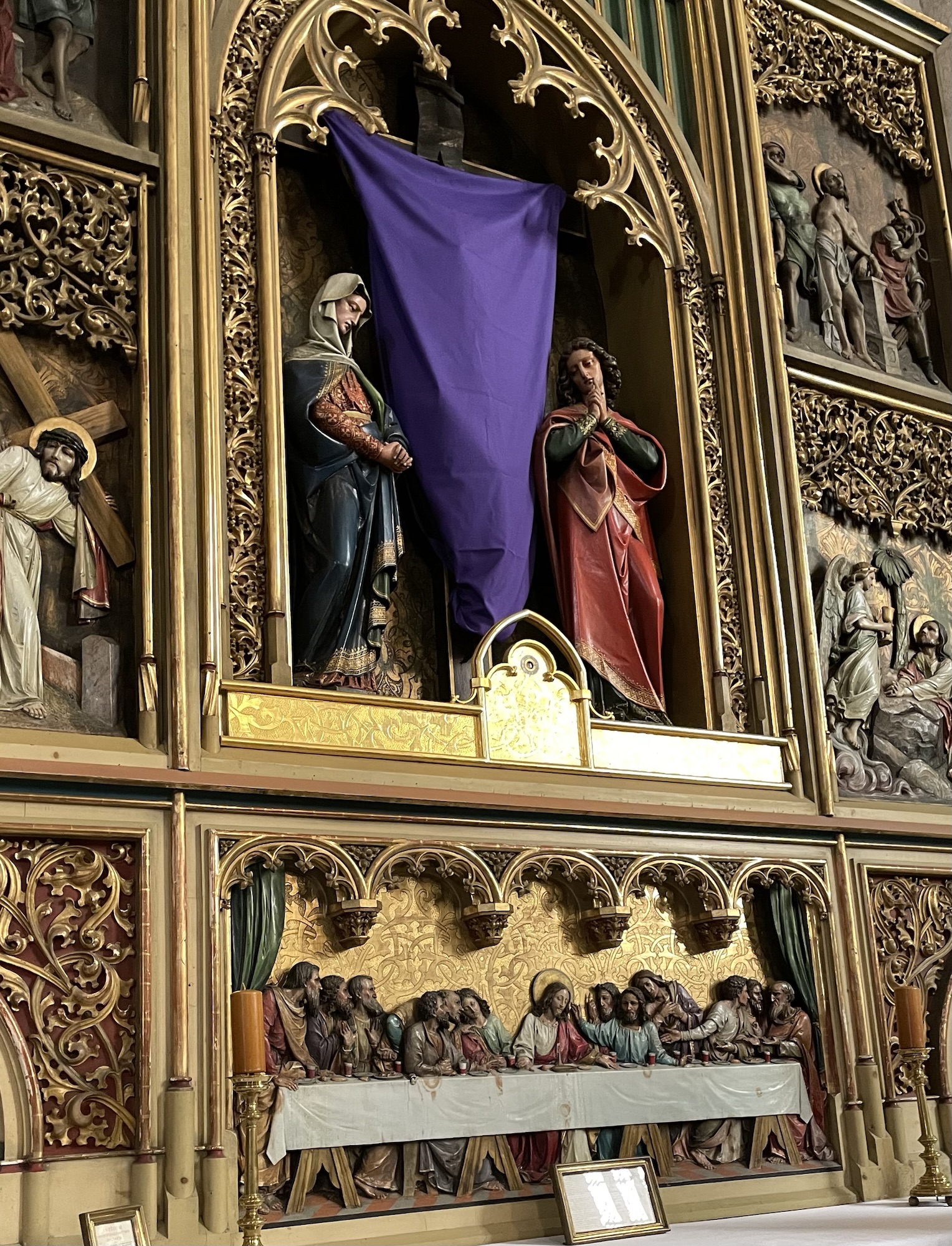
St. Martin’s Cathedral has a soaring interior with very little interior decoration where frescoes were destroyed in the several fires that were started by lightening strikes. These interior fires started at the back of the sanctuary and were extinguished before reaching the altar, which remains filled with frescoes and elaborate carved seats, each with a symbolic animal (creature?) representing a sin or virtue.
On one side wall there’s a curious Habsburg relic, a recent gift of descendants of the Habsburg emperor who abdicated in 1918. The gift is gold, like a decorative frieze, and sits inside a large, carved wooden something-or-other. The curious part is in the center, a small round hole that holds a drop of the last emperor’s blood.
Walking through the renaissance
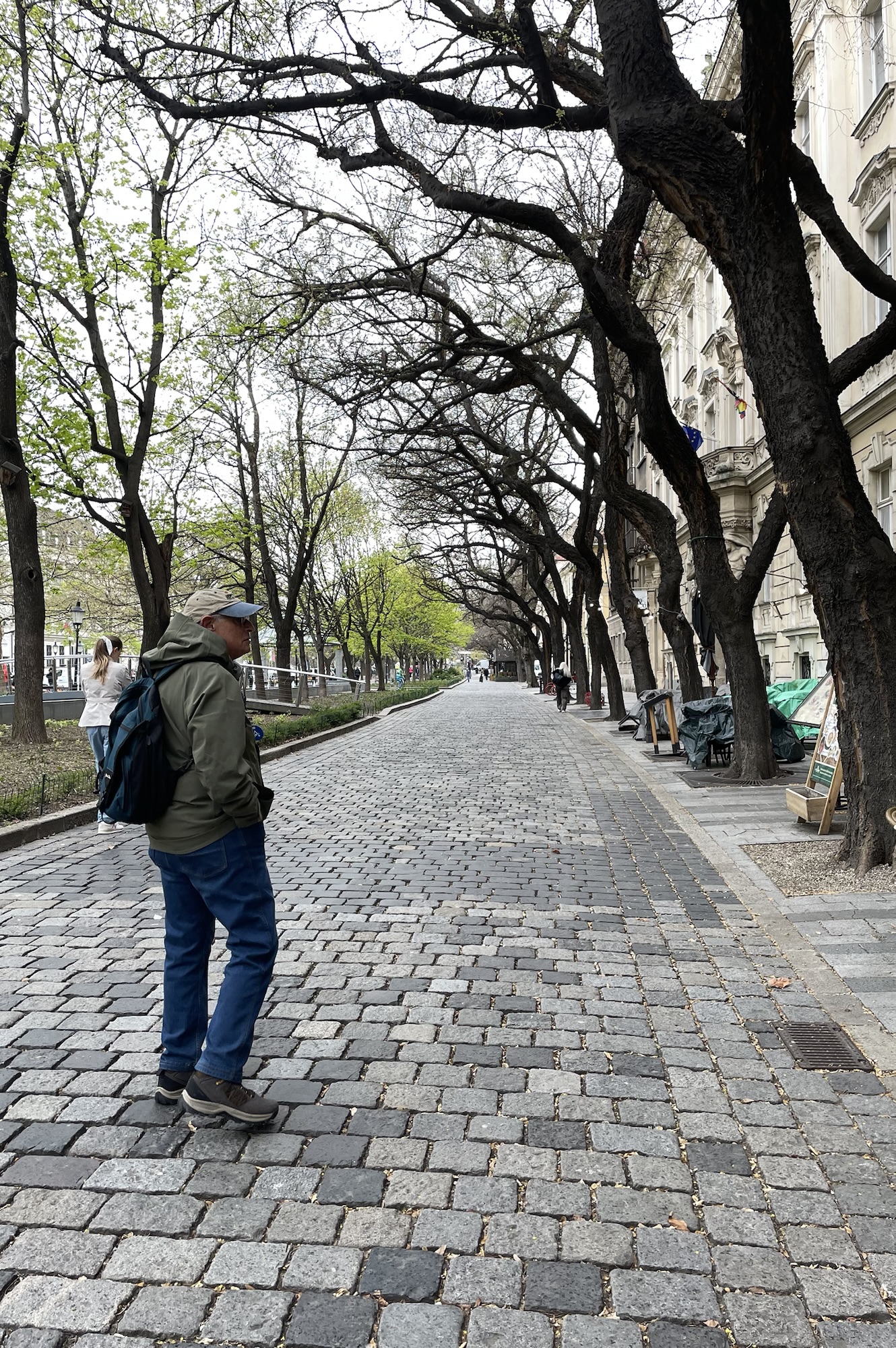
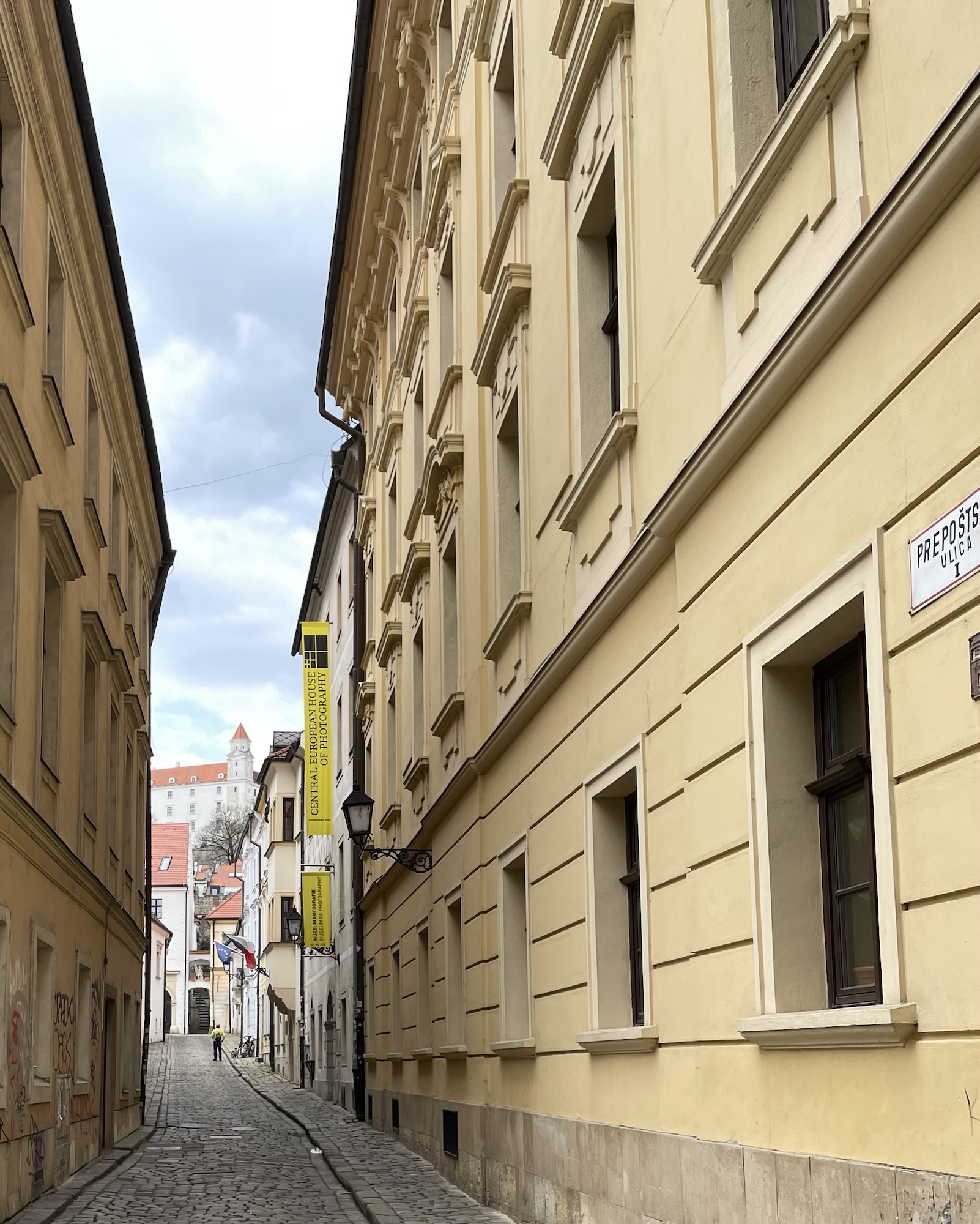
The streets of old Bratislava are narrow and treacherous with cobblestones that are themselves awfully uneven. The old town is so small you are through it in minutes. Our guide explained one street has been used over and over as a movie set because all of the buildings are owned by the Catholic church and hence there are no commercial signs. She told us a funny story. She was leading a tour and as they came around the corner onto this particular street a gate opened and out walked two tall men in full Nazi uniforms. Jana and her group stopped and gaped. “It was surreal,” Jana said. I’ll bet!
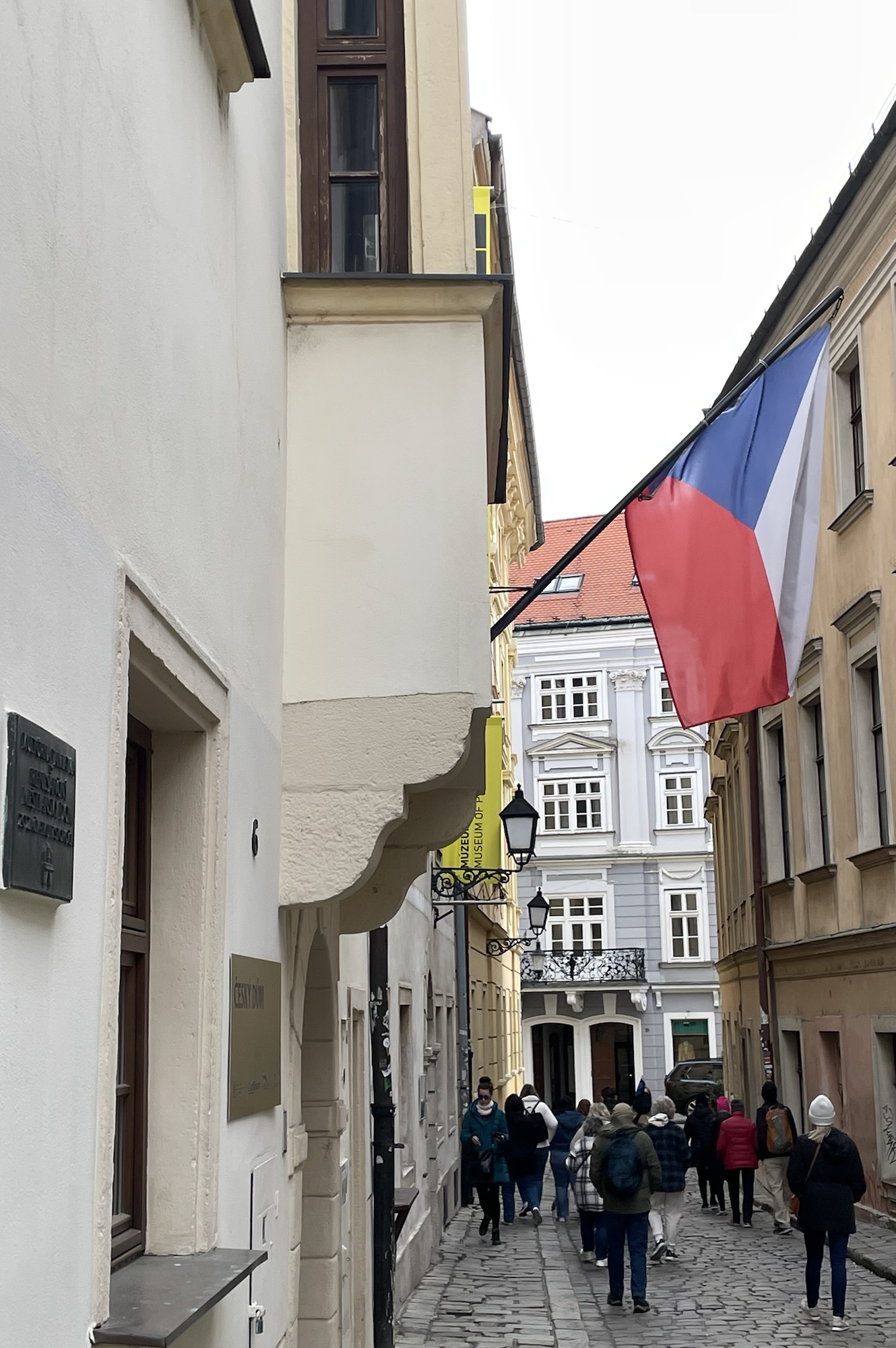
Many buildings date from renaissance and guide pointed out the distinguishing feature: enclosed balconies facing the street with windows on front and the very narrow sides. The side windows were a security feature…one could see from inside if a bad guy was sneaking along the wall toward the door. Only bad guys would approach by scooting along the wall instead of approaching directly from the front.
On the left, a renaissance building with side windows in covered balcony
Live and learn.
Bratislavan treat
Our wonderful guide Jana had stopped outside a restaurant that had photos of their traditional dishes to point out that we shouldn’t leave without eating the most delicious of local foods, halusky. Dumplings (along the lines of spaetzel) in sheep’s cheese with bacon on top. At the end of the tour I asked her to recommend a restaurant where we could find a good version and she have us a name and pointed it out.
One of my problems on the cruise is lunch is at 12:00 and dinner not until 7:00. Consequently I am hungry in the afternoon and the snacks on board are cookies, fruit, one day donuts…all sweet. So this day i counted on walking back into town to try halusky. We braved the windy cold and spatter of rain. Wow. So delicious. We also ordered potato pancakes which were unlike anything I have eaten. Thin like crepes, buttery, with a very faint sweetness. It looked like a lot of food but we ate every last bit.
Halusky and potato pancakes, and the view from inside the restaurant.
We left this beautiful peaceful town thinking it would indeed be a nice place to live!
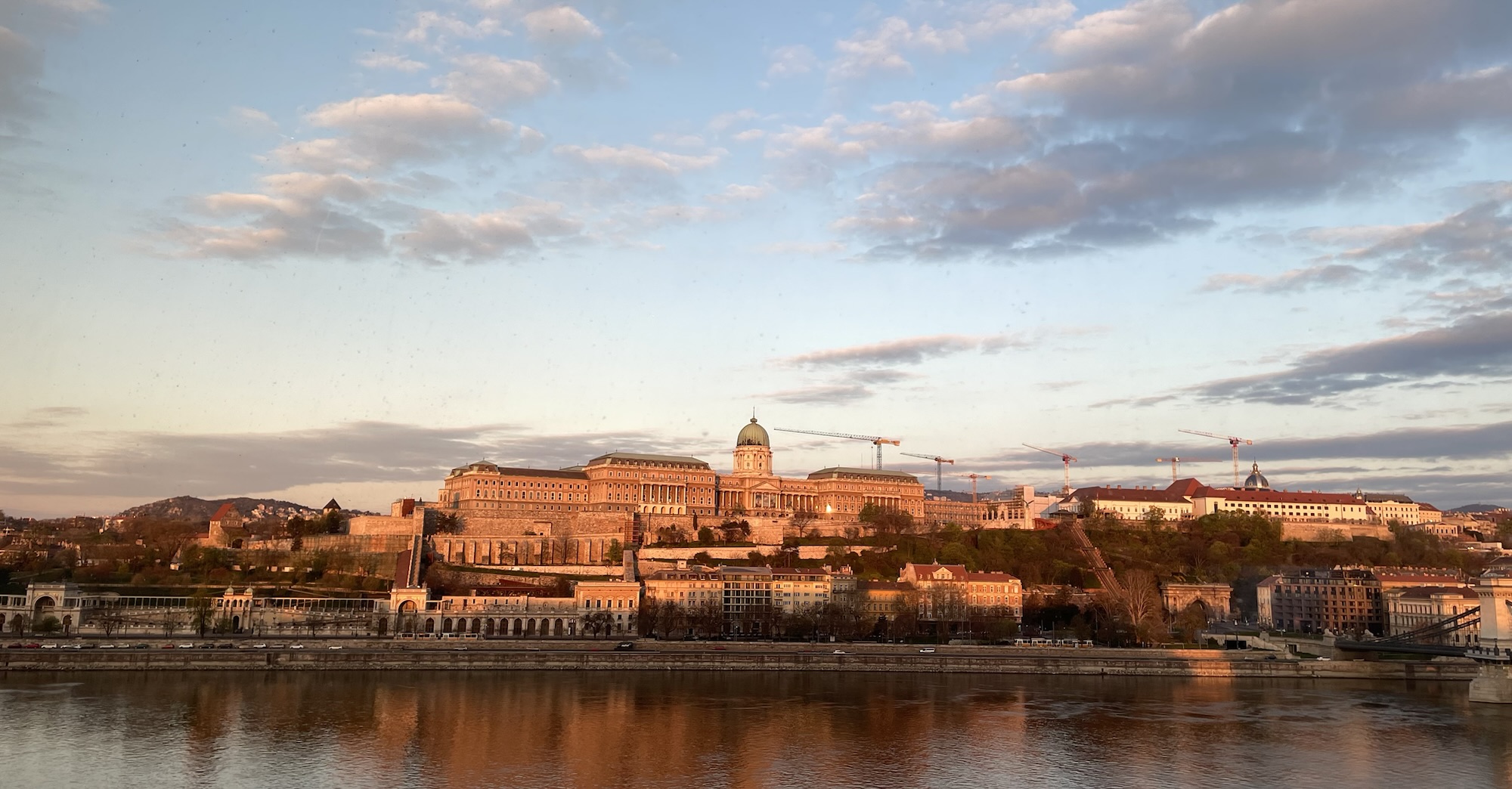
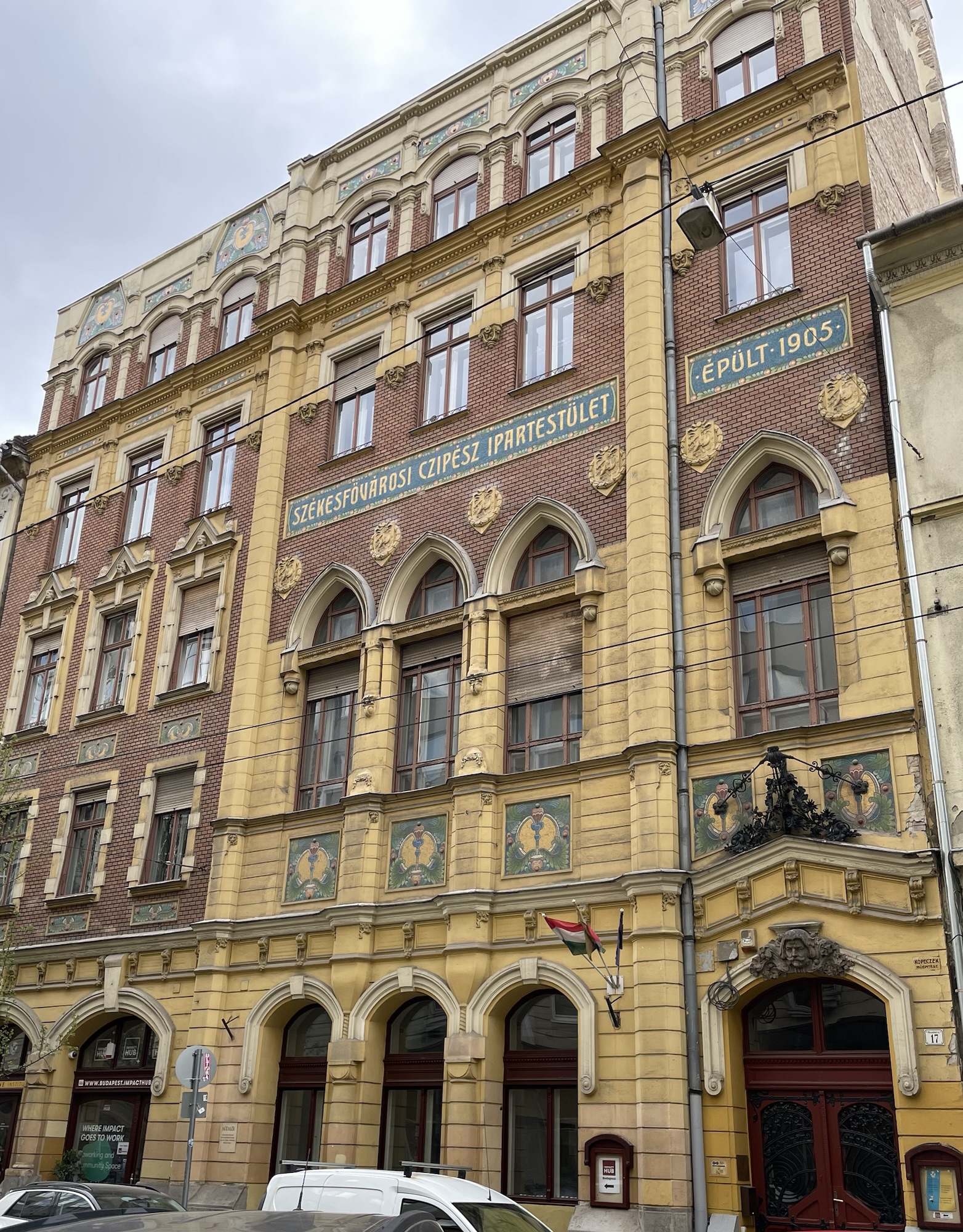
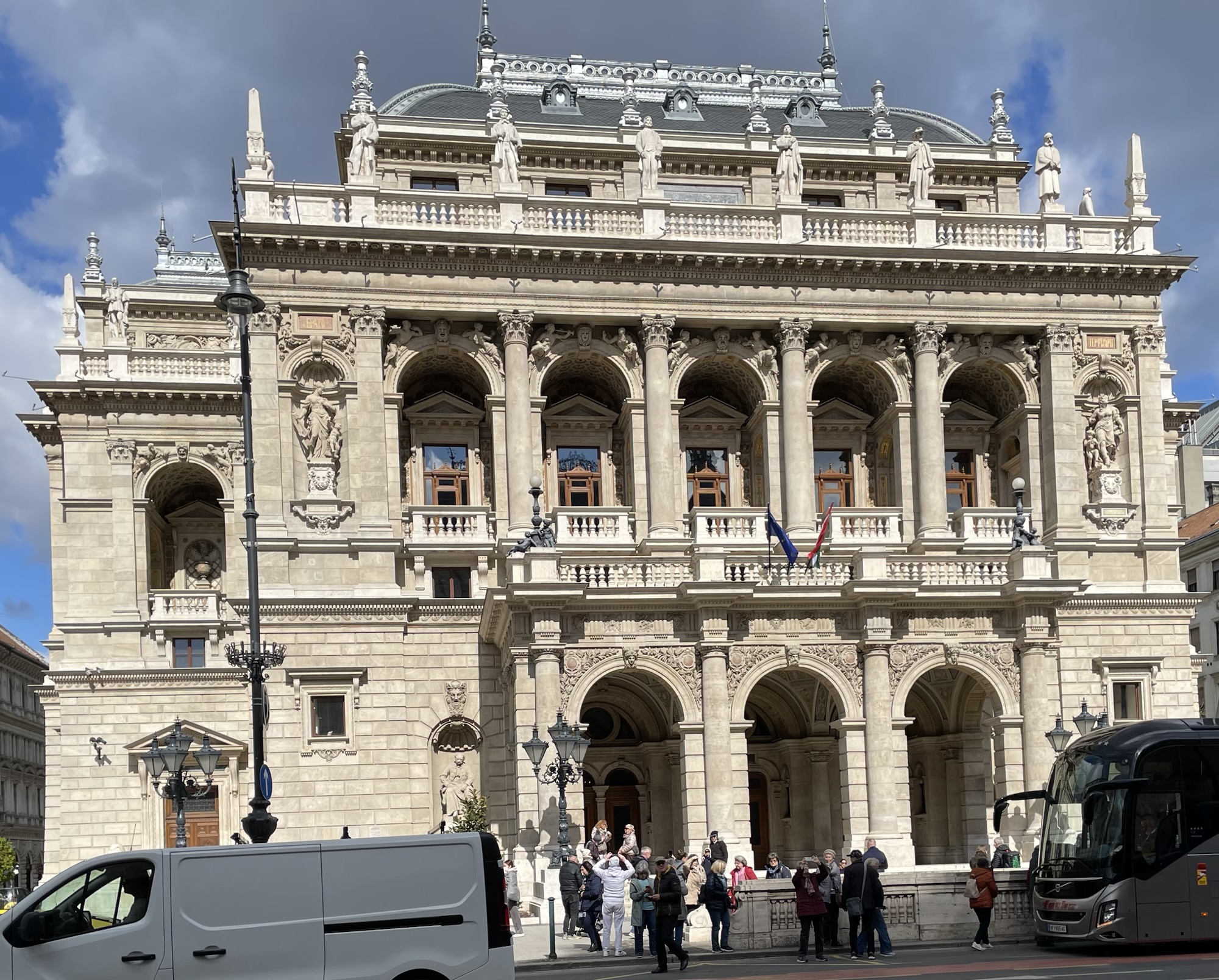
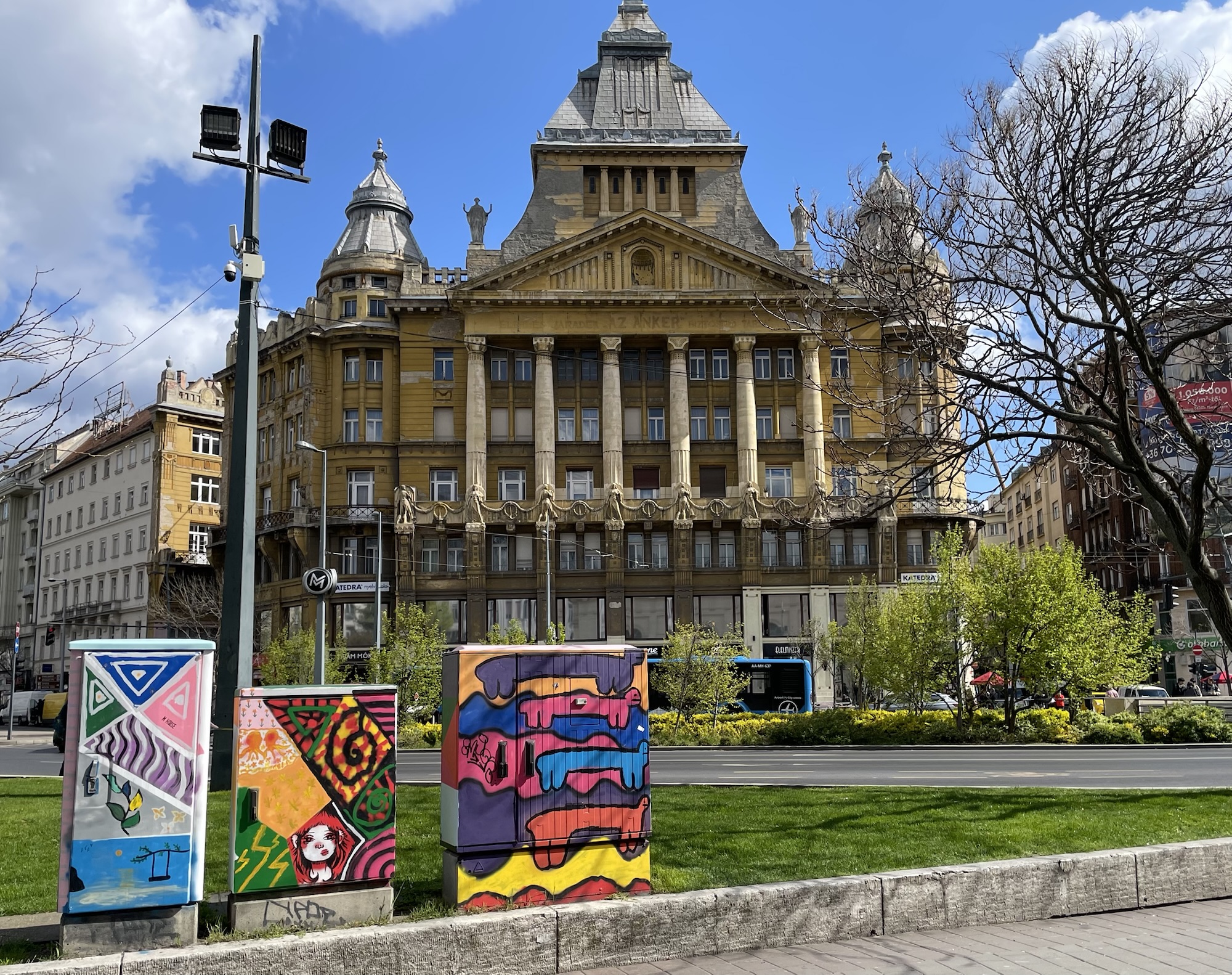
Budapest is a beautiful city. Like Prague, around virtually every corner is another deco or nouveau building, a small green park, or a monument with an unrecognizable, to Americans, statue on top.
It is also infected with plenty of American shops, pizza restaurants, kebab shops. I suppose we should no longer be bummed by Starbucks and McDonalds and Burger King, right? And yet…
We arrived several days before our Danube cruise started, fresh out of France and perhaps a bit hard to please on the food front as a result. Our visit was also handicapped by incredibly cold and windy weather that arrived our first morning. Nonetheless we layered up and headed out and about.
Public transportation
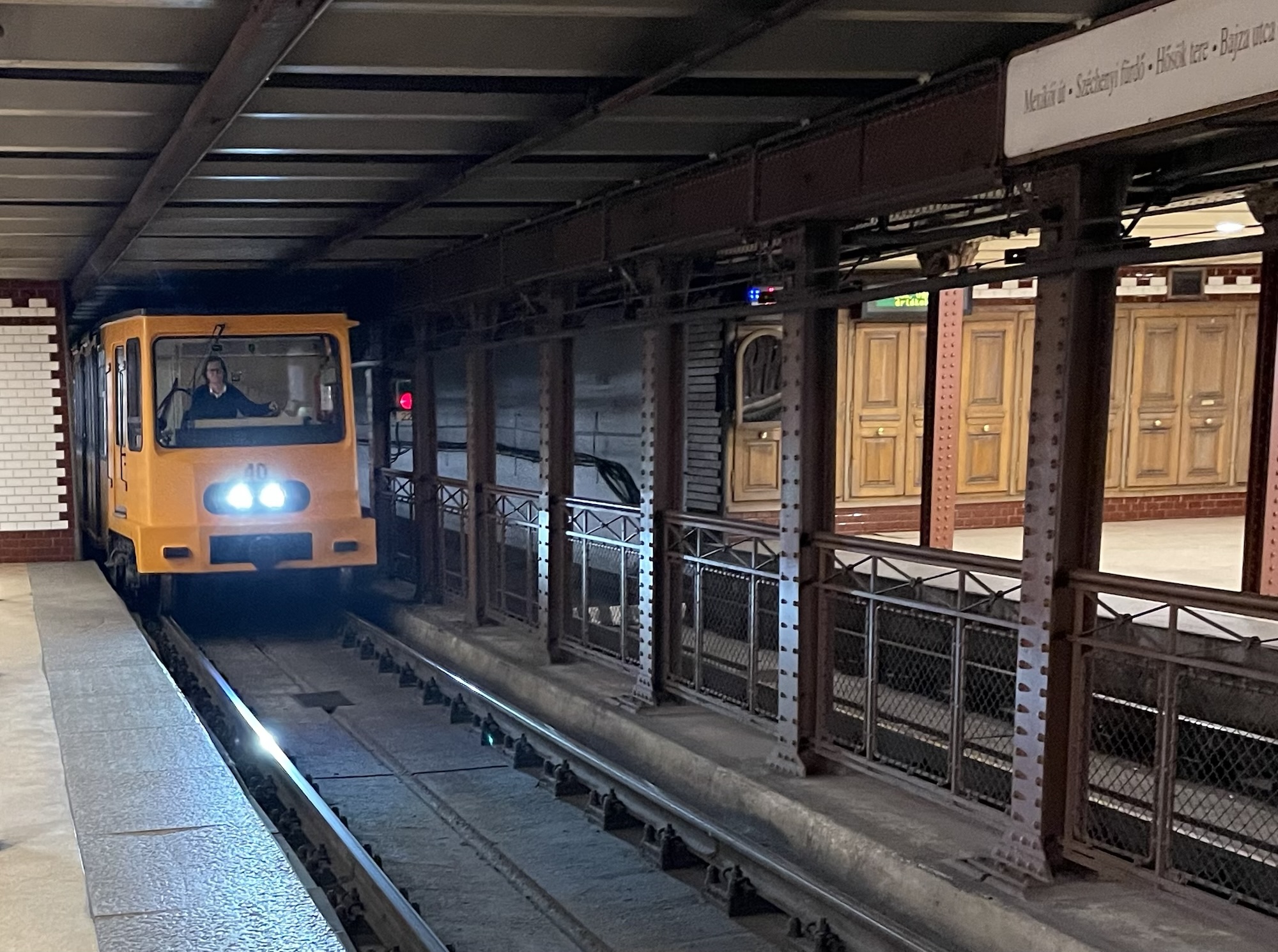
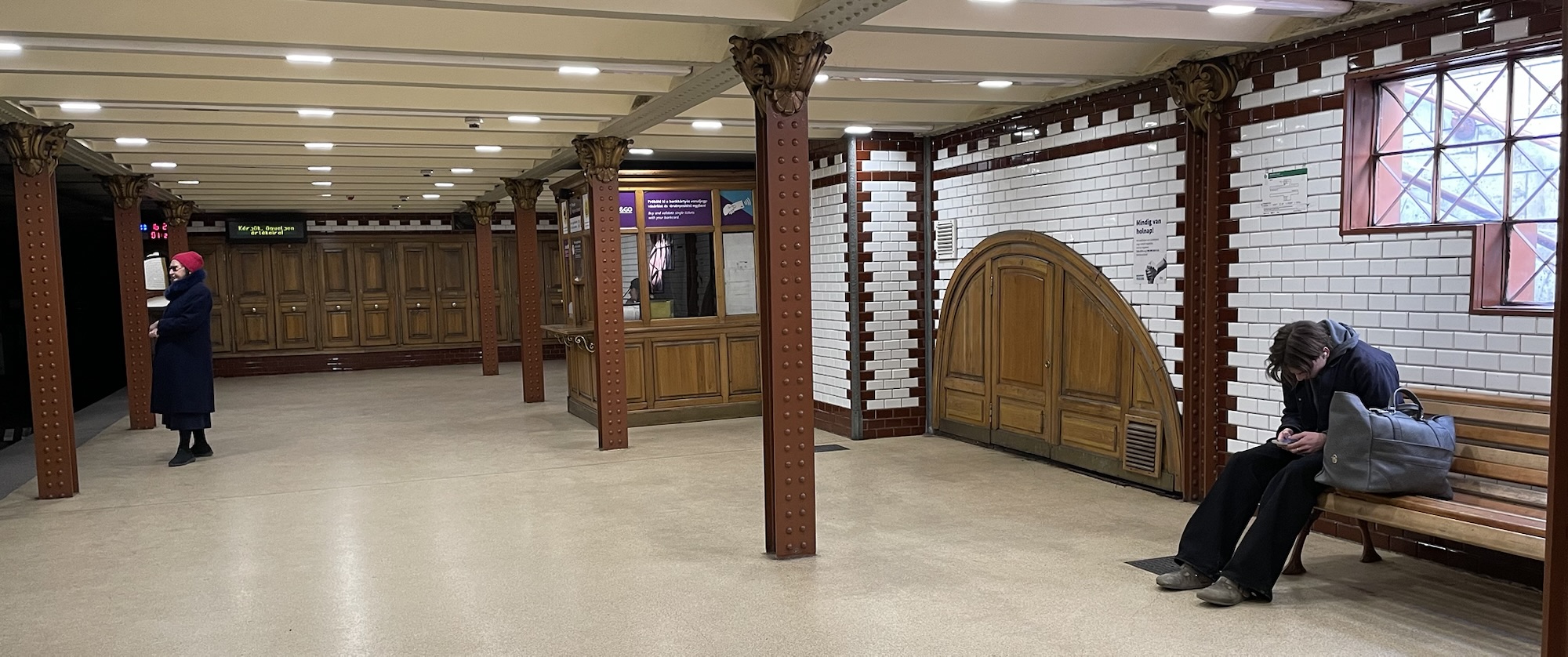
Line 1, the yellow line, oldest in Budapest
The metro is great, with the added attraction of the oldest line (yellow) with white and brown original tiled stations, quite small, and low ceilings. According to our guide it was the 3rd major underground system in the world after London and Istanbul. It is not many steps below ground and supposedly because it is not in a tunnel it is technically not a subway. The cars have leather straps (!), low ceilings, and the most terrifying door closings I have experienced. I tried to capture them on video but it does not do them justice. Ding, ding, ding and the doors close, slamming violently the last few inches. I bet they would take a limb off, easy.
Between the metro, the bus system, and electric streetcars you can get anywhere and quickly.
Advice: From the airport skip the cab line and head right for the express bus 100E, which barrels into Pest and drops you right in the center.
As we lined up for that bus, pretty tired from walking at least ten miles across the Munich airport (very slight exaggeration), we were taken aback by a twenty-something man who was almost aggressively asking us a question in incomprehensible English, over and over. We stepped back, alarmed, as another young man at the door to the bus asked if we were over 65. Uh, yes? No charge for public transportation! The insistent young man who had been pressing us a moment before looked down, saw he didn’t have his ID badge around his neck and immediately fumbled to get it out of his jacket pocket. He had been asking us “How old are you?” Poor guy.
Google maps were reliable for walking and taking public transportation, with few of the dead spots in many other old cities. So in spite of the windy cold we got around easily.
Disappointing
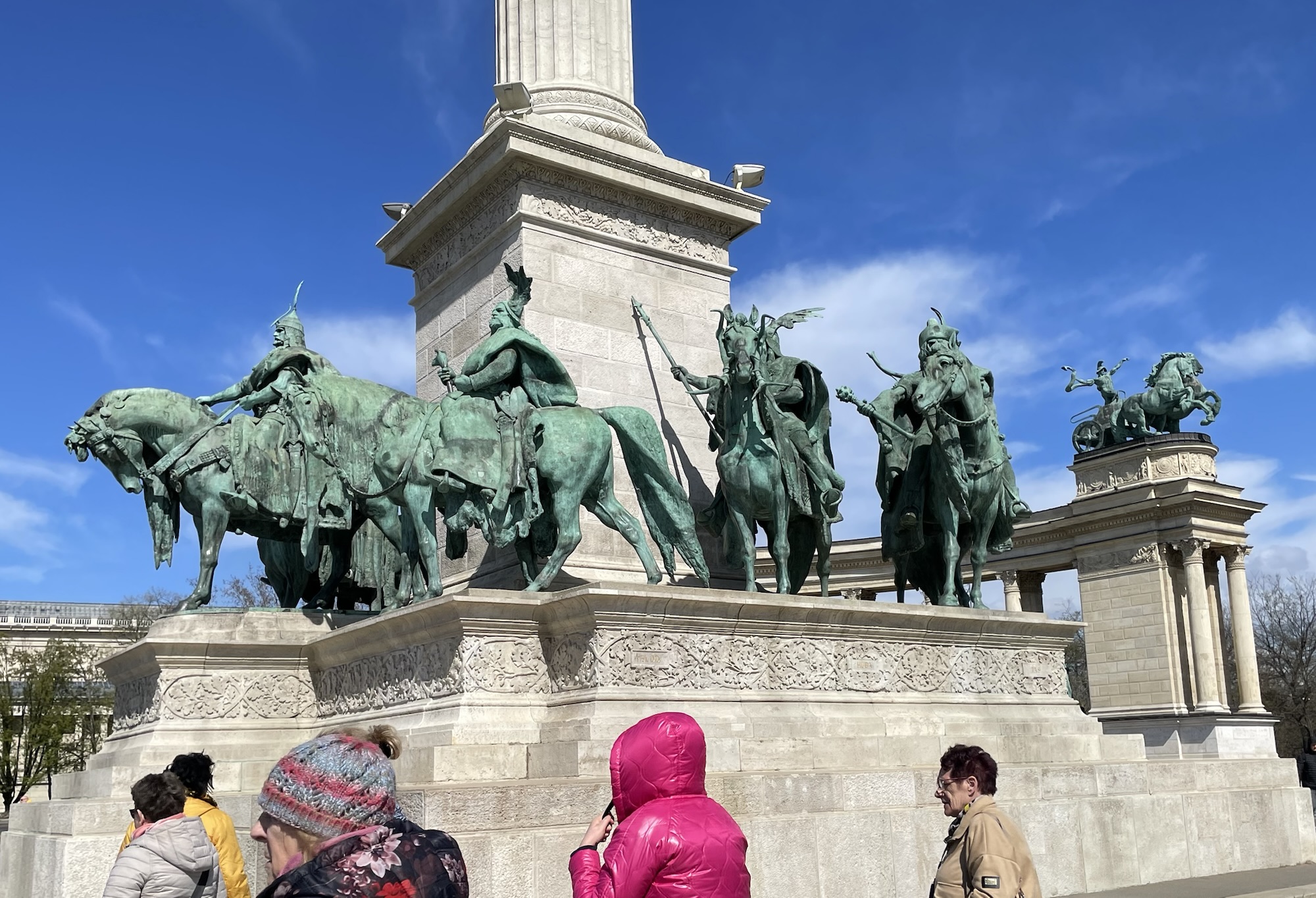
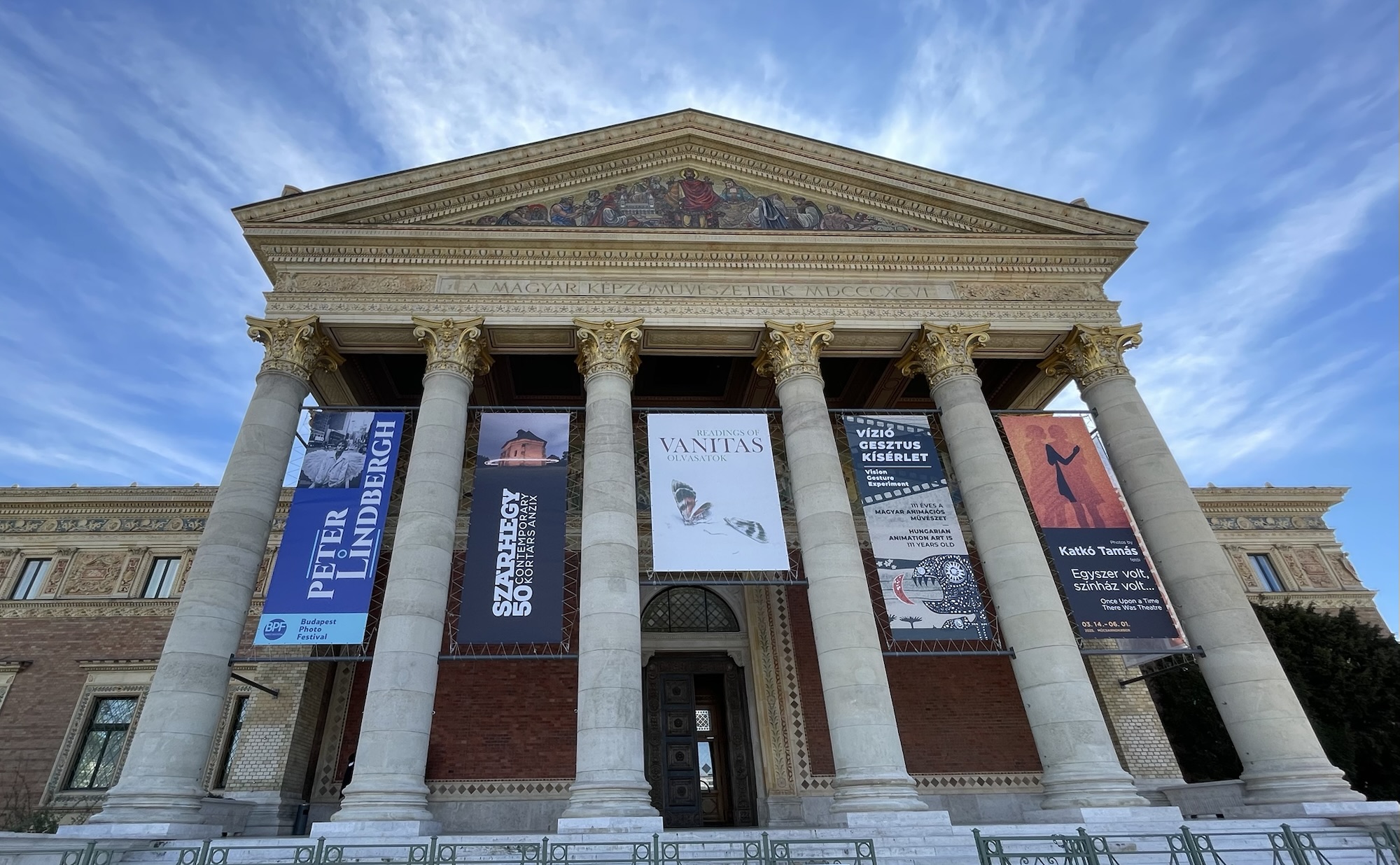
We love museums, primarily art and history. We found Budapest museums underwhelming. The fine arts museum, which is on Heroes Square (which is magnificent) is only mediocre and the building itself terribly confusing. It seemed in each era the examples on display were not the most impressive. Admittedly we have been to a lot of art museums but I do not think we’re jaded, we just had no wow moments, no revelations. But it is very well regarded and maybe we weren’t in the mood.
Heroes SquareHistorical Hungarian leadersFine Arts MuseumOne half of the Ethnography Museum
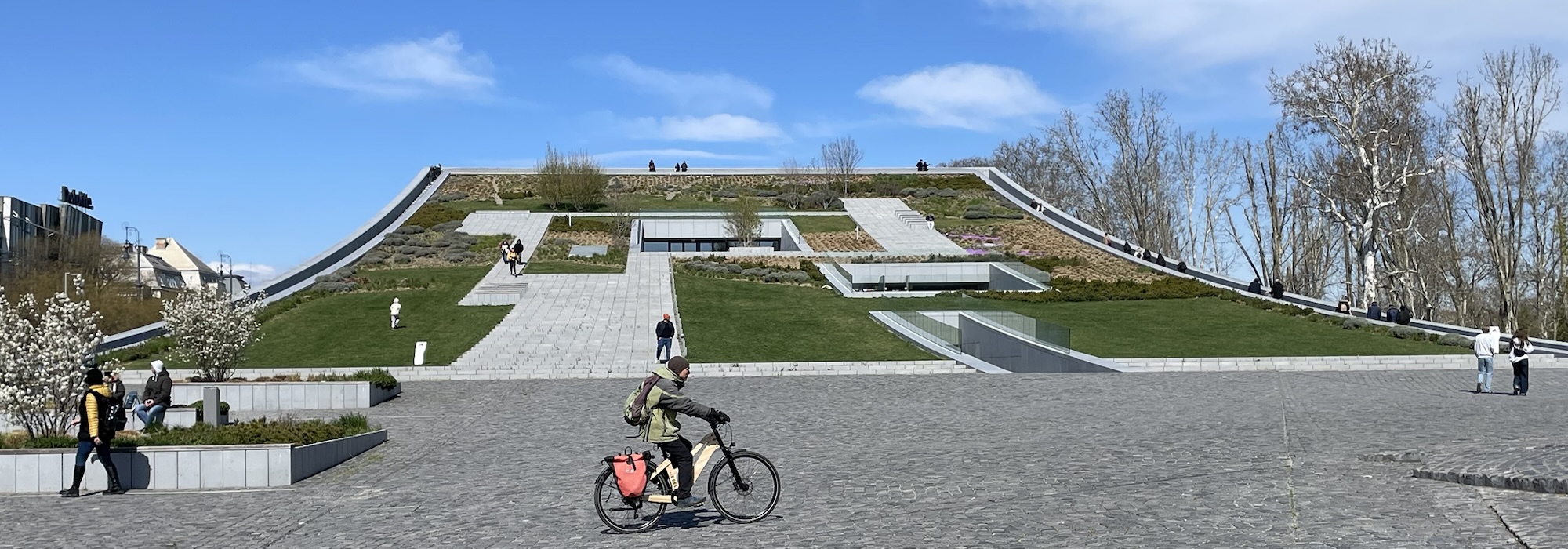
In retrospect we wish we had gone to the ethnography museum instead. First of all the building is amazing from the outside (see photos below) and lots of people were walking up to the top. For us it was way too cold and windy to try. A missed opportunity. And second, given the bits of Hungarian history we picked up a few days later at the national museum, an ethnographic history would have been fascinating. Quick, which language is Hungarian most closely related to? Yup, both the Finns and the Magyars came out of Siberia.
Our last museum experience worth mentioning was the National Museum, all about Hungarian history. Best part by far is on the second floor, 1703-1990. Lizt’s piano, which had been Beethoven’s! And the fascinating era from World War I through the velvet revolution. Well laid out, sufficient English signage, moving and just interesting.
Beethoven’s, subsequently Lizt’s piano!!
When we got there, tired as all get out, we decided to take the elevator up and walk down. We asked where it was at the entrance and were told to see a particular woman who motioned for us to sit down. We did. After perhaps ten minutes we didn’t begrudge given how tired we were, she motioned for us to follow as she led us through locked doors, a warren of hallways, finally getting into a freight elevator to the third floor where we were escorted back out to a public area. We said thank you and went on our way.
Our Hotel
Beautiful in the daytime too.These bronze figures are all over the city. This is right outside the hotel.So Zsa Zsa, darlingNight view from our room
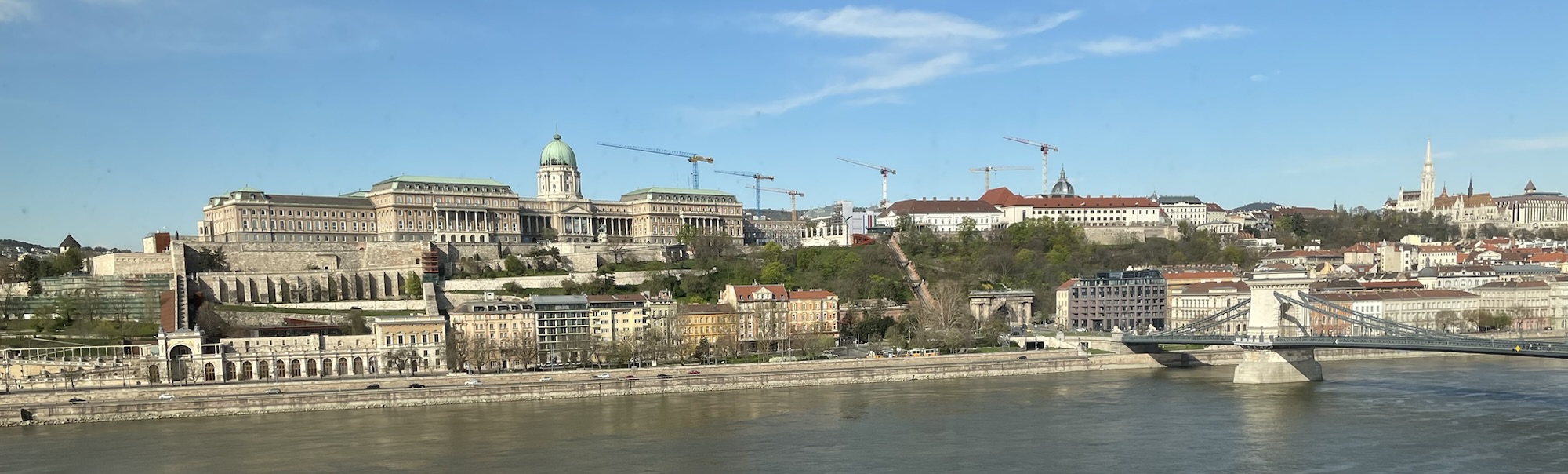
We stayed at the Intercontinental Hotel, right on the river, and we thrilled to the view both day and night. Our room was big and dead quiet, bed comfy, and we almost caught up on our sleep.
Food
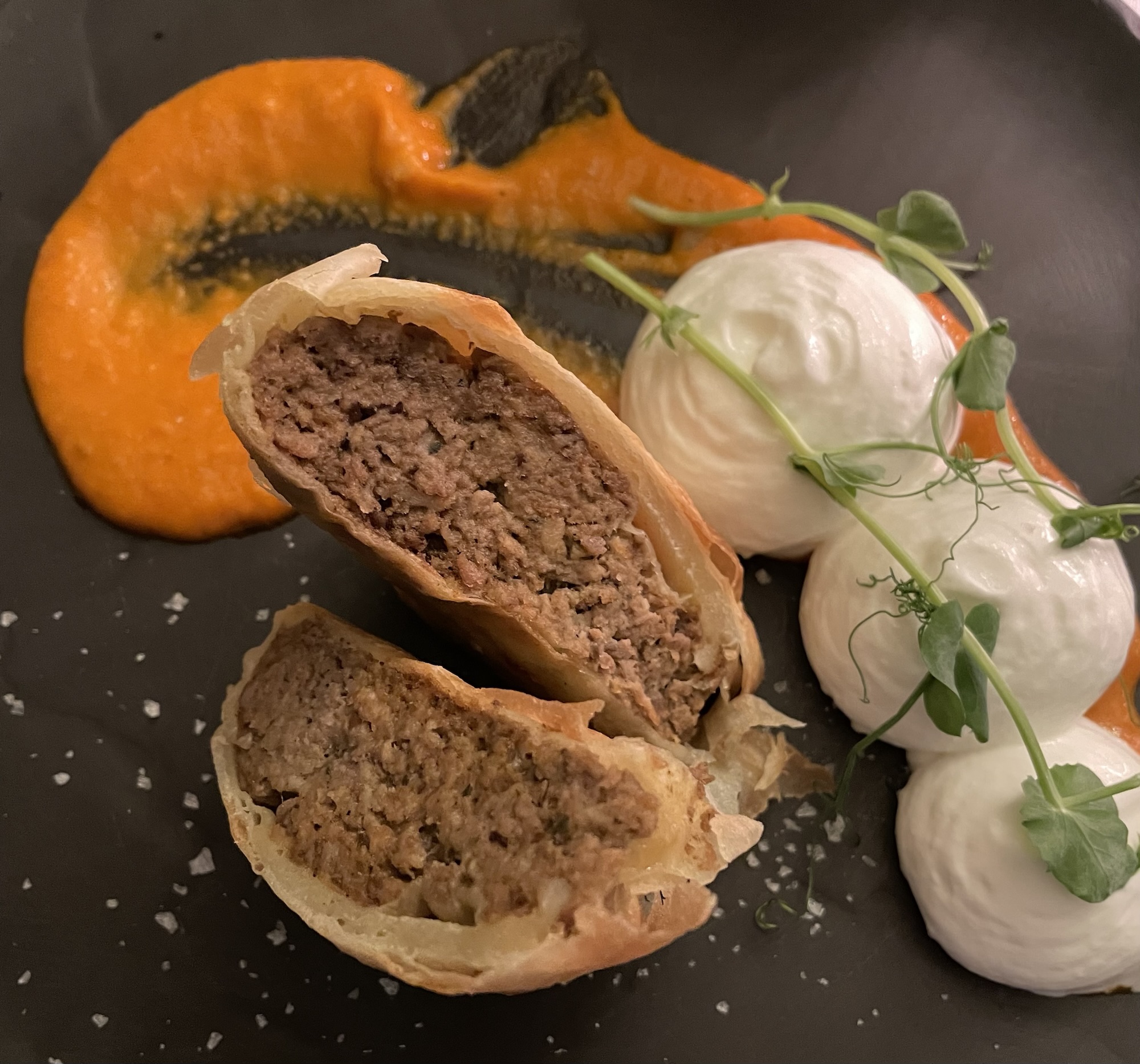
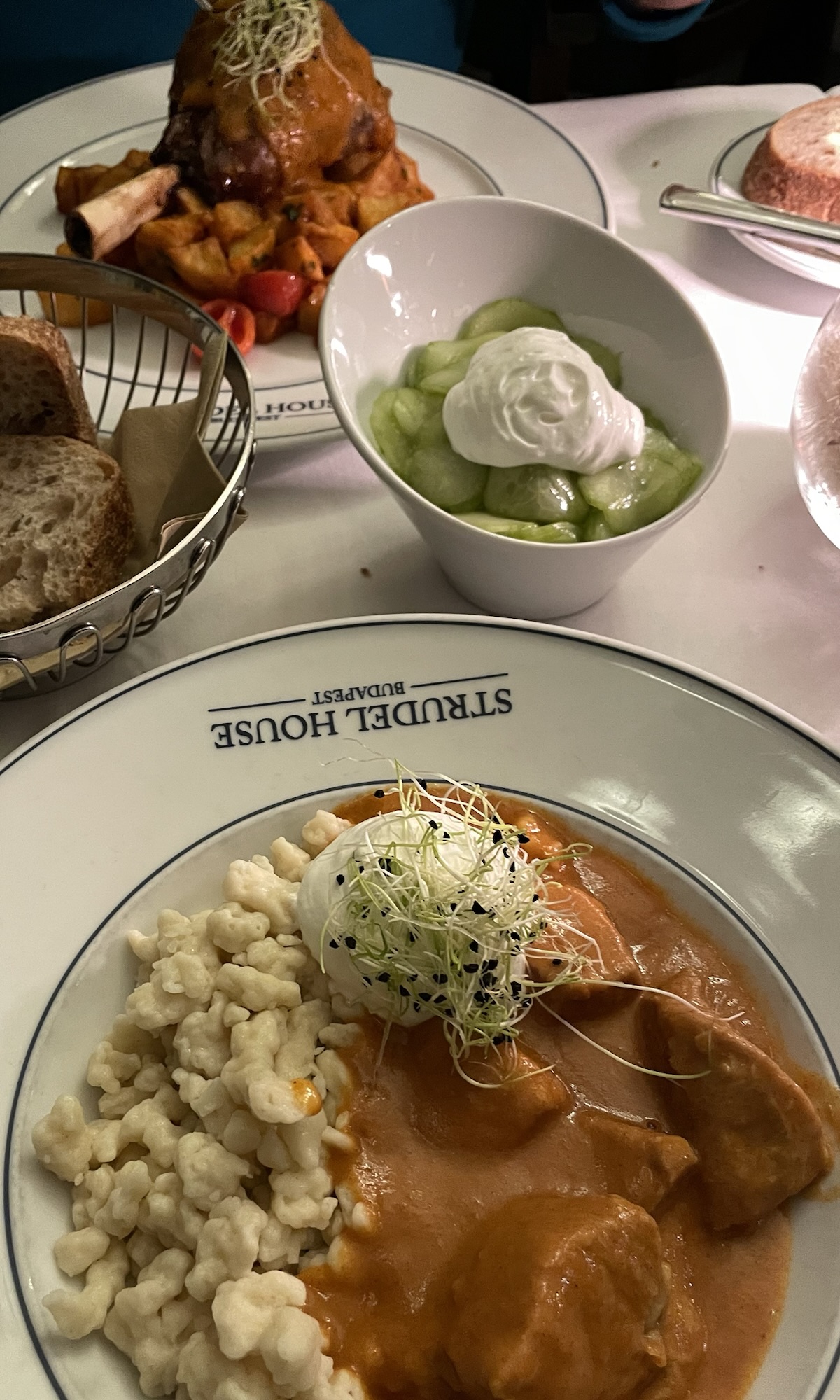
We had paprikash and goulash several times. Delicious. I think perhaps the cucumber salad that came with veal paprikash our last night was a highlight, as was the “onion” soup David ordered. It was the bright dark green of very fresh spinach, maybe, thinner textured than a cream soup, and wow what a flavor. The English translation in the menu was “Ramson’s onion soup.” Oh! Ramps, a beloved spring wild onion found in eastern US. it was a revelatory dish. This great meal was at Elso Pesti Reteshaz, also known as Strudel House. And yes, great strudel both savory and sweet.
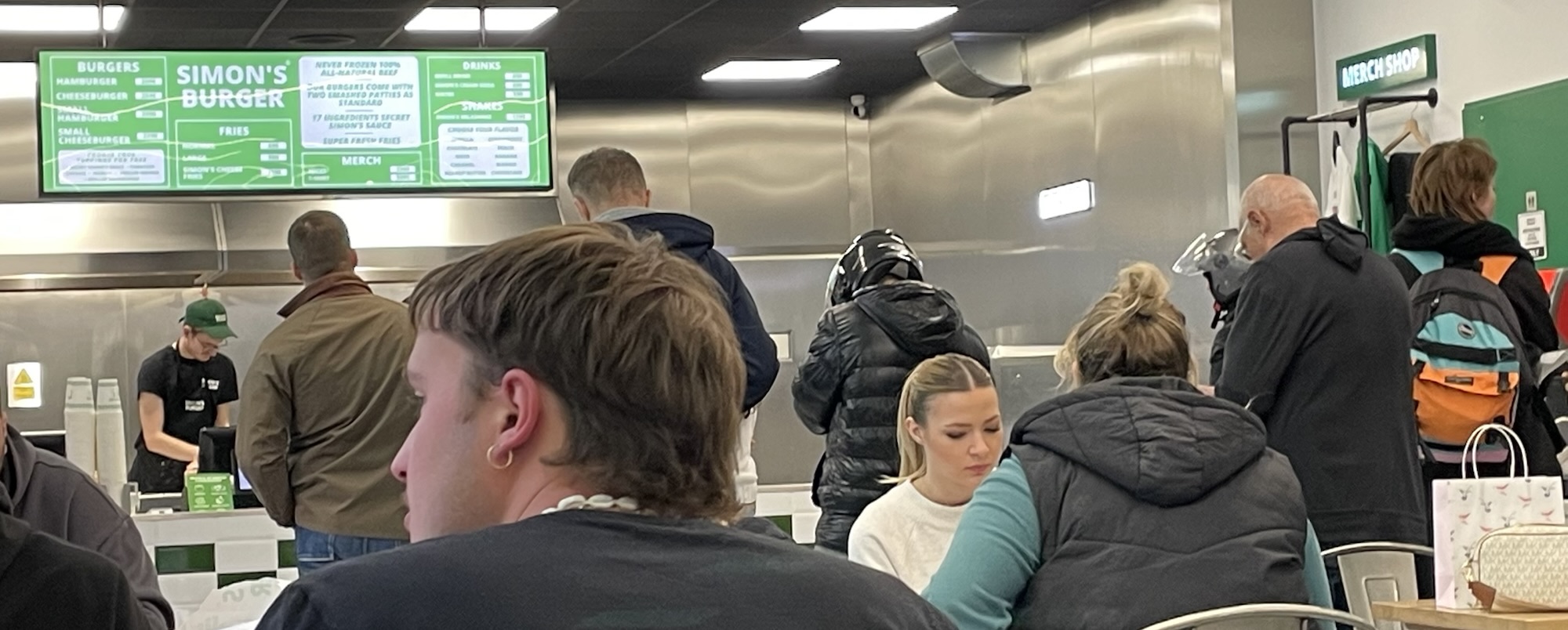
David and I raise the average age in Simon’s
A funny and yummy meal experience at the other end of the spectrum is Simon’s Burger. It is a love letter to American smash burgers and that cuts both ways, right? But we were tired of finding places to eat, we were hungry, and it was close by. Everything is in English, though the clientele is young and Hungarian. We raised the average age by a decade and the place was packed. We had medium hopes that were way too low. The burgers and fries were terrific, perfectly cooked and hot, and the ambiance so entertaining, we were very happy we went.
The concierge sent us to A La Maison, a ten minute walk, for breakfast because it was open at 8 unlike many of the coffee houses. Huge menu, delicious variations of eggs benedict, a few oddities to Americans like Hungarian French toast (savory, served with grated cheese on the side), pretty darned good coffee and fresh orange juice. Heaven for me.
Jewery
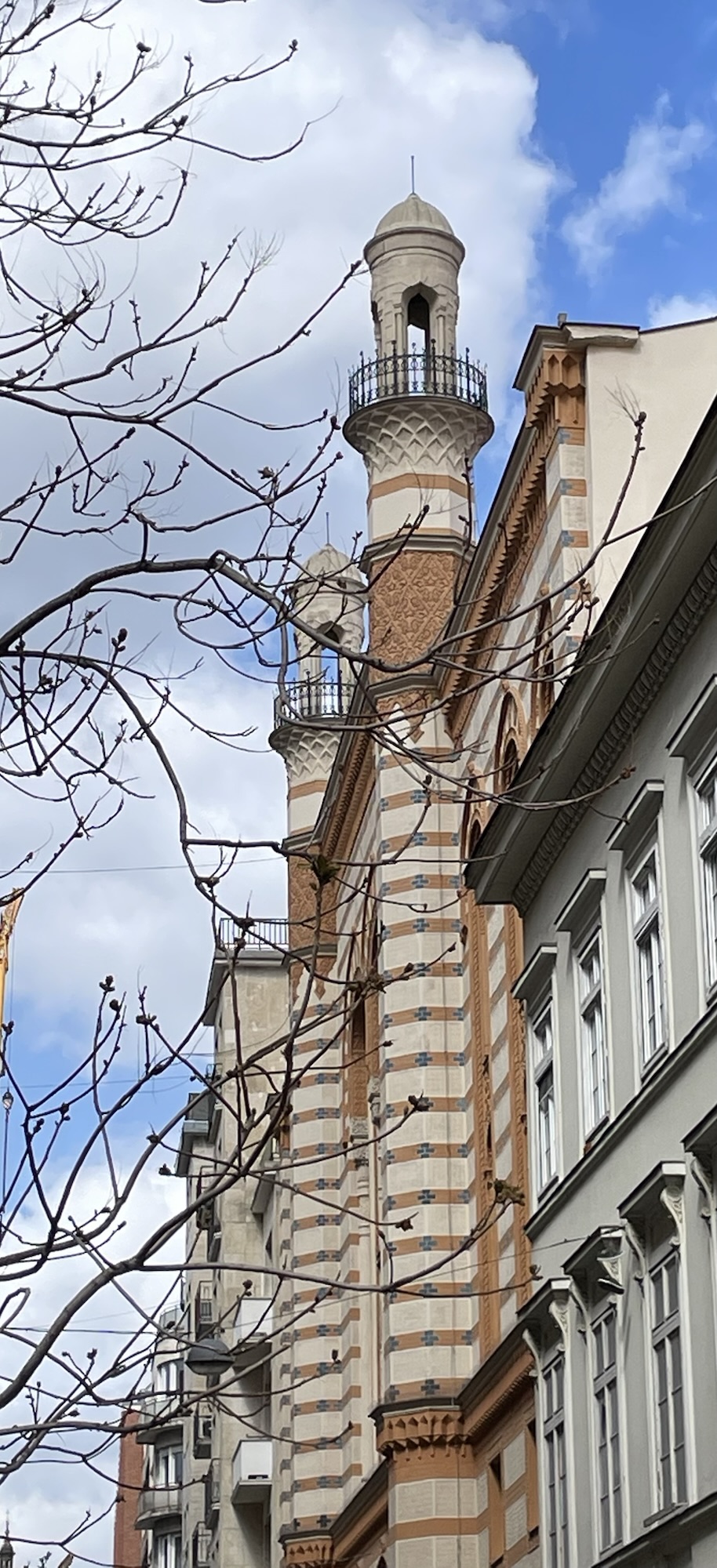
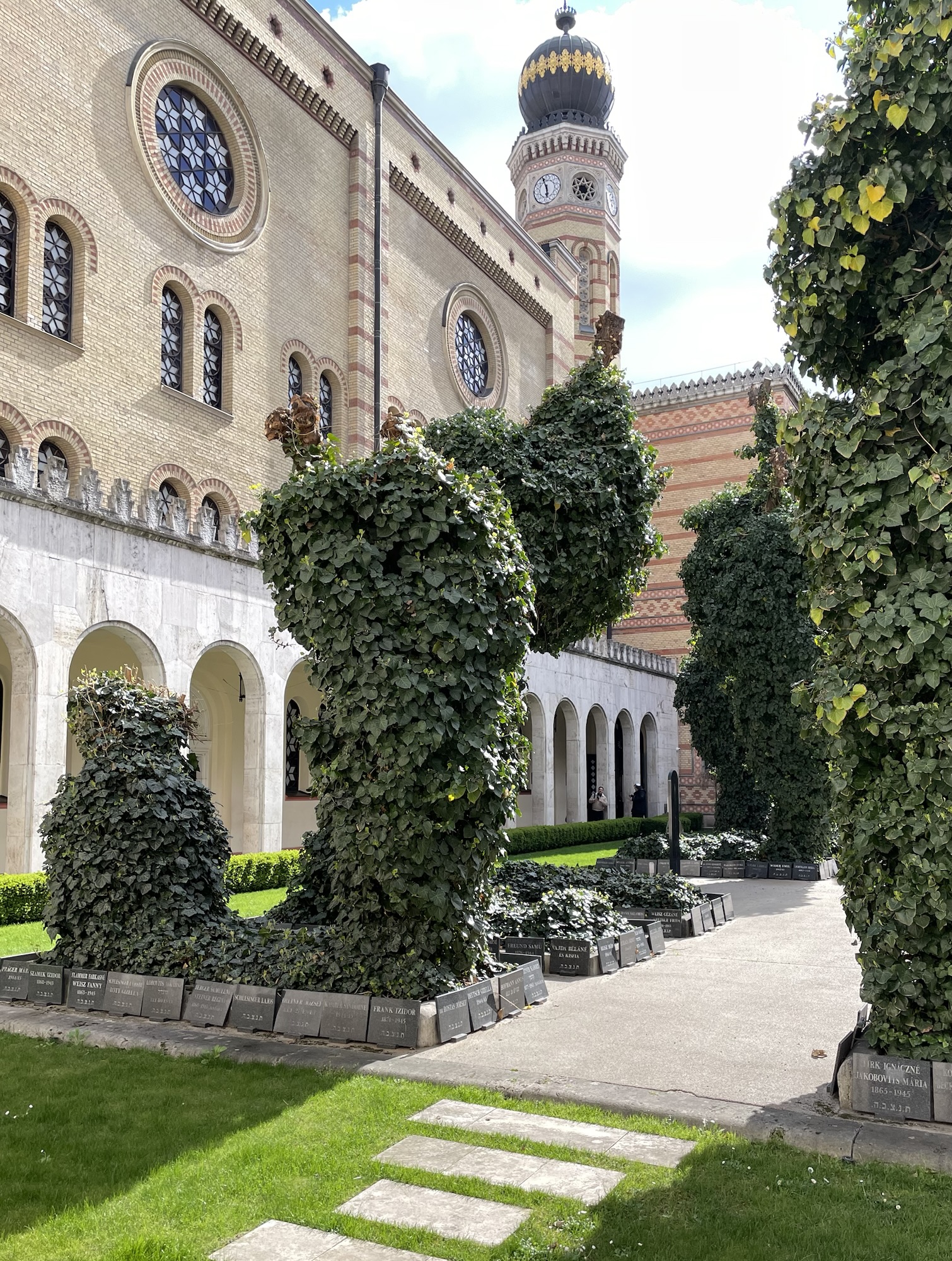
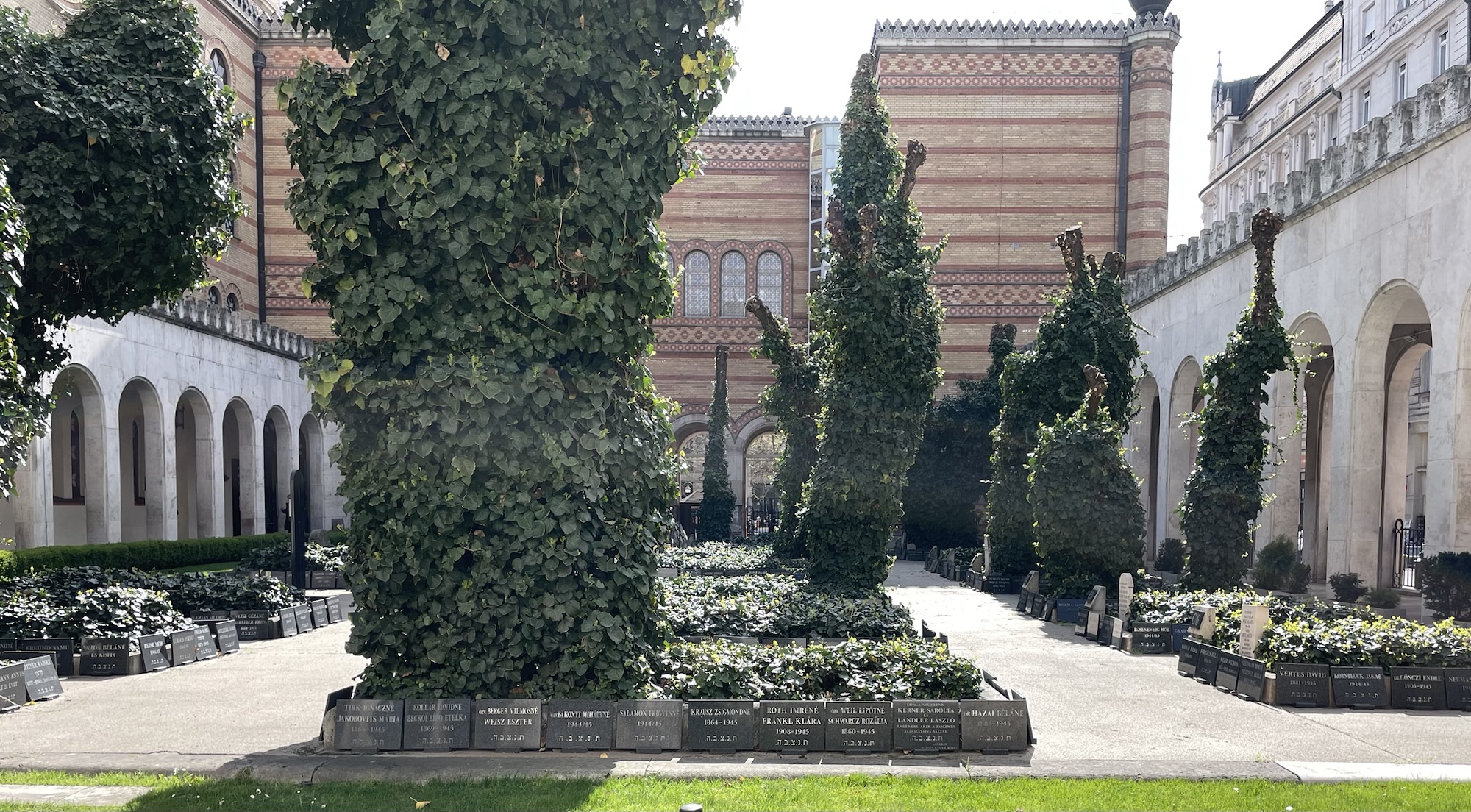
The Jewish quarter is known as the party district due to lots of “ruin bars” and a funky feel. It also has a lot of Jews and several large synagogues. One of these also has the Jewish Heritage Museum (somewhat boring) and a devastating photo exhibit about the demise of Budapests’s formerly large Jewish population at the very end of 1944, and the cemetery of mostly unidentified victims buried in perhaps a dozen mass graves ringed with the gravestones of the small number who were identified. Also a courtyard dedicated to Raoul Wallenberg and other gentile heroes who saved Jews from the Nazis. Worth seeing and facing but personally I couldn’t manage all of it and ended up leaving to cry in the synagogue.
Known and unknown buried together
Surprisingly interesting for me is the Robert Capa museum of his photography and his life. What a life. He was a very famous war photographer starting in the Spanish civil war through both world wars. He took a break of a few years, managing to squeeze in an affair with Ingmar Bergman and friendships with Steinbeck and other men of letters, then returned to the French Indochina war where he died in 1954 when he stepped on a land mine. It’s a grueling experience to see his work and read about his life and worth every minute. The Capa museum is on the edge of the Jewish Quarter, so if you are visiting I advise you to pace yourself.
Miscellany
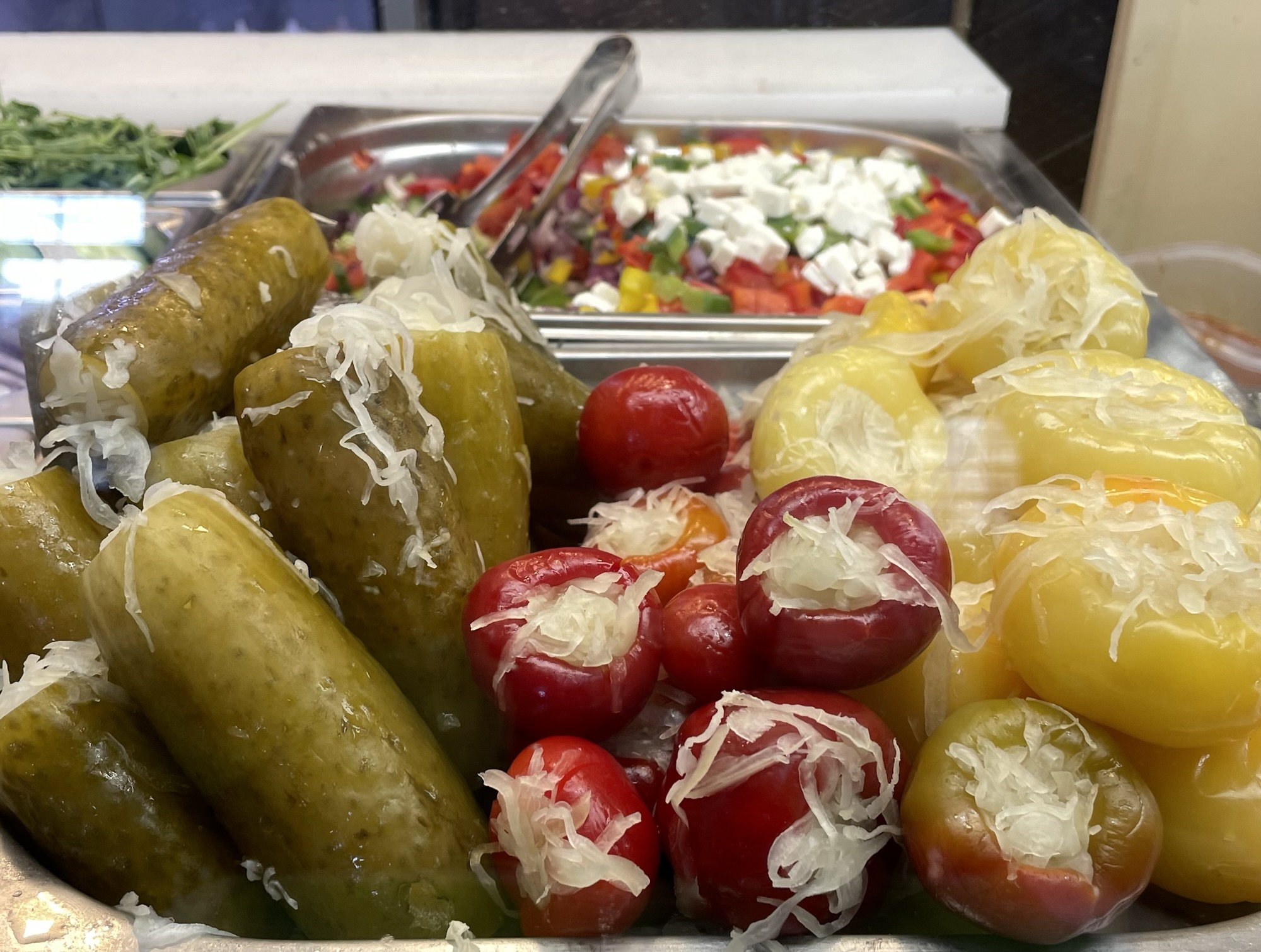
The enormous, somewhat touristy Central Market is worth a trip if only to buy eleventy-seven kinds of paprika. I also discovered the butchers are happy to sell you 4 little slices of salami to scarf down on the spot.
Hungarian specialty chocolatiers are amazing!
As you bus from center city outward the beautiful buildings gradually step down from maybe 7 stories to 5 to 4 to 2. All of the nouveau/deco eras, all gorgeous.
If you manage to learn even 3 words of Hungarian, especially thank you, you will always get a smile.
Most people who mention the government are scornful of Orban and sadly baffled by you-know-who. Oddly coincidental Netanyahu was landing for a visit as we landed Saturday.
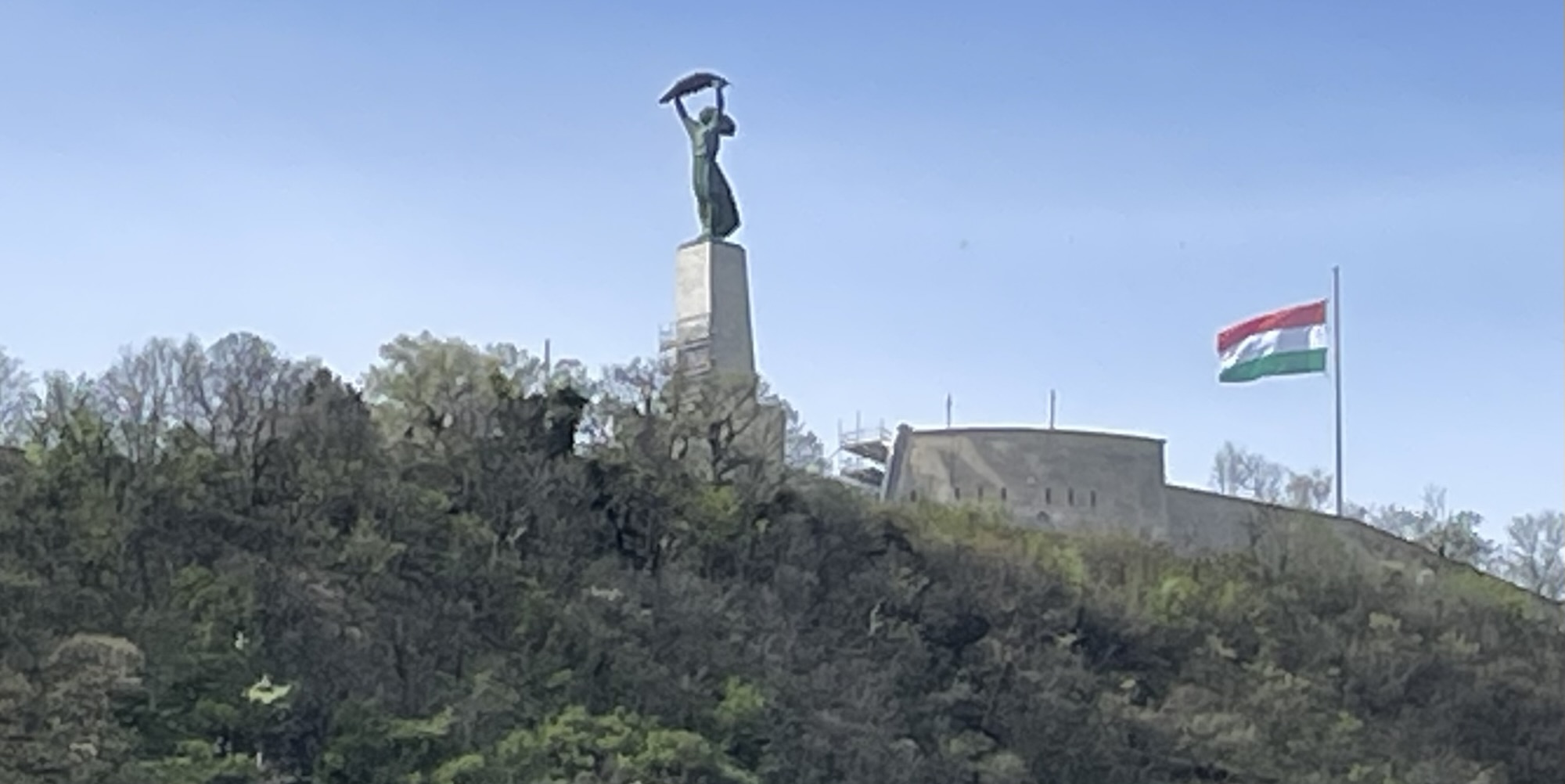
The photo below is a soviet era statue, very very large on the hill in Buda. After the velvet revolution it was draped in a white sheet for three days…our guide said it looked ghostly. Then the sheet was removed and it was renamed Lady of Liberty. Cool, huh?








































 Inescapably Rational