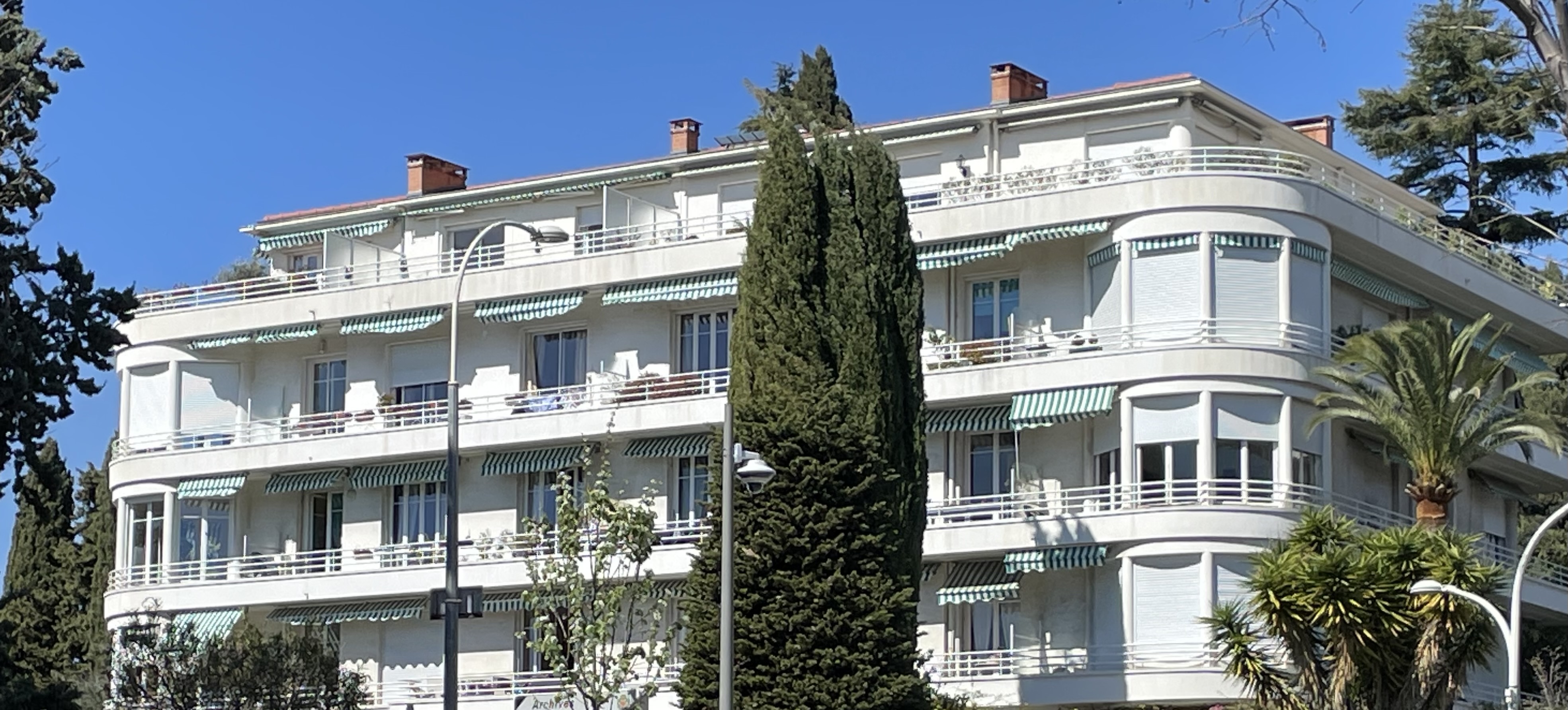
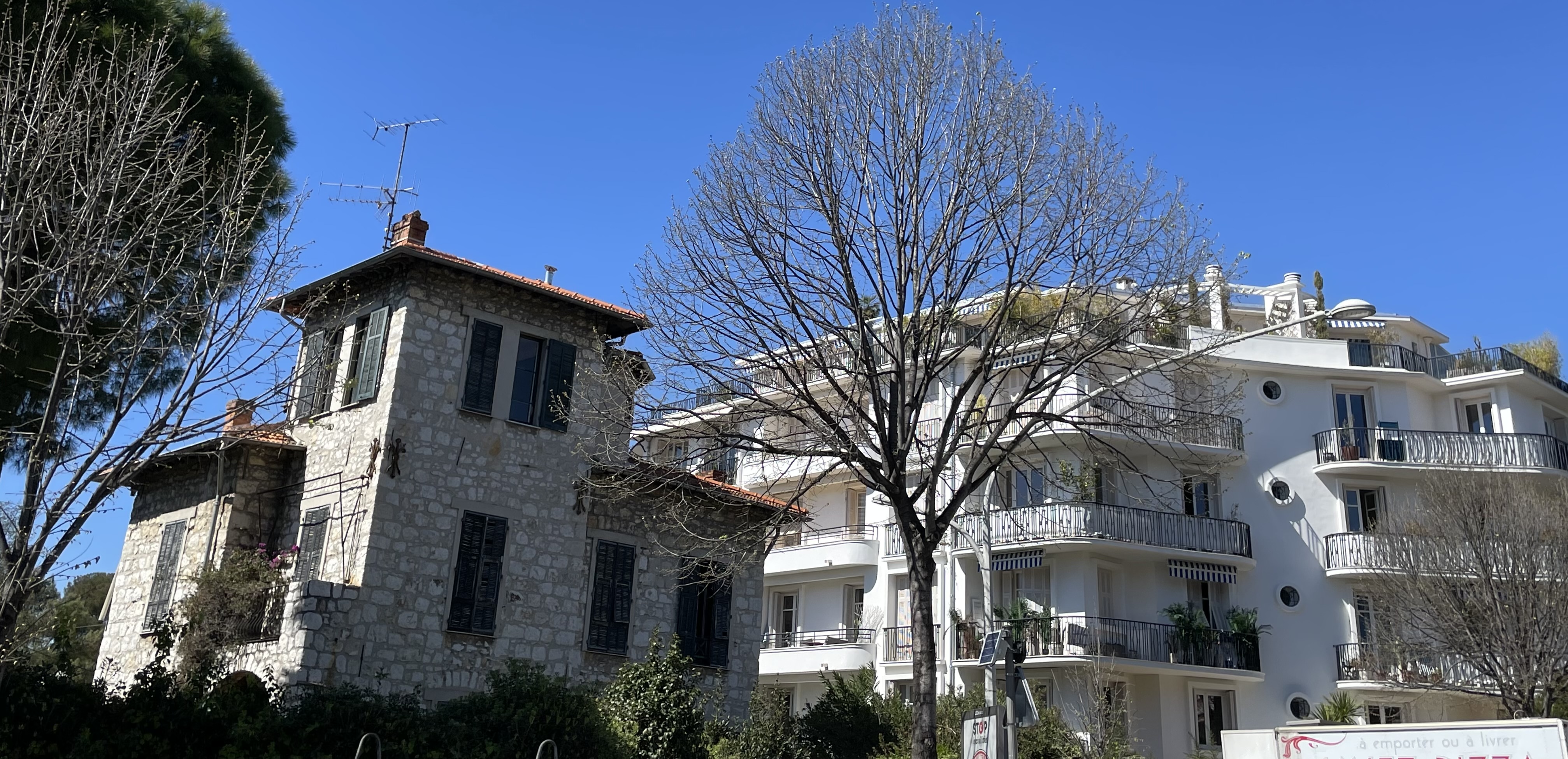
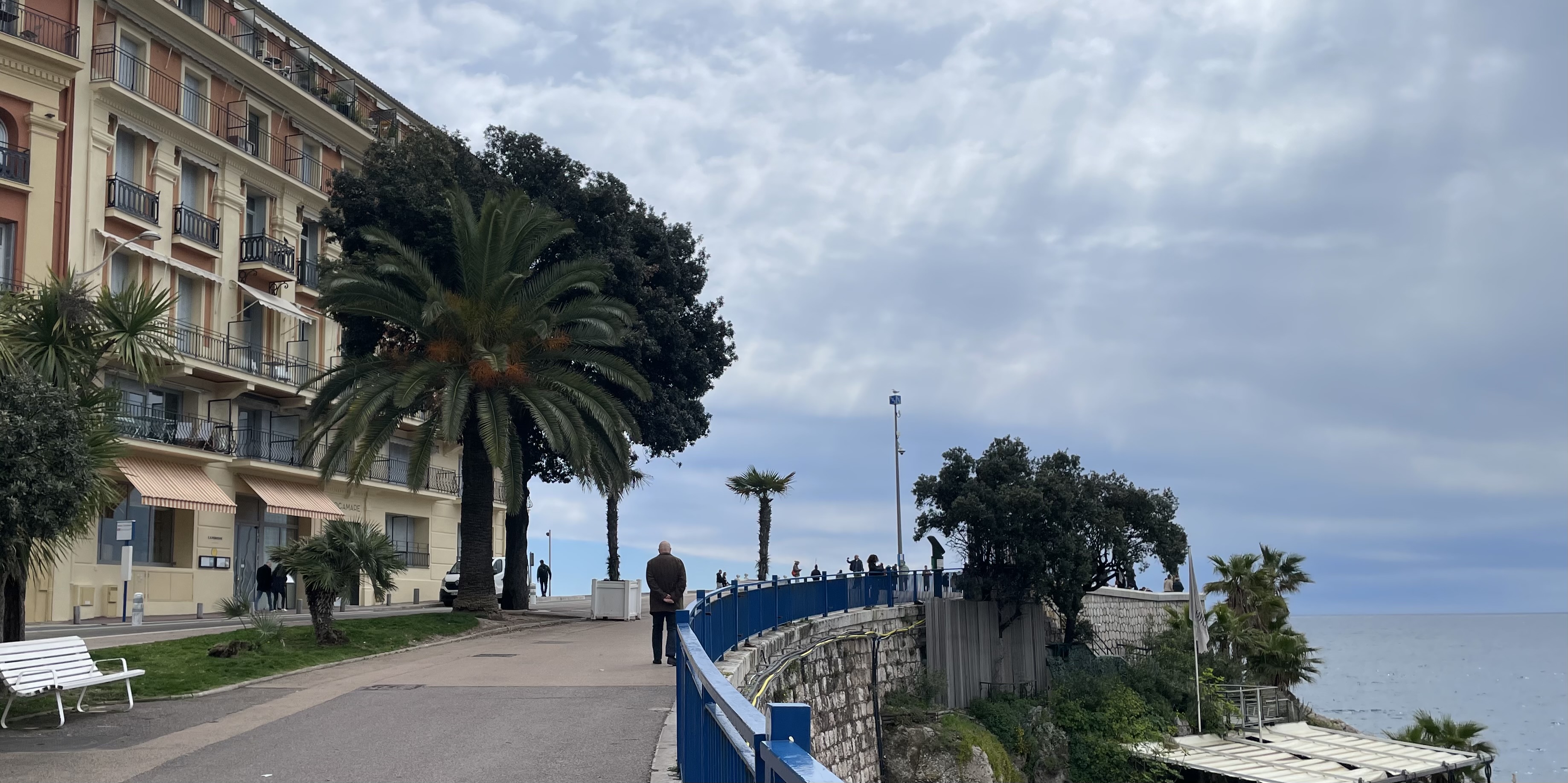
We arrived in Nice by car and I missed the exit so we ended up driving a bit more through the city up in the fancy hills. So very pretty—everything looks like it came right out of a movie in the 1960s. Large buildings with wrought iron balconies that would be complete with a young beautiful blond woman in a flowing scarf leaning over and calling “Jacques, I’ll be right down” as she scoops up her miniature poodle and ducks inside.
The view from my aunt’s apartment
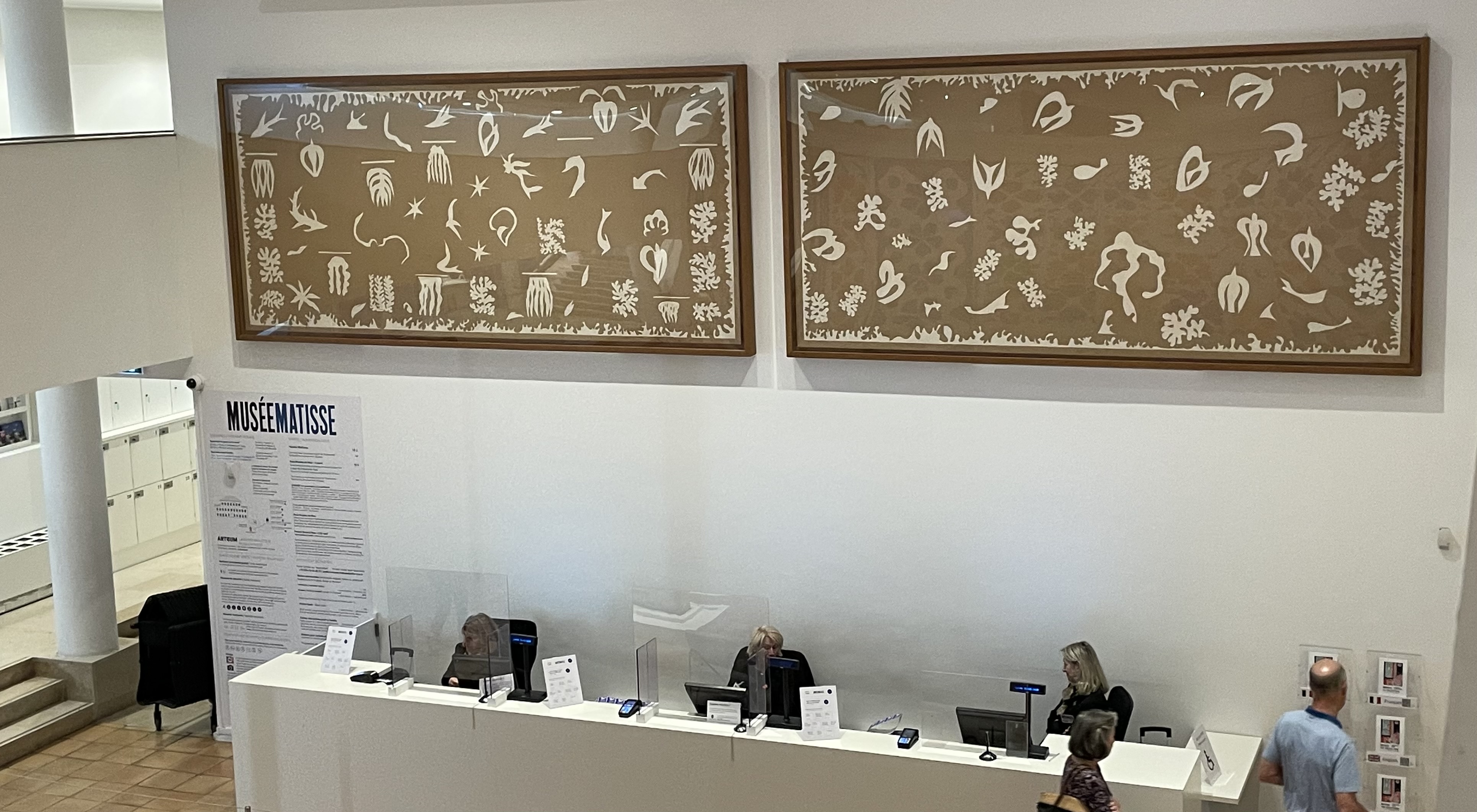
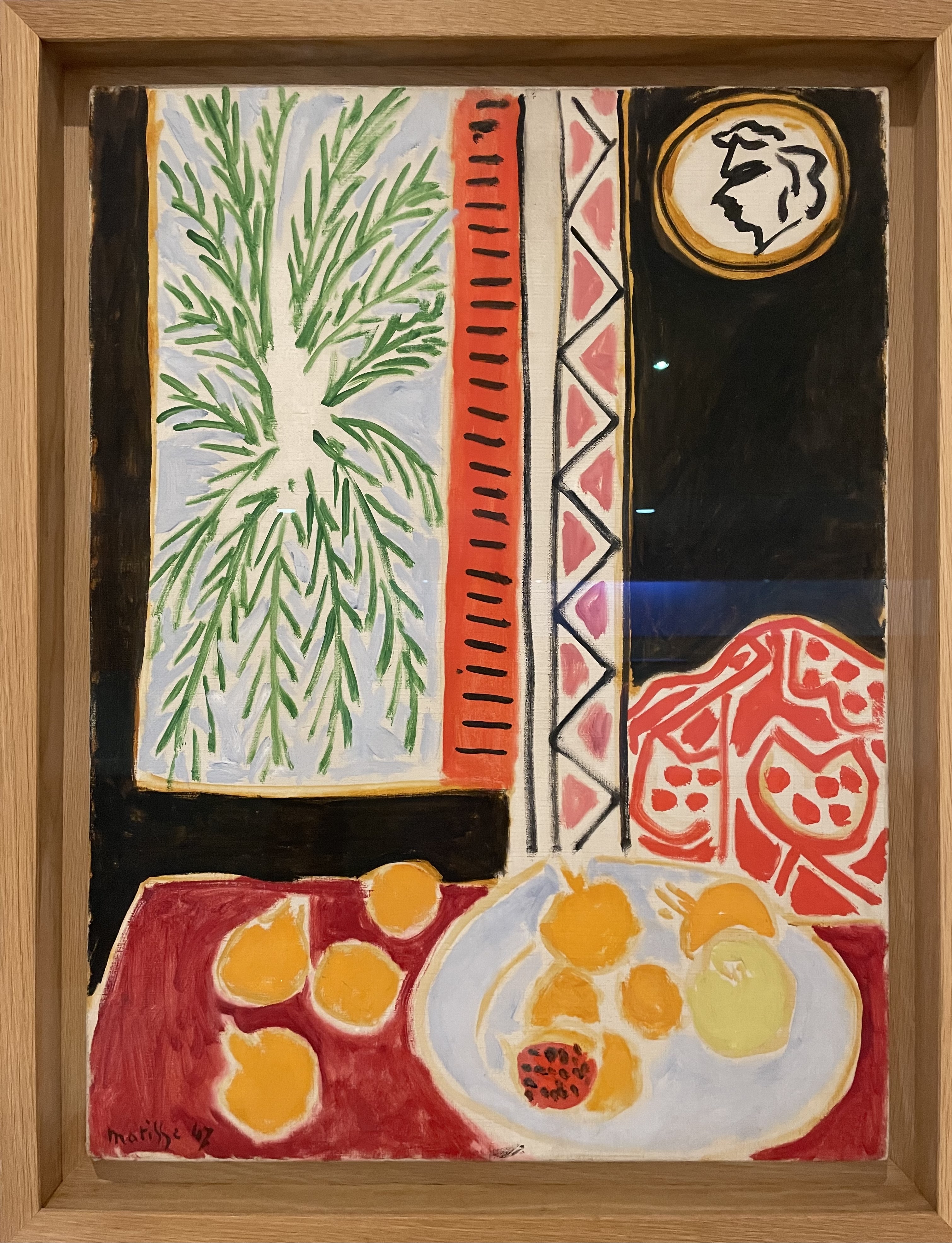
We didn’t see any blonds with poodles but we have enjoyed the lovely scenery, fantastic food, and the mix of old and new. It is by far the largest city of our trip so far and though I’m still going to hold out for a little apartment in Villeneuve, this place ain’t at all bad. Best of all, it has a museum devoted to Henri Matisse, my favorite painter, which I sopped up. Fortunately for David he is also a fan so he also enjoyed it and tolerates my over-the-top delight.
If he’d stuck with Impressionism he would have been grand!
The museum is here because Matisse and his family donated many many drawings (so many of those that they are rotated into public view), paintings, sculpture, photographs, lithographs, paper cutouts. To watch his progression as an artist from his very early self portrait drawings to his impressionist paintings to his exploration of techniques to transform the flat canvas to a multi-dimensional experience to his abstract cutouts…wow. I wonder if I could convince David to go back before we leave Saturday morning.
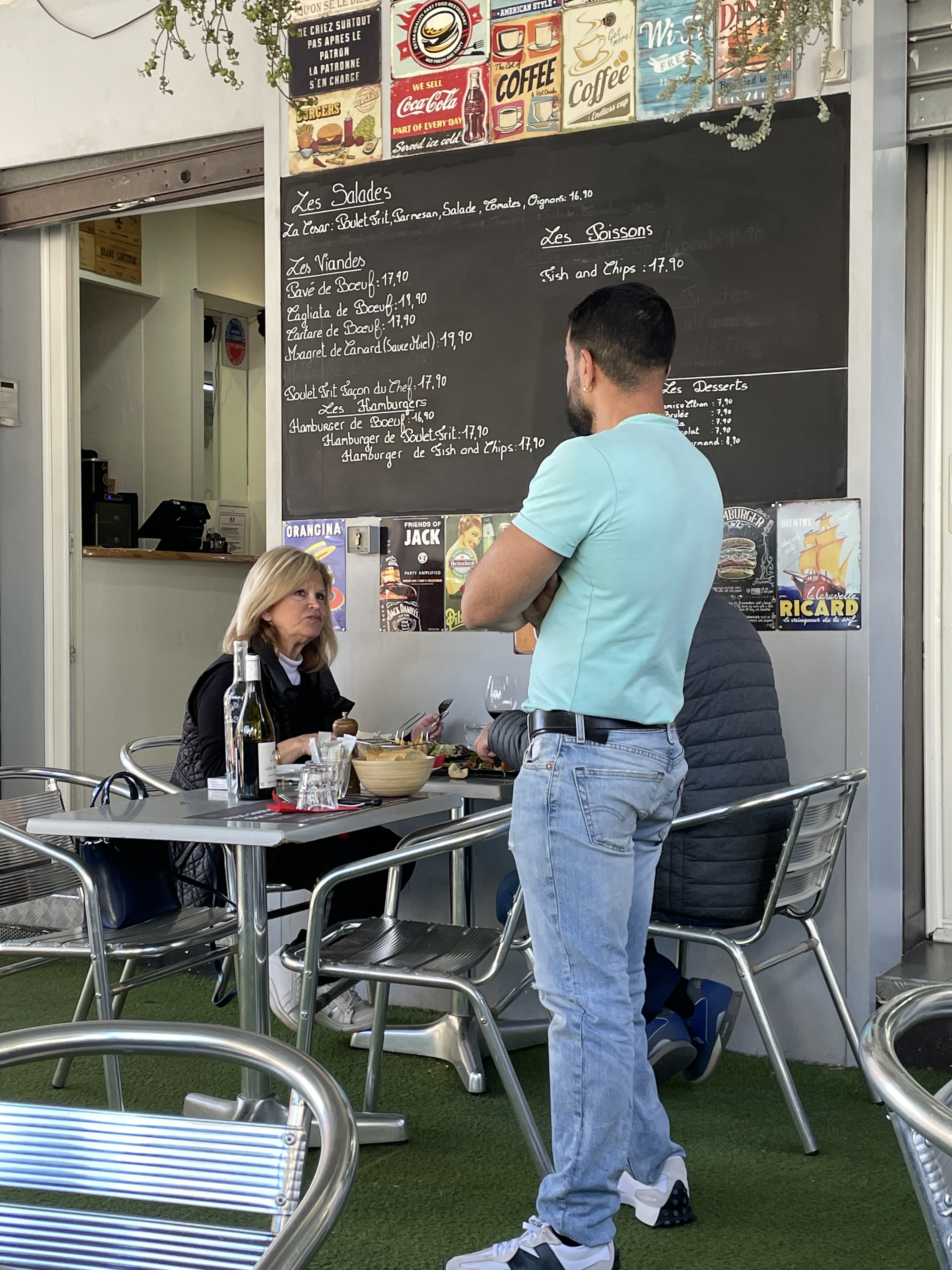
We left fully satisfied and walked down the hill to the Chagall Musee. En route I of course got hungry for lunch and we ducked into the only restaurant we passed and had an overwhelming fun lunch. I asked for the “Hamburger au poulet frite”, otherwise known as a fried chicken sandwich, which came with the predictably yummy fries. David had the “Cesar salade avec poulet frite” which looked delicious and which he finished down to the last little piece of lettuce.
Of course we were a bit tired by the time we got to the Chagall museum. We’ve seen plenty of Chagall, and David said he was not that into him because “too many goats.” So we had a contest—first one to see a goat wins. I won—third painting. We wandered the collection which is displayed in airy, spacious rooms and enjoyed it enough but our eyes couldn’t absorb any more and we walked home.
Home is my aunt’s enormous and comfortable four bedroom apartment in the thick of the commercial area, super convenient to the tram, to a large and fantastic Monoprix department store—though all we can vouch for is the overwhelming grocery, boulangerie, prepared food section. Every morning I take croissant orders and am there a bit after 8am, selecting the same assortment (butter croissants for me and the two other friends of my aunt spending the week here; a GIANT pain chocolat for David, and the ‘round thing with raisins’ for my aunt). After three days of buying more or less the same things from the same somewhat dour woman, this morning I said “A demain!” (See you in the morning!) and got a big smile and “Oui! A demain!” I think she might be tired, not dour.
After the museum overload we took the tram, right outside the apartment, to Vieux Ville, the old city. It is not separated from the rest of the city—no wall or gate that we saw—but it reminded us of the old cities and towns we’ve visited thus far. A few touristy shops and restaurants, a crowded plaza outside the old Cathedrale, but the same delightful narrow back streets and assortment of enticing places to eat lunch. We ended up at Bistro Antoine and oh oh oh. When I commented to the woman at the next table (she’s from Cyprus) how delicious our lunch was she said well of course, it’s been recognized under some designation or other by Michelin. We left so happy and full, but managed to eat the three beignets we had picked up at the open market. I mean, you cannot let fresh baked goods go uneaten.
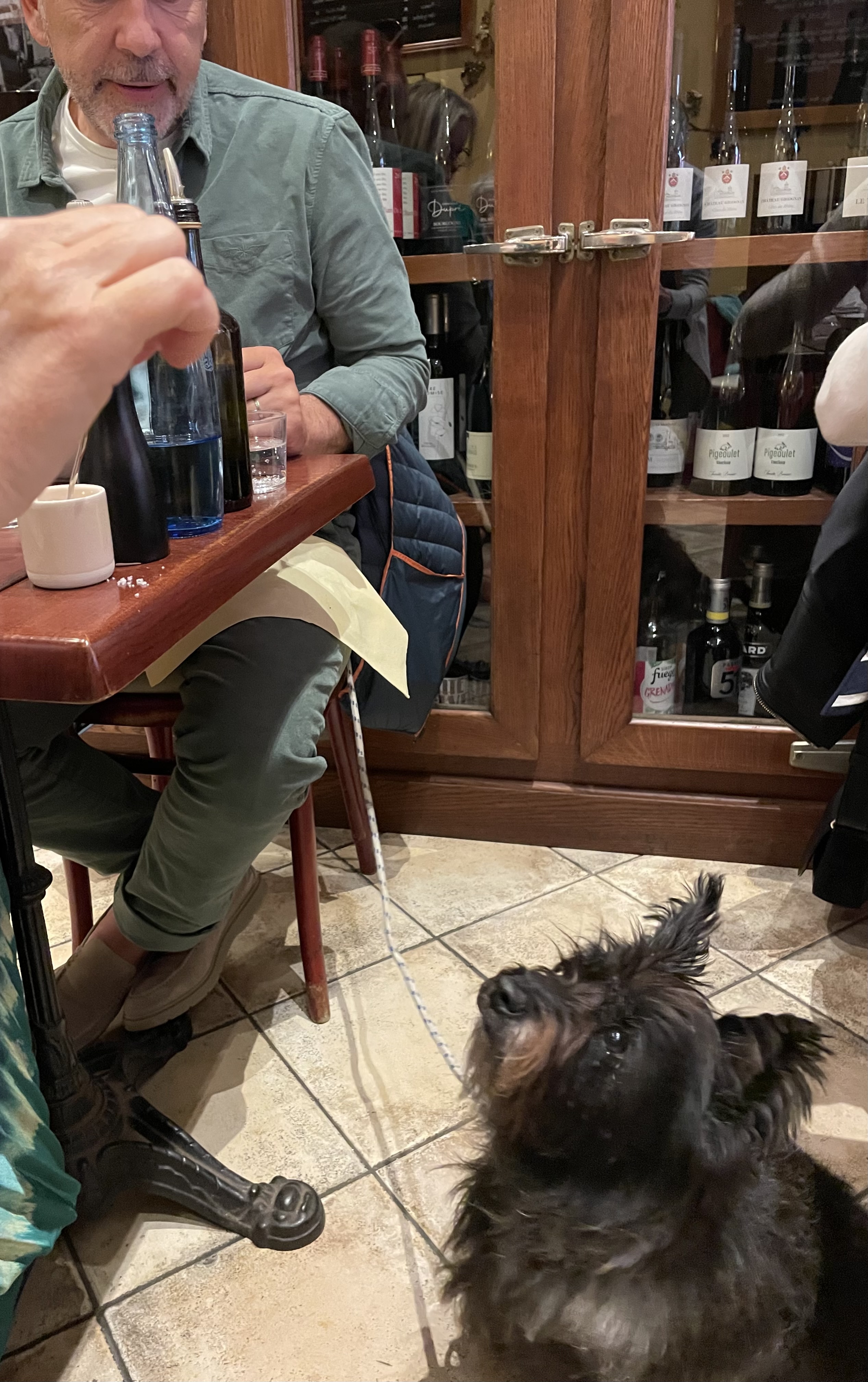
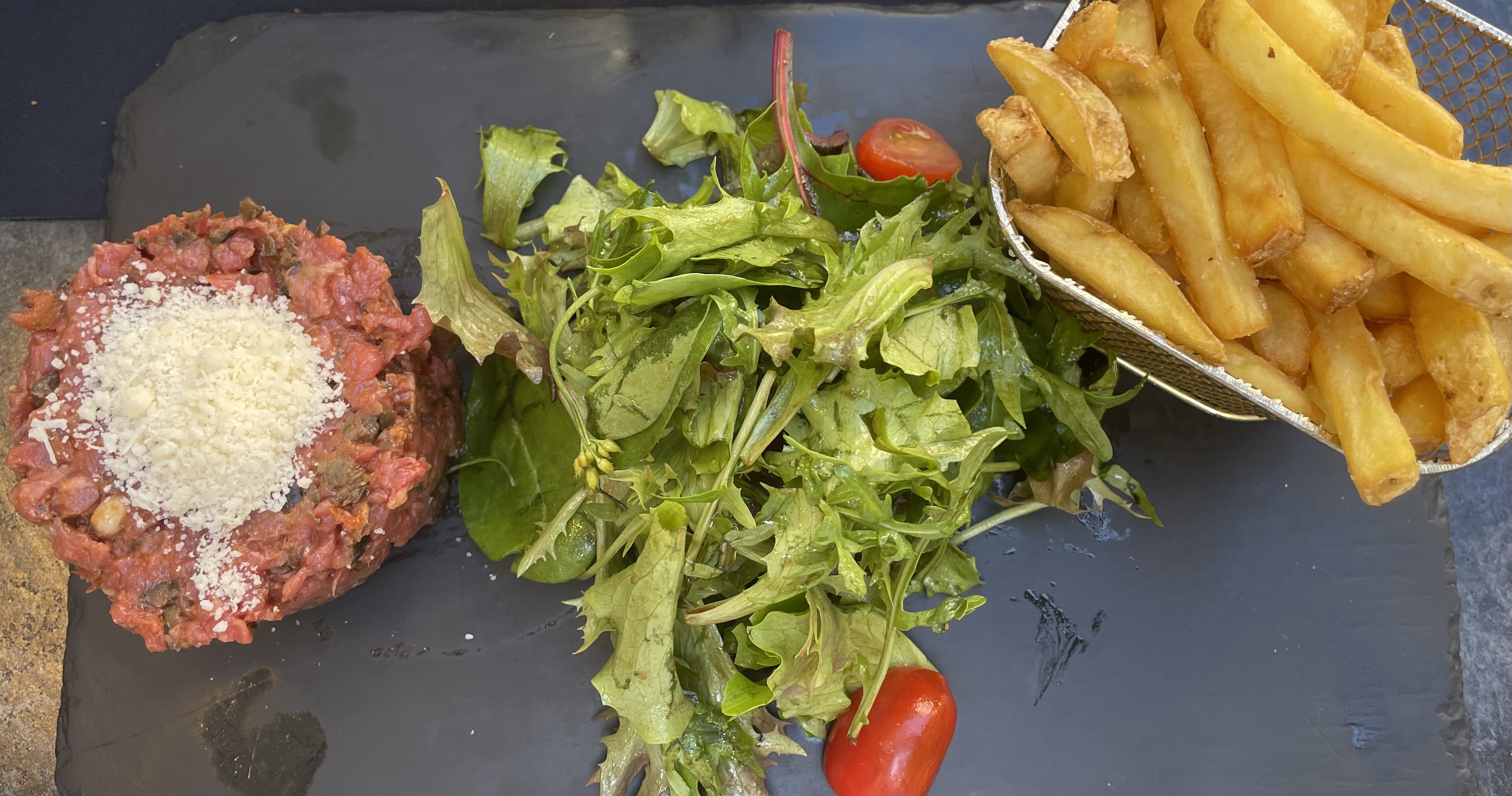
Dogs in restaurants…why not?In Nice, so of course nicoise olives.Indescribable lemon (the white stuff) that the waiter said was not a gelatin but it was smooth as silk.I had to have tartare one more time!
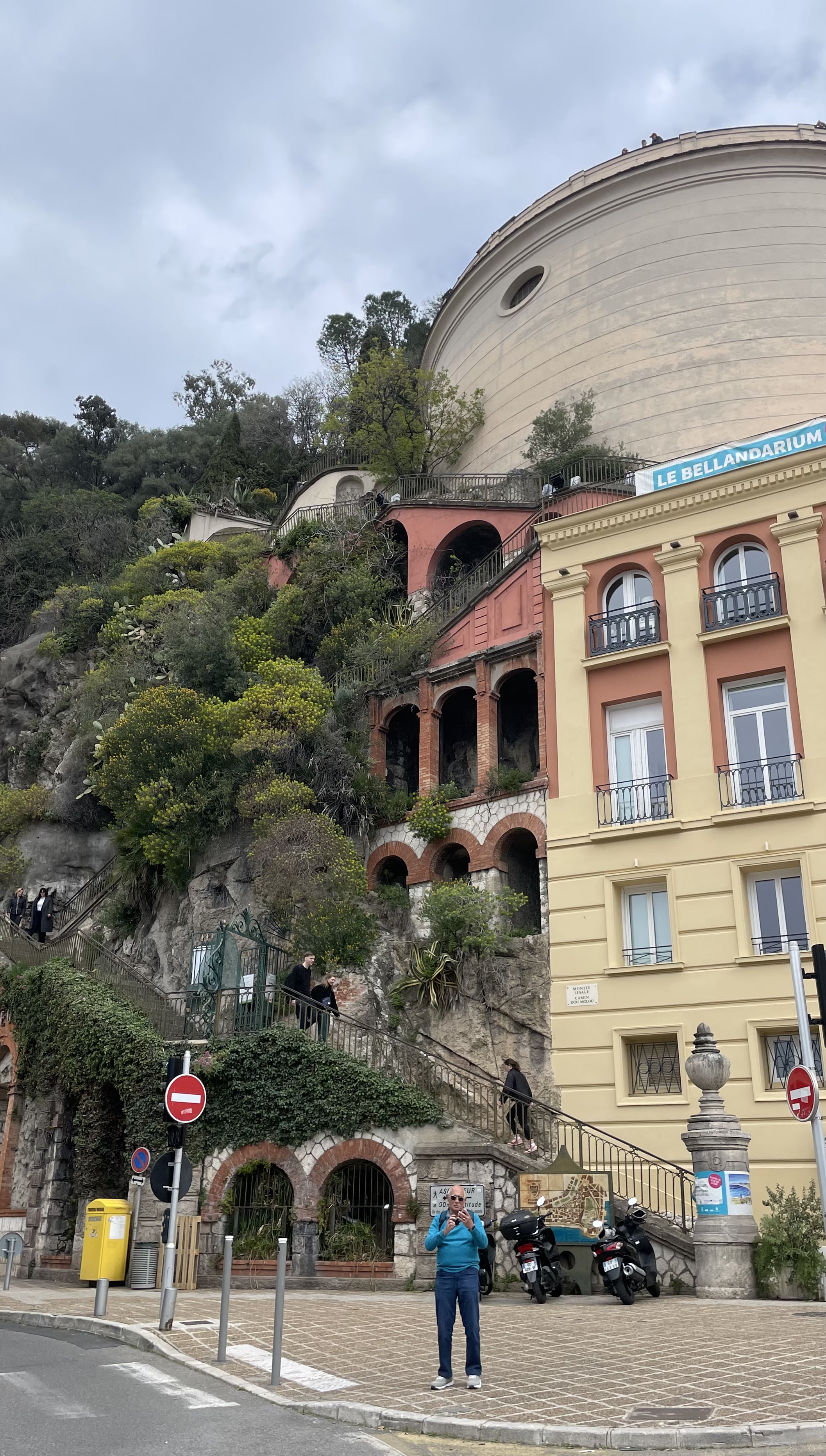
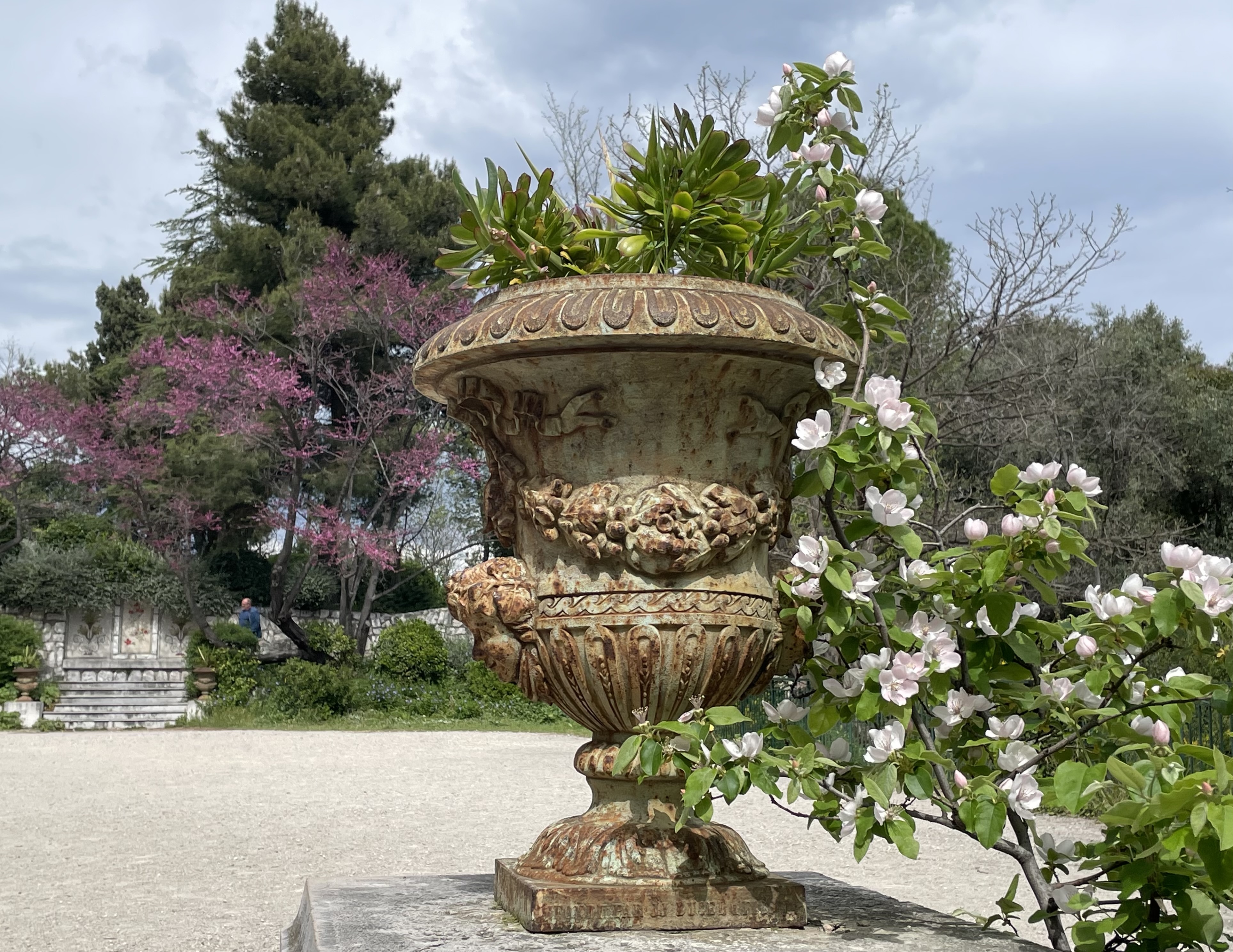
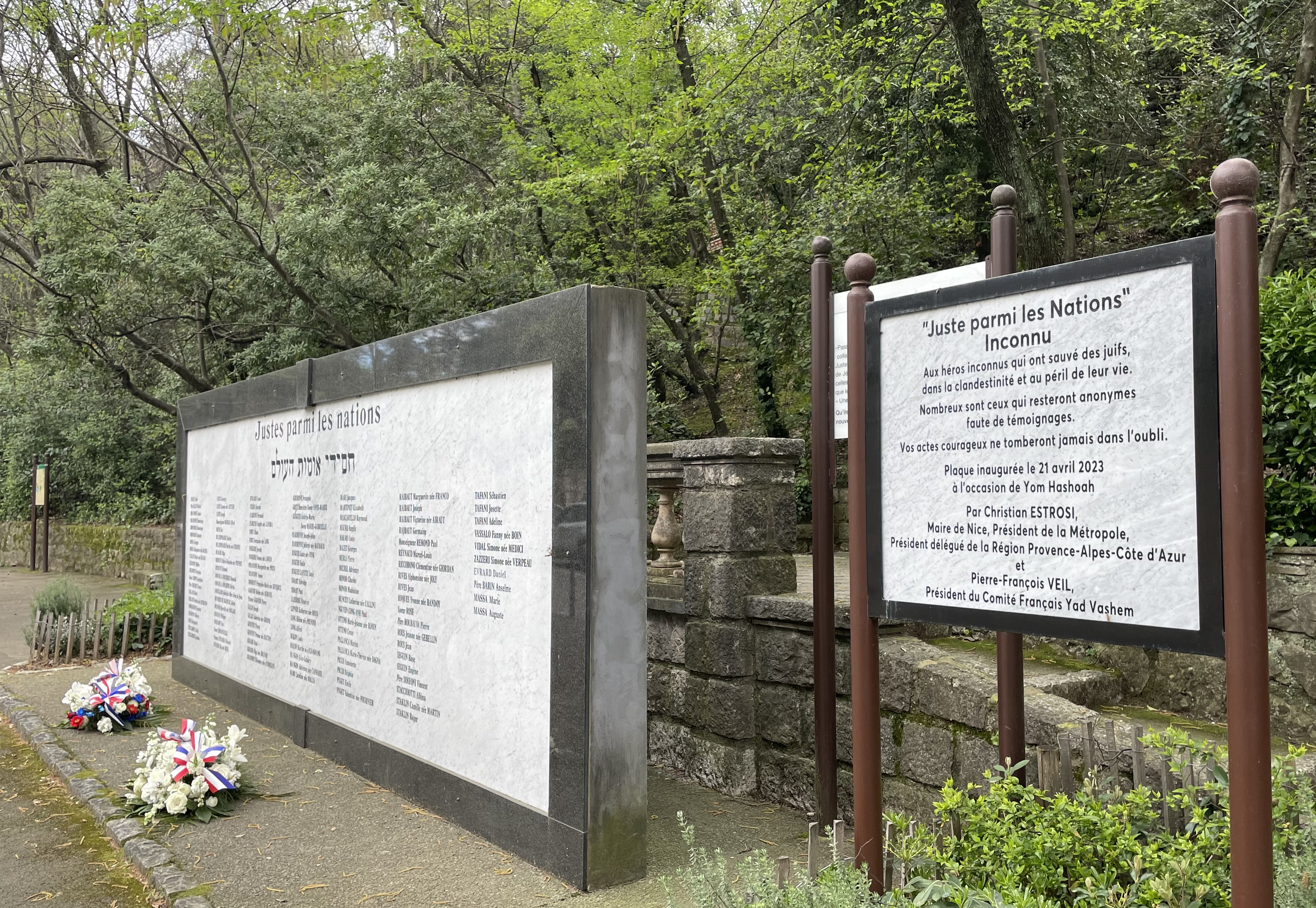
We walked along the waterfront a block or two and took the ascensuer (elevator) up to the top of the Colline de Chateau, walked around the chateau ruins, wandered the gardens (we wander a lot!), explored the Jewish cemetery, then walked back down super tired to the tram and hopped on. In a few minutes we were home.
In this lovely hilltop garden is a memorial to those who saved Jews during WWII…”that their courageous acts will never be forgotten.”
Late Thursday afternoon we took the bus to the TGV station to fetch our rental car. I had booked a EuropCar because none of the US companies had an option for English on the French site, nor did they allow a return to a different city. Our plan was to rent in Avignon, tour around outside the city, then return the car in Nice. EuropCar was perfect, had lower rates, and the young man who handled the rental was a pleasure.
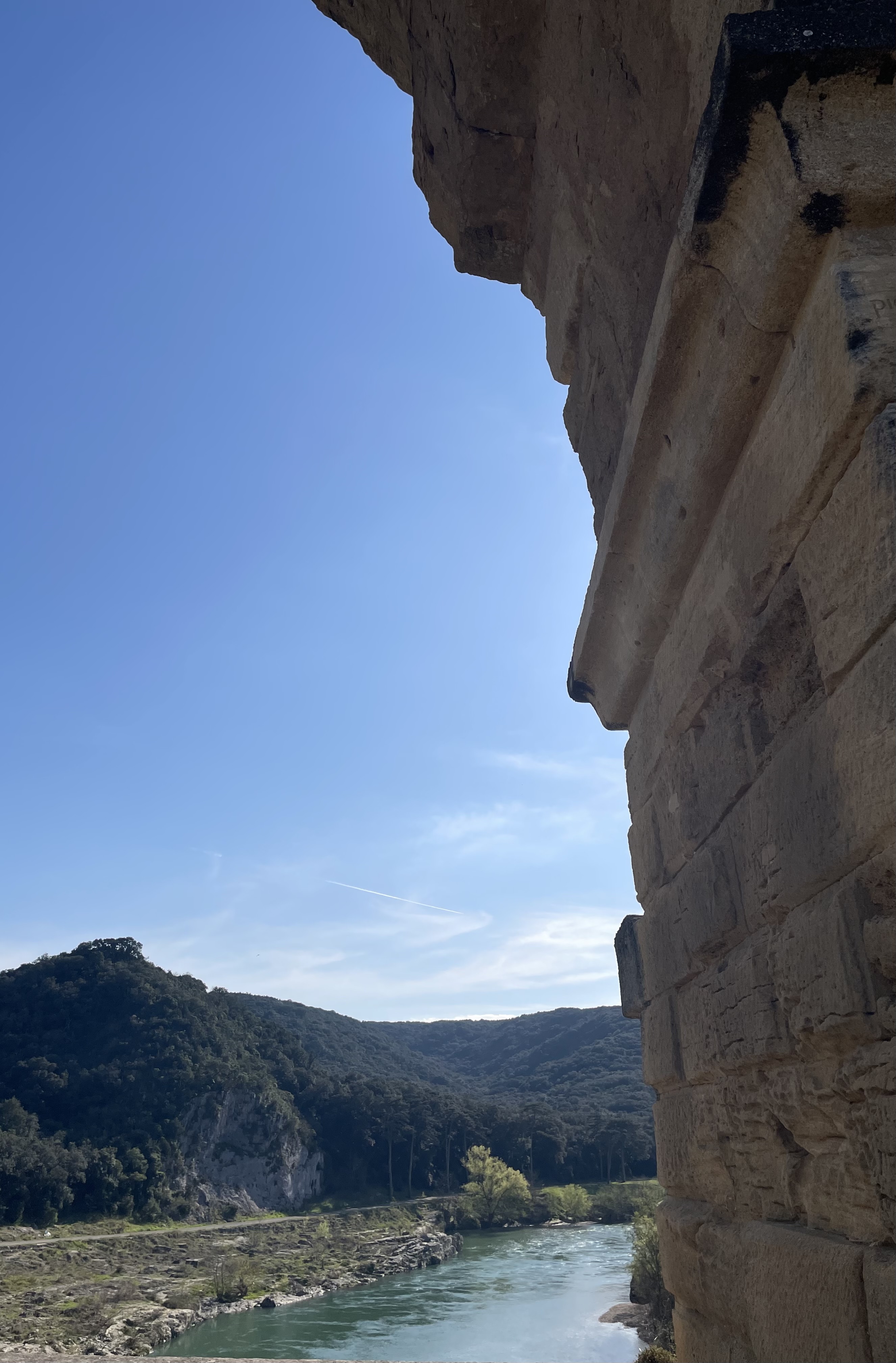
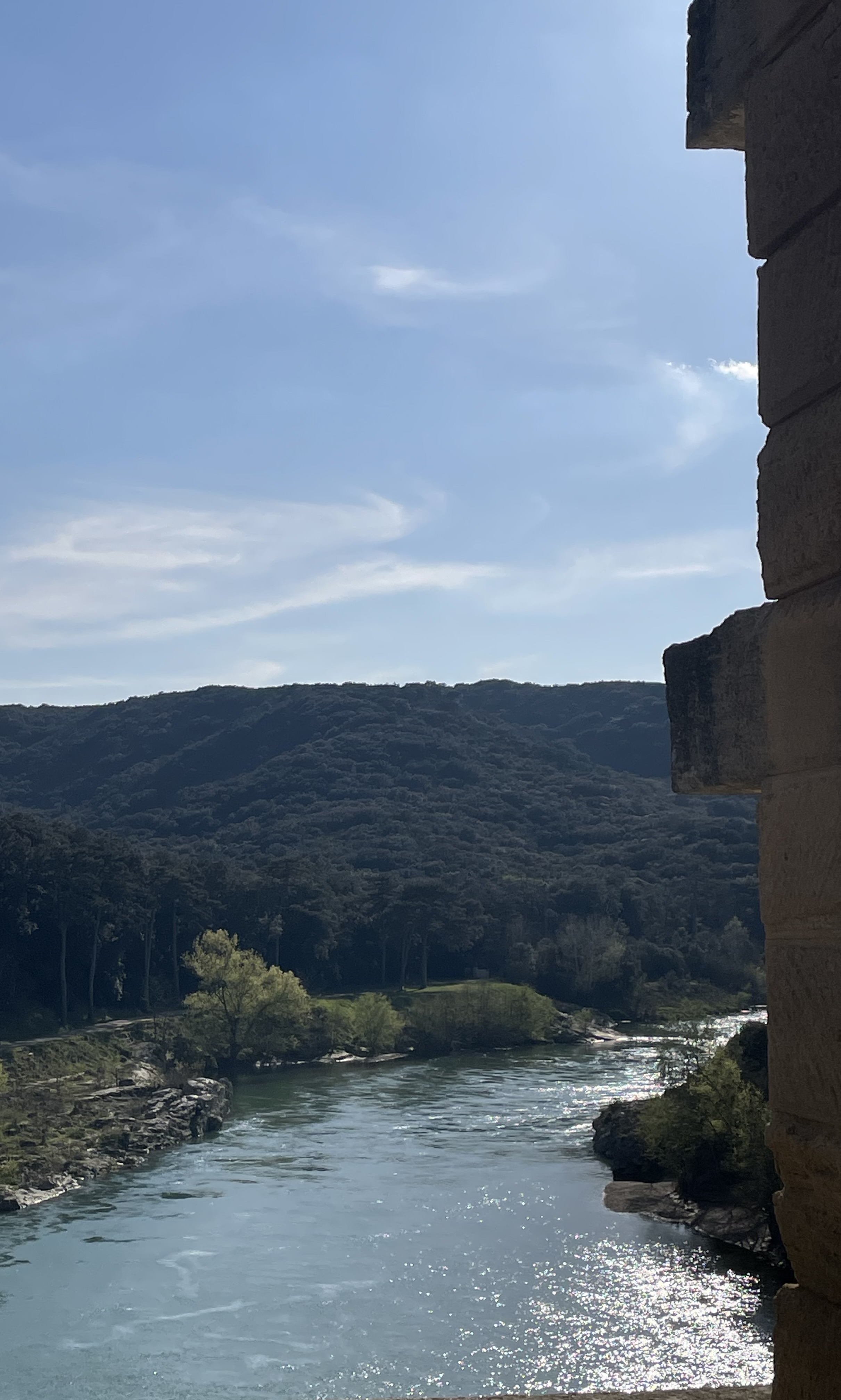
It was well after 3 so we drove directly to Pont du Gard. This is one mammoth aqueduct, built in the first century CE and in use until the fourth century. If you want to be amazed by this engineering feat go to Wikipedia or watch a film on YouTube. It ran for 31 miles, weaving around hills and adjusting the slope over the course of the run as needed. At the last section the slope was incredibly shallow. The concept and execution, not to mention the guts, to embark on such a crazy project is unimaginable. It turned out we were very lucky to go in late afternoon when the shadow of the mammoth structure was visible on the downstream river. We walked across and back, trying to imagine the now gone third set of arches which were taken down in order to use the stone for buildings nearby.
Looking westLooking east with the sun behind the bridge
Uzes and Nimes
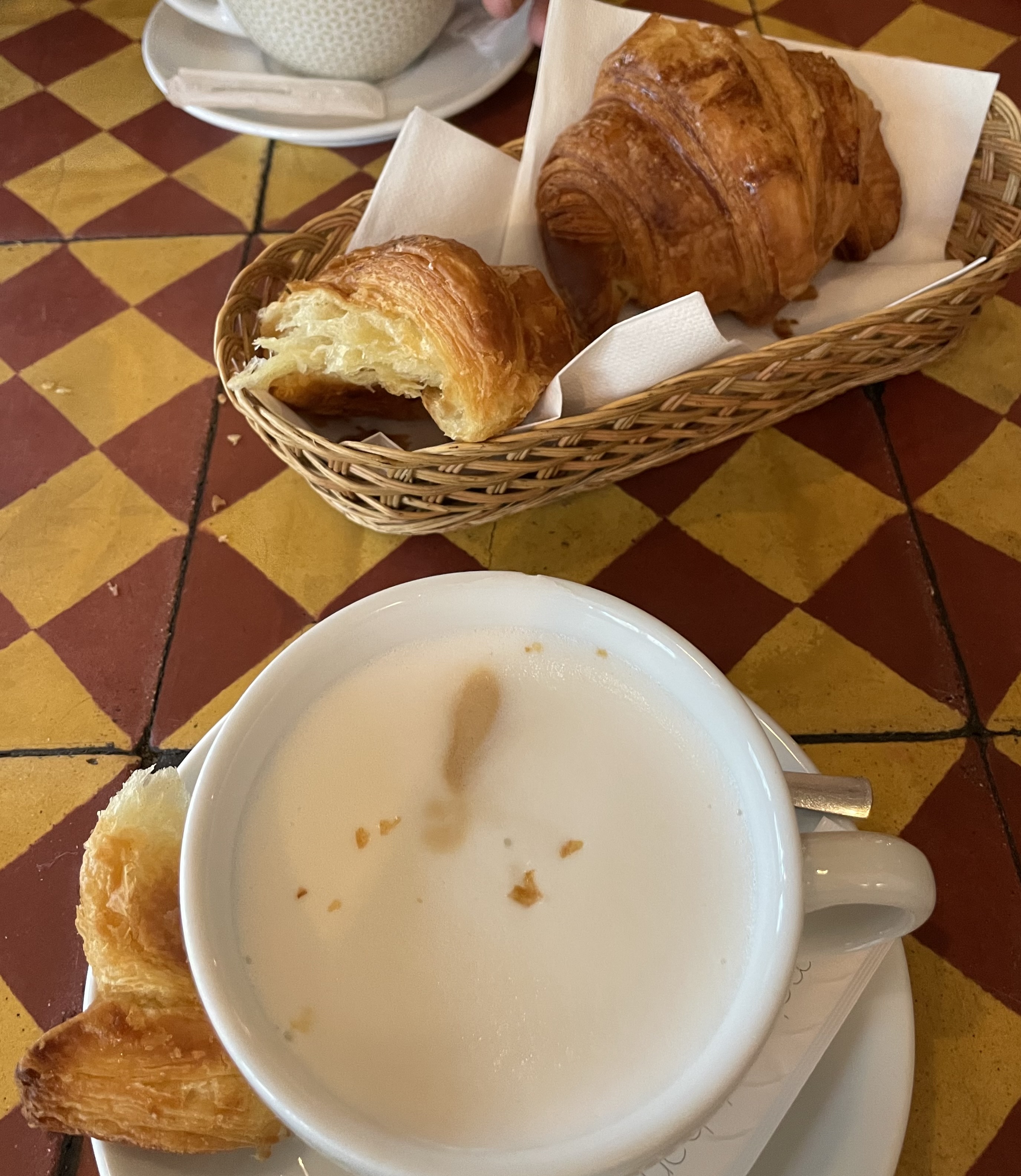
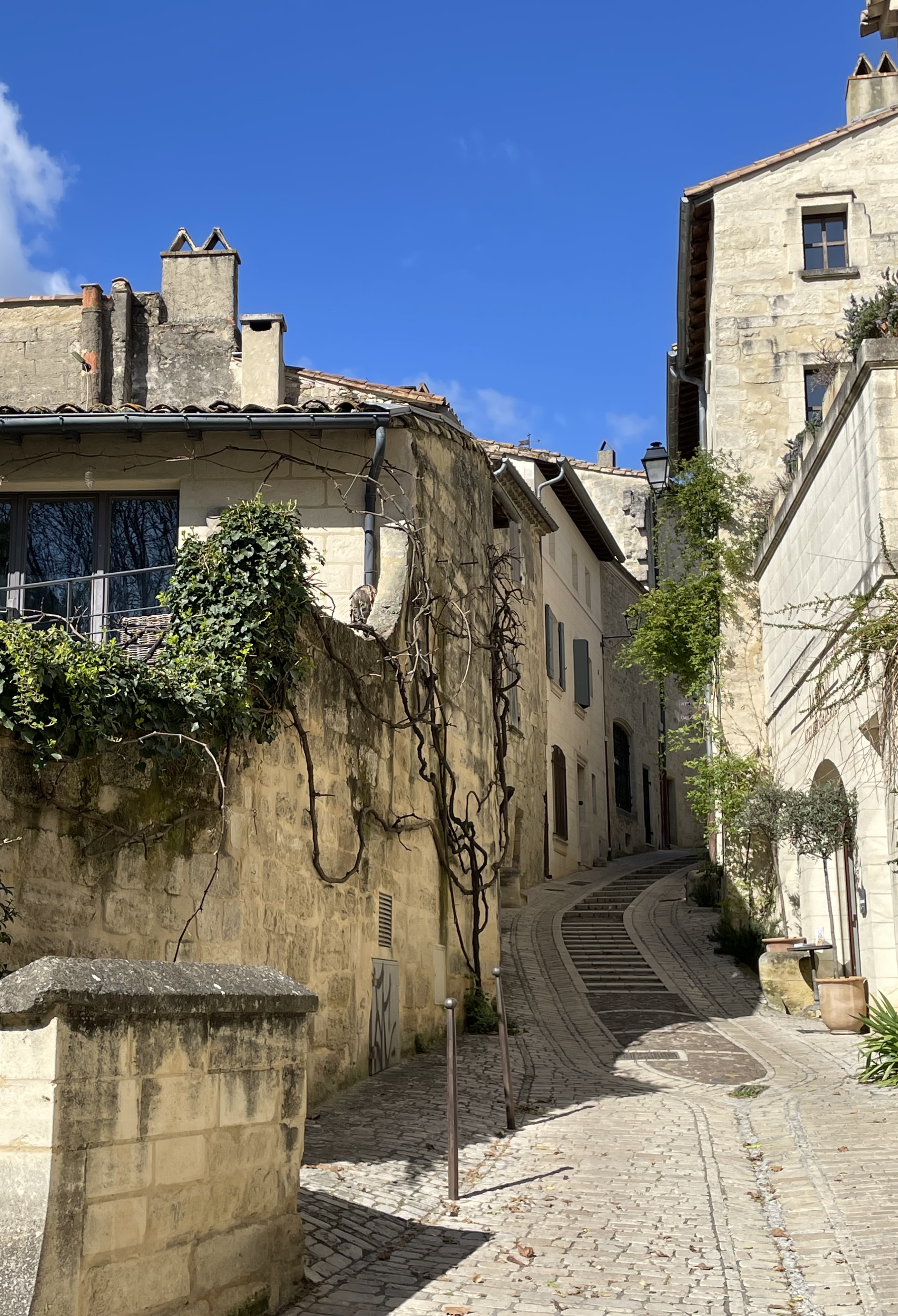
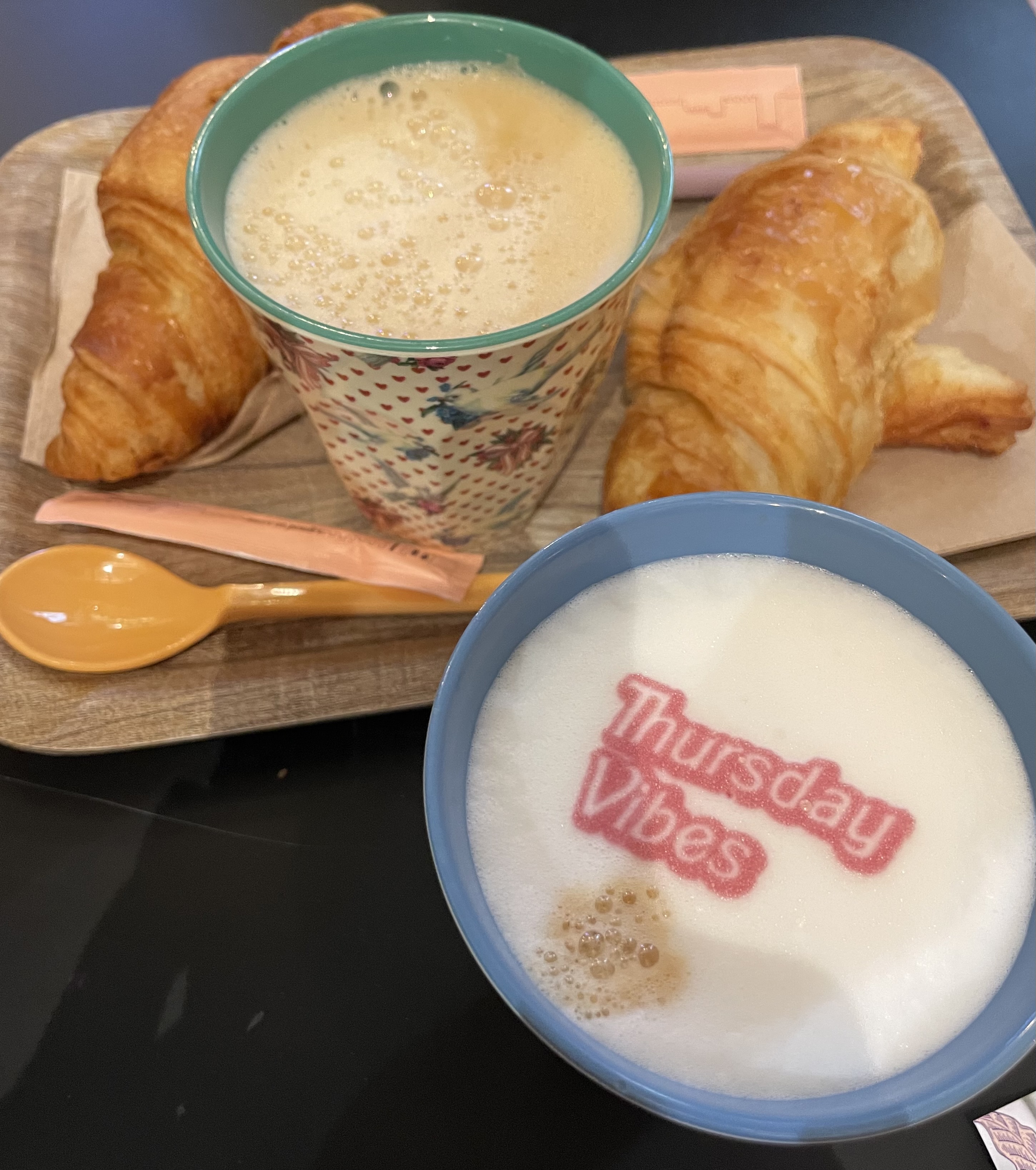
Saturday we drove to Uzes and Nikes. Uzes is a very small, and sadly getting smaller (now around 8500) town whose market day we wanted to enjoy, so that was our first stop. Less than 45 minutes away and so friendly, we had a lot of fun. First on the list was coffee and a croissant and walking down the main street only 10 yards or so brought us to Le Vieux Cafe. It was chilly and windy, yet there were 10 or so customers sitting outside. Let me take a moment to say that the French sit outside to drink and eat in weather that is way, way too cold for us Americans, and there’s not a gas heater anywhere. In we went and within a few minutes a man swings by, “Bonjour madame, bonjour monsieur, voulez vous un boisson” and 60 seconds later we had our café crème and croissants. Delicious.
We took the first side street and were enveloped by the market. The wind was fierce (gusts up to 48mph) and it felt quite cold but the crowd and the bustle of the weekly market kept us moving and somewhat warm. That wind. Every now and then an umbrella fell over, branches were falling, and the trees in bloom were shedding seeds that were everywhere on everything. And it was fun. We decided to put together enough food for an evening meal because I insisted every day that we take advantage of the custom of a big lunch—and the lunch specials that every restaurant offers and we planned to do a lot that day—I could already imagine not wanting to budge once we got back to the hotel (I was right about that). And, I confess, it is just fun to buy things at an outdoor market where everyone is in a market mood, I have a lot of questions I can ask in my rudimentary French, and who can resist the cheeses, the breads, the olives…
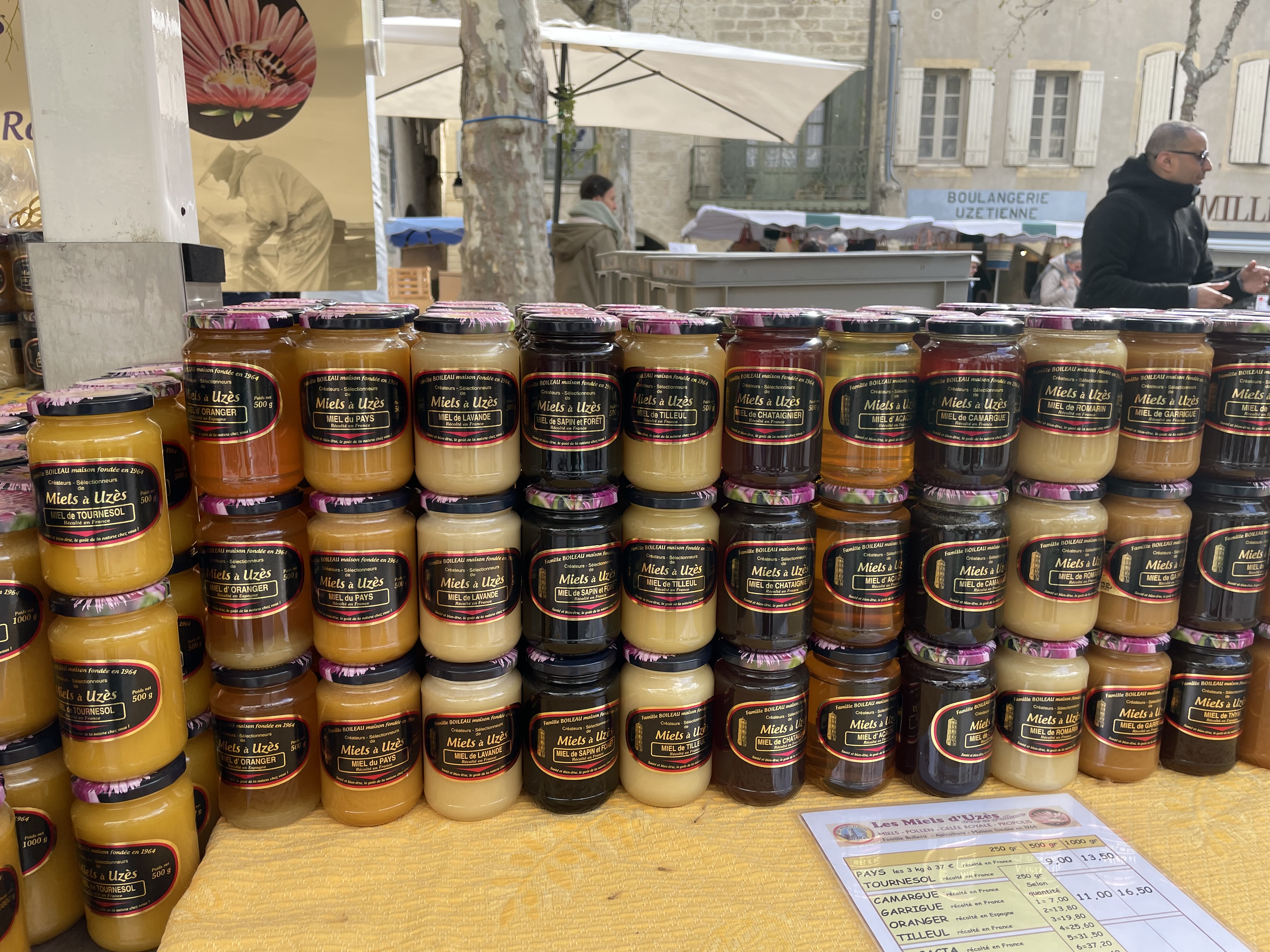
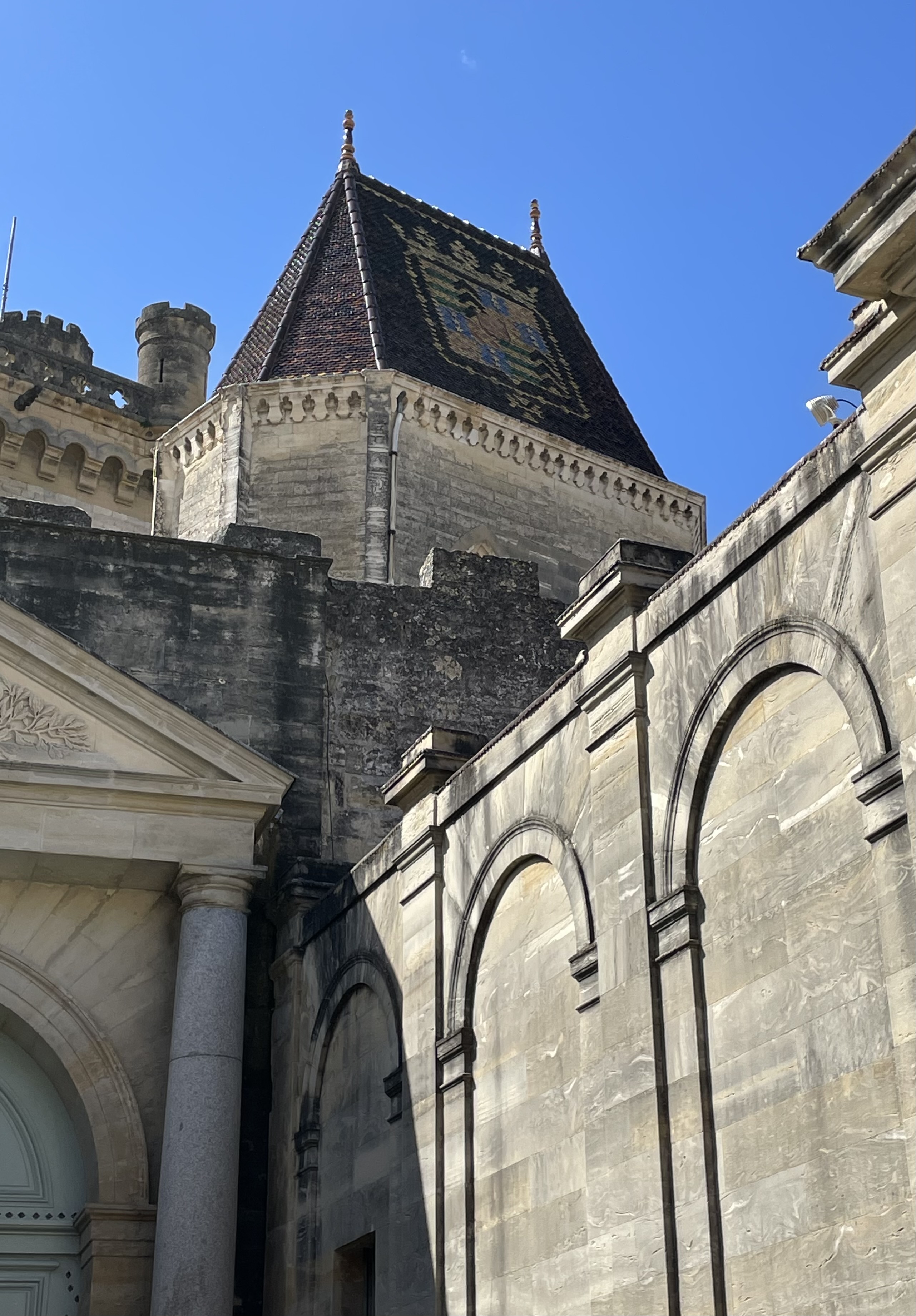
Le Vieux Cafe, so old and filled with stuff that appears to have been there for a few generations.One of the MANY honey displays. There are stores everywhere we’ve been that sell only honey.Uzes is such a lovely little town. I couldn’t resist taking a picture of the herald on the roof.
We decided to head to Nimes and assume we’d get there within normal lunch hours. We’d walked pretty much the entire town of Uzes anyway. Off we set, excited to see more Roman ruins—an arena, a temple, and a tower—and experience a different town. Well, wow, very different. We were surprised that Nimes was so big, much bigger than Avignon, at least the part within the city walls that we had gotten to know, and it made Uzes seem like a closet. We drove through this city, with wide streets and confusing directions, searching for a place to park that would be near at least one of the sites. Happily there is an underground parking garage adjacent to the arena/coliseum. We came up to the very big plaza to see the wind whipping water from a large fountain across the plaza in a cloud. We let the wind push us to the Office de Tourisme where we confirmed that the three things we wanted to see were within walking distance. “Mais, oui.” Off we set, but first, lunch.
The plaza the tourist office woman sent us to is clearly a tourist place—a small square ringed with restaurants, lots of outdoor seating, not too crowded but many people eating and talking. We were a bit dismayed, having avoided these settings as much as possible but too hungry to venture further. We entered one that advertised a gratin brandade (baked salt cod, usually with potatoes). We’d been so lucky regarding restaurants and feared our streak would end. Nope. It was still very windy so we went inside, and small tables close together were pretty packed. We sat and immediately the great table service we have found everywhere was here too. I made a comment to the woman at the next table in French—it was perhaps two feet from us—and she asked if I spoke English. The couple was traveling in their camper from Stuttgart on to Italy and we had a typical friendly conversation. David ordered what her husband was having (linguine with a baked Camembert that he stirred into the pasta, with a side of a small charcuterie) and I got the gratin brandade. Everything was delicious.
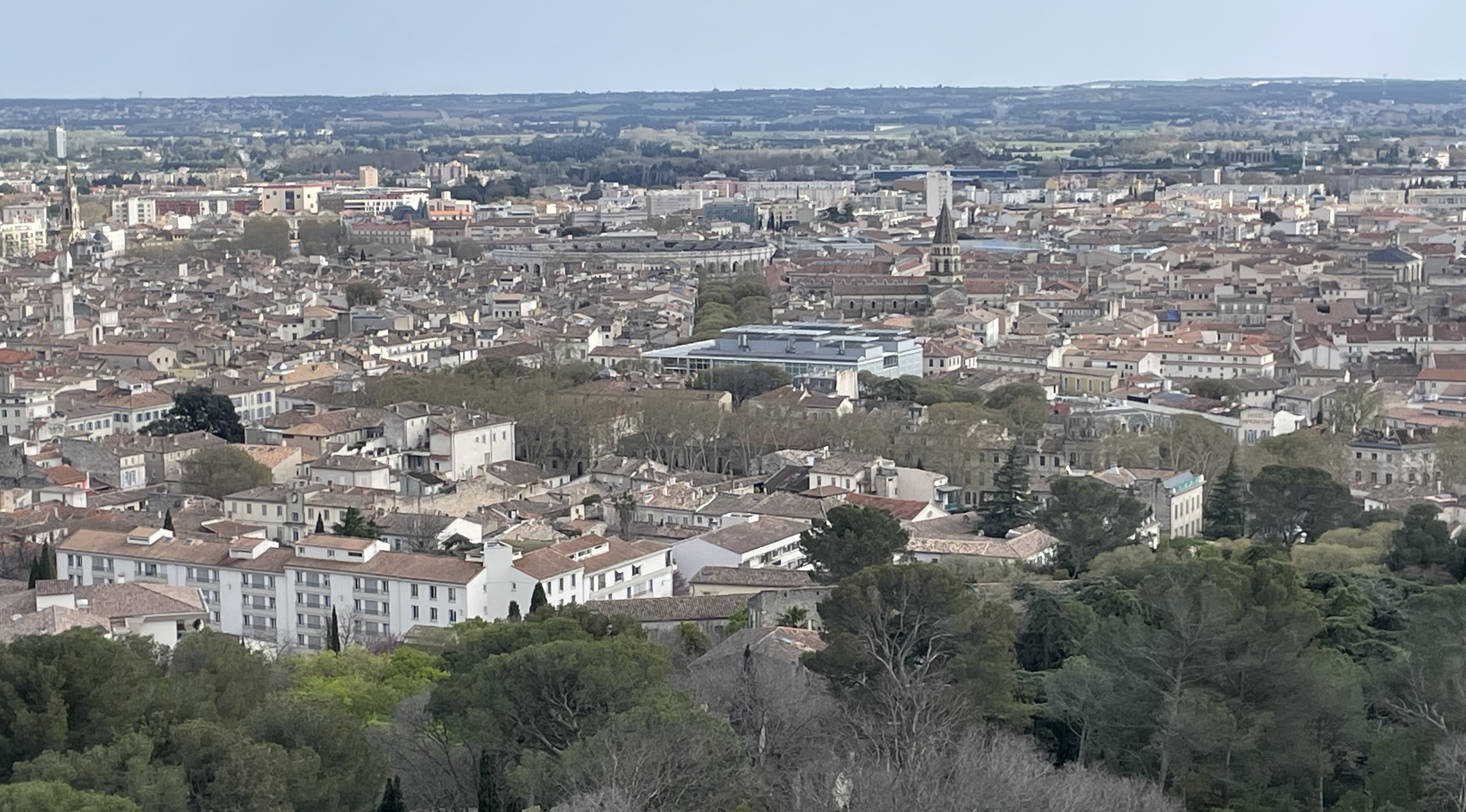
The brandade. So good. Potatoes covered with bubbling eggy salt cod.The arena here is used for events. They are repairing the clay surface.The view from Le Tour Magne, the last grueling stop on our Roman ruins trek. Yes, gorgeous but might have been my last tower!
Back we drove to Avignon, very very glad we had bought a supper at the market. We dragged ourselves to the room, scarfed down the baguette, cheese, and olives, and packed. We left Avignon the next morning and drove to Arles on our way to Nice.
We love museums. History and art are our favorites, and everywhere we go we spend hours in museums. Really. They are restful, mind-expanding, educational, and for us just plain fun.
I will now tell you about the museums of Avignon and tomorrow will add a bit about Villeneuve-Lez-Avignon. There are some great ones.
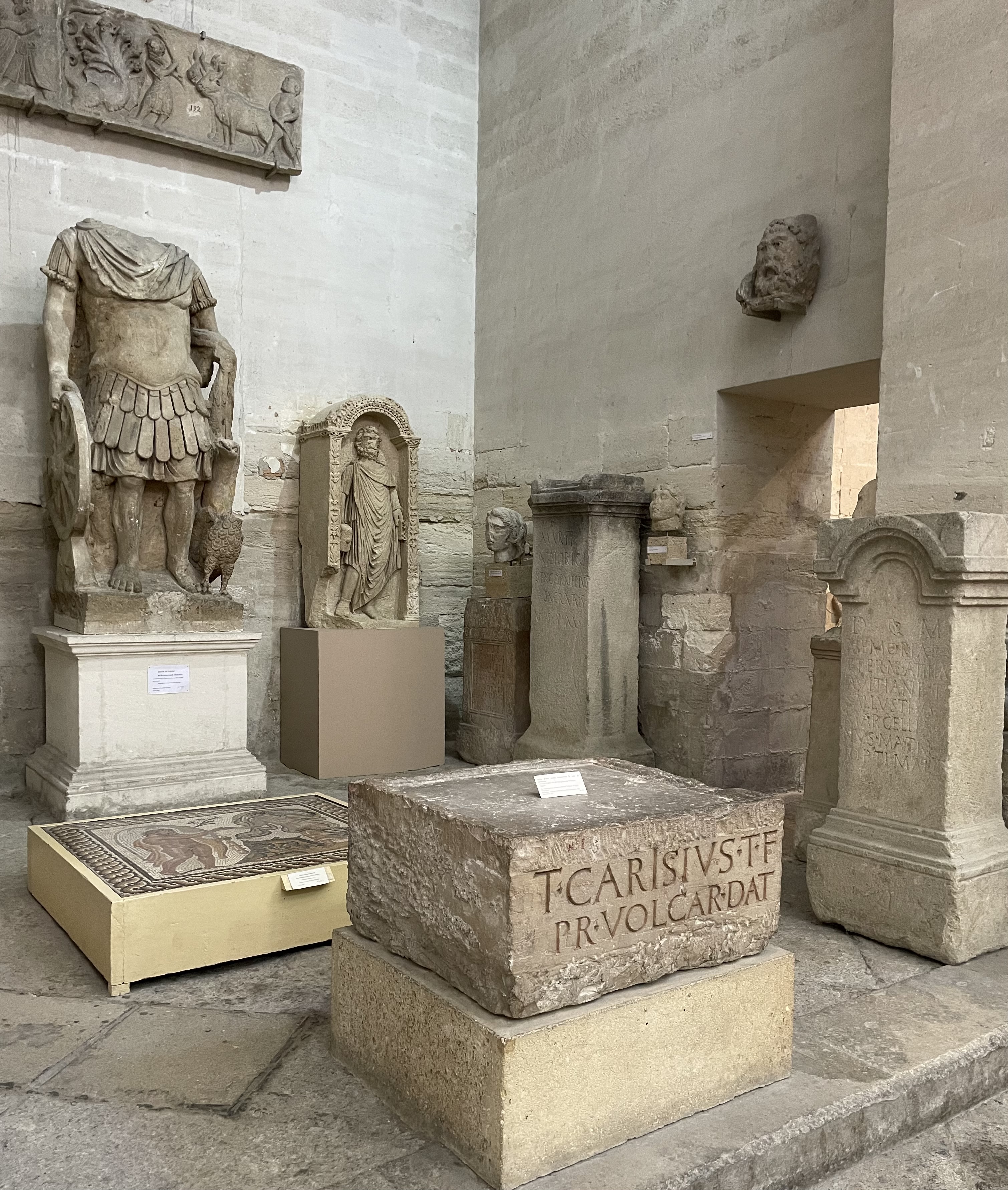
Our first day in Avignon we stopped at the Office de Tourisme and discovered there are four free museums—we visited three of them that first day. David and I are into Roman history and we had several day trips we had planned to see Roman ruins. And here we find out that there is a museum of Roman artifacts, Lapidaire Musee, a few doors from the Office de Tourisme. And free! We headed right over there and wow, what a lovely experience if you like Roman stuff.
A single soaring room filled, without feeling crowded, with all these amazing items that were excavated in Avignon, most in the mid 1800s. Best of all as you can see nothing is behind a barrier (except glassware and little ceramics) so you can walk right up and see things close. There was another couple in there with us and I said offhand to the woman “Incroyable, oui?” She nods yes and asks me if I am Spanish—doubtless due to my lousy accent. I say I do speak Spanish thinking that is what she speaks. She asks me where in Spain I am from. I say California, and ask her if SHE is from Spain. No, they are from France. Then we have a mish mash conversation, a melange of French and Spanish. We smile and laugh, then I hear her explaining to her husband what THAT was all about. Needless to say through this first week my French has come more easily and my accent has improved tremendously.
Anyway, get a load of this Roman mosaic. So beautiful.
Next we headed uphill to the Palais de Papes and across the plaza to the Musee Petit Palais. This is a relatively small museum, free, with an extensive collection of medieval paintings, virtually all religious as that’s what artists were expected to paint. The docents were wonderful (yes, I had questions) and were able to follow my French to my delight. But the best part for me was the ground floor exhibit that detailed what the profession of painter entailed in the Middle Ages. The artist who led an atelier with many apprentices was not just an artist and painter. He had to be a project manager, a teacher, a bit of a chemist—mixing colors was an art in itself in addition to a science—and a salesman. Of course! But I had never thought about it and led me to think differently about what art was all about in those days.
Finally, although we were warned it was boring we went inside the Palais de Papes. It is enormous..and we loved it. When you check in you get a tablet that, when aimed at a stand in each room, shows the room as historians believe it looked like in the day. Very cool, and surprising how walls, beams and ceilings were painted as well as the array of furniture. The tablet had loads of information about each room, how it was used, in some cases what it meant. When you get to the chambre de pape (the pope’s bedroom) the uncovered and restored tiles that cover the floor are breathtaking—and they let you walk on them! So neat. We failed to take any pictures inside so you’ll have to visit yourself. It is definitely NOT boring.
This medieval city, with its circling wall, lovely walking streets, and hospitable people grabbed us from the first morning as we set out for coffee. We had arrived late Tuesday after about 24 hours of travel, easily settled into Hotel Cloitre Saint Louis, and after a quick, delicious, albeit Italian, dinner we fell into the very comfy bed and slept 10 hours. Wednesday we quickly found a sweet little coffee and pastry place, Le Saint Chocolat, and enjoyed our breakfast of croissants and coffee so much we came back every morning this week.
Let‘s be clear, the food here is spectacular. It can’t be that a glass of champagne (for me) and a beer (for David) makes that much of a difference! Our first lunch, at unsung Petit Grand, was delectable. Our supper of soup and tartines (open faced sandwiches) perfect and in a little place right out of a French movie. The lunch in Avignon Villeneuve (across the Rhône), where we sat outside in the little square and talked travel and politics with the folks sitting at the next table—the man so happy to have a chance to speak English and sigh about the turn of events in the US (“This sure isn’t the America of 1945 that saved us from the Nazis, is it?”), and the food scrumptious. Lunch today might have topped them all, but that might also be that for me speaking French is beginning to flow and it made the food—the creamiest of carrot soups and baked goat cheese with honey for David, pate en croute and beef tartare for me—even better. Yeah, great eating that is frankly superior to typical American food in a tourist-y city, ooh la la is all I can say and yes, they say that here.
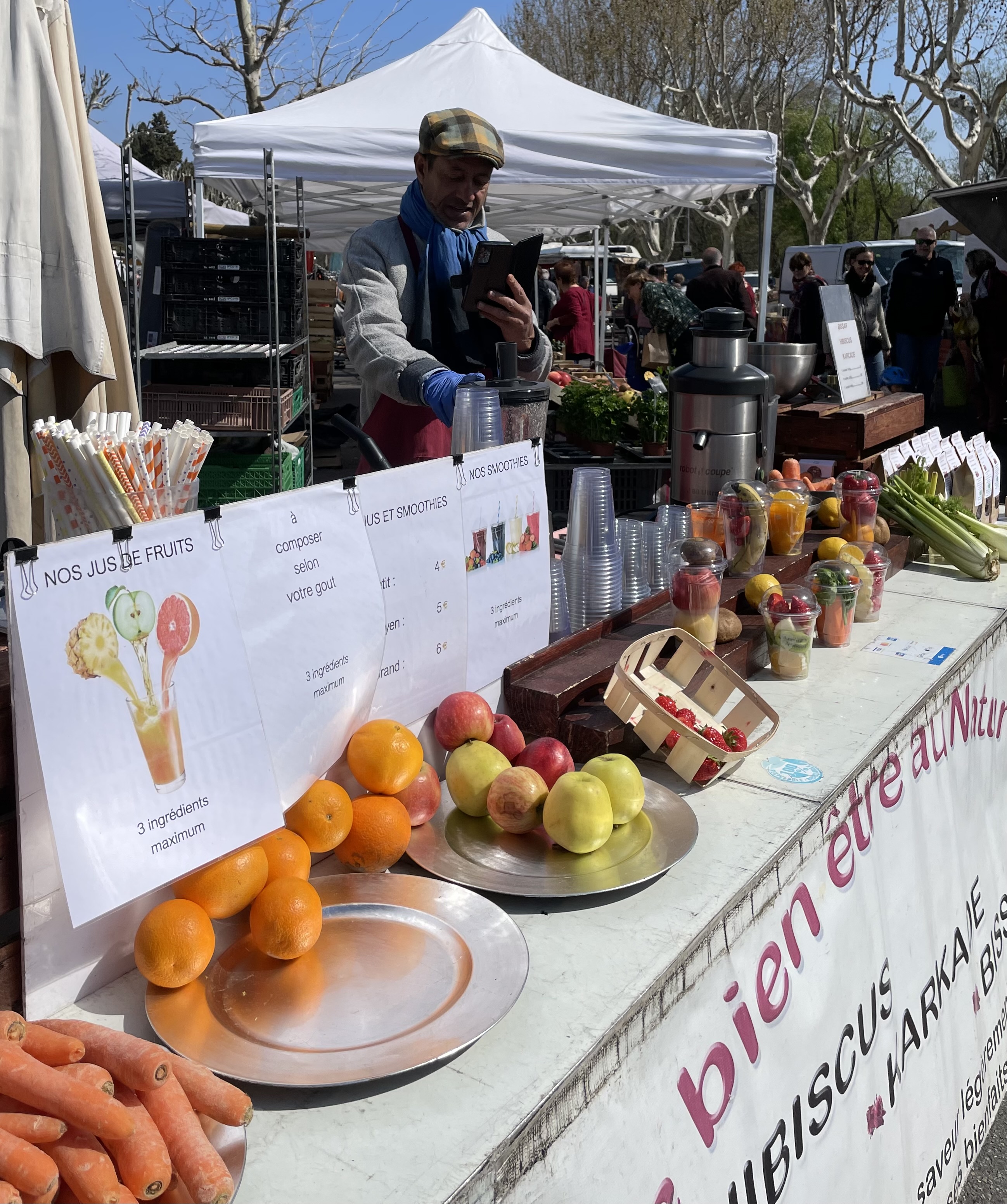
Yesterday we stopped in the Office de Tourisme to ask about getting a bus to Villeneuve-Lez-Avignon, the “new town” across the Rhône, and the very cordial young woman told us to get off at the Office de Tourisme there and noted that it was market day. We did, and there was the market, right across from the bus stop. Now, we consider the Grand Lake farmers market in Oakland to be pretty darned good, but this one put it to shame. Just watching the French talk, laugh, buy (and everyone seems to reuse containers—glass jars handed over to be filled with olives, bags to be filled with bread, little containers to be filled with humus), and laugh and talk some more was enough entertainment. Drooling over the produce—and the seeming endless array of olives, too—was fun and it made us hungry for lunch. There was even a stand that squeezed fresh juice on the spot.
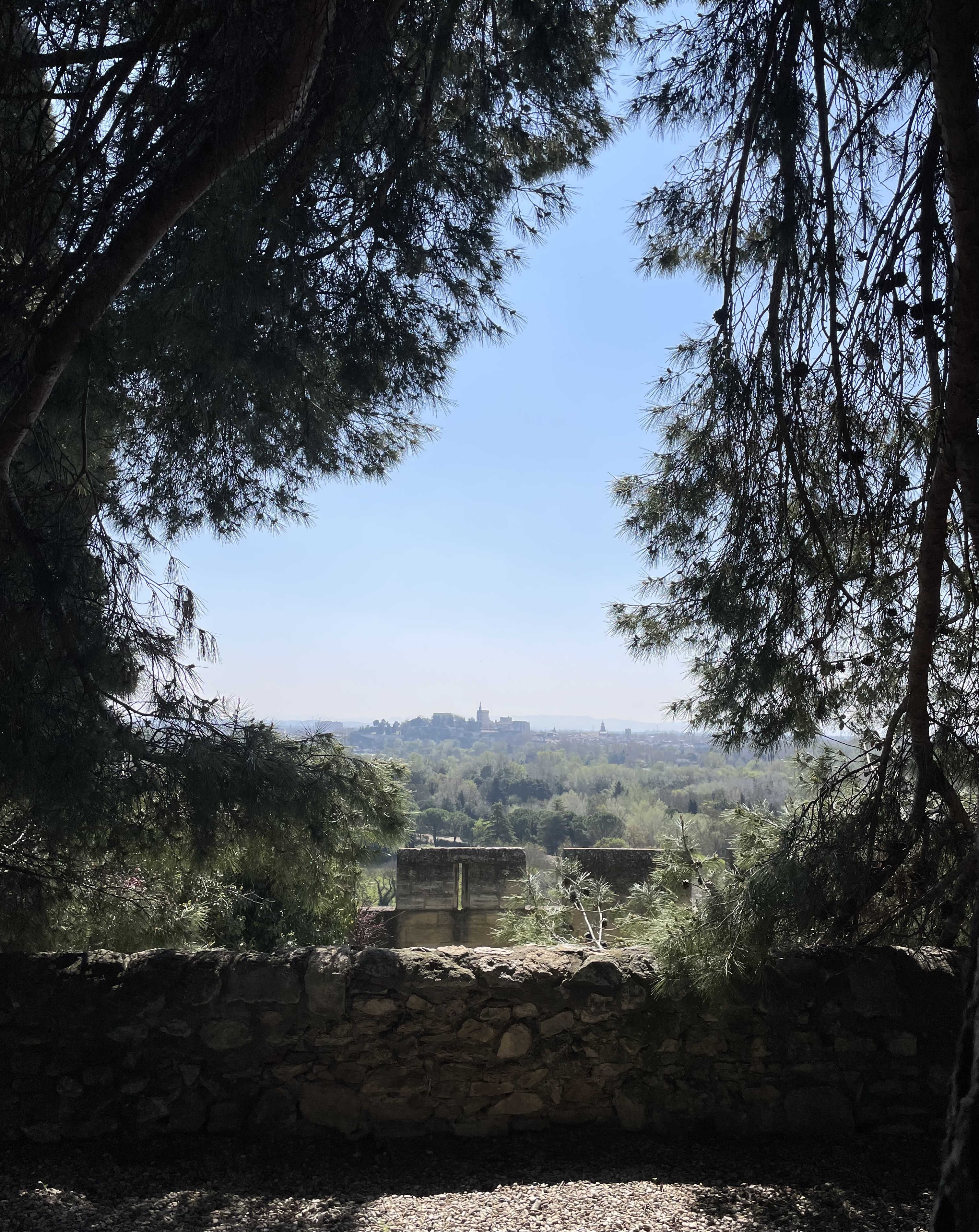
Though I could have gone straight to a restaurant David was more rational and suggested we head to the castle that we could see from the market.
This small town overflows with history and we marched through a lot of it in the one day we had. The gradual climb to the castle was lovely.
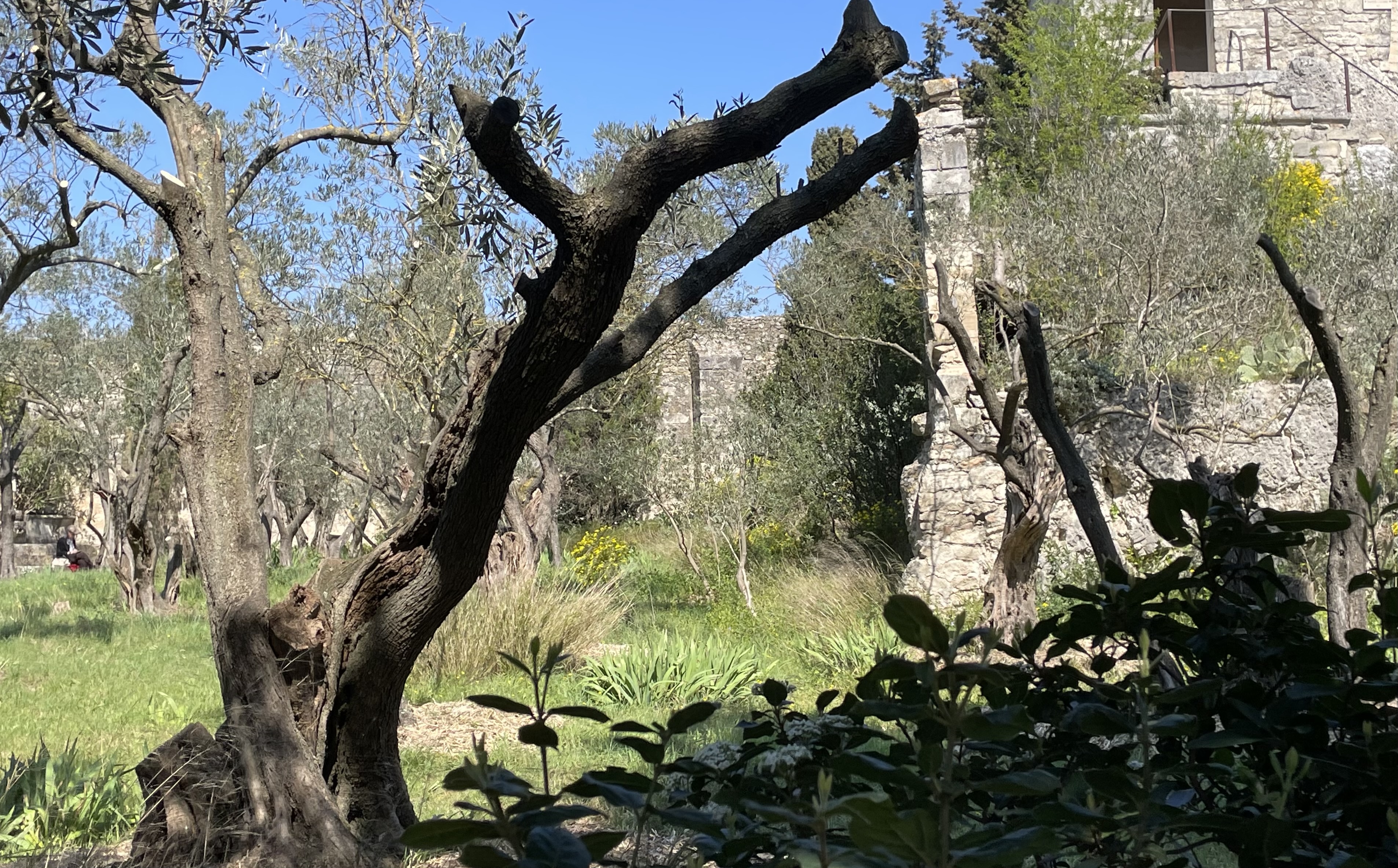
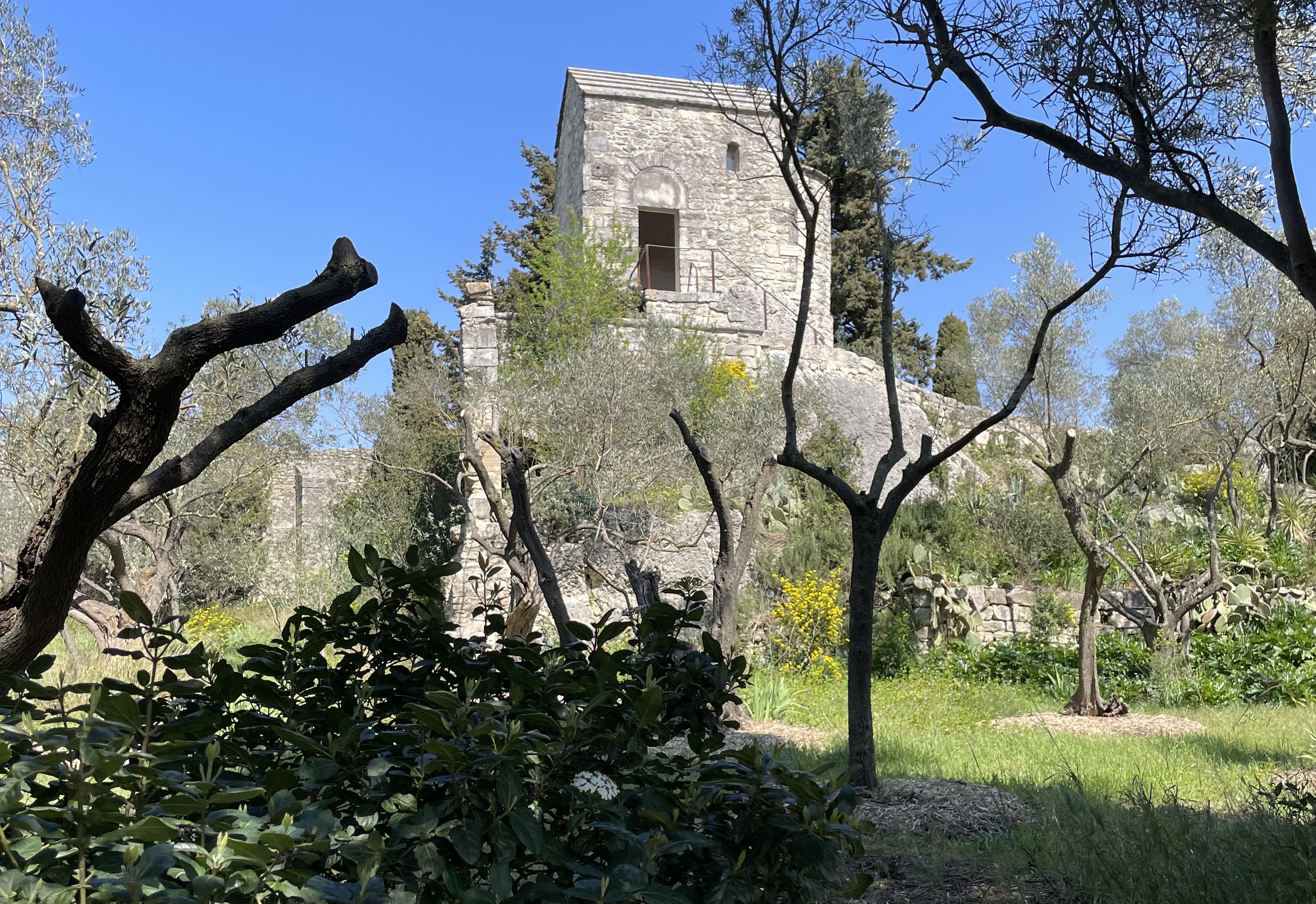
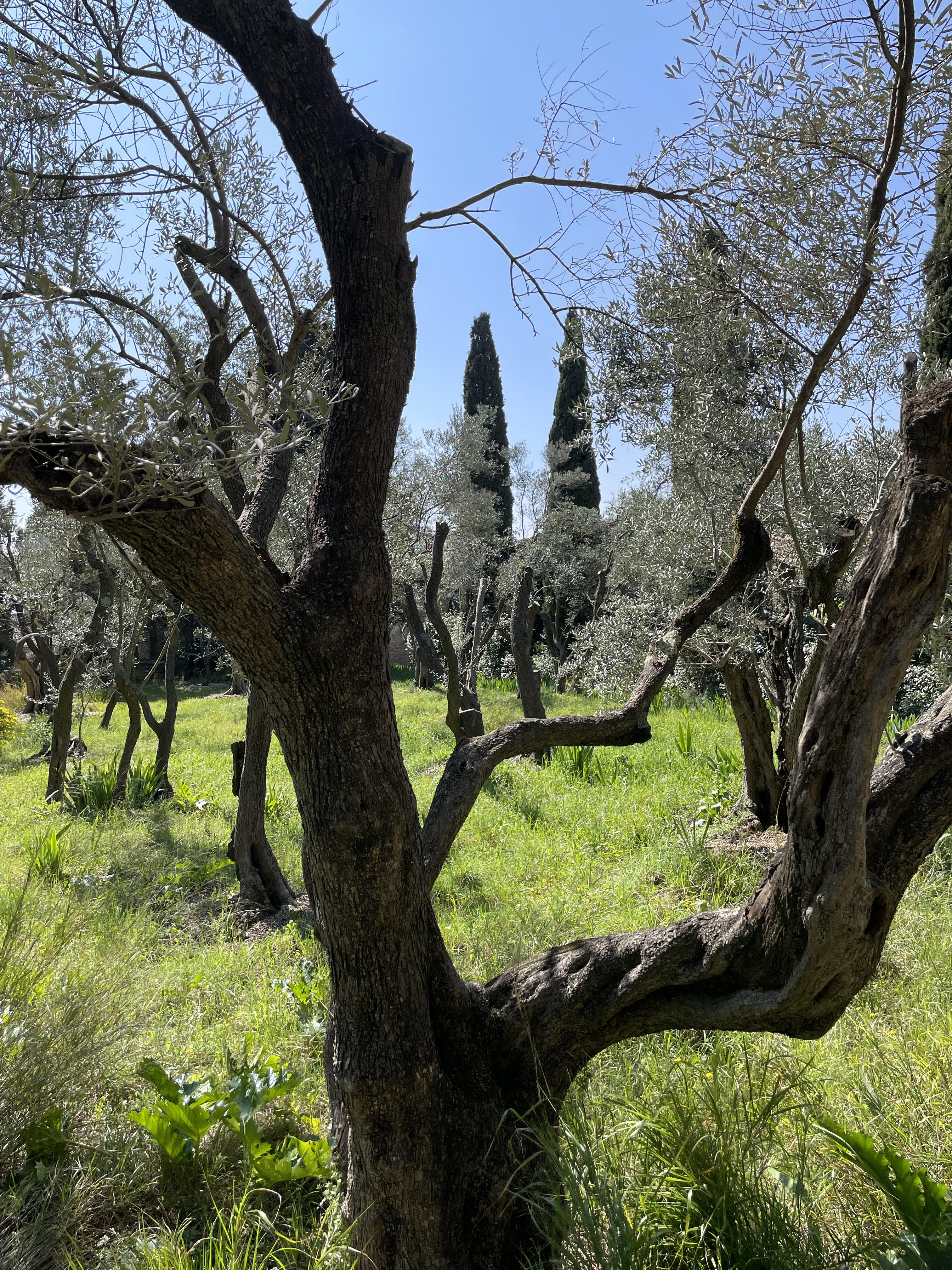
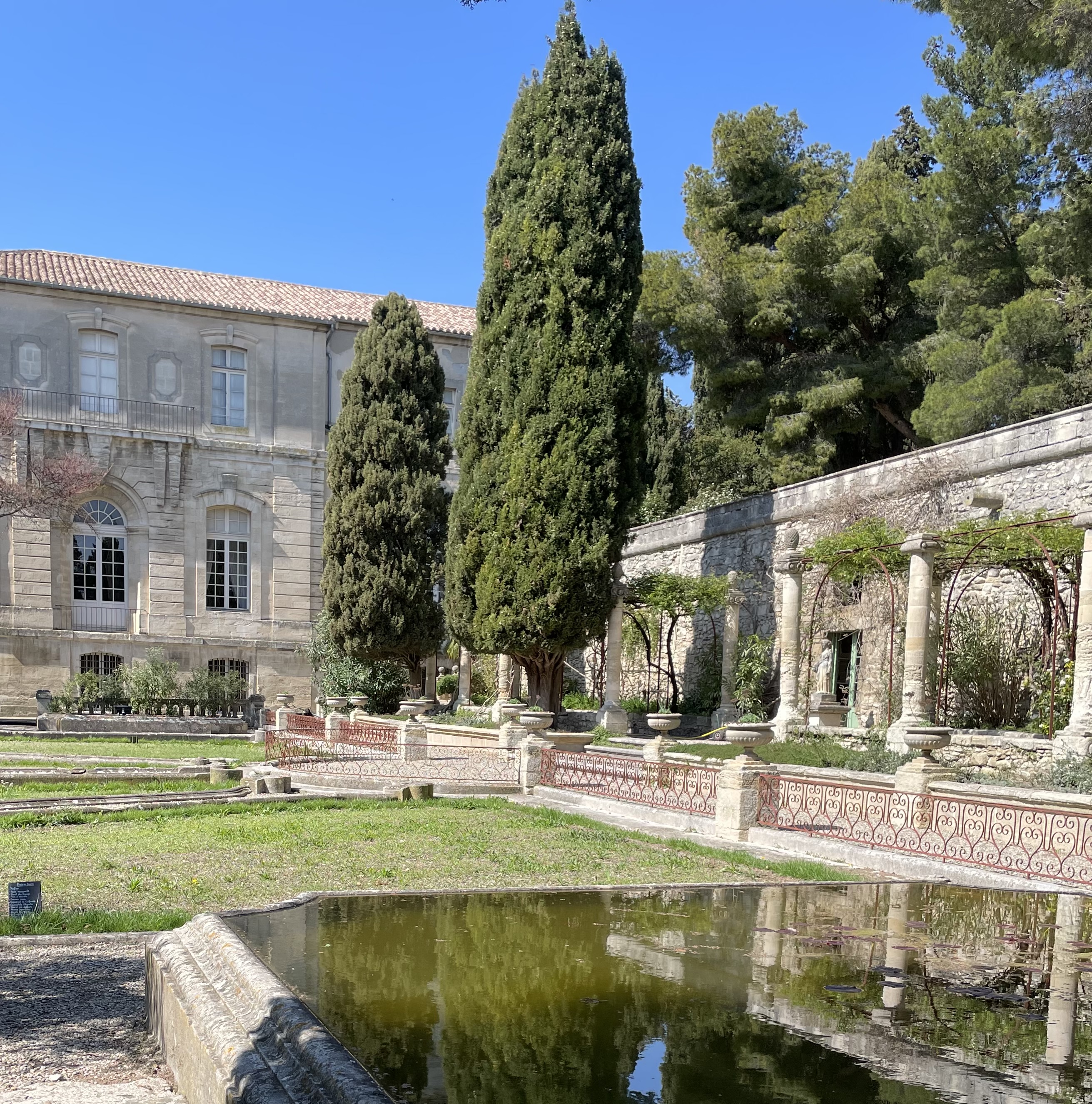
When we got there we thought about whether to buy a ticket but went to the billeteria to see what the deal was. We were quickly convinced to buy 2 twenty euro multi-site tickets and started with the “abbey” and its gardens. Alas, the website for this amazing place is really awful and the information about the restoration in the early twentieth century is buried. The fascinating parts to us are the purchase by a lovely painter, Gustave Fayet, a woman for whom he bought the abbey, Elsa Koenerle, who made it her lifelong work to restore the abbey and especially the gardens with her lifelong “close friend” who lived with them, Genia Lioubow. The gardens are gorgeous, even in their very early spring state. We wandered for at least an hour before walking back down to the square for lunch.
The abbey ground floor where they all lived is now a gallery of Fayet’s painting and drawings. They are lovely. I include here only one, a portrait of his wife and baby.
The next post will cover a few of the museums in Avignon and Villeneuve-Lez-Avignon. After several long days I am heading to bed.
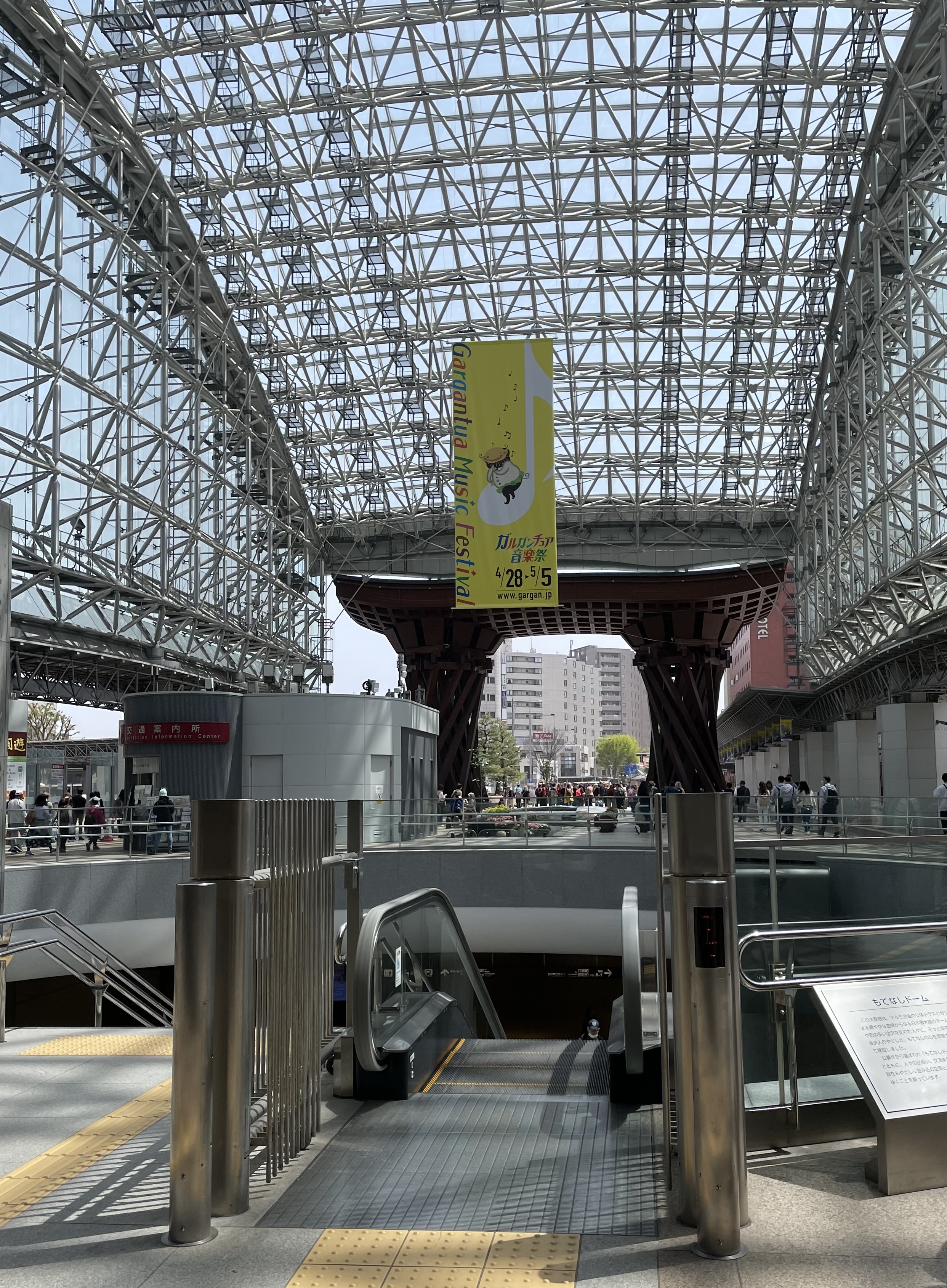
We checked into the Dormy Inn—our fourth—a short block from beautiful Kanazawa Station. The enormous entry, with huge sculptures representing traditional drums, is spectacular, the gardens and sitting areas peaceful. This Dormy Inn was probably the nicest with our larger room and an outdoor pool in the 14th floor onsen. Kanazawa, our last stop before returning to Tokyo, was a bit off the tourist track and we weren’t sure what we would do there. I did know if my ceramics shopping was still enticing me after Tamba and Kyoto i could finish it there, but had no clear plan where to go other than the two stores I had found weeks ago. I wanted to get one checked off and picked the one furthest out. We got on a bus after lunch (more about lunch later) using our mostly-accurate google maps app.
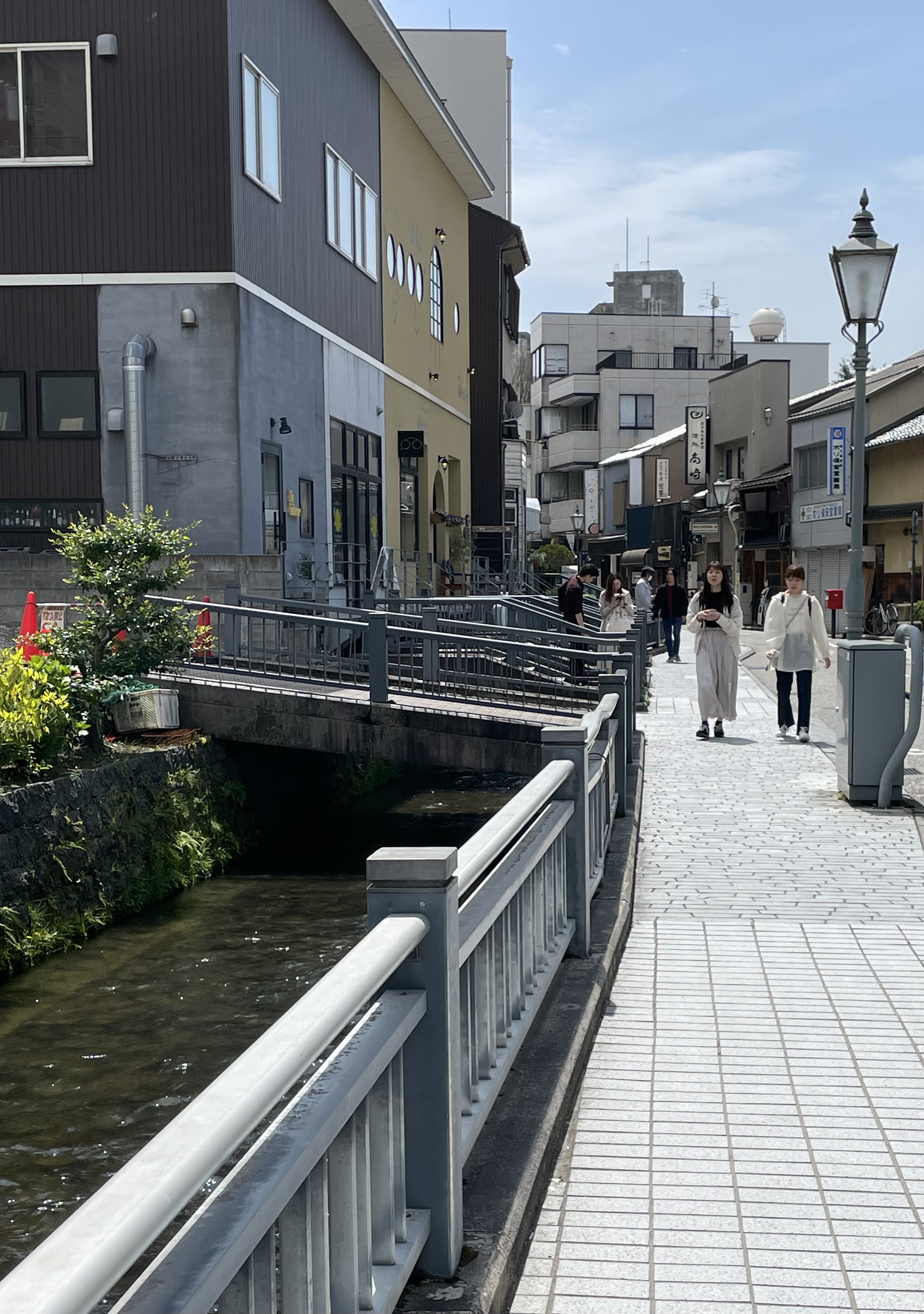
Oh, the buses of Kanazawa. As one helpful man told us, Kanazawa has only begun to attract tourists in the last few years, and the mishmash of streets combined with the most confusing bus system we have ever encountered made “hopping a bus” nothing like our week of tourist-friendly Kyoto. The signage on the stops is messy and seemingly contradictory (a loop bus that starts and ends at Kanazawa Station had, on one loop bus stop sign, a small notice in the middle of the text that “this bus does not go to Kanazawa Station”, just an example among many). Some blocks have, within 15 yards, two or three bus stops, each for a different set of buses. The buses have a lighted grid sign at the front next to the driver, each numbered block with a different price which we never did figure out. Unlike Kyoto, only the next upcoming stop is shown in English, forcing us to pay attention to each and every stop. And, the helpful man told us apologetically, “In the morning and evening the buses are reliable, but during the day…” He shrugged. Lastly, Google maps repeatedly lost us, or told us, when we were at a numbered stop, that we were not at that stop and had to walk 3 minutes to another street (helpful man said he had no idea but to stay put because if we caught that same numbered bus in a different spot it would not take us where we wanted to go.). It was frustrating and made us feel unwelcome. Oh and they do NOT accept Suica cards, the cards we have used in every city for transportation, konbinis, pretty much anything.
Bus footnote to the day—when returning to the hotel late in the afternoon we were delighted to see a JR bus coming. We have a JR Arch (a regional) pass, which we used our last days in Kyoto on several JR buses and of course was our method to get the Shinkansen to Kanazawa and back to Tokyo. Several times on that JR Kanazawa bus the PA announced if you had a JR pass to show it on exiting. So when we got to our stop we confidently walked up and flashed our pass. Gruff driver says “no good” no matter what we pointed to on the pass. “No, no,” he insists. We knew now we had to dig out cash, so I asked “How much?” The driver shoved my arm in disgust and waved us off the bus. Yeah, love the Kanazawa bus system.
We did find the outlying ceramics shop. It was in an old, semi-rundown neighborhood. About half the items in the very small showroom were out of stock so would have to be mailed at a future date and the prices were out of our range. We trudged to the stop/bus station where we found the helpful man, and after he and the agent had at least four conversations over the next twenty minutes about what we should do and how to get there, “there” being one of the largest and most revered tourist sites, suddenly a bus appeared and helpful man ran over to tell us “This one!” and we gratefully climbed aboard. Google maps on David’s phone told us to get off at one stop; on my phone it said a different stop. But it turned out fine, and we entered THE MOST BEAUTIFUL GARDEN in Japan.
Kenroku-en Garden
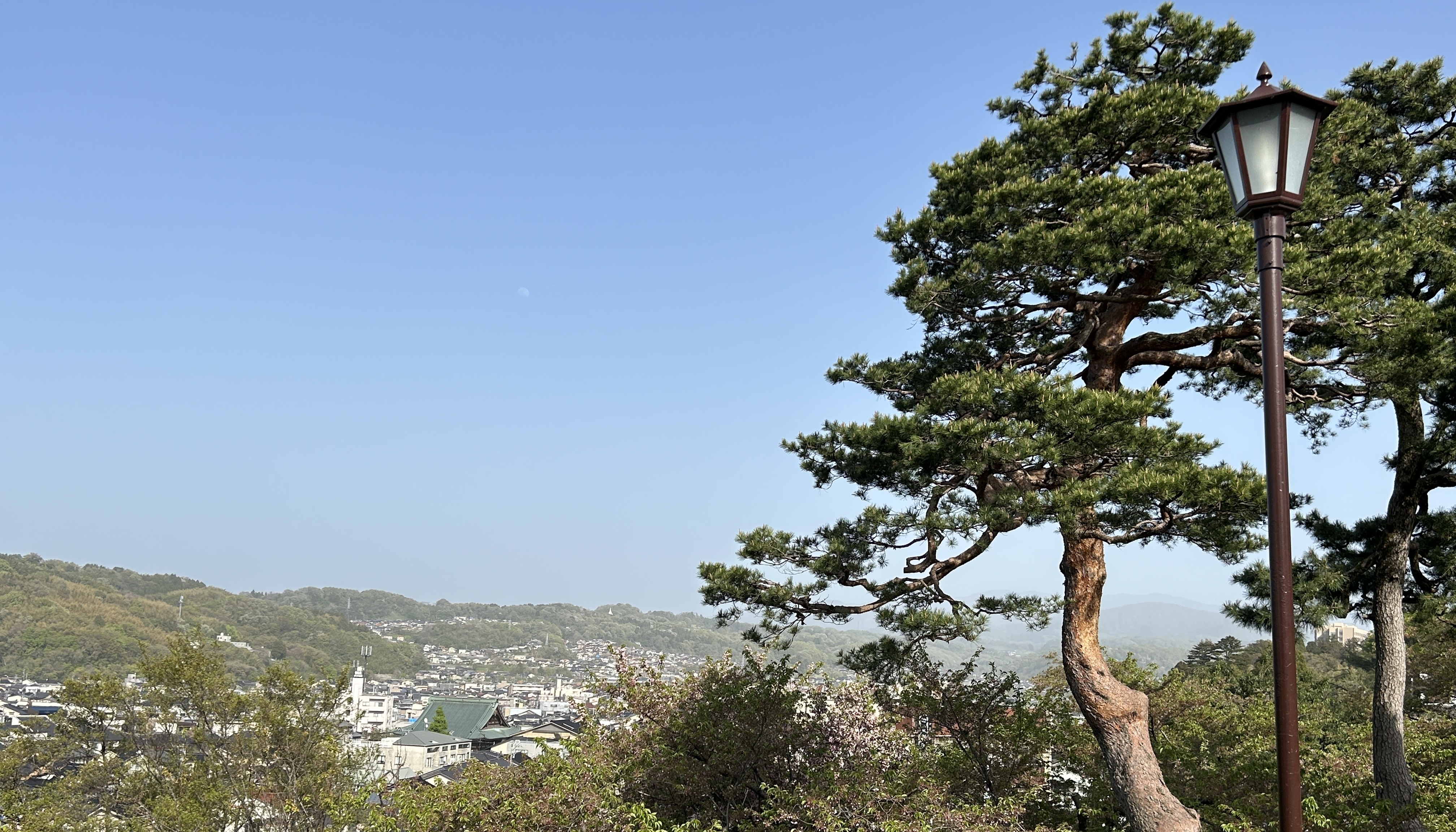
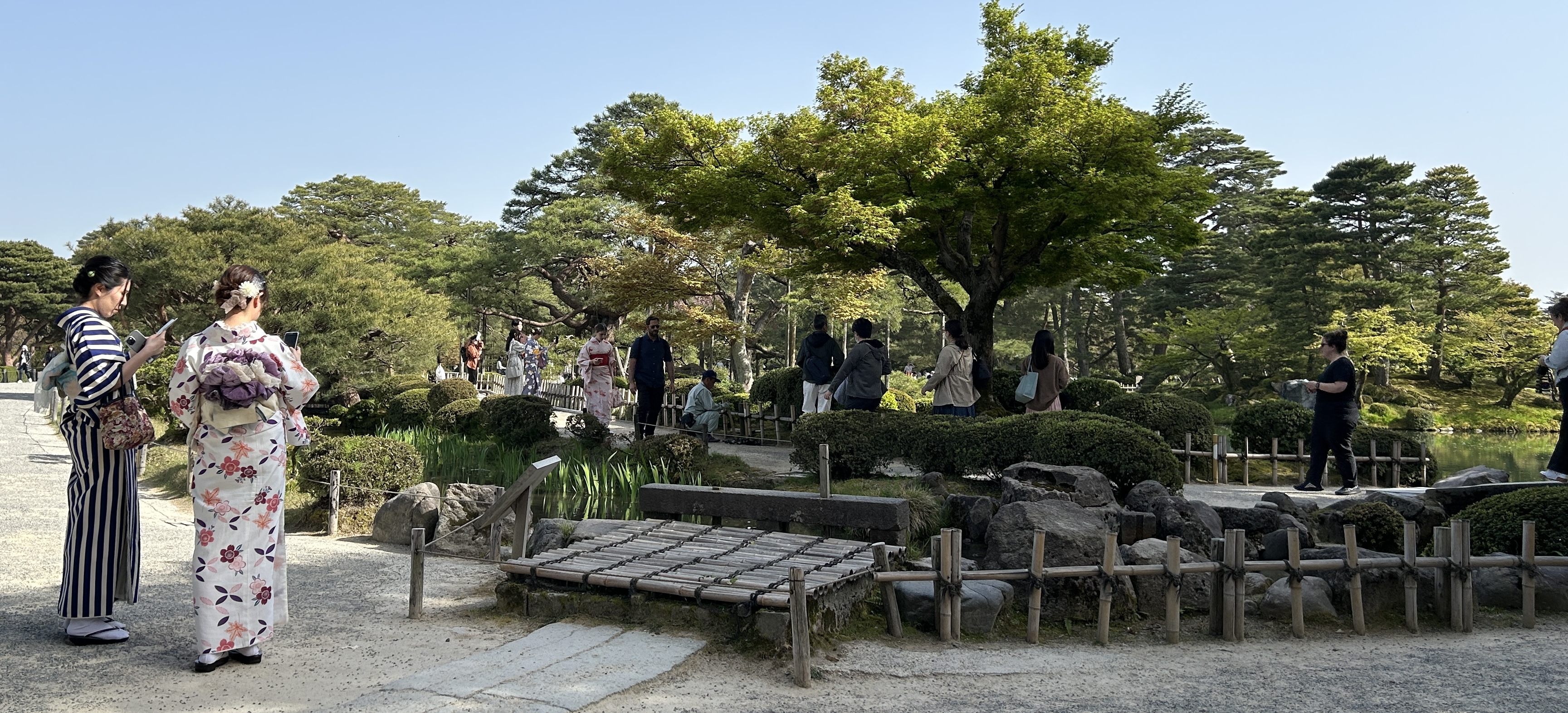
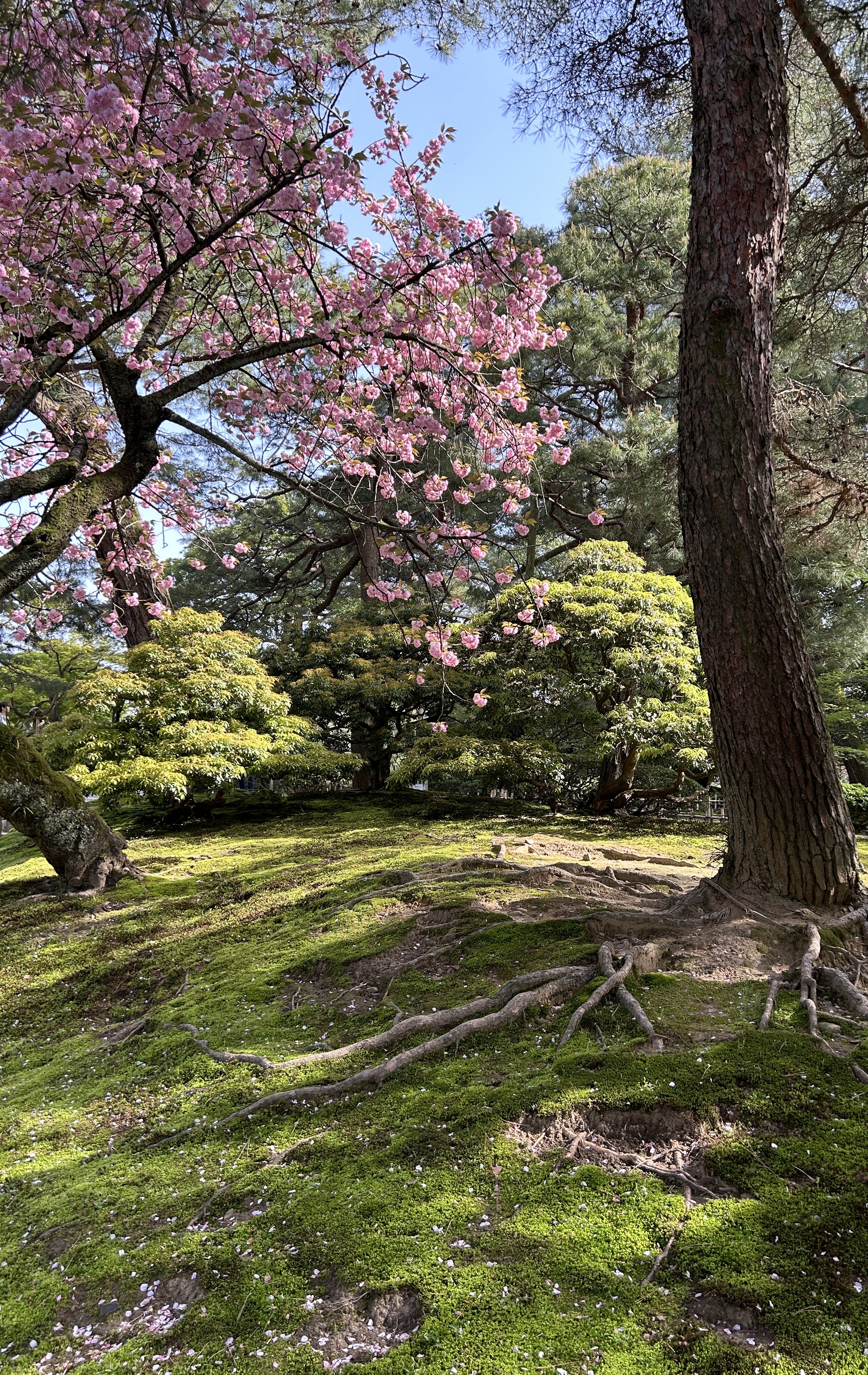
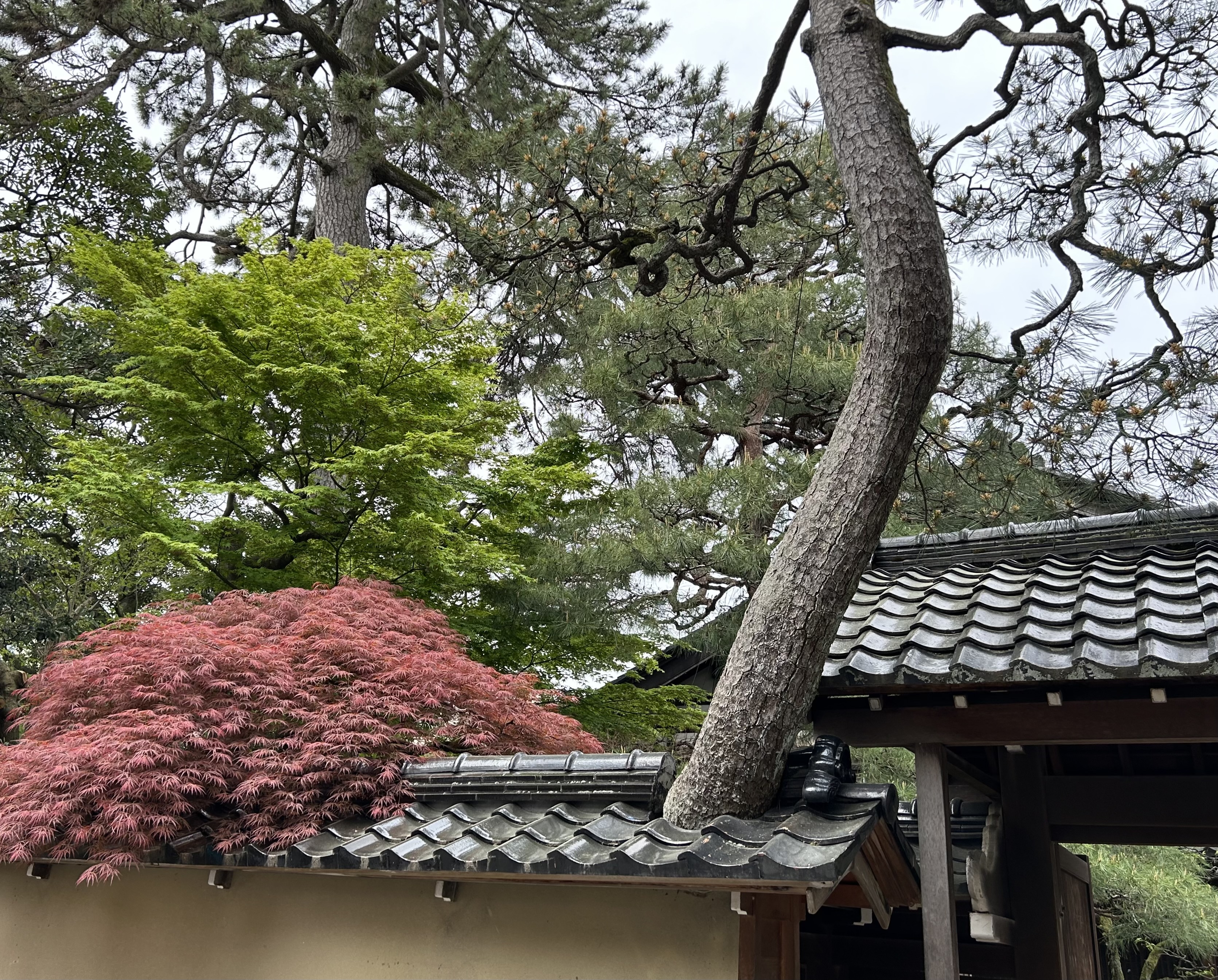
Wow. Wow. This garden was initially laid out in the 1620’s, but its current configuration was finished in 1822. It sits on a high point, almost a bluff, next to the castle ruins and it is spectacular. The sun was out, it was cool and a little breezy, and we began to like this city after all. We have been to many many gardens in many countries, and this wins hands down. While it has the feel of a typical small-scale Japanese garden, it is enormous, filled with enormous, meticulously pruned trees. Many are supported by one, ten, twenty crossed timbers, having been encouraged into bonsai-shapes of almost horizontal branches. We watched several gardeners removing, literally, needle by needle. We wandered and strolled, took pictures and enjoyed the other tourists, rested on benches, took a tour of a “villa” built in the 1800’s filled with cases of miniature household (a wealthy one) items that represented what a girl of the family would be bringing as a dowry. After a few hours we collapsed and after typical confusion about where the bus stop was we got on that ill-fated JR bus with the grumpy driver.
The Samurai House District
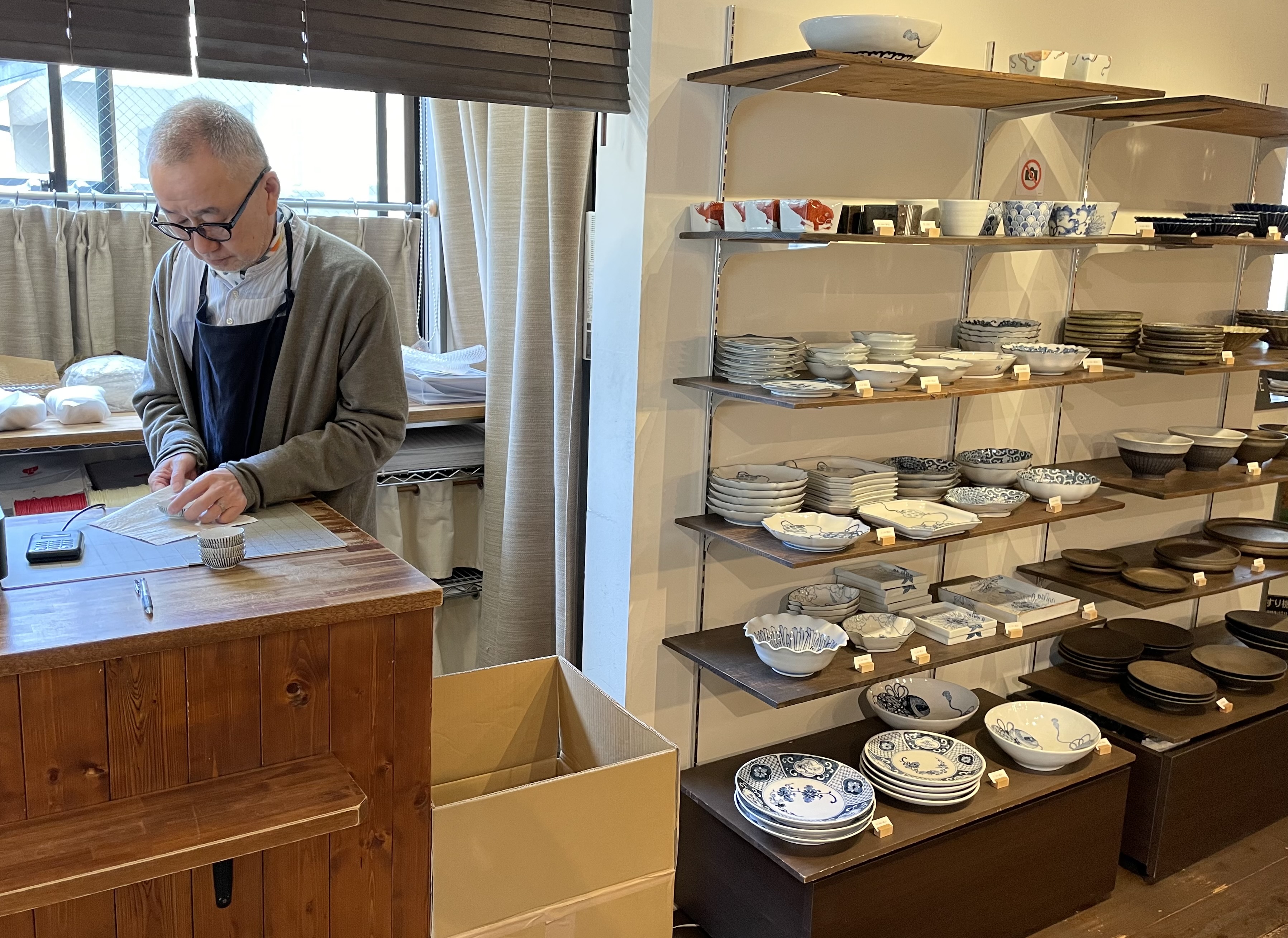
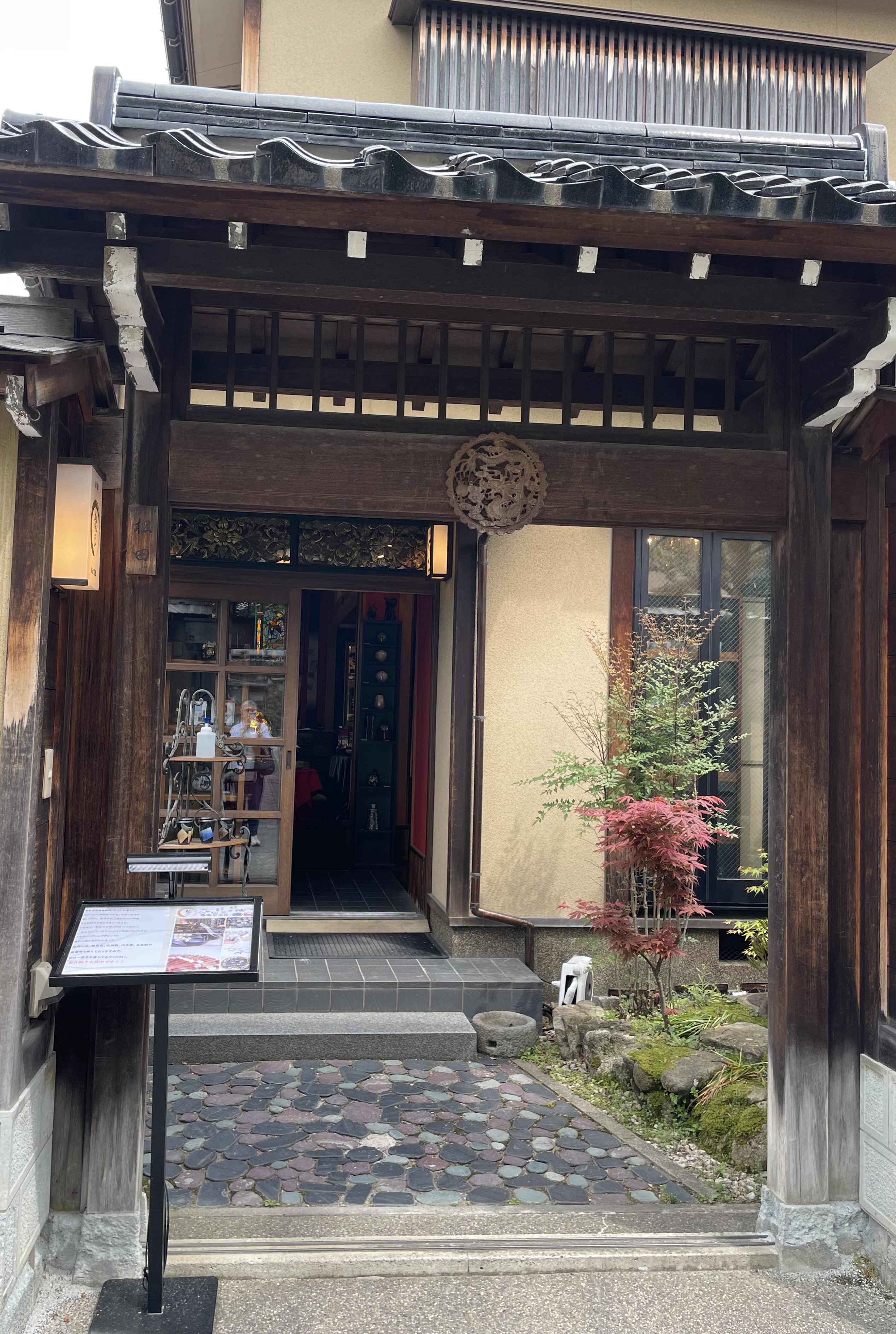
I stayed up late searching for ceramics stores and found four clustered in what is now known as the Samurai House District. After breakfast we took the bus down and started a-strolling. Peaceful, lovely, with historic houses, historic gardens, and amazing ceramics shopping. I thought I had been finished in Kyoto, but, alas, I needed one more fix and what a fantastic place to get it. After repeatedly vowing to buy only gifts, I caved at the last store and bought a few little things for myself. Everything is packed within an inch of its life, bubble wrap and boxes and paper and all. Thank goodness we pack light because Zipair is rigid about sizes and weights. I think we’ll be fine. I think.
Lunching at Ochimo Market Twice in Two Days
When we first arrived after a train ride of two hours we were hungry and Ochimo market was maybe a 20 minute walk up a main street. Kanazawa is known for seafood. Let’s go!
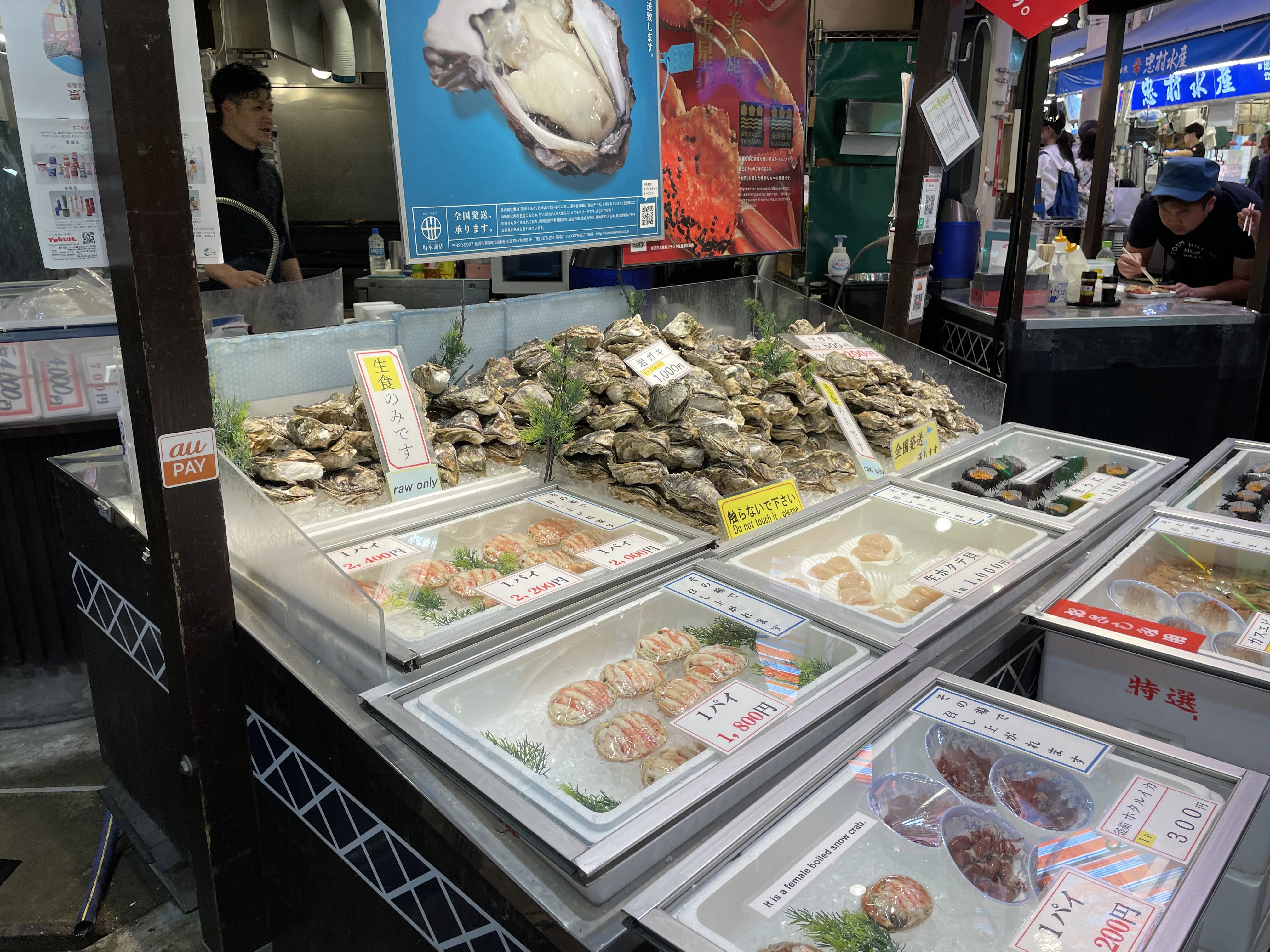
Unlike most similar markets, this one is designed for people to stand and eat at the fresh seafood stalls. Counters with condiments and small tables abound (no chairs). The seafood is peak fresh and delicious, the atmosphere happy and helpful. The first day we went into one of the myriad tiny sit down restaurants, all of which seem to serve the same things for the same prices. I had a mixed seafood over rice bowl, David had the minced tuna over rice bowl. David held his phone up to the specials blackboard and Google helpfully translated. Fried oysters? Yes please, oysters are a specialty of the city. Have I ever had better? Nope. I don’t believe it is possible for better to exist. Had fried oysters the second night at an izakaya around the corner from our hotel, and though a bit smaller they were just as good.
Of course we went back on Saturday. This time we wandered the stalls watching people eat. Raw Oysters. Raw fish. Sea urchin. After we ate our sushi and crab we stopped to watch a young couple from Australia eating wagyu beef cooked on a little ceramic stove on the counter in front of them. We asked how it worked, watching the preparation and thinking maybe we weren’t so full after all. You select a piece from the counter; they slice it, fire up your little burner, lay out the salt and garlic chips, and you eat. Yes, worth every penny and every melting bite eaten with flaky salt and garlic chips.
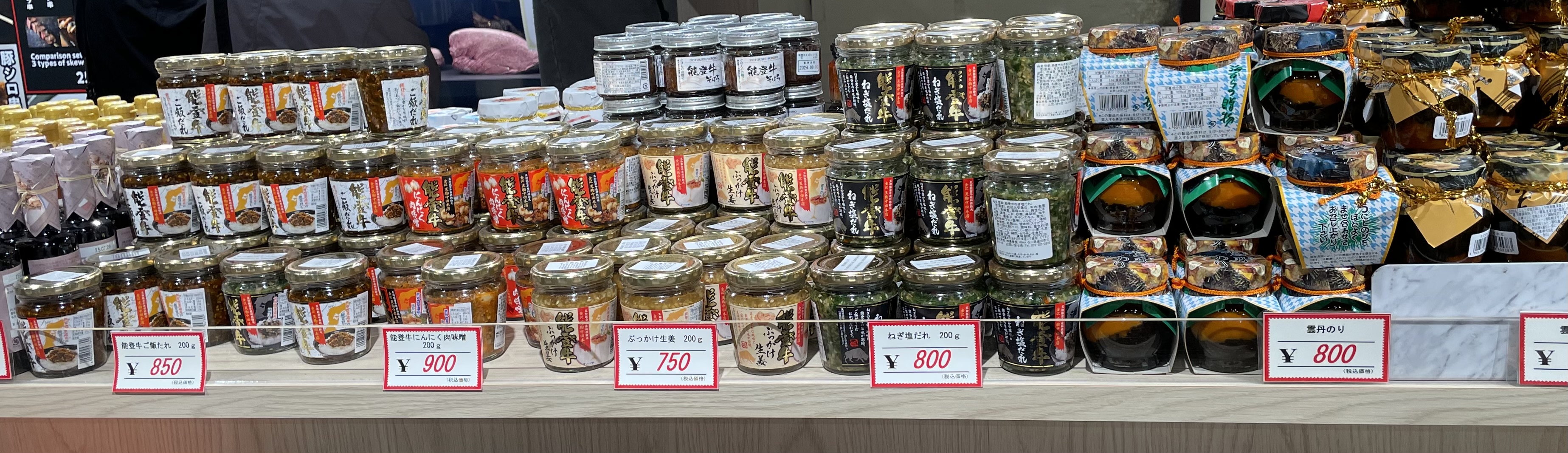
Every kind of jarred condiments…from a green onion sauce to some with uni (sea urchin), something I cannot imagine in a jar.
21st Century Museum of Art
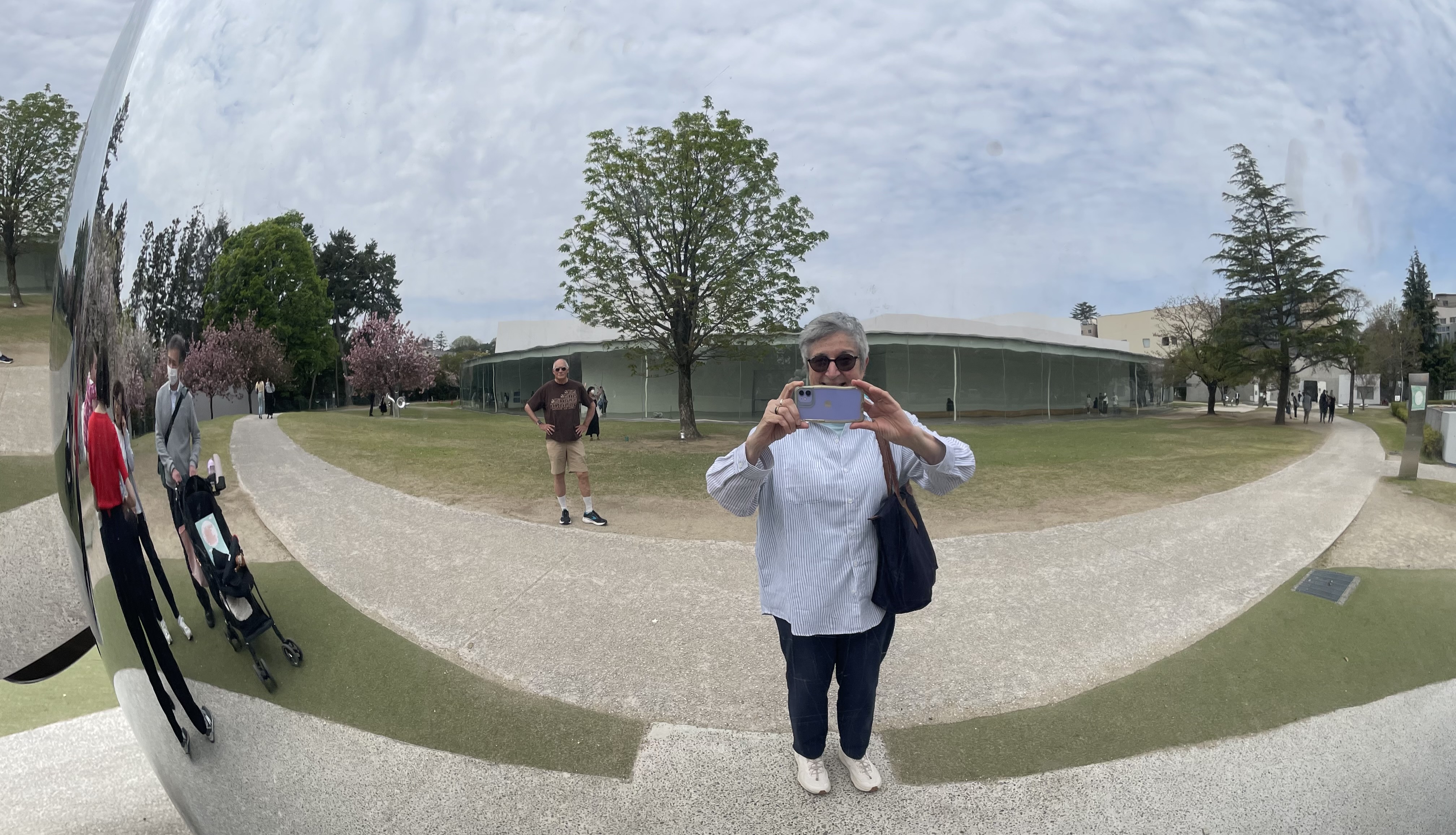
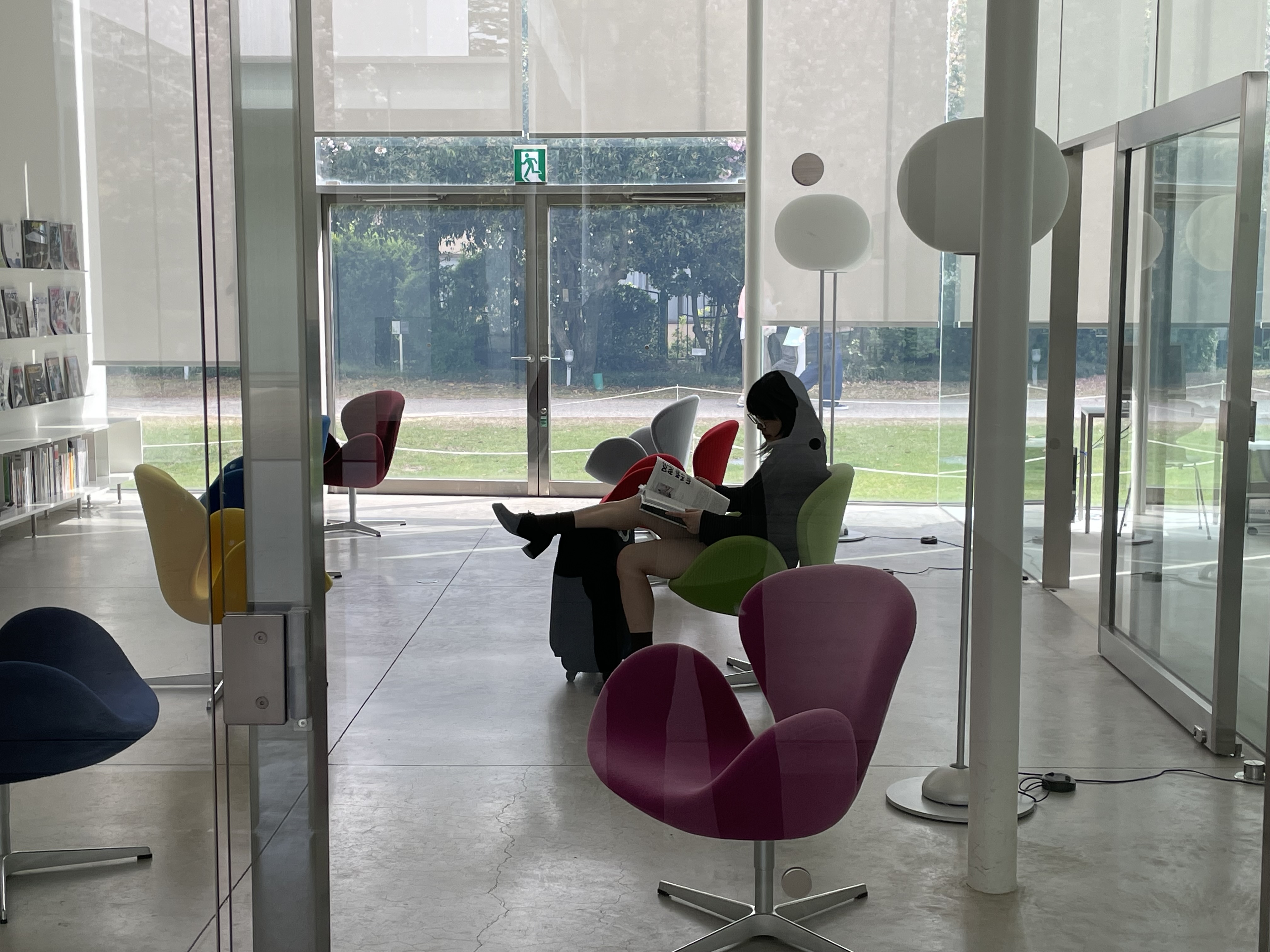
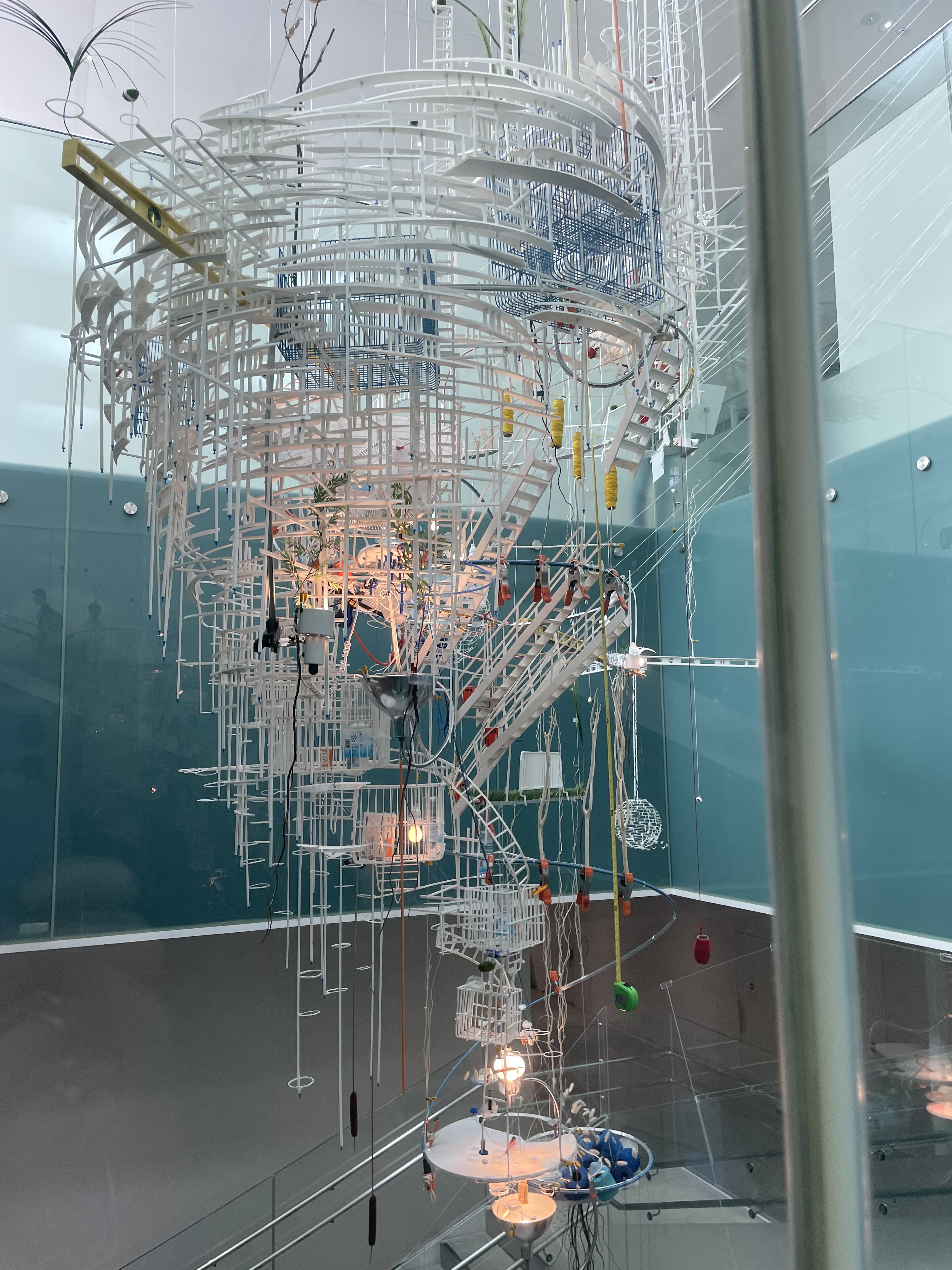
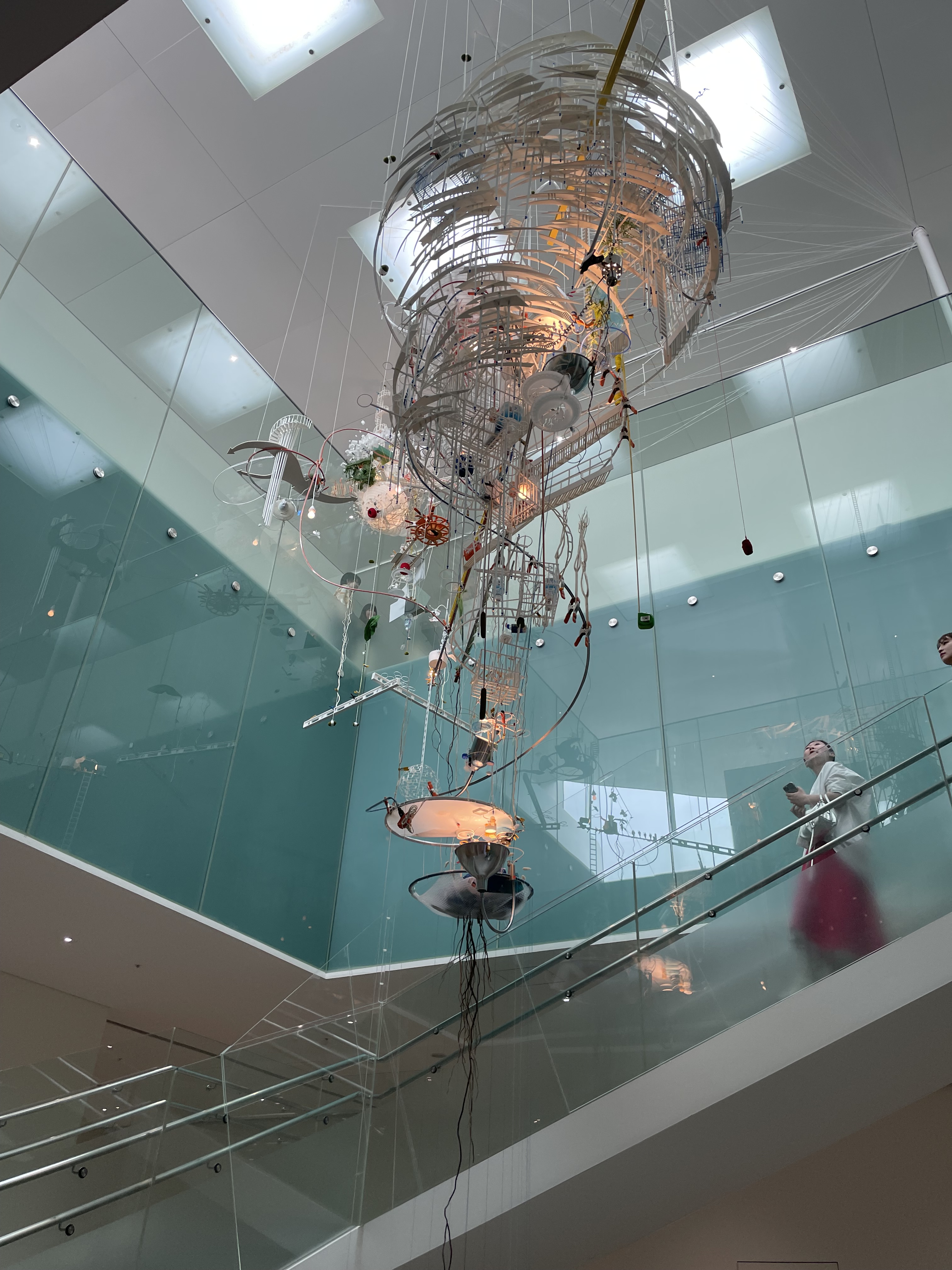
This amazing celebration of modern art was damaged in the December 2023 earthquake and the interior has yet to reopen fully. It sits in a large park filled with families on the Saturday we visited. Whispering tubes, climbing structures, cool-o places to sit, a large multi-colored glass box, reflective sculptures and wide lawns surround the circular glass building. Because only the exterior ring inside the building is open there is no admission fee—there is only one “gallery” with a single kinetic mobile is open. It was oddly entertaining—though all windows, the soundproofing is total and from the perimeter inside families carousing and couples strolling outside seemed like an immersive, silent movie.
There are plenty of museums around the park and castle ruins area, but we had neither time nor energy. We finished the day drinking and conversing and sharing pictures of our dogs via translation apps on our respective phones, with a young couple at the neighboring table in an izakaya around the corner from the hotel. They were from Tokyo and delighted we had been and were returning to their city. We returned to the Dormy Inn, had a last bath in the outside onsen where the moon shone and the wind blew, and fell into bed. On to Tokyo, last stop before home.
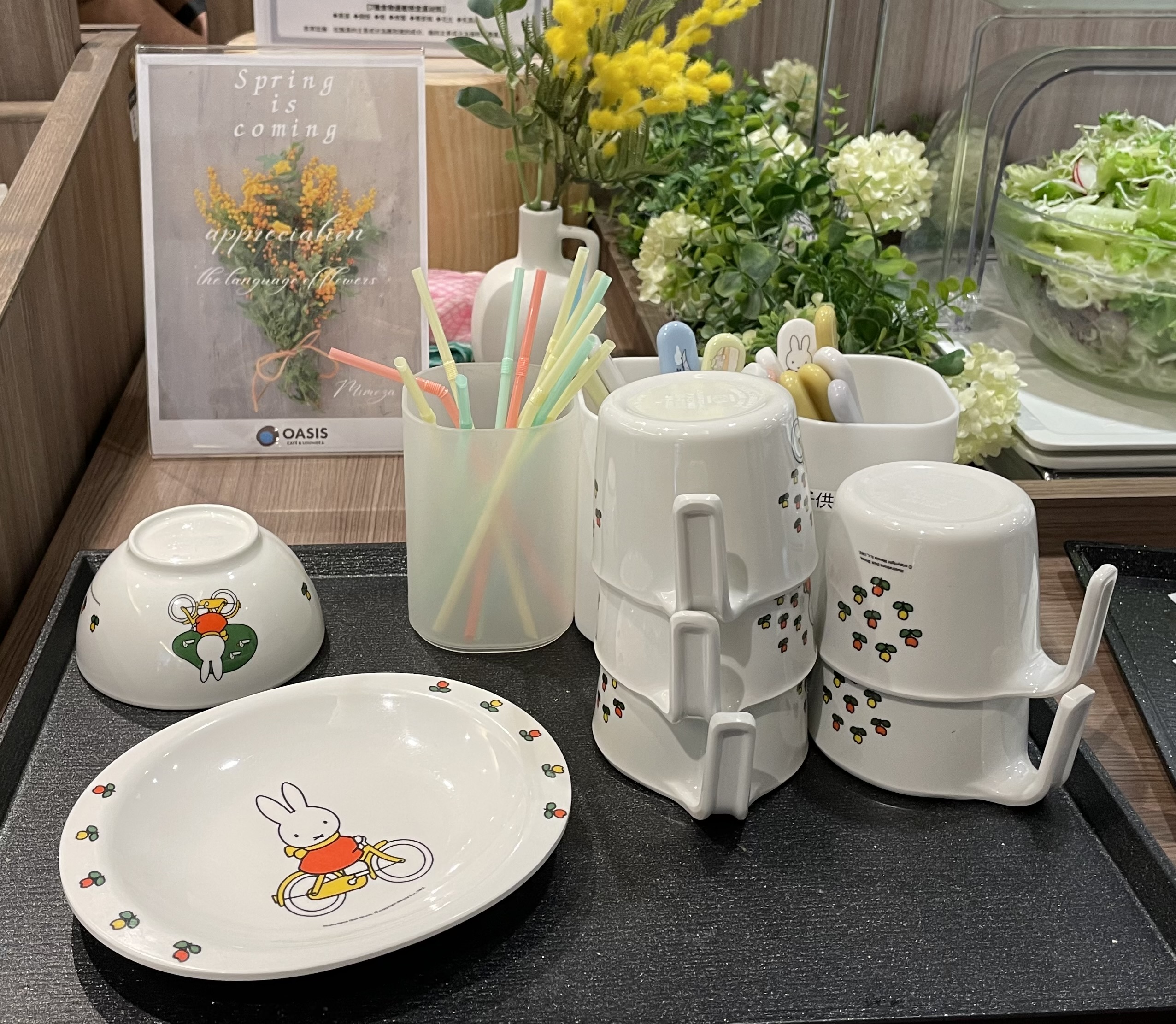
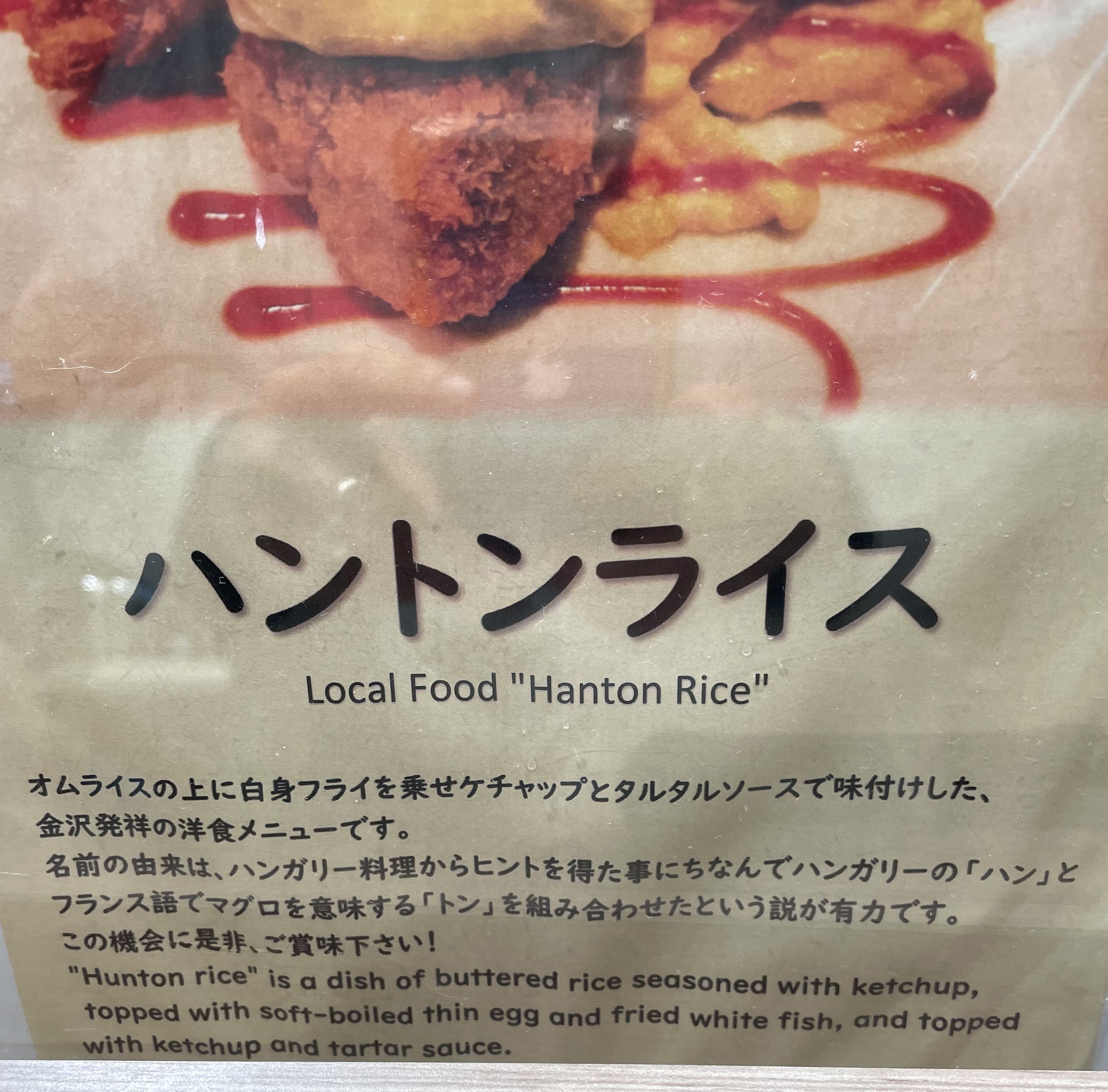
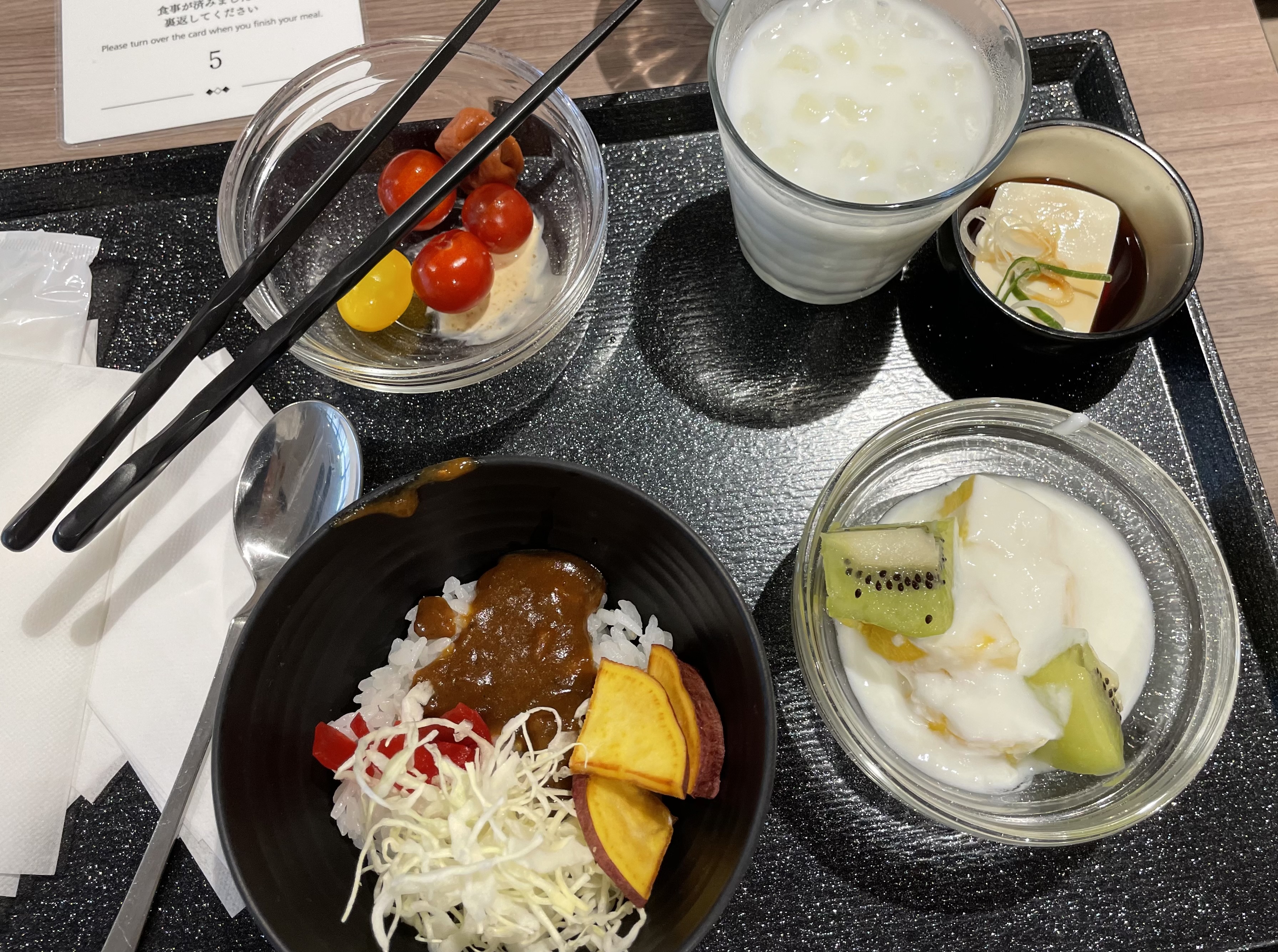
A Few Snaps of Breakfast at the Kanazawa Dormy
Kid friendly dishes, a strange local food combo, and my bowl of Kanazawa curry, appropriately garnished with pickles, roasted sweet potato, and shredded cabbage (surprisingly good).
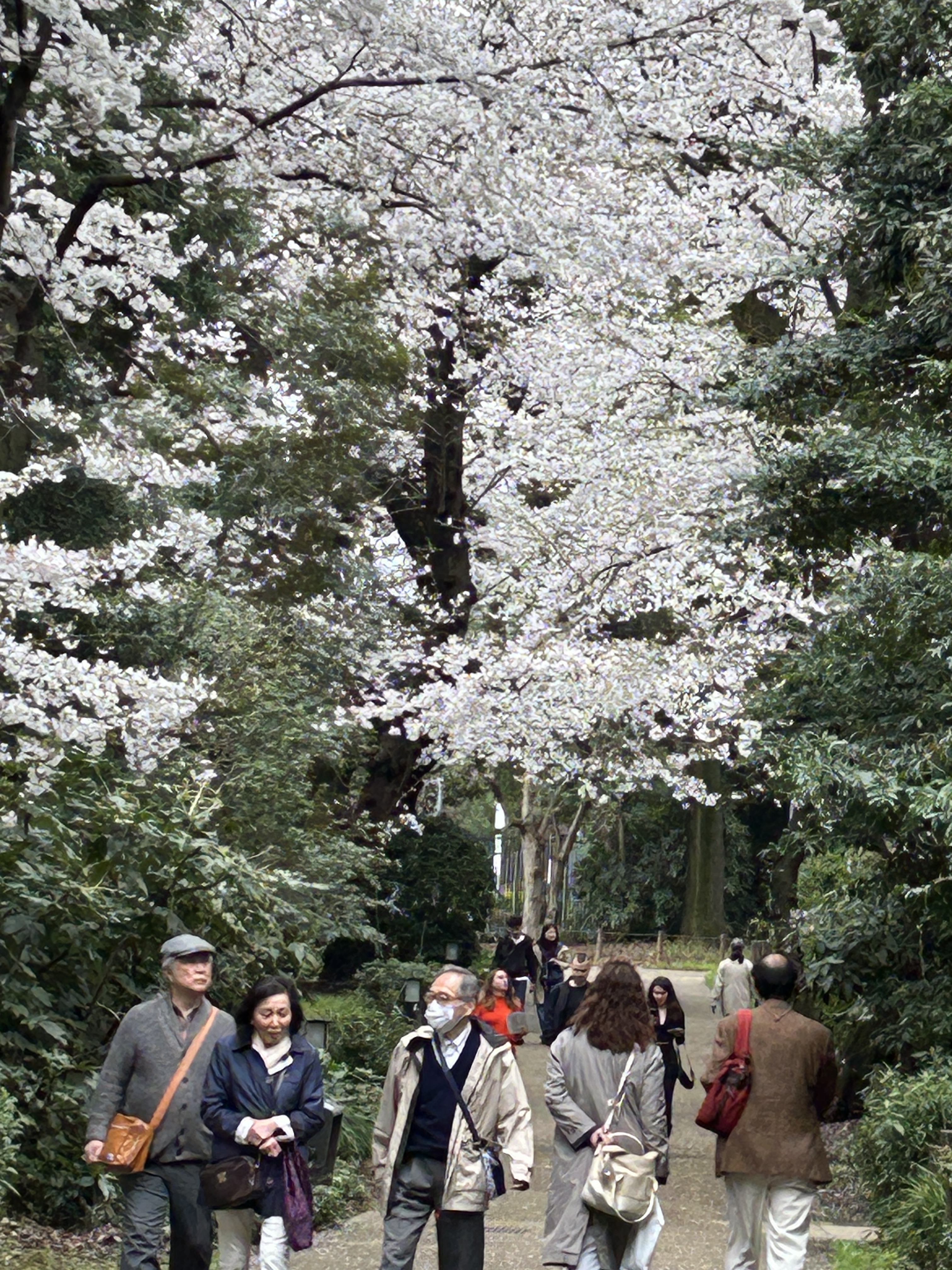
We had read somewhere that the cherry blossom season was early this year, so we were prepared to miss them. Turns out in Tokyo (and later in Osaka) it was peak bloom and what a show. Happily our plan to spend our first, hardest, most jet-lagged day wandering museums in Ueno Park, a short walk from our hotel the Dormy Inn Uneno, sent us wandering through gardens and tourists taking hundreds of photos of the gorgeous cherry blossoms. It was beautiful.
We wandered the park people watching, bird watching, and marveling we were smack in the middle of Tokyo. We couldn’t have asked for a more gentle and peaceful day to recover from the long flight.
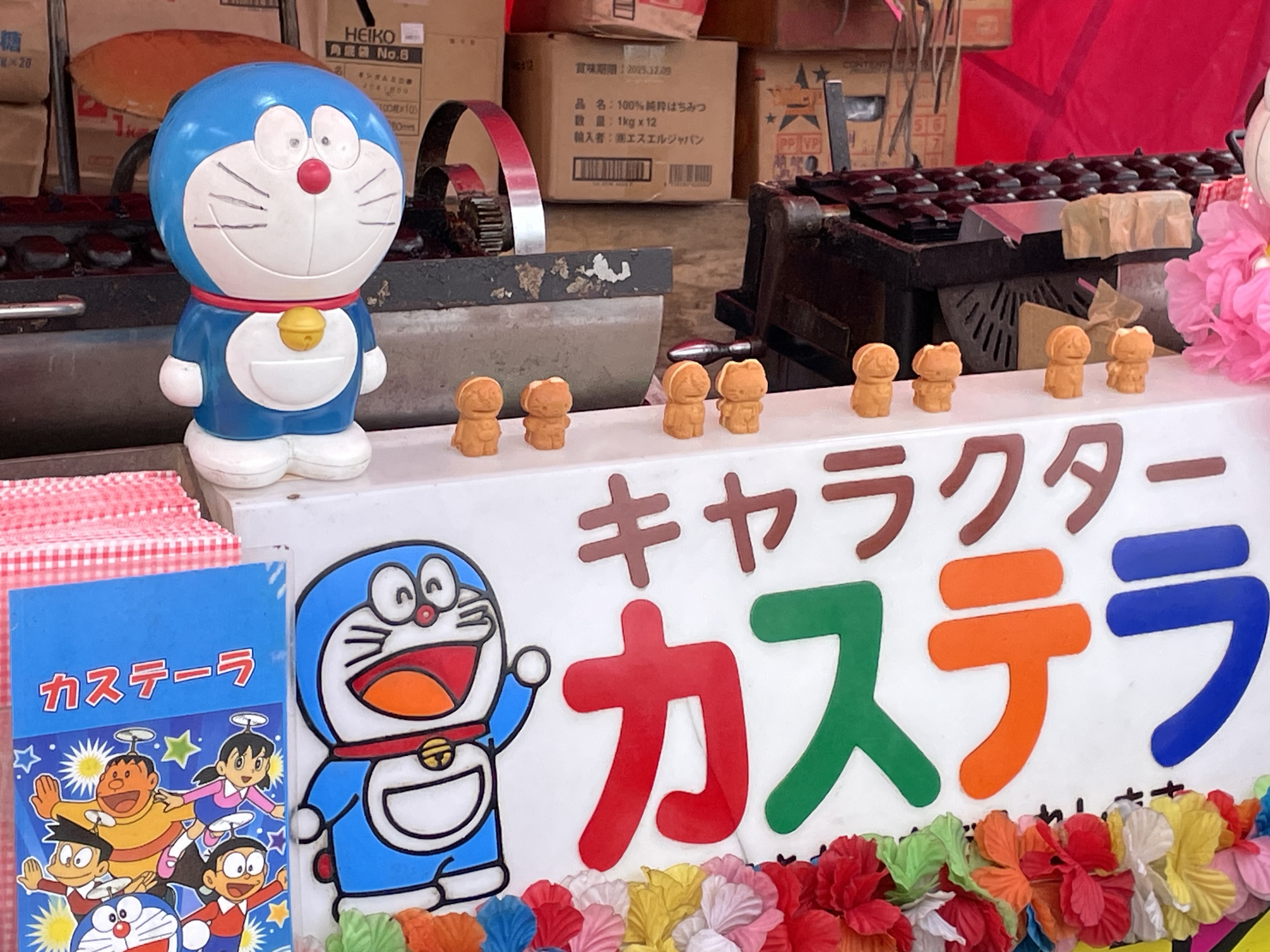
There were many, many Japanese families, seeming a holiday atmosphere, with food stands lining several of the walkways. Pizza. Kebabs. Karaage (fried chicken). French fries in varies forms…we finally settled on sharing a skewer of grilled beef tongue (delicious) and a potato and meat croquette. It was enough to sustain us and given our jet lag our bodies had no idea what time it was or what it wanted as sustenance.
Freshly made Hello Kitty cookies, anyone?
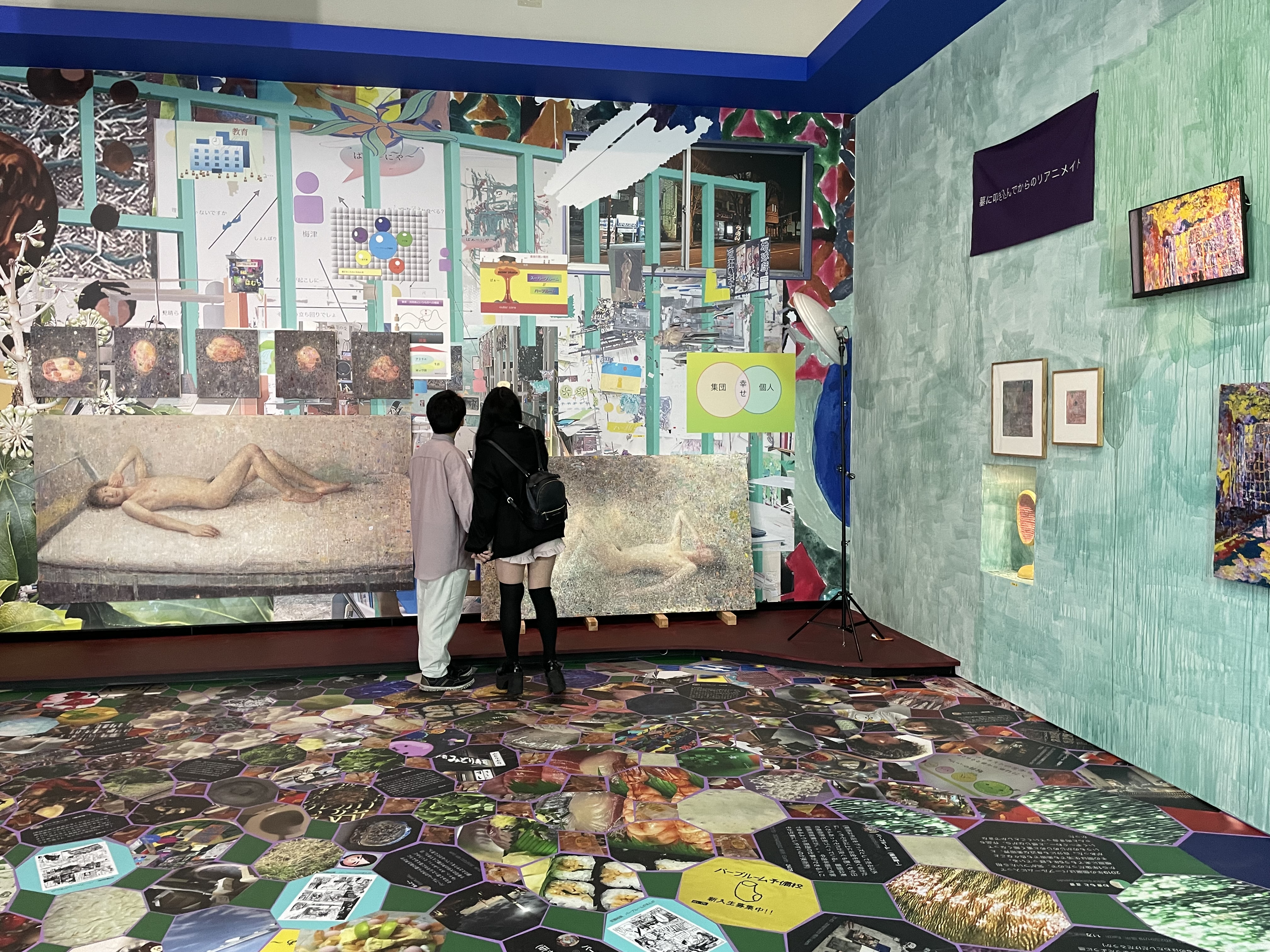
We knew a no-stress way to spend our first day included a museum or two and Ueno Park has many, from the zoological gardens to the Museum of Western Art. We headed there. It was fantastic.
We finished with the National Museum, overwhelming with the crafts and history of Japan, even including a large archeological building that we were too tired to appreciate. Of the three large buildings around a huge plaza we chose the Japan building. I had flashbacks of the Victoria and Albert Museum in London. SO MUCH STUFF. We wandered and tried to take in the kimonos, the laquerware, the ceramics, a video showing Kabuki and Noh, an entire separate building of archeological displays. Phew. At last we wandered out to the lovely gardens behind the main buildings and enjoyed more cherry blossoms.
Exquisite blossomsMore behind the National MuseumEvery surface a story in this amazing room at the Museum of Western Art
No idea the name, but I hope we can go back when we return to Tokyo our last few days in Japan
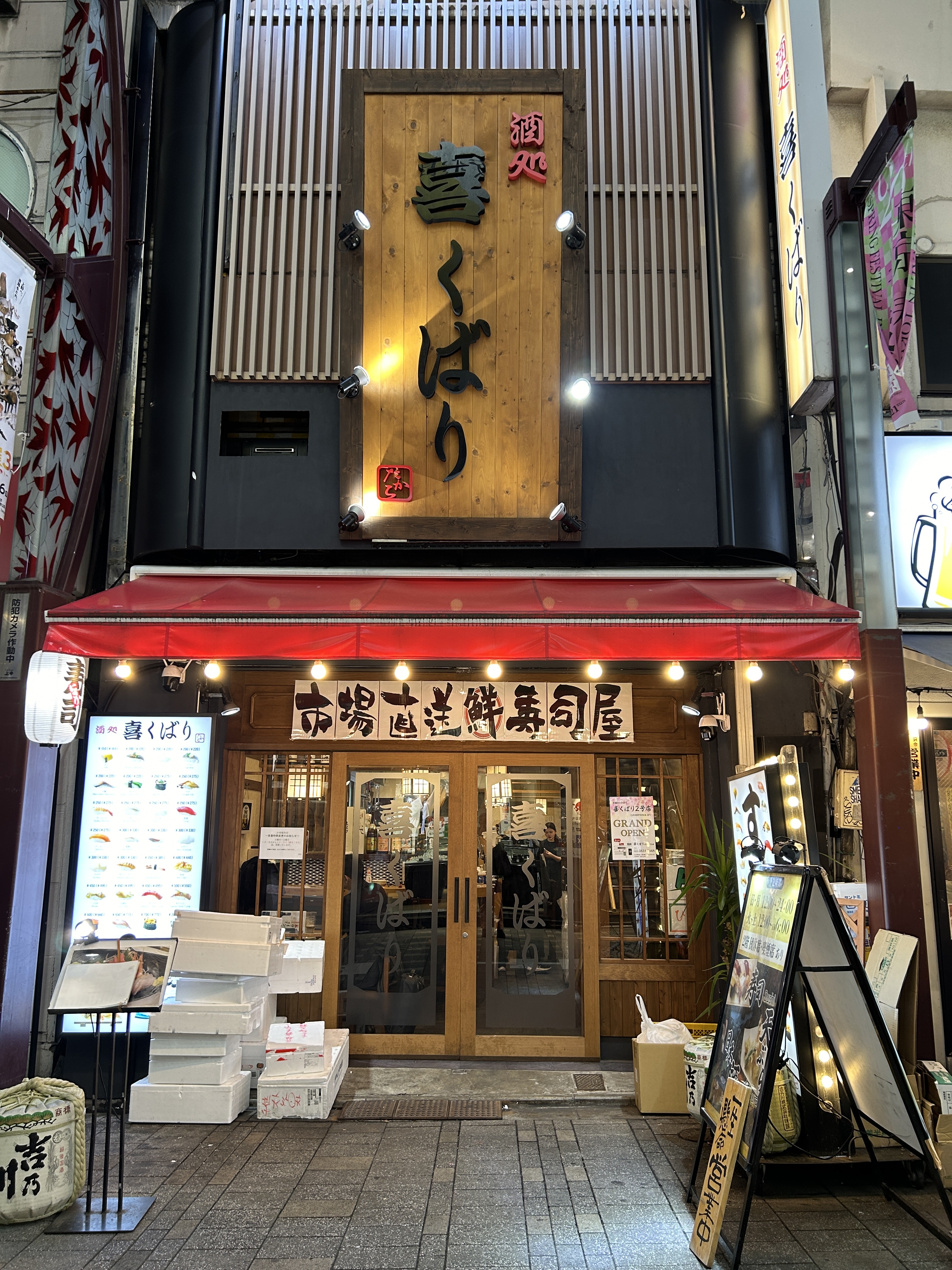
David found a little sushi place a few blocks from the hotel. Narrow, maybe 18 seats all told, with good natured hustle between the waitress, two older sushi chefs and a young cook/helper. Sushi was scrumptious, we finished the meal with a round of vegetable tempura (you order by the veg—we had shiso, eggplant and sweet potato). We walked back happy. A perfect day for the beginning of our three weeks.










































 Inescapably Rational