When Orvieto was not possible we had a free day Saturday and it turned out a lovely, and, compared to our normal pace when traveling, a relaxing day.
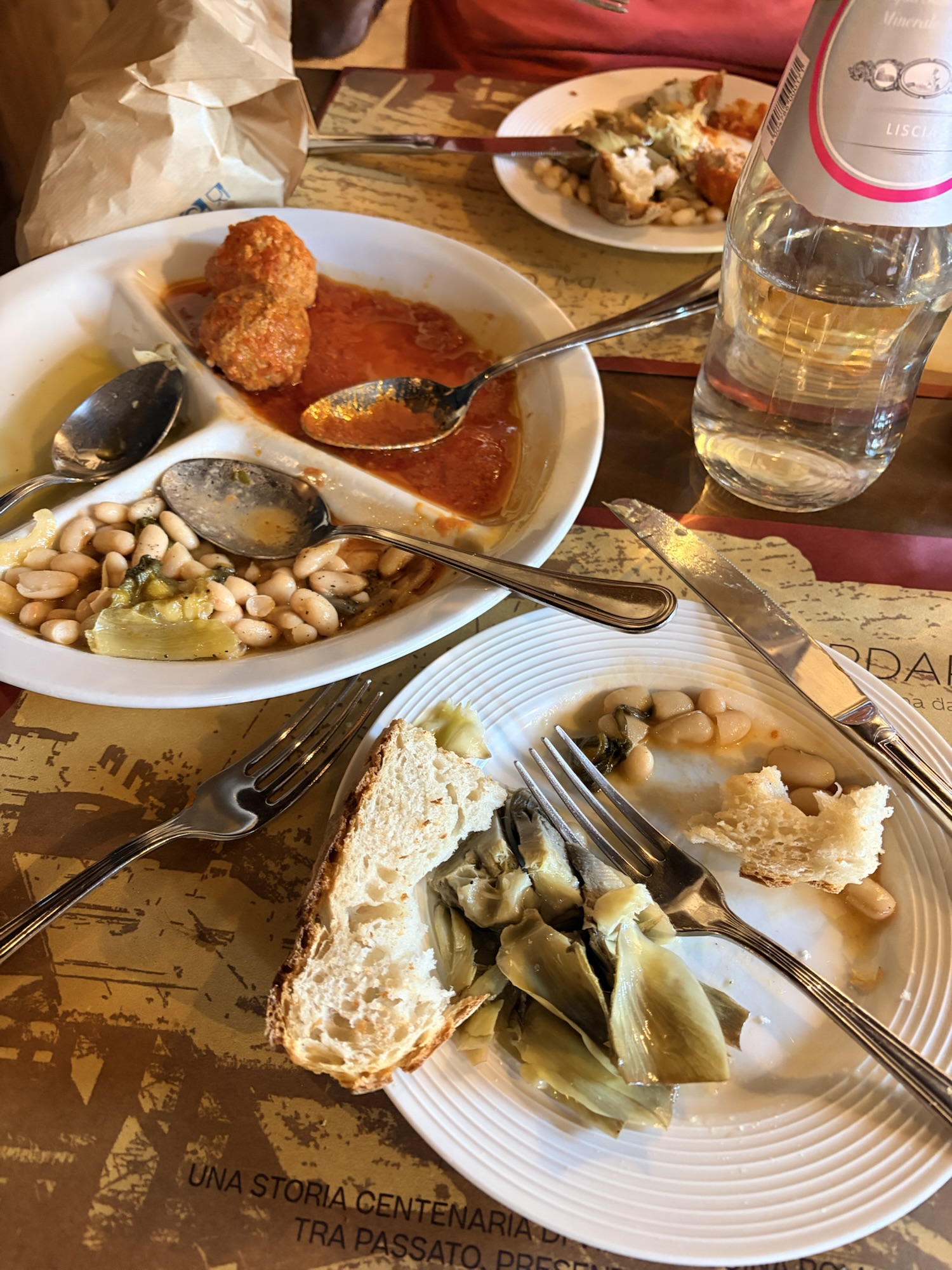
We dawdled over breakfast at Geselda’s, wandered back to the room, and decided to have a long indulgent lunch. Our host had suggested Dal Cordaro if we wanted an osteria, and when I checked for a dinner reservation they only took them 15 days ahead. We decided to try our luck walking in when they opened for lunch. We were the second customers and were seated right away. The atmosphere was somewhat cold and brusque and we were a bit uncomfortable until we were about halfway through ordering when the waiter suggested they had a special salad not on the menu…he was struggling to find the right word when one of the owners came by and said “cabbage.” Yes, he said, with olive oil and anchovies. We were game. We have learned dishes with just a few ingredients in Italy are very often delicious. It was. But everything was fabulous…with the antipasti’s cannellini beans, polpetto, and artichoke were beyond expectations. It was a meal to remember. As we left the man at the cashier asked if we enjoyed the food and I stopped to talk a bit. We are from California, we are so sorry about our insane president, the very typical conversation these days with Europeans. “We do not understand how he was elected again” he said to me. Yeah, we don’t either. He reached over and shook my hand. “Good luck to you!” And to all of us.
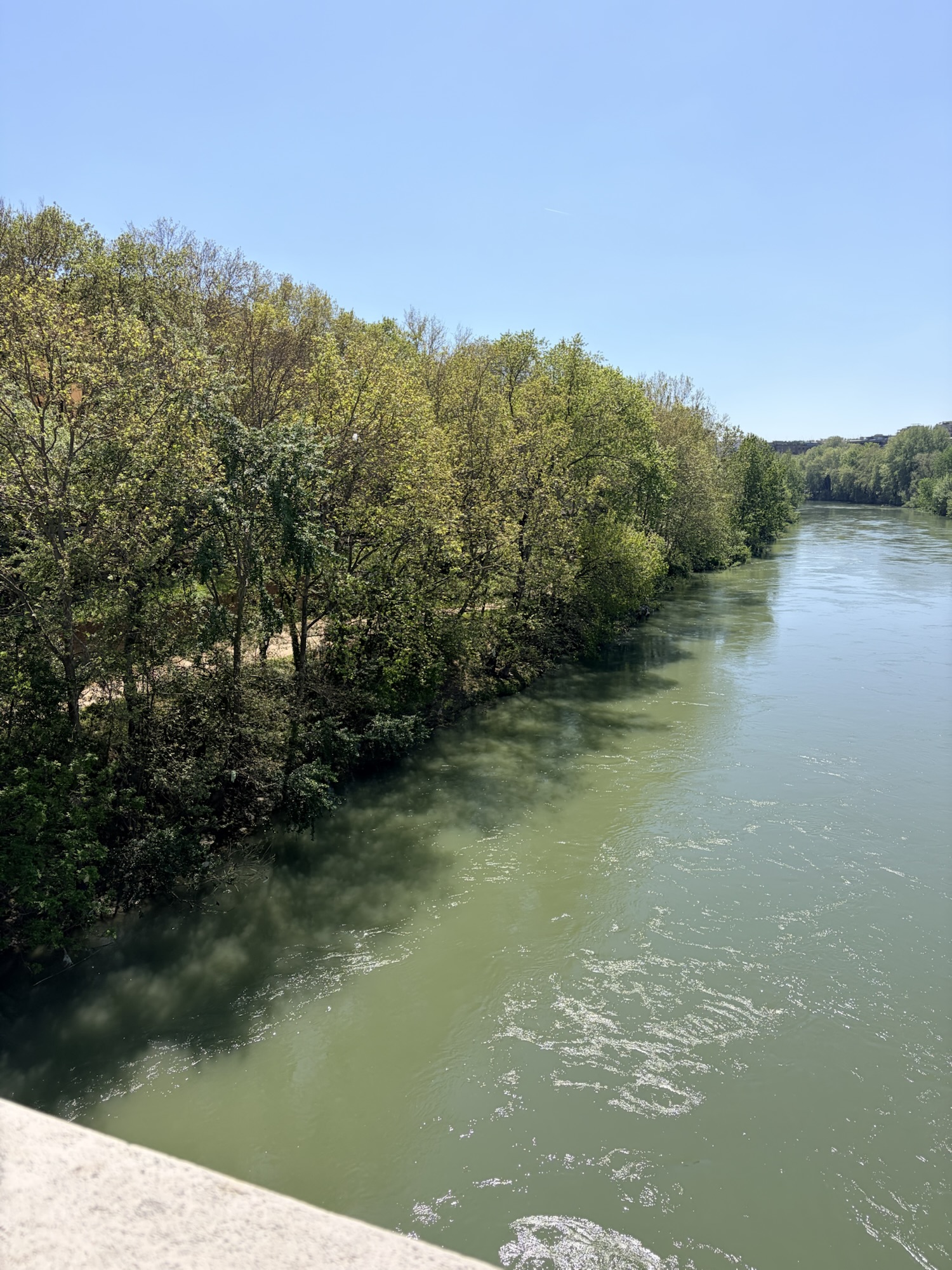
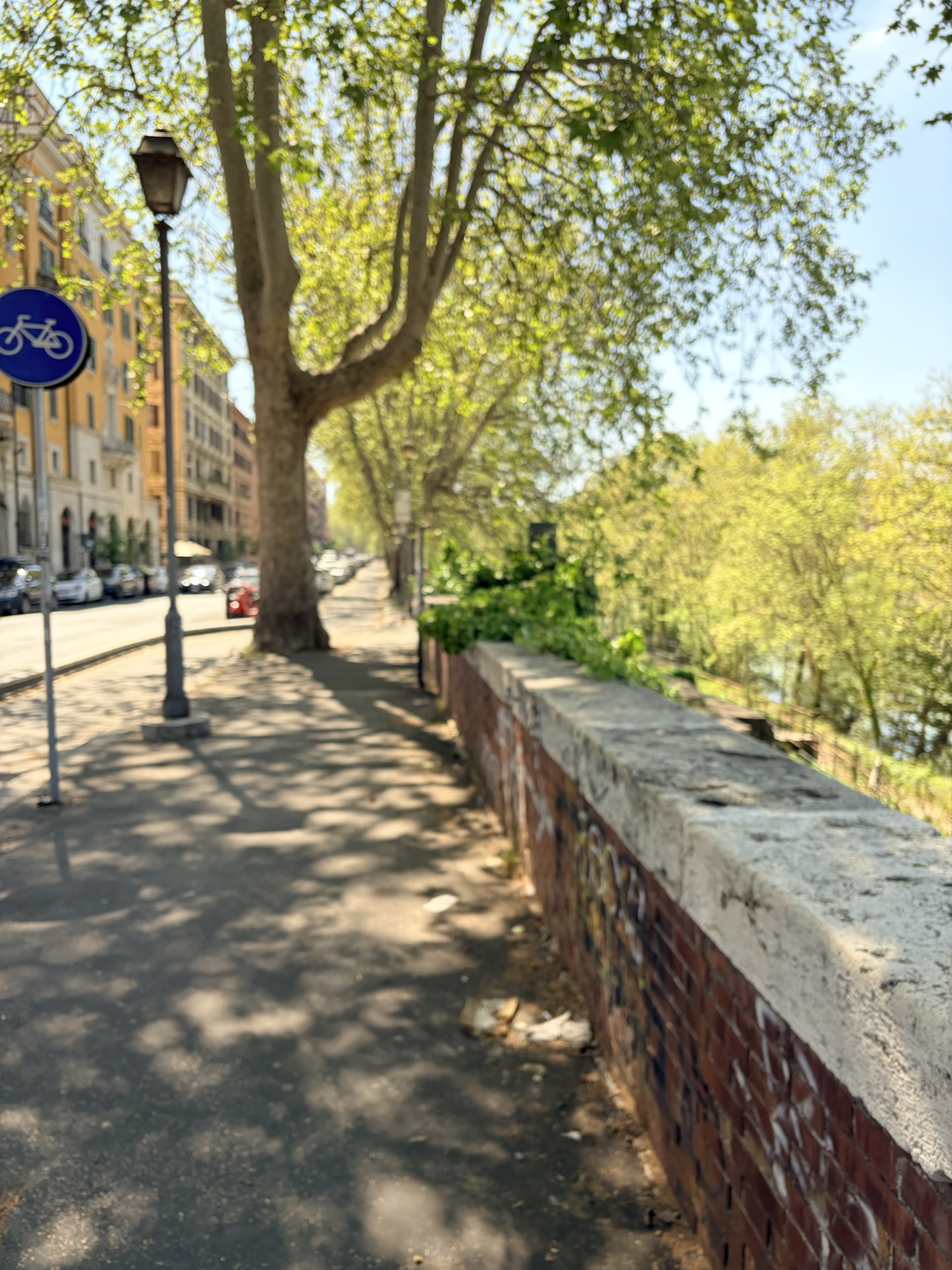
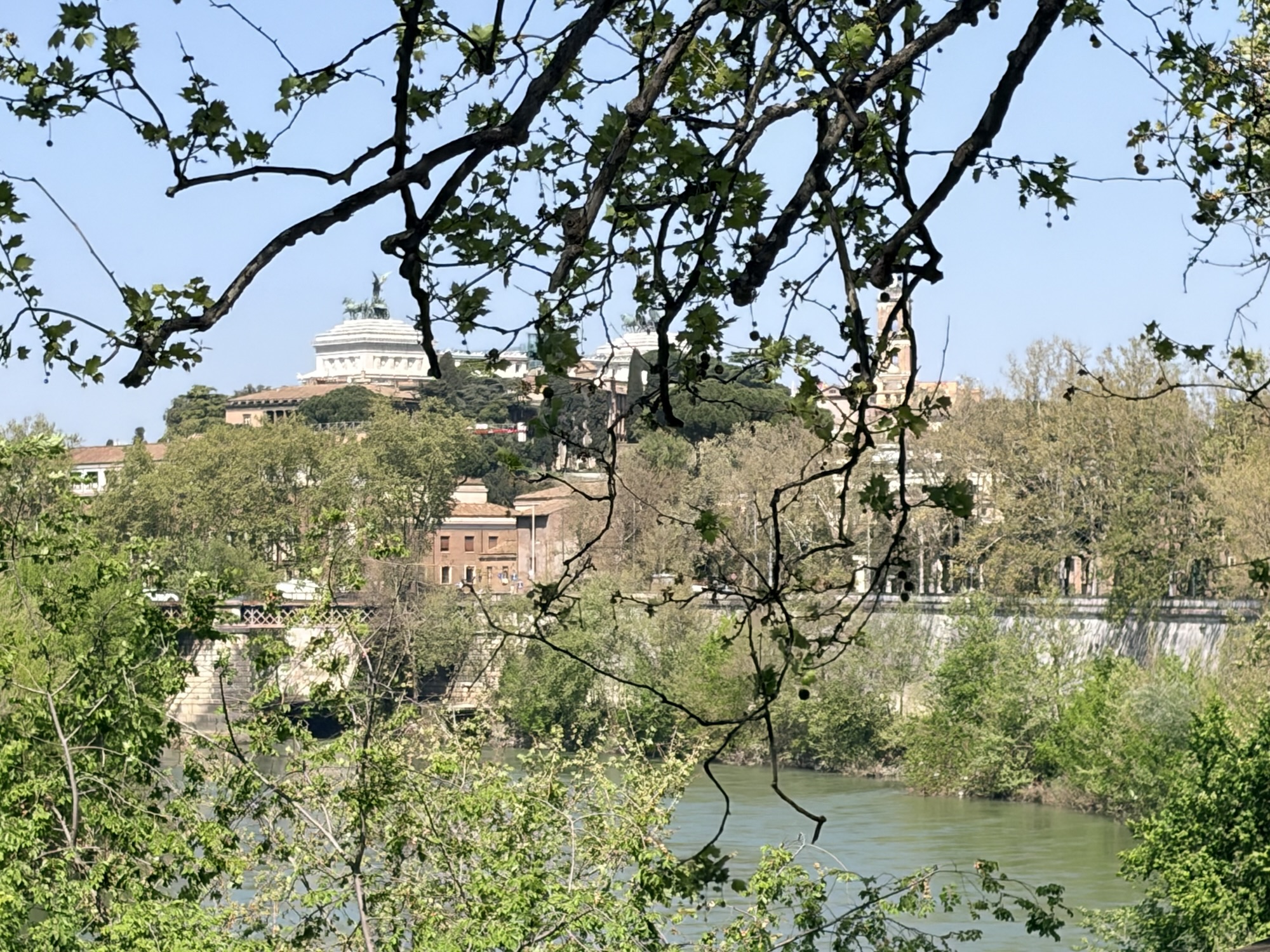
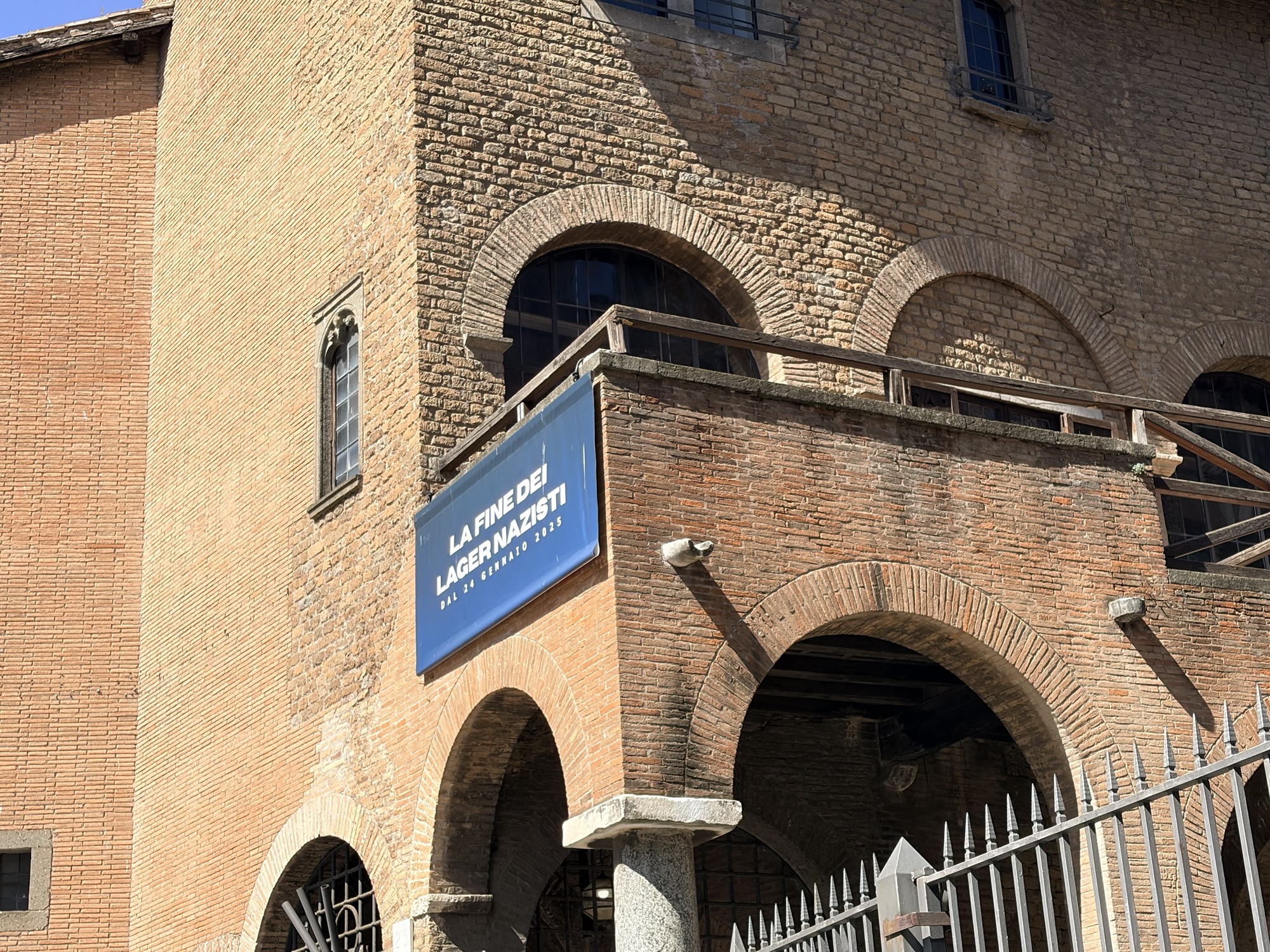
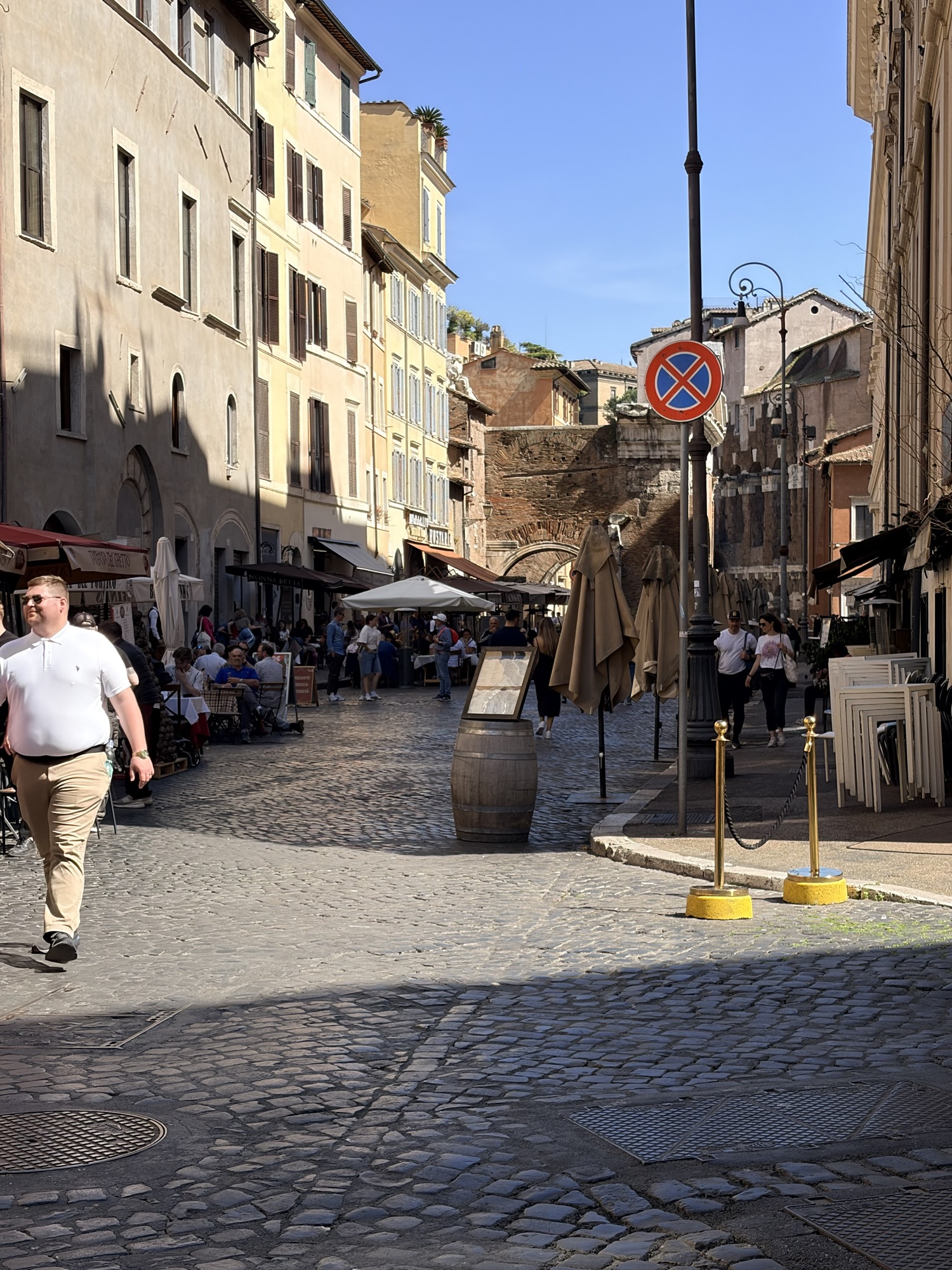
If only I could make cannellini beans like thisThe Tiber riverA lovely walk to end our Rome stayWherever we were there was a view of monumentsIn the Ghetto, a tribute to Jewish lives lost in WWIIIn the Ghetto looking back on the Portico d’Ottavia
One reason we wanted to try Dal Cordaro is it is steps from a bridge over the Tiber, very picturesque, and we took the long walk along the river back toward the Coliseum, and finishing with a wander through the Ghetto. Really lovely on a Saturday afternoon, not crowded at all. Suddenly we were back in familiar territory and hopped on the #8 tram back to our room.
Saturday Night Madness
We had one last meal in Rome and we couldn’t decide what to do. I wanted to try Eggs, a super modern slightly strange “all about eggs” place where you can get a course in which every dish is served in a half eggshell, yes, in a cardboard carton, but David thought it would be too weird. So instead we decided to walk through the restaurant district of Trastevere and discovered why you might hate this neighborhood. We had wandered into this area and it is where we ate several times. It was a little crowded but fun and eclectic. Saturday night is an entirely different experience.
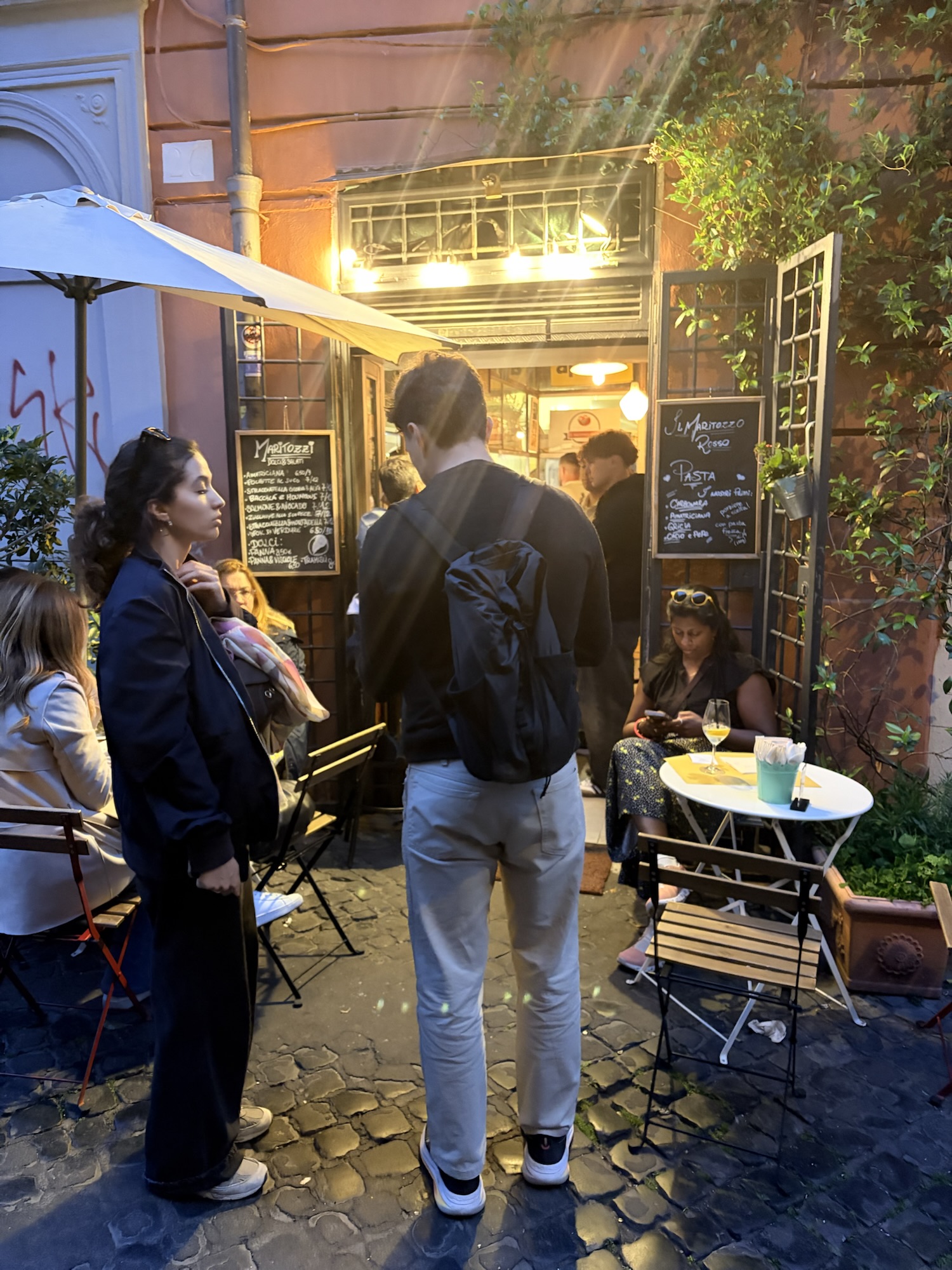
It was not yet dark, 6:30 or so, and it was absolutely jammed with tourists and partying teenagers, little kids running around the piazzas, motorcycles…insane. We had not selected a destination so kept pushing through, hoping something would appeal. There was one sort of odd suggestion from our host that we were iffy about, a tiny place Maritozzi. This is the name of a slightly sweet bun typically served in the morning filled with whipped cream. Reviews were mostly raves with scattered hates, intriguing. The place is so small that reservations are a must but we wanted to see if we could walk in since it was still early, and the location was deep in this insane neighborhood so it gave us a destination. When we arrived there were only a few people there—it filled up quickly—and we were offered a perch (this place is really small) if we would be ready to leave in an hour since it was reserved at 8. Sure!
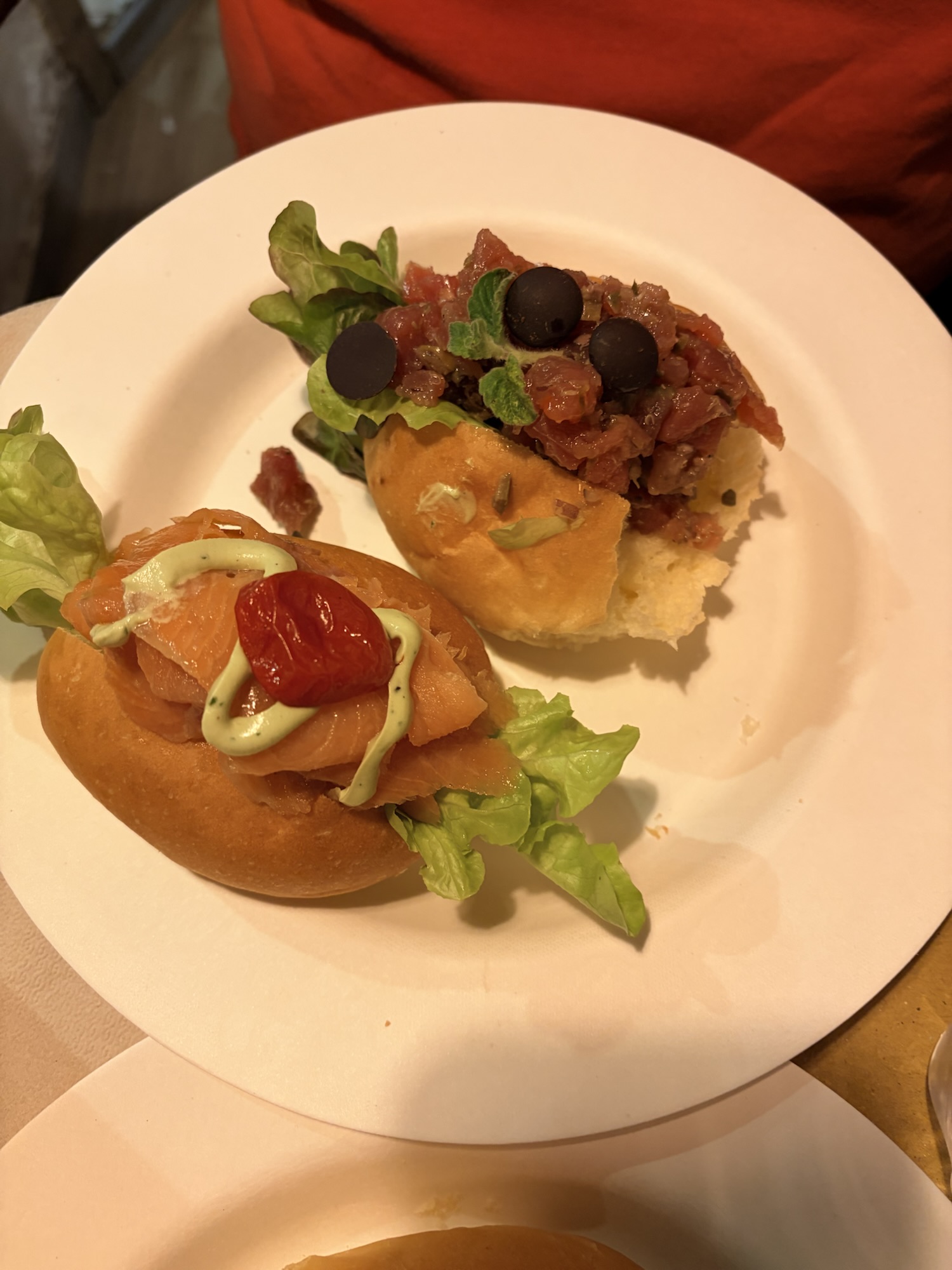
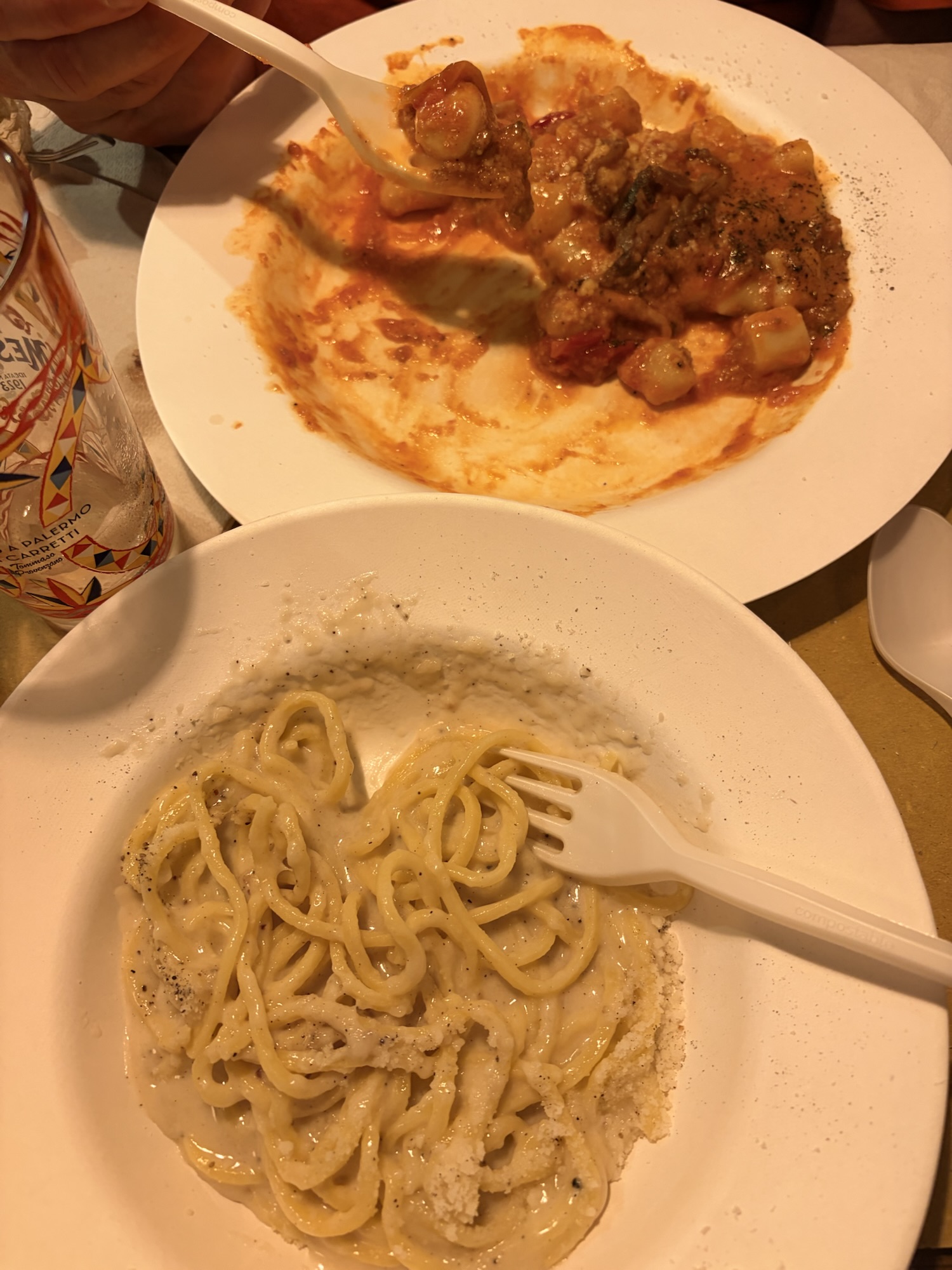
The menu thankfully had guidelines—order two small maritozzi and one main. The maritozzi are filled with savory things so we chose beef tartare and smoked salmon, and gnocchi for David and cacio e pepe for me. The quality of everything is very high, the tiny open kitchen a whirlwind of activity, and they have even been given “best carbonara in Rome” award from somewhere or other. They make their own pasta and offer pasta workshops which I wish I had known about. For me, though, the slightly sweet bread filled with savory food was not my favorite (yup, too sweet) and the pasta was for me too heavily sauced. But the experience was a lot of fun, all the diners seemed in celebratory mode. I guessed the place was all foodies, chefs, etc. Glad we went, wouldn’t return. Best if all it was down a narrow alley out of the fray.
The walk back through the crowds was okay, we never felt in any danger, but again not our scene. Arrivederci to the Rome food world!
Overall we would recommend staying in Trastevere over more central neighborhoods as it was, during the week, pleasant and extremely convenient. The tram stop was literally in front of where we stayed and it ran right to Piazza Venezia, from which we walked to the Borghese and the Coliseum. So convenient and when we returned “home” it was almost an escape from the Rome of crowds.
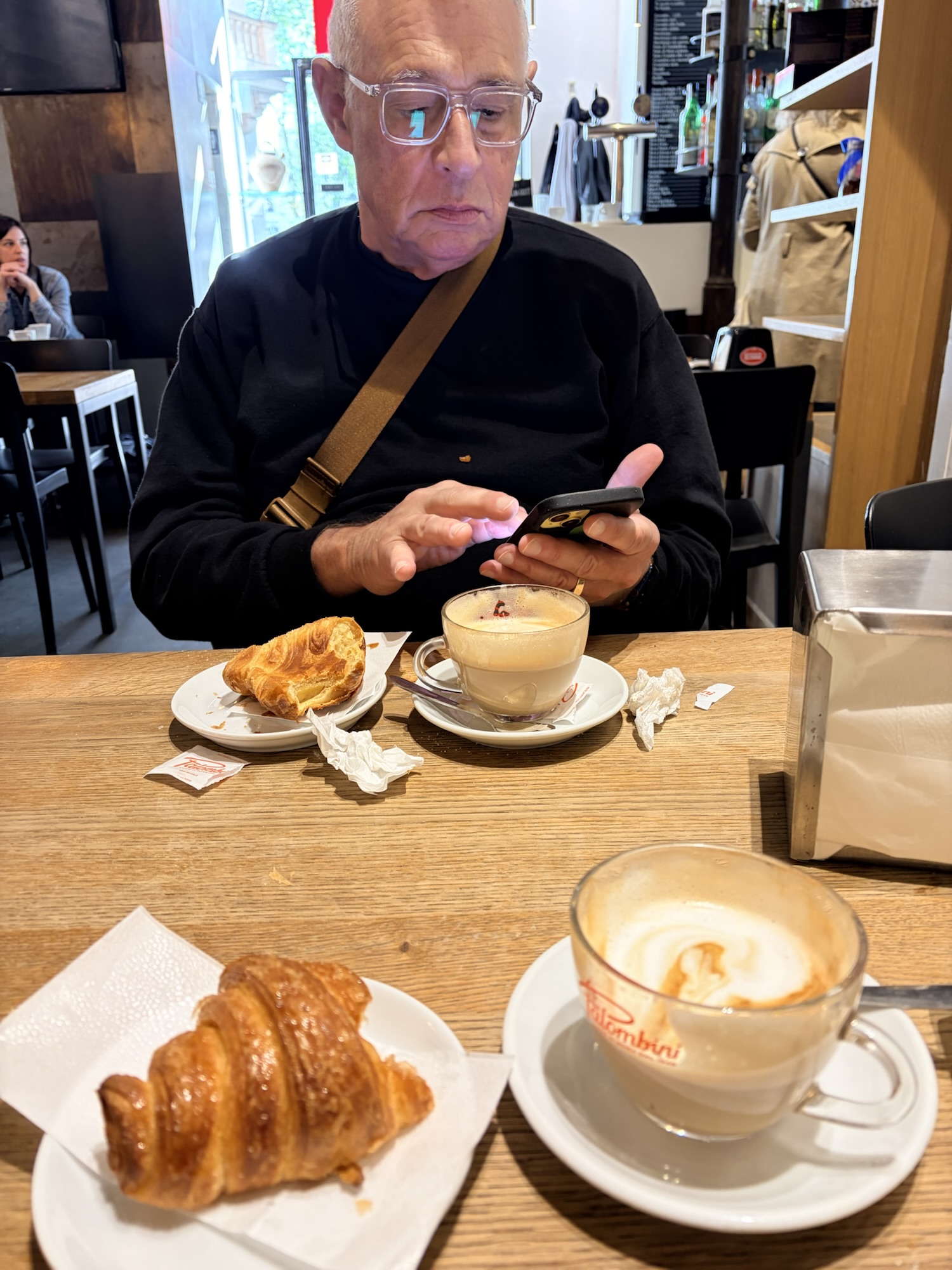
We started our day with pastry and coffee, as usual in Europe. Our B&B delivers breakfast via a coupon for a hot drink and a croissant at a nearby bakery/cafe, a nice morning routine that gets you up and moving. We tend to find a “regular” bakery with coffee whenever we are staying somewhere for more than 2 days so this fit perfectly for us. Perfetto.
We knew Thursday would be tiring, even grueling, as we had booked a 3 hour tour of the Coliseum, Palatine Hill, and the Forum. In retrospect we should have conserved our energy before the 2pm start; instead we walked the mile uphill and back to the main train station in order to, we hoped, get tickets to Orvieto. We have been there before, and really loved it, and a day trip seemed perfect for our free day (free meaning no tours booked) Saturday. David and I had each spent an hour or two online trying to buy tickets but nothing seemed to work. In theory Orvieto is an hour and fifteen minutes away, touted as the best day trip from Rome. However, every train was at least two hours and we couldn’t find a feasible return booking at all. Well, surely the humans at Roma Termini would be able to help us. Alas, it was not to be…she found us an outbound that was two hours long, but the only, the ONLY return was to leave an hour after we arrived and would take two changes and 9 hours. What? “Construction,” she explained.
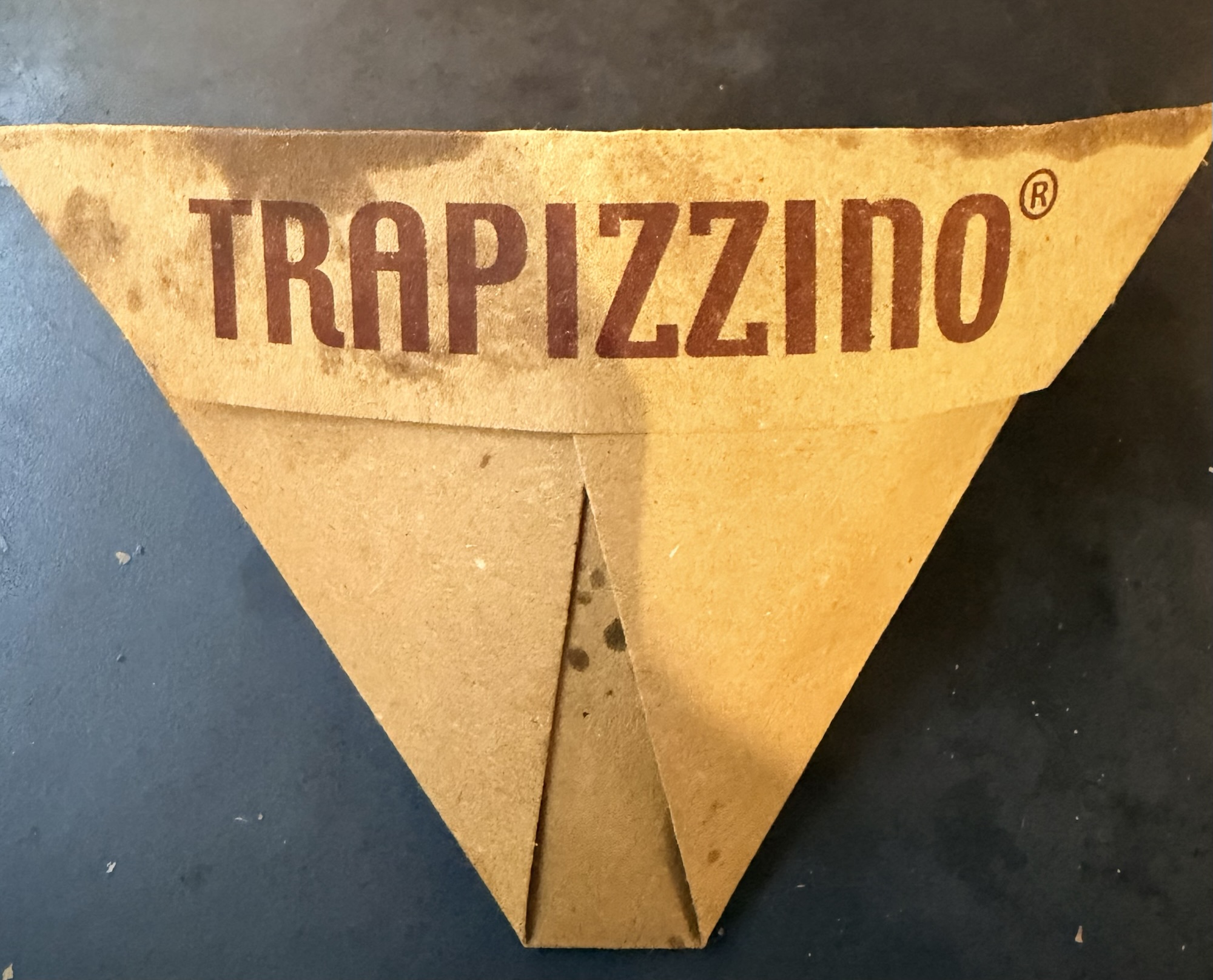
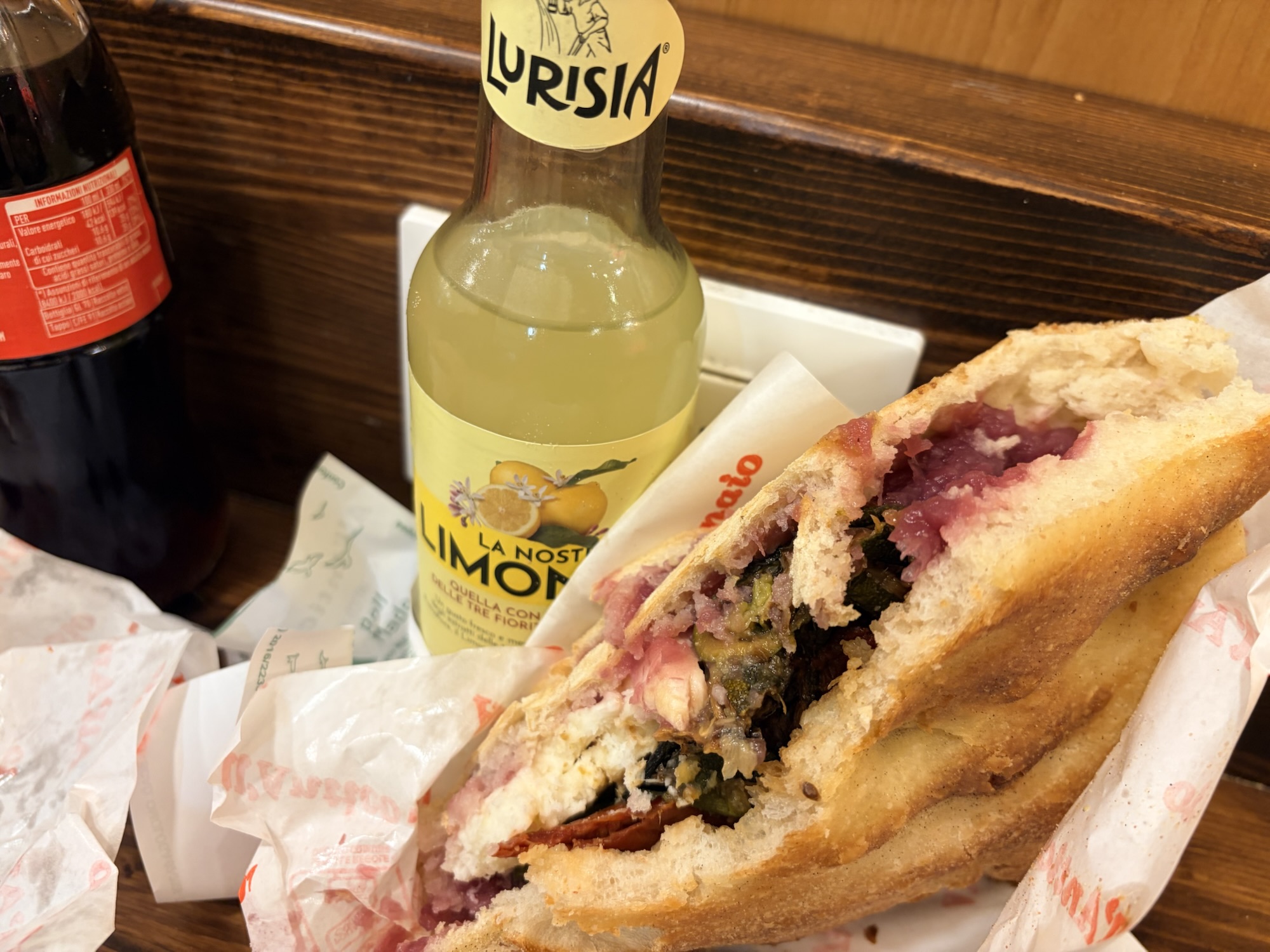
We walked next door to the Mercado Centrale, a pretty cool, modern food hall where I was happy to find I could get a “trapizzino,” a new fast food that is genius—foccacia cut into triangle, slit, into which you can have various traditional Italian foods such as eggplant parmigiano, chicken, and, what I chose, lingua in salsa verde. Delicious and, for once, not too much food. Our experiences with panini were disappointing. Way too big, and really not that good. Get a trapizzino if you can find it— 6 euro and perfetto.
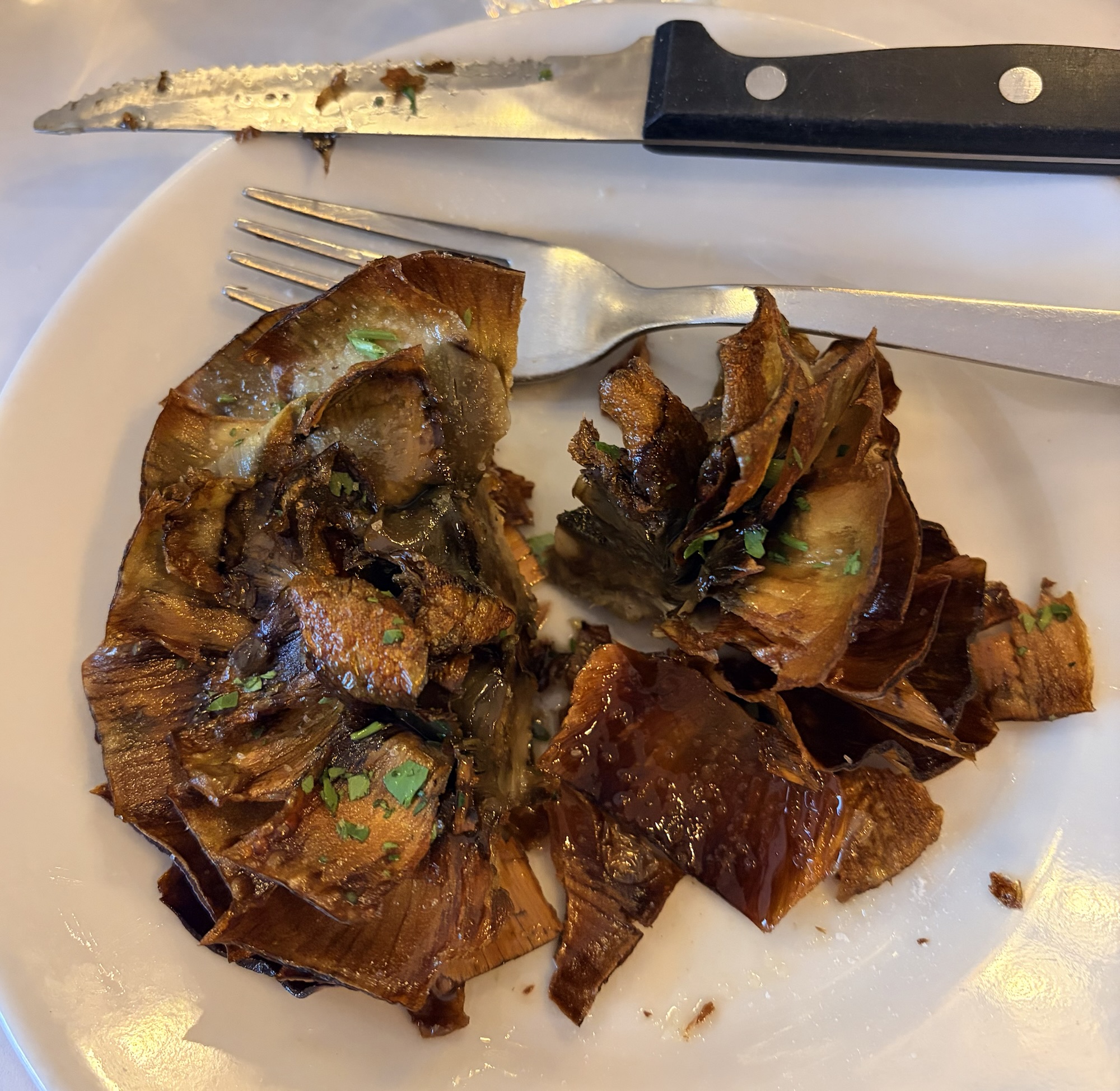
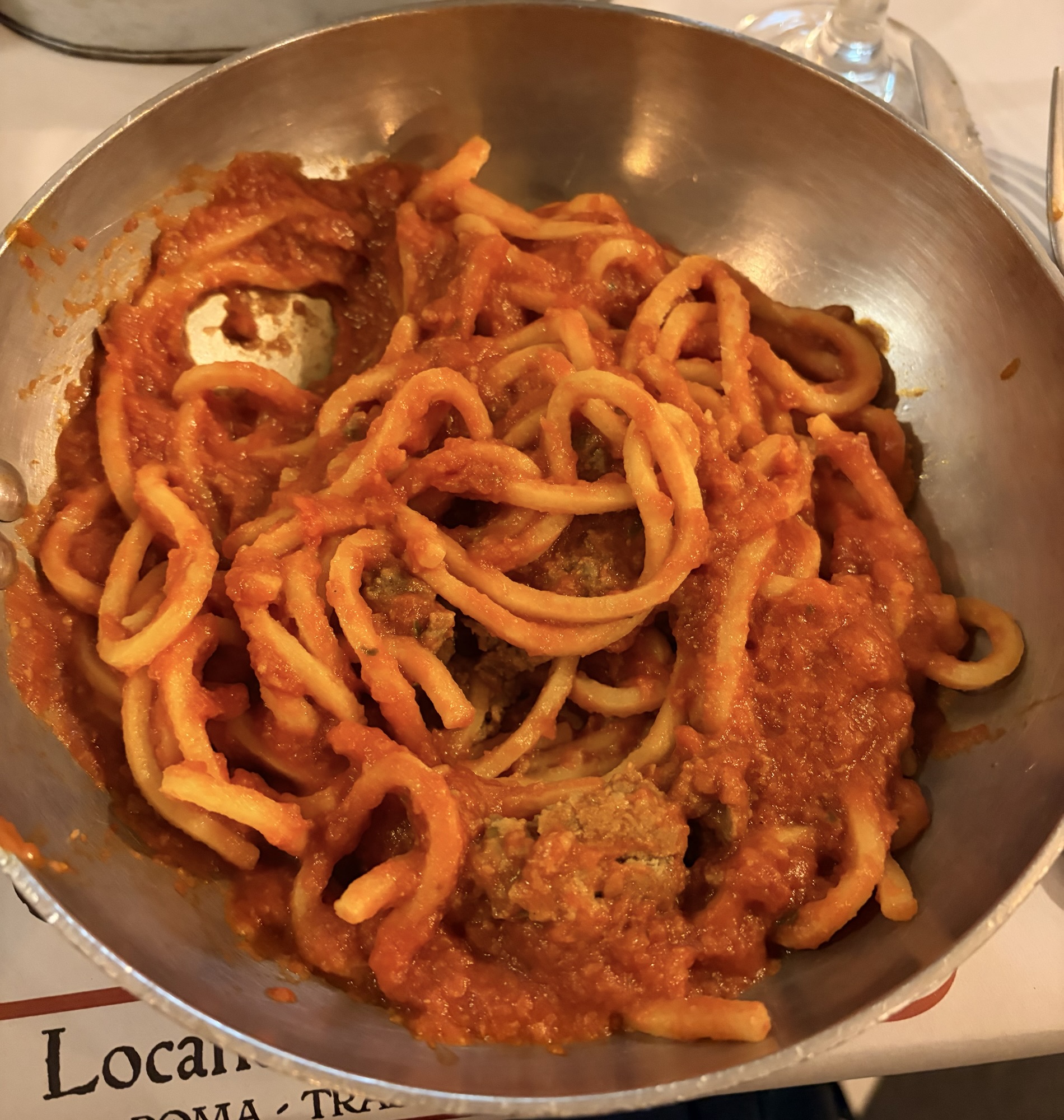
Here are some more pictures of food we ate this week.
Yes, it was yummy.Fried artichoke—deliciousPolpetto with pasta (spaghetti with meatballs)Italian breakfast—coffee and pastryPanini that WAS good at AV in centro historico—“vegeteriana 1” but SO big I could eat about 1/2.
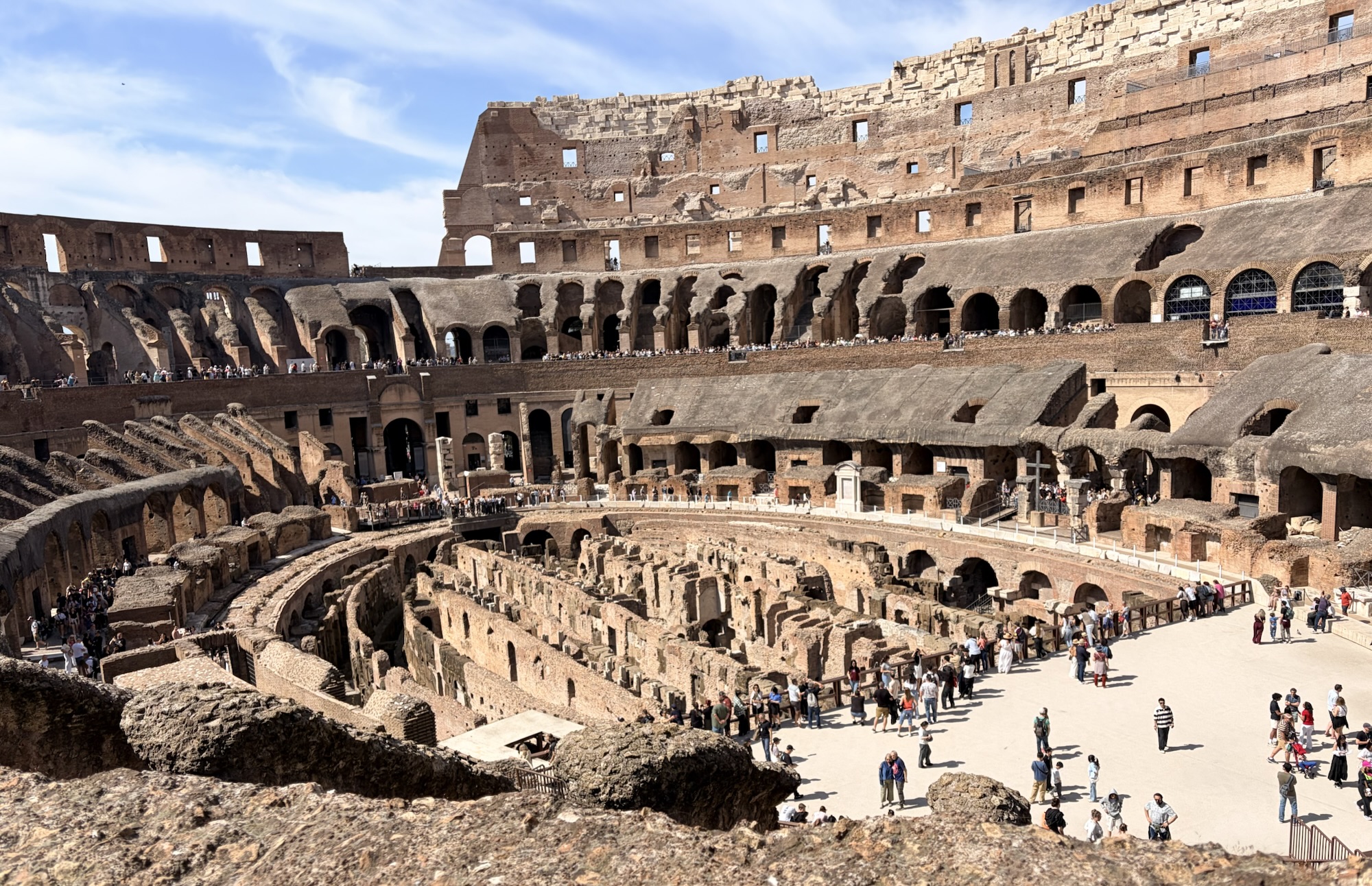
We finished lunch and walked down, down to the Coliseum. There were mobs of people on an April Friday. We cannot imagine what it is like in high season when it is hot. The tour started at the Coliseum where we spent the first 90 minutes. Our guide, Italian, was at times hard to understand but I appreciated her approach. Basically what went on here was a horror, accepted entertainment of murder, animal cruelty, and mayhem. “Little children attended, sitting on mother’s lap watching people kill each other—in battle, or in response to the emperor’s decision or sometimes the decision of the crowd. Kill him slowly! Kill him quickly!” Horrific and probably contributed to the continuation of a bloodthirsty culture that persisted for hundreds of years.
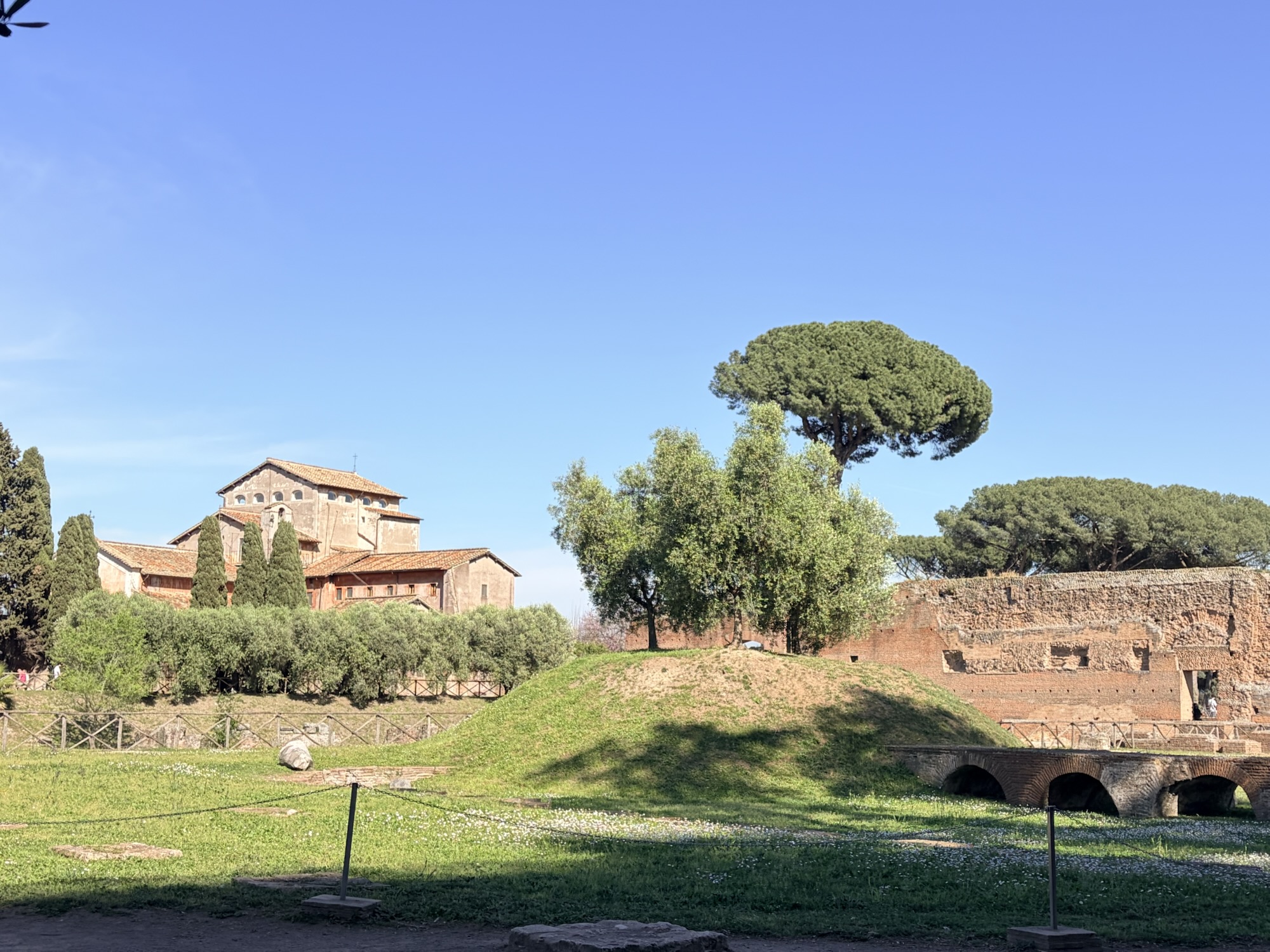
Next we walked up to the top of Palatine hill. It’s not a long walk but boy were we tired so it felt a slog. But well worth it…a beautiful space with stunning views.
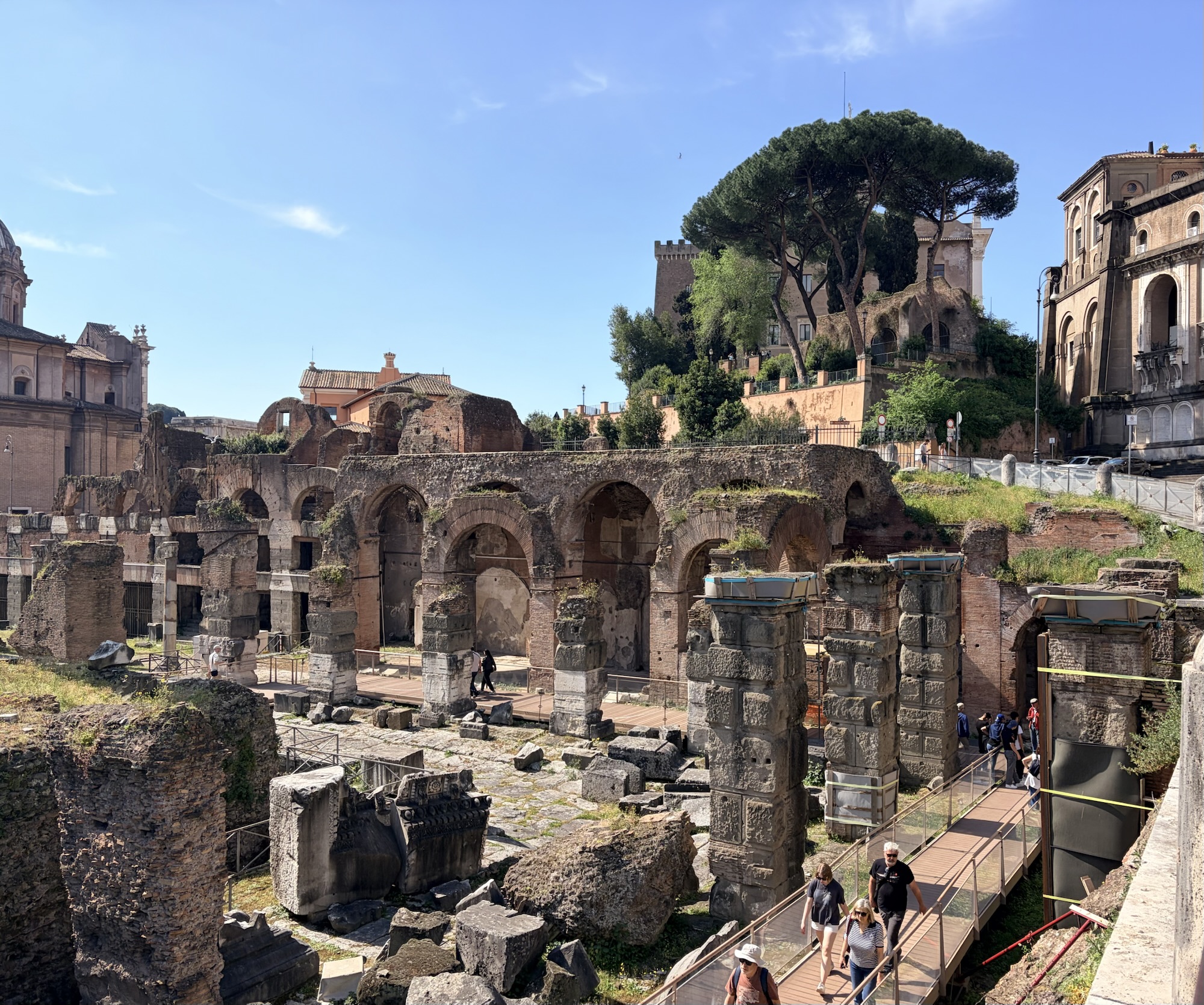
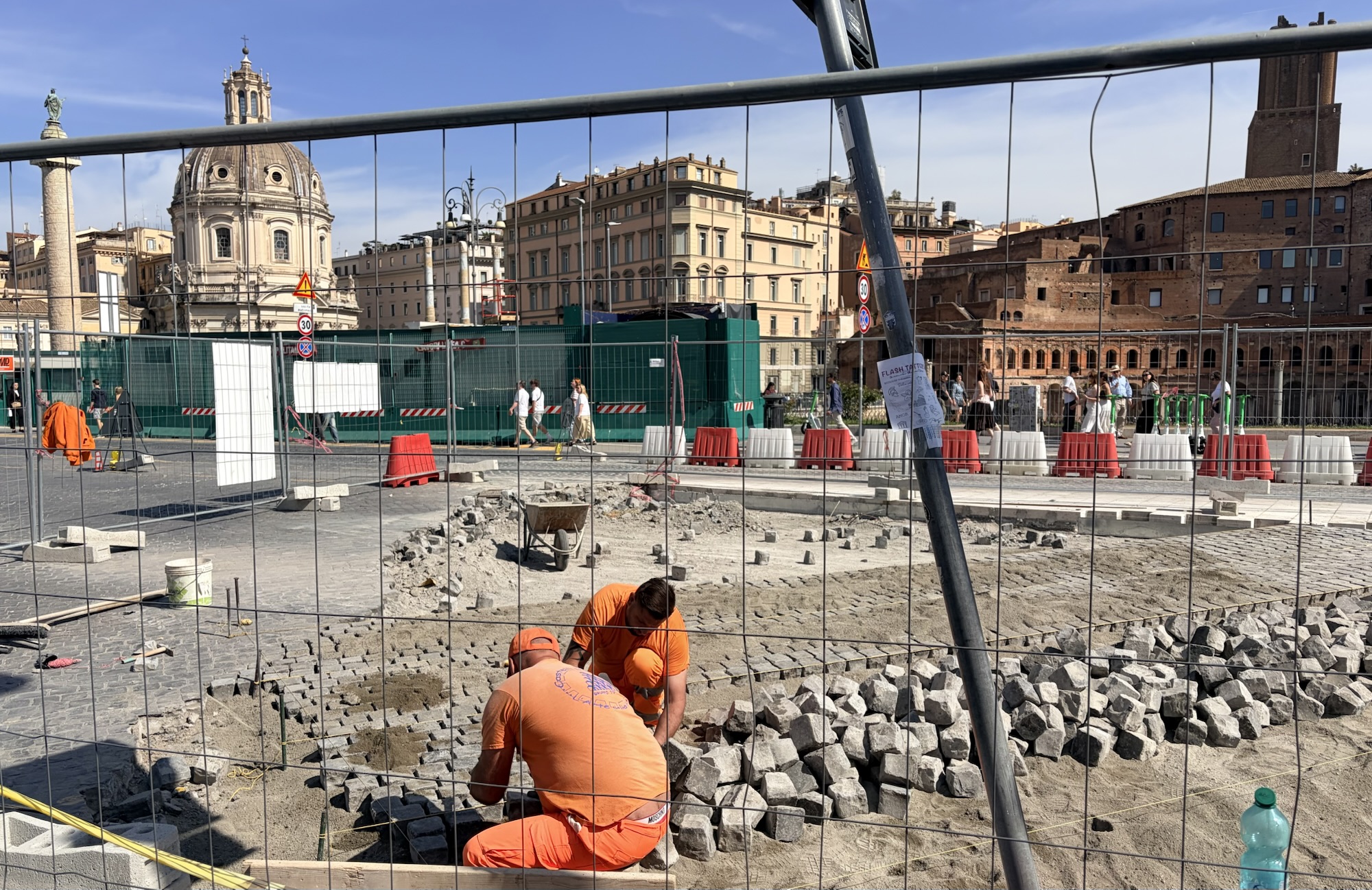
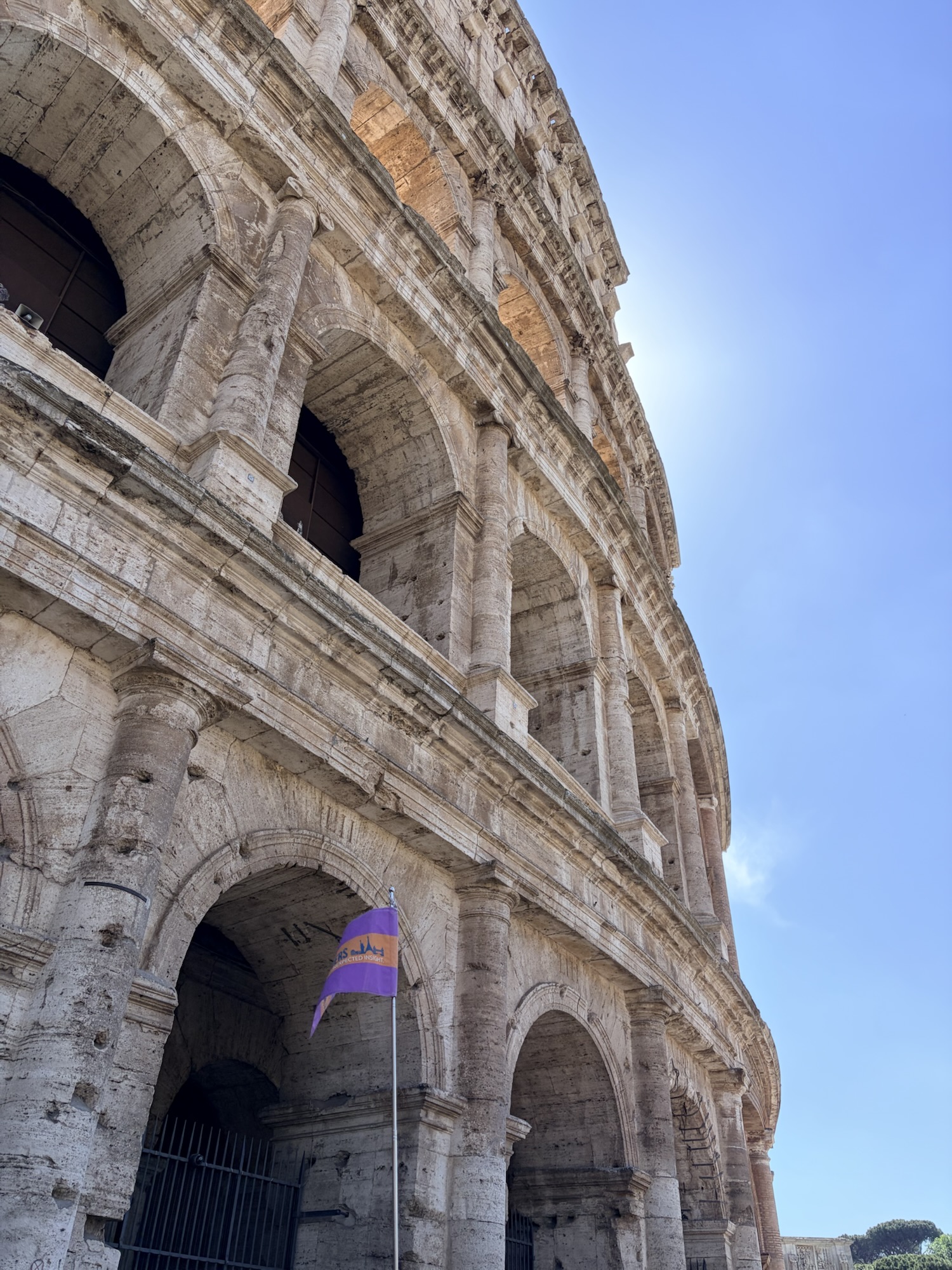
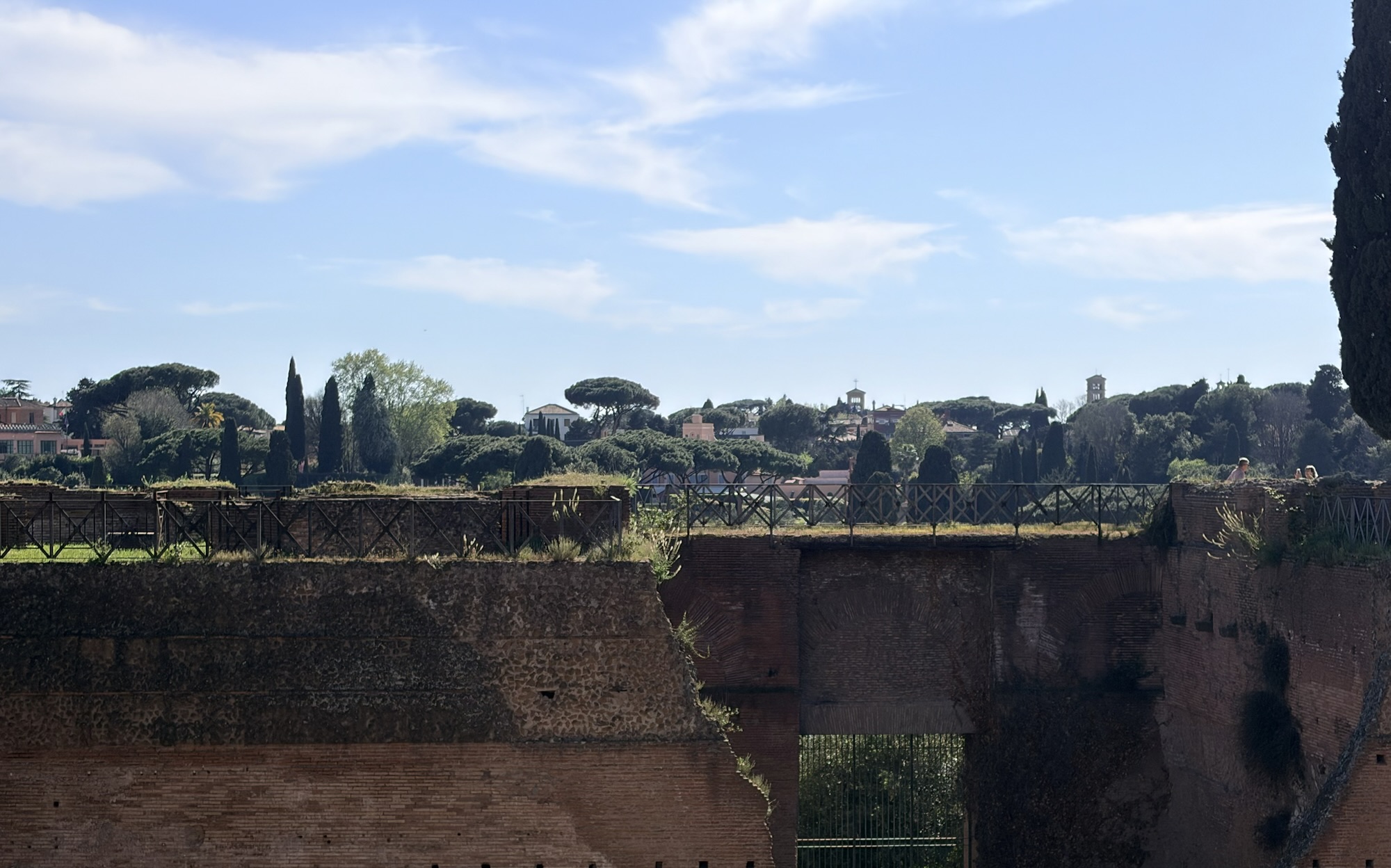
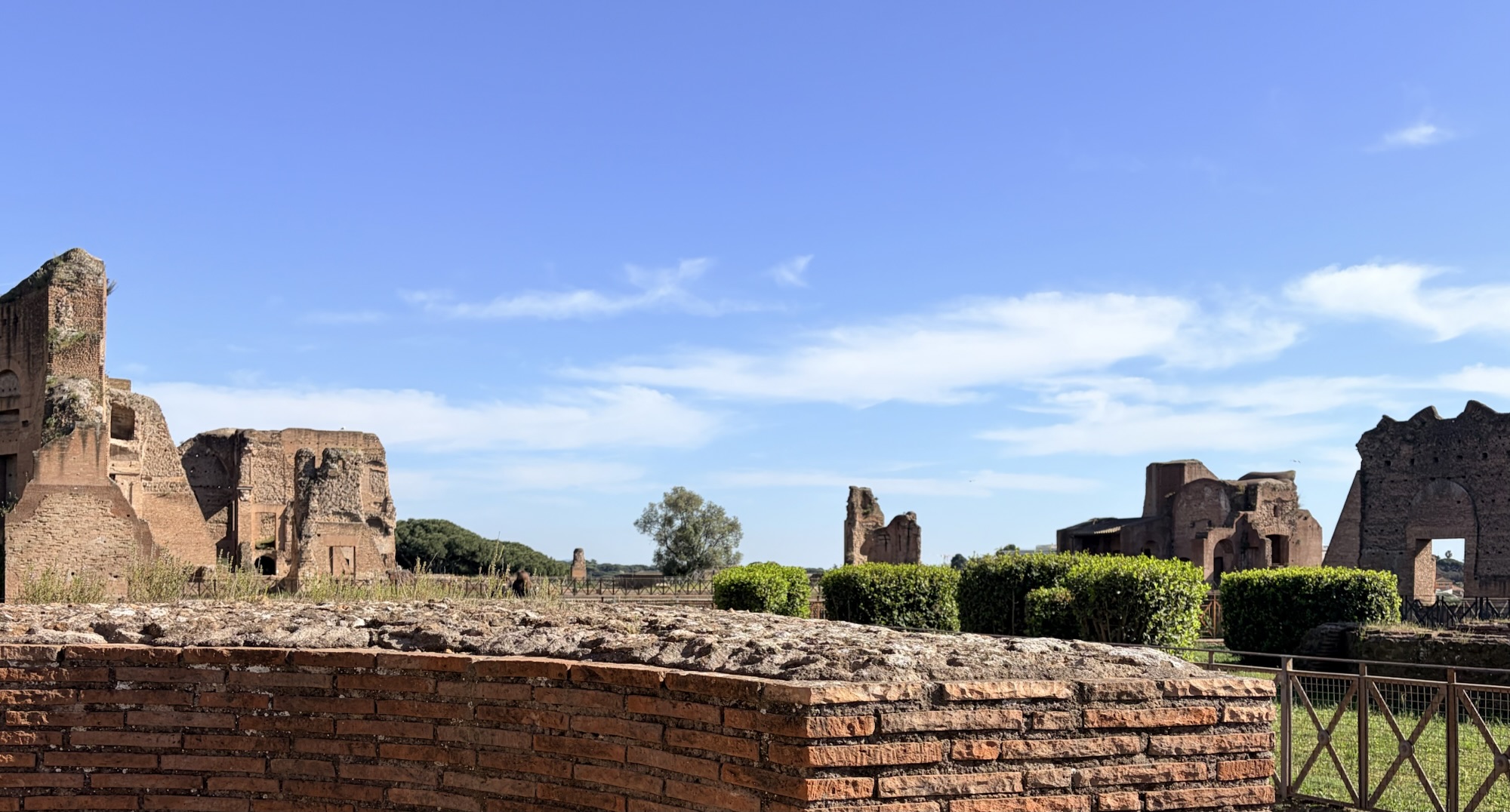
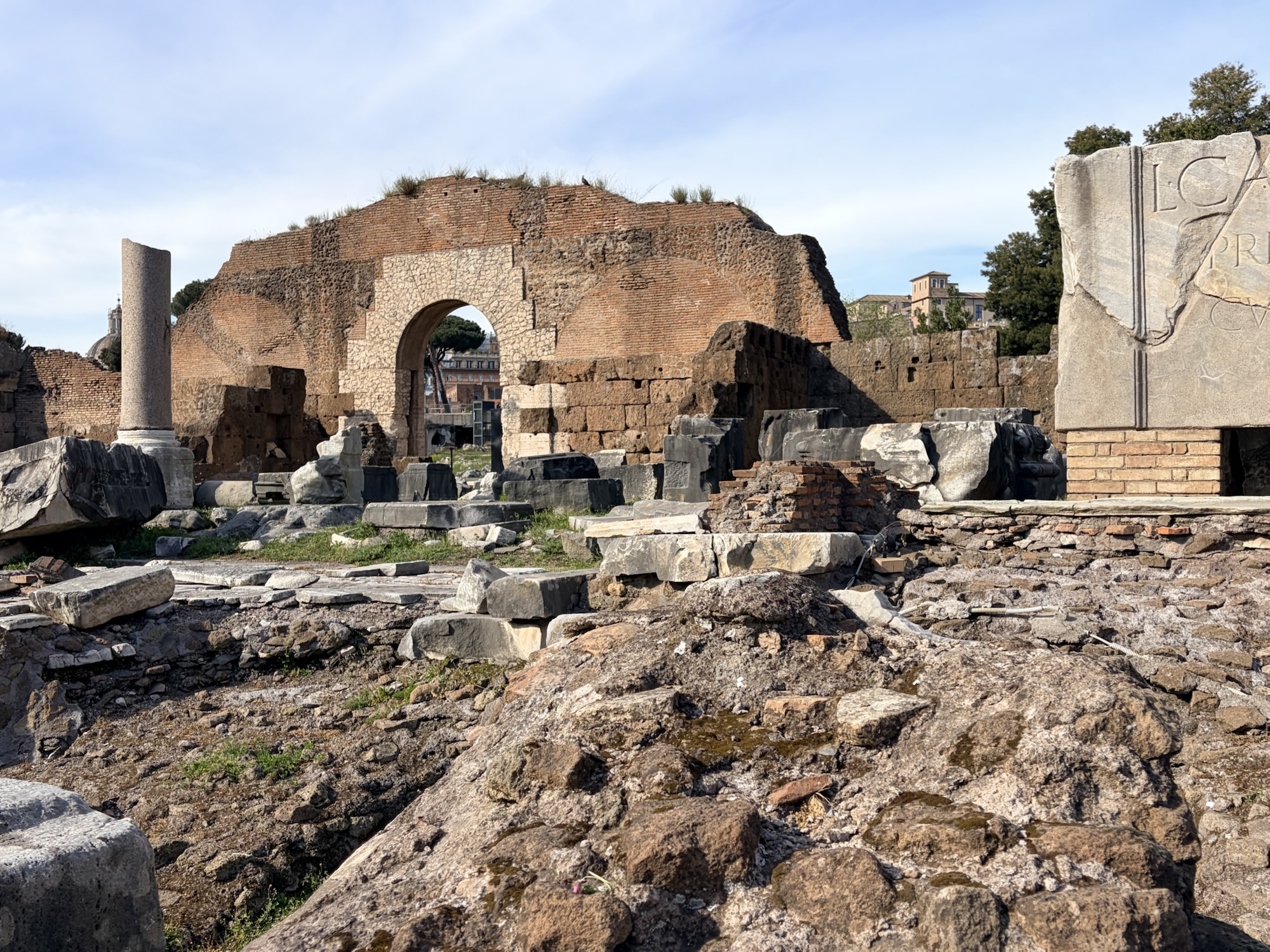
The forum, en route to our tourThe sound of road construction is “chink chink” as they tap pavers into placeColiseum exteriorWe had been to the large coliseum in Nimes…dwarfed by RomePalatine HillView from Palatine HillPalatine HillA section of the forum—ancient Rome’s shopping center
We were saturated with sights and sounds and exhausted by all the walking (totaled 5 miles this day) and almost missed our tram stop at our B&B.
Saturday is yet unplanned—but we will have time to do laundry and chill out a bit before we head to Naples.
Several years ago I read a piece about why Americans who live in less populated areas are so afraid of foreigners and so convinced Democratic mayors are inept—these Americans have never spent time in a big city. If you have not experienced the messiness of New York, London, Paris, San Francisco, even little old Oakland, it is scary and crazy from a distance. All big cities are messy, noisy, heterogeneous, confusing.
Wow, Rome covers all of those bases. It is big; it is messy; it is noisy; it is complicated. Also fascinating, exuding history—ancient history—at almost every turn. Yup, we’re having a good time even in our first jet-lagged days.
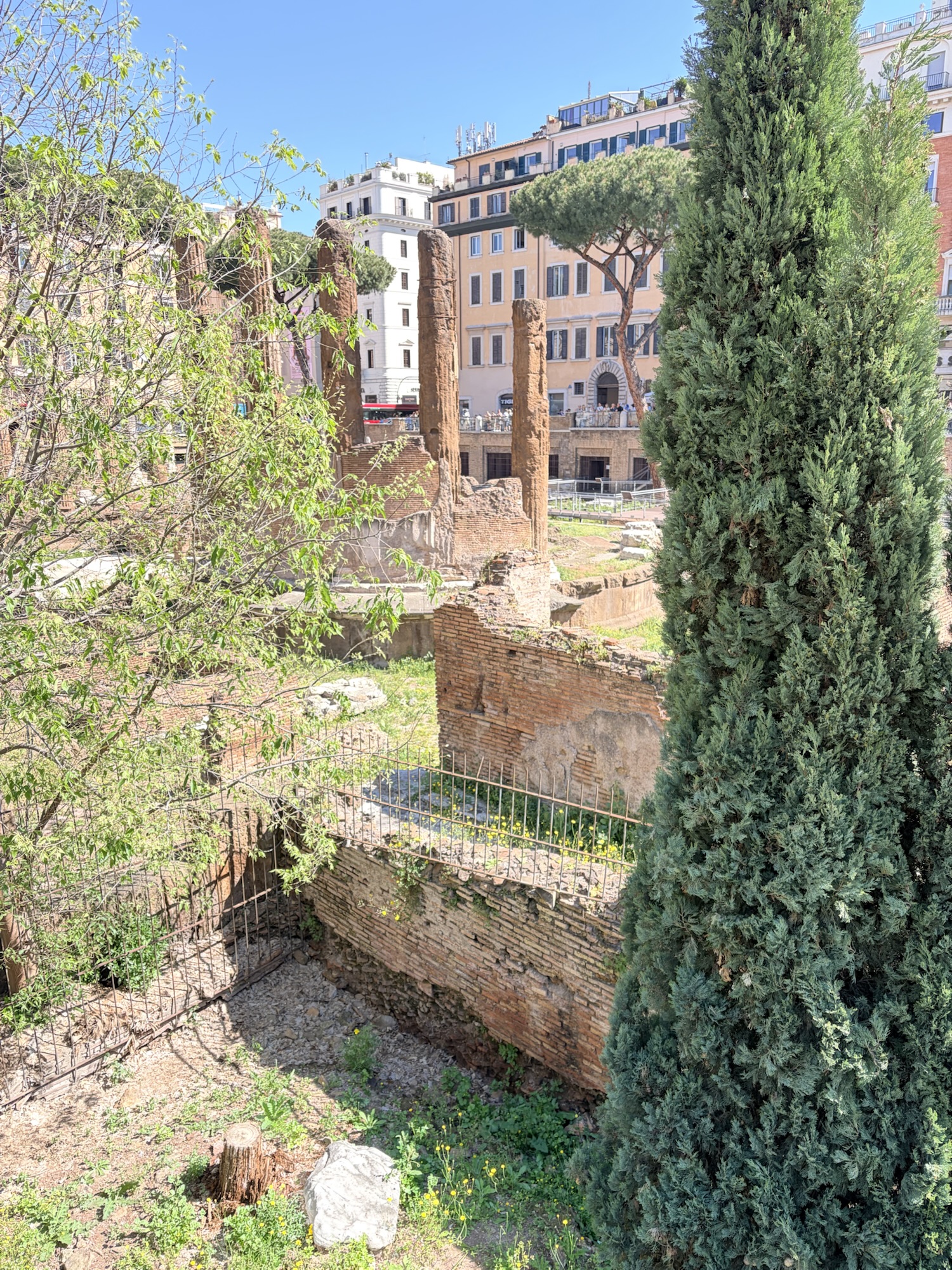
Random ruins we passed on a walk to the Pantheon.
We chose to stay in Trastevere, a neighborhood known for excellent restaurants and a bit removed from Roma Centro, the historical district. It was a good choice. We are staying at Dulcis in Fundo, a B&B right on the tram line. Our host met us at the tram stop from the train station from the airport (easy to navigate even as tired as we were after 24 hours of travel) and walked us into the building, up the steps, up the ancient (our host called it vintage) elevator, and into our room. Room is large, host Alberto is as friendly and helpful as you could ask for, and the plumbing works.
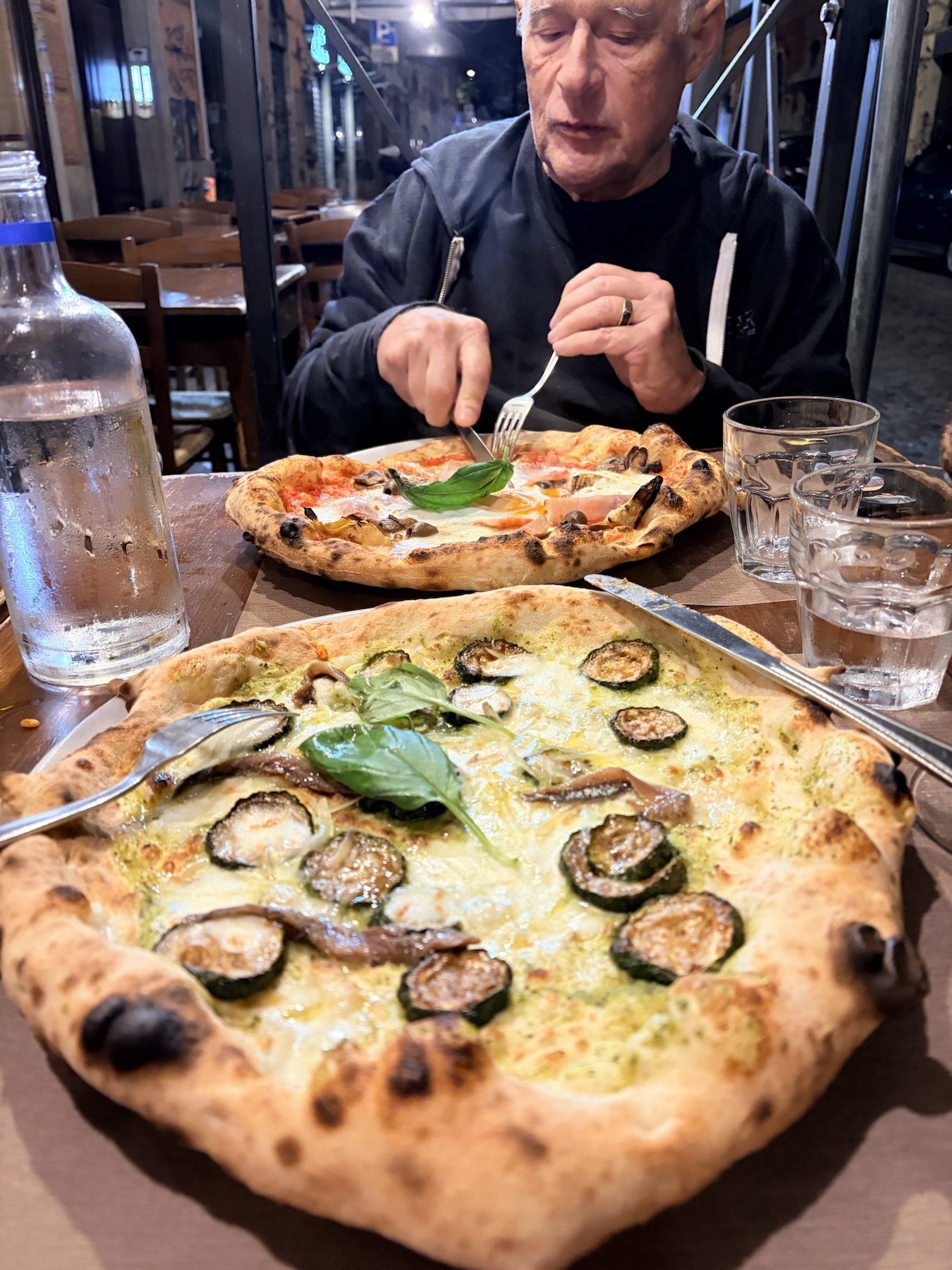
I had asked Alberto for his walkable restaurant suggestions and we were only a few blocks from all of them. Pizza first night, pasta second night, all delicious.
Peppo al Cosimato in Via Natale Del Grande. As good as they look.
Our second night we went to the famous Tonnarello for pasta. Not only were we seated immediately (they often have a 30 minute wait but we were on the early side) but we were surrounded by happy families, gracious and friendly service and delicious pasta. There are comments on the web re Tonnarello—is it still good? Worth the wait? If you are in Trastevere do not hesitate to go.
Villa Borghese
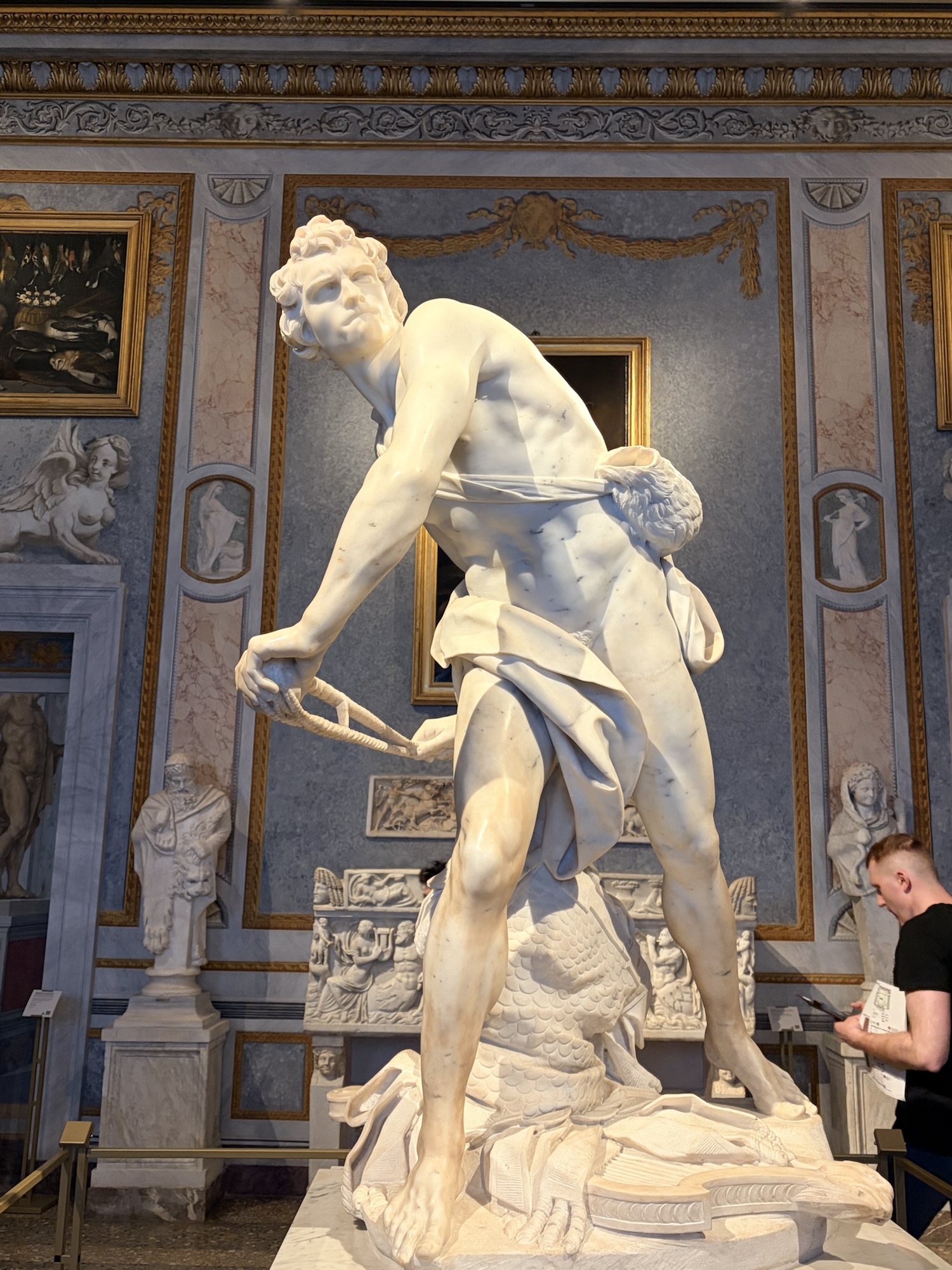
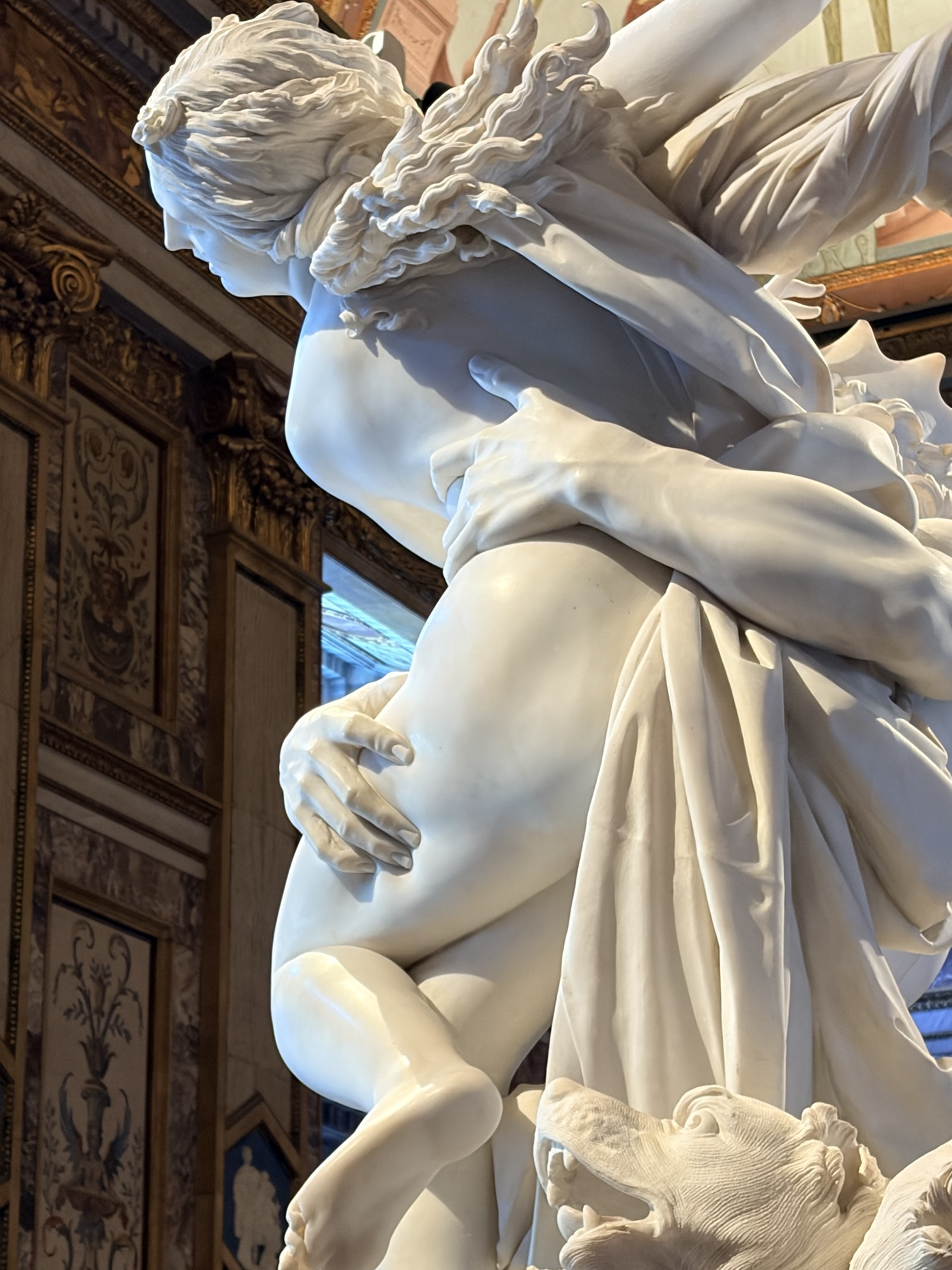
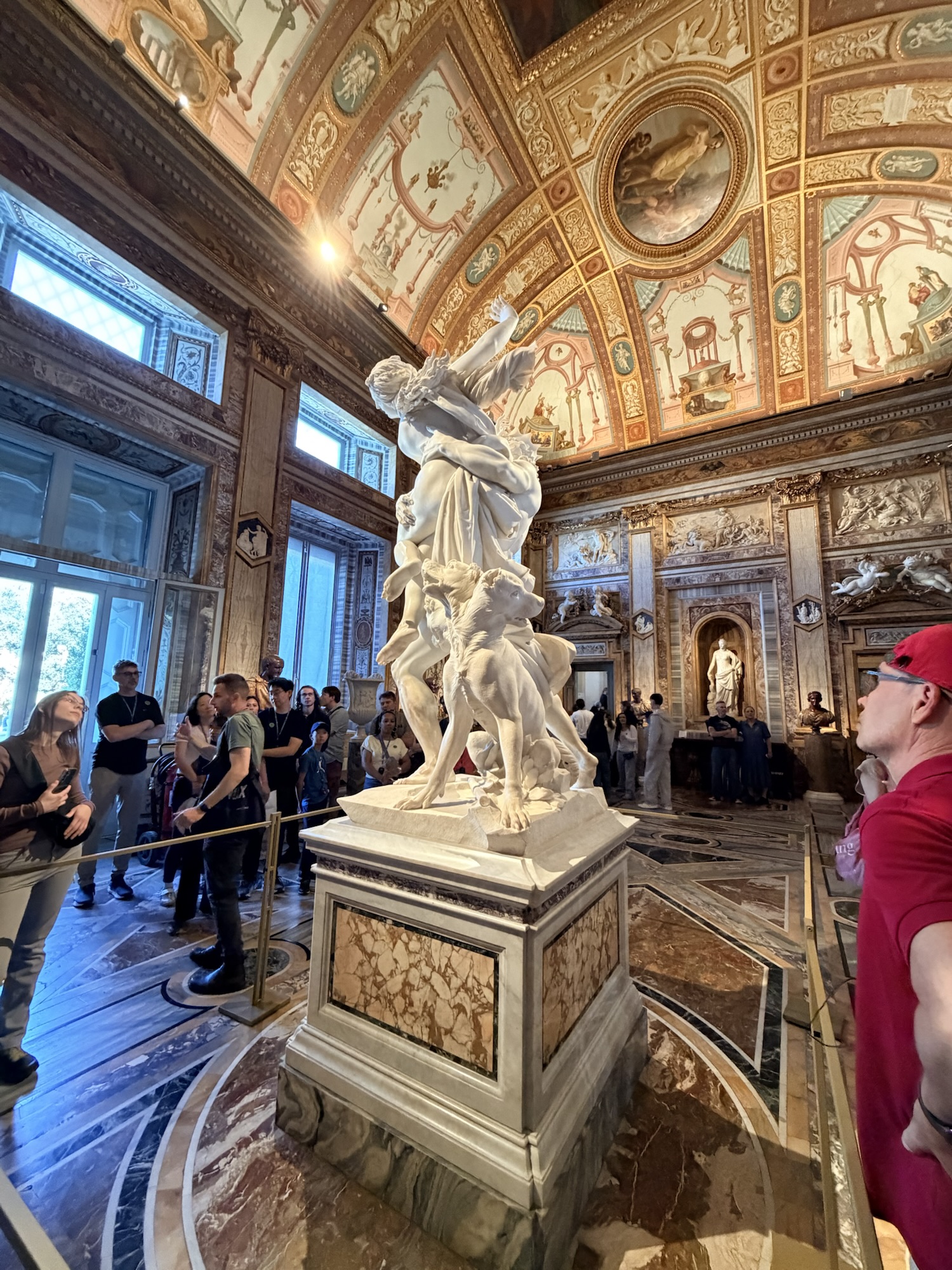
Our first booked tour was of this private family art museum from the 1600’s. If you have read any of my trip reports you know we love museums and this was spectacular. Much smaller than Musee d’Orsay or the Louvre or the Uffizi, it is overwhelming nonetheless with rooms decorated with frescoes, paintings, finely detailed mosaics (I thought they were paintings until I looked closely) and stunning marble sculpture. We were not so familiar with Bernini and we were wowed over and over. The Rape of Persephone, terrifying…but not as terrifying as Apollo and Daphne, showing her transformation into a laurel tree at the moment Apollo touches her. Those Greek myths are not kind when it comes to forcing young women to submit to the gods who want them. Bernini’s skill at depicting movement turns cold white marble into hot violence.
Our guide was an expert, so articulate in English and so charming to our ears with the beautiful rolling “allora” with which she began each explanation. Every language should have “allora!”
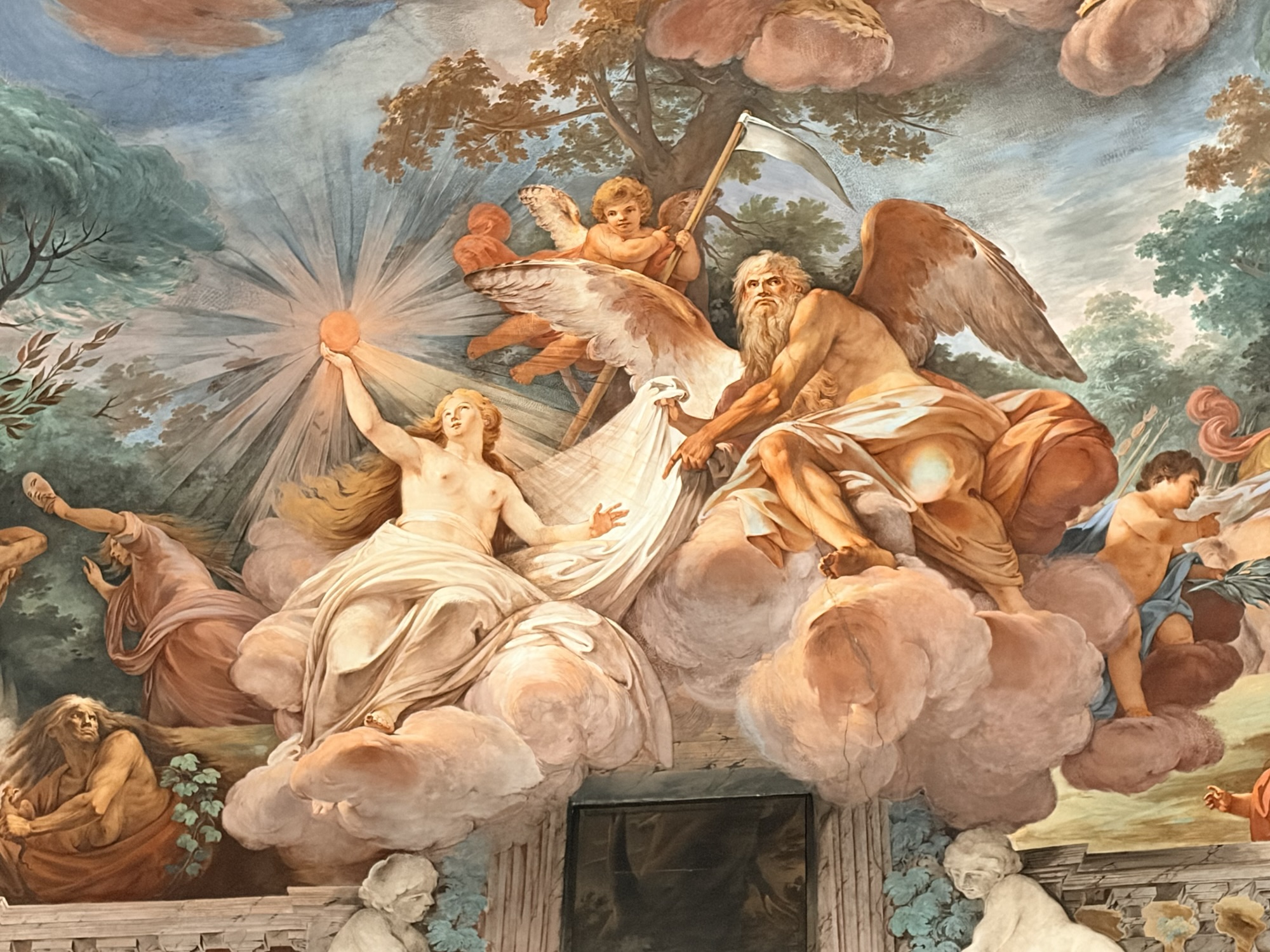
David’s intensity as he prepares to sling the rock to kill Goliath. The face is the sculpter’s.The pressure of the hand on Persephone’s thigh…wow.Persephone has no chance of escape.Truth, the blond woman, is revealed by Time, the bearded man on the right. The eagle head that Time forms in the white sheet is a symbol of the Borghese family.
We would have called ourselves experienced travelers but there are always things to learn.
Even if you have used an airport dozens of times for international travel, be sure to confirm which terminal your flight departs from. We started in the International Terminal at SFO, not knowing that there are now two—at opposite sides of the airport. The only way to get from one to the other is a 30-40 minute walk. Thank goodness we had allowed plenty of time.
Even when your agent and the airline sell you an itinerary with a connection in a foreign airport, double check that it is doable. For example, a 90 minute connection at Heathrow via British Airways sounded reasonable; now we know we would have had only the tiniest chance of making it. “Luckily”our initial flight from SFO was on the ground an extra two hours due to a customer incident so our initial 90 minute connection was not to be and British Airways automatically rebooked us to a later flight to Rome with a 3 hour connection. It took more than 2 hours to get from arrival gate, passport control, security (agonizingly slow even with light traffic), and to find which side of the very large and crowded concourse our gate was…and…
Do not assume the departure gate information is correct. When we arrived at SFO International Terminal our departure gate was posted on the boards as G2. We left from A11. (When we asked about this the answer was “oh, you cannot trust the board.”) And at enormous Heathrow gates are not even posted until 30 minutes before boarding time, probably why we saw so many people literally running down halls looking panicked.
Do not expect new processes to work well. Europe is instituting a new biometric system to track visitors which entails photos and fingerprints. How hard can this be? The Rome Airport is riddled with brand new kiosks and signs instructing foreigners to stop at a kiosk to preregister. Kiosks which were all blocked off until right before passport control. Why quickly became obvious—the kiosks are incredibly slow, so slow that they are difficult to use. Attendants wandered the crowd helping travelers follow the instructions. In the end it was pretty simple, but the learning curve was steep.
Just because there are elevators doesn’t mean they work. Especially when you are hauling baggage.
Thursday was the first day we had no museum timed tickets, no things we had to go see, just an open day and thank goodness for it. It was lovely to dawdle over breakfast and hang out.
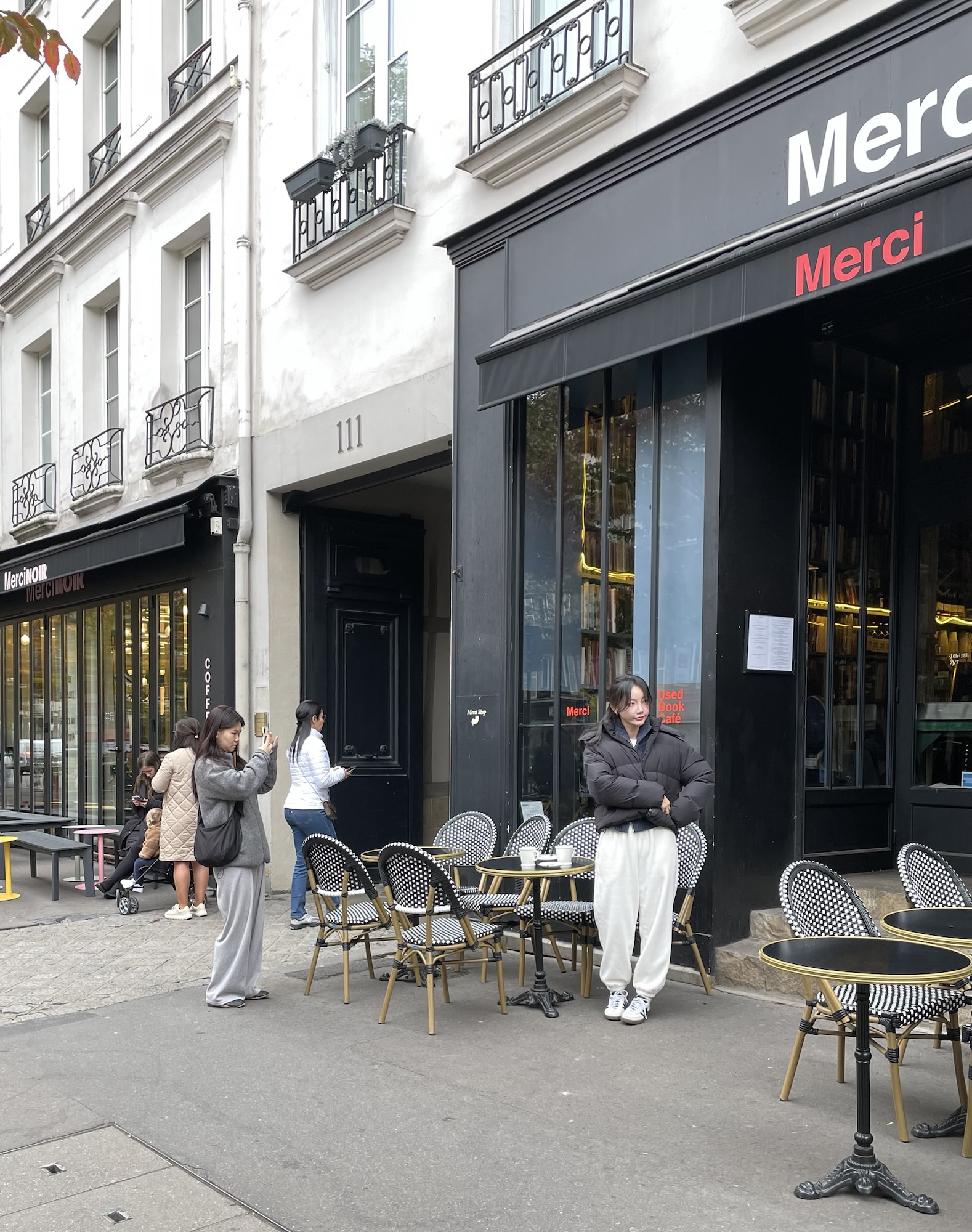
We did have assignments, though. Our wonderful daughter had given us, as she did in April, a list of skin care items only available in France, and two fun things that she hoped we could track down. One of the fun things was at a store “Merci”, which was noted in France as “the hottest concept store in Paris” and I’d say from the activity around the store (tourists were photographing the outside of the Merci used bookstore/coffeeshop as we walked up) yes, it’s hot. Concept store is a phrase we have seen around Europe which seems to describe a store that is not built around one particular consumer category (clothing, household goods, coffee beans) but is the more eclectic kind of store that is so common around where we live. Merci is anchored by its clothing, but has housewares–very trendy and cute–lots of accessories, handbags, etc. We were the oldest people in the building.
Our assignment from Merci was to find a tote bag, apparently something that went viral and comes in a bunch of colors and is not expensive. Sure! Then we agonized over the colors but settled on brown with the name Merci in dark blue. As we were ringing up I asked the (of course lovely and sweet) young woman at the counter where we could get the skin care stuff. When she saw the list she said any “Pharmacie” would have it all. Super! Our other assignment was to find a Kutjen store–tiny boutique stores that sell cashmere things. One of them is in Le Marais, so off we headed to our favorite wandering- -around neighborhood. We were, it turned out, on the edge of Le Marais so decided to walk.
Within two blocks we found a a pharmacie and though it didn’t look very big what the heck. The store security guy was an older man who was able to point us to a particular brand we were looking for, and as we pulled things from the list he appeared with a basket. So nice. We had one last item we couldn’t find but the young woman at the cash register knew exactly where it was. We also grabbed a few more tubes of Homeoplasmine, a magical skin irritation ointment that for some reason only exists in France. It’s pretty great. We crossed the 100 euro mark and got our tax refund forms, and off we trekked to find the Kutjen store.
Again, tiny store, super nice people working there, and they had exactly what our daughter had requested. It was delightful.
It really does help you explore and enjoy a new place if you have a quest or two! We would never have gone into these stores, never would have had such pleasant interactions, without a list of stuff we had to find. I recommend having a few of these for the times you don’t have plans and want a little guidance in your wandering.
Onward
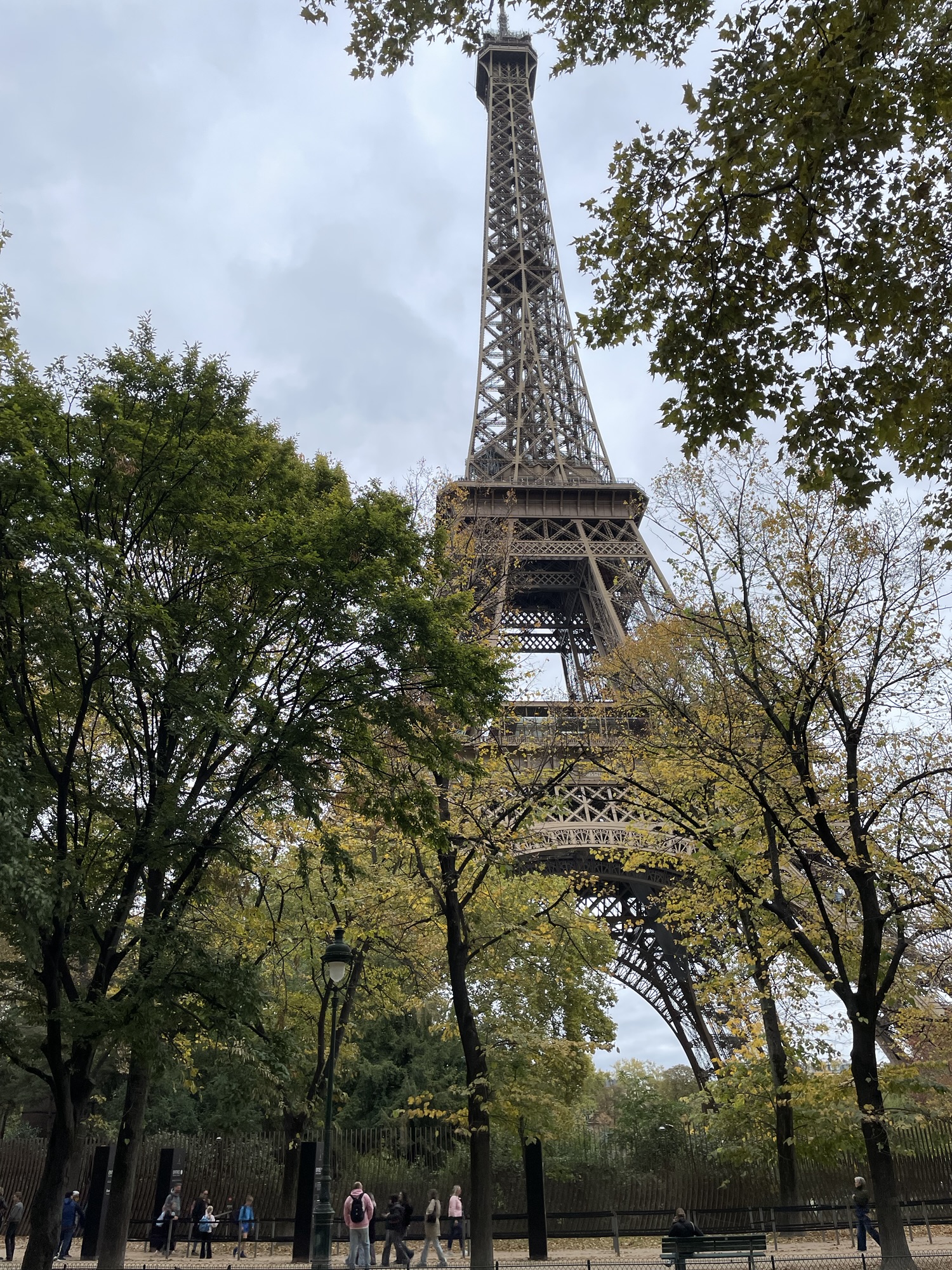
After our delicious falafel lunch (see post on restaurant notes) we thought we’d better at least walk by the Eiffel Tower, so took the metro out to the banks of the Seine and a lot of people taking pictures. We stood there for ten minutes, looked up at the tower which is so big and quite ugly, watched tourists, and that was that. But, wait, isn’t there something else we could do or see in a drizzly late afternoon? Notre Dame! We hopped on the RER (the train) and were there in a few minutes. Stood in line 10 minutes and we were in. WOW. So glorious, clean, light…it was just fantastic. And at the last chapel there was a plaque that this was where Charles deGaulle and his generals came the day Paris was liberated for a singing of the Magnificat. We learned more about this at the Musee Liberation de Paris. It’s so cool to learn how things unfolded back in the day when the US was a hero.
By the time it was evening and we were back in our hotel we decided to return to Poni, where we had eaten our first night in Paris, and had another very good meal. What a great place. As I paid the bill I mentioned we had been there a few nights earlier, and the man said of course he recognized us and pointed to the table where we had sat the first night. “Bonne nuit!”
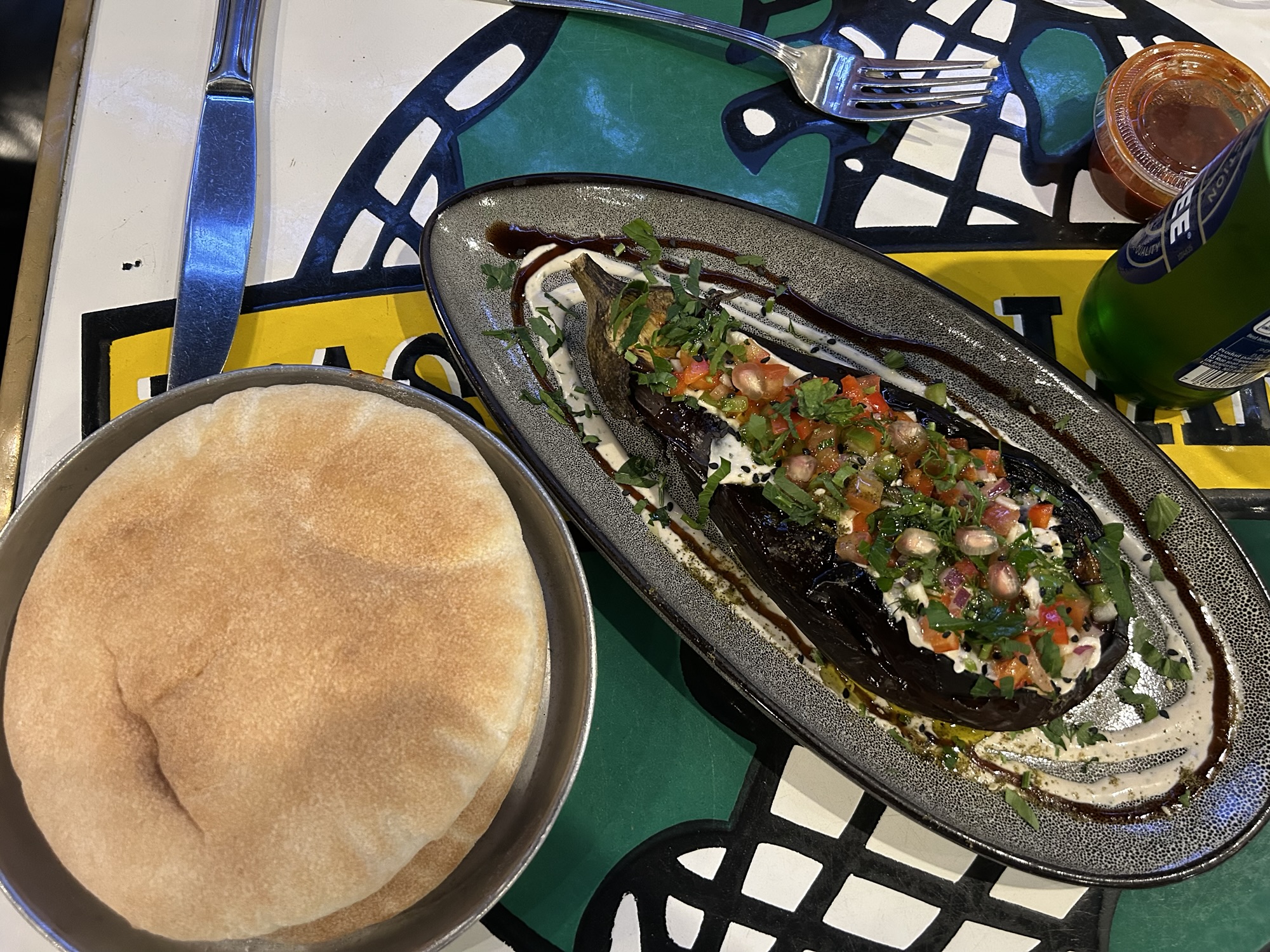
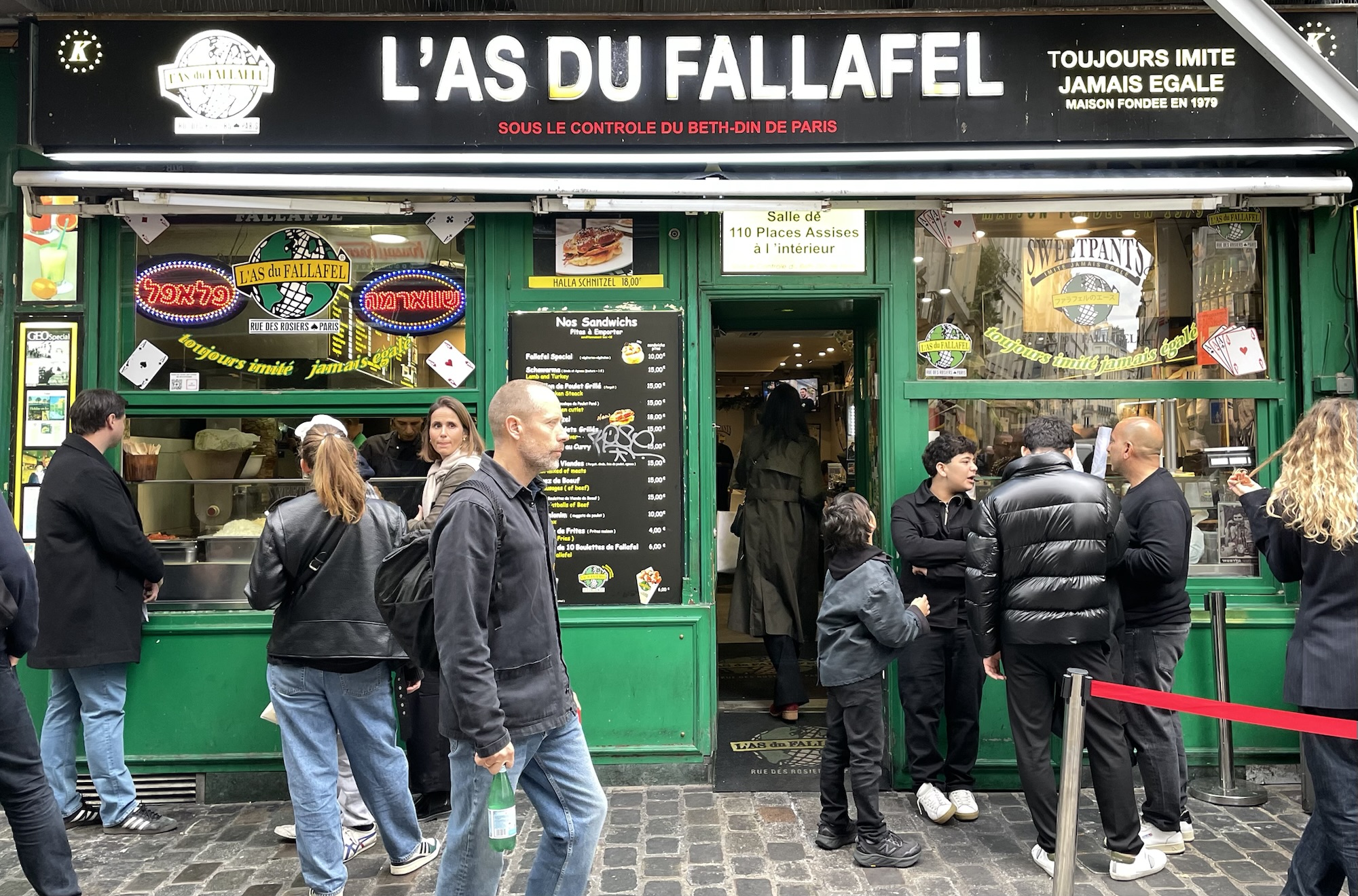
Hottest concept store in ParisLe Marais L’As Fallael’s eggplant entreeWe saw several carousels in random placesGleaming restored Notre DameWe saw more about this at the Liberation museum The scale of Notre Dame…where work continues on the exterior
When we were on our food tour way back on Monday our guide recommended a particular falafel place in Le Marais if we were in the area again. Falafel sounded awfully good, and the restaurant was a few blocks away. It was great! Not only was the food perfect, no one yelled at me (a la New York Jewish places, for example). It was jammed, a little crazy, but we were seated right away and it was all “Bonjour!” and “Bonne journee.” Tables were literally inches apart so we ended up talking to the older man and his elderly mom at the next table. They were from Quebec, on their way back from a gorilla excursion in Africa. She is still travelling at 87!
Stray from your list
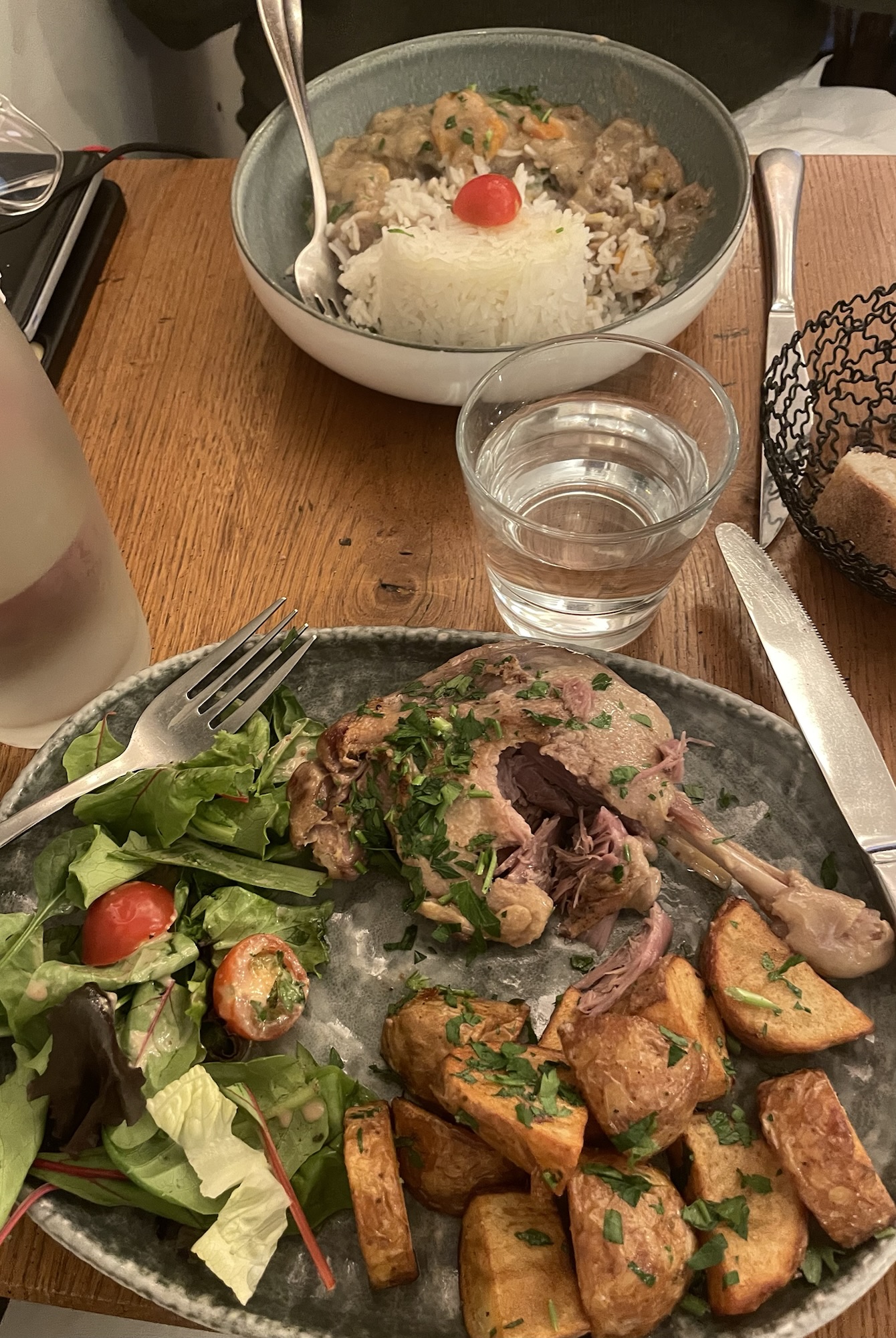
Feel the vibes and leave if you do not feel comfortable. One of our last evenings I got out my list and we headed to a recommended place. Walked out…just didn’t feel friendly. We kept going and wandered into Comptoir des Archives, a casual, kind of jammed small bistrot, and immediately felt good. I had duck confit and roasted potatoes which were both delicious, as was David’s veal stew with rice. Small wooden tables, some jostling to get seated, and a great meal.
Marches couverts
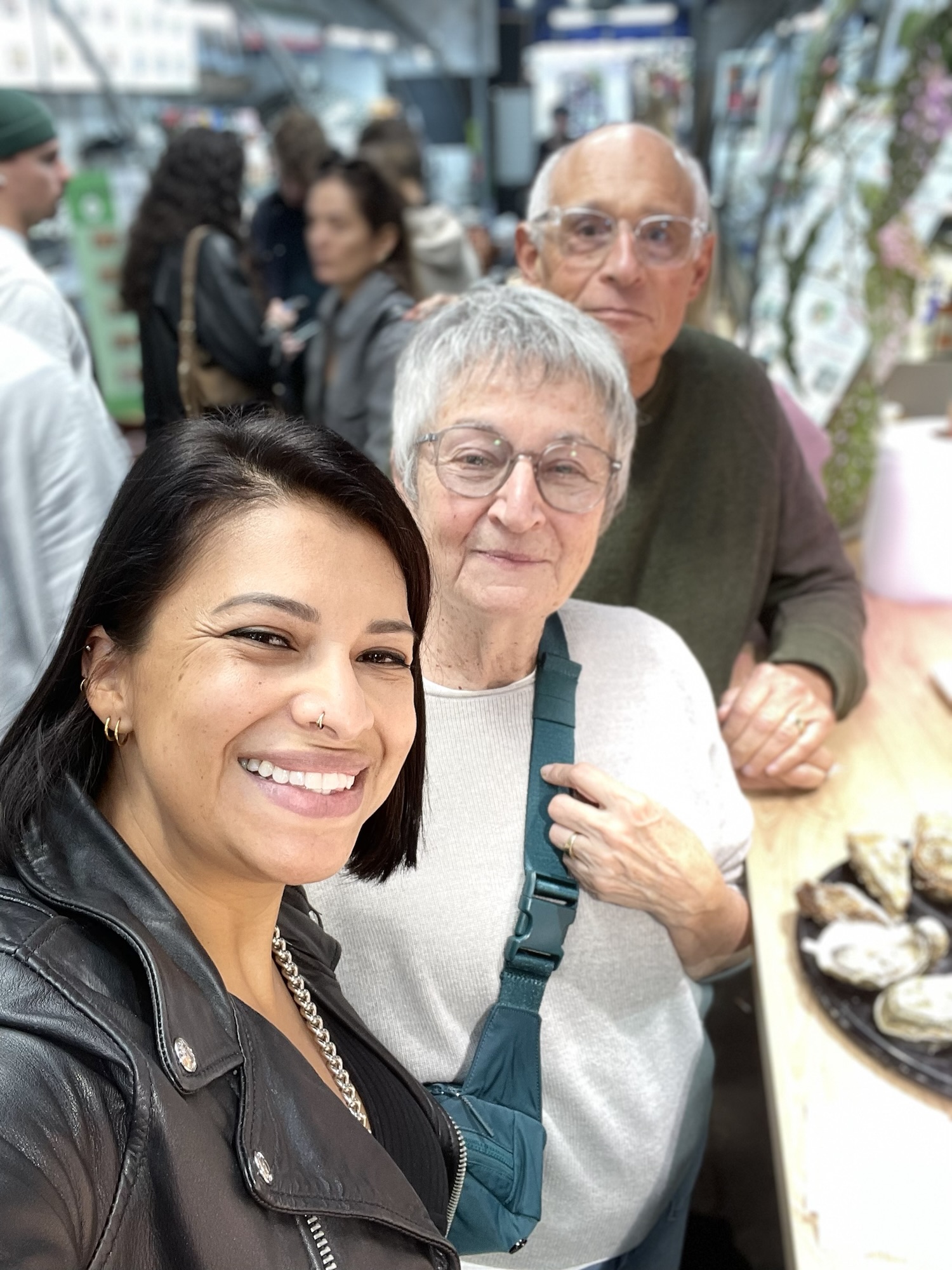
If you visit one of the marches couverts and want food to eat there, do not be shy about asking for help (after saying “bonjour” of course). You may have to muscle your way to a counter, or ask where you can sit with food from the pasta place, but do not hesitate. They are happy to feed you and these are friendly spots where spontaneous conversations are the rule. While at Marche Couvert des Enfants Rouges we met a wonderful woman from Brazil (now a Parisian), an insanely good looking couple from Florida who were working their way home from southeast Asia, directed a lost tourist to where you could buy a glass or bottle of wine. The boys from Florida summarized their trip as “Loved Cambodia, hated Viet Nam.” Anyway, one of them had been Netanyahu’s makeup guy at a television station in Israel. “The guy is a total asshole and NEVER goes out without makeup.” Explains a lot about his relationship to dear leader. The terribly nice woman from Brazil who took our picture and even though she understood English did not let me resort to it. “Only French!” she demanded. Such fun.
Jammed and fun falafelComptoir des ArchivesDuck confit Our Brazilian amieMmmmmmMarche des Enfants Rouges
Our flight was fine, but of course sleep was on/off and we arrived quite tired. I have always assumed everything works better in Europe, but we landed in a humid airport and a long walk to a 50-minute line at passport control. Lots of people and a high-pitched alarm somewhere that was extremely annoying. All for the literal 15 seconds of passport examination; leaving we approached the source of the alarm which was deafening as we ran through the exit doors. Outside the humidity climbed and poor David was sweating as we got into a waiting, and crowded, bus. Several nice people reshuffled so we could both sit down. I guess we looked pitiful.
It was a long ride into the city where we were bleary, hot, tired, and grumpy looking for our street. It turned out to be a very short walk and we got there without mistakes thank goodness. Nice hotel—The Catalonia Vondel. There are so many small hotels in this part of the city we had trouble deciding where to book but this was a reasonably good choice. Nice staff, an elevator, and lovely room which alas we had to change because the tub-shower walls were SO high it was literally treacherous to climb into and I kept picturing the trip ending with a rush to the ER. We moved the next day to a room with a teeny bathroom but a walk-in shower. Our last 24 hours have a few issues [no maid service, very difficult to adjust the water temperature in the shower] so I cannot recommend it unequivocally. We found the location, on the edge of the museum district, just about perfect.
The Stedelijk Museum of Contemporary Art
Stedeljik Museum was our first stop because we didn’t have to book an entry time. We have gradually come to really enjoy contemporary art and this place is pretty great all around, with one masterpiece that we returned to our last day to see again. It is a short [45 minute] film by Wael Shawky titled Drama 1882, telling the story of the rebellion against the British in Egypt, ultimately crushed by the British. It is an opera, with a hauntingly beautiful score, subtitled in English thank goodness. We both loved it…so much we went back Saturday, our last day and the last chit on our museum pass, to watch it again. It is so poignant, so sad, as the citizens are betrayed by European powers and their own people [“Traitor 1, Traitor 2, Traitor 3”]. The entire film is a masterpiece. I have scoured the net looking for where else it can be seen but after a month long installation in LA I found nothing. It premiered at the Venice Bienniale last year.
The Seafood Bar
Oooh, so yummy. I suppose I should have taken pictures but we were immersed in eating and drinking. Started with 6 oysters, easily equal to the best we have ever had. Then shared the Plateau, a small lettuce salad and huge serving of smoked and cold fish and shrimp. Delectable. Then we shared an order of mixed grill, a tower of fish and shellfish grilled perfectly. We ate every bite. It was a ten minute walk from the hotel and we practically staggered back and fell into bed.
Day 2: RijksMuseum and Indonesian Dinner
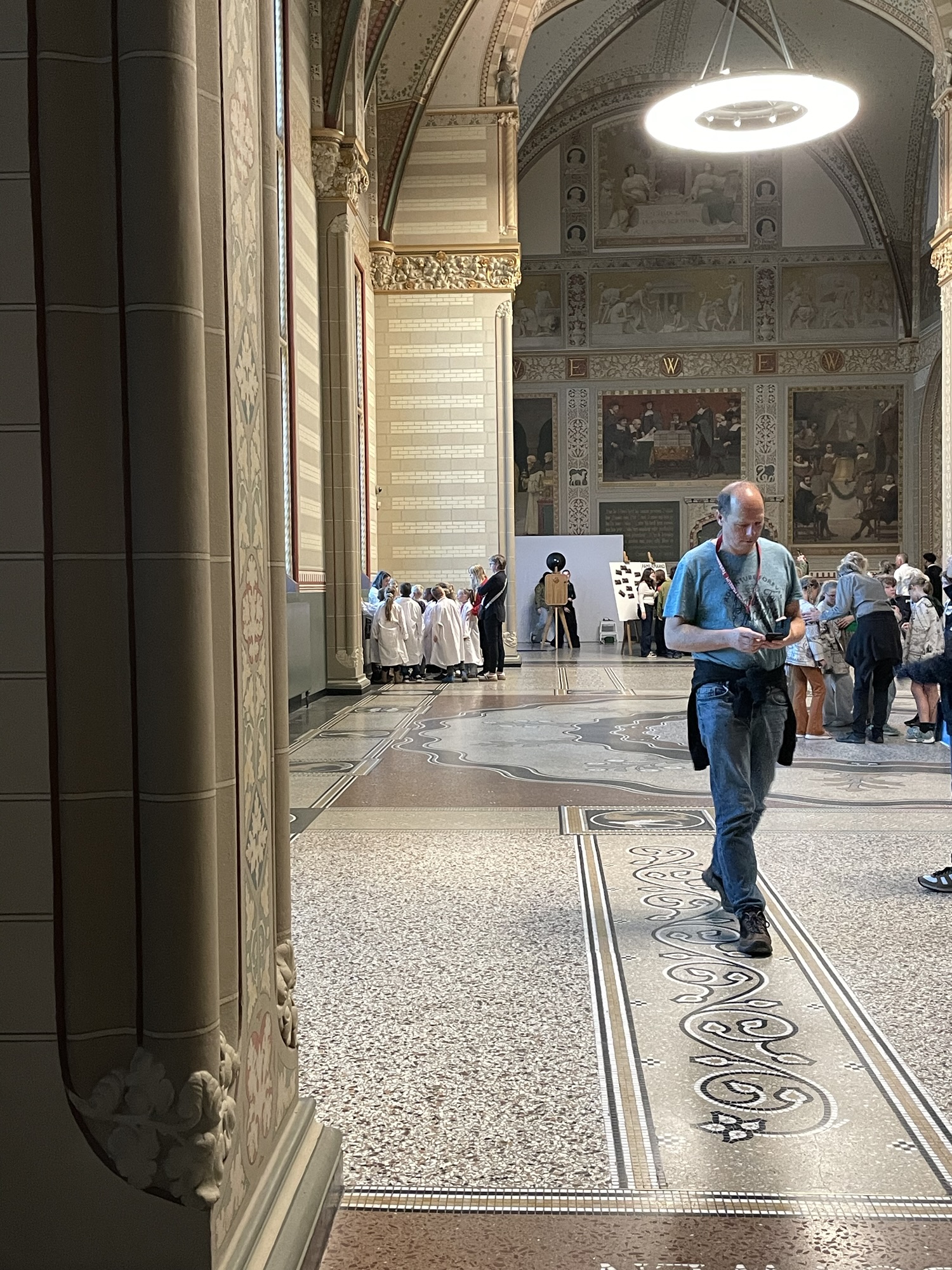
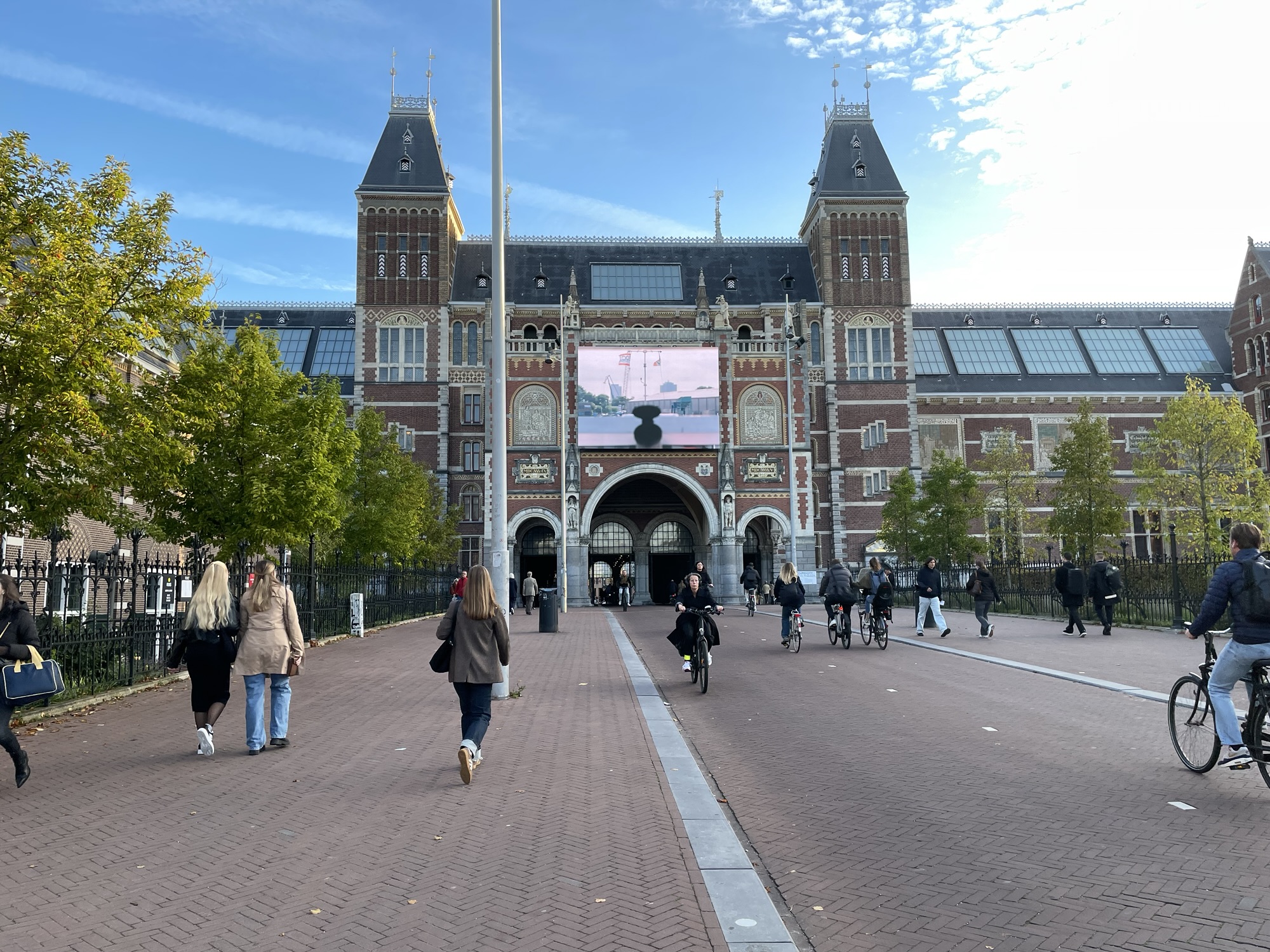
Well, this place is justifiably highly recommended in every guidebook…it is enormous, the building is fantastic, the layout fairly easy [though we had to ask at the information desk where the exit was!] and the audio tour essential. The first stop on the tour is the Great Hall, a beautifully adorned, immense space with massive murals that were part of the original construction. I mention this because not long after the museum opened styles changed and all the walls were painted over in white. The audio tour device allows you to “paint” the walls white to see this travesty of modernity over beauty. As the narration explains, years later it was decided the white walls were a mistake and fortunately all the original decorations and murals were intact under the paint which was meticulously scraped away. Phew.
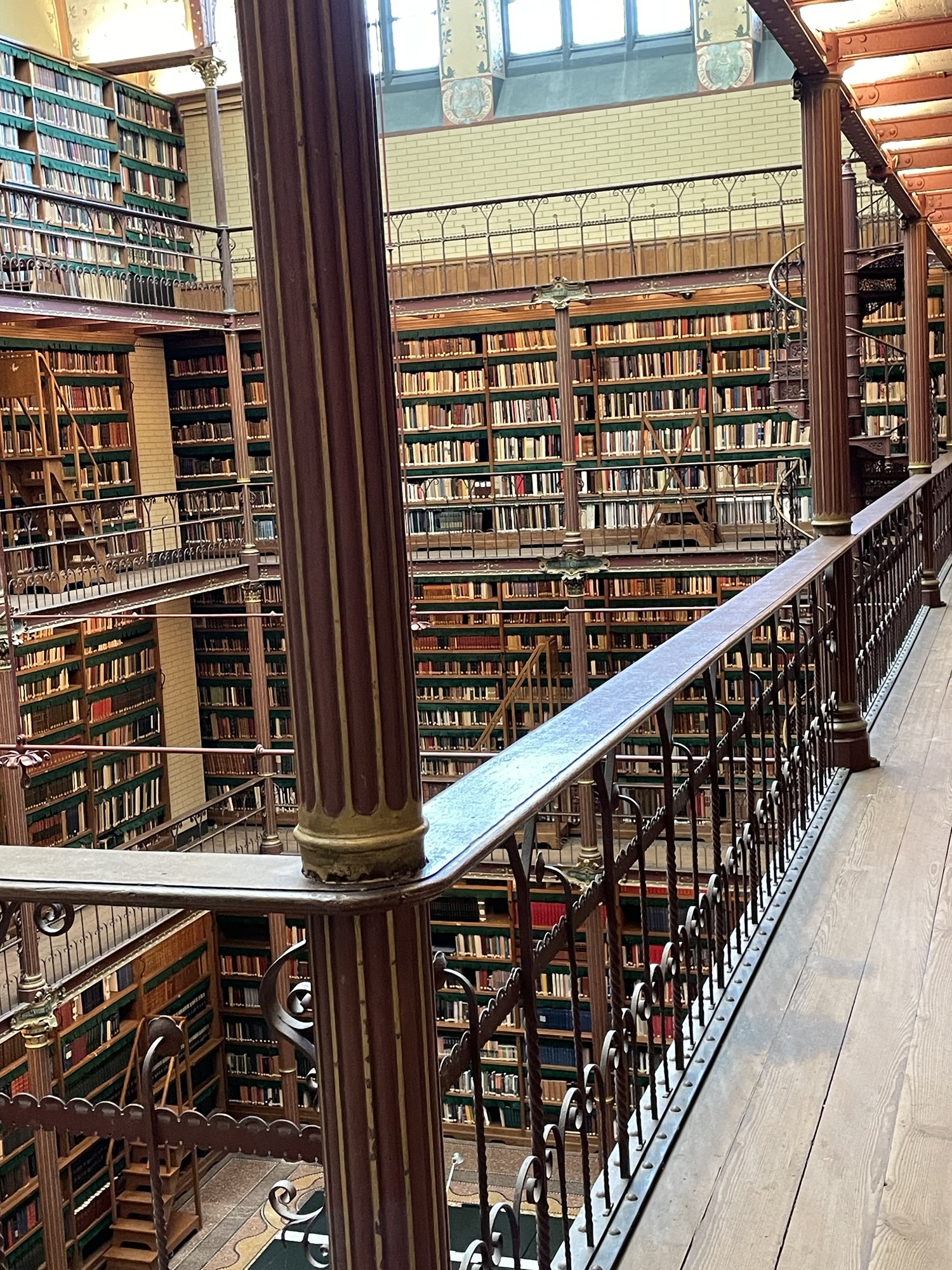
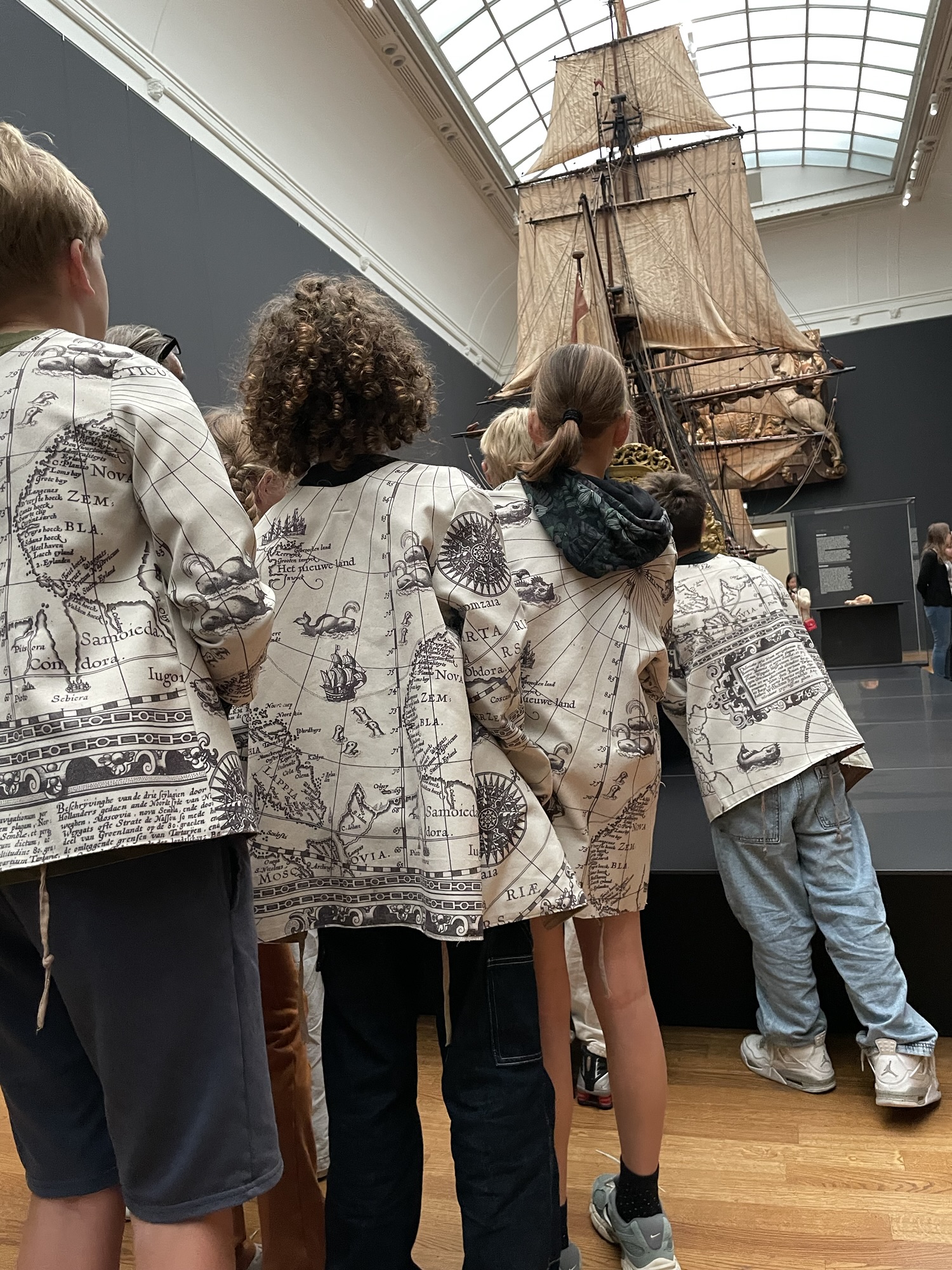
The title is Puck—the dogA corner of the great hall with smocked school group on the leftThis is the library. No talking. Another school group examining a ship modelThe Night Watch undergoing restorationThe galleries are so beautifulThe massive Rijksmuseum
Of course the Dutch masters are well represented and their works remain as appealing as ever. The Night Watch is being restored and behind a glass wall—but visible behind the wall and a reproduction is in the next room over so one can see the details. The tour had ample explanations of why these masterpieces of the 17th Century are as wondrous today as ever. Still lifes that entice you to reach in and take a piece of cheese; interiors (e.g. The Milkmaid) that are inviting and colorful; group portraits, such as The Nightwatch, that transport you to the scene. We loved it.
Afterward we wandered across the canal to a sweet little restaurant, Cafe Mankind, and at 12:30 we were the first people to sit down for lunch. I had learned from the massive sandwich I had had the day before that a half would suffice so we shared a smoked salmon on brown, thin, warm toast. Yummy. We returned to our room for a nap, then had a very good Indonesian dinner in honor of the colonial past and staggered back to bed.
Day 3: Haarlem Food Tour and Frans Hals Museum
We had booked a food tour in the city of Haarlem, a very short train ride, and ever worried about making our way to unknown locations on time we were an hour plus early for the tour so stopped in a nice coffee place with wifi. Thirty minutes in an American sounding guy sat next to us, a talker but an entertaining one. He was born in Indiana but had emigrated to Canada years ago and was now a Canadian citizen. Show off. We had a fun time mostly listening to him, getting in words as we could, as we explored traveling, being Canadian, his time on vacation in Haarlem (which I recommend highly…stay there and take day trips into Amsterdam) , and so forth. It passed the time and then we walked a few more blocks to the food tour.
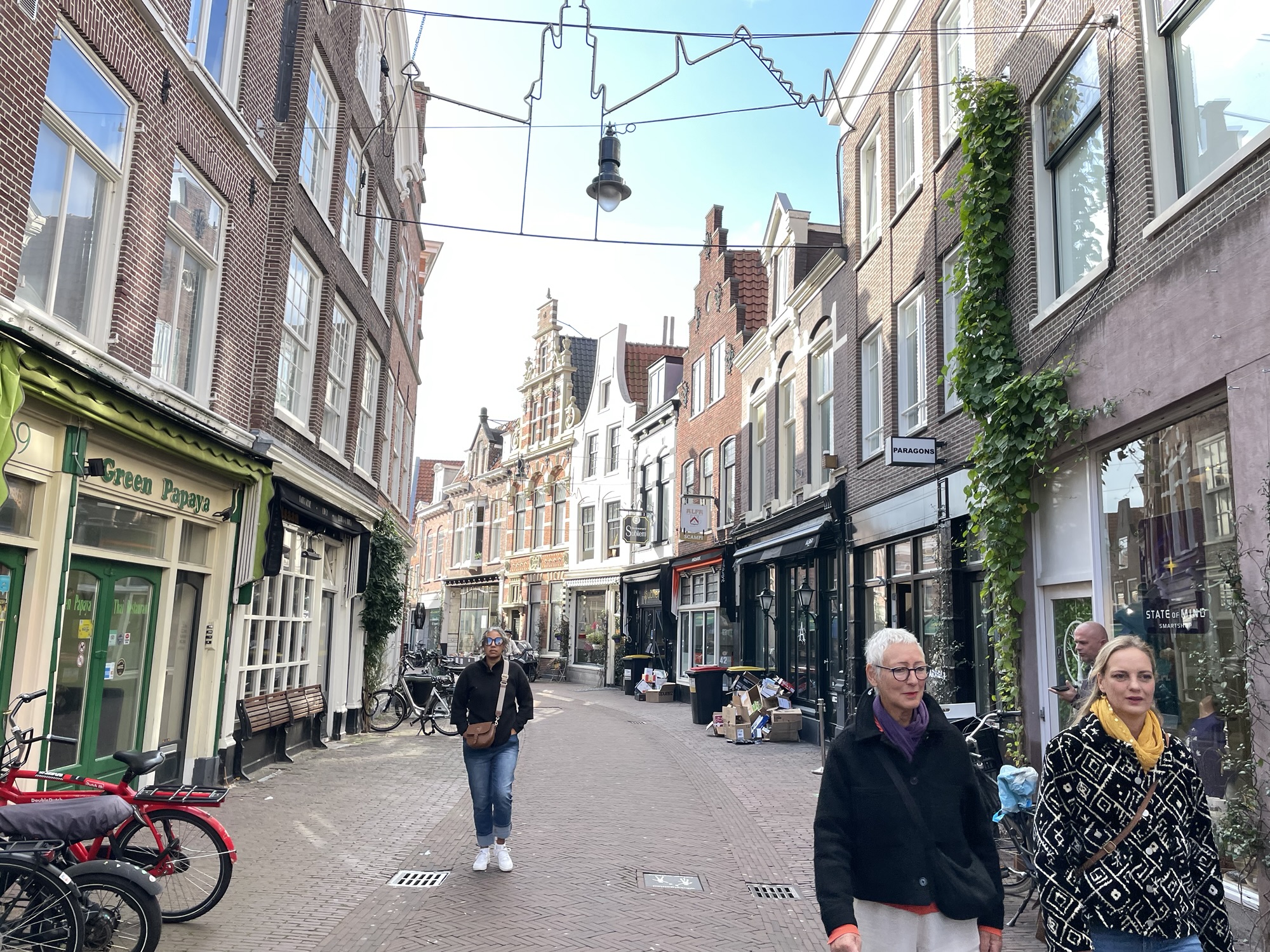
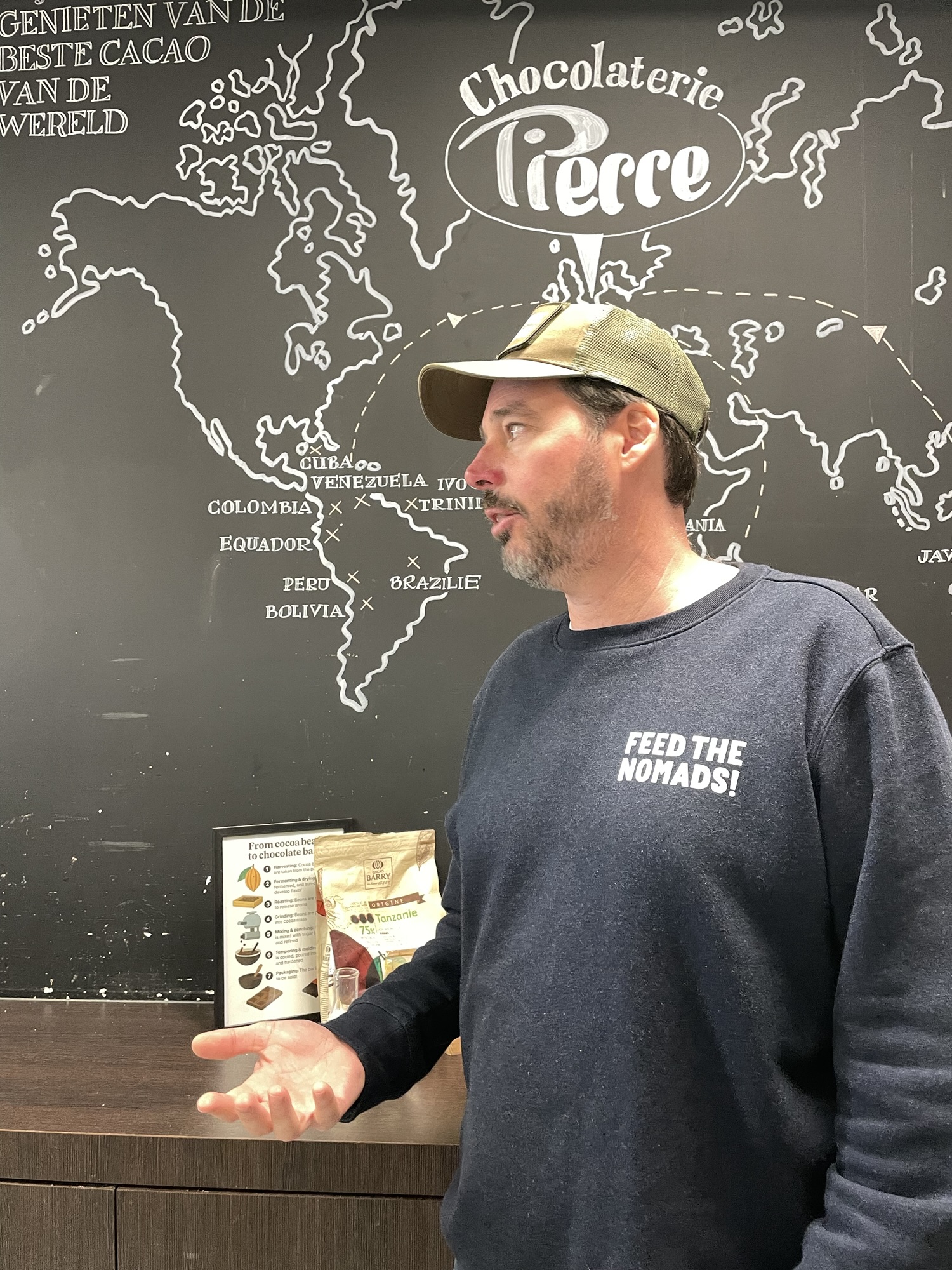
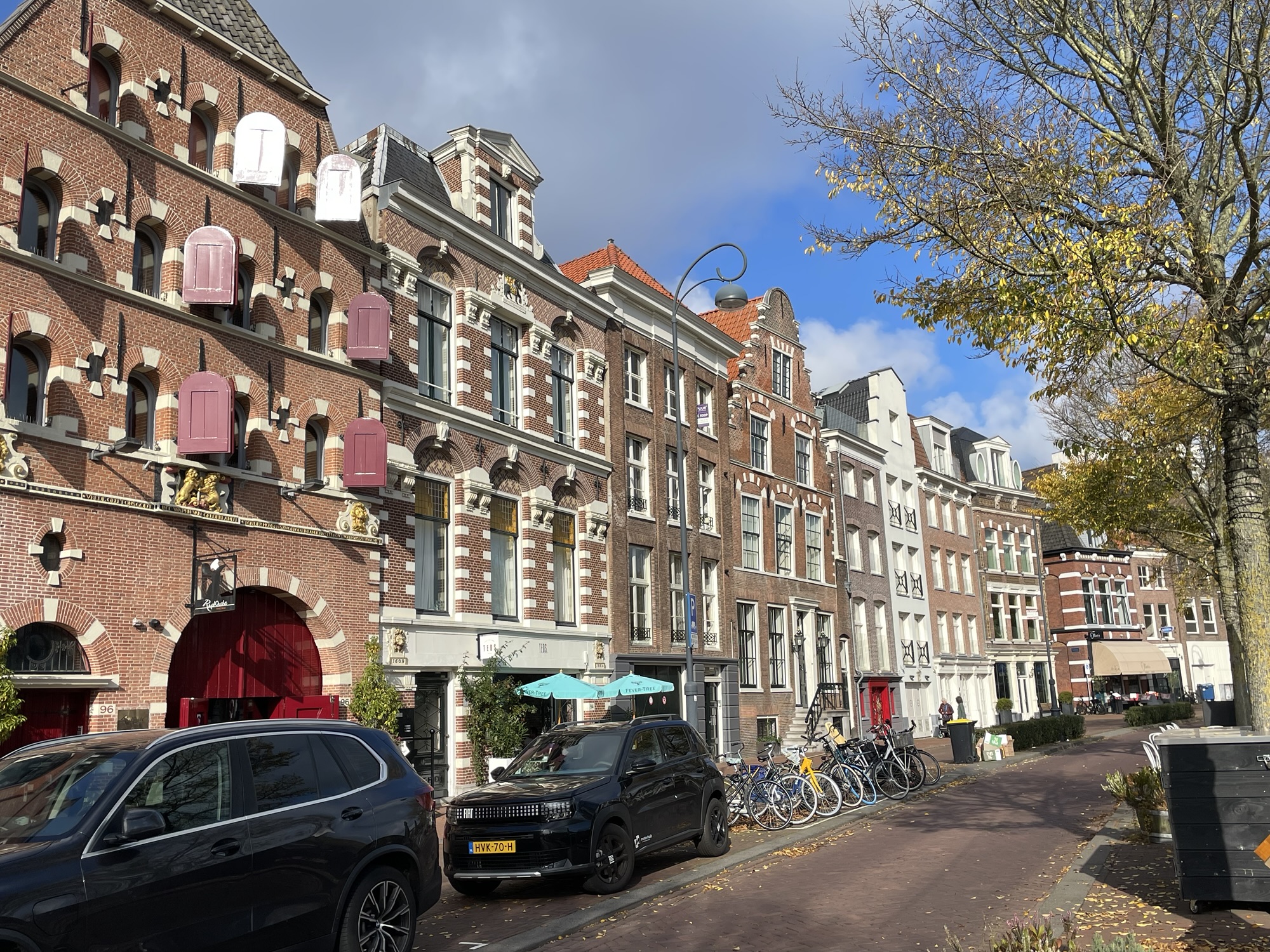
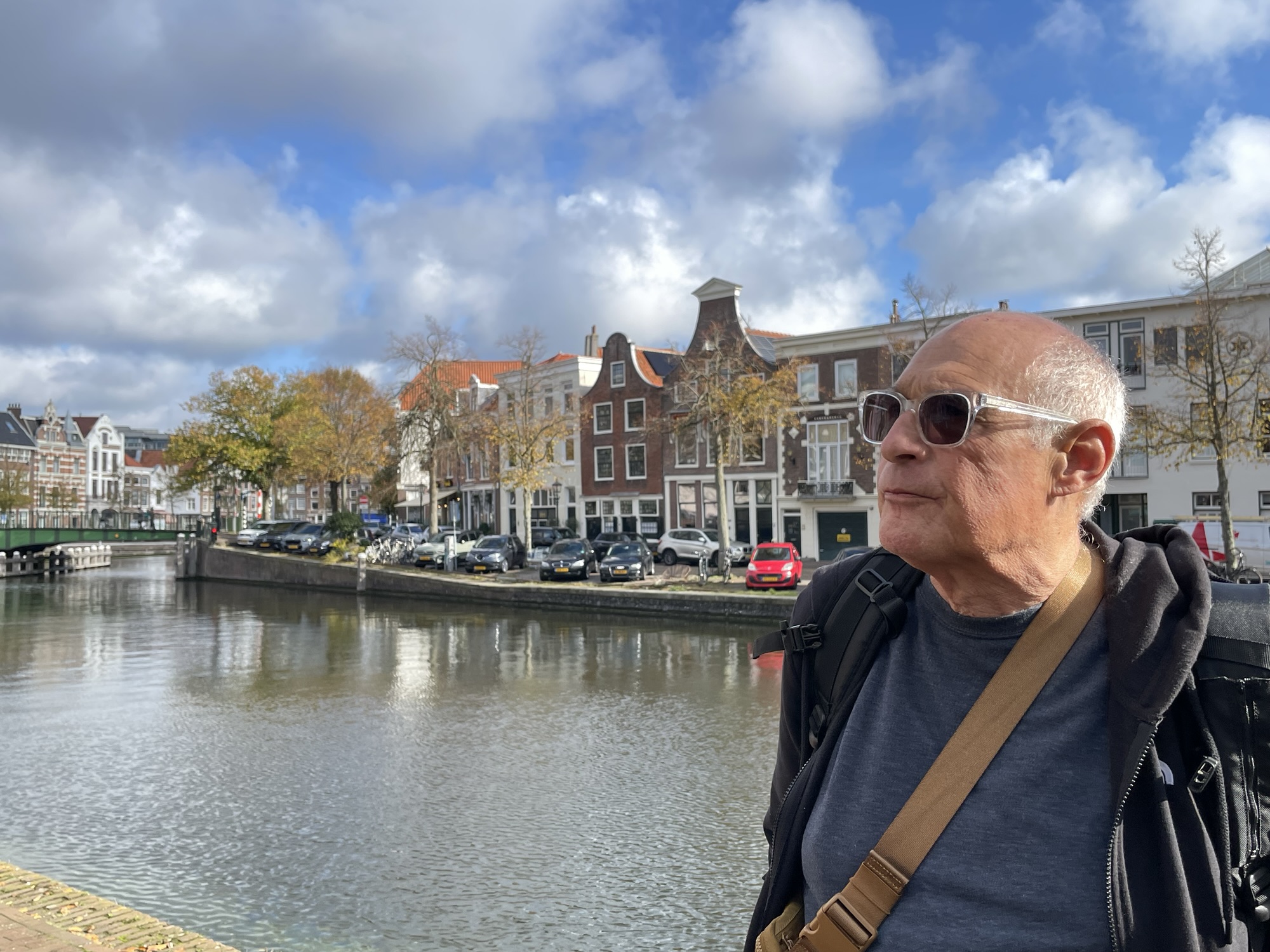
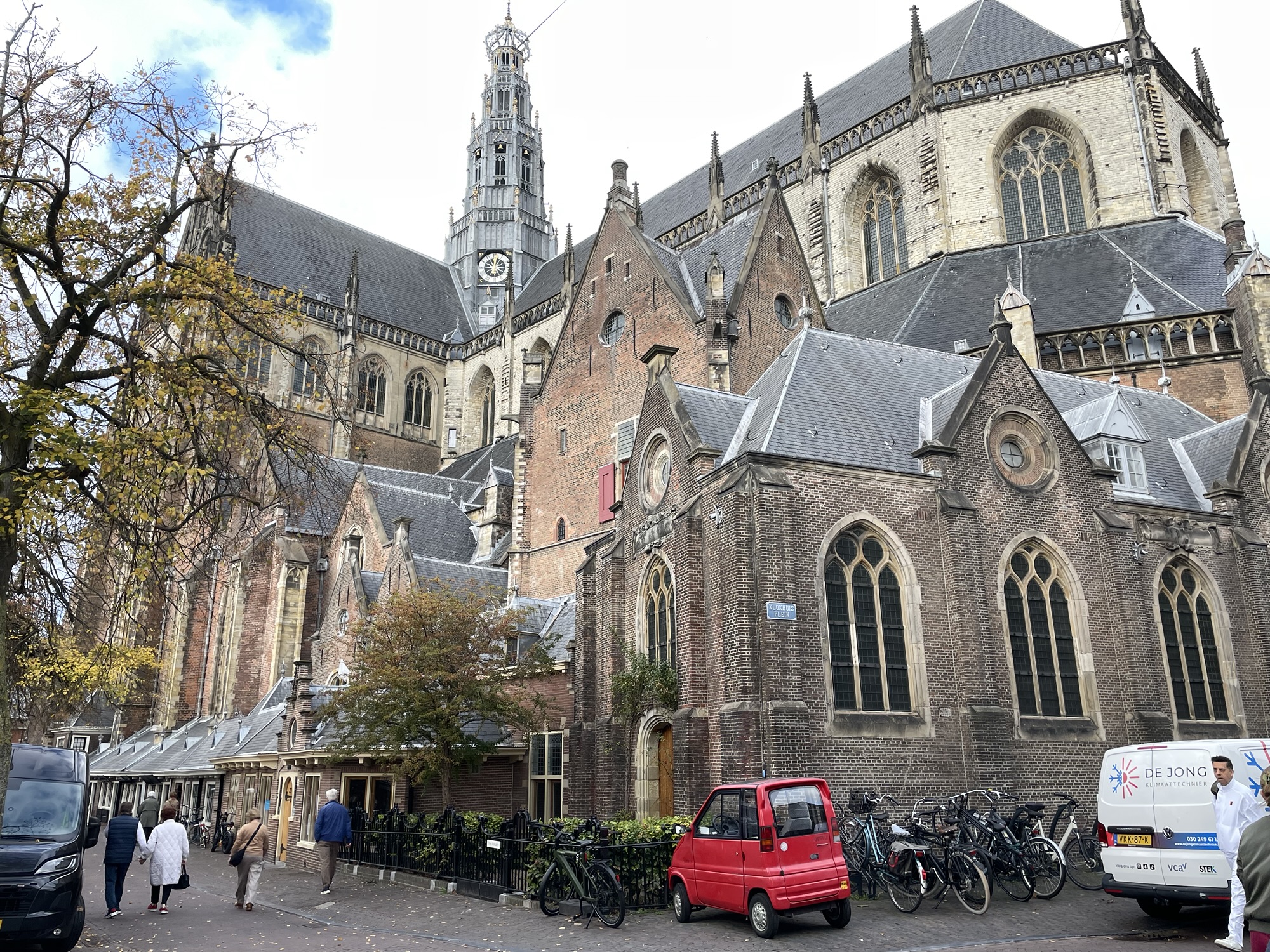
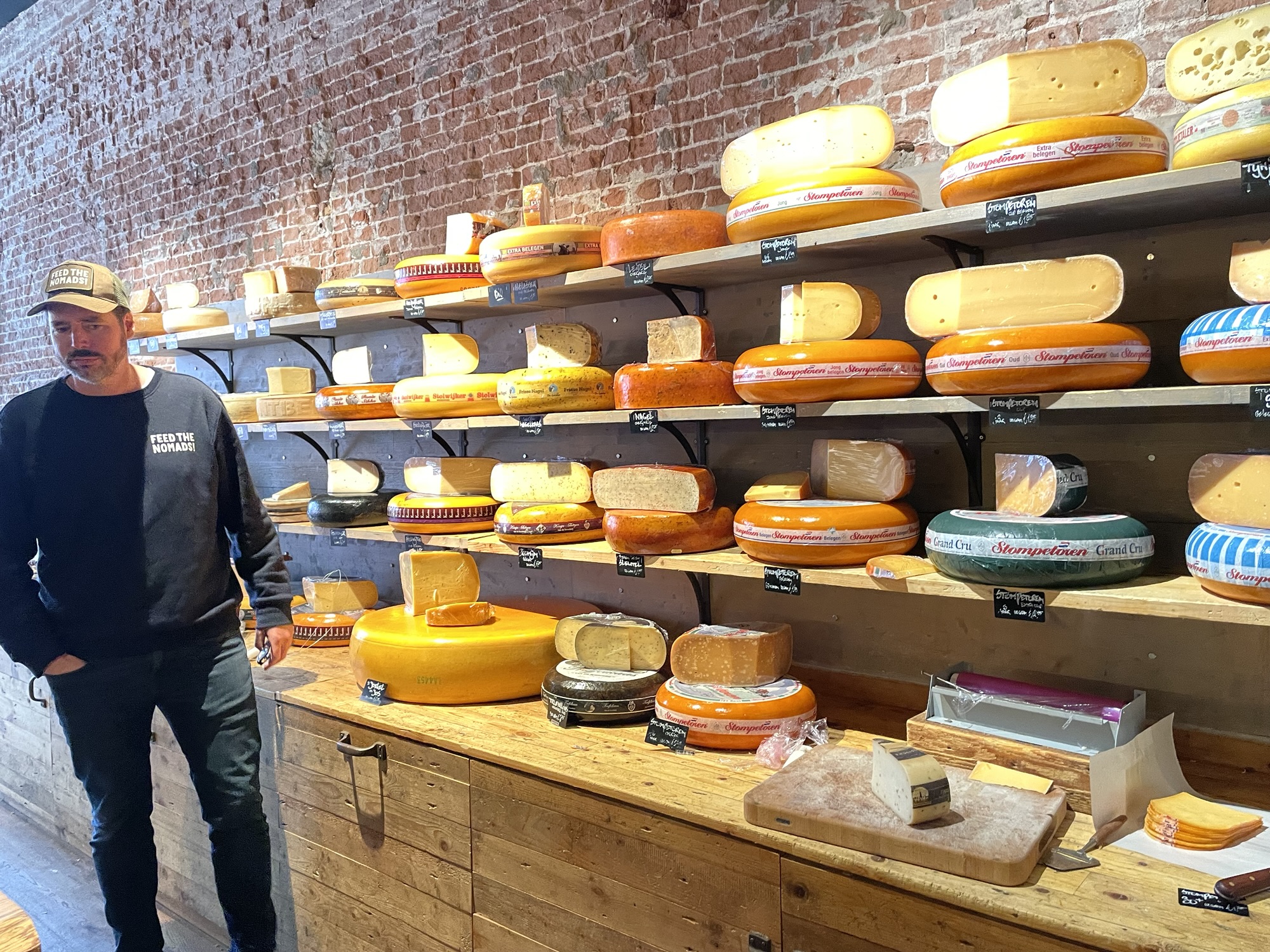
Haarlem, a manageable amsterdamOur wonderful guide explaining chocolate Narrow residential streets where the city promotes greeneryThese enormous houses were built primarily by beerPlenty of canals…this is an actual riverThe former cathedral, now Protestant, is a jumble of buildings smashed togetherDutch cheese is similar to parmesan in that it is non-perishable meant for long sea journeys as they became a colonial power.
This food tour was more a walking tour through old Haarlem and its history—our guide introduced the tour by going through all the Dutch-American connections, place names, etc.—a walking tour with great snacks! It turned out the group was the guide, the two of us, and 3 of his buddies. We had a blast. Old Haarlem is gorgeous, with lovely restored buildings, NO CHAIN STORES as a result of city government policy, plazas, canals, narrow alleys of original buildings, built for warehouses and businesses but now residential, filled with greenery (also government policy to keep things cooler—oh, huh, is global warming a thing?), hidden gardens, little green squares surrounded by small row houses built specifically for elderly women or the disabled…everything on a small scale with no more than 3 or 3 1/2 stories per building. I yearned to go shopping in these lovely local businesses but luckily no time. Snacks started with coffee and little savory bites, then a cheese store, an outside market where we ate smoked eel (delicious) and salted herring with onions and pickles, warm donuts filled with raisins, chocolate at a local chocolatier, local craft beer and bitterballen, everything delicious and just right. The tour, we suppose because it was a group of (delightful) friends and the two of us, was four hours! We left the group at another restaurant/bar built on the top of a parking structure with a great view of the city—we had timed tickets to the Frans Hals Museum. We shook hands and left for our next immersion in Dutch painting.
Frans Hals Museum
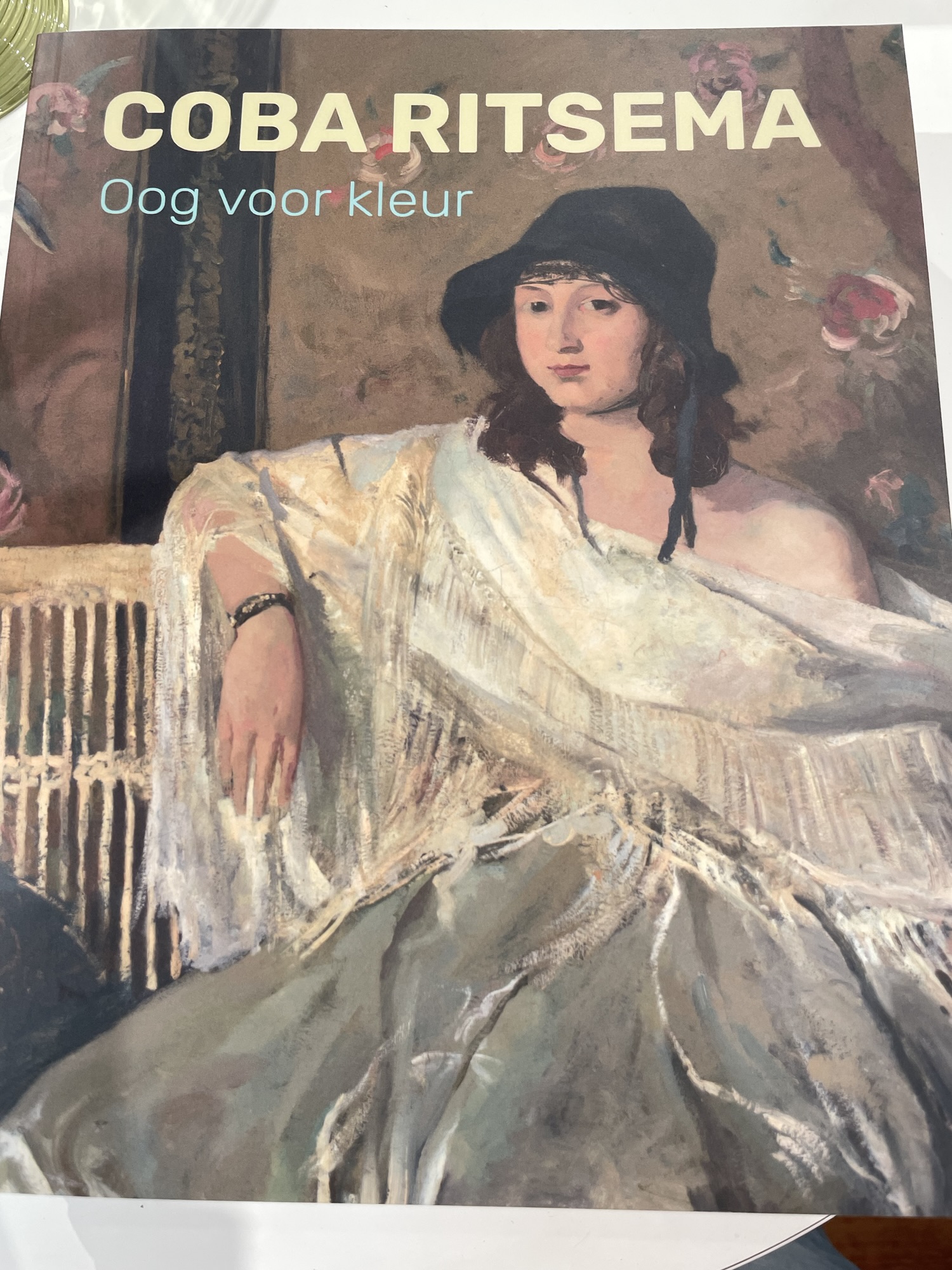
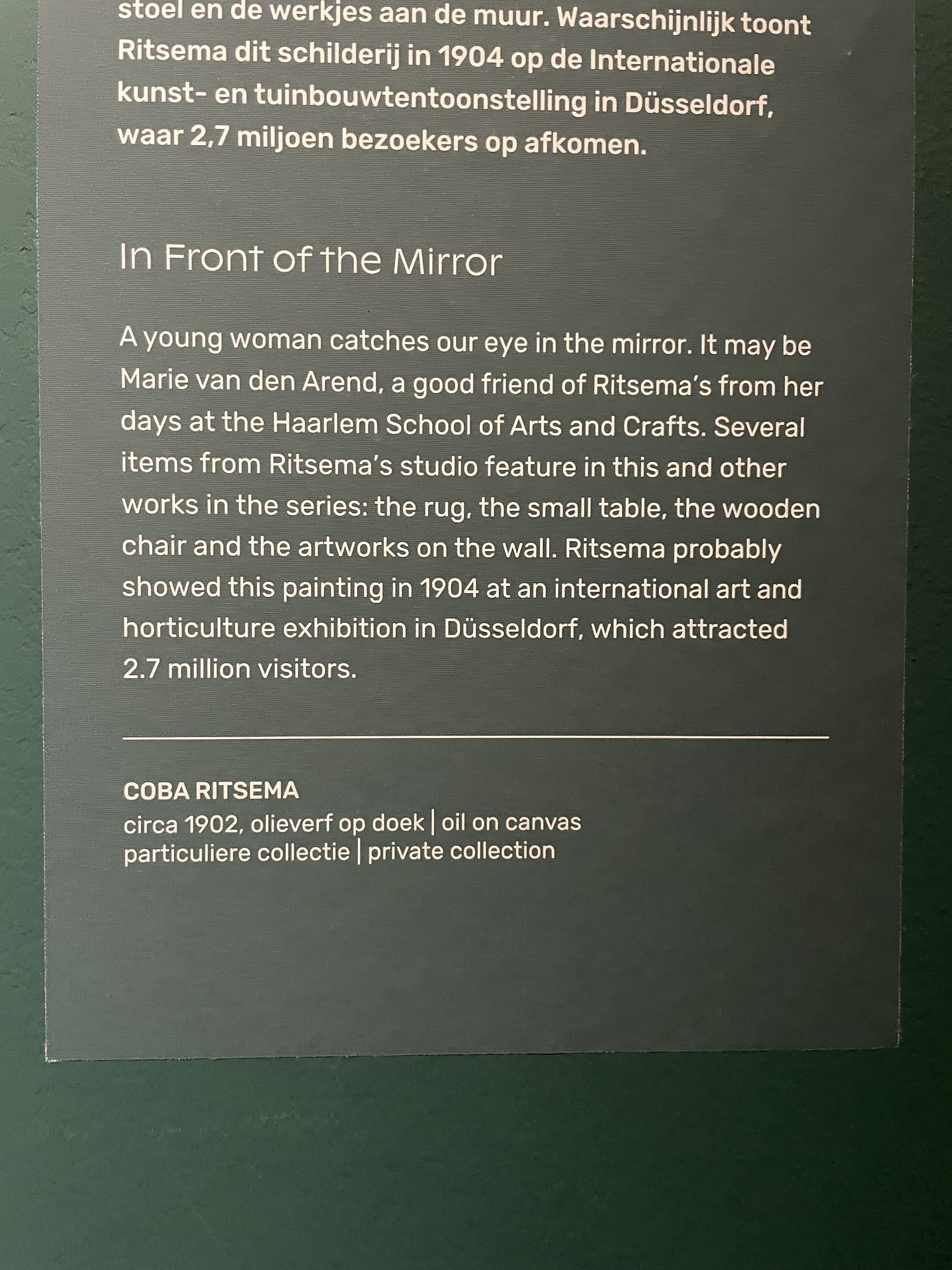
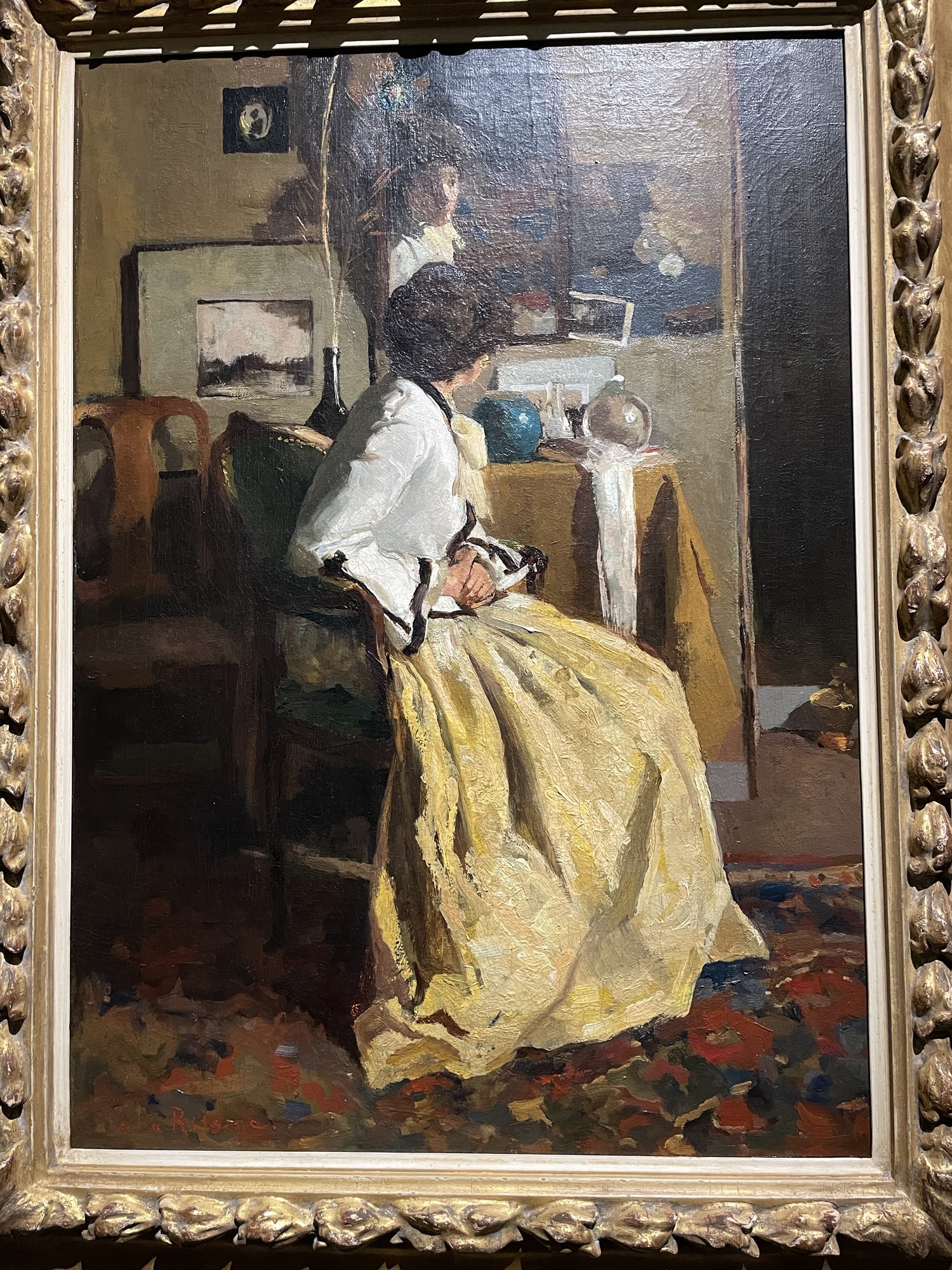
We liked it. All on one story, surprisingly large, but by the end I felt I had seen as many Hals and Hals-adjacent portraits I would ever want to see. There was a nice surprise at the end—several rooms of the life and work of Coba Ritsema, an amazing 20th century woman painter we had never before encountered. I was sad that the only book of her work on sale was entirely in Dutch. She is worth tracking down.
We really loved Ritsema’s workThe one-story museum on a typical Haarlem street. Charming.
We headed back to Amsterdam thinking we were on a bus to the Haarlem train station but it turned out to be a bus to Amsterdam South Station. A hop onto a tram and we were back in our neighborhood. We redeemed our champagne coupons (a very generous pour) and wandered across a few canals to have a fast burger and fries supper. Easy and fun—we were worn out and looked forward to bedtime.
Last Day: Van Gogh Museum! And a return to Stedelijk for Drama 1882 redux
Oh boy. We had 9:30am tickets to the Van Gogh Museum so after a stop at our favorite bakery for rolls and coffee we hurried over. It was just opening and the line was long, but these major museums have maximum tickets/day and timed entries so while there were a lot of people it was manageable.
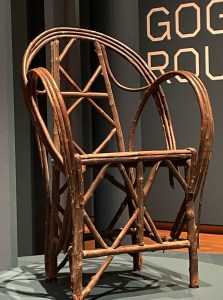
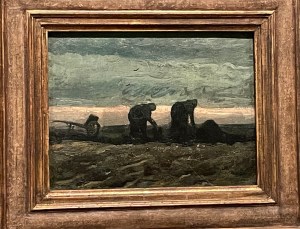
So many of his paintings are iconic and well known. I did my best to not take pictures of his work unless it was new to me—his chairs and a small country scene that kind of stunned me.
We like Van Gogh but here I realized how little I knew of him. (In April we had spent a few hours in Arles, his second-to-last home, so we knew a little bit about the events of his life.) This museum is fantastic, not to be missed. It is huge. We got the audio tour which was well done, and the first special exhibit was all about his time in Arles where he painted this particular family over and over and became very close with them. Van Gogh had decided to be a portrait painter and it was here, with these models, that he learned his approach. You have seen his pictures of the Roulin family if you have ever seen anything of his. He painted a version, e.g. of Postman Joseph Roulin, and then painted multiple versions; the same for his wife, a beautiful rendering of this beloved friend, over and over with subtle changes. He did the same with his self-portraits, changing the colors of the background and clothing. They are wonderful. That he was already struggling mentally adds a dimension to understanding his work in this era. He also wrote hundreds of letters to his brother Theo, fortunately and lovingly preserved and transcribed by Theo’s widow. He wrote with intensity and awe about art and what it meant to him and, he hoped, to his viewers. Many of these letters were quoted in the audio tour and wow.
I had not known that painters of this era in France, where he went to learn to paint, were excited to experiment with new science of color. Van Gogh and others used dabs of many colors to let the beholder’s eye blend into another color. In the museum they have extreme (via microscope) close ups of one of his paintings to show in detail how the shapes and colors of these dabs create depth and interest. Also little grains of sand in a painting he did at the seashore. So cool.
Dutch Lunch
We had lunch reservations at The Pantry, a tiny, famous, old restaurant a 10 minute walk from the museum. Fun and yummy.
Drama 1882 Redux
David and I were so enchanted by the movie the first time we visited Stedelijk we wanted to see it again. I wish it were widely available, e.g. on YouTube or venues in the US, but I have scoured the web without finding anything. It played at the LA Museum of Contemporary Art for a month this spring.
We had one more museum left on our pass and we chose to use it to return to Stedelijk. Friends, I cried. It is so moving, so beautiful, so very unusual. We were so happy we could see it a second time. A masterpiece. Wael Shawky. Remember that name.
Fancy Dinner with our beloved niece
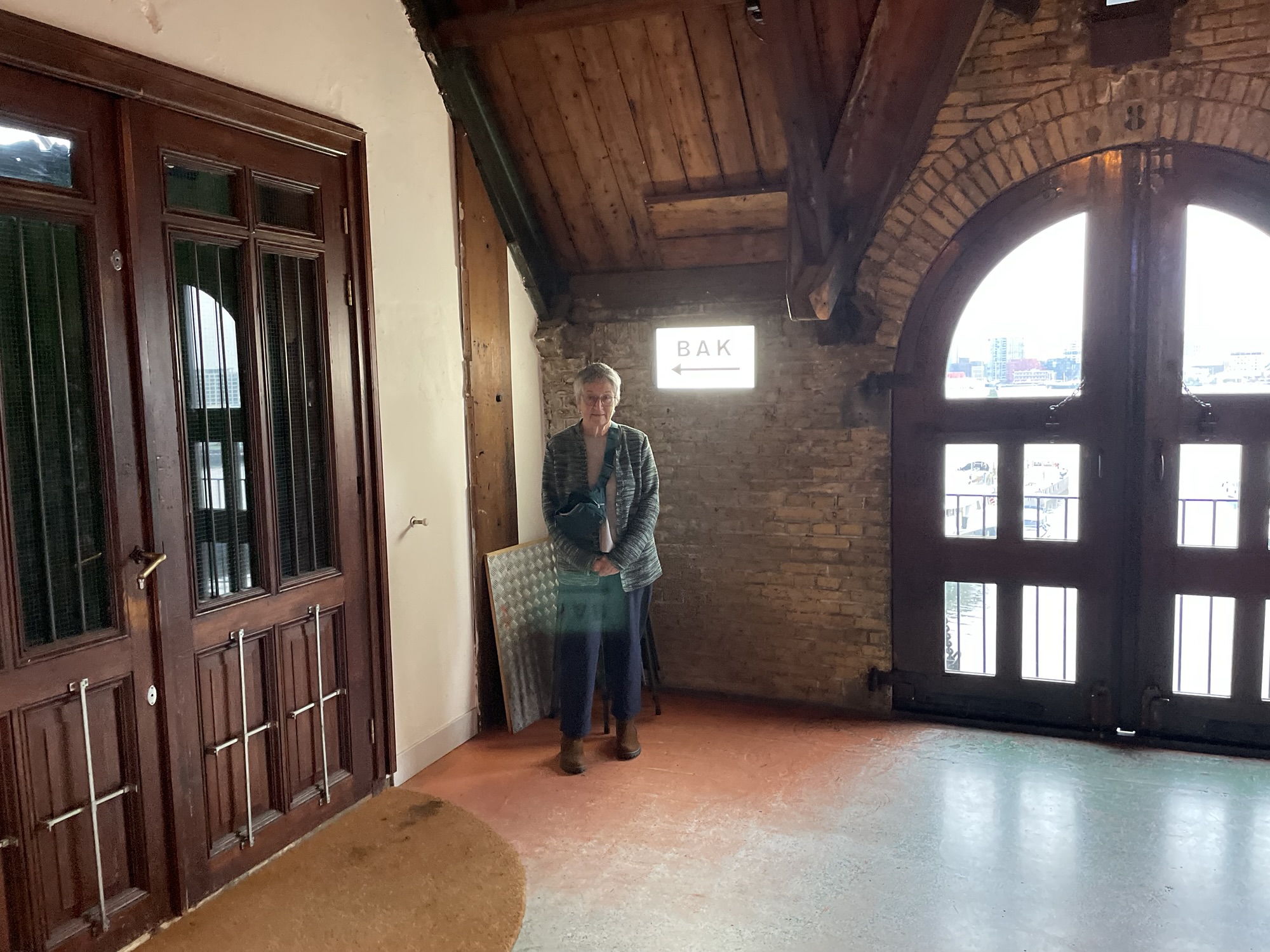
We had reservations at Bak, a place that occupies a corner of the top floor of a warehouse on the river (not a canal!) renowned for its tasting menu. We had to deposit 40 euros per person to hold the reservation, and we hoped it was worth it.
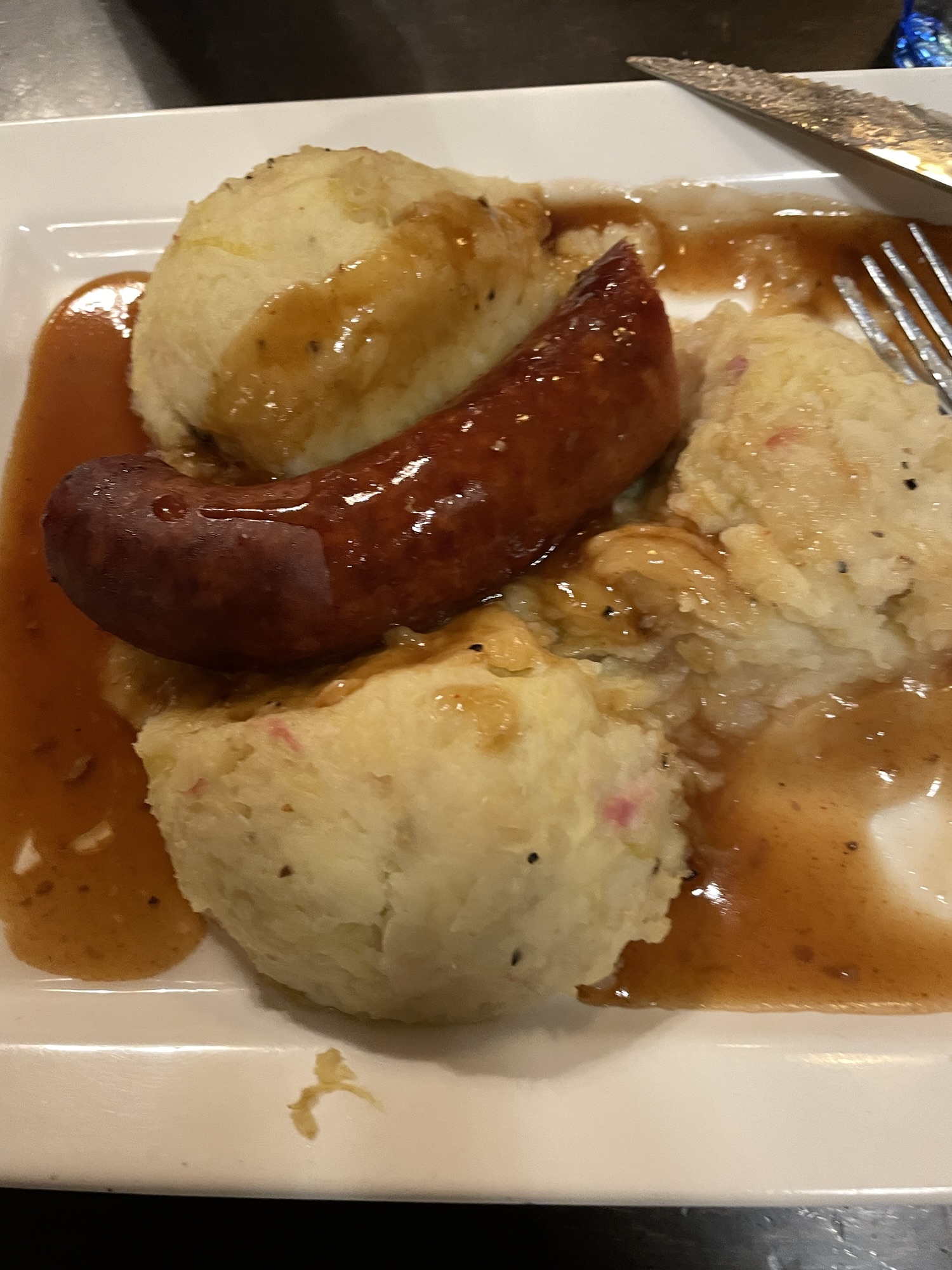
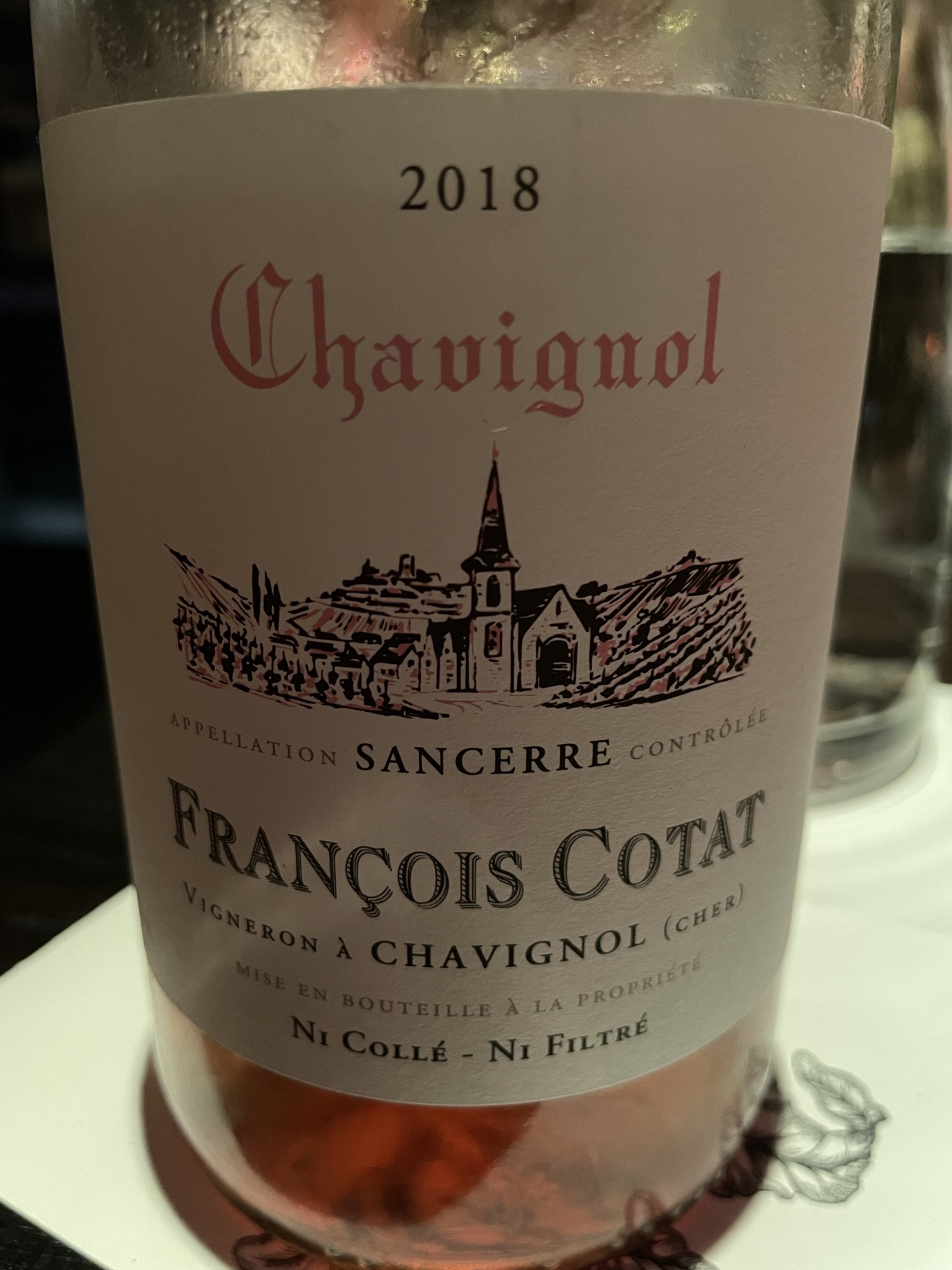
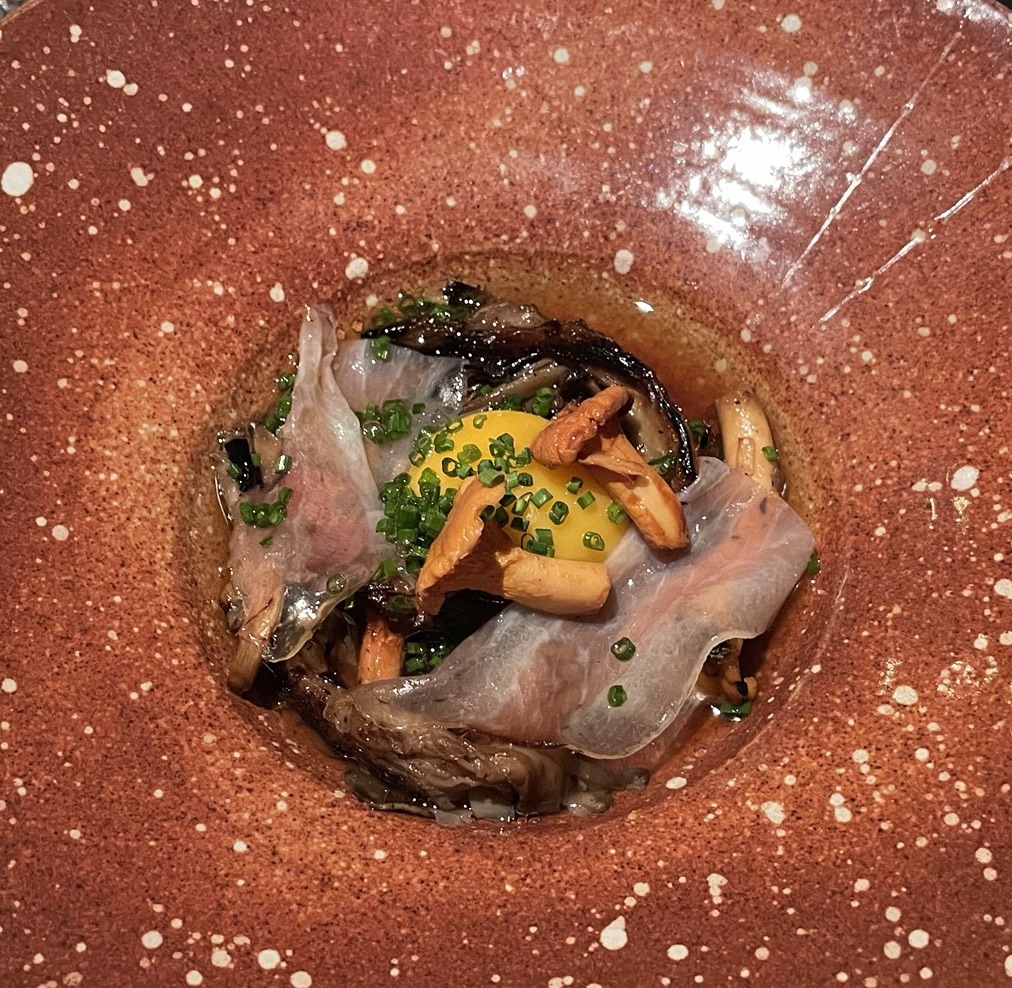
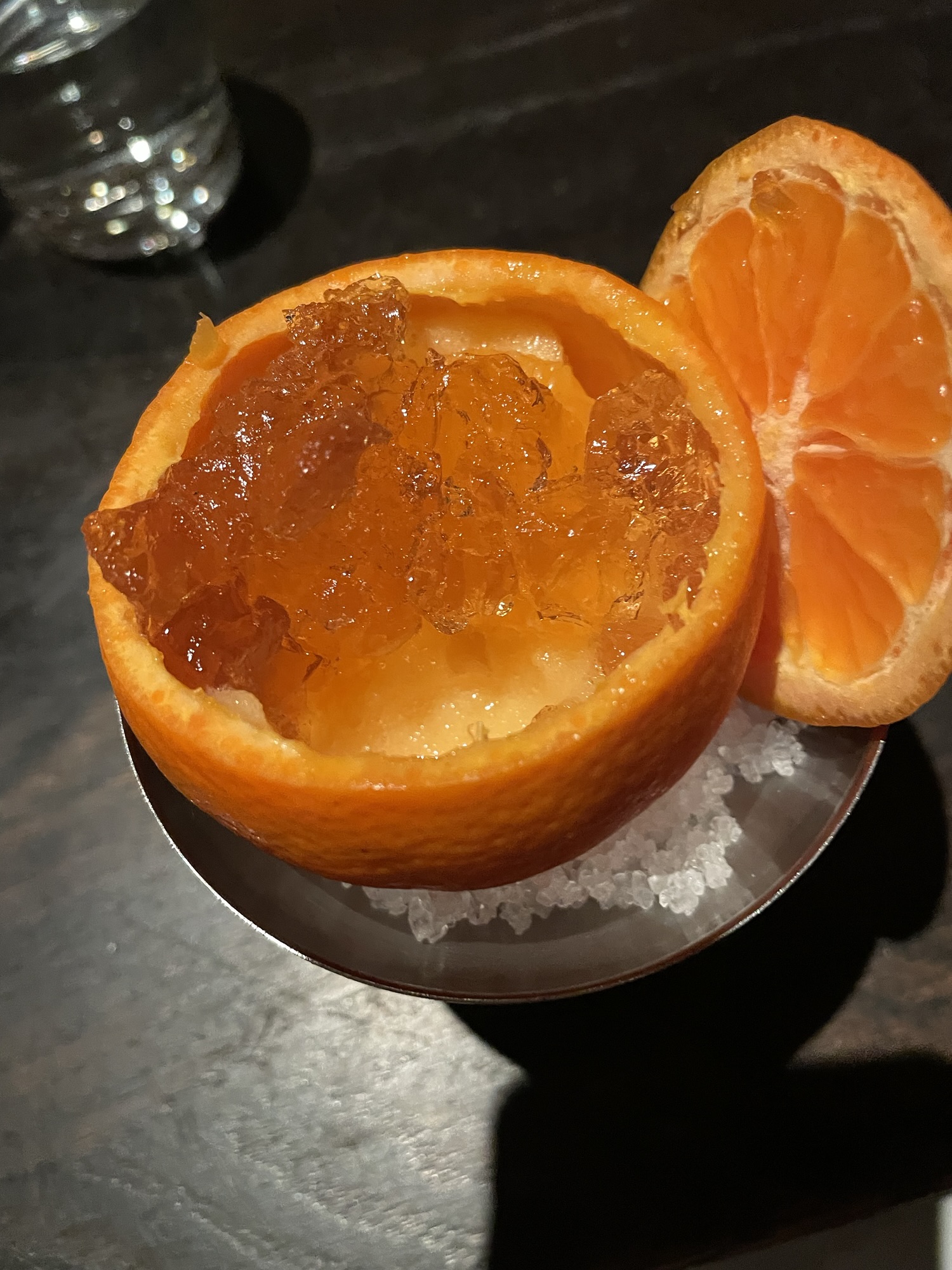
In the top floor of a warehouseAn almost thrilling roseDon’t recall what this was other than deliciousDitto. And…ditto.One of 3 desserts, an orange sorbet, I think, with sherry jelly on top.
It was. These kinds of meals are such fun, and perfect for a long evening of conversation. Lauren joined us and we talked and ate for hours. Service is attentive and unfussy, food delicious, and when they didn’t have the (least expensive) rose they substituted a spectacular French rose for the same price. After gin and tonics, all that food, all that wine, we were sated to say the least. To complete the luxury of the evening we shared Uber with Lauren (we of the always take the local transit habit) and returned to our room feeling as if we had enjoyed our narrow version of Amsterdam sufficiently.
As I write this we are on the fast train to Paris for another ten days of sightseeing, museums, and food.
Our plan when traveling is to eat whatever is local (and good,of course) so we were determined to eat as much Bavarian food as our digestive systems could handle. Mission accomplished.
We were incredibly lucky to have a young friend living here who loves her city and gave us a list of favorite Bavarian restaurants and beer halls. She also steered us to several of her favorite museums…our visit wouldn’t have been nearly so fabulous or so easy without Janina’s help. It is easy to be overwhelmed in a city with so much to do.
I think we might also have been a bit wary of beer halls. In truth they are so different from any other food experience we could have chickened out entirely—and what a mistake that would have been. Sure, Bavarian food is heavy and rich, but we were only here for a week and one’s body can handle a week of anything, right?
We dug in right up to our last few hours.
First night we walk to Brunnwart and I get my first pretzel
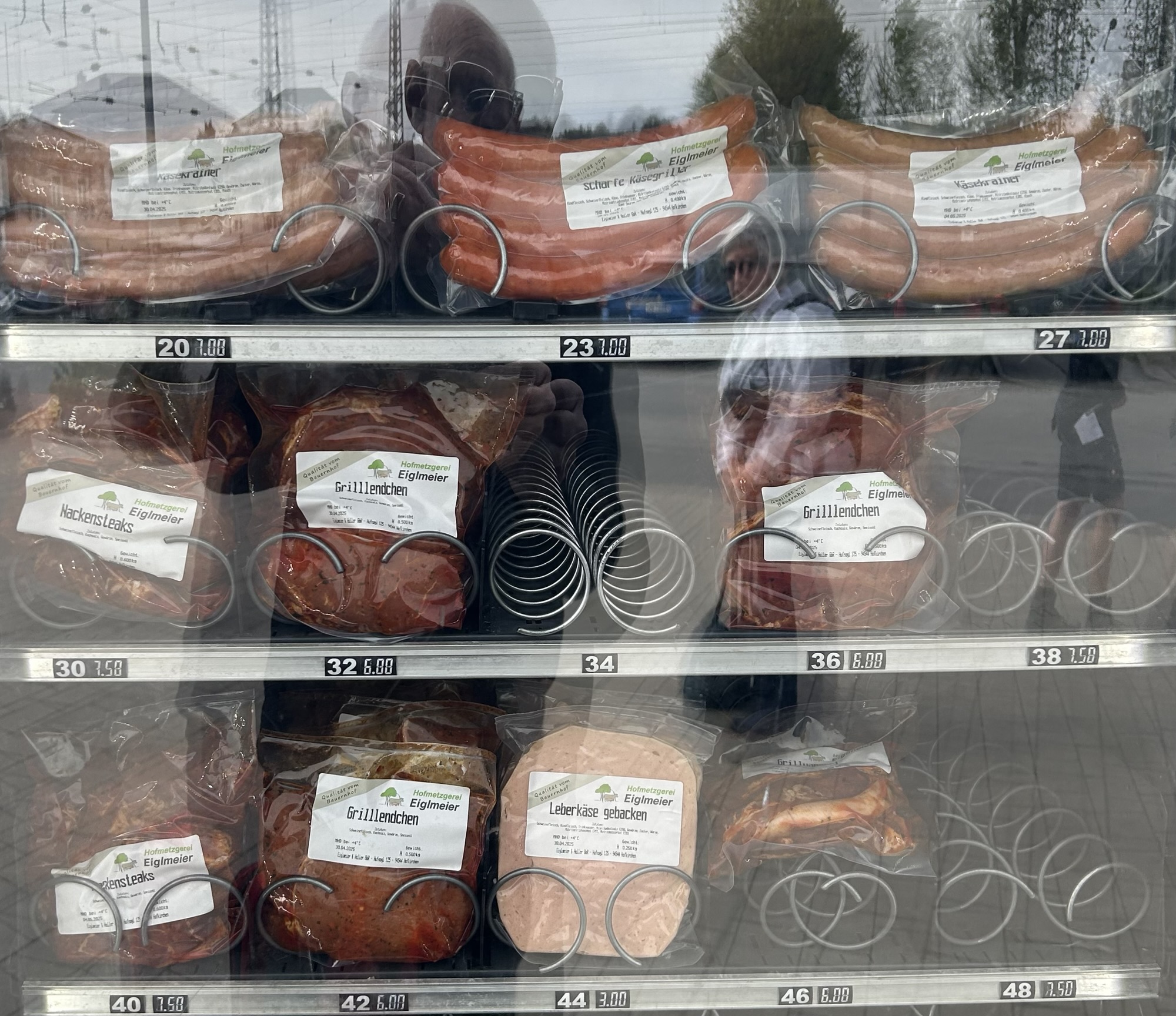
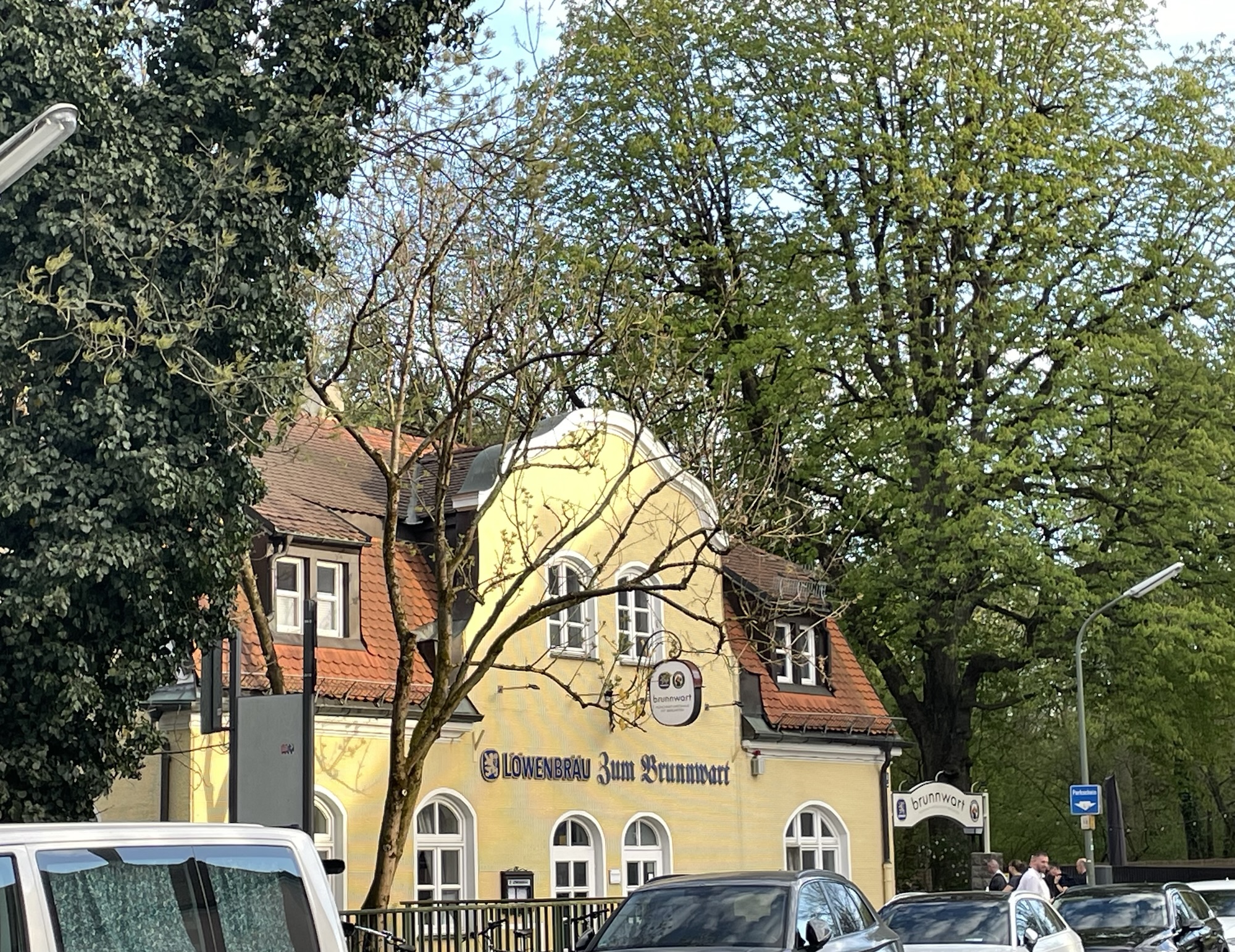
We had had a long day–checking out of the boat, walking to the train station (painfully–my pack was too heavy), marveling at the sausage vending machine, 2 hour train to Munich, 45 minutes figuring out the metro, checking into hotel…so we really deserved an easy supper and thanks again to Janina we had one–Brunnwart, a lovely restaurant and garden a very pleasant 15 minute walk from the hotel.
The place was hopping, but we were happy to sit with our beer and wait a bit for the food, which was delicious of course. I had felt over-red-meated from the time on the boat, so was happy to order an oven fried fish with a cucumber-potato salad (and a pretzel!). I had no second chances for that salad, which is too bad. So yummy and tangy and fresh.
Beer and Bavarian food
Our first morning we took a Walkative guided tour and learned about the six Munich beers and what makes them so good. The definition of these beers is managed in the way any terroir food or drink is—e.g. you must use only local water and these days it is almost impossible to get a permit to dig a new well. We had earlier in the trip learned about Budweiser, a commercial brand which appropriated the name of an Austrian town’s brew because it wasn’t protected even though there is still that town and its beer is beloved…it is not American Budweiser. Munich has been smarter and as a result the Munich six beers are unchanged and, btw, delicious even for a non-afficionado like me. Volumes have been written on this subject so I will stop here before I make an egregious error. Know this: the local beer halls and gardens each feature a particular brand—Augustiner, Lowenbrau, etc.—and the helles, a refreshing lager style, is delicious. It is all draft in restaurants and beer gardens and halls. I rarely drink beer at home but had a half liter glass most of our dinners and does it ever go down easy. It makes Bavarian food even better.
Germany’s restaurant culture is completely different from France, where menus change often, are posted on chalkboards facing the sidewalk, and the midday meal is leisurely. And yet we managed to have long, delicious lunches almost every day, often in museum cafes, as well as big, rich suppers. Yes, we ate a lot! As usual, though, we justified our gluttony by walking most all of most days. Our last day, when we walked the English Garden, it came to 7+ miles. We needed the calories, no?
We ate so much and enjoyed it all. In this post I will tell you about a few highlights.
Lenbachhaus Museum Restaurant
It is delightful to be able to eat well and quickly at a museum cafe. We are deep in art! No time to wander off and find food!
This place was so good, and such a nice setting, we went back a second time between the Glyptotek and its sister across the square.
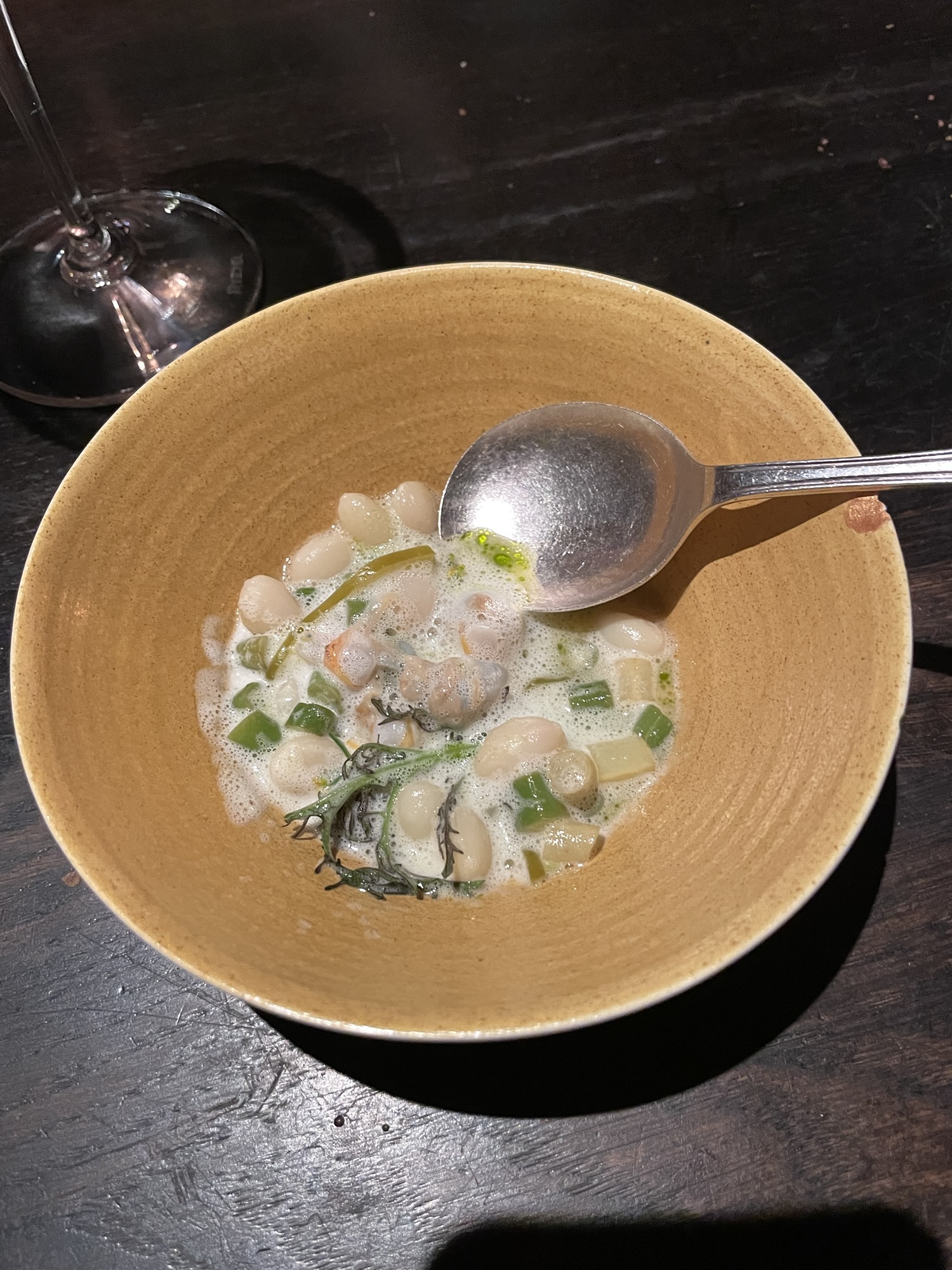
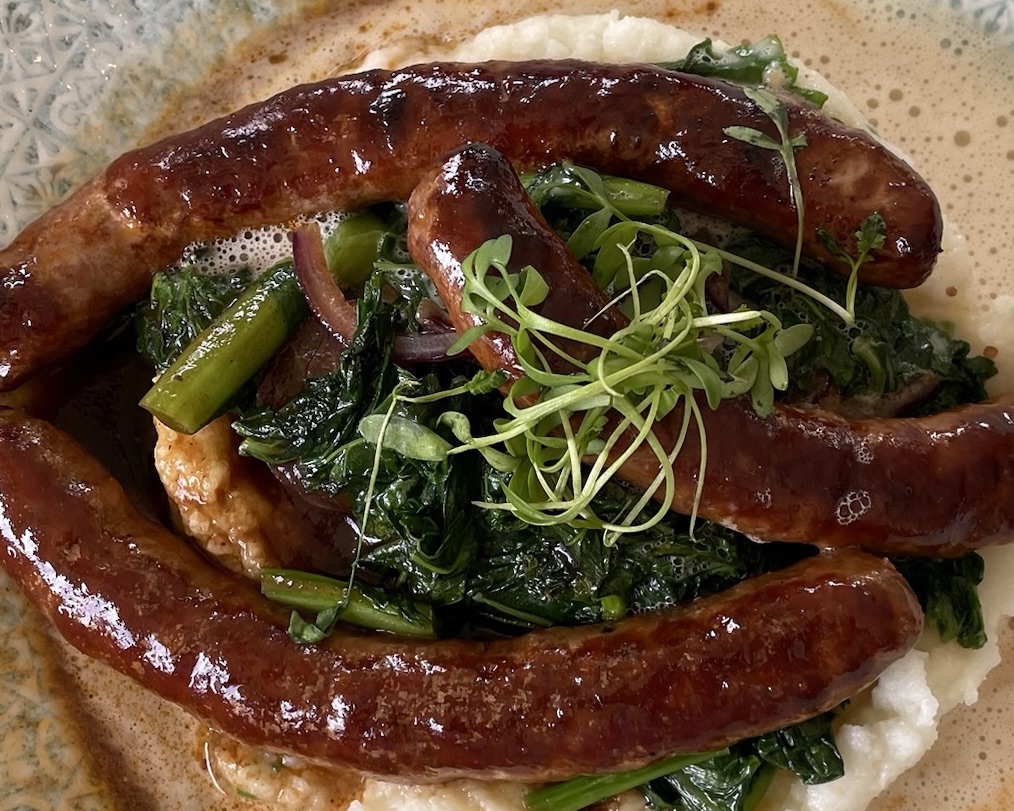
Creamy polenta, salty sausage, bitter kale with some sprouts to make it healthier.
They even had a museum ticket holder special dish, discounted several euros, which we had to have. Well nourished, we headed for more art.
We love beer halls and beer gardens!
Dear Janina and husband Gustav met us for dinner at our first beer garden experience and explained the ropes…self service for beer outside, table service for the meal. They took us to a favorite of theirs, an oasis in the university neighborhood, the name of which I failed to write down.
I also learned the women’s restrooms are labeled Damen. Not sure if I would have figured that out!
It was white asparagus season so that was what I had. David had his first of several pork knuckle meals and called it fine.
I dare myself to eat all of this.I obviously misunderstood just how much salad I was ordering.Well, I didn’t finish the entire potato dumpling…
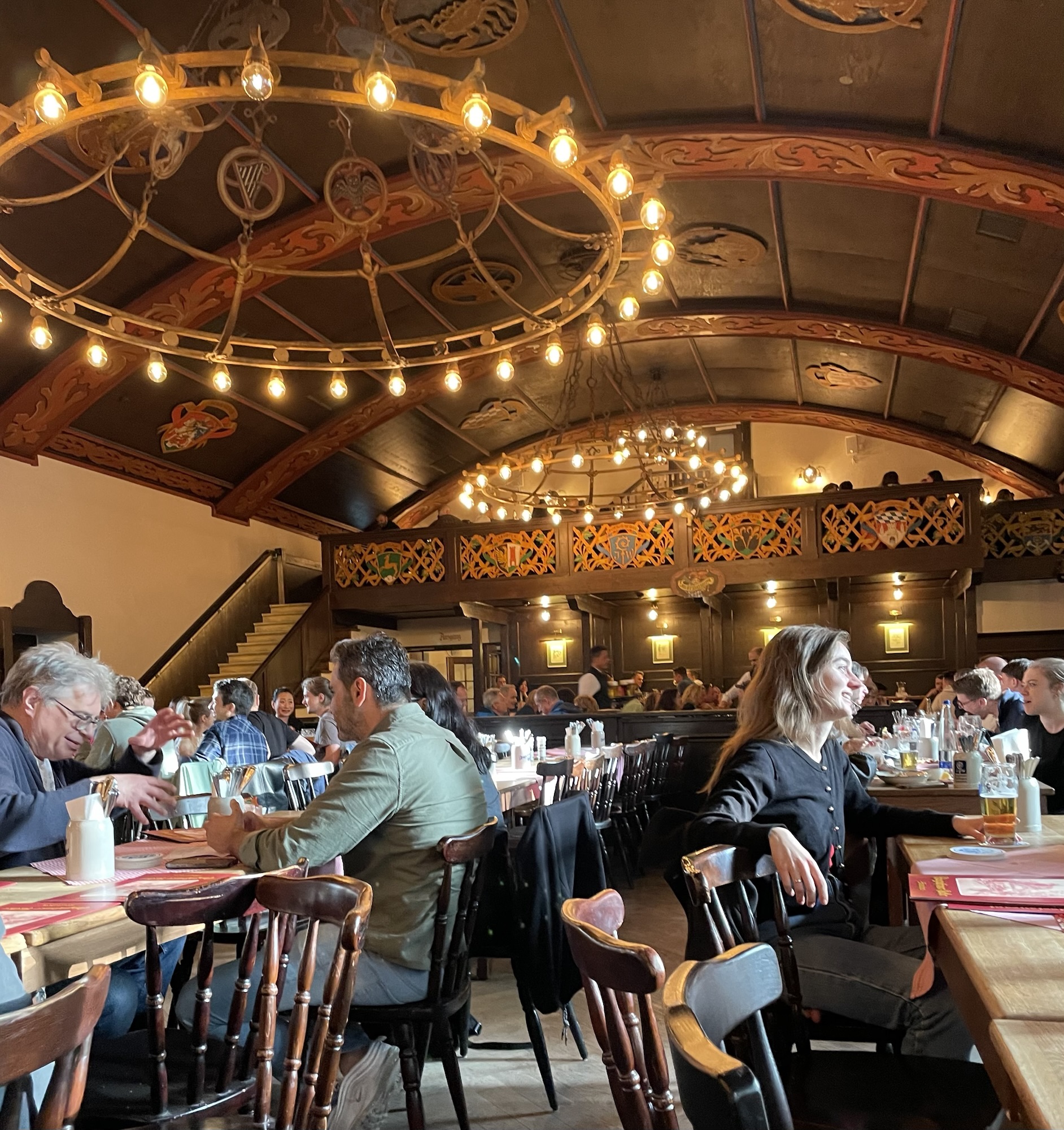
Well-educated on how these mysterious outfits work, we took ourselves to Augustiner Keller, an enormous beer garden where food and drink are self-serve, and a gigantic hall with table service. We chose the hall.
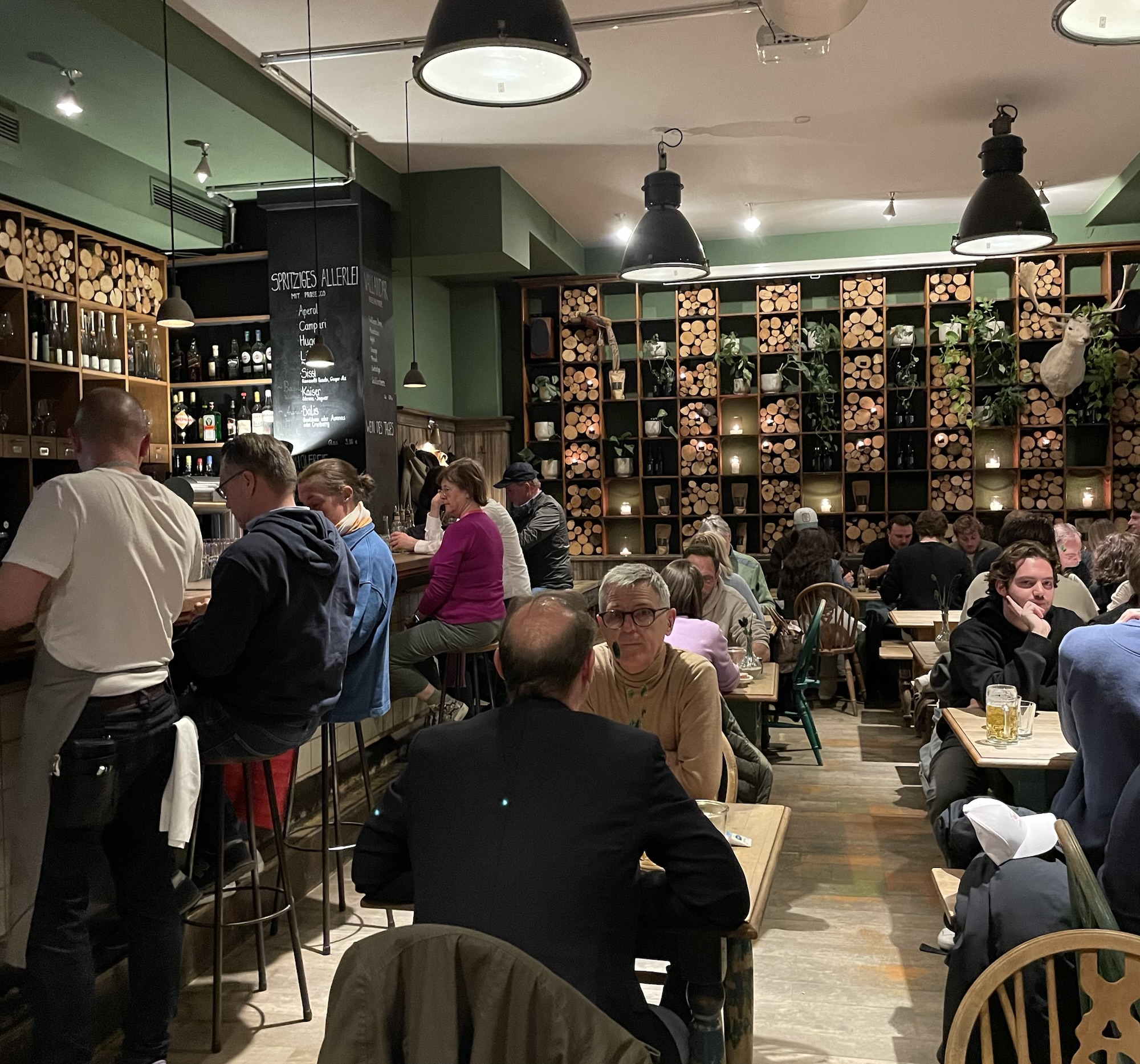
What a scene. The noise level of a full hall of drinkers and eaters is difficult to convey. Talking, laughing, people coming and going with scraping of chairs and rearranging of people at long, very long tables. I had planned to have duck while in Munich but hesitated when I saw the dinner was a half duck, with a potato dumpling (they tend to tennis ball size) and cooked purple cabbage. I was sure this was too much food for me. But I ordered it anyway along with a salad to share.
The salad was a mountain, and yes, a half duck is a lot. Ate it all!
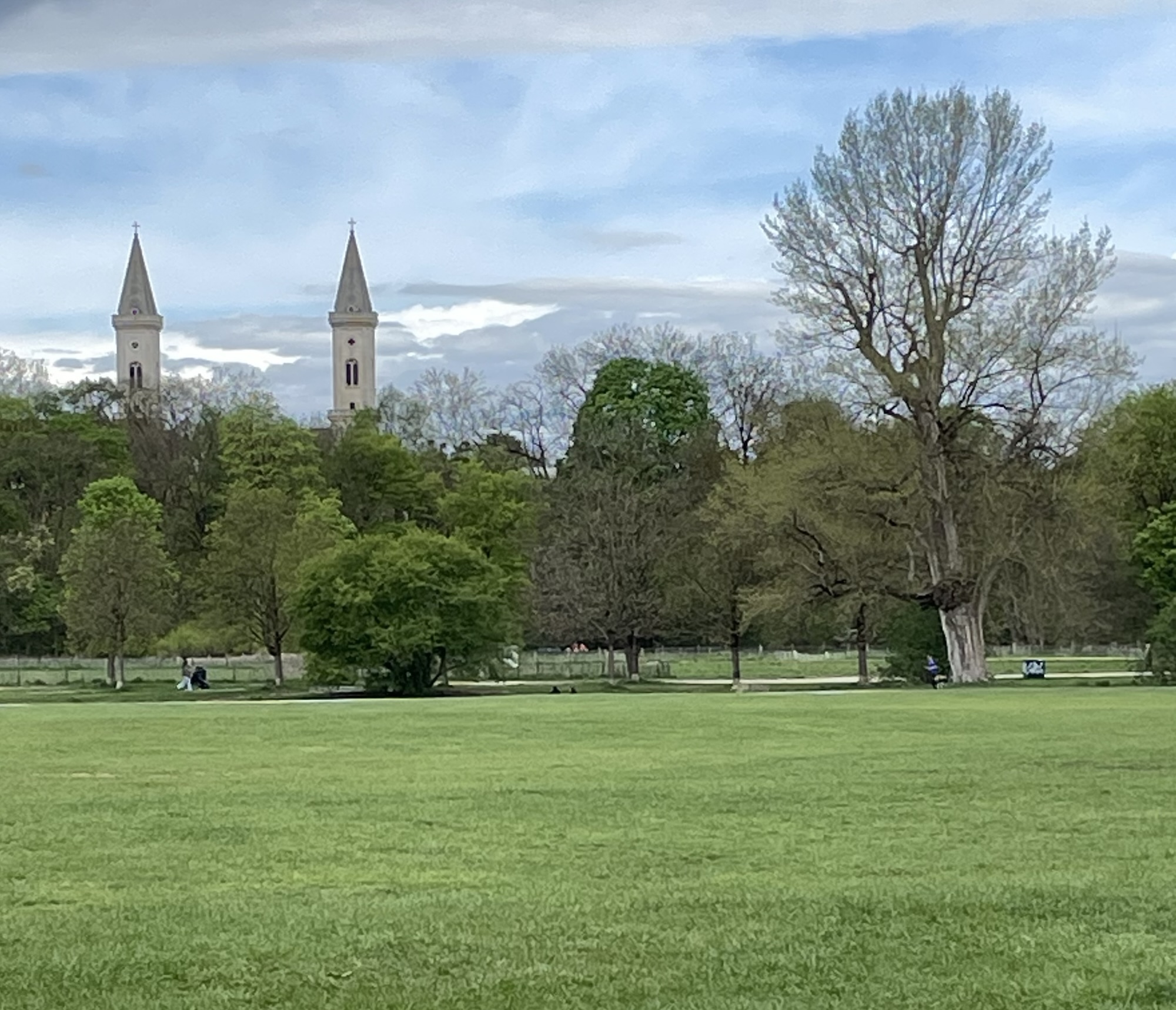
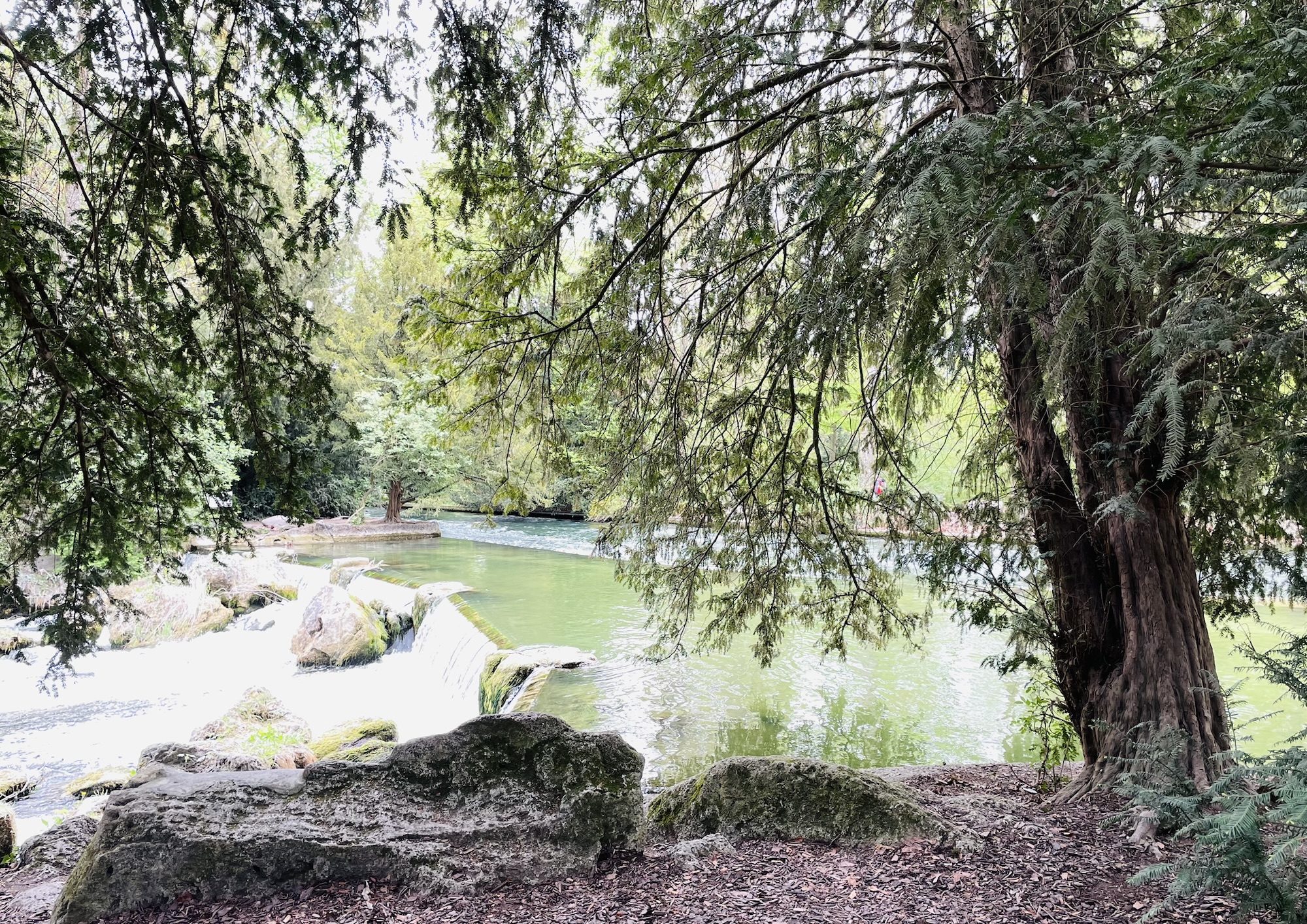
Our last full day was a holiday, Easter Monday, and we planned to walk as much of the English Garden as we could manage, which turned out to be seven miles. No human can be expected to walk that much without sustenance and we wisely stopped at the beer garden at the Chinese Tower, which is definitely not at all Chinese and the day we were there housed a 3 man band playing traditional German music. Again, hard to describe how big these gardens are…and such fun as you take a tray and go from hut to hut loading up your meal. Sauerkraut, spaetzel, donuts cooked in lard, fried potatoes, french fries, chicken…and of course plenty of beer. I wish I was sitting there right now.
That is the “Chinese” Tower in the background.A pair of Mandarin ducks!!The English Garden is huge. We never reached the northern border and still walked 7 miles.
Kaisergarten (much better eating than Kaiser Permanente)
When we returned to Oakland David dug into mail, messages, our budget, etc., and he was puzzled to see we had a charge from Kaiser Permanente (we’re not members) from a day we had been in Munich. Ah, mystery solved–Quicken had interpreted our charge at Kaisergarten as that other Kaiser.
The right one was a two metro stops from our hotel, and a few blocks’ walk through a beautiful neighborhood. I had made a reservation from caution–we’d been asked several times if we had reservations when we were just walking in and I was worried this place wouldn’t have room. Glad we did–it turned out to be quite small especially since it was too cold, even for Germans, to sit in the outside garden.
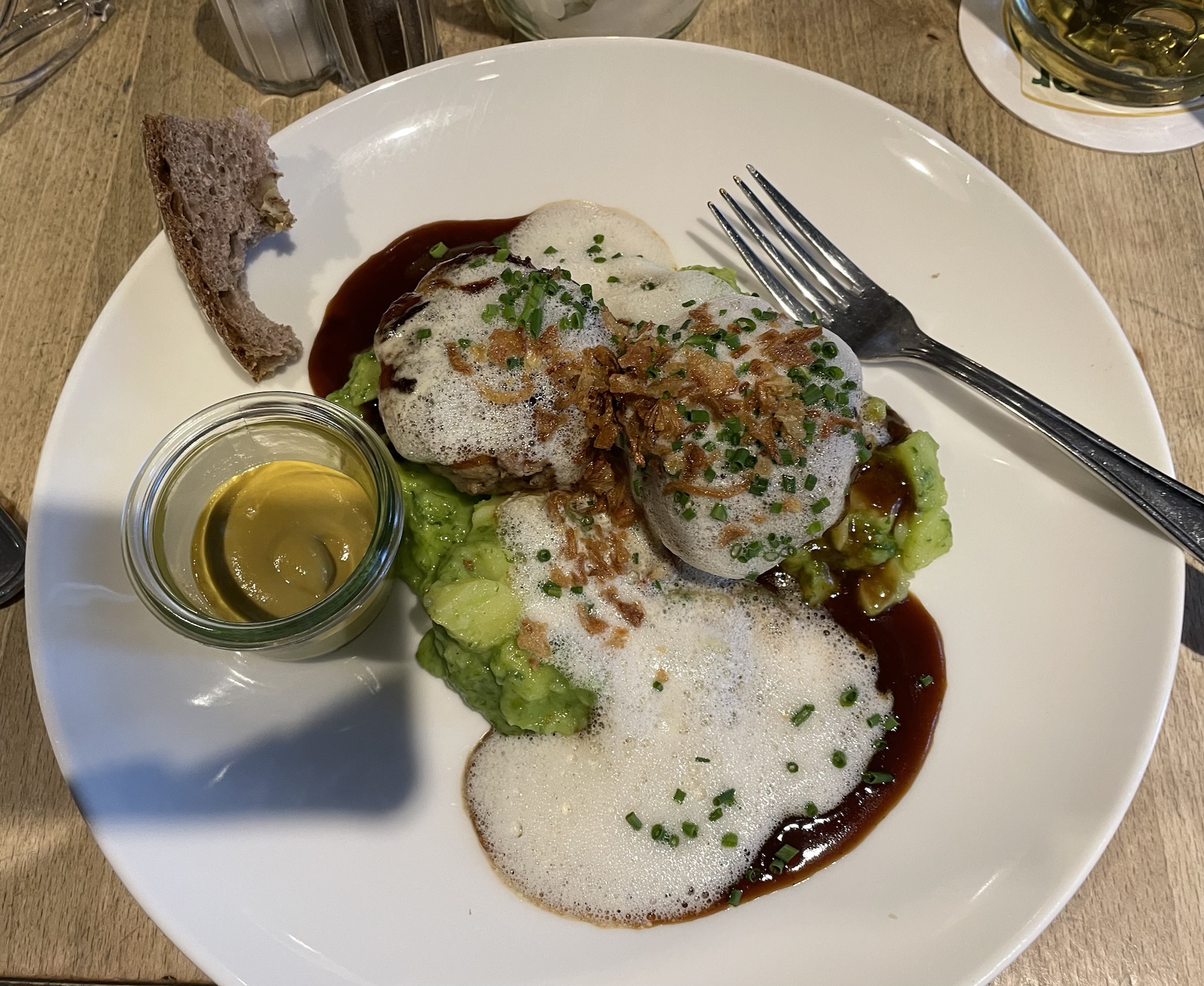
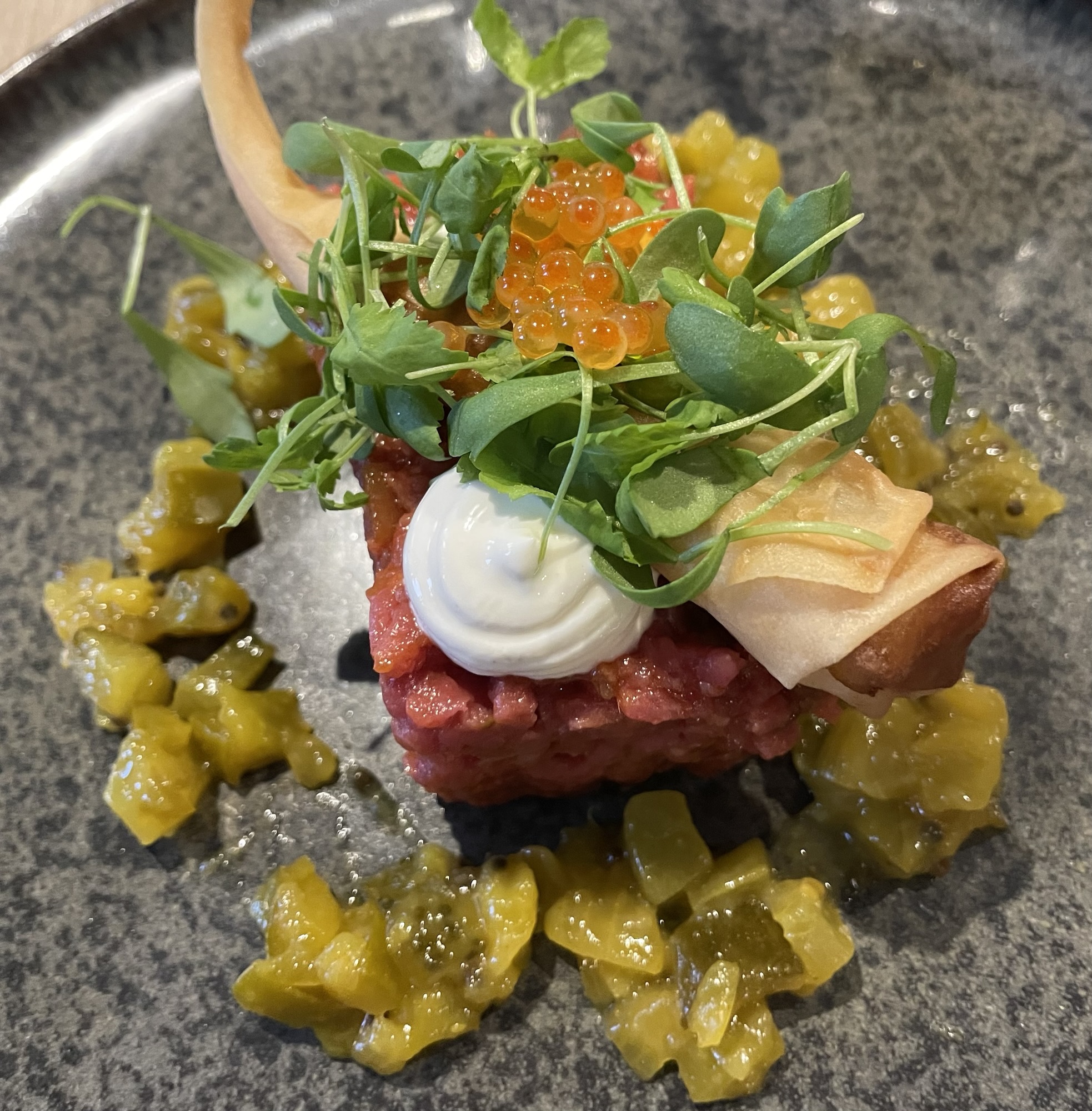
I was delighted to see beef tartare on the menu–I had had it twice in France and wanted to see how the German version differed. David ordered a dish called “meatballs” and was happy to find it was much more than that. Yummy. And we had kaiserschmarrn for dessert–an eggy pancake, torn into pieces, doused in (more) butter and some powdered sugar. We’d had some for breakfast that morning at Rischart Bakery (they’re all over the city but we went to the one on Marienplatz–highly recommended) and couldn’t hold back from trying another version.
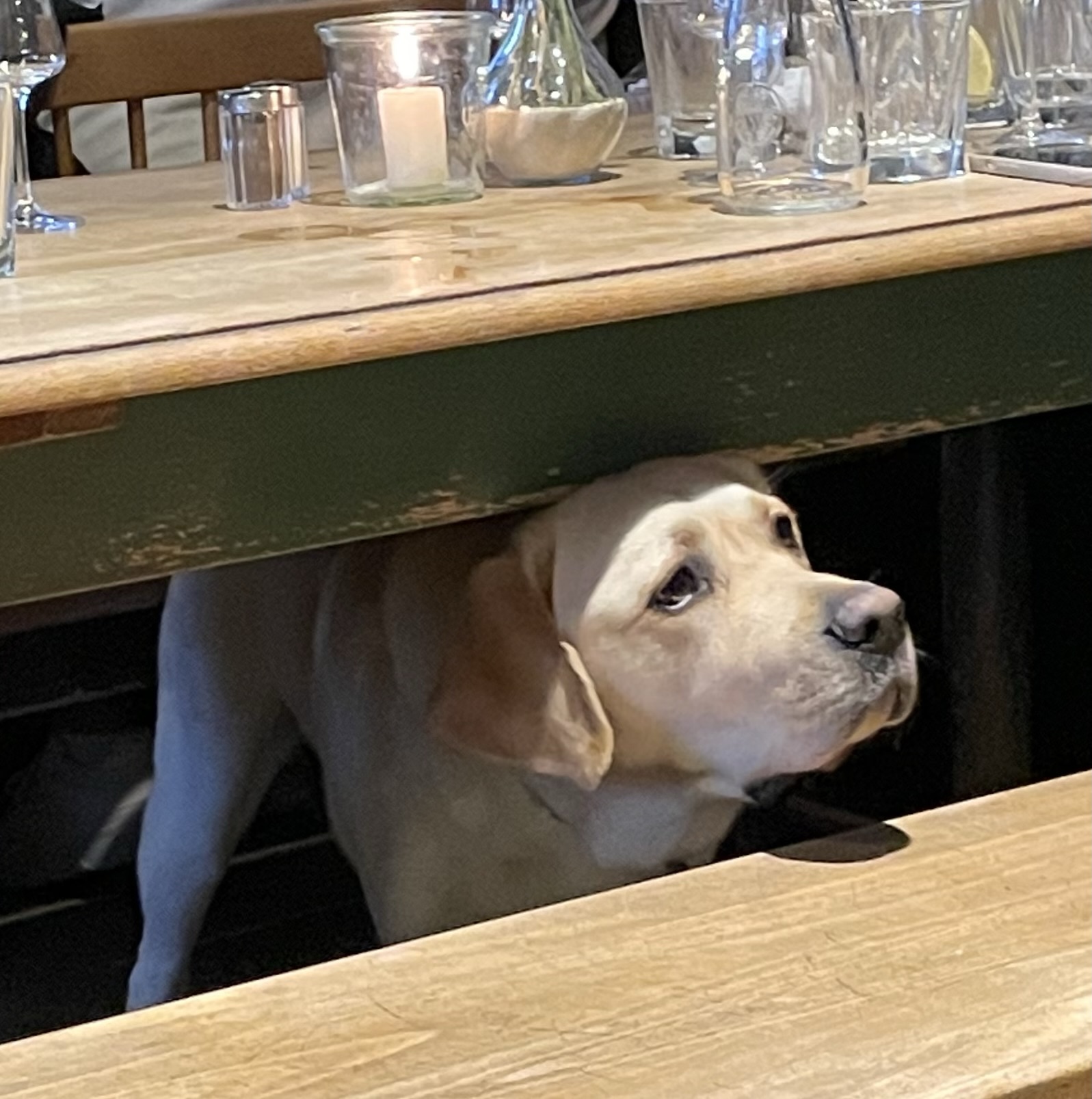
Lovely, friendly restaurant right down to the retriever under the table next to us.
Unlike the French version, this was pure beef with condiments on top, surrounded by spicey sweet picklesKaiserschmarrn–must make this at home.
Our last Munich supper
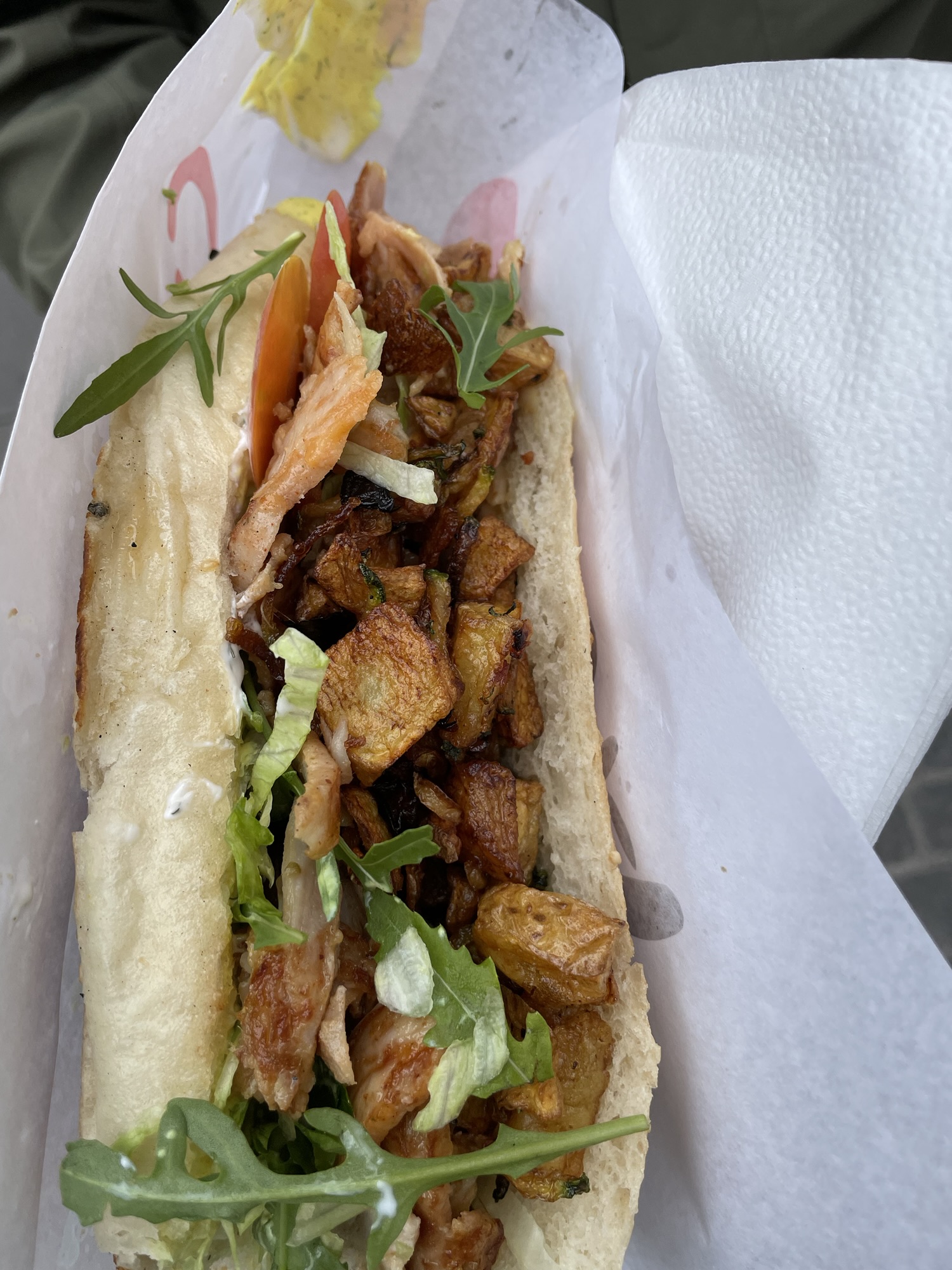
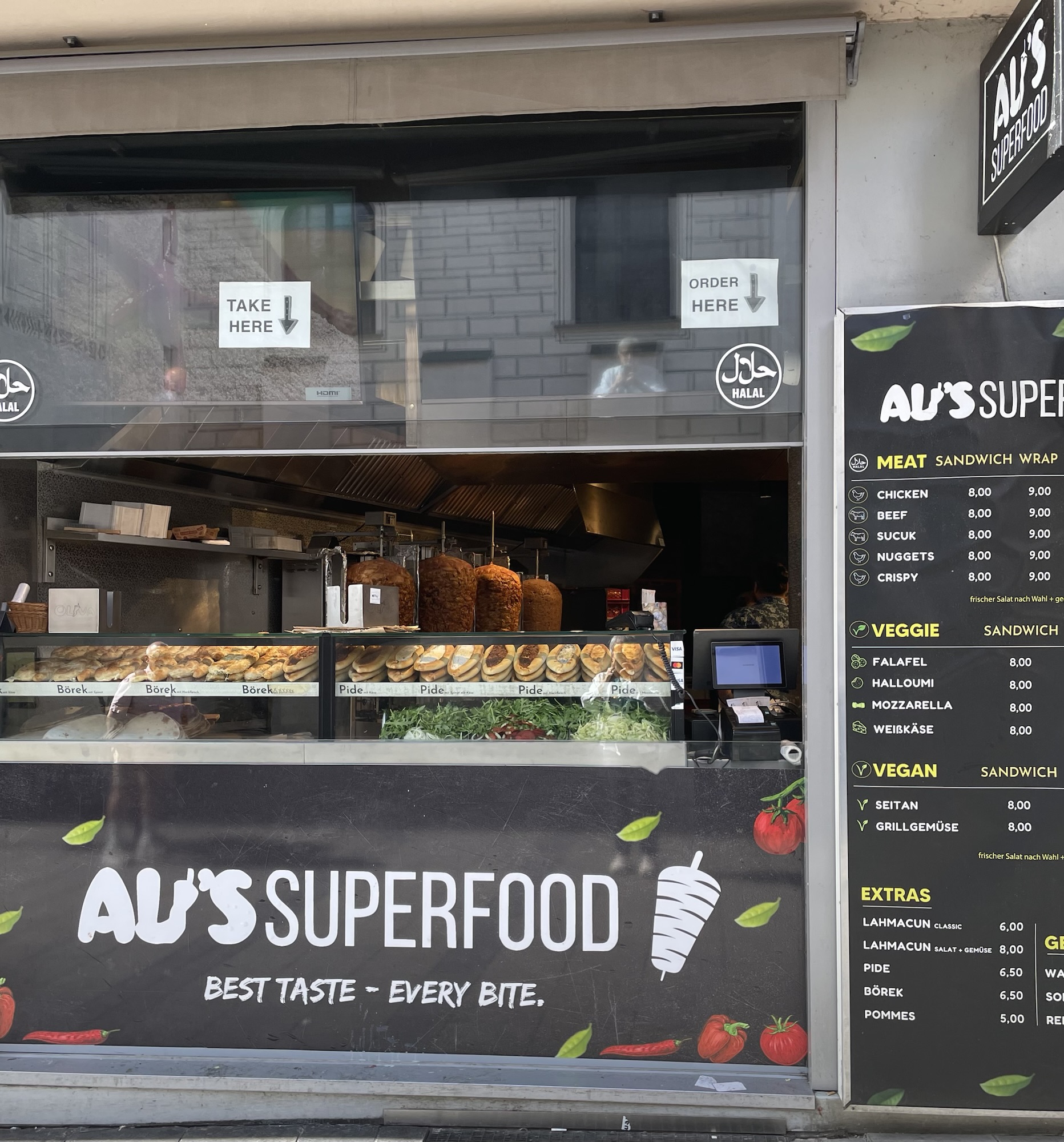
Having traipsed, happily, all over the city seeking out delicious food we realized one major Munich dish had been neglected—the famed donner kebab sandwich. Well, to be honest I had a donner kebab sandwich from Al’s Superfood in Marienplatz, but David had not. And mine was sooo good I knew I wanted another.
Chicken, vegetables, four different sauces, crispy bun, roasted potatoes…
Lucky for us a great looking donner kebab place was a ten minute walk away.
We were definitely on the early side and as the only customers we were able to chat with the young Turkish woman working the counter. She was excited to guide us through the ordering process. Two sandwiches and an order of fries “Turkish street style.” I was delighted to see they had salty yogurt drinks, and David of course had a beer. Just yummy!
By the time we finished the place was hopping, super chill with obvious regulars—large young men talking sports. If this place was in our neighborhood we would be regulars, too. No, we didn’t figure out why “the most expensive kebabs in Germany” was the primary selling point–and they weren’t.
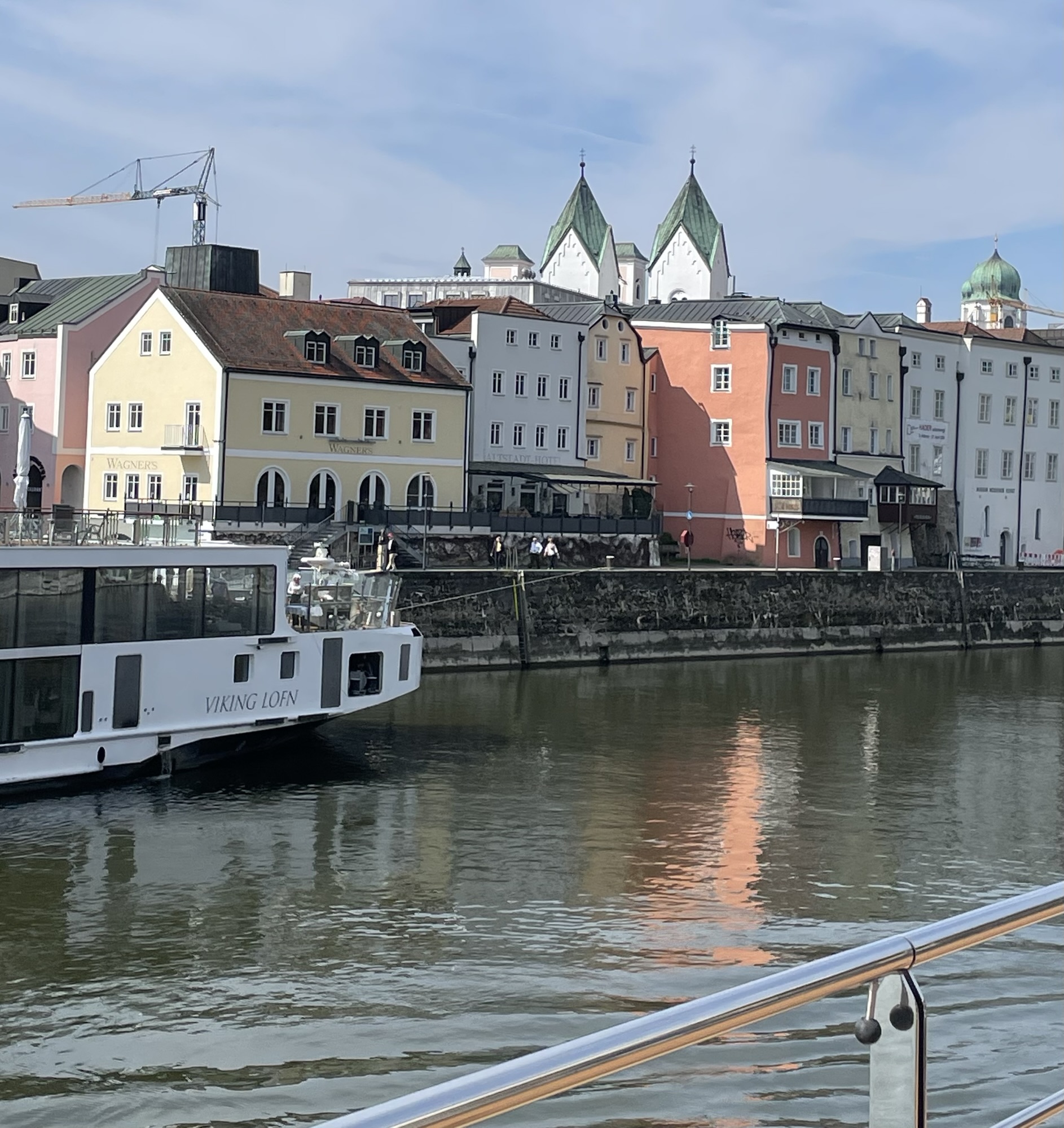
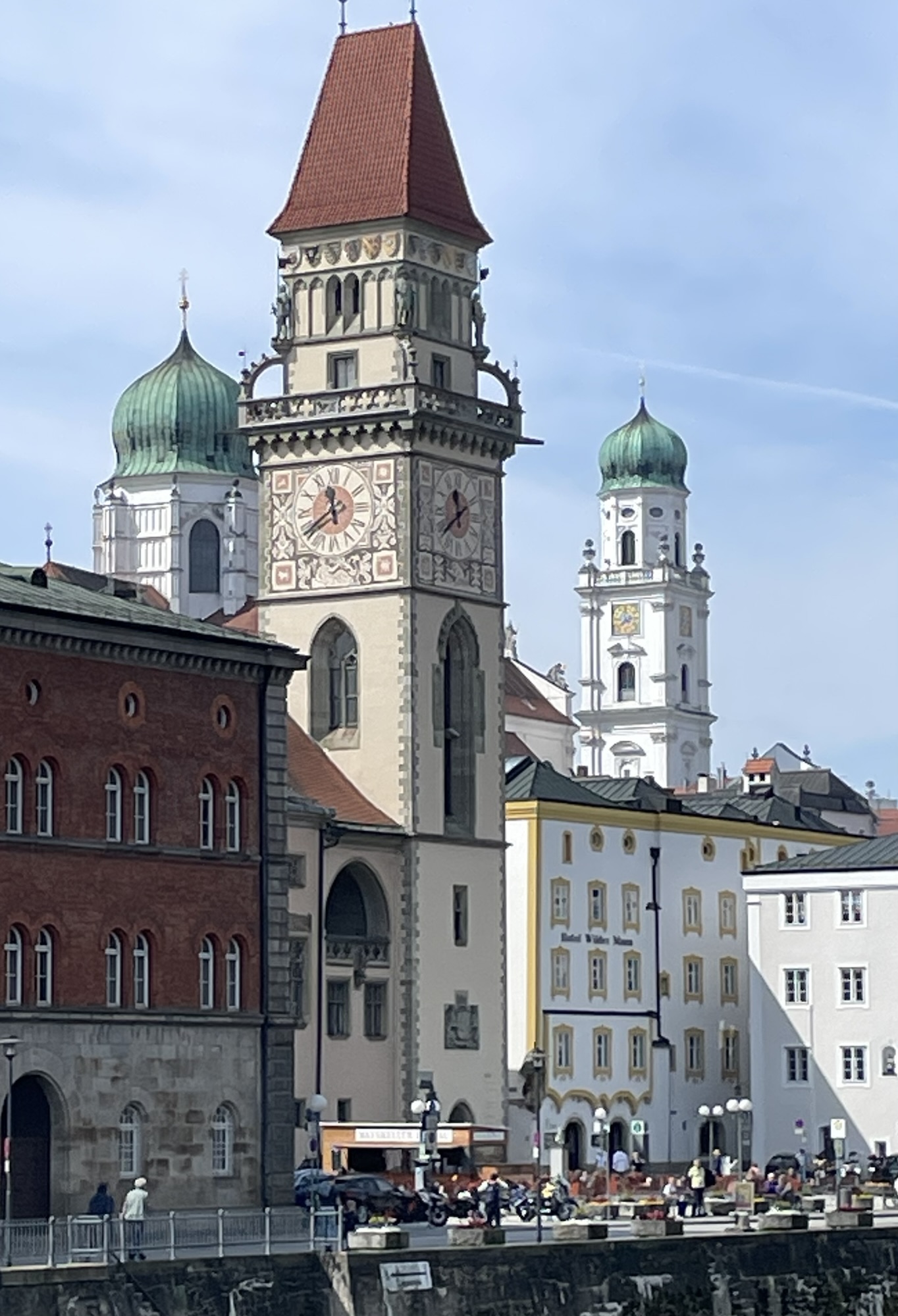
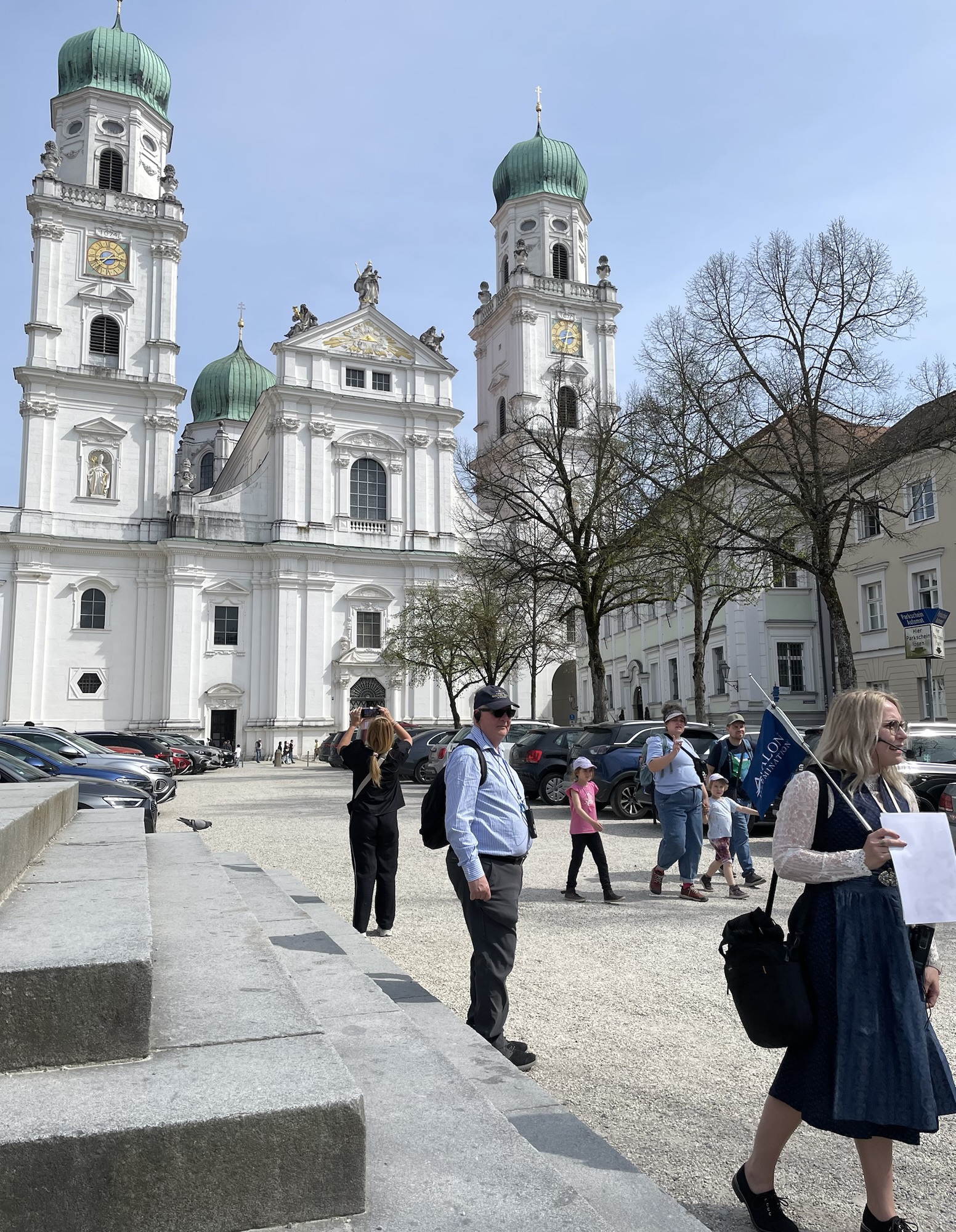
Our time on the boat was suddenly winding down and we were looking forward to being on our own again. This last stop in Passau was just half a day, and given the size of the old town along the river that seemed enough.
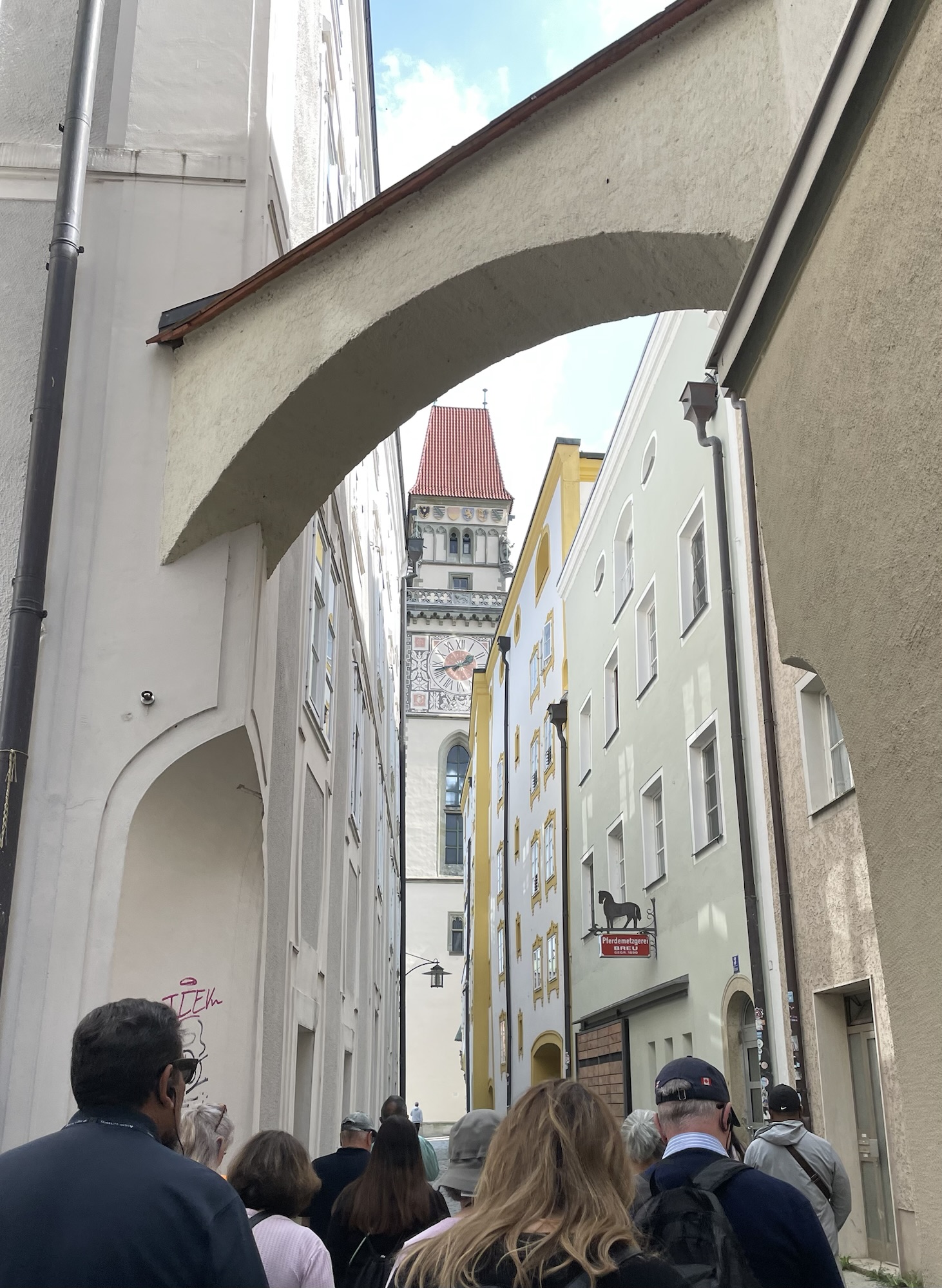
We had an hour and a half, maybe, of a delightful tour. I am struck by how very local our guides have been…I grew up here, went to university here, now have a job where I talk about a place I know so well and love. Our guide, a young woman dressed in dirndl (and sneakers), explained the meaning of the placement of the bow on the overskirt. Married (or unavailable), widowed (or a waitress!), open to a relationship, and one other I cannot recall. Handy, I suppose.
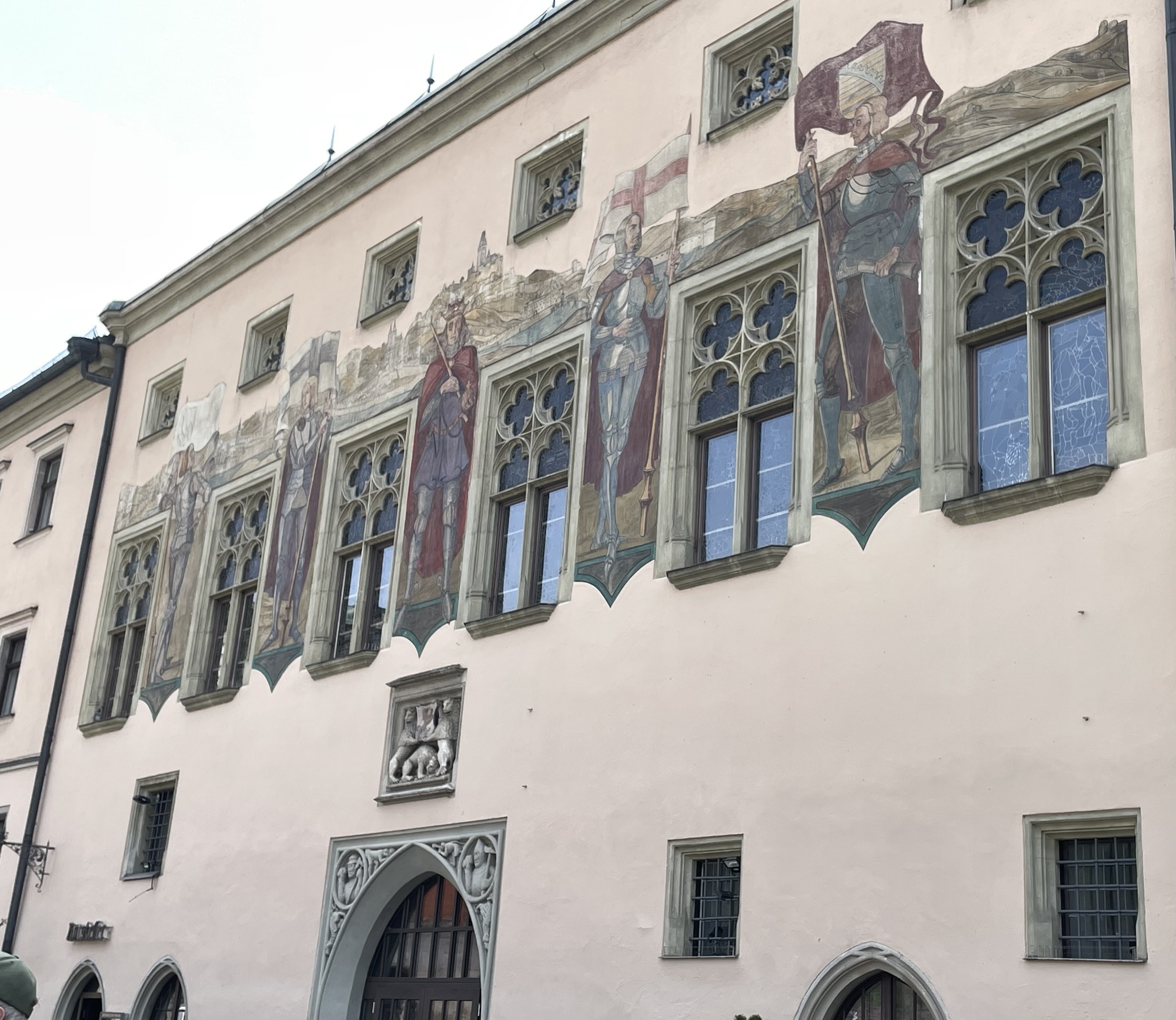
The tiny peninsula of the old town is as picturesque as most every other small town we have visited. Because of the surrounding three rivers, though, serious floods have been a problem for centuries. Currently the part of the city that is especially vulnerable is where artists and other artistic folks live, and of course they are loathe to move. As in Cesky Krumlov the high water marks are unimaginable. In 2013 the water rose 42 feet.
After our tour David wanted to walk down to the tip of the peninsula while I hung out on the boat. It was getting hot. Several hours later the boat moved on to Vilshofen where we disembarked the next morning and hopped on the train to Munich.
We arrived in this small (450,000) capital city on a cloudy morning with the same considerable windchill which ebbed and flowed throughout the day.
The walking tour was one of the best ever because our guide had all the requisite traits: she knew the city and its history, she was by turns serious and respectful and funny, and she gave me a recommendation for a restaurant that served a superb version of a Slovakian specialty, halusky. More on that later.
Because our guide, Jana, had lived half her life under Soviet rule she could share many insights and family stories about those dark times and about how life had changed since the velvet revolution. Jana plus the exceedingly picturesque old city (barely a city!) made for a great morning.
Jana introduced us to Bratislava by stating the two unequivocal advantages to living in her town. One, no traffic. It was rush hour and we were at a major intersection with barely a lane full of cars. Two, it is located at the intersection of three countries—Hungary, Austria, and Slovakia.
Soviet times
Standing just a few yards from the boat Jana pointed across the Danube at a woods with a large hill behind on which we could see a transmitter tower. The tower was in Austria, and the woods at the edge of the river were not at all dense. Jana explained that the soviet government had mowed down the trees and shrubbery and placed several rows of barbed wire and high voltage lines to prevent escapes. (According to wikipedia 400 Bratislavan citizens were killed trying to escape during the years Soviet Russia ruled Slovakia.). But the Austrian tower transmitted television, though often jammed, and Jana asked us what we thought her grandmother’s favorite tv series was. Dallas! Her grandmother was really pissed when jamming made her miss an episode.
Upper left, the Neolog memorial; lower right, the drop of blood in that little hole in the gold decoration
The Neolog Synagogue that survived both world wars was torn down by the Soviets in 1969 to make way for a road, which now runs so close to the beautiful St. Martin’s Cathedral that it is now suffering damage from traffic vibration. There are reminders of the lost synagogue around the central historic district including a memorial on the site and information placards posted nearby.
St. Martin’s Cathedral alongside the Neolog Synagogue before the Soviets destroyed the synagogue.
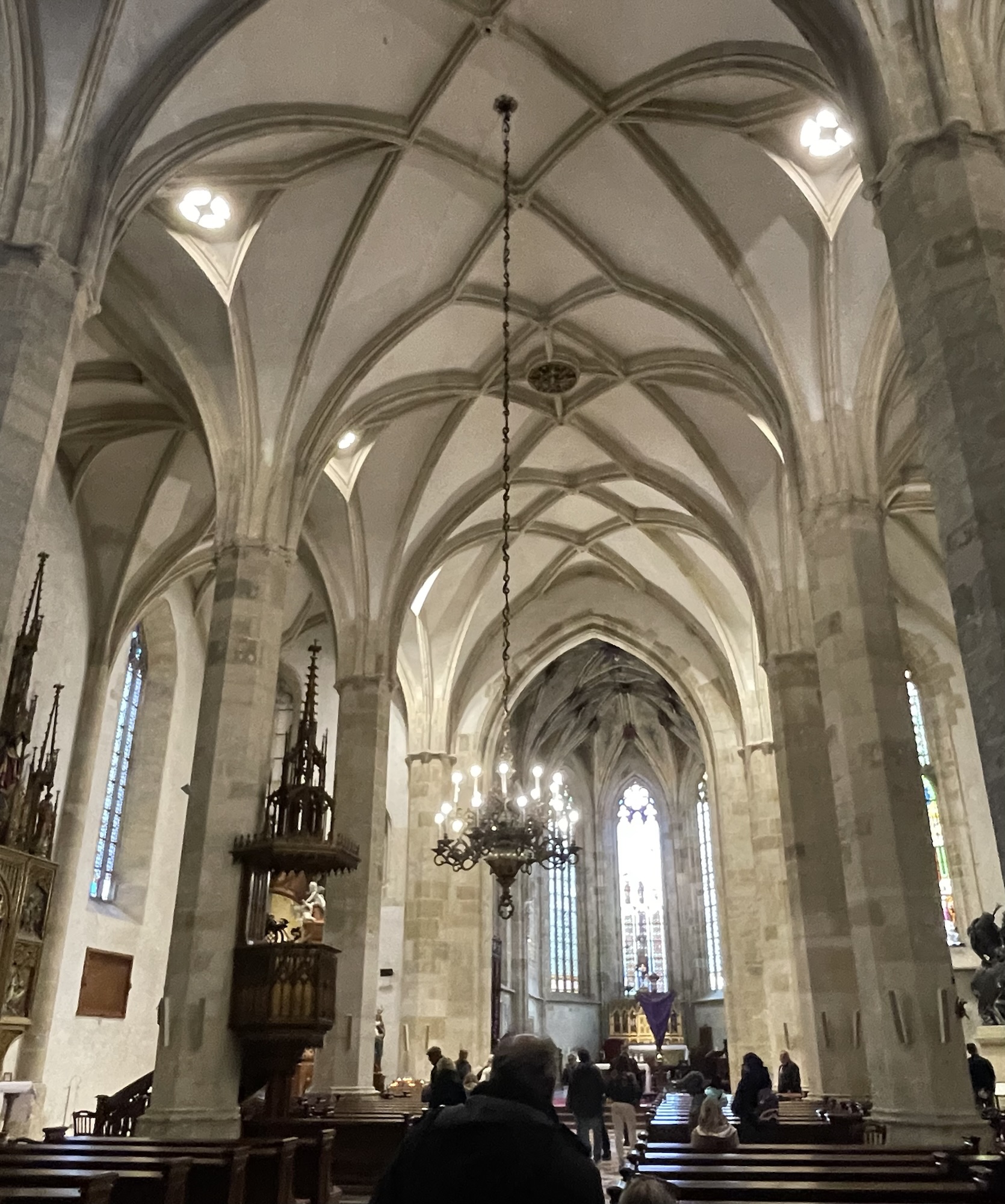
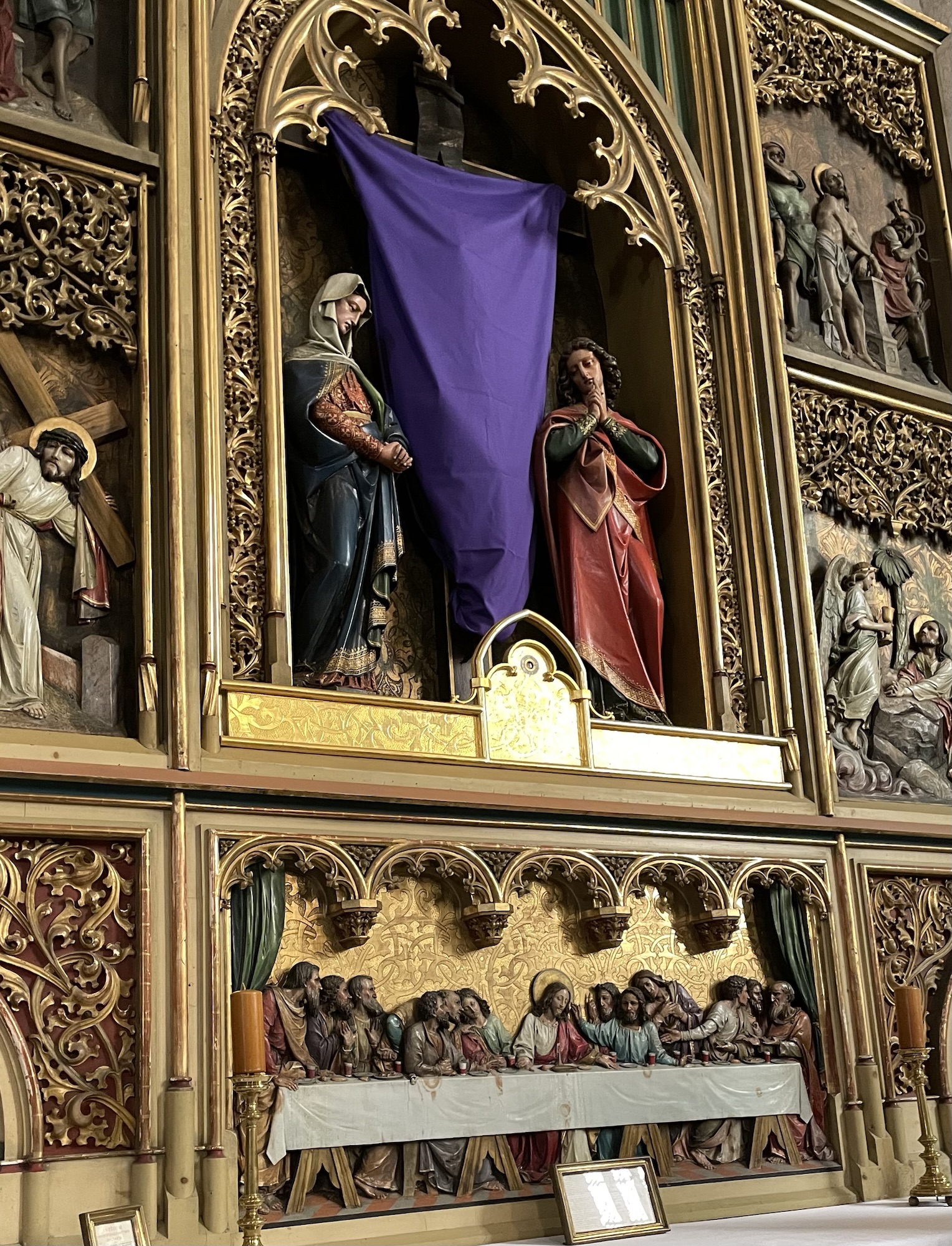
St. Martin’s Cathedral has a soaring interior with very little interior decoration where frescoes were destroyed in the several fires that were started by lightening strikes. These interior fires started at the back of the sanctuary and were extinguished before reaching the altar, which remains filled with frescoes and elaborate carved seats, each with a symbolic animal (creature?) representing a sin or virtue.
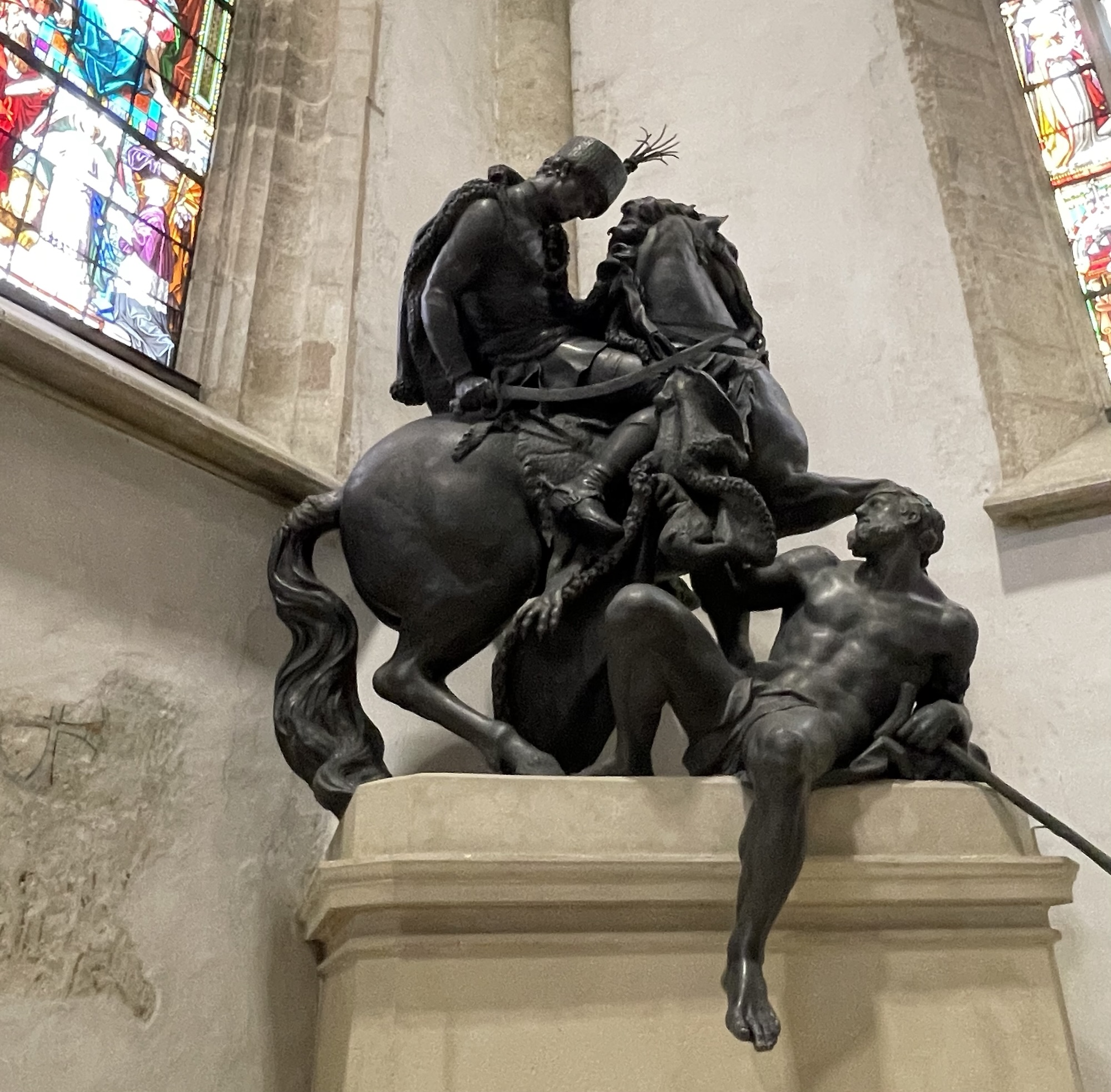
On one side wall there’s a curious Habsburg relic, a recent gift of descendants of the Habsburg emperor who abdicated in 1918. The gift is gold, like a decorative frieze, and sits inside a large, carved wooden something-or-other. The curious part is in the center, a small round hole that holds a drop of the last emperor’s blood.
Walking through the renaissance
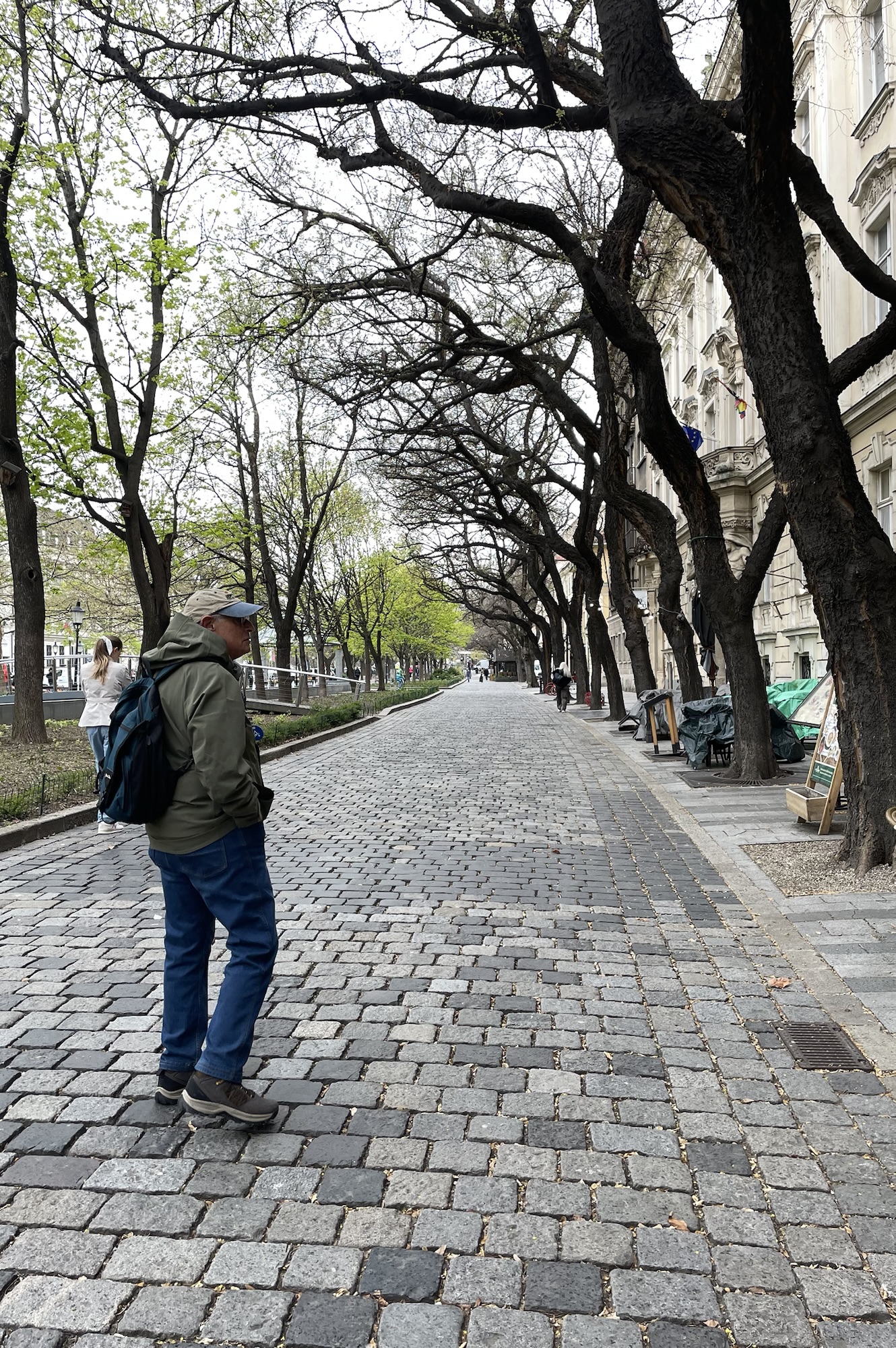
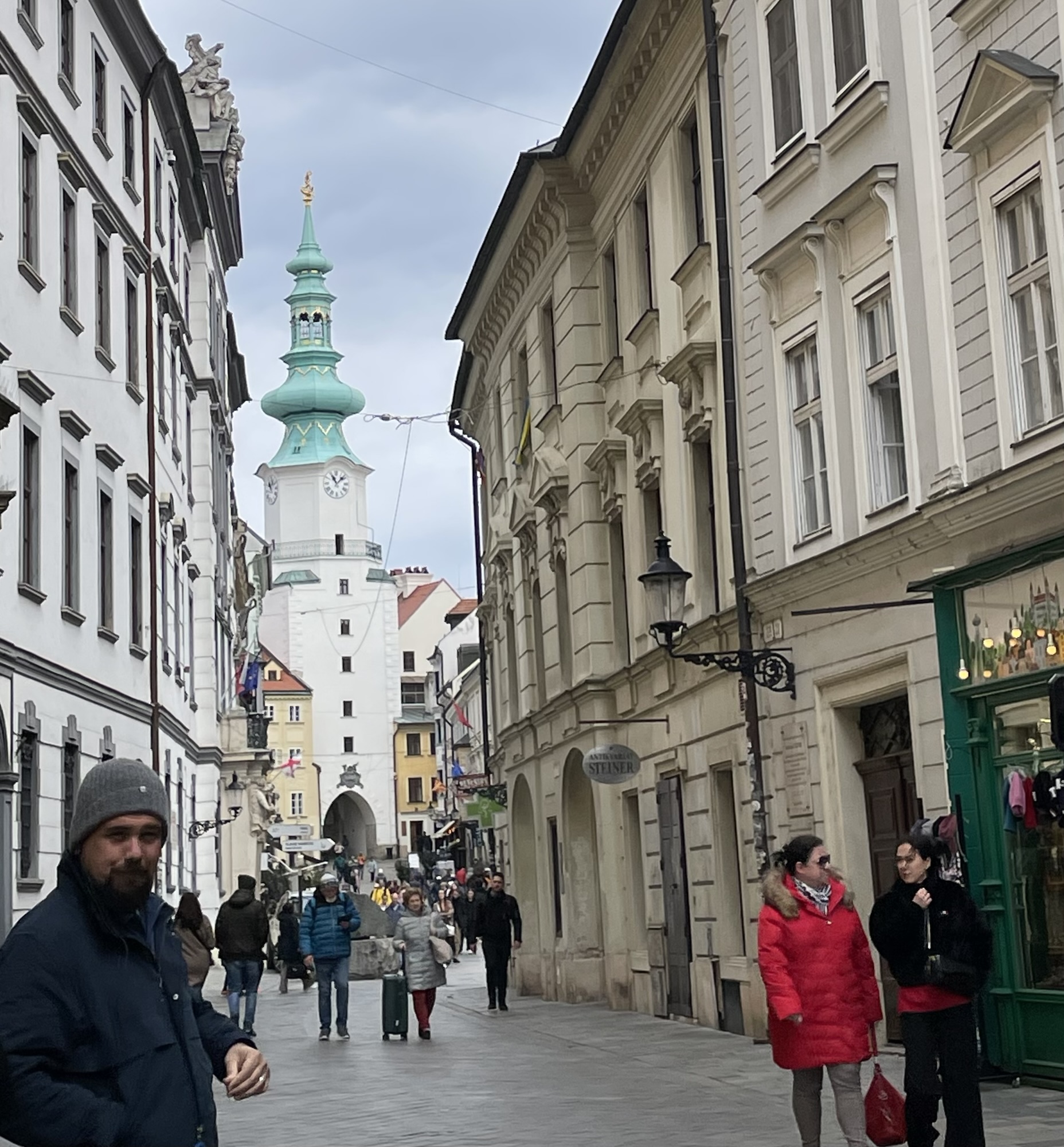
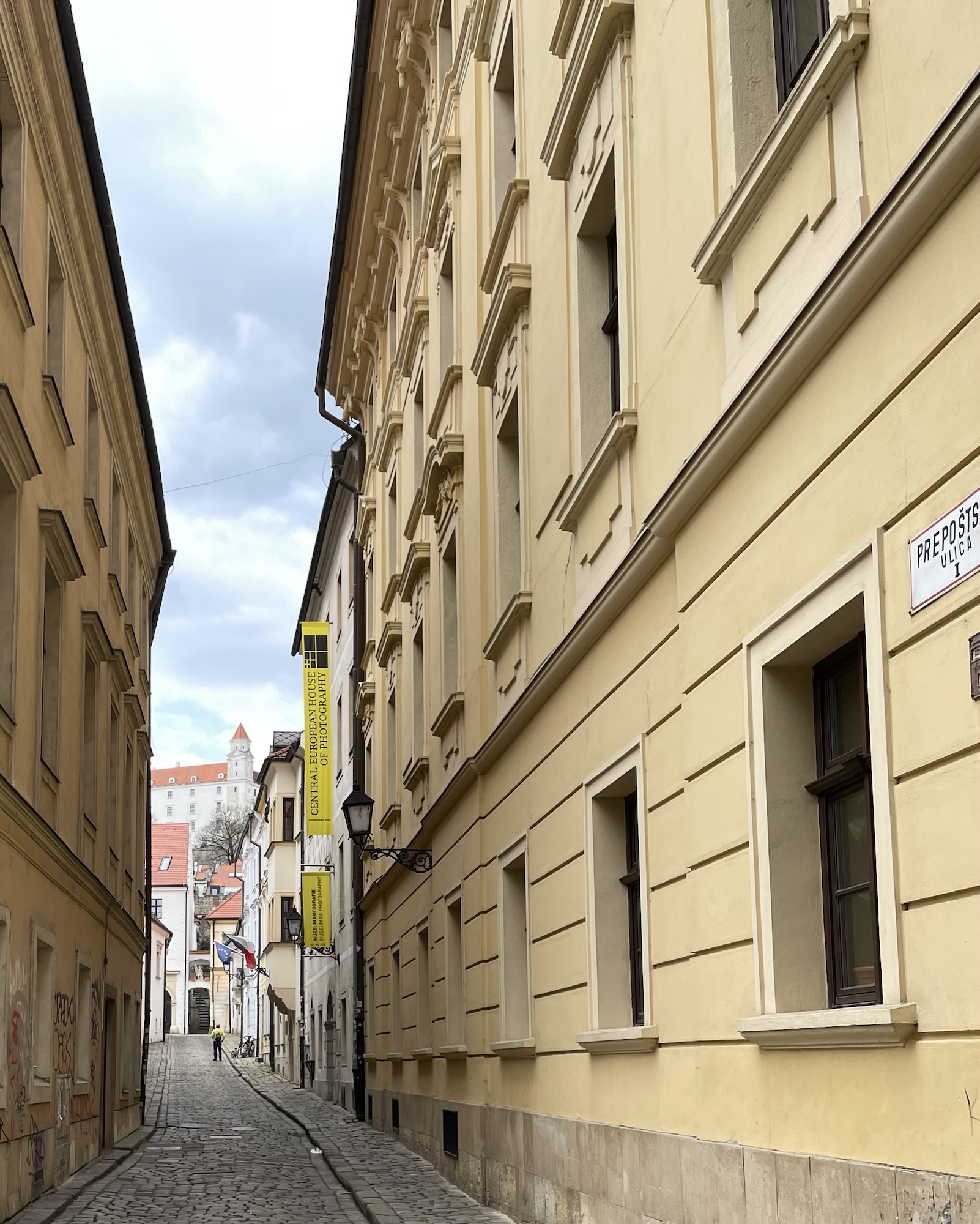
The streets of old Bratislava are narrow and treacherous with cobblestones that are themselves awfully uneven. The old town is so small you are through it in minutes. Our guide explained one street has been used over and over as a movie set because all of the buildings are owned by the Catholic church and hence there are no commercial signs. She told us a funny story. She was leading a tour and as they came around the corner onto this particular street a gate opened and out walked two tall men in full Nazi uniforms. Jana and her group stopped and gaped. “It was surreal,” Jana said. I’ll bet!
Many buildings date from renaissance and guide pointed out the distinguishing feature: enclosed balconies facing the street with windows on front and the very narrow sides. The side windows were a security feature…one could see from inside if a bad guy was sneaking along the wall toward the door. Only bad guys would approach by scooting along the wall instead of approaching directly from the front.
On the left, a renaissance building with side windows in covered balcony
Live and learn.
Bratislavan treat
Our wonderful guide Jana had stopped outside a restaurant that had photos of their traditional dishes to point out that we shouldn’t leave without eating the most delicious of local foods, halusky. Dumplings (along the lines of spaetzel) in sheep’s cheese with bacon on top. At the end of the tour I asked her to recommend a restaurant where we could find a good version and she have us a name and pointed it out.
One of my problems on the cruise is lunch is at 12:00 and dinner not until 7:00. Consequently I am hungry in the afternoon and the snacks on board are cookies, fruit, one day donuts…all sweet. So this day i counted on walking back into town to try halusky. We braved the windy cold and spatter of rain. Wow. So delicious. We also ordered potato pancakes which were unlike anything I have eaten. Thin like crepes, buttery, with a very faint sweetness. It looked like a lot of food but we ate every last bit.
Halusky and potato pancakes, and the view from inside the restaurant.
We left this beautiful peaceful town thinking it would indeed be a nice place to live!




































 Inescapably Rational