En route out of town Yoojin and Gideon dropped us at the Express Bus Terminal in Busan from which we headed to Jeonju, a small (650,000) city in west central Korea. Jeonju has about a dozen special designations (World Heritage, Slow City, others) and enormous, justified pride in their food, natural beauty, history and culture.
We stayed in a guesthouse in their hanok village, which is, like Seoul’s, a collection of traditional houses and picturesque streets. Unlike Seoul, it is flat and almost entirely commercialized with few private homes scattered about though many guesthouses are tucked into little alleyways or down narrow paths off the main streets. While cars are allowed there were very few, though the traffic was astounding as explained below. Our accommodation was, fortunately for our backs and hips, only one night. Fortunately because sleeping was tough—futon on the floor. This means a 2” thick or so pad, a large feather pillow, and heavy, cozy down cover. The room, typical of a guesthouse, is only a little larger than the bedding, with a private bathroom like every other here, a tiled room with toilet, sink, and showerhead in the corner. As Gideon says, you take a shower and hose down the room in one process. Ample water, plenty hot, makes it all work just fine and it sure saves space. A small, clean, lovely common room had refrigerator, toaster, microwave, dishes, a little counter, and off this room were the 3 doors to private bedrooms including ours. If we had had a real bed this would be a heavenly option to a hotel. Ours was run by a young man whose full time job was managing the guesthouse, formerly his grandma’s home. Heavily laden persimmon trees overhung the fence, the path to the door was stepping stones in soft grass, very picturesque and sweet.
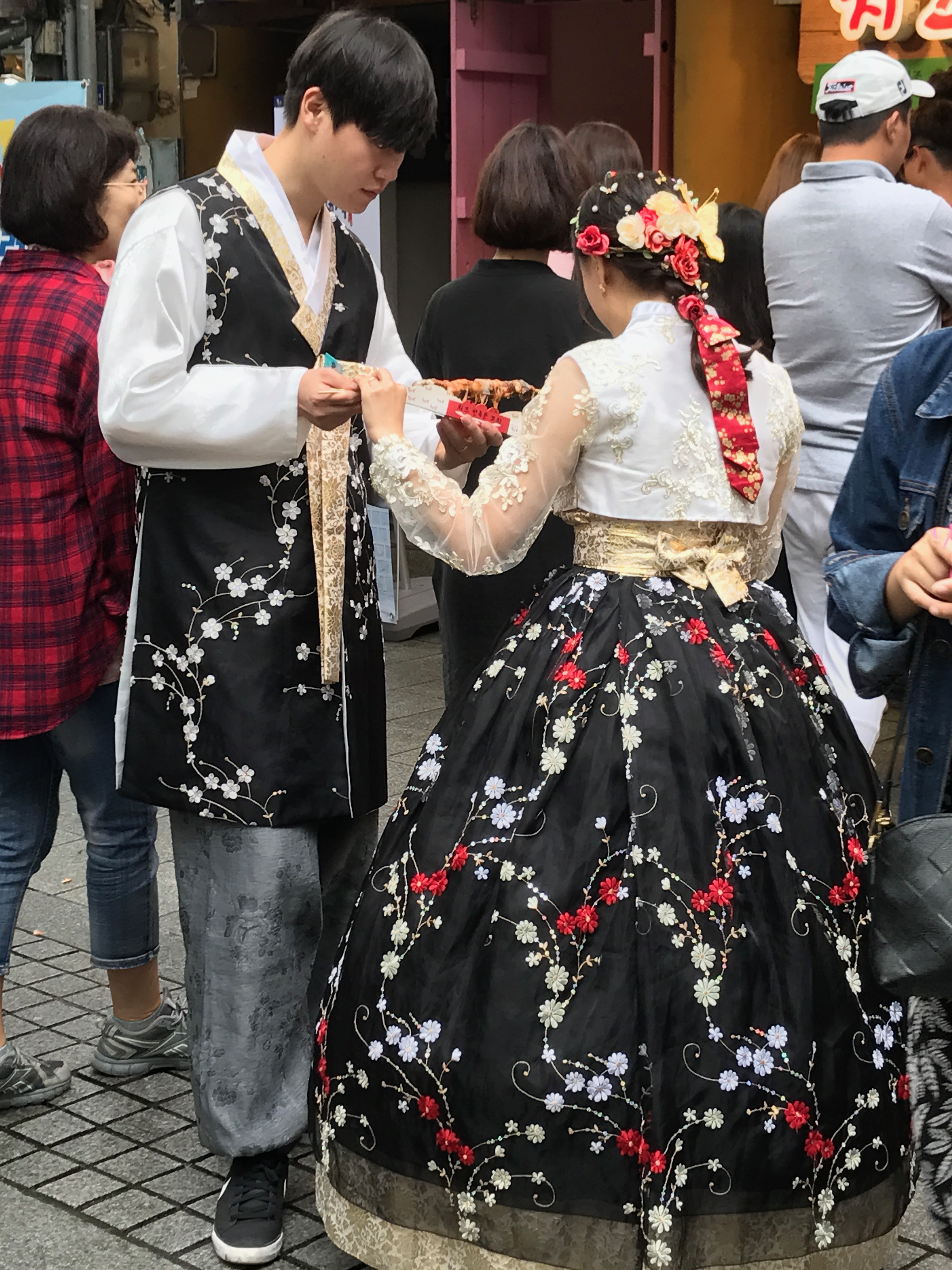
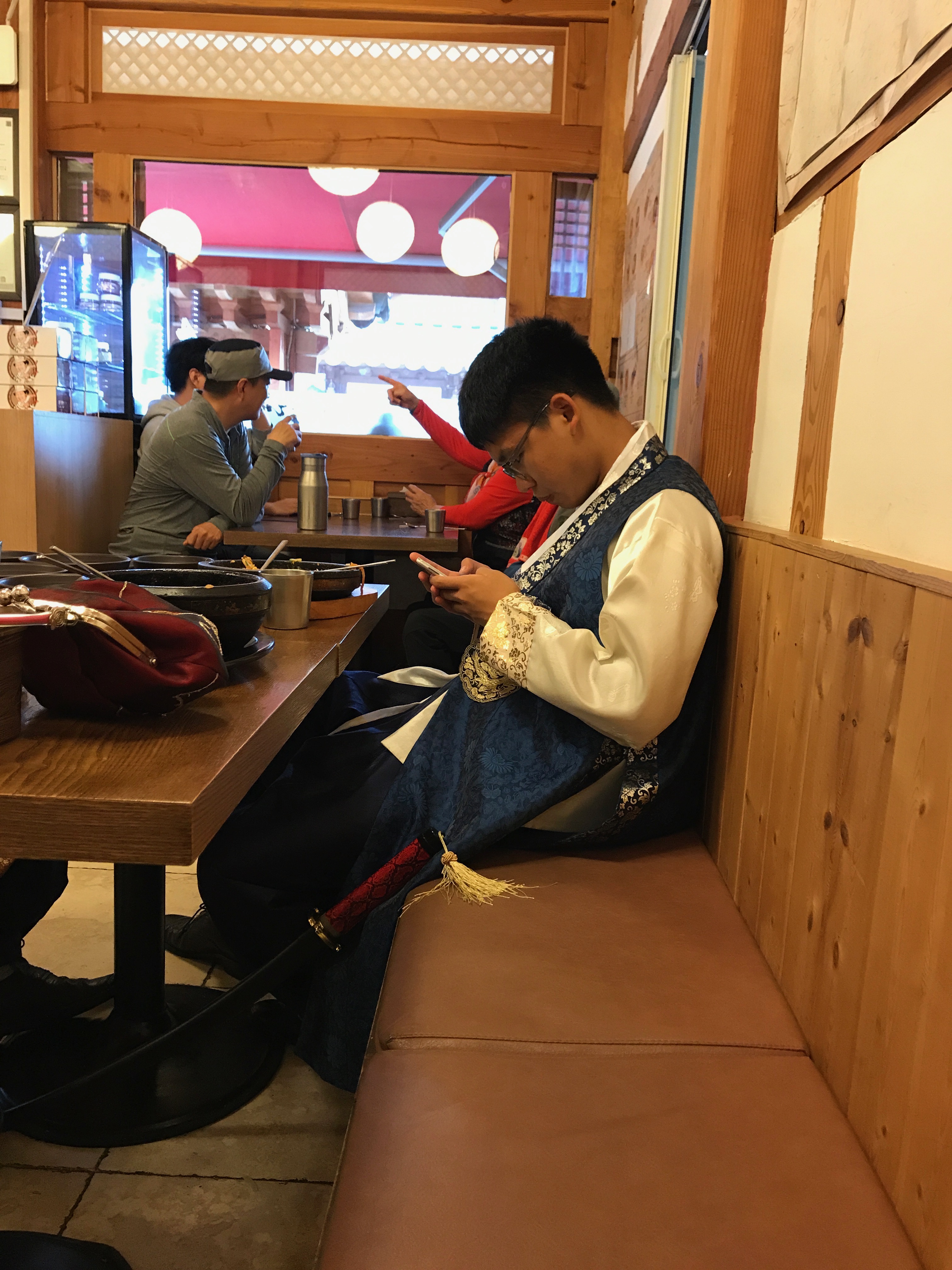
Hanok village was bursting with families, electric vehicles of various kinds (Segways, little cars with trailers, scooters and motorbikes), with perhaps 50% of the visitors in hanbok, or traditional Korean clothing that was rented from the many shops around the village. Little girls spun around in their sparkling skirts, entire families from grandpa to grandchildren walked together, couples in matching clothes, girlfriends walking and taking pictures, even several young men in hanbok drag, giggling under elaborate hats…everyone having a fantastic time. There were very few westerners, maybe .01% of the crowds. Sites we will remember always:
A young boy on a Segway talking on his phone with one hand and balancing a tray of food in the other
Dad with baby driving the car, with mom and toddler in the trailer
Very elderly couple being clothed in elaborate traditional clothing for a portrait
Girls arm-in-arm, strolling while watching themselves via a selfie stick a few feet long waving in front of them
Entire families in hanbok carrying tripods
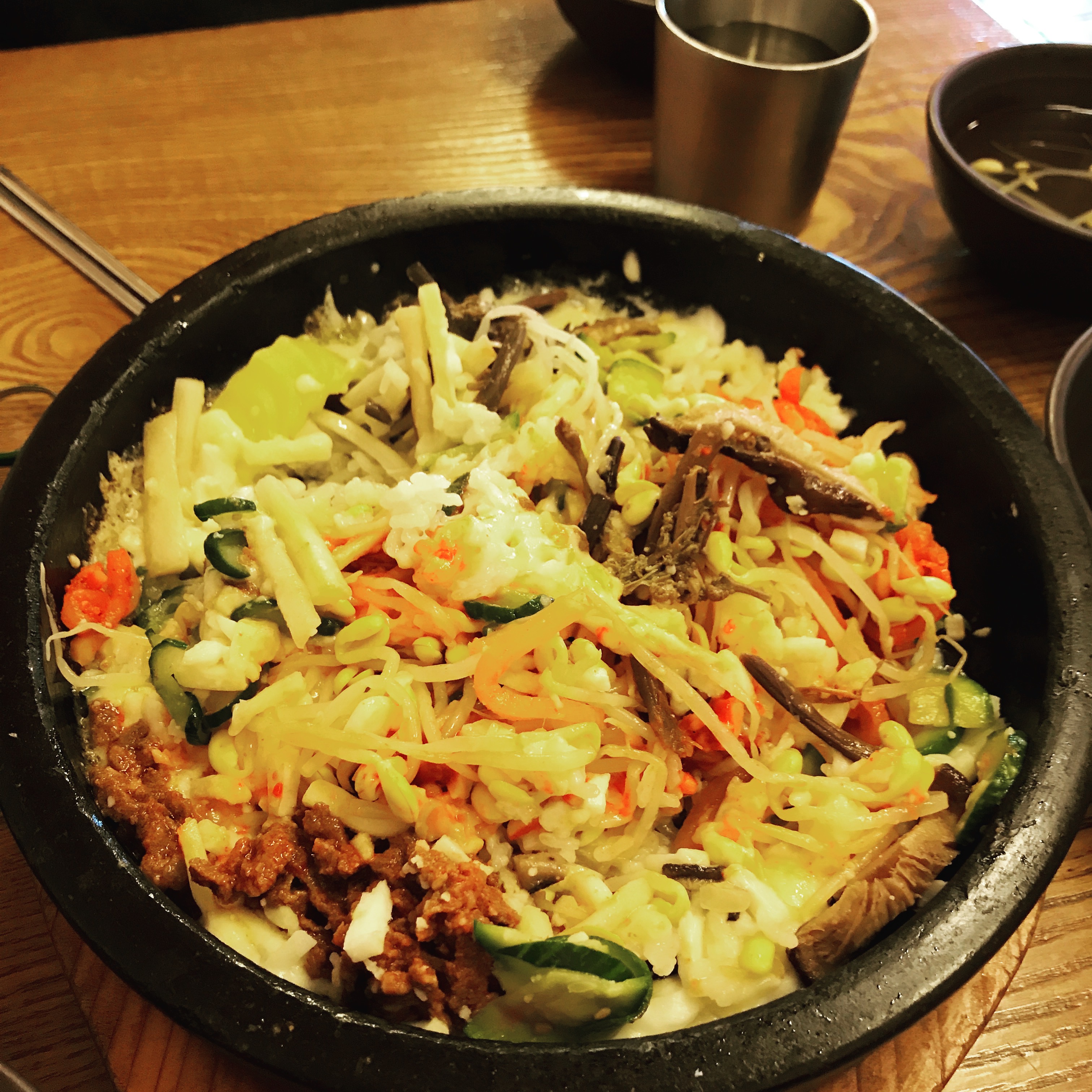
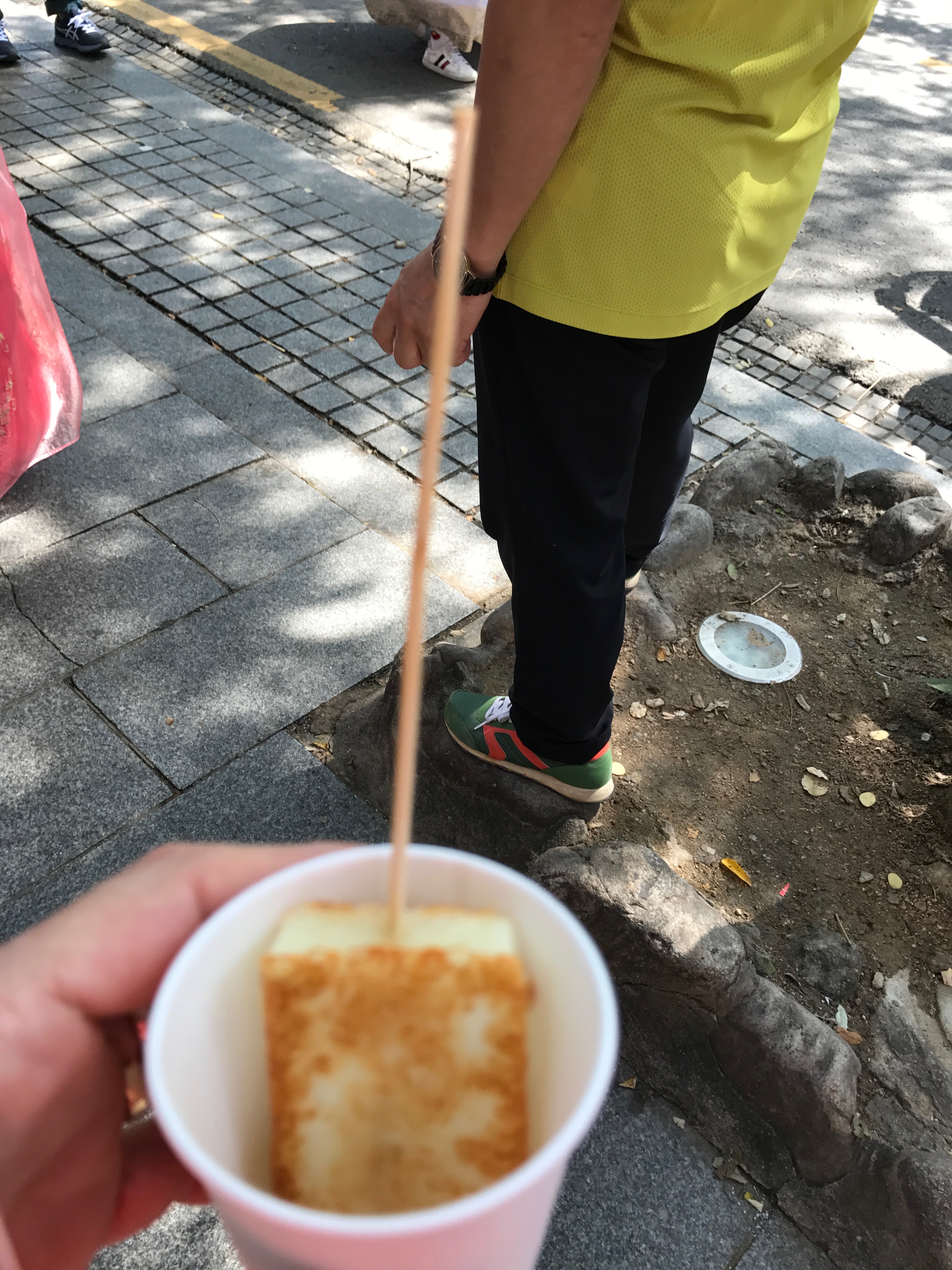
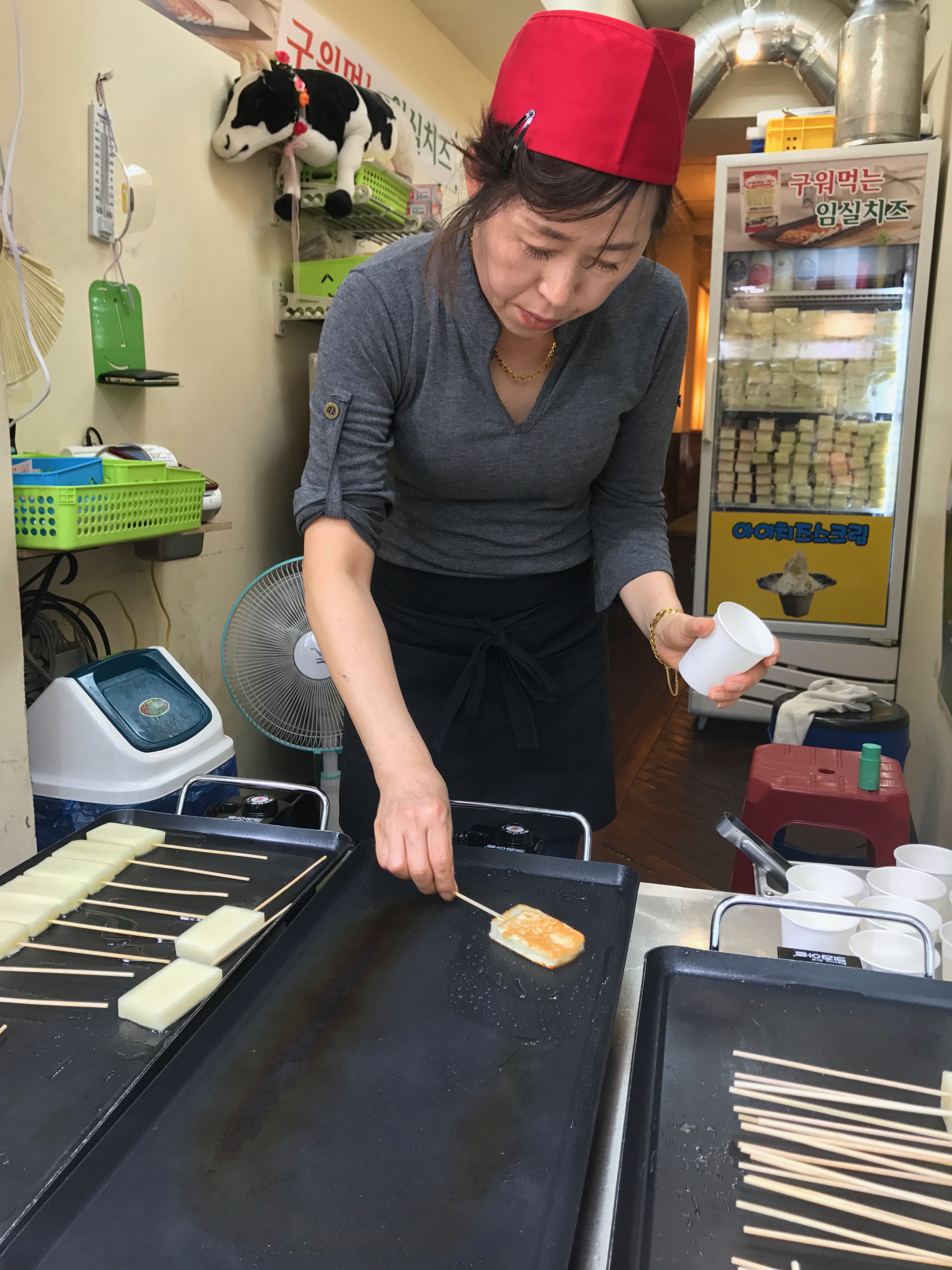
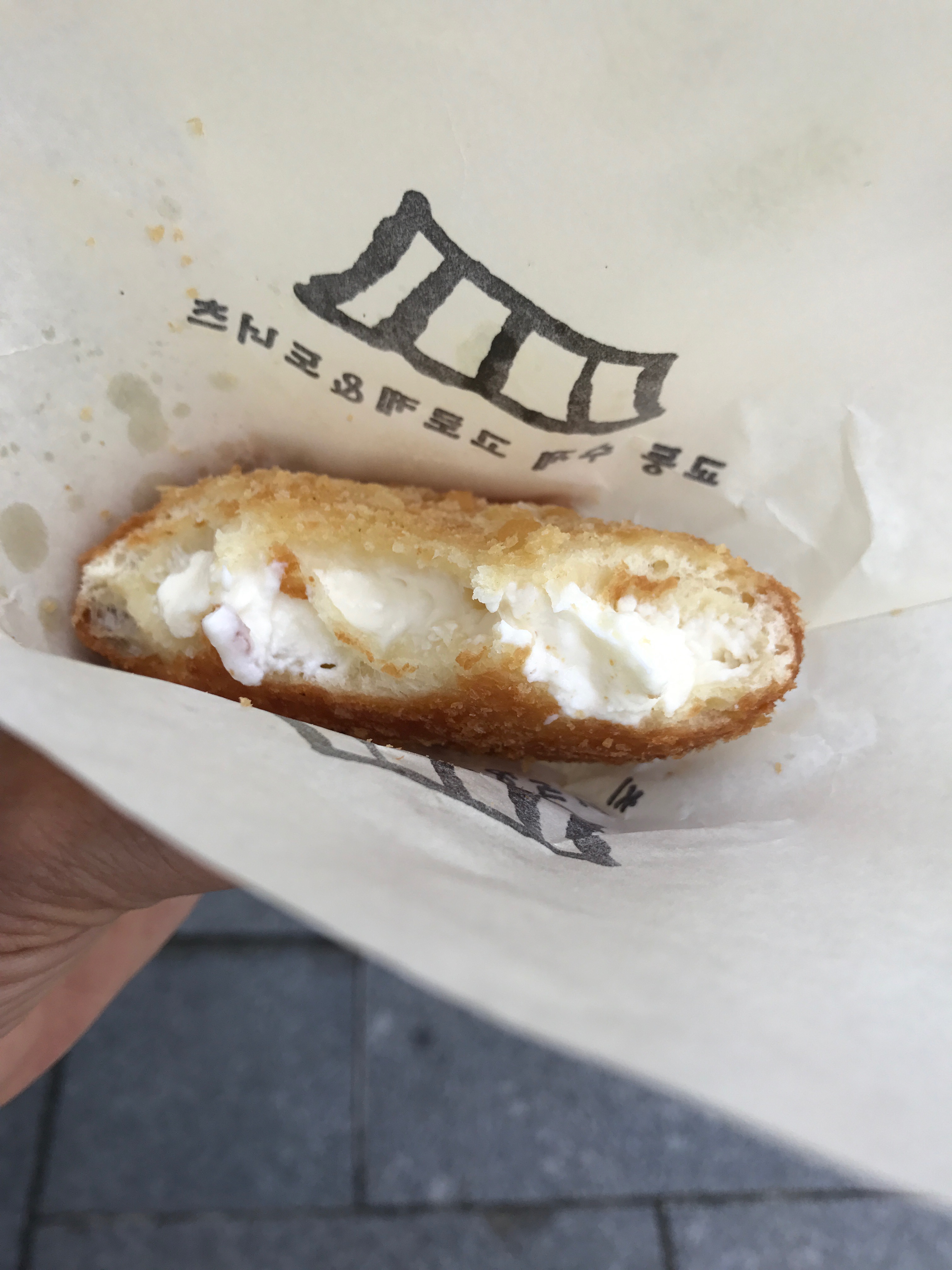
Also, everyone is eating almost all the time. There are many sit down restaurants but even more street food stands. Fried squid, little custard pies, croquettes filled with potato, or noodles, or kimchi, or sweet cream cheese, ice cream, shrimp dumplings, and lots of things on sticks including fried cheese, chicken, meatballs, more squid—endless choices. Jeonju is known for its variety of bibimbop and in 24 hours we had it twice. The first version was in a restaurant where we noted almost everyone was ordering the version covered with melted cheese so we did too. It was odd and very good (of course, there was corn in it, too—they put corn in and on all kinds of things including pizza).
In the center of the village is a large palace, important in Korean history for its founding emperor and its royal portrait gallery. We took the English language tour with a delightful young woman with horrid English, so bad I told the French family that was with us on the tour that we couldn’t understand her either. No matter. The tour was great and the site impressive.
Across a main street from the village is Nambu Market, a sprawling inside/outside typical market selling basically everything and in a scrambled arrangement. Seafood, clothing, herbal medicine, “flour-based food” (no idea), furniture, dry goods, bedding, shoes. A few examples as written in the market guide:
Mango Love (ice water)
JeonJu TwBap (popped rices)
PungNyeon JuDan (mending clothes)
JeonJuNamMun GamJaTang (pork back bone stew)
IJin SangHoe (fermented soy paste)
SeongMSa (underwear)
We wandered the market, bough some melons (we asked the vendor “Sweet?” “Yes.” “Melon?” “Similar.” Very good, small, sort of a cross between melon and cucumber. A river borders the market, and we walked along and across it, complete with a crane walking in the water.
We took the city bus back to the terminal. Typical experience was the driver asking David as we boarded where we were going, assuring us “I will tell you when we are there” which he did, and it was back on the bus through Chuseok freeway traffic, akin to Wednesday-before-Thanksgiving in the states, and back to Seoul. Boy, were we ever happy to be back in our apartment with a real bed!
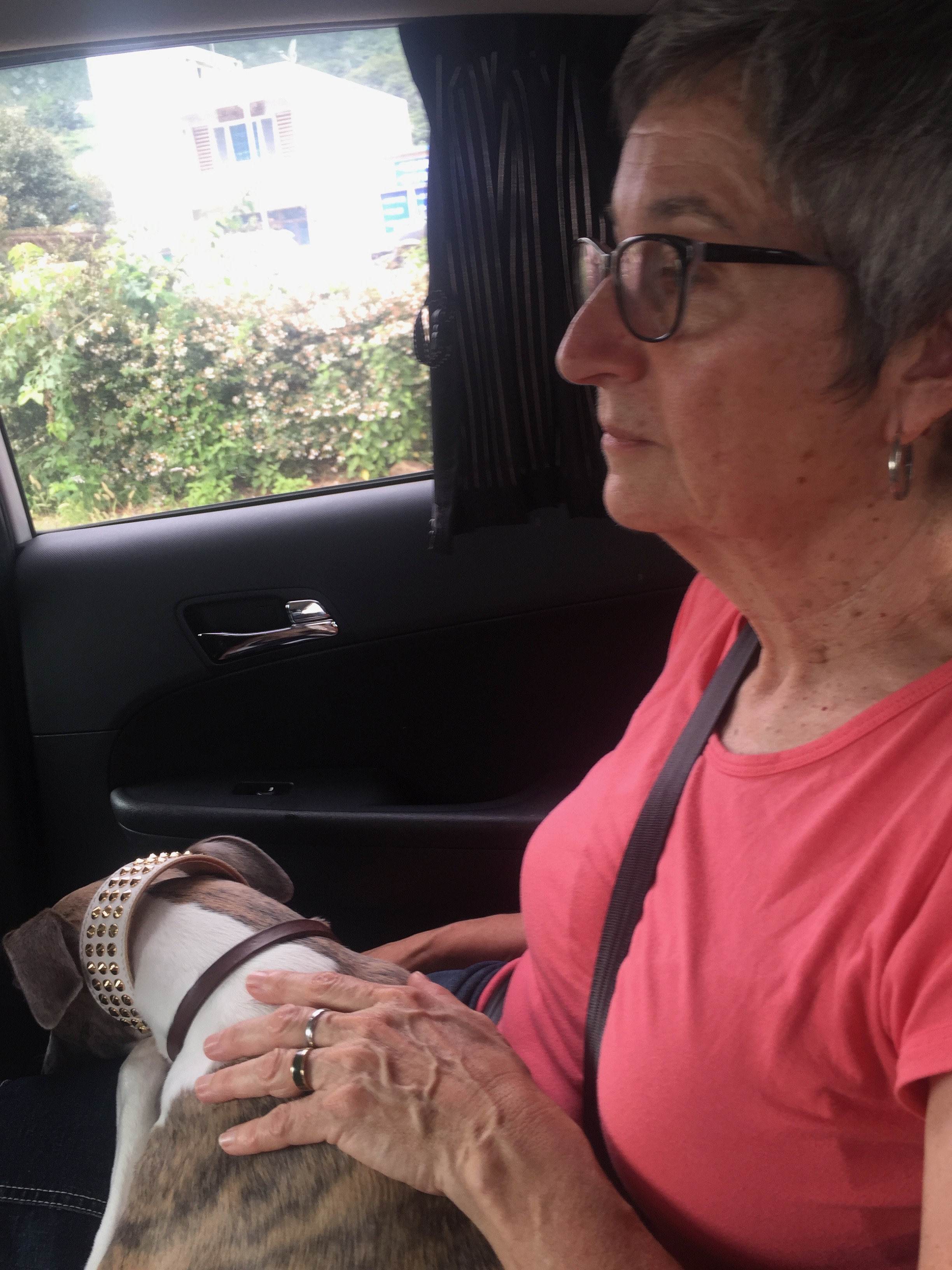
Saturday morning Gideon and Yoojin, and Birdie, their whippet, picked us up bright and early (6:45) and we headed south to Busan. Birdie is gorgeous and regal, and while at first she seemed spooked by the situation and us, Gideon and I sat in the back seat with her and before long she was sleeping/meditating with her head in my lap. Doggie fix!
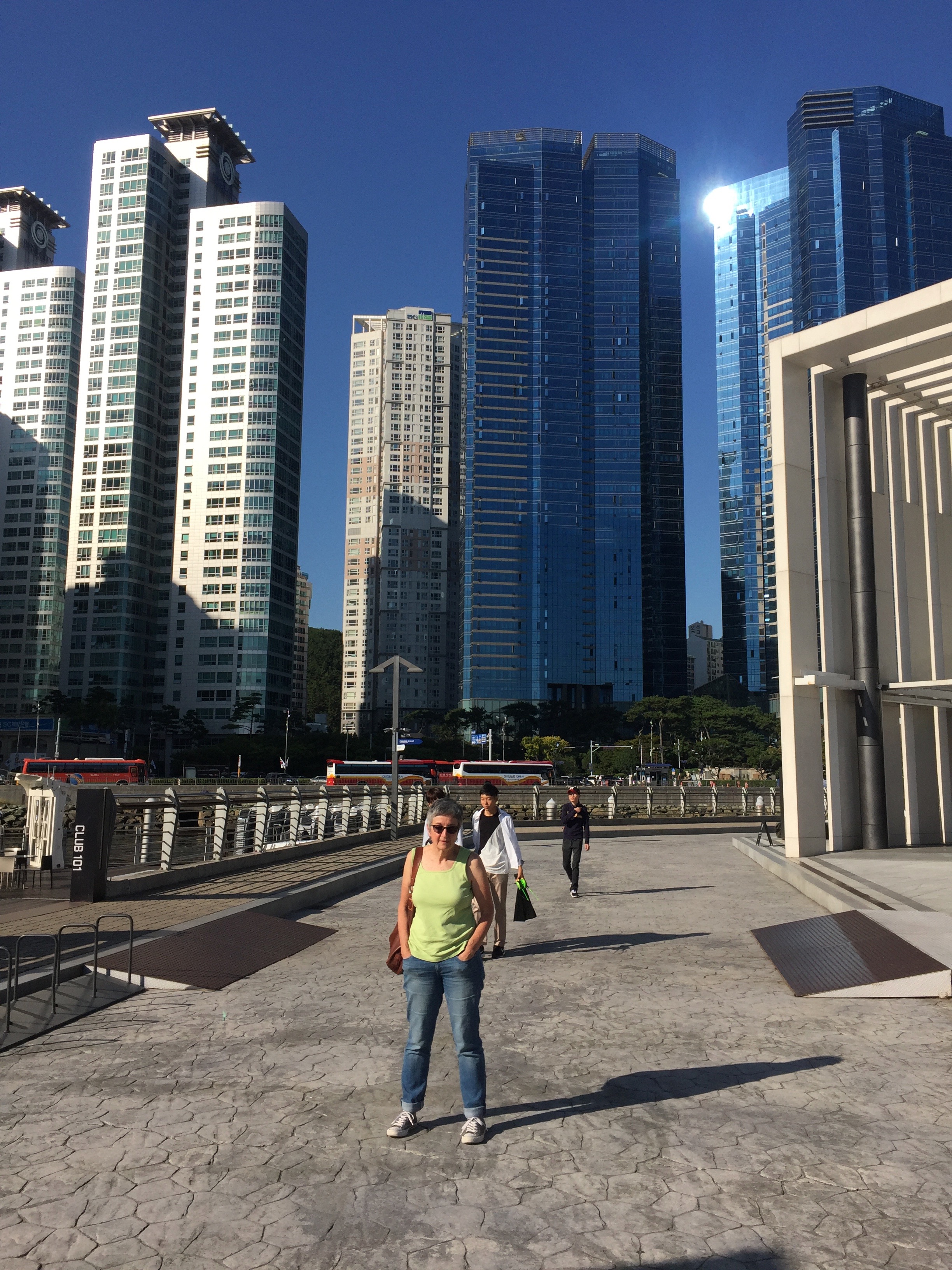
This is a mountainous country, and we drove right down the middle from Seoul in the northwest to the second largest city, Busan, on the coast in the southeast. Blue-green mountains on all sides, and the most modern and well-kept freeway the entire route. David read that Hyundai built the freeway in under 3 years. Amazing. We arrived in Busan after about 5 ½ hours, hitting rather horrid traffic as we approached the city and then went in fits and starts through downtown and over to the southeastern edge where our airbnb was. This time we were in a modern highrise, though not so high by Busan standards (18 floors or so) and we were on the 15th. Lovely apartment with two bedrooms, very roomy, overlooking a small lake surrounded by a park.
We parked our luggage and headed out for some walking for us and for Birdie and a little sightseeing. The weather was warm to hot, but a seaside beachy heat, so we went to a nearby beach and walked looking for a place to eat. Finally we settled on a place with outdoor tables since we had Birdie with us and ate truly delicious fish and chips, then headed back to chill, watched a little Korean TV and went to bed.
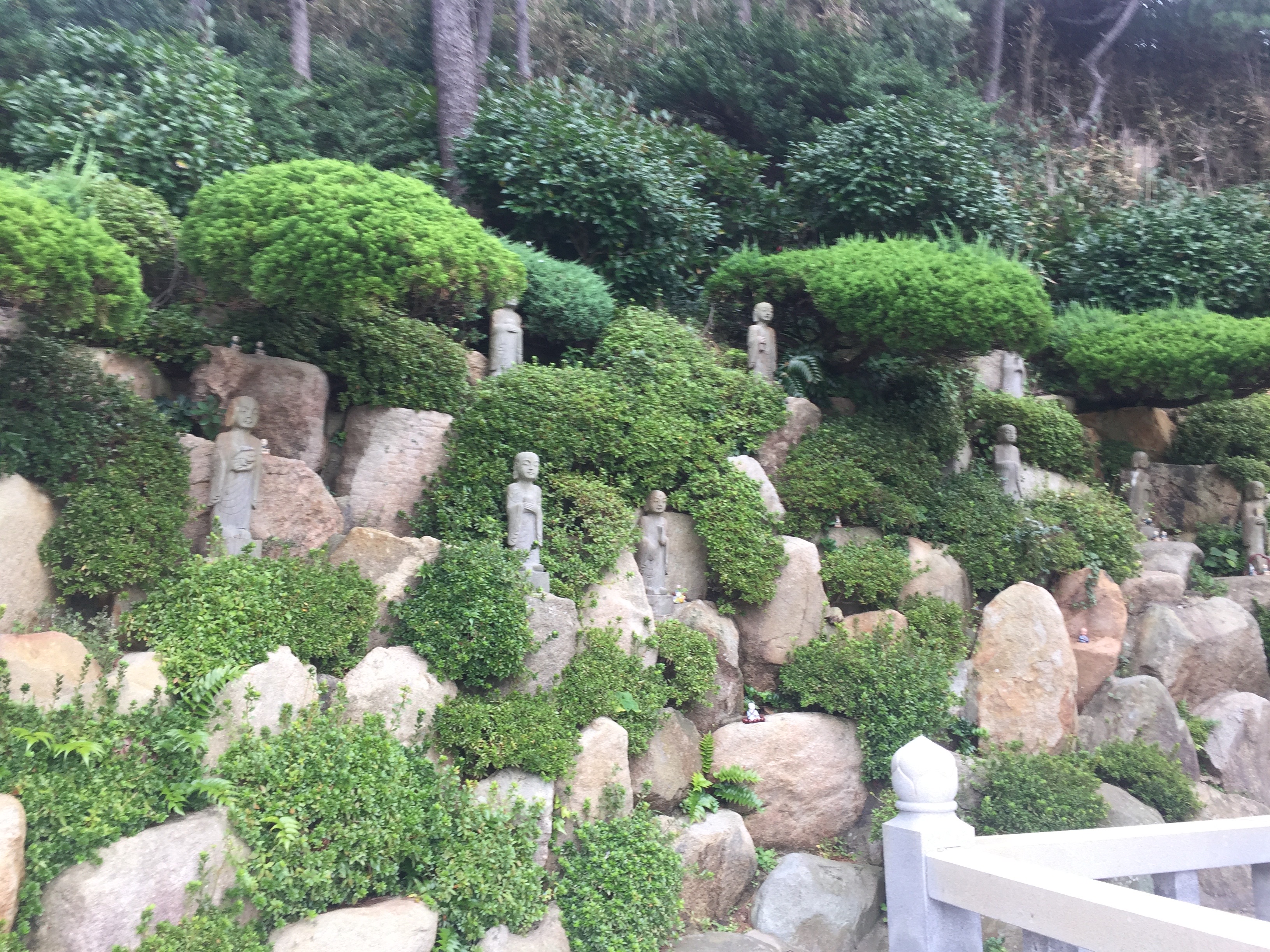
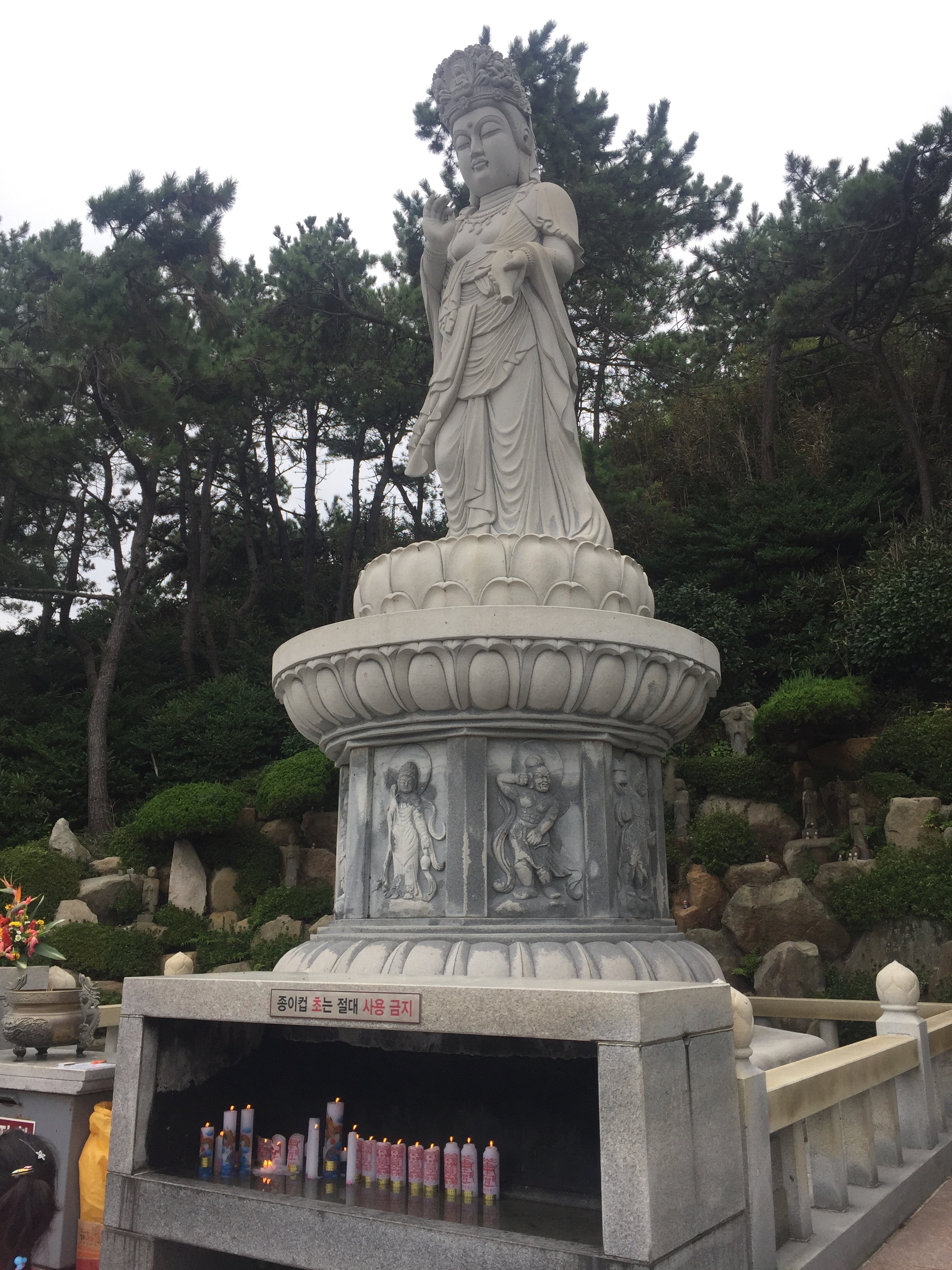
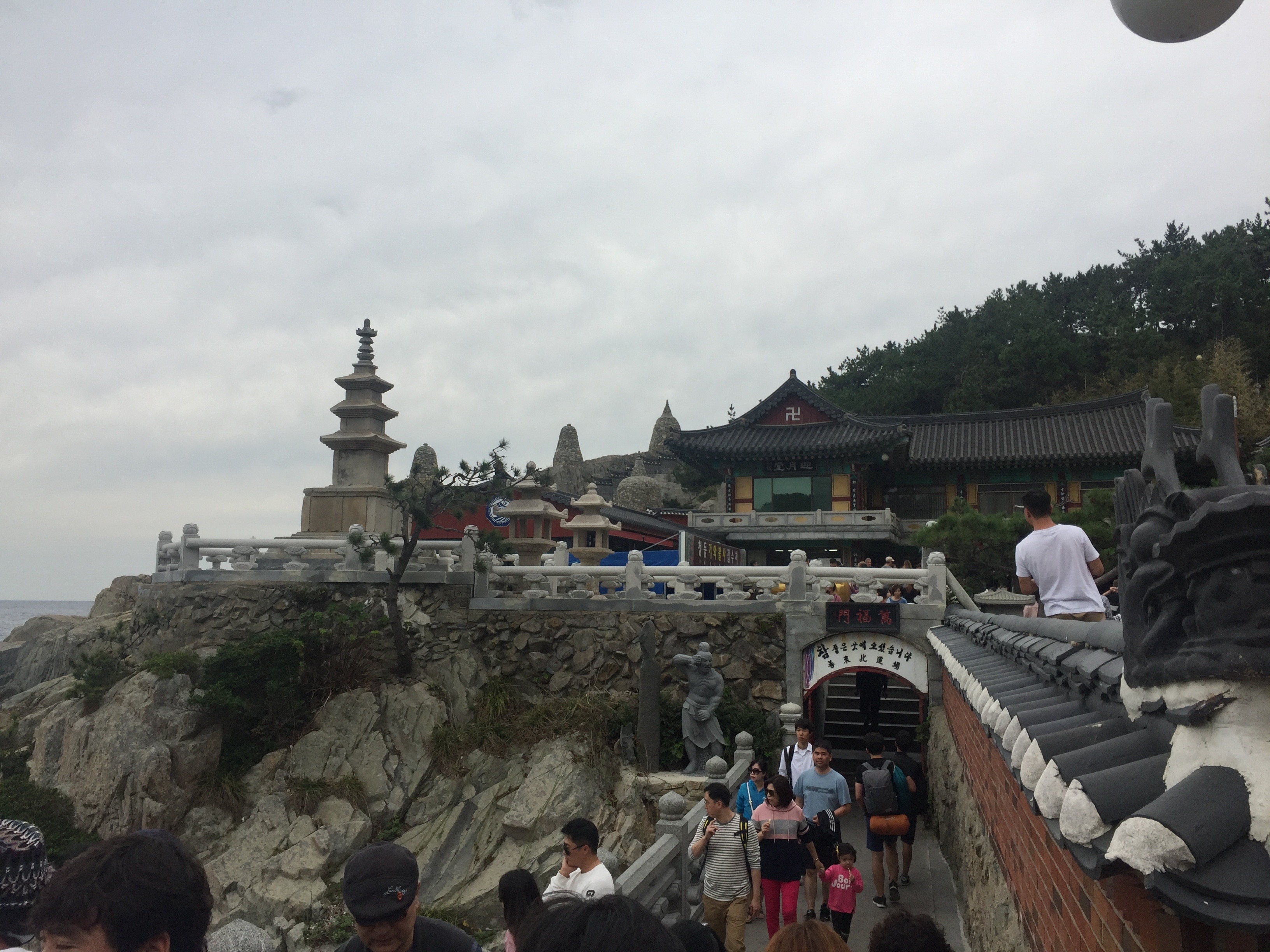
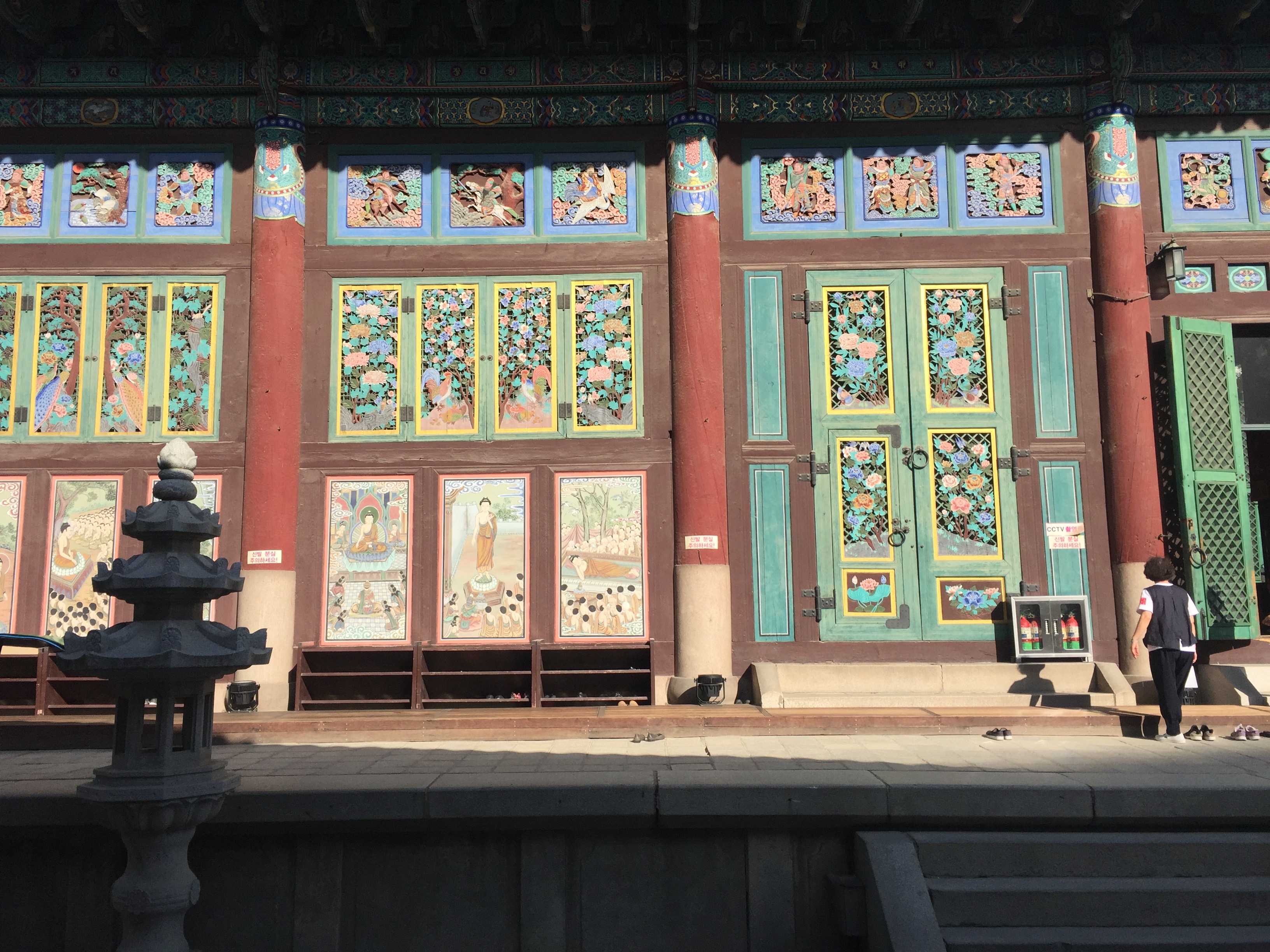
Sunday we woke to a little bit of a cloudy morning. Luckily the airbnb owner had stocked the kitchen with breakfast food—two loaves of Japanese style bread (white, thick, fluffy), apples and oranges, juice and milk and cornflakes. We devoured breakfast and headed out. Our first stop was the Haedong Yonggungsa temple which is right on the coast, in a dramatic setting of rocks and hills. Due to the holiday weekend it was jammed with a cheerful crowd and much pointing and fussing over Birdie (typical Korean response to dogs, especially unusual breeds since most dogs we see are toys and often are being carried in arms and tote bags). We were perhaps among 8 total westerners in the crowd.
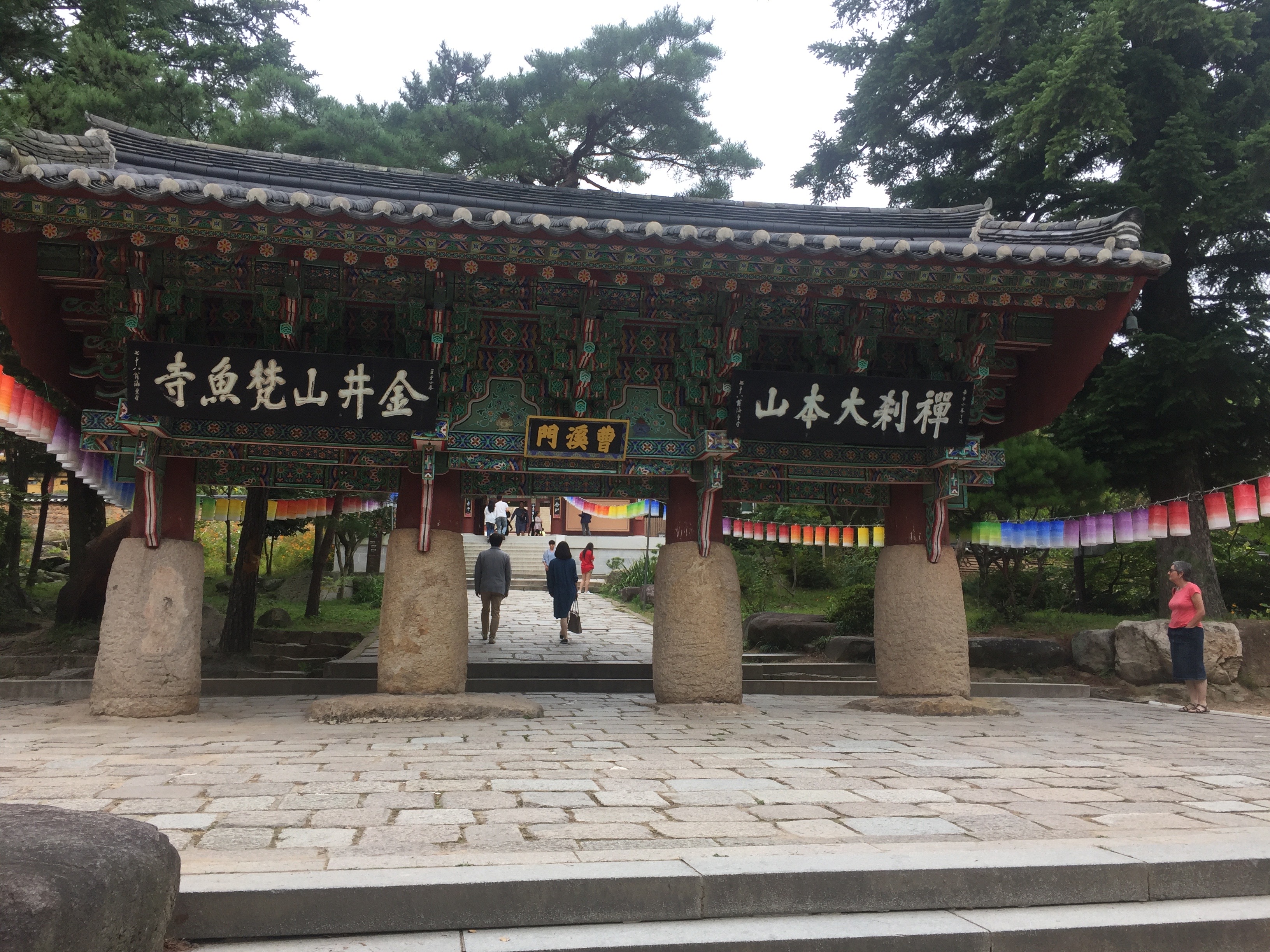
Next was Beomeosa, in central Busan but way, way up a mountainside, and finally downtown to the fish market where we had supper around 4:30.
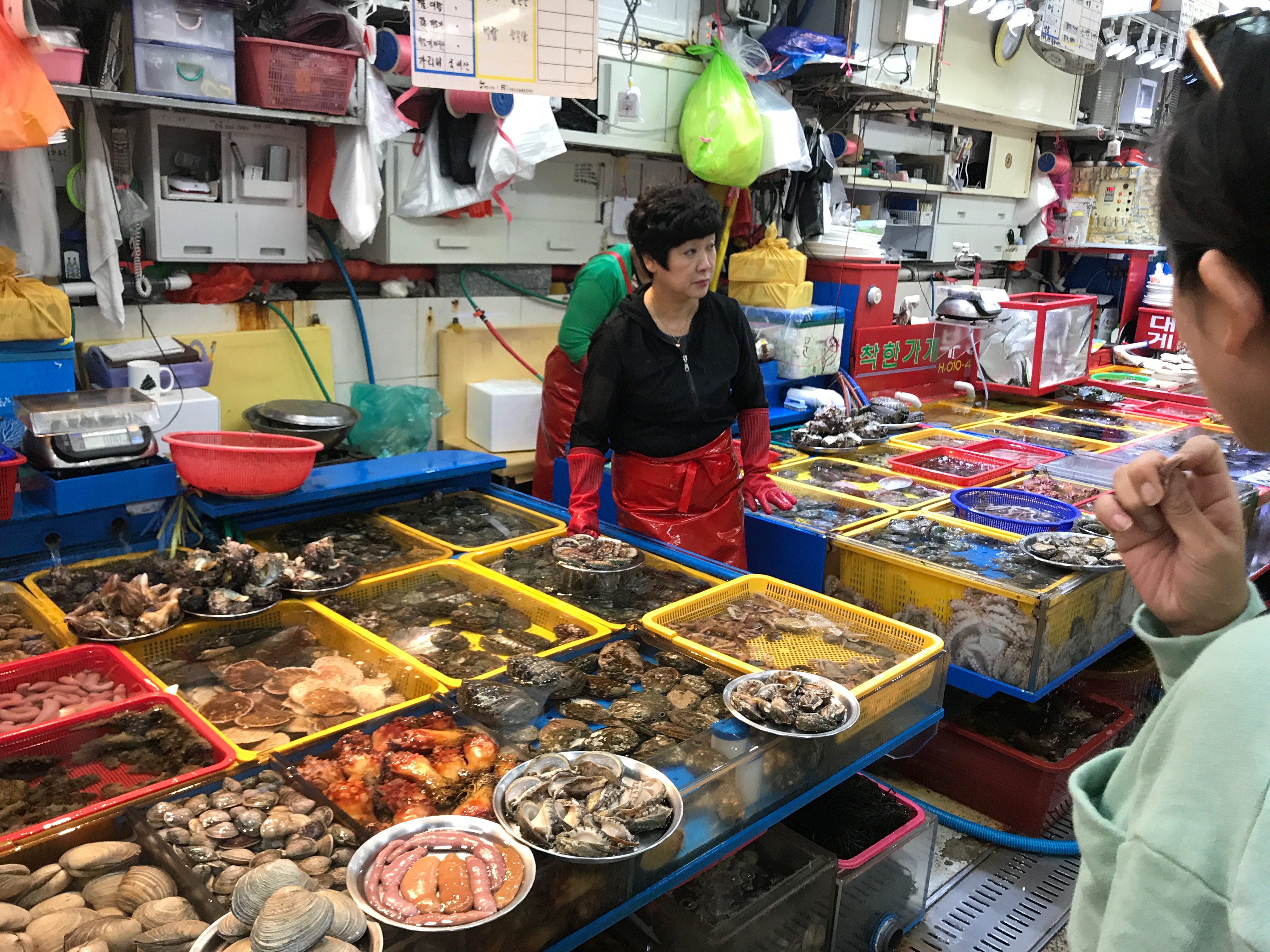
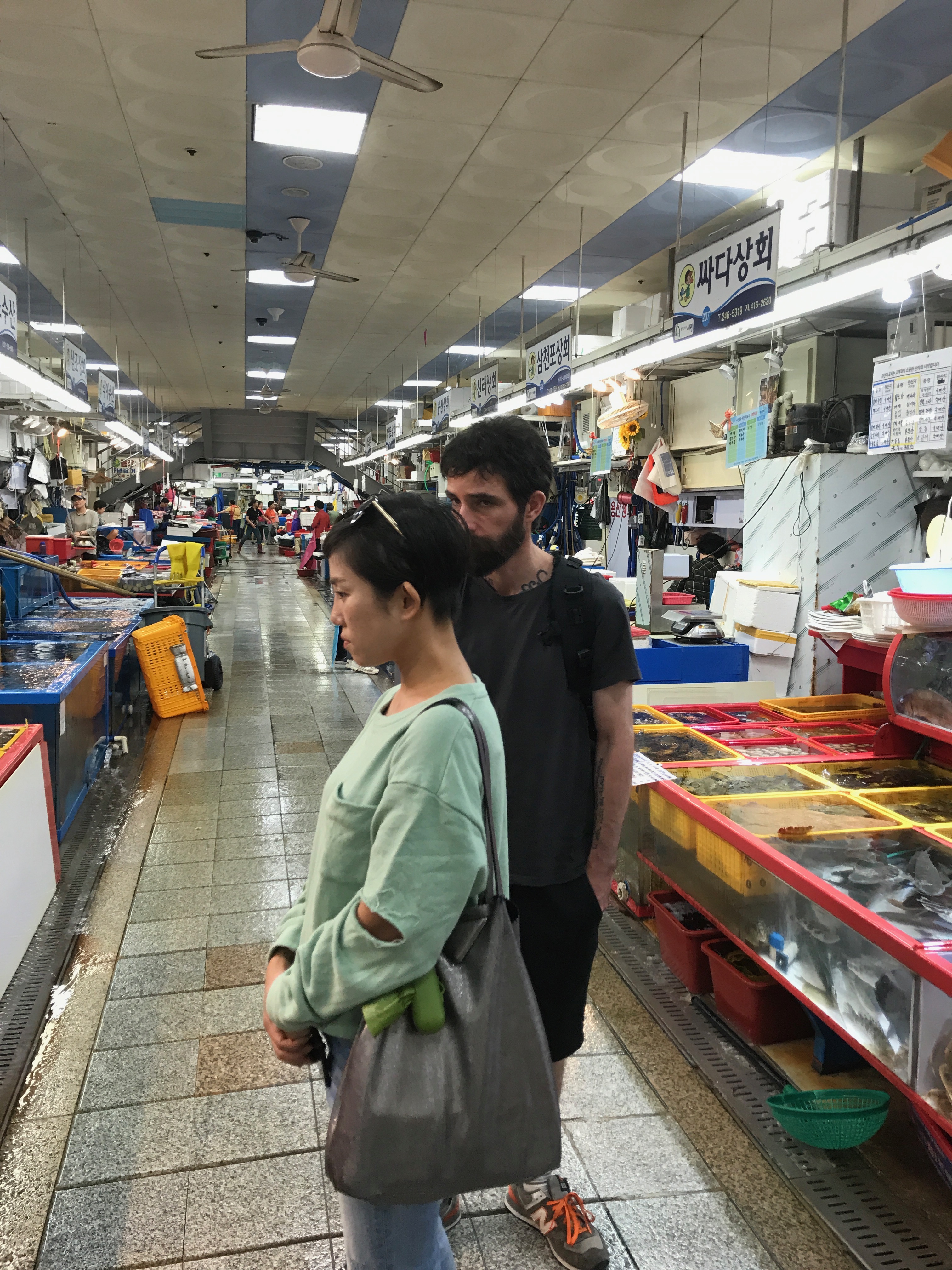
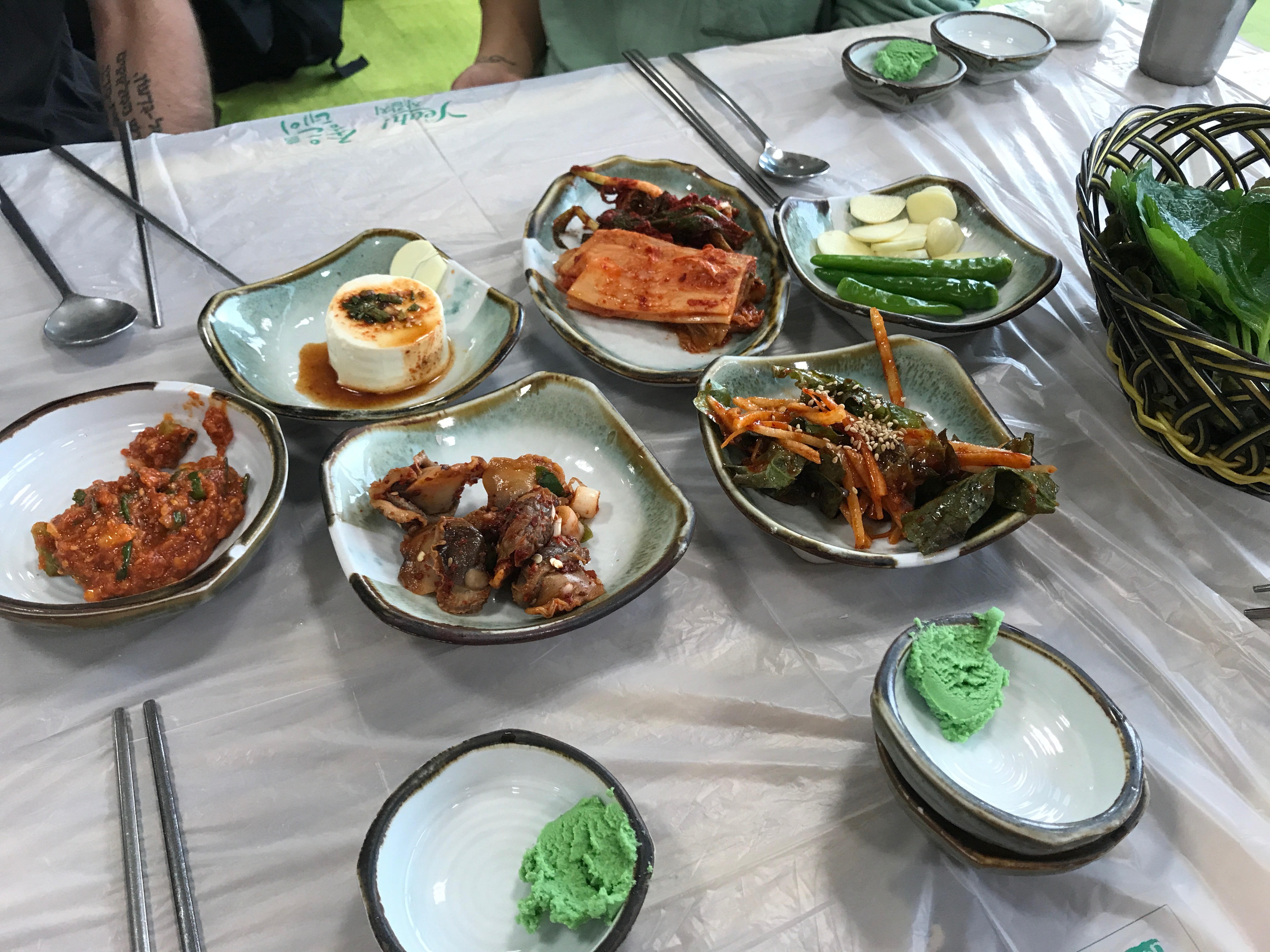
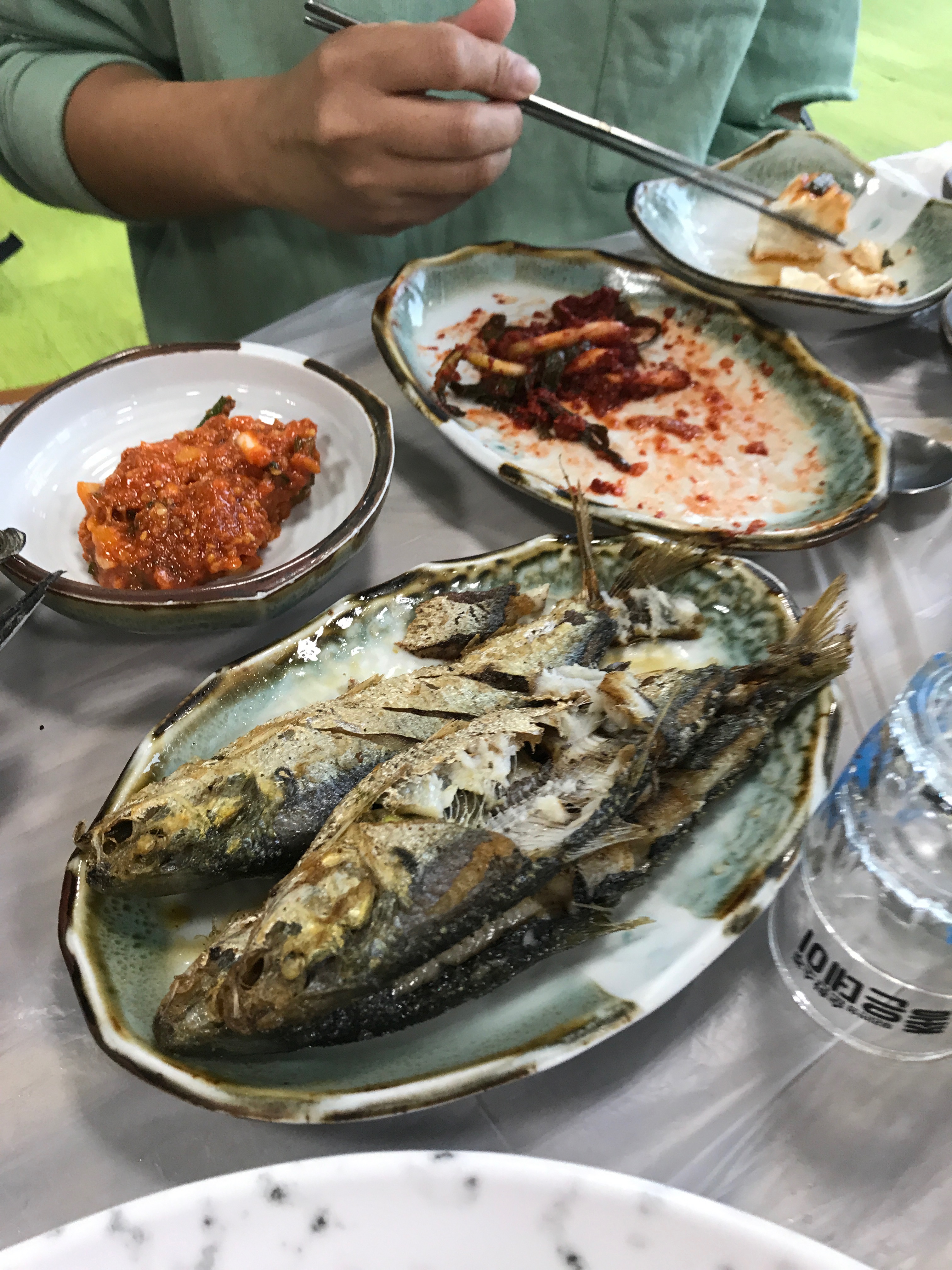
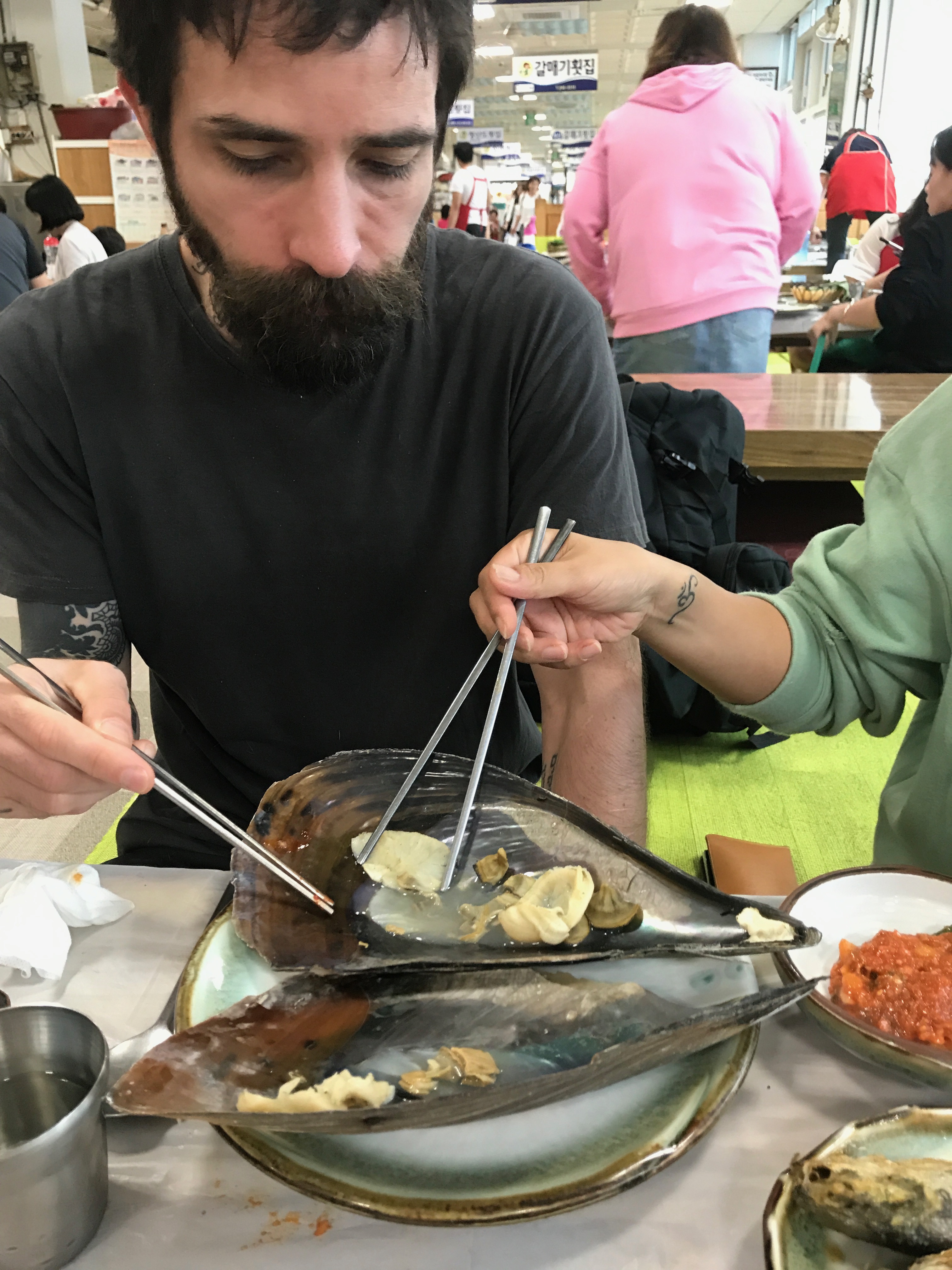
The Busan fish market is well known, quite large and nothing like we’d ever seen. Stall after stall, many with tanks of live shellfish of all kinds including hundreds of abalone, a little shocking to a Californian. Clams of all sizes, and lots of things I could not identify. The deal is you select fish and shellfish from a stall, and that stall proprietor calls upstairs to the associated restaurant. A short discussion about how things will be prepared is conducted (sashimi for the larger fish, smaller fish grilled, and the giant clams steamed in our case), you pay (came to about 80,000 wan) and a young woman comes down to take the fish up in a bucket and lead you to a table. Banchan appears, then the various dishes and accouterments (e.g., soy sauce and wasabi for the sashimi), drinks are ordered, and we start to eat. And eat. And eat…and then the soup comes which is made from the fish bones and veggies and is boiled on a little gas burner that is placed on the table. We ate most of that, too.
We were stuffed. As we left it started to rain, and I didn’t think I personally could look at food again, but ha, we went across the street to a bustling, nay jammed couple of blocks filled with street vendors and people, umbrellas and commotion, and proceeded to eat some sweet little buns shaped like peanuts and fried dumplings filled with nuts and something or other that was also sweet, Delicious! It was really raining by then so we hustled back to the car and headed back to our apartment. With traffic this turned into a 90 minute drive…we staggered upstairs and fell into our respective beds.
Around 2:30 David and I both woke up and went to pee. The moment we finished an alarm started screaming, bells ringing, and the repeated instructions in Korean telling us, apparently, to get out. Of course our first thought was “what in the world did we just break? By peeing?” Yoojin ran into the living room as we all were totally confused and freaking out. She said “A FIRE??” and we all started getting dressed, still in a daze. It was freaky but not that frightening, as 1) this is a concrete apartment building and 2) it was POURING rain, and had been for at least 5 hours. How could the building possibly be on fire? Gideon went into the hall and a man was fiddling with some box on the wall and mumbling there was a problem with the alarm, as if this was not unusual. Nonetheless the alarm continued, so Gideon and I decided to go down the stairwell and see if we could find someone to explain there was no need to worry. We walked all the way down (15 flights) and did not see a soul. As we walked down it was increasingly obvious we were the only residents with any concerns since we never found anyone else up and about. We got in the elevator and went back up. Into bed, everyone. This was actually the second time on this trip we have been awakened in the middle of the night—a few nights after we arrived David got a phone call at around 3am, a wrong number from Berkeley. Okay, let’s have this be two of two.
Monday morning we were all back in the car at 7am, as Yoojin and Gideon dropped us at the Central Bus Terminal. We took the bus to Jeonju and they drove on back to Seoul.
We woke this morning, our fourth in Seoul, to cool temperatures and marveled at the happy change in the weather that had started the day before. When we arrived and for the first few days the city was humid and hot, but yesterday steady breezes blew away the humidity and while it was warm it was much more comfortable and there was a tiny hint of fall as leaves fluttered around. Seoul, this side of the river at least, is quite green, and many of the shopping streets are tree lined. As well, there are public spaces with flower gardens and occasionally even narrow older streets, mostly pedestrian (where cars are allowed but there aren’t many and they drive slowly—ah, I remember the opposite in India), have a slight arboreal feel.
Our first evening here was exciting as it always is when you are in a new place, but the heat was heavy and I was sorry I was wearing jeans which quickly became sticky. The airport was enormous and modern (not nearly like Dubai, rather similar to SFO) and after a 12 hour flight we sort of staggered around to find the ATM (third floor) and then the airport bus desk (first floor) and out into the bus queue where we had a lovely chat with an American from Brooklyn who is an analyst in the natural gas industry on her way to a conference in middle-of-nowhere (to us) eastern Russia. We waited maybe 45 minutes for the airport bus and the ride into Seoul was interesting/weird. The bus is the touring kind, and like the long distance buses in Mexico came with TV, with both Chinese and Korean subtitles. First program, a restaurant show, patrons with various animated reactions to the food, with either cartoon steam coming out of their ears (too spicy!) or little stars of happiness bursting around their heads. One of the specialty dishes highlighted was a kabocha squash, steamed in the microwave, hollowed out, filled with apparently a VERY spicy seafood stew, covered with cheese, back into the microwave until the cheese is molten, then the squash cut as a pie so each slice falls away, covered with stew and cheese. Sorry, that looks awful! Next program was a travelogue, with each segment replayed several times in slow-mo, with animated additions (question marks, etc.). Then a soap opera. Yes, the bus trip was long, and when we were the only passengers remaining the driver pulled over, told us “TEN MINUTES BATHROOM” and we sat in the empty bus seething. We were so tired and only one stop away from Itaewon! Not fair. Gideon explained when we arrived that this was common and inexplicable in his various bus travels around the city.
We finally arrived at our stop, having texted steadily to no avail to Gideon and Yoojin, who were to meet us and walk us to our apartment (airbnb). The street was bustling, we were hot and tired, and no Gideon and no wifi connection. ACK! We realized we were totally dependent on their help. We walked a little way (like, two storefronts), got a signal, called Gideon on Kakaotalk, and turns out they were only a few blocks away where they had thought the bus would stop. They appeared in a few minutes, all smiles and hugs. Saved! We trudged, hungry and hot and tired, to our apartment, which turned out to be on a sketchy looking (more so when we saw it in the daylight) street one level up from the main Itaewon drag.
Gideon had our key code, had connected with the landlord, and in we went. The apartment is great—perfect. Just big enough (an efficiency with a roomy bathroom) and so close to the action yet dead quiet inside. Hurrah. We are very happy with the accommodation ($53/night) and super glad we booked it for the two full weeks we’re here. It is 100% Ikea, so even the bed and furniture are familiar. It’s ideal and only two blocks from the metro, but honestly given the scope and reach of the metro I don’t know what odd corner of the city wouldn’t be.
walking to Leeum
entrance to Leeum
Tuesday Gideon and Yoojin were working so we headed out to Leeum, the ultra beautiful art museum (Samsung, of course). The 20 minute walk was through an increasingly upscale and modern neighborhood, then up a short hill through lovely and varied modern architecture to the museum. We wanted to learn a little about traditional pottery and Leeum has two wings, one with a highly specifically curated collection of historically important pottery and paintings, the other much smaller and which, sadly for us, did not concentrate on Korean artists but was like a mini MOMA (though I was delighted to see a Conrad Richter I didn’t know, as well as an artist new to me, Wesselman, whose single example of “steel painting” they had was thrilling).
The historical pottery was primarily celadon, and wow. We learned a ton, and the audio tour, which was high tech so as you approached a piece the description launched, with additional detail on the (Samsung, natch) device screen. So you can learn as much or as little as you choose. They have also placed modern Korean pieces here and there which are related to the traditional work. One memorable piece is a very large (6’ across) sphere made of broken black glaze pots, seamed with gold so the entire globe was confusing at first artistically, but as you looked closely and read the intention of the artist to celebrate a type of glaze no longer “desireable” it was compelling. On another floor the modern piece among the old paintings was a huge map of Korea, made entirely of tiny (1 ½”?) metal figures packed together, to represent the entirety and individuality of the population that comprise the country. Cool and beautiful.
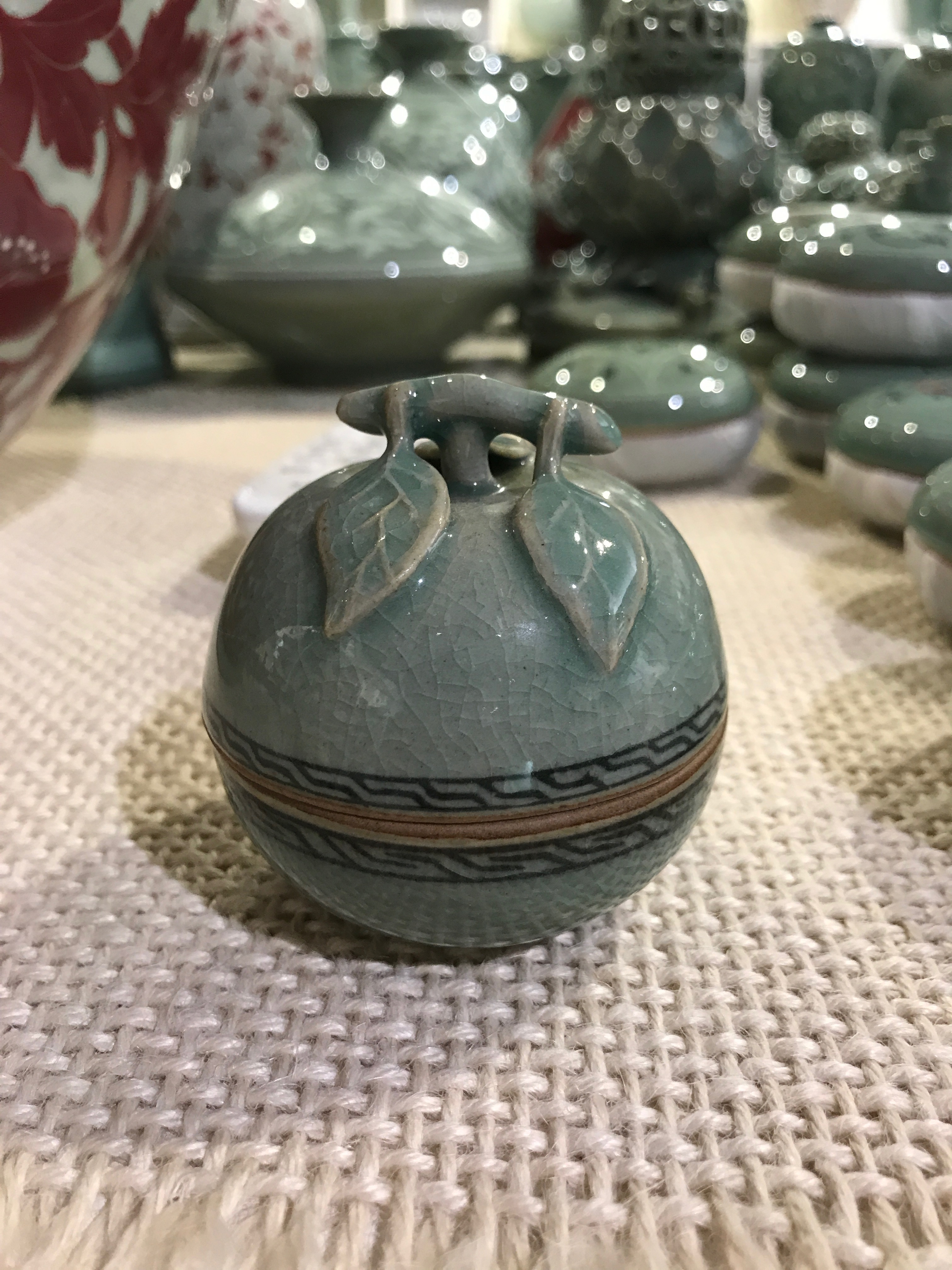
Our neighborhood having a concentration of Muslims, there was a Halal Guys (NYC!!) where we had falafel sandwiches. Yum. Inspired by the Leeum collection I wanted to test the pottery market options, and found one single mention on the web of a store Eden Pottery with a notation “my favorite place to shop for ceramics in the world” and it is just a few blocks from our apartment. No web site, no information whatsoever on the web, so we headed over to get educated and see if it would be a good place to look for tea bowls and other items. One of my missions on this trip is to find high end (i.e., out of my personal price range) tea bowls for Cousin Harumi—she had shown me the few pieces she already had and explained how Japanese revere Korean pottery. With this meager knowledge I entered Eden, and what a happy choice. Mison Kim, the proprietor, speaks English and represents four important potters, well known here, as well as carrying more commonly available pieces. I showed her my photos from Harumi, and we pulled several wood fired (more valuable than gas fired) bowls which might suit and I sent photos to Harumi for her thoughts, as well as a tea box shaped like a persimmon, celadon glaze, and a few other random items. I had high confidence in Ms Kim, but afterward we headed to the recommended Arts shopping area, Insadong (20 minutes by metro) to see what else we might find. Turned off by the propensity for Insadong shopkeepers to start lowering prices when I showed interest in something, we decided to wait and return to Eden.
Celadon tea box in shape of persimmon
We did in fact return Thursday, and as it was morning here/evening in Oakland Harumi and Mison and I were able to connect by KakaoTalk with video, so I could pull and show things to her for her to choose from. What fun! Harumi selected 3 tea bowls, all by well known potters, and a tea box in apple shape (celadon). So we had a fantastic time—but as we left David reminded me that we have to take all these to Japan, back and forth to airports here and there, and due to their value each bowl is packed in its own wooden box. Ah, well, what is international travel for anyway? It will all work out.
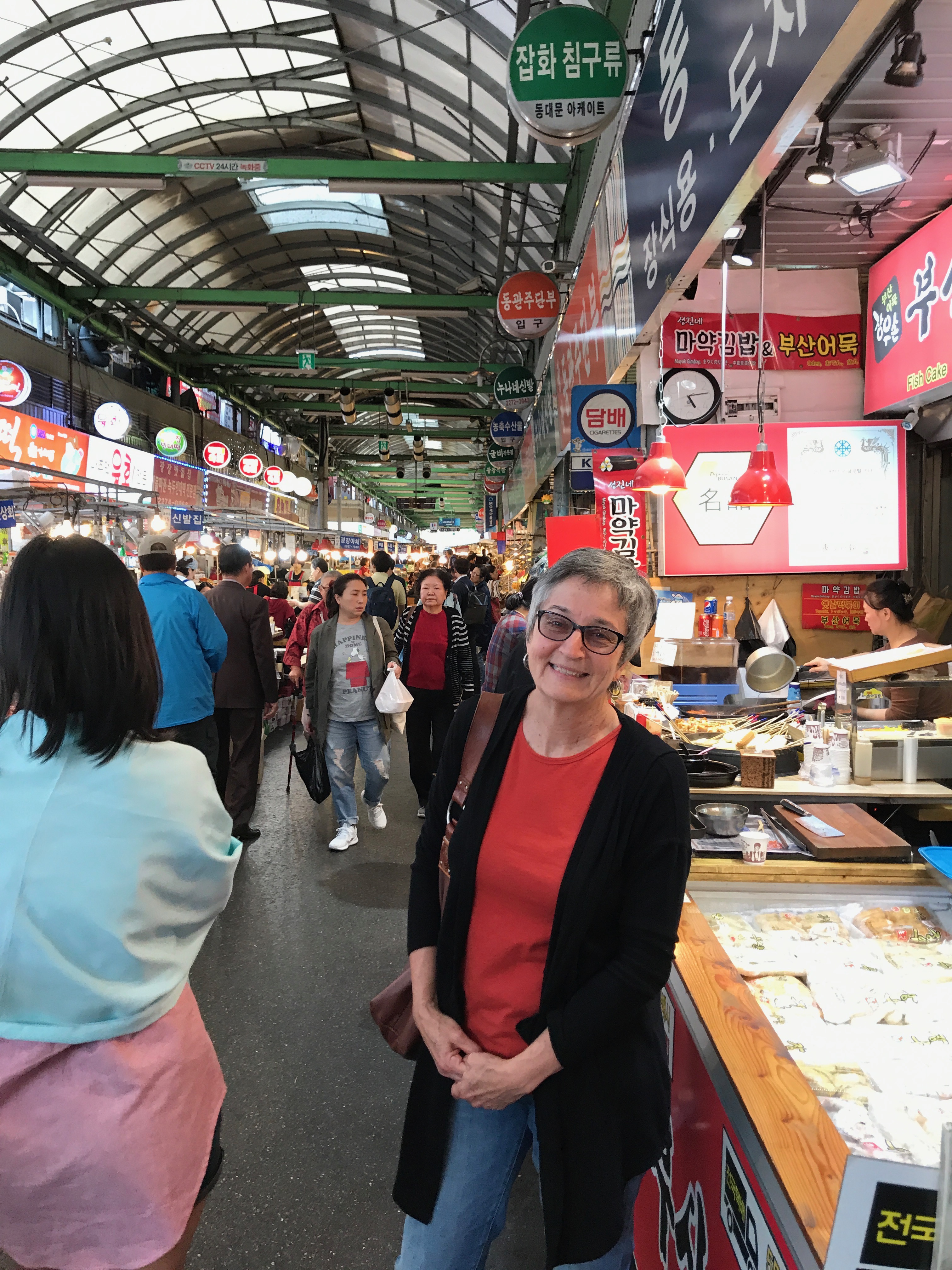
Wednesday, after a lovely breakfast with Gideon and “tour” of his gym, we headed to Namdaemun Market. This is the Seoul version of every crazy, jammed market from Mexico to India. A mix of stores and stalls, we were instantly lost and stopped at an information booth where we were given a map that showed the ‘zones’ such as the Chopped Noodle Street, the Food Materials Street, where to buy socks or candy or housewares, the Fish and Stew Street, the sock area, housewares, candy, Camera Street, Stationery and Toy Street, on and on. Plus underground shops with opticians (a huge business here), underwear, vitamins, other clothing, you name it. I volunteered to be a rice pounder for the crowd, getting an “OOH” when I managed to slug the glutinous mass with some force.
We shared an enormous fried kimchi-filled fritter and ate kimchi-filled dumplings, so delicate and flavorful I will eschew the frozen version we can get at Koreana Plaza in Oakland forever.
We were hot and sticky and tired, but headed 5 long blocks or so to one of the palaces which sits right in the center of downtown, a shady complex of pavilions and other royal buildings, all painted in vivid designs along the rafters, and inside several were contemporary art installations that represented the mix of past and present day Korea. One was an entire wall showing overlays of a multi-story pagoda and modern office buildings, with the ghost of a train moving across the bottom. Stunning and evocative.
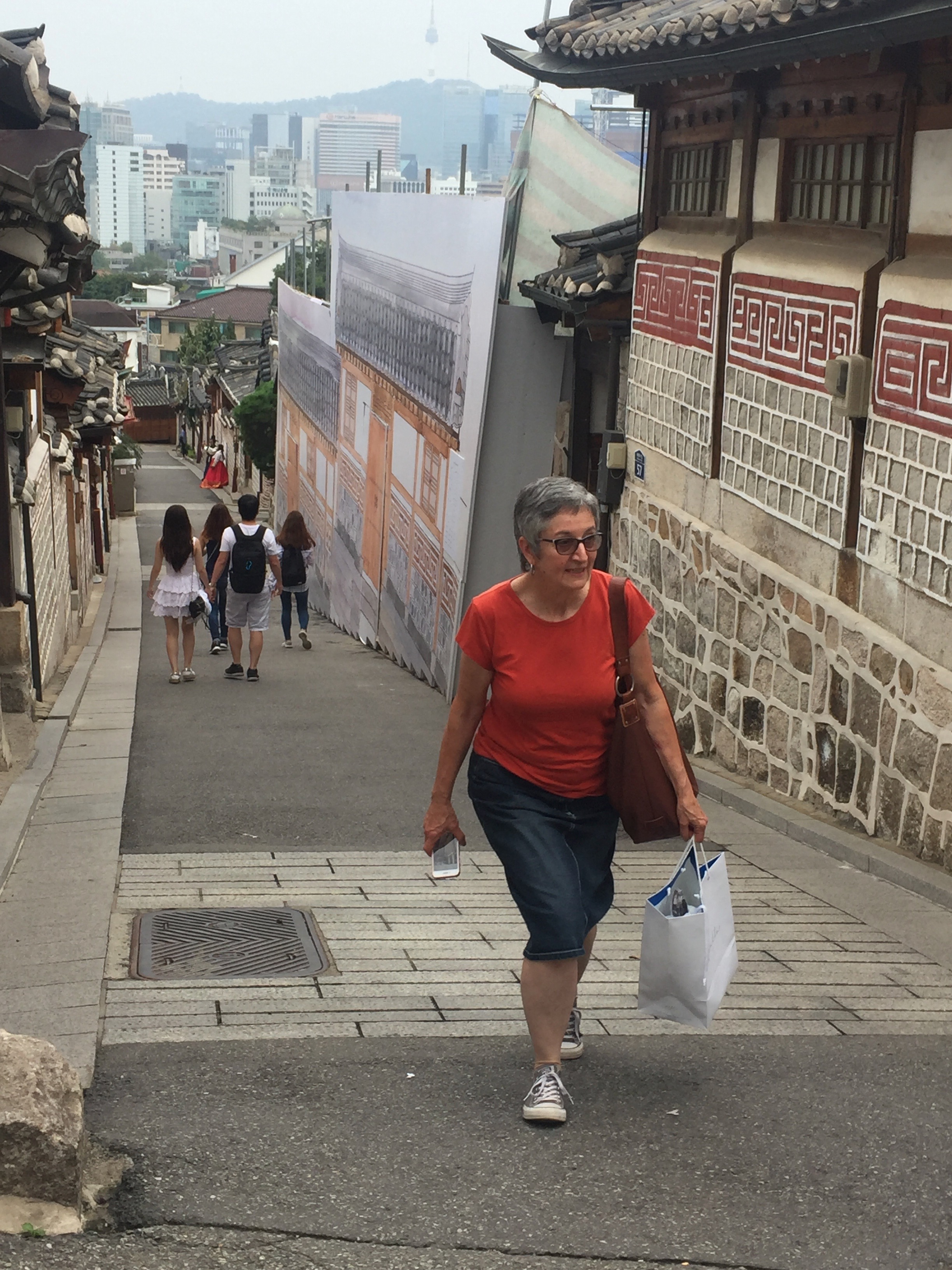
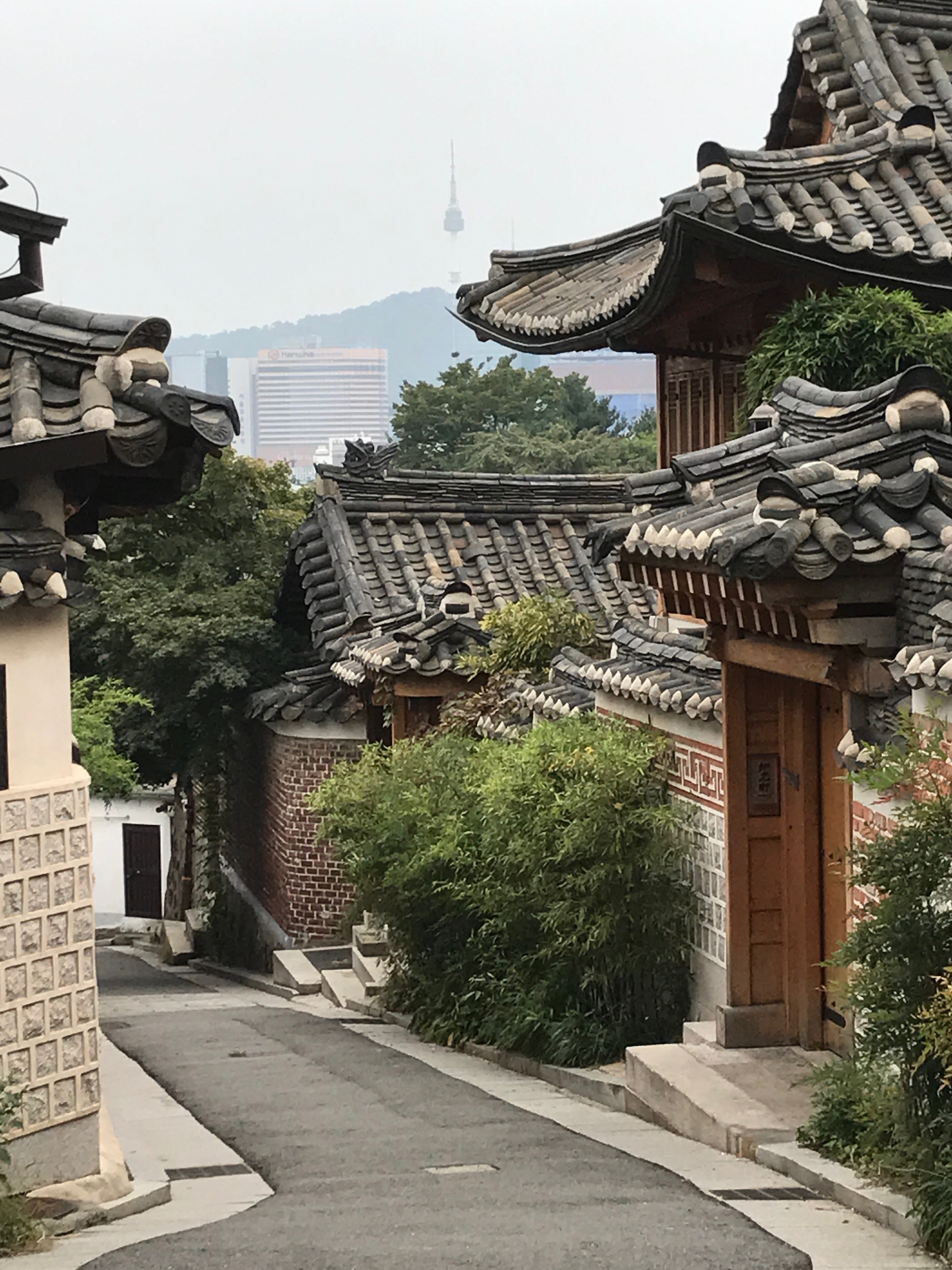
We thought we were so exhausted and over full of sights and sounds of Seoul, but David was determined that we trudge on and thank goodness, for we headed to Bukchon Hanok Village, a living neighborhood of traditional homes, some of which were moved there for preservation, which sits along a steep hillside with winding narrow stone streets and many signs warning tourists (mostly Korean but some foreigners) to be silent because people live there.
Every now and then we came across a charming little store, and as we came out of the neighborhood we saw were in a delightfully artsy commercial area with beautiful boutique clothing, other crafts, contemporary murals, and suddenly we were surrounded by a true gaggle of school girls, all in uniforms and heading down the hill. The streets are tree lined, and the traffic very light.
Again, cars seem to be allowed everywhere but they are blessedly quite and move slowly, as pedestrians wander in the roadway where sidewalks are marked but not raised. We wandered too, soooo tired and hot but soooo happy at what we had seen. When we got home David checked his phone and we had walked 9 miles.
Thursday after our Eden Pottery purchases we went back to Insadong for more souvenir and present shopping, and finally ventured into a Korean restaurant for lunch. What a bargain—we ate 5 huge mandu (meat and vegetable filled dumplings) and shared a bowl of savory beef soup, with rice and kimchi on the side. Fifteen bucks and we were completely satisfied.
Shopped out, we walked along side streets looking for a particular Buddhist shrine, which we found and managed to join the congregation for the end of an afternoon service (99% women, who were clearly enjoying themselves, much laughter at what the monk was saying), and at last returned home exhausted and hungry. Familiar food sounded good when I found a listing for Burger Itaewon about 5 blocks’ walk from our apartment. We had medium high hopes—but wow. Five minutes after ordering we had hot, crisp French fries and honestly delicious hamburgers that were also piping hot. What a find. We staggered up the hill to our apartment and collapsed into bed, so happy with our day (walked “only” 6 miles).
Middle of the night David’s phone rings—we startle awake, confused and groggy, and David literally rolled off the bed trying to answer his phone (the bed is low, thank goodness). Wrong number from Berkeley. Last time we will leave a phone on overnight!
Today we made the most of the cool and breezy and clear weather, hopping on the metro for a morning at the National (Samsung) Museum, a massive building with incredible views of the city, which sits in a huge landscaped park adjacent to the US military base. A gorgeous, spacious museum of which we managed to cover about 60% before we looked at each other and said “ENOUGH!”
Headed home, grabbed Turkish kebab sandwiches and drinks from the grocery, staggered once again up the hill and after inhaling our lunch took a nap. An hour later we were back on the metro to head downtown to the Sejong Art Musem, downtown, to see an Escher exhibit which had over 100 drawings and lithographs and several videos (I have to find “Inspiration Animation Edit 4” somewhere) and a movie narrated by his son, now an older gentleman, who noted his father’s work ethic (“we were not allowed to even walk by a window when he was working on something new so he would not be disturbed or distracted”).
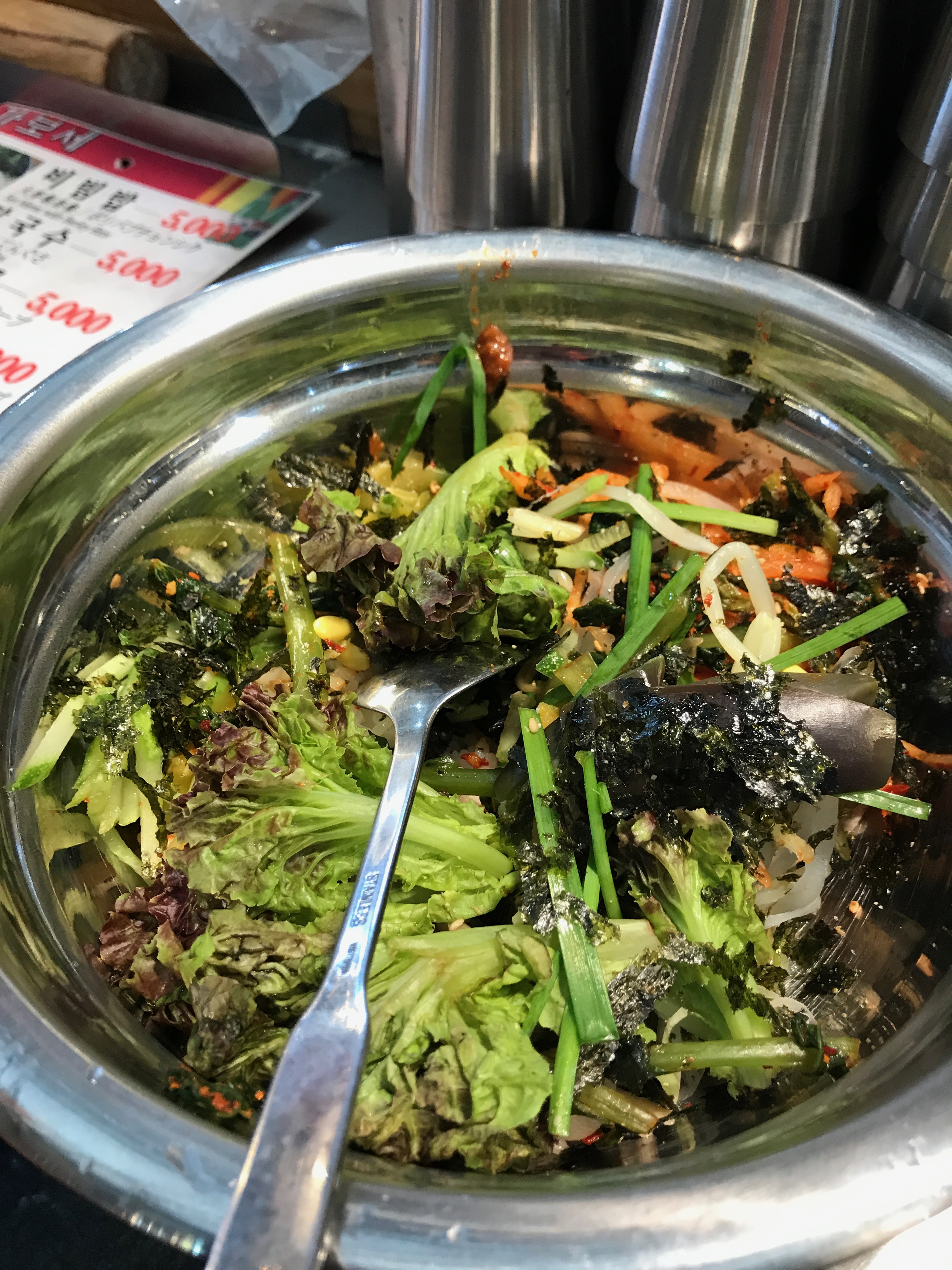
Emerging hungry and ready for an adventure we hopped on the metro to the Gwangjang market, where there are something like 120 food stalls, specializing in savory pancakes according to the guidebook but in fact with not only pancakes but all kinds of scary looking seafood, noodles, pancakes (including whole fried flounders, sand dabs, sea squirts, as well as vegetable versions). We were completely intimidated initially, so David went looking for a new neck pillow as there were also long “alleys” of bedding stores, fabric stores, clothing, etc. He found just what he was looking for! Triumphantly and full of confidence we went back on a food quest and finally settled on a bibimbop stand. Delicious! A huge metal bowl heaped with vegetables, rice, chili sauce, sesame oil—we shared it and a small bowl of hot, delicious vegetable soup with greens that I cannot identify. So good. Several western young women came up and were greeted by the cooks (all women) with lots of laughing and smiles. Turns out they are from Poland, and two of them have been to Korea many times and were remembered. We talked with them—commiserated about our respective political leadership, laughed about how we were all warned not to come to Korea due to tensions with the north and how our native contacts all told us to come, it wasn’t anything new.
We had a jolly time eating and laughing, and then David and I headed off to find pancakes because they smelled SO good. We sat at one of the less intimidating stalls and ordered “assorted savory pancakes” and a bottle of soju. Directly in front of us was the griddle on which more and more and more pancakes of various types were piled on by the warm, smiling cook, and when we started on the soju she immediately gave us pieces of pancake to go with it while the rest finished crisping up. We ate a heap of cut up pancakes, served with a side dish of marinated, raw onion and very hot peppers which she warned us off of. We drank the bottle, ate the pancakes, and waved to our Polish friends as then walked by, a little stunned we were eating again. Ha. Do not underestimate Americans!
Tomorrow we head to Busan with Gideon, Yoojin, and their whippet Birdie. More Korea!
He seemed like a nice enough young man, teenager, a little removed and grumpy but who isn’t at 6:30 in the morning and already at a boring job? His name is Jay, and he was there to help out our housekeeper, house sitter, friend, on a Friday morning. Our rude dogs were uncomfortable with him; Hops got a little snippy, and Pumpkin too barky, while Barley just avoided him.
I totally trust our friend to bring only good people into our home, and so I immediately trusted Jay but didn’t think he and I would ever have much interchange. Does it matter that we’re white and he’s African-American? Sort of…I could label him if I saw him on the street as surly or unfriendly or even a little frightening, but he’s just a young man who happens to come from a different background. I was cordial but distant. He was hard-working and reserved.
One morning a few weeks ago, as I sat at my desk while he and Wendy cleaned around me I saw him standing aside, looking at his hand and frowning. “Jay, what’s wrong?” “I have a splinter. Ugh.” I went to get the tweezers, and then held his hand to the light while we tried to get it out and he flinched, telling me he had had a foster mom who was too aggressive with the tweezers and they scared him a little bit.
Such a tiny encounter. Such a very brief moment. An intimate touch. A shared fear.
What about this experience made it so powerful for me? Is it simply that I look for chances to be a mom, to be needed, and here was one of those sudden opportunities? Almost. But as I took his hand I thought I heard a soft, short, pinging sound, that sound when there is an almost imperceptible break, a crack, or a tiny hole in the protective coating we present to the people around us. A breach that can let humanity in, even for a second, and resonate through a day, a week, or forever. Too poetic? And yet that moment of holding Jay’s hand, helping him deal for a minute or two, it changed me just like every one of those moments in my life has changed me, nudged me closer to being the person I want to be.
When the first Bush was elected my husband said, “Well, I guess we will be listening to a lot more music for the next 4 years.” He meant “Turn off the news, quick!!”
I spend about an hour a day reading political blogs and getting myself worked up about the latest victory, the latest injustice. I’m not at all certain when my appetite for this content will return. At the moment I’m digging in to escapist TV (The Crown!!) and escapist sci-fi (Old Man’s War series at the moment).
We all know, we often repeat, how a life of generosity and justice and love begins at home. That family and friends are more important than what might be happening in the bigger world. That it’s the small things that make the difference. These ideas and values had better be right, because I plan to cling to them for the next little while. Then, I imagine, I’ll be back to consuming the news, fretting over what new horror the white, right-wing folks are planning and doing. Love, peace, harmony, justice–I’ll keep trying to live every one and wish the same to all. And music–listen to more music!
I was thrilled to read this article today on some (small but real) progress in bringing toilets to Bihar state in India, where we visited Patna and rural regions in January. This was a specific request from the women we met with–we need sanitation and toilets, because we all use the fields.
I have been to two Asian countries, 3 weeks in each–Japan in 2013, and our just completed visit to India. Two crowded countries of mega-cities, each with population issues, commute issues, vast investments in infrastructure.
With my n=2, I will now make some only very lightly-informed pronouncements and over-generalizations on societal coping strategies in crowded urban settings.
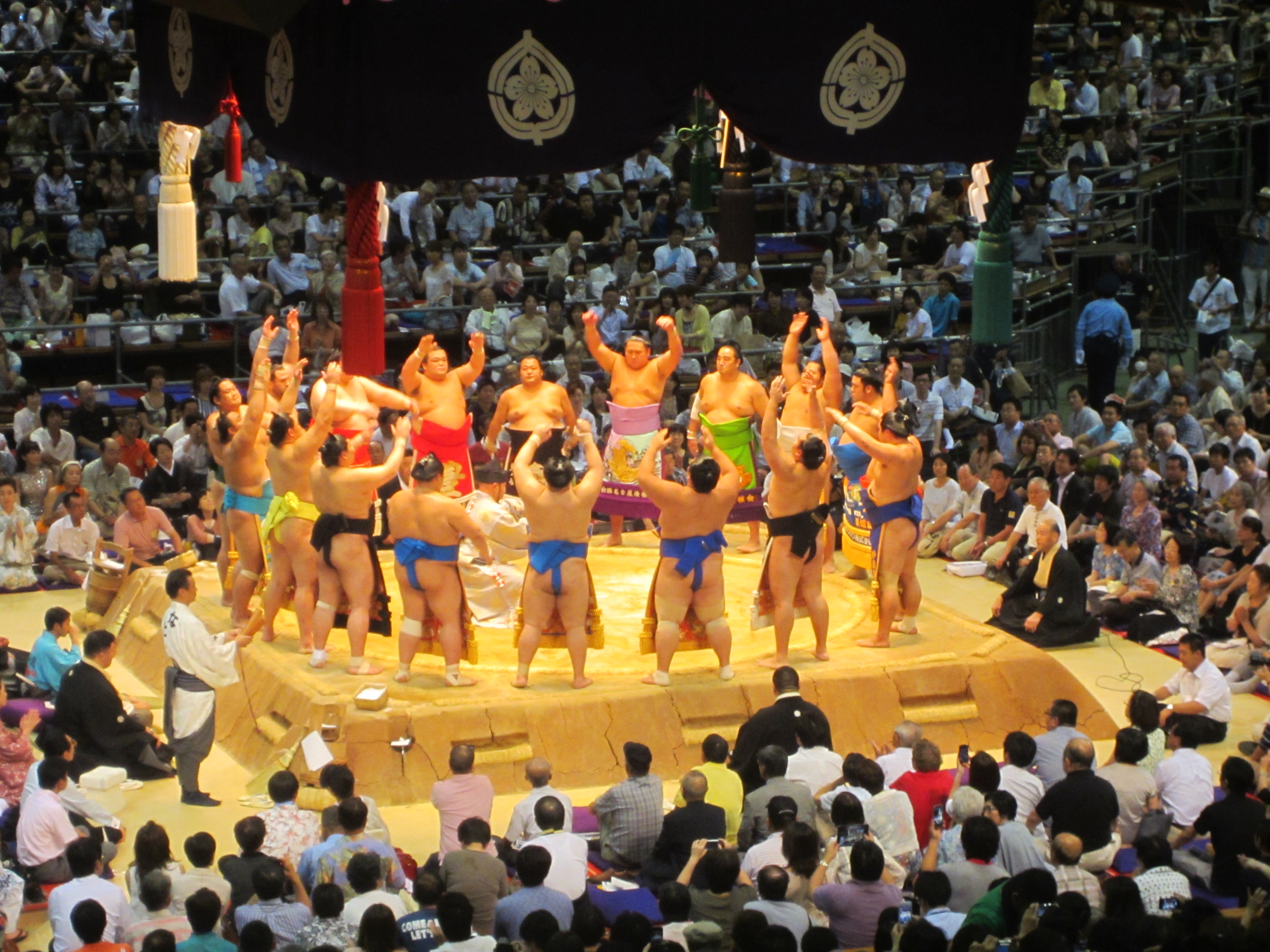
National Sumo semi-finals
In Japan you can almost physically feel the stress, especially in the subways and, oddly, in elevators. Japanese are very polite, very contained, very regimented. They rush through train stations without eye contact. They are impeccably dressed. Everything in the commercial world we encountered was hyper-organized: lines of bowing clerks at opening time in department stores, perfectly timed trains, over-engineered public bathrooms (including the option of having music or sound effects play so no one is disturbed by the sound of your peeing). Yes, of course there are messy edges, but in general it seems to the traveler that everything works. 99% of the restaurants have plastic food displays, so you know EXACTLY what you are getting–an example of a regimented, organized, planned-in-advance way of doing things. Stray animals? Other than the wild deer, none. Dogs running along the street? Never. Though in Tokyo you can see a lot of the quirky teenage fashionistas and costumers out and about, for the most part the homogeneity is striking. The obsession with cleanliness is delightful as a traveler–I could walk all day, and did, in Tokyo in hot steamy weather in sandals, and come back to the hotel with clean feet. Private life–it’s invisible.
In India, everyone is just as, probably more, crowded, but everyone lives life in the open. Bathing. Changing clothes. Men getting shaved, or shoes getting repaired, or clothes being ironed–it’s all on the street. Homogeneous? Not even close. Every variety of sub-continent apparel and manner is available. Colorful is an insufficient adjective. Animals everywhere. Broken sidewalks, people and dogs and beggars and cows and goats, wandering in and out of traffic, on and off the pavement, groups of people standing around everywhere eating, talking, hollering–your impression is that nothing is hidden, life is an open, communal, shared experience. People clothe stray dogs. People feed the cows by tossing fresh greens on the sidewalks in the afternoon. People throw bananas to the wild monkeys. And messy around the edges? India is profoundly messy in so many ways.
When we returned from 3 weeks in Japan, we walked into our house and decided it needed some upgrading–and began planning a major remodeling project. We laughed–compared to the cleanliness of Japan, our life looked a bit shabby.
When we returned from India it felt as if we were entering a surrealistically quiet, peaceful, clean, organized, and maybe a bit dull, world.
When we travel internationally we try to book 3 weeks, given the typically long flights involved. By the time I get to the middle of that last week I am usually beginning to feel homesick for my dogs, bed, food, cool breezes at night coming through open windows–all that good stuff of normal life. Sometimes I’m even beginning to miss work!
Reentry is usually a fog of jet lag and general fatigue for a few days, and then I’m back, with all kinds of resolutions to organize my photos (rarely done), a big box of souvenirs and gifts to be distributed in the corner of the bedroom, and a return to digestive and sleep normality.
Coming back from India had a few aspects that surprised me a little.
To be clear, we don’t live out in the country, but rather in a medium sized city that sits in the middle of a pretty large metropolitan area. Traffic, trains, and the rest of the urbanized commotion are the background of our lives.
I never realized before just how quiet it is here. Coming back from the airport was like gliding along in a dream, seemingly silently though I know there were real noises–they just couldn’t penetrate my armored consciousness. Cars changed lanes, melding into the flow of traffic without scary near misses or horn announcements “I’m about to move;” “I moved;” “I am now past you.” Eery. When you honk your horn in the US it’s because someone is backing out into your car, not because you’re, well, driving. And after five days, we are still noticing the peaceful state of the streets and freeways.
I was struck by how intrusive it is to understand what people around me are saying. Walking through the farmers’ market the day after we arrived, snatches of conversations interrupted my thoughts, my interior monologue, and my conversation with my husband. English words kept barging in on us. Parents talking to their kids, questions to vendors, adult conversations around us seemed almost rude! Jee, keep it to yourself, would you? Our last few trips abroad have been to Spanish-speaking countries where I do catch a fair bit of the talking around me, but in India the only words I understood were greetings, yes, and no. The rest was atmospheric, not communicative. I miss that privacy–not following what everyone is saying around you means you concentrate thoroughly on your own experience.
We surely missed home-cooked and just plain homey food, and one of the first things I had thought I craved was a tunafish salad sandwich. But it didn’t really taste that good–mild and salty at the same time. Last night I made pad Thai for the first time because I wanted something “different.” I am going to go for roast chicken tonight, our most typical dinner. Maybe that will snap me out of it and get my palate back to normal!
All that aside, it sure is nice to be greeted by wagging tails and licks every time we enter a room and, it appears, our dogs are happy all over again to see we’re home.
Outskirts of Old Delhi–a vendor selling corn to feed to birds, with a large pan of milk for stray cats and a street dog curled up on front.
We had feared that by the time we reached our last day in India, a 20 hour stint in Delhi, we would be so tired, tired of India, and homesick that it would be a slog to get through it. The plan we formed a week or so ago was to go to Old Delhi, walk around, buy some spices, and punt the rest of the day. When we landed in Delhi our travel manager met us at the airport and we talked over the plan. He suggested that walking in Old Delhi alone was unwise, and he would arrange a driver to accompany us for the day. This sounded reasonable. It turned out the driver would be the same fellow who took us to the hotel that evening, so we finalized a pickup time for the next morning–he suggested 9 am, as any earlier there wouldn’t be much open anyway. The day dawned misty and chilly. We had gotten a very good night’s sleep and we awoke enthusiastic about the day, against all our expectations. Our visit to Old Delhi the second day in India had been brief–just a bicycle rickshaw tear through, up the hill to the big mosque, a walk around the mosque and then a tear down to be dropped at the Red Fort which is more or less across the street. This time we parked the car, one of the first ten cars or so in the dusty, unpacked lot, and set out walking to the disappointment of the ten or twenty rickshaw drivers who hollered for our business, “take ride to spice market! walk no good!”
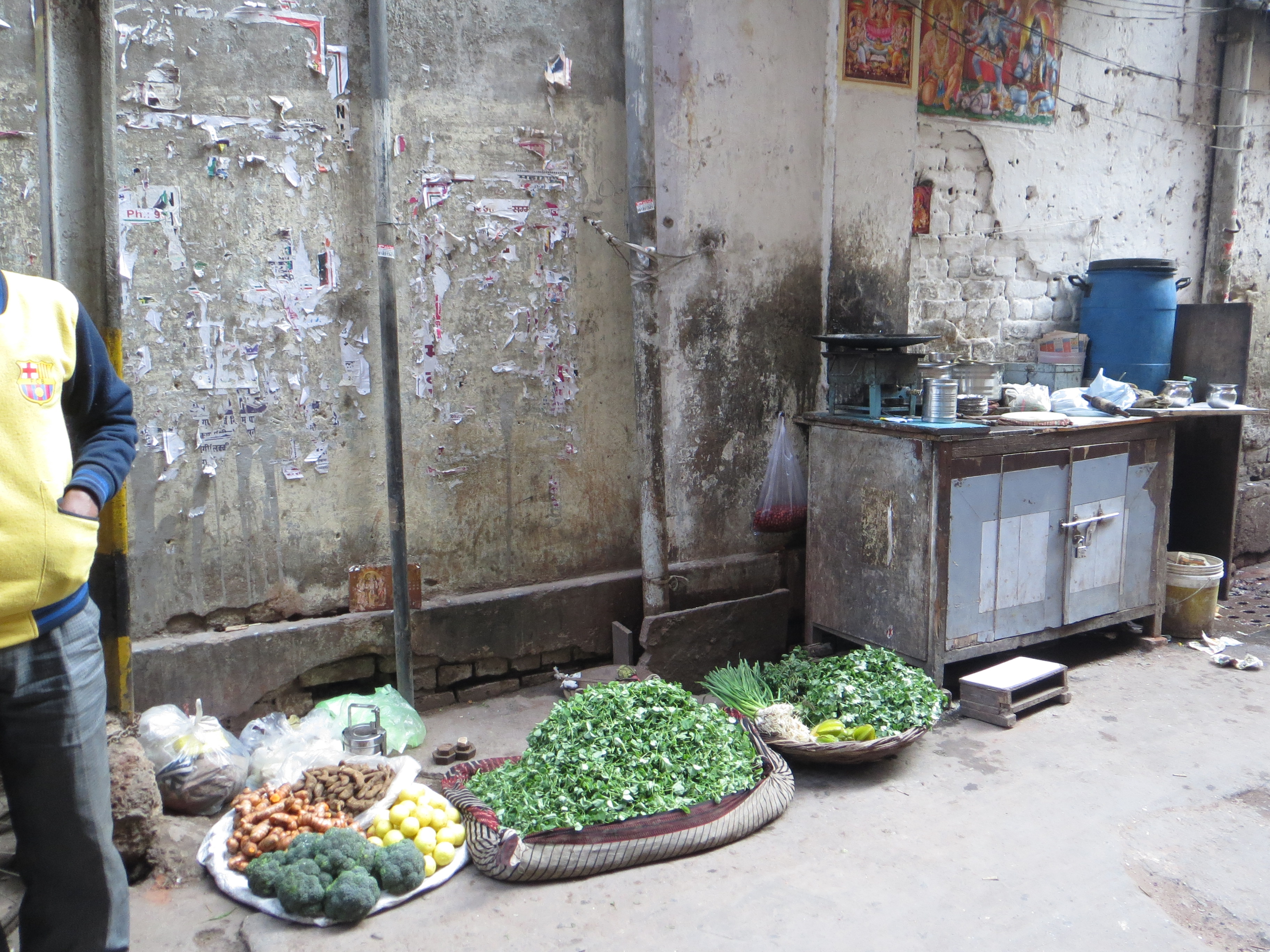
Even on our last day, the beautiful and abundant produce still impressed us.
The sun was coming out, warming the street just enough and we felt more and more excited about the day. Our driver and guide, Santosh, pointed out all kinds of things and guided us along the already somewhat crowded streets, holding us back as motorcycles and rickshaws and handcarts came from every direction. The fruit and vegetable carts and stands and sidewalk displays were out and lots of commerce and bustle kept us entertained. We turned up a main thoroughfare, perhaps a full lane, or, for bicycle rickshaws ample two lanes, wide. Many storefronts were still closed, metal gates down, but many were open including breakfast poori and dal stands, and of course tea shops/stands with battered aluminum pots of milky tea at full boil over charcoal fires. We made our first commercial stop at a large–for Old Delhi–incense, oil and perfume shop.
Incense store.
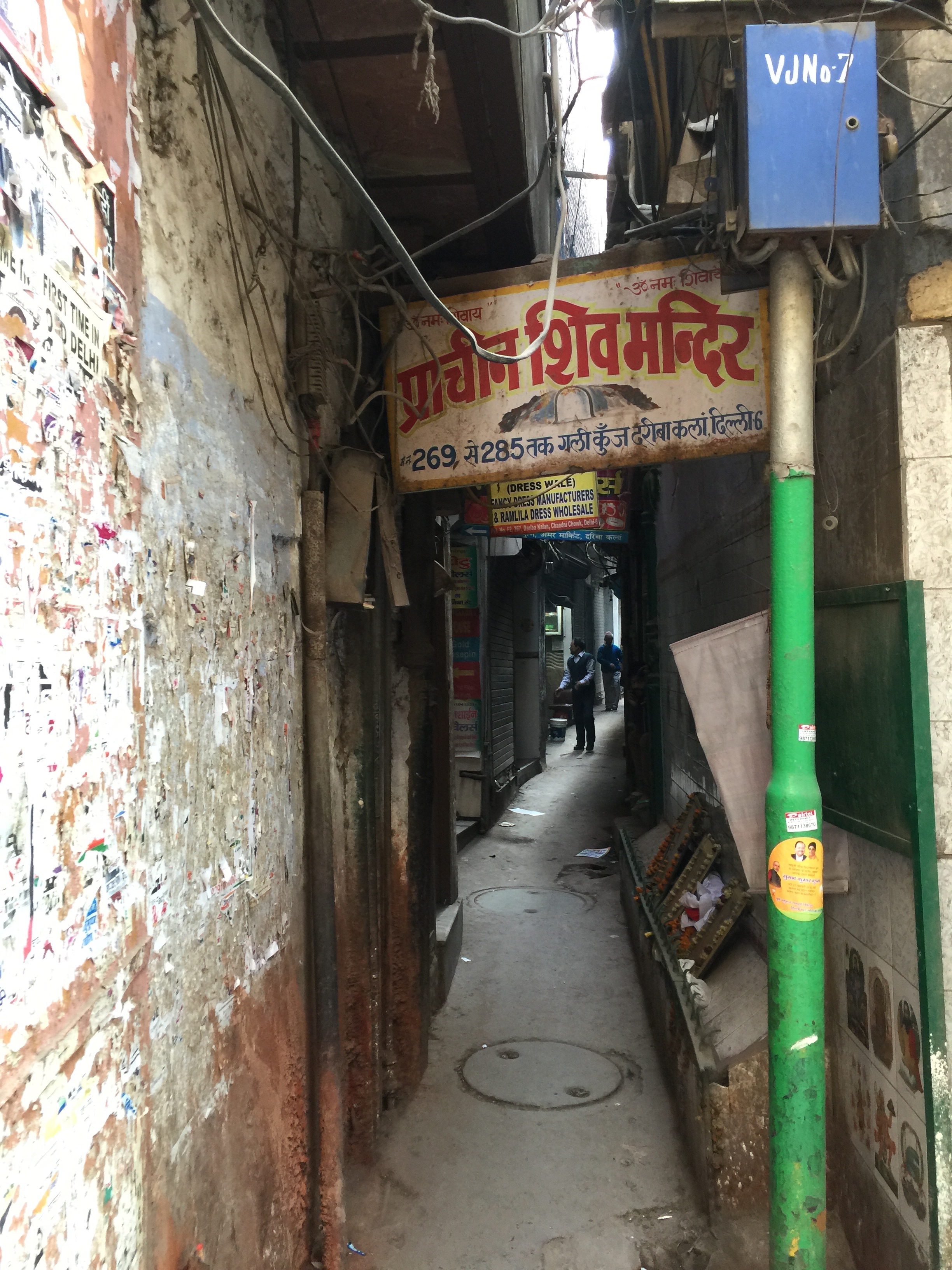
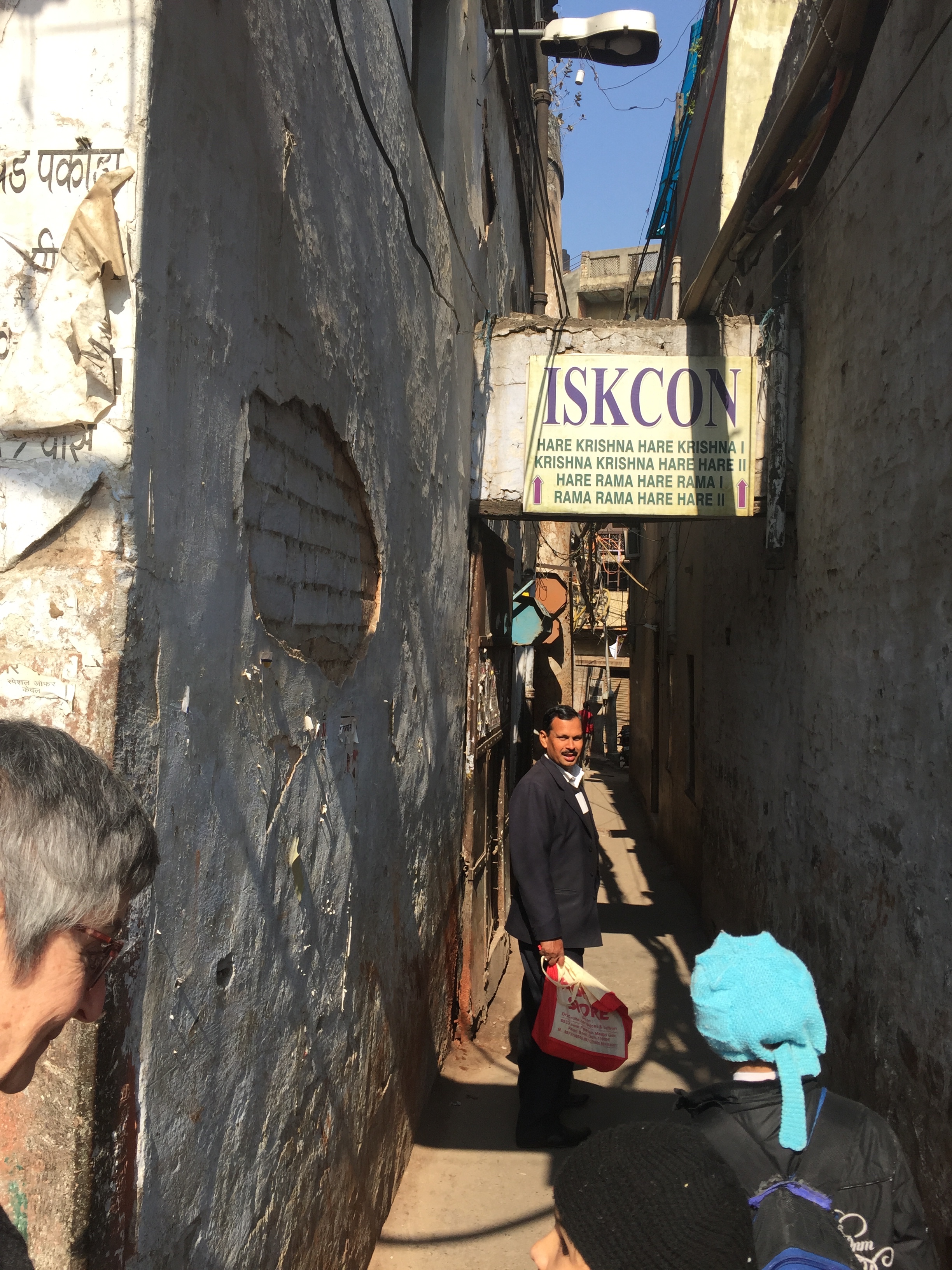
We bought a few packages of cone incense, each with a little ceramic dish for burning them in, and got into a chat with the proprietor. Where are you from? Where have you visited? Very nice. We kept walking, watching the city come fully alive alleyway by alleyway. Santosh suggested leaving the main thoroughfare so we turned into one of the very, very narrow alleys.
Temple decorations.
Window symbol looks so Jewish!
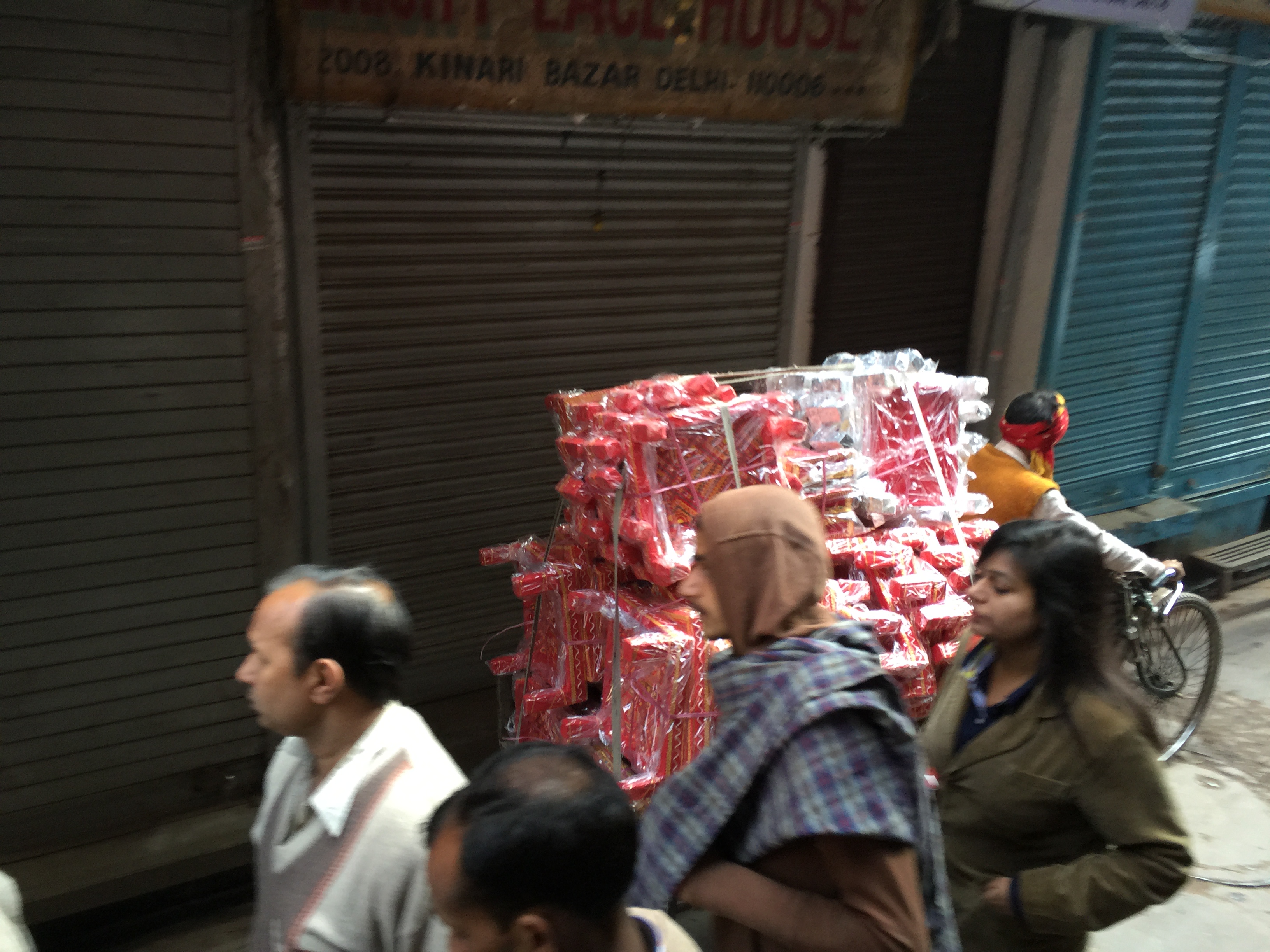
The volume of goods moving by bicycle amazes–this is a cart of painted tables.
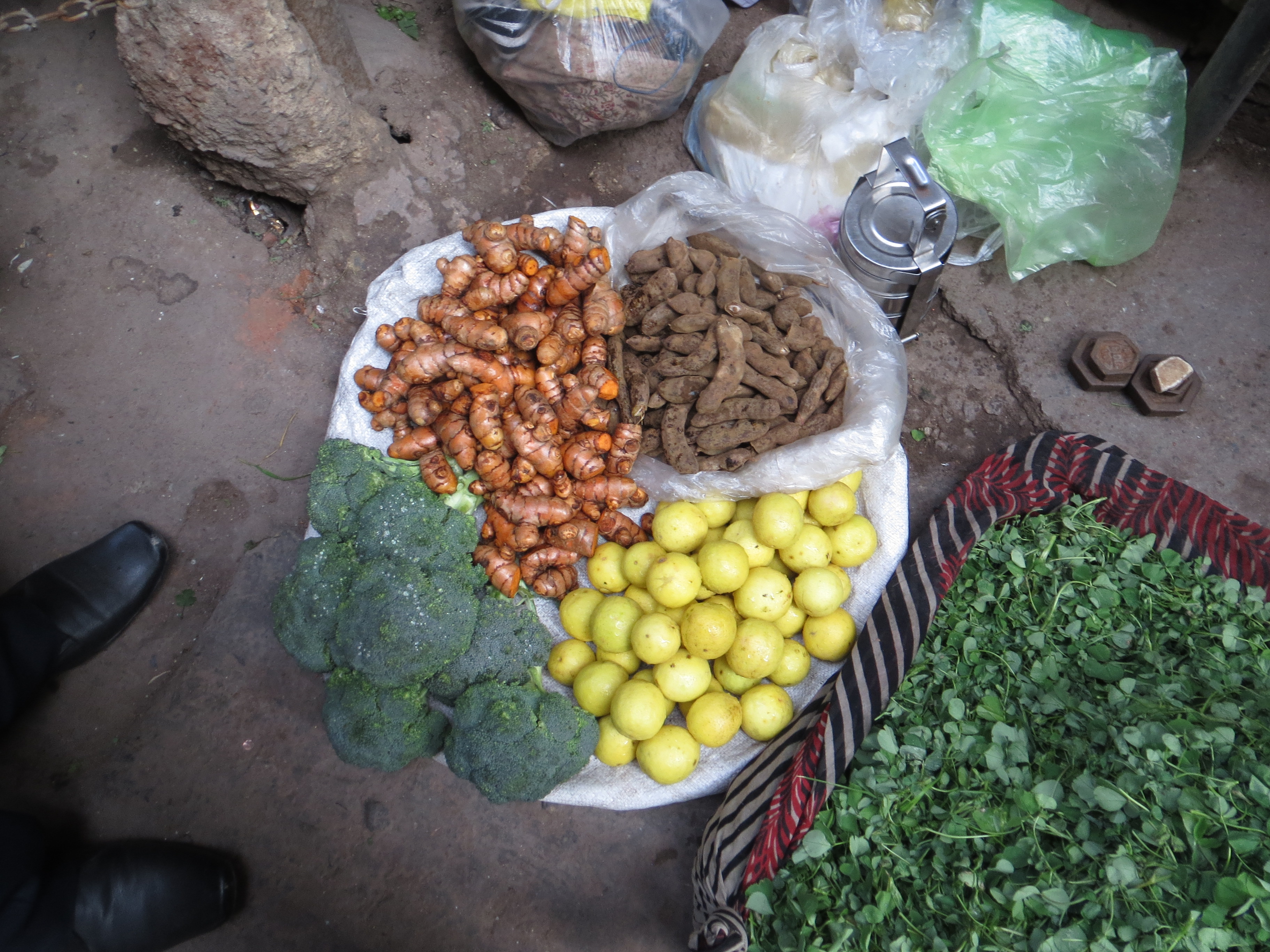
What a delight! Many sari and bead stores were opening, as we were in the sari district, and vegetables were for sale from canvas spreads on the pavement. I stopped to look at what I thought were ginger bulbs, but the ends were orange.
Produce for sale all over the place.
Upper left–looks like ginger but is fresh turmeric.
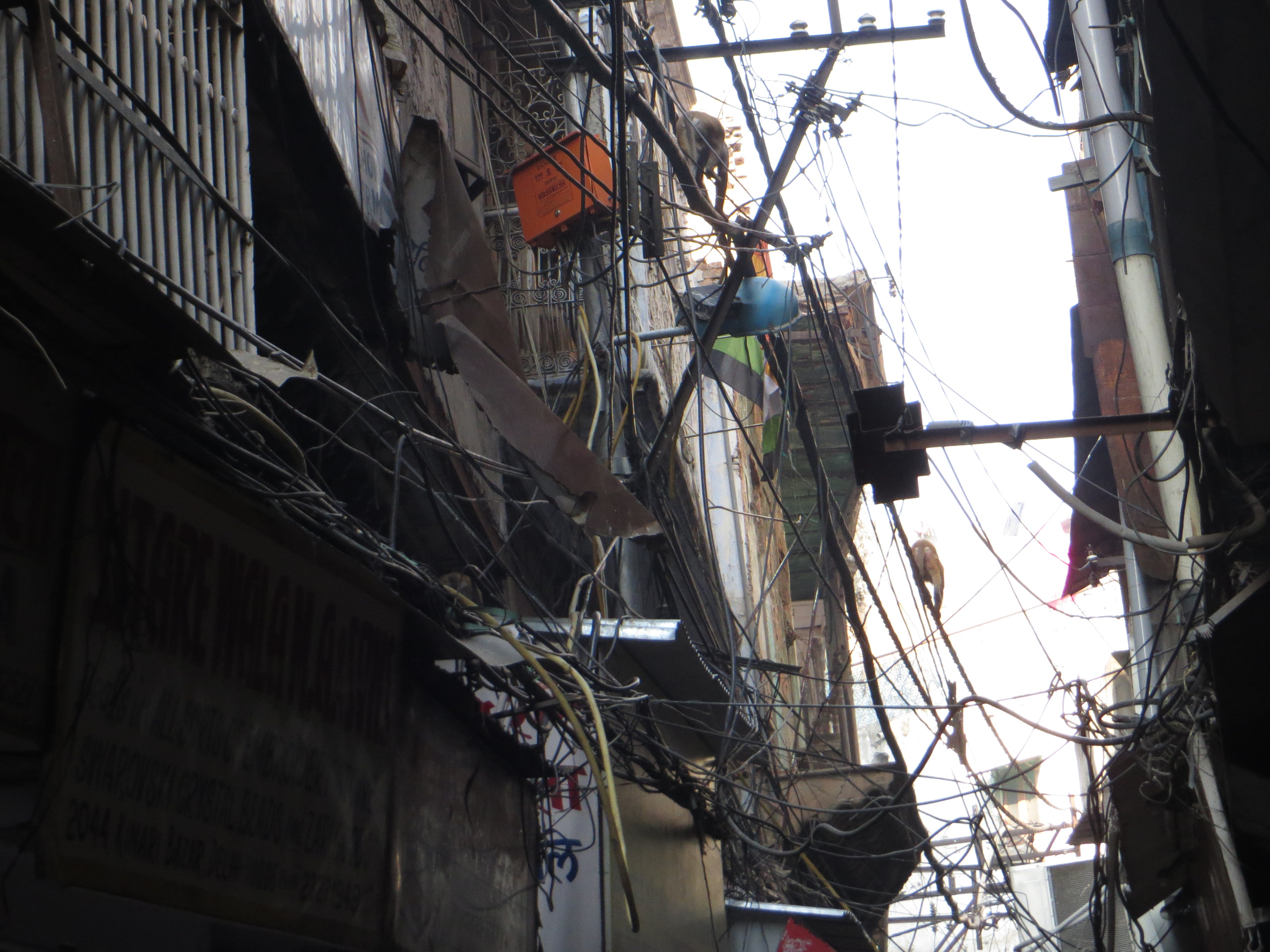
They were fresh turmeric! I bought a few (15 rupees) and hope I can bring them into California. We shall see. Cauliflower, peppers, tomatoes, purple and spring onions, bananas, apples, star fruit, and a few things we couldn’t name. A few monkeys ran ahead of us on overhangs and, frighteningly, the sagging tangle of electric wires.
I hope you can see the monkeys running along the wires.
Vendors tossed bananas up to the monkeys which run along the overhangs and electrical wires.
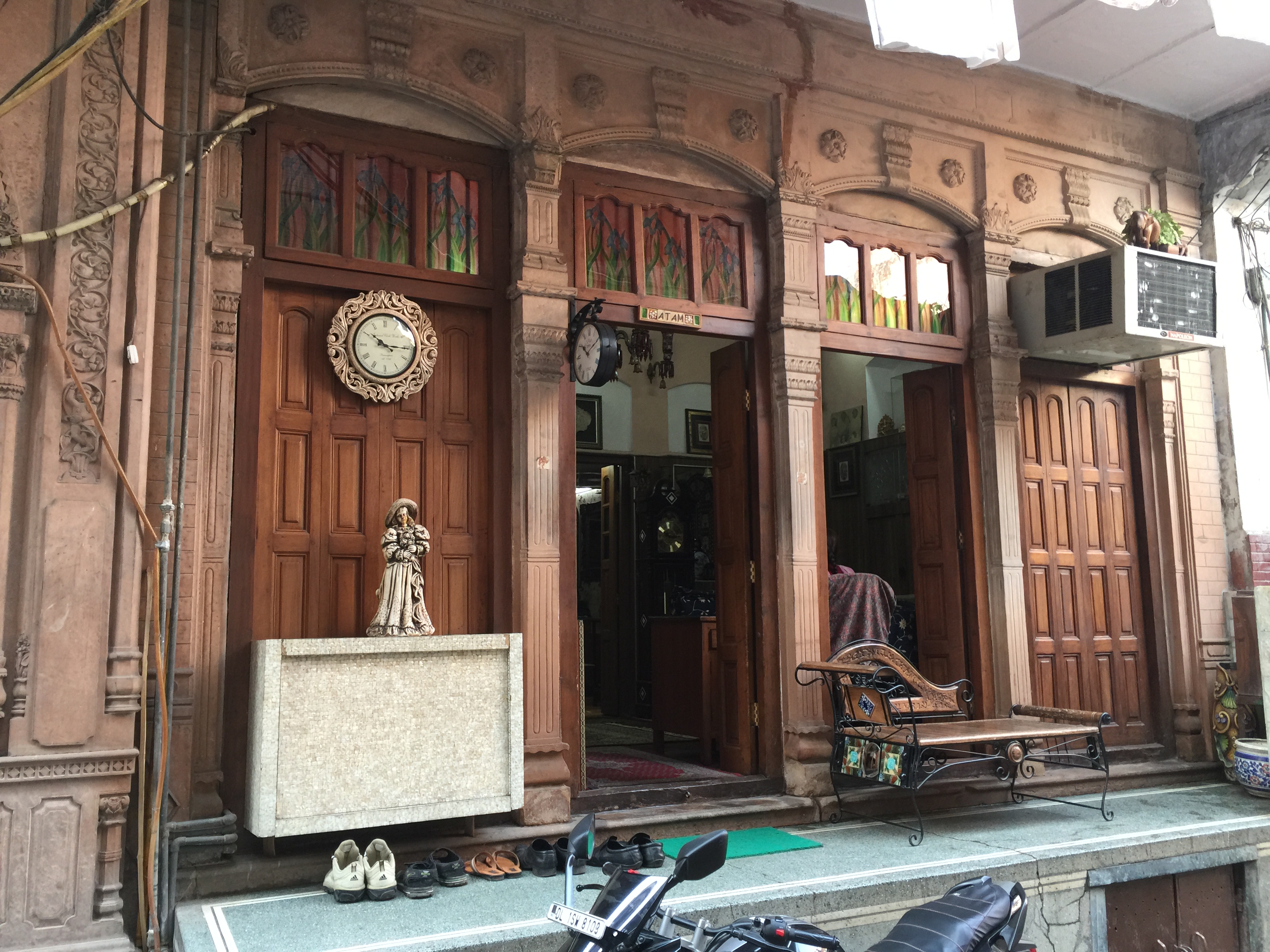
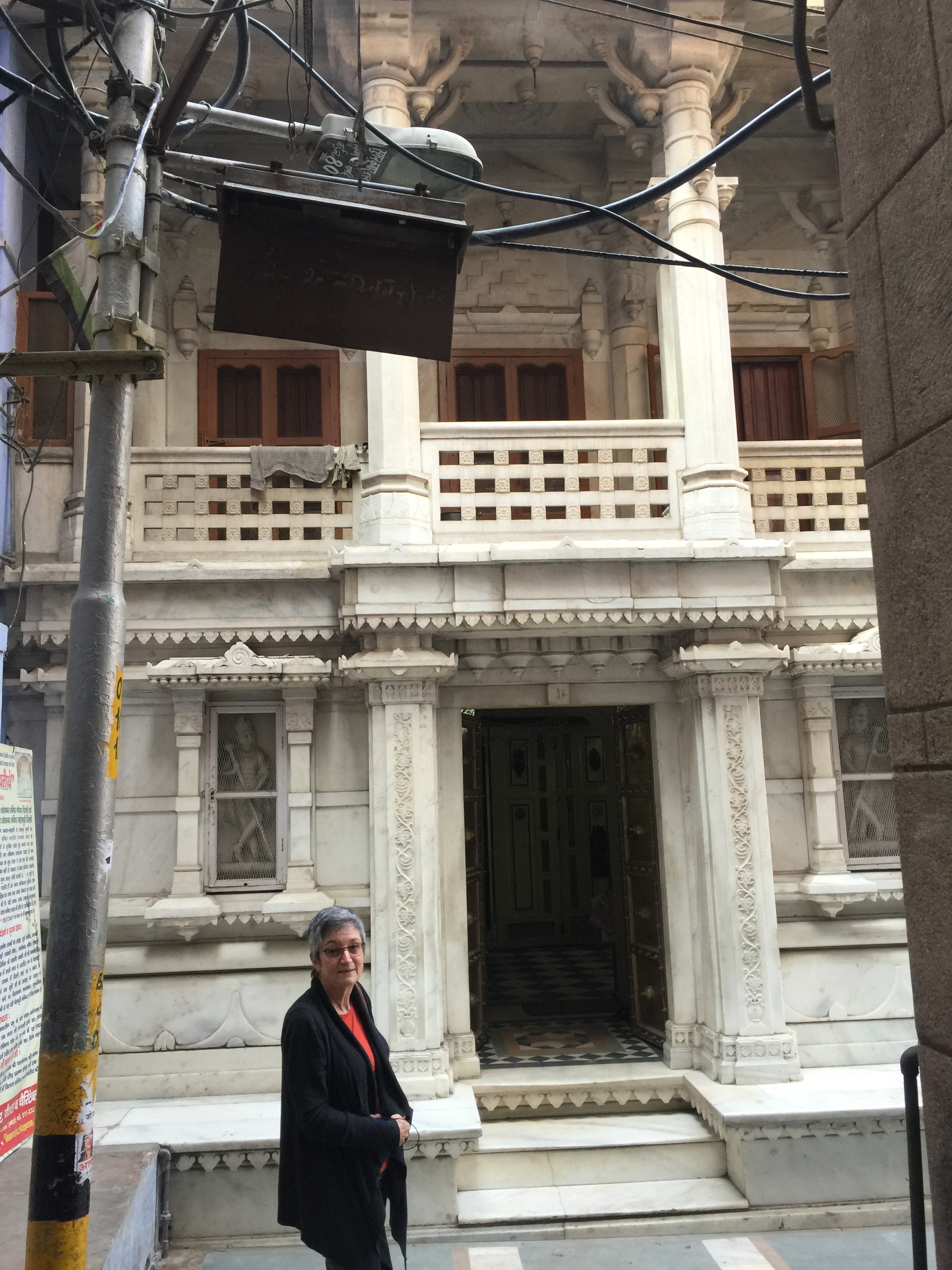
At one alley corner a fruit monger was tossing bananas up to them, and it appeared to be a morning ritual as the monkeys each waited for his or her banana and one dropped down to the pavement to eat it. Off to the side of one alley was a wide, quiet, beautiful and ancient-seeming row of houses, a commercial office of what looked like an antique or arts dealer having a chat on a speaker phone, and at the end of the block a white marble building which must have been a temple of some kind. We took many pictures…it reminded me of the row of painted ladies in San Francisco in that it was impossibly picturesque.
Quiet side alley of beautiful buildings.
Another building in the quiet alley.
White marble, which we assumed was a temple, in the quiet alley.
In the quiet alley.
We wandered from one commercial district to the next–housewares, books, paper goods/stationery, saris, sari lace and beadwork, brass work, jewelry…and it got busier and busier as pretty soon every shop was open. It seems impossible that all this stuff gets sold, or that an establishment produces a sufficient income. But this is largely a wholesale district and it apparently all works. We insisted on getting to a spice market but Santosh didn’t know of it. We begged him to ask and he did, and we made a u-turn. The we were in the shoe district, the clothing district, the watch district–and I remembered that my watch and was fraying and so we ducked into a store, like most about 5 feet wide with glass cases up one side and a counter on the other. Yes, they had them! About five minutes later and 150 rupees lighter (a few dollars) I had a new watch band installed. Yeah!
New watch band.
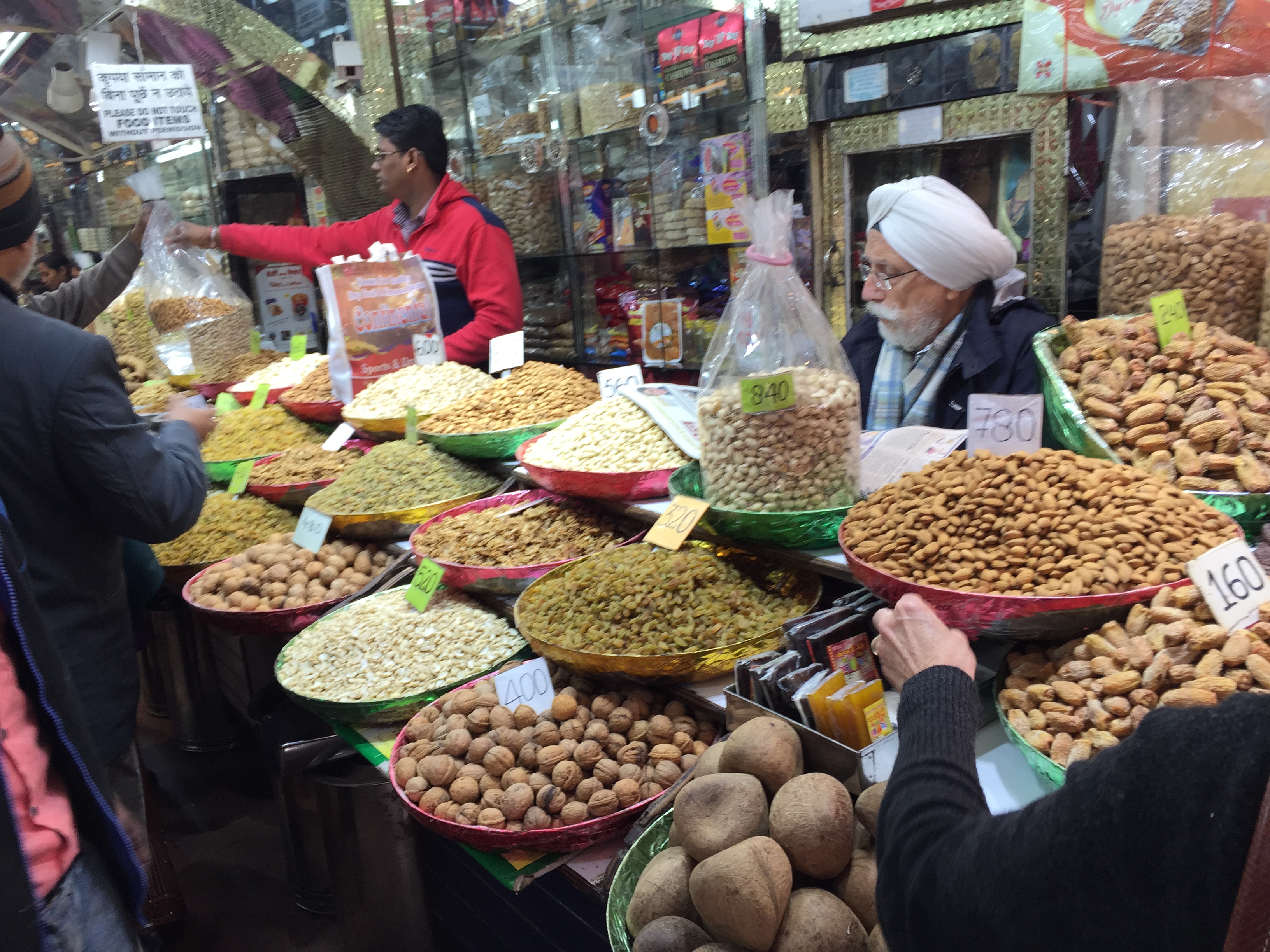
Imported almonds-from California!
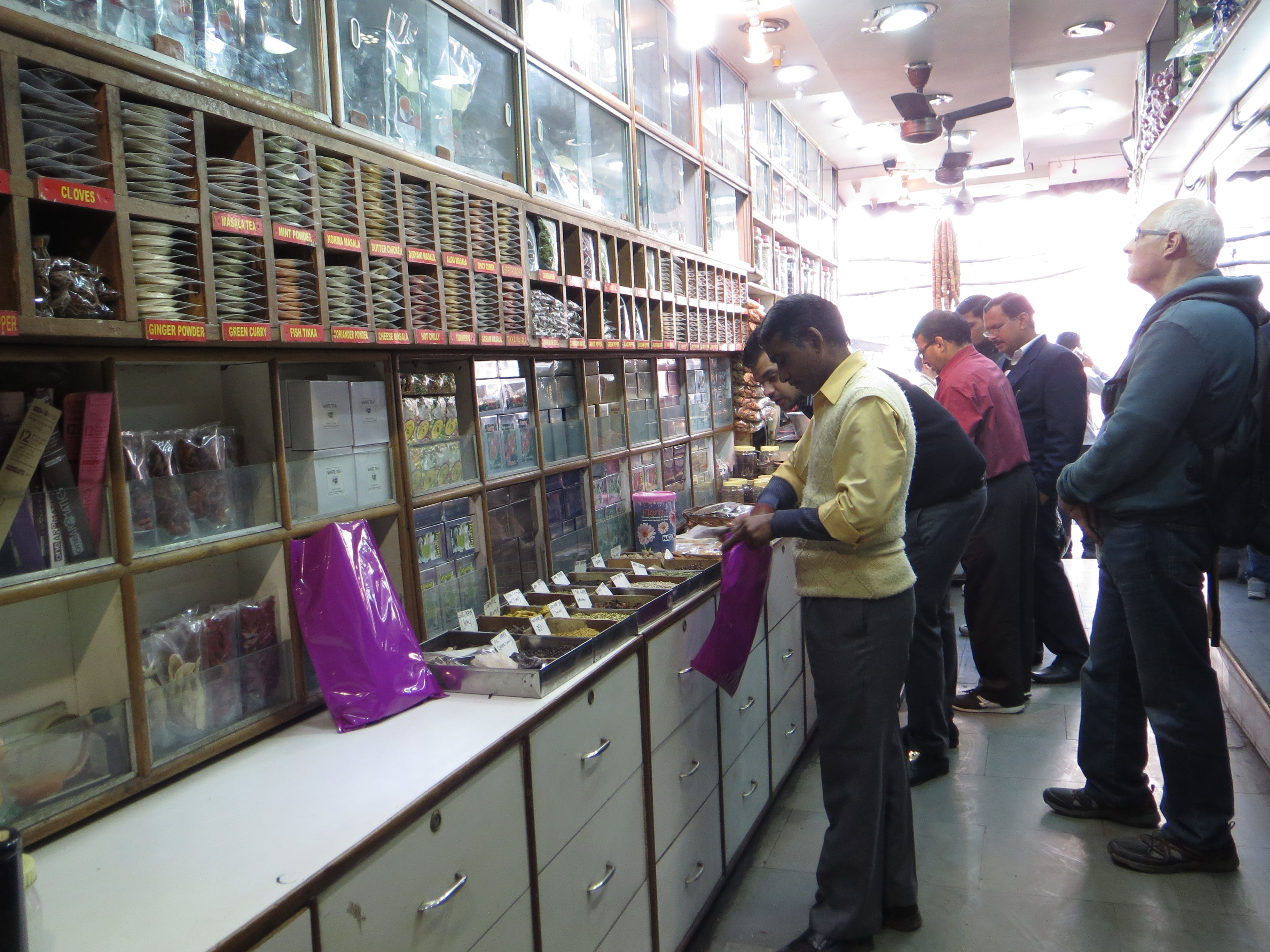
We came around a bend and store after store was selling nuts and dried fruits, including almonds from California, but mostly local. Santosh had us duck into one, and they sold a wide array of spices and masalas (spice mixes). A salesman started taking us through everything that they had. There was a open tray of compartments and he had us smell or taste each one–all, except Szechuan pepper, of Indian origin. “Taste this salt–it tastes like hard boiled eggs” as he picked up two large rocks of purple crystal, rubbed the, together to drop a few flakes in our open palms. Yup! It did, because, as I confirmed, it has sulfur in it. This is the black Himalayan salt–some of which I have at home but believe me it tastes nothing like this delicious stuff and I said right away I wanted some.
In the spice store.
Fellow on the left had us sample all the spices–great sales experience.
Tellicherry black peppercorns. Dried mace flowers. Dried whole turmeric. Vanilla bean. Cinnamon bark. White peppercorns. Coriander seeds that are light yellow and oval, unlike the ones in the states. The we went on to the masalas. Fish masala, chicken tandoori, and about five others. And chai tea mix. We ended up spending $140 or so…what fun!
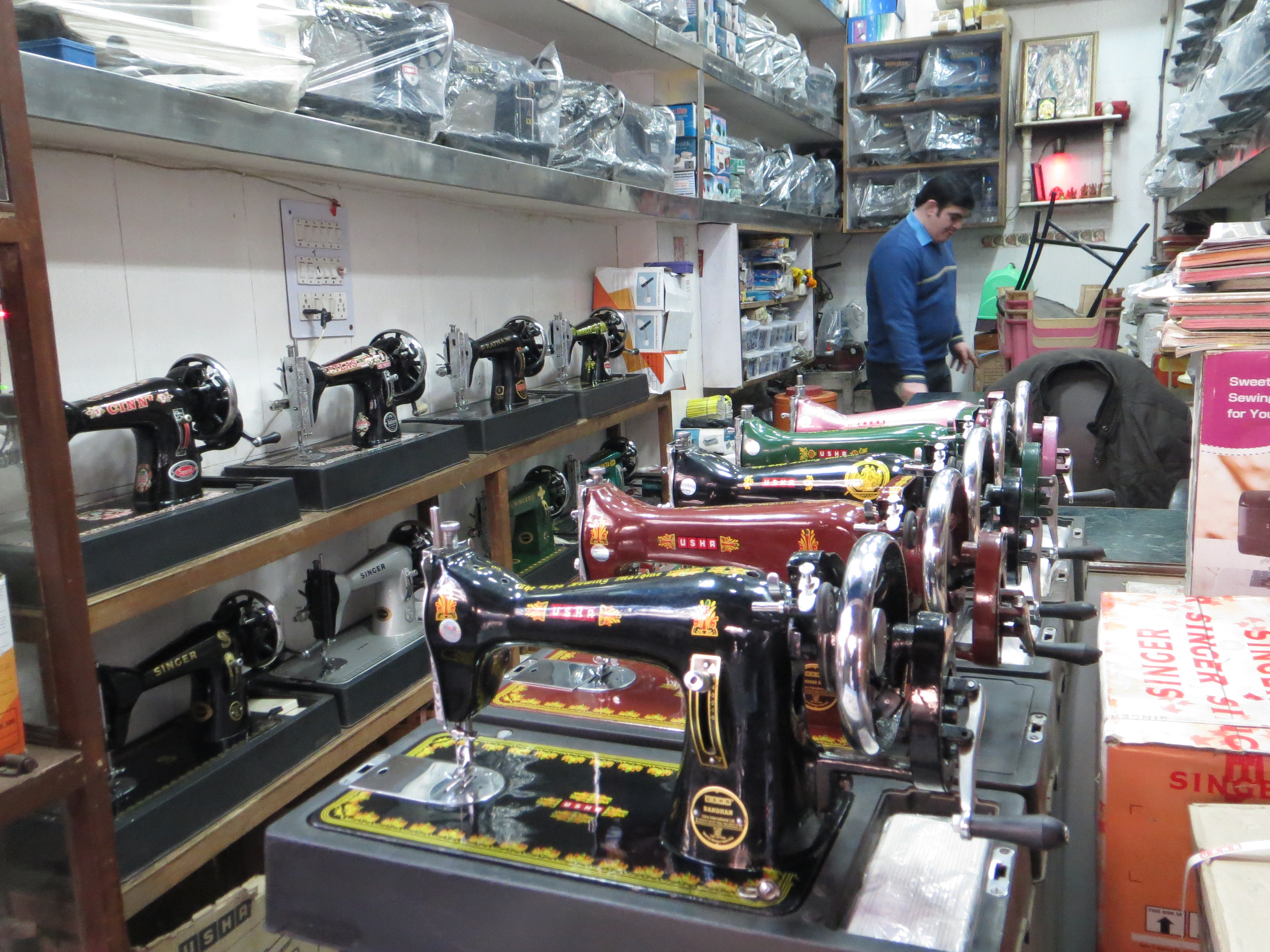
Shiny new manual sewing machines–the ones we saw at street tailors and in, for example, the place in Jaipur where I bought the Afghan antique fabric.
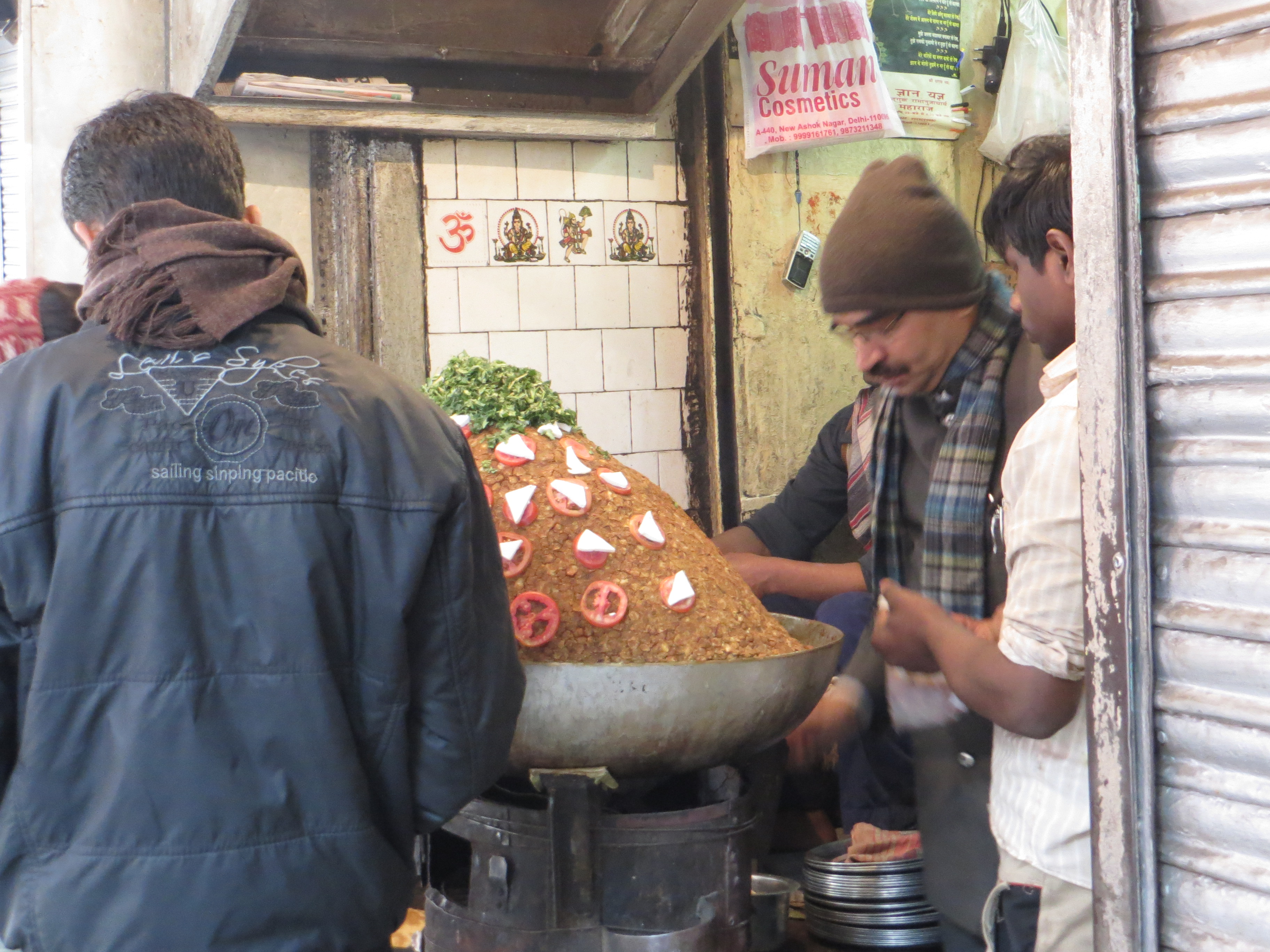
A mound of a chickpea mix, decorated with slices of paneer and tomato, at a breakfast stand.
Santosh ran into an old friend on the street; note the sewing machine–a street tailor.
Street barber.
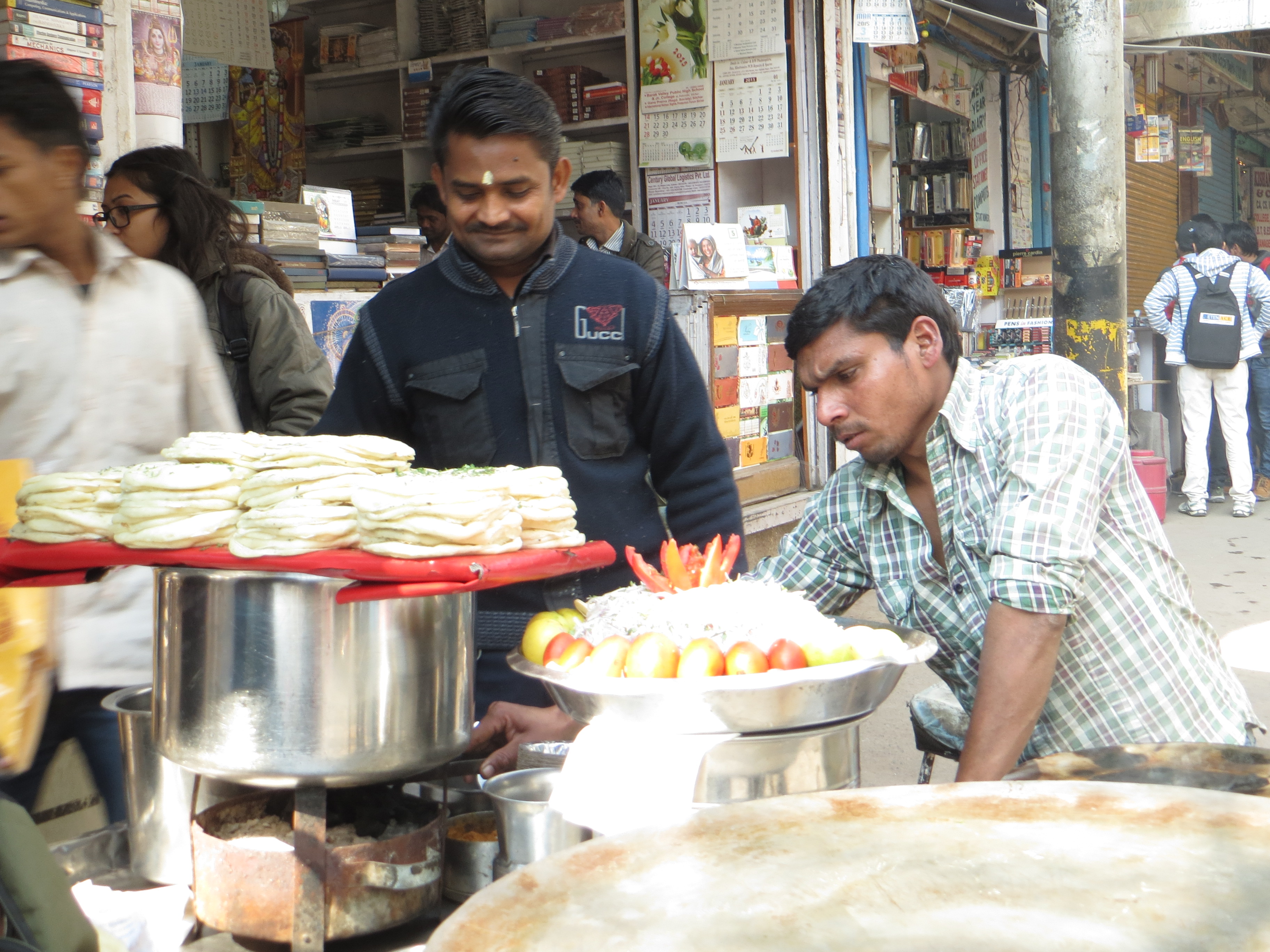
Snacks–so tempting.
Shoe repairman on the sidewalk (common).
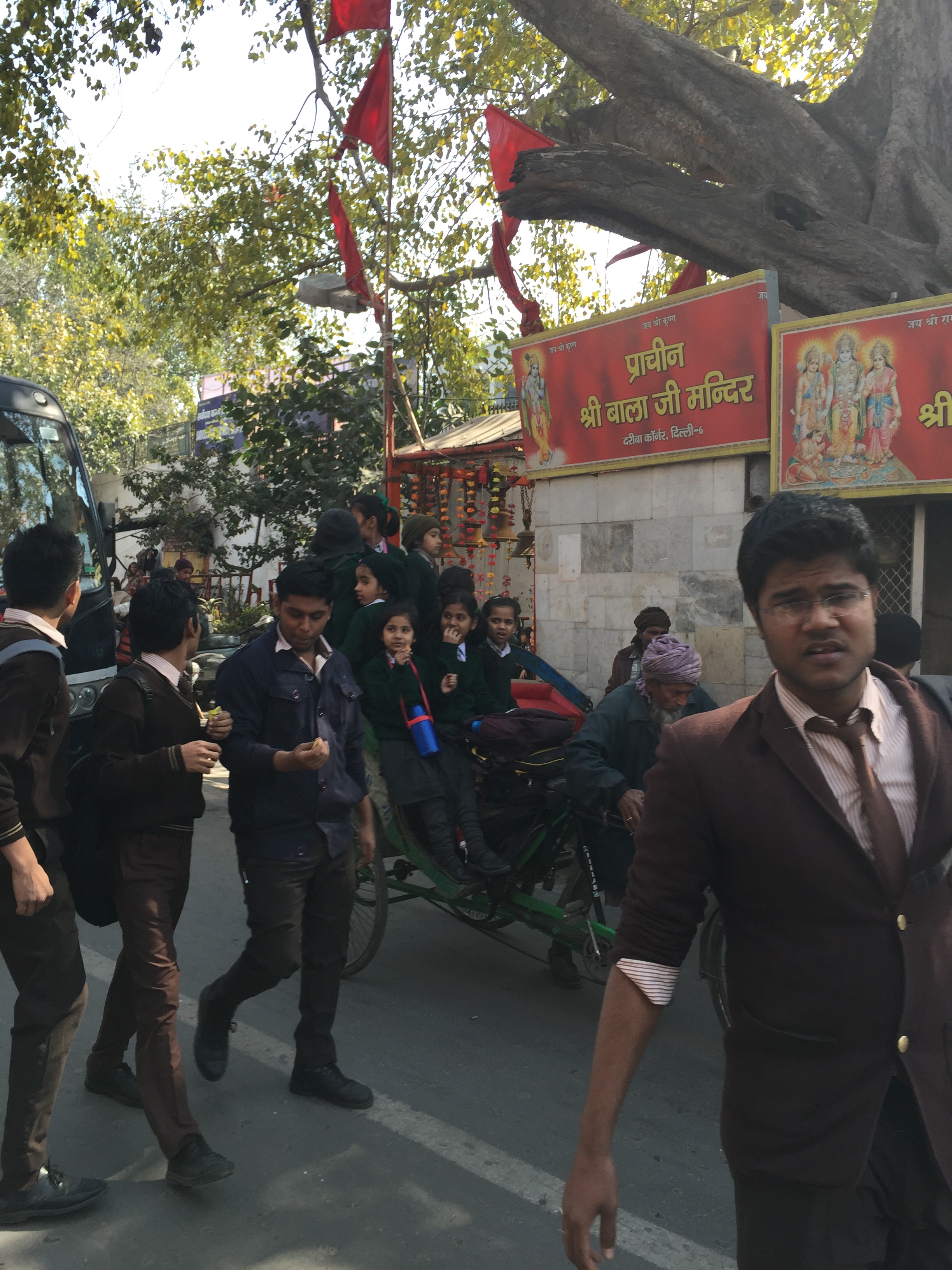
We wandered back through the side alleys, gawking and taking pictures. The sun was shining and it was like the whole of India was crammed into this amazing place. Schoolgirls in uniform buying little dishes of noodles, all crowded around and pouring orange and green sauces on top. School kids jammed 6 or more into bicycle rickshaws to head to school. Muslim men, and some women, milling around the mosques. An oxcart racing, incredibly, up the street. A man hurrying down an alley with a washing machine balanced on his head. Poori stands (a puffed fried bread).
Girls going to school via bicycle rickshaw.
Looking at garnets in a small wholesale jeweler.
Typical bedding store.
Off the tourist path in Old Delhi.
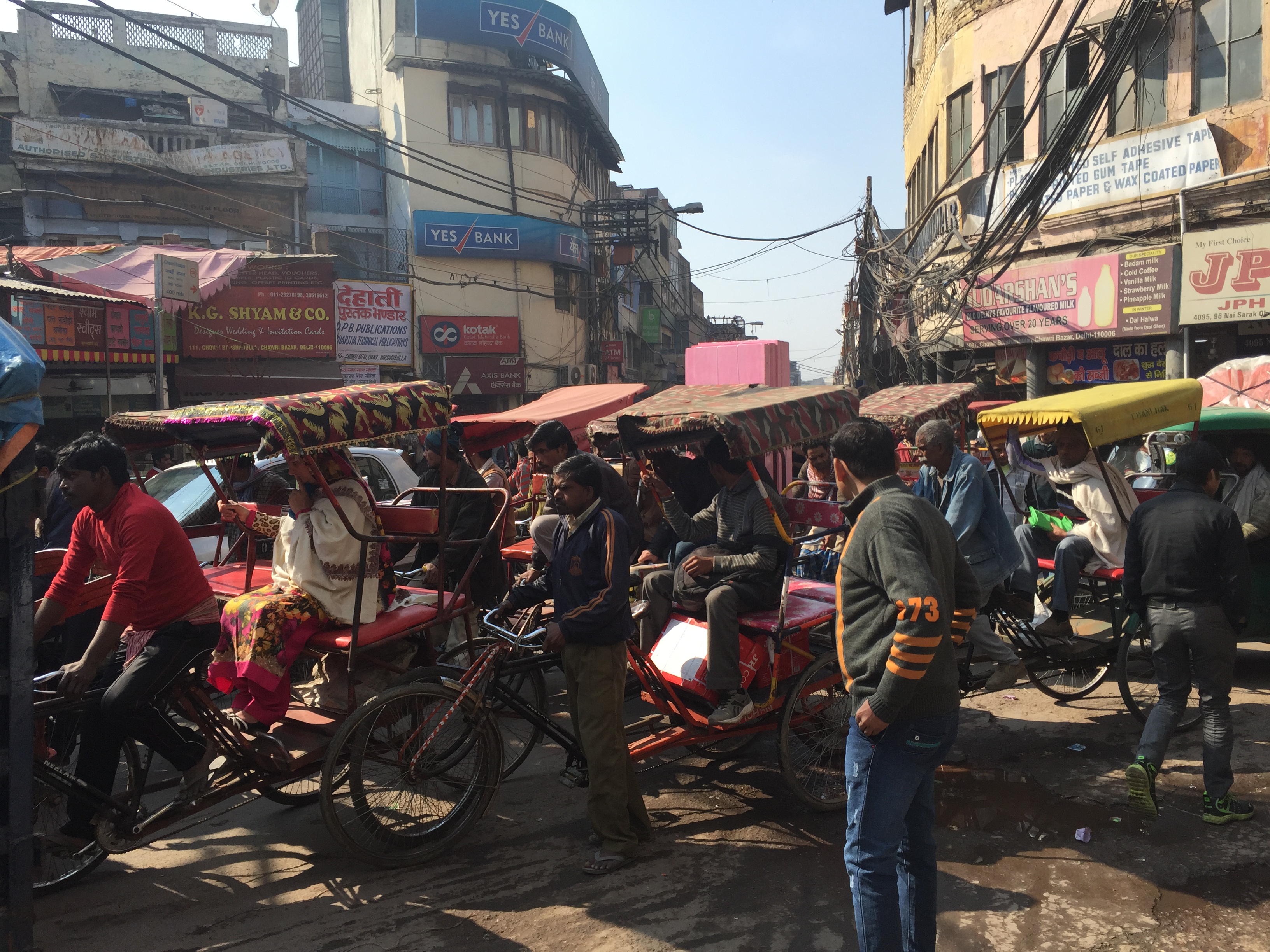
Late morning crowd in the paper district.
Seems impossible for anyone to get anywhere, but they do.
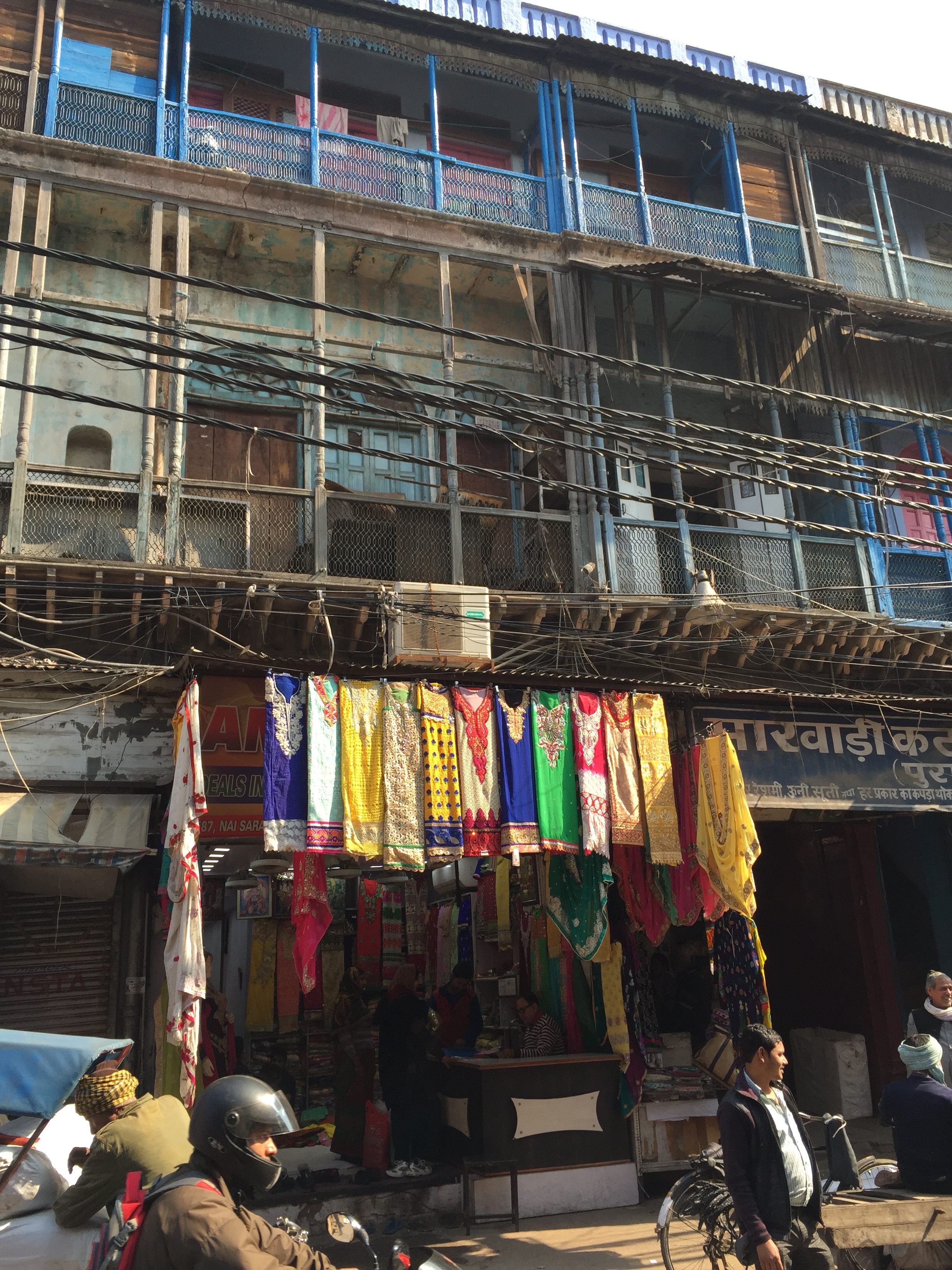
Our guide told us the exteriors are deceiving–there are very nice apartments above the stores, even in the very old buildings
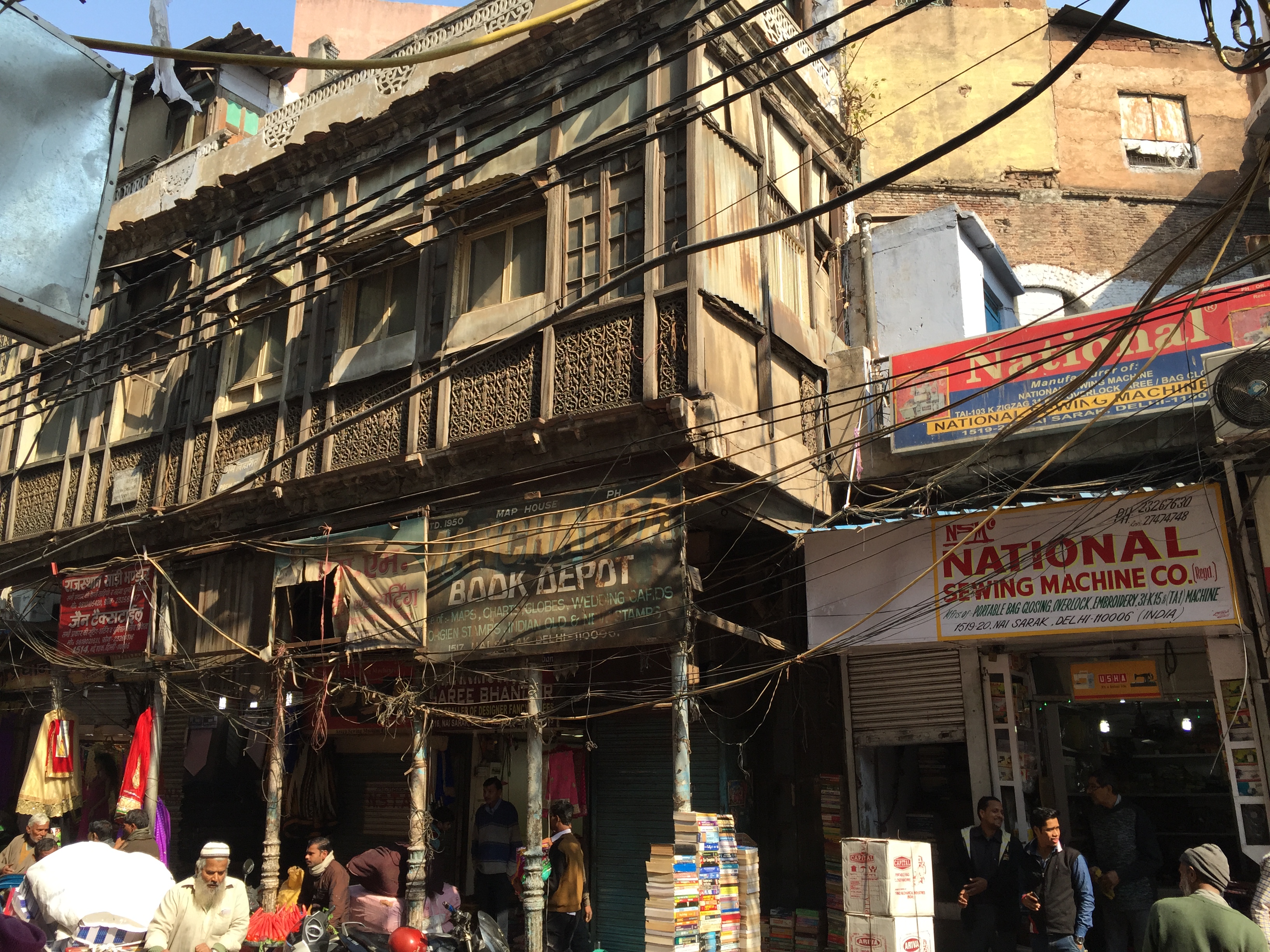
Beautiful old building. Sewing machine companies sell manual machines used everywhere. We saw only men sewing.
When we returned to the parking lot it was a mass of cars, so crowded and busy with cars coming in I couldn’t see how we would ever get out. But it took only a few minutes and we were on the road, which was midday full. We stopped at Pindi, which had been our favorite restaurant in Delhi, for our last, and most delicious lunch of paneer tikka, mutton saagwala (lamb in a spinach sauce), rice and paratha. Heavenly.
Need fireworks?
Goodbye
Major street repairs in front of old apartments.
Families buying saris.
You can see family groups selecting wedding saris.
Delhi. Goodbye India. Thank you for treating us so well and for showing us your beauty, squalor, messiness; for saving your history, your palaces, forts, temples; for your generosity, openness, curiosity; your spices, food, salt lassis; your Hindus, Sikhs, Muslims; your friendly children, beautiful and inspiring women, pushy businessmen; your cows and water buffalo, your dogs and cats and monkeys; soaring kites, both avian and paper, screaming parakeets.
We won’t miss the dusty roads, uncollected garbage, constant honking horns, beeping motorscooters, ringing bicycles. We won’t miss the unending construction, piles of bricks and sand and lumber, or having to buy bottled water or having every single meal at least a little bit spicy. We never expected to love it as much as we now do, and hope we will come back someday.
As first time travelers in this wondrous and complicated country, we probably were more attuned to the “messy bits” than we will be next time, so here are a few things that might help other first timers.
Traffic and travel times
Looking at India from afar we found ourselves dreading the traffic in Delhi and other large cities. In fact, the traffic everywhere (except open highway, sometimes, and Khajuraho) is horrible. Many roads are in pretty awful shape or, worse, are in the midst of major repair. Because there are vehicles of various sizes all competing for space, every gap is quickly filled with whatever will fit. Three marked lanes will always have at least four, usually five, vehicles abreast.
There is nothing, nothing, you can do about it. Fortunately estimated travel times from our guides always took traffic into account. Even more fortunately, the people watching, animal watching, and general stuff to see is so absorbing that the time it takes to get from one place to another was, for us, rarely tedious and even then it passed pretty quickly.
So sit back and chill. Look around and be glad you have the swirl of Indian life to entertain you.
Drivers
Some drivers are extremely aggressive. Some are chill. We didn’t notice much difference in how long it took to get somewhere, but it could be rather scary to focus on all the many (many!) seemingly near misses. While in the US it seems everyone overestimates how big his or her car is, pulling out of parking places at a snail’s pace and leaving half a car length between unmarked parking spaces instead of a foot or so, Indian drivers appear to have a precise, to the inch understanding of where their cars start and end. They can pull around other cars with what to us looks like a mere centimeter, and no more, to spare. We saw exactly one traffic accident and it was on an open highway.
Try not to focus on how close everything seems to be passing your vehicle. Just don’t look, or look and marvel.
Hotel room electrical management
We stayed at upscale hotels–not the highest of the high end, but, for example, the nicest hotel in Khajuraho, a large Sheraton in Delhi, and the like. Every hotel used the room key to turn the power on in the room–you drop your key in a slot by the door and the lights come on. So far, so good. But every room had a confusing, sometimes illogical set of switches to turn things on, and a few had timers on bathroom lights and/or auto-on motion detectors for hall or bathroom. It was incredible to us how difficult it was to figure out how to manage a simple thing like turning off the bathroom light..
Make sure you ask! And pay attention to the instructions. Remember that you cannot leave something to charge all day while you are out and about…because when you leave, the power to your room is off.
Food
We never got sick, but we never had street food though we did have chai tea from a street vendor. It was delicious, btw.
We also ate and drank a lot of yogurt and took probiotic capsules every day. I ate papaya and yogurt every morning for breakfast–yummy and a digestive aid. All in all we were probably simply lucky.
The non-Indian choices in the hotels were so-so. As much as we enjoyed the food we did get weary of it a few times. Do a little research if you are not familiar with Indian food, and do note that almost everything is very spicy for most American palates. The breads, and the yogurt, which were always available, were very helpful in offsetting the intense flavors. Do try the lassis!!!
Public elimination
There was a lot of press about the lack of public toilets, and rightly so. Men pee on the sides of the roads everywhere. Everywhere. The only public urinal we saw was in Old Delhi (we saw only one and it was in steady use).
We also saw women and men defacating in open fields. This is not only very dangerous to everyone’s health but demeaning to the population. Indians and visitors can pray that the government gets this remedied as soon as possible for so many reasons.
It’s best, and easiest on the emotions, to ignore this behavior. Do use hotel and restaurant facilities whenever they avail themselves. Not everywhere has western style toilets, so bring strong thighs. Very few women’s bathrooms had both toilet paper and paper towels or hand dryers. I was super glad I had purchased a travelers roll of TP in a little plastic case and used it often. Get used to drying your hands in the air or on your jeans.
Animals
There must be millions of stray dogs. It is extraordinarily sad to see, and of course for India an enormous problem by adding to the mess and at times general commotion, though barking dogs were quite rare. As a dog owner and lover I found it painful. The countervailing aspect is that most Indians love animals and many take time and money to feed them, and in some cases put t-shirts or sweaters on them when it is cold. (We also saw goats in clothing!) I assumed if you saw a dog in clothing it meant it had an owner but I was told by several folks that no, people just did this when it got cold.
In general the dogs seem independent and/or resigned. Though some are very thin, most are on the thin side but not alarmingly so. We saw them sleeping in front of vendors, undisturbed, and we never saw kids or anyone deliberately harassing, injuring or chasing them. So it is awful, but bearable. As I mentioned in another entry we saw monkeys being fed, there were street vendors selling dried corn to feed to birds, and people put out greens in the afternoon for cows and goats. Try to console yourself with these things and not stress about how the public animals don’t have the cosy life of most American pets.










































 Inescapably Rational