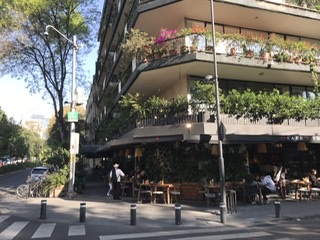
We could live here. What a great walking, eating, dog-watching, park-filled part of the city. Our hotel, the Stanza, sat right on the edge across from Pushkin Park, and it couldn’t have been more convenient or pleasant.
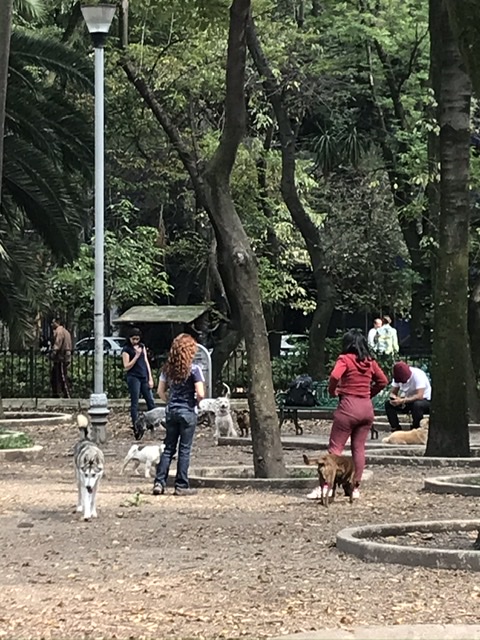
From Taquitos Frontera, a fabulous restaurant (two locations–we preferred the one with the larger menu and a block away from the one that is actually on Frontera, both on Obregon) to Contramar, a world class splurge of splurges, the food is varied and fun. Pushkin Park on the weekend was filled with kids learning to roller skate on one end and an open, off leash dog extravaganza on the other.
At all times the shopping, street vendors, shady streets, lovely architecture, and sidewalk scene were comfortable and fun, safe and friendly, bustling and peaceful in turn.
We spent two separate days in the intense downtown and enjoyed both immensely. There is so much happening, seemingly at all times, it can be overwhelming…but the historical sights, the fascinating architecture, the markets all add up to a vibrant scene.
From Roma Norte it was about 20 minutes to downtown via Uber, though on Saturday the driver noted the many closed off streets made getting us to our museum of the day somewhat complicated.
The zocalo is immense. On one side is the cathedral, two sides are government buildings, and the fourth is shops at street level (mostly jewelry) and restaurants on the second level, meaning there are hawkers every few feet encouraging you to come and eat something. Once off the zocalo there is a mix of every kind of retail, many many restaurants at street level, and every few blocks or so a string of food stalls on the sidewalks. Is it my fault I spend all my time in Mexico hungry? The smells of corn tortillas and grilling meat and vegetables are so enticing. Mostly we recognized the food but every now and then I had to ask “what is that?” And I would have tried them all—if my stomach could have fit everything.
Templo Mayor
This was on our list but when we asked a driver “what is the one thing we should not miss while here” the answer was Templo Mayor. Yes!
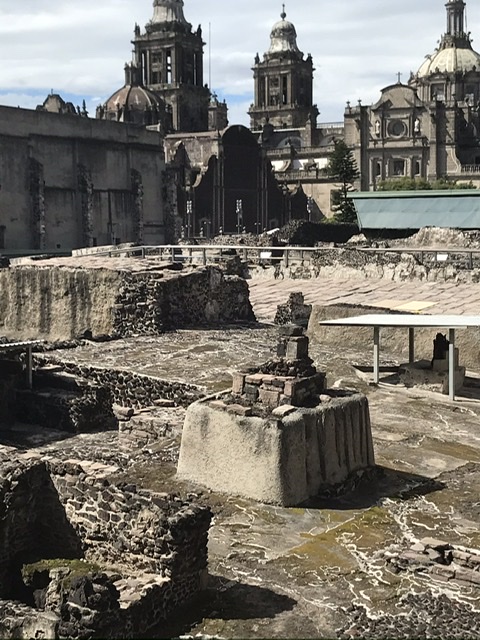
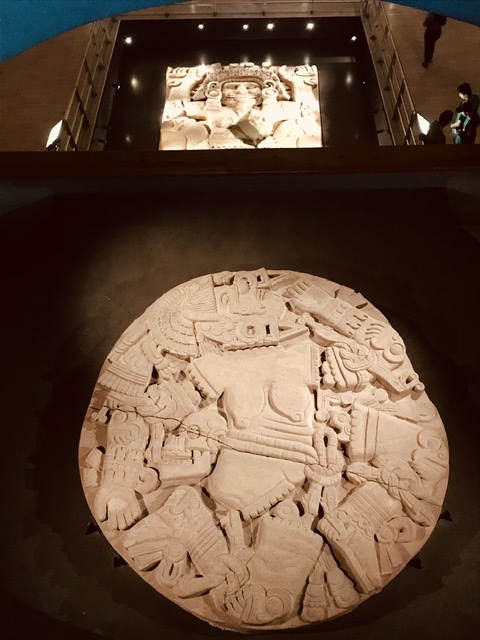
The history of how this site was rediscovered is fascinating. I won’t go into it here, see the link, but let’s just say some developers were probably mighty pissed that their plans were foiled by a major discovery in 1978 (the round “tablet” below–it was a world-renowned find). And it is such a large excavation, right smack in the middle of the downtown, that it must have cost the city and country a lot of money in foregone taxes, not to mention the expense of the dig itself.
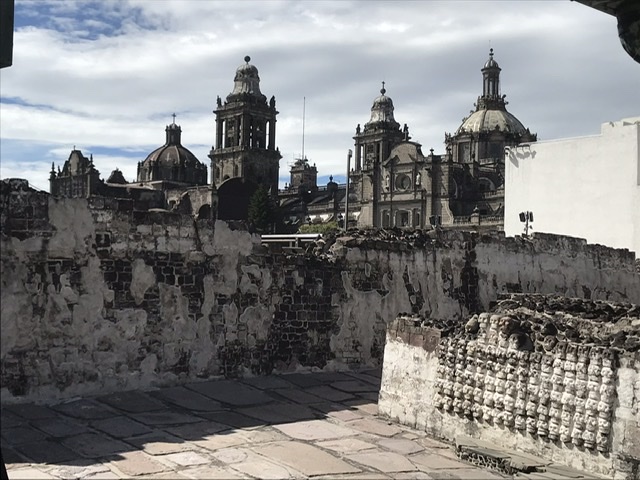
There is the site itself and the attached museum, both worth the time. We spent several hours and were fascinated and dazzled. The juxtaposition of the site and the adjacent cathedral is also pretty cool, as you view ancient and contemporary religions right up against each other.
It is quite impossible to show the scale of the two pieces on the right; the photo was taken from the second floor where the round piece is, looking down to the first floor where the rectangular piece is. They both represent goddesses. There are a few visitors on the right looking at the rectangular piece–shows, kind of, the scale of these things.
Tacos de canasta
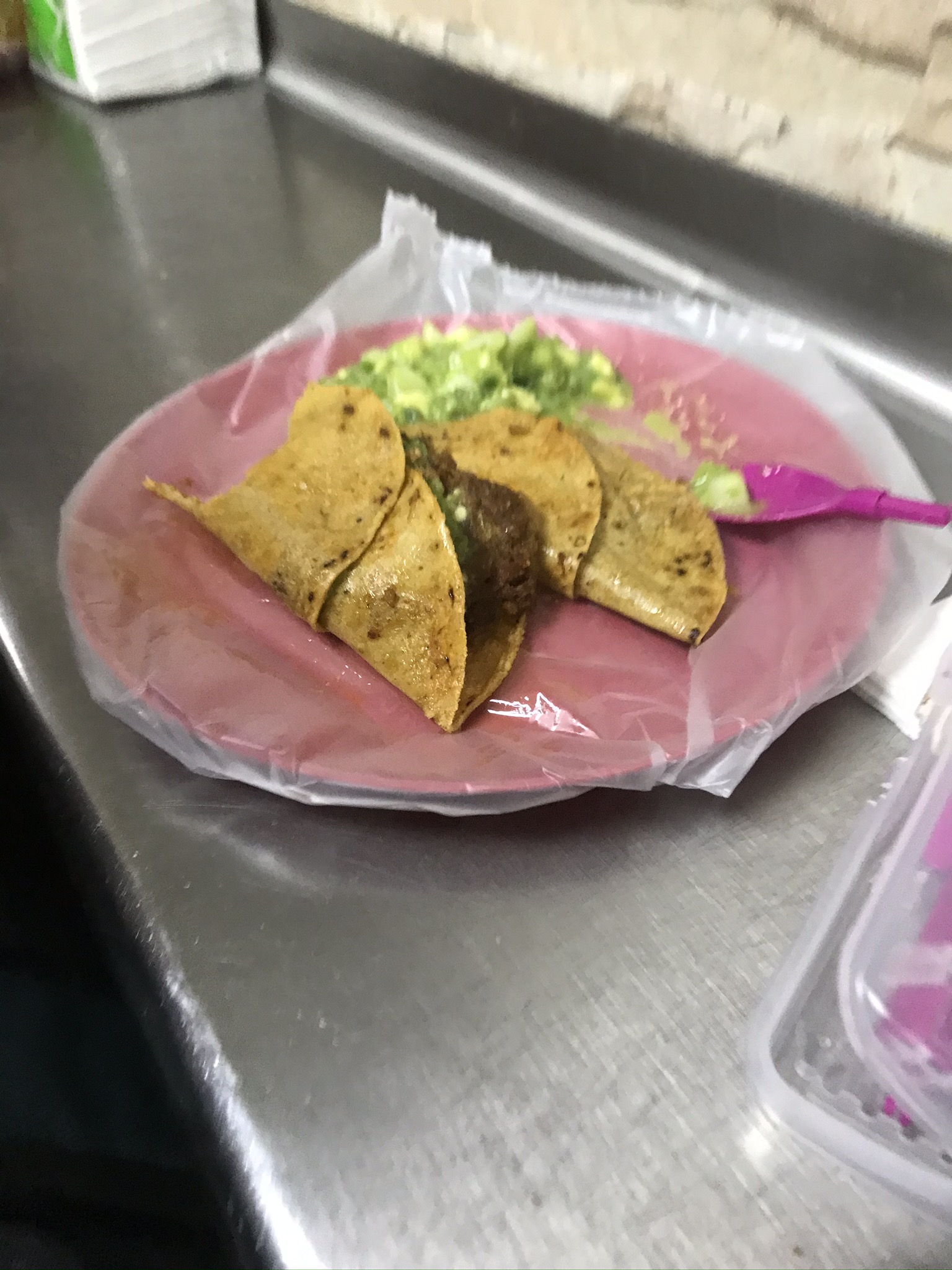
I must share our lunch experience. I very quickly glanced at yelp and saw a highly rated taco place and without reading anything we headed over-it is just a half block off the zocalo. The name is Tacos de Canasta los Especiales, and there was a large queue which David joined while I slid past the line to the inside to try and figure out the deal. In the back was a large multi-part room, lined with narrow stainless steel counters and every 5 feet or so enormous bins of chopped lettuce, pickled jalapeños and carrots, and seemingly gallons of a guacamole salsa. Every few feet the counters had stacks of napkins–this is an ‘eat with your hands’ place. I went back to David, shrugged my shoulders and in a minute we were at the first “station”. I asked “que es el sistema?” and he replied we paid for how many tacos we wanted, he then handed us a token with the number of tacos, we handed the token to the next guy who gave us two paper plates each with two tacos that he had scooped out of the basket in front of him, and we headed back to a counter to eat. We don’t remember what it cost but according to Yelp it’s 40 pesos for 5 tacos plus a drink. Suffice to say it was embarrassingly cheap, and they were delicious and the entire scene great fun. HINT: Carry some silverware with you–I have some snap together knife/fork/spoon “kits” in a little box that I bought at Cole Hardware in downtown SF. They sure came in handy here, as I didn’t want to leave a bit of the crunchy lettuce and jalapeños.
Palacio de Bellas Artes
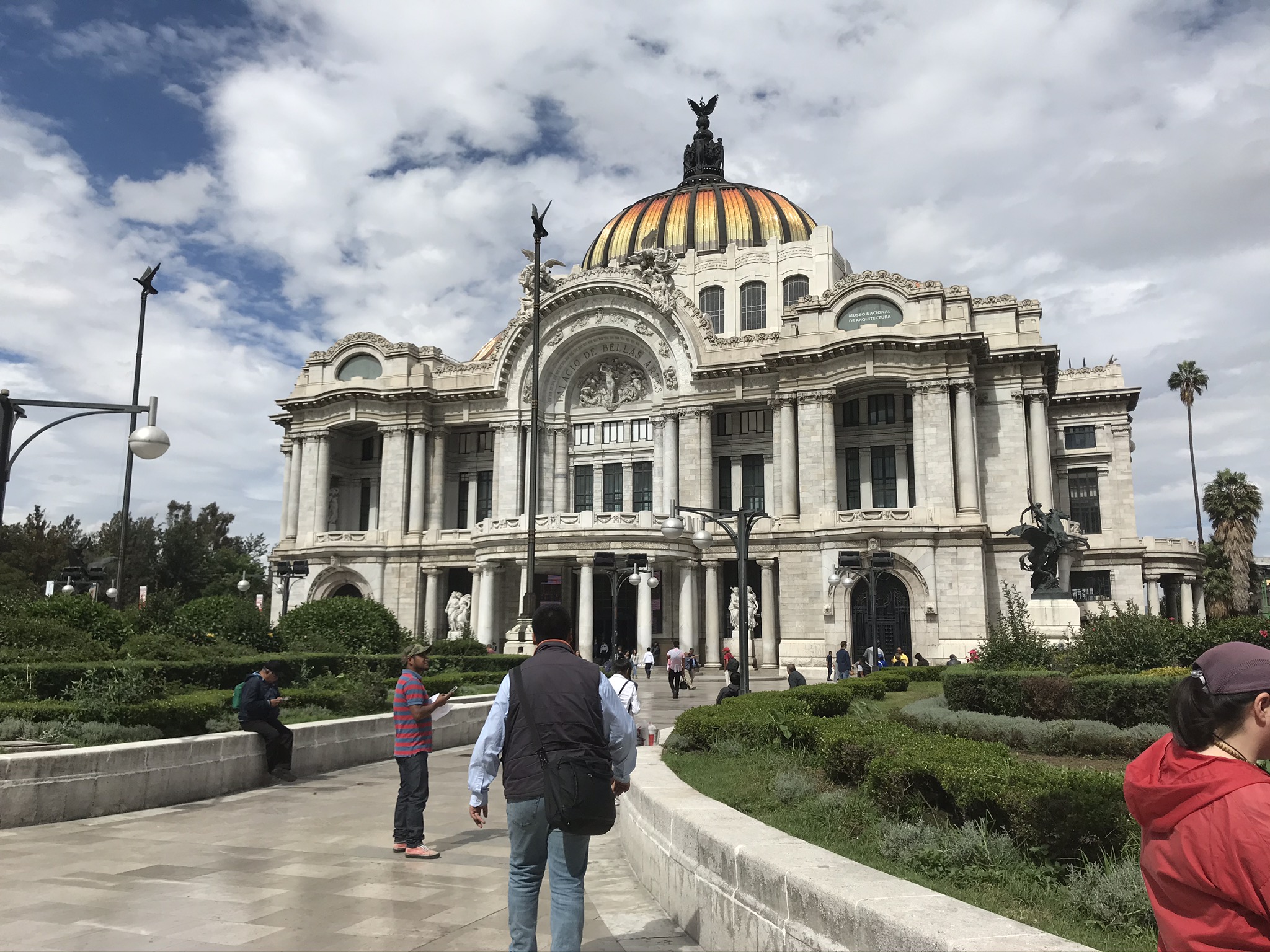
We decided to wander and ended up walking over to the Palacio de Bellas Artes where we enjoyed the beautiful architecture, murals, and a very fun temporary exhibit titled “Redes de Vanguardia” (networks of the vanguard) about Amauta, a Peruvian arts and politics journal from the 1926-1930 that for the first time brought indigenes art and culture to the fore. Seems so obvious now, but recognizing indigenes contributions was a breakthrough at the time.
One wall on the third floor is Diego Rivera’s remake of the mural he completed on commission for Rockefeller Center in NY. The commission was refused and the mural destroyed for its socialist political statement.
Museo de la Ciudad de Mexico
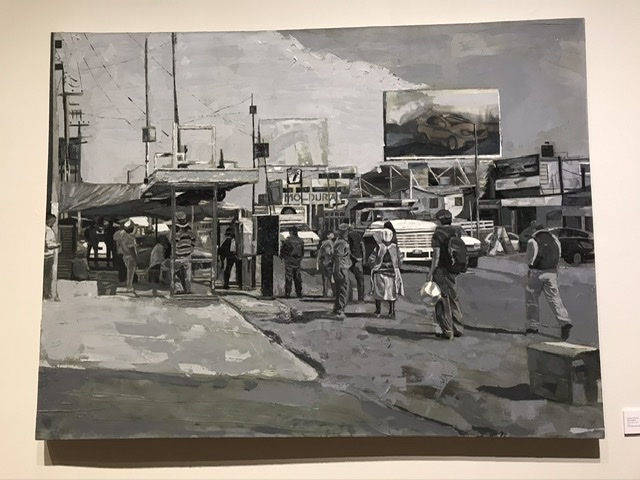
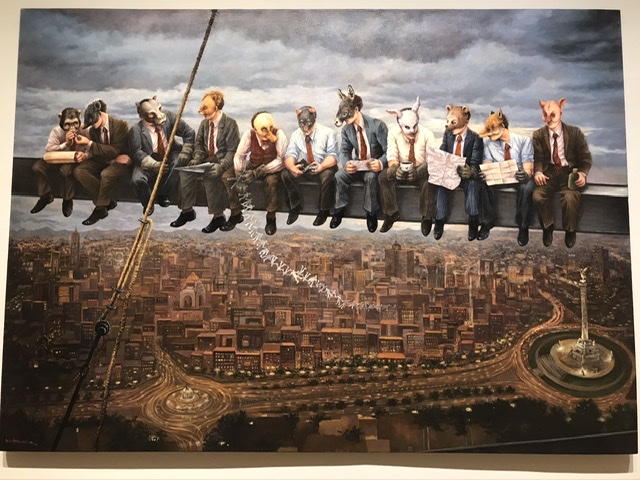
This is one of those places that is terribly under-represented in the guide books. We went there our last full day in the city, and it was a wow. The building, just a few blocks off the zocalo, is lovely, the displays about the challenges of large urban centers is a multi-media wonder, and the information about the city itself—its history from pre-Hispanic to modern times is rich and entertaining. However, some Spanish is recommended as much of the information is not translated (though much is). There is an entire room devoted to explaining the many different jobs that keep the city running, from teachers to street food vendors to dog walkers to construction workers. Each wall is covered with photos and descriptions, and there are also five or six videos that profile work and workers…it was incredibly illuminating and it brings the people of the city alive.
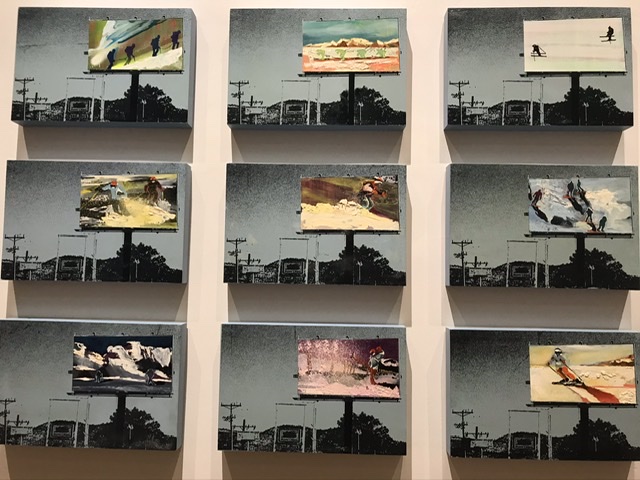
On the second floor are a series of art exhibits, including one that had just opened—we were so lucky!—that comprised four large rooms filled with mostly very large contemporary paintings of Ciudad de Mexico. We loved it.
Two ways of explaining what Mexico City is all about!
This may have been our favorite art exhibit of the trip.
Downtown on a holiday weekend
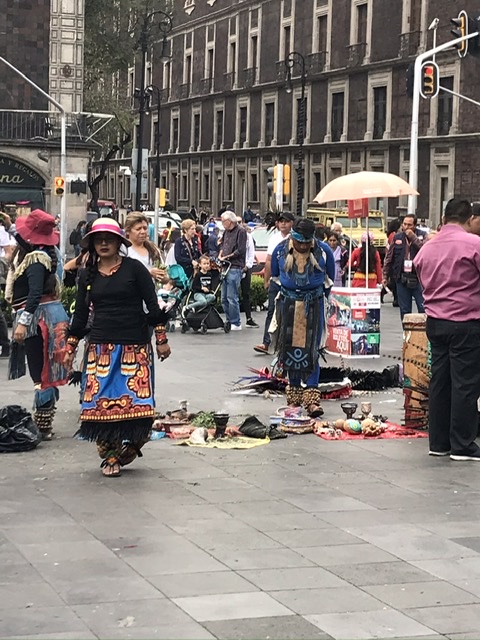
That last day, a Saturday, the zocalo was filled with tents. We asked our Uber driver what was going on and he said it was just “normal.” As we walked around we figured out it was a celebration/observation of life with a physical disability. For example, there was a footrace with paired runners, tied together at the wrist with one runner blindfolded. There were wheelchair races and apparently a race on crutches, as there were many pairs of crutches lined up against the fence. A short zipline was managed by members of the military helping kids go back and forth. We didn’t enter but it looked like a lot of fun, like a different kind of carnival. “Normal.”
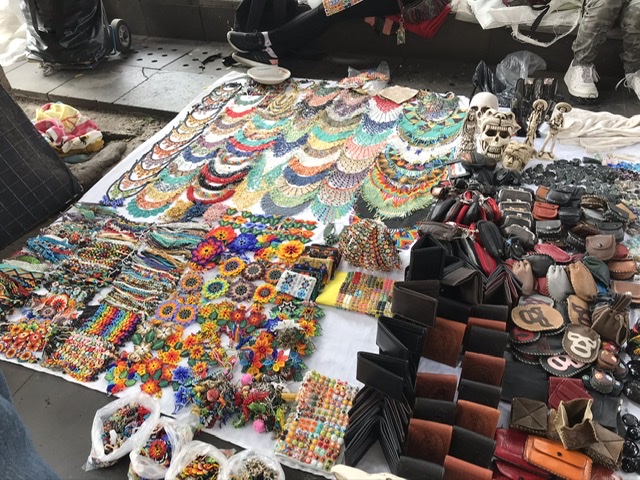
Naturally for Mexico, around the fair were artisan street vendors selling anything and everything. Something we had not seen before were maybe five or six spots where indigenes shamans (?) offering purification. Individuals stood with their arms out, eyes closed, as they were fanned with burning bundles of dried something that might have been sage, serenaded by conch wails, and otherwise rid of bad spirits. Intriguing, but I wasn’t brave enough to do it. Small children ran everywhere, and I had to photograph a group of 4-6 year olds sitting on the pavement trading Barbie and other doll clothes so intensely they were oblivious to anything happening around them.
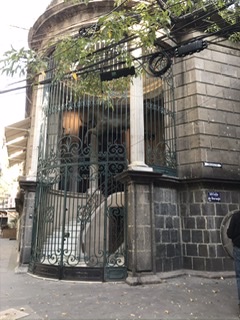
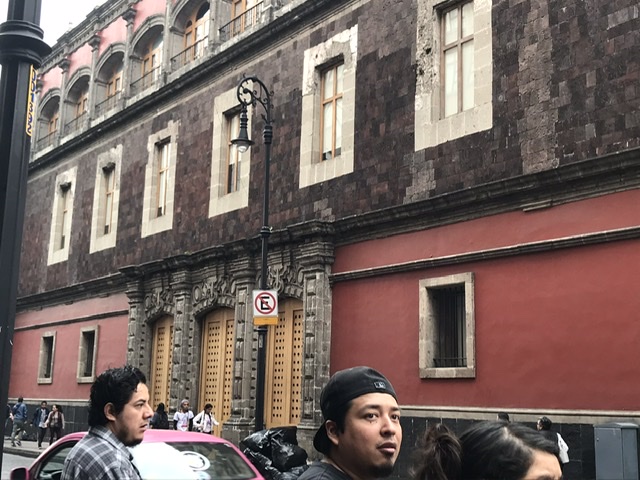
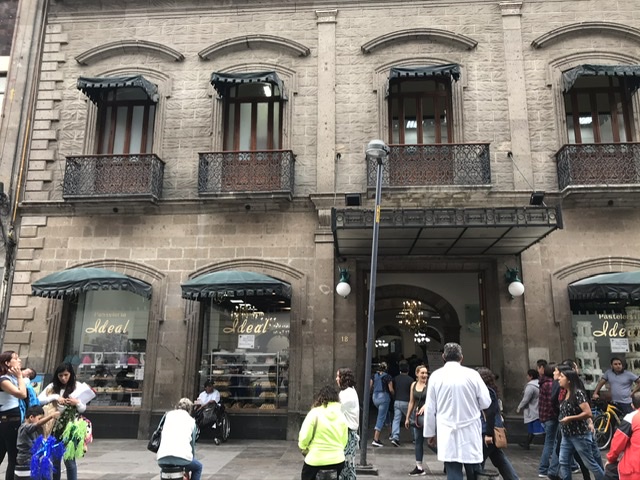
Downtown architecture is a mishmash of the new and the old.
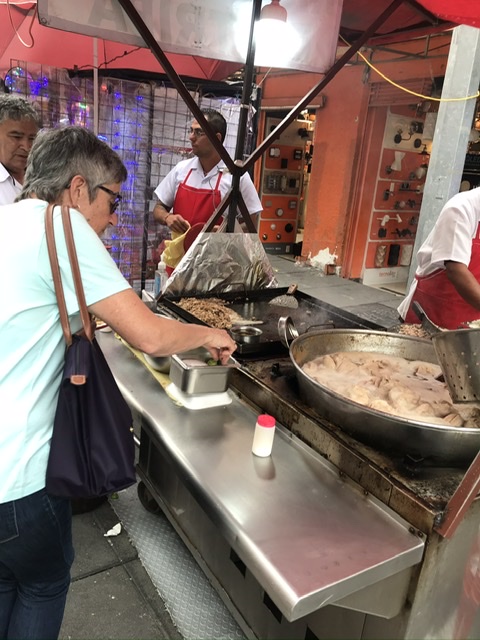
From here we walked to La Ciudadela, an artisanal market. The market was really great and well worth a stop even though we had been shopping at markets for two weeks. The walk could have been a 15 minute affair but the crowded streets and vendors were too interesting to rush by and we spent about 40 minutes dawdling. I was hungry (surprising?) so kept stopping to ask street vendors “what is this?” I am still regretting not trying a “pata” taco–the customer who told me this mysterious ingredient’s name put her fingers to her lips, Italian style, gave a kiss and said “Muy rica!” A few blocks later, though, we came upon “Tacos de Tripa.” The cook pulled pieces of tripe out of a boiling caldron, chopped them into tiny pieces, tossed them on the steel grill where they became crispy, separated them into little piles each of which he covered with a tortilla, deftly flipped each over, crisping up the tortilla as well. I love tripe and was delighted to stop and order one, yes please to onions and cilantro, while a couple eating next to me asked “What is the word for ‘tripa’ in English?” (In Spanish of course.) And then they wanted to know the English word for caliente, hot, which I explained was the same as the word for picante (spicy). We agreed that ‘tripa’ (tree-pa) is a much prettier word than ‘tripe.’ Oh yes, the taco was delicious.
As everywhere we have been in Mexico, this is a friendly, comfortable city where a little Spanish will get you far, most everyone is happy to explain or help, moving around is straightforward, Uber is ridiculously cheap, and the food is plentiful and delicious.
We have started each day with coffee and a pastry (if you are in Roma Norte we highly recommend Buna for croissants—cuernitos—of the highest quality and especially well made espresso drinks), stopping at a fruit/juice street vendor for what may be a quart of freshly squeezed orange juice for 40 pesos or so, then after a refresh at the hotel calling Uber to head to a museum. From there we wander to a taco stand or market or hole-in-the-wall place for lunch, and either walk and wander or call Uber to take us back to the hotel to spend the rest of the day in and around the Roma neighborhood.
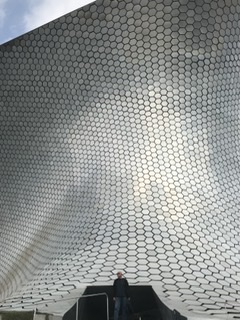
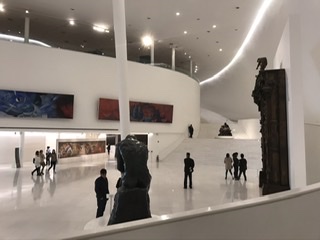
Yesterday, for example, we visited the Museo Soumaya in the Polanco neighborhood, known as the Beverly Hills of Mexico City and reputed to be the most desirable real estate in Latin America. The museum contains Carlos Slim’s personal collection. The guidebooks call it “eclectic” and I would rename it “Stuff I Bought.” It is the most bizarre, oddly organized, hodgepodge of an art museum imaginable, housing everything from an enormous (too much so) collection of Rodin to postcards and watches. The building was designed by his son-in-law and is, shall we say, striking. The interior has an open stairway and ramp which wind from level to level and room to room, and I was freezing the entire time because there is a wind tunnel effect adding to the oddness of the experience. Sr. Slim has no apparent discipline or taste, and while the collection includes many paintings from recognizable artists I learned something I’m not sure I wanted to know—even the biggest names (Renoir, for example) did some truly mediocre work. But it was free, we toured with energy, and were out in perhaps 90 minutes.
The top floor of the museum is overflowing with way, way too many examples of European sculpture, maybe 25 Degas and 75 Rodin…impossible to appreciate any one piece. David said, “I feel like I am in a warehouse “
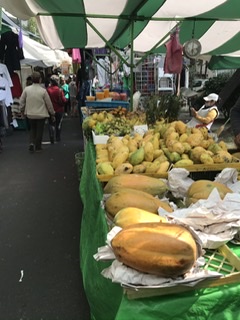
Having no interest in walking around a cliche rich peoples’ neighborhood to ogle houses or Chanel shops, we hopped an Uber and went to the Friday market in Condesa to find something to eat. Now, that was more like it. Below note the beautiful blue corn gorditas and quesadillas. A very nice man in front of the cooks is there to explain what is on offer and take orders. Gorditas were “chicharron” but in truth that meant cheese, nopales, and a few other vegetables stuffed into fat tortillas that were split like pita and grilled. The mushroom quesadilla was alas eaten too quickly to make it into the photo. I was happy to see a juice vendor so I could get a picture showing the enormous number of small, green and yellow orange rinds piled into the two big bags as he grabbed halves, pulled down on the juicer, and tossed them aside in a single motion. Poetry.
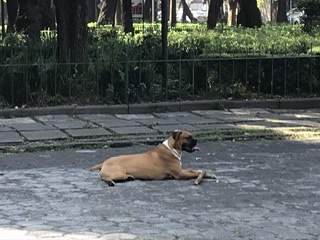
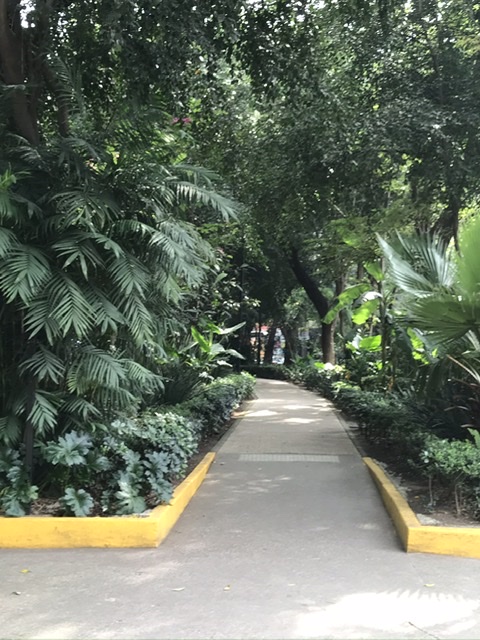
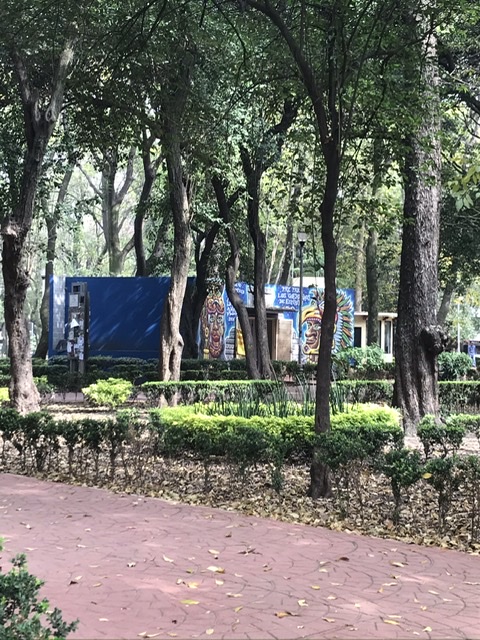
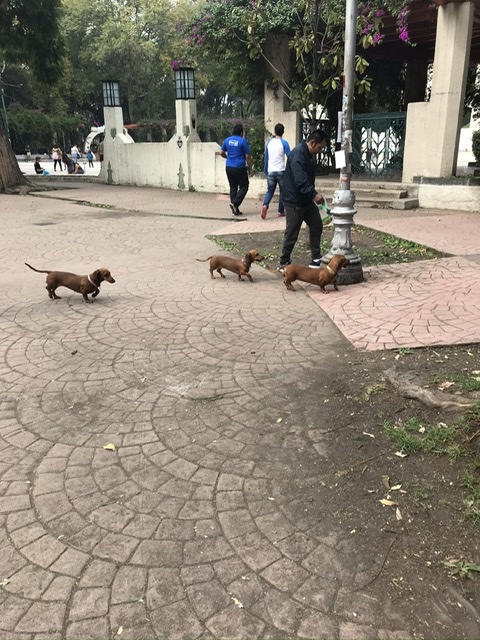
It was about a mile’s walk back to our neighborhood in Roma, so we decided that would make a perfect end to the afternoon. We were correct—discovering the beautiful, dog-filled Parque Mexico and the enchanting architecture of Condesa, and before we knew it we were back “home.”
At least half the dogs in the last picture were fast asleep. The two dog walkers were standing to the right talking…that must have been some walk!
Trotsky and Casa Azul
Our friend Christina had encouraged us to check out the Coyoacan neighborhood and that meshed nicely with our plan to see Trotsky’s house and small museum as well as Casa Azul, the home of Diego Rivera and Frida Kahlo, two worthwhile sites only a few blocks apart.
We had both been ignorant of the Trotsky story, and both had the same revelation about how the heck Trotsky ended up living, and being assassinated, in Mexico City. Turns out Rivera, also a socialist, had prevailed on the government to give Trotsky asylum, and even had him as a houseguest for a few months (during which there was apparently a strong flirtation between Frida and Leon).
Trotsky comes across as a lovely guy, doting on his chickens and rabbits while he wrote obsessively, often using a dictation machine. It was while he was working at his desk that the assassin came up behind him and hit him in the head with an axe. It is a very small, traditional, modest casa and he and his wife were admired for adopting a completely Mexican life.
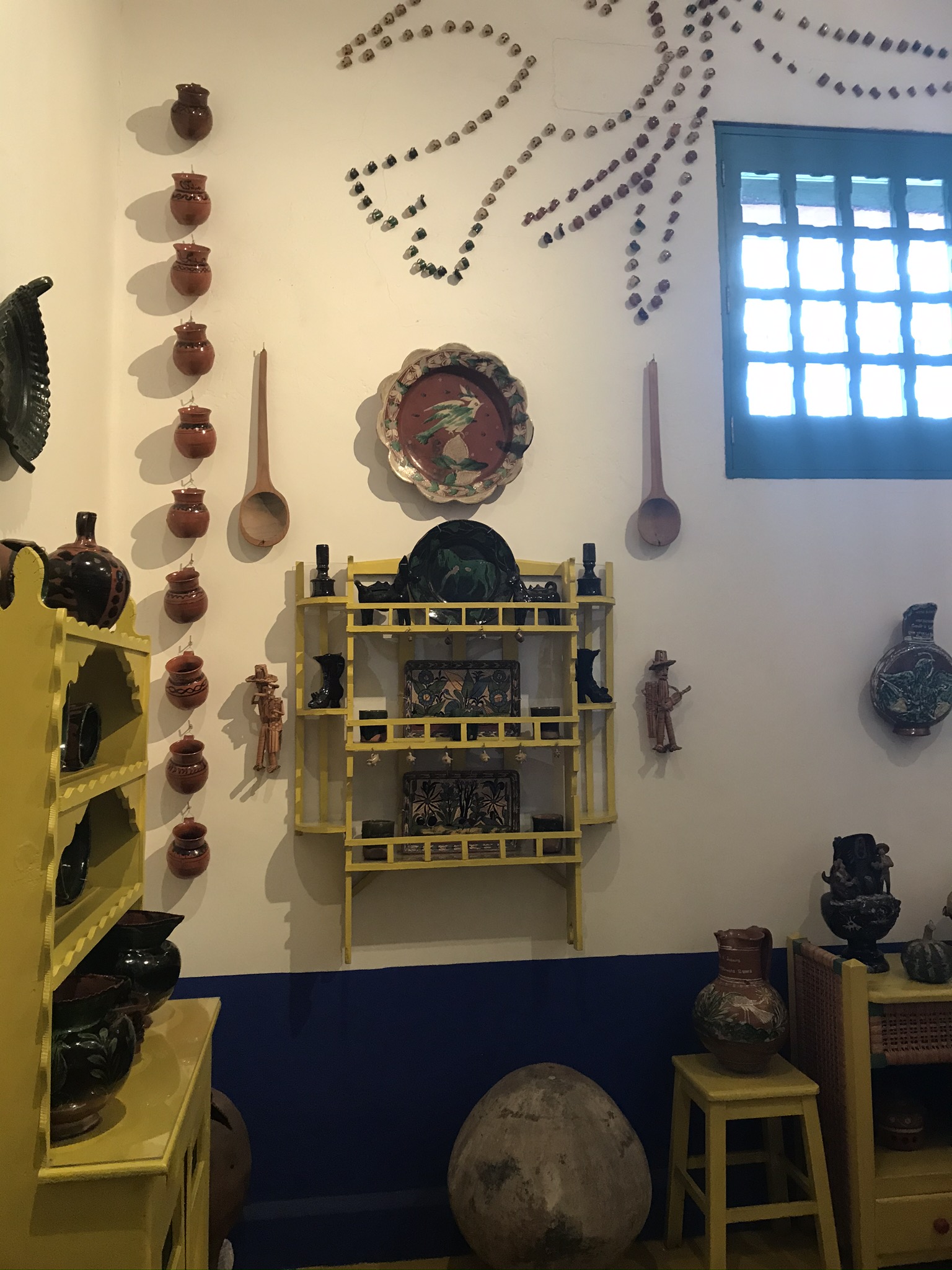
Now, Casa Azul is something else again—filled with art, curios, gardens, studios, traditional kitchen (no electricity or modern accoutrements of any kind), and the very sad remnants of Frida’s pain-filled life. In spite of her physical misery, however, she had many lovers and intense relationships while at the same time suffering greatly from Diego’s affairs. We rented the audio-video tour and highly recommend it.
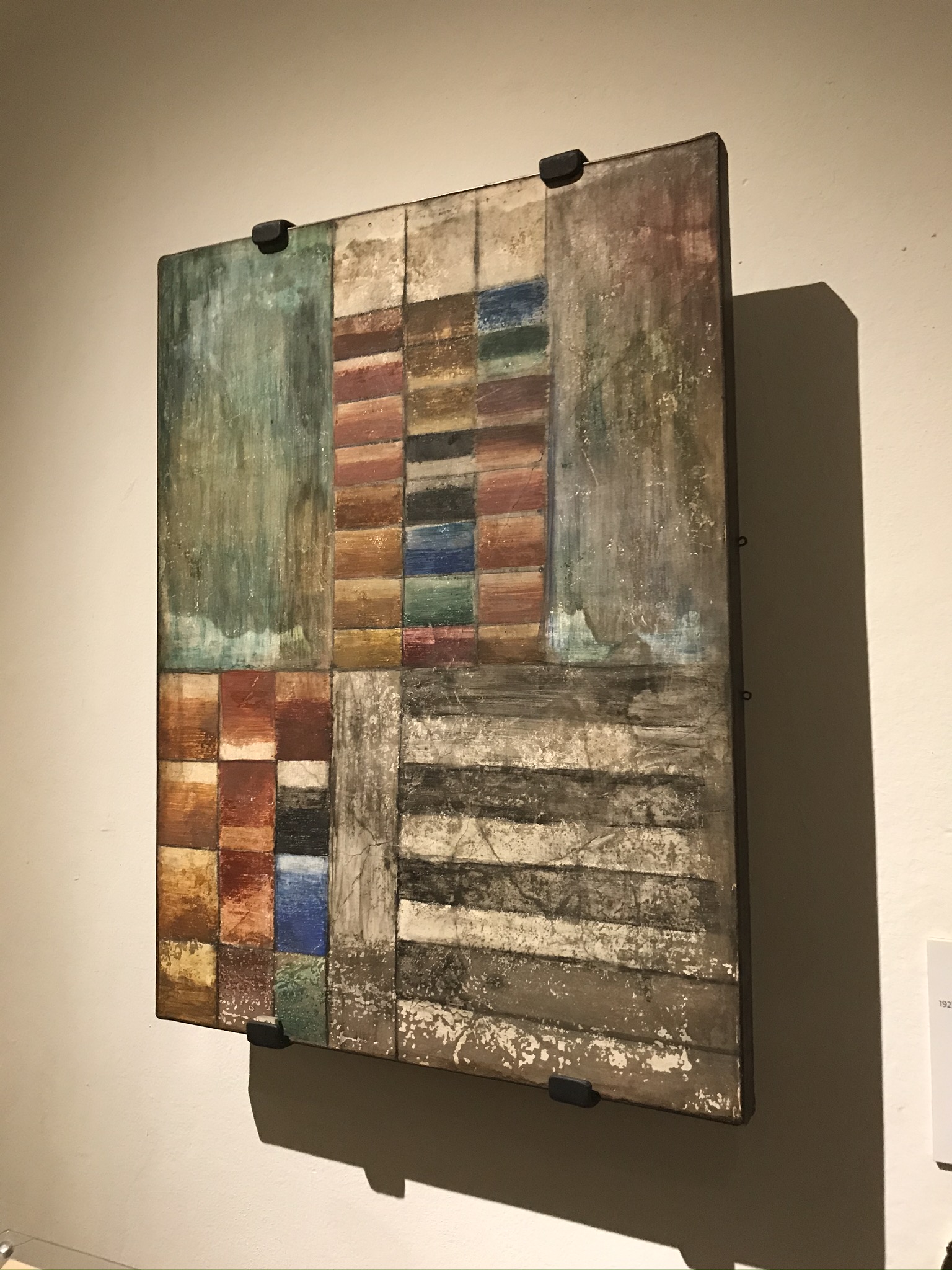
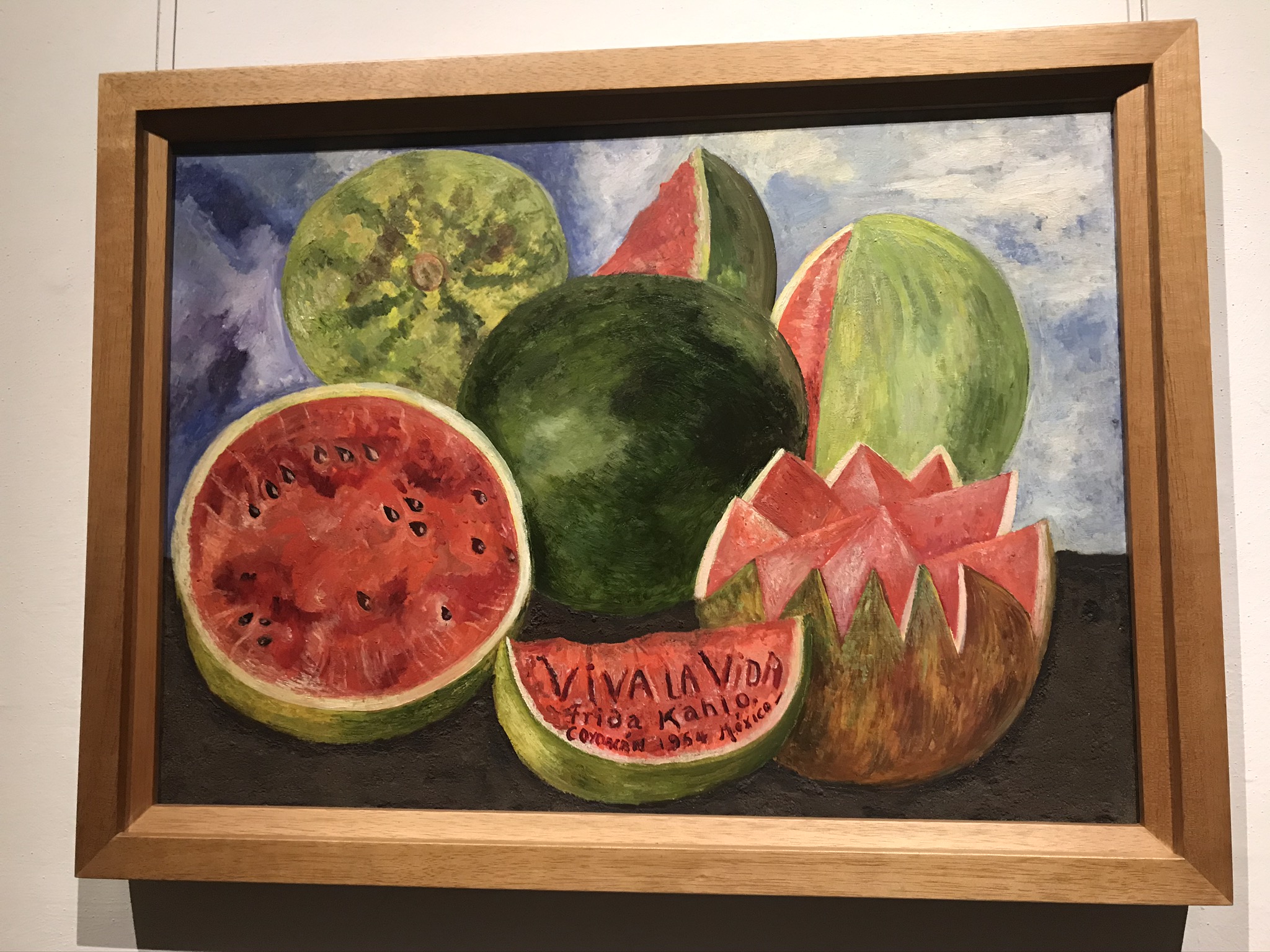
On the left, a commissioned painting which was refused by the patron when Frida presented it—intended as a dining room still life, it was a bit too filled with erotic symbolism. In the middle is Frida’s palette. The audio tour includes her description of each color and its meaning. The painting at the right is one of (maybe the?) last she did right before her death, celebrated for Viva la Vida, her belief to the end that life was worth living.
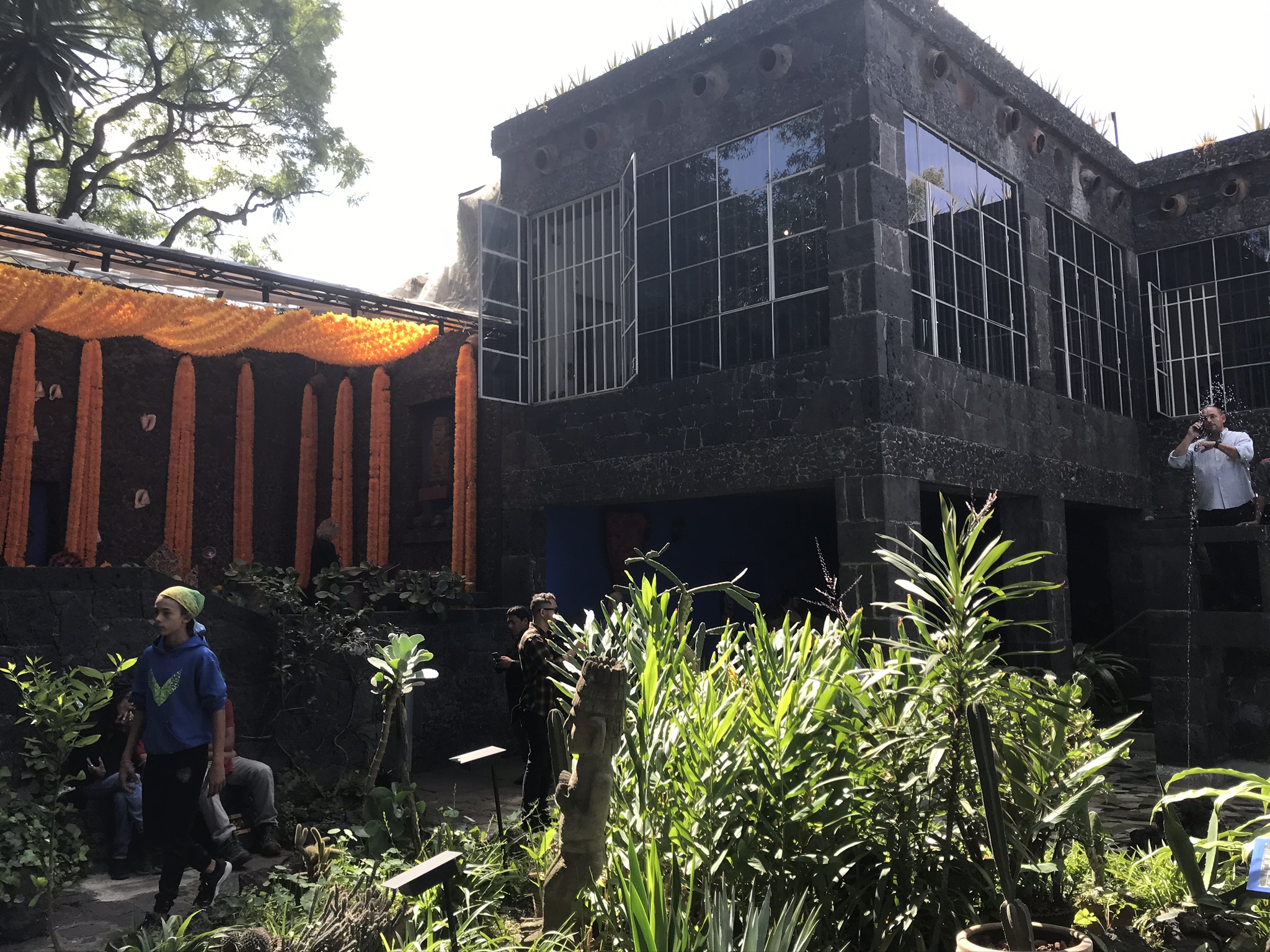
The volcanic stone addition was built to Diego’s specifications to add a studio for Frida. This was the house she grew up in, but her father borrowed money from Diego and when he was unable to repay him Diego acquired the property, which he then gave to Frida.
We walked on a few blocks to the small mercado looking for lunch, and ended up in a lovely conversation with a couple from Montreal, ate an enormous lunch at a little counter in the middle of the market, walked for a while in the lovely, quite, cobblestoned neighborhood of Coyoacan, then took Uber home to Roma Norte.
The symbol of Coyoacan is the coyote, and they’re everywhere.
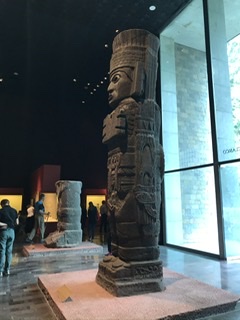
As we were leaving the National Museum of Anthropology I flashed on the Prado in Madrid. Like our experience there last year, this museum totally lived up to the hype and we had used every bit of energy to finish seeing everything in the one day we had dedicated.
This enormous architectural wonder is an epic history of the many peoples who comprise Mexico, starting from the latest understanding of where they came from (across the Bering Straight) and how the many cultures arose, migrated, combined, changed, and occupied the many distinct regions of this enormous country.
One thing has struck us over and over—how old and complex pre-Hispanic Mexican history is. These peoples built enormous cities (Teotichuacan had 75,000 people at its peak), conquered and reconquered each other, left millions of artifacts of artistic and historical value. Thank goodness they believed as the Egyptians did that when a person of note is buried, examples of the items that support daily life were buried with her. This custom has made recreating long extinguished cultures possible…and every year the archeologists uncover more.
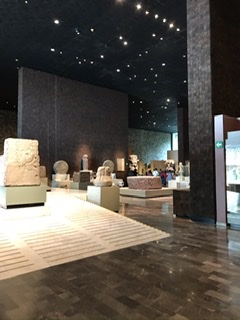
The collection is organized historically in rooms 1-6, and then geographically—Oaxaca, Gulf Coast, Maya, West Mexico, and Northern Mexico. Some displays are intimate, some, such as the enormous room 6 dedicated to the Mexica people (formerly Aztec) where the famous stone “calendar” hangs in the center, are huge. This room also has a large diorama of a Mexica (pronounced me-zhi-ca) market—which looks very much like the markets in Mexico today. One of the more interesting items is a codex, unfolded from its accordion form, that details the migration of the Mexica over many years from place to place. A video explains each page and what the symbols and drawings mean.
The charming figures at the top of this post are from the preclassic era, 2500 BC to CE 100. A figure sits with a dog on her lap, giving a kiss. How lovely is that?
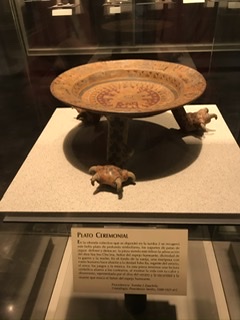
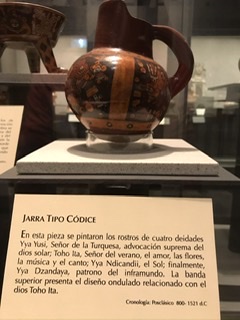
I did my best to control the impulse to photograph everything, so here are a few representative pictures which I hope convey something of the grandeur and beauty of this treasure.
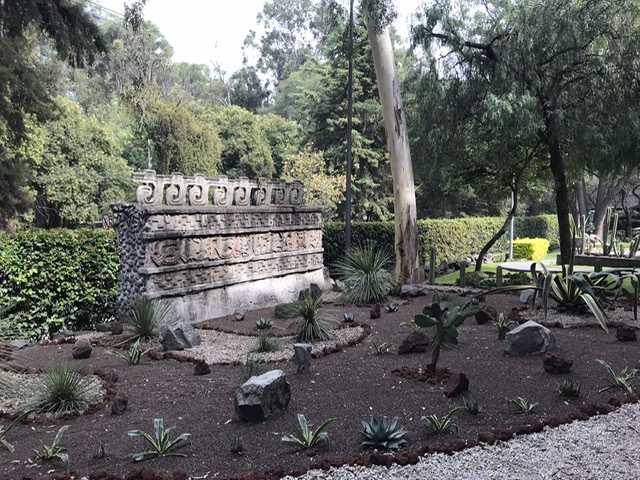
The last photo is one view of a series of gardens which line the outside of the historical wing—each further displaying items representative of the era, enabling you to walk outside from any gallery, very lovely and peaceful.
Midday we were suddenly hungry and found the cafe, a fixed price cafeteria with a variety of Mexican and Euro-American foods. As with most everything in this friendly country we had no opportunity to try and figure it out ourselves. We were immediately approached by a woman who explained the system, showed us to a table, took our drink orders and welcomed us to be comfortable. Refreshed, we headed to the last few rooms on the ground floor and then upstairs where the distinct cultures and regions of the country are shown as they live, work, make art, and worship today.
Una experiencia muy linda. Exhausted and happy, we called an Uber and returned to Roma Norte and our hotel to face our next big decision: Where to have dinner!
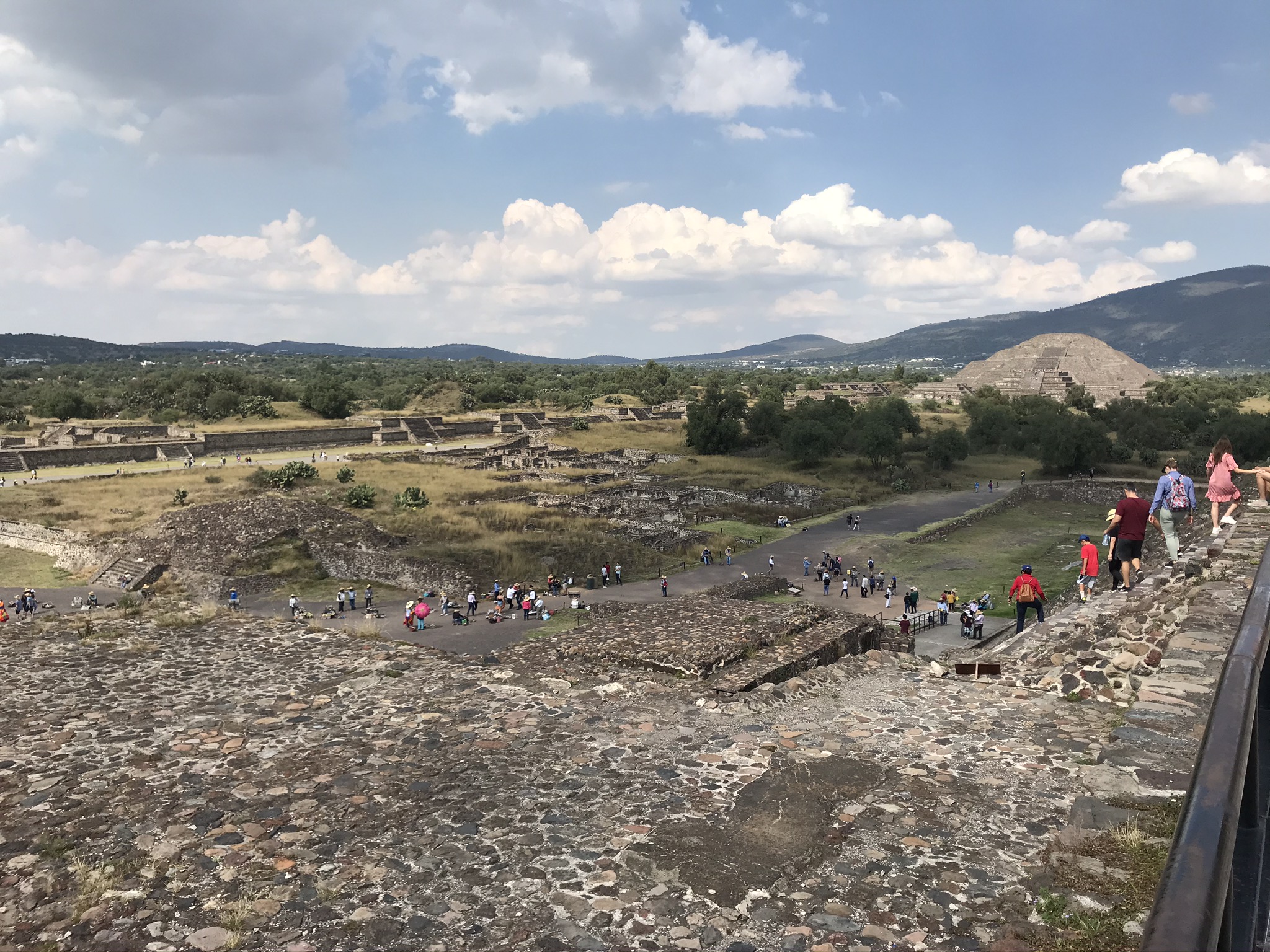
Having arrived late afternoon Sunday in Mexico City we started planning the week and since museums are commonly closed on Mondays we decided the next day would be perfect for a trip to Teotihuacan. And it was. The weather was warm, not hot, with big fluffy clouds so we had intermittent shade and the crowds were, for this most amazing site, small. (They warn you not to go on Sundays, when it’s free for Mexican citizens.). I had been here before but it was a first for David, though he is an experienced pyramid visitor having Cholula, Palenque, and Monte Alban under his belt.
I’m sure you’ve seen pictures of this impressive place, with the Pyramid of the Sun and Pyramid of the Moon, the Street of the Dead, and the amazing frescoes and decorative sculptures. It’s everything you expect and a little more.
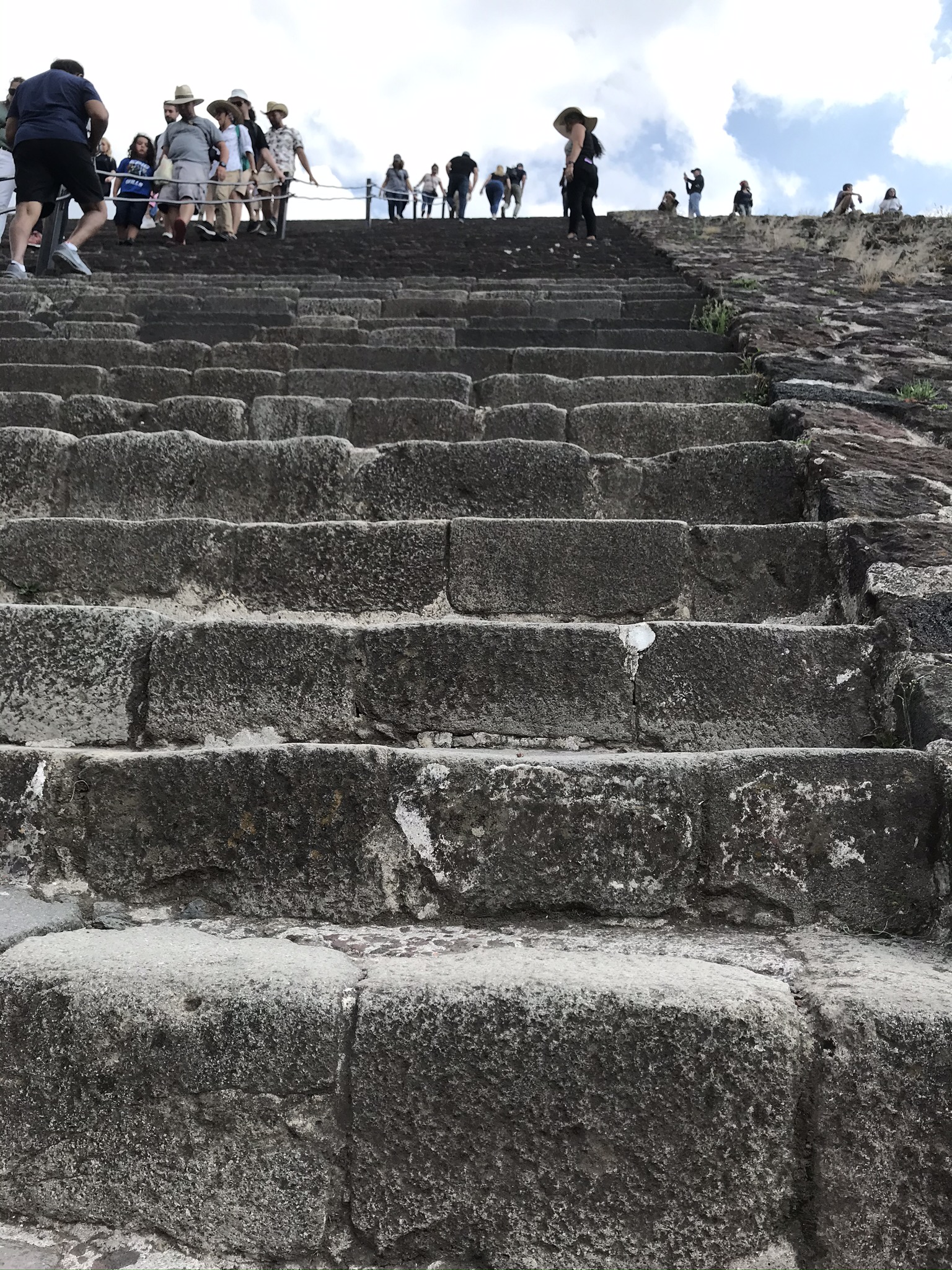
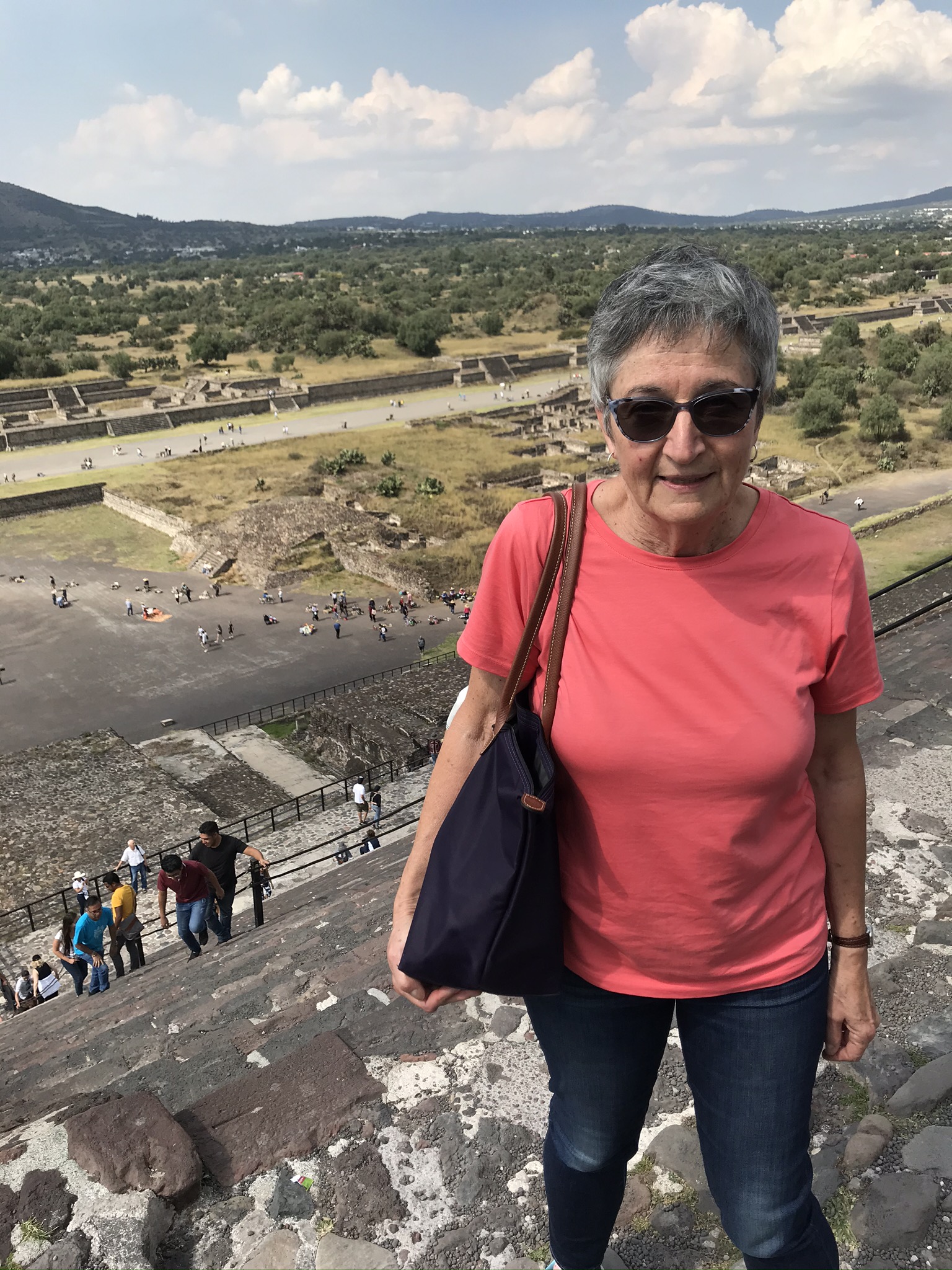
Feeling our age and insufficient sleep after 3 days in noisy Taxco we were skeptical we would do much climbing but once we were there we had to do just a little. We kept looking up at Piramide del Sol, the highest, and the teeny tiny silhouettes of people walking around the top, and challenging each other that yes, we were going to do it. And we did. We were enormously proud of ourselves, so much so we decided to skip Piramide de la Luna and caught the bus back to Mexico City, which was waiting when we walked out of the gate (not so surprising, they run every 15-20 minutes). We celebrated our accomplishment with a very good sushi dinner at Mog, a 10 minute walk from our hotel.
We started at Gate 1, where the Templo de Quetzalcoatl is. A short, easy climb. We went from there to the lovely Museo del Sitio as we worked our way to the big ones, del Sol and de la Luna.
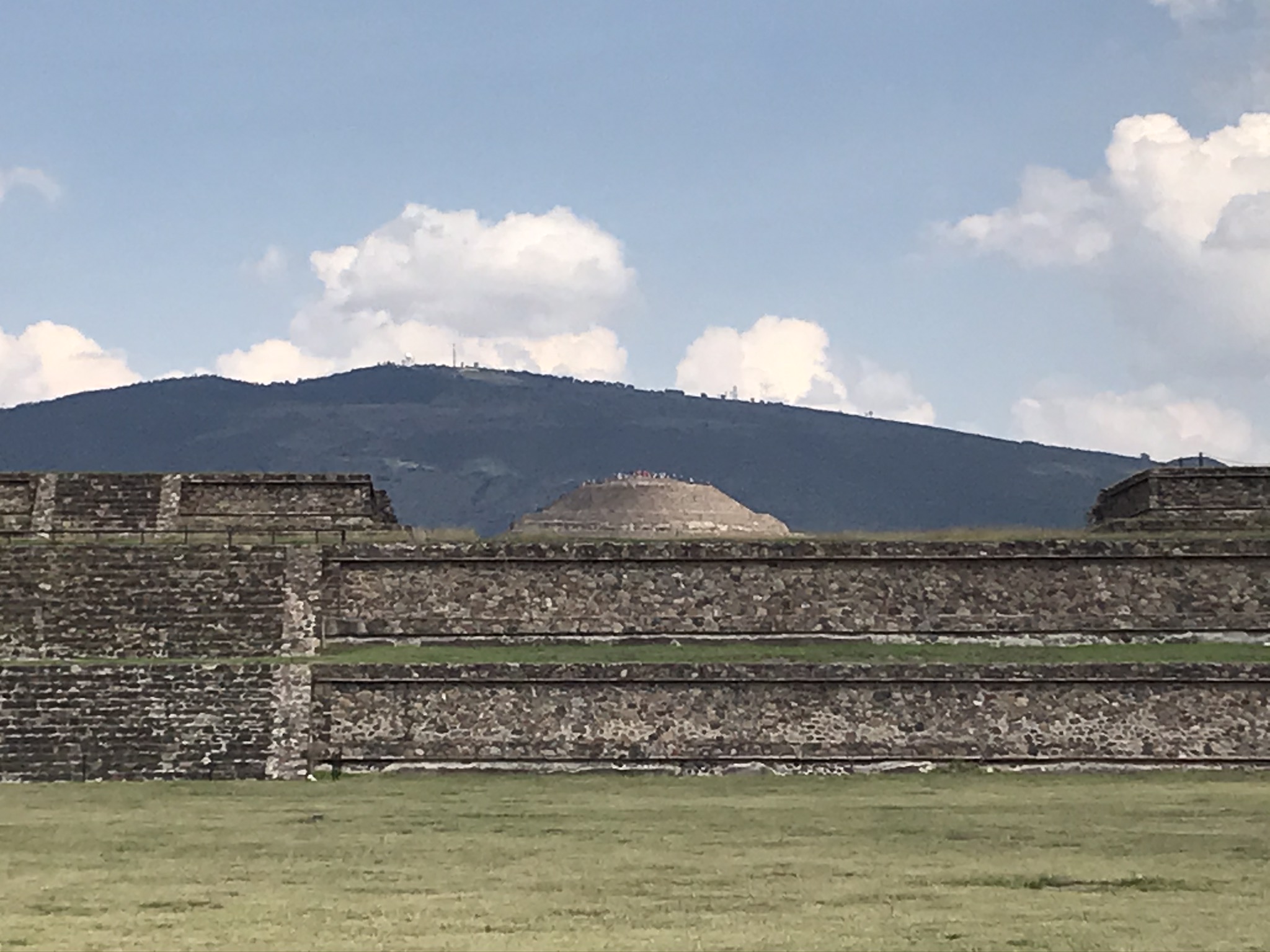
The top of del Sol is visible—we saw teeny tiny people on top and decided there was NO WAY we were going up there.
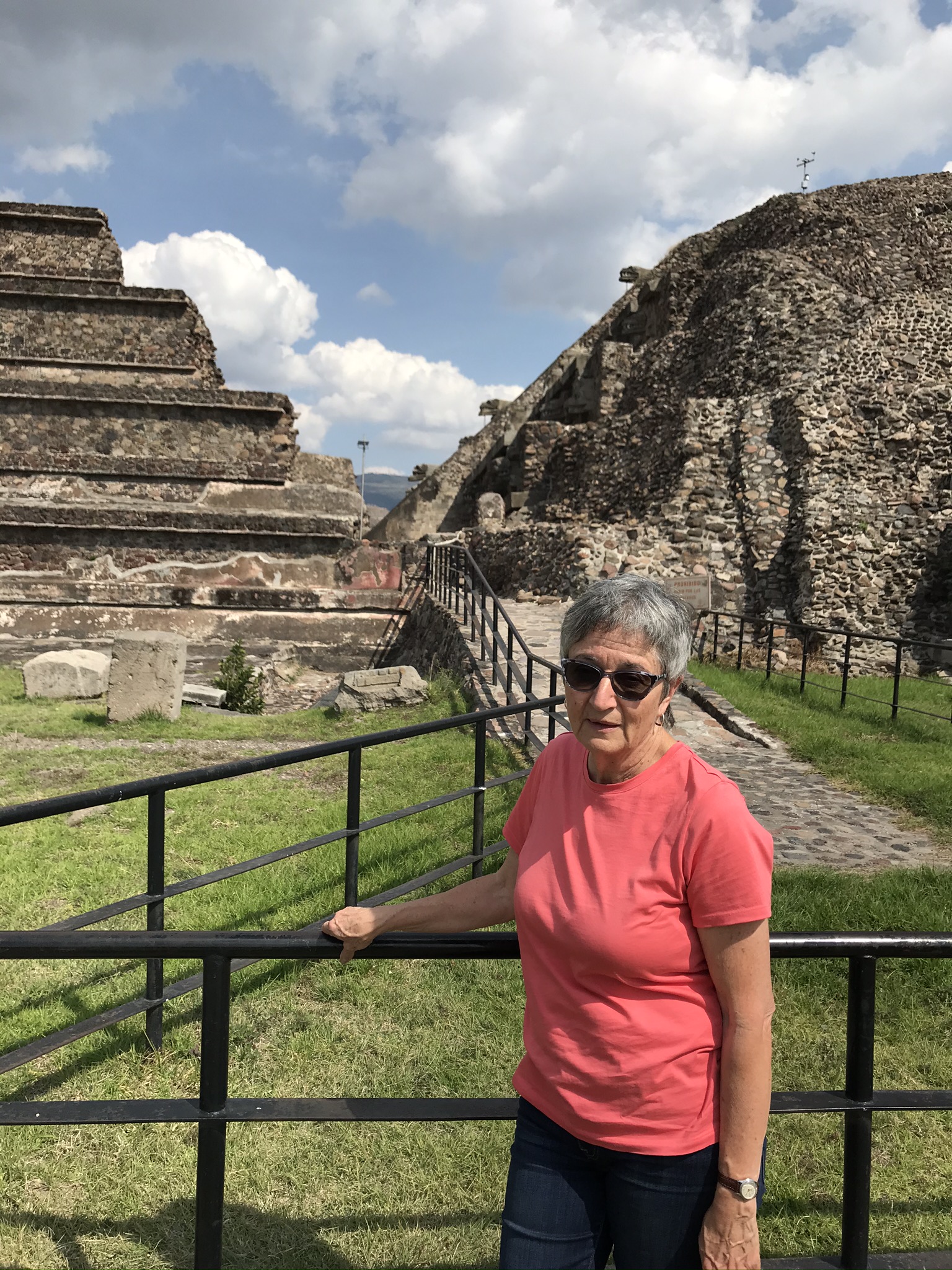
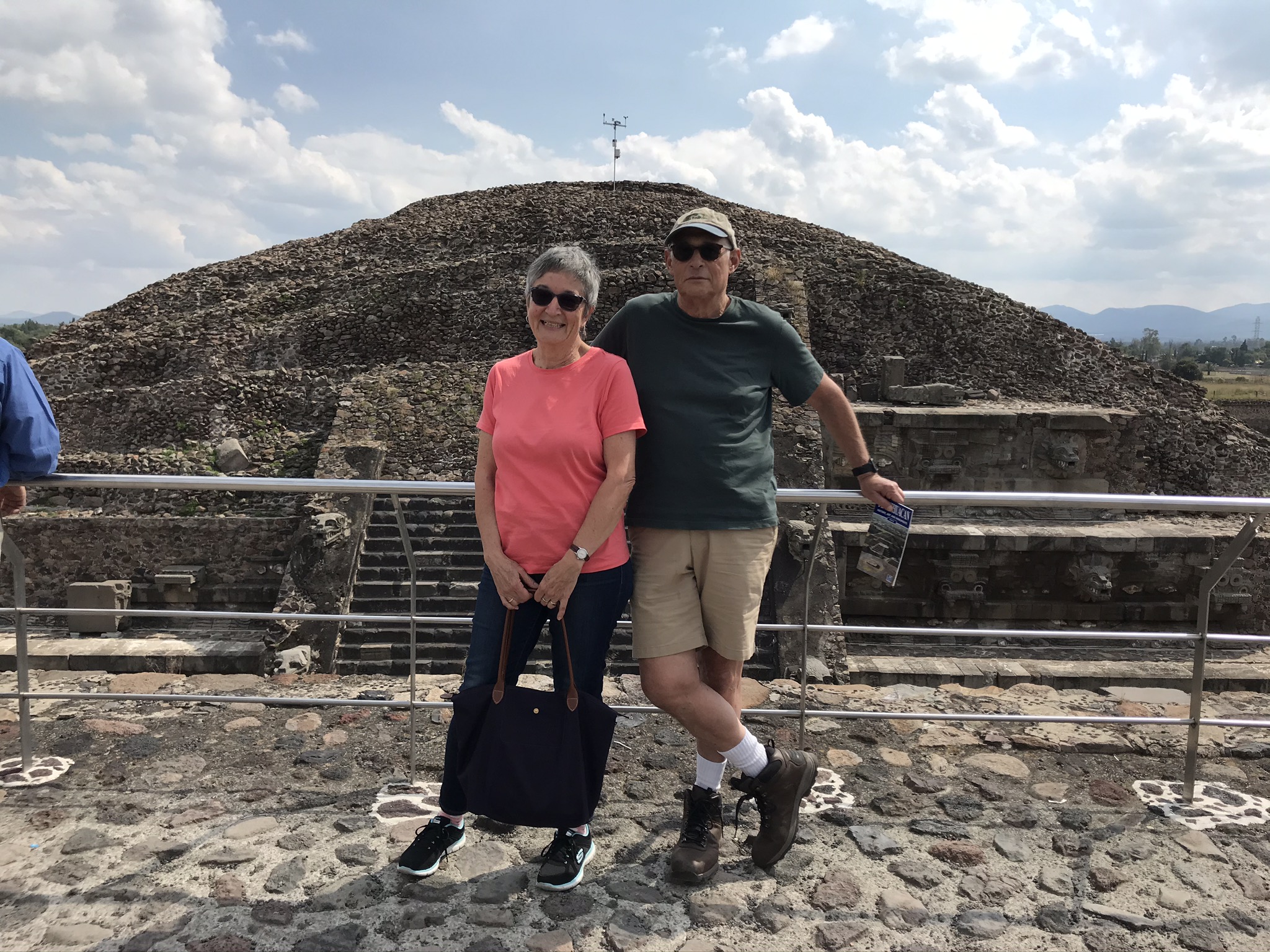
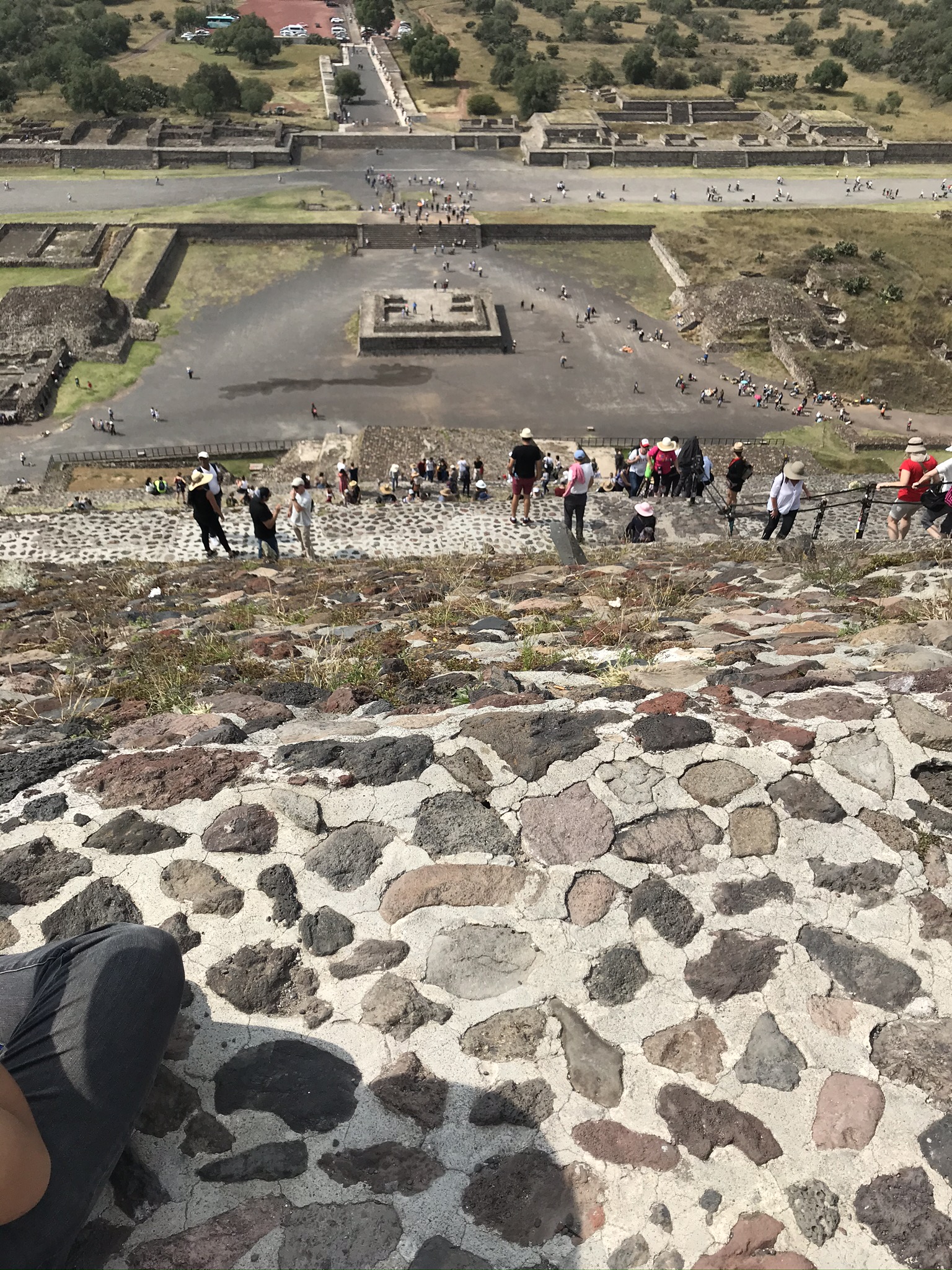
The photos above show our progress to the very top. The view, and sense of accomplishment, were more than satisfying. Going down is a bit scary, but we did it.
Our view in the “rear view mirror”—we climbed that?! Sushi celebration was well earned.
Bus travel in Mexico is inexpensive—shockingly so at times—and the buses are extremely comfortable and welcoming. For trips longer than an hour you get a drink, sometimes water, sometimes your choice of a soda, often a cookie or other small snack. The seats are reserved, are often memory foam, they recline, there is space for carry-on. Larger luggage is carefully placed in storage under the bus—no tossing of bags or rough handling. It’s so nice.
However, it is ridiculously hard to ascertain schedules or even which bus company goes where. There are myriad bus companies which often have their own terminals and might have more than one in a single city. Sometimes you seem to be able to reserve seats and sometimes not. Sometimes you can buy a ticket online, sometimes not. In smaller cities there may be several terminals each for just one company, while in Mexico City the terminals are akin to airports in the US. Enormous, with arrivals and departures via separate concourses, restaurants and shops just like an airport.
Typical luxury bus, this one from Puebla to Cuernavaca.
The Terminal del Norte in Mexico City.
And even sometimes ‘in flight’ live entertainment—this was en route to Teotihuacan, a short hour’s trip so a somewhat smaller bus.
Our only almost disaster was our trip from Puebla to Taxco. First, Abraham the guest services Superman at Meson Sacristia spent one morning unable to find any company that had a route to Taxco. Then, he found the company but was unable to reserve us seats so urged us to get to the terminal early. The second day of his efforts he got us a reservation, via the city of Cuernavaca, told us the time, and instructed us that we would be able to purchase our tickets to Cuernavaca and on to Taxco from the Puebla terminal. When we got to the terminal we attempted to do so, but the young lady, after checking with a co-worker, told us we would be able to buy the ticket when we got to the Cuernavaca terminal. Phew. All on a single company, Estrella Oro.
We arrived in Cuernavaca and went straight to the counter to buy our second leg.
“We don’t go to Taxco. You need to go to the Estrella Blanca terminal.”
Yikes. We hopped in a taxi and told the driver to take us to Estrella Blanca. He asked where we were headed, we answered Taxco, and he started a long and complicated explanation of routes and roads and different bus terminals as he drove through the city. I was finally able to slow him down as he seemed to be saying we wanted the “other” Estrella Oro terminal. This seemed weird, but okay. Then he assured us that there was a 3pm bus on Estrella Oro to Taxco. I am wondering how he would know this, and whether he was trustworthy as we drove on and on through the city—it was around 2:15 so a tiny bit of worry started creeping into my mind. If he was wrong, and we were at the wrong terminal…
He suddenly turned into an Estrella Oro station, saying again he was sure there was a 3pm bus to Taxco. We paid him and, still doubtful entered the station. There were a few people at the counter so as we waited we watched the rolling list of departures on a screen, which kept flipping from alphabetical to time of day order, back and forth. No sign of Taxco. Now we got really worried, aggravated by David’s discovery he had left his pullover sweatshirt in the taxi. I cautiously approached the counter. Could we buy tickets to Taxco?
Of course—the bus left at 3pm. All was wonderful! Why did the young lady at the other Estrella Oro terminal tell us they didn’t go to Taxco? We will never know.
Another thing about traveling in Mexico, there are surprise inspections that can be disconcerting if you are the panicky type. As we lined up to board the bus we were pulled aside by a federal police officer who wanted to check our passports and entry/departure forms. I had stashed the forms in a safe place but we offered our passports to be admonished, in an officious but not unfriendly way, to keep the forms tucked next to a particular page of the passports. He explained “Immigration!” But then he smiled and waved us on the bus. In 90 minutes we were in Taxco, after being stopped again by an official who wanted to inspect ID for anyone who had a discounted ticket. ?? The same man appeared on the bus out of Taxco to Mexico City, for the same purpose.
The next day when leaving Teotihuacan the bus was stopped by police—two men, one of whom video’d every person’s face, the other strode up and down the aisle looking serious. Then they said “have a good trip” and left.
Oh, one more oddity—the buses show movies, and what a hodgepodge! We laughed with our friend Christina, who lives in Mexico City, about the completely random movies that show up. For example, on the way to Taxco the movie was The Kindergarten Teacher with Maggie Gyllenhaal, an indie remake of an Israeli film about a 5 year old poetry prodigy with whom his teacher, Maggie, becomes obsessed. Hardly a mainstream offering. Whatever, the trip was scenic, fast, and we got where we needed to be.
Someone should start a travelocity-type service for bus travel here. It would make so much sense!
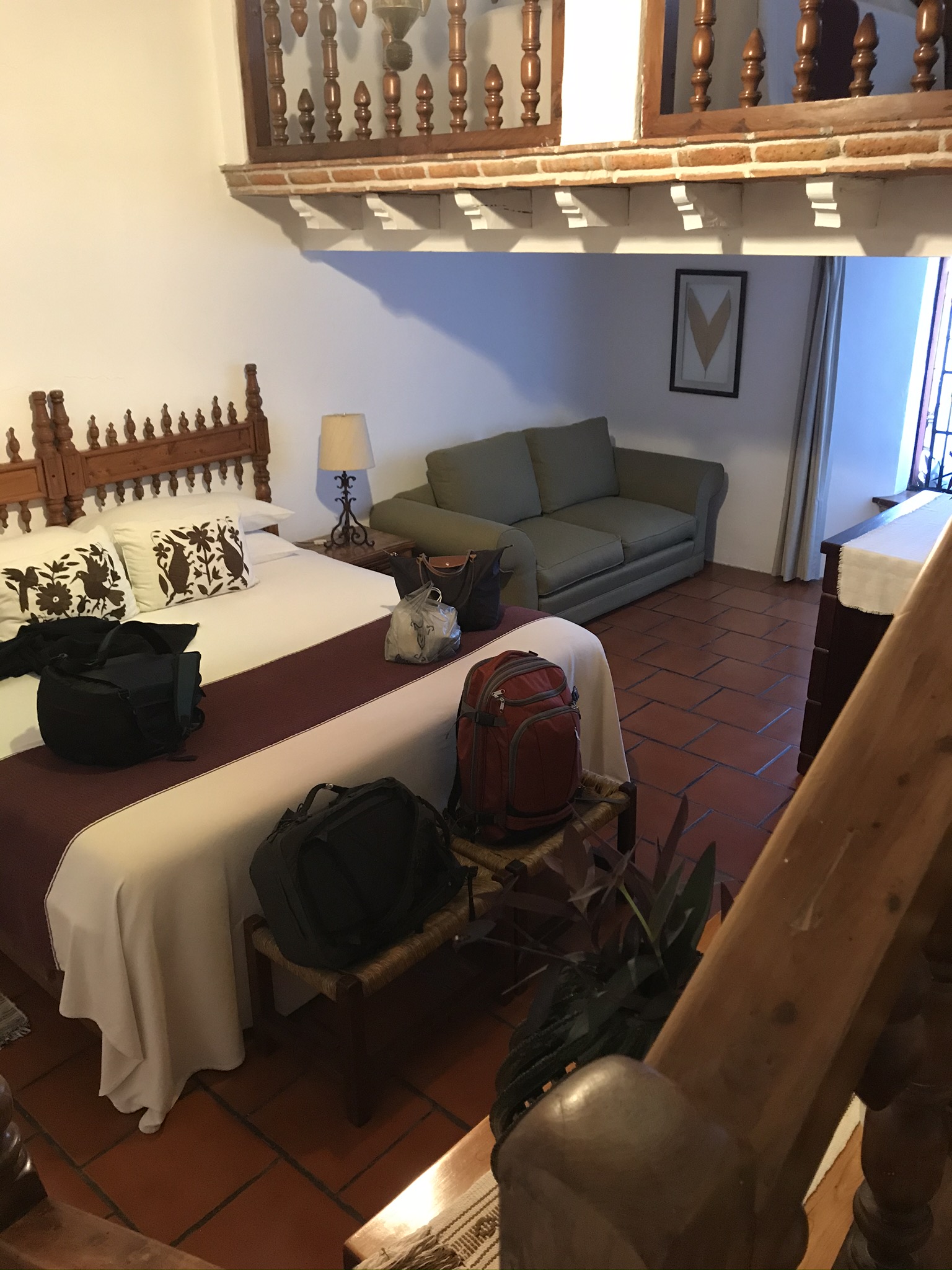
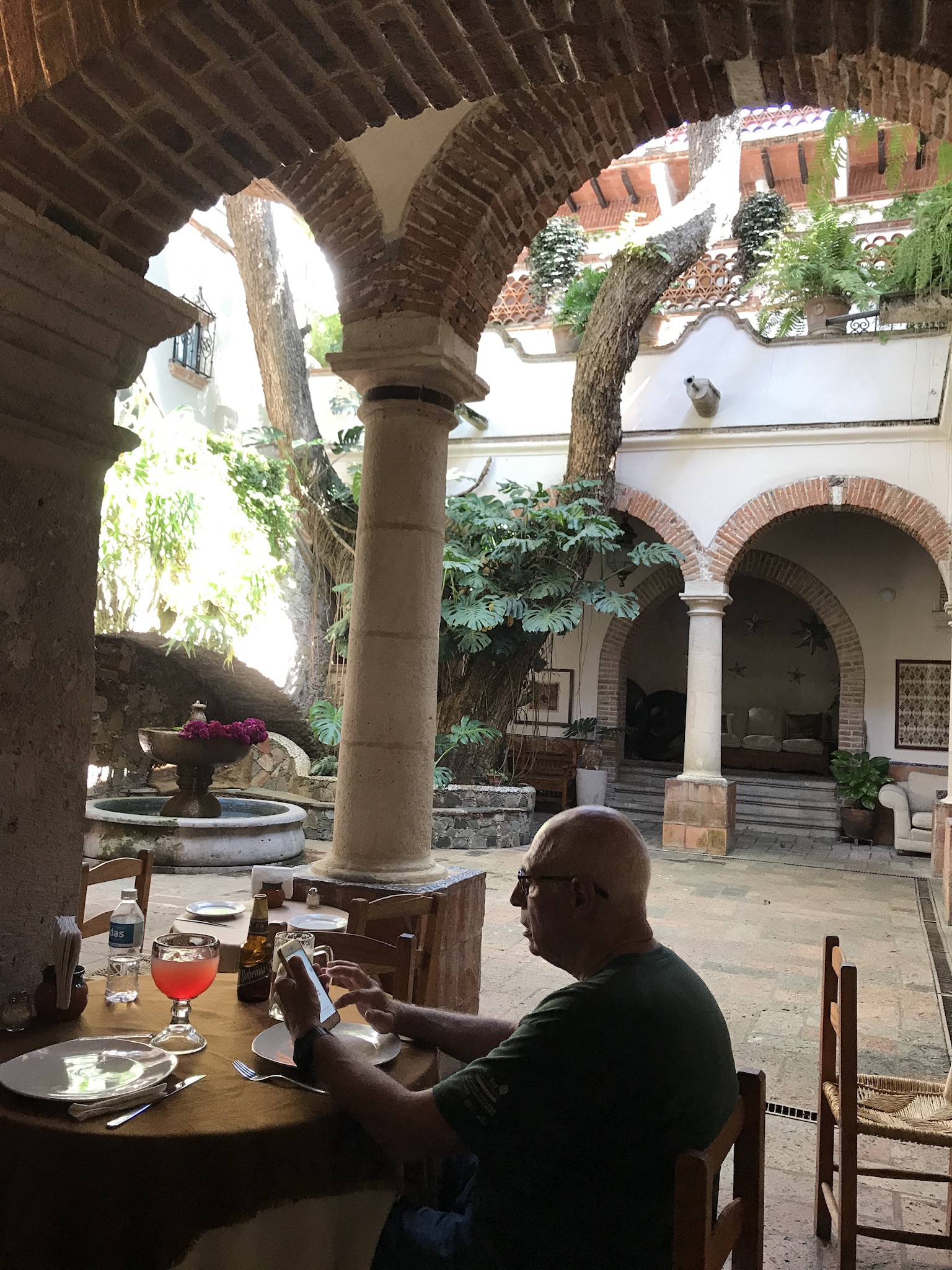
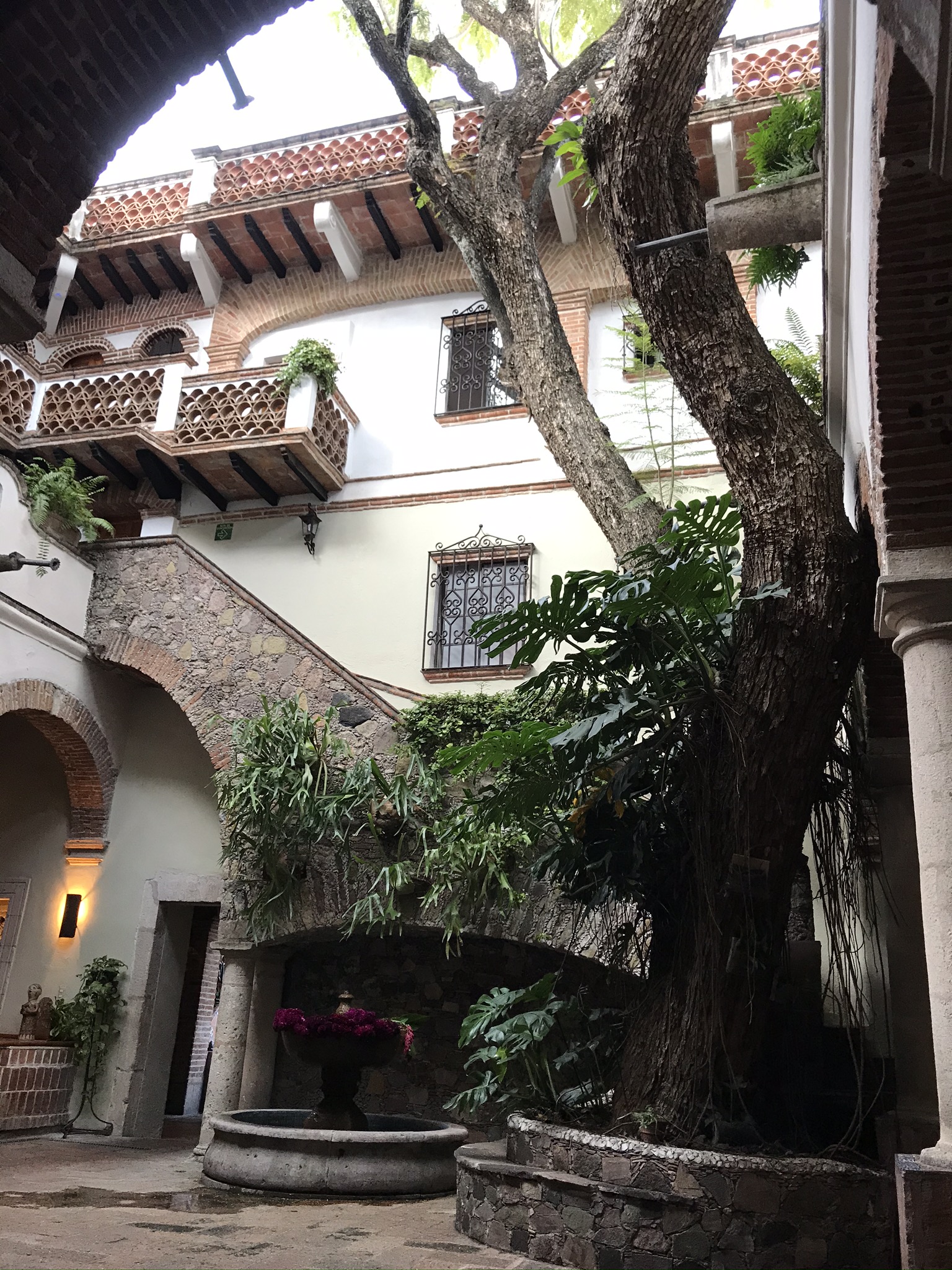
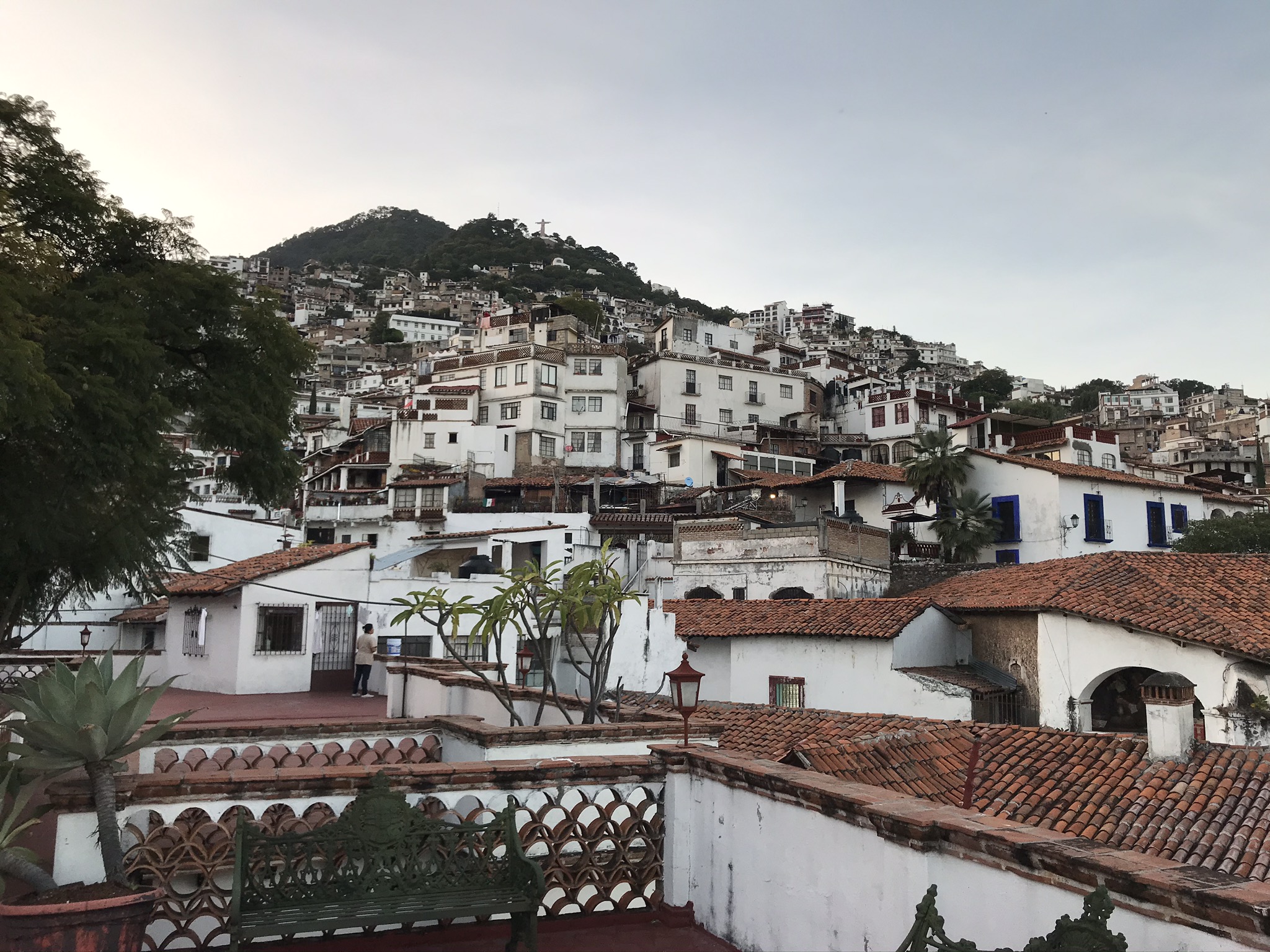
I’m not sure how I selected this place but it turned out to be perfect. While there is no quiet spot in Taxco on a weekend, the location, just around the corner and down the hill a bit from the zocalo, was ideal. The room was large and comfortable and the central patio peaceful and picturesque. On the roof is a large terrace with gorgeous views of the town, which stretches way up the mountain and down into a valley. Walking this town requires stamina (it’s at around 6,000’), good shoes, and strong thighs and knees. We loved it.
Bufy (pronounced boo-fee) is a former street dog who is now under the protection of the hotel. Dogs are allowed everywhere; this hotel, which seems to be operated by a group of women as we never saw a man working there, has a sign at the front desk listing restaurants which are dog friendly. We saw a fair number of street dogs, maybe 5-10 all told, which were calm and well treated. In fact we saw Bufy around the zocalo and out and about, often on his own but sometimes with someone from the hotel on an errand. Dog food and water bowls are all over the place.
Food highlights
Well, the food in general in Taxco is as delicious and inexpensive as elsewhere in Mexico but a few meals and restaurants stand out.
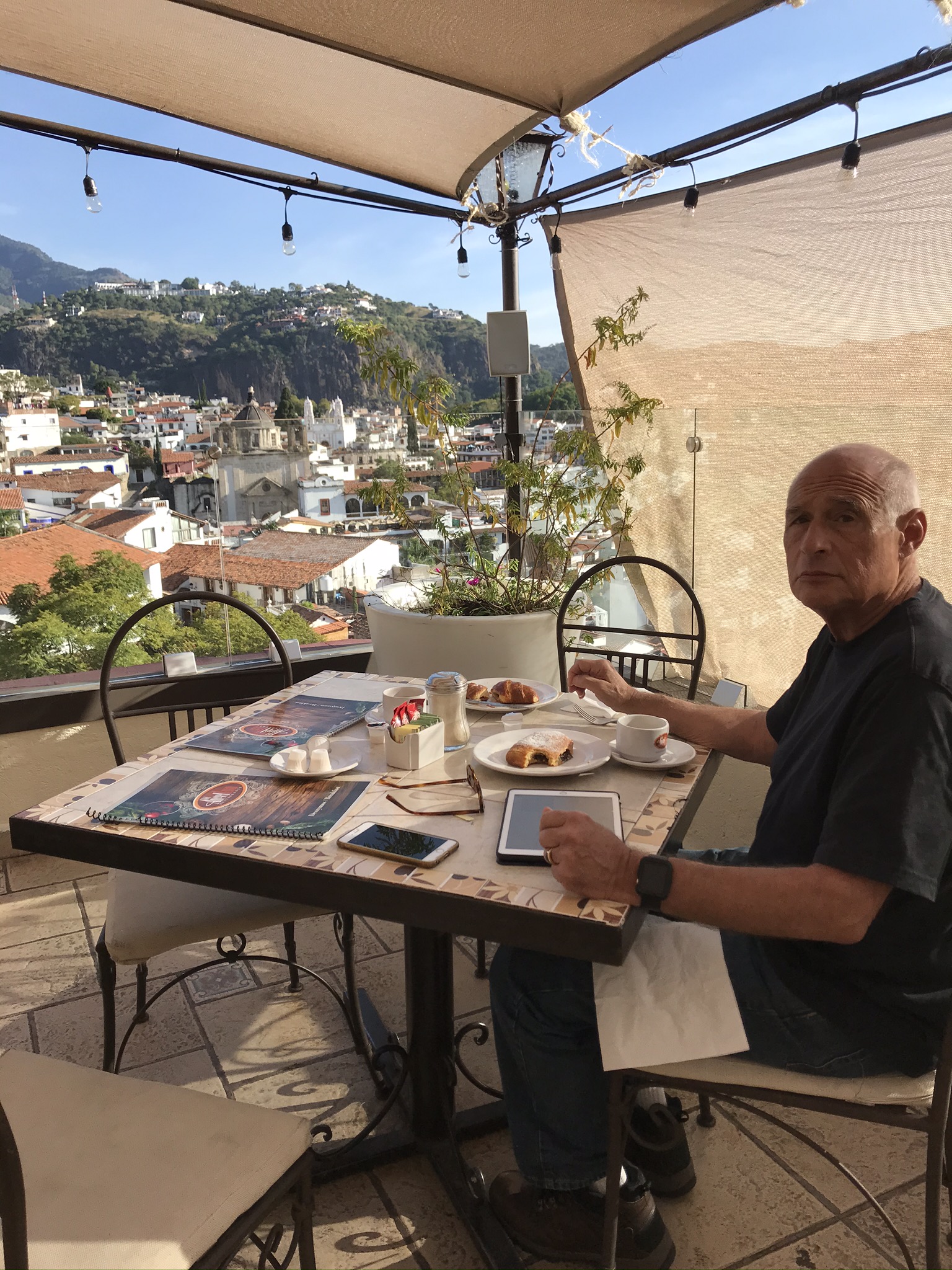
We had two fantastic, and typically enormous, breakfasts of chilequiles with eggs. The restaurant that serves in the hotel patio is terrific and highly recommended for convenience, service, delicious food. One of the “jams” they serve is a sweet chipotle that was memorable…not spicy, just a smoky, just sweet enough condiment. For the view—though the servings were overwhelmingly large so eating was almost discouraging, we went to Del Angel, a hotel behind Templo de Santa Prisca, the huge central church on the zocalo. The restaurant has several outdoor terraces, all with sweeping vistas of the town. Don’t get me wrong, the food was great—but entirely too much for a normal human being to consume in the morning.
Seriously, after fresh juice and pastries, all part of the shockingly inexpensive paquete (like the Japanese breakfast sets), could you eat that entire serving of chilequiles?
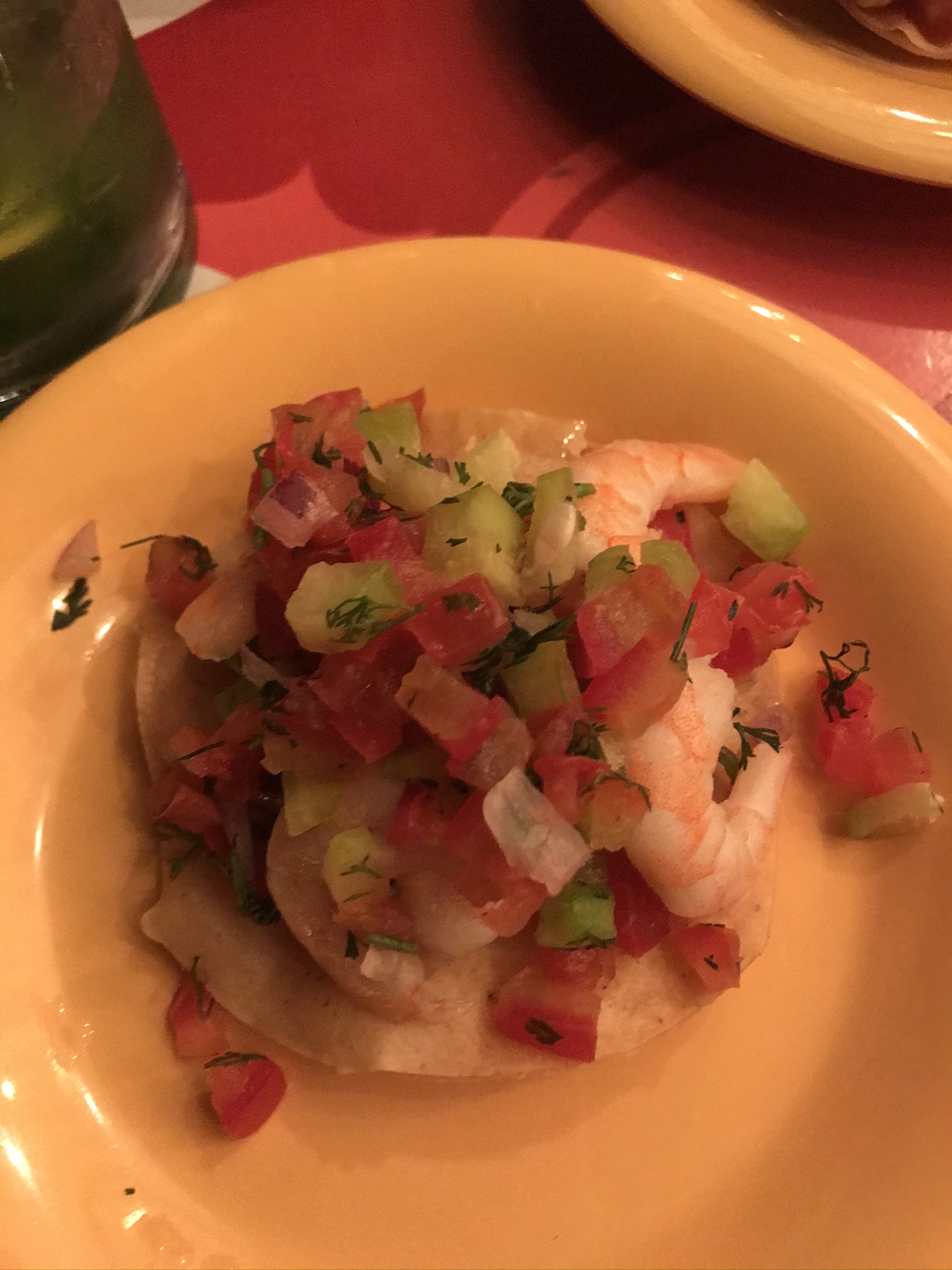
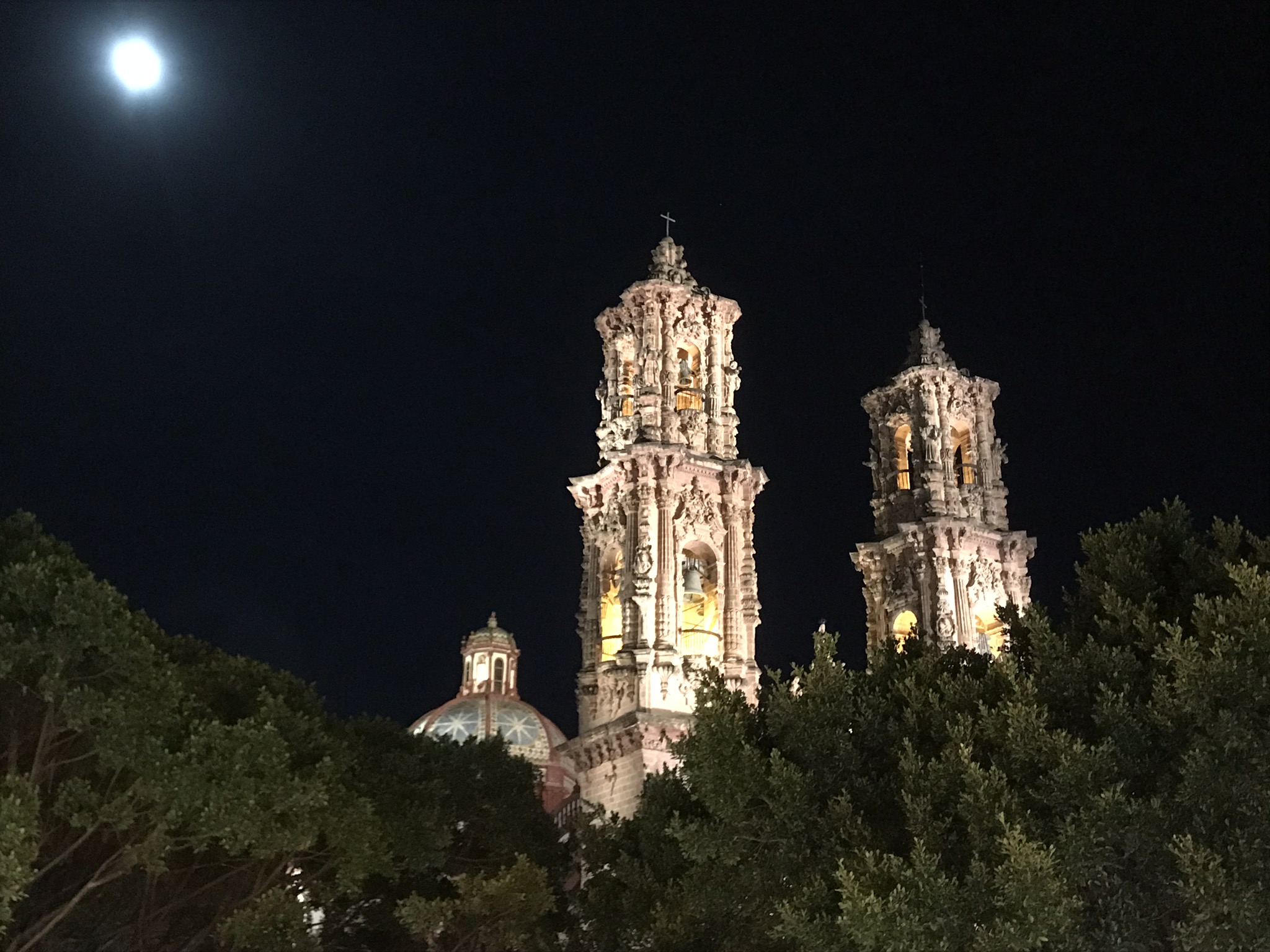
Two of our three nights in town we went to La Bendita, a small cantina-like place for drinks and small plates such as tacos, tostadas, quesadillas. The ceviche tostadas were what called us back for a second time, and I highly recommend the chicharron pescado (fried fish) tacos as well. My mojito(s) were delicious, and both nights David had the liter of beer. Sitting at a tiny table on a tiny balcony overlooking the zocalo madness was entertaining. The second evening the moon rose over the bell towers to give us a magical picture.
Finally, on the Taxco food front, we went to the famous Tia Calla, a basement level pozoleria. David isn’t a big fan of pozole but I am—and he had the chalupas, four little tortillas with chicken and chipotle. By the end of his snack he said his mouth was tingling but they were not the killer heat we know from chipotles in the US. The pozole was the best I’ve had.
The pozole had a half an avocado in it!
Plata
I really wanted to be in town for the Saturday market, a truly insane explosion of silver puestos (little stands) that seemingly filled every bit of space in the town—buildings that were closed on Friday opened to be consumed by hundreds of vendors each with approximately a card table’s worth of display. While many vendors sell the same things, as you walk each aisle you see that from one to the next they have a particular type of jewelry or a distinct style. My plan was to leave with enough pairs of earrings to last me for years, and I did. We also bought a few little gifts which will not be shown here as we want to surprise the recipients. The prices are absurdly low and the experience always “muy linda.” I had tried to describe Saturdays to David—there are always hundreds of vendors in stores and on the streets in Taxco—but he was shocked at the sheer level of commercial enterprise.
The picture on the left does not do justice—this is one of maybe thirty spaces that are filled with vendors on Saturday. I bought several pair of earrings from this most friendly woman at this puesto, which was down a series of stairways winding around impossibly complicated aisles lined with taco stands, jewelry vendors…just a mass of activity.
Simply too picturesque
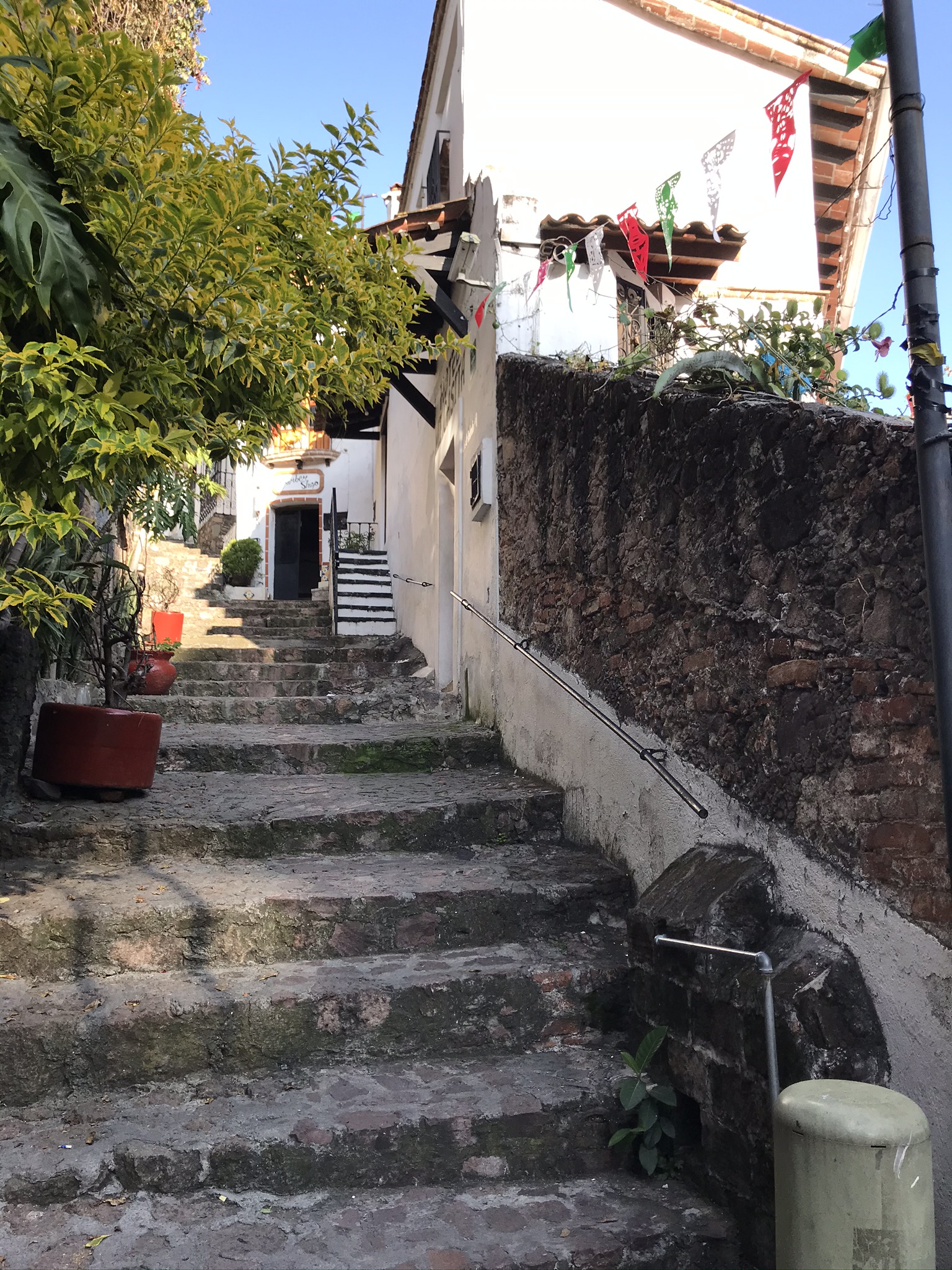
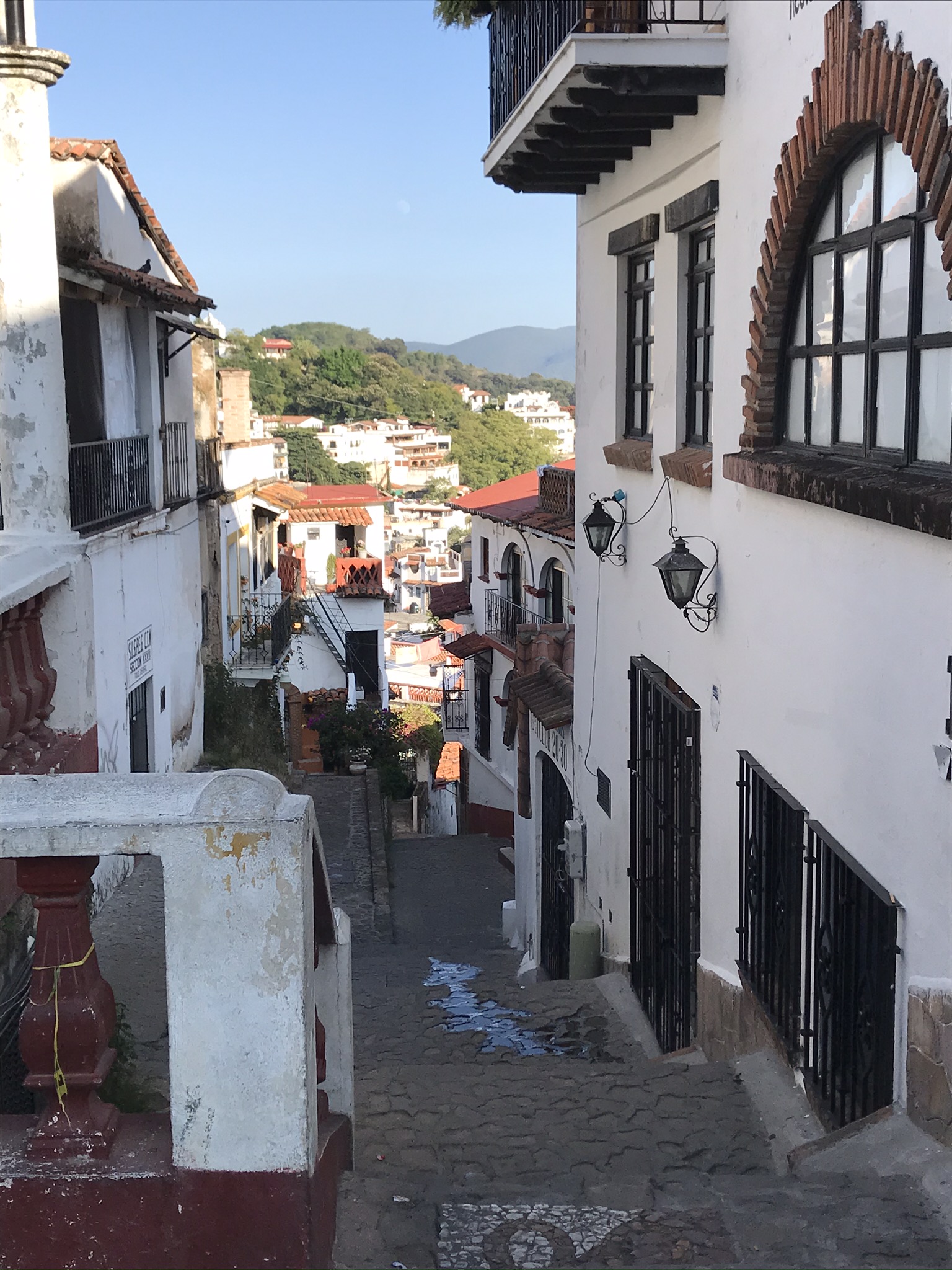
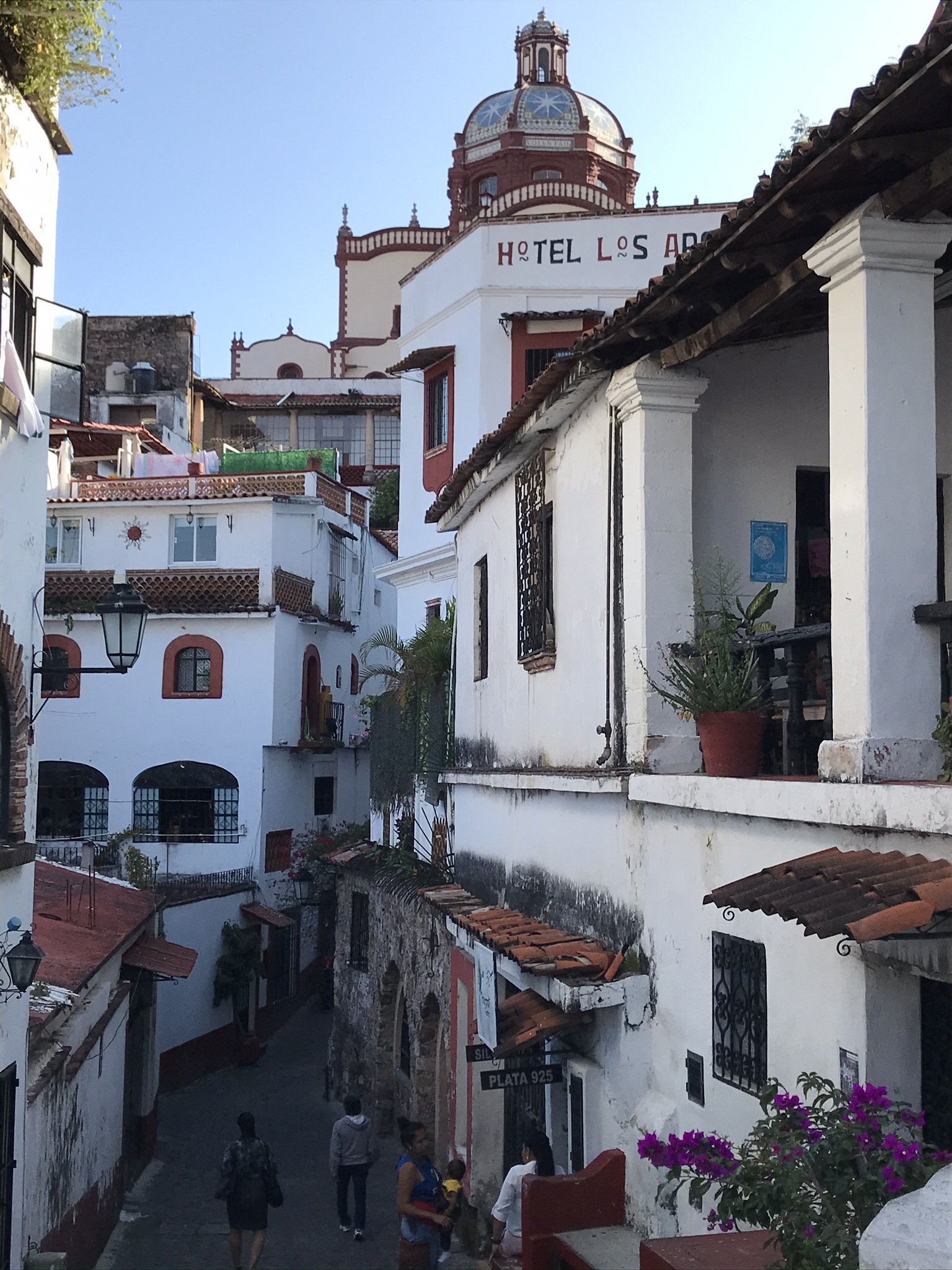
We wandered the town every day, and at every turn enjoyed the beauty of this amazing town, one of Mexico’s Pueblos Magicos.
Cholula is maybe a 20 minute Uber from the historic center of Puebla, and yes, it has the very biggest pyramid on earth. It is also a lovely town easily navigated on foot, and we spent several hours in the archeological zone, as it is known, walking through the slightly scary tunnels, wandering the ruins that have been excavated, and then took a walk through the ‘downtown’ where we had a delicious lunch and a walk through an odd church right across from the zocalo. It made for a good day trip.
The pyramid was for centuries thought to be a big hill with a church on the top that was built in the 1600’s. A thing about Mexico—it is so much older than the US, with many buildings and churches still standing that were built in the 16th and 17th century. Bits and pieces were unearthed over the last 100 years or so, and now there is even a small museum (very small) that discusses the history of the area, once a marshy lake, and what they have been able to decode about the different groups which lived, died, and moved on over the centuries.
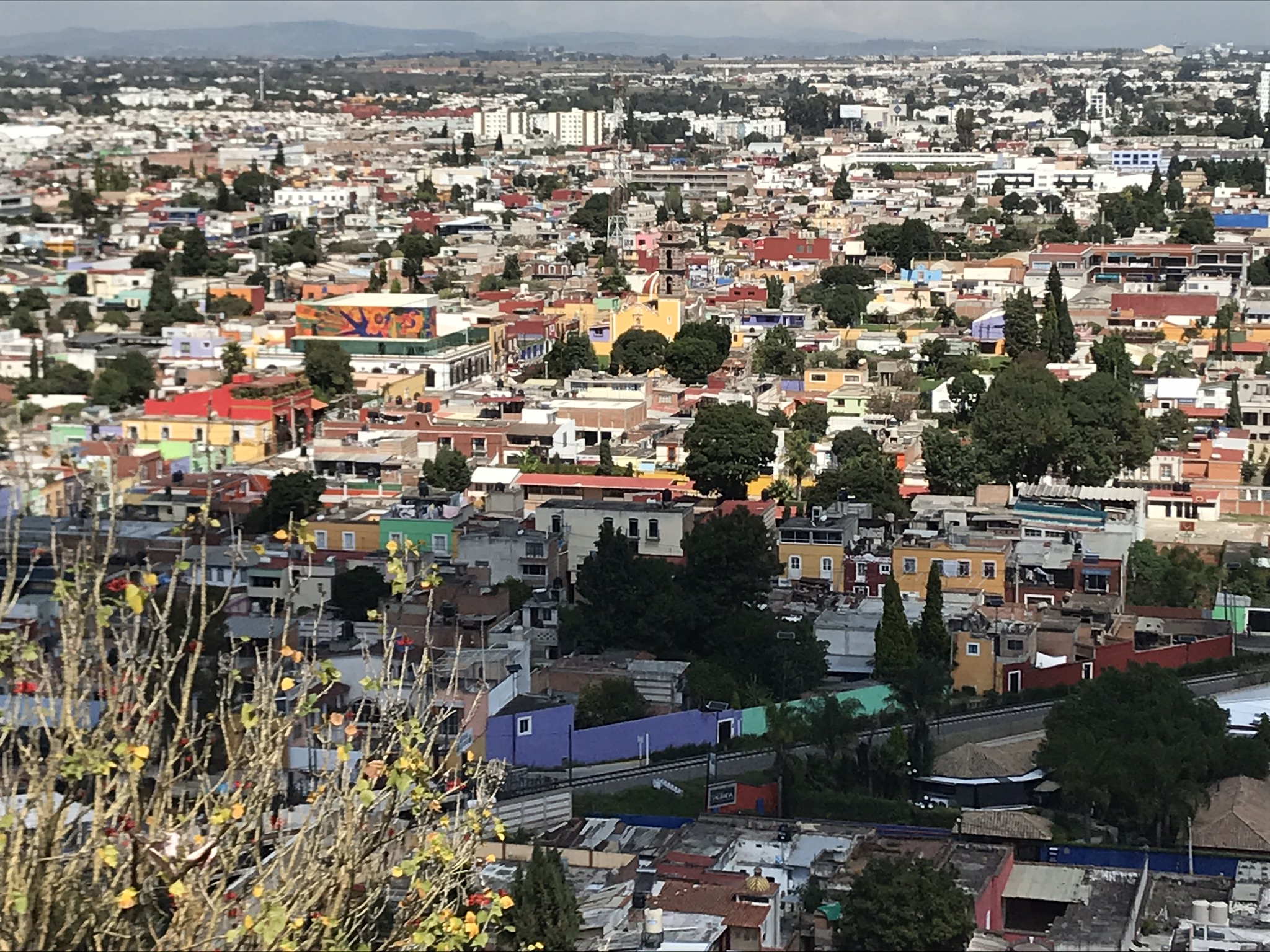
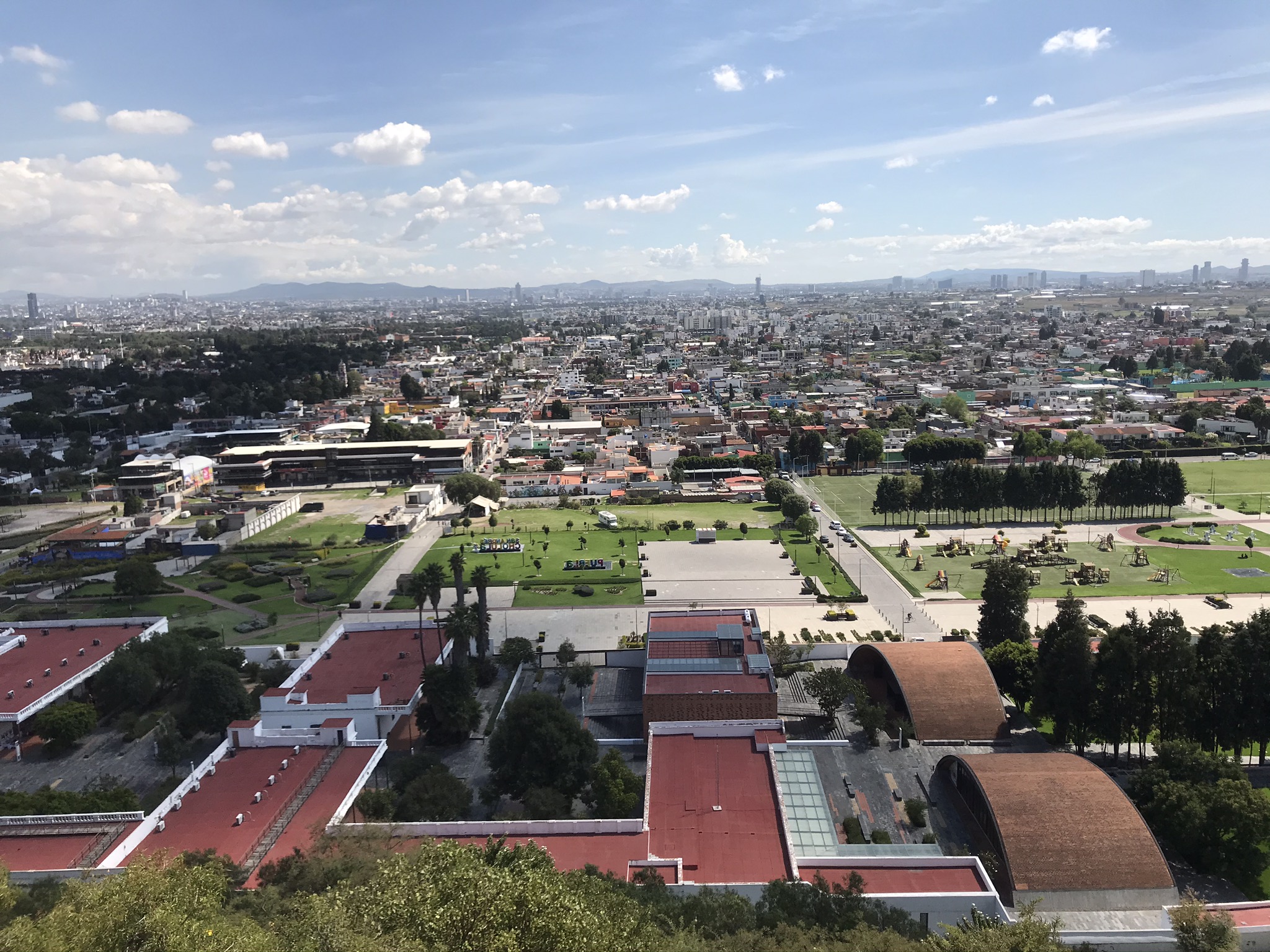
The views from the top of the pyramid, which still does look like a big hill, show the lovely, and growing, Cholula.
Scary tunnels through the pyramid are NOT for the claustrophobic. A view from the church at the top is lovely, but, alas, the volcano was clouded over. The last picture is the pyramid and the church at the top, taken from the zocalo.
“Downtown” Cholula is lovely. The middle photo is of ancient tombs along the side of Capilla Real de Naturales, a church built in 1540 which has 49 domes (third picture inside). The tombs are so old the names and dates have completely worn away.
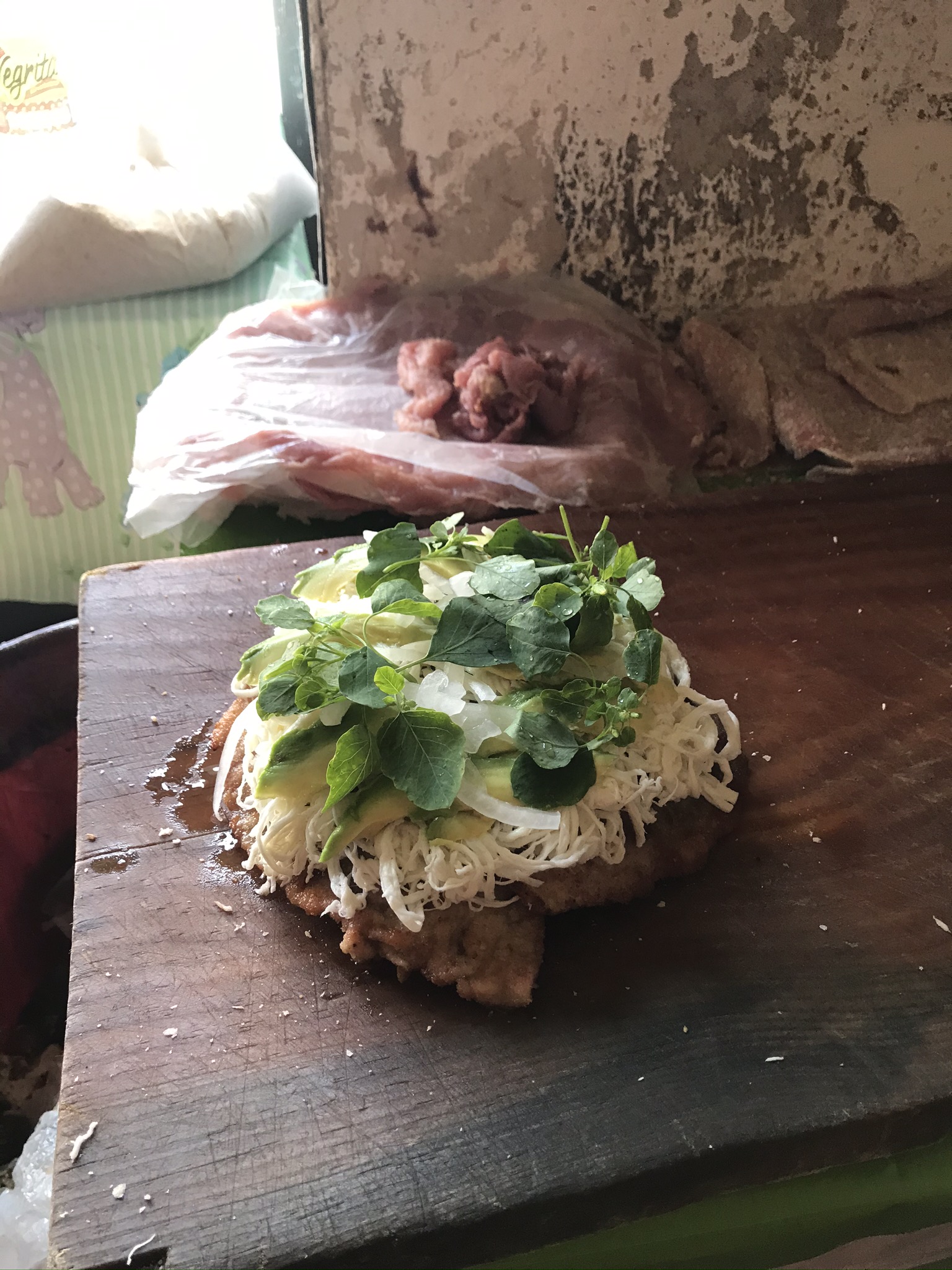
Cemitas are the Puebla version of an oversized, overstuffed sandwich. They are everywhere…from tiny puestos, holes in the wall with rickety card tables and often waves of heat coming from gas fired flat grills of beaten steel, with shallow depressions that are filled with cooking oil for frying potatoes and nopales, stand alone puestos on the street where buy your food and eat out of hand on the sidewalk, to full restaurants that serve cemitas from a menu.
Our last afternoon in Puebla we knew cemitas were on our menu for lunch, and as we left the Casa Alfenique we asked the group of students at the entry where we should go for cemitas—they recommended the neighborhood El Carmen, which was very close to where we had stopped for chanclas the day before. It was about a 20 minute walk, and we were en route when we passed one of the tiny holes in the wall, the grill in the doorway, 3 women cooking like mad, and a sample cemita displayed on the edge of the grill as an advertisement. The sample cemita was enormous—and the smells of the frying potatoes and nopales was enticing. Also, only one of the 4 card tables was empty. David said “let’s just go here” and as it was 2 blocks from the hotel and we were hungry from all the work of visiting museums, in we went.
As we sat down at the empty table we were able of course to watch all the cooking—it was literally right in front of us. One woman was making tortillas from a pile of masa harina that must have been a foot tall and a foot wide. As she removed the tortilla from the press she passed it back and forth from hand to hand—exactly the same technique I had watched recently in a video about making naan. Each tortilla puffed up as she moved them around the grill. A second woman was chopping onions with an enormous knife. The third was cooking cemitas—she took 3 paper thin pieces of meat, probably pork, and slapped them on the grill. While the meat grilled she prepared the rest of the filling. The bottom of the roll was covered with avocado, strings of Oaxacan cheese (the only cheese we saw in Puebla), slices of onion, an herb papalo which is kind of similar to cilantro though unrelated, a good flavor and quite strong, and a handful of French fries. As you can see from the picture, it is enormous. I was unable to finish my half and I was so very hungry when I started! Anyway, this little place turned out amazing food and was always full—there was a “nicer” cemitas place next door which was empty as we walked by. What a treat. And our 100% good luck eating street food held—no after effects at all.
A wonderful no-name place turning out world class cemitas!
Chanclas
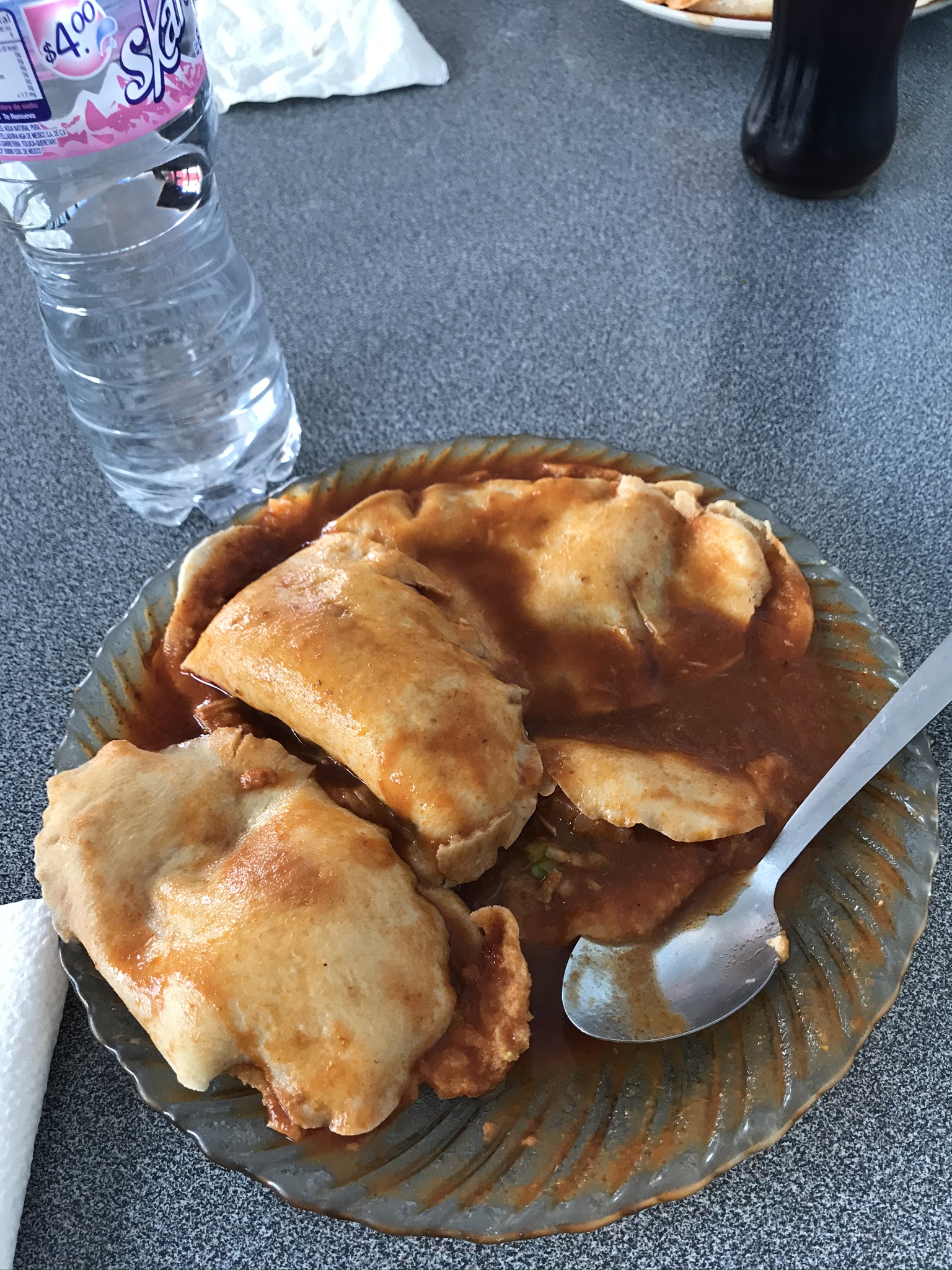
These were described to us as a kind of sandwich, but though there is bread involved these are nothing like a sandwich.
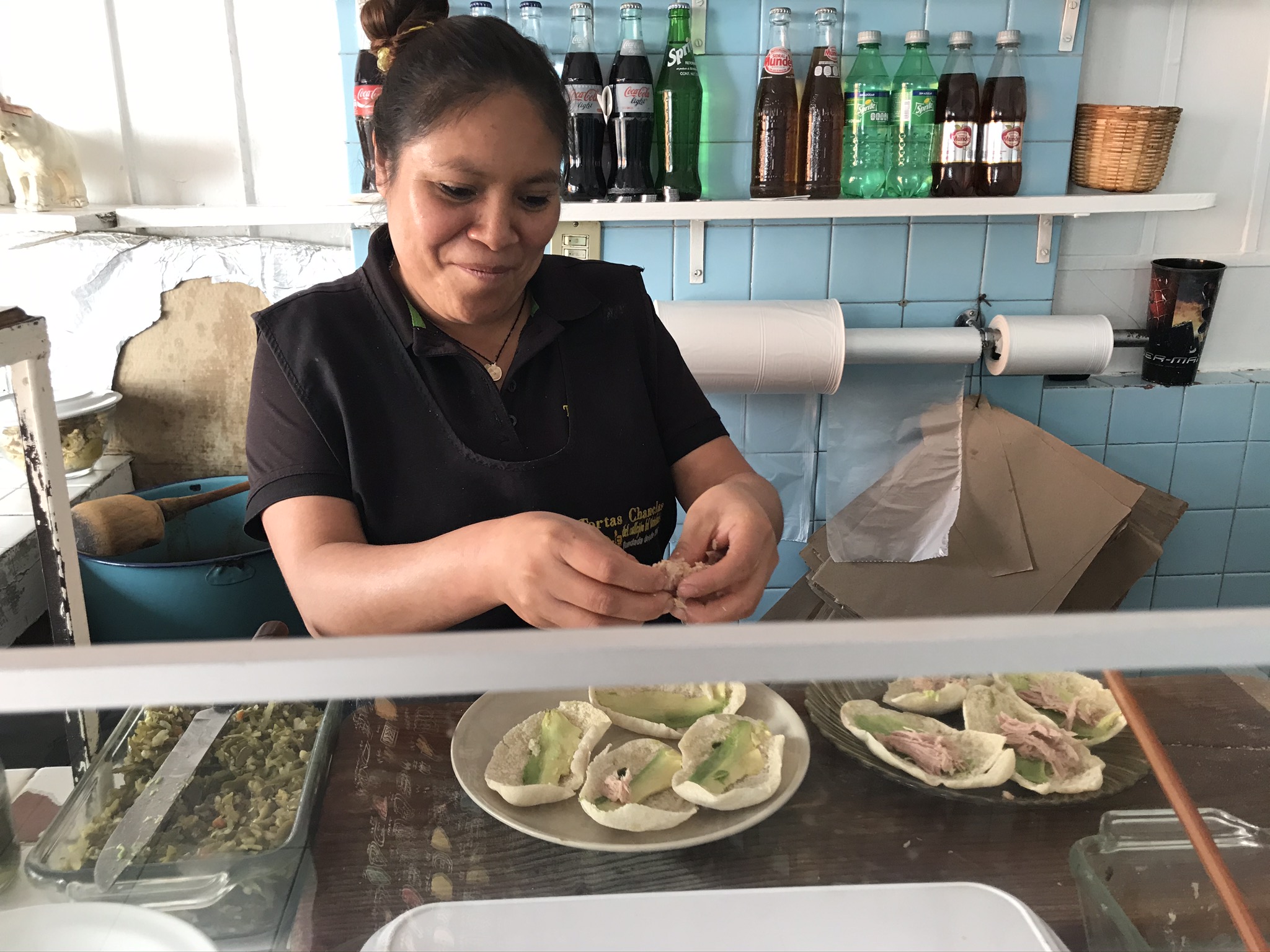
Small white rolls, which are somehow hollow, are cut in half. The place we went—recommended by our Uber driver, letting us off there instead of taking us back to the hotel as he told the owner “I have some tourists here who want chanclas”— was of course tiny so I could watch the assembly which included shredded chicken, slices of avocado, the top of the roll and then the entire plate is filled with a thin red sauce similar to the red sauce we know from red enchiladas in the states. One order is four chanclas—I ALMOST finished mine, though David had no trouble with his four.
And as always the very nicest young woman prepared our food.
Moles (that’s mo-lays, not the rodent)
Every region seems to have its own specialities when it comes to moles and we had several different such in Puebla.
The dark mole, almost always served over chicken or a chicken wrapped in a corn tortilla, is sprinkled with sesame seeds and is intensely flavored with a very definite chocolate undertone. A little too sweet for me, but David loved it. We also had a mole “house specialty” at the sister hotel Meson Sacristia de la Compania which was not at all sweet, even a bit sour/tangy. I loved that one. The other common mole in Puebla is pipian, ground squash seeds which I liked as well, lots of cumin and a hint of tahini-like flavor. We had this trio at Fonda de la Santa Clara over beef—we were a little tired of chicken on our last night.
Tacos al pastor and tacos arabe, and the grilled mix alambre
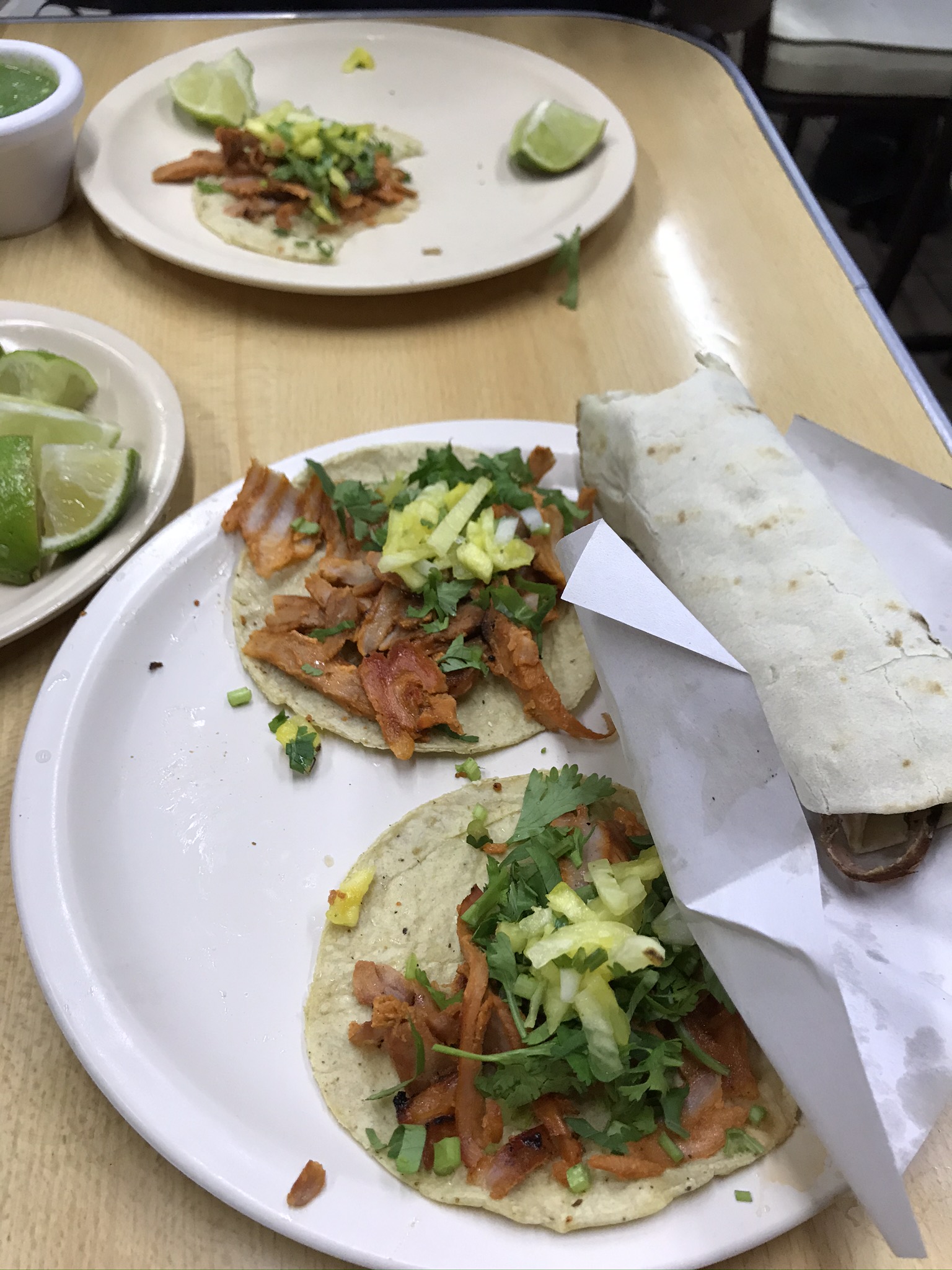
Tacos al pastor and tacos arabe are both specialties of Puebla and so good. Arabe means the meat comes wrapped in a flour tortilla, well, halfway between pita bread and a tortilla. The default meat in a taco arabe they call “carne blanco” which means it’s not reddish brown with spices as al pastor is. Simple and delicious, especially with the bright green tomatillo salsa usually on the table.
Al pastor is what we see in the US if you are lucky enough to live near good taquerias: stacked meat, heavily spiced, turning in front of a roaring vertical grill, sliced off in thin pieces and served on corn tortillas with pineapple, onion, and cilantro. OMG so good, almost refreshing with the fresh pineapple on top. I could have eaten those every day if there hadn’t been so many other things to try!
(At the central bus station, which is like an airport with all the companies in one place and a large waiting area surrounded by food stands, the “Rincon Poblano” (Puebla Corner) had tacos arabe and cemitas—but we were on an morning bus and passed, reluctantly.)
Our first night we went to Las Ranas where we ordered the .5kilo of meat with a stack of tortillas. It turned out to be a mix of meats—not sure what all—with peppers and onions and a cover of melted cheese. So delicious and we could not finish, as hungry as we were after a long day of travel.
On the left, cutting al pastor; in the middle, tacos al pastor and unwrapped taco arabe; on the right, alambre.
In conclusion—
Every single place we went was so friendly, so helpful, and so welcoming it was easy to jump into foreign foods with happy confidence. For a food festival, go to Puebla!
Boy oh boy has this city ever changed in the 17 years since I took a day trip from my immersion school in Cuernavaca. It seems very prosperous, much larger, with a lot more going on everywhere we turn.
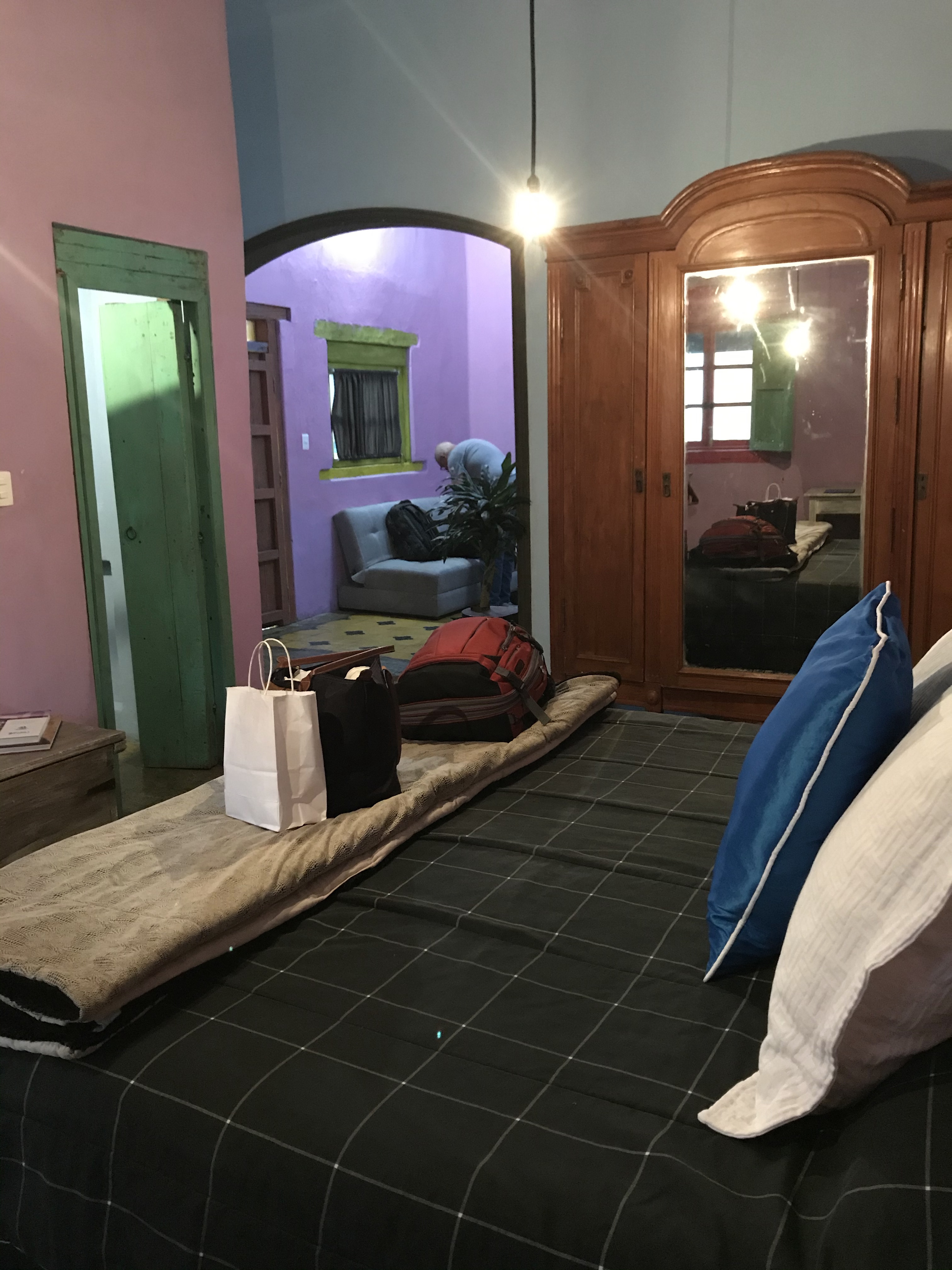
We are staying in Meson Sacristia de la Soledad, a lovely small inn with maybe 4 guest rooms (counting the tables set in the dining room that seems right). The owners live here as well, and are delightful, helpful, warm, welcoming. When helping us with the lost iPad I kept apologizing for the trouble, they kept telling me it was their job to help and make sure we were comfortable and happy.
I cannot recommend Meson Sacristia de la Soledad highly enough. The location is great, the room is comfortable…the owners have several other properties, one of which has a full restaurant which we dined at one evening (delicious) but we are happy we are here instead—smaller, quieter, just lovely in every way. I cannot wait to post reviews every place I can find.
The Meson is built around this lovely garden; our room (picture on the right) is behind the yellow door on the second floor.
Abraham is always there to help at Meson; the lovely breakfast room where we feasted every morning.
The historical district was a Dia de Los Muertos celebration—happy friendly crowds everywhere—which continued into Sunday unabated.
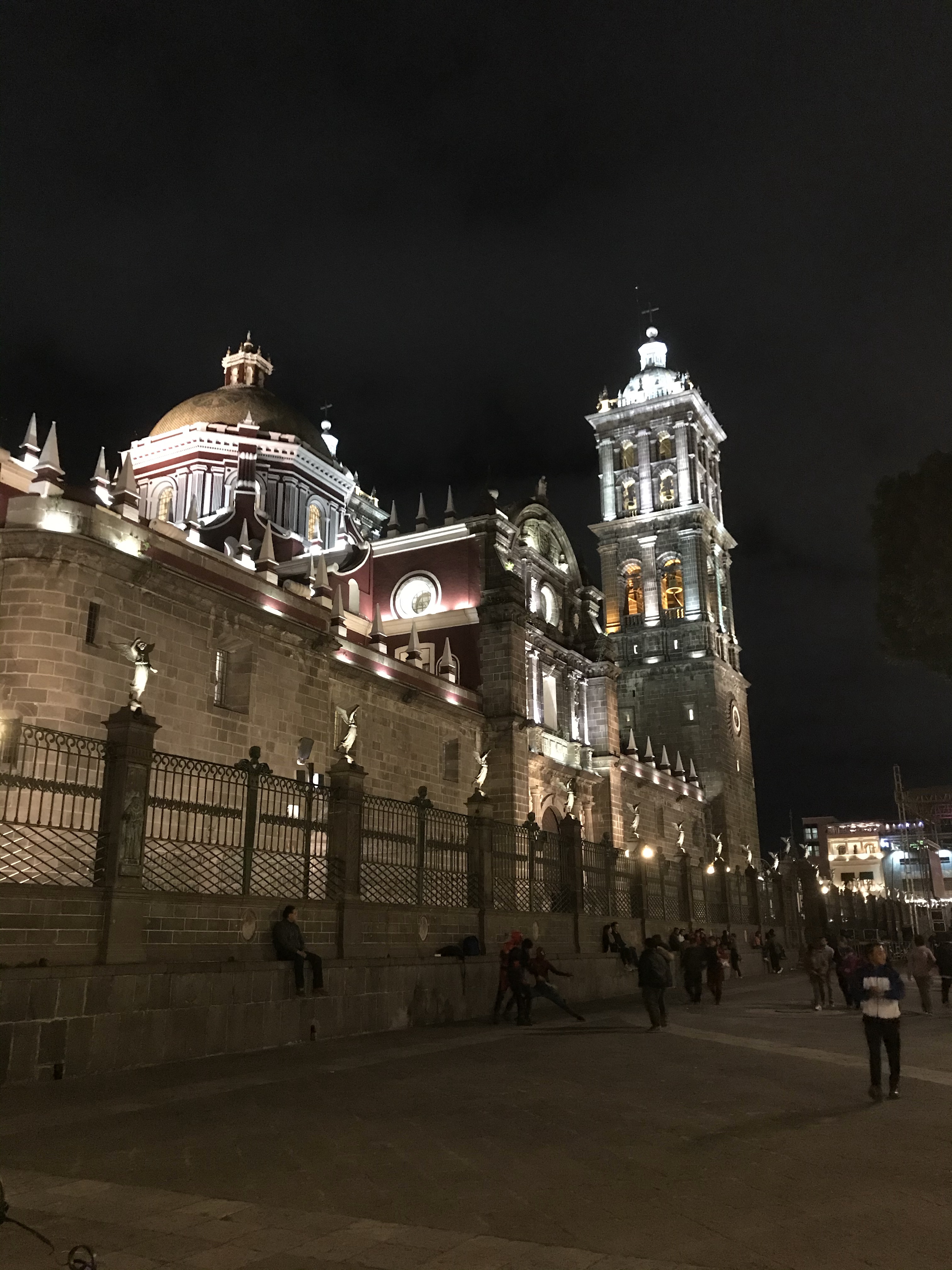
Centro Historico was so lovely at night.
Around the zocalo; the famous street of antique shops (the blue people were still celebrating Dia de Los Muertos)
Below are scenes from around the zocalo. Nice town.
Templo de Santo Domingo/Capilla del Rosario
When we were at the International Museum of the Baroque (see below) a couple urged us to visit this church, so we did. The main church is stunning, with an enormous wall of saints (?) and other people important to Christianity (we couldn’t identify a one), but when you reach the front and look to the left, the Chapel of the Rosary shines out at you and then draws you in. I have never seen such compelling faces in the decorations around the walls of this small, extremely tall, chapel. It’s a wow.
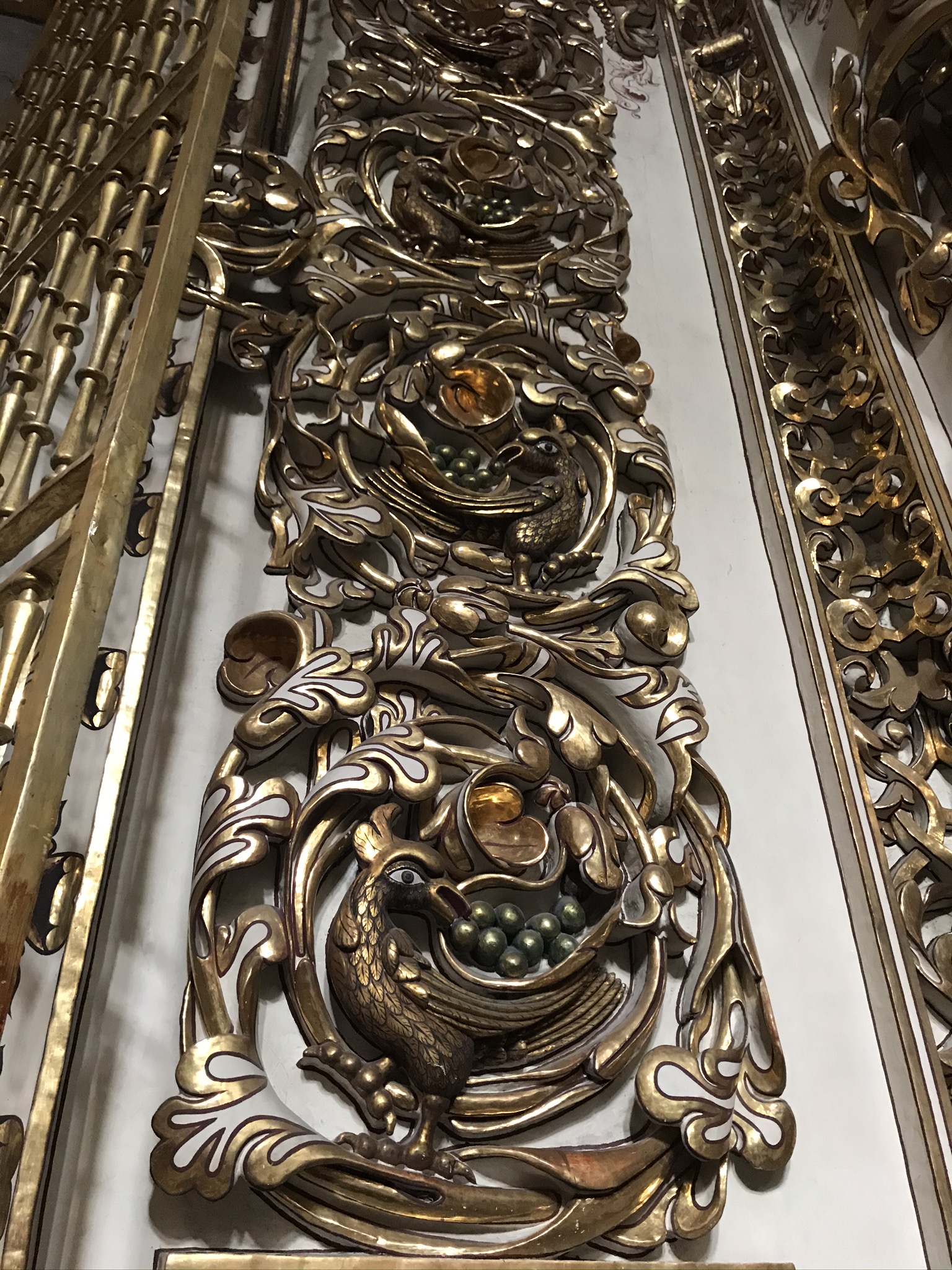
Fantastical creatures and gorgeous faces in the Capilla.
Museums Galore
We are museum lovers and Puebla has given us a slew to visit. I don’t think I can rank them so will just give you a snapshot in the order we saw them, more or less.
Museo Amparo
This is listed as a private museum, which is surprising because they had free days and also free nights at the museum. In any case the tickets are inexpensive. The audio guide is solely for the pre-Hispanic exhibits, and wow, they are great. Why great? They are arranged by aspect of life—music and musical instruments, artistic expression (first place I have encountered a discussion of the contrast between European art, which strove for realism, and pre-Hispanic art which is dominated by a more abstract representation of people and things), spiritual understanding of how the world works (rivers, for example, are the way the life forces communicate with each other)…so rather than a chronological march, everything is tied together to help you understand how they saw the world.
The special exhibits were no less impressive. An exhibit open right now features an American Jewish-African Ecuadorian woman, Karina Skvirsky, which blew us away. She works with photo collages, which were disturbing and interesting, but her short film that represents/recreates her great grandmother’s journey at age 14 from the Ecuadorian countryside to the city where she worked as a domestic was spellbinding.
The first view of the terrace through the glass walls seemed unreal.
Finally, the third floor, which we might have skipped because it’s the cafe and we weren’t hungry, opens onto a terrace that is exactly at the height of the many surrounding church domes and towers—which are so close, given the narrow streets, and of many colors, under a cloudy sky the day we were there that looked unreal. We gasped.
Museo Internacional de Barocco
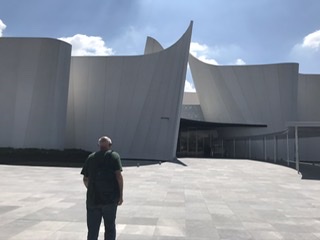
This extremely modern, almost distractingly high tech museum about 20 minutes’ drive from the Centro Historico was a surprise in all ways. Puebla, founded in the 1500’s, is a baroque city with many obvious examples of the style in its churches and other buildings. The museum, though, explores everything about the baroque period—architecture, science, music, painting, etc.—around the world, using poblano examples wherever appropriate but is truly a complete picture of how the baroque period changed everything in western culture.
Bilbao-like on a huge site complete with rock lined pools.
The architecture of the museum is very modern designed by a Japanese architect, and stunning. On the inside the exhibits are arranged by subject (painting, architecture, scientific exploration, music…) and each room is filled with examples, explanations, multimedia presentations, narrations. It was wonderful and a bit exhausting. Well, well worth the Uber ride and typically low ticket fee.
In this room a narration and shifting pictures on two huge screens (you can see one here) discussed baroque buildings in Puebla, which is laid out in a scale model, lighting the building discussed in turn. Very elaborate!
Biblioteca Palafoxiana
Not strictly a museum, this is the first public library in the Americas. Bishop Juan de Palafox left his personal collection of 5,000 books to the Seminary of San Juan in 1646, with the stipulation that access not be limited to church personages but open to the public. It is small and gorgeous and the exhibit laid out in cases in the center is currently on the recording of indigenous languages by the clergy during the first several hundred years of the church’s presence in Mexico.
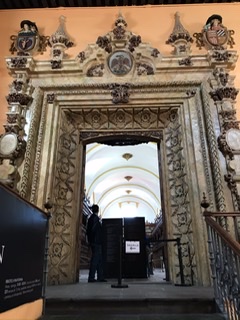
The entrance to the library; the interior is a large room with multi-tiered stacks.
This beautiful poem brought tears to my eyes. The panel to the right had the Nahuatl translation. The title is When a Language Dies. Use your google translate if you do not read Spanish. Vale la pena.
Museo Casa Alfenique
This was a surprise—we expected a restored residence (it is named for a confection made of egg whites and sugar and is embellished within an inch of its life) but it is a lovely history of Puebla and its role in Mexican history (you all know that 5 de Mayo celebrates the victory over the French invaders in Puebla, right?) as well as a lovely explanation of China Poblana, the creole/criollo indigenous/Spanish culture of Puebla revered in Mexico. Well worth the visit.
Casa De Los Hermanos Serdan
This place was a little gruesome—the bullet holes from one of the revolutionary struggles in 1911 remain on the exterior and inside, including a large decorative mirror with obvious bullet damage. The exhibit is about the Mexican Revolution in general, about which we realize we are insufficiently educated, and the slaughter in and outside what was the private home of the Serdan family. I cannot begin to explain what all this was about—read some history if you are interested. But do visit the museum when you come to Puebla. These events still resonate.
Bullet holes remain outside the Serdan home. On the right is the kitchen at Alfenique—beautiful.









































































 Inescapably Rational