Osaka is known for kashikatsu, one of the many kinds of “food on a stick” in Japan, and our young cousin Maya was tasked by mom Harumi to find a place. Now, Maya is a student and gravitates toward bargains, while her mother was determined to find someplace really great, and Harumi was quick to veto the first suggestion where each skewer is about 100 yen—way too cheap!
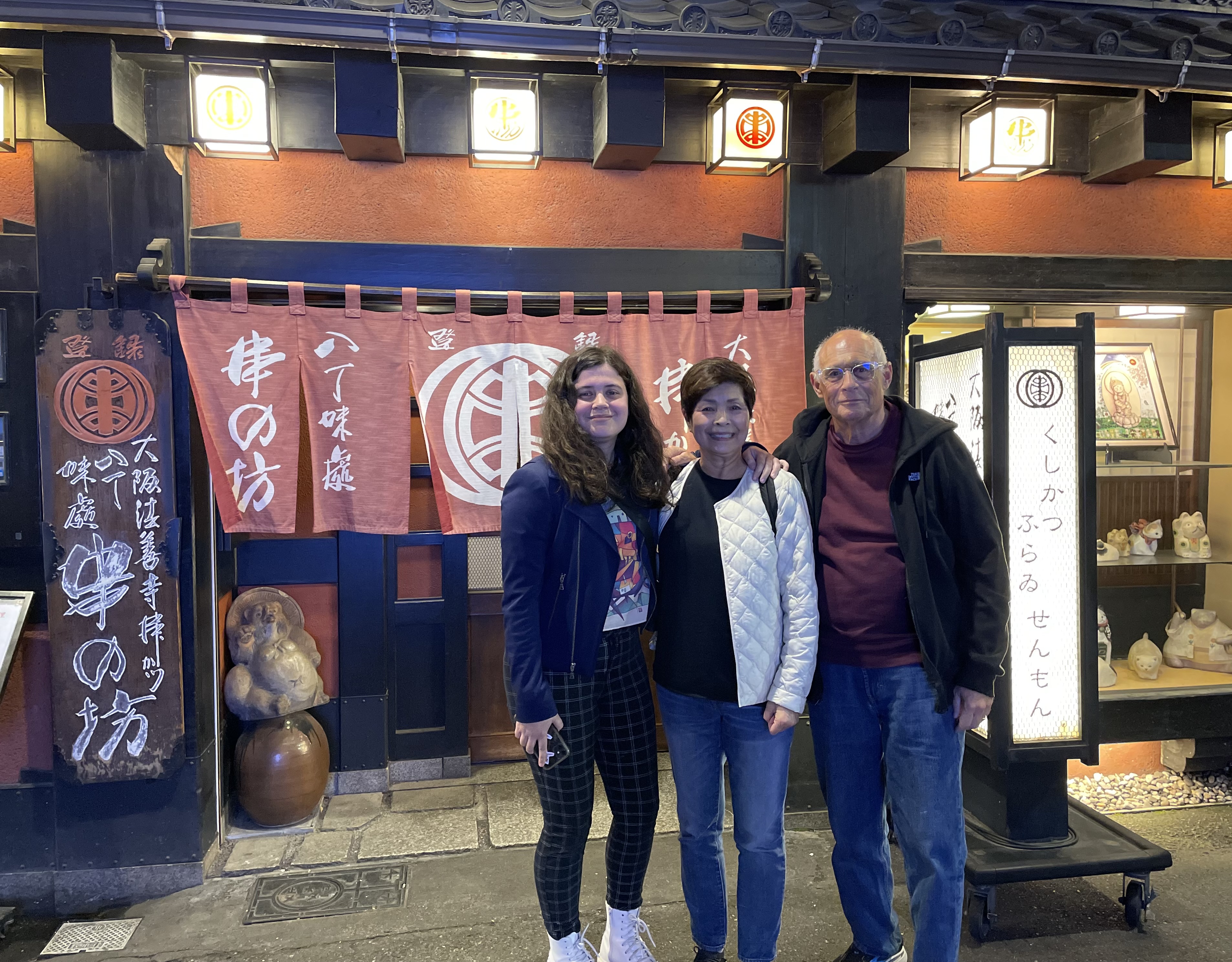
Maya did her mom proud by finding Kushinobo Osaka Hozenji 串の坊 大阪法善寺本店, a 15 minute walk from our hotel in Dotonbori but off the madhouse main street. Oh, what a find. The restaurant is clearly old and reminded me (really) of an old time German restaurant in Chicago or Milwaukee. Dark wood paneling, two rooms only in which all the counter seats surround the cooking space. We ordered the special omikase sets, which they were able to tailor to Maya’s pescatarian diet. The three of us, on the other hand, will eat just about anything put in front of us.
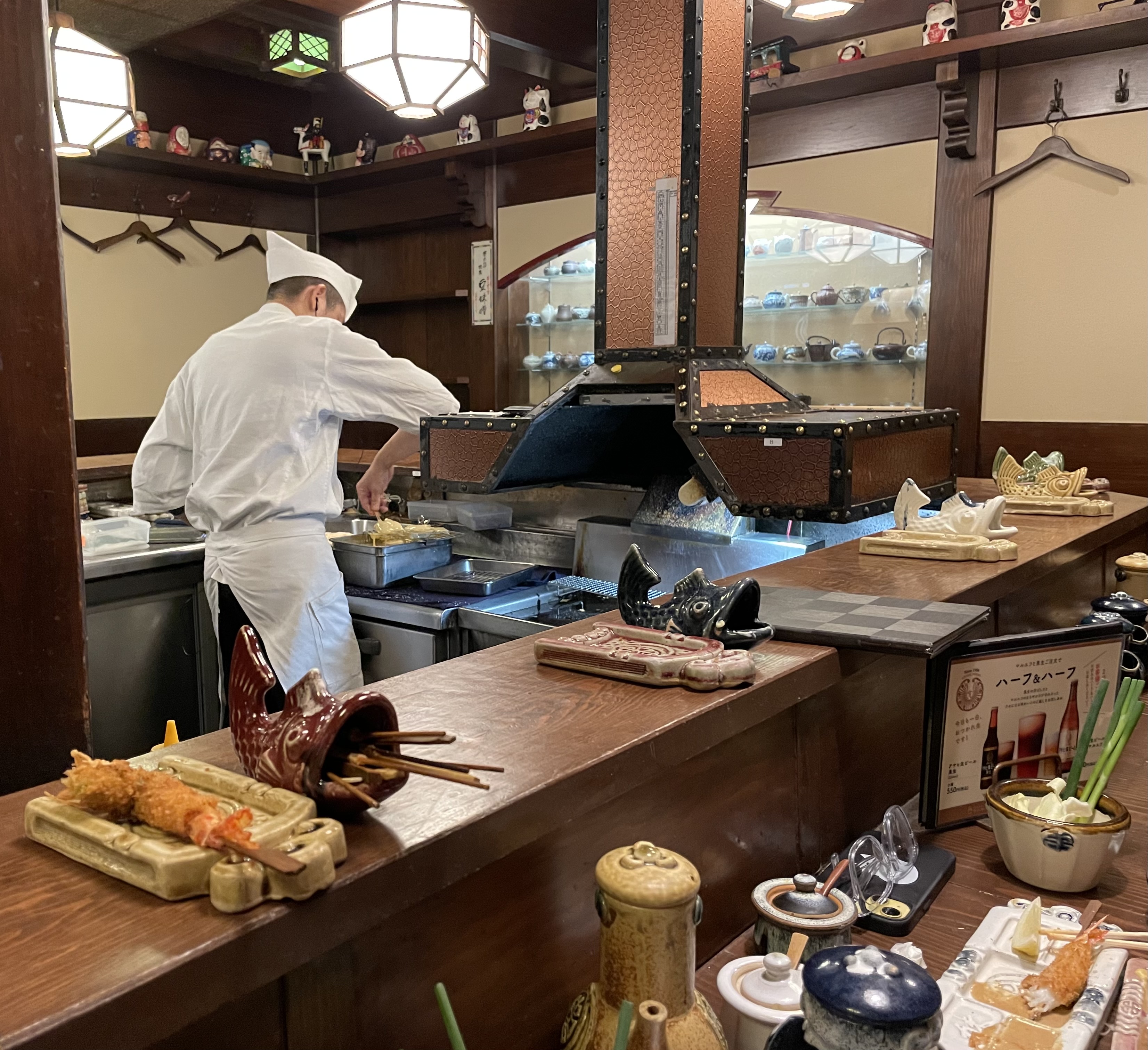
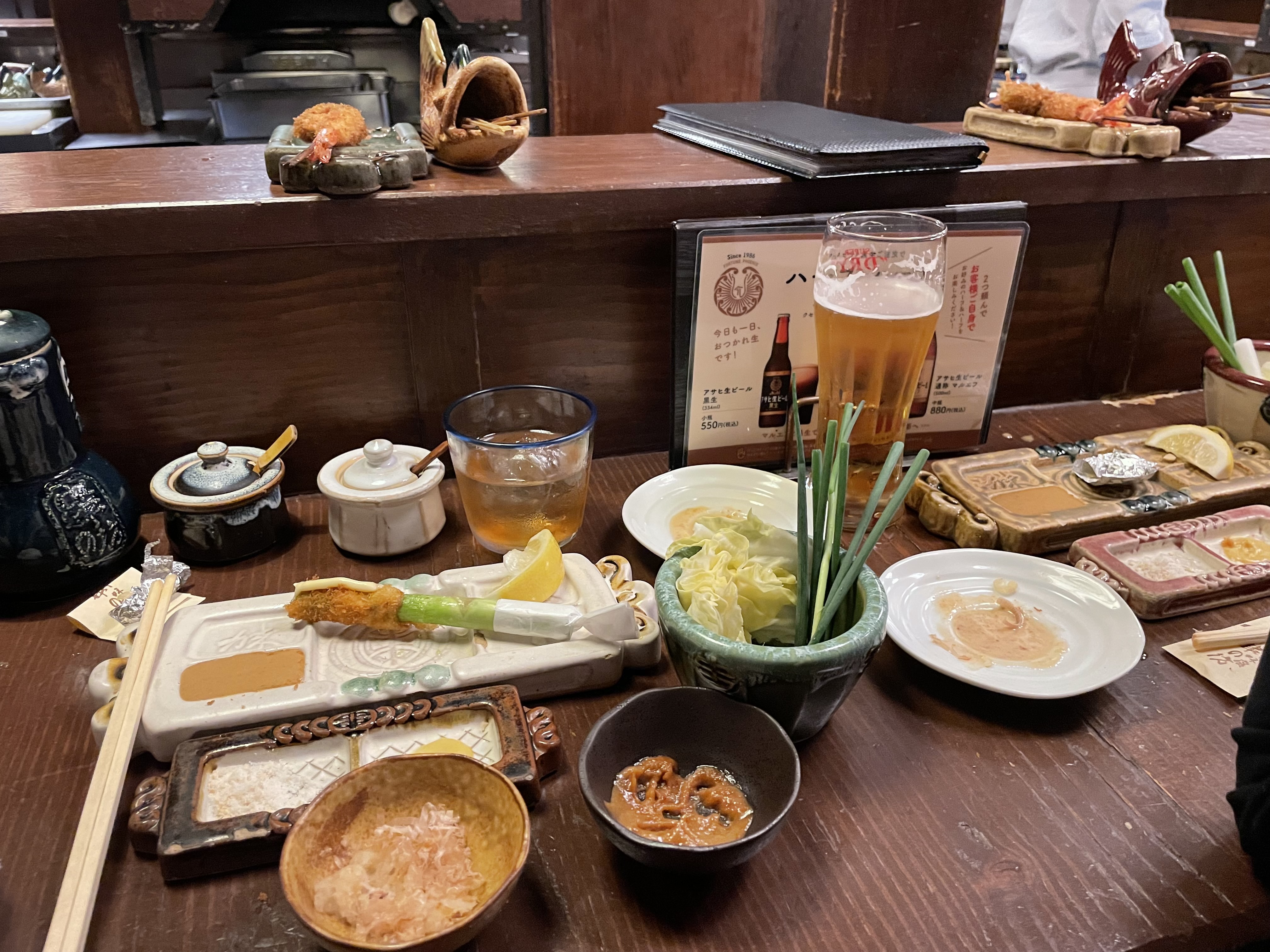
Each item is cooked to order, and watching the chef dip the item in batter, draining each on a heavy mesh screen, then each coated in bread crumbs, deep fried, and placed with care in front of you. A variety of sauces were available at each place setting, as well as salt and a wedge of lemon. You eat the item as it is served and put the empty wooden skewer in a ceramic fish. Most things look quite similar (except for items like asparagus, obviously recognizable) yet everything is distinct and distinctive.
Just as we were all agreeing that we had no more room, dessert appeared—a square of grapefruit jello. Light, tart, perfect.
Marvelous.
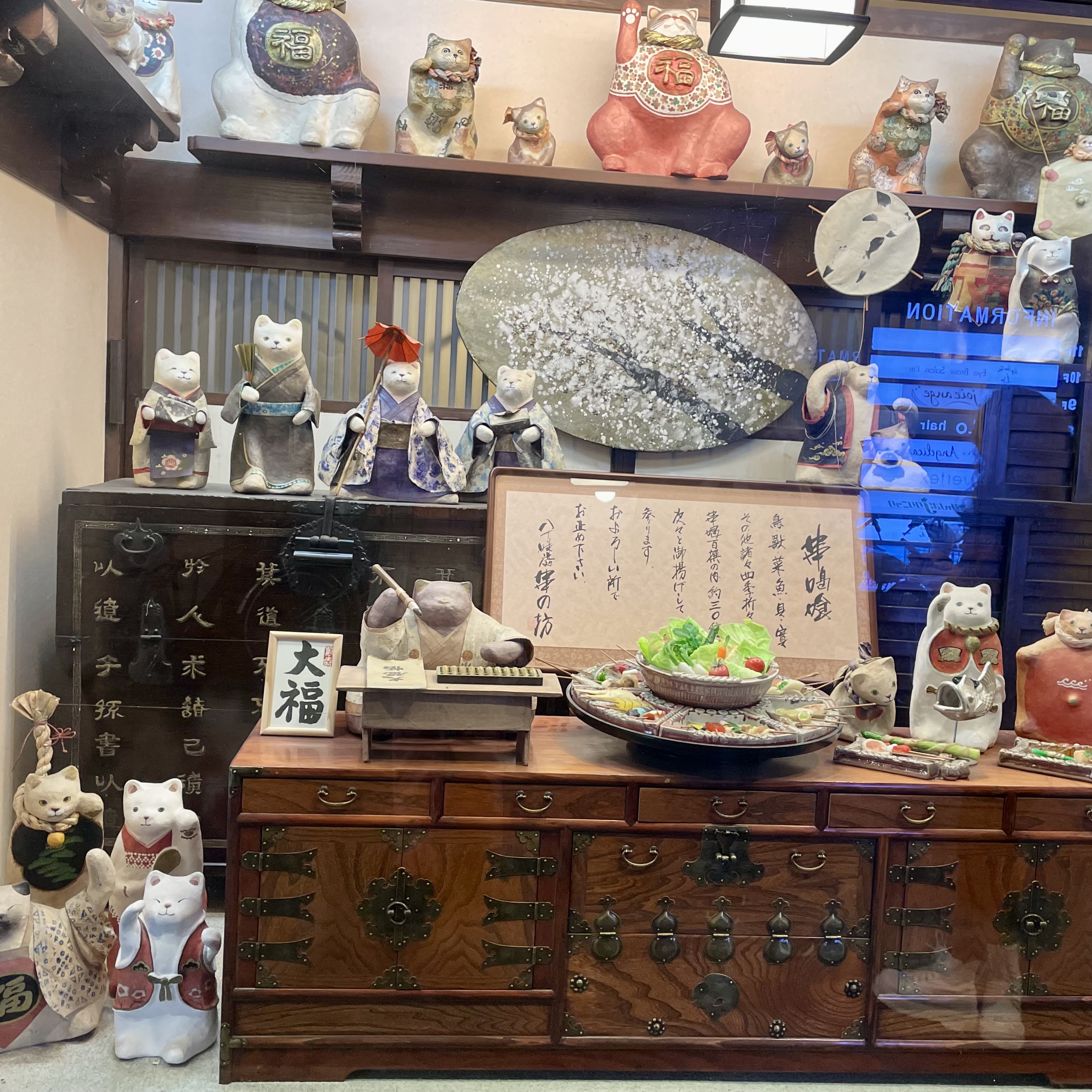
Fortunately we paused outside in time to notice the delightful window—not the typical plastic food but this:
With our cousin Harumi we had decided to take a day trip from Osaka to Himeji, primarily to see Himeji Castle. Renowned for being the most intact of the major castles in Japan, we chose it to represent our castle experience here…we learned years ago that visiting every castle we come upon gets boring. We pinned our castle hopes on Himeji.
A short train ride via Shinkansen from Shin-Osaka station, this beautiful, open, modern city, much smaller than Osaka, Kobe, etc., welcomes visitors with a spectacular view of the castle directly across, maybe 10 blocks away, from the station. It’s a wow moment, and also produces instant concern that it is awfully high and how in heaven’s name does one get up there?
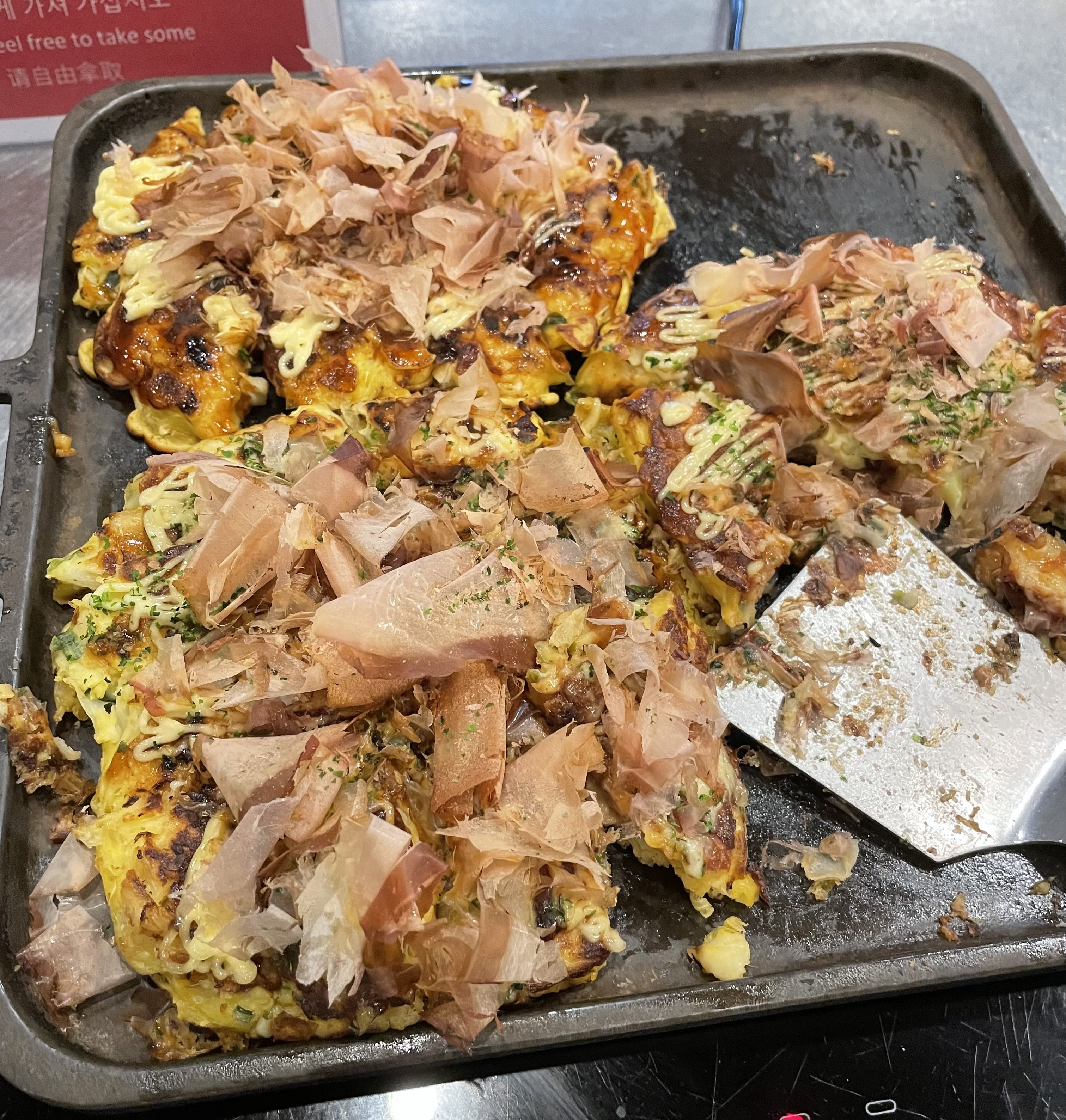
We set off to find out, walking this wide, boulevard with perhaps the most beautiful manhole covers we had ever seen, bits of statuary, and inviting shops. As we approached the castle grounds there was a small set of permanent food stalls with covered picnic tables behind—especially convenient and friendly. We stopped to inspect one of the offerings and laughed that it was okonomiyaki on a stick! We continued on.
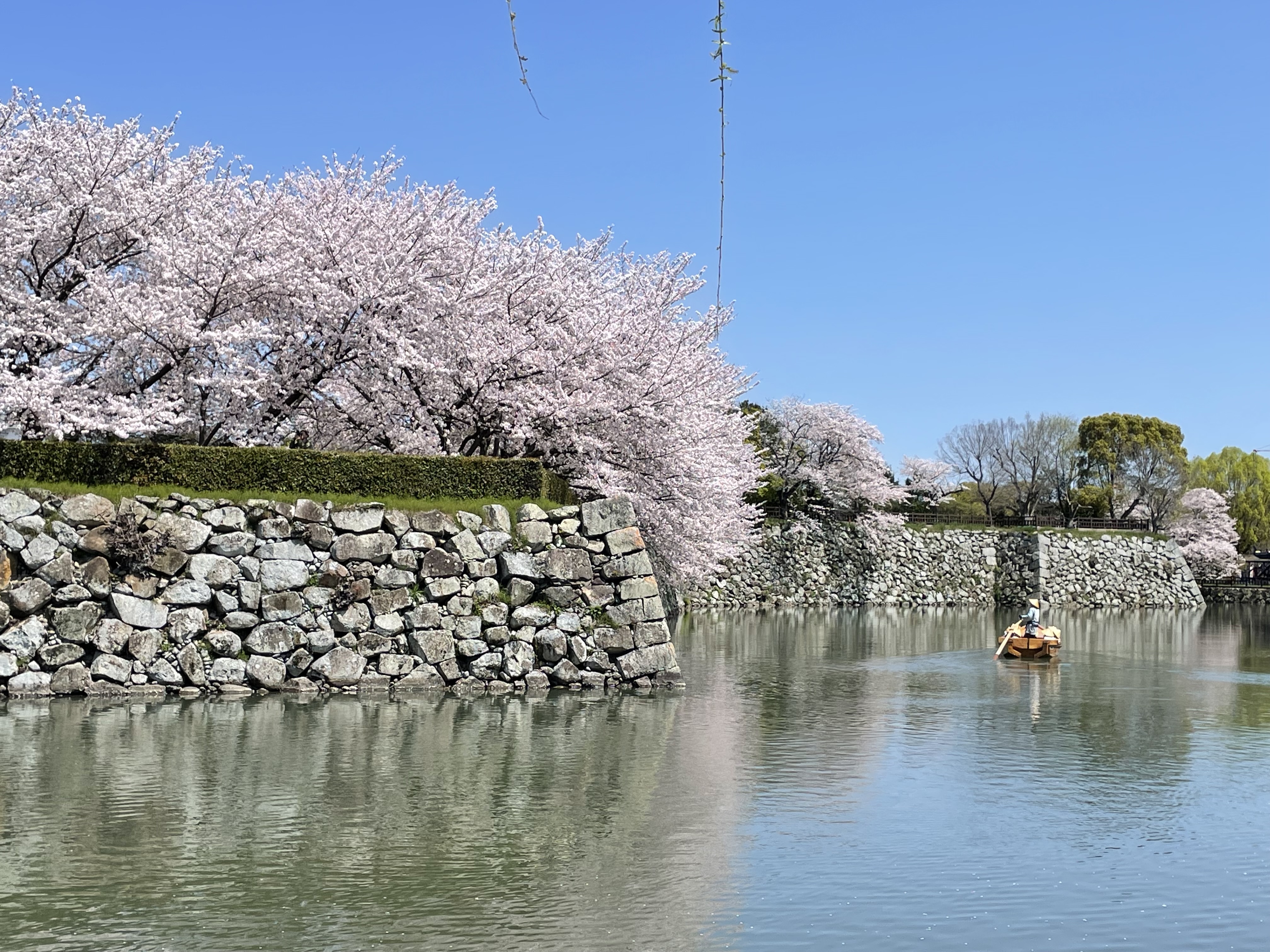
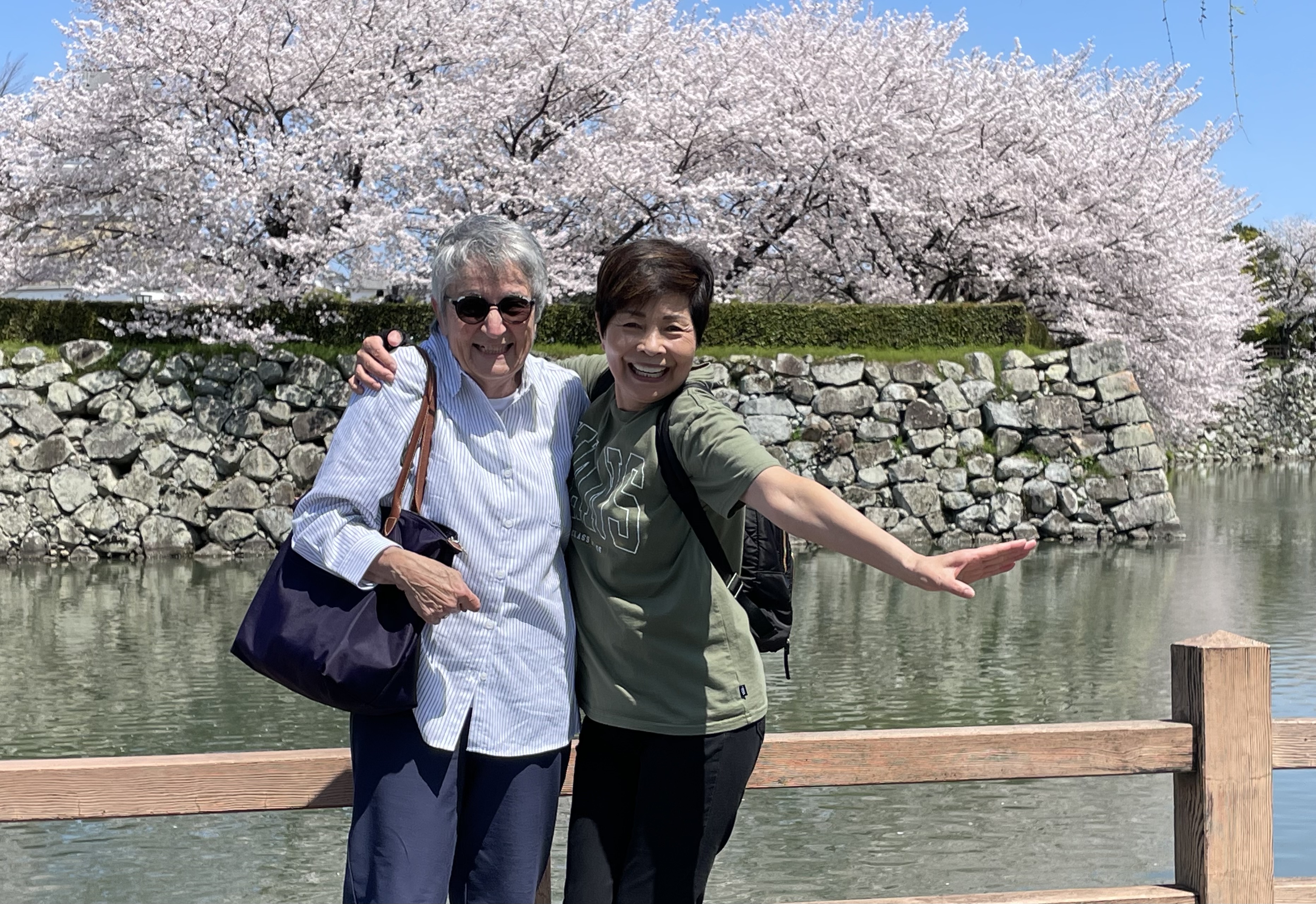
You enter the castle gate by crossing the moat on a lovely wooden bridge. Sakura—cherry blossoms—everywhere. I mean, everywhere. And they were in full bloom everywhere. We have been extraordinarily lucky to see this beauty. I hadn’t considered just what it means to be here in cherry blossom time. Well, it’s pretty great.
We wound our way up the castle grounds amidst the many tourists of all nationalities, lots of little kids running around, and enjoying the endless blue sky and vistas of mountains. Up and up we went, a slowly moving parade of visitors. A very Asian appearing young man struck up a conversation with us. He was from Texas, and traveling alone because his buddy bailed on him for some girl. After a considerable climb we entered the castle building proper and we all laughed to read the sign—we had made it to the castle basement! A few more rooms and we were in a staging area with a guide repeating “please remove your shoes on the brown mats” and we did as we were told. Plastic bags—recycled—were offered and everyone is now carrying an extra bag. We rejoined the parade in our socks (never travel in Japan without wearing clean socks), navigating slippery, centuries old wooden floors and stairways that were virtually ladders. Everyone follows the signs and barriers and slowly we all continue, up and up and up. It was, frankly, grueling, and also exciting and scary.
The trek tops out at the top—the sixth floor—where a small family shrine sits in the middle of the room. Many Japanese visitors, including Harumi, bowed, clapped, as is the custom of respect. Then we embarked on the descent, again, in SOCKS down, down those ladder-staircases. At least on the down direction they have put narrow treads so it wasn’t as treacherous as we had feared. Nonetheless it’s tricky because each step is so narrow one must turn sideways to fit one’s foot. I don’t think I have ever been so glad to get down from a climb. We continued on to the castle grounds, surrounded by sakura and filled, now it was midday, with kindergarten aged kids in their uniforms running around, families on blankets, older people (like us) sitting on rocks in the shade.
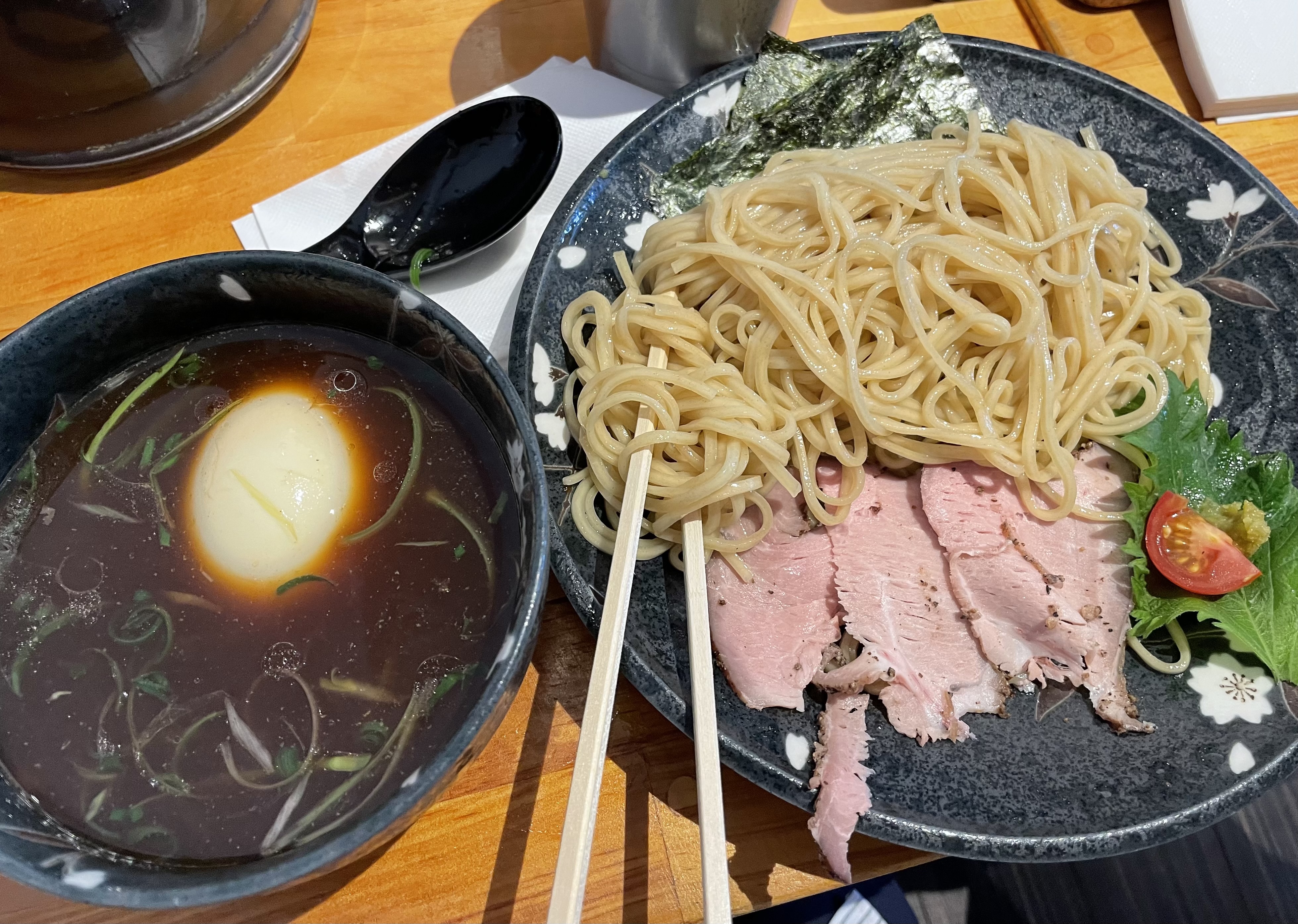
Lunch! We earned it. There was a lovely arcade street back toward the station (note: do NOT go into antique stores in Japan—everything is authentic, many very old bowls and cups come with the original wooden box…so tempting) and came to a noodle/ramen shop where a young woman stood beckoning us in. Harumi and David had soup ramen, I had the dipping ramen. Dipping broth was way too rich for soup but delish to drag the noodles through. Yum! It is refreshing to find hundreds, thousands of independent enterprises which in our experience are always good.
Satisfied, we decided to find out how to get to the gondola that would take us to a large forested area of shrines and halls. You can imagine how tired we were after the castle climb, and this sounded relatively easy. I mean, don’t gondolas take you to the tops of things?
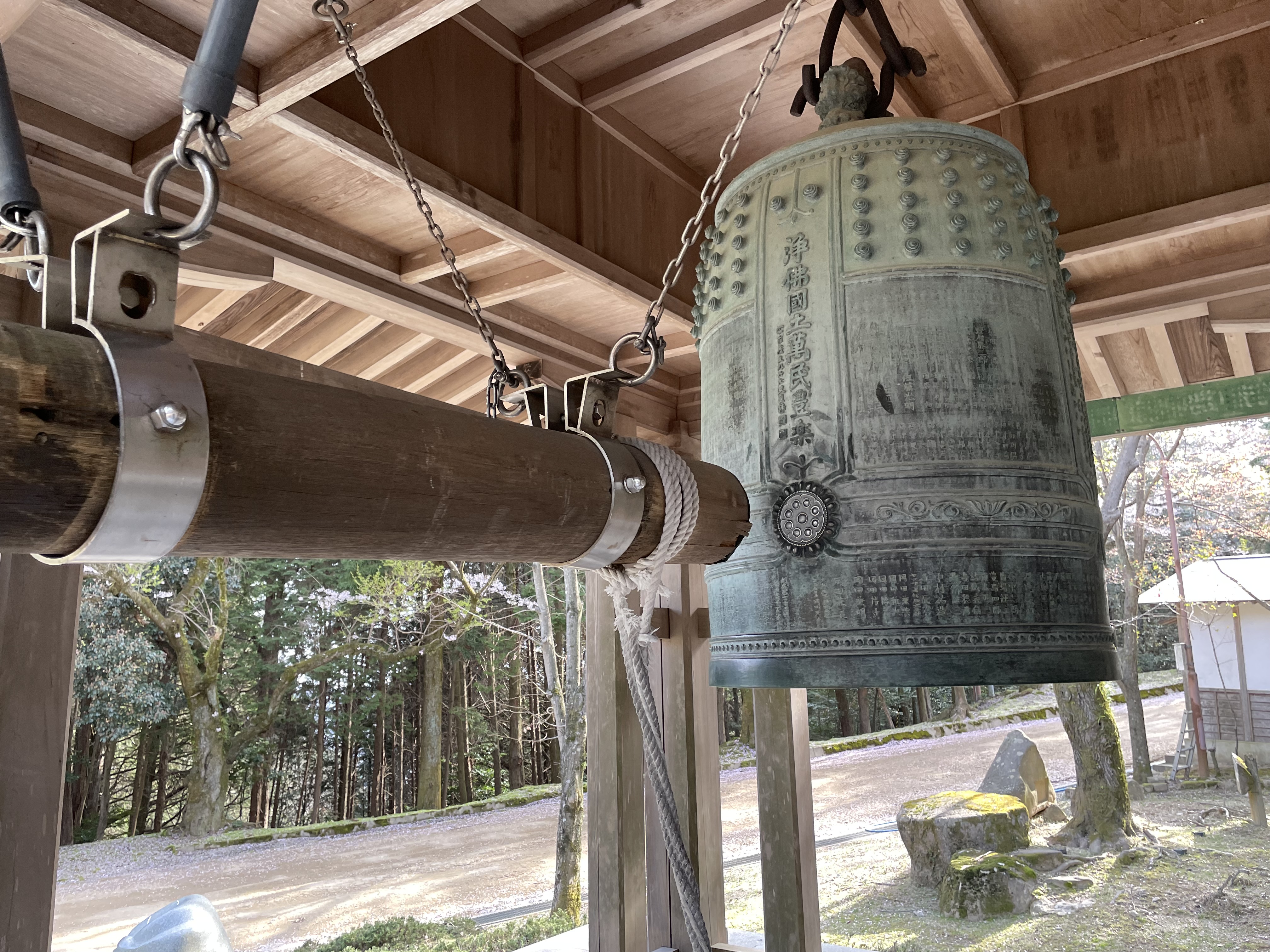
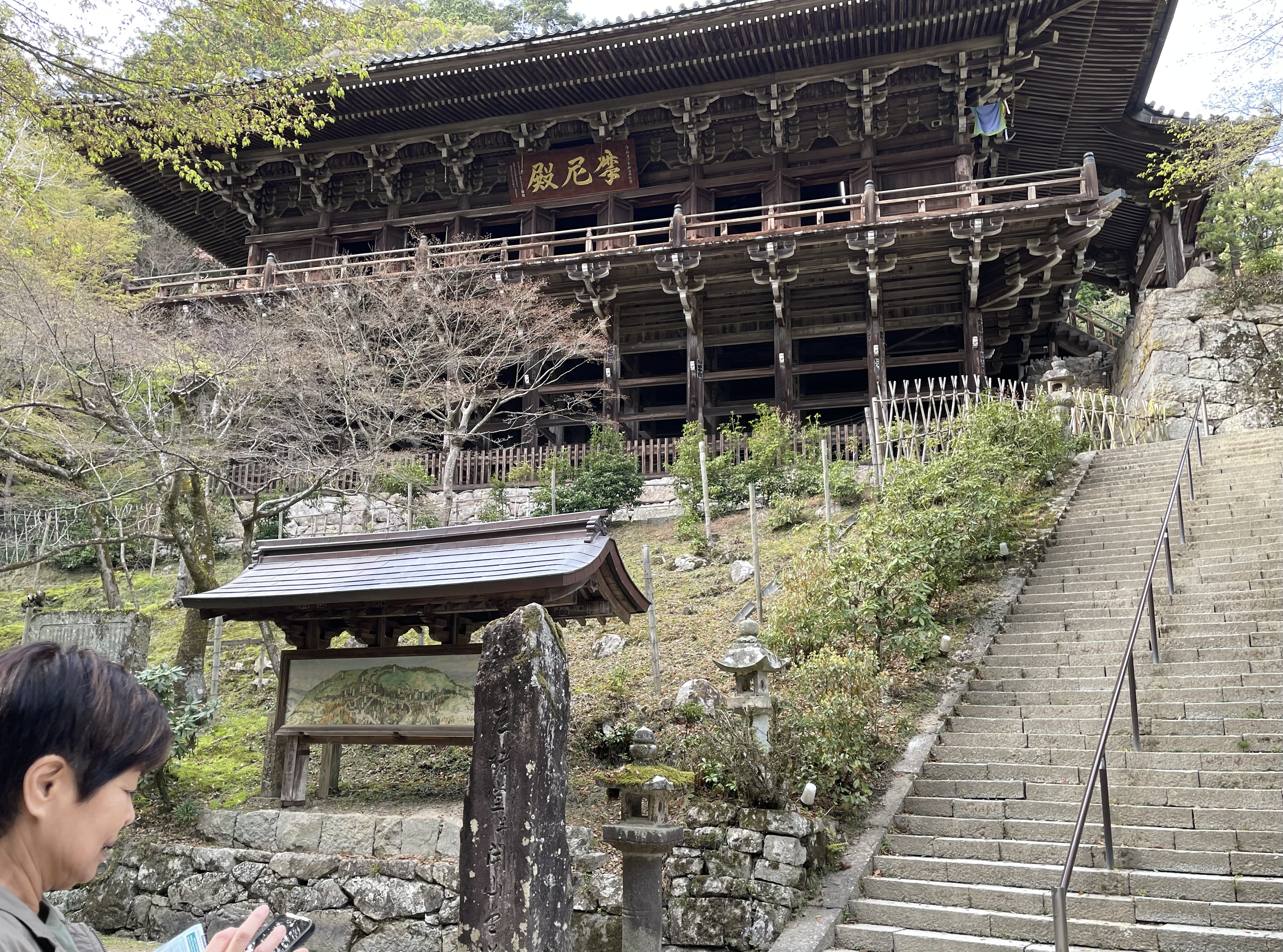
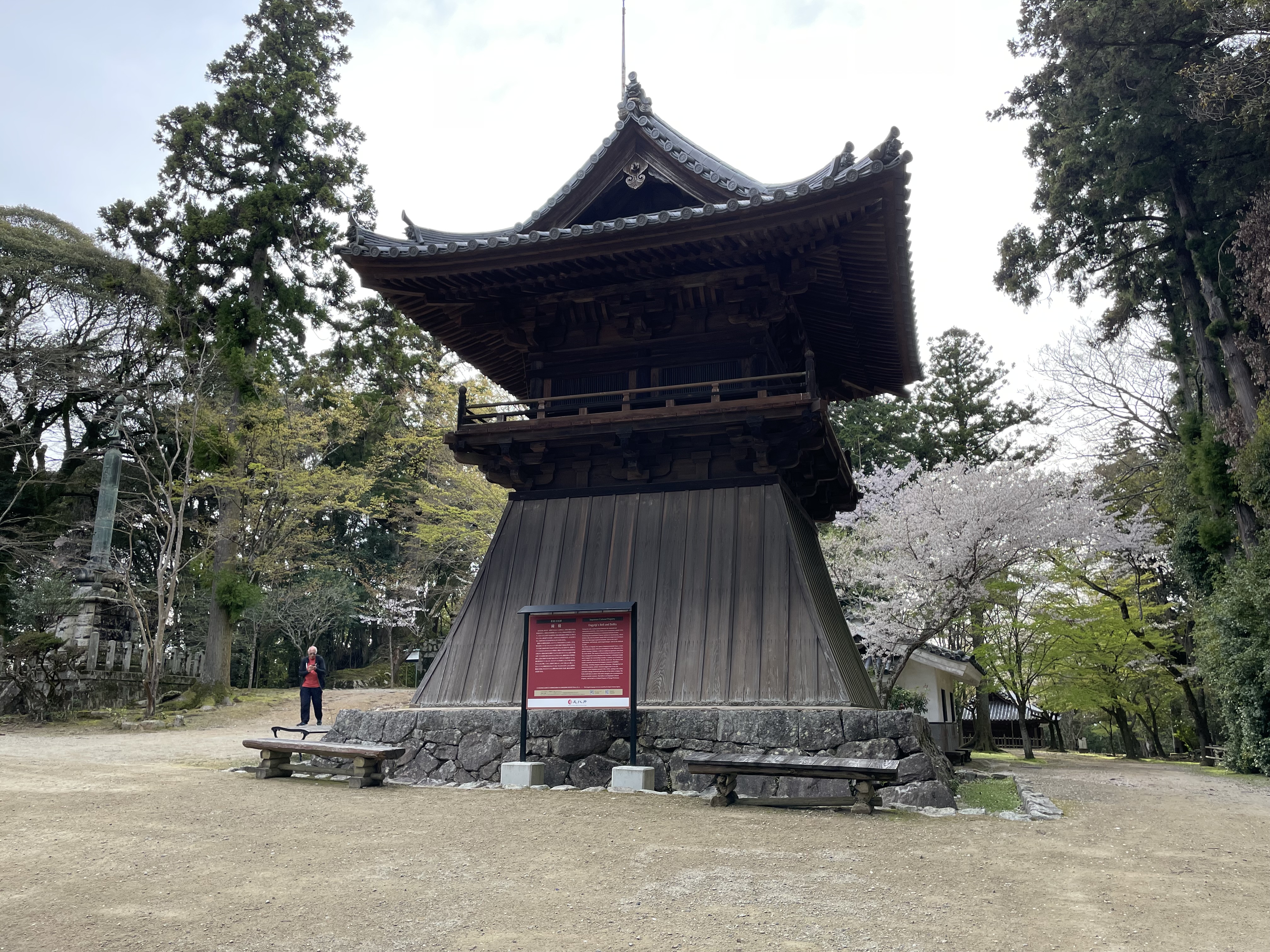
Not always. We had 2 1/2 hours before the last gondola down (tourist office lady: DO NOT MISS the last ropeway down) and from the map it looked very doable. 30 minute bus ride to the gondola/ropeway, 5 minutes up to the site, then a wander through the woods to as many shrines and halls as we could manage, back in plenty of time. Well, Shoshazan Engyoji is an enormous space, with many pathways and much of it a steep climb. When we got off the ropeway they asked “Bus?” Of course not! Off we set, naively, to climb, and climb, and climb…a path through the forest with Buddhist deities every 5-10 yards, wonderful and, as we got further away from our starting point a bit worrisome. Finally we realized we were never going to see everything, and found, luckily, a shortcut back to the ropeway. We headed back down at 5:30 a bit wiser. Wouldn’t have missed it, though.
A quick train ride back to Osaka, aching and exhausted. After an adventure of several hours, repeatedly getting turned around (Google maps for walking in crowded, narrow streets are less than reliable) trying to find a particular restaurant, we landed in a crowded but of course quite good little place where we three raised the average age by several decades, ate, and wandered back to the hotel in a daze.
We love museums. So far we have been to three here in Osaka, one per day. This, combined with the sometimes interminable walking required to use the fantastic public transportation, is why no matter how much I eat, I lose a few pounds on a traveling vacation. And I do eat with abandon, believe me.
First full day we went to the Osaka Museum of Housing and Living. The intricate displays are models of life in the Edo period. One floor is life sized recreation of two streets in Osaka in the 1830s. You look down on the life sized streets from the floor above, then walk down and through it. Warm, helpful docents, authentic houses and shops. There is even a ‘kimono experience, where a kimono expert dresses you, both girls and women, with all the care and intricacy required. The many small scaled displays show Osaka life in the twentieth century. Bonus—adjacent to the building is an arcade shopping street where I satisfied my craving for cold soba and one big veggie tempura. David had a bowl of noodles and other things we couldn’t identify. As is most common here, it was a little narrow “joint” where every order is fresh. Then I bought a big baggy shirt to blend in a bit.
Day Two, we go back to the beginning and through a flurry
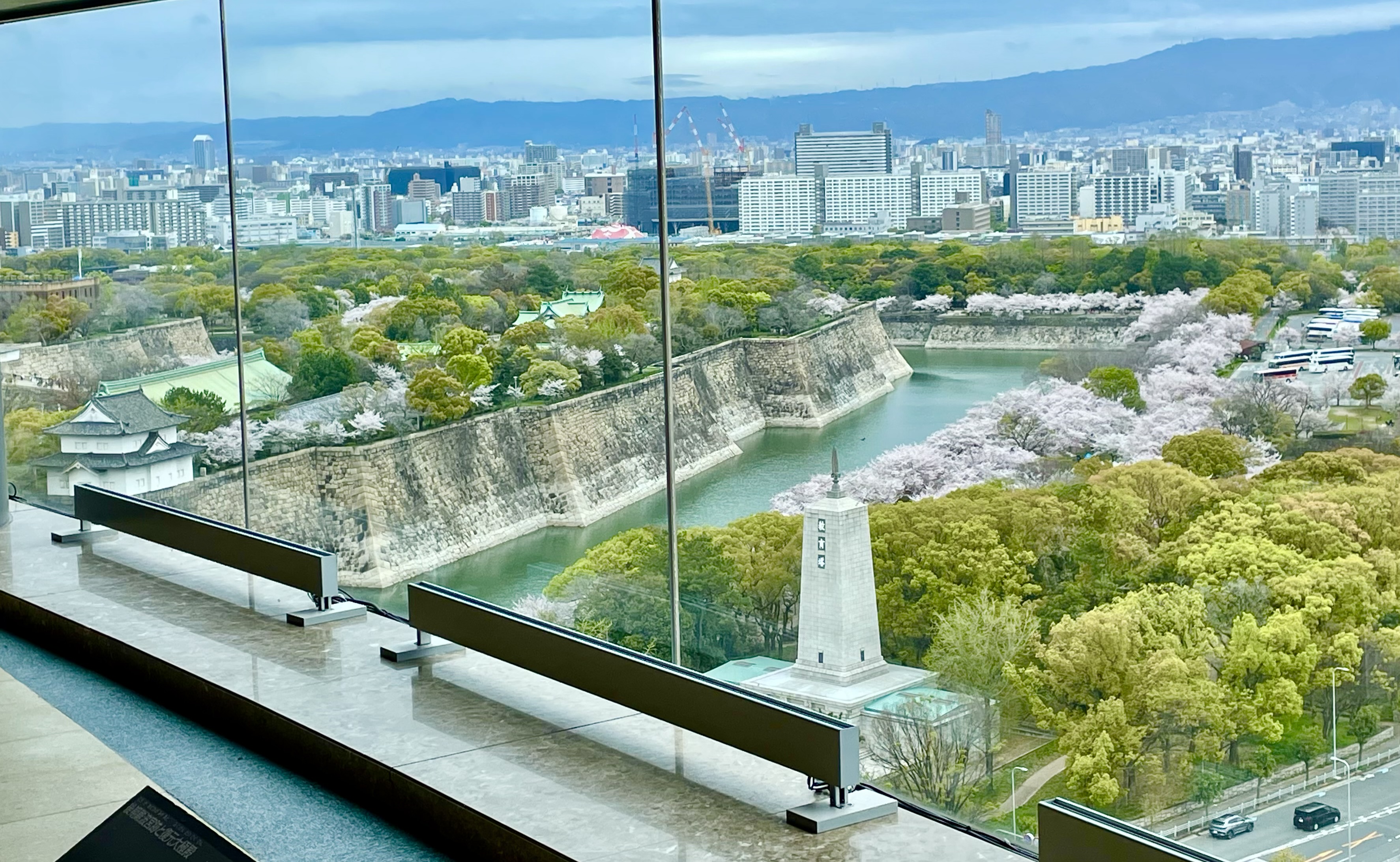
The next day it was the Osaka Museum of History. It takes you from the earliest settlements, and all about the archeological digs ongoing to plot where the first people lived, to modern times. Many exhibits are a mix of life sized displays you walk through and multimedia explanations. May I say thank goodness for google translate, which enabled us in every museum to translate the text explanations. Fun, overwhelming, jammed with information—and a bonus—the incredible views of Osaka Castle and surrounding grounds.
Having absorbed our fill of Osaka history we crossed the street to the castle grounds, where a small jammed Lawson’s satisfied our hunger. We made a picnic of our $6 investment and then wandered through bowers of cherry blossoms, petals blowing like a snow flurry. Wow.
Day Three, that feeling
Nakanoshima Museum of Art was a bit of a trek given our predictable issues with Google maps walking directions, but oh so worthwhile . They have no permanent collection—just special shows. We started with the Monet, an enormous retrospective showing how he evolved into painting series. It was stunning, as were the visitors. Lots and lots of hushed conversations about the paintings. It felt different, people more involved with the art than is common in the US.
Down a floor, short rest to get a bit of energy back, and we dove into the other exhibit, Fukuda Heihachiro: A Retrospective. Never heard of the guy. Walked in, and at the third painting i got that feeling, instantaneous love and emotional connection. It is a simple painting, Ducks by the Pond, painted in 1916. That feeling, like the first time I walked into the room of Matisse cutouts at the National Gallery. It is a rush of excitement, then a deep resonance in my chest like a gong. And I want to cry, and do for a few seconds. I couldn’t tear myself away. Walked on to see a huge painting on eight large screens…just sheep. No background , no setting, just intimacy with the animals. This amazing painter evolved and evolved, always paintings and sketches from nature. Later he moved toward abstraction as he distilled water rippling to dashes of blue, closeups of bamboo, a painting titled Rain that is roof tiles in a million shades of blue-grey.
Yeah, idiotic I know but I bought the exhibit catalog that we now have to schlep all over Japan. Photographing his works in the gallery was limited to maybe four, none of which excited me.
So we said goodby to this gorgeous museum with a wave to space cat.
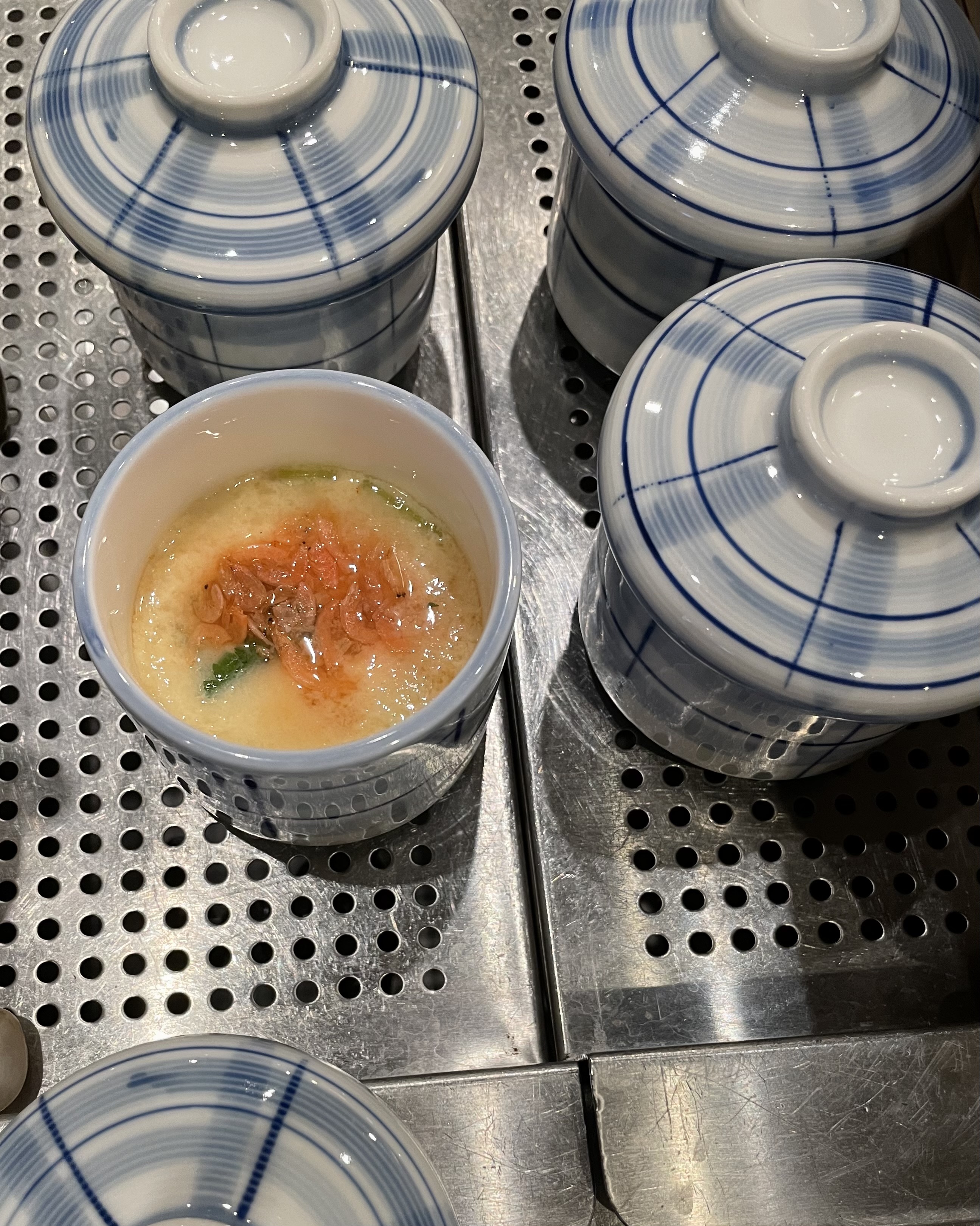
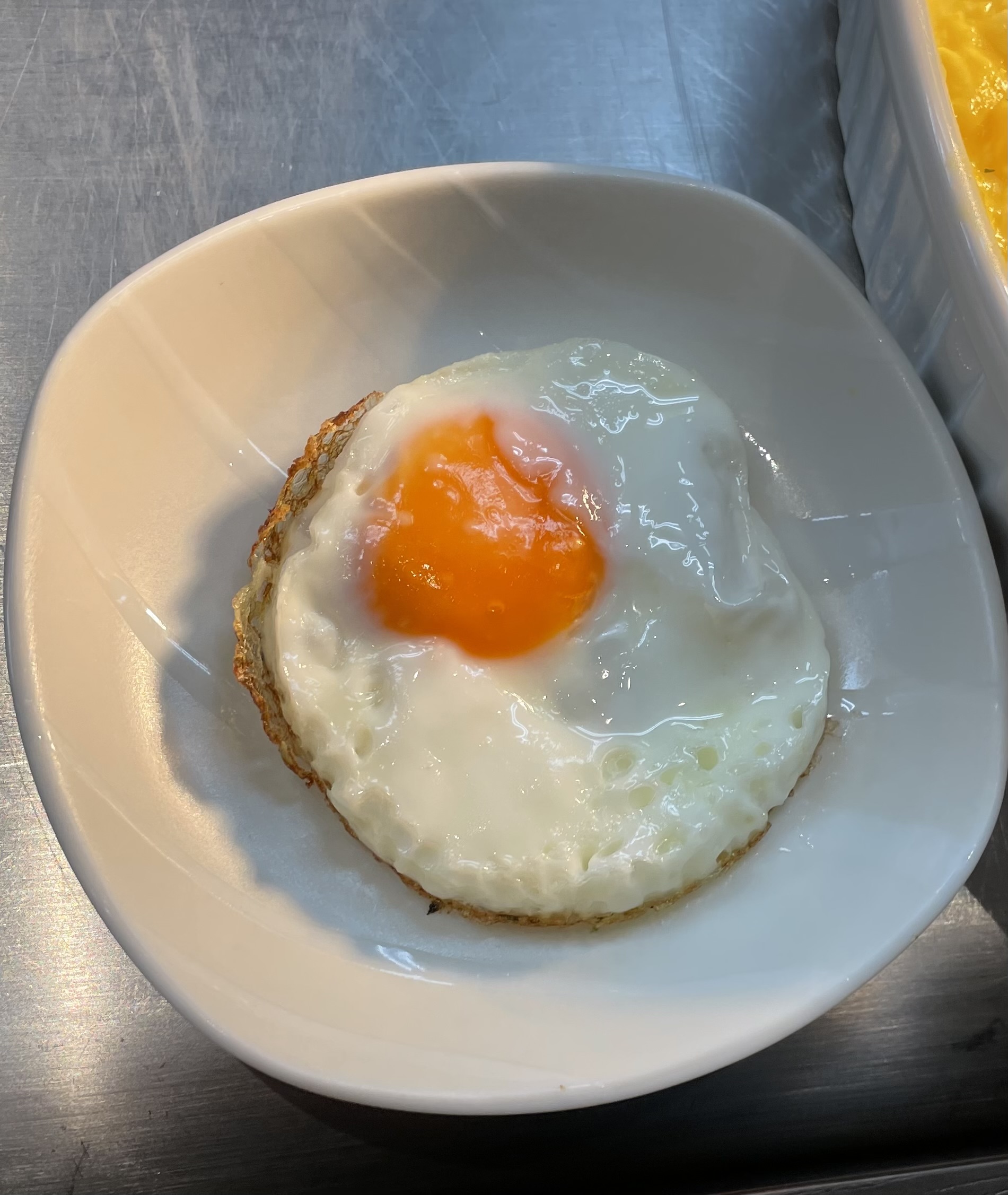
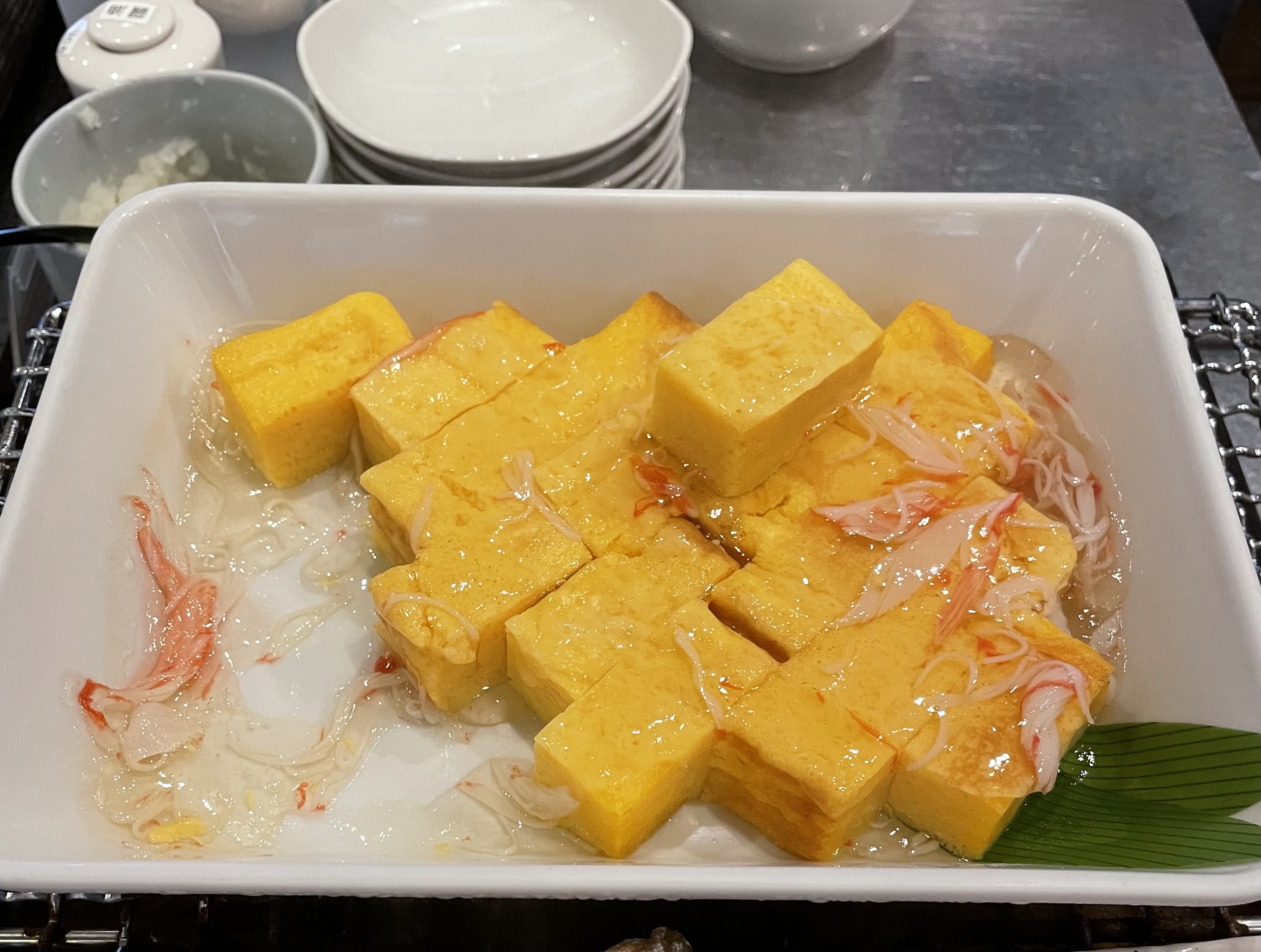
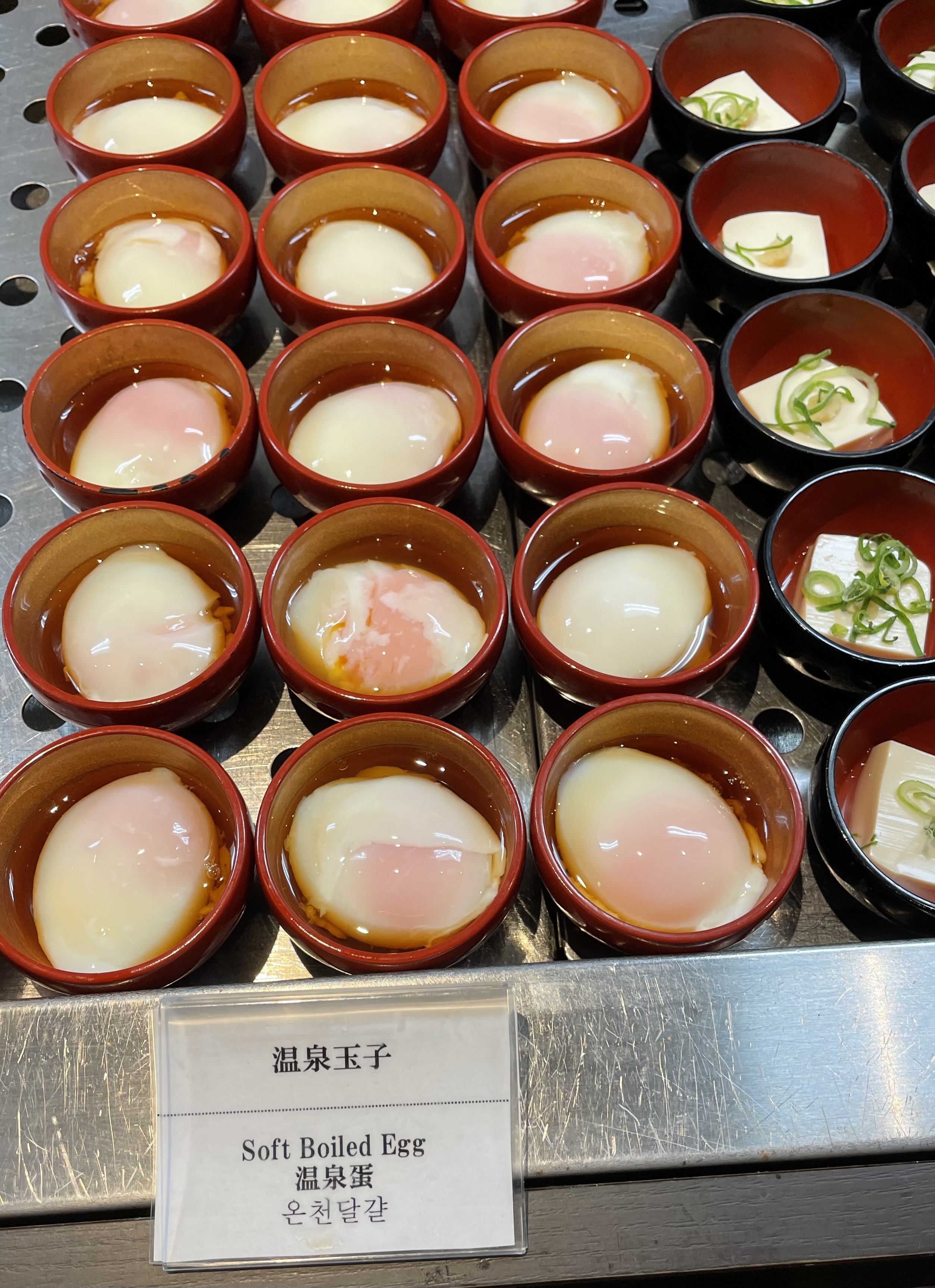
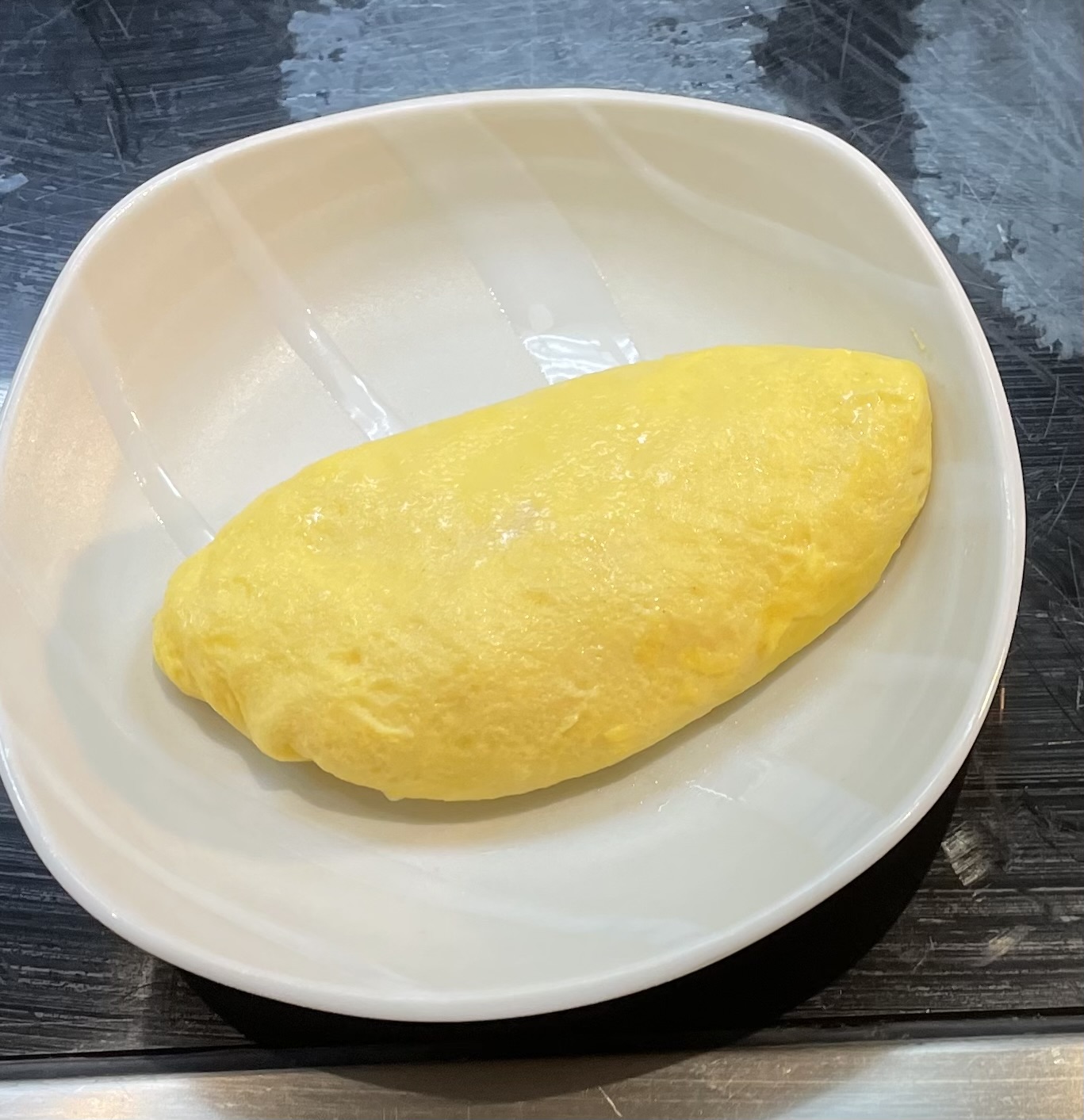
At our hotel in Osaka, the breakfast buffet includes, among the salads and stews and soups and rice, plain or vinegared, the raw tuna and salmon and roe…the fruit and yogurt and cheesecake, there are seven egg preparations. All tasty.
We arrived in Shin-Osaka train station after the whirlwind Shinkansen from Tokyo a bit tired but ready for a brand new city. The central train station is sparkling. We followed the many, many signs, which fortunately made it hard to go astray, because it is a trek to the subway line from the Shinkansen platform. We have since taken the city metro multiple times and it is without a doubt the most beautiful and cleanest subway we have ever been on, and we have been on a lot of subways. Every train spotless, but also every train painted differently. Comfy seats, natch.
Great people watching—the fashions sense of women, young and old, is lovely and varied. The rare young woman in jeans and a knit shirt (never have seen a plain old t-shirt on a female) is wearing beautifully cut wide leg pressed jeans and some adorable top, often cropped. The most common look, though, is layers and layers—net skirts over ankle length skirts over boots, long breezy shirts over other roomy shirts. Or mini skirts and boots. Or completely color coordinated layers of, say, a crop top and a sparkly long sweater and several long-strapped, hip-length purses. I guess they are purses. I have tried to take photos, either at a distance or by asking if it is okay. And I have been refused, with smiles, then giggles. I would happily stand for half an hour watching girls and young women go by, taking pictures. But of course that would be rude. There are also many coordinated couples, by color or style, sometimes in traditional dress, always gorgeous.
The places we have wandered give the impression of a very prosperous city. Our cousin Maya mentioned that the little kids are so well dressed, and yup. No jeans and grubby t-shirts. We watched some boys playing ball, about 7 or 8 years old, in three-quarter length cool pants, stylish knit shirts, good looking sneakers. They rough-housed like boys but it looked like a fashion spread in the cutest way.
I will try to put together a gallery of fashion. If I can get permissions!
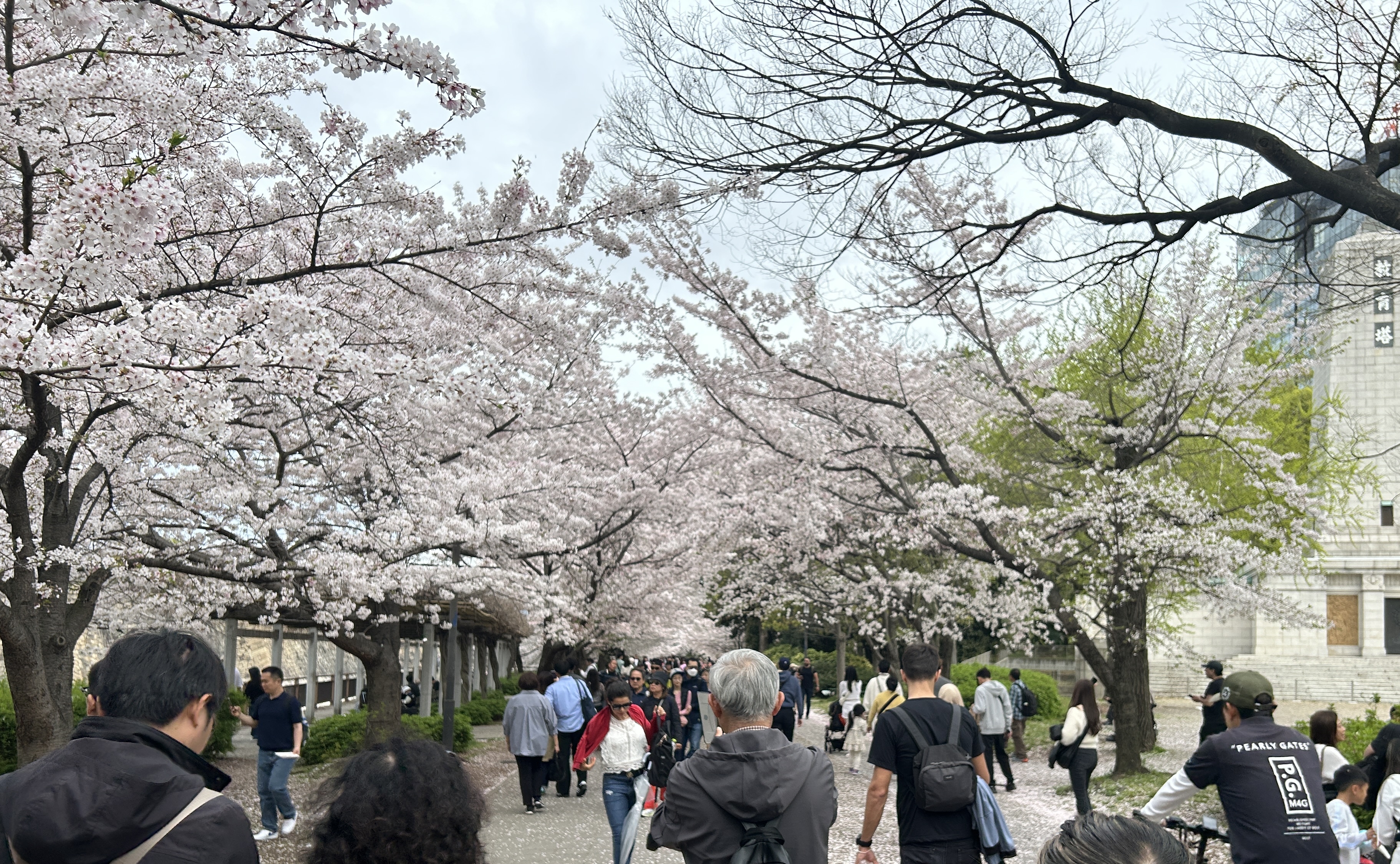
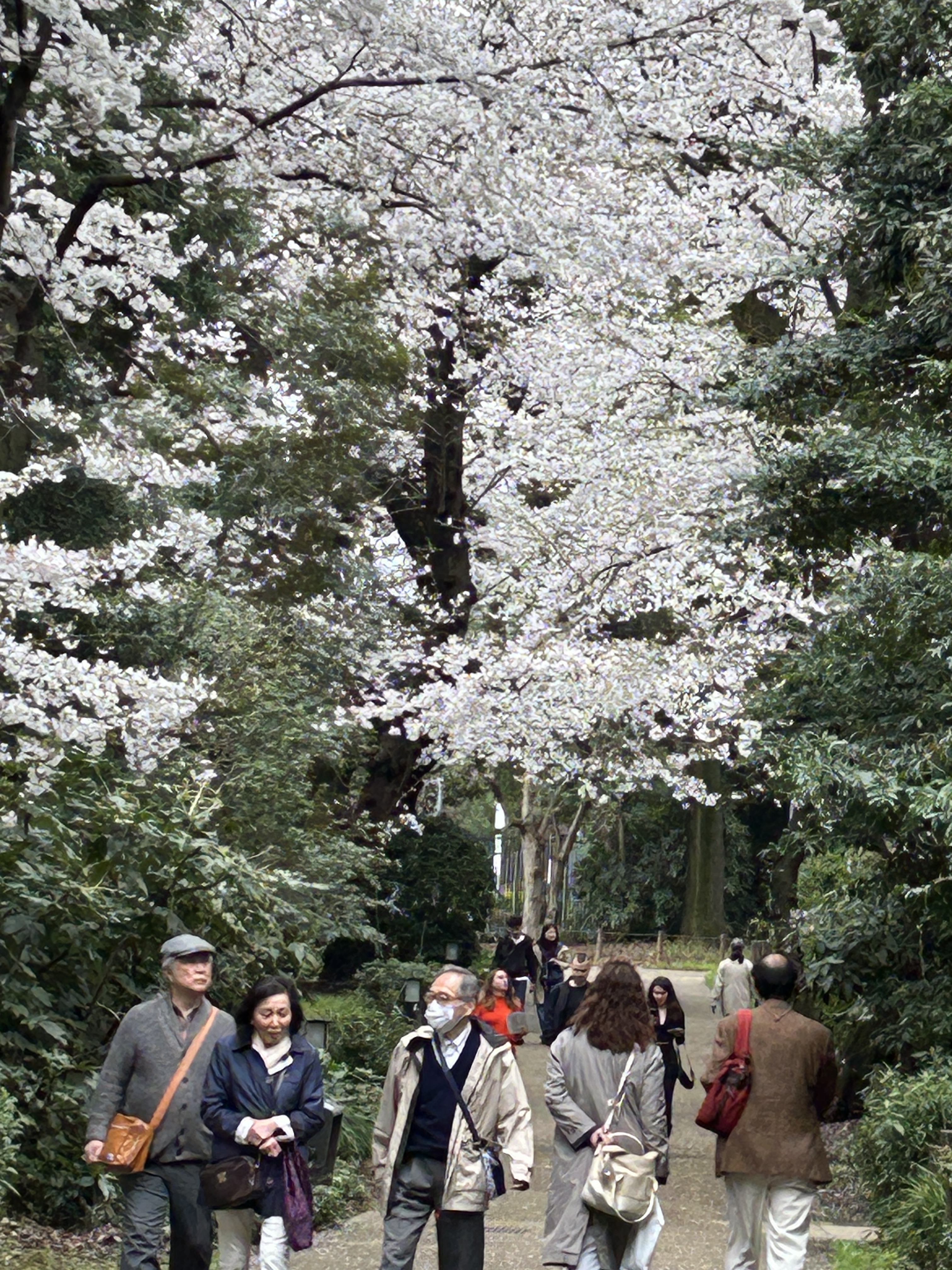
We had read somewhere that the cherry blossom season was early this year, so we were prepared to miss them. Turns out in Tokyo (and later in Osaka) it was peak bloom and what a show. Happily our plan to spend our first, hardest, most jet-lagged day wandering museums in Ueno Park, a short walk from our hotel the Dormy Inn Uneno, sent us wandering through gardens and tourists taking hundreds of photos of the gorgeous cherry blossoms. It was beautiful.
We wandered the park people watching, bird watching, and marveling we were smack in the middle of Tokyo. We couldn’t have asked for a more gentle and peaceful day to recover from the long flight.
There were many, many Japanese families, seeming a holiday atmosphere, with food stands lining several of the walkways. Pizza. Kebabs. Karaage (fried chicken). French fries in varies forms…we finally settled on sharing a skewer of grilled beef tongue (delicious) and a potato and meat croquette. It was enough to sustain us and given our jet lag our bodies had no idea what time it was or what it wanted as sustenance.
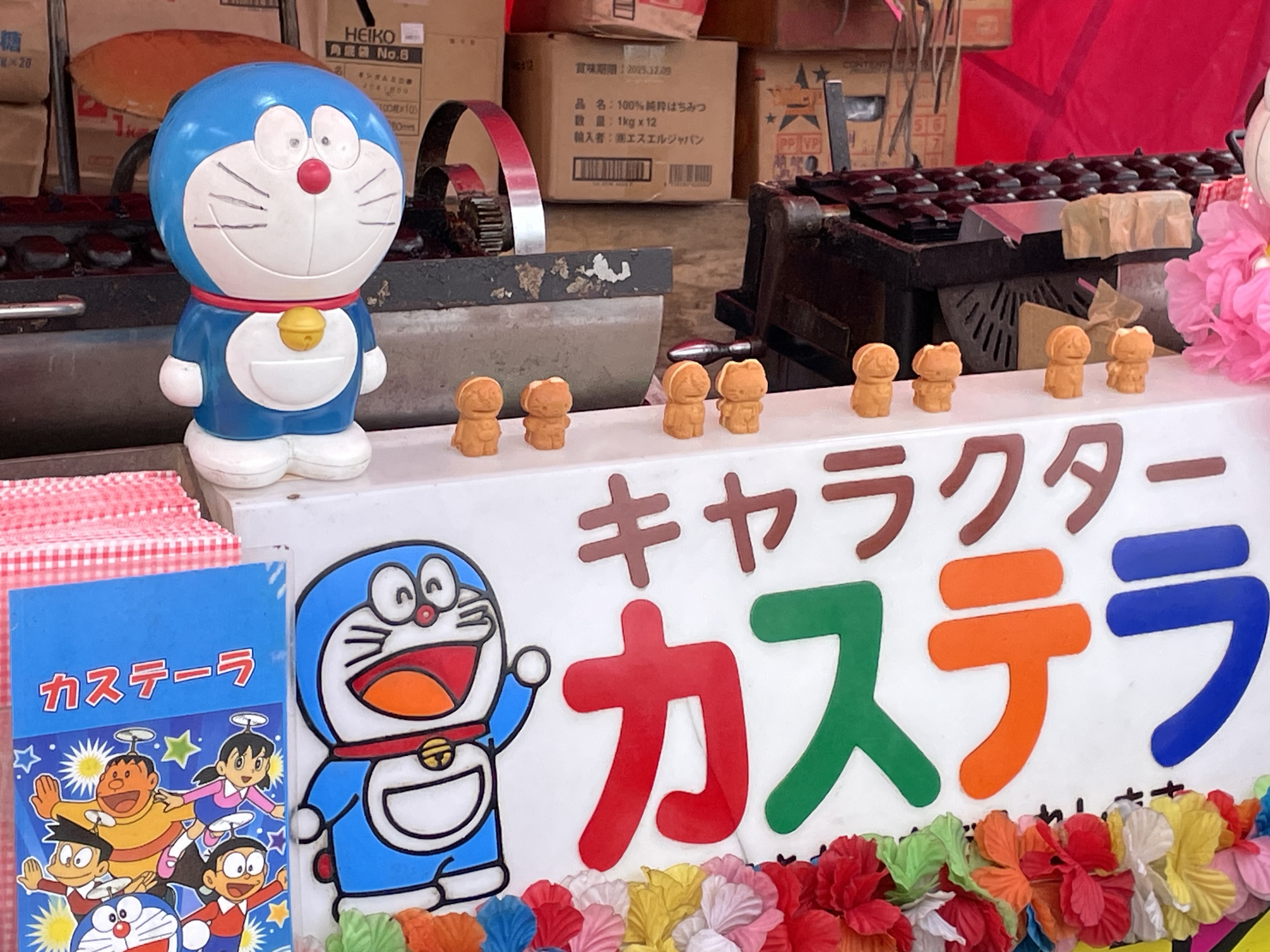
Freshly made Hello Kitty cookies, anyone?
We knew a no-stress way to spend our first day included a museum or two and Ueno Park has many, from the zoological gardens to the Museum of Western Art. We headed there. It was fantastic.
We finished with the National Museum, overwhelming with the crafts and history of Japan, even including a large archeological building that we were too tired to appreciate. Of the three large buildings around a huge plaza we chose the Japan building. I had flashbacks of the Victoria and Albert Museum in London. SO MUCH STUFF. We wandered and tried to take in the kimonos, the laquerware, the ceramics, a video showing Kabuki and Noh, an entire separate building of archeological displays. Phew. At last we wandered out to the lovely gardens behind the main buildings and enjoyed more cherry blossoms.
Exquisite blossomsMore behind the National MuseumEvery surface a story in this amazing room at the Museum of Western Art
No idea the name, but I hope we can go back when we return to Tokyo our last few days in Japan
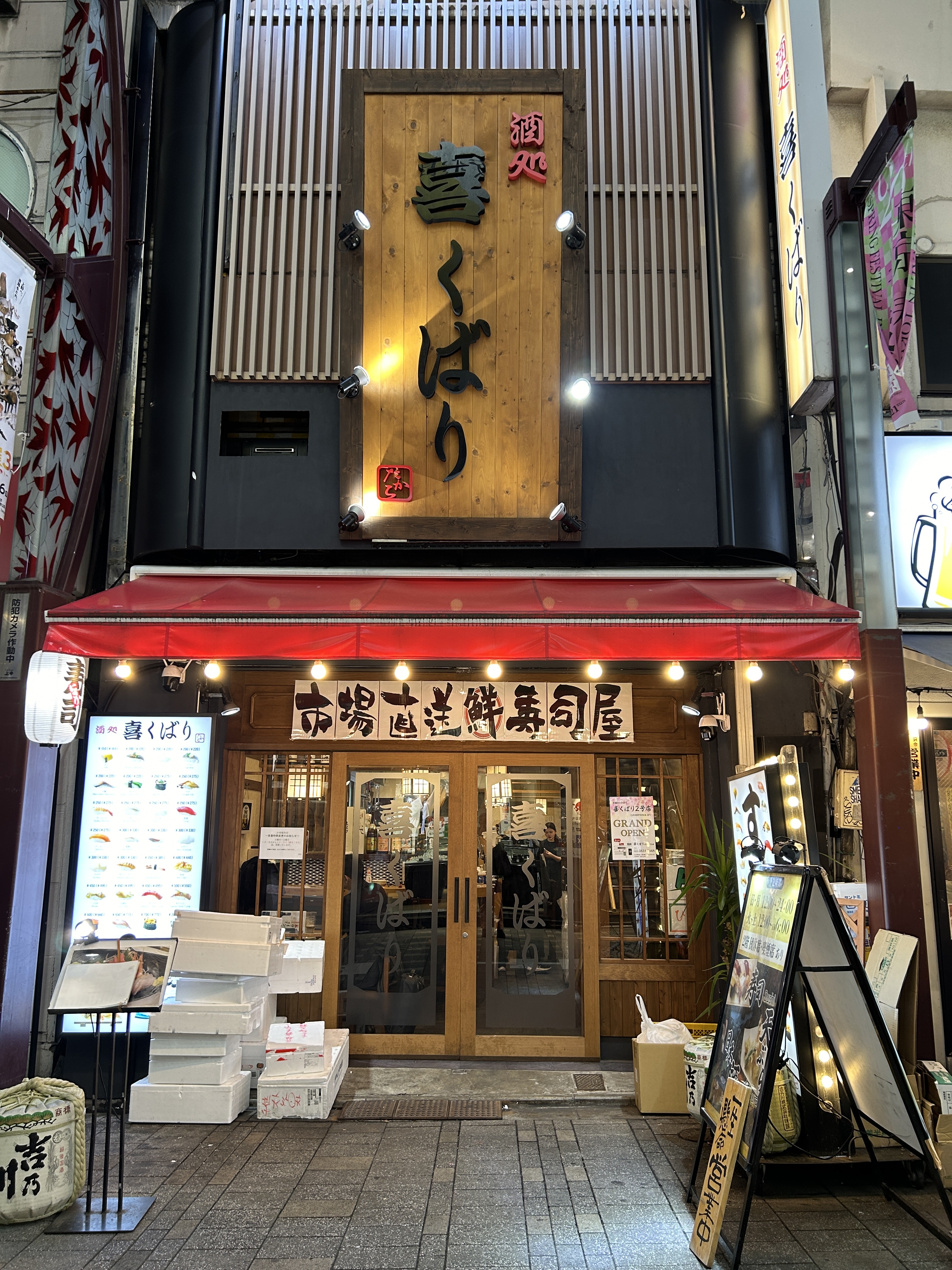
David found a little sushi place a few blocks from the hotel. Narrow, maybe 18 seats all told, with good natured hustle between the waitress, two older sushi chefs and a young cook/helper. Sushi was scrumptious, we finished the meal with a round of vegetable tempura (you order by the veg—we had shiso, eggplant and sweet potato). We walked back happy. A perfect day for the beginning of our three weeks.
We took Zipair from San Francisco and frankly for the price it was fine. When you pay full business class fare you tend to want to take advantage of all fuss and food and service that`s part of the deal. And traveling this far (11 hours) and with the time dislocation (leave SF around 5pm, arrive Tokyo around 8pm the next day) the best way to accommodate your body and mind is to sleep a few hours as soon as you take off, then try to stay awake and alert for the remainder in hopes you will be able to sleep when you get to the hotel. Because the food and drink service in real business class starts early in the flight, I find I stay awake too long and arrive feeling yuck. With Zipair you bring your own food, bring your own sleeping accoutrements, and bring your own schedule. The reclining seat is the same as other airlines…so all in all highly recommended. You pay for the bed and, frankly for being left alone.
David and I are heading back to our favorite place, Japan. Three weeks of fun and food!
We will start in Tokyo, move on to Osaka, a quick overnight ryokan stay in Tamba, spend a few days in Kyoto, and after a two days in Kanazawa will be back in Tokyo for a few days before we return to San Francisco.
This will be our maiden voyage on Zipair, a discount airline of JAL which has low-service-but-reclining-seats business class at a bargain price.
I may be posting less frequently than in the past…will have to see how energetic I am!
Boy oh boy has this city ever changed in the 17 years since I took a day trip from my immersion school in Cuernavaca. It seems very prosperous, much larger, with a lot more going on everywhere we turn.
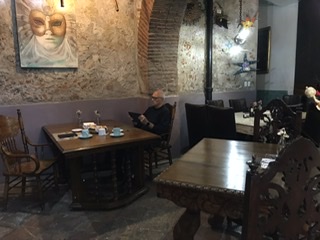
We are staying in Meson Sacristia de la Soledad, a lovely small inn with maybe 4 guest rooms (counting the tables set in the dining room that seems right). The owners live here as well, and are delightful, helpful, warm, welcoming. When helping us with the lost iPad I kept apologizing for the trouble, they kept telling me it was their job to help and make sure we were comfortable and happy.
I cannot recommend Meson Sacristia de la Soledad highly enough. The location is great, the room is comfortable…the owners have several other properties, one of which has a full restaurant which we dined at one evening (delicious) but we are happy we are here instead—smaller, quieter, just lovely in every way. I cannot wait to post reviews every place I can find.
The Meson is built around this lovely garden; our room (picture on the right) is behind the yellow door on the second floor.
Abraham is always there to help at Meson; the lovely breakfast room where we feasted every morning.
The historical district was a Dia de Los Muertos celebration—happy friendly crowds everywhere—which continued into Sunday unabated.
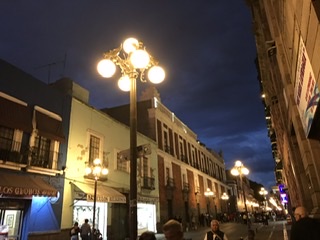
Centro Historico was so lovely at night.
Around the zocalo; the famous street of antique shops (the blue people were still celebrating Dia de Los Muertos)
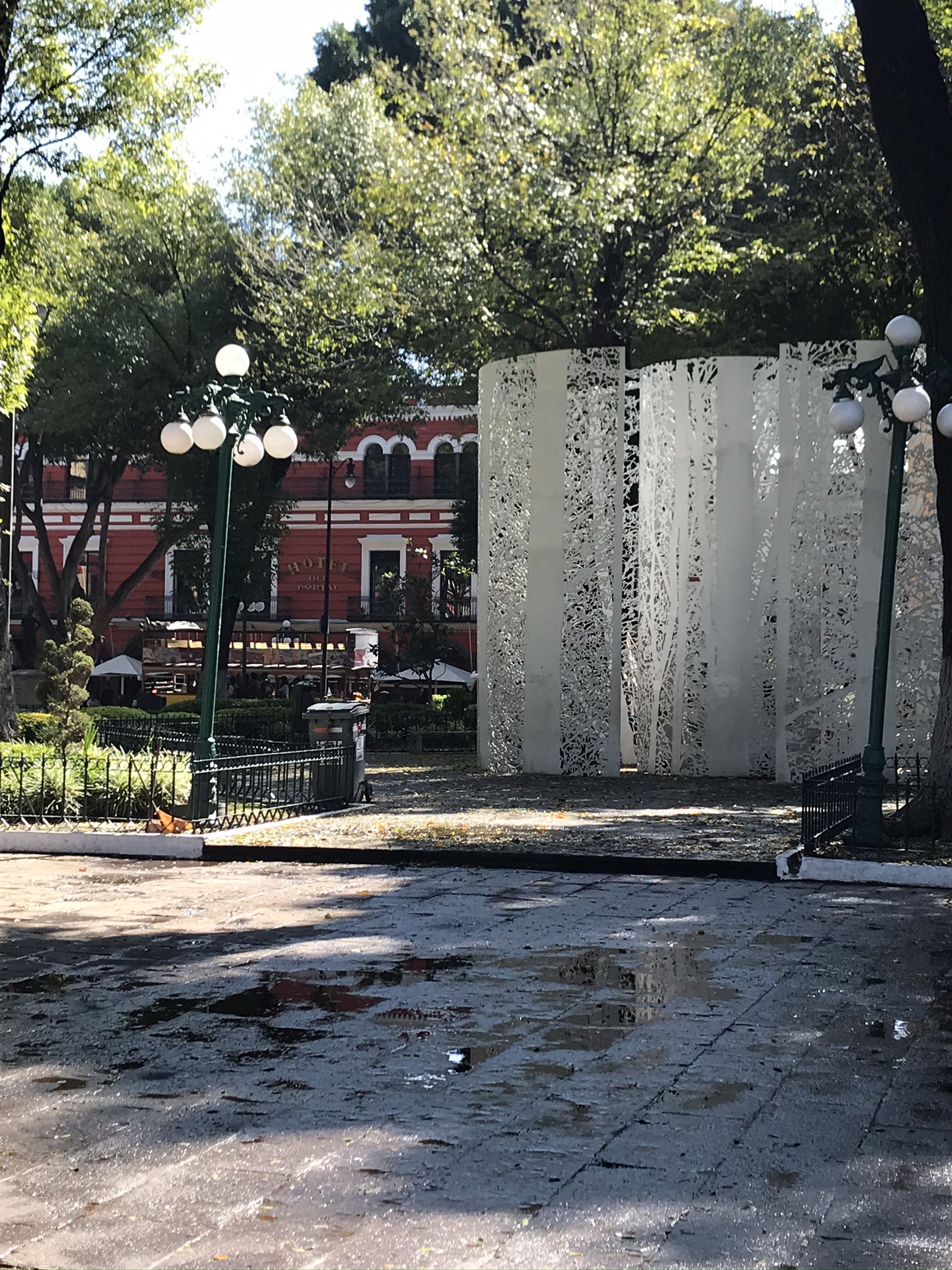
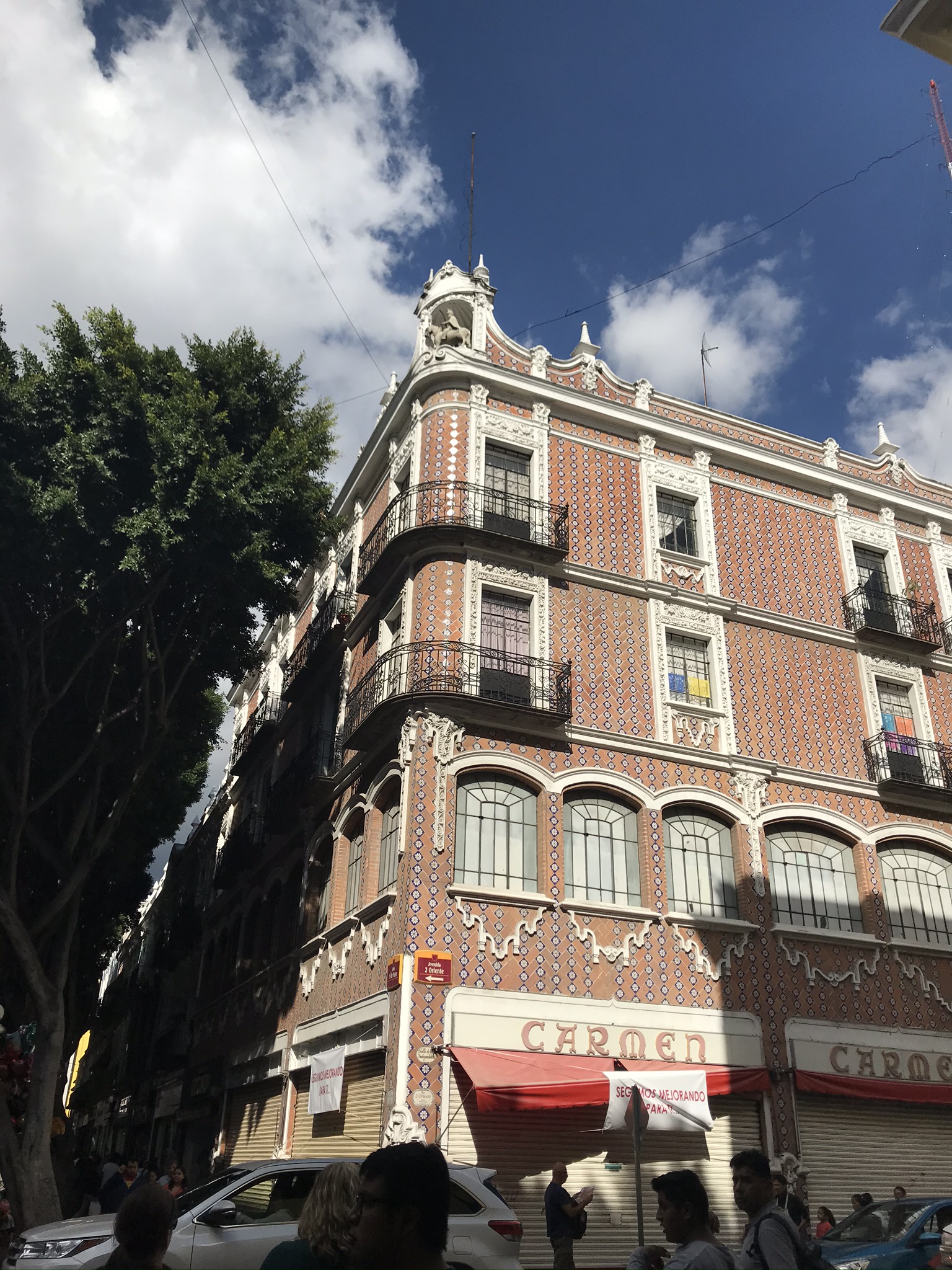
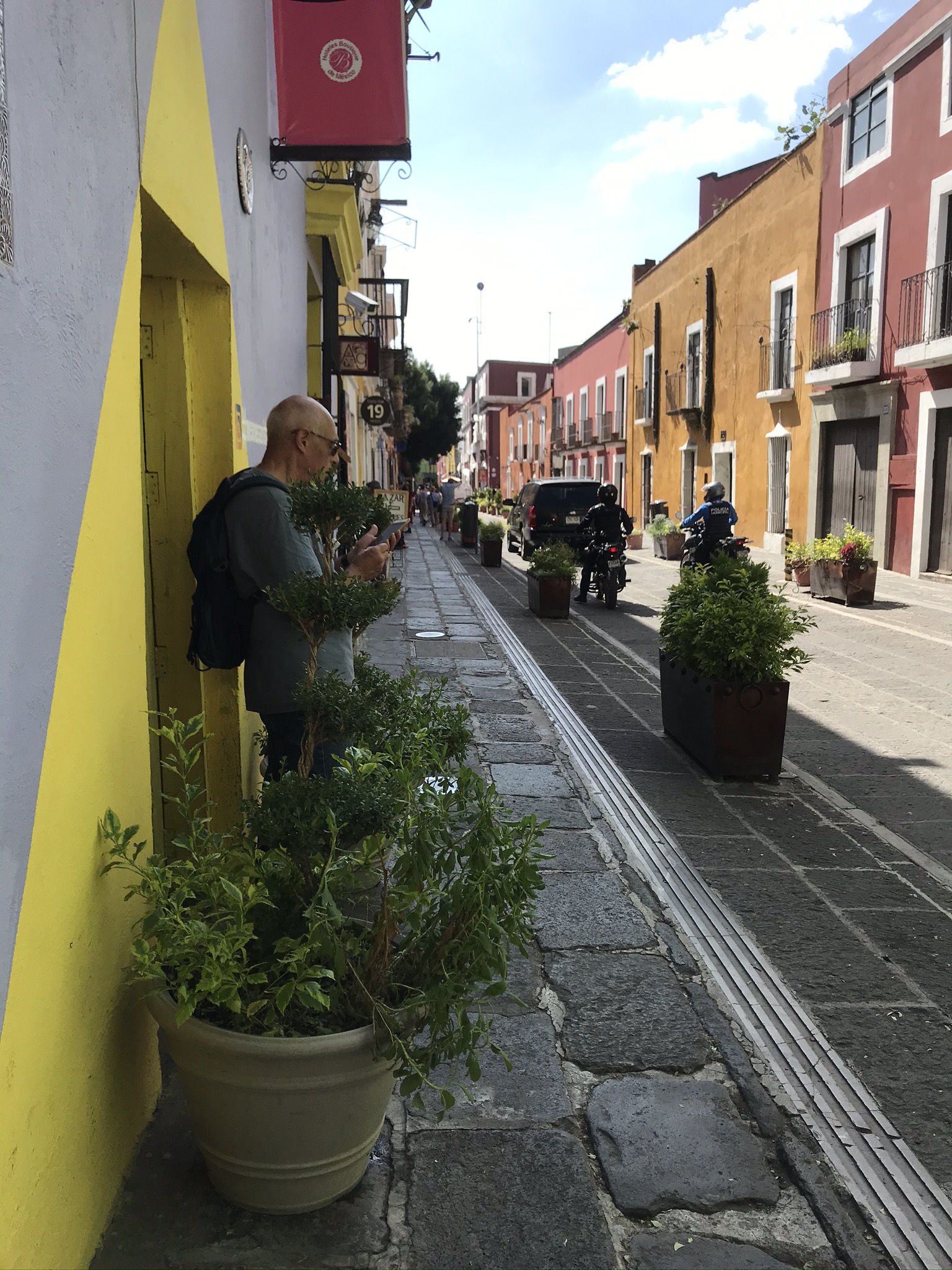
Below are scenes from around the zocalo. Nice town.
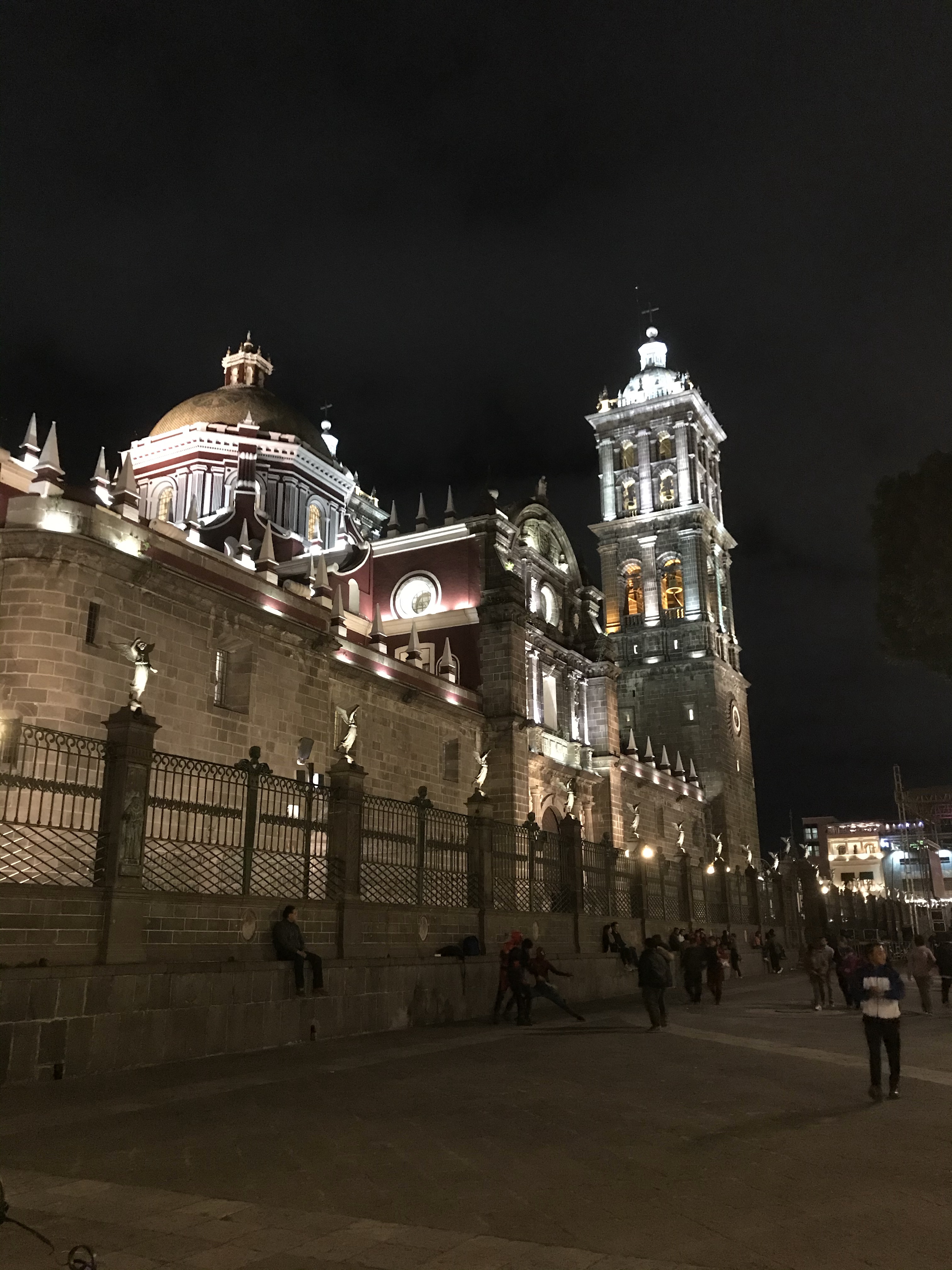
Templo de Santo Domingo/Capilla del Rosario
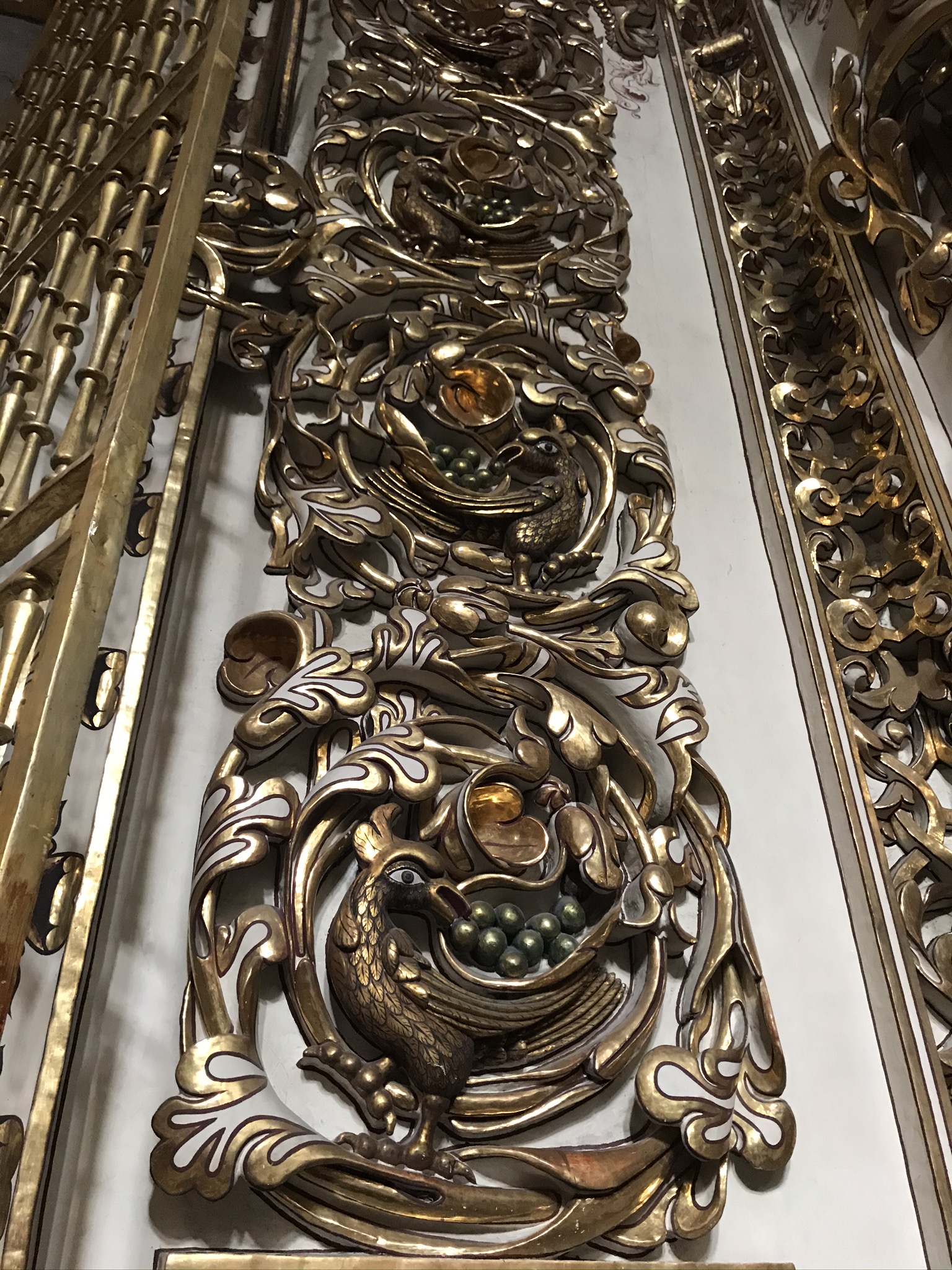
When we were at the International Museum of the Baroque (see below) a couple urged us to visit this church, so we did. The main church is stunning, with an enormous wall of saints (?) and other people important to Christianity (we couldn’t identify a one), but when you reach the front and look to the left, the Chapel of the Rosary shines out at you and then draws you in. I have never seen such compelling faces in the decorations around the walls of this small, extremely tall, chapel. It’s a wow.
Fantastical creatures and gorgeous faces in the Capilla.
Museums Galore
We are museum lovers and Puebla has given us a slew to visit. I don’t think I can rank them so will just give you a snapshot in the order we saw them, more or less.
Museo Amparo
This is listed as a private museum, which is surprising because they had free days and also free nights at the museum. In any case the tickets are inexpensive. The audio guide is solely for the pre-Hispanic exhibits, and wow, they are great. Why great? They are arranged by aspect of life—music and musical instruments, artistic expression (first place I have encountered a discussion of the contrast between European art, which strove for realism, and pre-Hispanic art which is dominated by a more abstract representation of people and things), spiritual understanding of how the world works (rivers, for example, are the way the life forces communicate with each other)…so rather than a chronological march, everything is tied together to help you understand how they saw the world.
The special exhibits were no less impressive. An exhibit open right now features an American Jewish-African Ecuadorian woman, Karina Skvirsky, which blew us away. She works with photo collages, which were disturbing and interesting, but her short film that represents/recreates her great grandmother’s journey at age 14 from the Ecuadorian countryside to the city where she worked as a domestic was spellbinding.
The first view of the terrace through the glass walls seemed unreal.
Finally, the third floor, which we might have skipped because it’s the cafe and we weren’t hungry, opens onto a terrace that is exactly at the height of the many surrounding church domes and towers—which are so close, given the narrow streets, and of many colors, under a cloudy sky the day we were there that looked unreal. We gasped.
Museo Internacional de Barocco
This extremely modern, almost distractingly high tech museum about 20 minutes’ drive from the Centro Historico was a surprise in all ways. Puebla, founded in the 1500’s, is a baroque city with many obvious examples of the style in its churches and other buildings. The museum, though, explores everything about the baroque period—architecture, science, music, painting, etc.—around the world, using poblano examples wherever appropriate but is truly a complete picture of how the baroque period changed everything in western culture.
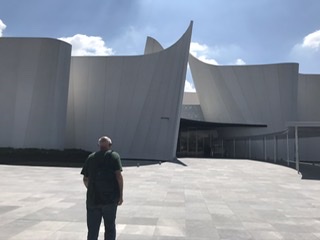
Bilbao-like on a huge site complete with rock lined pools.
The architecture of the museum is very modern designed by a Japanese architect, and stunning. On the inside the exhibits are arranged by subject (painting, architecture, scientific exploration, music…) and each room is filled with examples, explanations, multimedia presentations, narrations. It was wonderful and a bit exhausting. Well, well worth the Uber ride and typically low ticket fee.
In this room a narration and shifting pictures on two huge screens (you can see one here) discussed baroque buildings in Puebla, which is laid out in a scale model, lighting the building discussed in turn. Very elaborate!
Biblioteca Palafoxiana
Not strictly a museum, this is the first public library in the Americas. Bishop Juan de Palafox left his personal collection of 5,000 books to the Seminary of San Juan in 1646, with the stipulation that access not be limited to church personages but open to the public. It is small and gorgeous and the exhibit laid out in cases in the center is currently on the recording of indigenous languages by the clergy during the first several hundred years of the church’s presence in Mexico.
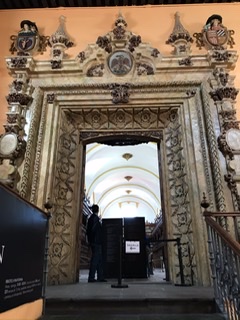
The entrance to the library; the interior is a large room with multi-tiered stacks.
This beautiful poem brought tears to my eyes. The panel to the right had the Nahuatl translation. The title is When a Language Dies. Use your google translate if you do not read Spanish. Vale la pena.
Museo Casa Alfenique
This was a surprise—we expected a restored residence (it is named for a confection made of egg whites and sugar and is embellished within an inch of its life) but it is a lovely history of Puebla and its role in Mexican history (you all know that 5 de Mayo celebrates the victory over the French invaders in Puebla, right?) as well as a lovely explanation of China Poblana, the creole/criollo indigenous/Spanish culture of Puebla revered in Mexico. Well worth the visit.
Casa De Los Hermanos Serdan
This place was a little gruesome—the bullet holes from one of the revolutionary struggles in 1911 remain on the exterior and inside, including a large decorative mirror with obvious bullet damage. The exhibit is about the Mexican Revolution in general, about which we realize we are insufficiently educated, and the slaughter in and outside what was the private home of the Serdan family. I cannot begin to explain what all this was about—read some history if you are interested. But do visit the museum when you come to Puebla. These events still resonate.
Bullet holes remain outside the Serdan home. On the right is the kitchen at Alfenique—beautiful.
The worst part of traveling is the night before an early flight. We slept poorly as usual. With a 6am departure we had scheduled a Lyft for 4:25am, having checked and double checked that we were set for such an early ride. I looked at my phone at 4:15…”Your ride will arrive in 45 minutes.” WHAT? Checked Uber–no cars available. Called Flywheel Taxi, “Open 24 hours” to get no answer. Called the Lyft driver to confirm he was going to be that late, saying “I have a flight to catch”…his initial response was “Hey, why the attitude?” He went on, very impatiently, “They just put this on my list and I still have to drop this guy off at SFO.”
Went back to Uber, still no cars available. Then a most welcome text appears, “Your ride will arrive in 15 minutes.” They had found a new driver, who did appear in 15 minutes. We were so grateful, and it turned out so was she. She had been out in Walnut Creek where she was getting calls for rides further and further out, and “I wanted to get back to Oakland, and I took this (our) request because I had already turned down 2 and they don’t like that.” Arrived at OAK in plenty of time, boarded, relaxed, and off we went.
The airport in Mexico City is big and pretty well organized. When David turned down a hallway to the men’s room a young man walking out said it was closed, and to follow him. We did, a long and complicated route, to an open men’s room. That left us a very short hallway from the bus counter where we bought tickets for a bus leaving in 30 minutes–David prodded me to ask for a senior discount. I did, happy to remember the word for “discount” but the the ticket agent was unsure there was one, that is until he asked if we would contribute to their fund for “ninos en Puebla,” which I gladly did and then voila, the senior discount was discovered and applied and after a short wait we were on the bus to Puebla. Took a taxi to the hotel, Meson Sacristia de la Soledad, through a mass of people which the driver complained about steadily. Then a police barricade was at our block so we walked the last bit. Dia de Los Muertos, with a major parade two blocks further which we ran to watch after checking in to this lovely, warm, hospitable little inn (meson=inn).
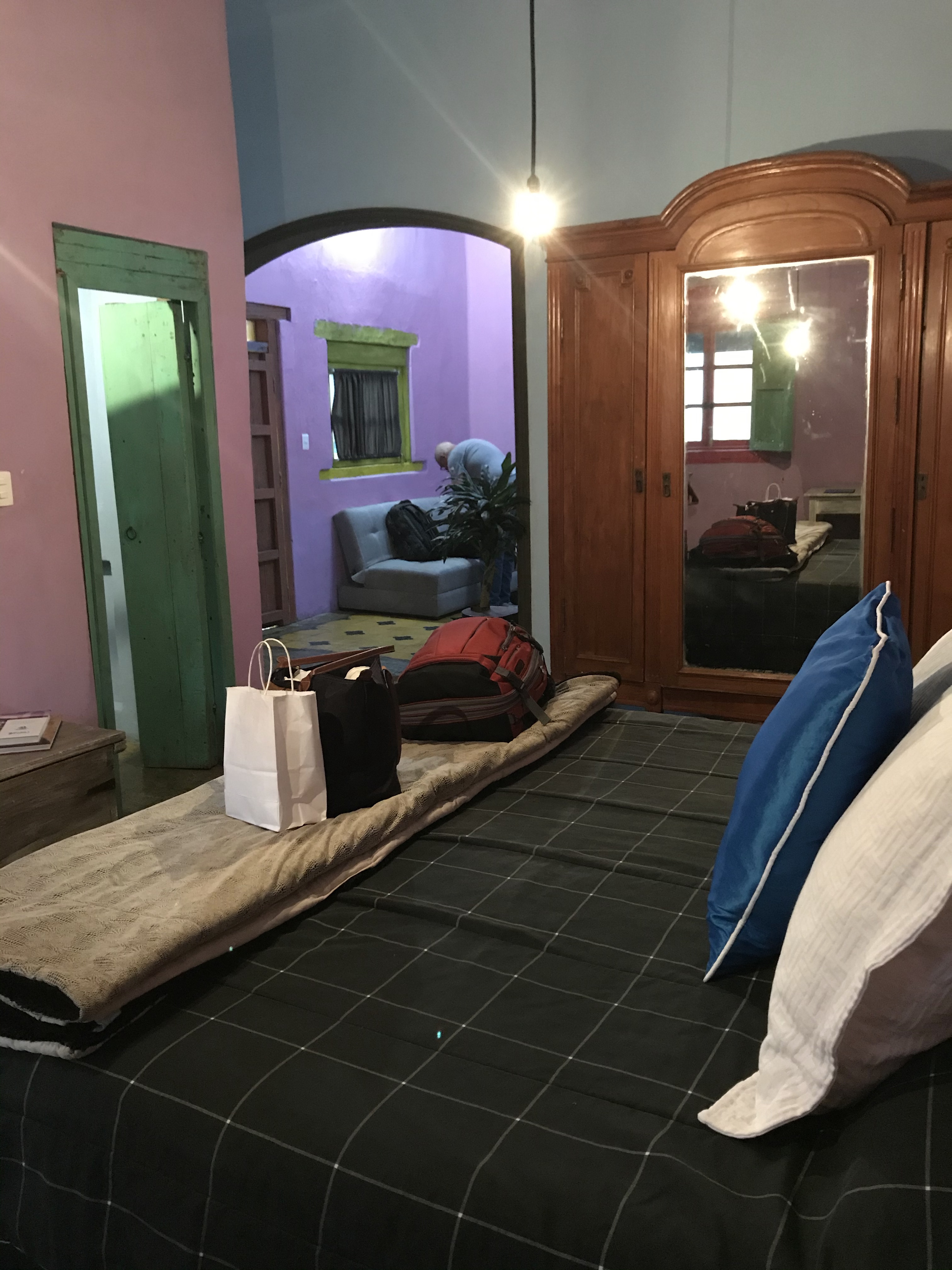
Our room is huge, colorful, comfy. We dumped our things and headed to the parade, and then to Las Ranas for supper. The zocalo (central square) was jammed with families, many in costume, many elaborately painted faces, vendors, a stage with a band playing, balloons of course, just happy madness everywhere. Supper was great–a half kilo of a meat/pepper/onion/cheese mass, hot off the grill, and a huge supply of tortillas. We ate until we could eat no more. With David’s beer and my jamaica the bill was $8. We wandered back through the crowds intending to fall into bed, but…
David: I can’t find my iPad!
Me: Relax, I’ll find it.
Ha. No iPad. David was of course very upset as he concluded he had left it on the bus, and I, realizing that calling the bus company myself would be futile as the conversation would be way too complicated, went downstairs to ask Paco for help. He roused the owner who, in his pajamas, called the bus company and after a very long and, yes, complicated, conversation, reported the missing item. We had our ticket stub so we knew what seat, which bus, etc. He gave them his cell number to call if they located the iPad. They gave him an incident number which we would need to retrieve the item if they found it. David had calmed down, we had setup “erase” on the iPad as soon as it connected to the internet, and got ready for bed.
Knock, knock, knock at our door maybe 45 minutes later. It was Paco, to report they found the iPad and the owner would drive us to the terminal the next morning after breakfast. I think I said about five times “Es verdad?” The next morning I assured the kind owner (Lulu) we could go whenever it was convenient for her, but she graciously said “David will not be able to relax until he has it in his hands” which was true, and within a little while we had retrieved the iPad and everything was wonderful again.






























 Inescapably Rational