Thanks to David’s excellent planning and ticket management we were outfitted for our Eurostar train mid-morning Sunday and without a hitch were boarded and on our way. Surprisingly there was no electrical or USB support but we were charged up and had our trusty little backup battery. Never travel without one!
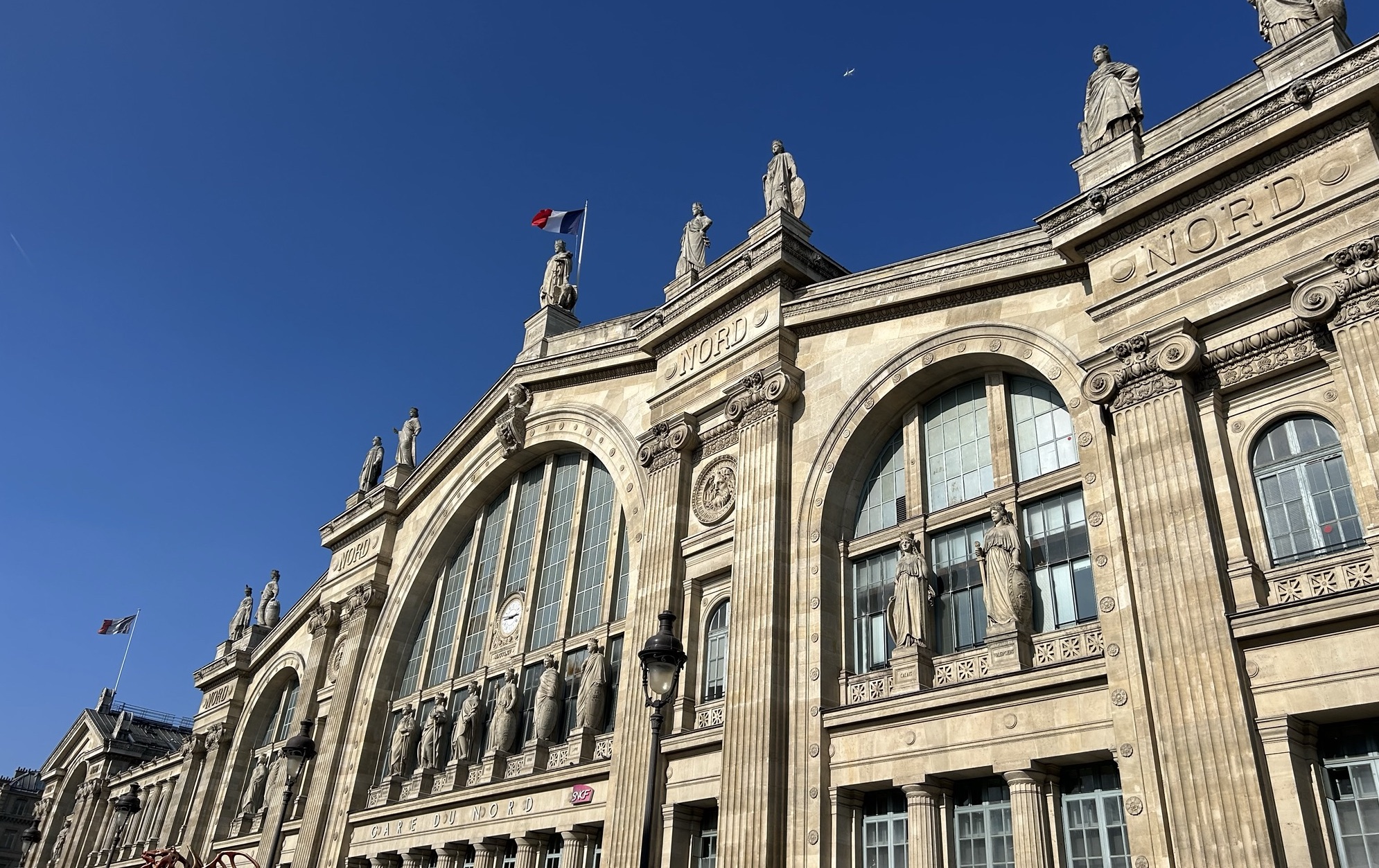
Gare du Nord, our introduction to Paris
David had also researched the bus-metro pass options and combined with my French we bought just what we needed at the train station in Paris—a one week pass good for every mode. The trick is knowing it runs from Monday through Sunday, so David knew we needed a bus pass for just the one trip from Gare du Nord to our hotel. Seemed like a few moments and we were checking into the Joyce Hotel in Montmartre. Great location, pleasant hotel with warm and helpful staff, comfy room and bed. The first night, though, the room was waayyy too warm and we got little sleep. The next morning I sorted it out with the front desk and since then we have had a cool room and good sleep. Fortunately bcause we have been kicking it every day!
Here are the highlights for days one and two.
Sunday
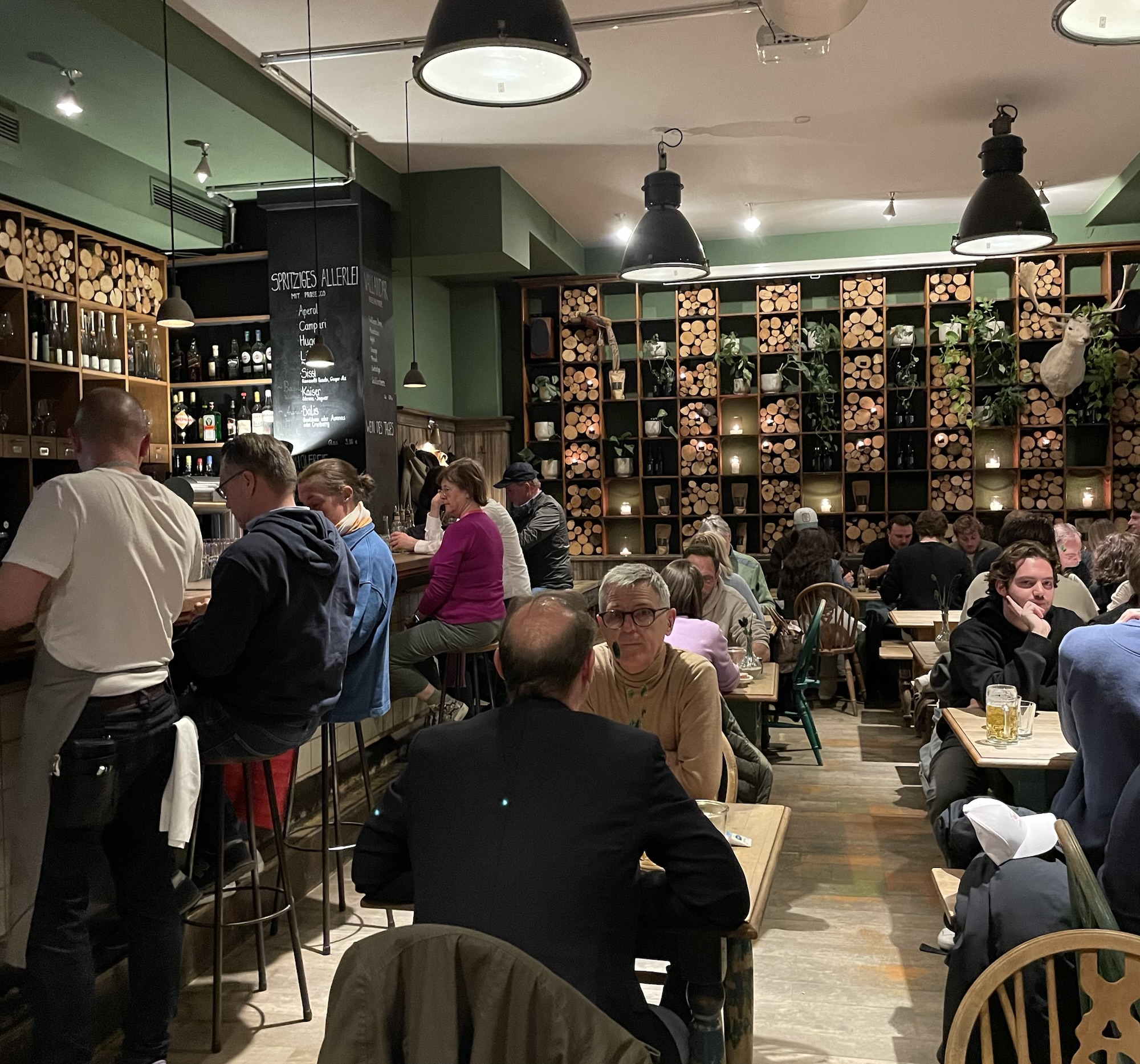
We were tired, we were hungry, we were disoriented. After unpacking, such a joy since we are staying in one place for 10 nights, we found a close-by bistro and went to dinner. I laugh as I write ’close by’ because I don’t think you can throw a stone in this city without hitting a bistro, a brasserie (bigger, bigger menus), or a boulangerie (bakeries that usually have savory things too like quiches and sandwiches). We landed at Poni, a very friendly place that takes walk-ins and has a wonderful vibe. When we went back a few nights later the guy behind the bar remembered us and where we sat and as we left said “see you tomorrow.” I had ‘salade cobb’ as I was hungry for veggies after Amsterdam, David had his first of so-far 3 boeuf tartare. The salade was enormous, the wine just fine, the tartare very good.
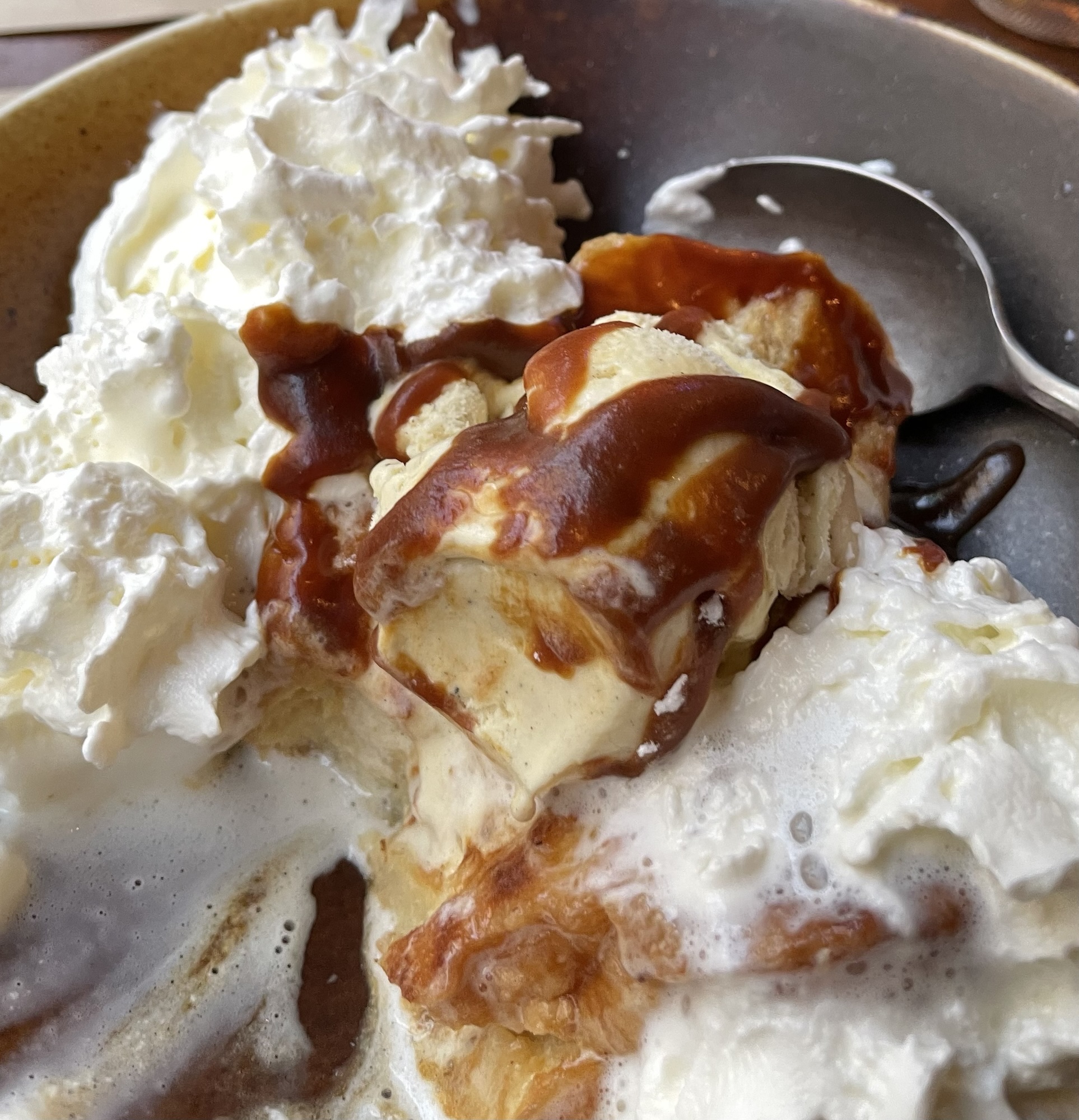
Poni’s salade cobbBrioche Perdue came with 3 scoops of whipped creamGreat vibe, so friendly
We dragged ourselves back up the hill and fell into that first too-hot night and thus crummy sleep.
Monday
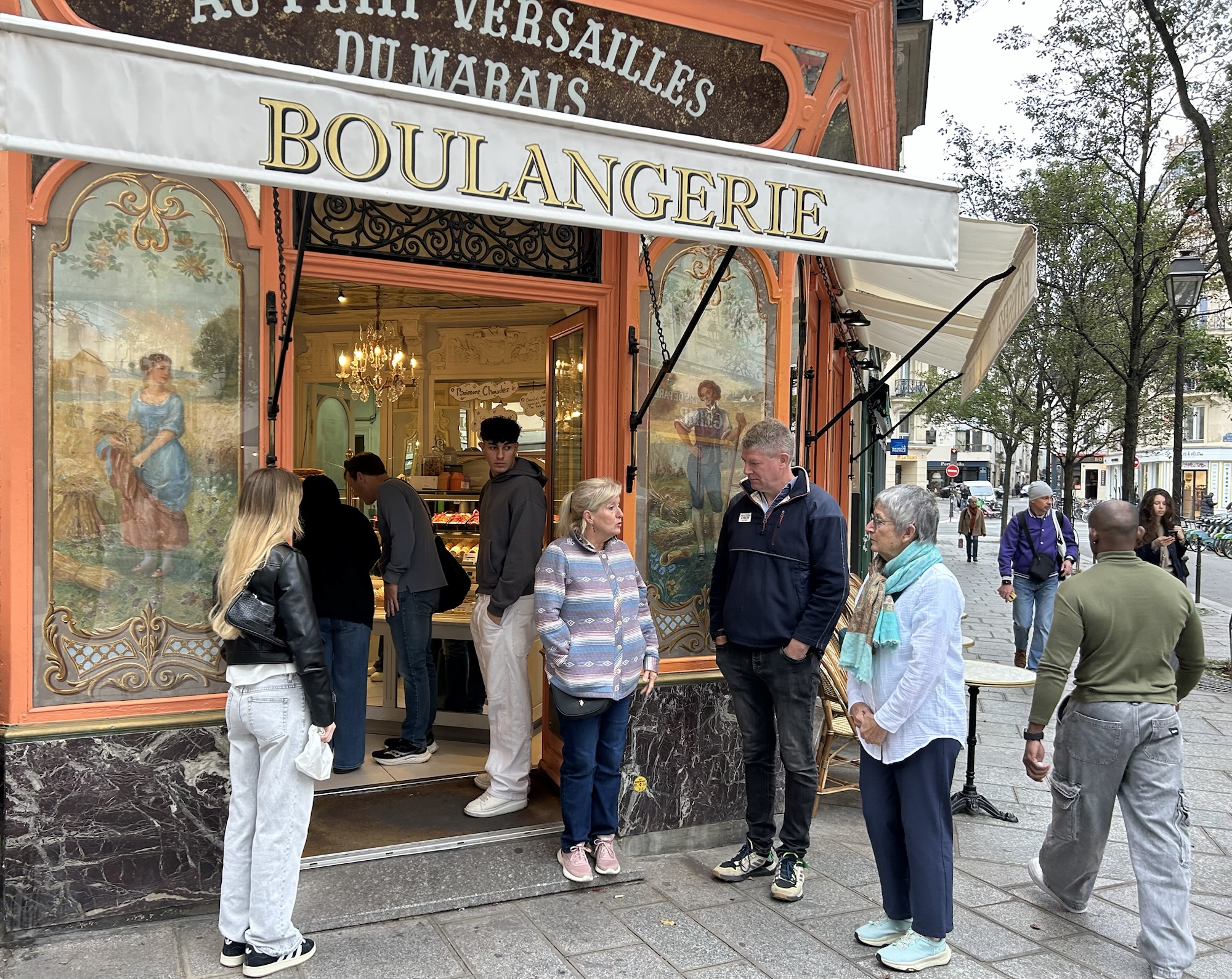
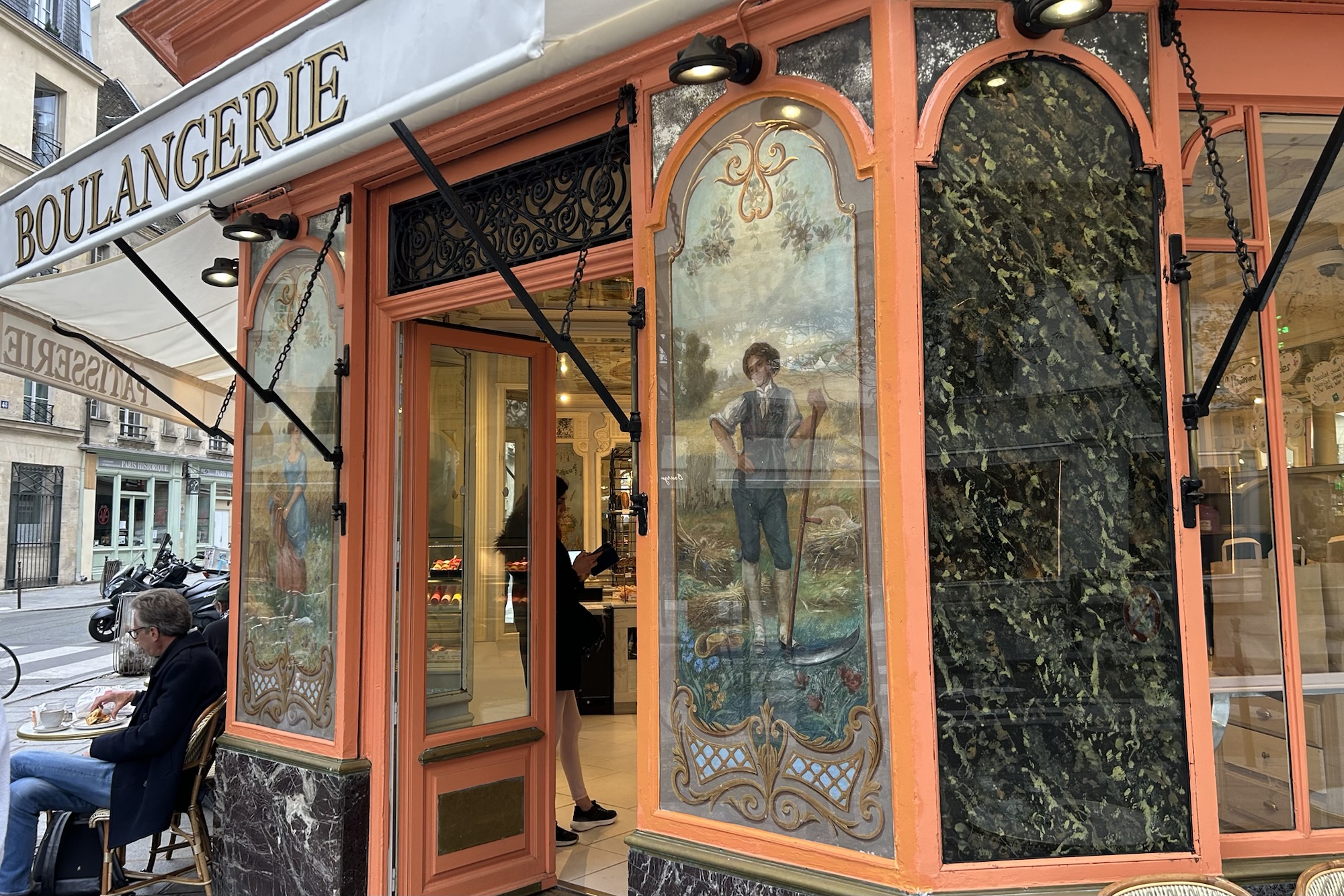
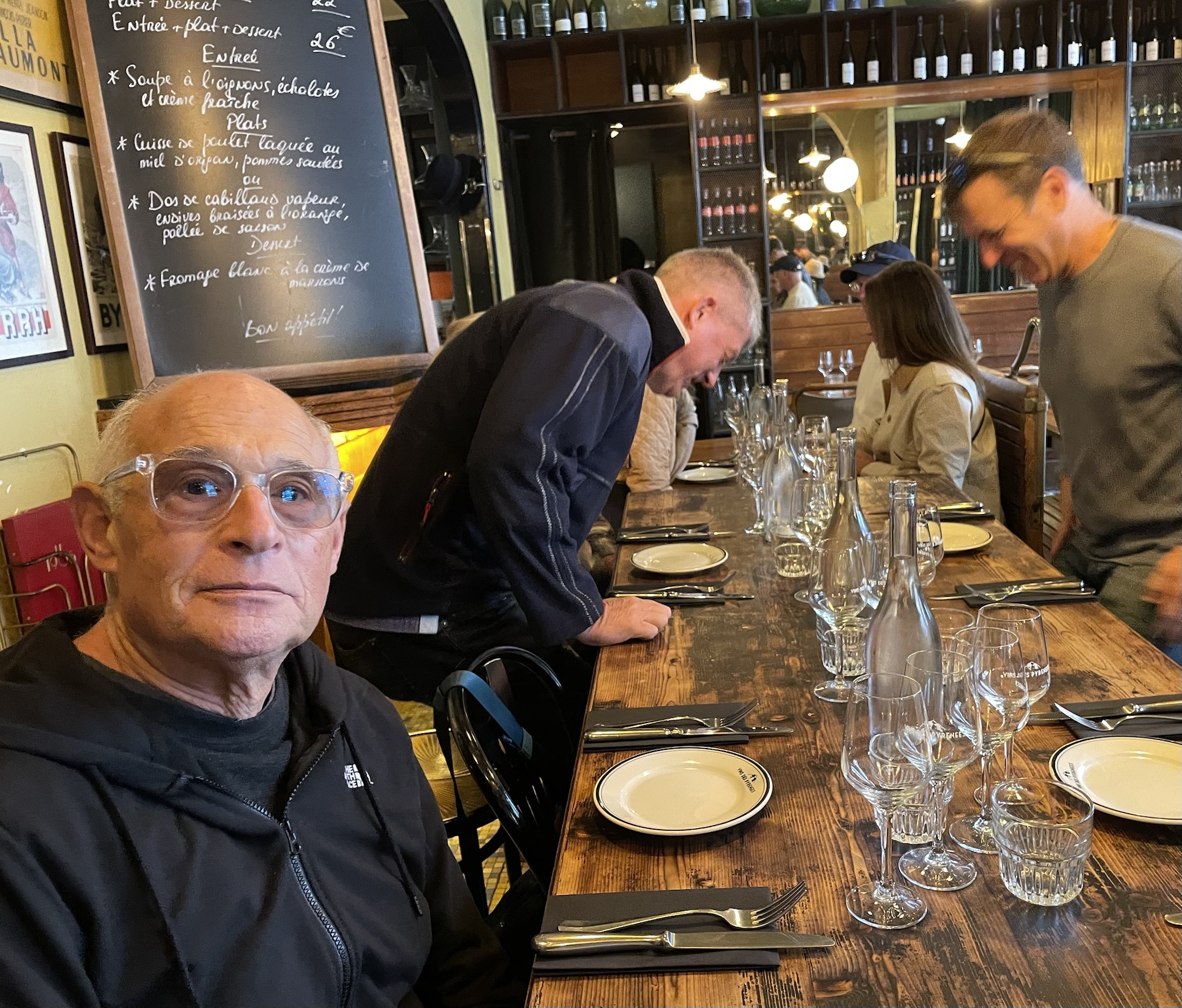
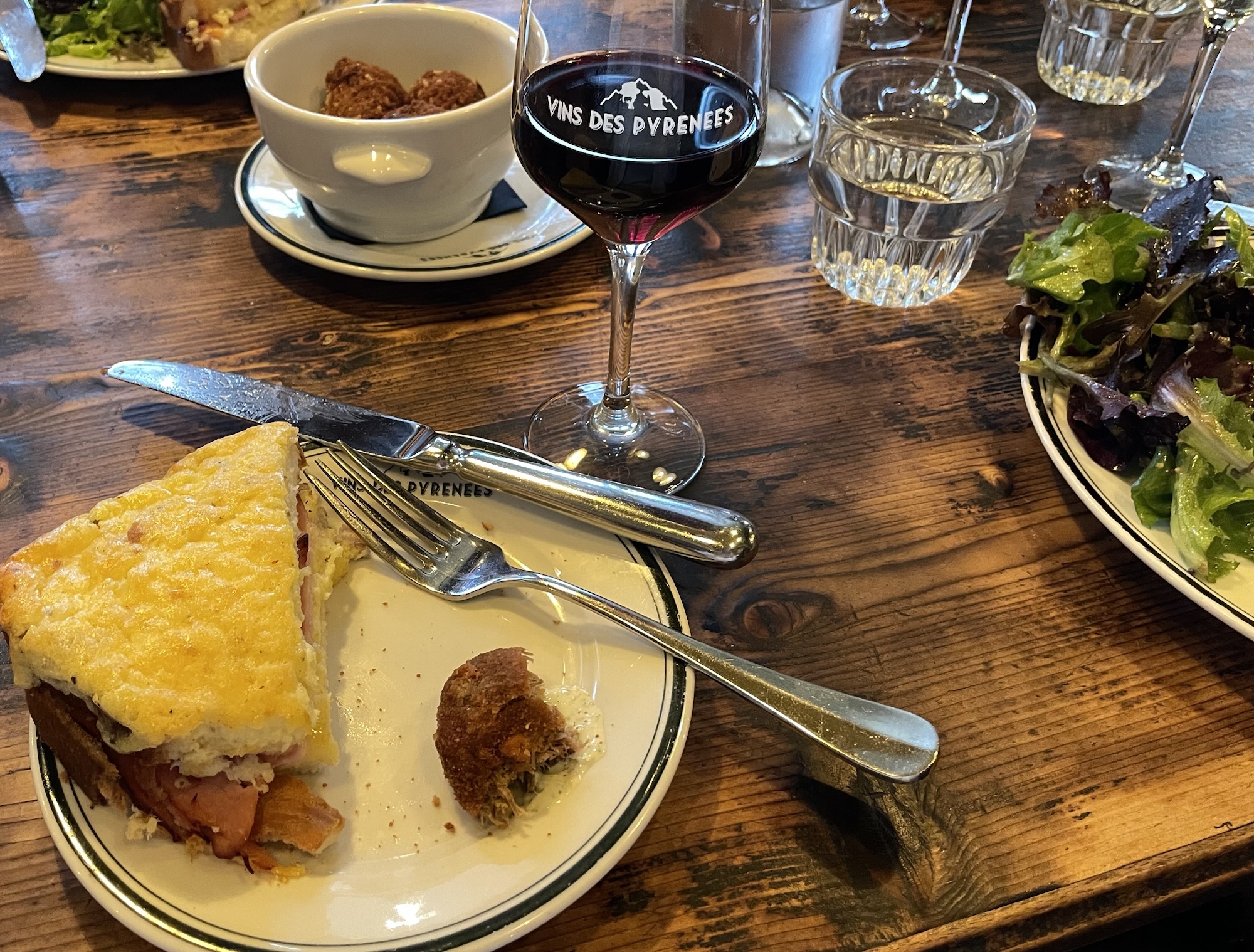
At 11am we met in Le Marais for a food tour through Viator. First stop, a classic boulangerie, everyone got either pain chocolate or a croissant. You know David had the pain chocolate as he has had every morning since. Following a little talk on boulangeries, historic preservation, and a some Le Marais background we walked to a fromagerie, Laurent Dubois. The owner also ages cheese for other cheese makers (I have read about this—you must have very specific attributes to age cheese…temperature, ambiance, skill). The owner has won the annual award for excellence several times, and has cases of his special creations out front. Our guide bought two cheeses, a comte aged 25 months (not exactly the same as what we get at Costco!) and a creamy, mild blue with two ribbons of hazelnuts, probably 5” high. You cut it like a pie. The guide had bought two baguettes at the boulangerie so we expected cheese and bread at some point. He walked us to a wine shop/restaurant, Vins Des Pyrenees, another award winner. A table was set for our group of ten, each place with two wine glasses. Uh oh. It was about ten minutes to noon! As soon as we were settled every two people had an enormous croque monsieur delivered, fortunately cut in two to share. I personally could eat about half. THEN we had two wines, something red I don’t remember (very good) and a delicious viogner. We were presented with the two cheeses and sliced baguettes! So much food. The blue with the viogner was recommended and yup, so good.
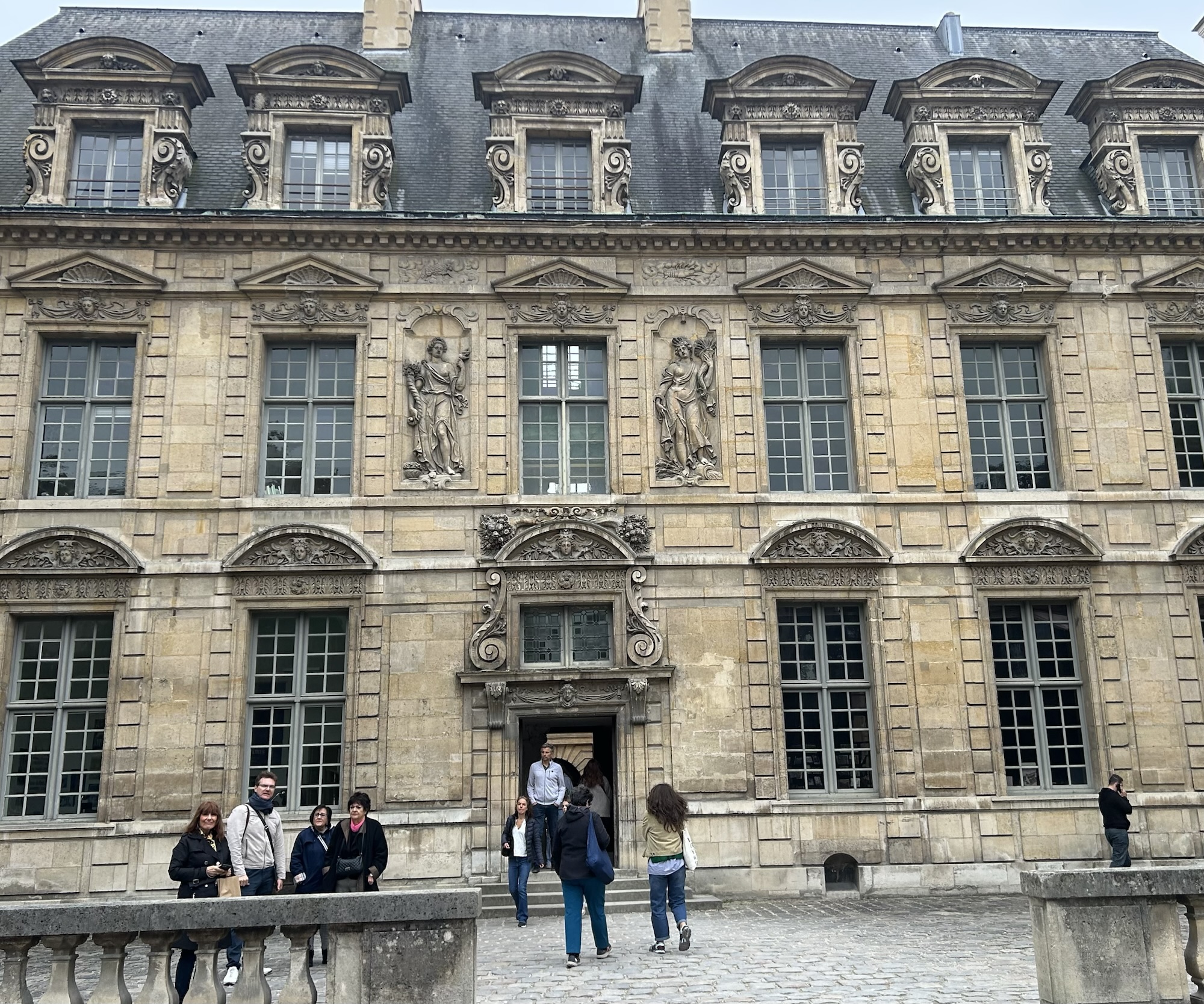
Historic boulangerieNot ready for what was comingThat is a half croque monsieur; couldn’t finish itOh, that comte…and the blue!ALMOST finishing up…still had meringues to goWhat was called a townhouse, later taken over by workers during the revolutionOpposite the house, a building for growing tropical plants and trees
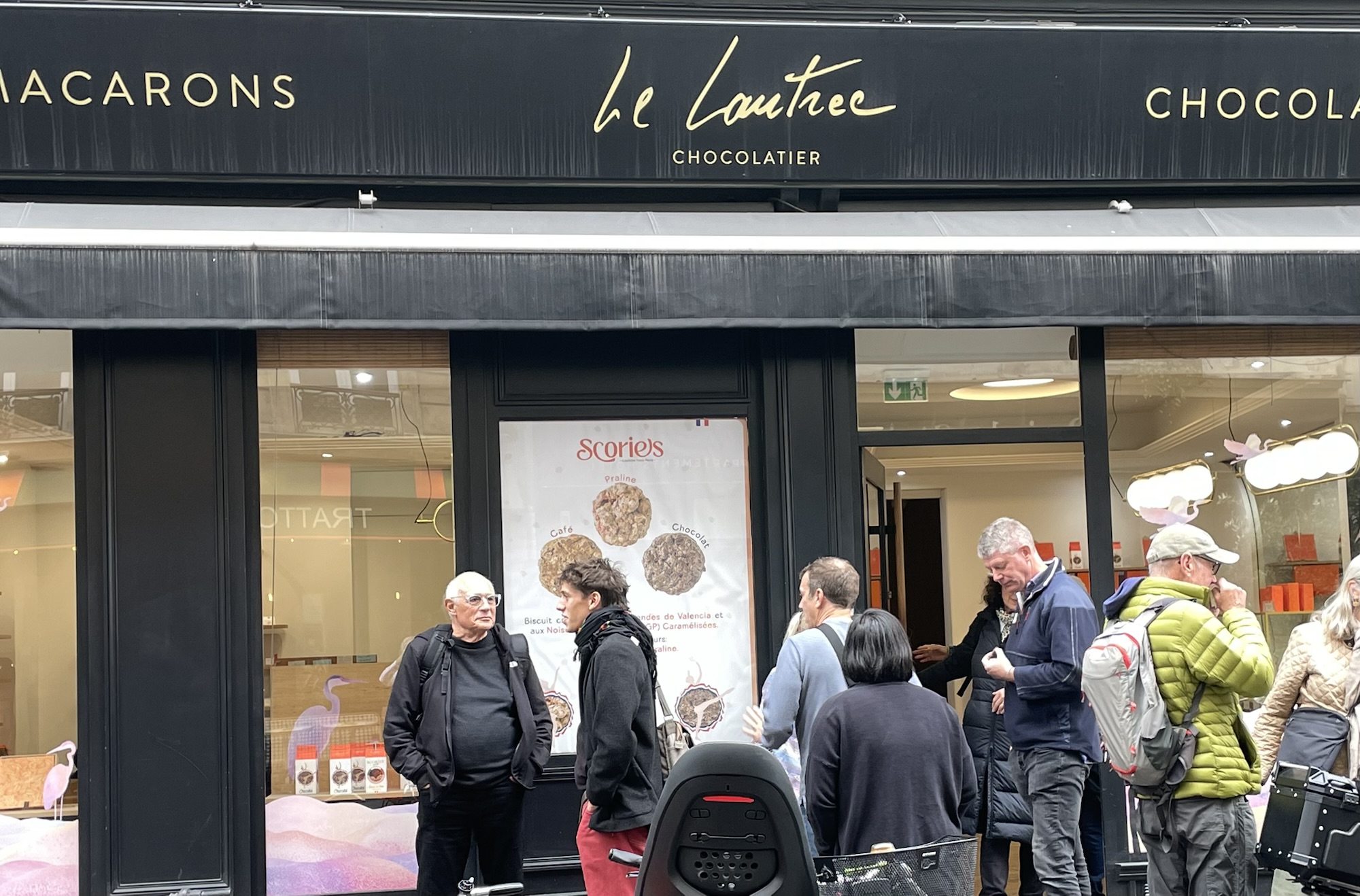
Next we were guided through hidden gardens and picturesque streets, with a bit more history, and paused in the small Jewish area where our guide sadly told us the falafel place he wanted us to sample was closed for Sukkot. We groaned—so much food! But he had a consolation prize, a nearby chocolate shop where we each got to pick 3 chocolates and/or macarons. I am not a macaron fan but these were ethereal, and it was easily the best chocolate I have ever had. We walked some more, learned more about the neighborhood, and then a last stop at a meringue shop. I passed, David popped one down, and we hurried off to a 2pm entry at the Musee Jacquemart-Andre.
Le Marais streets
It was a bit of a trek, with a long walk and a bus ride, then more walking, and we hopped into the “avec billets” line. This is an enormous mansion, donated to the city, and as such has the large, old rooms filled with objets d’art, the original furniture (it was built at the end of the 19th century), lots of paintings, and an exhibition space which, when we visited, had a pretty breathtaking collection of the paintings by Georges De La Tour, 1593-1652. He was a successor to Caravaggio, then all but forgotten after his death until he was rediscovered in the 20th century. His work is beautiful in many respects but especially for his use of dark and light. Many paintings are illuminated by a single candle. Worth a look.
Our flight was fine, but of course sleep was on/off and we arrived quite tired. I have always assumed everything works better in Europe, but we landed in a humid airport and a long walk to a 50-minute line at passport control. Lots of people and a high-pitched alarm somewhere that was extremely annoying. All for the literal 15 seconds of passport examination; leaving we approached the source of the alarm which was deafening as we ran through the exit doors. Outside the humidity climbed and poor David was sweating as we got into a waiting, and crowded, bus. Several nice people reshuffled so we could both sit down. I guess we looked pitiful.
It was a long ride into the city where we were bleary, hot, tired, and grumpy looking for our street. It turned out to be a very short walk and we got there without mistakes thank goodness. Nice hotel—The Catalonia Vondel. There are so many small hotels in this part of the city we had trouble deciding where to book but this was a reasonably good choice. Nice staff, an elevator, and lovely room which alas we had to change because the tub-shower walls were SO high it was literally treacherous to climb into and I kept picturing the trip ending with a rush to the ER. We moved the next day to a room with a teeny bathroom but a walk-in shower. Our last 24 hours have a few issues [no maid service, very difficult to adjust the water temperature in the shower] so I cannot recommend it unequivocally. We found the location, on the edge of the museum district, just about perfect.
The Stedelijk Museum of Contemporary Art
Stedeljik Museum was our first stop because we didn’t have to book an entry time. We have gradually come to really enjoy contemporary art and this place is pretty great all around, with one masterpiece that we returned to our last day to see again. It is a short [45 minute] film by Wael Shawky titled Drama 1882, telling the story of the rebellion against the British in Egypt, ultimately crushed by the British. It is an opera, with a hauntingly beautiful score, subtitled in English thank goodness. We both loved it…so much we went back Saturday, our last day and the last chit on our museum pass, to watch it again. It is so poignant, so sad, as the citizens are betrayed by European powers and their own people [“Traitor 1, Traitor 2, Traitor 3”]. The entire film is a masterpiece. I have scoured the net looking for where else it can be seen but after a month long installation in LA I found nothing. It premiered at the Venice Bienniale last year.
The Seafood Bar
Oooh, so yummy. I suppose I should have taken pictures but we were immersed in eating and drinking. Started with 6 oysters, easily equal to the best we have ever had. Then shared the Plateau, a small lettuce salad and huge serving of smoked and cold fish and shrimp. Delectable. Then we shared an order of mixed grill, a tower of fish and shellfish grilled perfectly. We ate every bite. It was a ten minute walk from the hotel and we practically staggered back and fell into bed.
Day 2: RijksMuseum and Indonesian Dinner
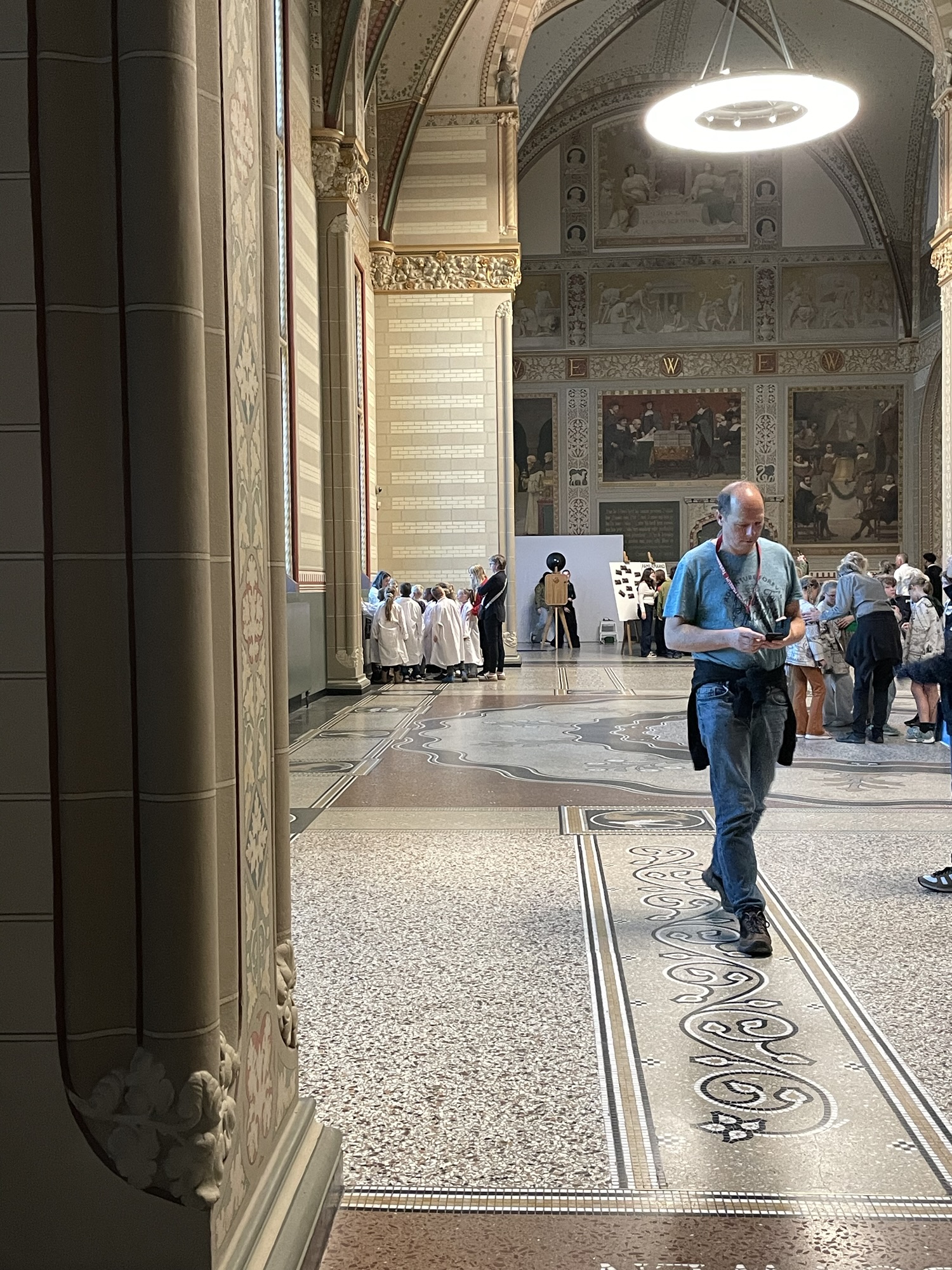
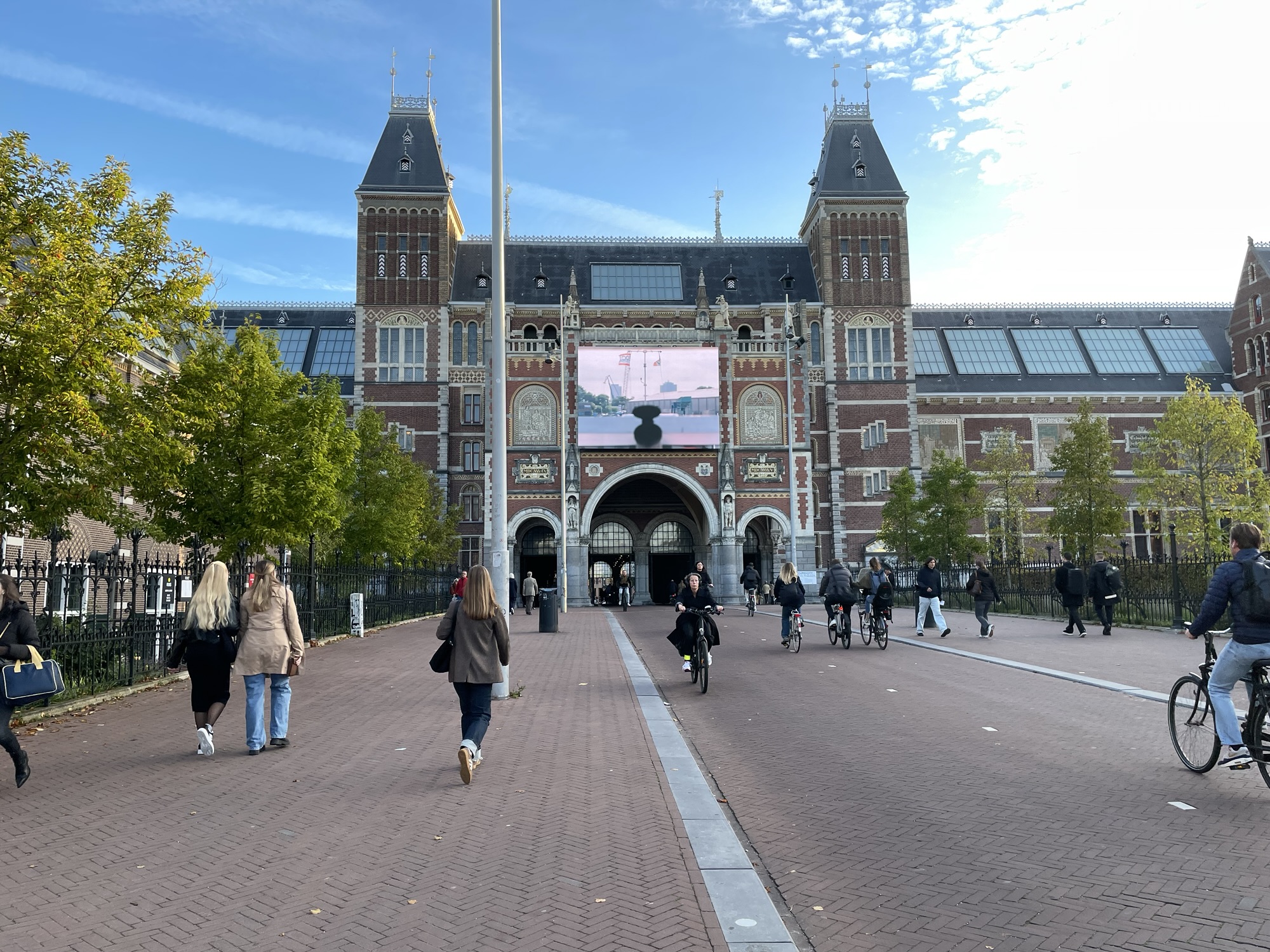
Well, this place is justifiably highly recommended in every guidebook…it is enormous, the building is fantastic, the layout fairly easy [though we had to ask at the information desk where the exit was!] and the audio tour essential. The first stop on the tour is the Great Hall, a beautifully adorned, immense space with massive murals that were part of the original construction. I mention this because not long after the museum opened styles changed and all the walls were painted over in white. The audio tour device allows you to “paint” the walls white to see this travesty of modernity over beauty. As the narration explains, years later it was decided the white walls were a mistake and fortunately all the original decorations and murals were intact under the paint which was meticulously scraped away. Phew.
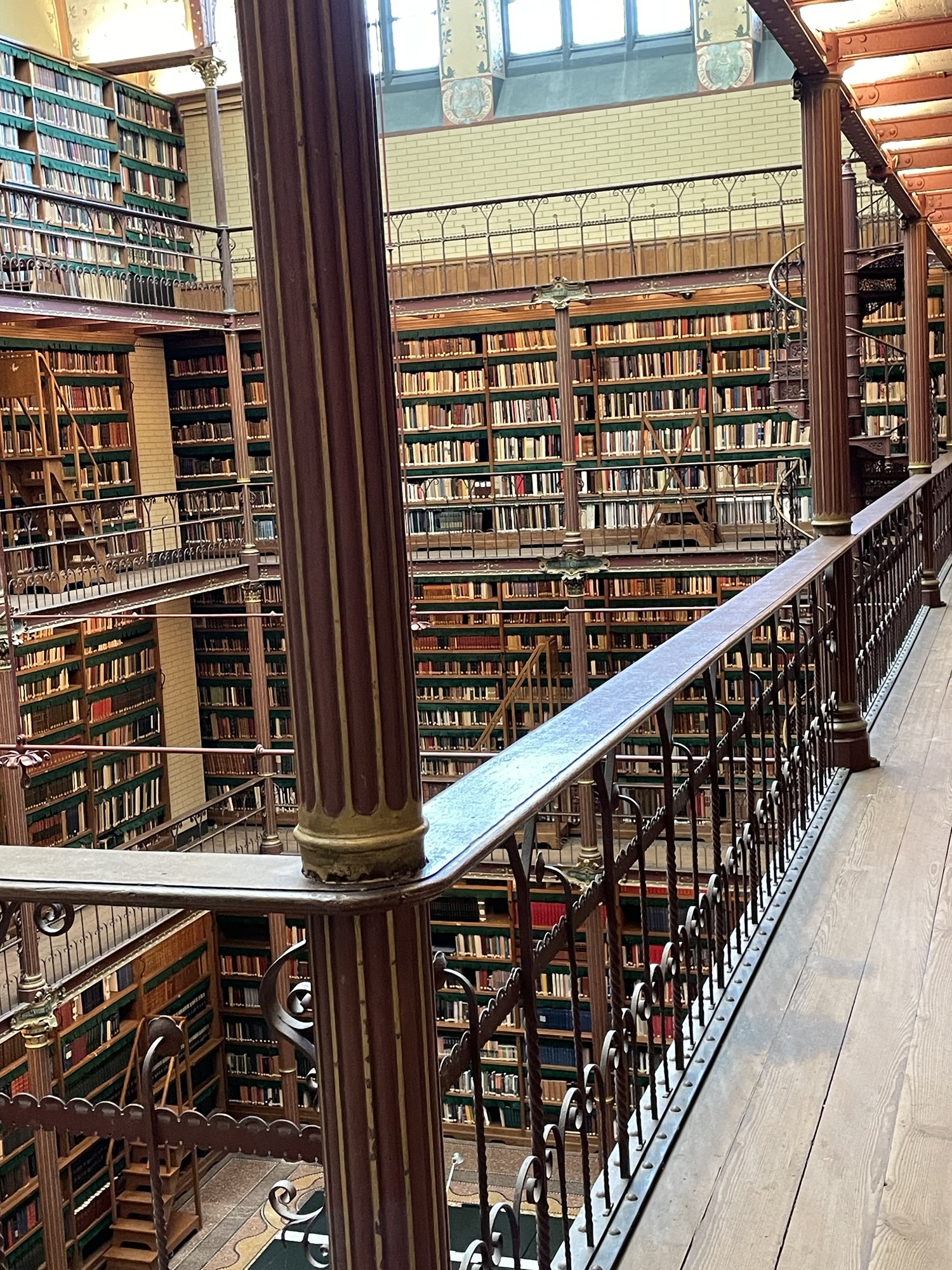
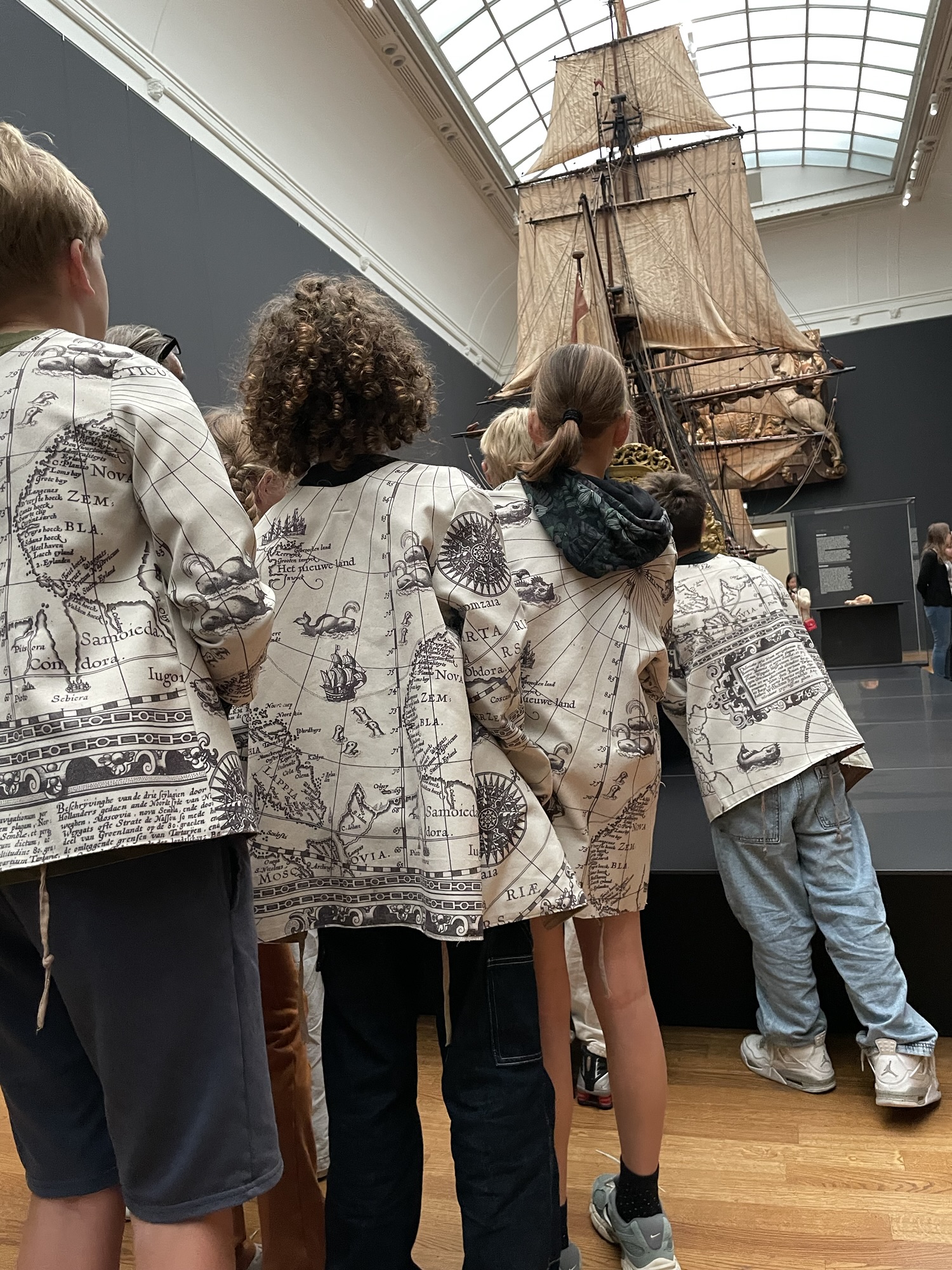
The title is Puck—the dogA corner of the great hall with smocked school group on the leftThis is the library. No talking. Another school group examining a ship modelThe Night Watch undergoing restorationThe galleries are so beautifulThe massive Rijksmuseum
Of course the Dutch masters are well represented and their works remain as appealing as ever. The Night Watch is being restored and behind a glass wall—but visible behind the wall and a reproduction is in the next room over so one can see the details. The tour had ample explanations of why these masterpieces of the 17th Century are as wondrous today as ever. Still lifes that entice you to reach in and take a piece of cheese; interiors (e.g. The Milkmaid) that are inviting and colorful; group portraits, such as The Nightwatch, that transport you to the scene. We loved it.
Afterward we wandered across the canal to a sweet little restaurant, Cafe Mankind, and at 12:30 we were the first people to sit down for lunch. I had learned from the massive sandwich I had had the day before that a half would suffice so we shared a smoked salmon on brown, thin, warm toast. Yummy. We returned to our room for a nap, then had a very good Indonesian dinner in honor of the colonial past and staggered back to bed.
Day 3: Haarlem Food Tour and Frans Hals Museum
We had booked a food tour in the city of Haarlem, a very short train ride, and ever worried about making our way to unknown locations on time we were an hour plus early for the tour so stopped in a nice coffee place with wifi. Thirty minutes in an American sounding guy sat next to us, a talker but an entertaining one. He was born in Indiana but had emigrated to Canada years ago and was now a Canadian citizen. Show off. We had a fun time mostly listening to him, getting in words as we could, as we explored traveling, being Canadian, his time on vacation in Haarlem (which I recommend highly…stay there and take day trips into Amsterdam) , and so forth. It passed the time and then we walked a few more blocks to the food tour.
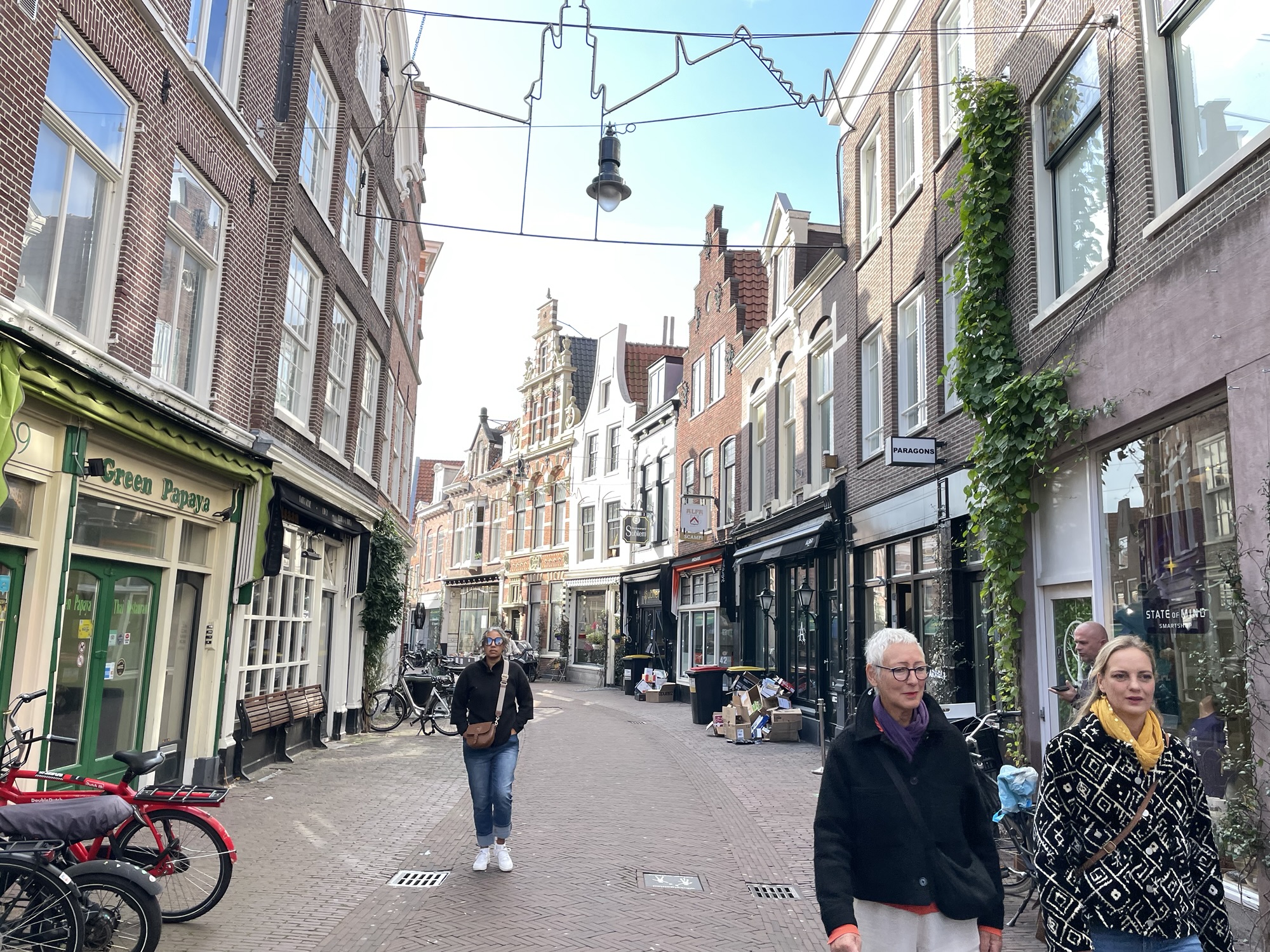
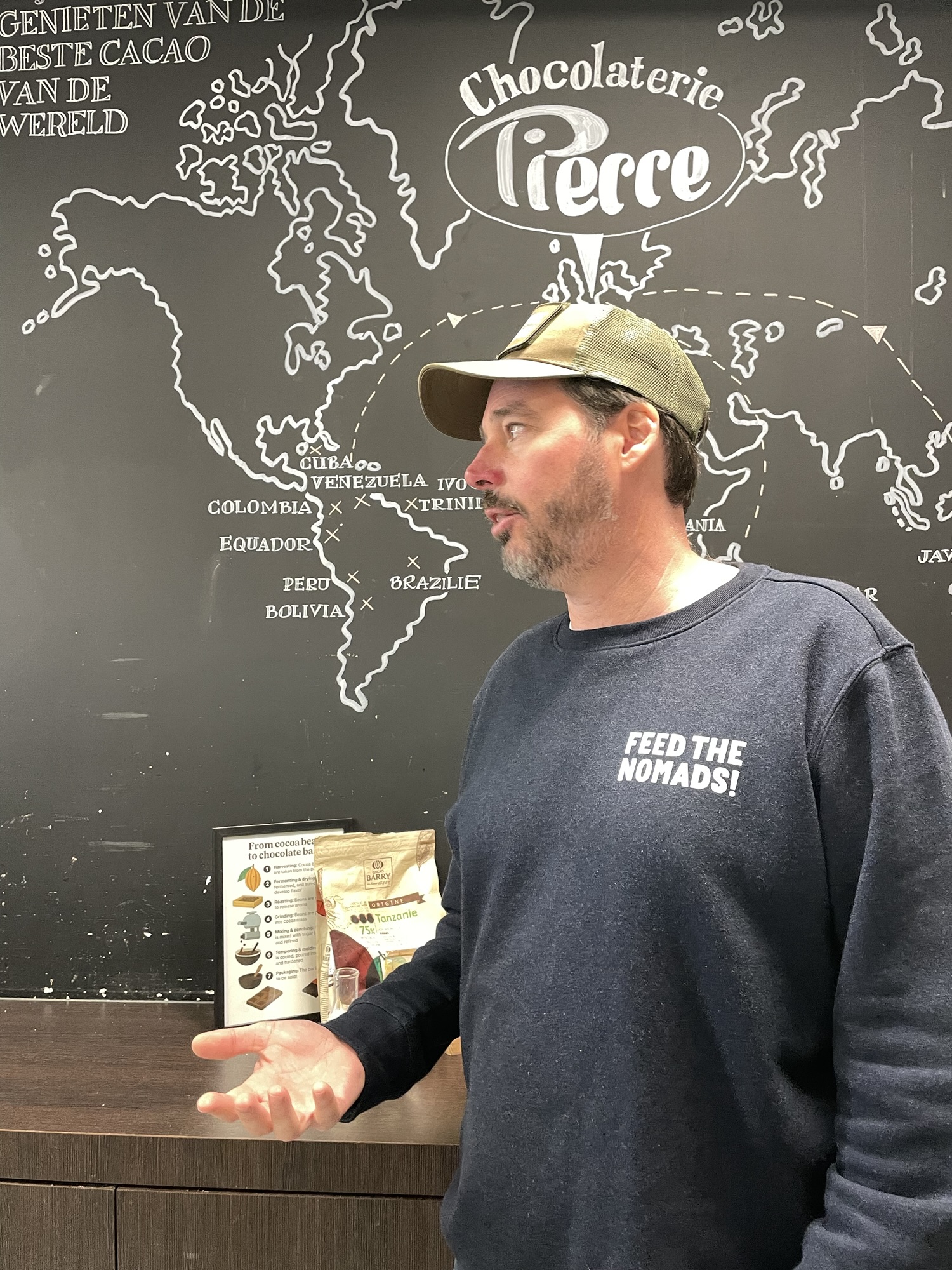
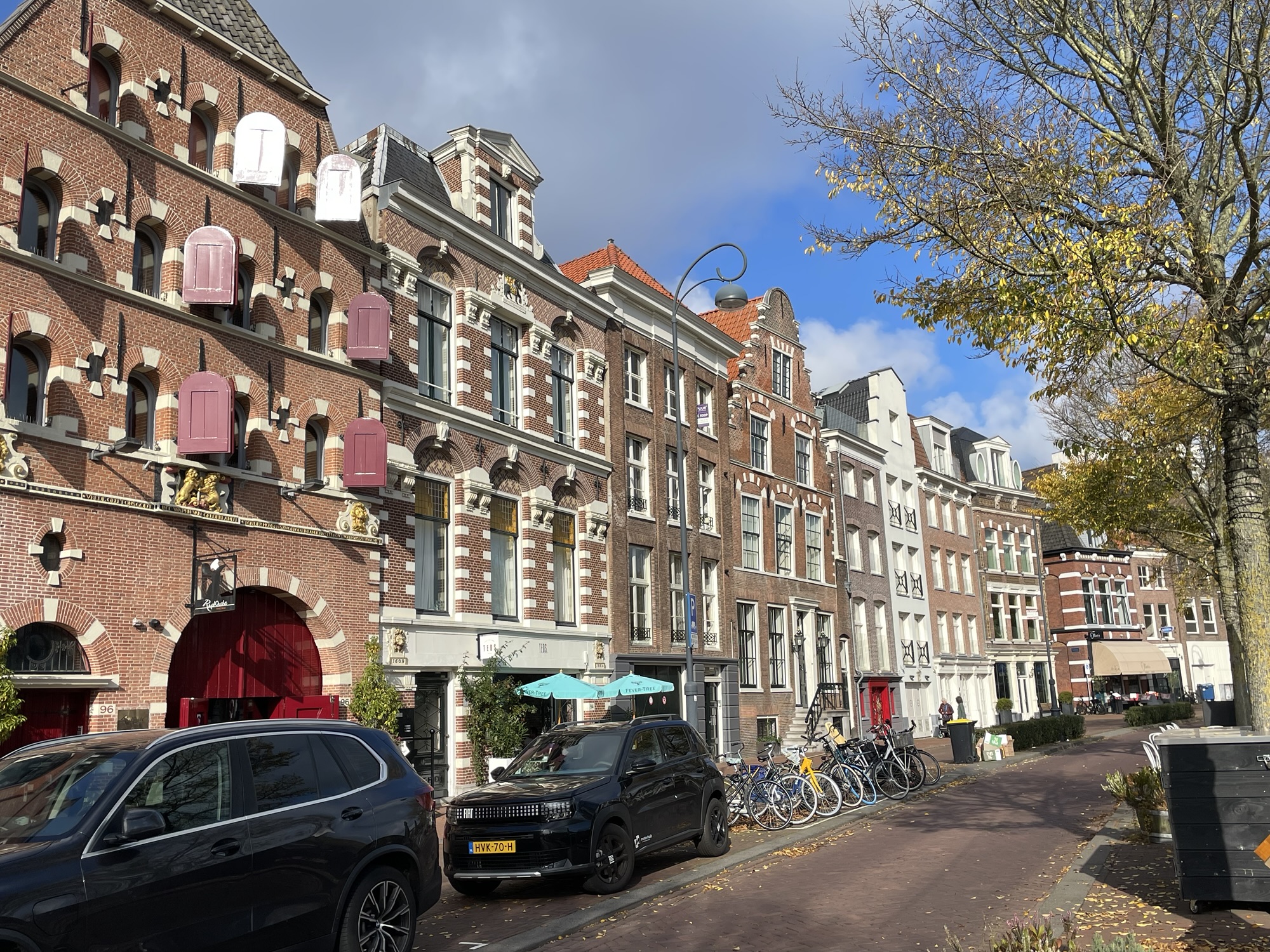
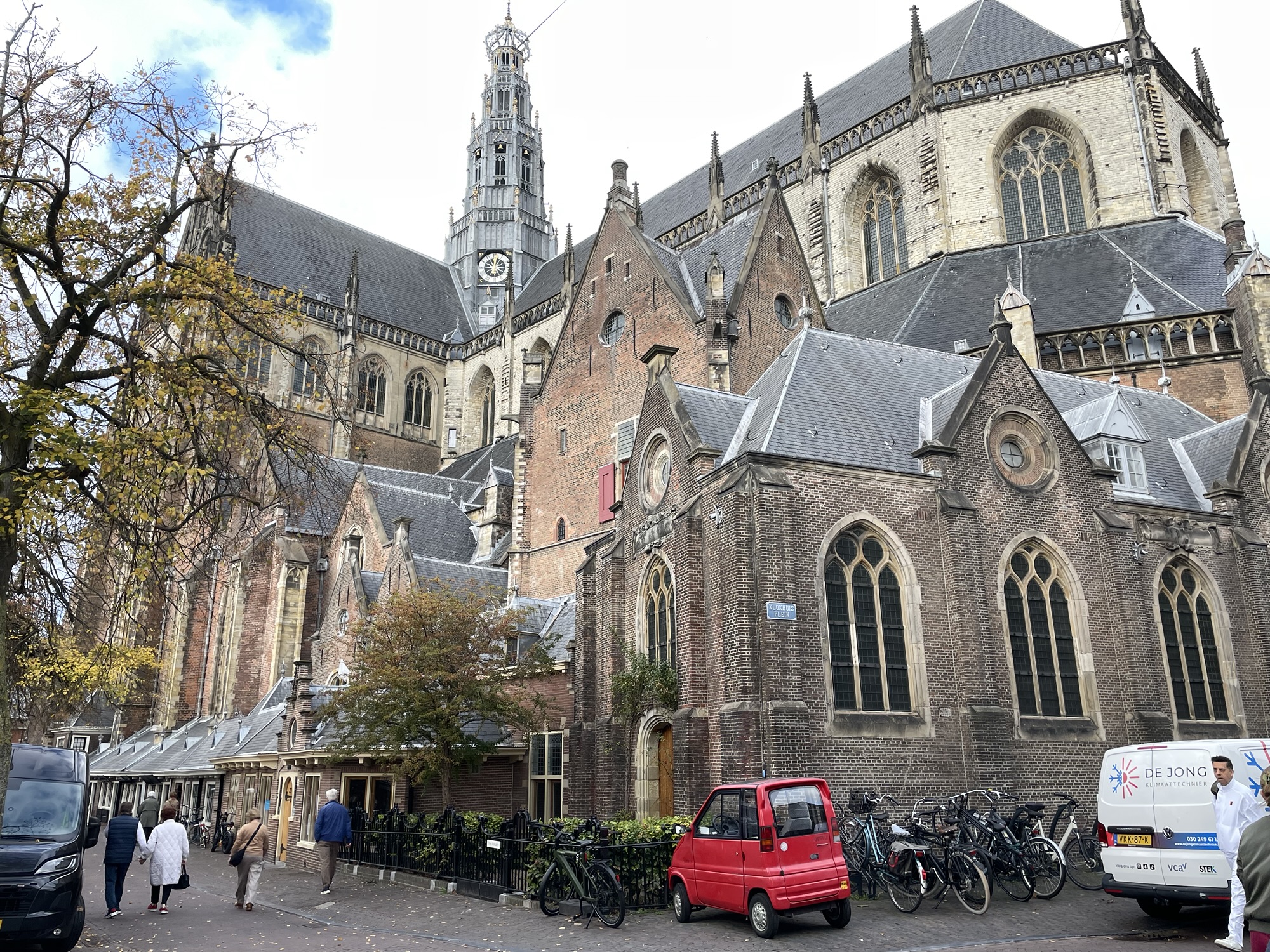
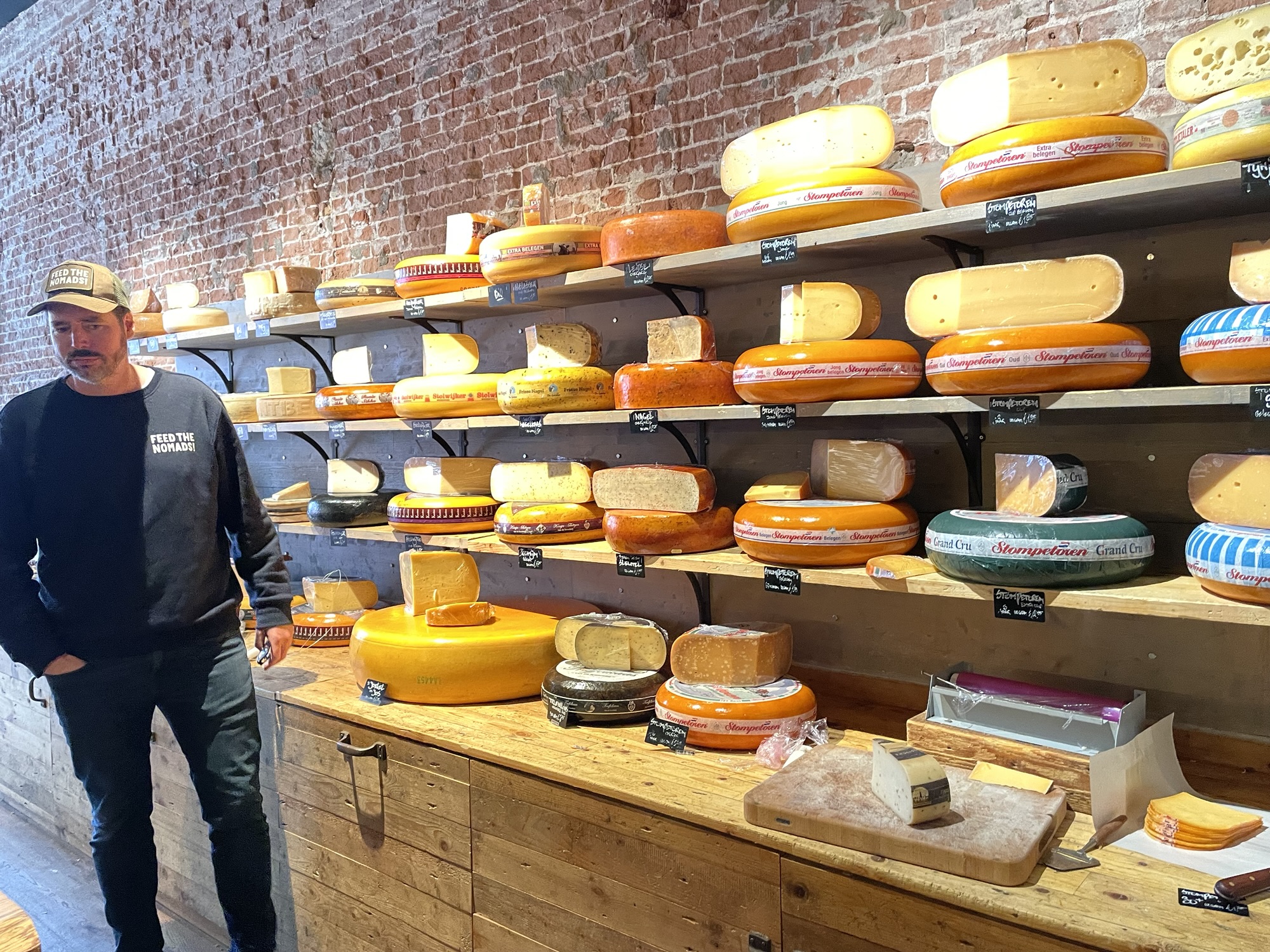
Haarlem, a manageable amsterdamOur wonderful guide explaining chocolate Narrow residential streets where the city promotes greeneryThese enormous houses were built primarily by beerPlenty of canals…this is an actual riverThe former cathedral, now Protestant, is a jumble of buildings smashed togetherDutch cheese is similar to parmesan in that it is non-perishable meant for long sea journeys as they became a colonial power.
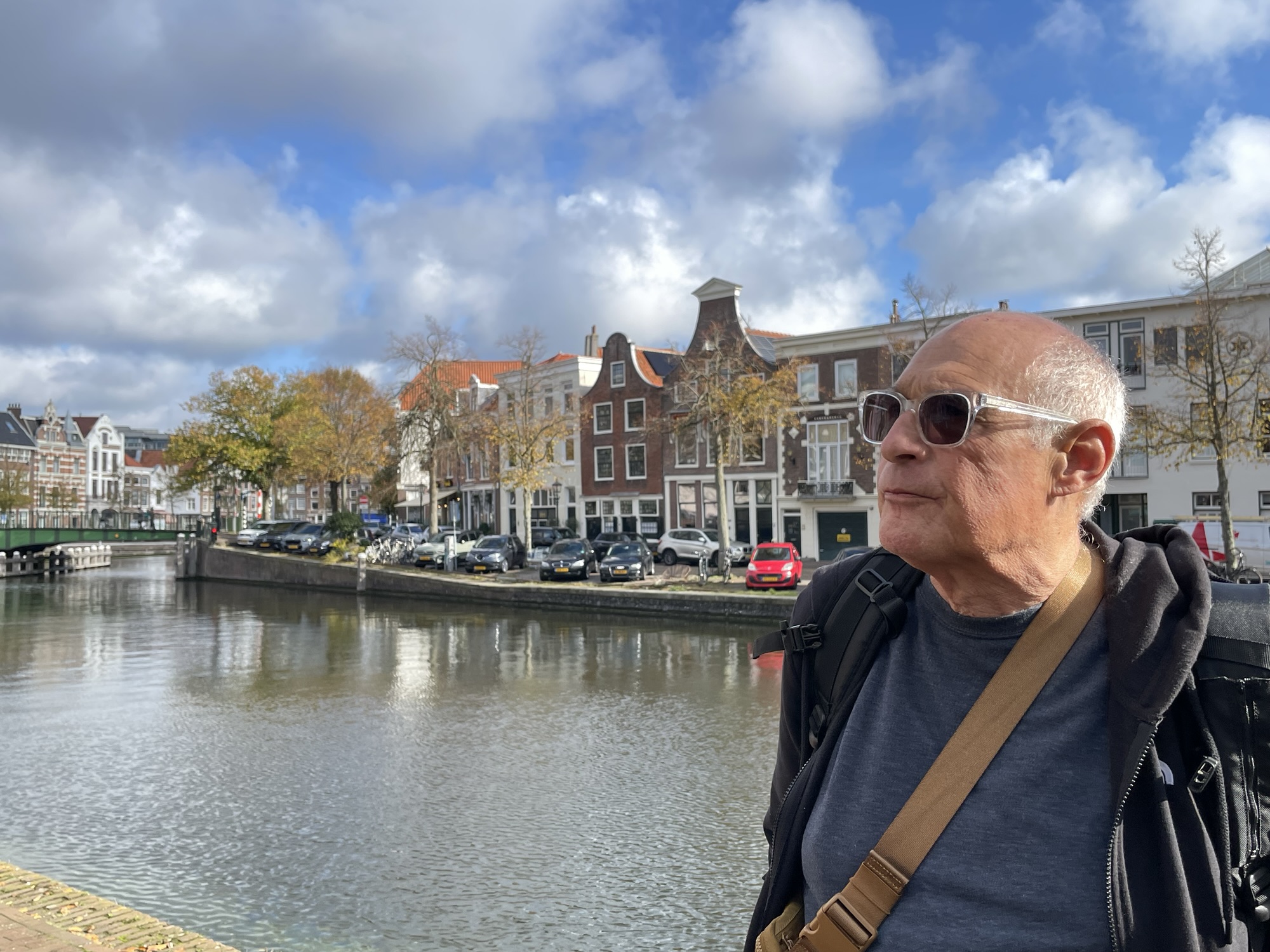
This food tour was more a walking tour through old Haarlem and its history—our guide introduced the tour by going through all the Dutch-American connections, place names, etc.—a walking tour with great snacks! It turned out the group was the guide, the two of us, and 3 of his buddies. We had a blast. Old Haarlem is gorgeous, with lovely restored buildings, NO CHAIN STORES as a result of city government policy, plazas, canals, narrow alleys of original buildings, built for warehouses and businesses but now residential, filled with greenery (also government policy to keep things cooler—oh, huh, is global warming a thing?), hidden gardens, little green squares surrounded by small row houses built specifically for elderly women or the disabled…everything on a small scale with no more than 3 or 3 1/2 stories per building. I yearned to go shopping in these lovely local businesses but luckily no time. Snacks started with coffee and little savory bites, then a cheese store, an outside market where we ate smoked eel (delicious) and salted herring with onions and pickles, warm donuts filled with raisins, chocolate at a local chocolatier, local craft beer and bitterballen, everything delicious and just right. The tour, we suppose because it was a group of (delightful) friends and the two of us, was four hours! We left the group at another restaurant/bar built on the top of a parking structure with a great view of the city—we had timed tickets to the Frans Hals Museum. We shook hands and left for our next immersion in Dutch painting.
Frans Hals Museum
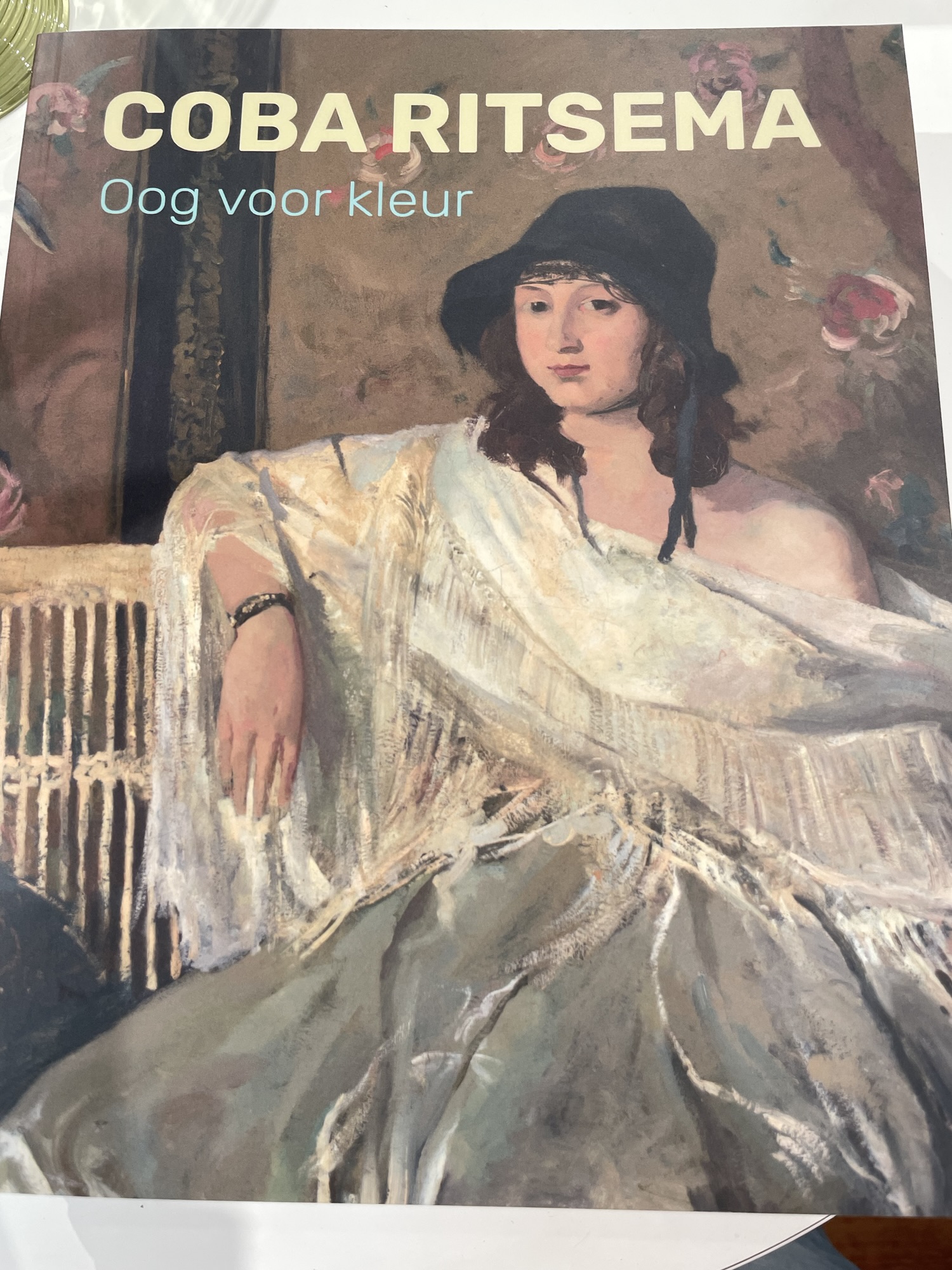
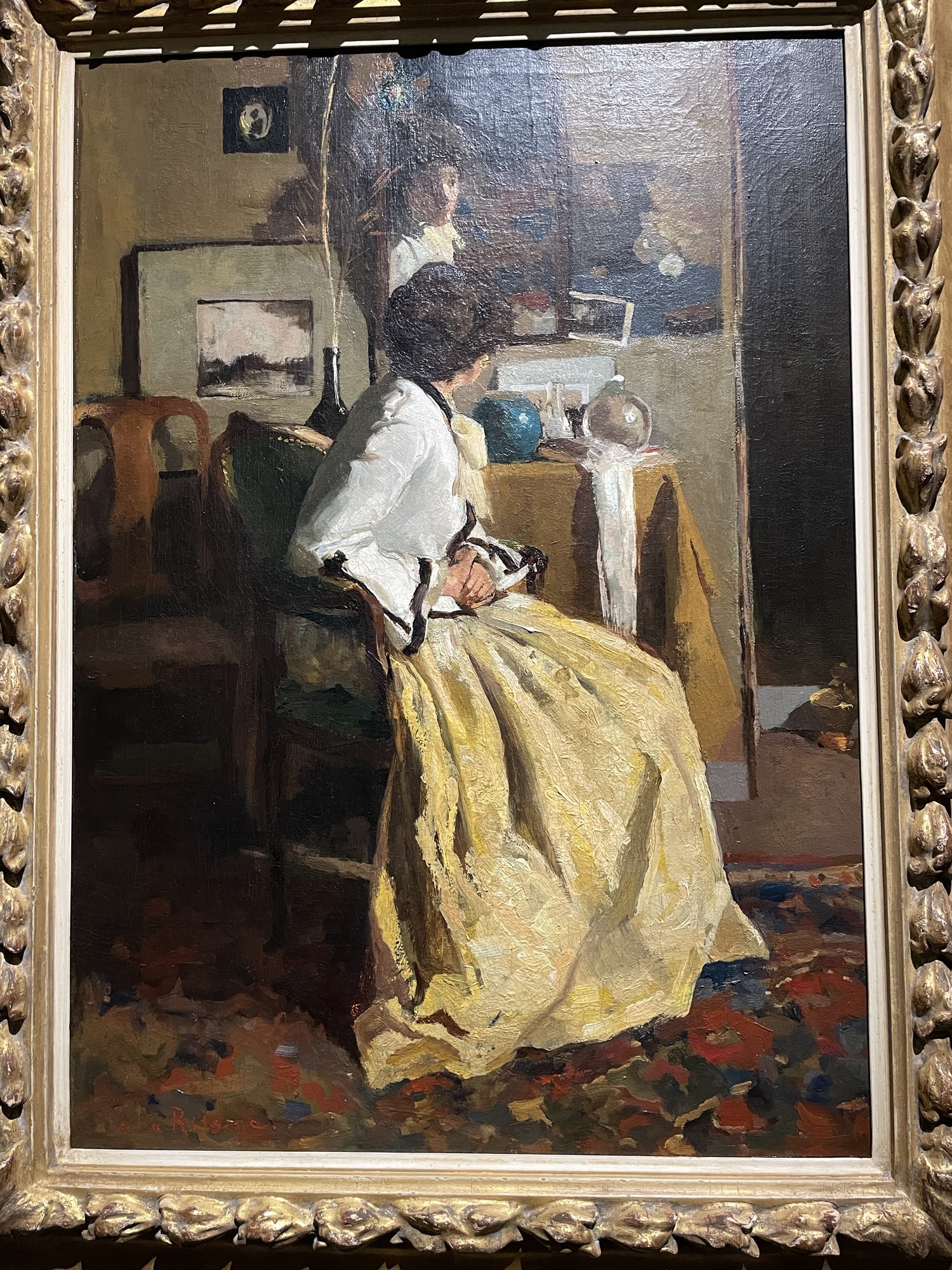
We liked it. All on one story, surprisingly large, but by the end I felt I had seen as many Hals and Hals-adjacent portraits I would ever want to see. There was a nice surprise at the end—several rooms of the life and work of Coba Ritsema, an amazing 20th century woman painter we had never before encountered. I was sad that the only book of her work on sale was entirely in Dutch. She is worth tracking down.
We really loved Ritsema’s workThe one-story museum on a typical Haarlem street. Charming.
We headed back to Amsterdam thinking we were on a bus to the Haarlem train station but it turned out to be a bus to Amsterdam South Station. A hop onto a tram and we were back in our neighborhood. We redeemed our champagne coupons (a very generous pour) and wandered across a few canals to have a fast burger and fries supper. Easy and fun—we were worn out and looked forward to bedtime.
Last Day: Van Gogh Museum! And a return to Stedelijk for Drama 1882 redux
Oh boy. We had 9:30am tickets to the Van Gogh Museum so after a stop at our favorite bakery for rolls and coffee we hurried over. It was just opening and the line was long, but these major museums have maximum tickets/day and timed entries so while there were a lot of people it was manageable.
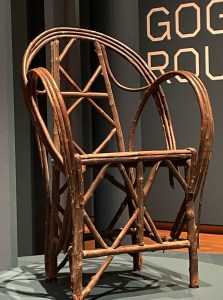
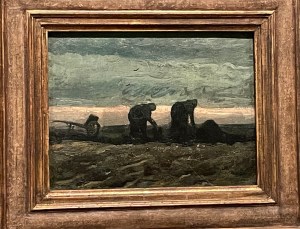
So many of his paintings are iconic and well known. I did my best to not take pictures of his work unless it was new to me—his chairs and a small country scene that kind of stunned me.
We like Van Gogh but here I realized how little I knew of him. (In April we had spent a few hours in Arles, his second-to-last home, so we knew a little bit about the events of his life.) This museum is fantastic, not to be missed. It is huge. We got the audio tour which was well done, and the first special exhibit was all about his time in Arles where he painted this particular family over and over and became very close with them. Van Gogh had decided to be a portrait painter and it was here, with these models, that he learned his approach. You have seen his pictures of the Roulin family if you have ever seen anything of his. He painted a version, e.g. of Postman Joseph Roulin, and then painted multiple versions; the same for his wife, a beautiful rendering of this beloved friend, over and over with subtle changes. He did the same with his self-portraits, changing the colors of the background and clothing. They are wonderful. That he was already struggling mentally adds a dimension to understanding his work in this era. He also wrote hundreds of letters to his brother Theo, fortunately and lovingly preserved and transcribed by Theo’s widow. He wrote with intensity and awe about art and what it meant to him and, he hoped, to his viewers. Many of these letters were quoted in the audio tour and wow.
I had not known that painters of this era in France, where he went to learn to paint, were excited to experiment with new science of color. Van Gogh and others used dabs of many colors to let the beholder’s eye blend into another color. In the museum they have extreme (via microscope) close ups of one of his paintings to show in detail how the shapes and colors of these dabs create depth and interest. Also little grains of sand in a painting he did at the seashore. So cool.
Dutch Lunch
We had lunch reservations at The Pantry, a tiny, famous, old restaurant a 10 minute walk from the museum. Fun and yummy.
Drama 1882 Redux
David and I were so enchanted by the movie the first time we visited Stedelijk we wanted to see it again. I wish it were widely available, e.g. on YouTube or venues in the US, but I have scoured the web without finding anything. It played at the LA Museum of Contemporary Art for a month this spring.
We had one more museum left on our pass and we chose to use it to return to Stedelijk. Friends, I cried. It is so moving, so beautiful, so very unusual. We were so happy we could see it a second time. A masterpiece. Wael Shawky. Remember that name.
Fancy Dinner with our beloved niece
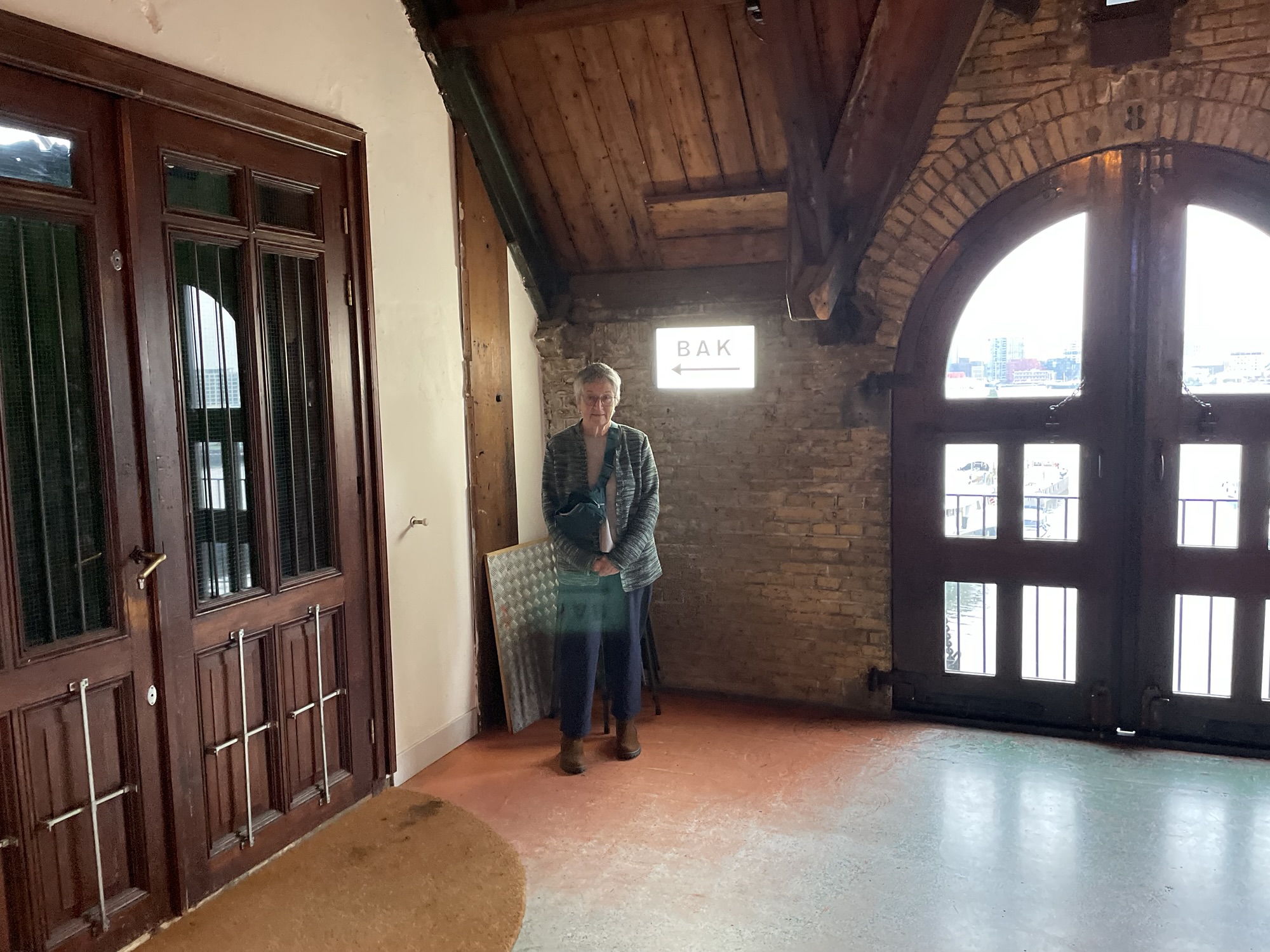
We had reservations at Bak, a place that occupies a corner of the top floor of a warehouse on the river (not a canal!) renowned for its tasting menu. We had to deposit 40 euros per person to hold the reservation, and we hoped it was worth it.
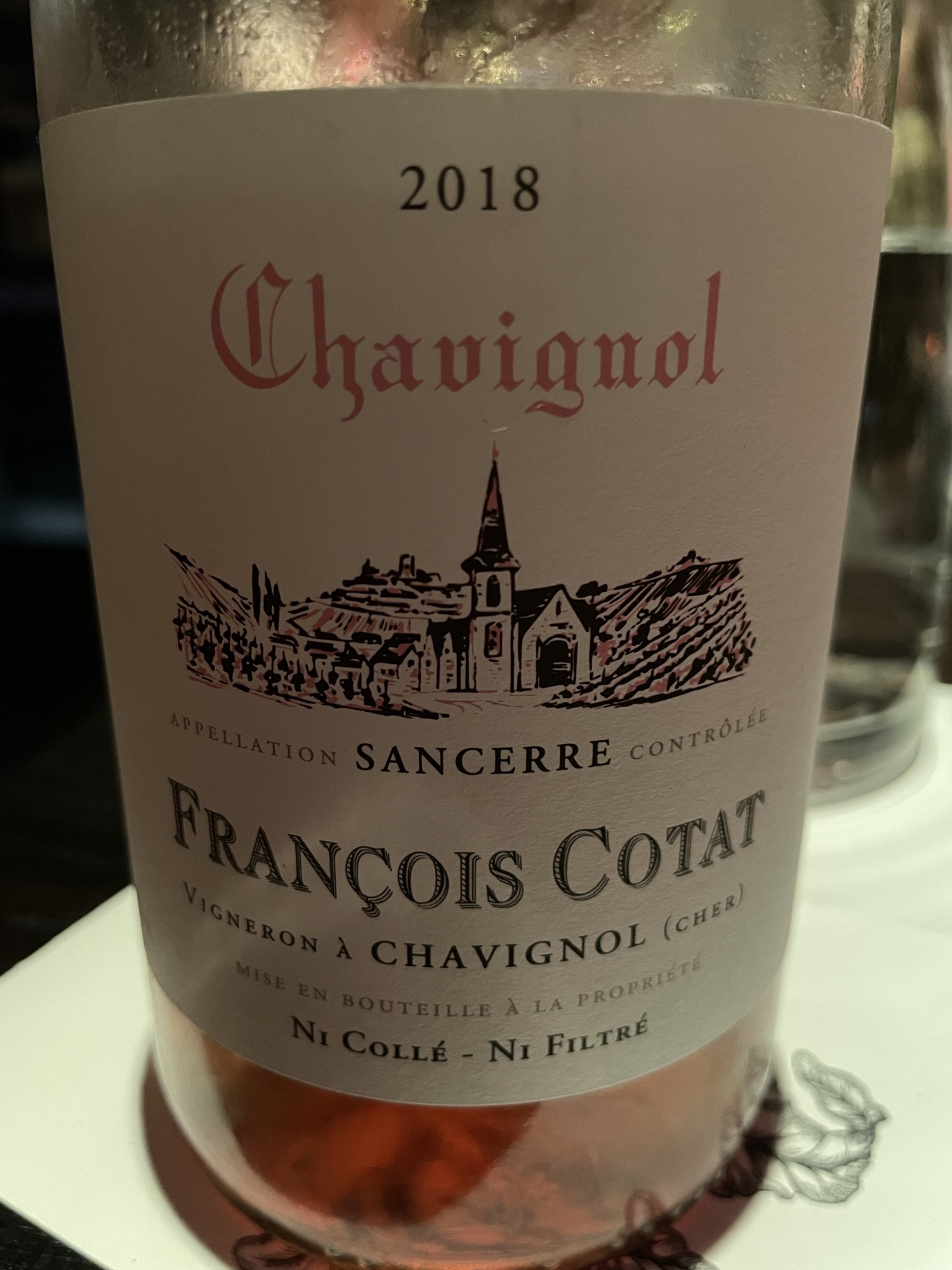
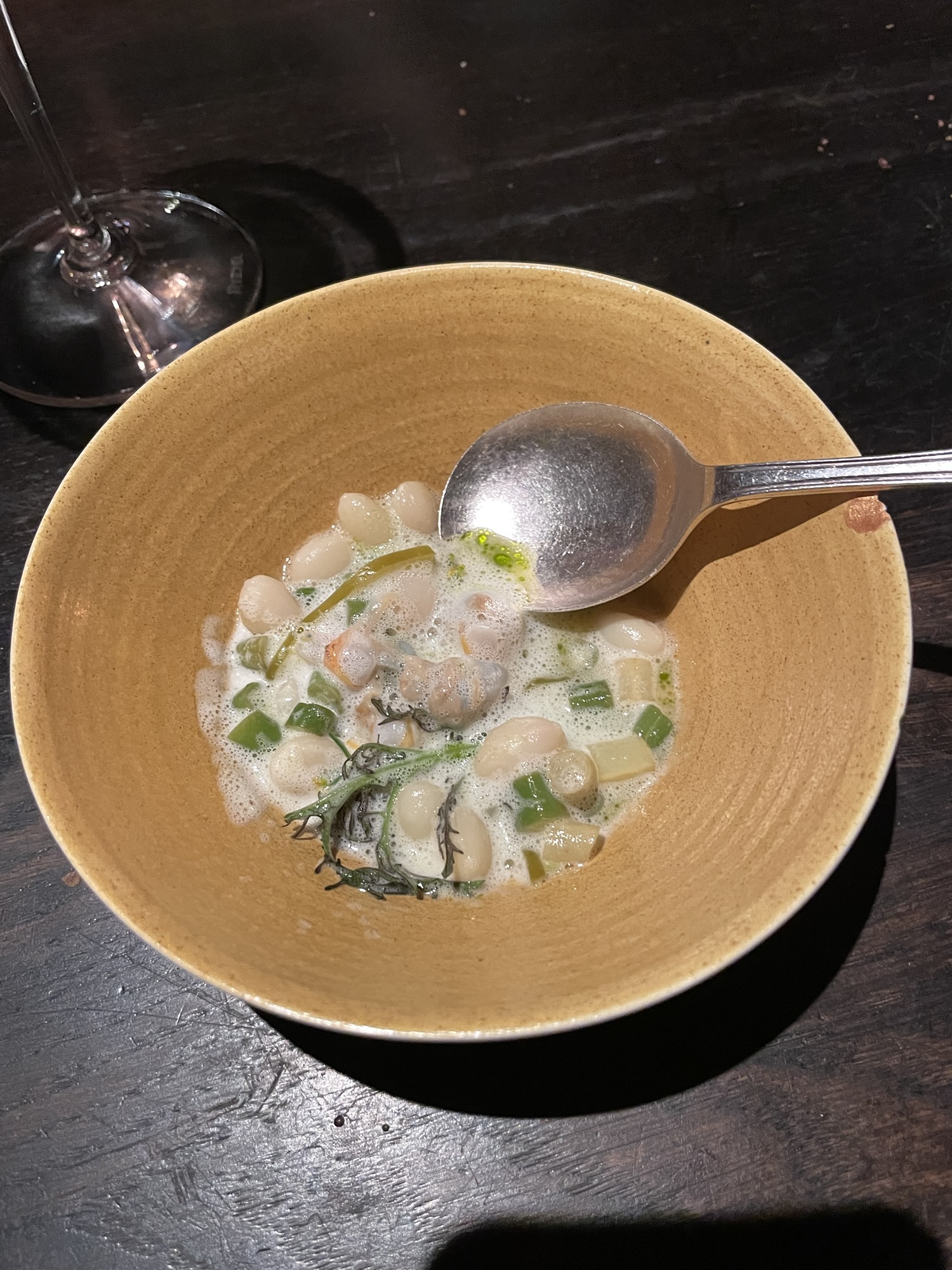
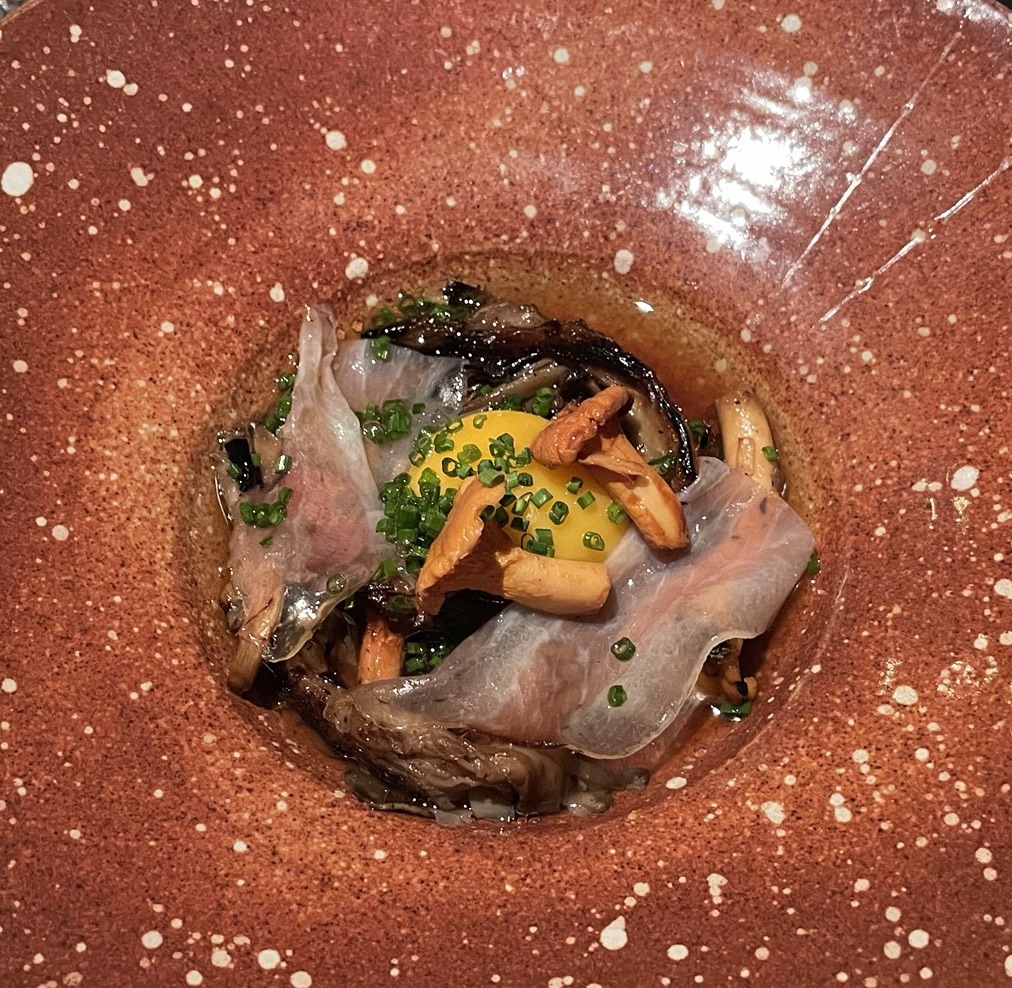
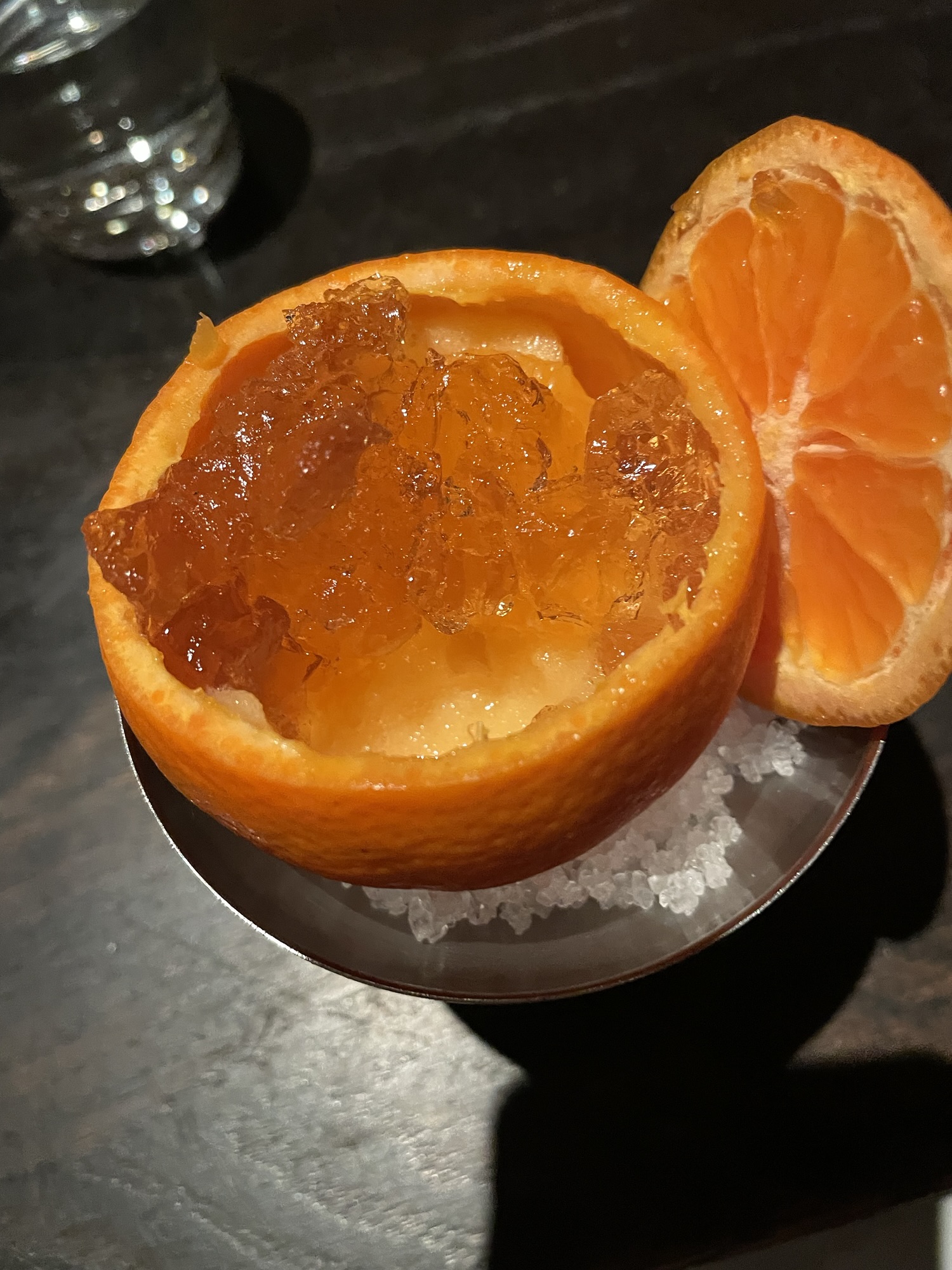
In the top floor of a warehouseAn almost thrilling roseDon’t recall what this was other than deliciousDitto. And…ditto.One of 3 desserts, an orange sorbet, I think, with sherry jelly on top.
It was. These kinds of meals are such fun, and perfect for a long evening of conversation. Lauren joined us and we talked and ate for hours. Service is attentive and unfussy, food delicious, and when they didn’t have the (least expensive) rose they substituted a spectacular French rose for the same price. After gin and tonics, all that food, all that wine, we were sated to say the least. To complete the luxury of the evening we shared Uber with Lauren (we of the always take the local transit habit) and returned to our room feeling as if we had enjoyed our narrow version of Amsterdam sufficiently.
As I write this we are on the fast train to Paris for another ten days of sightseeing, museums, and food.
Our plan when traveling is to eat whatever is local (and good,of course) so we were determined to eat as much Bavarian food as our digestive systems could handle. Mission accomplished.
We were incredibly lucky to have a young friend living here who loves her city and gave us a list of favorite Bavarian restaurants and beer halls. She also steered us to several of her favorite museums…our visit wouldn’t have been nearly so fabulous or so easy without Janina’s help. It is easy to be overwhelmed in a city with so much to do.
I think we might also have been a bit wary of beer halls. In truth they are so different from any other food experience we could have chickened out entirely—and what a mistake that would have been. Sure, Bavarian food is heavy and rich, but we were only here for a week and one’s body can handle a week of anything, right?
We dug in right up to our last few hours.
First night we walk to Brunnwart and I get my first pretzel
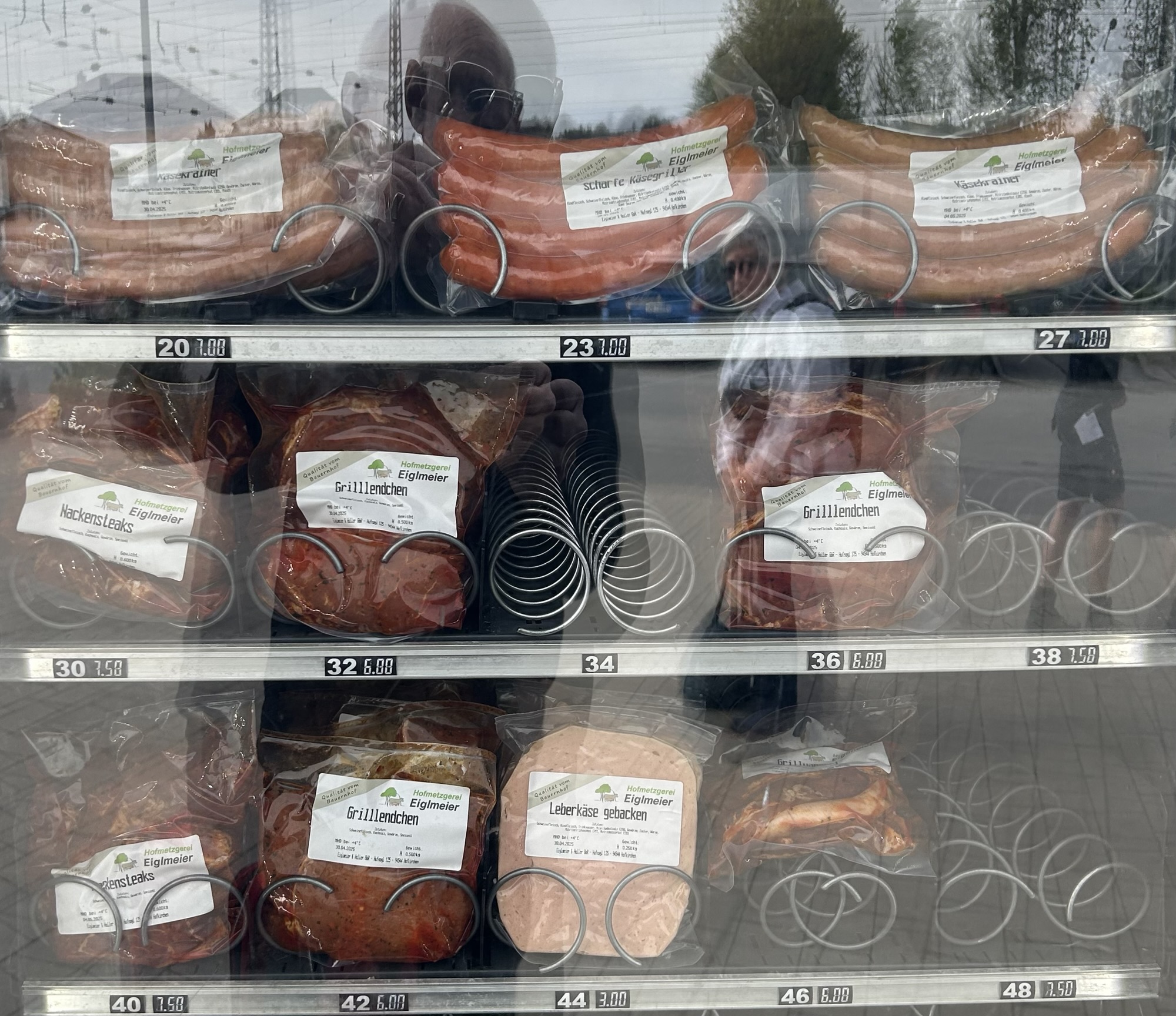
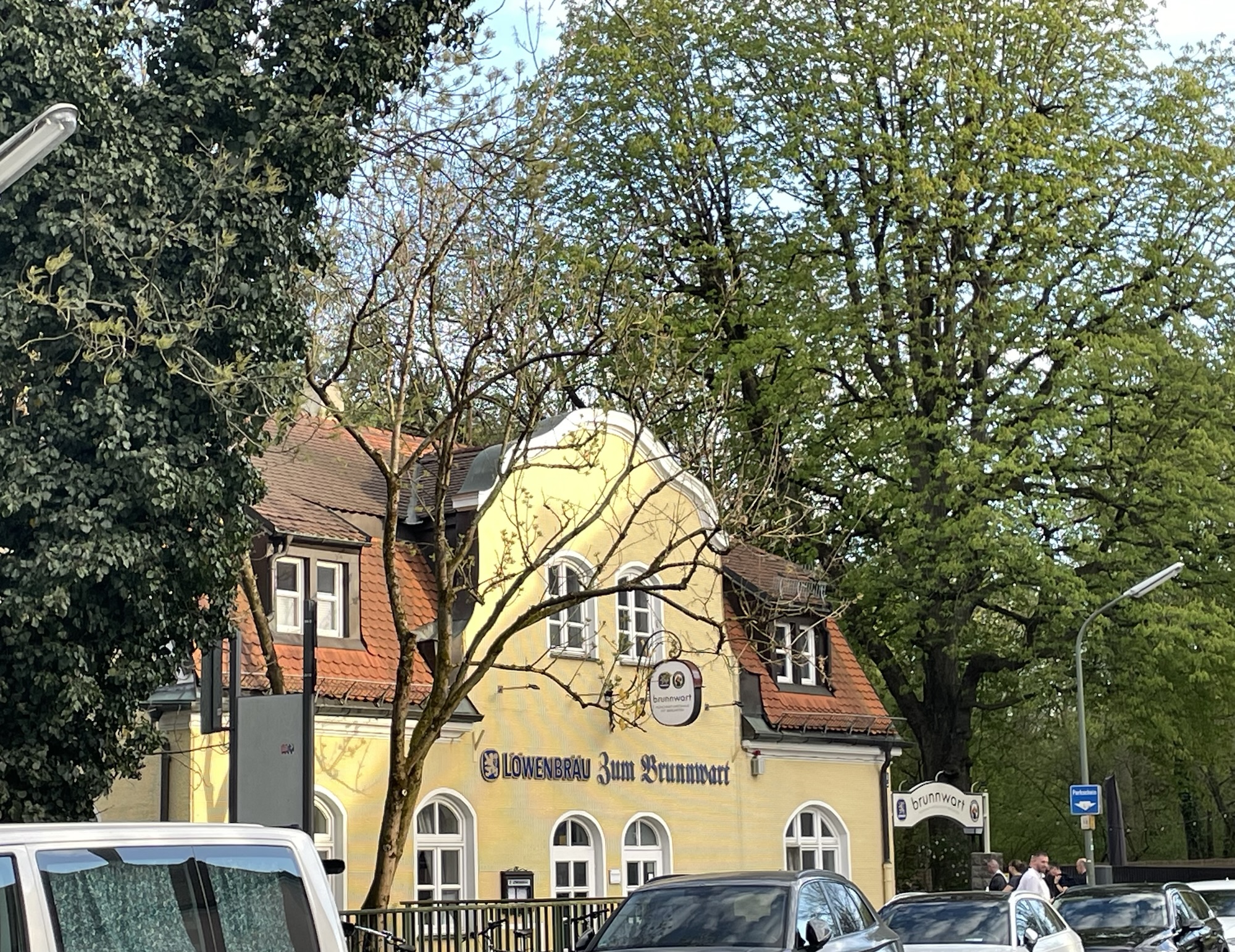
We had had a long day–checking out of the boat, walking to the train station (painfully–my pack was too heavy), marveling at the sausage vending machine, 2 hour train to Munich, 45 minutes figuring out the metro, checking into hotel…so we really deserved an easy supper and thanks again to Janina we had one–Brunnwart, a lovely restaurant and garden a very pleasant 15 minute walk from the hotel.
The place was hopping, but we were happy to sit with our beer and wait a bit for the food, which was delicious of course. I had felt over-red-meated from the time on the boat, so was happy to order an oven fried fish with a cucumber-potato salad (and a pretzel!). I had no second chances for that salad, which is too bad. So yummy and tangy and fresh.
Beer and Bavarian food
Our first morning we took a Walkative guided tour and learned about the six Munich beers and what makes them so good. The definition of these beers is managed in the way any terroir food or drink is—e.g. you must use only local water and these days it is almost impossible to get a permit to dig a new well. We had earlier in the trip learned about Budweiser, a commercial brand which appropriated the name of an Austrian town’s brew because it wasn’t protected even though there is still that town and its beer is beloved…it is not American Budweiser. Munich has been smarter and as a result the Munich six beers are unchanged and, btw, delicious even for a non-afficionado like me. Volumes have been written on this subject so I will stop here before I make an egregious error. Know this: the local beer halls and gardens each feature a particular brand—Augustiner, Lowenbrau, etc.—and the helles, a refreshing lager style, is delicious. It is all draft in restaurants and beer gardens and halls. I rarely drink beer at home but had a half liter glass most of our dinners and does it ever go down easy. It makes Bavarian food even better.
Germany’s restaurant culture is completely different from France, where menus change often, are posted on chalkboards facing the sidewalk, and the midday meal is leisurely. And yet we managed to have long, delicious lunches almost every day, often in museum cafes, as well as big, rich suppers. Yes, we ate a lot! As usual, though, we justified our gluttony by walking most all of most days. Our last day, when we walked the English Garden, it came to 7+ miles. We needed the calories, no?
We ate so much and enjoyed it all. In this post I will tell you about a few highlights.
Lenbachhaus Museum Restaurant
It is delightful to be able to eat well and quickly at a museum cafe. We are deep in art! No time to wander off and find food!
This place was so good, and such a nice setting, we went back a second time between the Glyptotek and its sister across the square.
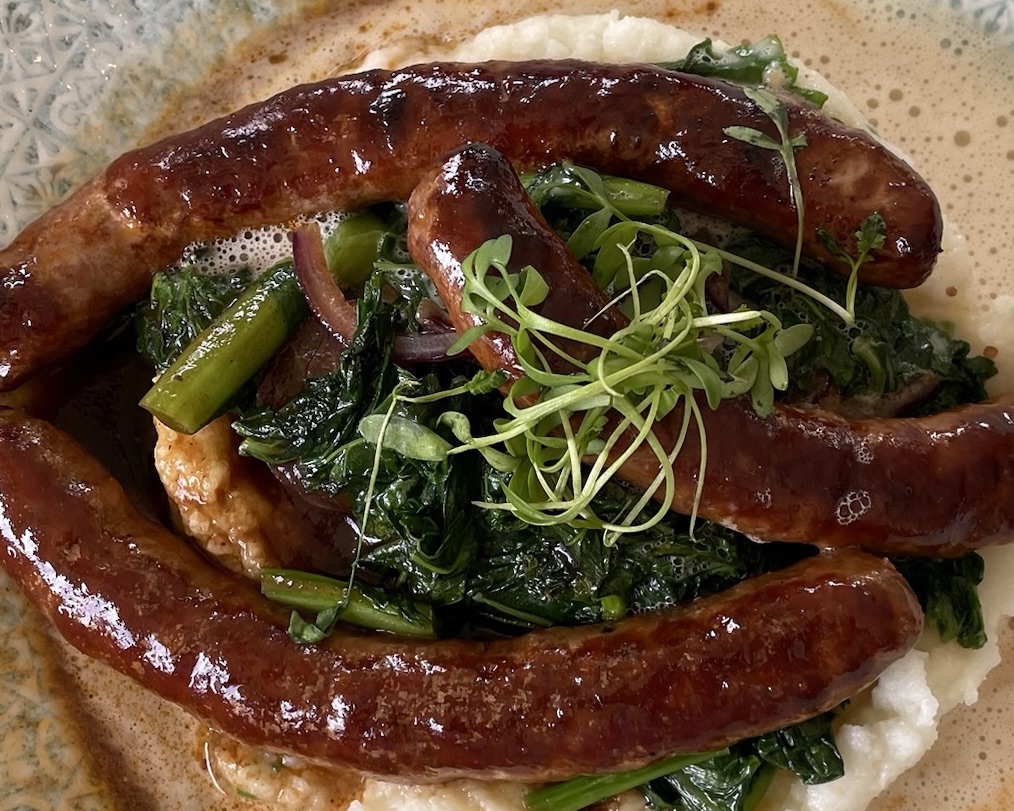
Creamy polenta, salty sausage, bitter kale with some sprouts to make it healthier.
They even had a museum ticket holder special dish, discounted several euros, which we had to have. Well nourished, we headed for more art.
We love beer halls and beer gardens!
Dear Janina and husband Gustav met us for dinner at our first beer garden experience and explained the ropes…self service for beer outside, table service for the meal. They took us to a favorite of theirs, an oasis in the university neighborhood, the name of which I failed to write down.
I also learned the women’s restrooms are labeled Damen. Not sure if I would have figured that out!
It was white asparagus season so that was what I had. David had his first of several pork knuckle meals and called it fine.
I dare myself to eat all of this.I obviously misunderstood just how much salad I was ordering.Well, I didn’t finish the entire potato dumpling…
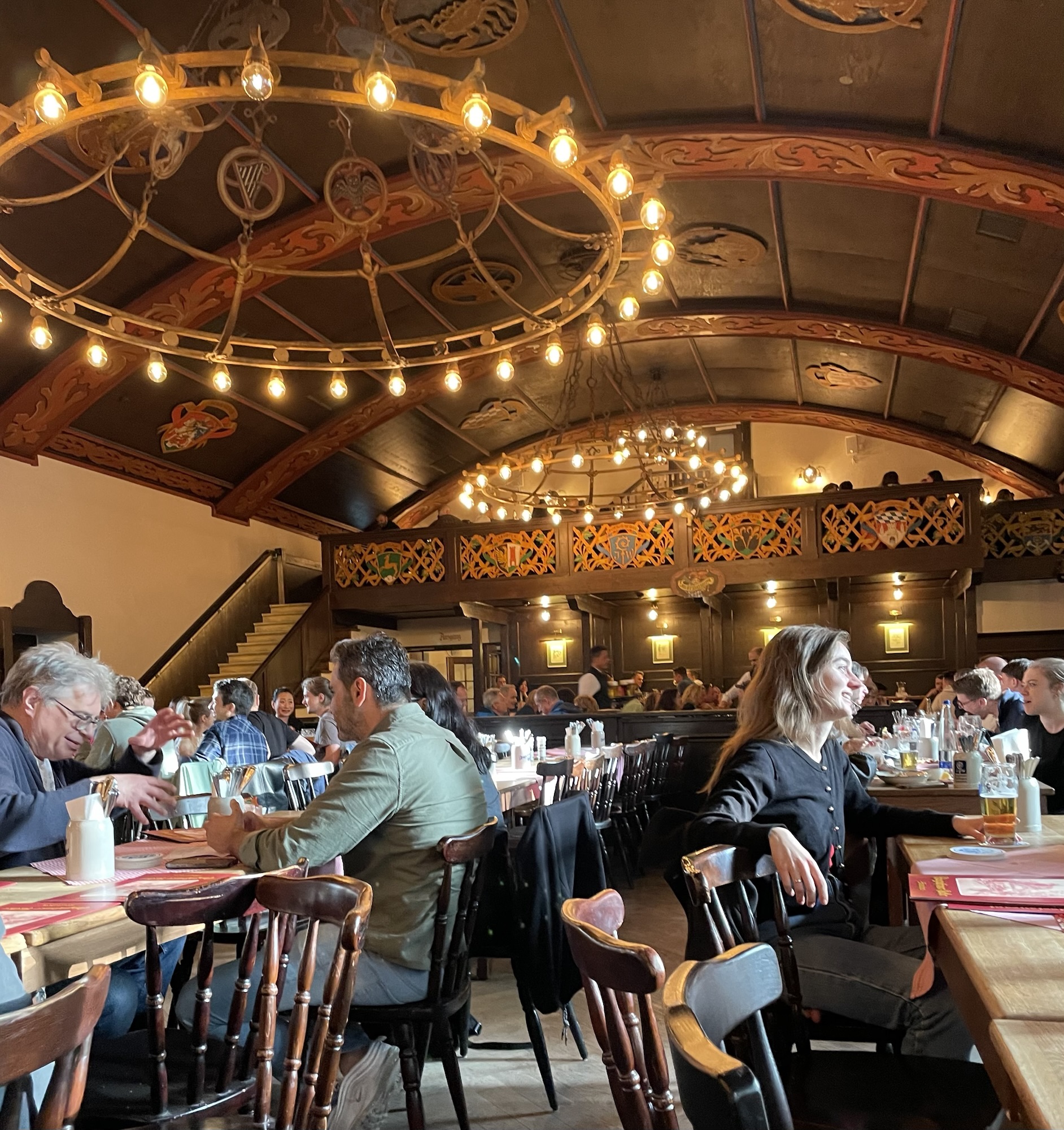
Well-educated on how these mysterious outfits work, we took ourselves to Augustiner Keller, an enormous beer garden where food and drink are self-serve, and a gigantic hall with table service. We chose the hall.
What a scene. The noise level of a full hall of drinkers and eaters is difficult to convey. Talking, laughing, people coming and going with scraping of chairs and rearranging of people at long, very long tables. I had planned to have duck while in Munich but hesitated when I saw the dinner was a half duck, with a potato dumpling (they tend to tennis ball size) and cooked purple cabbage. I was sure this was too much food for me. But I ordered it anyway along with a salad to share.
The salad was a mountain, and yes, a half duck is a lot. Ate it all!
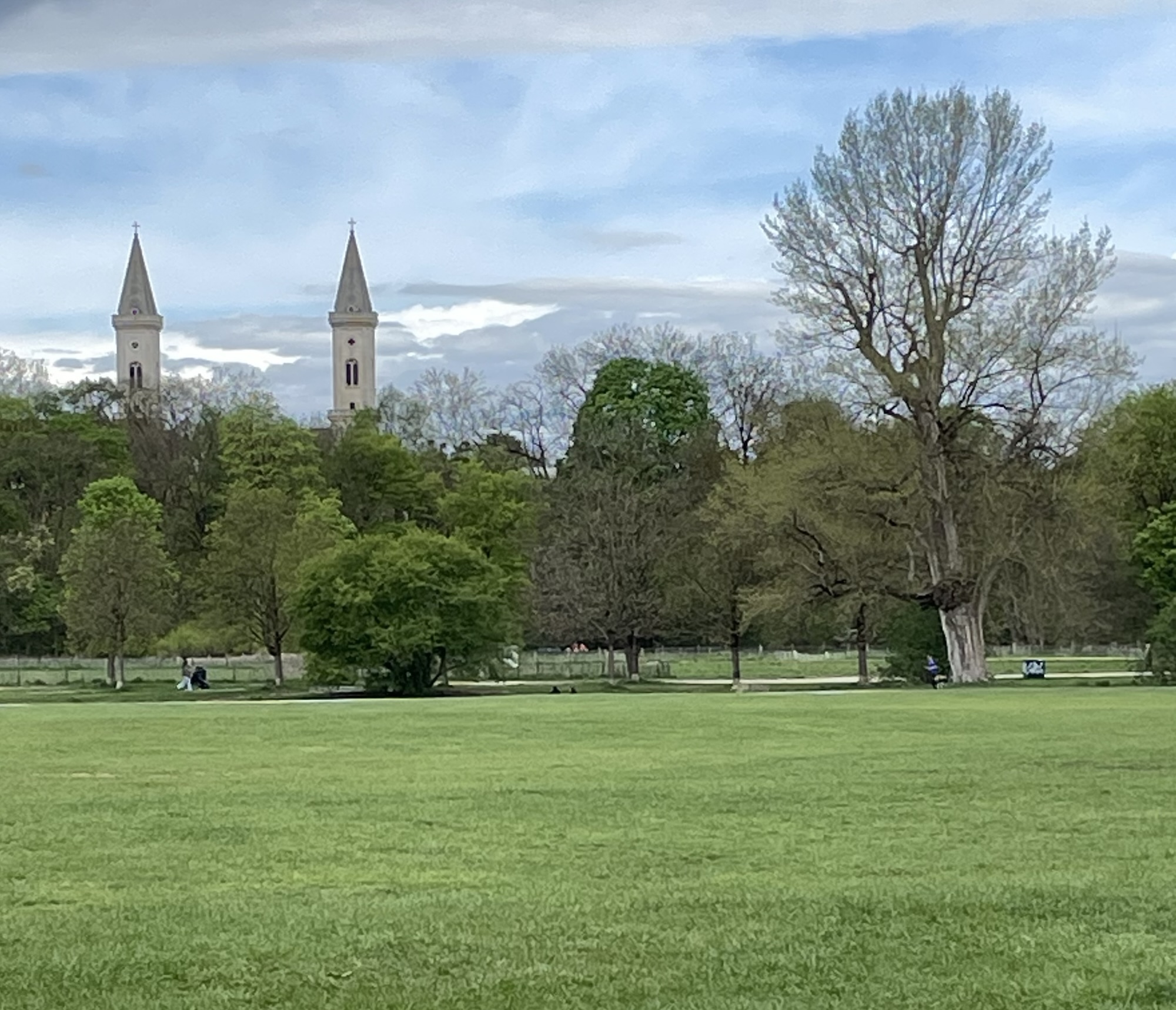
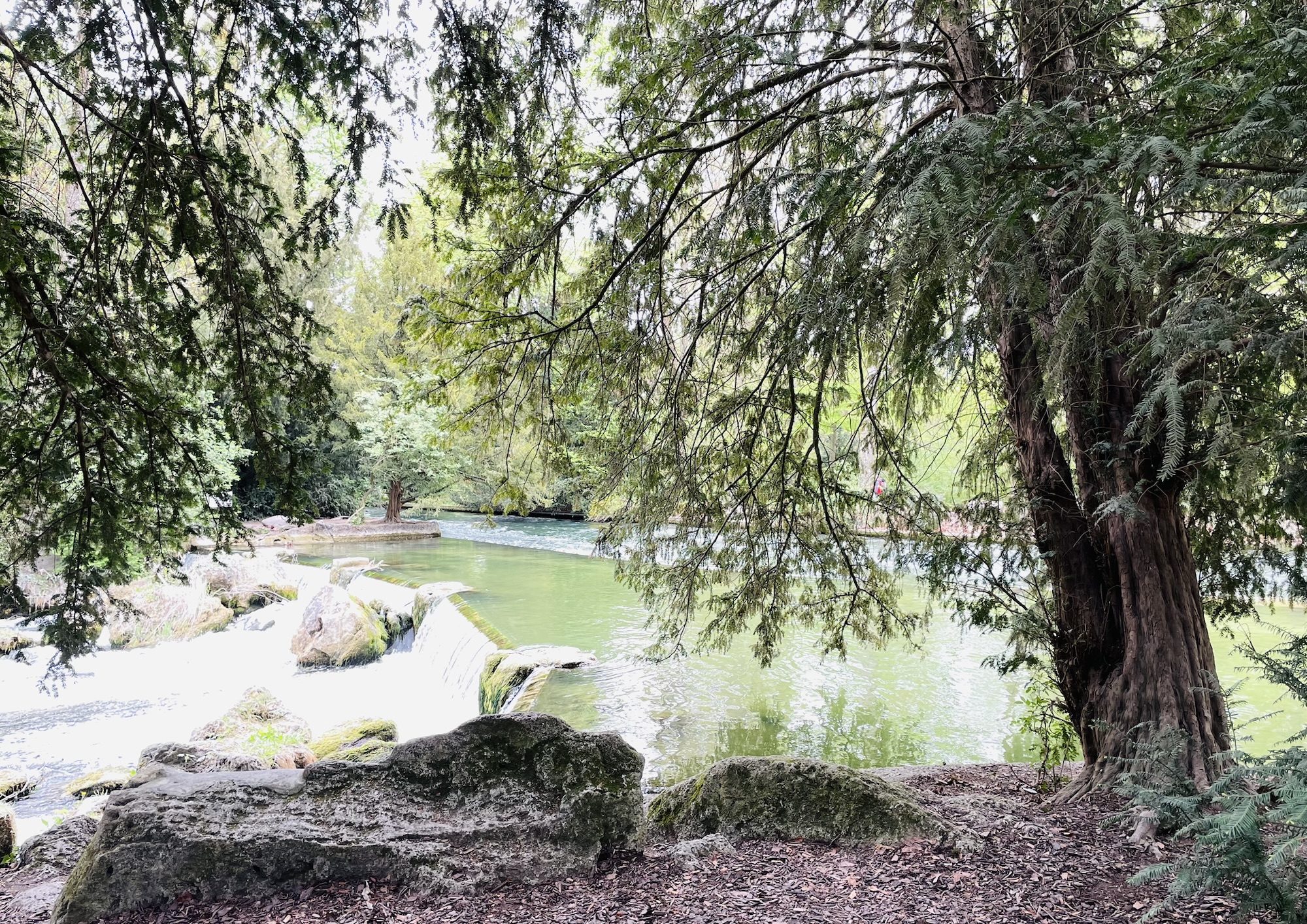
Our last full day was a holiday, Easter Monday, and we planned to walk as much of the English Garden as we could manage, which turned out to be seven miles. No human can be expected to walk that much without sustenance and we wisely stopped at the beer garden at the Chinese Tower, which is definitely not at all Chinese and the day we were there housed a 3 man band playing traditional German music. Again, hard to describe how big these gardens are…and such fun as you take a tray and go from hut to hut loading up your meal. Sauerkraut, spaetzel, donuts cooked in lard, fried potatoes, french fries, chicken…and of course plenty of beer. I wish I was sitting there right now.
That is the “Chinese” Tower in the background.A pair of Mandarin ducks!!The English Garden is huge. We never reached the northern border and still walked 7 miles.
Kaisergarten (much better eating than Kaiser Permanente)
When we returned to Oakland David dug into mail, messages, our budget, etc., and he was puzzled to see we had a charge from Kaiser Permanente (we’re not members) from a day we had been in Munich. Ah, mystery solved–Quicken had interpreted our charge at Kaisergarten as that other Kaiser.
The right one was a two metro stops from our hotel, and a few blocks’ walk through a beautiful neighborhood. I had made a reservation from caution–we’d been asked several times if we had reservations when we were just walking in and I was worried this place wouldn’t have room. Glad we did–it turned out to be quite small especially since it was too cold, even for Germans, to sit in the outside garden.
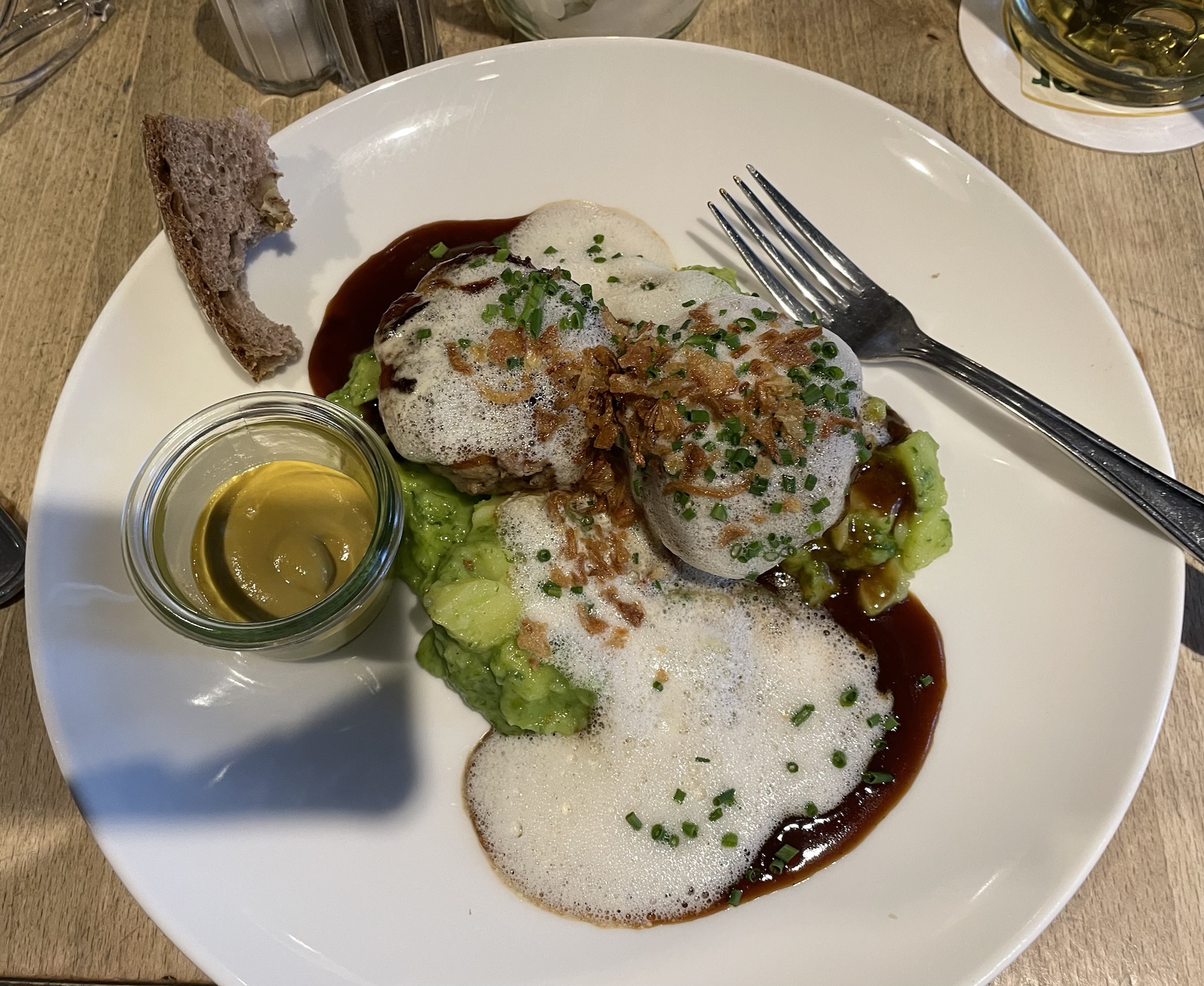
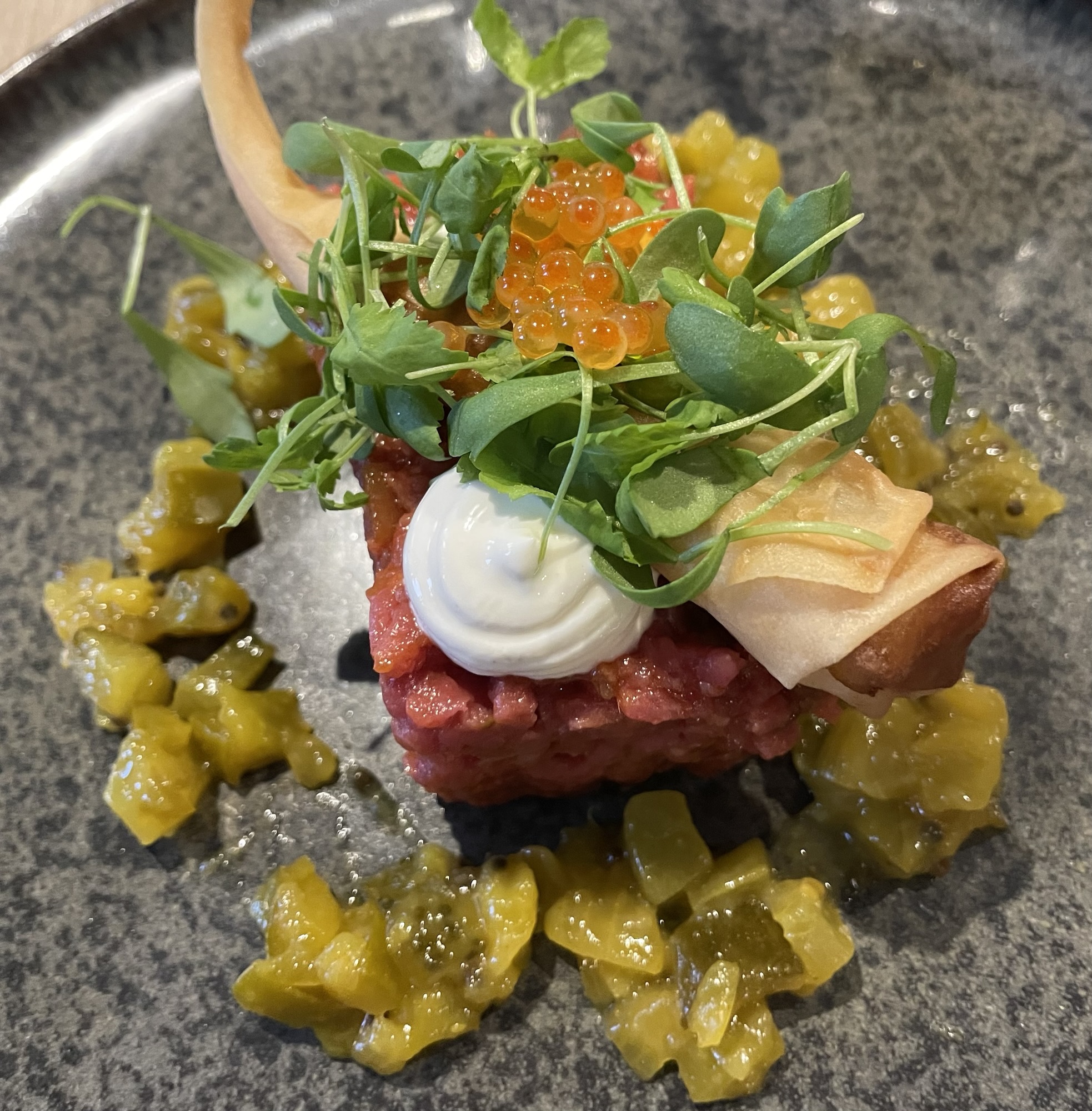
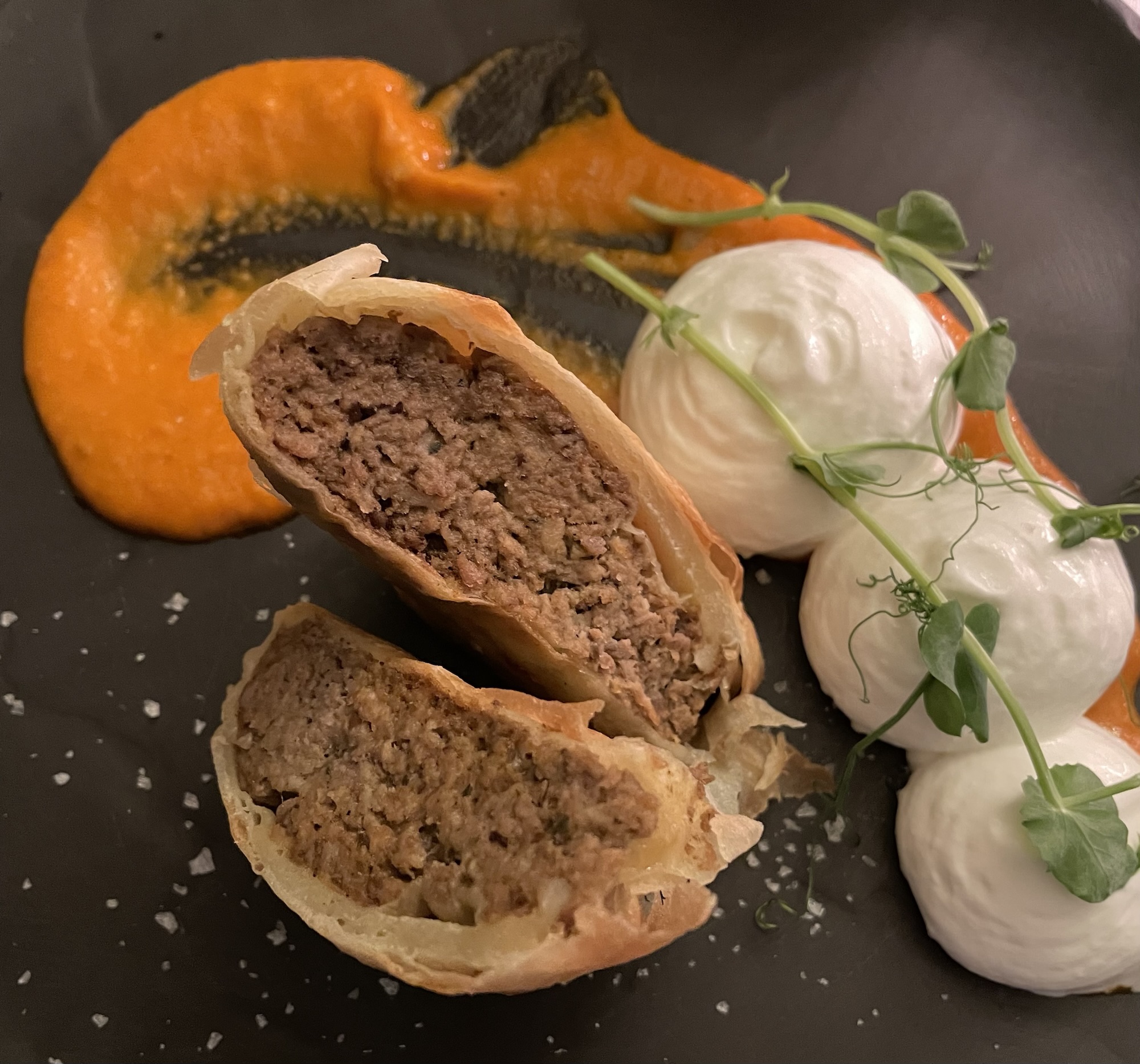
I was delighted to see beef tartare on the menu–I had had it twice in France and wanted to see how the German version differed. David ordered a dish called “meatballs” and was happy to find it was much more than that. Yummy. And we had kaiserschmarrn for dessert–an eggy pancake, torn into pieces, doused in (more) butter and some powdered sugar. We’d had some for breakfast that morning at Rischart Bakery (they’re all over the city but we went to the one on Marienplatz–highly recommended) and couldn’t hold back from trying another version.
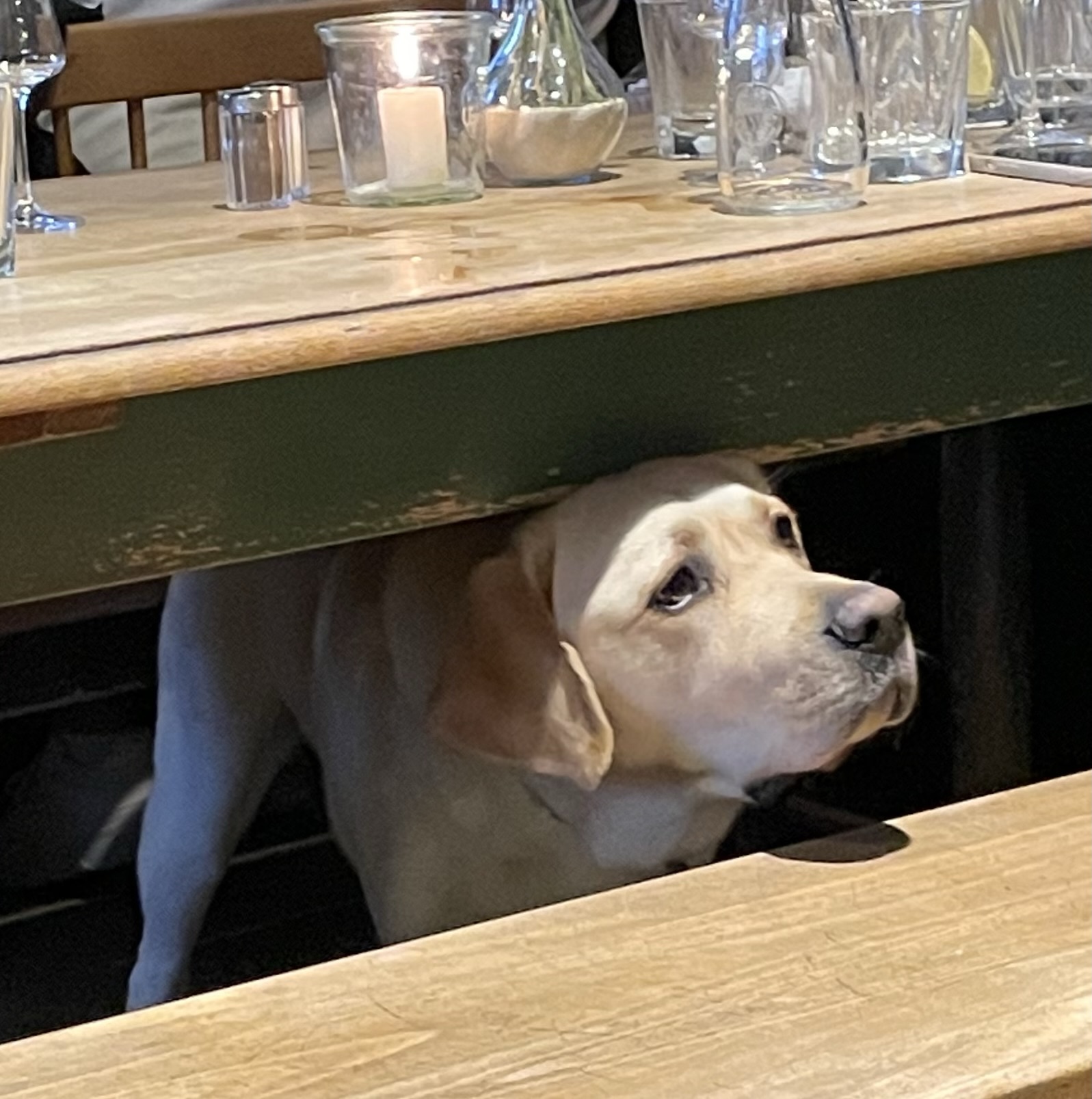
Lovely, friendly restaurant right down to the retriever under the table next to us.
Unlike the French version, this was pure beef with condiments on top, surrounded by spicey sweet picklesKaiserschmarrn–must make this at home.
Our last Munich supper
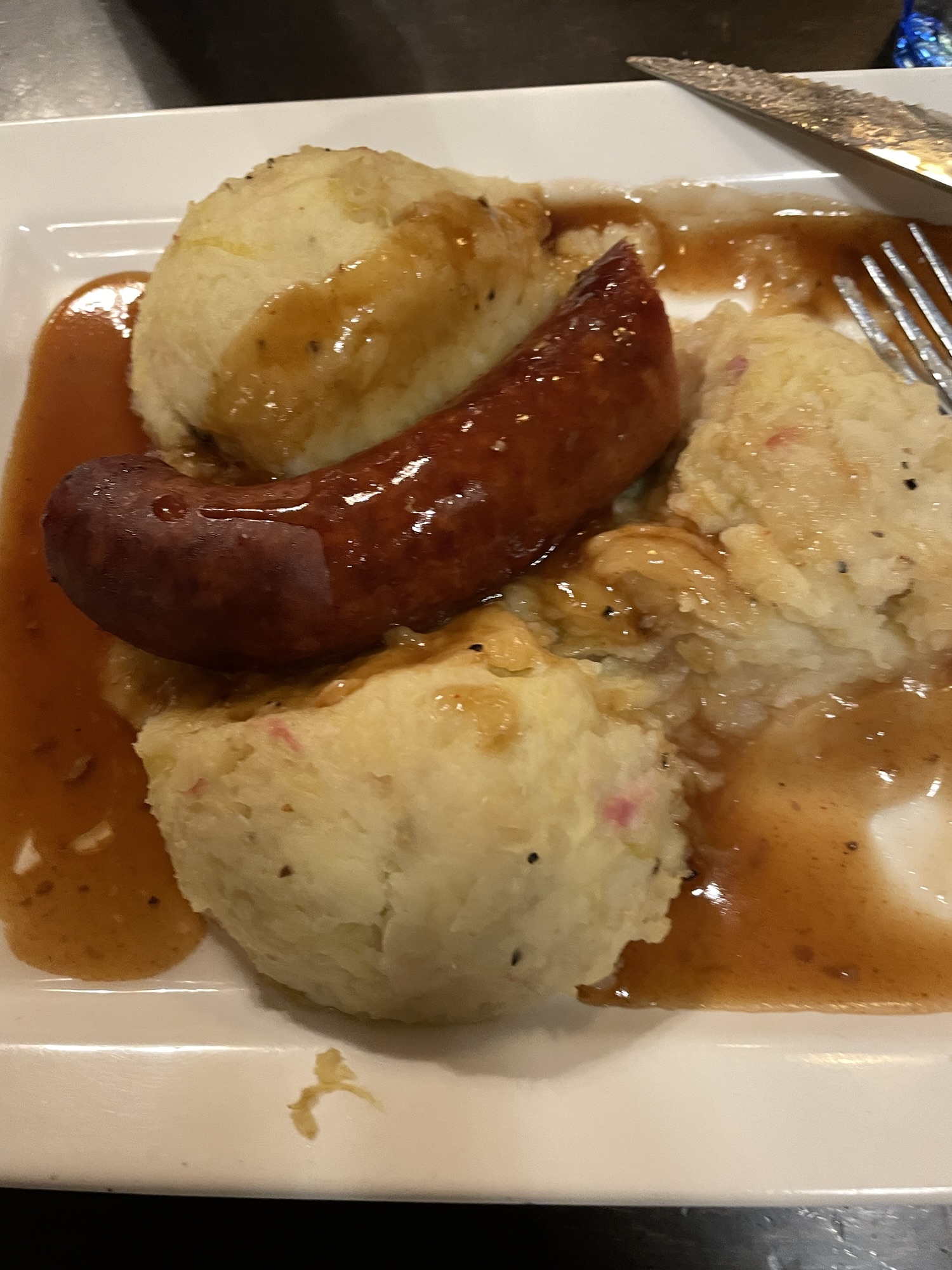
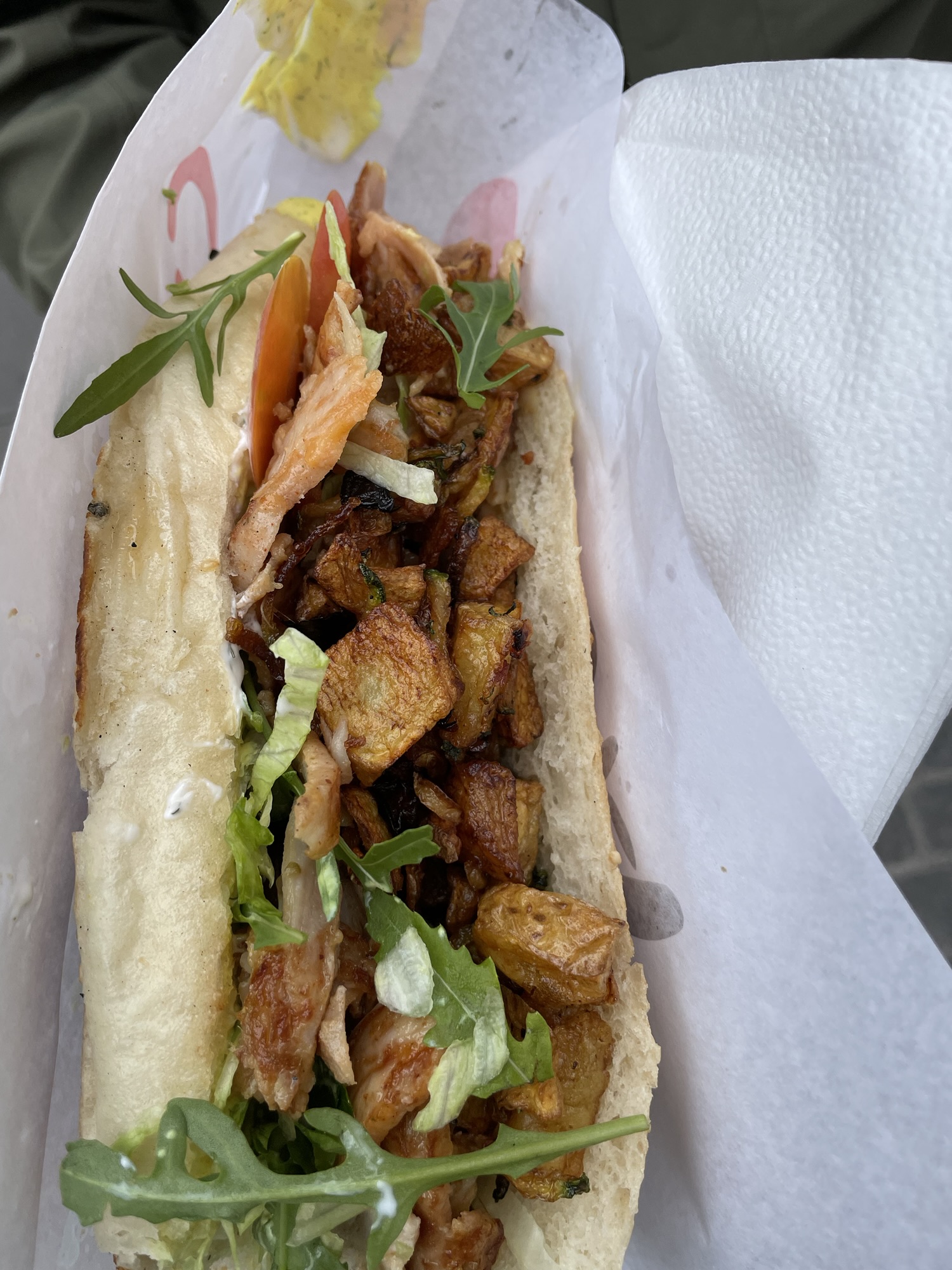
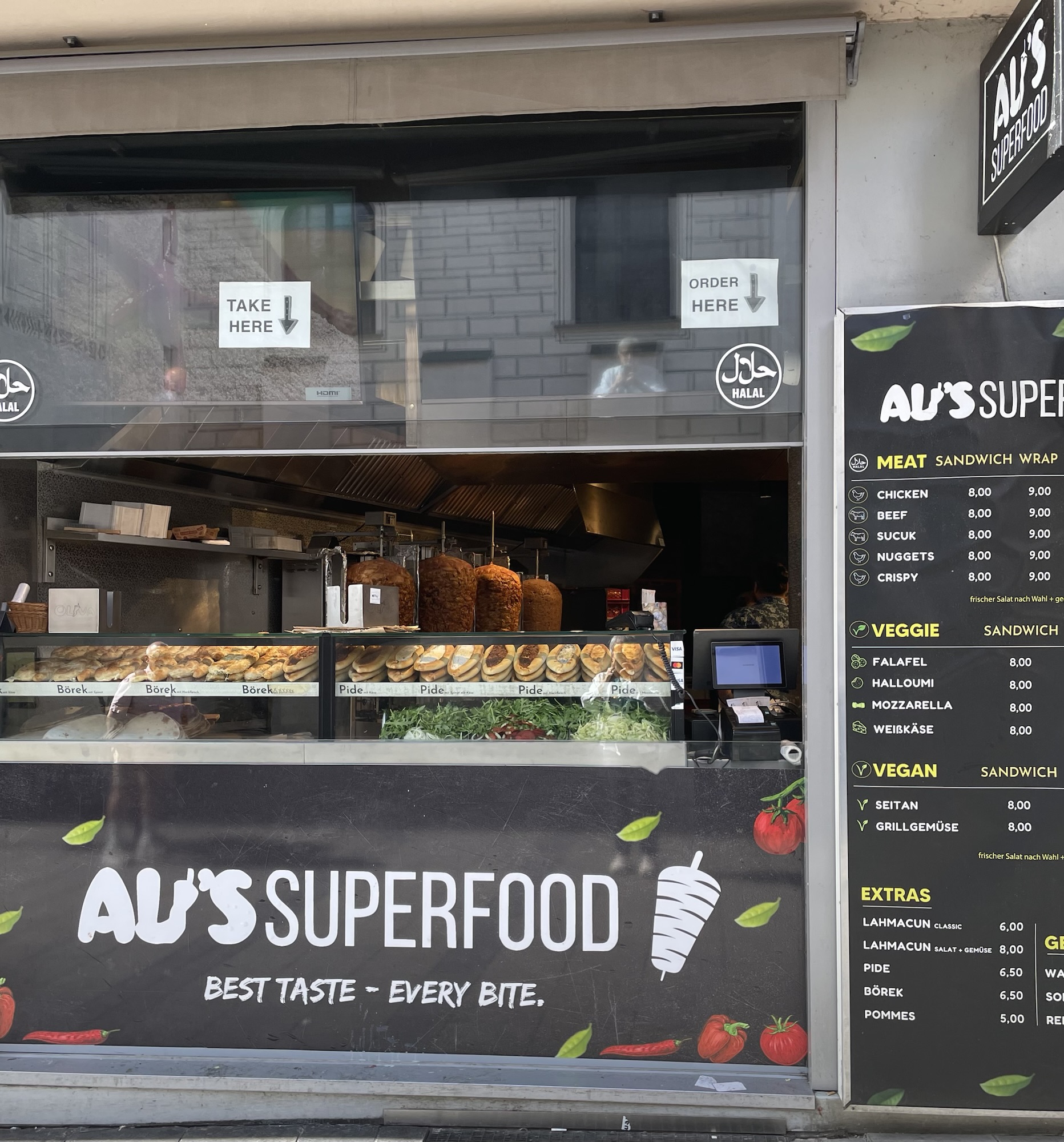
Having traipsed, happily, all over the city seeking out delicious food we realized one major Munich dish had been neglected—the famed donner kebab sandwich. Well, to be honest I had a donner kebab sandwich from Al’s Superfood in Marienplatz, but David had not. And mine was sooo good I knew I wanted another.
Chicken, vegetables, four different sauces, crispy bun, roasted potatoes…
Lucky for us a great looking donner kebab place was a ten minute walk away.
We were definitely on the early side and as the only customers we were able to chat with the young Turkish woman working the counter. She was excited to guide us through the ordering process. Two sandwiches and an order of fries “Turkish street style.” I was delighted to see they had salty yogurt drinks, and David of course had a beer. Just yummy!
By the time we finished the place was hopping, super chill with obvious regulars—large young men talking sports. If this place was in our neighborhood we would be regulars, too. No, we didn’t figure out why “the most expensive kebabs in Germany” was the primary selling point–and they weren’t.
Munich is a lot. Three stand out as the most thrilling experiences–we were able to go from room to room in a state of delight. Peak art museum.
We had so much fun simply staring at paintings and sculpture we had never seen in books, in a special exhibition, never anywhere. And wows as a percentage I would put at 30%, off my personal experience charts. I cannot stop thinking about the wows. Thank you, Janina, for your guidance. The city has so much and you helped us prioritize.
Love of art and fascination with the artistic mind are mysterious preoccupations for me, a not-artist. I am not a skillful enough writer to use words that would convey even a bit of the awe I felt.
Our top three, and what we loved about them:
Stadtische Galeries im Lenbachhaus
I had heard of the Blue Rider school but knew nothing about it. I assumed I’ have’d seen examples simply because of all the art museums we have visited. Wrong again.
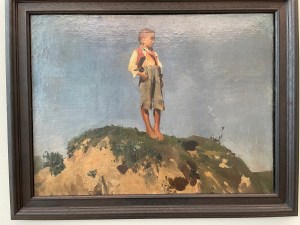
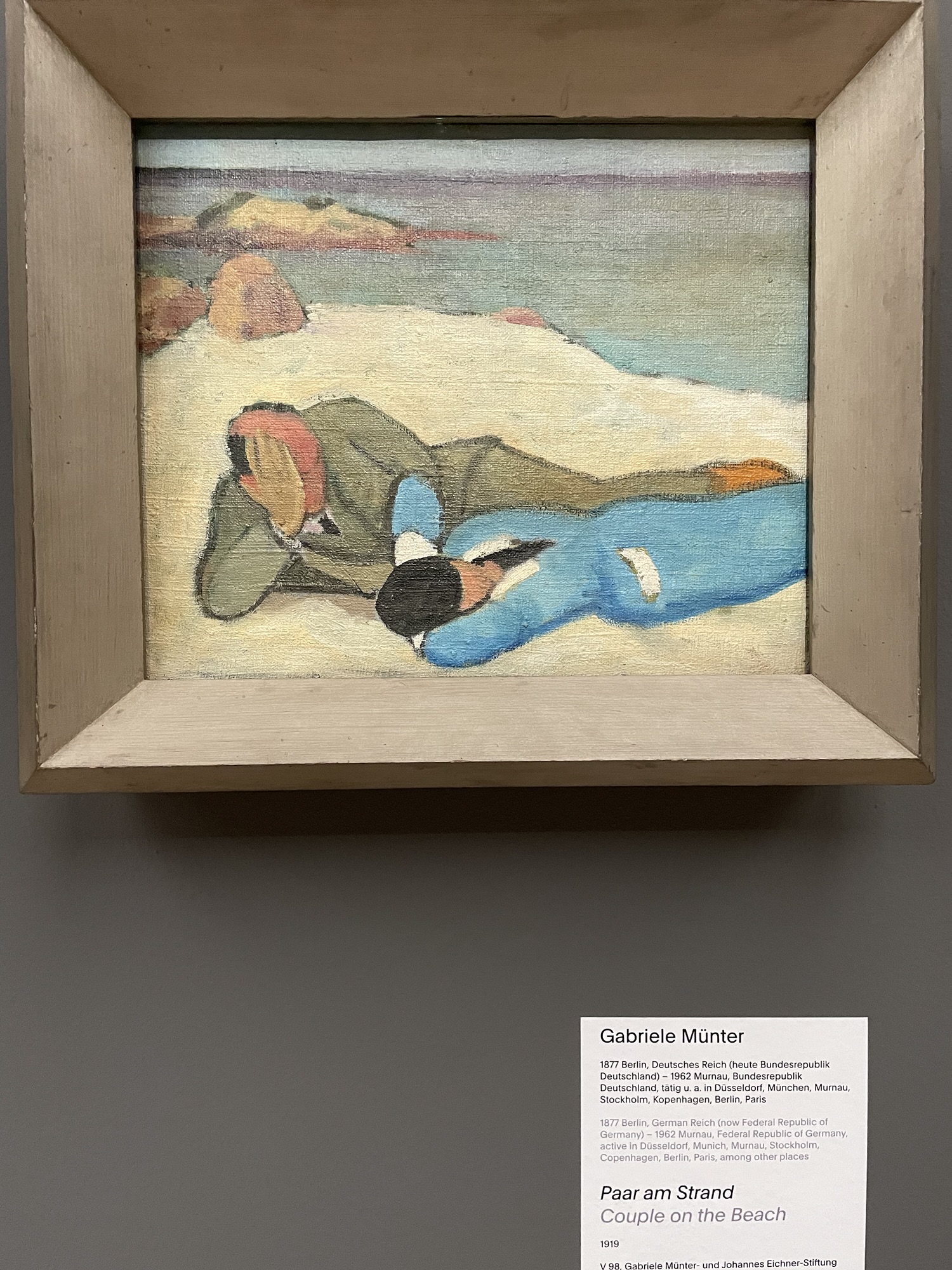
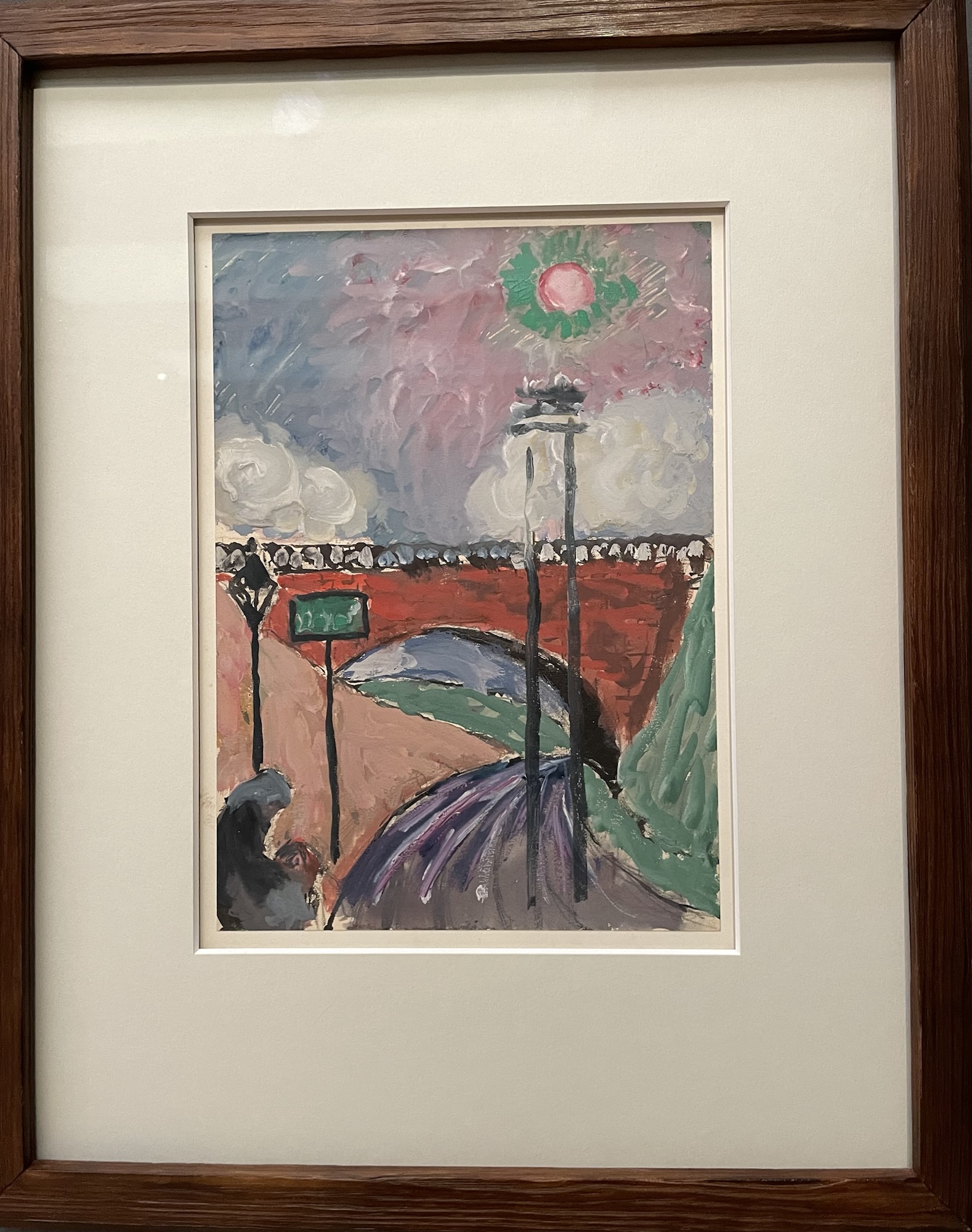
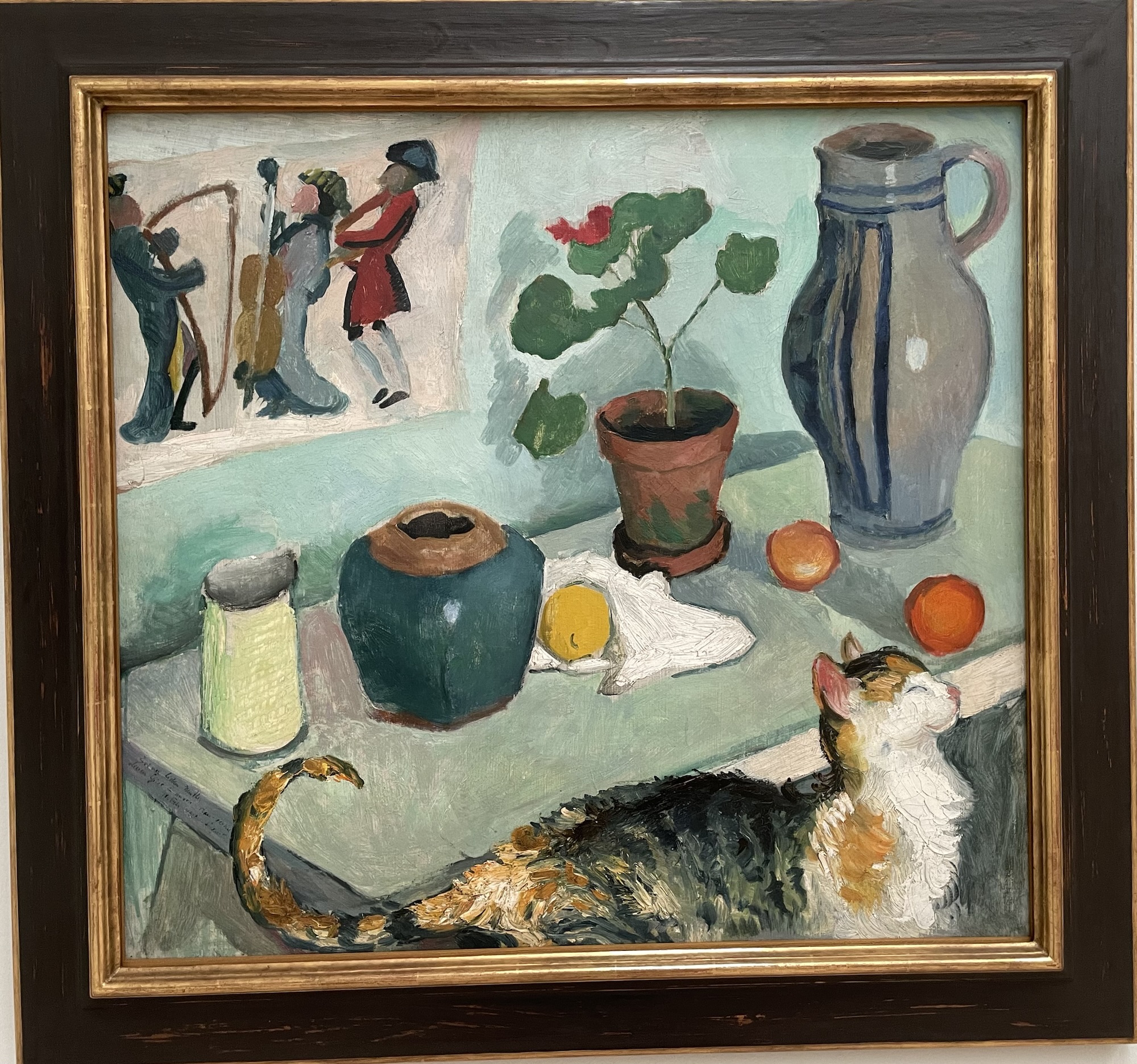
The museum itself is in a lovely space. The early Kandinsky’s, as well as Gabrielle Munter and August Macke, blew my mind. Icing on the cake–so to speak–is the excellent museum cafe that we returned to for a second lunch a few days later.
The link below is to an online selection of the Blue Rider collection.
This very early Kandinsky wowed me. I am not that fond of his late abstract work, but this experiment using a palette knife is lovely.
Pinakothek der Moderne
Turns out there are three Pinakothek museums, and we went to two of them…and “der Moderne” was a revelation. Big, tall galleries, each with a theme that is explained on a poster as you enter; mixed media, paintings, video, posters, sculpture, mixed into the theme in eye-popping ways. The building itself is tall, wide, with an enormous lobby full of fun kinetic seating that was well-exercised by the many kids of all ages. Note: Seems in Europe there is much more expectation and tolerance of small children in art spaces, which was great in our opinion. Get your kids to a museum!
This museum is best known for its industrial design collection, but frankly we were so overwhelmed with the other galleries we decided to skip that floor and head over to Alte Pinakothek across the street which was great but missed being in our top three. The competition was tough.
Always fun to see a Magritte1938 self portrait, Florence HenriGiant fantasy room
Glyptothek
We are Roman and Greek history and mythology nerds, so when we mentioned our interest in this museum to Janina and she told us how much she loved it we put on the must-visit list.
First, the building itself is impressive, with tall, domed, coffered ceilings, giant windows, and plenty of room between items to wander and circle them. We noticed everywhere in Europe the art is rarely behind glass or in cases–you can get right up close and really see the work. For these ancient sculptures this made our viewing experience feel personal–you can walk around a piece, no barriers, and it frankly was hard not to reach out and touch them (we did NOT).
The phone app they offer added so much to our understanding of what we were looking at, as did the posters in each room explaining why certain pieces were displayed together and what they represented. There was too much to absorb in one visit. And every now and then, a gasp–as in the room where a bigger than life size Apollo looks down on us mortals and even in his purely arts-patron guise is freaking powerful and impressive.
I told David I felt as if I’d just completed a masters in classical sculpture by osmosis.
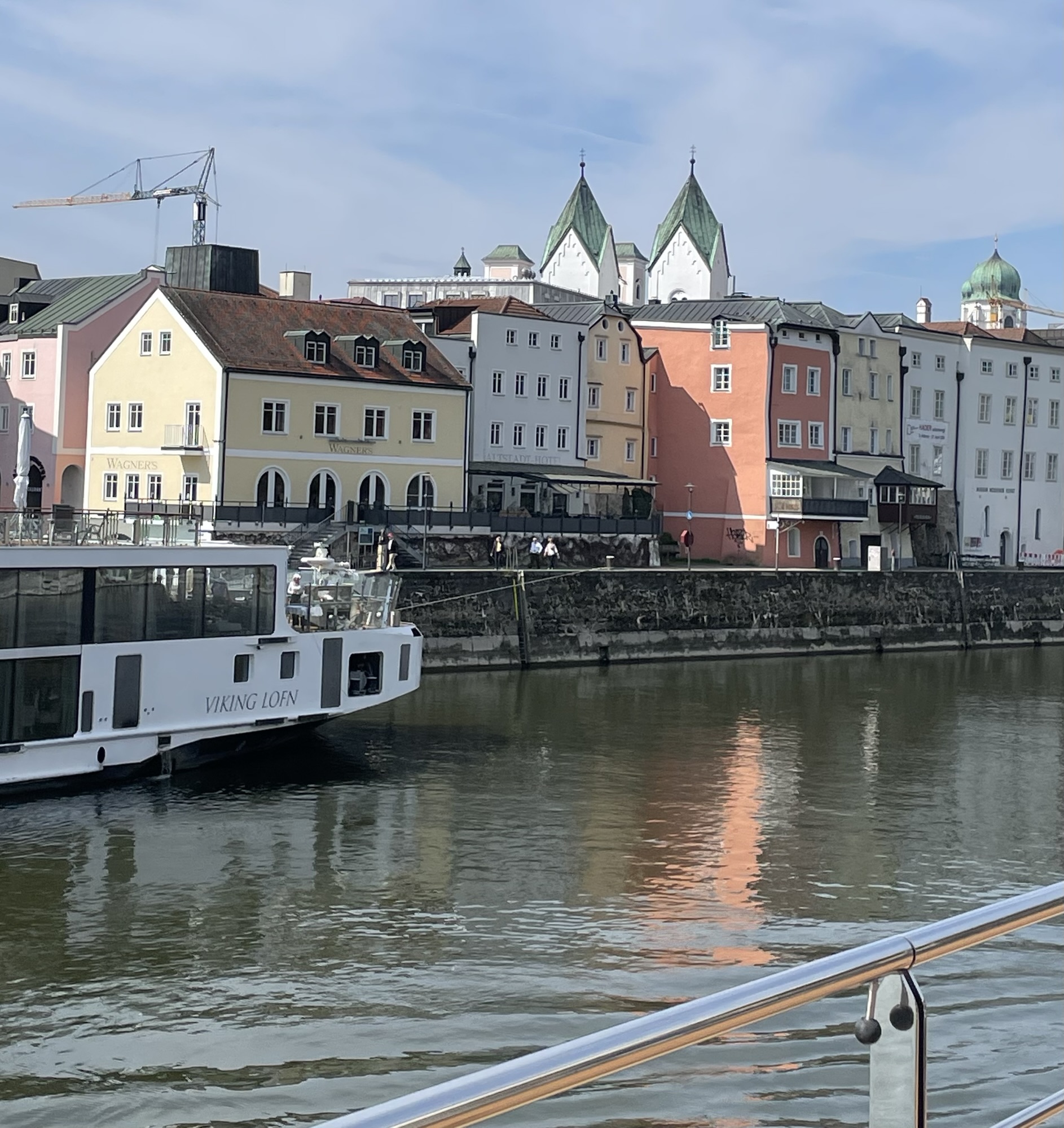
Our time on the boat was suddenly winding down and we were looking forward to being on our own again. This last stop in Passau was just half a day, and given the size of the old town along the river that seemed enough.
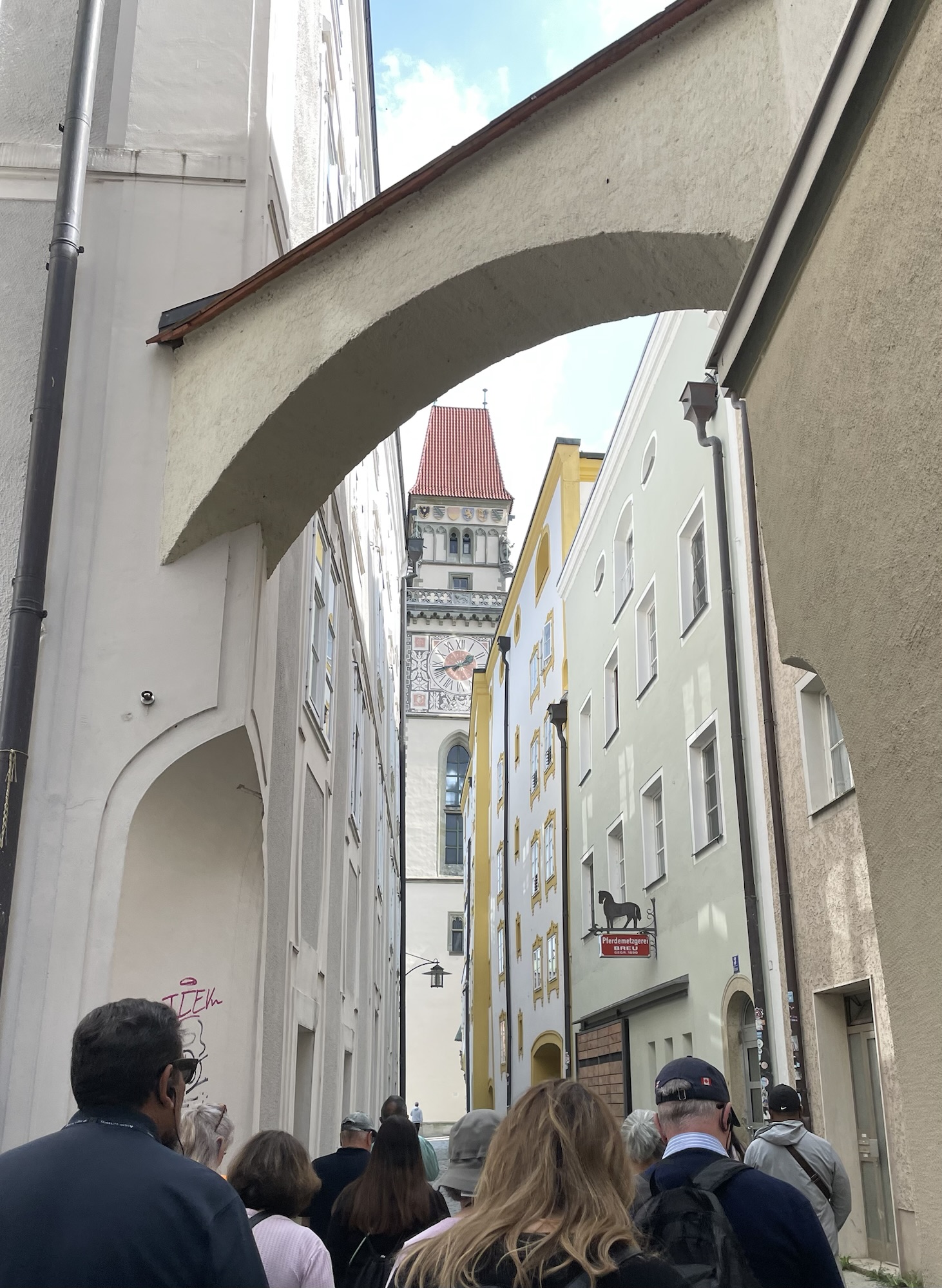
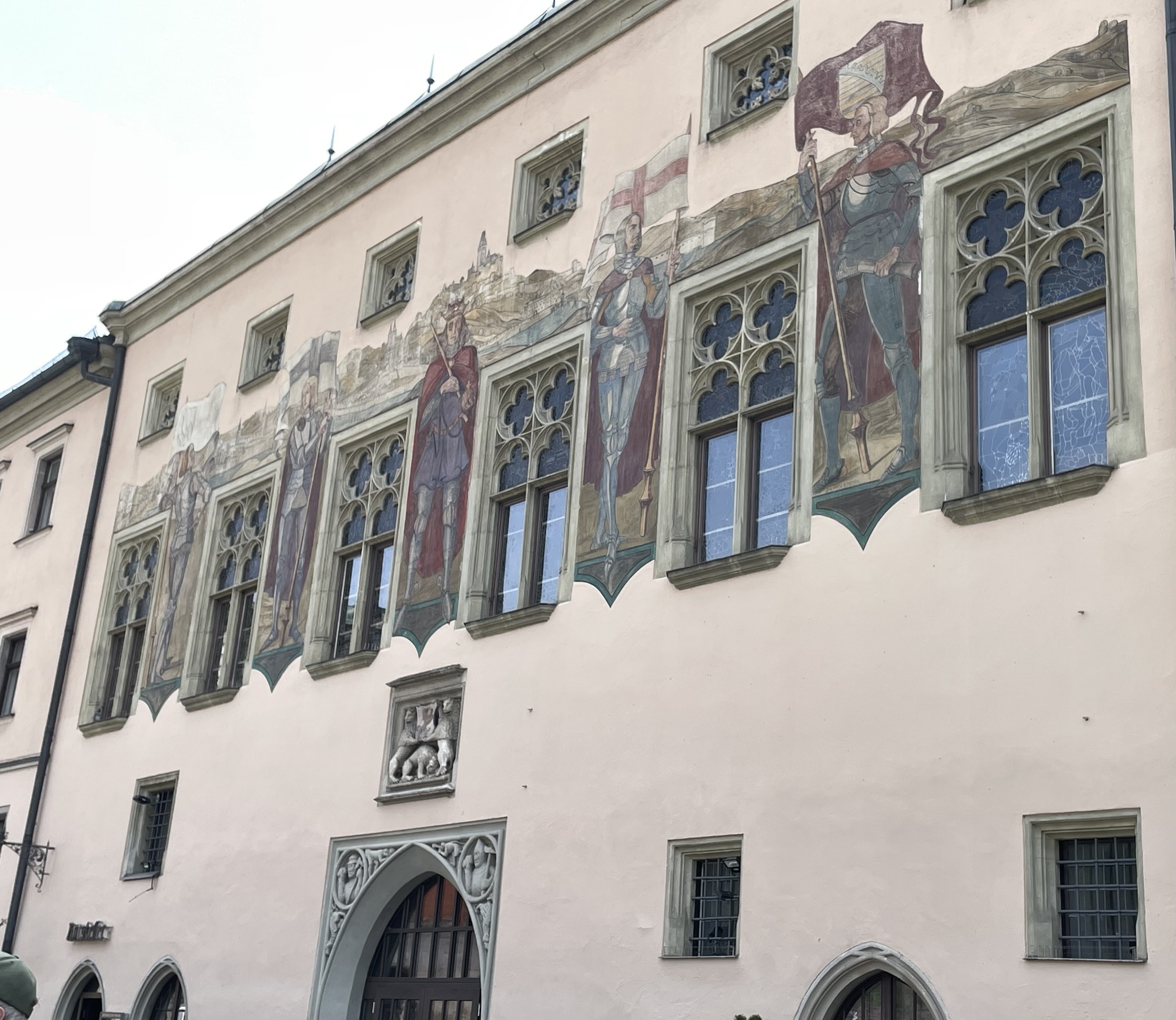
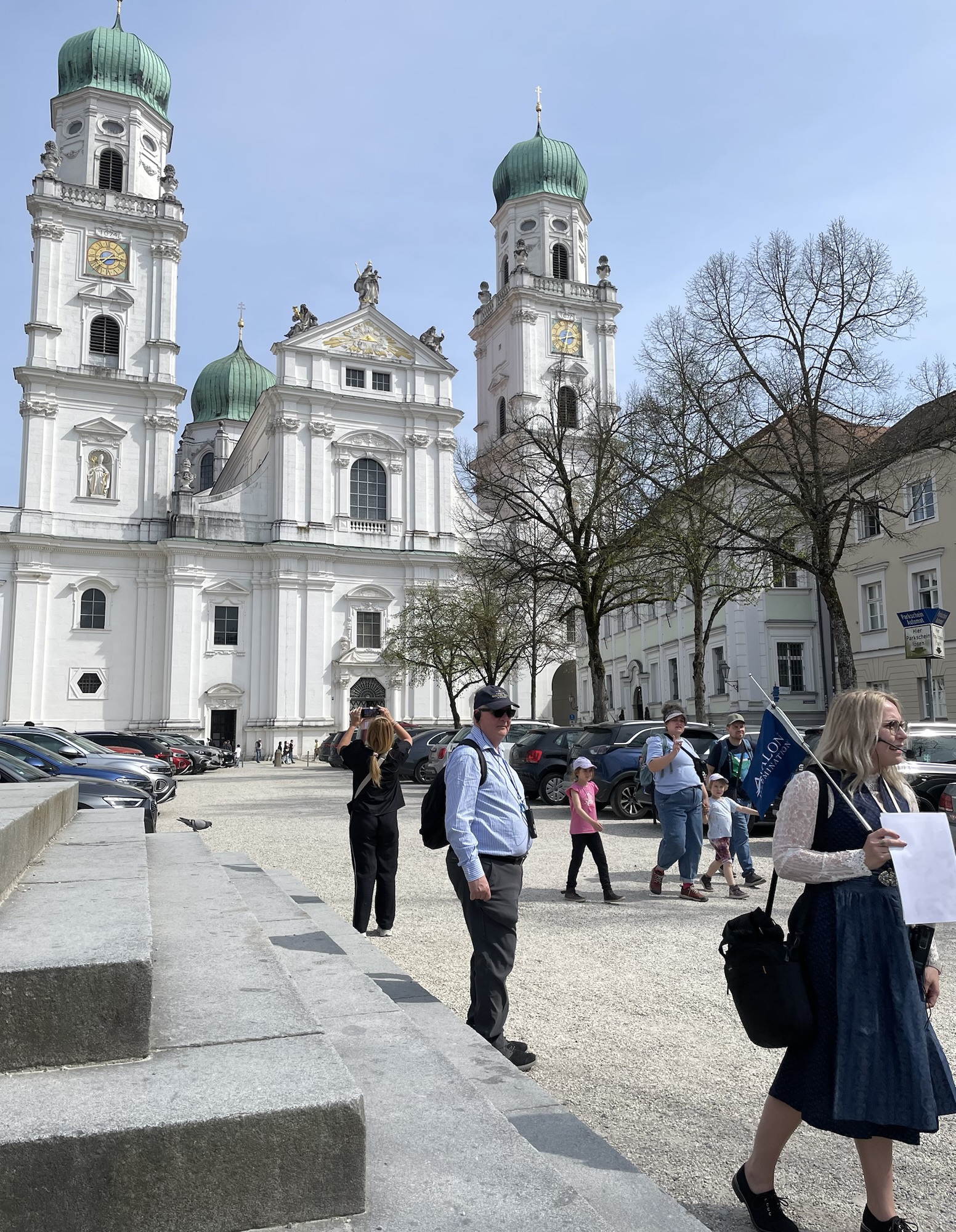
We had an hour and a half, maybe, of a delightful tour. I am struck by how very local our guides have been…I grew up here, went to university here, now have a job where I talk about a place I know so well and love. Our guide, a young woman dressed in dirndl (and sneakers), explained the meaning of the placement of the bow on the overskirt. Married (or unavailable), widowed (or a waitress!), open to a relationship, and one other I cannot recall. Handy, I suppose.
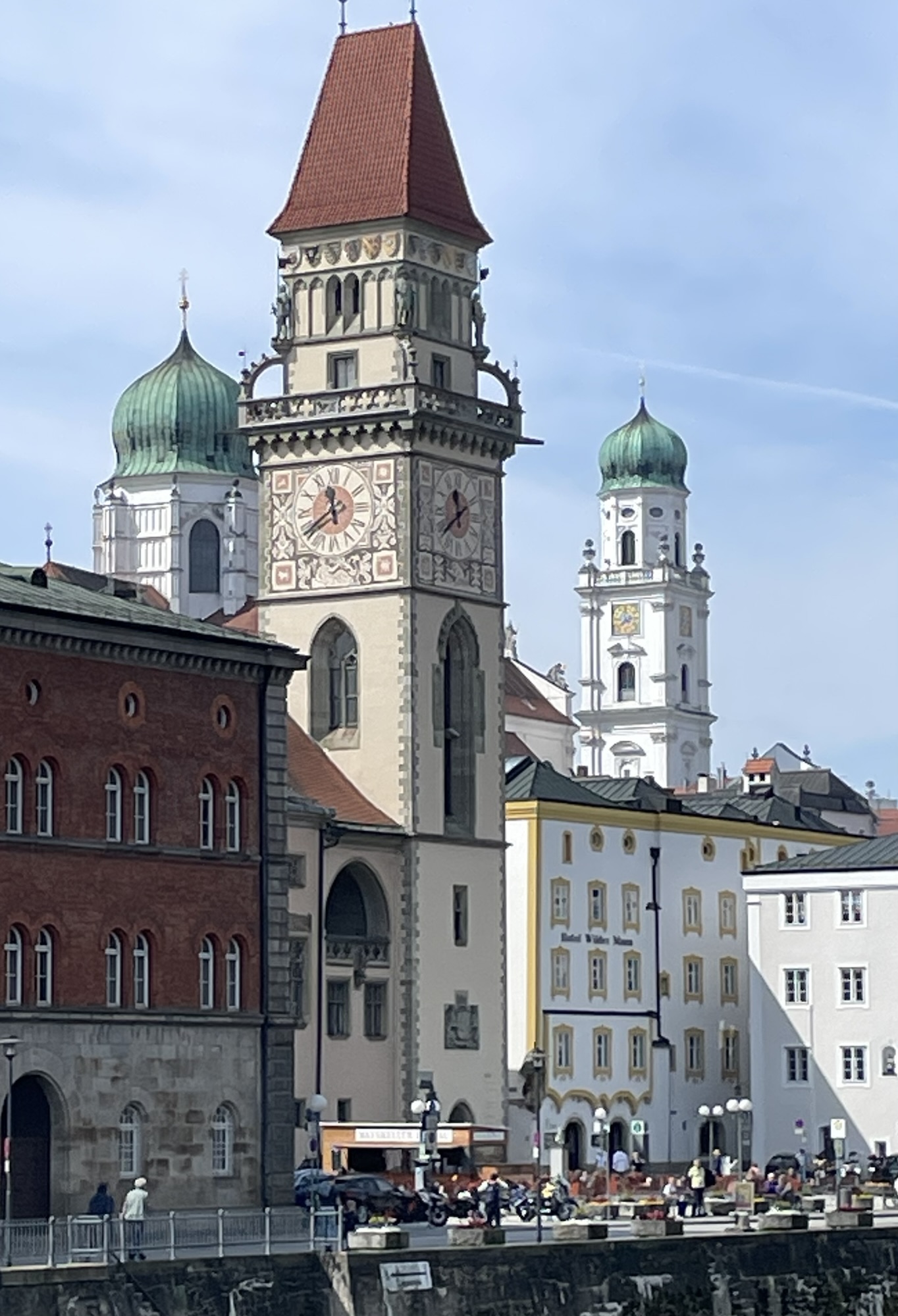
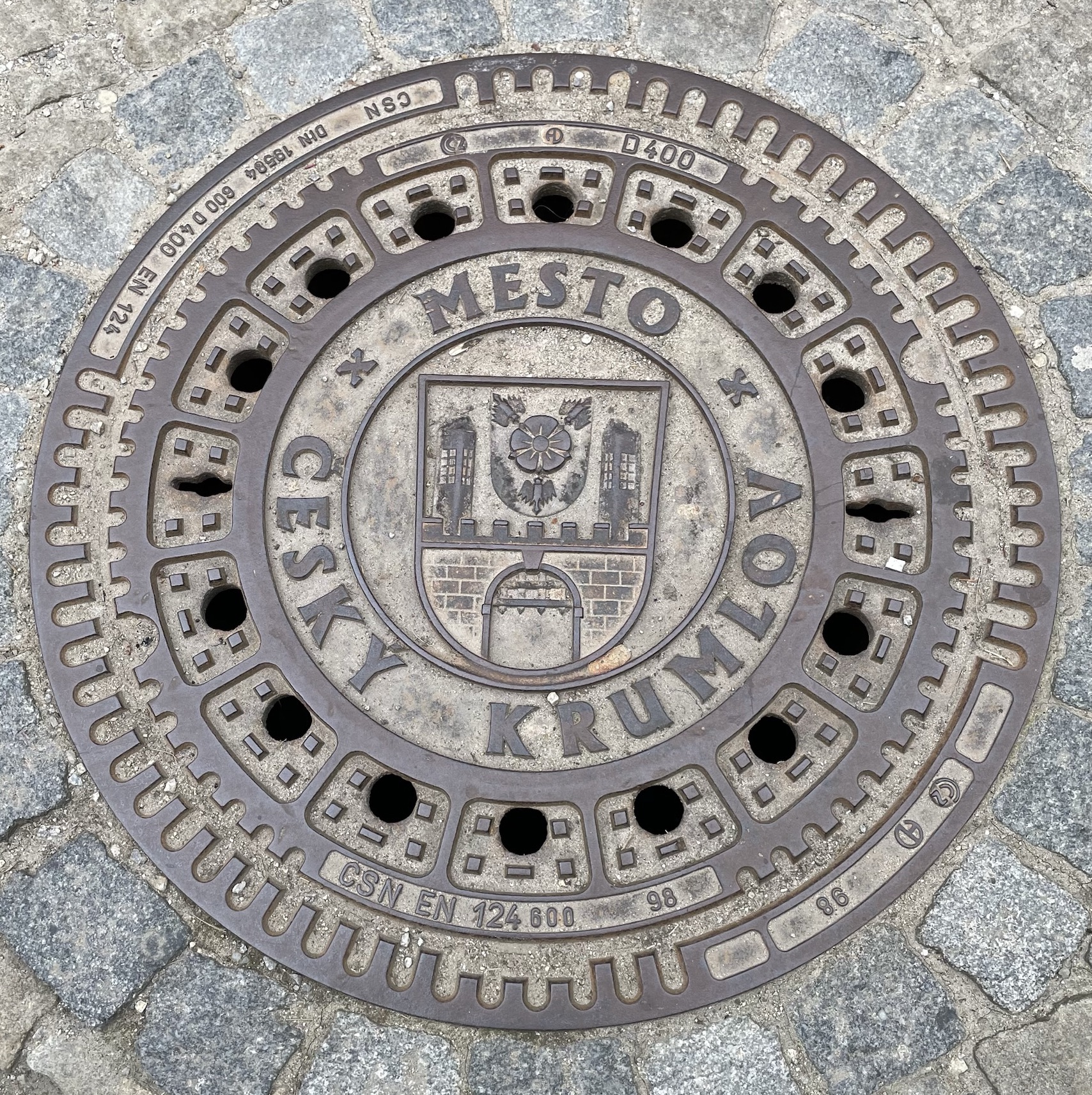
The tiny peninsula of the old town is as picturesque as most every other small town we have visited. Because of the surrounding three rivers, though, serious floods have been a problem for centuries. Currently the part of the city that is especially vulnerable is where artists and other artistic folks live, and of course they are loathe to move. As in Cesky Krumlov the high water marks are unimaginable. In 2013 the water rose 42 feet.
After our tour David wanted to walk down to the tip of the peninsula while I hung out on the boat. It was getting hot. Several hours later the boat moved on to Vilshofen where we disembarked the next morning and hopped on the train to Munich.
When the boat arrived in Linz we saw nothing of the town as we were hustled aboard comfy touring buses. One group headed to Salzburg, Austria while we were off to Cesky Krumlov, a medieval town across the border in the Czech Republic. We had little memory of how we had made the decision and even less about our destination. It turned out just fine due to excellent guides (one on the bus, one in the town), a yummy lunch, and a pleasant afternoon walking around a very small old town.
The drive through Austrian farmland…rolling green hills, immaculate farms and small villages…took two hours that seemed much shorter. Our guide was a great storyteller and taught us a lot about the days of soviets right across the border and the evolving relationship between Austria and the Czech Republic.
About 45 minutes into the drive we passed Hallstatt, a tiny farming village, very pretty. We were through it in a blink. Our guide explained that a Chinese official, some years ago, had been touring the area and fell in love with the town. He returned to China and oversaw the building of a replica village that, unlike other European town replicas in China which are basically housing developments, is more or less a museum (and apparently a wedding destination). Well, it has generated a steady stream of Chinese tourists who come to see the real thing. Unfortunately like idiotic tourists everywhere they fail to distinguish between a real live place with real live people living real lives, and a museum. There are many tales of Chinese walking into houses assuming they are museums as in the Chinese replica. She told a personal version—a friend of hers whose husband was startled in the bathroom—and the bus driver who lives in Hallstatt was nodding along. It seemed far fetched, right? And yet we saw tens of Chinese tourists in nearby Cesky Krumlov, so it was believable.
Our guide also explained why there were so many Vietnamese restaurants across the border. During the Viet Nam war when North Viet Nam was a more rigid communist country it was much easier for North Vietnamese citizens to travel abroad to other communist countries and places like communist Czechoslovakia welcomed the tourists…and many stayed.
A happy result of the Austrian-Soviet Czech border is the wildlife-rich two kilometer wide swath that the soviets had enforced to keep people from crossing over to Austria. It is now a protected green belt.
We had been instructed multiple times that we must have our passports for this particular outing, and we did of course, but at no time were they of any use. I guess it´s a just-in-case deal but we were a bit disappointed that we crossed the border and back with nary a border guard interaction.
It is truly lovely country. Our guide pointed out the tiny “dachas” that had been built in soviet times and were used for free by Czech citizens. Now they have been built out, added onto, and are year round homes for the most part. They are cute and Russian-looking.
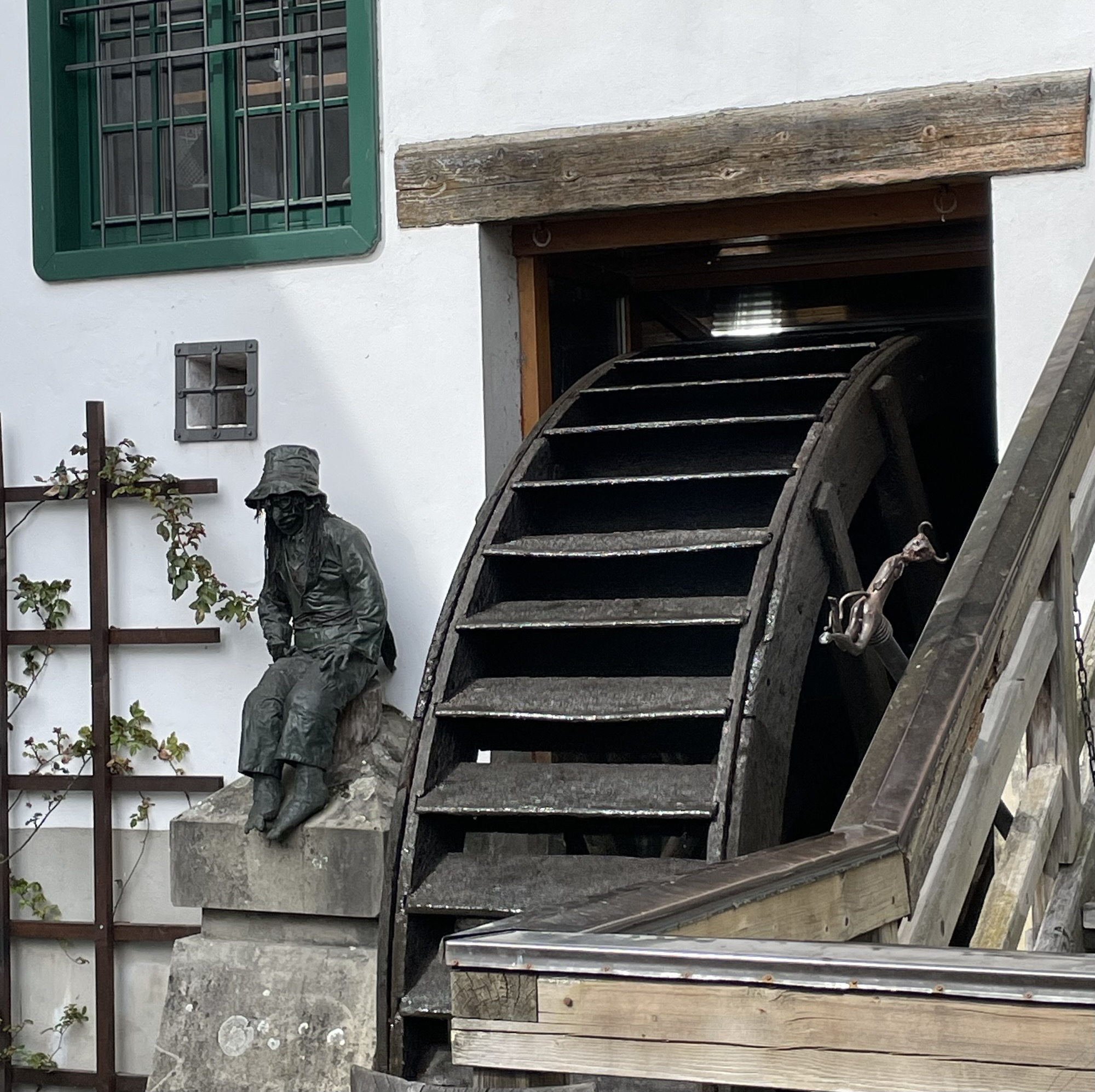
Although it looks like an aqueduct it is a bridge between two parts of the castle.
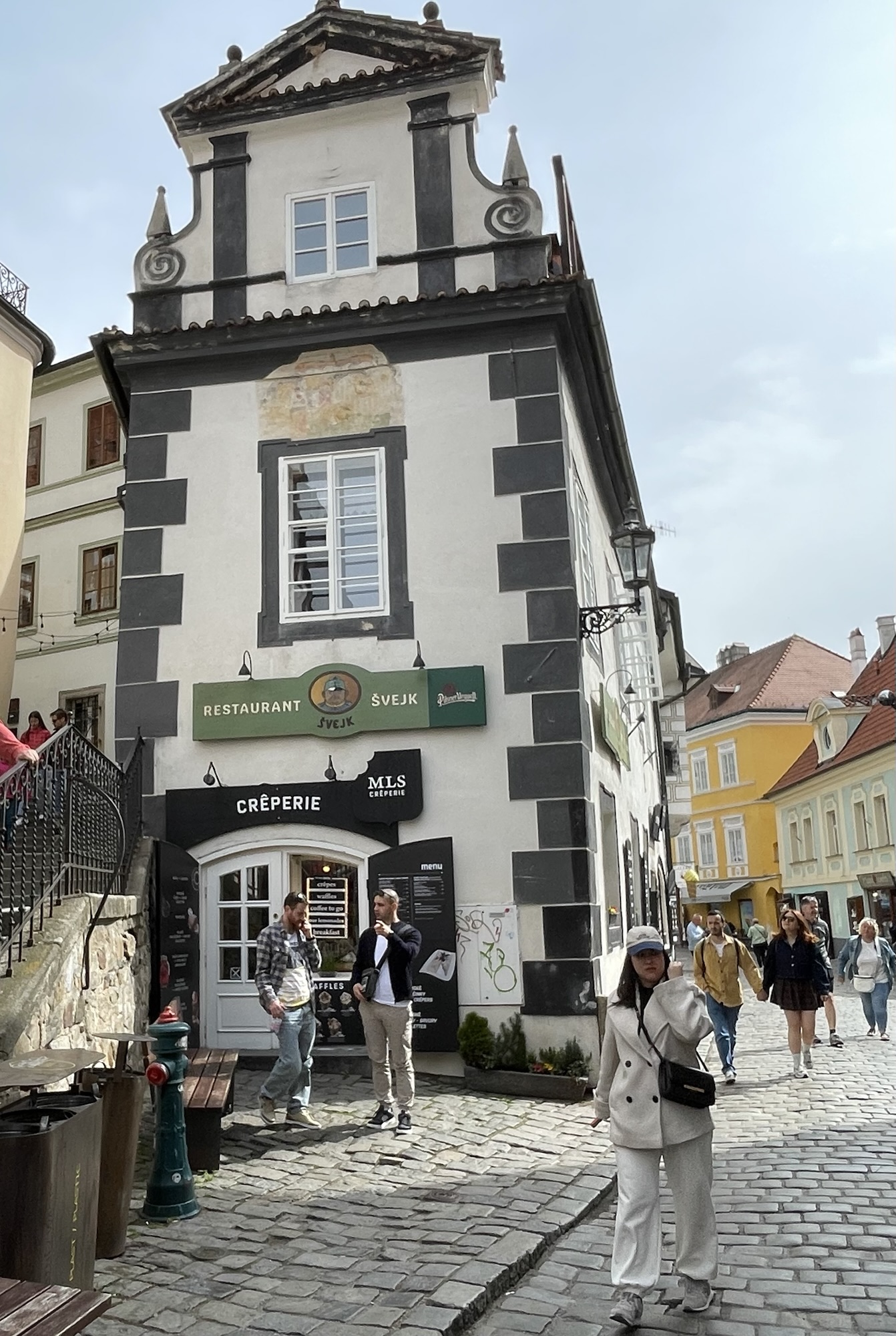
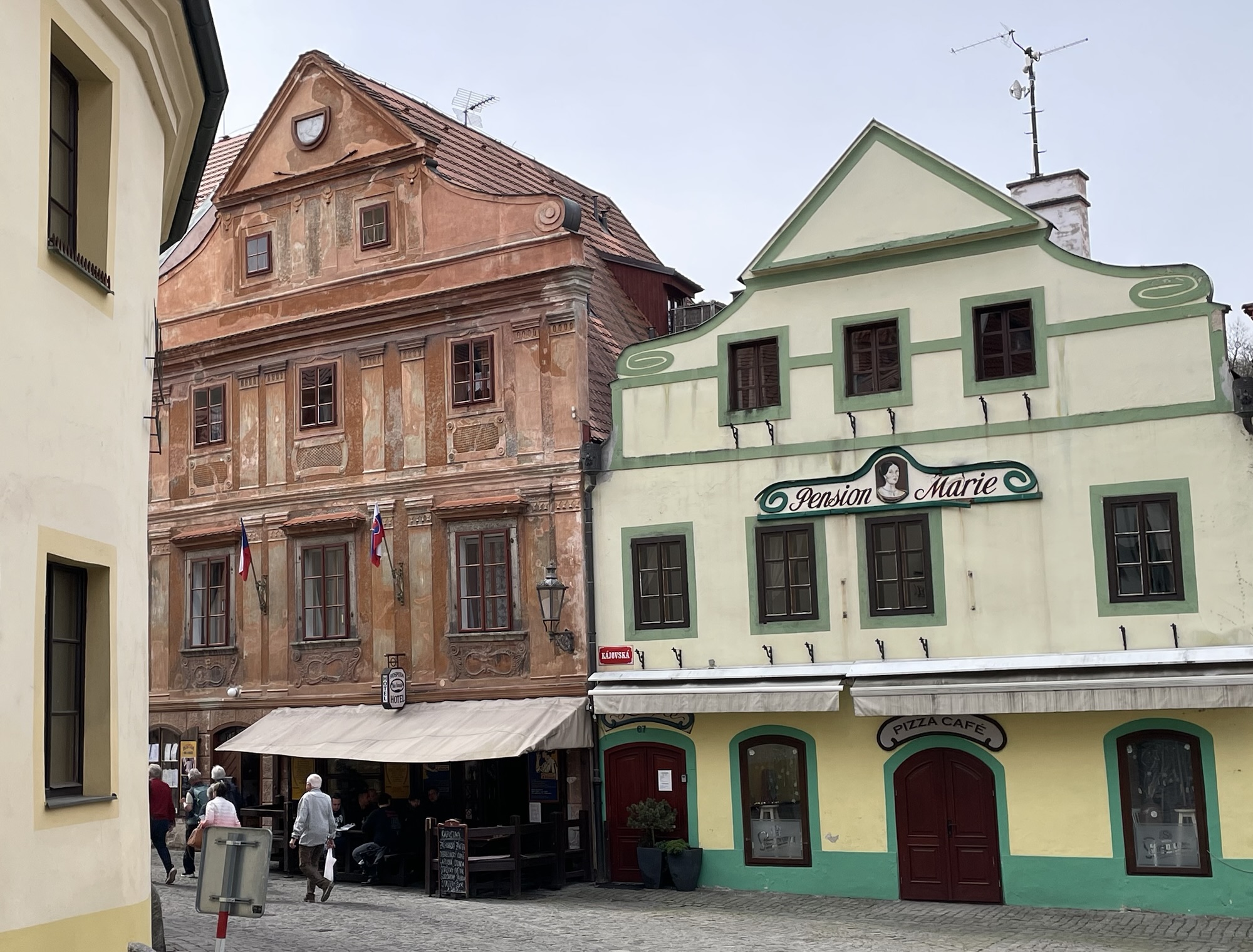
Suddenly we arrived and we were out of the bus walking into the town. It is fairy-tale like, with twisty streets, unbelievably uneven cobblestones, a small river running through, and a bit of an artsy feeling.
Our town guide was an extremely droll man who made the driest jokes among a densely informative spiel. It was a lot of fun. He also told us where to eat, where to walk…and we had several hours to explore. One of their local products is pencils of all things, because of nearby graphite mines. Makes sense. After the tour and a delicious lunch David and I walked literally the entire town. Then back on the bus for a gorgeous drive into Linz and our comfortable boat.
Such a pretty restaurant with fantastic food. The slices on my plate are mosaic bread dumplings. I was sure it was too much food but ate it all.
One of the unique architectural features on many buildings is a 3-D effect of the stucco (?) by scratching the surface to make it seem faceted. Hard to explain! Here is an example.
A now deceased sculpter left his mark all over the town. He made a lot of things that look like over sized fat fingers and hands.
A bench next to the river. Door to an art supply store.
It is a fun, funny, friendly and pretty little town. Glad we went!
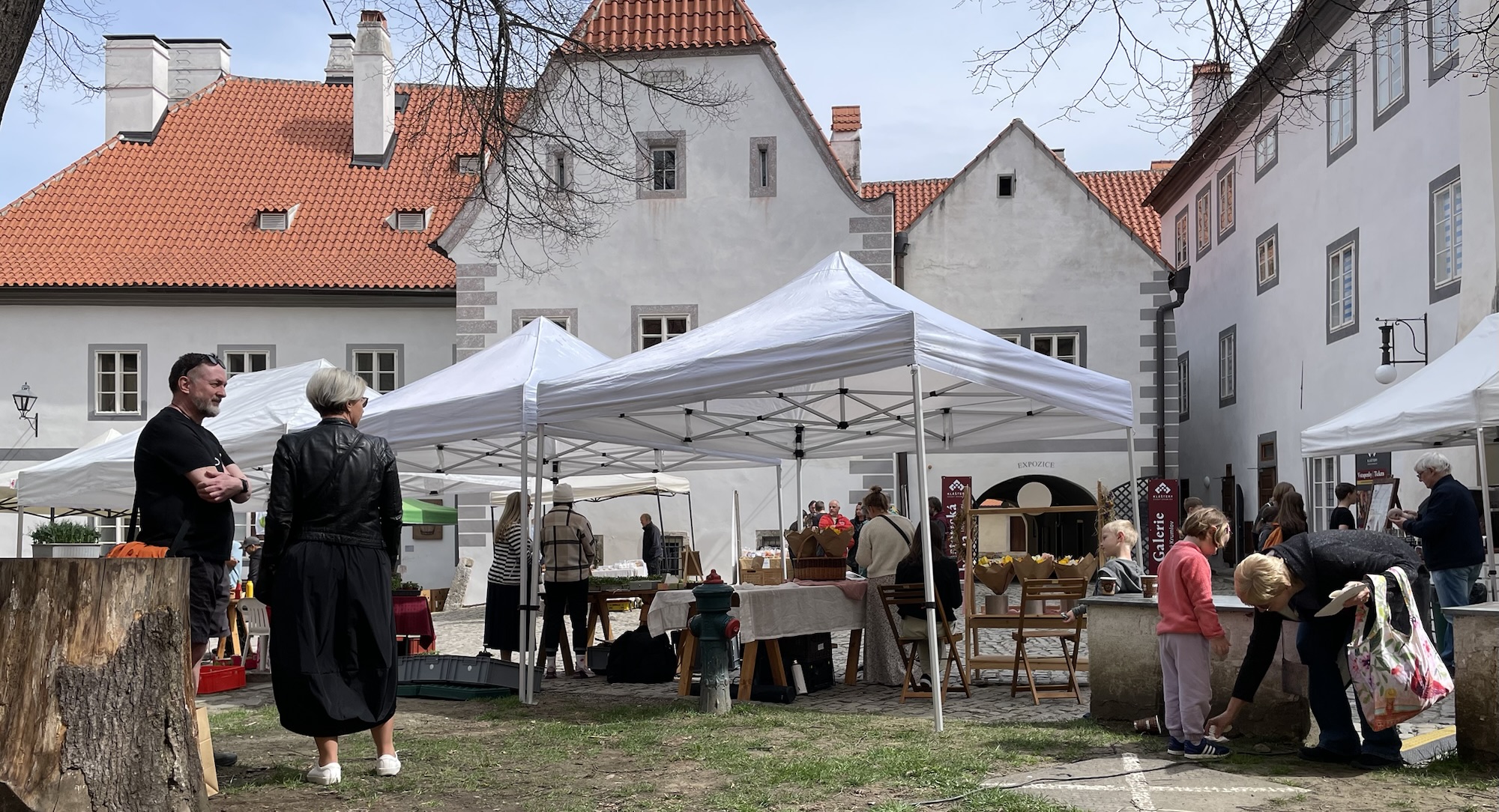
A small fair, all locals. Except us!The line on the building is the high water mark of a flood a few years ago. Ridiculously uneven street surfaces made walking a bit annoying.
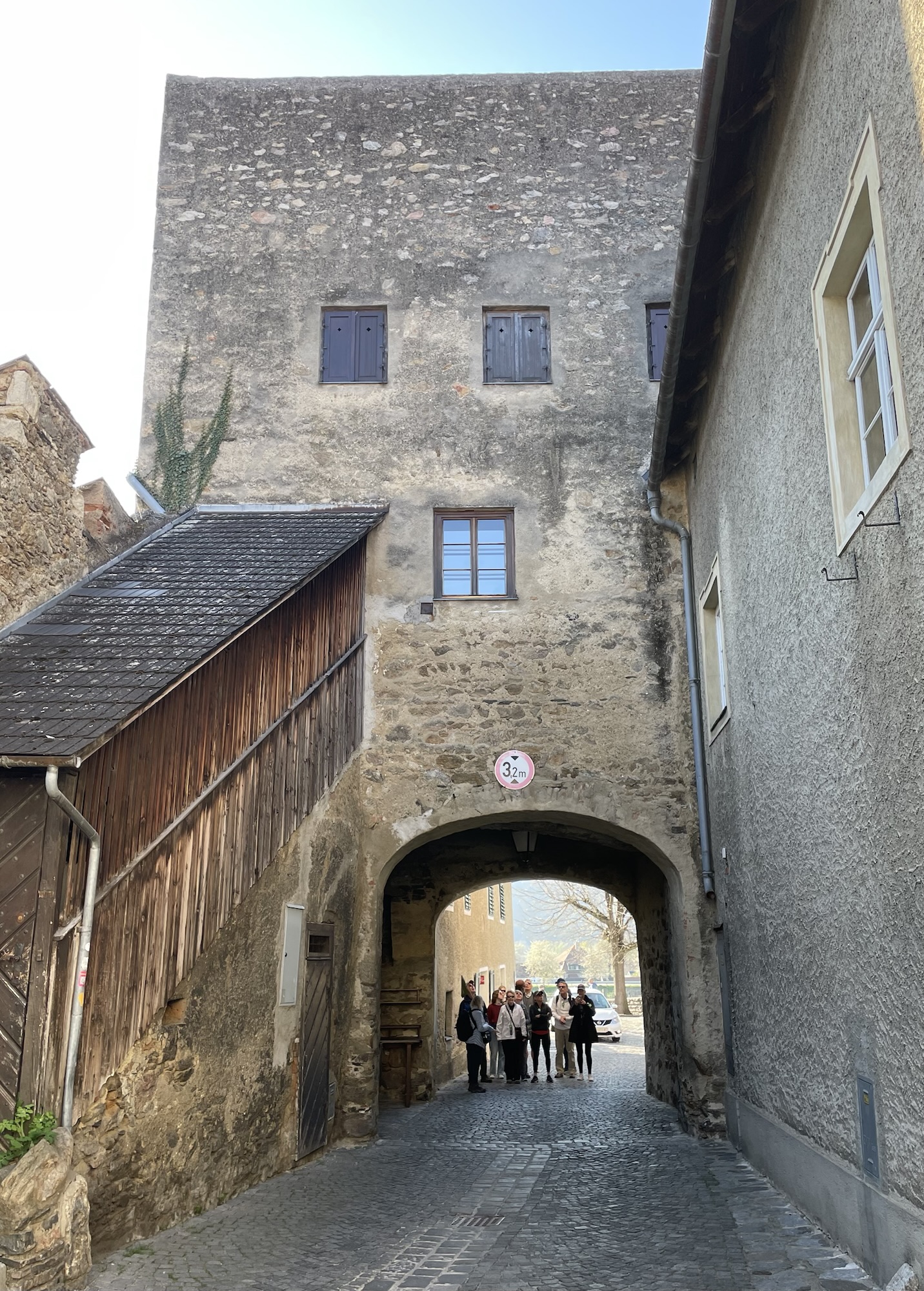
Our destination in the upper leftThrough the townThe town gate
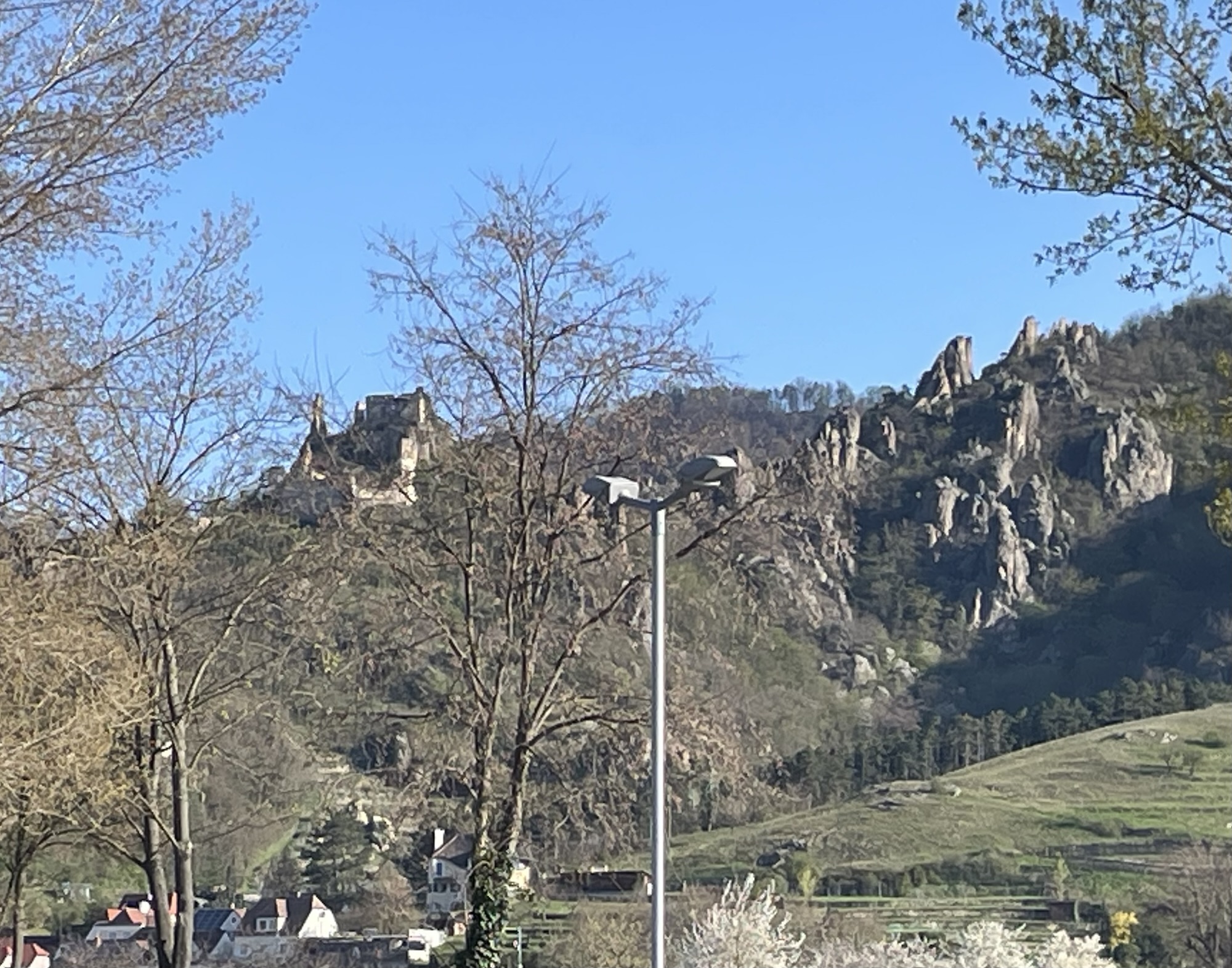
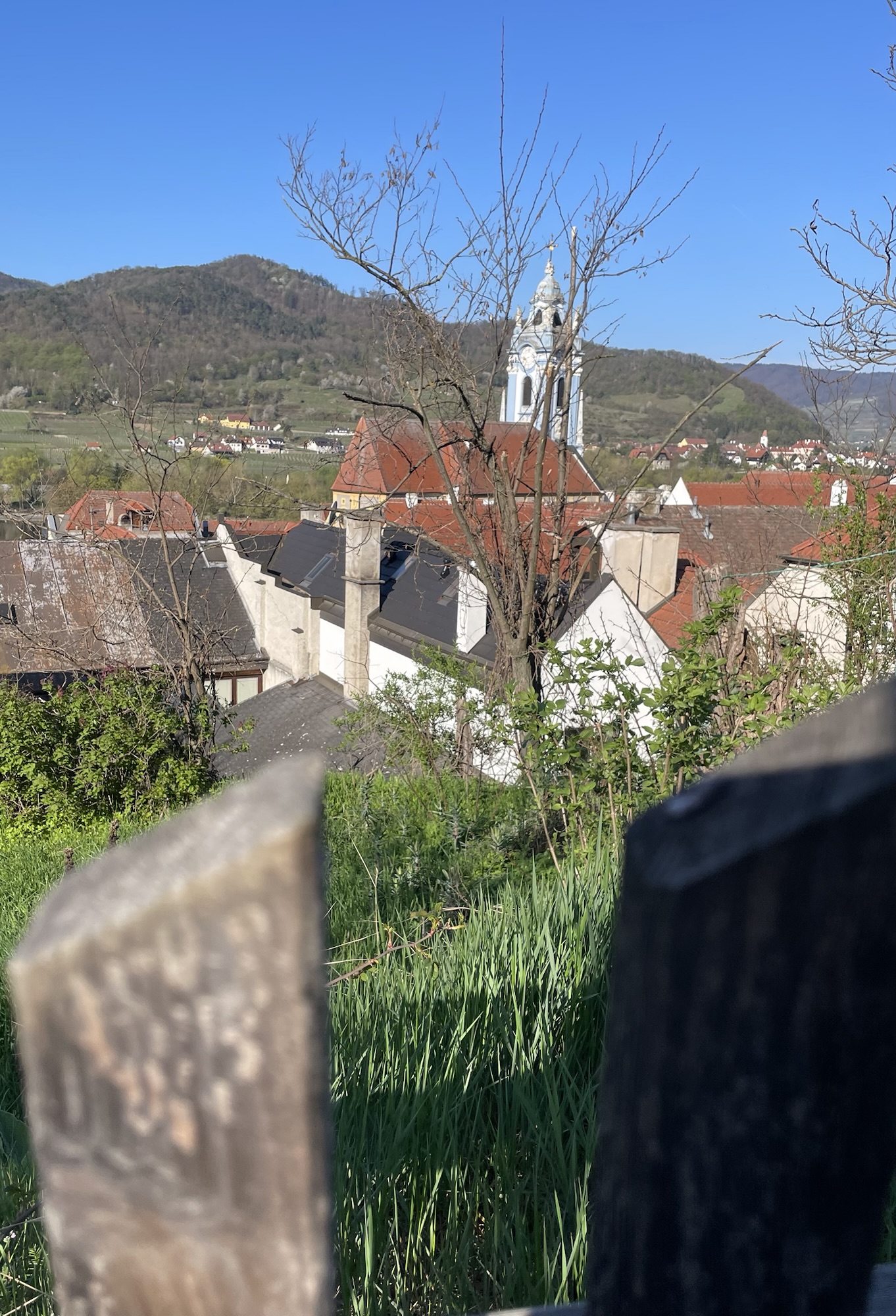
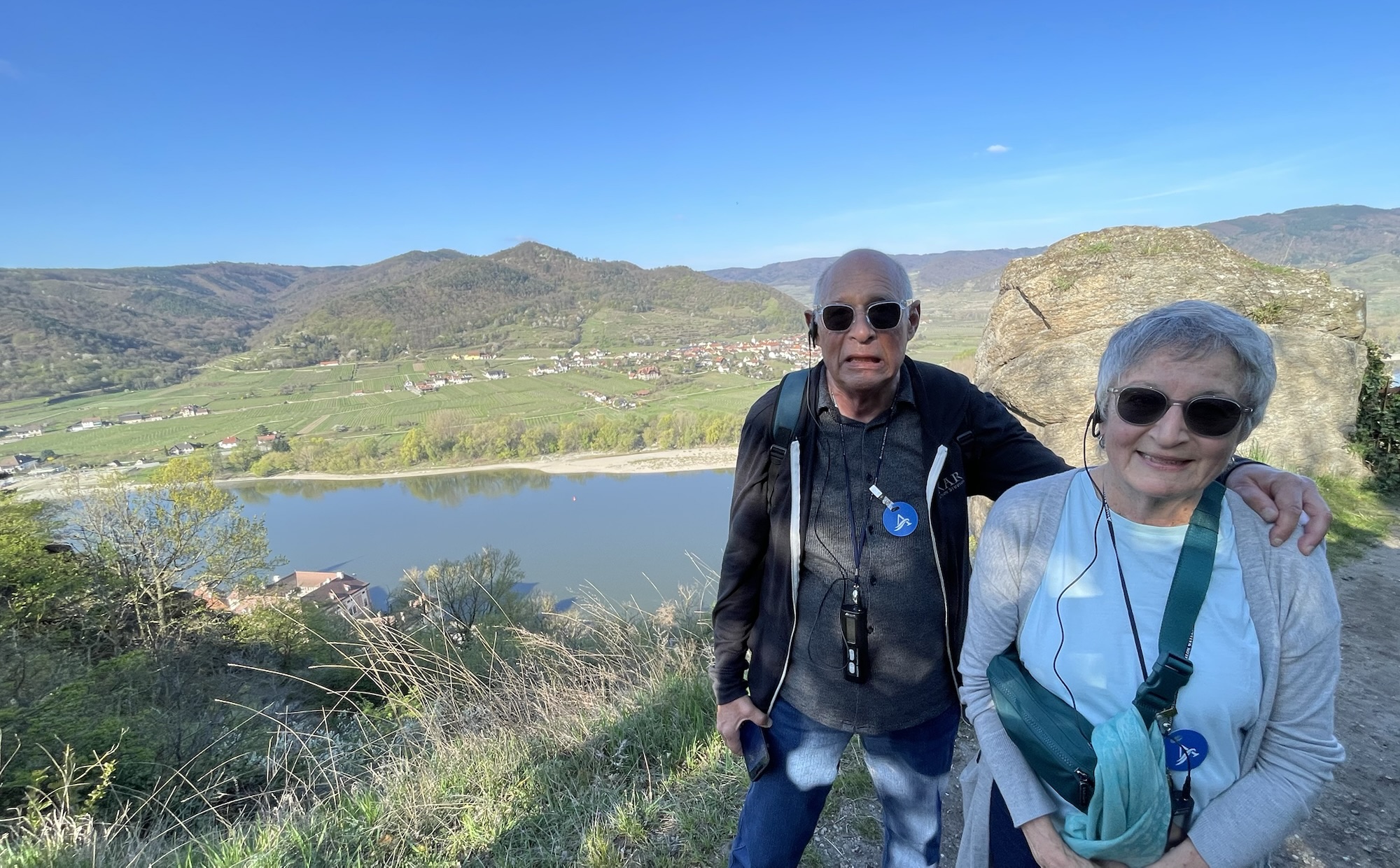
We woke up Saturday, April 12, in Durnstein, a ridiculously picturesque Austrian town. We had signed up for the hike to the castle ruins, which seemed, when we chose it months ago, so doable. That was before we entered the lazy period that started when we got on this boat. As we looked up at the destination we gulped, but, committed, we laced up our shoes and joined our little group.
It was 8:30. The guide promised we would be back in an hour and a half and off she went, the group hurrying to catch up. It was a cool, sunny morning and the weather inspired us all as we walked up a steep cobblestone street the width of a small alley, crossed the main street (wide enough for a car, cobblestone of course) and up and up we went.
This town has 150 permanent residents and only they are allowed to drive into the old part of town. The new town is maybe .2 of a mile to the right. I hope I got those facts right.
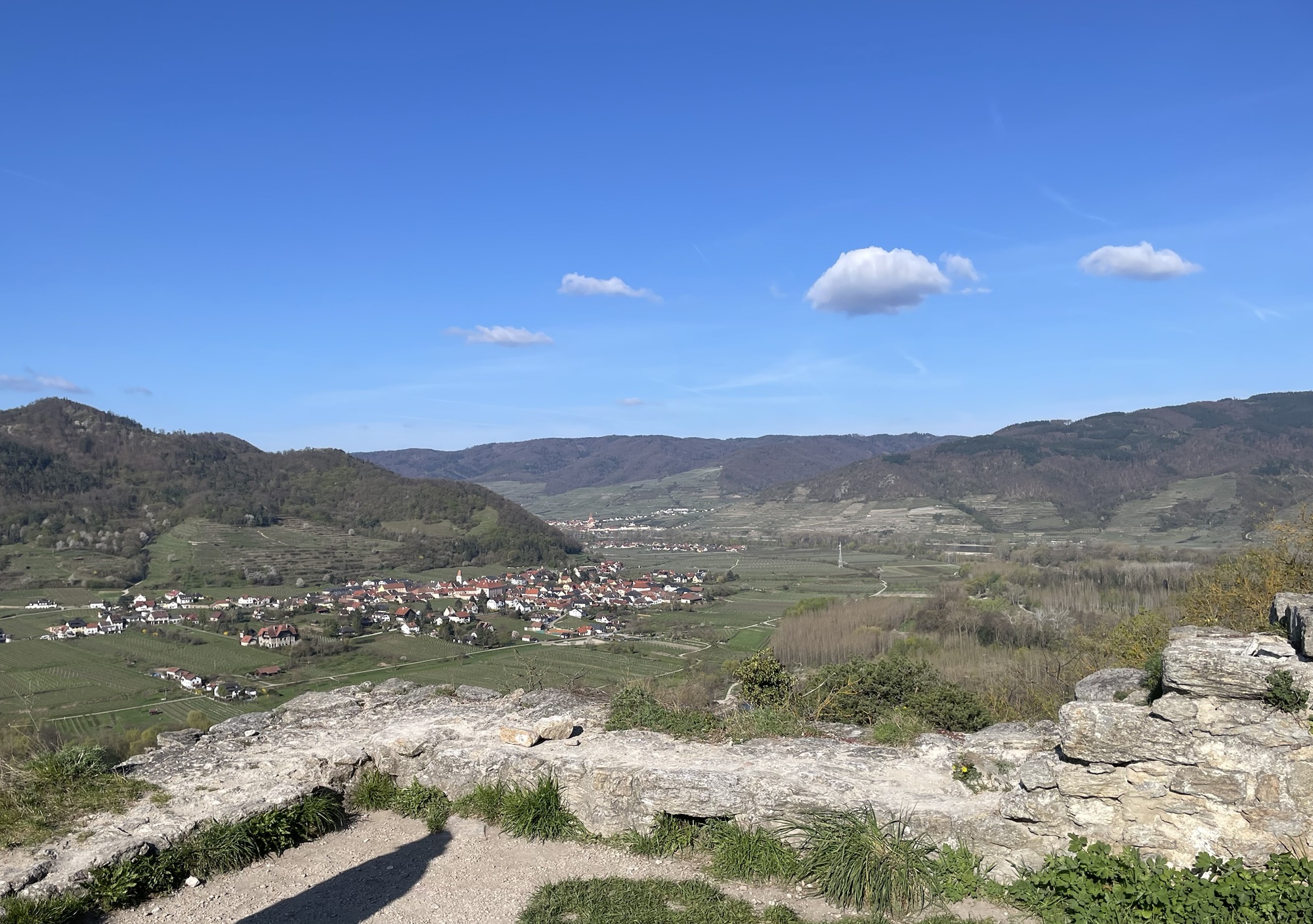
Anyway, soon the hike got serious with steep stone steps that required close attention. The guide promised 3 stops to take photos and it was some work to catch up in time to rest a bit before we were off again. It was hard work. But the cool air, the many many wild flowers, the views, and our common determination to get to the top propelled us all.
It was worth every huff and every puff.
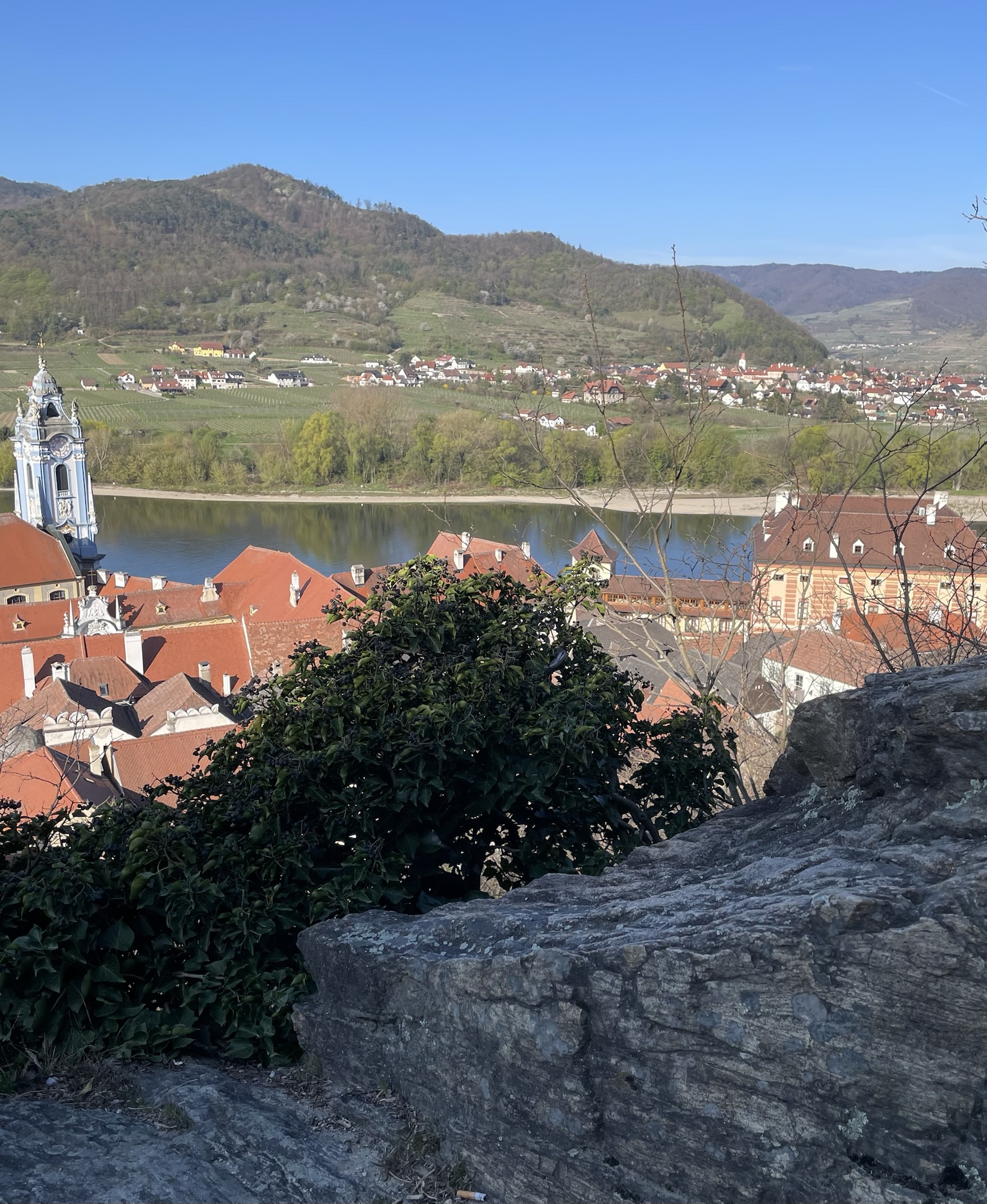
UpAnd upFlowers everywhereAnd up…the Danube waaay down thereJust below the ruins
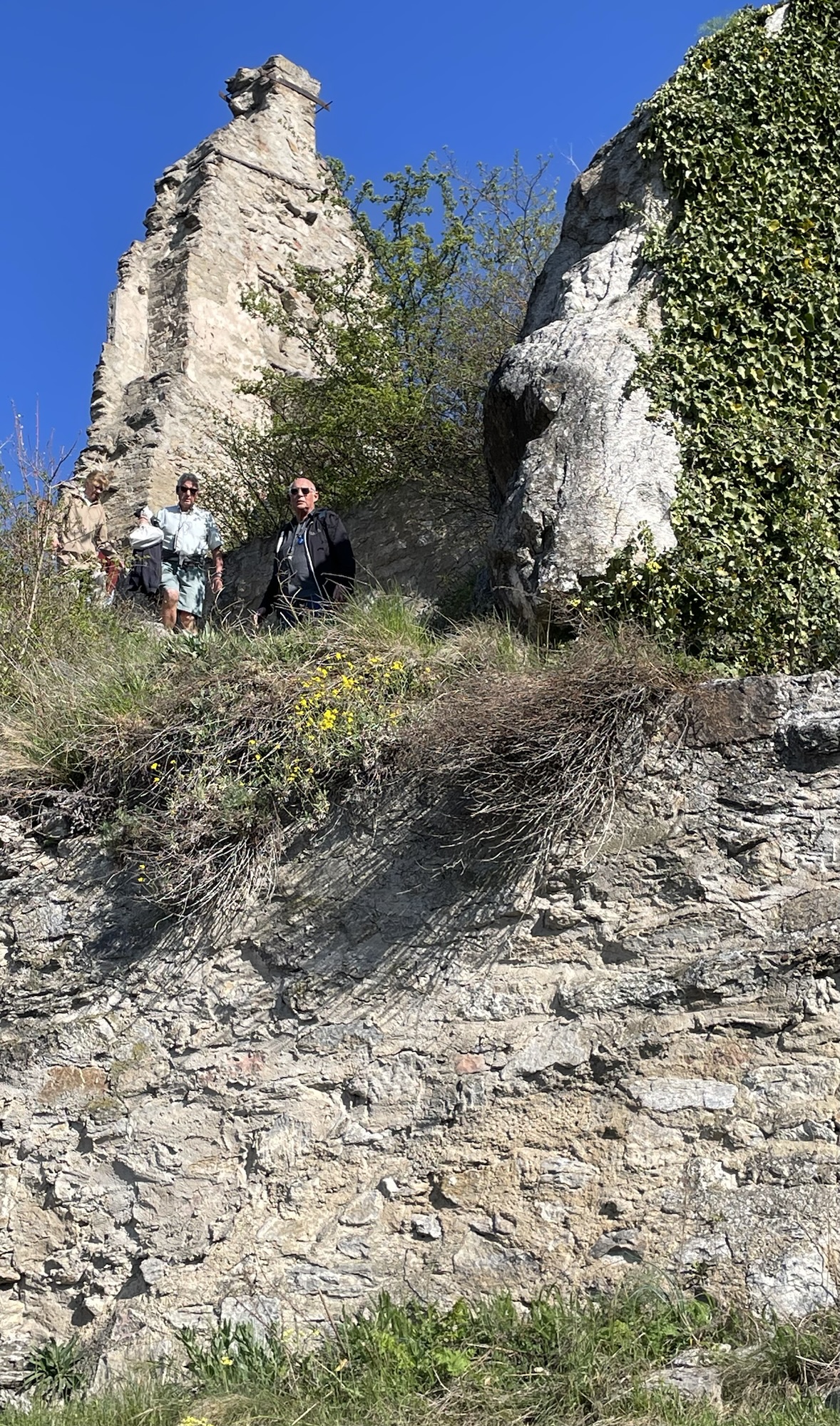
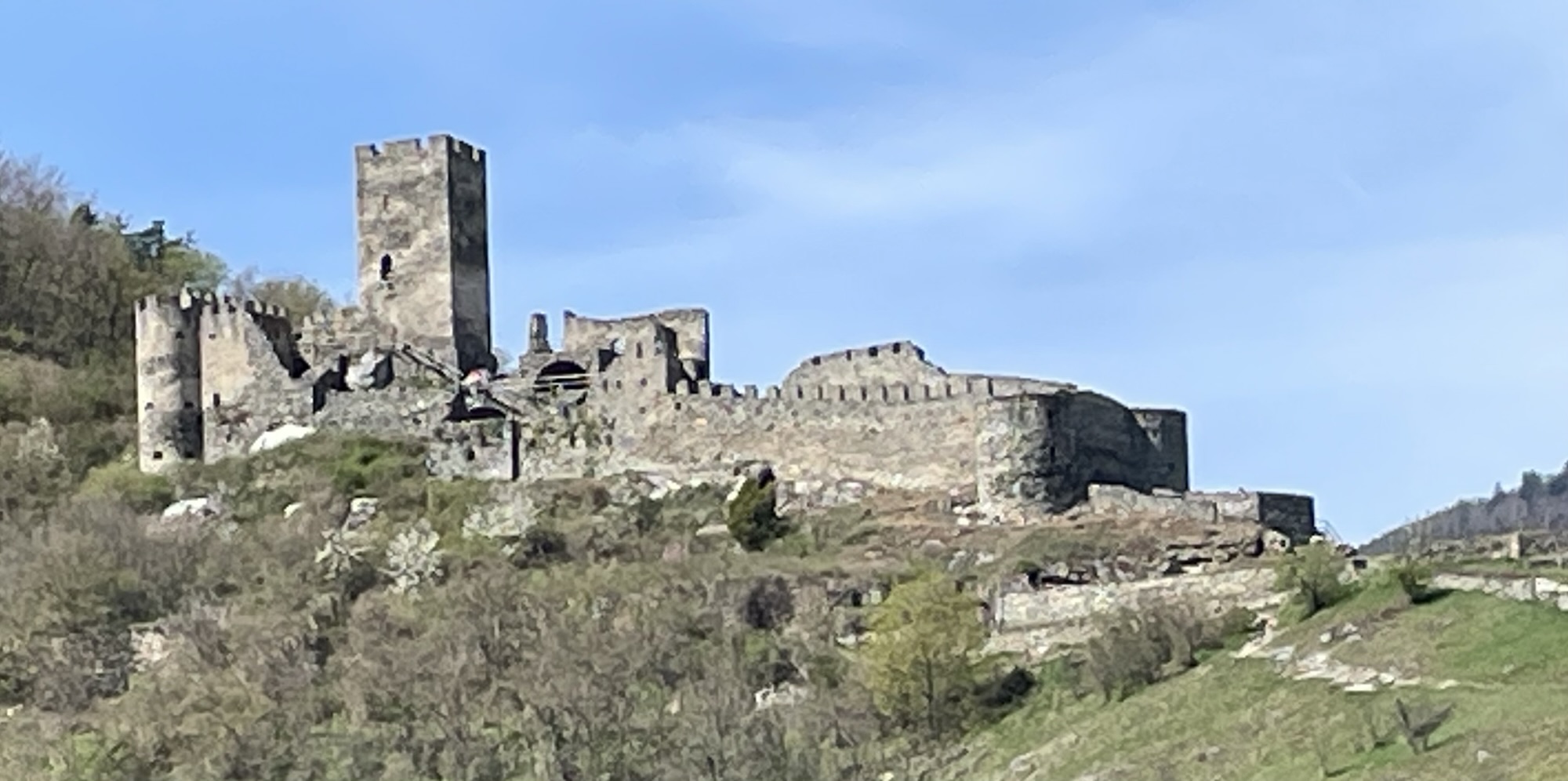
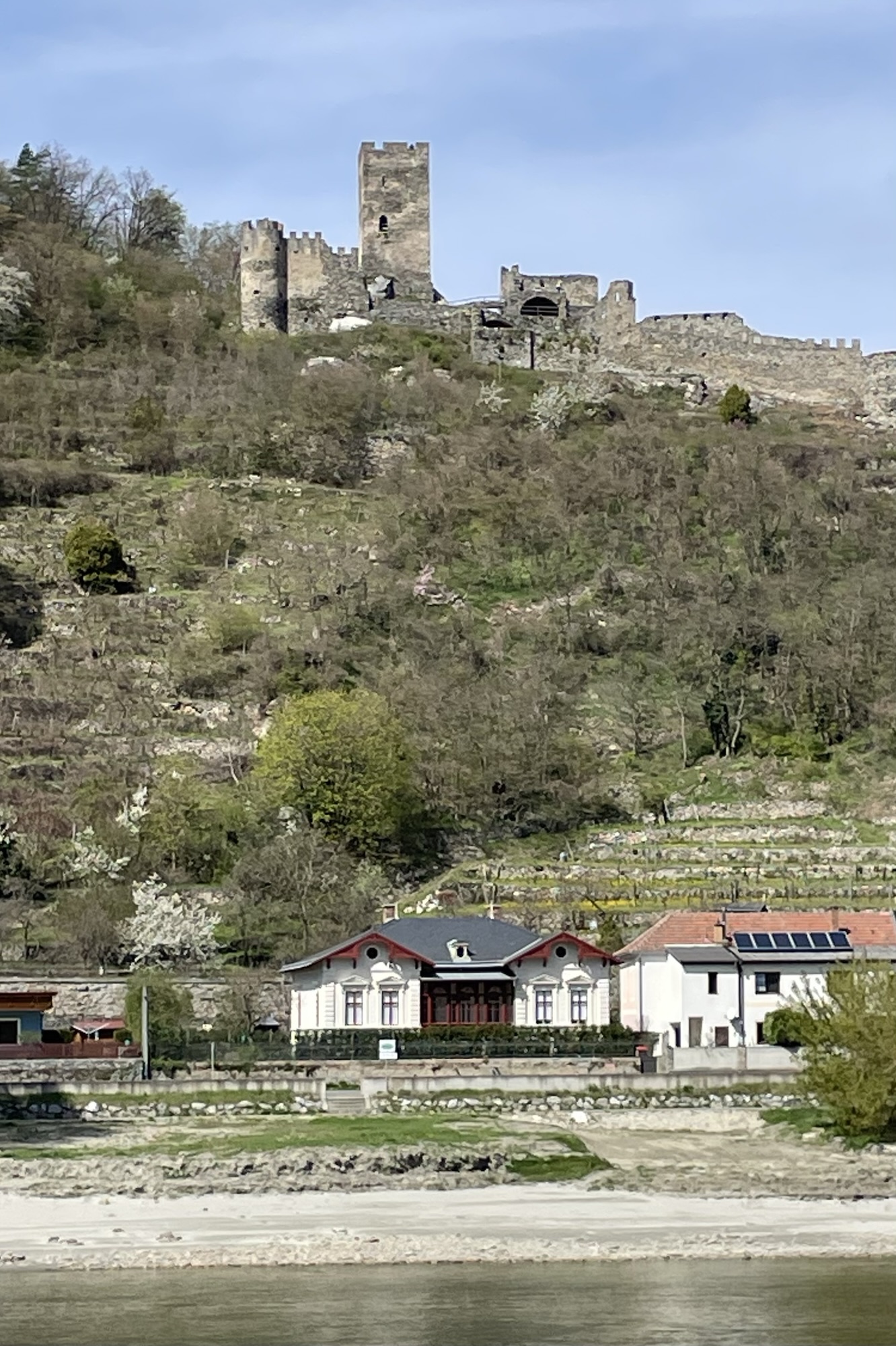
At the top we learned that Richard the Lionhearted had been kept prisoner there, waiting for a ransom to be paid. He wa alowed to hint, go into the town, and live a nice enough life as one could when one is not allowed to leave and return home. Having seen this place I now want to learn more about the details of this fellow’s life.
David coming down from the tippy topHad to get a few more flowers inWhen we came down it was hard to believe we had climbed up!
Because we all wanted at least a half hour to see the town itself we hurried down a different route that was fairly steep but without steps. Thank goodness. Suddenly the guide stopped, excitedly pointing to the side of the trail. It was an emerald lizard, a good luck symbol. The lizard rather deliberately walked away into the vegetation. She was indeed bright green. Neat!
The nicest chocolate maker. She was from Ukraine, talked a mile a minute in German saying her German was poor. We switched to French. Adorable doggieJust a gate and flowersWe got back in time!
In the town I rushed to get to the chocolatier’s store, only because I had a tradition to keep, buying chocolate in as many places as I could—only chocolate made locally. I had a great time tasting and choosing a poppyseed chocolate and another with apricots and almonds. This area grows apricots that are prized throughout the region…you cannot buy them in supermarkets and they are controlled by the government the way champagne is by France. So of course I also bought a very small jar of preserves. One must support the local economy.
Many of us went up top to watch the valley glide by.
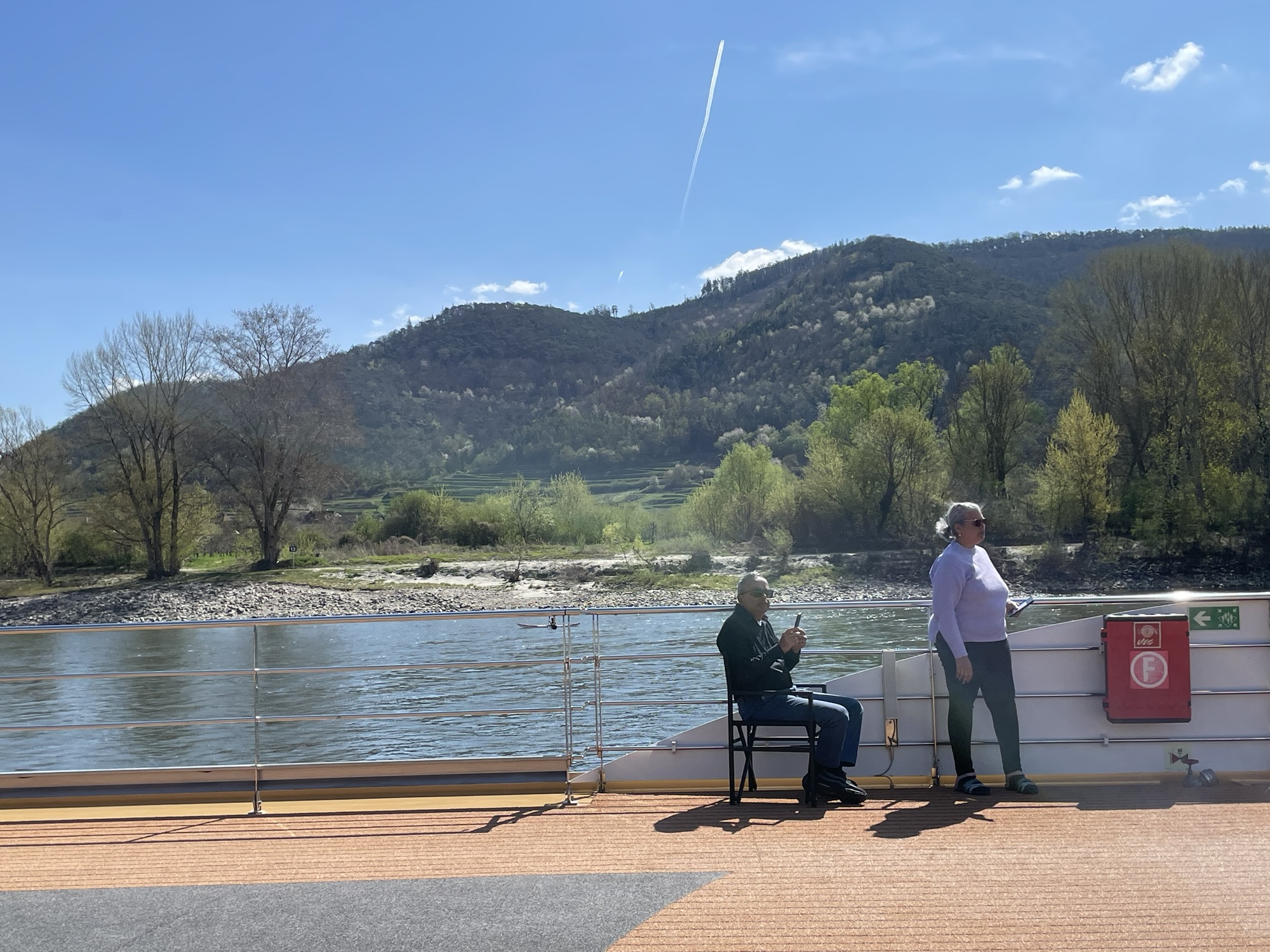
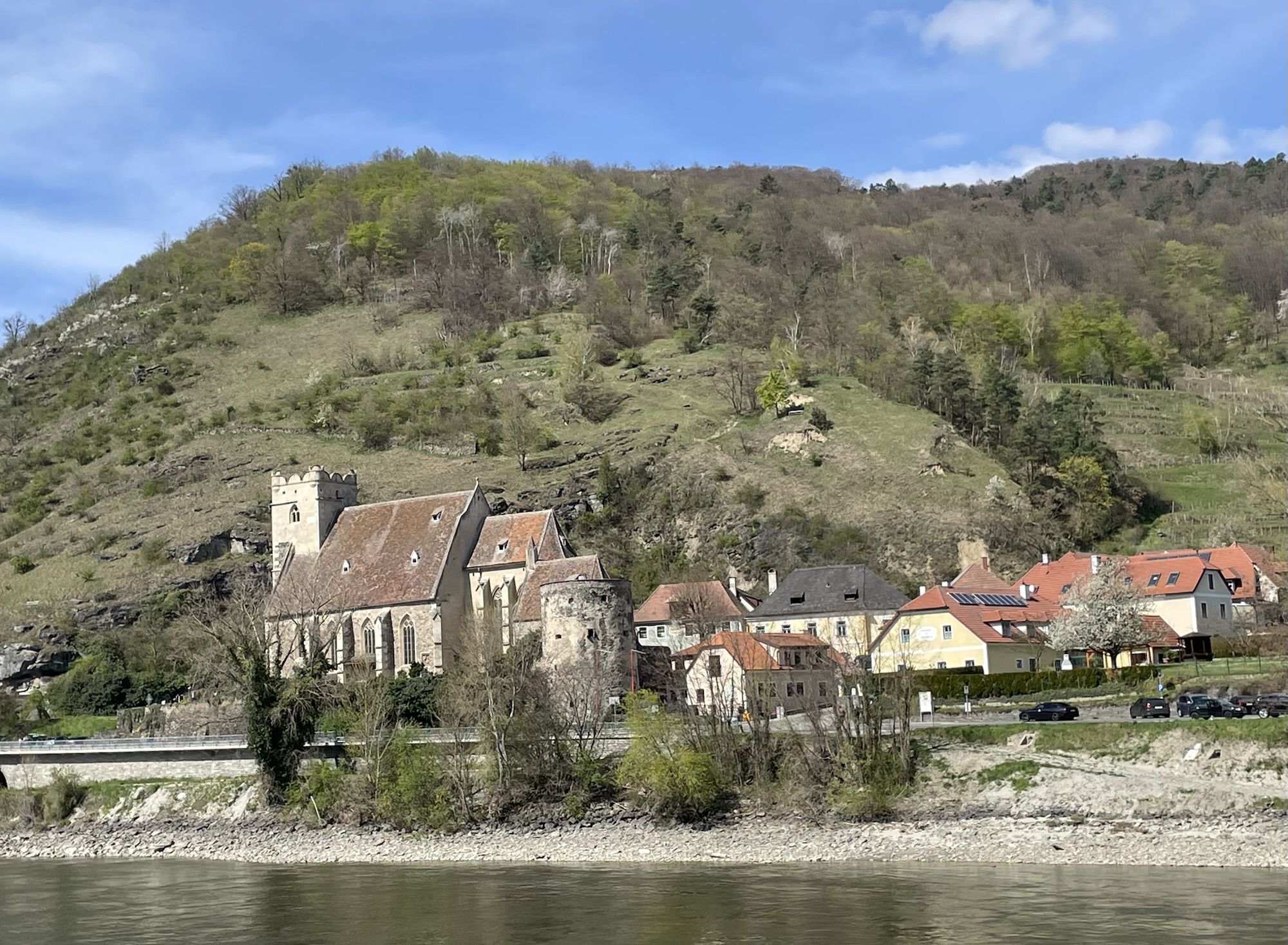
The boat left at 10:45 and many of us went up top to see the Wachau Valley. The Danube runs between steep hills, almost mountains, gorgeous and peaceful.
After lunch we left for a boring, too long tour of the Melk Abbey. No indoor photos are allowed as there are still 21 monks living there. The guide was wonderful but we had to stay an additional hour with little to do while the boat moved on to Ybbs where we were driven to meet it by the tour bus. Not our favorite afternoon…but the morning was amazing.
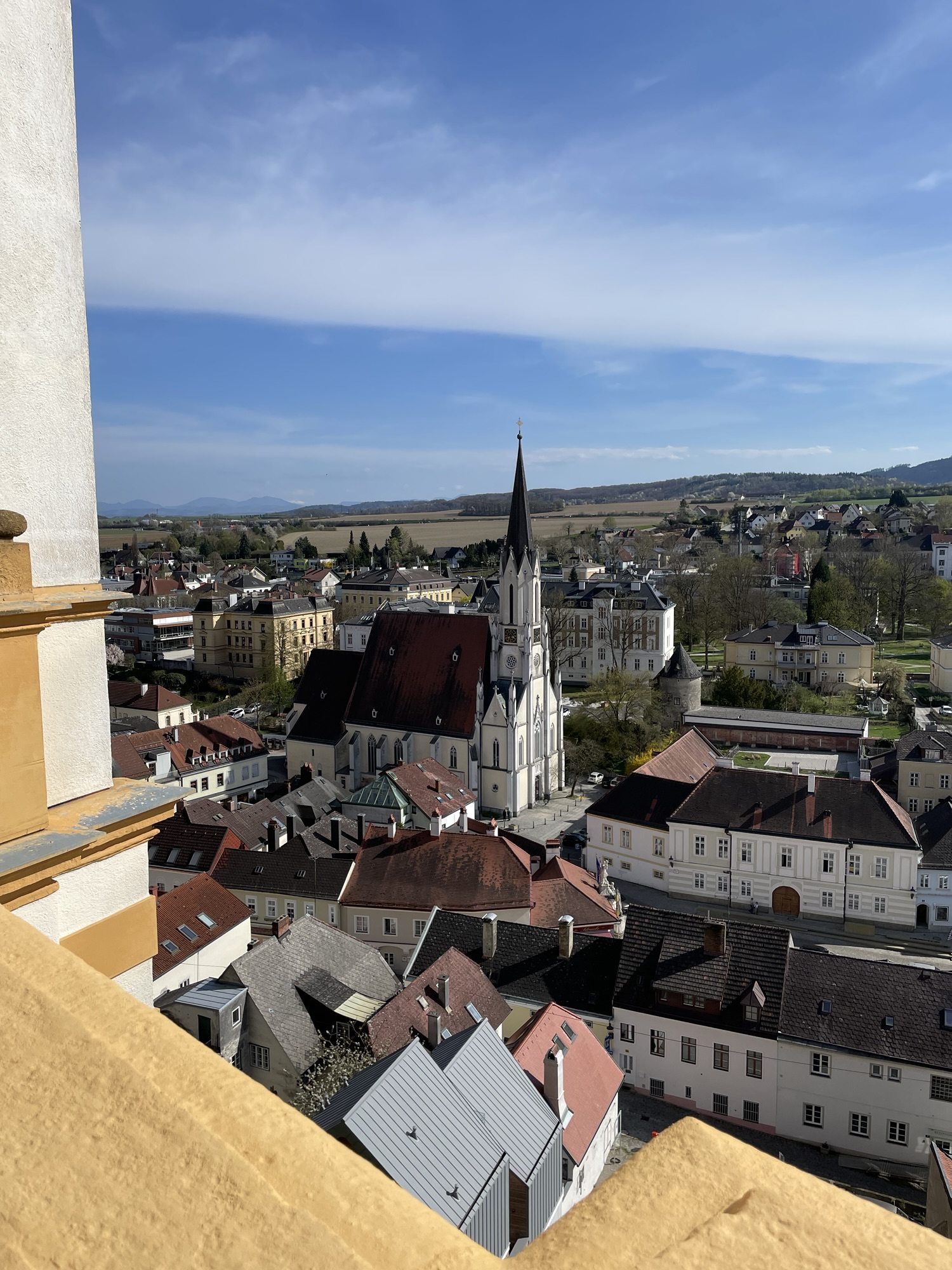
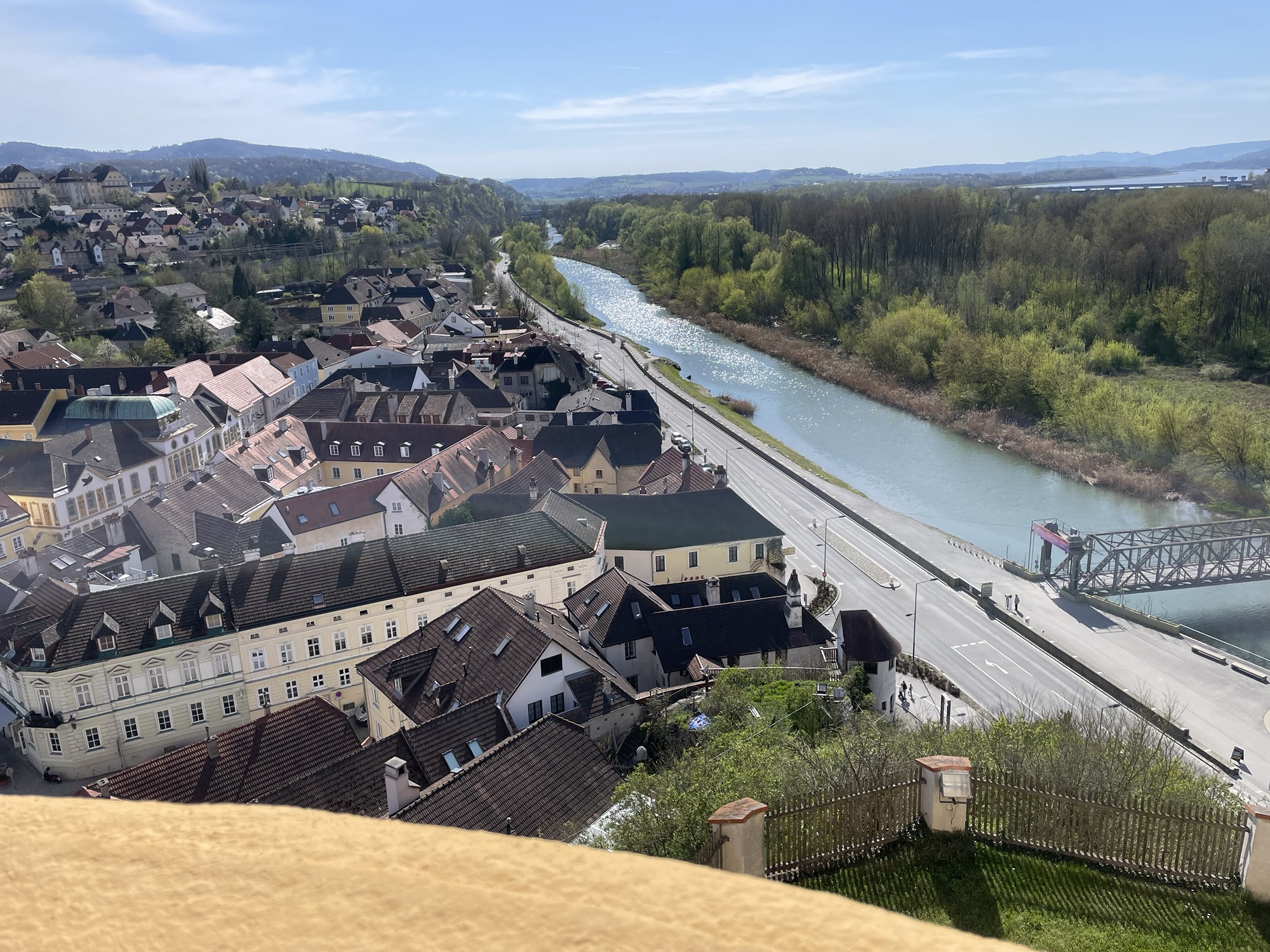
Melk Abbey courtyardMelk AbbeyView of the town of Melk Not the Danube
I read later that the restoration of the Abbey, completed in 1996, was financed largely by the sale of the Abbey’s Gutenberg bible to Harvard. Seems interesting enough to have been mentioned on the tour. Oh, well.
We arrived in this small (450,000) capital city on a cloudy morning with the same considerable windchill which ebbed and flowed throughout the day.
The walking tour was one of the best ever because our guide had all the requisite traits: she knew the city and its history, she was by turns serious and respectful and funny, and she gave me a recommendation for a restaurant that served a superb version of a Slovakian specialty, halusky. More on that later.
Because our guide, Jana, had lived half her life under Soviet rule she could share many insights and family stories about those dark times and about how life had changed since the velvet revolution. Jana plus the exceedingly picturesque old city (barely a city!) made for a great morning.
Jana introduced us to Bratislava by stating the two unequivocal advantages to living in her town. One, no traffic. It was rush hour and we were at a major intersection with barely a lane full of cars. Two, it is located at the intersection of three countries—Hungary, Austria, and Slovakia.
Soviet times
Standing just a few yards from the boat Jana pointed across the Danube at a woods with a large hill behind on which we could see a transmitter tower. The tower was in Austria, and the woods at the edge of the river were not at all dense. Jana explained that the soviet government had mowed down the trees and shrubbery and placed several rows of barbed wire and high voltage lines to prevent escapes. (According to wikipedia 400 Bratislavan citizens were killed trying to escape during the years Soviet Russia ruled Slovakia.). But the Austrian tower transmitted television, though often jammed, and Jana asked us what we thought her grandmother’s favorite tv series was. Dallas! Her grandmother was really pissed when jamming made her miss an episode.
Upper left, the Neolog memorial; lower right, the drop of blood in that little hole in the gold decoration
The Neolog Synagogue that survived both world wars was torn down by the Soviets in 1969 to make way for a road, which now runs so close to the beautiful St. Martin’s Cathedral that it is now suffering damage from traffic vibration. There are reminders of the lost synagogue around the central historic district including a memorial on the site and information placards posted nearby.
St. Martin’s Cathedral alongside the Neolog Synagogue before the Soviets destroyed the synagogue.
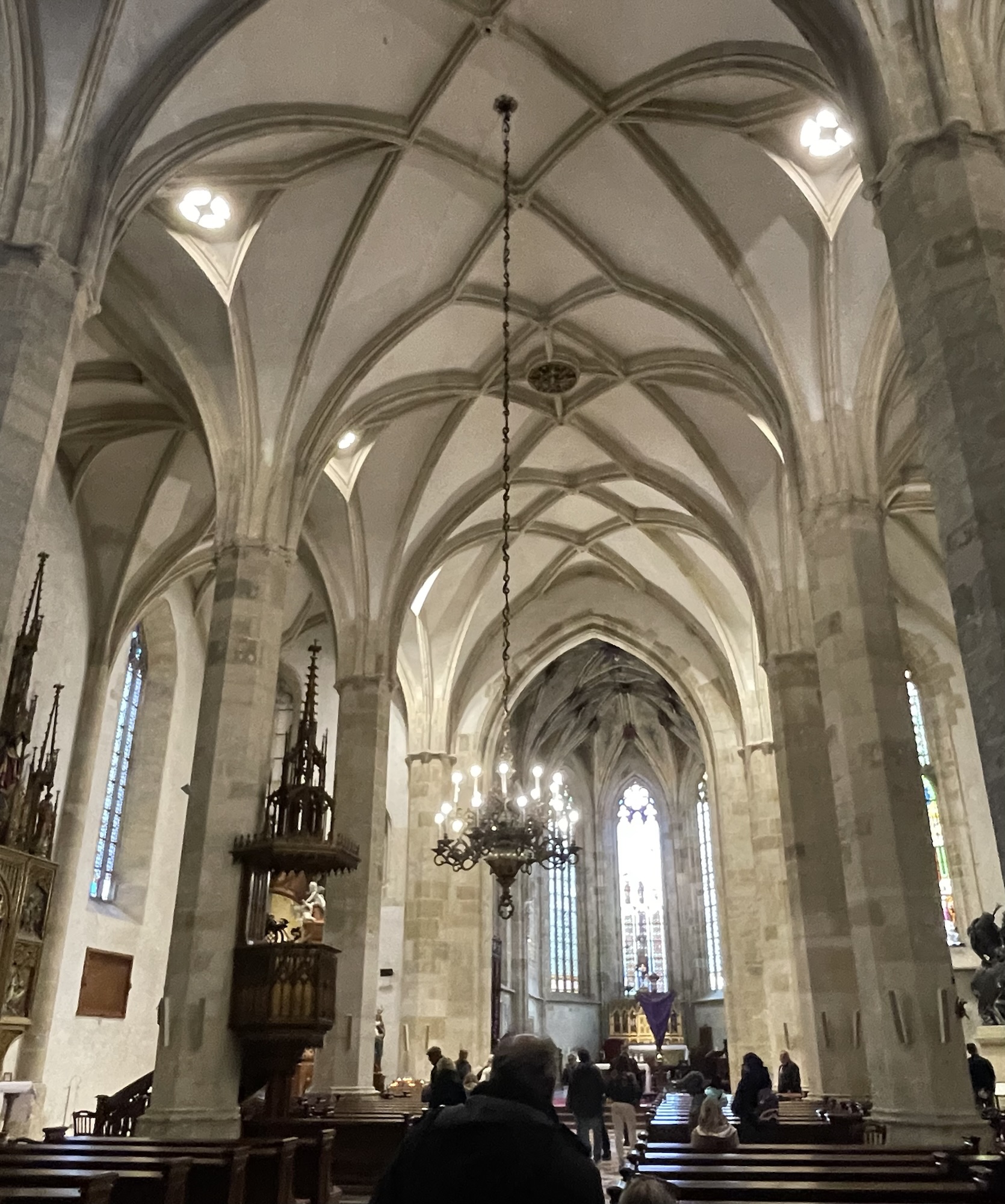
St. Martin’s Cathedral has a soaring interior with very little interior decoration where frescoes were destroyed in the several fires that were started by lightening strikes. These interior fires started at the back of the sanctuary and were extinguished before reaching the altar, which remains filled with frescoes and elaborate carved seats, each with a symbolic animal (creature?) representing a sin or virtue.
On one side wall there’s a curious Habsburg relic, a recent gift of descendants of the Habsburg emperor who abdicated in 1918. The gift is gold, like a decorative frieze, and sits inside a large, carved wooden something-or-other. The curious part is in the center, a small round hole that holds a drop of the last emperor’s blood.
Walking through the renaissance
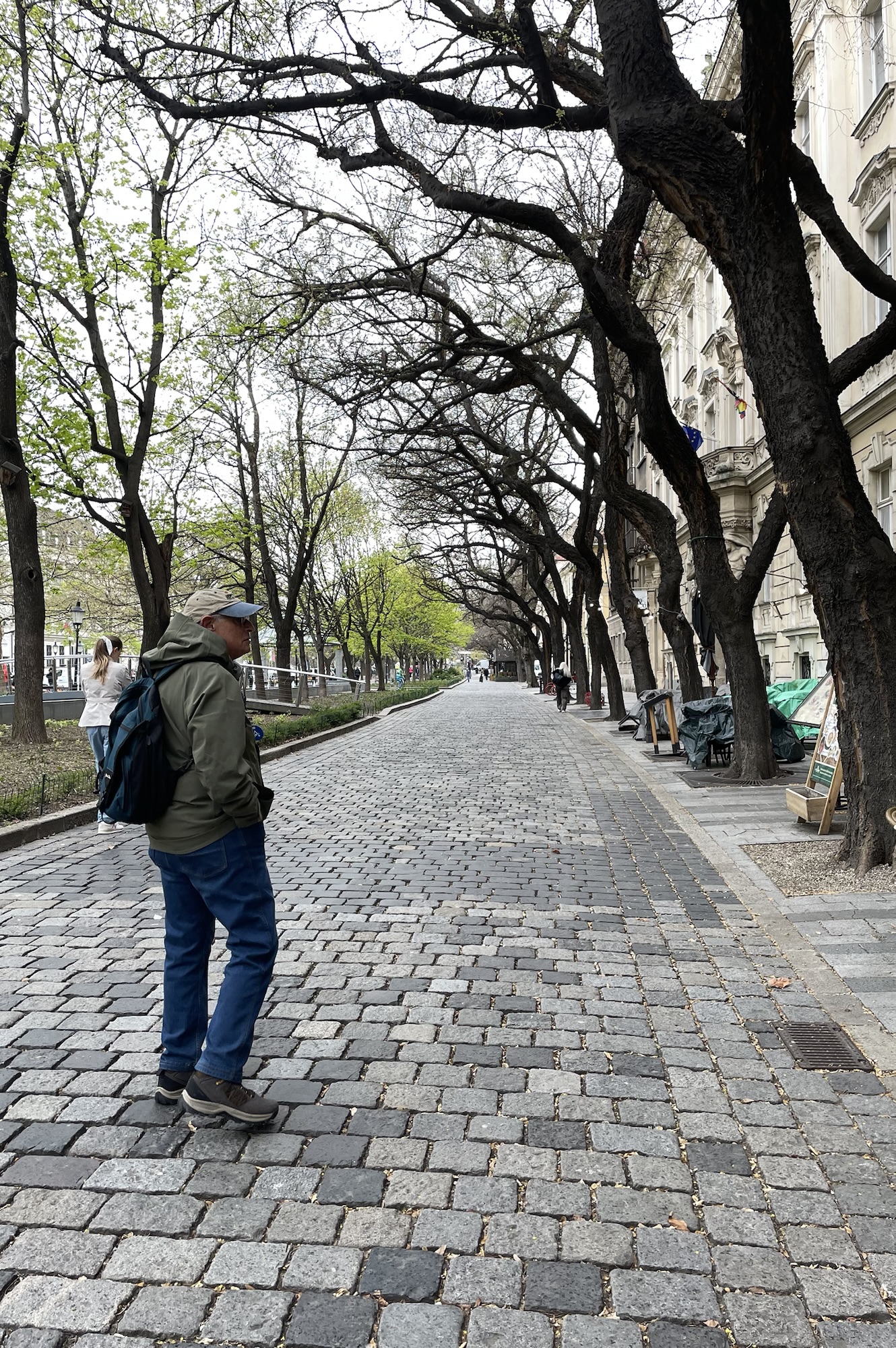
The streets of old Bratislava are narrow and treacherous with cobblestones that are themselves awfully uneven. The old town is so small you are through it in minutes. Our guide explained one street has been used over and over as a movie set because all of the buildings are owned by the Catholic church and hence there are no commercial signs. She told us a funny story. She was leading a tour and as they came around the corner onto this particular street a gate opened and out walked two tall men in full Nazi uniforms. Jana and her group stopped and gaped. “It was surreal,” Jana said. I’ll bet!
Many buildings date from renaissance and guide pointed out the distinguishing feature: enclosed balconies facing the street with windows on front and the very narrow sides. The side windows were a security feature…one could see from inside if a bad guy was sneaking along the wall toward the door. Only bad guys would approach by scooting along the wall instead of approaching directly from the front.
On the left, a renaissance building with side windows in covered balcony
Live and learn.
Bratislavan treat
Our wonderful guide Jana had stopped outside a restaurant that had photos of their traditional dishes to point out that we shouldn’t leave without eating the most delicious of local foods, halusky. Dumplings (along the lines of spaetzel) in sheep’s cheese with bacon on top. At the end of the tour I asked her to recommend a restaurant where we could find a good version and she have us a name and pointed it out.
One of my problems on the cruise is lunch is at 12:00 and dinner not until 7:00. Consequently I am hungry in the afternoon and the snacks on board are cookies, fruit, one day donuts…all sweet. So this day i counted on walking back into town to try halusky. We braved the windy cold and spatter of rain. Wow. So delicious. We also ordered potato pancakes which were unlike anything I have eaten. Thin like crepes, buttery, with a very faint sweetness. It looked like a lot of food but we ate every last bit.
Halusky and potato pancakes, and the view from inside the restaurant.
We left this beautiful peaceful town thinking it would indeed be a nice place to live!
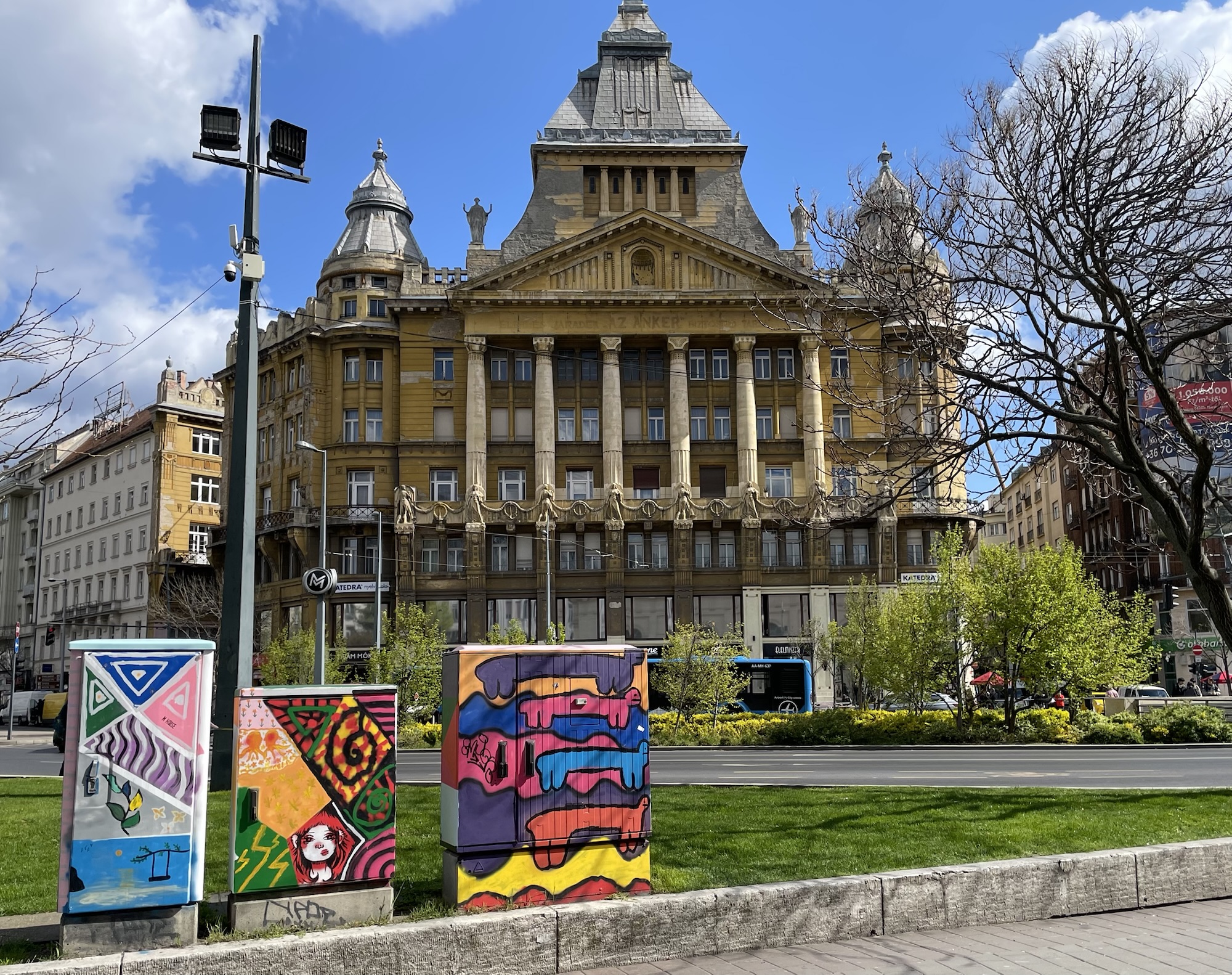
Budapest is a beautiful city. Like Prague, around virtually every corner is another deco or nouveau building, a small green park, or a monument with an unrecognizable, to Americans, statue on top.
It is also infected with plenty of American shops, pizza restaurants, kebab shops. I suppose we should no longer be bummed by Starbucks and McDonalds and Burger King, right? And yet…
We arrived several days before our Danube cruise started, fresh out of France and perhaps a bit hard to please on the food front as a result. Our visit was also handicapped by incredibly cold and windy weather that arrived our first morning. Nonetheless we layered up and headed out and about.
Public transportation
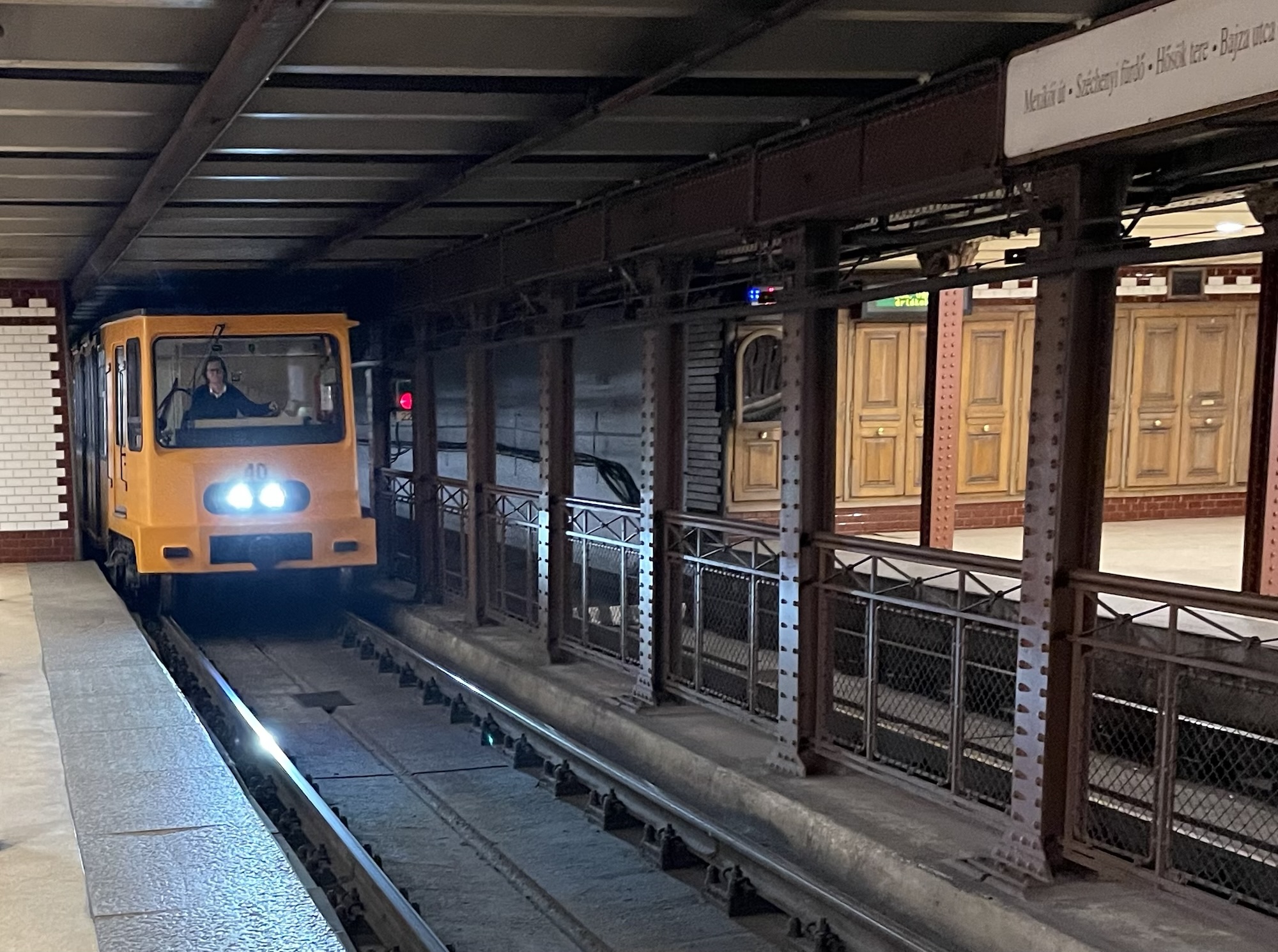
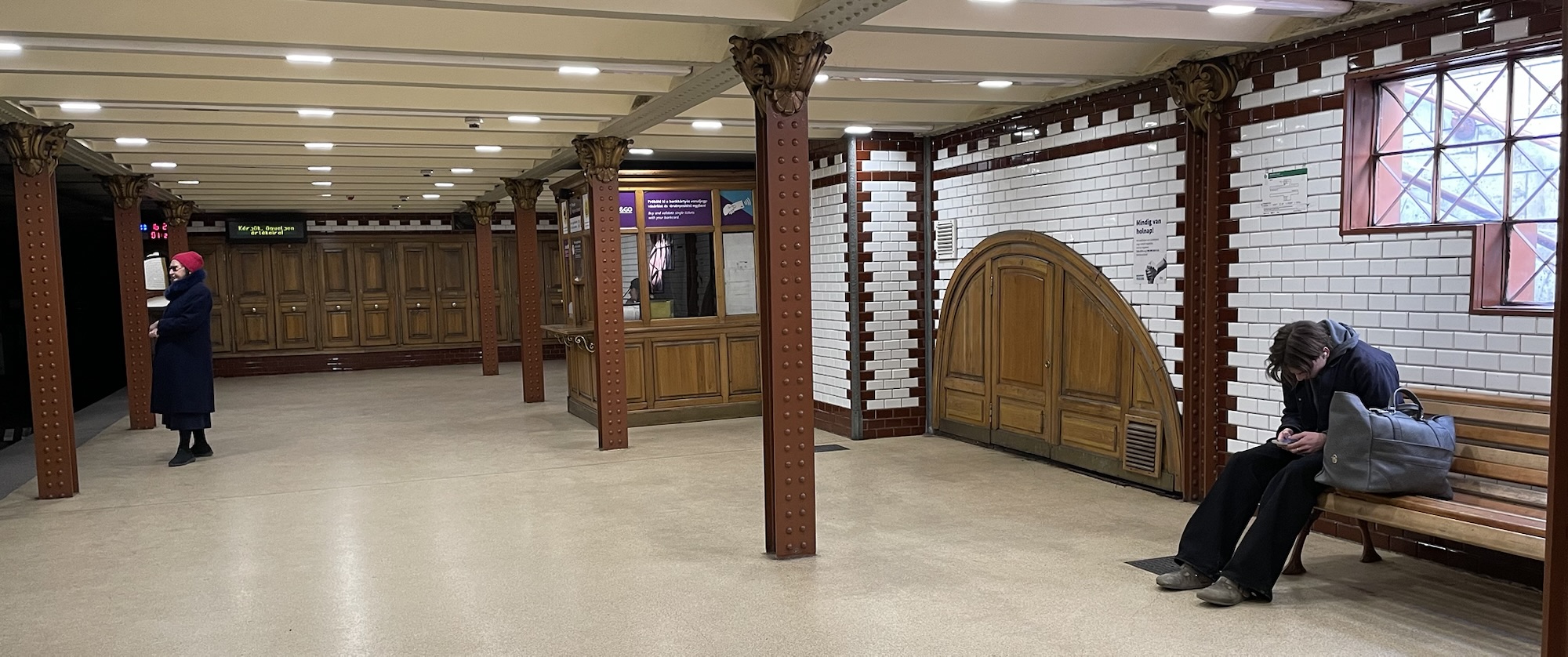
Line 1, the yellow line, oldest in Budapest
The metro is great, with the added attraction of the oldest line (yellow) with white and brown original tiled stations, quite small, and low ceilings. According to our guide it was the 3rd major underground system in the world after London and Istanbul. It is not many steps below ground and supposedly because it is not in a tunnel it is technically not a subway. The cars have leather straps (!), low ceilings, and the most terrifying door closings I have experienced. I tried to capture them on video but it does not do them justice. Ding, ding, ding and the doors close, slamming violently the last few inches. I bet they would take a limb off, easy.
Between the metro, the bus system, and electric streetcars you can get anywhere and quickly.
Advice: From the airport skip the cab line and head right for the express bus 100E, which barrels into Pest and drops you right in the center.
As we lined up for that bus, pretty tired from walking at least ten miles across the Munich airport (very slight exaggeration), we were taken aback by a twenty-something man who was almost aggressively asking us a question in incomprehensible English, over and over. We stepped back, alarmed, as another young man at the door to the bus asked if we were over 65. Uh, yes? No charge for public transportation! The insistent young man who had been pressing us a moment before looked down, saw he didn’t have his ID badge around his neck and immediately fumbled to get it out of his jacket pocket. He had been asking us “How old are you?” Poor guy.
Google maps were reliable for walking and taking public transportation, with few of the dead spots in many other old cities. So in spite of the windy cold we got around easily.
Disappointing
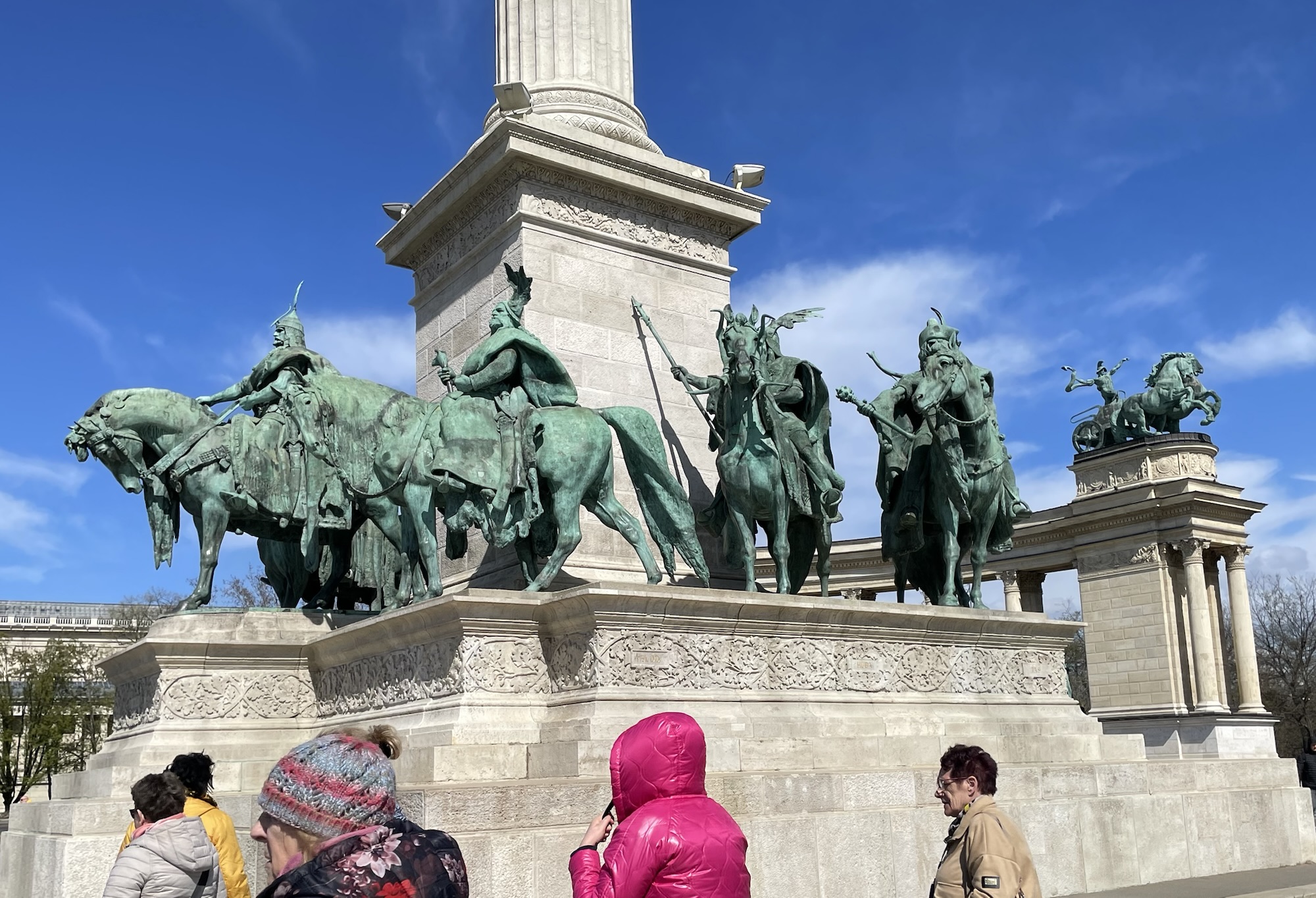
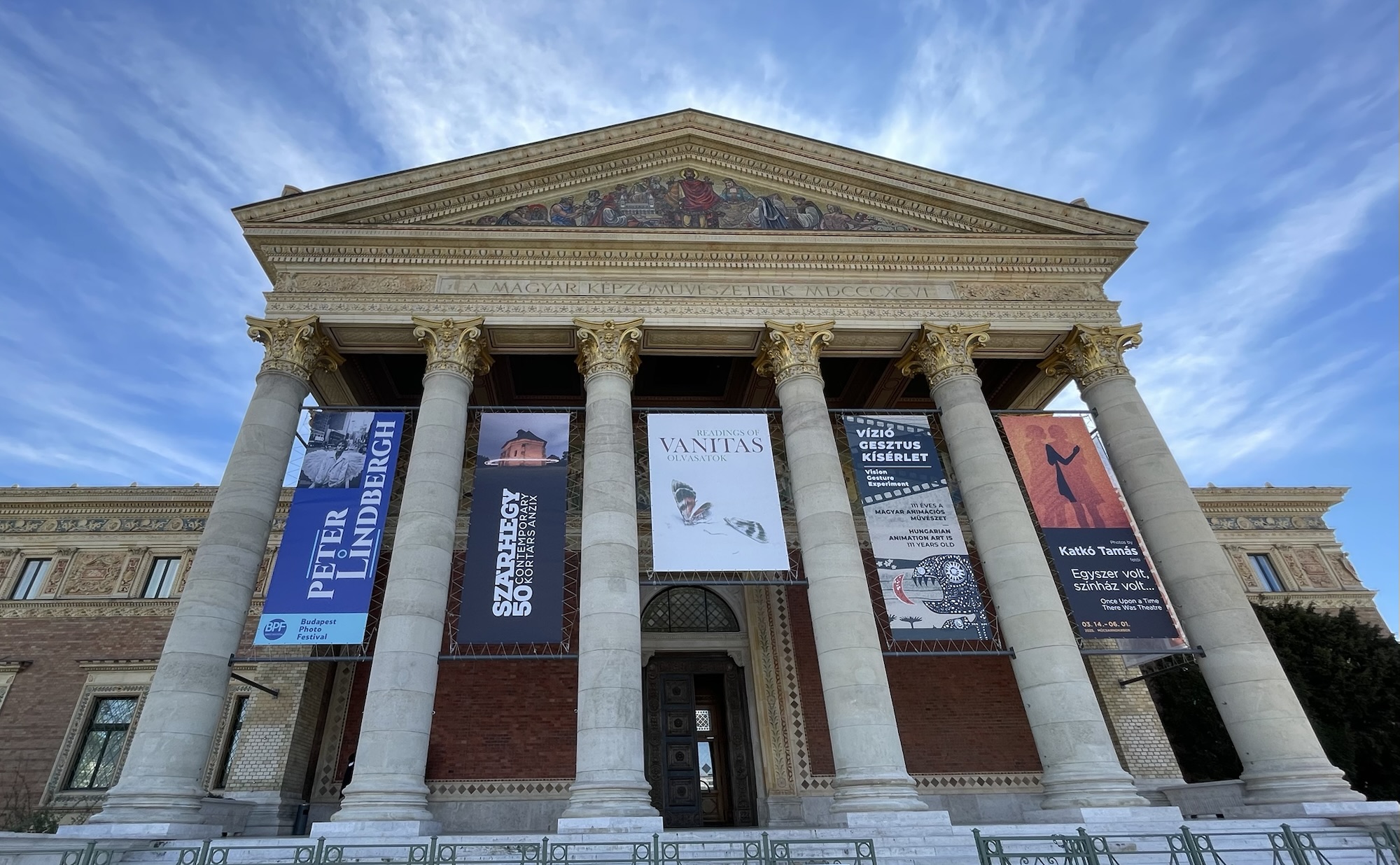
We love museums, primarily art and history. We found Budapest museums underwhelming. The fine arts museum, which is on Heroes Square (which is magnificent) is only mediocre and the building itself terribly confusing. It seemed in each era the examples on display were not the most impressive. Admittedly we have been to a lot of art museums but I do not think we’re jaded, we just had no wow moments, no revelations. But it is very well regarded and maybe we weren’t in the mood.
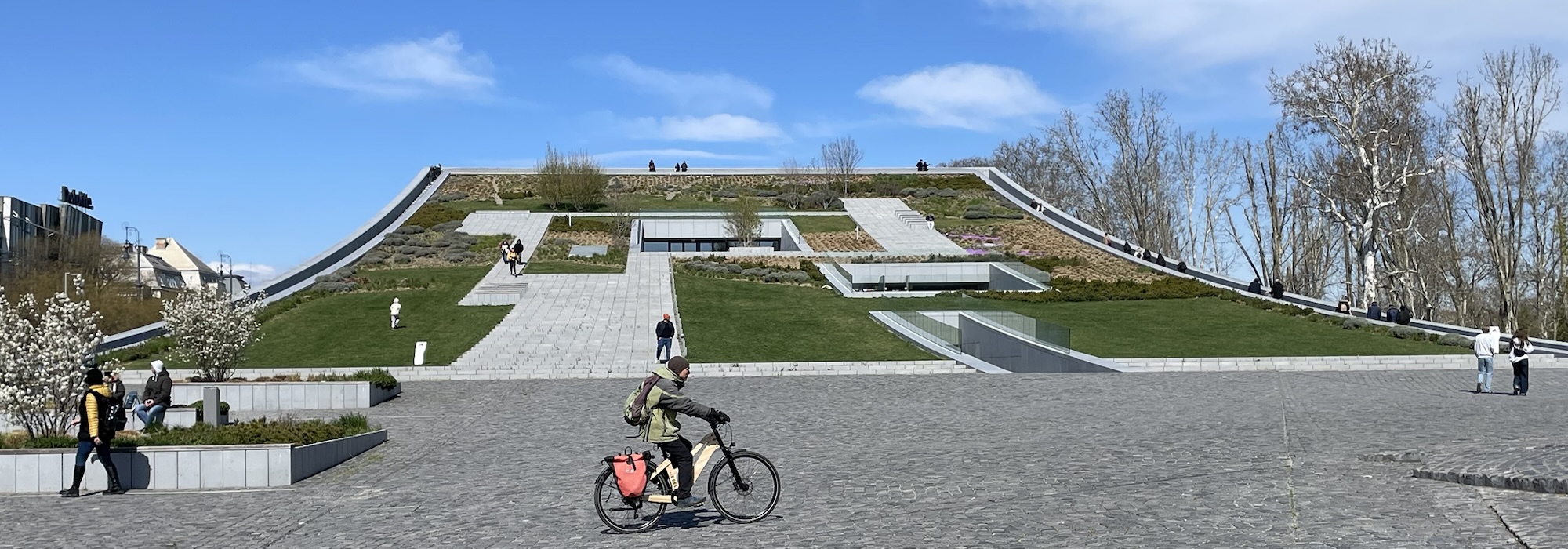
Heroes SquareHistorical Hungarian leadersFine Arts MuseumOne half of the Ethnography Museum
In retrospect we wish we had gone to the ethnography museum instead. First of all the building is amazing from the outside (see photos below) and lots of people were walking up to the top. For us it was way too cold and windy to try. A missed opportunity. And second, given the bits of Hungarian history we picked up a few days later at the national museum, an ethnographic history would have been fascinating. Quick, which language is Hungarian most closely related to? Yup, both the Finns and the Magyars came out of Siberia.
Our last museum experience worth mentioning was the National Museum, all about Hungarian history. Best part by far is on the second floor, 1703-1990. Lizt’s piano, which had been Beethoven’s! And the fascinating era from World War I through the velvet revolution. Well laid out, sufficient English signage, moving and just interesting.
Beethoven’s, subsequently Lizt’s piano!!
When we got there, tired as all get out, we decided to take the elevator up and walk down. We asked where it was at the entrance and were told to see a particular woman who motioned for us to sit down. We did. After perhaps ten minutes we didn’t begrudge given how tired we were, she motioned for us to follow as she led us through locked doors, a warren of hallways, finally getting into a freight elevator to the third floor where we were escorted back out to a public area. We said thank you and went on our way.
Our Hotel
Beautiful in the daytime too.These bronze figures are all over the city. This is right outside the hotel.So Zsa Zsa, darlingNight view from our room
We stayed at the Intercontinental Hotel, right on the river, and we thrilled to the view both day and night. Our room was big and dead quiet, bed comfy, and we almost caught up on our sleep.
Food
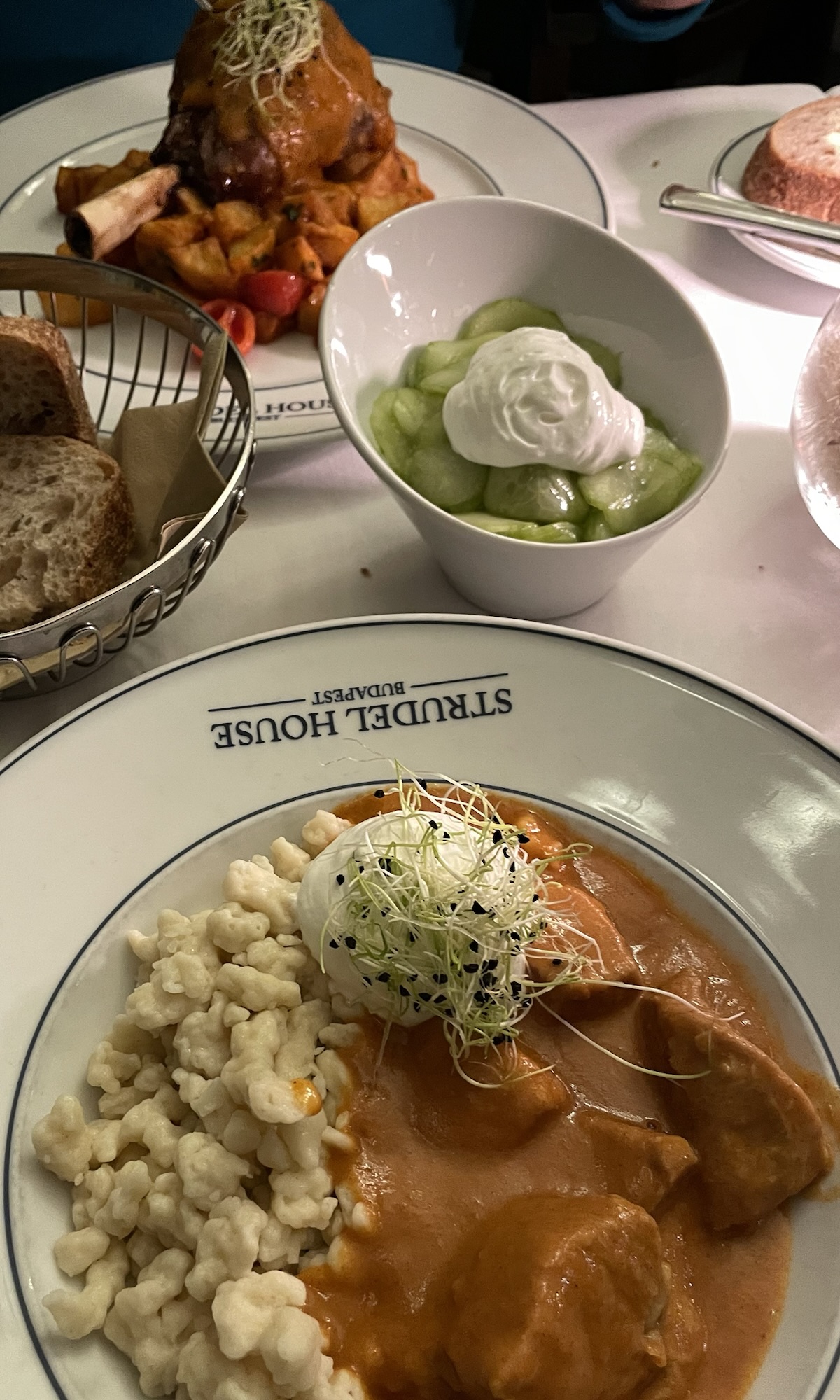
We had paprikash and goulash several times. Delicious. I think perhaps the cucumber salad that came with veal paprikash our last night was a highlight, as was the “onion” soup David ordered. It was the bright dark green of very fresh spinach, maybe, thinner textured than a cream soup, and wow what a flavor. The English translation in the menu was “Ramson’s onion soup.” Oh! Ramps, a beloved spring wild onion found in eastern US. it was a revelatory dish. This great meal was at Elso Pesti Reteshaz, also known as Strudel House. And yes, great strudel both savory and sweet.
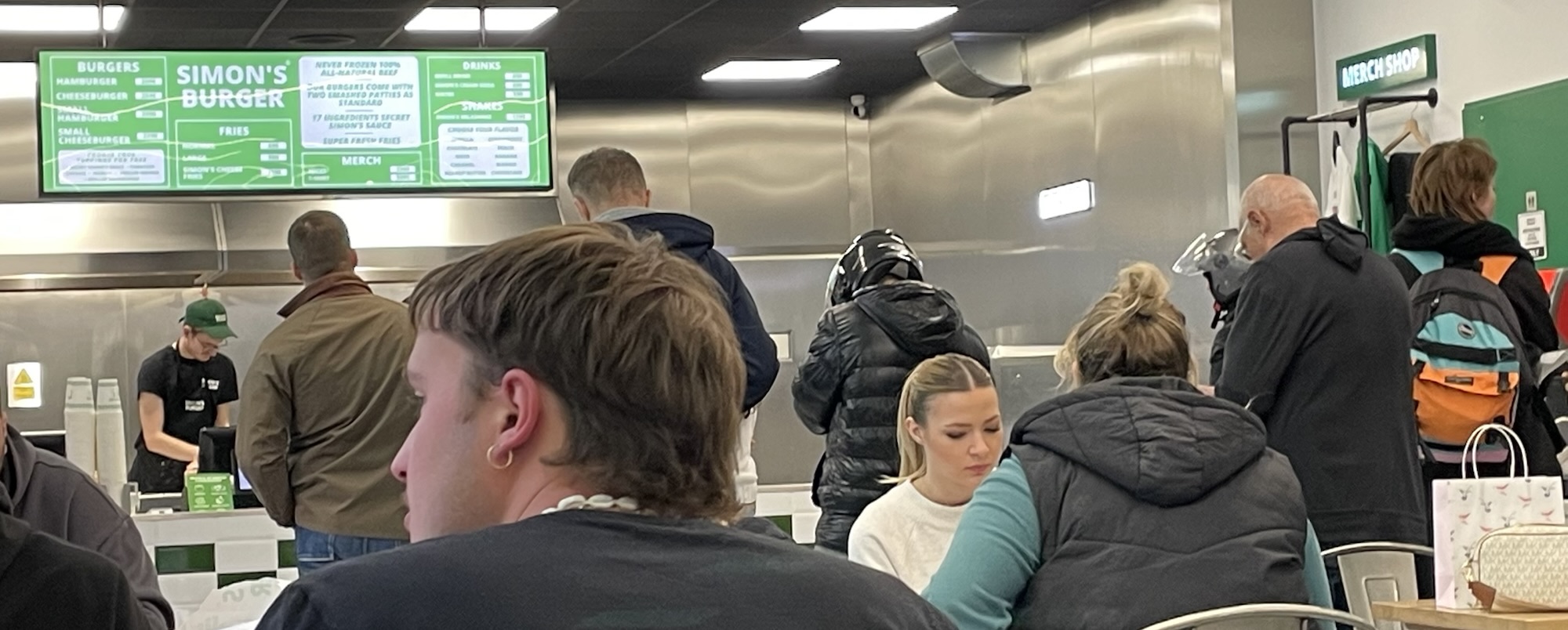
David and I raise the average age in Simon’s
A funny and yummy meal experience at the other end of the spectrum is Simon’s Burger. It is a love letter to American smash burgers and that cuts both ways, right? But we were tired of finding places to eat, we were hungry, and it was close by. Everything is in English, though the clientele is young and Hungarian. We raised the average age by a decade and the place was packed. We had medium hopes that were way too low. The burgers and fries were terrific, perfectly cooked and hot, and the ambiance so entertaining, we were very happy we went.
The concierge sent us to A La Maison, a ten minute walk, for breakfast because it was open at 8 unlike many of the coffee houses. Huge menu, delicious variations of eggs benedict, a few oddities to Americans like Hungarian French toast (savory, served with grated cheese on the side), pretty darned good coffee and fresh orange juice. Heaven for me.
Jewery
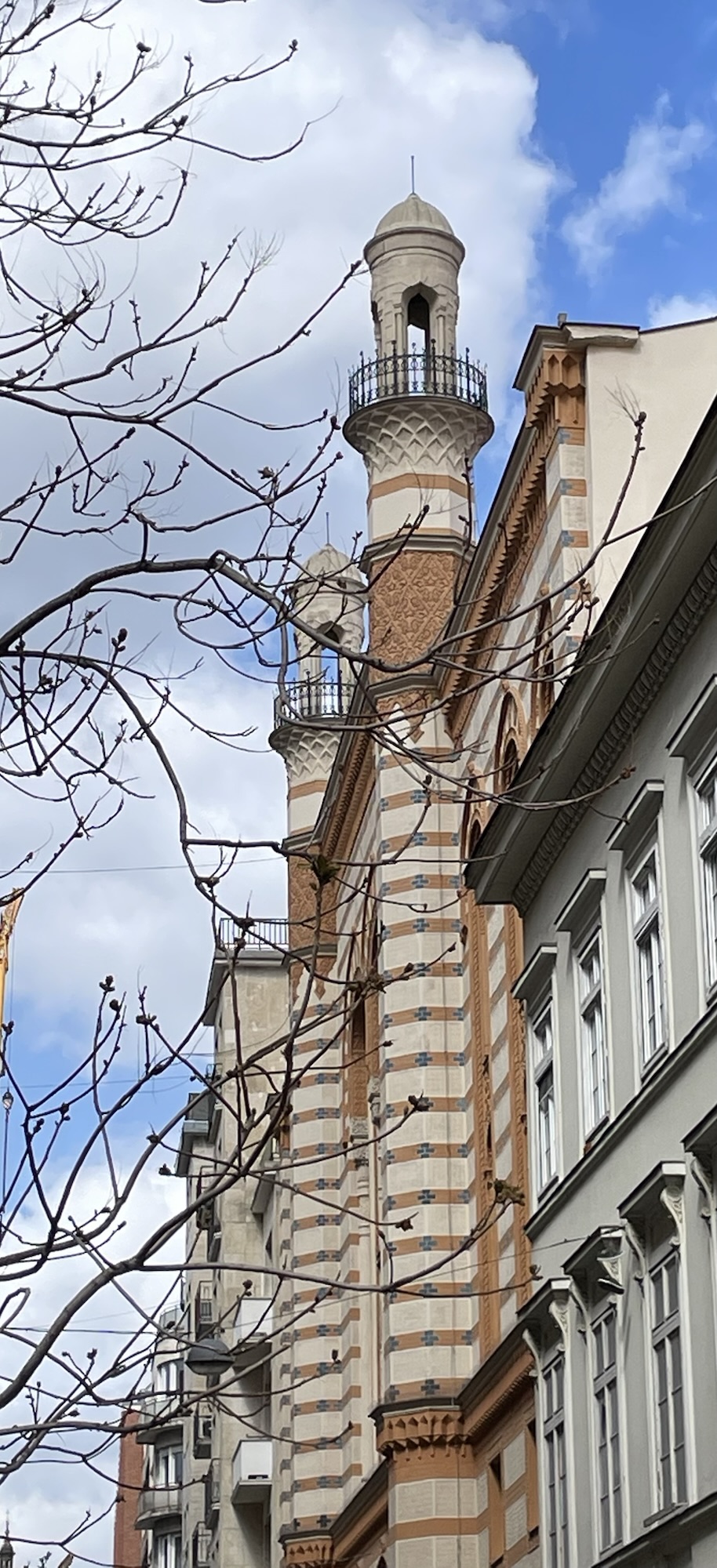
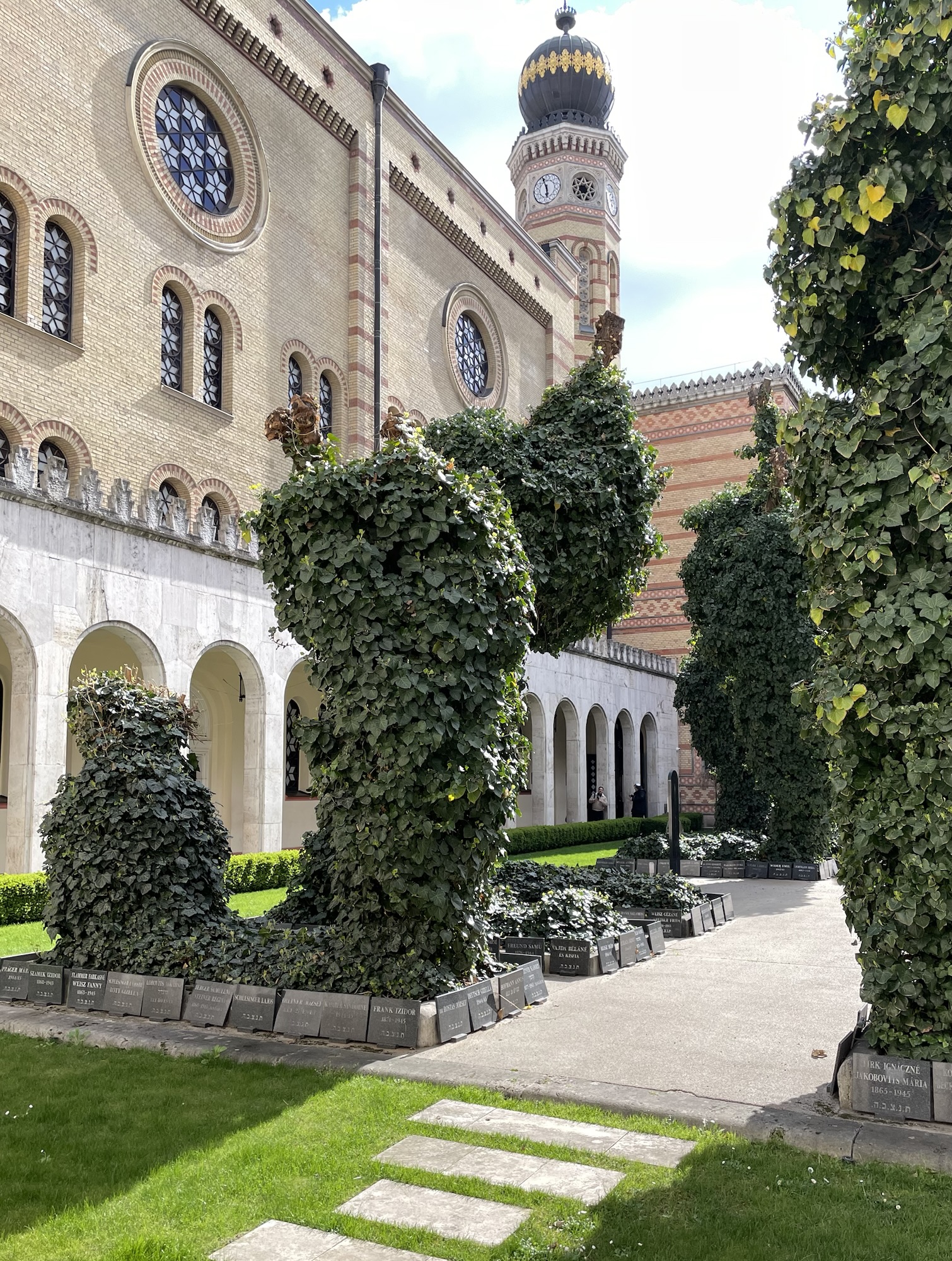
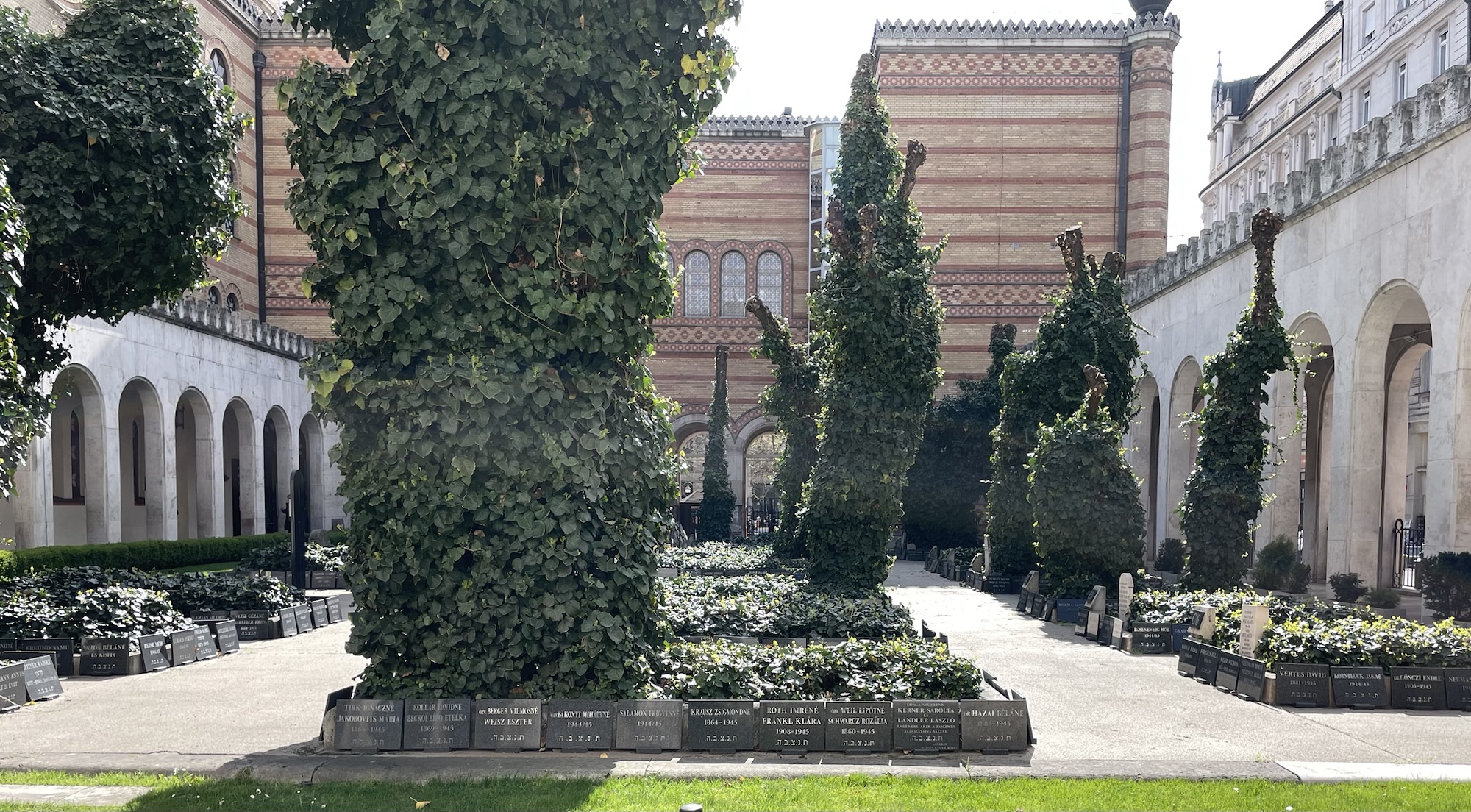
The Jewish quarter is known as the party district due to lots of “ruin bars” and a funky feel. It also has a lot of Jews and several large synagogues. One of these also has the Jewish Heritage Museum (somewhat boring) and a devastating photo exhibit about the demise of Budapests’s formerly large Jewish population at the very end of 1944, and the cemetery of mostly unidentified victims buried in perhaps a dozen mass graves ringed with the gravestones of the small number who were identified. Also a courtyard dedicated to Raoul Wallenberg and other gentile heroes who saved Jews from the Nazis. Worth seeing and facing but personally I couldn’t manage all of it and ended up leaving to cry in the synagogue.
Known and unknown buried together
Surprisingly interesting for me is the Robert Capa museum of his photography and his life. What a life. He was a very famous war photographer starting in the Spanish civil war through both world wars. He took a break of a few years, managing to squeeze in an affair with Ingmar Bergman and friendships with Steinbeck and other men of letters, then returned to the French Indochina war where he died in 1954 when he stepped on a land mine. It’s a grueling experience to see his work and read about his life and worth every minute. The Capa museum is on the edge of the Jewish Quarter, so if you are visiting I advise you to pace yourself.
Miscellany
The enormous, somewhat touristy Central Market is worth a trip if only to buy eleventy-seven kinds of paprika. I also discovered the butchers are happy to sell you 4 little slices of salami to scarf down on the spot.
Hungarian specialty chocolatiers are amazing!
As you bus from center city outward the beautiful buildings gradually step down from maybe 7 stories to 5 to 4 to 2. All of the nouveau/deco eras, all gorgeous.
If you manage to learn even 3 words of Hungarian, especially thank you, you will always get a smile.
Most people who mention the government are scornful of Orban and sadly baffled by you-know-who. Oddly coincidental Netanyahu was landing for a visit as we landed Saturday.
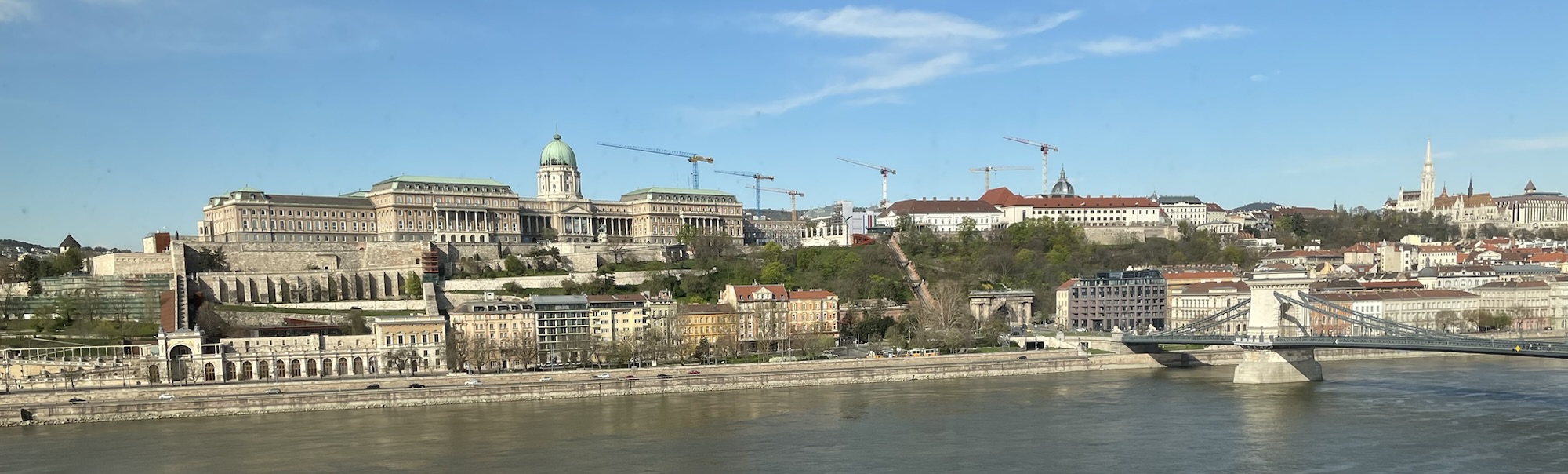
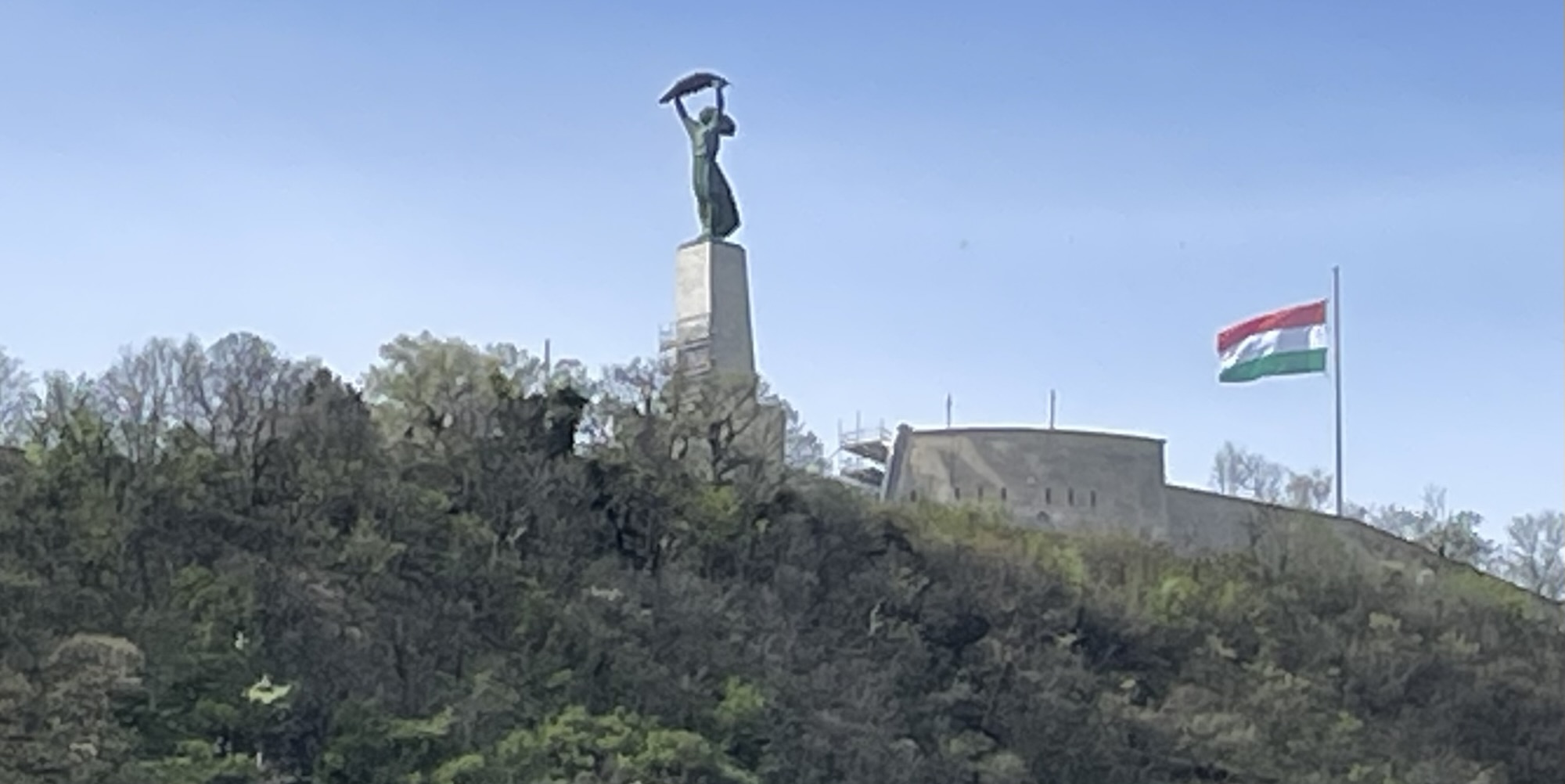
The photo below is a soviet era statue, very very large on the hill in Buda. After the velvet revolution it was draped in a white sheet for three days…our guide said it looked ghostly. Then the sheet was removed and it was renamed Lady of Liberty. Cool, huh?
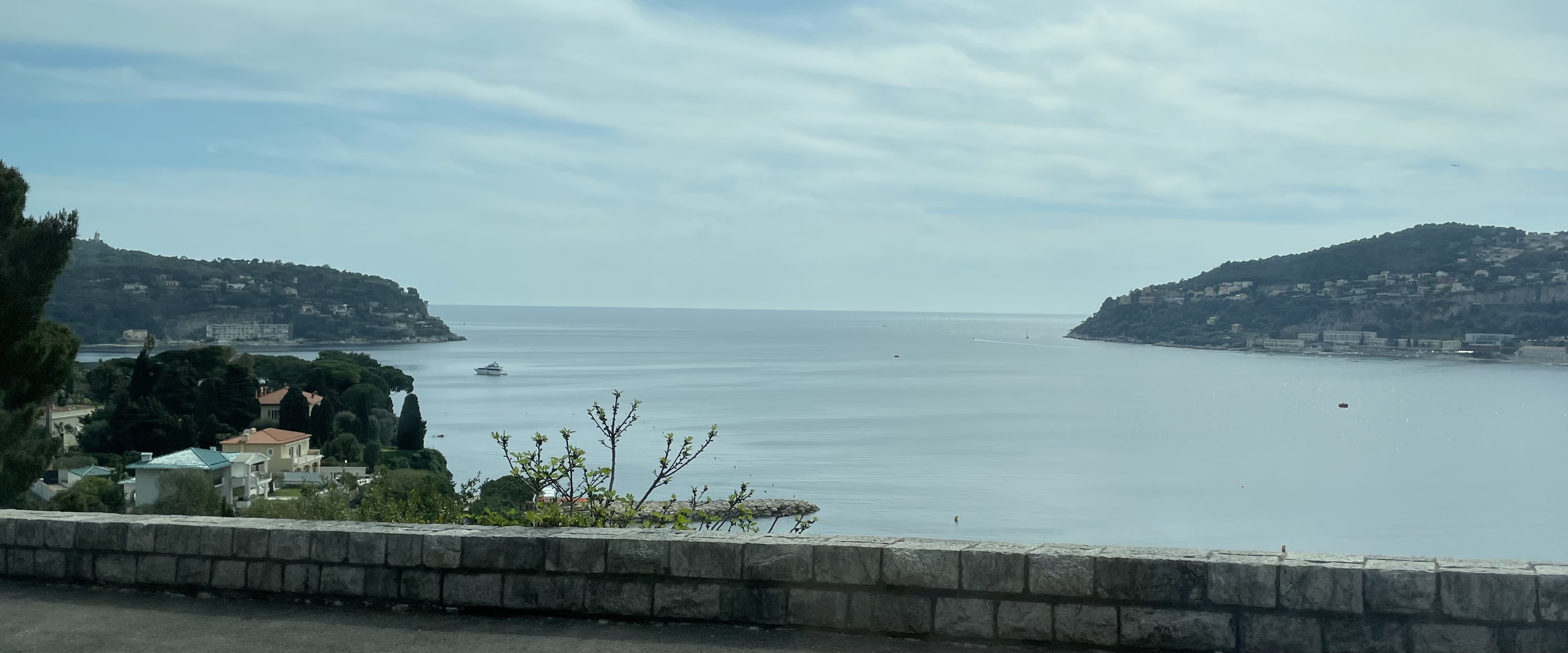
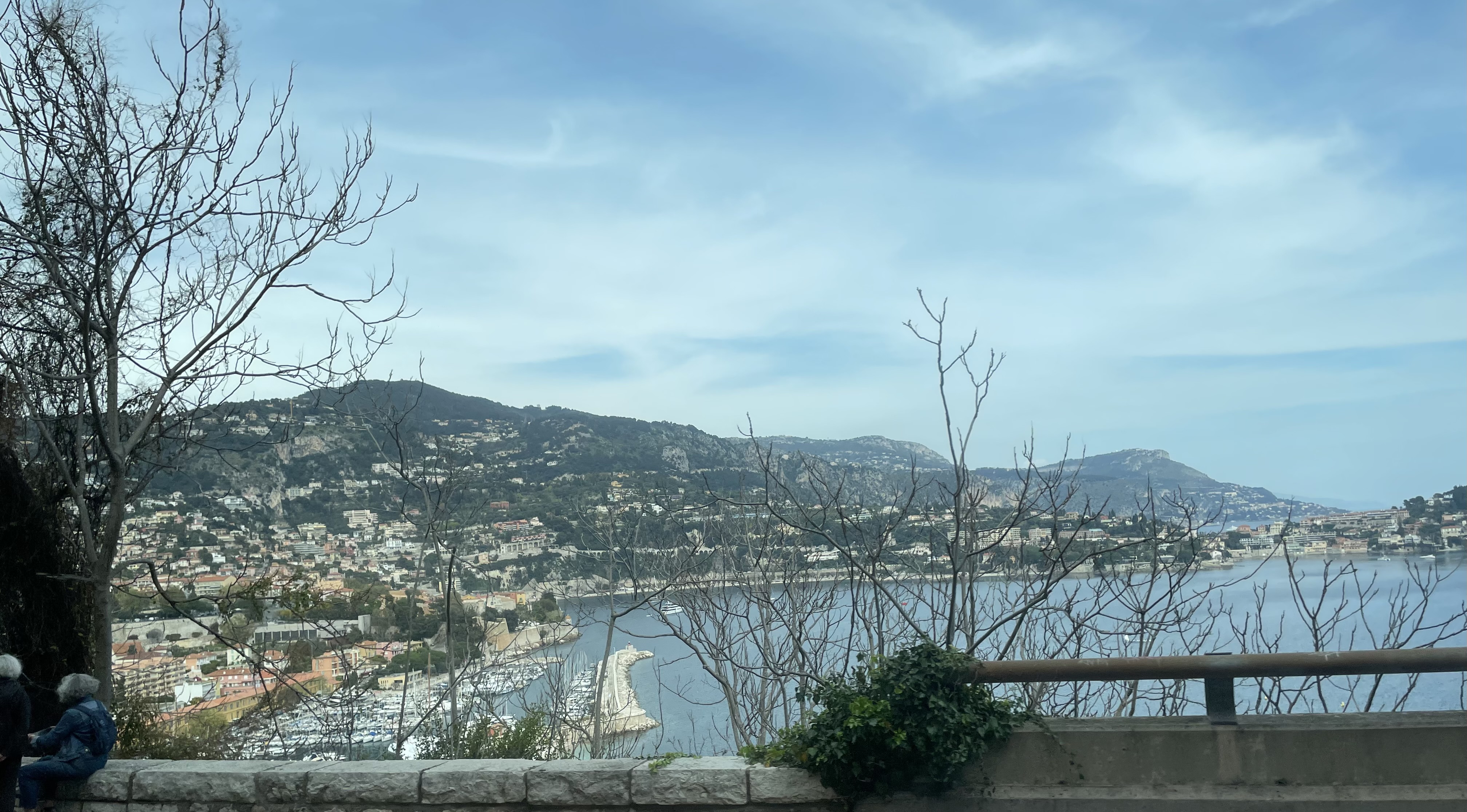
We had just a day or two left in Nice and we were happy to take my aunt’s suggestion to see the Ephrussi-Rothschild villa and gardens in Villefranche-Sûr-Mer. Hurrah, again, for a fully functioning public transportation system.
I would compare the ride, which was close to an hour, to the delightful bus ride we took through Kyoto our last day in town in 2024. So interesting, so lovely, the time flew by. The bus dropped us at the entrance to the villa grounds and we walked up the hill in the morning sun, bought our tickets and walked through the very early spring gardens…not a lot was blooming but the views, the great weather, and the ever changing garden designs were delightful. After an hour or so I was, of course, hungry and we walked through the villa itself to the restaurant. In a minute we were seated in the soaring, elegant room, only a few tables occupied. The host, a handsome young man, was from Portugal and we had an extended conversation when he asked where we were from, where we had traveled, and when we mentioned we loved Mexico he said he‘d been there because his dad married a woman from there and they now lived in Cancun. We turned to the menu and soon were drinking a half bottle of rose and devouring our customary French lunch. We’re getting used to this high class life.
The villa itself is rather small with human-sized rooms, though the art is a bit one-note. Nothing to knock our socks off but the film about the doyenne of the villa and grounds was pretty interesting (we’d have liked more details on her apparently strange marriage) and it’s always fun to watch old black and white films about rich and famous strangers.
We walked down to the bus stop and this time we knew how gorgeous the views were and could get a few photos. I post them for you to enjoy and daydream over.
Wrapping up our time in France
We didn’t feel we had fully enjoyed everything in Vielle Ville so determined to spend the morning there and the afternoon at the Archeological Museum next to the Matisee Museum. We really love Roman stuff.
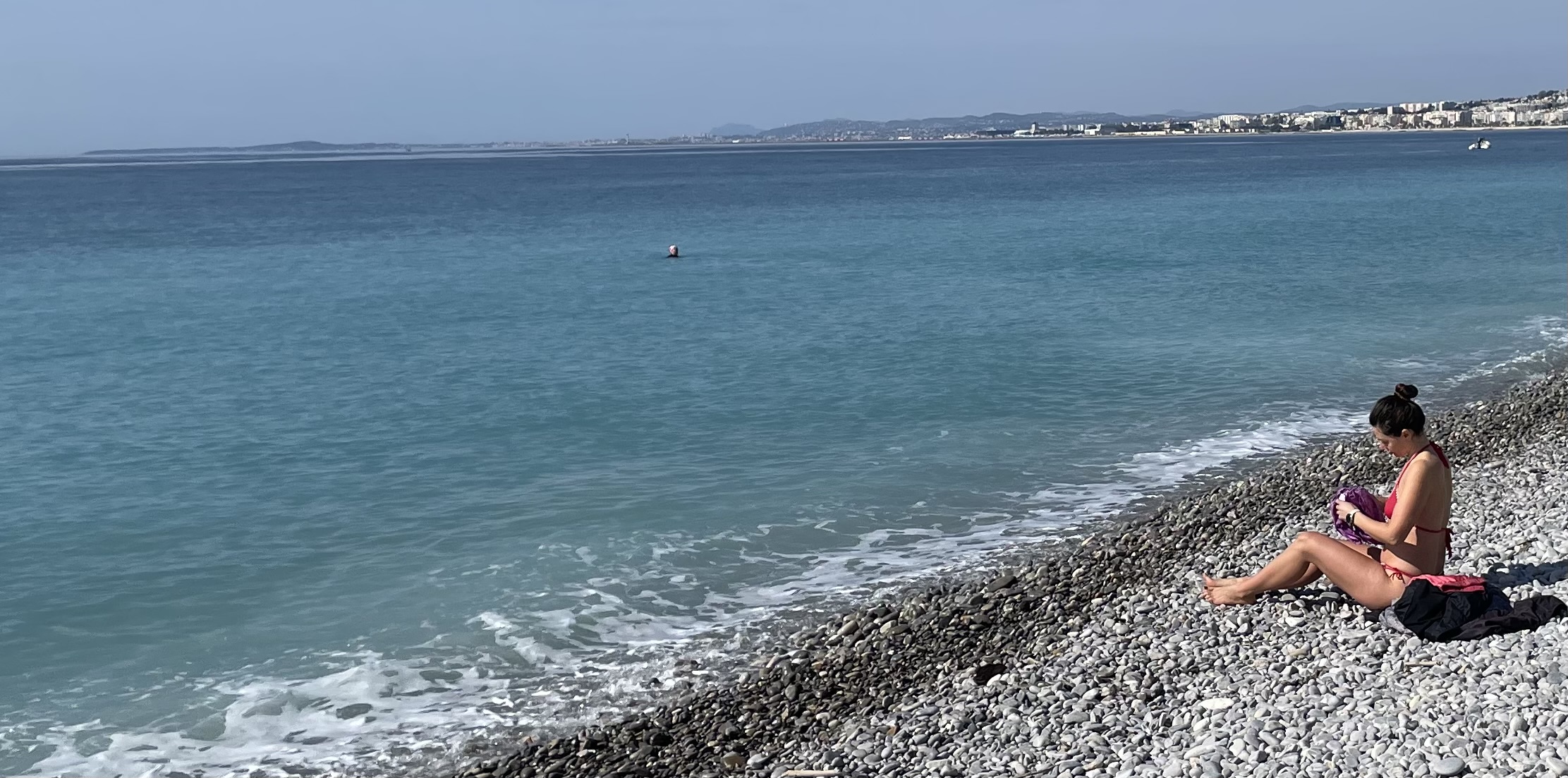
The old city is just a few tram stops away from my aunt’s and thus we arrived fairly early in the morning. We hadn’t made it down to the actual seashore the other day. This time we got off at the Opera stop and walked directly there. Well, almost directly, because I had a mission to have a few specialties of Nice that somehow hadn’t yet touched my lips—socca, a chickpea savory pancake, and pan bagnat, basically a Niçoise salad in bread—a truly appealing sandwich, no? Within a few blocks we passed a boulangerie and I ducked in to see wonderful examples in round, thick buns. We figured we would see them again so walked on, but within a few blocks David indulged my sudden need to turn back and buy two. We continued to the “beach,” a rocky shore not at all crowded at the early hour and definitely off-season, and enjoyed the sound of the surf on the rocks and the few bikini’d women, a few dogs, a few families—a pleasant scene.
We had wanted to see a particular cathedral that we didn’t find our previous time in the old city. David, whose phone has the eSIM and hence manages a lot of out maps and lists (I can get on line when we are together and he opens his hot spot) checked his saved map and we left the beach to find the cathedral. As we walked along I spied an intriguing store and, calling out to David I would need a minute, went in without waiting for his acknowledgment. After a nice conversation with the woman and making a purchase I went back out…no David. I figured he had continued on to the cathedral so I opened my phone to looks at the saved map. Well, it had a picture of where the cathedral was, and lots of streets, but not a single street name. Unconcerned I kept walking. No cathedral, no David—but I did see Bistro Antoine where we had eaten a few days prior. I went in, found our waiter, and showed him my phone. Where was this cathedral, please?
Waiter: “Hmmm. A droit, en suite a droit…je pense…” (to the right, then right again, I think).
I follow his vague directions but see no cathedral and no spouse. But I brighten up when three gendarmes walk toward me.
Me: “Pardon, ou est ce cathedrale (I show the picture on my phone) parce que j’ai perdu mon marie!” (Pardon, where is this cathedral because I have lost my husband.)
Gendarme, looking at his colleagues: “Hmmm.”
He takes out his phone, punches away, looks vaguely around, points in a direction up the street, then “Voila!” The cathedral was a half block away. And there was David, too. We laughed, went into the cathedral, and while it was beautiful there were an unusually large number of gruesome paintings featuring martyred saints and the like. We spent five or ten minutes but left as I announced how hungry I was getting.
I had scored our pan bagnats but what about the socca? Happily on our way out of Vielle Ville we spied a counter which sold lots of Nice delicacies including socca. As the young woman packed my order “pour apporter” I noticed a big tray of petits farcis…little stuffed tomatoes, onions, and zucchini. I added them to our picnic.
My rudimentary French again came to our rescue when we couldn’t find the bus stop. Two cordial women in turn steered us right to the correct spot.
The park was perfect, pan bagnat and socca and petits farci were scrumptious, and we loved the small museum filled with Roman artifacts, complete with a meadow out back filled with Roman ruins.
By the time we got back to my aunt’s apartment we didn’t want to go anywhere or see anything. We rustled up a supper of scrambled eggs with our fellow houseguests, Ronnie and Arthene, and collapsed into bed.
We ate our picnic with a Roman arena in the background!Roman ruins behind the museum. So cool.
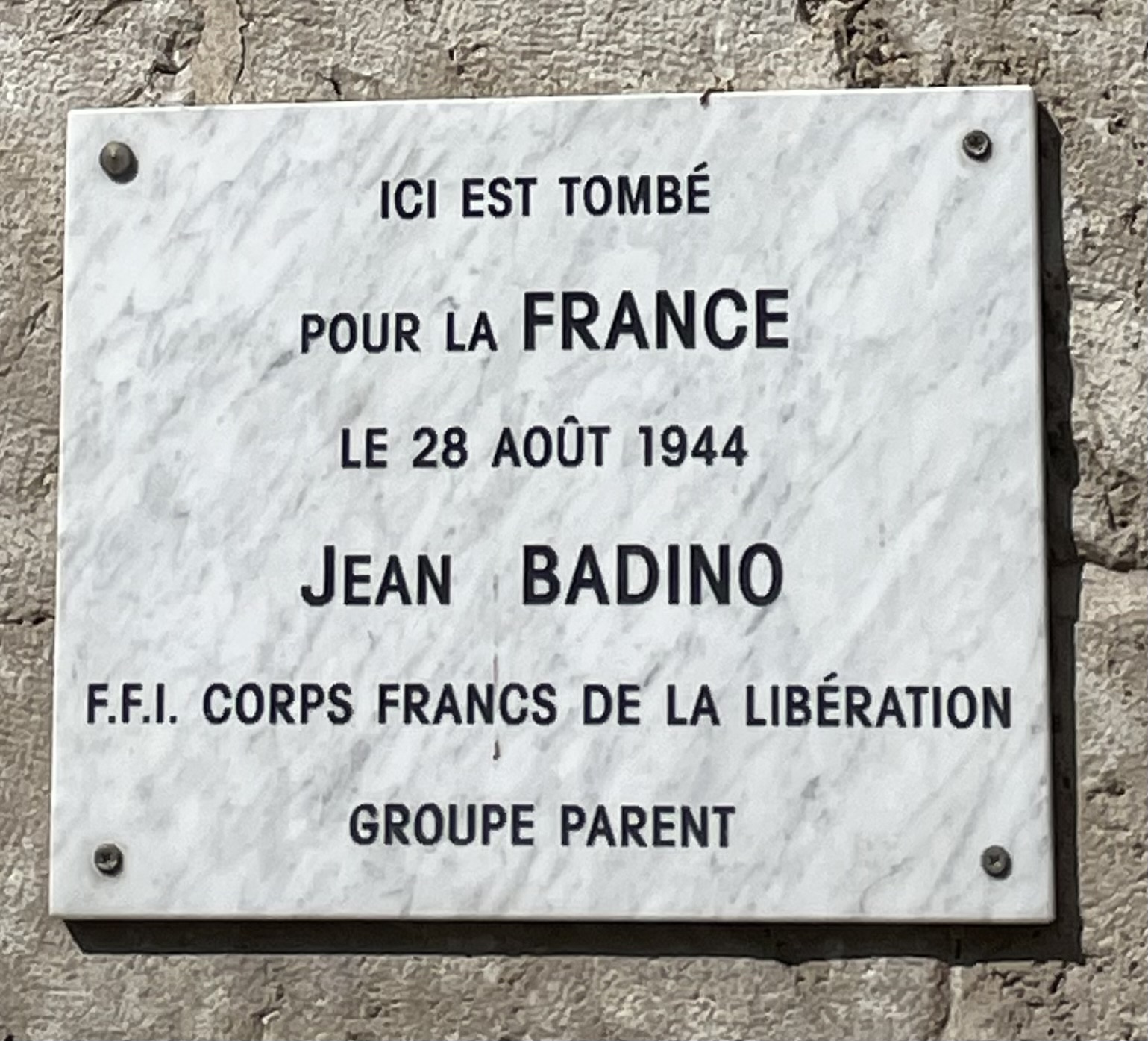
i cannot end this last post from France without addressing the sad fracture in our relationship with the Europe that survived World War II largely due to our help. Many Americans died. Many more Europeans died, lost family, friends, communities, almost everything. They have not forgotten—no, they have not let themselves forget—what happened and what we did, what we lost, what we sacrificed.
One of many subtle memorials to the people who died in WW II.
You cannot go too far in many places in France without seeing a memorial or a simple plaque like this one. Here fell Jean Badino, a human being, on August 28, 1944, for the liberation of France. Do not forget him. Do not forget that a war was fought here, right here, for our country.








































































 Inescapably Rational